1 Introduction
English has a so-called future-progressive construction, a sentence containing will (shall) followed by the progressive be + present participle.Footnote 2 Most grammar books and monographs about English tenses (e.g. Wekker Reference Wekker1976; Coates Reference Coates1983; Quirk, Greenbaum, Leech & Svartvik Reference Quirk, Greenbaum, Leech and Svartvik1985; Leech Reference Leech1987, Reference Leech2004; Palmer Reference Palmer1988, Reference Palmer1990; Declerck Reference Declerck1991; Huddleston & Pullum et al. Reference Huddleston and Pullum2002) include descriptions of this tense form, and there are also some pedagogical works on it (e.g. Whitaker Reference Whitaker1983; Thomson & Martinet Reference Thomson and Martinet1986; Nehls Reference Nehls1988; Swan Reference Swan1995). Nevertheless, the will + be -ing construction (WBI construction) is one of the least discussed tense forms. As far as I know, most previous studies have merely noted its uses and characteristics, with some comments, and have not analysed it in detail. A few studies have provided detailed descriptions of the WBI construction, but they have drawbacks and do not explain its tense characteristics on the basis of a general theory of tense. The aim of this article is to explain the WBI construction systematically in theoretical terms.
This article consists of six sections. Section 2 observes linguistic facts concerning the WBI construction and points out problems with previous studies. Section 3 surveys the general tense theory, which provides an explanatory basis for our analysis. In section 4, I present the temporal structures of three uses of the WBI construction by combining those of the will + infinitive construction (will-construction) and of the present-progressive construction, whereby we solve the problems highlighted in section 2. In section 5, by using temporal structures, I explain the linguistic facts observed in section 2. Section 6 offers concluding remarks.
2 Linguistic facts to be explained
2.1 Three uses of the WBI construction and their characteristics
Let us first observe some linguistic facts concerning the WBI construction. This construction is generally said to have three uses. The first use, dubbed here as use A, refers to ongoing situations in the future,Footnote 3 as illustrated in (1).
- (1)
(a) This time next week they will be sailing across the North Sea. (Leech Reference Leech2004: 66)
(b) The whole factory will be working overtime next week. (Leech Reference Leech2004: 67)
(c) This time tomorrow I'll be lying on the beach. (Swan Reference Swan1995: 225)
Use A involves progressive aspect. It usually shows the so-called ‘framing effect’, namely that the situation referred to by the WBI construction occupies a time span encompassing a time in the future, especially as specified by a time adverb, as in (1a, c), but sometimes it simply describes an ongoing situation in the future, as in (1b).
The second use, or use B, refers to a future situation that occurs as a matter of course. This concept is exemplified by (2):
- (2)
(a) Professor Baxter will be giving another lecture on Roman glass-making at the same time next week. (Swan Reference Swan1995: 218)
(b) David Lawrence will be staying with the county after signing a new four-year contract. (BNC A8N)
(c) Tonight until December 16 the Scottish Ballet will be dancing the popular Peter Pan. (BNC A9T)
Use B is generally considered not to reflect the progressive (imperfective) aspect and is regarded as a special use of the WBI construction. It requires further observations.
First, use B does not describe a future situation conveying volition at the time of the speaker's utterance, i.e. speech time; instead, it indicates that some prerequisites for the occurrence of a future situation have already been set up or fixed (Declerck Reference Declerck1991; Huddleston & Pullum et al. Reference Huddleston and Pullum2002; Leech Reference Leech2004), as in (3):
- (3)
(a) Your son will be staying with the other first formers in block D. (Declerck Reference Declerck1991: 165)
(b) Shall I take you to the station? – Oh, I don't want to trouble you. – That's all right. I'll be driving past it anyway. (Declerck Reference Declerck1991: 165)
Second, as explicitly shown by the time adverbs in (2a, c) above, use B tends to refer to the near but not too-immediate future (Leech Reference Leech2004: 68). However, this is only a rough guideline: this use can refer not only to the immediate future, as in (4), but also to the somewhat distant future, as in (5).
(4) The train will be leaving in a second. (Leech Reference Leech1987: 69)
(5) I'll be meeting him next year. (Kashino Reference Kashino1999: 103)
Third, this use is usually incompatible with situations that are not normal or occur suddenly (Declerck Reference Declerck1991: 165; Leech Reference Leech2004: 68), as shown in (6).Footnote 4
- (6)
(a) ?*Margot will be poisoning her husband when he gets home. (Leech Reference Leech2004: 68)
(b) ?We'll be catching a huge pike tomorrow. (Declerck Reference Declerck1991: 165)
Fourth, the use under consideration is compatible with stative verbs, which are not normally progressivised.Footnote 5 Consider (7):
- (7)
(a) He'll be owning his own house next. (Quirk et al. Reference Quirk, Greenbaum, Leech and Svartvik1985: 217)
(b) ‘Will you be needing your car?’ ‘I don't think so.’ (Kashino Reference Kashino1999: 95)
Fifth, use B can indicate that the participial situation will occur as a daily routine or regular activity. This use is exemplified by (8).
- (8)
(a) Bill will be driving to London tomorrow. Why don't you ask him to deliver the parcel? (Declerck Reference Declerck1991: 116)
(b) When will you be seeing her again? (Declerck Reference Declerck1991: 116)
Sixth, this use is sometimes utilised to describe natural and physiological phenomena, as in (9).
- (9)
(a) The cherry blossoms will be falling in a few days. (Sawada Reference Sawada2006: 471)
(b) When the speaker sees John enter a dusty room.
He will be {coughing/sneezing} in a minute. (Sawada Reference Sawada2006: 479)
Before moving on, note that a WBI construction can be ambiguous between use A and use B when it co-occurs with a future time adverbial, as in (10) below; with use A, the temporal adverbial specifies a future time included in the time span of an ongoing situation, whereas with use B, it specifies the very time when a future situation occurs.
- (10)
(a) When the meeting ends, we'll be flying to Bonn. (Huddleston & Pullum et al. Reference Huddleston and Pullum2002: 171)
(b) I'll be visiting my aunt at lunchtime. (Leech Reference Leech2004: 68)
I turn now to the third use, an epistemic use referring to a current, ongoing situation. This use, or use C, is exemplified in (11).
- (11)
(a) By now they'll be eating dinner [looking at one's watch]. (Leech Reference Leech2004: 86)
(b) Don't phone now – they'll be having lunch. (Swan Reference Swan1995: 218)
(c) Most self-respecting museum directors will now be counting up the takings from the holiday season. (BNC ABD)
Like use A, use C also involves progressive aspect.
2.2 Critique of previous studies
Most previous studies of the WBI construction merely note the characteristics of the three uses with some comments and do not explain systematically why they have such characteristics and/or why one single form appears to express two contrasting aspectual values, i.e. progressive and non-progressive.
Sawada (Reference Sawada2006), one of the few detailed studies, characterises the three uses with some linguistic tests and, like many other studies, argues that only the will of use C is an epistemic modal referring to the present, the will of use A and use B being a future-tense marker.
However, his temporal schemata for the three uses are intuitive and not motivated theoretically. Moreover, his approach cannot explain why future will and other epistemic modals (including epistemic will) behave similarly with respect to a number of linguistic phenomena, as we will see in section 3.
What is worse, he cannot explain the existence of sentences like (12) and (13):
(12) This book will be in her library now and for years to come. /www.makereadingfirst.com/Parts.html/
(13) In this way, through Christ and his work in us, we will be living in God's presence now and eternally. /www.theseed.info/sermon.php?id=337/
Here, sentences containing a single instance of will are used to refer to the present and the future at the same time. This use suggests that future will and epistemic will with present time reference cannot be different in semantic terms because a single form cannot signify two different meanings at a time (cf. Schachter Reference Schachter1977: 92).Footnote 6
Celle & Smith (Reference Celle and Smith2010), in another detailed study, argue that use B is underspecified for aspect, which means that it can express any type of aspect depending on the context. Therefore, they are not motivated to allow use A (future progressive) as an independent category because the future progressive can be expressed by use B in their system.
Moreover, they argue that the notion of ‘predetermination’, which triggers an ‘already decided (started)’ reading, is not a distinctive factor for use B, but can also be observed in use A, as illustrated by (14):
(14) He gave the address of the destination to him.
‘Axel will be waiting for you,’ he said to her in a whisper. ‘He'll take you to the boat. I'll be there shortly after six.’ (Celle & Smith Reference Celle and Smith2010: 253)
However, this is no more than a pragmatic implicature deriving from the context in which the WBI construction occurs because the same expression does not convey predetermination in a context like (15):
(15) He gave the address of the destination to him.
‘We haven't made the arrangements yet, but Axel will be waiting for you when you get there,’ he said to her in a whisper.
This WBI construction indicates that the arrangements (i.e. preparations) will be made between the speech time and the time of the arrival. The point here is that the ‘already decided’ reading is not due to use A itself, but induced by other factors, e.g. the contextual information.
This reasoning is strengthened by the following example, where the use of still triggers the ‘already started’ reading.
(16) Output has fallen more slowly this time, and unemployment has risen less fast . . . The decline in output seems to be coming to an end, so the economy is at or near the trough. Unemployment will still be rising this October (and for months after that) – but output should be expanding. (BNC ABG)
In (16), the rise of unemployment is ongoing at the future time specified by this October, so this WBI construction is an instance of use A; the presence of the temporal still, which implies a state's continuation to the reference time in question (Michaelis Reference Michaelis1993: 193), i.e. the future time in this case, implies in this context that the participial situation is also ongoing now. Therefore, the situation is considered to have started before now; hence, the WBI construction receives the ‘already started’ reading.
By contrast, in the case of use B cancelling the predetermination causes a contradiction, as illustrated in (17):
- (17)
(a) *Professor Baxter will be giving another lecture on Roman glass-making at the same time next week, but it has not been decided yet. (Adapted from Swan Reference Swan1995: 225)
(b) *This train will be calling at Preston, Chorley, . . ., but it has not been decided at which stations it will make a stop. (Adapted from Celle & Smith Reference Celle and Smith2010: 240)
The observations made above suggest that the alleged predetermination associated with use A is of a different type from that associated with use B; they should be distinguished from each other.
3 Theoretical framework
To solve the problems with the previous studies, as well as consider the linguistic facts observed above systematically in theoretical terms, I will present a temporal-structure analysis based on the tense theory proposed by Wada (Reference Wada2001) and developed in my subsequent studies (Wada Reference Wada2009, Reference Wada2011).Footnote 7 This theory aims to construct a unified model of tense interpretation of both finite and non-finite forms in English, systematically utilising factors concerning auxiliary and modality as grammatical fields closely related to tense and indispensable for tense interpretation, and thus has the potential to explain the tense phenomena of the WBI construction systematically in a comprehensive way. In this section, I will outline the theory in some detail.
First, the theory distinguishes the tense-structure (TS) level from the tense-interpretation (TI) level. The TS level is concerned with the schematic semantic structure of a tense form, finite or non-finite, which represents grammatical time information and is called a tense structure. The TI level is an interface in which tense-structure information interacts with other information from semantic, pragmatic and syntactic factors (including contextual information) to reach a temporal value through temporal calculation. The semantic structure of a tense form on this level, a basis for temporal calculation, is called a temporal structure. The distinction of the two types of structures allows cases in which instances of the same tense form share the same tense structure, but can have different temporal structures.Footnote 8
Second, the tense theory distinguishes between two types of tense forms in terms of tense structure: absolute and relative tense forms. Absolute tense forms have a dual tense structure consisting of an A(bsolute tense)-component and an R(elative tense)-component, whereas relative tense forms have a single tense structure consisting only of the R-component. The tense-structure information associated with the A-component is represented by a tense morpheme that changes according to person, number and mood (A-morpheme), whereas that associated with the R-component is represented by a verb stem and, if any, a tense morpheme that does not change according to person, number and mood (R-morpheme). Therefore, in English, finite forms are absolute tense forms, and non-finite forms are relative tense forms. In the case of the present-tense form plays and the past-tense form played (i.e. finite forms), the present-tense morpheme -s and the past-tense morpheme -ed (i.e. A-morphemes) are related to the A-component, but the verb stem play- is related to the R-component; in the case of the present-participle form playing and the bare infinitive form play (i.e. non-finite forms), not only the verb stem but also the non-finite markers (the present-participle morpheme -ing and the bare infinitive morpheme Ø) – which are R-morphemes in that they can denote relative time relationships – are related to the R-component.
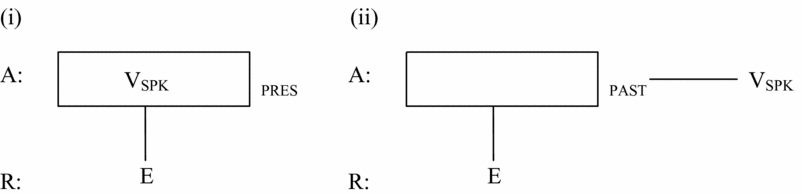
Tense structures of the present-tense form (i) and the past-tense form (ii)
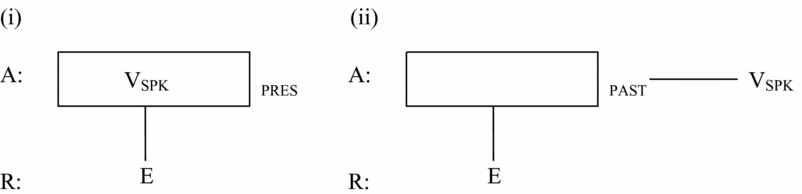
The tense-structure information represented by an A-morpheme is a time-sphere, i.e. a grammatical time range, whose value is determined in relation to the position of the speaker's t(emporal)-viewpoint (VSPK), i.e. deictic centre of grammatical time. A time-sphere including the speaker's t-viewpoint is a present time-sphere (represented by -s), and a time-sphere excluding or prior to it is a past time-sphere (represented by -ed).
The tense-structure information represented by a verb stem is an event time (E), a time occupied by the relevant part of a situation mentioned (cf. Declerck Reference Declerck, Reed and Cappelle2006). Because English finite forms consist of an A-morpheme and verb stem, their tense structure includes a time-sphere and event time. An event time is included in a time-sphere because it is restricted within the time range that the latter can cover (we will see an illustration later). The tense structures of the present- and past-tense forms are schematically represented in figure 1. Throughout this article, A and R represent the A-component and the R-component, respectively, a rectangle represents a time-sphere, a horizontal line represents temporal subsequence, and a vertical line or comma indicates simultaneity or inclusion.
The tense-structure information represented by an R-morpheme is an intrinsic relation of grammatical (or logical) time between an event time and time of orientation (O), a central point for computing (the position of) the event time. There are logically three types of relation between these two times: anteriority, simultaneity and posteriority. Because English non-finite forms consist of an R-morpheme and verb stem, they represent any of the three relations depending on the type of R-morpheme. In particular, the present participle and the bare infinitive, which are germane to this article, respectively represent simultaneity and unspecifiedness in grammatical time.Footnote 9
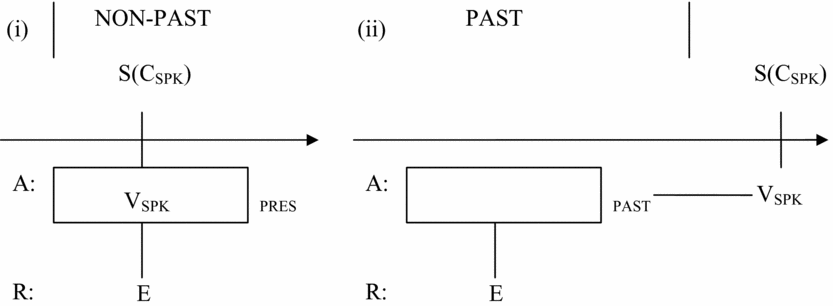
In calculating temporal values at the TI level, the temporal structure of a tense form is first formed, then its constructs will be elaborated or specified with sentential and/or contextual information. With English finite verbs, the speaker's t-viewpoint is, in the default case, situated at speech time (S) in constructing their temporal structures.Footnote 10 The reason for this default operation is the following. The speaker's consciousness (CSPK), defined as a part of the brain engaged in any type of cognitive activity such as uttering or thinking, is by definition always in existence at speech time. The same speaker's consciousness and deictic viewpoint generally share the same time and space. Therefore, in the default case, the speaker's t-viewpoint, a type of deictic viewpoint, fuses with the same speaker's consciousness existent at speech time.
The temporal structures of the present- and past-tense forms in the default case are schematised in figure 3, where the present and the past time-sphere correspond, respectively, to the non-past (present and future) time-area (represented by NON-PAST) and the past time-area (represented by PAST), i.e. real-time ranges.
Three time relations of the non-finite forms

Temporal structures of the present-tense form (i) and the past-tense form (ii)
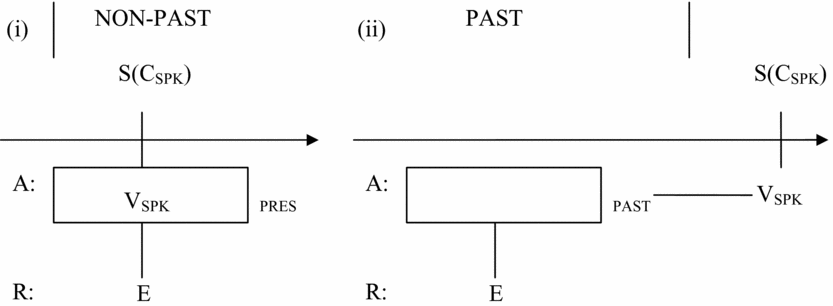
The correspondence pattern here is supported by the following paradigm:
(18) Toru {loves/*loved} Yoko now. [Present Time Reference]
(19) The Orient Express {leaves/*left} at 5:30 tomorrow. [Future Time Reference]
(20) Akane {*plays/played} the flute at yesterday's concert. [Past Time Reference]
These examples also support the above claim that the event time of a tense form is restricted within the time range covered by the time-sphere. With the past-tense form, for example, the past time-sphere corresponds to the past time-area, and the event time cannot be located outside its time range in the temporal structure. The event time is computed directly from speech time as the time of orientation if there is no other candidate for the time of orientation, as in (18)–(20).
With the two relevant non-finite forms, i.e. the present participle and the bare infinitive, their temporal structures are obtained by the identification of the time of orientation intrinsically included in their tense structures (see figure 2 above) because this identification projects the tense-structure information onto the real time-line. Consider the following:
(21) I fell in love with you watching ‘Casablanca’.
(22) Heathcliff may {love Cathy/go to Wuthering Heights}.
In (21), the present participle, whose tense structure is a simultaneous relationship between the event time and the time of orientation, requires that the latter be identified with the main-clause time in this context. Therefore, the temporal structure of watching is the simultaneity of its event time with the event time of fell.
With regard to the bare infinitive, whose tense structure is unspecified, its temporal structure is specified depending especially on syntactic position and the type of the situation. In particular, when the bare infinitive occurs in the complement position of a modal, the time of orientation for computing its event time is the time of the modal. With stative situations (situations described by stative verbs or habitual/generic situations), such as love Cathy in (22), the relation between the event time and the time of the modal is that of either simultaneity or posteriority, whereas with non-stative situations (single situations described by non-stative verbs), such as go to Wuthering Heights in (22), the relation is always that of posteriority (Duffley Reference Duffley1992).Footnote 11
Let us now turn to two hypotheses indispensable to this tense theory. One is that an auxiliary verb as well as a lexical verb can have its own event time (Nakau Reference Nakau1994; Janssen Reference Janssen and van der Wurff1996). In this hypothesis, the modal auxiliary may in (22), when interpreted as the modal of possibility, can represent its own event time, namely the time when the possibility on the part of the speaker occurs. This hypothesis is motivated to the extent that auxiliary and lexical verbs make a natural class under the notion ‘predicate’, and it is supported by the fact that both verbs can be modified by time adverbs, as in Now we will have no money at the end of the month (Huddleston Reference Huddleston1969: 789).
The other hypothesis concerns modality, typically defined as a mental attitude or assessment on the part of the speaker at speech time. There are two crucial assumptions with respect to this hypothesis. One is that future will is a modal (Lyons Reference Lyons1977; Nakau Reference Nakau1994; Huddleston Reference Huddleston1995; Huddleston & Pullum et al. Reference Huddleston and Pullum2002; Celle Reference Celle2005; Klinge Reference Klinge and Müller2005; Collins Reference Collins2009) and expresses a ‘high probability of occurrence’ as its abstract core meaning. This modal is interpreted as conveying several types of modal meanings depending on the context and which aspect of a sentence containing will is focused on.Footnote 12
When the context allows us to focus on the subject's volition, a sentence with will receives a volitional reading (we will see this concept in section 4.1). When the infinitival situation occurring in the future does not deserve the speaker's subjective judgment or evaluation, the sentence receives a ‘simple-future’ reading.Footnote 13 A sentence with simple-future will, as in He will be two tomorrow, can be paraphrased as an unmodalised present-tense sentence, as in He is two tomorrow, with little change of meaning. Because the will of the WBI construction cannot express the simple-future, as illustrated by *He will be being two tomorrow, the simple-future use will be ignored in the discussion of the WBI construction.
When we focus on a subjective judgment or evaluation performed by the speaker of a sentence with will, the sentence receives a predictive reading, a reading in which will is interpreted as conveying predictive modality, or prediction.Footnote 14 This modality is a mental attitude when the speaker forecasts on a reasoned basis. The term ‘forecast’ means ‘calculate or estimate something conjecturally’ (Close Reference Close1977: 131), and the phrase ‘on a reasoned basis’ signifies ‘on the basis of observation, experience, and scientific reason’. Under this definition of predictive modality, a predicted situation is very likely to be actualised in the speaker's mind. In addition, not only a future situation, but also a present or a past situation can be predicted (Leech Reference Leech2004; Collins Reference Collins2009). This position is in keeping with the observations concerning (12) and (13) above because both future will and epistemic will are modals expressing prediction and thus receive the same semantic interpretation.
Our assumption that future will is a modal requires justification because it remains fairly controversial. First, it is supported by the fact that future will and other modals such as may or must share the same morphosyntactic properties (e.g. the so-called NICE properties).Footnote 15 It is also supported by the linguistic fact that, as stated in Collins (Reference Collins2009), future will can be followed by the perfect or the progressive form, which is a common characteristic of epistemic modals (cf. also Coates Reference Coates1983), and can co-occur with a modal adverb such as probably, which typically corresponds in the degree of modality to will (cf. also Halliday Reference Halliday1970: 334). It is further supported by the fact that future will and other epistemic modals such as may usually cannot occur in typical (open) conditional clauses, as in *If it {will/may} rain tomorrow, I'll stay home.
The other assumption is that an unmodalised sentence, i.e. a sentence without any explicit modal expression, can convey assertive modality, or assertion. This modality is a mental attitude when the speaker states the propositional content as a fact (cf. Nakau Reference Nakau1994). We regard assertion as a type of (epistemic) modality because its nature accords with the nature of subjective modality in the sense of Verstraete (Reference Verstraete2001), which expresses modal performativity, i.e. the speaker's interactive position with respect to the propositional content of an utterance. Considering that an independent finite clause in the indicative mood is the linguistic environment reflecting a speaker's mental attitude/assessment or illocutionary act, we can claim that an unmodalised sentence in this environment conveys assertive modality (cf. also Palmer Reference Palmer1986: 14).
Our hypothesis about modality explains why in the temporal structure of the present-tense form in figure 3(i), the event time is usually (interpreted as) simultaneous with speech time and thus located in the present time-area, but not in the future time-area (a logically possible case). The event time of a modal such as will (prediction) or may (possibility) in the present-tense form, by definition, occurs at speech time. An unmodalised present-tense form in independent finite clauses is associated with assertive modality, and a situation in the future relative to the time of assertion (in this case, speech time) usually cannot be stated as a fact. Therefore, the event time of an unmodalised present-tense form usually occurs at speech time.
4 Towards the construction of temporal structures of the WBI construction
Having surveyed my theory of tense as a theoretical framework, I will, in this section, construct the temporal structures of the three uses of the WBI construction by combining the temporal structure of the will-construction (developed in Wada Reference Wada2011) with that of the present-progressive construction (developed in Wada Reference Wada2009).
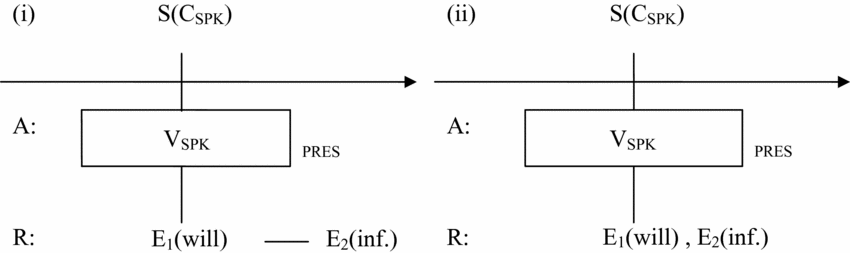
Temporal structures of the will-construction with future time reference (i) and of the will-construction with present time reference (ii)

4.1 Will-constructions
Let us first observe the two relevant temporal structures of will-constructions, those of the will-constructions with future and present time reference, exemplified by (23) and (24).
(23) It will rain tomorrow. (Wekker Reference Wekker1976: 118)
(24) That'll be the electrician. (Leech Reference Leech2004: 86)
The two temporal structures are schematised in figure 4.
The modal will as a finite form and the bare infinitive (‘inf.’) as a non-finite form have their own event times. In (English) independent finite clauses, speech time is the only location to which the speaker's t-viewpoint (VSPK) is anchored; there is no other possible location for this anchoring. Therefore, the speaker's t-viewpoint in the tense structure of will in the present tense is anchored to speech time. Its event time (symbolised by E1) is simultaneous with speech time for the reasons discussed in section 3. When a non-stative situation is described by a bare infinitive in the complement position of will, its event time (E2) occurs in the future (see figure 4i). With a stative situation, its event time occurs either in the present (see figure 4ii) or in the future; the latter is the case especially when a future time adverb is present, as in I guess it'll be rainy tomorrow.
The point is that futurity or presentness is expressed by the positional relation of the event time associated with the infinitival situation to that associated with will, which usually expresses prediction. A will-construction referring to the future may convey a subject's volition, i.e. mental activity of making a practical decision (cf. Zhu Reference Zhu2004: 178), especially when the subject is the first person and the situation is a controllable type, as in I will write tomorrow (Leech Reference Leech2004: 87), although whether the reading is predictive or volitional ultimately depends on the context. Because volition accompanies the fulfilment of a subject's intention, i.e. ‘part of the subject's present state of mind’ (Leech Reference Leech2004: 62, 87), it occurs at speech time. However, if what the subject decides to do, i.e. an infinitival situation (E2), is actualised, it must happen in the future relative to the time of the decision (E1). This accords with the temporal structure of the will-construction with future time reference, but not that of the will-construction with present time reference because the latter represents the simultaneous relationship between E1 and E2.
4.2 Present-progressive constructions
I will next consider the two relevant temporal structures of present-progressive constructions, those of the present-progressive construction in its basic use (reflecting present-progressive aspect) and the present-progressive construction with future time reference (the PPFT construction). They are illustrated by (25) and (26), respectively.
(25) However, the American method is now gaining popularity. (BNC A6A)
(26) ‘We're meeting at the cave after dinner,’ Cameron said to Neil.
(N. H. Kleinbaum, Dead Poets Society, p. 87)
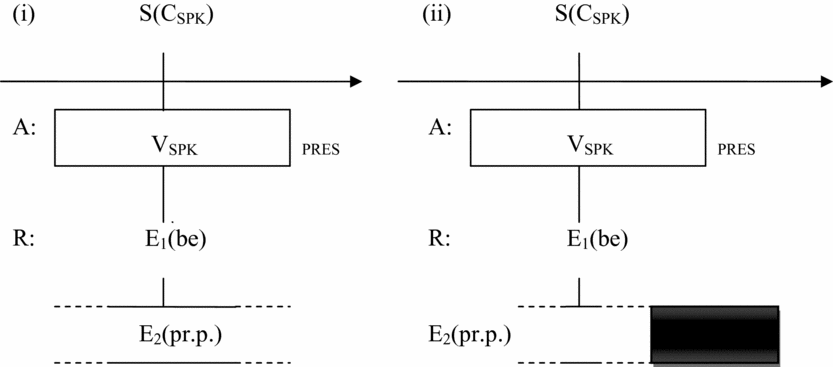
The two temporal structures are schematised below in figure 5.
The progressive be, a finite form, conveys assertive modality in independent clauses, and its event time (E1) is simultaneous with speech time for the reasons we saw in section 3. Because the present-participle form (‘pr.p.’), whose tense structure is the simultaneity between the event time and the time of orientation, occurs in the complement position of be, its event time (E2) is simultaneous with E1 as the time of orientation. In general, by using the progressive construction in its basic use, the speaker focuses on the middle part of the target situation, disregarding its beginning and end (Declerck Reference Declerck1991: 157). Therefore, the temporal structure of the present-progressive construction in its basic use is schematised in figure 5(i), where the solid-line portion of E2 represents the middle part of the situation as the foreground and the broken-line parts represent its beginning and end as the background. Therefore, in (25) above, the speaker asserts that the foregrounded part of the participial situation (associated with E2) – which has a certain length of time – is in progress at E1, the time of orientation, which in turn coexists with speech time.
Temporal structures of the present-progressive construction in its basic use (i) and of the PPFT construction (ii)
As for the PPFT construction in figure 5(ii), the preliminary stage (symbolised by the combination of the solid-line and the broken-line parts of E2) is integrated with the main situation (symbolised by the black part of E2) to form what Smith (Reference Smith1981) calls an ‘extended process’; using a metonymy representing a temporal before–after relationship, the preliminary stage is reinterpreted as ongoing at E1 (the time of orientation) – simultaneous with speech time – implying that the main situation occurs in the future (cf. Hirtle Reference Hirtle1967: 96). The preliminary stage is a schematic situation, regarded as a ‘precondition’ for the occurrence of the main situation (see section 4.3 for details) and specified in the context. Because we generally focus on the main part of something, the main situation is interpreted as the foregrounded part of the integrated situation, namely the target part of E2, which is finally interpreted as posterior to E1 in the temporal calculation. Therefore, we interpret (26) above in such a way that the meeting will occur as a natural consequence of the preliminary stage – interpreted here as the state of it being already arranged in the speaker's mind – which is in progress at the time of orientation.
The dual-time reference of the PPFT construction is supported by the fact that it can occur with two time adverbs, one referring to the present and the other to the future, as in (27):
(27) Now I'm flying down there tomorrow night. (C. Webb, The Graduate, p.155)
Here, now specifies the time associated with the preliminary stage, whereas tomorrow night specifies that associated with the main situation.Footnote 16
The temporal structure in figure 5(ii) reflects the major characteristics of the PPFT construction. First, this temporal structure accounts for why the PPFT construction appears to have a ‘dual’ aspect. The preliminary stage reflects the progressive aspect because it can be viewed as ongoing towards the actualisation of the main situation (Smith Reference Smith1981; Prince Reference Prince1982; Hirtle & Curat Reference Hirtle and Curat1986); the main situation is viewed ‘holistically’ (Leech Reference Leech2004: 67) and reflects the perfective aspect, in the sense that the situation is taken as a whole with its initial and final points (Smith Reference Smith1981: 374; Huddleston & Pullum et al. Reference Huddleston and Pullum2002: 124). This structure also implies that there is a change from the preceding phase of a situation (i.e. the preliminary stage) to the actualisation of the situation itself (i.e. the main situation).
Moreover, the temporal structure can account for why the PPFT construction tends to receive a reading in which the target situation is certain to occur and/or will occur in the near future, and why it tends to convey the notion of ‘arrangement’ or ‘fixed plan’. The existence of the preliminary stage at speech time indicates not only that a decision to bring about that stage has already been made by speech time (i.e. now), but also that something is currently ongoing towards the occurrence of the main situation in the future, which in turn suggests that the main situation is certain to occur, especially in the near future, as a natural consequence unless interrupted or cancelled by external pressure. In addition, because the modality relevant to this construction is assertion, the speaker regards the degree of certainty of the occurrence of the target situation as very high. These observations are in keeping with the notions of ‘arrangement’ and ‘fixed plan’, i.e. an agreement with someone to do something and an unchangeable method of achieving something that you have worked out in detail beforehand (cf. Wekker Reference Wekker1976: 109; Leech Reference Leech2004: 62; Wada Reference Wada2009: 115), which, by definition, not only require the situations involved to be controllable/decidable (Leech Reference Leech2004: 63), but also cannot be easily changed or called off at the speaker's whim and thus are very certain to occur, as exemplified in (28a, b).
- (28)
(a) I'm taking Mary out for dinner this evening. (Leech Reference Leech2004: 62)
(b) The parcel is arriving tomorrow. (Leech Reference Leech2004: 55)
If the content of the situation is incompatible with any of the notions above, it is difficult to use the PPFT construction, as shown in (29), where an uncontrollable situation is described.
(29) ?It's raining tomorrow. (cf. Wekker Reference Wekker1976: 110)
4.3 WBI constructions
Having observed the relevant temporal structures of will-constructions and present-progressive constructions, I will now build the three temporal structures of WBI constructions based on them.Footnote 17 Because the WBI construction consists of three verbs, its temporal structure includes three event times: the event time of will (E1), the event time of be (E2), and the event time of the present participle (E3).
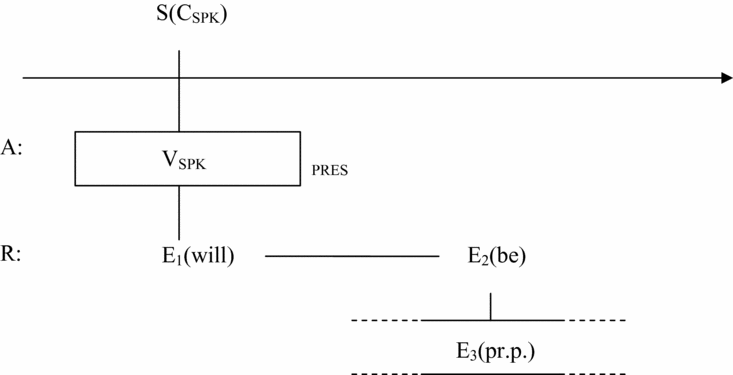
Let us start with the temporal structure of use A, or the future-progressive aspect, whereby the situation is predicted to be ongoing at the future time specified by a future time adverbial or by the context. Its temporal structure inherits the structure of the will-construction with future time reference (see figure 4i) and that of the progressive construction in its basic use (see figure 5i), schematically represented in figure 6.
Temporal structure of use A of the WBI construction
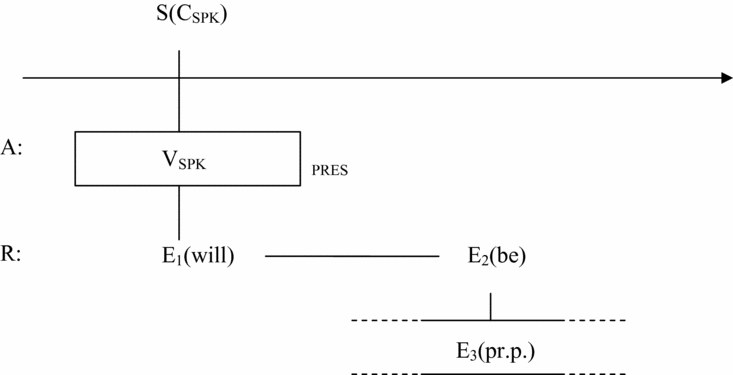
The modal will in use A basically expresses predictive modality (for a volitional reading, if any, the conditions discussed above must be met), and its event time (E1) coincides with speech time because of our definition of modality. The be -ing part refers to an ongoing situation (associated with E3) at the time of orientation (E2) because of the temporal structure of the progressive construction in its basic use. E2 is posterior to E1 because of the temporal structure of the will-construction with future time reference.
The pure progressiveness (imperfectiveness) denoted by use A is due to the temporal structure in which the present-participle part is unbounded and thus there is no change of situation involved; use A cannot include the preliminary stage in terms of the temporal structure (i.e. semantically). However, this condition does not prevent use A from implicating pragmatically that a previous stage leading to the participial situation occurs at or even before speech time because we can generally infer that for the speaker to be able to predict a non-stative situation to be in progress at a certain time, such a previous stage must have already happened by that time. This statement is in keeping with the observations made about examples (14) and (16) in section 2.2.
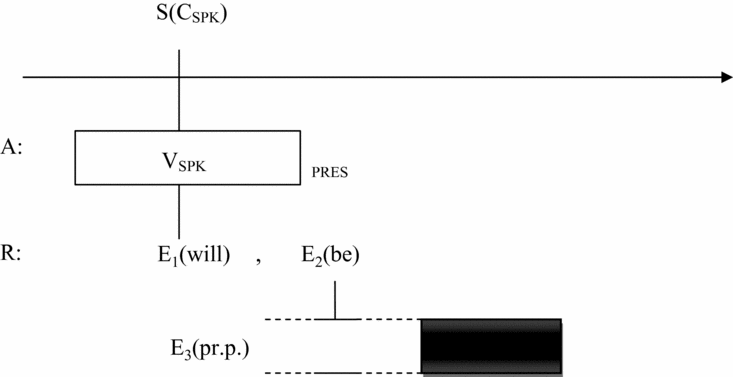
The temporal structure of use B, or the future-as-a-matter-of-course use, refers to a future situation which will occur as a matter of course or a natural progression. This use differs semantically from the other two in that it includes the preliminary stage at speech time in its temporal structure, which is demonstrated by the non-cancellability of the preliminary stage, as shown in (17) in section 2.2. The speaker of use B predicts on the basis of the preliminary stage (reflecting the progressive aspect) that the main situation (reflecting the perfective aspect in the sense defined above) will occur at a future time (cf. Williams Reference Williams2002: 51). The duality of aspect reflected in this temporal structure accounts for why use B is expressed by the progressive form. This temporal structure evokes an interpretation in which if things go like this, the target situation will naturally happen, hence the matter-of-courseness of use B. Therefore, the temporal structure of use B inherits that of the will-construction with present time reference (see figure 4ii) and that of the PPFT construction (see figure 5ii), as shown in figure 7.
Temporal structure of use B of the WBI construction
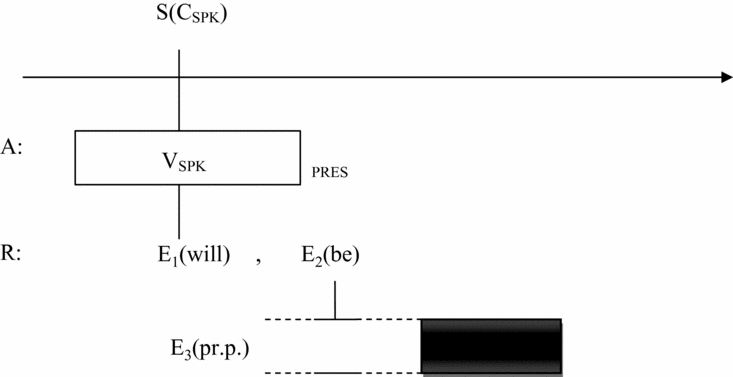
In use B, will represents predictive modality (we will see in section 5.2 why it does not express the subject's volition occurring at speech time), and its event time (E1) coincides with speech time because of our definition of modality. Because of the inheritance mentioned above, the preliminary-stage part of the present-participle situation (associated with E3) is ongoing at the time of orientation (E2), which in turn coexists with E1 and thus speech time, so the main-situation part (i.e. the foreground) occurs in the future. As with the PPFT construction, we construe this temporal structure in such a way that it includes a change from the preliminary stage to the main situation; the existence of the preliminary stage in progress at speech time causes use B to receive the ‘already decided (started)’ reading.
However, the WBI construction (use B) differs from the PPFT construction in that the former conveys prediction whereas the latter conveys assertion; the WBI construction represents its situation as less certain than the PPFT construction because of the definition of the two types of modality in section 3. We contend that this difference has an influence on the controllability of the situation involved. As we observed in section 4.2, the notion of assertion, together with the ongoingness of the preliminary stage at speech time, causes the PPFT construction to give an affinity for controllable situations such as an arrangement or fixed plan. However, what is predicted to happen as a matter of course or as a natural progression is not restricted to human (agentive) actions, which are preconditions for controllability. Regardless of whether a situation is controllable, we can make a prediction. Our contention is supported by the difference in acceptability between (29) above and It will be raining tomorrow (Wekker Reference Wekker1976: 118).
The preliminary stage in use B prototypically serves as a condition for, or a situation leading to, the occurrence of the main situation. In a less typical case, it can refer to what the speaker regards as a solid basis for predicting the occurrence of the main situation, e.g. the structure of the world in the sense of Goldsmith & Woisetschlaeger (Reference Goldsmith and Woisetschlaeger1982). In this way, the preliminary stage can serve as a ‘precondition’, i.e. whatever the speaker regards as a condition to predict the situation involved. What type of preliminary stage is assumed depends on the type of context in which the WBI construction occurs. What is important here is that use B entails the preliminary stage in its temporal structure.
There are at least two phenomena supporting our claim about the temporal structure of use B in figure 7. First, a time adverbial with in (e.g. in two hours) co-occurs only with a delimited event (Vendler Reference Vendler1967: 101; Tenny Reference Tenny1994). We argue that such an adverbial co-occurs only with use B, because it can delimit the preliminary stage and at the same time refer to the very time when the main situation as a whole occurs (Smith Reference Smith1981: 378; Sawada Reference Sawada2006). This is an answer to the question why uses A and C cannot co-occur with this type of time adverb: their temporal structures do not include the preliminary stage as well as the main situation viewed ‘holistically’.
Second, the time adverbial next implies two consecutive periods of time or events. We argue that this characteristic of next has an affinity to the temporal structure of use B. Consider (30):
(30) In the study of crime, particularly with respect to its predictability (and manipulability, which I will be looking at next), the more moderate versions of these two positions have shown some potentiality for convenience. (BNC CRX)
Here, the presence of next facilitates a reading in which the WBI construction will be looking at implies the two consecutive events, i.e. looking at the predictability of the crime and looking at its manipulability. The two events are likely to be interpreted to adjust themselves to the temporal structure of use B, which includes two stages: the former event is interpreted in the speaker's mind as if it were a ‘precondition’ for the actualisation of the latter event. This phenomenon is in keeping with Hirtle's (Reference Hirtle1967: 107) observation that next, when co-occurring with the WBI construction, implies the present condition for evoking the future event as a consequence. Because uses A and C do not include the two stages in their temporal structures, they have a different affinity from next.
By constructing the different temporal structures of uses A and B, we are arguing that the WBI construction is (semantically) ambiguous between the two uses. This is verified by Lakoff's (Reference Lakoff1970) ambiguity test. Consider (31):
(31) Toru will be flying to Venice at 5 p.m., and Yoko will, too.
If the first conjunct receives the ‘future-progressive’ reading, then the second conjunct must receive the same reading, not the ‘future-as-a-matter-of-course’ reading.
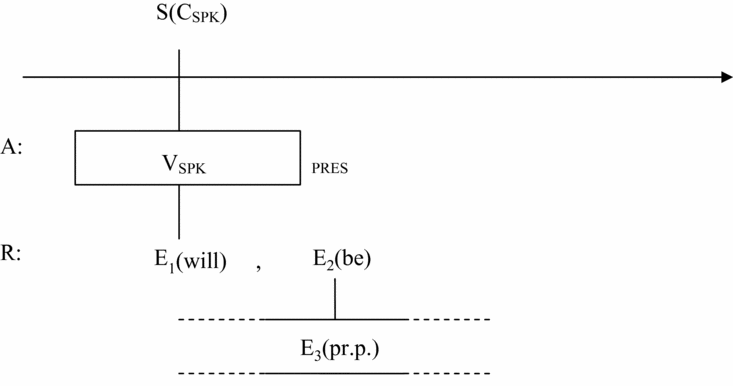
Finally, let us observe the temporal structure of use C, or the present-progressive aspect, which is employed to infer a current, ongoing situation – often clarified by the presence of a present time adverbial. Its temporal structure inherits those of the will-construction with present time reference (see figure 4ii) and of the progressive construction in its basic use (see figure 5i), as shown in figure 8.
Temporal structure of use C of the WBI construction

In use C, again, will represents predictive modality (recall that the will-construction with present time reference cannot receive a volitional reading), and its event time (E1) coincides with speech time because of our definition of modality. The be -ing part refers to a situation ongoing (associated with E3) at the time of orientation (E2) because of the temporal structure of the progressive construction in its basic use. E2 is simultaneous with E1 because of the temporal structure of the will-construction with present time reference.
Our claim that the temporal structure of use C is different from those of uses A and B is also justified by Lakoff's (Reference Lakoff1970) ambiguity test. Consider (32):
(32) Hitomi will be eating dinner, and Ken will, too.
If the first conjunct receives the ‘present-progressive’ reading, then the second conjunct cannot receive the ‘future-progressive’ or ‘future-as-a-matter-of-course’ reading, but must receive the ‘present-progressive’ reading.
Whereas the present-participle situation in use C is computed from the time of orientation in the present in terms of the temporal structure, it may, with further contextual information, extend further into the past, as in (33), or into the future, as in (34).
(33) When I went to Bruce's room an hour ago, he was playing the guitar. I think he will still be playing it now.
(34) By now Akane will be playing the flute in earnest, so she may not notice the return of her husband around ten o'clock.
Note, however, that this extension of the time reference range is cancellable in appropriate contexts and thus is not part of the temporal structure of use C.
We are now in a position to explain, in a systematic way, the linguistic facts observed in section 2. For the sake of convenience, I will first consider uses A and C, and then move to use B.
5 Explanation
5.1 Progressive uses: use A (future progressive) and use C (present progressive)
As we observed above, use A tends to show the framing effect, as in (1a), This time next week they will be sailing across the North Sea, but it is not necessarily the case, as in (1b), The whole factory will be working overtime next week. Both phenomena can be explained by the interaction between the temporal structure and the length of time referred to by the time adverb involved. In (1a), because the present-participle situation (i.e. sailing across a sea) occupies a certain period of time, its event time (E3) corresponds to a certain period of time; the time indicated by this time next week, a shorter time, is thus interpreted as included in E3. Therefore, a sentence like (1a) shows the framing effect. In (1b), by contrast, the time span of the present-participle situation (i.e. working overtime) – corresponding to E3 – does not include, but is included in, the time span indicated by next week; there is no framing effect in a sentence like (1b).
With respect to use C, the framing effect is always in operation. Because the time of orientation in the present coexists with speech time, which is made explicit by the presence of a present time adverb, the time span of the present-participle situation, e.g. having lunch in (11b) in section 2.1, always encompasses speech time.
5.2 Future-as-a-matter-of-course use: use B
I turn now to use B. Let us start with a distinctive characteristic of use B, namely that a prerequisite for the future situation has already been fulfilled by speech time. For example, in (3a), Your son will be staying with the other first formers in block D, the speaker predicts that the main situation (i.e. staying) will occur as a result of the fulfilment of the preliminary stage (i.e. doing what is necessary for living together) at speech time, and for the preliminary stage to be ongoing at speech time, at least a decision to pursue the situation in question has already been made before that time. Therefore, use B can receive the ‘arrangements/preparations’ or ‘already decided’ reading.
This phenomenon also explains why use B does not convey the subject's volition at speech time. As we observed in section 4, volition includes the decision to pursue something, and the ongoingness of the preliminary stage at speech time presupposes that such a decision has already been made before that time. In this connection, Celle & Smith (Reference Celle and Smith2010: 251) convincingly state that with the WBI construction, ‘the relation between the speaker and the predication as a whole takes precedence over the relation between the grammatical subject and the verb’. The former relationship is concerned with the speaker's attitude towards the situation (i.e. prediction) described by the WBI construction, whereas the latter is concerned with the subject's volition. Observed from our perspective, this precedence is, at least in use B, due to the presence of the preliminary stage ongoing at speech time in its temporal structure. Although human activities may more or less imply volition of some sort, the presence of the preliminary stage – which indicates that the decision has already been made – makes the subject's volition ‘out of focus’ in terms of the temporal structure or irrelevant to the interpretation (cf. Wekker Reference Wekker1976: 119).
The temporal-structure approach can also explain why use B sometimes refers to natural and physiological phenomena, as in (9) above. For example, (9a), The cherry blossoms will be falling in a few days, is uttered when the speaker sees the cherry blossoms exposed to wind and rain. The preliminary stage may be the state of the cherry blossoms being in full bloom or starting to fall, a precondition for the occurrence of the main situation (i.e. the dropping off), because we know from encyclopaedic knowledge that cherry blossoms will drop off because of wind and/or rain. The sentential and/or contextual information specifies the content of the preliminary stage.
In addition, our analysis can account for the observation that use B tends to refer to the near future, as in (2a), Professor Baxter will be giving another lecture on Roman glass-making at the same time next week, but can refer to both the immediate future, exemplified in (4), The train will be leaving in a second, and the somewhat distant future, exemplified in (5), I'll be meeting him next year. That the temporal structure of use B includes the preliminary stage in progress at speech time suggests that the main situation to occur has already been ‘set in motion’. Moreover, the temporal structure entails a change from the preliminary stage to the main situation. These characteristics imply that the preliminary stage is temporary and giving way to the main situation. Therefore, use B tends to refer to the near future, as in (2a). However, this is only an implicature; the preliminary stage can come to an end immediately or continue for a rather long time depending on the sentential and/or contextual information. Therefore, use B is compatible with both a time adverb referring to the immediate future, as in (4), and one referring to the rather distant future, as in (5).
Next, I will explain why use B tends to be incompatible with situations that are not normal or occur suddenly, illustrated by (6) above. Recall that the preliminary stage must be specified in the interpretation process. To do so smoothly, the content of the preliminary stage should be easily retrievable from our knowledge of the world, namely that it should be an ordinary situation in daily life, when the WBI construction is used without further contextual information. Without detailed information, an extraordinary situation is usually difficult to conceptualise, and so is its preliminary stage. Therefore, in (6a), ?*Margot will be poisoning her husband when he gets home, the preliminary stage may be the state of Margot's making poisonous chemicals to kill her husband, but such a scene is extraordinary in daily life and thus difficult to regard as happening in everyday-life contexts without further contextual information. Therefore, the sentences in (6) receive low acceptability. However, as suggested from note 4, if detailed information enables us to evoke the scene in which the precondition for killing someone by poison or catching an extraordinarily large fish can be assumed easily, the sentences in (6) would be acceptable.
Moreover, the temporal-structure analysis explains why use B can refer to a future situation which occurs as part of daily routine activities, exemplified by (8) above. This is a less typical case, where the preliminary stage is interpreted as referring to part of the structure of the world at speech time; on the basis of what constitutes (part of) the world structure, we can predict that the target situation will occur as a matter of course. To illustrate this, consider (8a), repeated here as (35).
(35) Bill will be driving to London tomorrow. Why don't you ask him to deliver the parcel?
The speaker views Bill's habit of regularly going to London (part of the world structure corresponding to the preliminary stage) as a condition to predict the occurrence of his going there tomorrow (the main situation). The point is that even this less typical case is in keeping with the temporal structure of use B because recognising what constitutes (part of) the world structure comes before the occurrence of the main situation, indicating that the former situation serves conceptually as a ‘precondition’ for the latter.
Furthermore, our approach can explain the fact that, as illustrated in (7) above, use B is compatible with purely stative verbs, which do not occur in the progressive construction reflecting the progressive aspect. Consider again (7a): He'll be owning his own house next. The common absence of purely stative verbs such as own and need from the progressive form, as in (iii) and (iv) in note 5, is generally due to the redundant marking of unboundedness: because stative verbs themselves refer to unbounded situations, they do not require the help of the progressive form, a grammatical means of expressing unboundedness, to do so. However, as we have observed, the temporal structure of use B does not reflect pure progressiveness; the situation itself is viewed as a whole. In use B, purely stative verbs are converted to be viewed as a whole with their initial and final boundaries, so there is no such redundancy of unboundedness. For this reason, the WBI construction (use B) can co-occur with purely stative verbs.
Finally, the different temporal structures of uses A and B explain why and how the WBI construction with a future time adverbial is interpreted ambiguously between the two uses, as exemplified by (10) in section 2.1. In both uses, a future time adverbial refers to E3, the event time of the present participle. However, with use A, the target part of E3 is the middle part of the present-participle situation, and it is this middle part (the foreground) that is specified by the future time adverbial (see figure 6 above). With use B, the target part of E3 is the main-situation part as a whole (the foreground), but not the preliminary-stage part, which is specified by the future time adverbial (see figure 7 above).
6 Conclusion
This article has shown that the three temporal structures of the WBI construction, constructed with regard to the theory of tense I developed in a series of studies, explain the linguistic facts concerning the three uses systematically and solve the problems with previous studies. To enhance the validity of our analysis, we must compare, in terms of temporal structure, the temporal phenomena of the WBI construction with other future time expressions such as the will-construction or the PPFT construction. I hope that my analysis has taken at least one small step towards a more comprehensive study of various English tense phenomena with future time reference.