INTRODUCTION
This study investigated second language acquisition in typically developing sequential bilingual children. These preschool age children learned Samoan as a first language (L1) from birth. English was introduced as a second language (L2) during early childhood. Specifically, word learning across four word types was investigated. These word types demonstrated varying levels of phonological and conceptual similarity between L1 and L2. This allowed analysis of the influence of phonological and conceptual factors in the acquisition of a second language.
Word learning
Childhood word learning is a complex process. For each new word children hear, they must “attend to the semantic cues in the environment, must store and retrieve the derived meaning of words, and must associate meaning with the phonological form of the word” (Gray, Reference Gray2005: 1453). This process of acquisition involves two distinct stages occupying two distinct areas of the brain: fast mapping and lexical consolidation.
The initial ‘fast mapping’ stage of learning occurs following limited word exposure. The child creates a ‘recording’ linked with available conceptual, syntactic and phonological information (Kan & Kohnert, Reference Kan and Kohnert2008). Even at this point, relatively stable memories exist, with evidence of detailed phonological form representations in recognition tasks (Gaskell & Dumay, Reference Gaskell and Dumay2003). The nature of these representations, however, is different to those of words already fossilized within the lexicon. This early stage of learning occurs in the medial temporal lobe (MTL), where novel words and their related knowledge remain “functionally separated from the established lexicon” (Lindsay & Gaskell, Reference Lindsay and Gaskell2010: 48).
Lexical consolidation occurs when new representations are ‘laid down’ in the established lexicon. Evidence for this is seen where a novel word (such as cathedruke) engages in lexical competition with an established lexical item (cathedral) during word-recognition tasks. Two key components have been identified in this process (Dumay & Gaskell, Reference Dumay and Gaskell2007; Gaskell & Dumay, Reference Gaskell and Dumay2003). The first is familiarity, with multiple exposures to novel words increasing the likelihood of lexical competition. The second is time, with lexical competition only appearing days after initial introduction of novel words. In particular, “sleep provides an opportunity for regions of the MTL to reciprocally activate the neocortex, resulting in neocortical consolidation” (Lindsay & Gaskell, Reference Lindsay and Gaskell2010: 53).
Word learning in bilinguals
Word learning in a sequential bilingual context adds a further dimension to an already complex process because bilingual children learn and add new words to two, inter-related lexicons. Models of the bilingual lexicon highlight this complexity. Like monolingual models, representations store conceptual, lexical and phonological information (Costa, Santesteban & Caño, Reference Costa, Santesteban and Caño2005; Kroll, Sumutka & Schwartz, Reference Kroll, Sumutka and Schwartz2005). In contrast, representations appear across two languages. Information stored at the conceptual and phonological levels is shared across languages and is not language-specific. Conversely, the lexical level is thought to be language-specific, with conceptual information linking with corresponding, but separate, L1 and L2 representations (Kroll & Stewart, Reference Kroll and Stewart1994; Kroll et al., Reference Kroll, Sumutka and Schwartz2005).
The separation of L1 and L2 at the lexical level allows for varied word storage. Some representations will be unique to L1 or L2. Other words, known as translation equivalents (TEs), are found in both L1 and L2. The mix of unique words and TEs in a bilingual child's vocabulary produces two varied lexicons. The length of time and level of exposure a child has to L1 and L2 will determine the size and composition of each lexicon (Hemsley, Holm & Dodd, Reference Hemsley, Holm and Dodd2010; Peña, Bedore & Zlatic-Giunta, Reference Peña, Bedore and Zlatic-Giunta2002).
The size and composition of L1 and L2 lexicons can also vary according to test modality. While children are able to readily ‘fast map’ new words, evidence of lexical consolidation appears receptively before expressively. This trend appears in a number of studies into early sequential bilinguals.
Kohnert and Bates (Reference Kohnert and Bates2002) found the transition from L1 to L2 dominance occurred earlier receptively, with L2 dominance emerging in children with an average of 6·9 years of L2 experience. Approximately three years of additional L2 exposure were necessary to obtain L2 dominance in expressive lexical tasks. Similarly, Hemsley, Holm and Dodd (Reference Hemsley, Holm and Dodd2006) found receptive lexical skills significantly stronger than expressive abilities in two sequential bilingual groups with approximately six years of L2 exposure. These results highlight the lengthy process of lexical consolidation, with long-term exposure necessary to develop a comprehensive L2 lexical footprint.
During the lengthy process of acquiring a second language, bilingual speakers simultaneously access L1 and L2 lexical representations during language tasks. They activate word alternatives in both L1 and L2, even in tasks that are language exclusive (Costa, Reference Costa, Kroll and De Groot2005; Kroll et al., Reference Kroll, Sumutka and Schwartz2005). For example, during an L2 language activity, related words in the L1 lexicon will also be activated. Executive function modulates language selection and use, employing processes such as attention, memory and inhibition. In this way, bilinguals possess a “dynamic system in which there is the potential for interplay between the languages within the developing speaker” (Kan & Kohnert, Reference Kan and Kohnert2008: 500).
The interplay between languages
The term ‘cross-linguistic influence’ (or ‘cross-linguistic transfer’) refers to the interplay between the two languages of a bilingual speaker. It occurs where knowledge or resources from one language have an effect on use of the other (Kohnert, Reference Kohnert2008). Of the several factors that may impact on this phenomenon, typological relations between L1 and L2 appear paramount (Kellerman, Reference Kellerman1995; Kohnert, Reference Kohnert2008). That is, languages with a degree of syntactic, conceptual, lexical and/or phonological similarity (e.g. French–Spanish) should be more conducive to cross-linguistic influence than those with limited overlap (e.g. Vietnamese–English).
Functionally, the interplay between lexicons is seen in research involving cognates. Cognate words belong to the lexicon of one language but are ‘borrowed’ from another (Roberts & Deslauriers, Reference Roberts and Deslauriers1999).Footnote 1 They subsequently have similar conceptual and phonological representation across the two languages (Yudes, Macizo & Bajo, Reference Yudes, Macizo and Bajo2010), such as pen and peni in English and Samoan. Small differences in phonological representation frequently occur, typically when the borrower alters sounds or word shape to reflect the phonotactic rules of its own language. In contrast, non-cognates refer to a single concept but have little or no phonological resemblance (e.g. spider and apogaleveleve).
Studies evaluating language performance on tasks including cognates and non-cognates indicate that bilinguals consistently perform faster and more accurately on cognates (Costa, Caramazza & Sebastian-Galles, Reference Costa, Caramazza and Sebastian-Galles2000; Costa et al., Reference Costa, Santesteban and Caño2005). Cognates have “a positive effect not only on the speed with which words are produced, but also on how resistant they are to momentary malfunctioning of the lexical retrieval system” (Costa et al., Reference Costa, Santesteban and Caño2005: 95). This effect appears particularly strong where L1 (the stronger language) facilitates L2 (de Groot, Borgwaldt, Bos & van den Eijnden, Reference de Groot, Borgwaldt, Bos and van den Eijnden2002).
While cognates facilitate language performance, evidence exists that cross-linguistic influence can also be inhibitory. Conceptually different languages produce negative effects on language processing and expression. For example, differences in conceptual organization of positional language in German and English resulted in significantly different output during descriptive language tasks (Carroll & Von Stutterheim, Reference Carroll and Von Stutterheim1993). Theoretically, if these languages were introduced sequentially, the conceptual differences between German and English would work to hinder cross-linguistic acquisition of positional language (Kellerman, Reference Kellerman1995).
Study aims and predictions
Much of the research into cross-linguistic influence focuses on late sequential bilinguals who acquire another language during or after the teenage years. Research into cross-linguistic influence in early sequential bilinguals, where a second language is introduced during the first five years of life, is limited. Further, the majority of studies focus on syntax. They evaluate the influence of one set of grammatical rules on production of a second language. Outside the cognate effect, research into lexical cross-linguistic influence is limited.
While the cognate literature points to cross-linguistic interplay between L1 and L2 at a processing level, it is not yet clear if or how the L1 lexicon influences L2 acquisition. No previous research studies have investigated whether certain words types, such as cognates, are more easily consolidated into the L2 lexicon. The literature emphasizes the need for further research into this area, “as it lies at the heart of educational and clinical treatment issues” (Kohnert, Reference Kohnert2008: 78). An understanding of mechanisms that facilitate or hinder the learning process for sequential bilinguals would have obvious benefits for language clinicians and educators alike.
This article pursues Lindsay and Gaskell's proposal that “one of the most important influences on word learning is the similarity of a new form to existing lexicophonological representations” (Lindsay & Gaskell, Reference Lindsay and Gaskell2010: 58). Specifically, it explores the possibility that existing knowledge and resources from L1 facilitate retention of L2 lexical items. The methodology presented here differs from previous studies into word learning by examining real-life L2 acquisition. This was achieved by testing four-year-old sequentially bilingual children at three time-points over a 12-month period. The research focused on acquisition patterns for high-frequency, everyday vocabulary rather than vocabulary taught in a contrived or clinical setting.
The language pair investigated in the current study was Samoan–English. Consideration of these two languages revealed interesting similarities and contrasts. Samoan is an Austronesian language with many phonological similarities to English. While all Samoan vowels and consonants are found in English, Samoan uses fewer consonants and vowels overall. Also in contrast to English, Samoan phonology does not include syllable-final consonants or consonant clusters (Comrie, Matthews & Polinsky, Reference Comrie, Matthews and Polinsky1996; Pratt, Reference Pratt1862).
Historically, the considerable English influence on Samoan has resulted in many cross-linguistic cognates. Despite these similarities, many conceptual and lexical differences also exist. When developing a list of words for tasks in the current study, the researchers observed four types of cross-linguistic word pairs:
1. Matched nouns: where a single concept is represented by one phonetically dissimilar word in both English and Samoan (e.g. spider–apogaleveleve; soap–fasimoli).
2. Cognates: the Samoan lexicon has many cross-linguistic cognates which share similar form (phonological representation) and meaning (conceptual representation). Differences only occur where an English word has been altered to reflect Samoan phonology. This typically affects word shape, eliminating syllable final consonants and consonant clusters (e.g. pen–peni; spoon–sipuni).
3. Phrasal nouns: where a Samoan phrase represents one English word. In Samoan, descriptors are added to a base word to create a more specific meaning. The base word generally equates to a category in English. For example, ofu is the base word for garment in Samoan. Additional words add detail, so that ofu vae pupu'u (‘garment legs short’) is the Samoan phrasal noun for shorts, while ofu vae u'umi (‘garment legs long’) refers to trousers. Ofu moe (‘garment sleeping’) are pyjamas, and ofu tino (‘garment body’) is the phrasal noun for shirt.
4. Holonyms: where one Samoan word translates to two (or more) related words in English. The relationship between words is taxonomic: the Samoan word represents a whole of which the English words are a part/type. For example, chair and couch are both represented by nofoa in Samoan; while arm and hand are both lima.
These words differ in their phonological and conceptual representation between languages. Table 1 summarizes their characteristic differences. For the purposes of this study, phonological distance describes the degree of difference between the phonology of L1 and L2 lexical items. As expected, all categories represent words differently across languages, with the exception of cognates. For cognates, the phonological distance is minimal, with similar (or the same) representations in L1 and L2. Cognates were judged in terms of global phonological similarity between the two words, rather than phonotactic adherence to L1 phonology. Although not addressed here, it is possible that identical cognates (with shared phonotactic constraints between L1 and L2) may be more easily learned than cognates where word shape is altered to match L1 rules (e.g. spoon–sipuni).
Summary of the conceptual and phonological distance between English/Samoan word pairs

Less straightforward is the concept of conceptual distance. This describes differences in conceptual representation in L1 versus L2. Words with differences in conceptual organization have greater conceptual distance than those that can be translated directly. In the current study, matched nouns and cognates are conceptually similar: single-word representations exist in L1 and L2, with one form corresponding directly to the other. Phrasal nouns and holonyms demonstrate greater conceptual distance. Here, English and Samoan representations are not direct translation equivalents: conceptual schema/traits differ between the languages. Phrasal nouns shift from describing a lexical item (in Samoan) to providing a single-word English label with defined boundaries. For holonyms, the actual definition of lexical items differs – resulting in conceptual contrast between languages.
We hypothesized that word pairs with conceptual/phonological similarities to L1 would be easier to acquire than words without. Phrasal nouns and holonyms were of particular interest with semantic organization of these words being very different to that of English.
Specifically we predicted five outcomes on English lexical tasks:
1. that receptive and expressive scores would improve over time, reflecting expanding L2 acquisition;
2. that L2 acquisition would be stronger in receptive tasks, with slower uptake of skills in expressive tasks;
3. that due to their conceptual and phonological similarity to L1, cognate scores would be higher compared to other word types at each assessment point (reflecting faster L2 acquisition);
4. that due to differences in conceptual and phonological representation, phrasal nouns and holonym scores would be lower compared to other word types at each assessment point (reflecting slower L2 acquisition); and
5. that matched word scores would fall between these two groups: with conceptual similarities to L1 but different phonological representation.
METHOD
The language background of sequential bilinguals is highly variable. By necessity, researchers from different cultures tailor descriptions to reflect sociolinguistic factors within the population being studied. For this reason, we present the language environment and patterns of language use within the current study group in detail.
We selected a culturally and linguistically diverse suburban area for the study. The presence of Samoan within the community was strong, as evidenced by the presence of many Samoan sporting and social groups, churches, playgroups and medical services. The socioeconomic status of the area (as measured by the index of relative socioeconomic advantage) was in the bottom 10 percent of the population (Australian Bureau of Statistics, 2006).
Participants
The data presented were drawn from a larger longitudinal study investigating language acquisition in early sequential bilingual children. Nine Samoan–English bilingual children and nine monolingual English children participated in the study. Participants were recruited from three state preschools within the targeted geographic region. Their classrooms reflected the multicultural nature of the suburb, with a majority of children being bilingual. Approximately one-third of children in each of the preschools were from Samoan-speaking families. Children attended the preschools 2·5 days a week. As all teachers were monolingual English speakers, child–teacher interactions were in English; however, teachers noted that peers from similar linguistic backgrounds would interact using both L1 and L2 during play.
Preschool teachers identified nine Samoan–English bilingual children eligible for participation. Children were only eligible if Samoan was the primary language heard in the home during their first two years of life. None of the children previously attended childcare or kindergarten facilities. No children with diagnosed disabilities were included in the study.
Parent interviews confirmed information regarding the bilingual group's home language use. A fluent bilingual Samoan–English speaking teacher completed the interviews over the phone. Initially, the interview discussed family composition and confirmed the predominant use of Samoan at home during each child's first two years of life. Then, information was collected regarding language use at home. This addressed the amount of Samoan used by others speaking to the child at home, as well as the amount of Samoan used by the child when talking at home (Hemsley et al., Reference Hemsley, Holm and Dodd2010).
Responses to parent questionnaires revealed that Samoan was the primary language heard at home during the participants' first two years of life. At the time of the study, Samoan was also the primary language used by parents at home when interacting with their children, although in each parent reported using ‘a little’ English when talking with their child. Given that all parents had at least basic English competence, it is highly likely that children were also exposed to language mixing with utterances containing elements from both L1 and L2. This is common in children from a sequential bilingual background (Goodz, Reference Goodz1989). For this reason, participants in the study would have been exposed to varying degrees of Samoan and English in their early years. On the whole, however, their language exposure would be described as predominantly Samoan prior to starting school.
A different pattern was discovered regarding child language use at home. Parents reported that little or no Samoan was used by their child when interacting at home. In fact, several parents noted encouraging their children to use English at home. That is, the parents spoke to their children in L1 and their children responded in L2. Communication breakdowns were limited because the parents also understood at least basic English. This pattern of passive bilingualism is common in early sequential bilingual children (Hammer, Miccio & Rodriguez, Reference Hammer, Miccio, Rodriguez and Goldstein2004; Hemsley et al., Reference Hemsley, Holm and Dodd2010). For example, Spanish-speaking children in the USA “quickly learn that English is the preferred language and that there is limited value in using and maintaining (expressive) Spanish” (Hammer et al., Reference Hammer, Miccio, Rodriguez and Goldstein2004: 26).
We also recruited a monolingual English-speaking comparison group. For each bilingual child in the study, teachers selected a typically developing child of the same gender and within two months of the comparison bilingual child's age. This was possible in all but one case, where a participant of the same age but different gender was selected as a comparison child.
The bilingual group consisted of four boys and five girls. The monolingual English-speaking group consisted of five boys and four girls (participant details available in Hemsley et al., Reference Hemsley, Holm and Dodd2010). The two groups were well matched for age (Mann–Whitney U=23·5, p=0·136). At initial assessment the mean age for the bilingual group was 4 ; 9 (SD 2·84 months; range 4 ; 7–5 ; 2) and for the comparison monolingual group was 4 ; 7 (SD 2·97 months; range 4 ; 3–5 ; 1).
Stimuli
Receptive Vocabulary and Picture Naming tasks were developed for the study. Items were selected from the 316 nouns in the Australian adaptation of the MacArthur Communicative Development Inventories (Fenson et al., Reference Fenson, Dale, Reznick, Thal, Bates and Hartung1993), known as the Australian English Communicative Inventory OZI (Schwarz, Burnham & Bowey, Reference Schwarz, Burnham and Bowey2006). Each task contained a variety of words from the semantic categories included in the OZI (e.g. animals, vehicles, food, clothing). Items less common to Samoan culture were identified by a Samoan-speaking teacher (e.g. beanie, tricycle, biscuit) and subsequently excluded from tasks. Items in each task were also selected to reflect differences between Samoan and English conceptual/phonological organization. A total of seventy-two items were included for each task, with eighteen items from each of the four identified word pair patterns described above: matched nouns, cognates, phrasal nouns, holonyms. Word lists can be found in the Appendix.
During the Receptive Vocabulary task, children were presented with four 6 cm square coloured pictures. The examiner asked the child to identify a target item (e.g. “Point to the bus.”) following which the child selected and pointed to the corresponding picture. The three foil pictures were in the same semantic category with matching features and/or function (e.g. car, train and truck). The Picture Naming required children to label seventy-two coloured pictures, each 6 cm square.
Procedure
We tested each child in a quiet room at their preschool during school hours. Children were tested three times over the research period. The initial assessment took place after approximately ten weeks of preschool attendance. The first repeat assessment took place about six months later (after approximately thirty weeks of schooling). The third assessment took place approximately twelve months following initial assessment, once children had commenced their first year of full-time education.
During each assessment, the English skills of the bilingual group and their monolingual peers were tested over two short sessions (total assessment time 30 minutes). Each session was on a different day. The Picture Naming task was administered in the first session, and the Receptive Vocabulary task during the second session. This sequence of administration was necessary to avoid potential word learning in the receptive task (as some items were the same across tasks). An experienced monolingual English speech-language pathologist administered all tests. We ensured consistency and integrity of experimental tasks across languages by administering each test using set instructions and sufficient practice items to make task comprehension certain. We recorded labelling tasks to achieve accurate transcription of responses without lengthening assessment time.
Parametric analyses of variance were used. Graphing of the distribution of scores demonstrated slightly negatively skewed bell-shaped curves for both monolingual and bilingual groups. To ensure the degree of skewness did not violate the assumption of normality, the numerical value for Skewness was compared with twice the Standard Error of Skewness (monolingual receptive vocabulary Skewness=−0·43; picture naming Skewness=0·09; bilingual receptive vocabulary Skewness=−1·23; picture naming Skewness=−0·58; Standard Error of Skewness range=+/−1·43). As the value for Skewness fell within the range from minus twice the Standard Error of Skewness to plus twice the Standard Error of Skewness, the assumption of normality was not seriously violated (Coolican, Reference Coolican2004). A Levene's test for homogeneity of variance revealed that the picture naming task complied with the assumption of homogeneity of variance (p=0·098), however the receptive vocabulary task did not (p=0·012). The ANOVA is robust to violation of homogeneity of variance as long as similar sample sizes are used and the sample sizes are not extremely small (less than five), both of which were true in this study (Maxwell & Satake, Reference Maxwell and Satake2006).
RESULTS
Comparison of bilingual and monolingual performance on receptive vs. expressive tasks
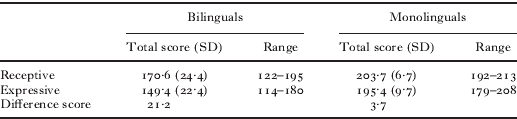
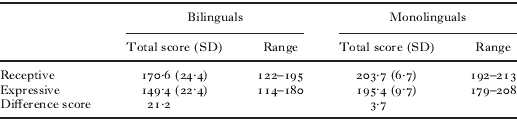
Table 2 shows the mean total receptive and expressive scores for bilinguals and monolinguals. A two-factor repeated-measures ANOVA (group by task type) showed a significant effect of group (F(1,16)=24·703, p<0·001, ηp2=0·607), with the monolingual children performing better than the bilingual children. There was also a significant effect of task, with the receptive task eliciting better performance than the picture naming task (F(1,16)=39·121, p<0·001). The interaction was also significant (F(1,16)=7·258, p=0·008) indicating that the two group profiles of performance across tasks differed. A post-hoc independent t-test, comparing difference scores between receptive and picture naming scores, indicated that there was a greater difference for the bilingual than the monolingual group (t(16)=3·019, p=0·01).
Mean total receptive and expressive scores in each group (time 1+time 2+time 3)
Receptive vocabulary: longitudinal comparison of bilingual and monolingual groups
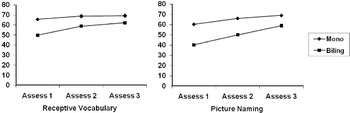
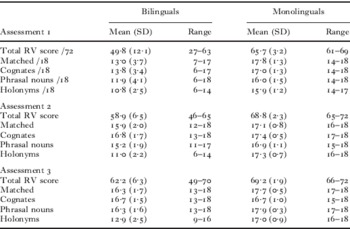
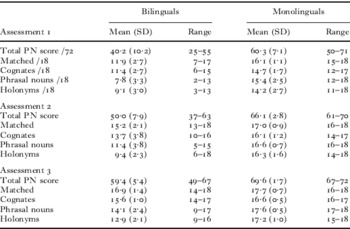
Table 3 shows the mean bilingual and monolingual receptive vocabulary scores across the three assessments conducted. A repeated-measures ANOVA (group by total receptive vocabulary scores over time) revealed a significant difference between the bilingual and monolingual groups (F(1,16)=15·574, p<0·001, ηp2=0·493). Closer inspection of Table 3 indicates that the bilingual children performed less well than the monolingual group. Analysis also revealed a significant effect of assessment time (F(2,15)=18·287, p<0·001) with combined group scores improving over time. The interaction between group and receptive vocabulary scores over time was also significant (F(2,15)=5·728, p=0·014). This indicated that each group's change over time varied. Figure 1 suggests that while the monolingual group's scores varied very little across the three assessment times, the bilingual children's scores improved more markedly over time. Post-hoc assessments confirmed these findings. For the bilingual children, Bonferroni corrected (significance level p<0·013) paired t-tests indicated that Assessment 1 receptive vocabulary scores were lower than those for Assessment 2 (t(8)=4·25, p=0·003) and that Assessment 2 scores were lower than Assessment 3 scores (t(8)=3·09, p=0·015). In contrast, while the monolingual children's receptive vocabulary scores improved between Assessment 1 and Assessment 2 (t(8)=6·42, p<0·001), the analysis showed no significant difference between Assessments 2 and 3 (t(8)=0·59, p=0·569). This result is due to the monolingual group reaching ceiling performance on this task.
Total receptive vocabulary and picture naming scores by group.

Bilingual and monolingual receptive vocabulary scores across three assessments

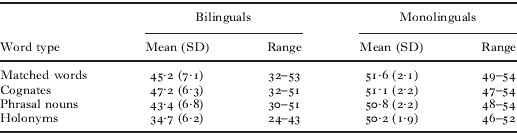
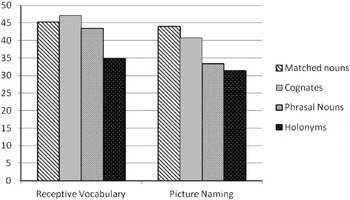
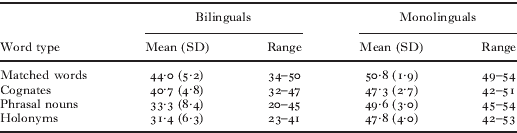
Table 3 indicates that the pattern of performance between groups differed according to the type of words. Table 4 shows performance summed across assessments for each word type. A repeated-measures ANOVA on these data showed a significant group effect (F(1,16)=15·453, p<0·001, ηp2=0·491), with the monolingual group achieving higher mean scores on all word types. Combined performance differed according to word type (F(3,14)=19·526, p<0·001). However, Table 4 indicates that the difference between word types was due to the bilingual group who scored poorly on the holonym category, whereas the monolinguals showed consistency of performance across word types.
Total receptive vocabulary scores according to group and word type (time 1+time 2+time 3)
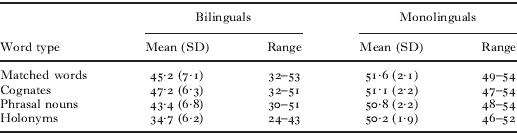
Post-hoc Bonferroni corrected (significance level p<0·008) paired-t testing confirmed that the monolingual group performed no differently according to word type (matched–cognates: t(8)=0·580, n.s.; phrasals–holonyms: t(8)=0·783, n.s.; matched–phrasals: t(8)=1·214, n.s.; matched–holonyms: t(8)=1·746, n.s.; cognates–holonyms: t(8)=1·403, n.s.; phrasals–cognates: t(8)=0·632, n.s.). In contrast, the bilingual group performed more poorly on holonyms than phrasal nouns (t(8)=6·397, p<0·001), matched words (t(8)=8·036, p<0·001), and cognates (t(8)=6·932, p<0·001). No other comparisons were significant (matched–cognates: t(8)=1·75, p=0·118; matched–phrasals: t(8)=1·403, p=0·198, cognates–phrasals (t(8)=2·773, p=0·026). These word type comparisons are shown graphically in Figure 2.
Bilingual mean word type scores across three assessments.

Picture naming: longitudinal comparison of bilingual and monolingual groups
Table 5 shows the mean bilingual and monolingual picture naming scores across the three assessments conducted. A repeated-measures ANOVA (group by total picture naming scores over time) revealed that there was a significant difference between the monolingual and bilingual groups (F(1,16)=32·108, p<0·001, ηp2=0·667). Closer inspection of Table 5 indicates that the bilingual children performed less well than their monolingual counterparts. The results also showed a significant effect of assessment time (F(2,15)=44·49, p<0·001), with combined group scores improving over time. The interaction between group and picture naming scores over time was also significant (F(2,15)=6·508, p=0·009). This indicated that that each group's change over time varied. Bonferroni-corrected t-tests (significance level p<0·02) indicated a significant improvement in performance on total vocabulary over time for both groups. For the monolingual group, picture naming scores significantly improved between Assessments 1 and 2 (t(8)=3·339, p=0·01) and again between Assessments 2 and 3 (t(8)=5·149, p=0·001). Similarly, the bilingual children's picture naming scores improved between Assessments 1 and 2 (t(8)=5·549, p=0·001) and also between Assessments 2 and 3 (t(8)=5·425, p=0·001). Table 5 suggests that the difference between the monolingual and bilingual groups' scores varied across the three assessment times in that the bilingual children's scores showed less difference to those of the monolingual group over time. At Assessment 1, the mean difference between the groups was 20·1, at Assessment 2, 16·1, and at Assessment 3, 10·2.
Bilingual and monolingual groups' picture naming scores across three assessments

Table 5 indicates that pattern of performance between groups differed according to the type of words. Table 6 shows picture naming performance summed across assessments for each word type. A repeated-measures ANOVA on these data showed a significant group effect (F(1,16)=31·870, p<0·001, ηp2=0·666), with the monolingual group achieving higher mean scores on all word types. Combined performance differed according to word type (F(3,14)=20·077, p<0·001). The interaction between group and word type was also significant (F(3,14)=9·949, p<0·001). As indicated in Table 6, the bilingual group's performance varied according to word type, whereas the monolinguals showed consistency of performance across word types.
Picture naming scores according to group and word type (time 1+time 2+time 3)
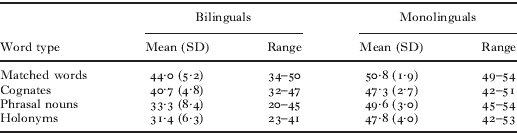
Post-hoc Bonferroni-corrected (p<0·008 required for significance) paired-t testing confirmed that, apart from matched–cognate words (t(8)=4·299, p=0·003) the monolingual group performed no differently according to word type (phrasals–holonyms: t(8)=2·604, n.s.; matched–phrasals: t(8)=1·178, n.s.; matched–holonyms: t(8)=2·268, n.s.; cognates–holonyms: t(8)=0·512, n.s.; phrasals–cognates: t(8)=2·295, n.s.). In contrast, only two comparisons were not significant for the bilingual group: matched–cognates (t(8)=2·341, n.s.) and phrasals–holonyms were equally difficult (t(8)=1·434, n.s.). Matched words elicited better performance than phrasal nouns (t(8)=6·102, p<0·001) and holonyms (t(8)=9·128, p<0·001). Cognates also were associated with better performance than phrasal nouns (t(8)=3·874, p=0·005) and holonyms (t(8)=4·954, p=0·001). These word type comparisons are shown graphically in Figure 2.
DISCUSSION
This study investigated word learning in typically developing sequential bilingual children, during their first eighteen months of school. Specifically, the study investigated patterns of L2 word learning across four word types: matched nouns, cognates, phrasal nouns and holonyms. The importance of phonological and conceptual distance between L1 and L2 word types was of particular interest. We hypothesized that L2 word types with phonological and/or conceptual similarity to L1 would be consolidated more easily into the L2 lexicon than words with phonological and/or conceptual difference. Results indicated rapid receptive and expressive vocabulary growth over time. Consistently, receptive scores were higher than expressive scores for both groups, although this pattern was more marked in bilinguals. Over time, the monolingual group demonstrated no differences in word learning according to word type. Conversely, significant differences across word types in the bilingual group suggested that L1 knowledge influences L2 lexical acquisition and consolidation. Of particular interest, conceptual distance appeared to be a stronger predictor of word learning than phonological distance, that is, L2 lexical items were acquired earlier if their conceptual representation was similar to that of L1. Words with greater conceptual distance between L1 and L2 were slower to emerge. We examine each of these findings in more detail below.
Given that the bilingual group received regular exposure to English at school during the study, we anticipated that L2 vocabulary would improve. Not surprisingly, assessment revealed significant improvements in receptive and expressive scores at each assessment point. Assessment also revealed improvements within each word type. This pattern is consistent with studies demonstrating rapid lexical growth in young children during early L2 exposure (e.g. Kan & Kohnert, Reference Kan and Kohnert2005; Leseman, Reference Leseman2000; Schaerlaekens, Zink & Verheyden, Reference Schaerlaekens, Zink and Verheyden1995).
Comparison of monolingual and bilingual test scores provided evidence of rapid lexical growth in the bilingual group. In both the receptive vocabulary and picture naming tasks, scores showed progressively less difference between the bilingual and monolingual group scores over time. Despite this, however, the monolingual group performed significantly better than the bilingual group on both measures at all time-points. This result was expected, given the limited English exposure of the bilingual group.
Another expected result in the bilingual group was consistently higher scores in the receptive vocabulary task relative to the picture naming task. That is, children were able to show word knowledge for a greater number of words receptively than expressively. This pattern presented even though both tasks contained equal numbers of words selected from a high-frequency word set. Evidence of lexical consolidation appearing receptively before expressively is well documented in the literature (Hemsley et al., Reference Hemsley, Holm and Dodd2006; Kohnert & Bates, Reference Kohnert and Bates2002). Lexical representations are present but may be underspecified, limiting expressive retrieval and production.
Central to this study was the possibility that L1 knowledge facilitates word learning in L2. Specifically we proposed that the similarity of ‘new’ words to existing lexico-phonological representations would influence their uptake in L2 (Lindsay & Gaskell, Reference Lindsay and Gaskell2010). To achieve this comparison, we developed English lexical tasks with equal representation of four cross-linguistic word types: matched words, cognates, phrasal nouns and holonyms. Each type demonstrated varying conceptual and phonological distance between L1 and L2. We expected that word types with conceptual/phonological similarity would show faster uptake than those with greater conceptual/phonological distance.
To ensure patterns were not associated with word differences in English, bilingual results were compared to those of a monolingual control group. As expected, monolinguals largely showed consistency of performance across word types both receptively and expressively. One unexpected statistical difference for the monolingual group was in picture naming between matched words and cognates at initial assessment. This difference did not appear in the bilingual group. Inspection of the monolingual children's initial assessment data indicated that two participants performed poorly, probably because of the unfamiliar assessment context. In contrast to the monolingual group, the bilingual group presented many significant differences between word type scores. These related both to phonological and conceptual differences, which are presented, in turn, below.
Phonological distance: a known advantage?
Cognates demonstrate conceptual and phonological similarity between L1 and L2. We expected that this would facilitate L2 learning, with faster neocortical consolidation than word types with greater conceptual or phonological distance (Costa et al., Reference Costa, Caramazza and Sebastian-Galles2000; Costa et al., Reference Costa, Santesteban and Caño2005; Lindsay & Gaskell, Reference Lindsay and Gaskell2010). We predicted relatively higher cognate scores in both receptive and expressive tasks. On the contrary, a significant cognate advantage was only identified in the picture naming task. Given that vocabulary learning tends to appear receptively before expressively, the absence of this pattern receptively was, in hindsight, logical. Receptive word learning scores were close enough to ceiling for a cognate advantage to have passed. Had the participants been assessed earlier in their English acquisition, we propose that the anticipated pattern would then have been discernible receptively, but perhaps not expressively. Further research with sequential bilinguals earlier in their L2 acquisition would confirm this suspicion.
The picture naming task revealed a cognate advantage. Cognates elicited significantly higher scores than phrasal nouns and holonyms. This is consistent with literature suggesting that cognates support L2 language abilities because they integrate more easily into the lexicon, resulting in faster and more accurate retrieval (Costa et al., Reference Costa, Caramazza and Sebastian-Galles2000; Costa et al., Reference Costa, Santesteban and Caño2005; de Groot et al., Reference de Groot, Borgwaldt, Bos and van den Eijnden2002).
Of interest, there was no difference between cognates and matched words. That is, words with phonological similarity were no easier to learn than matched words (without phonological similarity). Conceptual similarity appeared more important here, a feature shared by both groups. This conceptual advantage was not anticipated. We suggest that conceptual distance between L1 and L2 may be of (at least) equal importance to phonological distance in facilitating word learning in sequential bilinguals.
Conceptual distance: a new player
Cognates, and phonological distance, are easily distinguishable dimensions for evaluating lexical acquisition in sequential bilinguals. Much less evident is the effect of conceptual distance: the way in which L1 conceptual representations affect L2 acquisition. Given that conceptual information is shared across languages (Kroll & Stewart, Reference Kroll and Stewart1994; Kroll et al., Reference Kroll, Sumutka and Schwartz2005), it makes sense that L1 conceptual representations could facilitate or inhibit L2 acquisition. Limited evidence suggests that conceptual distance can affect language processing and expression across languages (Carroll & Von Stutterheim, Reference Carroll and Von Stutterheim1993). However, a greater understanding of transfer effects is “critically needed … to inform educational practice and language intervention programs” (Kohnert, Reference Kohnert2008: 78).
The current study deemed single words with the same meaning in English and Samoan to have conceptual similarity. This was seen in matched words (e.g. spider vs. apogaleveleve) and cognates (pen vs. peni). Conceptual distance was evident in two word types. Phrasal nouns described concepts represented by a single word in English (e.g. shorts) but a short descriptive phrase in Samoan (ofu vae pupu'u). Holonyms described two words in the English lexicon (e.g. arm and hand) represented by a single lexical item in Samoan (lima).
Phrasal nouns and holonyms were predicted to be the most difficult word types to acquire in L2. Both demonstrated conceptual and phonological distance between L1 and L2. This pattern was confirmed in the Picture Naming task. Both phrasal nouns and holonyms demonstrated significantly lower scores than matched words and cognates. Phrasal nouns and holonyms were equally difficult. These results confirm that cross-linguistic influence can be either facilitative or inhibitory. Further, conceptual distance appeared to determine this pattern. Words with conceptual similarity between L1 and L2 (cognates and matched nouns) demonstrated quick L2 consolidation. Conversely, words with conflicting conceptual representation between L1 and L2 (phrasal nouns and holonyms) appeared more challenging to acquire in L2.
This finding is not entirely unprecedented. In a discussion of language organization, Kellerman (Reference Kellerman1995) highlighted the problematic nature of conceptual differences between languages: “the search for correspondences, for an opportunity to transfer to somewhere is motivated by the existence of a particular disposition to view things that way” (p. 142). It seems that sequential bilinguals use existing language constraints and resources when developing new lexical footprints (Gaskell & Dumay, Reference Gaskell and Dumay2003). Words requiring a conceptual shift from L1 take longer to consolidate and strengthen within the L2 lexicon. Further research, including a range of language pairs, is needed to confirm these findings.
Holonyms presented the only statistically significant finding in the receptive task. This word type scored significantly lower when compared with matched words, cognates and phrasal nouns. It is possible this finding was a remnant of patterns more clearly identifiable in the expressive task because children establish receptive mental representations for words before they use them. It is also possible that holonyms have greater conceptual distance than phrasal nouns, making them harder to fossilize in the L2 lexicon.
CONCLUSION
This exploratory study investigated whether L1 influences L2 word learning in sequentially bilingual children. The importance of phonological and conceptual distance between L1 and L2 word representations was of particular interest. Results showed that the level of conceptual distance between L1 and L2 was a key factor in L2 lexical acquisition. That is, L2 lexical items were acquired earlier if their conceptual representation was similar to that of L1. Words with greater conceptual distance between L1 and L2 emerged more slowly. This suggests that L1 knowledge and resources influence L2 lexical consolidation for sequential bilinguals. Words that do not fit existing schemas, or require a conceptual shift from L1, take longer to consolidate and strengthen within the L2 lexicon.
APPENDIX – WORDS ACCORDING TO CATEGORY IN LEXICAL TASKS
Receptive Vocabulary Task
Holonyms: foot–leg; hand–arm; jumper–jacket; couch–chair; watch–clock; grapes–sultanas; photo–picture; lamp–light; brush–comb
1 to 1: spider; rain; pig; box; duck; pillow; fork; fish; broom; house; boy; lounge-room; friends; tractor; game; child; milk; corn
Compound words: dress; fridge; playground; chicken; pyjamas; toes; cup; socks; postman; toothbrush; gloves; ladder; plane; juice; pram; shop; garage; motorbike
Derived words: bus; ice-cream; cupboard; chips; kangaroo; jelly; bucket; truck; koala; zip; bubbles; mop; tiger; carrot; blocks; glue; puzzle; cake
Picture Naming Task
Holonyms: foot–leg; hand–arm; jumper–jacket; couch–chair; watch–clock; grapes–sultanas; photo–picture; lamp–light; brush–comb
1 to 1: kite; moon; basket; soap; frog; ant; button; towel; pumpkin; teacher; bird; boat; policeman; flower; school; tummy; book; Dad
Compound words: present; camera; fire truck; glass; shorts; puppy; fingers; kitchen; fireman; doll; train; bike; toast; shirt; bedroom; shower; pool; tongue
Derived words: chocolate; sandwich; ball; possum; helicopter; strawberry; spoon; pizza; teddy; vacuum; truck; lion; key; rabbit; steps; telephone; bat; giraffe