Implications
Once a day (OAD) milking is a management tool that helps to reduce workload in dairy farms and make farming more attractive, compared to twice a day (TAD) milking systems. The reduction from two to one milking daily, in dairy cows, decreases milk production per cow and farm’s incomes, although it also reduces labour cost and other expenses. Once a day milking would be recommended for those farmers who can either afford a reduction in profit to gain better and more flexible working conditions or can minimise milk yield loss and greatly reduce labour cost.
Introduction
Attracting and retaining qualified people to work on farms is a challenge in many dairy producing countries (Bewsell et al., Reference Bewsell, Clark and Dalley2008), as dairying has a reputation for unpleasant working conditions. The great demand and effort required to milk cows, could be one of the main factors explaining the high employee turnover rate in dairy farms (Poulter and Sayers, Reference Poulter and Sayers2015). Milking is generally performed TAD, 365 days a year, and conducted many times at socially unacceptable hours (Bewsell et al., Reference Bewsell, Clark and Dalley2008). Reducing milking frequency, from TAD to OAD offers an opportunity to increase labour flexibility and improve lifestyle, and employee recruitment and retention (Tipples et al., Reference Tipples, Verwoerd, Bewsell, Dalley and Turner2007). Once a day systems have also shown to improve animal reproductive performance (Clark et al., Reference Clark, Phyn, Tong, Collis and Dalley2006). The main disadvantages of OAD include a decrease in milk production per cow and per ha (Stelwagen et al., Reference Stelwagen, Phyn, Davis, Guinard-Flament, Pomiès, Roche and Kay2013) and an increase in somatic cell count, in comparison to herds milked TAD (Clark et al., Reference Clark, Phyn, Tong, Collis and Dalley2006; O’Brien et al., Reference O’Brien, Gleeson, Boyle and Mee2007), which may increase the risk of milk price penalty and clinical mastitis occurrence.
Once a day milking has been previously investigated, either across the entire lactation or strategically in parts of the lactation (Stelwagen et al., Reference Stelwagen, Phyn, Davis, Guinard-Flament, Pomiès, Roche and Kay2013) in different countries. Experimental studies reported a decrease in milk production per cow from 22% to 50% when cows were milked OAD during the whole lactation, compared with cows milked TAD (Stelwagen et al., Reference Stelwagen, Phyn, Davis, Guinard-Flament, Pomiès, Roche and Kay2013). Milk production reported in those experiments ranged from ~2800 kg (Jersey cows; Clark et al., Reference Clark, Phyn, Tong, Collis and Dalley2006) to 7300 kg (Holstein cows; Remond et al., Reference Rémond, Pomiès, Dupont and Chilliard2004) per cow for the entire lactation, milked TAD. On the other hand, information from commercial dairy farms, in New Zealand, reported that milk production was reduced by 24% during the first year after switching milking frequency from TAD to OAD and it was possible to achieve 10% decrease in milk volume, compared with farms milking TAD, by the 4th and 5th year milking OAD (DairyNZ, 2016), for an average milk yield of 4185 kg/cow per year under TAD milking (LIC, 2017).
Most of experimental and commercial farm data has been generated under grazing systems with little use of supplements. There is only one published experiment evaluating cows grazing pasture with high levels of supplementation (3 tonnes of DM of supplements/cow per year) under OAD during the whole lactation (Remond et al., Reference Rémond, Pomiès, Dupont and Chilliard2004). In this experiment, cows under OAD milking produced 5114 kg/cow in a 305 day period, 30% less milk than their counterparts milked TAD.
A strategy to overcome milk production losses per cow, in OAD systems, is to increase stocking rate (SR) and thus the reduction in milk production per ha is attenuated (Clark et al., Reference Clark, Phyn, Tong, Collis and Dalley2006). Although milk sales are reduced in OAD systems, due to lower milk production, labour expenses and other milking-related costs are also reduced (Anderle and Dalley, Reference Anderle and Dalley2007), so the profitability of OAD needs to be considered. With milk sales being reduced when milking OAD, the exposure of the system to risk might be higher than TAD milking systems.
There are no studies reporting economic performance and risk of dairy systems with cows milked OAD, during a whole lactation under grazing systems and high levels of supplements, as we investigated in this study. Although field studies might be necessary to investigate the full impact of OAD on productivity, profitability and risk of dairy farms, modelling is a valuable tool to represent real situations (Bryant et al., Reference Bryant, Lopez-Villalobos, Holmes and Pryce2005) and test alternative hypothesis when resources are constrained. The aim of this study was to model productive and economic impact, and the risk of reducing milking frequency from TAD to OAD for supplemented cows under grazing systems, assuming different percentages of milk reduction per cow in OAD systems. The risk of OAD and TAD systems was studied under uncertain market scenarios (affecting milk and concentrate feed prices) as well as uncertain climate scenarios (affecting pasture and crop yields).
Material and methods
To investigate productive and economic impact of changing milking frequency from TAD to OAD, we created five different scenarios: one scenario to represent a dairy system under TAD (TADAR); and four alternative scenarios representing OAD systems. Each OAD scenario, represented a different percentage of milk yield decrease per cow, in comparison to the TADAR scenario. We then used a computer whole-farm model to perform deterministic and stochastic simulations for each scenario.
Simulated scenarios
Five dairy systems scenarios were simulated to investigate the effects of reducing milking frequency on the productive and economic results and risk of dairy farms. Scenario TADAR represented a dairy farm managed under TAD. Data from a 2-year farm system study in Argentine, with spring-calving cows grazing alfalfa (Medicago sativa L.) pasture and fed supplements (Baudracco et al., Reference Baudracco, Lopez-Villalobos, Holmes, Comeron, MacDonald and Barry2011) were used as input for this scenario. The rationale to generate OAD scenarios was based on experimental and commercial farms data. In comparison to TAD herds, different experiments, worldwide, have reported, on average, 30% decrease in milk yield per cow for herds managed in OAD during the whole lactation (Holmes et al., Reference Holmes1992; Cooper, Reference Cooper2000; Remond et al., Reference Rémond, Pomiès, Dupont and Chilliard2004; Clark et al., Reference Clark, Phyn, Tong, Collis and Dalley2006; O’Brien et al., Reference O’Brien, Gleeson, Boyle and Mee2007). On the other hand, data from a survey of 230 OAD and 425 TAD farms in New Zealand (DairyNZ, 2016), showed that milk yield per cow in commercial farms, that switched from TAD to OAD, decreased 24% during the first year under OAD milking, 19% during the 2nd and 3rd year and by the 4th and 5th year milking OAD, milk production decreased only 10%, compared with TAD herds.
Based on the aforementioned experiments and commercial data, the four OAD scenarios were designed to represent milk yield reduction similar to experiments (30% reduction; OAD30) and milk yield reduction similar to commercial farms switching to OAD in the first (24% reduction; OAD24), second and third (19% reduction; OAD19) and 4th and 5th year (10% reduction; OAD10) after the change of milking frequency. The OAD scenarios assumed that milk yield per cow decreased compared with TAD. This was effected in the model by matching cow’s requirements with feed supply, to be consistent with assumed reductions in milk yield in OAD scenarios.
Whole-farm model
A whole-farm, deterministic and stochastic simulation model named e-Dairy (Baudracco et al., Reference Baudracco, Lopez-Villalobos, Romero, Scandolo, Maciel, Comeron, Holmes and Barry2013) was used. The model simulates the whole system in a 365-day period accounting for individual cows within a herd. The main inputs of e-Dairy are farm area, use of land, type of pasture, type of crops, monthly pasture growth rate, supplements offered, nutritional quality of feeds, herd description including herd size, age structure, calving pattern, body condition score and live weight at calving, probabilities of pregnancy, average genetic merit and economic values for items of income and costs. The main outputs are pasture and supplements dry matter intake (DMI), annual pasture utilisation, milk and milk solids yield, changes in BCS and live weight, farm operating profit and return on assets. Deterministic and stochastic simulations can be carried out with e-Dairy. A group of variables can be allowed to behave stochastically, such as crops and pasture yields as well as milk and concentrate feeds prices to assess the risk of different dairy systems.
Productive and economic assumptions
Farm area and stocking rate
Simulations were performed to represent a 100 ha farm area used exclusively for milking and dry cows. Pasture and crops were grown on the farm area and concentrate feeds were assumed to be brought-in. A total of 86 ha were used for alfalfa pasture and 14 ha for sorghum silage (Sorghum Vulgare L.). Stocking rate for TADAR was 2.60 cow/ha, as reported in the study (Baudracco et al., Reference Baudracco, Lopez-Villalobos, Holmes, Comeron, MacDonald and Barry2011) used as reference system, and it was set 10% higher for OAD scenarios (2.86 cows/ha) to compensate for lower milk production per cow, which is a common practice in OAD systems (Clark et al., Reference Clark, Phyn, Tong, Collis and Dalley2006).
Feeds supply and quality
Dry matter production and quality, assumed for all scenarios, were those reported in the study used as reference (Baudracco et al., Reference Baudracco, Lopez-Villalobos, Holmes, Comeron, MacDonald and Barry2011). Dry matter yields were 12 100 and 11 060 kg of DM/ha for alfalfa pasture and sorghum silage, respectively. Feed quality, in terms of metabolisable energy, was 10.65 MJ/kg of DM for alfalfa, 9.05 MJ/kg of DM for sorghum silage and 12.50 MJ/kg of DM for concentrate feeds. Amounts of supplements (silage, hay and concentrate feeds) offered per cow in kg of DM/year were 3043, 2421, 2585, 2752 and 3135 for TADAR, OAD30, OAD24, OAD19, OAD10, respectively. Feed utilisation efficiency (feed consumed/feed offered×100) of sorghum silage and concentrate feeds was assumed to be 95%. Pasture utilisation efficiency was predicted by the model for each situation. To calculate pasture utilisation efficiency, the model takes into account the potential pasture DMI per cow, based on cow’s requirements and quantity and quality of pastures and supplements offered per cow (Baudracco et al., Reference Baudracco, Lopez-Villalobos, Holmes, Comeron, MacDonald and Barry2011).
Animals and milk composition
A crossbreed Jersey×Holstein Friesian cow, of 512 kg of live weight at calving, was used to simulate all scenarios. A spring-calving pattern was simulated. Mortality rates were 10% for young calves and 6% for cows, the same across all scenarios. Cows’ culling rate was assumed at 19%, and therefore, replacement rate (culled cows plus dead cows) was 25%. Milk fat and protein concentrations were 3.89% and 3.59%, respectively, for TADAR, as reported in the study used as reference system (Baudracco et al., Reference Baudracco, Lopez-Villalobos, Holmes, Comeron, MacDonald and Barry2011). Based on trends observed in OAD commercial farms data (DairyNZ, 2016), milk fat and protein concentrations were increased by 6% and 5%, respectively, for all OAD scenarios compared with TADAR.
Incomes
Economic values are expressed in US dollar ($) in this study. Milk prices used for deterministic simulations were $0.300/kg of milk for TADAR scenario and $0.315/ kg of milk for OAD scenarios, due to higher concentrations of milk solids in the latter.
Feed expenses
Cost of DM produced on farm were $342 and $762/ ha per year for alfalfa pastures and sorghum silage, respectively. Costs for silage included cropping and silage making. The price of concentrate feeds was $0.230/ kg of DM. An extra cost of $0.051/ kg of DM was considered to account for distribution of silage and hay on a mixing wagon (accounting for salary, fuel, machinery depreciation and maintenance).
Labour and animal-related expenses
Labour cost was considered as a percentage of total milk sales. It was assumed to be 13% for TADAR scenario ($66 998/year; total labour cost) and 11% for OAD scenarios, due to less workload in the latter, representing a saving in labour cost of 15% in OAD scenarios, compared with TADAR. A further analysis was conducted accounting for a reduction of 30% in labour cost, for OAD scenarios, as reported by Anderle and Dalley (Reference Anderle and Dalley2007). Herd-related costs were assumed the same for all scenarios, on a per head basis. Animal health, breeding and herd testing, dairy shed expenses and effluent disposal were assumed at $70, $33, $24 and $10/cow per year, respectively. Electricity cost was considered $0.003/kg of milk produced.
Overheads and land leasing
Overheads costs including, repairs and maintenance, vehicle expenses, administrative, standing charges and depreciation related to dairy farms assets were $60, $30, $58, $105 and $457/ ha per year, respectively, for all scenarios. The total farm area, for all scenarios, was leased at a cost equivalent to 1200 kg of milk per ha per year, which represented $360/ ha per year at a milk price of $0.300/ kg.
Farm operating profit and return on assets
Farm operating profit was calculated as proposed by DairyNZ (2009): Farm operating profit=farm incomes–(feed expenses+labour expenses+animal-related expenses+overheads+land leasing). Return on assets was calculated as farm operating profit/total assets×100. An investment of $1126/cow was assumed for all systems, to account for dairy facilities (races, shelter, water supply, dairy shed). Investment on farm machinery was $713/cow. A value per cow (animal capital) was assumed at $1200.
Deterministic and stochastic simulations
Deterministic simulations were performed with all input data fixed, producing a single result, while stochastic simulations allowed for variation in some key variables, producing multiple results, allowing for risk analyses. Stochasticity was incorporated for: (i) milk and concentrate feeds prices, to investigate impact of market variability and (ii) pasture and crop yields, to investigate impact of climate variability. To perform stochastic simulations, mean and standard deviation (SD) were randomised using a normal probability function. To obtain SD values for milk and concentrate feeds and pasture and crop yields, historical series of milk and concentrate feeds prices, and results of alfalfa and crop yielding experiments were used (CREA, unpublished data). Mean (±SD) milk price per kg for TADAR and OAD scenarios were $0.300 (±0.0525) and $0.315 (±0.0550), respectively; concentrate feeds price per kg of DM was $0.230 (±0.0506) and pasture and crop yields were 12 100 (±2178) and 11 060 (±2310) kg of DM/ha per year, respectively. One thousand simulations were performed for each of the five scenarios investigated.
Results
Deterministic simulation
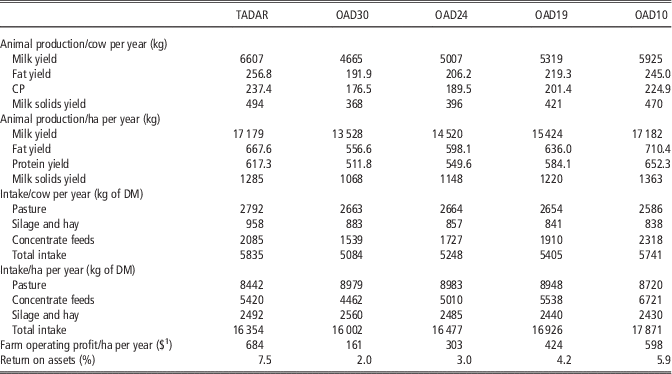
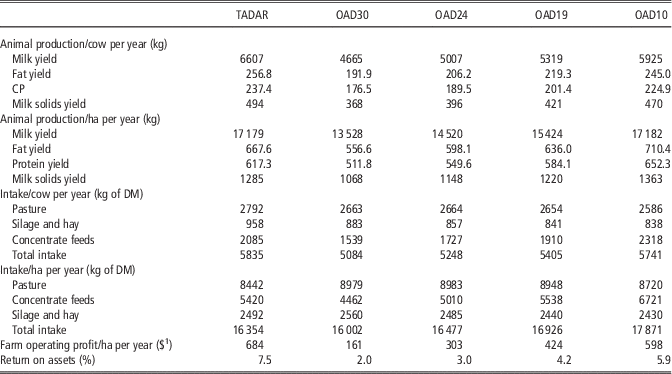
Productive and economic performance of deterministic simulations for all scenarios is presented in Table 1.
Productive and economic performance of dairy herds with cows milked twice a day (TADAR) and once a day (OAD) decreasing milk yield per cow by 30% (OAD30), 24% (OAD24), 19% (OAD19) or 10% (OAD10), under deterministic simulations
$=US dollar.
1 It includes saving in labour cost of 15% for OAD scenarios compared with TADAR.
Milk and milk solids yields
Within OAD scenarios, milk yield/ha per year decreased 21%, 15% and 10%, for scenarios OAD30, OAD24 and OAD19, respectively, compared with TADAR. Scenario OAD10, created to represent a farm performing the 4th and 5th year after switching to OAD milking, produced 17 182 kg/ha per year, which was similar to TADAR scenario. Scenario OAD30, created to represent the average milk yield decrease per cow observed in OAD full lactation experiments, produced 15.7 kg/cow per day, which represents 1942 kg/cow per year less than TADAR scenario. Milk solids yield per ha was the highest for scenario OAD10, which produced 1363 kg/ha per year.
Dry matter intake
Dry matter intake per cow and per ha is also shown in Table 1. The TADAR scenario had the highest DMI per cow due to greater energy requirements to produce more milk per cow compared with OAD scenarios. However, DMI per ha was higher in OAD10 due to higher SR compared with TADAR. Pasture utilisation efficiency (pasture consumed/pasture offered×100) were 70.0%, 74.9%, 74.5%, 73.5% and 73.1% for TADAR, OAD30, OAD24, OAD19, OAD10, respectively.
Economic results
The TADAR scenario had both the highest average farm operating profit and return on assets ($684/ha per year and 7.5%, respectively), when labour cost was reduced 15% in OAD scenarios. Farm operating profit and return on assets decreased as milk production per cow decreased under OAD scenarios. All OAD scenarios showed positive farm operating profit and return on assets, being OAD10 the one that had the best economic results among OAD scenarios (13% lower farm operating profit than TADAR). Farm operating profit for OAD30 was $161/ha per year and return on assets was 2%. When labour cost was further reduced by 30%, in OAD scenarios compared with TADAR, farm operating profit was $246, $394, $521 and $706 per ha/year in OAD30, OAD24, OAD19, OAD10 scenarios, respectively. Economic results presented in Table 1, and stochastic simulations, were calculated with labour cost reduced by 15%, in OAD scenarios, compared with TADAR.
Stochastic simulations: risk analysis
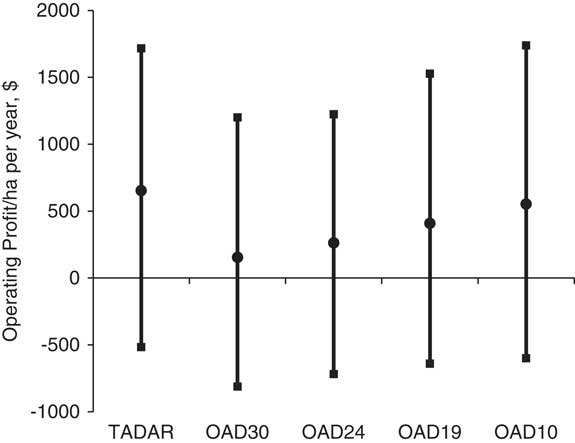
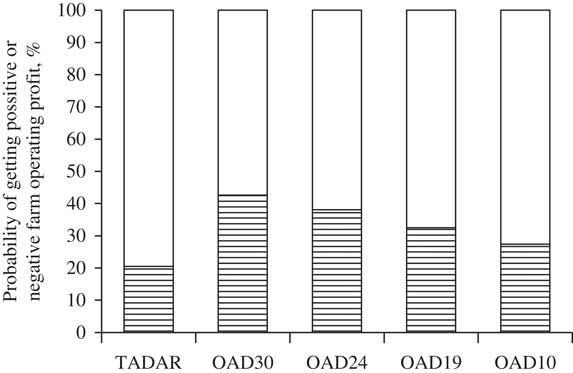
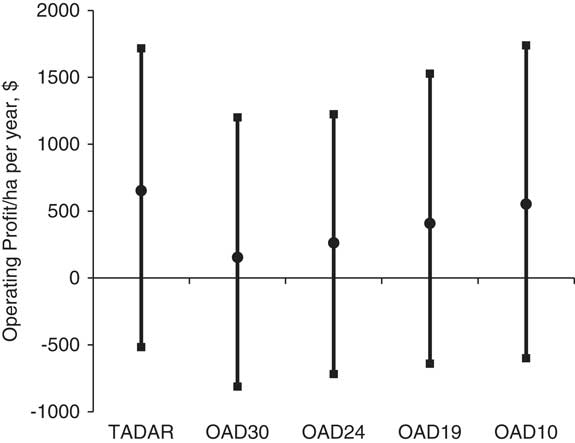
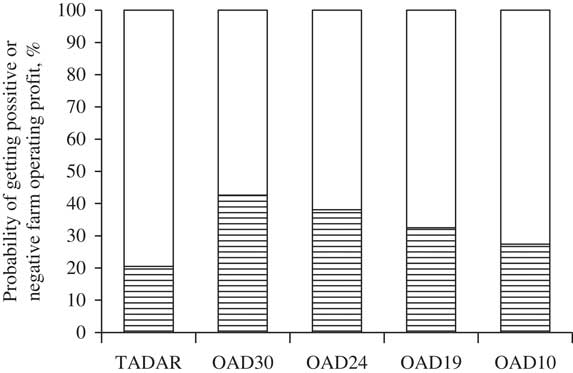
Figure 1 shows the range of predicted farm operating profit for each scenario, within the 80% probability range, as the top and bottom 10% results were excluded. Randomised milk prices, using a normal probability function, resulted in a range of $0.145 to $0.448/kg of milk and $0.157 to $0.480/ kg of milk for TADAR and OAD scenarios, respectively. According to stochastic simulations, all scenarios showed relatively similar dispersion of results due to market and climate variability, which is illustrated by the length of the bar, which represents the possible range of results. In 80% of years, farm operating profit per ha per year would be between $512 and $1718, $811 and $1201, $718 and $1224, $640 and $1528, $600 and $1740 for TADAR, OAD30, OAD24, OAD19, OAD10, respectively. Probability of getting negative farm operating profit every 10 years would be approximately: 20% for TADAR, 40% for OAD30 and OAD24 and 30% for OAD19 and OAD10 (Figure 2).
Predicted farm operating profit, in US dollar ($), for each scenario investigated, facing simultaneously market (random milk and concentrate prices) and climate (random pastures and crops yields) variations. Scenarios represent twice a day milking (TADAR), and once a day (OAD) milking with 30% (OAD30), 24% (OAD24), 19% (OAD19) and 10% (OAD10) milk yield decrease per cow, compared with TADAR scenario. Circle in the middle of the bar indicates the average farm operating profit and the length of the bar indicates the range in which economic outcomes are observed in 1000 simulations. Top and bottom 10% results were excluded.
Probability of getting positive (white bars) or negative (stripped bars) farm operating profit for all scenarios investigated, facing market variation (random milk and concentrate feeds prices) and climate variation (random pasture and crops yields) in 1000 simulations. Scenarios represent twice a day milking (TADAR), and once a day (OAD) milking with 30% (OAD30), 24% (OAD24), 19% (OAD19) and 10% (OAD10) milk yield decrease per cow, compared with TADAR scenario.
Discussion
Deterministic simulation: productive performance
Experimental studies conducted with cows milked OAD during the whole lactation have shown, in average, 30% decrease in milk yield per cow compared with cows milked OAD (Holmes et al., Reference Holmes1992; Cooper, Reference Cooper2000; Remond et al., Reference Rémond, Pomiès, Dupont and Chilliard2004; Clark et al., Reference Clark, Phyn, Tong, Collis and Dalley2006; O’Brien et al., Reference O’Brien, Gleeson, Boyle and Mee2007). This high decrease in milk volume per cow, which was represented in our study by scenario OAD30, is probably the major impediment for farmers who are considering a change to OAD. However, in the aforementioned OAD experiments, due to experimental rules, cows that could not adapt to OAD frequency (i.e. produce low volumes of milk) were not refused from the herd, thus decreasing the average milk production per cow. This is not a common practice in commercial farms. Instead, as reported in Holmes (Reference Holmes, Wilson, Mackenzie and Purchas2011), commercial farms that switch from TAD to OAD milking achieve lower milk yield reduction per cow than in experimental conditions due to culling of non-suited cows. During the first years of OAD milking, higher decrease in milk production per cow is expected, compared with subsequent years milking OAD (DairyNZ, 2016). Farmers considering OAD milking should be aware of it to cope with lower incomes due to lower milk sales and possible higher replacement rate during the first years under OAD. Cows are generally selected in conditions where they are milked TAD, so when milking frequency is switched to OAD it is expected that some cows would not adapt to this milking frequency (early dried off, low milk production, udder problems) and have to be replaced (Holmes, Reference Holmes, Wilson, Mackenzie and Purchas2011). This also means that only farmers who are able to manage additional heifers each year, could afford a change to OAD systems. Achieving a decrease in milk production per cow of only 10% compared with TADAR, as we assumed for OAD10, would be possible only after many years milking on OAD and higher culling rates than TADAR, when most of the herd is adapted to the new milking frequency.
Scenario OAD10, with 10% decrease in milk production per cow and 10% increase in SR had similar productivity compared with TADAR. Increasing SR is a strategy used to compensate for reduced milk production per cow in OAD farms (Clark et al., Reference Clark, Phyn, Tong, Collis and Dalley2006). An experiment conducted in New Zealand (Clark et al., Reference Clark, Phyn, Tong, Collis and Dalley2006) showed that milk yield per ha was only reduced by 13% compared with TAD herds despite milk yield per cow decreased 27%, when SR was increased by 17% in OAD herds compared with TAD. In our study SR rate was 10% higher for OAD scenarios, compared with TADAR, to compensate for lower milk production per cow. Higher SR, than the proposed 10% in our study, would have implied more feed into the systems to maintain milk yield per cow and more than three cows per ha, and this in turn, may have negative impact on the environment in grazing systems (Basset-Mens et al., Reference Basset-Mens, Ledgard and Boyes2009), given the initial SR used in TADAR.
Increasing SR by 10%, in our OAD scenarios, also increased pasture utilisation, compared with TADAR scenario, as it usually occurs in dairy grazing systems (MacDonald et al., Reference MacDonald, Penno, Lancaster and Roche2008). In the present study, cows on scenario OAD10 showed higher intake of supplements and lower intake of pasture than cows on TADAR. This was due to lower amount of pasture available per cow in OAD10, as SR was set 10% higher for OAD scenarios. There is limited information on what can be expected when cows are fed pasture combined with great amounts of supplements, under OAD milking, as we used in our modelling study. In our study, scenario OAD19 produced similar yields of milk per cow than the cows under OAD reported by Remond et al. (Reference Rémond, Pomiès, Dupont and Chilliard2004). Our study, despite being based on modelling, explored OAD scenarios under moderate to high supplementation levels, as we used great amounts of concentrate feeds for OAD scenarios (1.8 tonnes of DM of concentrate feeds/cow per year, average for all OAD scenarios).
Deterministic simulation. Economic results with 15% reduction in labour cost
All scenarios simulated in our study had positive economic results in deterministic simulations. Farm operating profit for OAD scenarios was lower than TADAR. Our scenario OAD30 showed 76% less profit than TADAR, indicating that if milk production per cow is consistently reduced by 30%, as showed in full lactation experiments, and represented in our study by OAD30, OAD may not be economically attractive for farmers. Profitability of OAD milking systems has been also reported for commercial farms in New Zealand and Australia (Anderle and Dalley, Reference Anderle and Dalley2007; Armstrong and Ho, Reference Armstrong and Ho2009; DairyNZ, 2016). In these studies, economic data showed that farm operating profit and return on assets were positive but 24% and 14% lower, respectively, compared with TAD farms (DairyNZ, 2016). Due to the expected reduction on farm profit, OAD milking would be recommended only for efficient and high profitability TAD farms which can afford reduction in profit to gain better working conditions.
Deterministic simulation: economic results with 30% reduction in labour cost
Bigger reductions of labour cost may compensate decreased profit in OAD scenarios. We have also calculated farm operating profit in OAD scenarios, with a reduction of 30% in labour cost, as proposed by Anderle and Dalley (Reference Anderle and Dalley2007). In this case, only scenario OAD10 would have had higher profit than TADAR ($706/ha and $684/ha per year, respectively). All other OAD scenarios would have increased profit but it still would not compensate for reduction in milk production. Although milking time is reduced when milking OAD, there are other activities, not related to milking, such as calf rearing, distribution of feed, animal health treatments, which are independent of the milking frequency (Guimaraes and Woodford, Reference Guimaraes and Woodford2005). Therefore decreasing milk yield per cow by 10% and reducing labour cost by 30%, would be an alternative for OAD systems to be as profitable as TADAR, under our assumptions.
Stochastic simulations: risk analysis
We included stochasticy in the model for milk and concentrate feeds prices and crop and pastures yields, to perform a risk analysis under all five scenarios. Both uncertainty effects, namely climate and market variation, were investigated simultaneously, as could be the case in real scenarios. To our knowledge, there are no previous studies comparing the risk of OAD and TAD systems. Our results showed that exposure to risk would be higher in all OAD scenarios compared with TADAR, as the amount of years with negative economic results would be higher in all OAD scenarios (Figure 2).
Limitations of our assumptions
In our modelling study, all expenses were considered equal, on a per cow basis, for TAD and OAD scenarios, except for labour and electricity; labour was assumed to be cheaper in OAD scenarios and electricity was considered to be dependent on milk production. However, there are other expenses that usually decrease when milking OAD, such as animal health, milking-related expenses and herd improvement (Anderle and Dalley, Reference Anderle and Dalley2007) but we did not account for this reductions in our study. We assumed higher milk price for OAD scenarios, as protein and fat content were increased in OAD scenarios; however a possible decrease of milk price due to possible increased somatic cell count was not accounted for in our study. Most of experiments evaluating OAD milking have been conducted with cows with initial low somatic cell count (<200 000/ml), and milking OAD have risen somatic cell count to <300 000/ml (Cooper, Reference Cooper2000; Clark et al., Reference Clark, Phyn, Tong, Collis and Dalley2006). However, if somatic cell count is high in TAD systems, and increases in OAD scenarios, above threshold limits, price penalties might be applied.
It is generally reported that cows milked OAD gain more live weight and body condition score during lactation than cows milked TAD (Holmes et al., Reference Holmes1992; Remond et al., Reference Rémond, Pomiès, Dupont and Chilliard2004). Improvement in BCS may reduce veterinary-related costs, metabolic diseases and reduce empty rates, thus improving reproductive performance in cows milked OAD. Results from experiments (Remond, et al., Reference Rémond, Pomiès, Dupont and Chilliard2004; Clark et al., Reference Clark, Phyn, Tong, Collis and Dalley2006; Patton et al., Reference Patton, Kenny, Mee, O’Mara, Wathes, Cook and Murphy2006) and commercial farms (DairyNZ, 2016) demonstrated that some reproductive parameters are improved when cows are milked OAD. An improvement in reproductive performance in OAD farms would reduce culling due to reproductive failure. This would represent an advantage for OAD systems; we did not account for improved reproduction performance in our study.
Main benefits of OAD milking systems are related to improvement in working conditions. Employee turnover generates costs to the employer, including recruiting, selecting and training a new employee and also productivity losses (Billikopf and González, Reference Billikopf and González2012). Milking OAD may help to retain good staff in the farm and also reduce turnover rates. In our modelling study none of these advantages were included or valued in economic terms.
Conclusions
Milk yield/ha per year was similar in OAD10 compared with TADAR due to higher SR in the former. For all other OAD scenarios, milk yield per ha was lower than TADAR. Economic profit for OAD scenarios was lower than in TADAR, but still positive, yet risk would be higher under OAD. Decreasing labour cost by 15% in OAD scenarios, compared with TADAR, would not compensate the decrease in profit due to lower milk production. Higher reduction of labour cost may help to have better economic results. Results from our study suggest that under the assumptions used in these simulations, OAD milking might be an attractive alternative for farmers provided that, decrease in milk yield per cow is maintained at minimum and labour cost is greatly reduced.
Acknowledgements
The principal author acknowledges the support from CONICET doctoral scholarships from Argentina.