Introduction
Insects, being constantly exposed to a variety of pathogens like bacteria, fungi, and viruses, lack adaptive immune responses found in vertebrates and rely solely on their innate immune system for defence (Lemaitre and Hoffmann, Reference Lemaitre and Hoffmann2007). During invasion of the cuticular surface and various ectodermal body parts such as tracheae, alimentary canal, and reproductive ducts by parasites, the immune system of insects get energised (Ashida and Brey, Reference Ashida and Brey1995; Dorrah et al., Reference Dorrah, Mohamed and Shaurub2019; Lin et al., Reference Lin, Cohen and Wasserman2020; W Zhang et al., Reference Zhang, Tettamanti, Bassal, Heryanto, Eleftherianos and Mohamed2021b). This immune response is typically initiated by the recognition of pathogen-associated molecular patterns (PAMPs) by pattern-recognition receptors (PRRs) (Pal and Wu, Reference Pal and Wu2009; Zhang et al., Reference Zhang, He, Cao, Gunaratna, Chen, Blissard, Kanost and Jiang2015). According to the pattern in vivo, PRRs can be divided into secreted PRRs and transmembrane PRRs (Wang et al., Reference Wang, Zhang, Zhang and Zhang2019), of which secreted PRRs are mainly located in the haemocytes and fat body (Stokes et al., Reference Stokes, Yadav, Shokal, Smith and Eleftherianos2015), including thioester-containing proteins, peptidoglycan (PGN) recognition proteins, Gram-negative bacteria-binding protein (GNBPs), β-1,3-glucan recognition protein (βGRP), haemolins, and C-type lectins (CTLs) (W Zhang et al., Reference Zhang, Tettamanti, Bassal, Heryanto, Eleftherianos and Mohamed2021b).
CTLs typically contain at least one calcium-dependent carbohydrate-recognition domain (CRD) (Weis et al., Reference Weis, Crichlow, Murthy, Hendrickson and Drickamer1991). Based on the domain structures, insect CTLs can be categorised into three main groups: CTL-S, immulectin (IML), and CTL-X (Xia et al., Reference Xia, You, Rao and Yu2018). The CTL-S and IML groups usually consist of single- and dual-CRD domains, respectively, whereas the CTL-X group comprises one CRD along with other intricate functional domains. Additionally, CRDs contain highly conserved motifs that are crucial for the binding specificity of PAMPs. For instance, CRDs with EPN (Glu-Pro-Asn) motifs can bind mannose and N-acetyl glucosamine, while those with QPD (Gln-Pro-Asp) motifs exhibit specificity for galactose and N-acetyl glucosamine (Weis et al., Reference Weis, Taylor and Drickamer1998; Y Zhang et al., Reference Zhang, Ai, Wang, Zhang, Du, Wang, Wang, Gao and Li2022b).Therefore, CTL-X is likely to be involved in biological functions that extend beyond its established role in immunity.
Previously studies have illustrated that CTL-IML primarily contributes to the innate immune response (Bi et al., Reference Bi, Ning, Li, Zhang, Wang, Xu, Zhong, Wang, Song and Li2020a; Eleftherianos et al., Reference Eleftherianos, Marokhazi, Millichap, Hodgkinson, Sriboonlert, Ffrench-constant and Reynolds2006; Ling and Yu, Reference Ling and Yu2006; Song et al., Reference Song, Tian, Dong, Ren, Du and Hu2020; Yu and Kanost, Reference Yu and Kanost2000, Reference Yu and Kanost2003). CTL-S and CTL-X not only participate in immune responses but also play crucial roles in developmental regulation and cell adhesion. For instance, Bombyx mori CTL-S6 has been observed to bind to lipopolysaccharide (LPS) and PGN, enhancing the phenoloxidase (PO) activity of haemolymph (Shen et al., Reference Shen, Tong, Guo, Mei, Xia, Qiu and Zhao2021). Additionally, B. mori CTL-S3 aids in the rapid clearance of pathogens from larval body cavities, indicating its potential role as an opsonin in larval haemolymph (Zhan et al., Reference Zhan, Shahzad, Yang, Liu, Yu and Rao2016). In Helicoverpa armigera, HaCTL3 (CTL-S) modulates larval body size and pupation time via mediating homeostasis of Enterocuccus mundtii in the haemolymph (Wang et al., Reference Wang, Wang, Zhuo, Liu, Tang, Liu and Wang2020). About the functions of CTL-X, the defectiveness of uif (CTL-X) led to abnormal tracheal inflation and larval death of D. melanogaster (Zhang andWard, Reference Zhang and Ward2009), the gene product of CG3921 is essential for septate junctions’ maturation and cell adhesion (Hildebrandt et al., Reference Hildebrandt, Pflanz, Behr, Tarp, Riedel and Schuh2015; Jaspers et al., Reference Jaspers, Nolde, Behr, Joo, Plessmann, Nikolov, Urlaub and Schuh2012). Furthermore, furrowed (CTL-X) is crucial for establishing planar cell polarity (Chin and Mlodzik, Reference Chin and Mlodzik2013; Leshko-Lindsay and Corces, Reference Leshko-Lindsay and Corces1997). There have been multiple reports on the immune effects of CTL-X on Tribolium castaneum, demonstrating its significant function in binding and agglutinating bacteria, as well as regulating the expression of antimicrobial peptides (Bi et al., Reference Bi, Wang, Gao, Liu, Jiang, Gao, Li, Song and Ning2023; Wang et al., Reference Wang, Ai, Zhang, Bi, Gao, Chen and Li2023; Zhang et al., Reference Zhang, Zhang, Yang, Hong, Du, Hu, Tang, Wang, Feng and Li2022a; Zhang et al., Reference Zhang, Ai, Wang, Zhang, Du, Wang, Wang, Gao and Li2022b). However, studies on its involvement in fundamental biological processes, such as insect growth and development, remain limited and underexplored.
The red flour beetle, T. castneum (Coleoptera), is a destructive and worldwide pest of stored cereals. With the publication and characterisation of genome (Richards et al., Reference Richards, Gibbs, Weinstock, Brown, Denell, Beeman, Gibbs, Beeman, Brown, Bucher, Friedrich, Grimmelikhuijzen, Klingler, Lorenzen, Richards, Roth, Schröder, Tautz, Zdobnov, Muzny, Gibbs, Weinstock, Attaway, Bell, Buhay, Chandrabose, Chavez, Clerk-Blankenburg, Cree, Dao, Davis, Chacko, Dinh, Dugan-Rocha, Fowler, Garner, Garnes, Gnirke, Hawes, Hernandez, Hines, Holder, Hume, Jhangiani, Joshi, Khan, Jackson, Kovar, Kowis, Lee, Lewis, Margolis, Morgan, Nazareth, Nguyen, Okwuonu, Parker, Richards, Ruiz, Santibanez, Savard, Scherer, Schneider, Sodergren, Tautz, Vattahil, Villasana, White, Wright, Park, Beeman, Lord, Oppert, Lorenzen, Brown, Wang, Savard, Tautz, Richards, Weinstock, Gibbs, Liu, Worley, Weinstock, Elsik, Reese, Elhaik, Landan, Graur, Arensburger, Atkinson, Beeman, Beidler, Brown, Demuth, Drury, Du, Fujiwara, Lorenzen, Maselli, Osanai, Park, Robertson, Tu, Wang, Wang, Richards, Song, Zhang, Sodergren, Werner, Stanke, Morgenstern, Solovyev, Kosarev, Brown, Chen, Ermolaeva, Hlavina, Kapustin, Kiryutin, Kitts, Maglott, Pruitt, Sapojnikov, Souvorov, Mackey, Waterhouse, Wyder, Zdobnov, Zdobnov, Wyder, Kriventseva, Kadowaki, Bork, Aranda, Bao, Beermann, Berns, Bolognesi, Bonneton, Bopp, Brown, Bucher, Butts, Chaumot, Denell, Ferrier, Friedrich, Gordon, Jindra, Klingler, Lan, Lattorff, Laudet, von Levetsow, Liu, Lutz, Lynch, da Fonseca, Posnien, Reuter, Roth, Savard, Schinko, Schmitt, Schoppmeier, Schröder, Shippy, Simonnet, Marques-Souza, Tautz, Tomoyasu, Trauner, Van der Zee, Vervoort, Wittkopp, Wimmer, Yang, Jones, Sattelle, Ebert, Nelson, Scott, Beeman, Muthukrishnan, Kramer, Arakane, Beeman, Zhu, Hogenkamp, Dixit, Oppert, Jiang, Zou, Marshall, Elpidina, Vinokurov, Oppert, Zou, Evans, Lu, Zhao, Sumathipala, Altincicek, Vilcinskas, Williams, Hultmark, Hetru, Jiang, Grimmelikhuijzen, Hauser, Cazzamali, Williamson, Park, Li, Tanaka, Predel, Neupert, Schachtner, Verleyen, Raible, Bork, Friedrich, Walden, Robertson, Angeli, Forêt, Bucher, Schuetz, Maleszka, Wimmer, Beeman, Lorenzen, Tomoyasu, Miller, Grossmann and Bucher2008), and the high efficiency of systemic and parental RNA interference (RNAi) (Tomoyasu et al., Reference Tomoyasu, Miller, Tomita, Schoppmeier, Grossmann and Bucher2008), T. castaneum was utilised as a powerful model organism for the study of developmental and evolutionary biology and immunity (Richards et al., Reference Richards, Gibbs, Weinstock, Brown, Denell, Beeman, Gibbs, Beeman, Brown, Bucher, Friedrich, Grimmelikhuijzen, Klingler, Lorenzen, Richards, Roth, Schröder, Tautz, Zdobnov, Muzny, Gibbs, Weinstock, Attaway, Bell, Buhay, Chandrabose, Chavez, Clerk-Blankenburg, Cree, Dao, Davis, Chacko, Dinh, Dugan-Rocha, Fowler, Garner, Garnes, Gnirke, Hawes, Hernandez, Hines, Holder, Hume, Jhangiani, Joshi, Khan, Jackson, Kovar, Kowis, Lee, Lewis, Margolis, Morgan, Nazareth, Nguyen, Okwuonu, Parker, Richards, Ruiz, Santibanez, Savard, Scherer, Schneider, Sodergren, Tautz, Vattahil, Villasana, White, Wright, Park, Beeman, Lord, Oppert, Lorenzen, Brown, Wang, Savard, Tautz, Richards, Weinstock, Gibbs, Liu, Worley, Weinstock, Elsik, Reese, Elhaik, Landan, Graur, Arensburger, Atkinson, Beeman, Beidler, Brown, Demuth, Drury, Du, Fujiwara, Lorenzen, Maselli, Osanai, Park, Robertson, Tu, Wang, Wang, Richards, Song, Zhang, Sodergren, Werner, Stanke, Morgenstern, Solovyev, Kosarev, Brown, Chen, Ermolaeva, Hlavina, Kapustin, Kiryutin, Kitts, Maglott, Pruitt, Sapojnikov, Souvorov, Mackey, Waterhouse, Wyder, Zdobnov, Zdobnov, Wyder, Kriventseva, Kadowaki, Bork, Aranda, Bao, Beermann, Berns, Bolognesi, Bonneton, Bopp, Brown, Bucher, Butts, Chaumot, Denell, Ferrier, Friedrich, Gordon, Jindra, Klingler, Lan, Lattorff, Laudet, von Levetsow, Liu, Lutz, Lynch, da Fonseca, Posnien, Reuter, Roth, Savard, Schinko, Schmitt, Schoppmeier, Schröder, Shippy, Simonnet, Marques-Souza, Tautz, Tomoyasu, Trauner, Van der Zee, Vervoort, Wittkopp, Wimmer, Yang, Jones, Sattelle, Ebert, Nelson, Scott, Beeman, Muthukrishnan, Kramer, Arakane, Beeman, Zhu, Hogenkamp, Dixit, Oppert, Jiang, Zou, Marshall, Elpidina, Vinokurov, Oppert, Zou, Evans, Lu, Zhao, Sumathipala, Altincicek, Vilcinskas, Williams, Hultmark, Hetru, Jiang, Grimmelikhuijzen, Hauser, Cazzamali, Williamson, Park, Li, Tanaka, Predel, Neupert, Schachtner, Verleyen, Raible, Bork, Friedrich, Walden, Robertson, Angeli, Forêt, Bucher, Schuetz, Maleszka, Wimmer, Beeman, Lorenzen, Tomoyasu, Miller, Grossmann and Bucher2008; Tonk et al., Reference Tonk, Knorr, Cabezas-Cruz, Valdés, Kollewe and Vilcinskas2015). Based on its genome, Zou et al. have identified 16 CTLs from T. castaneum: 10 (Tc-CTL1, 2, 4 through 10, and 13) with a single CRD, and only Tc-CTL3 with two, 5 other CTLs (Tc-CTL11, 12, 14, 15, and 16) contain a CRD and other functional domains(Zou et al., Reference Zou, Evans, Lu, Zhao, Williams, Sumathipala, Hetru, Hultmark and Jiang2007). In our previous research, a novel CTL-X (designated as TcCTL17, accession no. TC07861) was identified from T. castaneum by genome-wide analysis, which is consistent with other reports (Lu et al., Reference Lu, Su, Zhu, Zhu, Li, Hu, Zhang, Zhang and Yu2020). Therefore, the objective of this study is to investigate whether TcCTL17 has diversity of biological functions. In the present study, recombinant TcCTL17 (rTcCTL17) showed the activity of binding polysaccharide and bacteria. We confirmed that TcCTL17 could eliminate the invasive Escherichia coli and Staphylococcus aureus and improve the survival rate of larvae. Moreover, RNAi of TcCTL17 inhibited the metamorphosis and fecundity of T. castaneum by impacting the 20E/JH signalling pathway and vitellogenin (Vg), respectively. All these findings will help us to better understand the functions of PRR in T. castaneum immunity and development, which may be useful in controlling beetle pests through RNAi-based control strategies.
Materials and methods
Insect and bacteria
The Georgia-1 strain of T. castaneum was used for all experiments. The insects were reared in whole wheat flour containing brewer’s yeast (5.0%) at 30°C with relative humidity of 40.0% under a 14-h light/10-h dark period in a growth chamber (Gao et al., Reference Gao, Zhang, Wei, Wei, Xiong, Lu, Zhang, Gao and Li2020; Xiong et al., Reference Xiong, Gao, Lu, Wei, Mao, Xie, Cao, Liu, Bi, Song and Li2019).
Five types of microorganisms used here included three Gram-positive bacteria (G+) (S. aureus, Bacillus subtilis, and Bacillus thuringiensis) and two Gram-negative bacteria (G–) (E. coli and Pseudomonas aeruginosa). All bacteria were cultured in Luria-Bertani (LB) medium at 37°C.
Bioinformatics analysis of TcCTL17
The coding sequence of TcCTL17 gene (accession no. TC007861) was obtained from the iBeetle-Base (https://ibeetle-base.uni-goettingen.de/). Transmembrane regions and structural domains were predicted using TMHMM 2.0 (http://www.cbs.dtu.dk/services/TMHMM/) and SMART (http://smart.emblheidelberg.de/), respectively. The deduced protein sequence of CRD, molecular weight, and isoelectric point (pI) of TcCTL17 were predicted using the ExPASy (https://www.expasy.org).
Sample collection and bacterial challenge
To examine the stage and tissue distribution of TcCTL17, RNA was isolated from pooled individuals following the method described by Zhang (Zhang et al., Reference Zhang, Ai, Wang, Zhang, Du, Wang, Wang, Gao and Li2022b). The developmental stage samples included 1-day-old eggs (EE, ∼50 mg), 3-day-old eggs (LE, ∼50 mg), 1-day-old larvae (EL, ∼50 mg), 20-day-old larvae (LL, 3 individuals), 1-day-old pupae (EP, 3 individuals), 5-day-old pupae (LP, 3 individuals), 1-day-old adults (EA, 3 individuals), and 10-day-old adults (LA, 3 individuals). Tissue samples were obtained from pools of approximately 100 20-day-old larvae and included fat body, central nervous system, haemocytes, head, epidermis, gut, and haemolymph. All samples were collected using a mixed-gender approach. Each sample was subjected to three biological replicates.
The bacterial challenge experiments refer to the previous study (Bi et al., Reference Bi, Feng, Li, Mao, Ning, Song, Xie, Tang and Li2019). Briefly, 200 nL of E. coli suspension (∼7.8 × 10⁴ cells) or S. aureus suspension (∼7.0 × 10⁴ cells) was injected into each 15-day-old larva using InjectMan 4 (Eppendorf, Hamburg, Germany). Meanwhile, the larvae injected 200 nL of injection buffer (IB) which was composed of edible pigment (caizhihuang, China) and diethyl pyrocarbonate water in the ratio of 1:9 were performed as control group. Each group included about 30 larvae and carried out three biological replicates. At 3, 6, 12, 24, 36, 48, 60, 72 h after bacterial challenge, three survival individuals of each group were randomly sampled, the surviving individuals exhibited life responses to perturbations involving a brush.
RNA extraction, cDNA synthesis, and qRT-PCR analysis
Total RNAs of above samples were extracted using Total RNA Extraction Reagent (Product code: R401-01, Vazyme, Nanjing, China) according to the standard protocol. Subsequently, 0.5 μg of RNA, evaluated for quality and quantity using the Nanodrop 2000/2000c Spectrophotometer (ND-1000, USA), was employed for reverse transcription with HiScript® III RT SuperMix (Vazyme, Nanjing, China, Product code: R323-01) following the manufacturer’s instructions. The resulting products were diluted 10-fold and used as templates for quantitative real-time polymerase chain reaction (qRT-PCR) to determine the relative expression levels of the target genes listed in Table S1, qPCR conditions were set as an initial incubation of 95℃ for 30 s, 40 cycles of 95℃ for 5 s, and 60℃ for 30 s, and the relative expression levels of genes were normalised to reference gene with the 2 −ΔΔCT method. The ribosomal protein S3 (rps3; accession no. CB335975) was employed as an internal control for all samples.
Expression and purification of rTcCTL17
The cDNA fragment encoding TcCTL17-CRD was amplified using clone primer pairs (Table S2). Then the amplified fragment was inserted into the pET-28a (+) vector digested with EcoRI and XhoI and then transformed into E. coli strain DH5α (TransGene, Beijing, China) competent cells, and the positive clones were screened and sent for sequencing (GENERAL, Anhui, China). The recombinant plasmid was transformed to E. coli strain BL21 (TransGene, Beijing, China) and cultivated in Luria–Bertani medium containing 100 ug/ml kanamycin at 37°C, 200 rpm for 3 h. Subsequently, isopropyl β-d-1-thiogalactopyranoside (IPTG, 0.5 mM) was used for inducing the expression of recombinant protein followed by additional cultivation for 4 h. The refolding and purification of rTcCTL17 was on the basis of the methods of Bi et al. (Reference Bi, Feng, Li, Mao, Ning, Song, Xie, Tang and Li2019), centrifuge at 4°C at 12,000 rpm for 10 min between each step, followed by resuspension of the precipitate. The successfully purified protein was quantified using Total protein quantitative assay kit (Product code: A045-2-2, Jiancheng, Nanjing, China) and preliminary analysis using 12.0% sodium dodecyl sulphate polyacrylamide gel electrophoresis (SDS-PAGE).
Western blotting analysis
After separated by 12.0% SDS-PAGE, the band of rTcCTL17 was transferred from the gel to polyvinylidene fluoride membrane. After sealed in blocking buffer (Tris buffered saline with Tween-20 (TBST)) buffer which contained 5.0% skim milk powder) at room temperature (RT) for 2 h, the membrane was incubated with anti-His mouse polyclonal antibodies (1:2000 diluted in TBST) (TransGen, Beijing, China) at 4°C overnight. And then, washed membrane was incubated with the Goat Anti-Mouse IgG (H + L) and horseradish peroxidase (HRP) Conjugate (1:5000 diluted in TBST) (TransGen, Beijing, China) at RT for 2 h. After rinsed thrice times with TBST, the objective band was detected using Enhanced Chemiluminescence Substrate Kit (Product code: E411-04, Vazyme, Nanjing, China).
PAMPs binding assay of rTcCTL17
Enzyme-linked immunosorbent assay (ELISA) was used test the direct binding activity of rTcCTL17 to bacterial cell wall components according to the previous description (Li et al., Reference Li, Bi, Zhang, Wang, Zhong, Xu, Wang and Li2021). In brief, 96-well ELISA plates (Product code: 3300, Shanghai, China) were coated with 50 µL/well of LPS or PGN (80 μg/mL, diluted with TBS) at 37°C overnight. The plates were incubated at 60°C for 30 min to promote tighter binding of LPS and PGN, ensuring they remain attached during washing. This was followed by blocking with 200 μL of 1 mg/mL bovine serum albumin (BSA) at 37°C for 2 h. The supernatant was then discarded, and 100 µL of rTcCTL17 at various concentrations (0–70 μg/mL) was added to the wells and incubated at RT for 3 h. After washing thrice with TBS, each well was treated with 100 μL of anti-His mouse polyclonal antibodies (diluted 1:2000 in TBS) (Transgen, Beijing, China) and incubated at RT for 1 h. Subsequently, the wells were exposed to 100 µL of goat anti-mouse IgG (H + L) and HRP Conjugate (diluted 1:5000 in TBS) (Transgen, Beijing, China) at 37°C for 2 h. Next, 100 µL of 3,3,5,5-tetramethylbenzidine (TMB) solution (Beyotime, Shanghai, China) was added to each well as a chromogenic reagent in the dark. After a 10-min incubation, 100 µL of 2 M sulphuric acid was added to halt the chromogenic reaction. Finally, the absorbance at OD450 was determined using a Multiskan™ GO Microplate Spectrophotometer (Thermo Scientific, Waltham, MA, USA). Each assay was performed in triplicate.
Microbe binding and agglutination assay
The ability of rTcCTL17 binding to and agglutinating three G+ bacteria (S. aureus, B. subtilis, B. thuringiensis) and two G– bacteria (E. coli, P. aeruginosa) was performed as described previously with slight modifications(Bi et al., Reference Bi, Feng, Li, Mao, Ning, Song, Xie, Tang and Li2019). Briefly, the five bacteria were cultured in 5 mL LB medium at 37°C overnight. After washed thrice with TBS, the microorganisms were suspended at 2 × 10⁸ cells/mL, then 25 μL of purified rTcCTL17 (600 μg/mL) was added into 25 μL bacterial suspension in the presence or absence of 10 mM CaCl2. The recombinant methyl-CpG-binding domain (rTcMBD) of T. castaneum was used as negative control. Following this, the mixture was incubated at RT for 2 h with gentle rotation, and the bound proteins were separated and analysed by 12.0 % SDS-PAGE and Western blot after being washed for 10 times with 1 mL of TBS.
For the agglutination assay, five microorganisms, mentioned above, were suspended at 2 × 10⁸ cells/mL with sterile TBS. And then, in the presence or absence of Ca2+, 25 µL of bacterial suspension was incubated with 25 µL of rTcCTL17 (200 µg/mL) and rTcMBD (200 µg/mL, as control) at RT for 2 h. The agglutination reactions were observed and photographed by microscopy (Nikon, Shanghai, China).
RNAi assay, survival rate assay, bacterial clearance assay, and PO activity assay
The templates used to synthesise double-stranded RNAs (dsRNAs) of TcCTL17 by the Thermo Scientific TranscriptAid T7 High Yield Transcription Kit (Product code: K0441, Thermo Fisher Scientific, Shanghai, China) were amplified and purified by PCR and Gel purification kit (Product code: DC301, Vazyme, Nanjing, China), respectively. Then a total of 200 ng of the dsRNA dissolved in 200 nL IB was injected into the body cavity of each larva, meanwhile, larvae injected with equal volume of dsTcVer were employed for control group. On the third day after injection, the silencing efficiency was detected by RT-qPCR.
At 72 h after dsRNA injection, 40 larvae of each group were injected with 200 nL E. coli (∼7.8 × 10⁴ cells/larva) or S. aureus (∼7.0 × 10⁴ cells/ larva) into the body cavity to evaluate the shrimp survival rate. The number of dead larvae was observed at fixed intervals of 12 h, and dead individuals were excluded from the container to ensure that measurements were not repeated. The experiment was conducted using a single blind method. Survival curves were made using GraphPad 8.0 software. The significance between different curves was calculated with Log-rank (Mantel–Cox) test.
To explore the potential effect of TcCTL17 on the innate immunity, 12-day-old larvae were injected with E. coli or S. aureus at 72 h post injection of dsTcCTL17 or dsTcVer. After 3 h injection of E. coli or S. aureus, three larvae were randomly sampled and ground, then the homogenate was diluted with sterile PBS (1:1000) and 100 μL diluent was plated onto LB agar plates. After cultured at 37°C overnight, the number of bacterial colonies were counted in each plate. Three biological replicates were carried out for each assay.
To determine the potential immune function of TcCTL17, the PO activity of haemolymph was measured following a previous study (Tabunoki et al., Reference Tabunoki, Dittmer, Gorman and Kanost2019). Briefly, the haemolymph from TcCTL17 or TcVer depleted larvae was collected by centrifugation at 1000 g for 30 min at 4°C. Then, 25 μL haemolymph and 25 μL S. aureus or E. coli were incubated at 27°C for 30 min, following this, 200 μL l-dopa (3 mg/mL) was added as substrate to measure the PO activity, as PO exhibits high oxidation levels of l-dopa (Baruah et al., Reference Baruah, Sarma, Bardoloi and Bora2019; Ghanem et al., Reference Ghanem, Abd-Elaziz and Mohamed2025; Nivetha et al., Reference Nivetha, Marieshwari, Dev, Meenakumari, Muralisankar and Janarthanan2023; Rafaluk-Mohr et al., Reference Rafaluk-Mohr, Wagner and Joop2018). One unit of activity (U) was defined as ΔA490 of 0.001 in 1 min (Yuan et al., Reference Yuan, Xing, Wang, Wang, Yin, Wang, Hu and Zou2017). Each biological replicate consists of 30 larvae, and three biological replicates were carried out for each assay.
Behaviour analysis
For behaviour analysis, 15-day-old larval, 1-day-old pupal, and 5-day-old pupal were injected with dsTcCTL17 to assess noticeable metamorphosis defects, mortality, and reproduction. The injected 15-day-old larvae and 1-day-old pupae were observed for morphological defects and proportions. The injected 5-day-old pupae developed into 7-day-old adults for pairing, and the number of eggs per pair per day was recorded. The egg hatching rate was calculated over a 5-day period. Subsequently, the gonads of 10-day-old adults were dissected and imaged using an Olympus SZX16 stereomicroscope (Olympus Corporation, Tokyo, Japan).
Statistical analysis
The data were presented as mean ± SEM from three independent experiments. Significance in gene expression between experimental and control beetles was assessed using Student’s t-test or one-way analysis of variance (ANOVA) followed by Tukey’s test. Statistical significance was defined as p < 0.05.
Results
Sequence characterisation and bioinformatics analysis of TcCTL17
The TcCTL17 CRD (accession no. TC007861), comprising 98 amino acid residues, was cloned from T. castaneum and validated through sequencing. Analysis of the full sequence revealed that the TcCTL17 open reading frame (ORF) spans 8889 bp, encoding 2962 amino acid residues. Domain analysis identified a signal peptide, three scavenger receptor cysteine-rich domains, and one CRD within TcCTL17. Interestingly, the canonical CRD motifs (EPN, a CRD with Glu-Pro-ASN motif that can specifically bind to mannose, N-acetylglucosamine, and l-fucose and QPD, a CRD with Gln-Pro-Asp motif that can specifically bind to galactose and N-acetylgalactosamine) were absent in TcCTL17 (Fig. S1A). Functioning as a single transmembrane protein, TcCTL17 exhibits a theoretical molecular weight of 335.63 kDa and an isoelectric point of 6.41 (Fig. S1B).
Prokaryotic expression and purification of rTcCTL17
To preliminarily investigate whether TcCTL17 participates in immune response, rTcCTL17 was expressed and purified in vitro. Analysis by SDS-PAGE confirmed the successful expression and purification of rTcCTL17, which was found in the sediment fraction (Fig. 1A). Western blot analysis of the purified, hex histidine-tagged rTcCTL17 revealed a molecular weight of approximately 12 kDa, consistent with the theoretical molecular weight of the CRD of TcCTL17 (Fig. 1B).
The expression, purification, and binding activities of rTcCTL17. SDS-PAGE (A) and Western blotting (B) analyses of rTcCTL17. Lane M: molecular weight (kDa) marker; lane A1 and lane A2: the supernatant and precipitated protein of E. coli with pET-28a, respectively; lane A3 and lane A4: the supernatant and precipitated protein of E. coli with pET-28a-TcCTL17, respectively; lane A5: purified rtcctl17; lane B6: purified rtcctl17 determined by Western blotting. The black arrows point to the rtcctl17 protein. Binding activities of rtcctl2 to LPS (C), PGN (D) were analysed by ELISA. BSA was used as a control protein. (E) Confirmation of the binding activities of rTcCTL17 to bacteria (S. aureus, B. subtilis, B. thuringiensis, E. coli and P. aeruginosa) using Western blotting. +, presence; −, absence.

Binding affinity to PAMP and bacterium of rTcCTL17
CTLs carry out pathogen-recognition function by binding to PAMPs, as pattern recognition receptors (PRRs) to detect foreign microorganisms through binding to their glycans, such as mannose or β-glucan. Additionally, host lectins can recognise both host-like glycans on microorganisms and regulate immune responses accordingly (Ohta et al., Reference Ohta, Watanabe, Mikami, Nakajima, Kitami, Tabunoki, Ueda and Sato2006; Sato et al., Reference Sato, St-Pierre, Bhaumik and Nieminen2009). To determine the binding affinity of rTcCTL17, the binding experiments were performed using ELISA. The results showed that rTcCTL17 could bind to LPS and PGN in a dose-dependent manner(Fig. 1C, D). Furthermore, Western blotting was performed to investigate the binding affinity of rTcCTL17 to G+ (S. aureus, B. subtilis, B. thuringiensis) and G− (E. coli, P. aeruginosa) in the presence and absence of Ca2+. Western blot analysis revealed that rTcCTL17 binds to both G+ and G– bacteria, with binding activity even in the absence of Ca2+ but enhanced in the presence of Ca2+ (Fig. 1E).
Agglutinating activity of rTcCTL17
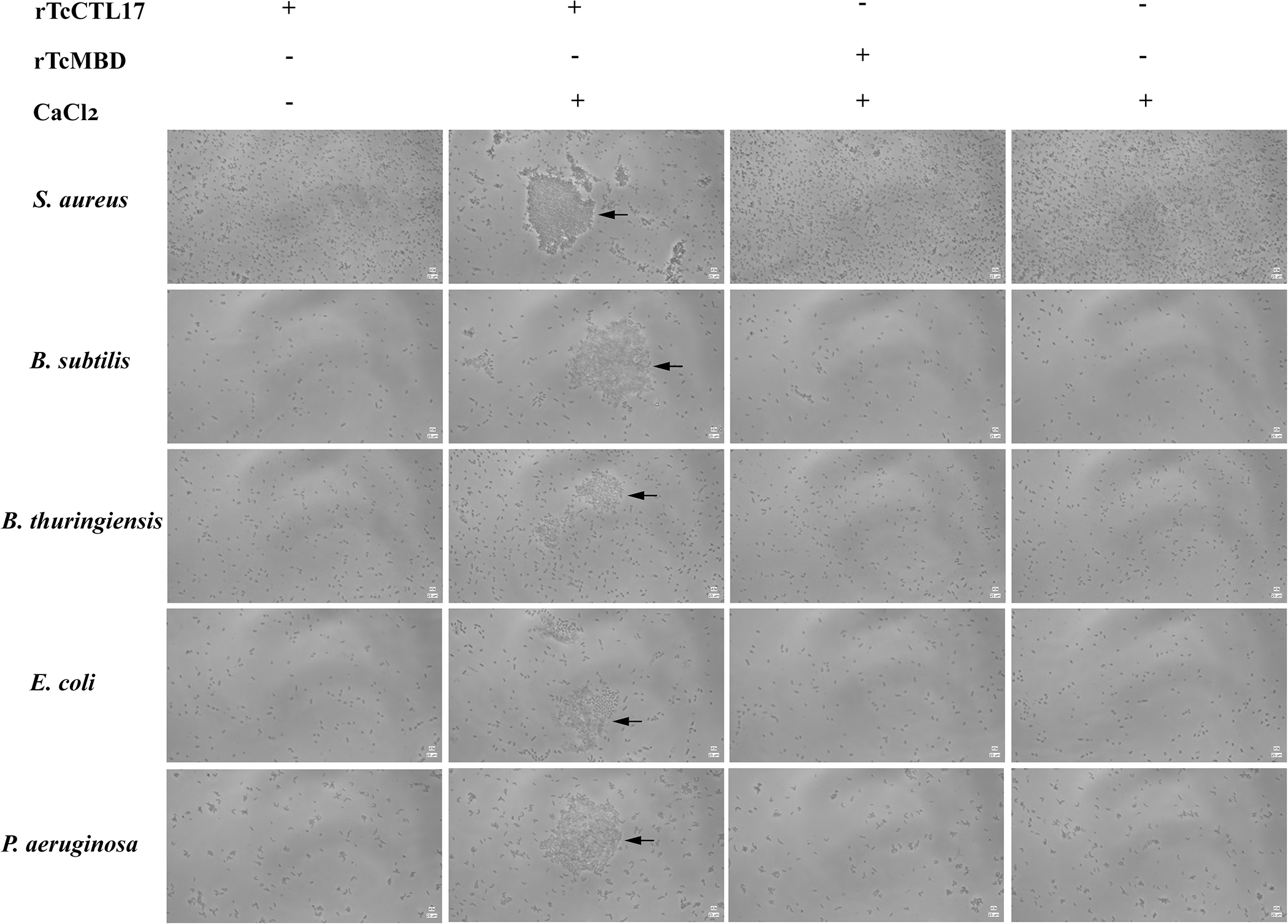
To investigate whether rTcCTL17 can further agglutinate pathogens after binding to the cellular surface, the agglutination assay was performed. Coinciding with the binding assay, rTcCTL17 exhibited a broad agglutination spectrum to all five bacteria in the presence of Ca2+. However, rTcMBD and rTcCTL17 without Ca2+ showed no agglutinating activity towards the bacteria. These results indicate that rTcCTL17 has extensive agglutination activity against bacteria, and the activity is Ca2+-dependent (Fig. 2).
Agglutinating activity analysis of rTcCTL17. Agglutinating activities of rTcCTL2 or rTcMBD against G+ bacteria (S. aureus, B. subtilis, and B. thuringiensis) and G– bacteria (E. coli and P. aeruginosa) were investigated in the absence or presence of CaCl2. BSA was used as a control protein. +, presence; −, absence. The black arrows point to the agglutination region. The scale bars represent 25 μm.

Expression profile of TcCTL17
qRT-PCR was performed to assess the expression profiles of the TcCTL17 in response to E. coli and S. aureus, and the larvae injected 200 nL of IB were performed as control group. In the early stages of E. coli stimulation, the transcription level of TcCTL17 was significantly increased (Fig. 3A). While the expression level of TcCTL17 was significantly up-regulated at 3, 12, and 36 h after infection with S. aureus (Fig. 3B). Furthermore, to investigate the potential function of TcCTL17, we assessed its expression across various developmental stages and tissues in T. castaneum. TcCTL17 is expressed throughout development, notably in early pupae, late pupae, and early adults, and is highly expressed in the gut, followed by the epidermis and fat body (Fig. 3C, D). Overall, it is implying that TcCTL17 may mediate the immune response and development of T. castaneum.
The expression profiles of TcCTL17. Relative expression levels of TcCTL17 in T. castaneum larvae after E. coli (A) or S. aureus (B) infection. (C) The expression levels of TcCTL17 in various development stages. (D) Tissue distribution of TcCTL17 in 20-day-old larvae. Data represent the mean ± SEM of three independent biological replicates. For (A) and (B), the asterisks above bars indicate significant differences between the control groups and infection groups. For (C) and (D), the different lowercase letters above the columns represent significant differences (p < 0.05; one-way ANOVA followed by Tukey’s test). (*p < 0.05, **p < 0.01 and ***p < 0.001; Student’s t-test).

TcCTL17 is involved in bacterial clearance and resistance
TcCTL17 was found to respond to E. coli and S. aureus stimulation. We investigated its role in clearing and resisting these bacteria in vivo. T. castaneum survival decreased notably in TcCTL17-RNAi larvae when exposed to E. coli and S. aureus, with final survival rates of 17.5% and 25.0%, respectively (Fig. 4C, D). Moreover, the dsTcCTL17 group showed significantly higher residual live bacteria compared to the control group (Fig. 4E). These results indicate that TcCTL17 plays a role in clearing invading bacteria and contributes to resistance against E. coli and S. aureus to varying extents.
Effects of TcCTL17 knockdown on host survival and bacterial clearance. (A) Efficiency of tcctl17 RNAi in 15-day-old larvae using qRT-PCR. DsTcVer injection was used as a control. Effect of TcCTL17 knockdown on the survival in T. castaneum infected by E. coli (B) or S. aureus (C). Survival curves were denoted with Kaplan–Meier plots and statistical differences between the compared groups were determined by the Log-rank (Mantel–Cox) test in the GraphPad Prism 8.3.0 and indicated with asterisks. Effect of TcCTL17 knockdown on the bacteria loads at 3 h (after E. coli or S. aureus infection. Asterisks denote statistical differences between the treatment and corresponding control (*p < 0.05, **p < 0.01, and ***p < 0.001; Student’s t-test).

TcCTL17 mediates the expression of AMPs, PPO and activates the PO activity to defend against E. coli and S. aureus
Previous studies have shown that various immune responses including the activation of prophenoloxidase (PPO) and the synthesis of antimicrobial peptides (AMPs) are initiated after the recognition of PAPMs by PPRs (Akira et al., Reference Akira, Uematsu and Takeuchi2006; Medzhitov and Janeway, Reference Medzhitov and Janeway2002; Wang et al., Reference Wang, Ai, Zhang, Bi, Gao, Chen and Li2023). Therefore, the effect of knockdown of TcCTL17 followed by bacteria challenge on the expression of immune genes was investigated. Induced mRNA levels of TcCTL17 were still significantly decreased after RNAi and bacterial stimulation. After RNAi targeting TcCTL17 and challenged with E. coli, the expression of transcription factors (TcDIF1, TcREL), and AMPs (including TcATT1, TcATT2, TcCOL1, TcDEF2, TcCEC2, TcCEC3) and TcPPO1/2 were significantly decreased (Fig. 5A, B, Fig. 6A). Furthermore, the expression of transcription factors (TcREL), while AMPs (including TcATT1, TcATT2, TcCOL1, TcCEC2, TcCEC3) and TcPPO1/2 were down-regulated after RNAi targeting TcCTL17 and injection of S. aureus (Fig. 5C, D, Fig. 6B). And the PO activity of haemolymph was significantly declined after knockdown of TcCTL17 and incubating with E. coli and S. aureus compared to the control groups (Fig. 6C, D). Overall, the above results demonstrated that TcCTL17 could mediate the expression of AMPs and PPO system to defend against E. coli and S. aureus.
Transcription factor and AMP gene expression upon challenge with E. coli or S. aureus after successful RNAi-mediated knockdown of TcCTL17. (A, C) the expression profiling of transcription factor genes post-dsRNA-treatment following E. coli and S. aureus injections. (B, D) The expression profiling of AMP genes post-dsRNA-treatment followed by E. coli and S. aureus challenge. The bars represent means ± SDs. Each experiment was repeated at least in triplicate. The asterisks denote significant differences from the control groups based on t-tests for unpaired samples (*p < 0.05 and **p < 0.01) .

TcCTL17 regulated PPOs expression and PO activity. Effect of TcCTL17 knockdown on the expression of PPO1 and PPO2 in the larvae infected by E. coli (A) or S. aureus (B). Effect of TcCTL17 knockdown after E. coli (C) or S. aureus (D) infection on the PO activity of T. castaneum haemolymph. Data represent mean ± SD of three independent experiments and asterisks above columns indicate statistical differences between the treatment and corresponding control (*p < 0.05, **p < 0.01, and ***p < 0.001; Student’s t-test).

TcCTL17 participates in metamorphosis of T. castaneum
CTLs are multifunctional proteins implicated in diverse biological processes, including growth and development. To study the role of TcCTL17 in T. castaneum metamorphosis, RNAi was used to suppress TcCTL17 expression. TcCTL17 mRNA levels significantly decreased by day 3 post-treatment compared to controls (Fig. 7A). Larvae treated at 12 days of age failed to molt, preventing pupation and leading to death within 14 days post-RNAi, the mortality rate is 100% (Fig. 7B, C). Since the metamorphosis of insects is regulated by JH and ecdysone 20E (Jindra et al., Reference Jindra, Palli and Riddiford2013; Liu et al., Reference Liu, Dai, Guo, Li, Ma, Tian, Cao, Zhang, Palli and Li2015; Zitnan et al., Reference Zitnan, Kim, Zitnanová, Roller and Adams2007), the relative mRNA levels of early response factors of 20E and the relevant genes on JH signalling pathway were detected on the third day after injection of dsTcCTL17 to explore the underlying molecular mechanism of pupation defects. The results showed that 20E receptor (TcEcR) and early response factor including TcBrC, TcE74, TcE95, TcE93 were significantly declined compared to the control (Fig. 7D). In addition, the expression levels of JHEH-r3 (juvenile hormone epoxide hydrolase-like protein 3), JHEH-r4 (juvenile hormone epoxide hydrolase-like protein 4), and Met (Methoprene-tolerant) were significantly decreased but the early JH-inducible gene, Kr-h1 (Krüppel-homolog 1), was significantly up-regulated in dsTcCTL17-treated beetles (Fig. 7E).
Knockdown of TcCTL17 impairs pupation in Tribolium castaneum. The mRNA level (A) of TcCTL17 and the phenotypes (B) of dsTcCTL17 and dsTcVer insects. dstcVer injection was used as a control. (C) Statistics of survival rate compared with dsTcCTL17 and dsTcVer groups. (D) The transcript levels of ecdysone-related genes after injecting dsTcCTL17. (E) The transcript levels of the key genes of JH biosynthesis after injecting dsTcCTL17 (*p < 0.05, **p < 0.01, ***p < 0.001; Student’s t-test).

In addition, injection of dsTcCTL17 into 1-day-old pupae led to their failure to molt and eventual death, the mortality rate is 100.0% (Fig. 8A, C). Analysis showed reduced mRNA levels of JHEH-r3, JHEH-r4, and Met in 4-day-old treated pupae, with Kr-h1 up-regulated and JHAMT3 expression unchanged (Fig. 8D). This indicates TcCTL17 affects T. castaneum metamorphosis via modulation of 20E and JH pathways.
Knockdown of TcCTL17 impairs eclosion in Tribolium castaneum. Statistics of phenotypes (A), transcript levels (B), and phenotype rate (C) compared with dsTcCTL17 and dsTcVer groups. (D) The transcript levels of the key genes of JH biosynthesis after injecting dsTcCTL17 (*p < 0.05, **p < 0.01, ***p < 0.001; Student’s t-test).

TcCTL17 is involved in fecundity of T. castaneum
To investigate whether TcCTL17 is involved in fecundity of T. castaneum, RNAi was performed in the 5-day-old pupae to deplete the expression of TcCTL17. The number of eggs laid by one pair of beetles (WT♀ × WT♂) were 8.5 ± 0.27 per day, but one pair of beetles (dsTcCTL17♀ × dsTcCTL17♂) laid 0 egg for 3 days (Fig. 9A). To further detect the effect of TcCTL17 on the reproduction is female or male specific, dsTcCTL17 was injected into the male and female pupae separately. The results showed that the number of eggs was returned to normal levels when dsTcCTL17♂ backcrossing with WT♀. Correspondingly, gonads dissection assay discovered that the ovaries of dsTcCTL17-treated female beetles showed severe atrophy compare to the ovaries of WT female, while the testis showed no significant difference in morphology between WT-male and dsTcCTL17-male (Fig. 9B). And compare to the control, the mRNA levels of vitellogenesis (Vg) and vitellogenesis receptor (VgR) were significantly down-regulated in dsTcCTL17-injected female adults (Fig. 9C). Altogether, these results suggest that TcCTL17 is involved in fecundity of T. castaneum and the effect is female specific.
Knockdown of TcCTL17 impairs reproduction in Tribolium castaneum. (A) The number of eggs laid by 30 pair of beetles among 3 days after injection with WT and dsTcCTL17. (B) The effect of TcCTL17 knockdown on testis and ovary morphology. (C) The relative mRNA levels of reproduction-related genes in dsTcCTL17-injected females compared with dsTcVer-injected females (the different lowercase letters above the columns represent significant differences, *p < 0.05, **p < 0.01; Student’s t-test).

Discussion
CTLs are critical PRRs that play a significant role in identifying non-self-molecules and facilitating pathogen clearance (Zelensky and Gready, Reference Zelensky and Gready2005). CTLs are known for their ability to bind to specific carbohydrate structures on the surface of pathogens, thereby initiating immune responses. In our previous study, we identified a novel CTL-X associated with resisting the invasion of harmful substances, named TcCTL17 (Bi et al., Reference Bi, Feng, Li, Mao, Ning, Song, Xie, Tang and Li2019). Functional assays revealed that TcCTL17 exhibits fundamental characteristics of CTLs, including binding to PAMPs and bacteria, and inducing bacterial agglutination, consistent with other members of the CTL-X group (Wang et al., Reference Wang, Ai, Zhang, Bi, Gao, Chen and Li2023; P Zhang et al., Reference Zhang, Ai, Wang, Zhang, Du, Wang, Wang, Gao and Li2022b; Y Zhang et al., Reference Zhang, Ai, Wang, Zhang, Du, Wang, Wang, Gao and Li2022b). Furthermore, TcCTL17 was involved in metamorphosis and fecundity of T. castaneum. Collectively, these results suggest that TcCTL17 possesses diverse biological functions, thereby expanding our understanding of CTL-X roles in invertebrate biology.
TcCTL17 contains a distinct CRD, indicating its ability to bind to pathogen surface carbohydrates (Drickamer, Reference Drickamer1993; Drickamer and Dodd, Reference Drickamer and Dodd1999; Weis et al., Reference Weis, Taylor and Drickamer1998). Our findings demonstrate that rTcCTL17 binds to LPS and PGN in a dose-dependent manner, and also interacts with bacteria in a calcium-independent manner, consistent with B. mori BmCTL-S3, M. sexta MsIML-1, and MsIML-2 (Yu et al., Reference Yu, Gan and Kanost1999; Yu and Kanost, Reference Yu and Kanost2000; Zhan et al., Reference Zhan, Shahzad, Yang, Liu, Yu and Rao2016). However, the CRD in TcCTL17 do not contain the typical EPN or QPD motif but showed the binding affinity to carbohydrates, suggesting that the conserved motif of insect CTLs CRD is not absolutely required for determining the binding specificity (Xia et al., Reference Xia, You, Rao and Yu2018). Additionally, CTLs commonly facilitate bacterial agglutination as a crucial step in clearing infections (Kilpatrick, Reference Kilpatrick2002; Zelensky and Gready, Reference Zelensky and Gready2005). In the presence of calcium, CTLs demonstrate agglutinating activity by forming lectin oligomers or more compact CRD structures to resist protease degradation, it is speculated that other unconventional motifs may also play a role in sugar ligand binding in CTLs (Xia et al., Reference Xia, You, Rao and Yu2018). Specifically, rTcCTL17 was observed to agglutinate five bacteria in a calcium-dependent manner in this study. Similarly, M. sexta immulectin-4 (MsIML-4) exhibited agglutination activity against E. coli, S. aureus, and S. cerevisiae, while Aedes albopictus CTL1 agglutinated S. aureus and Candida yeast in a calcium-dependent fashion (Cheng et al., Reference Cheng, Wang, Li, Liu, Sun and Wu2014; Yu et al., Reference Yu, Ling, Tracy and Zhu2006). Following this, two model bacterial pathogens (E. coli and S. aureus) were injected into T. castaneum, and the results showed that the expression level of TcCTL17 was significantly up-regulated in the early stages of stimulation but subsequently at a lower level. Similar results were detected in T. castaneum TcCTL12 and TcCTL14 post E. coli and S. aureus challenged and L. vannamei LvPLP post V. anguillarum challenged (Bi et al., Reference Bi, Ning, Xie, Fan, Huang, Gu, Wang, Wang and Meng2020b; P Zhang et al., Reference Zhang, Ai, Wang, Zhang, Du, Wang, Wang, Gao and Li2022b; Y Zhang et al., Reference Zhang, Ai, Wang, Zhang, Du, Wang, Wang, Gao and Li2022b). An explanation for this expression profile is that CTLs might act as an opsonin, in the later stage of infection, bacteria down-regulate the expression of CTLs to resist the attack from host immune system (Ip et al., Reference Ip, Takahashi, Ezekowitz and Stuart2009). Furthermore, bacterial clearance and resistance assay strongly suggest that TcCTL17 is involved in protecting T. castaneum from infectious microbes. Similar functions occurred in Marsupenaeus japonicus MjCC-CL, B. mori CTL-S3, A. gambiae CTL4 and CTLMA2 (Schnitger et al., Reference Schnitger, Yassine, Kafatos and Osta2009; Sun et al., Reference Sun, Lan, Zhao, Vasta and Wang2017; Zhan et al., Reference Zhan, Shahzad, Yang, Liu, Yu and Rao2016). Overall, these results imply that TcCTL17 may play a role in the immune response to E. coli and S. aureus infection through the CRD.
AMPs are small peptides that exhibit antimicrobial activity against pathogens (K Zhang et al., Reference Zhang, Shen, Wang, Yang, Zhang, Pan, Li, Ji, Abbas, Li and Cui2021). The PPO-mediated melanisation process plays a crucial role in the immune response of insects. During this process, PPO is activated to PO by specific proteases, which then catalyses the formation of melanin through an oxidation reaction to encapsulate and eliminate foreign pathogens (Kanost et al., Reference Kanost, Jiang and Yu2004; Wang et al., Reference Wang, Luo, Feng, Zhou and Tang2022; Zhang et al., Reference Zhang, Huang, Yuan, Lu, Yang, Wang, Zhang, Dobens, Zou, Wang and Ling2017; Zhao et al., Reference Zhao, Li, Wang and Jiang2007). Knockdown of TcCTL17 prior to E. coli and S. aureus injection resulted in a significant reduction in PPO expression and haemolymph PO activity, indicating that TcCTL17 can participate in bacterial immune response through cascade activation of PO precursor, similar to the response of cotton bollworm CTL14 to fungal infection (Cheng et al., Reference Cheng, Lin, Wang, Xing, Xiong and Zou2018). Yokoi (Yokoi et al., Reference Yokoi, Koyama, Ito, Minakuchi, Tanaka and Miura2012a, Reference Yokoi, Koyama, Minakuchi, Tanaka and Miura2012b) studied the induction profiles of seven AMPs gene of T. castaneum and divided these AMPs into three groups: group 1 (TcATT1, TcATT2, TcCOL1, TcDEF2), group 2 (TcDEF3), and group 3 (TcCEC2, TcCEC3). AMPs in group 1 and group 3 are regulated by the IMD-Rel and Toll-Dif pathways, respectively, while group 2 AMPs are co-regulated by both. In D. melanogaster, the Toll pathway combats G+ bacteria, while the IMD pathway targets G– bacteria (Hoffmann, Reference Hoffmann2003; Lemaitre et al., Reference Lemaitre, Reichhart and Hoffmann1997; Rutschmann et al., Reference Rutschmann, Kilinc and Ferrandon2002). However, in this study, activation by a single bacterium led to simultaneous activation of both pathways in T. castaneum, suggesting a more versatile use of these pathways. This crosstalk may be due to potential heterodimerisation of NF-κB molecules (e.g. Dif1-Relish or Dif2-Relish) or interactions between FADD and MyD88. (Yokoi et al., Reference Yokoi, Koyama, Minakuchi, Tanaka and Miura2012b). Overall, these results suggest that TcCTL17 could recognise pathogenic organisms and further participate in the clearance of bacteria by activating the PPO system and regulating the expression of AMP genes.
Developmental expression profiling revealed that TcCTL17 is highly expressed during the pupal stage and early adulthood, indicating its potential role in the metamorphosis and reproduction of T. castaneum. To test this hypothesis, RNAi, a robust tool for functional gene studies in T. castaneum (Roth and Hartenstein, Reference Roth and Hartenstein2008), was employed. Larvae injected with dsTcCTL17 failed to molt successfully and perished within 14 days. Given the critical role of 20-hydroxyecdysone (20E) in inducing the transcriptional expression of downstream genes upon binding to its receptor (Zhang et al., Reference Zhang, Chen, Wang, Bai, Yang, Zhong, Yu, Jin and Yang2023), we observed a significant reduction in the expression of TcEcR and early response factors (TcBrC, TcE74, TcE95, TcE93) in dsTcCTL17-treated larvae. Previous studies have demonstrated that interference with the early 20E transcription factor BrC in the leaf-eating insect Lymantria dispar leads to developmental abnormalities in larvae, resulting in a mortality rate of 67.18% (Natori et al., Reference Natori, Shiraishi, Hori and Kobayashi1999). Additionally, Br-C has been identified as a pupal-specific molecule induced by 20E (Ding et al., Reference Ding, Wang, Geng, Zou, Zhang, Cao, Li and Zou2020). This suggesting that TcCTL17 may mediate pupation via the 20E pathway. Furthermore, juvenile hormone (JH) is a pivotal regulator of insect metamorphosis (Jindra et al., Reference Jindra, Palli and Riddiford2013). Kr-h1, a primary JH response factor, acts as a universal repressor of insect metamorphosis (Jindra et al., Reference Jindra, Bellés and Shinoda2015). Previous studies have demonstrated that the down-regulation of Kr-h1 transcription is essential for the adult transition in Drosophila melanogaster, Pyrrhocoris apterus, and Blattella germanica (Konopova et al., Reference Konopova, Smykal and Jindra2011; Lozano and Belles, Reference Lozano and Belles2011; Minakuchi et al., Reference Minakuchi, Zhou and Riddiford2008). In our study, the expression of TcJHEH-r3 and TcJHEH-r4 was significantly reduced, while TcKr-h1 was up-regulated in dsTcCTL17-treated pupae, indicating an enhanced JH effect and subsequent inhibition of eclosion in T. castaneum. Interestingly, the knockdown of TcCTL17 resulted in the inability of beetles to lay eggs and severe atrophy of the ovaries in morphology. The Vg is a major yolk protein that can provide nutrition for ovarian and embryonic development (Sappington and Raikhel, Reference Sappington and Raikhel1998). Further detection showed the TcVg and TcVgR were significantly reduced in dsTcCTL17 females. Our results suggest that TcCTL17 plays an important role in the reproduction of T. castaneum by affecting the expression and transport of Vg. Nevertheless, the precise mechanisms through which TcCTL17 influences metamorphosis and fecundity in T. castaneum warrant further investigation.
In summary, we identified a novel CTL, TcCTL17, demonstrating its dual role in immunity and development in T. castaneum. On one hand, TcCTL17 binds bacterial polysaccharides and bacteria, exhibiting agglutination activity and activating the PPO system and antimicrobial peptide expression to counter pathogen invasion. On the other hand, TcCTL17 is involved in metamorphosis and fecundity, potentially related to 20E/JH and Vg, respectively. These findings provide new insights into the multifunctional roles of CTLs in insect physiology, emphasising the importance of TcCTL17 in both immune defence and developmental processes.
Acknowledgements
This work was supported by the National Natural Science Foundation of China (No. 32070501 and 32170521) and JiangSu province Graduate Research and Practice Innovation Program (KYCX23_1729).
Author contributions
Peng Chen and Huayi Ai contributed equally to this work. Peng Chen, Huayi Ai and Zhiping Liu significantly contributed to the data acquisition and data analysis. Peng Chen, Huayi Ai and Bin Li contributed to the manuscript drafting. Chenjun Li and Bin Li: Funding acquisition, editing, and supervision. All authors have read and approved the final manuscript.
Competing interests
The authors declare no competing financial interest.