Introduction
An invasive alien species originating in Eurasia, Contarinia nasturtii (Kieffer) (Diptera: Cecidomyiidae) (swede midge), is an economic pest of brassicaceous vegetable and canola (oilseed rape) (Brassica napus Linnaeus, B. rapa Linnaeus, and B. juncea (Linnaeus) Czernajew; Brassicaceae) crops that was first identified in North America from Ontario, Canada, in 2000 (Hallett and Heal Reference Hallett and Heal2001). By 2015 swede midge injury to canola in northern Ontario was severe enough to warrant an industry-initiated recommendation of region-wide cessation of growth of the crop for three years to alleviate pressure from the pest (Phillips Reference Phillips2015). Swede midge was first found on the prairies in pheromone traps in northeastern Saskatchewan in 2007 (Canadian Food Inspection Agency 2008). Noticeable injury to canola attributable to swede midge was first observed on a field scale in the area in 2012 (Andreassen et al. Reference Andreassen, Soroka, Grenkow, Olfert and Hallett2018). However, since then an increased amount and distribution of injury to canola without a concomitant increase in the number of adult swede midges caught in pheromone traps led to a re-evaluation of the identification of the midge, and a previously unknown second species of midge, C. brassicola Sinclair, feeding on canola across the prairies has been identified (Mori et al. Reference Mori, Andreassen, Heal, Dupuis, Soroka and Sinclair2019).
Swede midge natural history and host plant damage are well known, although its association with canola is fairly new. Swede midges overwinter in the soil as prepupae in debris-covered cocoons. In spring, mated females lay eggs in vegetative and reproductive meristematic tissues, and subsequent larval feeding causes leaf and stem deformation, with resultant swelling, twisting, and scar formation on these tissues (Barnes Reference Barnes1946, Reference Barnes1950). Caper-shaped galls can form from infested buds and flowers (Stokes Reference Stokes1953). Secondary and tertiary canola racemes are also readily infested if their formation coincides with that of egg laying by swede midge females (Williams and Hallett Reference Williams and Hallett2018). Populations can build rapidly, as three to four generations of swede midges typically occur in Ontario (Hallett et al. Reference Hallett, Goodfellow and Heal2007, Reference Hallett, Goodfellow, Weiss and Olfert2009b). While there is much less information on the newly described C. brassicola, differences in the natural history of the two species have become apparent. Along with subtle morphological differences between the two, Contarinia brassicola emerges in late spring on the prairies and is bivoltine or has at most three generations (Andreassen et al. Reference Andreassen, Soroka, Grenkow, Olfert and Hallett2018; Mori et al. Reference Mori, Andreassen, Heal, Dupuis, Soroka and Sinclair2019), typically with only the first generation affecting canola production. Contarinia brassicola injury to vegetative canola tissue is uncommon (Andreassen et al. Reference Andreassen, Soroka, Grenkow, Olfert and Hallett2018). Female C. brassicola lay eggs in developing flower buds, and larvae feed within the developing flower; the flower bud remains closed and becomes swollen, forming a bottle-shaped gall, which is the most representative damage symptom of the pest on canola (Mori et al. Reference Mori, Andreassen, Heal, Dupuis, Soroka and Sinclair2019). It is uncertain how these species differences might affect the impact of the midge complex on canola production on the prairies.
Several agronomic practices, including insecticide seed treatment and planting date, may affect the ability of midges to damage canola crops. Insecticide seed treatments are used to protect canola seedlings from injury from Phyllotreta Chevrolat (Coleoptera: Chrysomelidae) flea beetles and cutworms (Lepidoptera: Noctuidae). These seed treatments are principally neonicotinoids such as thiamethoxam, a component of Syngenta’s Helix Xtra and Helix Vibrance, and the diamide cyantraniliprole, a component of DuPont’s Lumiderm, which may be more effective than neonicotinoids against the striped flea beetle, Phyllotreta striolata (Fabricius) (Canola Council of Canada 2014). Seed treatments can provide effective early-season protection against swede midges in Brassica Linnaeus vegetable crops (Hallett et al. Reference Hallett, Chen, Sears and Shelton2009a) and may protect canola in the same way. Furthermore, experiments with canola in Ontario have indicated that early-seeded crops may be less injured by swede midges than late-seeded crops (Hallett Reference Hallett and Reddy2017). Whether this is true for the canola midge complex on the prairies has not been determined.
The objectives of this research were to examine the effects of seeding date and selected insecticide seed treatments on levels of Contarinia Róndani midge complex infestation and canola seed yield in northeastern Saskatchewan.
Materials and methods
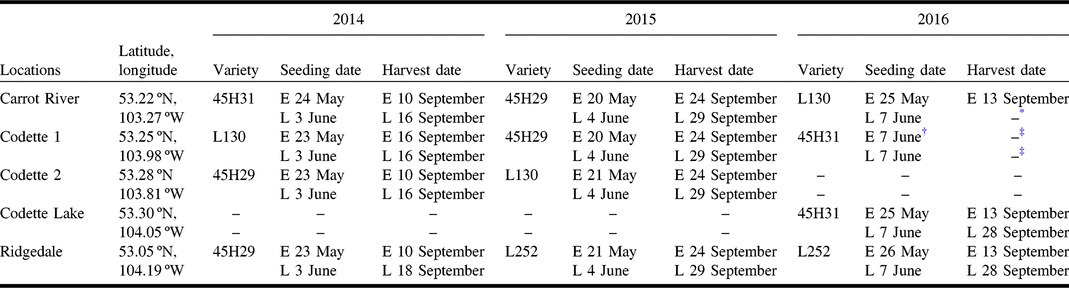
The study consisted of a three-year field experiment undertaken at four locations in northeastern Saskatchewan, Canada. Plots were established at locations west of Ridgedale (black soil zone); southeast of Codette (“Codette 1”, dark grey soil zone); halfway between Codette and Carrot River (“Codette 2”, dark grey soil zone); and southeast of Carrot River (grey wooded soil zone) (Table 1). In 2016 the Codette 2 location was replaced with a location east of Codette Lake (dark grey soil zone), about 20 km west of the previous Codette 2 locations.
Locations, Brassica napus varieties, seeding dates, and harvest dates (early [E] or late [L]) of a study investigating the effects of seeding date and seed treatments on injury inflicted by Cecidomyiidae midges to canola grown in northeastern Saskatchewan, 2014–2016.

* Heavy early snow prevented harvest.
† Early seeding delayed because of standing water in field.
‡ Plots flooded, no harvest.
Midge monitoring
Two types of traps were deployed to monitor Contarinia adults; four white Jackson traps housing swede midge pheromone lures (PheroNet, Distributions Solida, Saint-Ferreol-les-Neiges, Québec, Canada) were set 50 m apart at an edge of each field closest to the plots, suspended 20 cm above the soil surface in early May and left in place until the end of the season. The sticky trap liners were replaced weekly, and the pheromone lures were changed every four weeks. Further, four emergence cages (BugDorm, Taichung, Taiwan), with a base of 60 × 60 cm, were dug into the soil of nearby canola stubble in May of each year. Towards the end of July, four more emergence traps were placed within a stand of canola that was seeded next to the plots. In each year, two of the four cages deployed in May had white Jackson traps with swede midge pheromone lures inside, as did two of the cages deployed in July. The contents of a collection jar at the top of each cage along with the Jackson trap sticky liners were replaced weekly and processed in the laboratory. Contarinia specimens were sent to the systematists at the Canadian National Collection of Insects, Arachnids, and Nematodes (Ottawa, Ontario, Canada) for identification, and voucher specimens were deposited there.
Plot establishment
At all locations land preparation, fertiliser, and weed control measures were applied by the land owners, except for the Codette 2 site in 2014 and 2015, which was within an area of plots at a research farm; all plots were in fields seeded to commercial canola crops. The cultivars of hybrid canola seeded in the trials depended on the location and year, but were the same as that which the producer seeded in the rest of the field (Table 1), although from different seed lots. Two of the four cultivars grown in the study, 45H29 and 45H31, were glyphosate-tolerant, while L130 and L252 were glufosinate-tolerant. The experiment was set up in a split plot design, with four replicates of each treatment at each of the four locations. Early and late seeding date treatments were applied to whole plots, and four different seed treatments applied to the subplots (Table 1). Subplots were 6.1 m long and four rows wide, with 30 cm between rows and 200 seeds planted per row. All seeds for the experiment were treated with fungicides penthiopyrad (20 g active ingredient/100 kg seed) and mefenoxam (6.67 g). The four experimental seed treatments were no insecticide (fungicide alone), thiamethoxam (439 g), cyantraniliprole (400 g), and thiamethoxam plus cyantraniliprole (439 g and 400 g, respectively). Seedling survival was determined by counting the number of seedlings per randomly selected inner row 1–2 weeks after emergence. At the same time, flea beetle (Phyllotreta) injury was rated on early- and late-seeded plots according to the protocol of Palaniswamy et al. (Reference Palaniswamy, Lamb and McVetty1992); the proportion of tissue area eaten per seedling was averaged from visual estimation of feeding of cotyledons and first two true leaves on a scale from 0 (no feeding) to 10 (tissue completely consumed).
Midge damage assessment
Starting at the end of June, prior to the onset of adult Contarinia emergence, 10 randomly selected plants in one of the inner two rows of each plot were assessed for growth stage, using the Harper and Berkenkamp (Reference Harper and Berkenkamp1975) system, and for midge injury to vegetative tissue and the primary reproductive raceme, with different criteria used for each tissue type (Andreassen et al. Reference Andreassen, Soroka, Grenkow, Olfert and Hallett2018, modified from Williams and Hallett Reference Williams and Hallett2018). Damage to the primary flowering raceme was rated as 0, no feeding; 1, stem of raceme twisted but still elongate, with up to one-third of buds and/or flowers damaged; 2, more than one-third of buds and/or flowers damaged or distorted pod bunches (palm tree or umbrella effect); or 3, death of meristem or absence of pod formation (Andreassen et al. Reference Andreassen, Soroka, Grenkow, Olfert and Hallett2018). Ratings of secondary and tertiary racemes were based on the amount of racemes injured and the level of injury on the primary raceme; thus A = all ratings were 0, B = ≤ 50% of racemes were damaged, C = > 50% of racemes were damaged with level 1 or 2 most common, and D = > 50% of racemes were damaged and level 3 was most common. Damage was rated weekly thereafter to the pod-fill stage in the first or second week of August. Plots were swathed, harvested, and seed yield per subplot was measured. Plant densities, flea beetle defoliation, and seed yield were analysed with seeding date and seed treatment as fixed effects and replicates as random effects by using analysis of variance and PROC MIXED (SAS Institute 2010). When analysis of variance indicated significant differences at P ≤ 0.05, Tukey’s studentised range test was used to distinguish among means (Steel and Torrie Reference Steel and Torrie1980). Because plant growth stage and the midge complex damage rating system used are qualitative instead of quantitative attributes, plant growth and midge damage variables were analysed using PROC GLIMMIX (SAS Institute 2010) multinomial cumulative logistic regression analysis to predict the log odds of each category of growth or damage. Log odds were then converted to probabilities to allow for the determination of rate at which plants grew or midge injury to the primary raceme accumulated, and to compare midge injury levels among sampling dates. Change in damage rating through time was analysed by comparison of data from consecutive sampling weeks. Where treatment effects were statistically significant, treatment mean pairs were compared using P ≤ |t| values of estimate statements (SAS Institute 2010).
Results
Weather played a pivotal role in plot establishment, weed control, canola growth, and harvest of the trials in all three years of the experiment. In 12 of the 15 months of the May–September growing period, there were normal or above-normal levels of precipitation in the region (Environment Canada 2018a, 2018b). In 2014, late June–early July rains resulted in later-than-optimal herbicide application at the Codette and Codette 2 sites, causing heavy weed pressure. In June of 2015 Nipawin received 2.5 times the long-term normal amount of monthly rainfall; at Melfort, the 24-hour rainfall amount on 28 July 2015 was 108.3 mm. The Codette 1 fields were prone to flooding, with one early-seeded replicate under water for much of 2014, and the entire early treatment not seeded in 2016 because of standing water. Wet conditions in 2016 led to the collection of data from late-seeded plots at Codette 1 and Ridgedale in two sampling periods only, the weeks of 22 July and 5 August; in that year Ridgedale plots also experienced a lack of weed control and a heavy wild oat (Avena fatua Linnaeus; Poaceae) infestation. A substantial snowfall in September 2016 and subsequent cold temperatures resulted in the abandonment of late-seeded plots at Carrot River prior to harvest.
Midge numbers
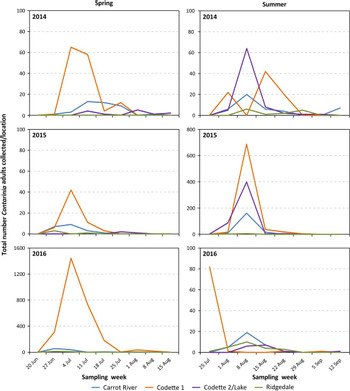
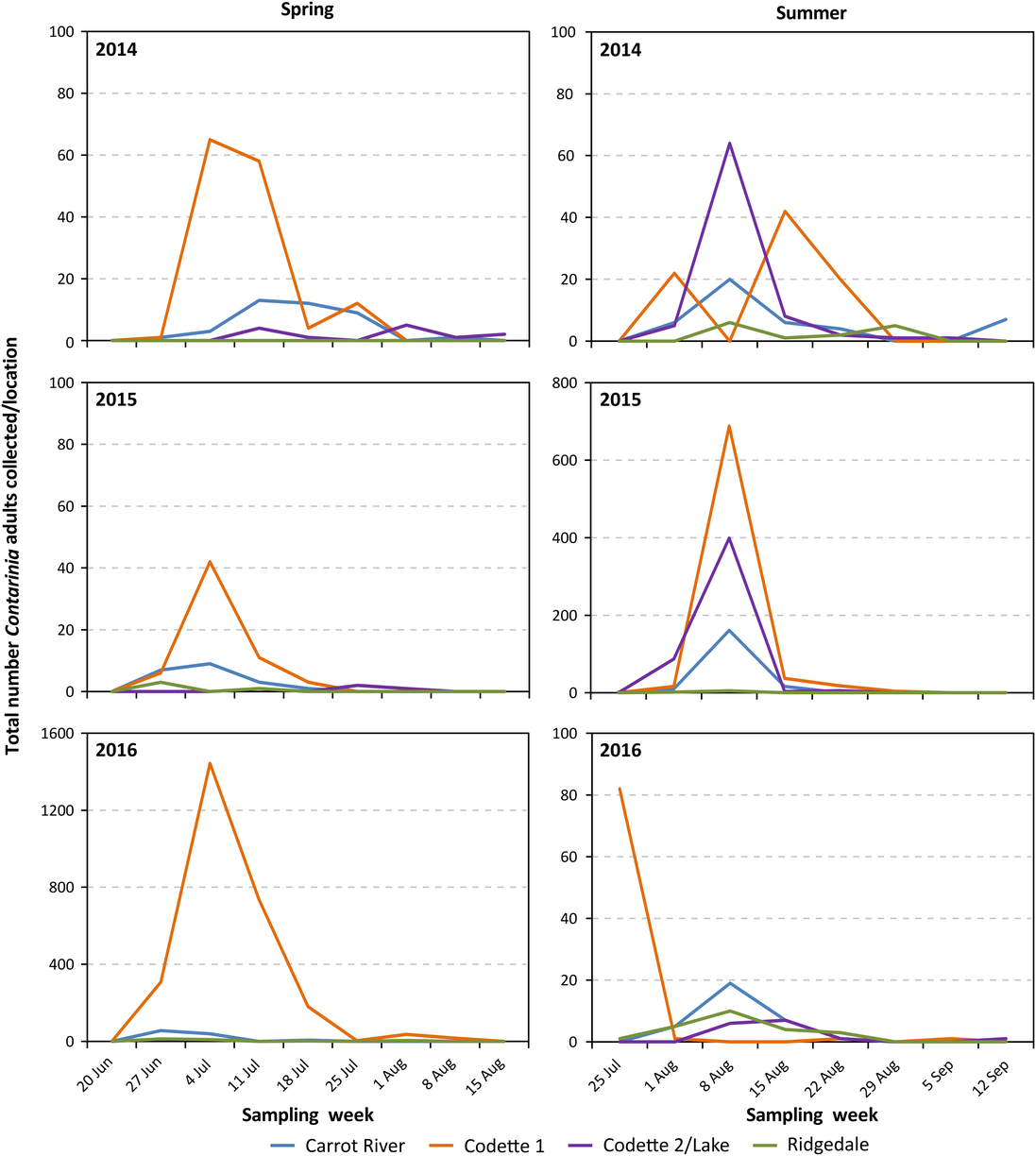
At the time of initial collection, the identification of new midge species was not known, but the presence of very few midges of any species in the swede midge pheromone traps in 2014 indicated a dearth of C. nasturtii in the overall midge complex, and no swede midges were found in pheromone traps in 2015–2016. Emergence trapping showed two midge adult emergence peaks or generations, the first in early to mid-July, and the second in early to mid-August (Fig. 1). The Codette 1 location, the wettest of the four, had the greatest number of midge adults in five of the six sampling periods. High numbers of midges collected at most locations in the summer of 2015 translated into extremely high numbers at Codette 1 in the spring of 2016, but not at other locations (Fig. 1).
Total weekly number of Contarinia midges collected in Jackson traps and emergence traps at four locations in northeastern Saskatchewan, differentiated by location, year, and trapping period. Note the change in abscissa in the summer 2015 and spring 2016 graphs. Jun, June; Jul, July; Aug, August; Sep, September.
Plant growth and damage assessment
Field location significantly affected most parameters measured in the study, including plant densities and flea beetle feeding levels. Plant densities varied significantly with location in all three years assessed (Supplementary Table 1), but differences were variable among years, with no location consistently having the highest or lowest plant densities (Supplementary Table 2). Late-seeded plots consistently had greater plant densities than did early-seeded plots (Supplementary Tables 1–2). Plant density varied significantly among seed treatments in two of three years, with fungicide-alone plots generally having the lowest plant densities (Supplementary Table 2). As with plant densities, flea beetle injury ratings varied with location (Supplementary Table 1), but not consistently so (Supplementary Table 3). Seeding date did not affect flea beetle feeding levels in any year. While seed treatments often significantly reduced flea beetle feeding below levels seen in insecticide-free plots (Supplementary Tables 1, 3), the overall level of flea beetle feeding pressure was low, with only two of 96 plots having injury greater than the economic threshold of 25% tissue area eaten; as a result, there was little effect of flea beetles on subsequent canola growth or damage from midges.
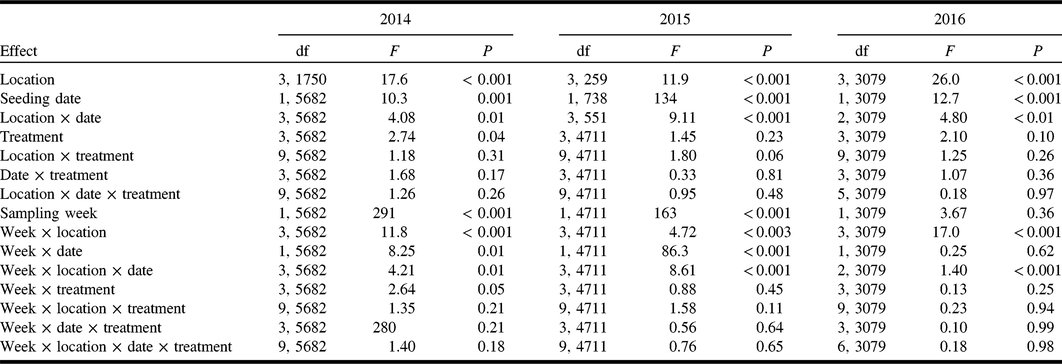
Statistics of mean predicted probability of midge damage rating of 1 on primary stems of canola seeded with four different seed treatments (treatment) on two different dates (date) at four locations (location) in northeastern Saskatchewan and sampled weekly (week) during the summers of 2014–2016, as derived from multinomial cumulative logistic analyses.

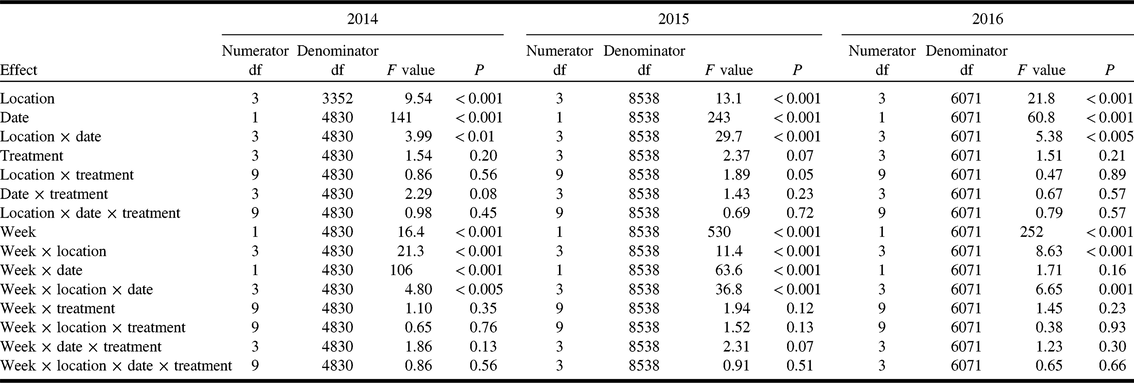
Statistics of mean predicted probability of growth stage of canola seeded with four different seed treatments (treatment) on two different dates (date) at four locations (location) in northeastern Saskatchewan and sampled weekly (week) during the summers of 2014–2016, as derived from multinomial cumulative logistic analyses.

The severity of Contarinia midge injury was light in all three years. Damage was expressed chiefly as fused or bottle-shaped flowers, with virtually no vegetative damage observed. On several occasions the first damage seen was to buds and flowers of nearby volunteer plants prior to bolting of plot plants. Damage ratings of 1 to the primary raceme were most common, ratings of 2 were infrequent, and ratings of 3 were rare. For example, over the three years only 4% of 3650 plants assessed in the first week of August had primary racemes with a damage rating of 2, and only five plants in the same time period had primary racemes with a damage rating of 3. While damage severity was low, by the end of each summer many plots had more midge-injured plants than uninjured ones (e.g., 52% damaged versus 45% undamaged in the first week of August over all years and locations). Although light infestation on primary racemes was common, damage to secondary racemes, when these racemes were present, was light and infrequent. Of the 11 850 plants with secondary racemes rated across all fields and years, 67 ± 8% were undamaged (damage rating A); 30 ± 9% had a damage rating of B, with up to half of racemes damaged but at a minimal level; and only 3 ± 2% of secondary racemes with damage levels of C or D, having more than half of racemes damaged to a lesser or greater degree. Damage to tertiary racemes was even lower, with 79 ± 10% of the 8500 tertiary stems rated being undamaged over the 3 years.
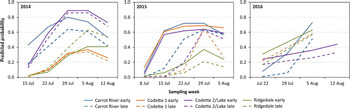
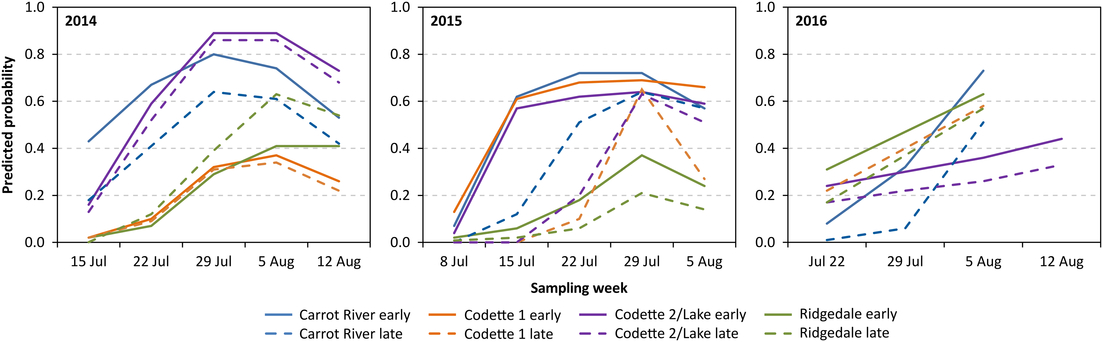
Location, seeding date, and rating week all affected the predicted probability of damage levels due to midges, and most of the interactions between and among location, seeding date, and sampling week also were significant (Table 2). Locations were inconsistent over years in their levels of midge injury. Although Codette 1 plots had lower probability of damage than Codette 2 and Carrot River across sampling weeks in 2014 (F 3,5682 = 11.8; P < 0.001) (Fig. 2), this did not hold true in 2015, when damage probability was the lowest at the Ridgedale site for both early-seeded and late-seeded plots compared with the other three sites (F 3,4711 = 8.61; P < 0.001), or in 2016, when Codette Lake (Codette 2) had the lowest overall probability of damage across the season (F 2,3079 = 4.80; P < 0.01) (Fig. 2). In all years early-seeded plots had greater probability of damage than late-seeded plots, with only one exception, that of Ridgedale in 2014 (Fig. 2). Probability of damage varied significantly with injury rating week in the first two of three years, demonstrating the cumulative nature of midge injury (Table 3, Fig. 2). Seeding date × location and seeding date × location × sampling week interactions were significant in all three years, illustrating the complexity of patterns of damage occurrence. In 2014 early-seeded plots at Carrot River were more heavily damaged than were plants in plots at other locations early in the season, while late-seeded plots at both Codette 1 and Ridgedale had less damage than the other locations early in the season. Damage patterns varied with year; the probability of damage occurrence was slightly greater in 2014 than in subsequent years, but peak probability of damage to early-seeded crops occurred 1–2 weeks earlier in 2015 than in 2014 or 2016 (Fig. 2).
Mean predicted probability of Contarinia midge damage rating 1 to canola seeded early and late at four locations in Saskatchewan, 2014–2016, as derived from multinomial cumulative logistic analyses. In 2016 the Codette 2 location was near Codette Lake. Jun, June; Jul, July; Aug, August.
Seed treatment had a marginally significant effect on damage rating in 2014 only (Table 2). In that year fungicide-alone treatment had the lowest probability of midge injury, with plants from the combined thiamethoxam and cyantraniliprole seed treatment having the highest injury (F 3,5682 = 2.74; P = 0.04) (Supplementary Fig. 1). Only one of the 21 interactions with seed treatment as a component differed significantly (Table 2), affirming the conclusion that seed treatment had little or no effect on midge-induced plant damage found in this investigation (Supplementary Fig. 1).
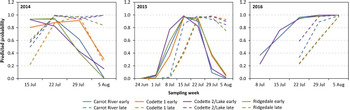
Field location, seeding date, and sampling week significantly affected canola growth stage in all three years, while seed treatment did not (Table 3). As expected, early-seeded plots matured more quickly than late-seeded plots, but locations were inconsistent in their plant growth patterns, and significant location × seeding date interactions indicated that differences in canola growth were not uniform between these parameters. In 2014 plants in both early-seeded and late-seeded plots at Codette 1 grew slower than did plants at other locations (F 3,2418 = 7.10; P < 0.001 and F 3,2410 = 9.24; P < 0.001 for early-seeded and late-seeded plots, respectively) (Fig. 3); in 2015 early-seeded canola at Codette 2 (F 3,2668 = 14.3; P < 0.001) and late-seeded plots at Carrot River (F 3,4269 = 6.23; P < 0.001) grew faster than their counterparts at other locations; and in 2016 late-seeded plots at Codette 1 and Ridgedale grew slower than comparable plots at Codette Lake (Codette 2) (F 3,3289 = 10.9; P < 0.001). Although seed treatment never affected canola growth stage directly, significant location × seed treatment interactions occasionally occurred within seeding dates. For example, in early-seeded plots at the Codette 2 location in 2014 the plants grown from seeds treated with the combination of fungicide, cyantraniliprole, and thiamethoxam grew faster than fungicide-alone plants (F 3,1254 = 3.84; P < 0.01). Likewise, in 2015 the late-seeded plots at Carrot River with the fungicide, cyantraniliprole, and thiamethoxam seed treatment grew faster than other plots (F 3,2469 = 6.23; P < 0.001).
Mean predicted probability of attaining growth stage 4, flowering, in canola seeded early and late at four locations in Saskatchewan, 2014–2016, as derived from multinomial cumulative logistic analyses. In 2016 the Codette 2 location was near Codette Lake. Jun, June; Jul, July; Aug, August.
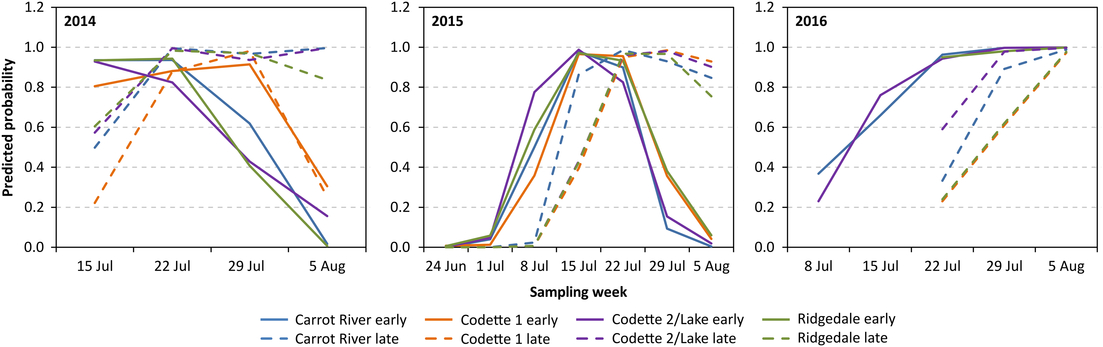
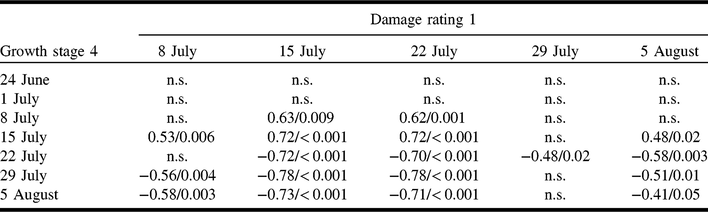
Damage to canola from Contarinia was correlated with growth stage, with slower growing plants such as those at Codette 1 in 2014 having the lowest damage probabilities (Figs. 2–3). A comparison of growth stage and damage rating probabilities showed that the steepest slopes in damage rating curves occurred 1–2 weeks after flowering commenced (Figs. 2–3). This was particularly evident in 2015, when early-seeded plots at all four locations flowered in the week of 8 July and had the greatest probability of attaining damage rating 1 in the week of 15 July. Likewise, most late-seeded plots in 2015 flowered in the week of 22 July, and most had the greatest probability of damage in the week of 29 July. The exception was late-seeded plots at Carrot River, where plants flowered in the week of 15 July, one week earlier than at other locations; these earlier-flowering plots had their greatest predicted probability of damage one week after flowering, on 22 July (Figs. 2–3). Correlation coefficients reflected this, with the probability of attaining growth stage 4, flowering, being correlated with the probability of attaining damage rating 1 later in the season, and the direction of correlation coefficients following the direction of damage rating curve (Table 4). This relationship held for late-seeded locations in 2014 as well, where the maximum increase in probability of flowering occurred in the week of 22 July, and the greatest increase in probability of damage was in the week of 29 July. Early-seeded plots in 2014 were not as uniform, however – flowering in the week of 15 July or earlier, and not attaining maximum probability of damage until 29 July (Figs. 2–3). The difficult growing (and rating) conditions in 2016 prevented any conclusions about plant damage and growth stage coordination.
Pearson correlation coefficients and related probabilities for correlation of attaining growth stage 4, flowering, and damage rating 1, up to one-third of buds and flowers damaged, from canola plots assessed on different dates at four locations in northeastern Saskatchewan, 2015.

n.s., correlation not significant.
Seed yields
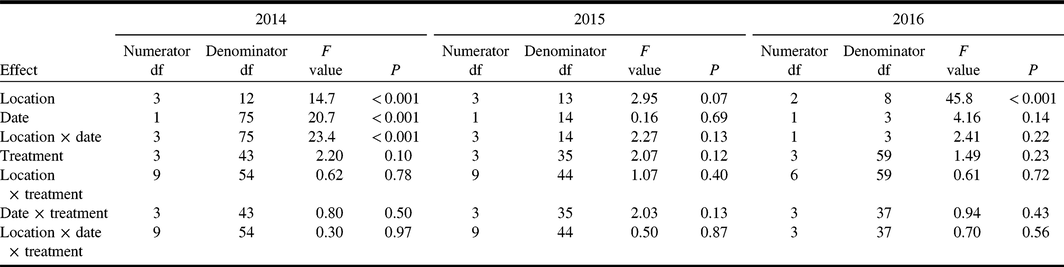
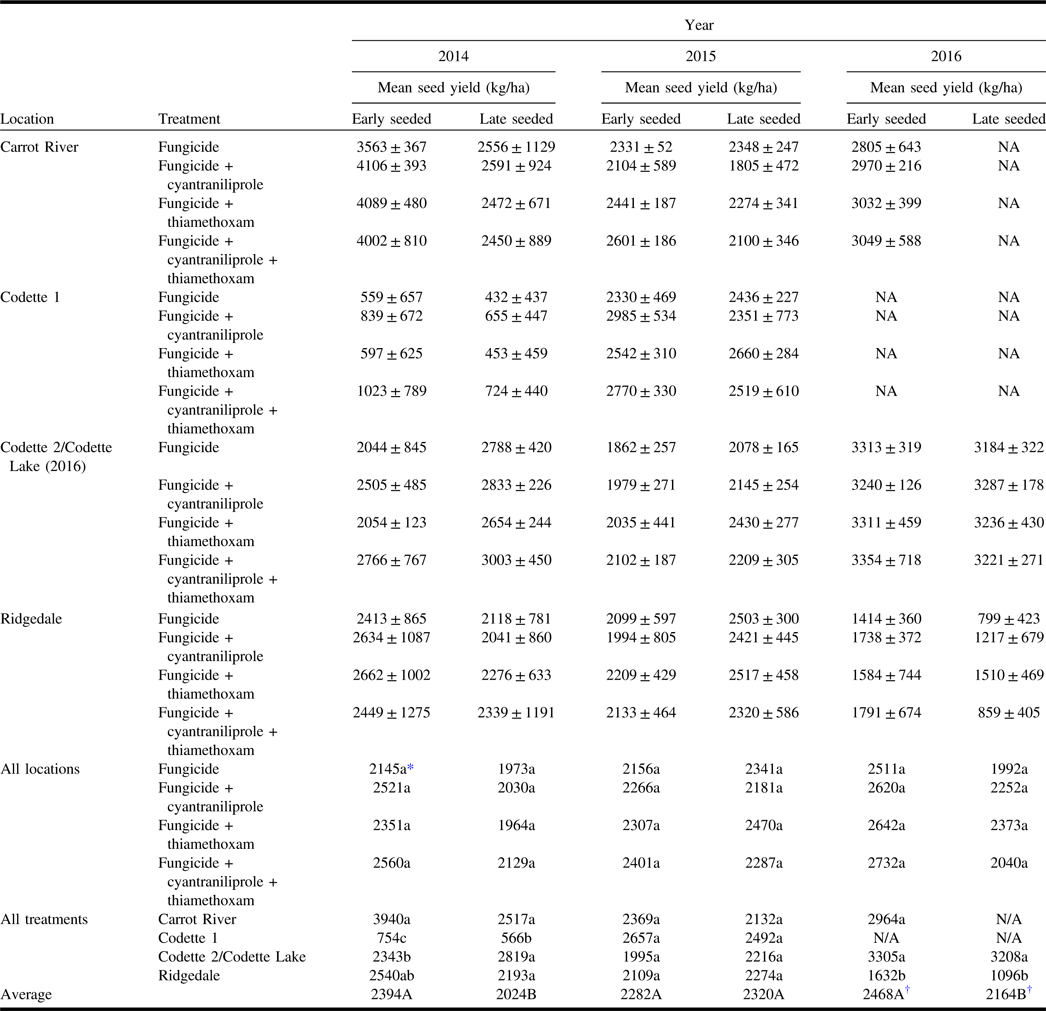
Experimental factors had inconsistent effects on seed yields. Location affected seed yields in 2014 and 2016, but not 2015 (Table 5). In 2014 the significant location effects (F 3,12 = 14.7; P < 0.001) were caused principally by low yields due to flooding at the Codette 1 site (Table 5). In 2015, when Codette 1 plots were located on higher ground than the low sites of 2014 and 2016, seed yields did not vary among locations. No seed was harvested from Codette 1 in 2016, again because of flooding. In that year a heavy wild oat infestation at Ridgedale caused canola seed yields to be lower than at Carrot River or Codette 2 for early plots (F 2,12 = 19.8; P < 0.001), and lower than at Codette 2 for late-seeded plots (F 1,6 = 139; P < 0.001) (Table 6). Seeding date affected yields over all locations combined in 2014 (F 1,75 = 20.7; P < 0.001), with early-seeded plots outyielding late-seeded plots. In 2016 early-seeded plots at Codette Lake (Codette 2) and Ridgedale had greater seed yields than late-seeded plots by 304 kg/ha (F 1,7 = 5.86; P < 0.05). A significant site × seeding date interaction (F 3,75 = 23.4; P < 0.001) affected seed yields in 2014. In that year Carrot River, Codette 1, and Ridgedale had higher seed yields in early-seeded plots compared with late-seeded plots, whereas seed yield was higher in late-seeded plots at Codette 2 compared with early-seeded plots (Table 6). Neither location nor seeding date effected seed yield in 2015 (P > 0.05). Seed treatment had no effect on seed yield in any season (P > 0.05), nor did any seed treatment interactions affect seed yield.
Statistics of mean canola seed yields from plots seeded with four different seed treatments (treatment) on two different dates (date) at four locations (location) in northeastern Saskatchewan, 2014–2016.

Mean canola seed yield in kg/ha by seed treatment and year at four locations in northeastern Saskatchewan, 2014–2016. In 2016 the Codette 2 location was near Codette Lake (early and late seeding dates listed in Table 1).

*Means within columns and categories followed by the same letters do not differ significantly at P ≤ 0.05, Tukey’s honest significant difference test.
† Seeding date comparisons for Codette Lake and Ridgedale only.
Discussion
This investigation is the first to examine the effects of Contarinia midges in commercial canola fields in western Canada. It was undertaken within three years of the first notice of midge injury in canola fields on the prairies, and midge injury was light in the period of investigation. The study answered some questions but raised several more.
Because the existence of a new midge species on canola, tentatively named Contarinia brassicola (Mori et al. Reference Mori, Andreassen, Heal, Dupuis, Soroka and Sinclair2019), was not known when this study was undertaken and we did not determine the C. nasturtii: C. brassicola species proportions, we describe the damage seen as due to Contarinia midge complex. However, the recovery of few midge adults from our C. nasturtii pheromone traps contrasting with the many midge flies found in our emergence traps corroborates the findings of Andreassen et al. (Reference Andreassen, Soroka, Grenkow, Olfert and Hallett2018) and Mori et al. (Reference Mori, Andreassen, Heal, Dupuis, Soroka and Sinclair2019) that, at most, C. nasturtii comprised a very small proportion of the midge population found in the region. The expression and timing of midge injury found in our study also support the conclusion that few, if any, C. nasturtii contributed to the damage seen. While plant damage found in this investigation was restricted to buds and flowers, with vegetative damage rare, canola tissues attacked by C. nasturtii in Ontario and Québec include vegetative apical meristems and leaf axils earlier in the season, as well as bud clusters later (Hallett Reference Hallett and Reddy2017).
As with most Cecidomyiidae (see, e.g., Cheng et al. Reference Cheng, Long, Zhang, Liang and Zhu-Salzman2017), C. nasturtii and probably C. brassicola population growth is optimised by moist conditions (Olfert et al. Reference Olfert, Hallett, Weiss, Soroka and Goodfellow2006). Varying local moisture conditions could help explain the differences in the number of Contarinia midges seen among the locations in the three years of the study. The Codette 1 location was by far the wettest in the spring of all three years and had the greatest number of midges collected, while the Ridgedale fields, with their light, silty loam soils, were the driest of the locations and had the fewest midges. Chen and Shelton (Reference Chen and Shelton2007) have found that the proportions of C. nasturtii adults emerging from silty loam soils were lower at 25% or 50% moisture than at 75% moisture, while adults emerged from five other soil types at similar proportions in the three soil moisture regimes. They have further found that extremely wet or dry soils significantly hindered C. nasturtii emergence, regardless of soil type (Chen and Shelton Reference Chen and Shelton2007). The standing water found at Codette 1 would suggest that midge emergence should be reduced under very wet conditions there. However, while the plots were often under water, our emergence traps were placed close to field edges and were never inundated.
Codette 1 had the highest number of Contarinia midges caught in traps in all three years, often by tremendous margins, yet canola there did not have greater damage probabilities than at other locations. This suggests that there was little relationship between midge numbers and damage observed. Williams and Hallett (Reference Williams and Hallett2018) have found a significant positive relationship between density of female C. nasturtii and total eggs laid per canola plant, and action recommendations for C. nasturtii management in canola in Ontario are based on midge numbers on pheromone traps (Baute Reference Baute2016). It is unlikely that the bionomics of C. brassicola differ from C. nasturtii greatly enough to explain the lack of damage seen at Codette 1. It may be that flooding delayed budding and flowering in the plots long enough that females flew to other less saturated and more advanced plants to oviposit. Flooding also may have elicited stress responses in canola plants that deterred midge females from laying in them, or affected egg hatch or early larval survival. Canola is sensitive to waterlogging, which can cause root apoxia and cell death, macronutrient deficiency in upper portions of the plant, reduced plant height and number of primary branches, decreased chlorophyll content in tissues, and changes in protein expression and endogenous levels of plant hormones, including increased ethylene production (Zhou and Lin Reference Zhou and Lin1995; Leul and Zhou Reference Leul and Zhou1998; reviews by Bedard-Haughn Reference Bedard-Haughn2009; Nguyen et al. Reference Nguyen, Rieu, Mariani and van Dam2016). These changes in plant metabolism could elicit avoidance behaviours in ovipositing Contarinia females or decrease survival of young larvae. The insect performance hypothesis, which postulates that gall-forming insects such as Contarinia perform better on vigorously growing plants than on stressed plants (Galway et al. Reference Galway, Duncan, Syrett, Emberson, Sheppherd, Cullen, Briese, Kriticos, Lonsdale, Morin and Scott2004 and references therein), could explain the lack of correlation between midge numbers and plant damage at Codette 1. However, insect performance depends on the type of stress as well as herbivore guild, and much less is known about the interactions between herbivorous insects and plants grown in water-excess than in water-deficit areas.
Our finding that early-seeded plots had more probability of Contarinia damage than late-seeded plots was opposite to that of Hallett (Reference Hallett and Reddy2017), who assessed the effects of C. nasturtii on canola planted on three dates at two Ontario locations in 2006. Hallett (Reference Hallett and Reddy2017) found that damage at all growth stages of both primary and secondary racemes was more severe in plots grown on later planting dates (7 and 21 June versus 24 May), and suggested that this was due to the interactions between swede midge numbers and plant stage at the time of infestation, as well as to swede midge preferences for particular plant stages. Differences in the results of these studies may be a factor of midge species, voltinism, and/or synchronicity of canola growth stage with C. brassicola adult emergence. C. nasturtii typically has four overlapping generations in eastern North America (Hallett et al. Reference Hallett, Goodfellow and Heal2007, Reference Hallett, Goodfellow, Weiss and Olfert2009b), and with no density-dependent decline in oviposition or larval survival, it has an extraordinary potential for population growth on canola within a season (Williams and Hallett Reference Williams and Hallett2018). In contrast, to date C. brassicola has two or at most three generations per summer (this study, Mori et al. Reference Mori, Andreassen, Heal, Dupuis, Soroka and Sinclair2019), and while the second and third generations may contribute to overall population increase in future years, they emerge too late to be of agronomic significance in the current year (Andreassen et al. Reference Andreassen, Soroka, Grenkow, Olfert and Hallett2018). Further, the relative lack of damage to vegetative tissue and secondary racemes seen in the current study suggests that C. brassicola prefer to infest late buds and very young flowers of the main raceme, unlike C. nasturtii females that infest vegetative tissues and will move readily to meristems of secondary racemes after bud swelling has occurred on the main raceme (Hallett Reference Hallett and Reddy2017). It should be noted that in both of these investigations “early” and “late” are relative terms. For a canola producer in northeastern Saskatchewan, a late seeding is one typically undertaken after 20 May.
The principal use of canola seed treatments is for control of disease, flea beetle, and possibly cutworm feeding of seedlings. The insecticide components protect canola from flea beetles in the first 14–35 days after emergence, depending on the insecticides, rates, and weather conditions (Canola Council of Canada 2014, 2017b). Thus, the finding that seed treatment had little or no negative effect on midge injury in our study is not surprising, given the 4–6-week period between seeding and appearance of the first overwintering generation of midges. The significant correlations between the least midge damage and the slowest growth on plants with no insecticide in 2014 could be explained by the phytotonic or increased vigour effects of neonicotinoids, even in the absence of insect stress (Ford et al. Reference Ford, Casida, Chandran, Gulevich, Okrent and Durkin2010; Preetha and Stanley Reference Preetha and Stanley2012; Soroka et al. Reference Soroka, Dosdall, Elliott, Gavloski, Olfert, Olivier and Otani2013; Afifi et al. Reference Afifi, Lee, Lukens and Swanton2015), coupled with the insect performance hypothesis. Because flea beetle feeding on prairie canola is most severe from May to mid-June (Canola Council of Canada 2017a), it is unlikely that there is a direct interaction between flea beetles and C. brassicola. However, indirect interaction could occur under heavy flea beetle feeding pressure. Severe flea beetle feeding can cause reduced canola emergence, stand loss, and delayed plant development (Lamb Reference Lamb1984; Soroka et al. Reference Soroka, Grenkow and Irvine2008), which could impact midge populations later in the season.
At the infestation levels observed to date, the new midge complex has had little economic impact on canola on the prairies. Its later appearance in the season and fewer generations than C. nasturtii in central Canada, as well as its status as host for two species of parasitoids (Mori et al. Reference Mori, Andreassen, Heal, Dupuis, Soroka and Sinclair2019), raise the possibility that C. brassicola may not be as pestiferous on the prairies as is C. nasturtii in eastern North America. However, economic injury to canola from C. nasturtii took over 10 years to develop from the time the pest was first detected in Ontario (Hallett Reference Hallett and Reddy2017), and the exact impact of C. brassicola on canola remains to be seen. In the meantime, prairie farmers should continue to seed canola as early as is practical to maximise seed yields, while incorporating other agronomic practices such as crop rotation to minimise the spread of insect pests such as Contarinia midges.
Acknowledgements
The technical assistance of our many summer students, especially Steven Anderson, is gratefully acknowledged. We thank Kent Baxter, Norman Enns, Jamie Freedman, and Ian Rushmer for providing land and field resources. Wade Annand of AgGrow Consulting initiated the idea of farm-based research, and this work was aided by his assistance and that of Tim Perkins, Lyle Cowell, and Mark Gordon. Funding for the project was provided by SaskCanola; the AIP CL-08 Canola/Flax Agri-Science Cluster agreement between Agriculture and Agri-Food Canada and the Canola Council of Canada, including its member partners Alberta Canola Producers Commission, SaskCanola, and Manitoba Canola Growers Association; the Alberta Crop Industry Development Fund; and the Canola Agronomic Research Program of Canola Council of Canada. We thank Bayer CropScience and Pioneer Seeds for supplying seeds for the project, and DuPont Canada for seed treatment. Bradley Sinclair, National Identification Service of Agriculture and Agri-Food Canada, Ottawa, and James Heal, University of Guelph, were instrumental in determining that there were two species of Contarinia in the investigation. We appreciate the valuable statistical advice of F. Craig Stevenson.
Supplementary material
To view supplementary material for this article, please visit https://doi.org/10.4039/tce.2018.68.