


Introduction
Early psychosis is characterized by moderate to severe symptoms, neurocognitive deficits and functional decline (McGorry et al., Reference McGorry, Allott, Jackson, Jackson and McGorry2009), with the two to five years following the first onset of psychosis considered to be a ‘critical period’ for intervention (Birchwood and Fiorillo, Reference Birchwood and Fiorillo2000). Longer duration of untreated psychosis (DUP), the time between the first psychotic symptom and initiation of treatment, is associated with poorer outcomes in terms of symptom severity, overall functioning, quality of life, and rates of remission (Marshall et al., Reference Marshall, Lewis, Lockwood, Drake, Jones and Croudace2005). The first onset of psychosis is not only a critical period for long-term outcomes, but also appears to be the most responsive to intervention (McGorry, Reference McGorry, Gleeson and McGorry2004).
Cognitive behavioural therapy for psychosis (CBTp) is a practice guideline recommended treatment for psychosis (National Collaborating Centre for Mental Health, 2014). Overall, there is an established evidence base for CBTp (Gould et al., Reference Gould, Mueser, Bolton, Mays and Goff2001; Pfammatter et al., Reference Pfammatter, Junghan and Brenner2006; Rector and Beck, Reference Rector and Beck2001; Wykes et al., Reference Wykes, Steel, Everitt and Tarrier2008; Zimmerman et al., Reference Zimmermann, Favrod, Trieu and Pomini2005), but the evidence for CBTp for early stages of psychosis is mixed (Lewis et al., Reference Lewis, Tarrier, Haddock, Bentall, Kinderman, Kingdon, Siddle, Drake, Everitt, Leadley, Benn, Grazebrook, Haley, Akhtar, Davies, Palmer, Faragher and Dunn2002; Morrison, Reference Morrison2009). In a review of the literature, CBTp demonstrated only minimal effects on overall symptom reduction, relapse and re-admission in first episode psychosis (FEP) populations; however, it did demonstrate benefits in terms of the rate of recovery, quality of life, and improvement of specific symptoms, such as hallucinations and hopelessness (Morrison, Reference Morrison2009). These findings suggest that, although CBTp can produce positive outcomes in this population, there is still substantial room for improvement in the cognitive behavioural treatment of recent onset psychosis, and further research is needed.
Specifically, it has been recommended that future CBTp research focus at the level of individual symptoms, identifying underlying mechanisms and intervening at the level of these causal factors (Freeman, Reference Freeman2011; Kendler and Campbell, Reference Kendler and Campbell2009). A worry-based thinking style is one factor that has been identified as playing a potential role in the generation and persistence of paranoia, a prominent symptom in FEP (Freeman et al., Reference Freeman, Stahl, McManus, Meltzer, Brugha, Wiles and Bebbington2012b; Freeman and Garety, Reference Freeman and Garety2014). Compared with the general population, individuals with psychosis exhibit significantly higher levels of worry, with one study estimating that 69% of this population falls within the range of clinical concern on a measure of worry (Teodorescu et al., Reference Teodorescu, Ifteni, Burtea, Fodoreanu and Moga2014), a level of worry comparable to treatment-seeking GAD patients (Startup et al., Reference Startup, Freeman and Garety2007). Furthermore, in patients with psychosis, worry also correlated with increased internal depersonalization experiences (Freeman et al., Reference Freeman, Startup, Dunn, Černis, Wingham, Pugh, Cordwell and Kingdon2013), higher levels of co-morbid depression, and poorer overall well-being and functioning (Kertz et al., Reference Kertz, Bigda-Peyton, Rosmarin and Björgvinsson2012).
Worry maintains paranoia in much the same way that it serves to maintain anxiety; the presence of avoidance and safety behaviours amongst worriers prevents them from interacting with evidence that might disconfirm their beliefs, perpetuating delusional thinking, worry tendencies and subsequent distress (Freeman et al., Reference Freeman, Dunn, Startup and Kingdon2012a; Freeman and Garety, Reference Freeman and Garety1999; Startup et al., Reference Startup, Freeman and Garety2007). The mechanisms of worry that may explain its causal role in paranoia include perseverative thinking style, low confidence in one’s cognitive abilities, perception of worry as uncontrollable, need to control thoughts, and intolerance of uncertainty (Startup et al., Reference Startup, Pugh, Dunn, Cordwell, Mander, Černis, Wingham, Shirvell, Kingdon and Freeman2016). These worry mechanisms are the same processes as those in non-psychotic worriers, suggesting that worry-based interventions used with other psychiatric populations may also be applicable in the treatment of paranoia and delusional thinking.
In an attempt to target worry as an important mechanism in the maintenance of paranoia, Freeman and his research team (Freeman et al., Reference Freeman, Dunn, Startup, Pugh, Cordwell, Mander, Černis, Wingham, Shirvell and Kingdon2015) adapted an individual cognitive behavioural worry protocol for patients with persecutory delusions (The Worry Intervention Trial, WIT). Compared with the control group, the CBT worry intervention significantly reduced both worry and persecutory delusions, and these reductions were maintained at the 24-week follow-up. The findings indicated that 66% of the reduction in delusions could be accounted for by the change in worry. Additionally, patients in the WIT group reported a greater reduction in delusional distress and improvement in psychological well-being than control group patients (Freeman et al., Reference Freeman, Dunn, Startup, Pugh, Cordwell, Mander, Černis, Wingham, Shirvell and Kingdon2015).
Recent studies by Isham et al. (Reference Isham, Grafahrend, Nickless, Pugh, Pleasants, Smedley, Freeman and Mulligan2018) and Courtney et al. (Reference Courtney, White, Richardson, Dasyam, Tedbury and Butt2019) adapted the WIT manual to a group setting. Findings from both studies indicated that it is feasible to deliver the worry-based intervention in a group format. Initial treatment outcome results from the study of Courtney et al. (Reference Courtney, White, Richardson, Dasyam, Tedbury and Butt2019) suggested that participants showed a reliable reduction in their levels of worry. While participants from both studies tended to have chronic courses of psychosis, evidence suggests that group interventions also appear to be well-suited to younger audiences with a more recent onset of psychosis. Lecomte et al. (Reference Lecomte, Leclerc, Corbière, Wykes, Wallace and Spidel2008) found that a group format of CBTp resulted in significant improvement of psychotic symptoms for individuals with recent onset psychosis. Leclerc and Lecomte (Reference Leclerc and Lecomte2012) argue that group therapy may be more effective than individual therapy for the typical early psychosis age range, as it offers the additional benefits of peer support, social connection, normalization and modelling.
To date, there are no studies investigating the use of worry-based interventions for recent onset psychosis. The importance of intervening early, particularly in light of its role in determining long-term outcomes, suggests that the adaptation and further testing of evidence-based interventions, such as WIT, is indicated for early psychosis populations. The current study is a pilot test of a group worry intervention for young adults with recent onset psychosis. Given the small sample size, the primary aim of the study was to assess feasibility of the adapted group intervention through quantitative and qualitative measures. According to Bowen and colleagues (Bowen et al., Reference Bowen, Kreuter, Spring, Cofta-Woerpel, Linnan, Weiner, Bakken, Kaplan, Squiers, Fabrizio and Fernandez2009), there are several ways to test the feasibility of a novel intervention, including an examination of its implementation and acceptability. Implementation, the extent to which a novel intervention can be delivered as planned, can be measured by the degree of execution. Acceptability (how the recipients react to the intervention) is typically measured by recipient satisfaction, perceived appropriateness, and intent to continue use. The current study aimed to explore the implementation and acceptability of the group intervention in a clinical setting. A secondary aim of the study was to examine the potential treatment impact through quantitative measures.
Method
This pilot study served as an initial trial of the feasibility, specifically the implementation and acceptability, of an eight-week group worry intervention for young adults with recent onset psychosis. The study was approved by the Stanford University Instituational Review Board. Two rounds of the intervention were held between November 2016 and March 2018.
Participants
Study participants were young adults between the ages of 18 and 32. In the first cohort, participants (n = 4) were all male with a mean age of 24.3±5.8 years. Six participants were originally enrolled, but two dropped out part way through the group. In the second cohort, participants (n = 2; one male, one female) had a mean age of 27.0±4.2 years. Six participants originally consented to the study; however, three dropped out of the group entirely, and one continued to attend the therapy group but withdrew from the research component. There was also one participant who did not consent to the research component from the outset, but regularly attended the therapy group. As such, in the second round of the group, only two participants were included as research participants, but four patients attended the therapy group. Detailed patient demographics are included in Table 1.
Participant demographic information

Patients 1 to 4 participated in the first round of the group. Patients 5 and 6 participated in the second round.
Study protocol
Participants were recruited from the INSPIRE Clinic at Stanford University’s Department of Behavioral Sciences. This clinic offers recovery-oriented care for individuals experiencing early psychosis, including medication management, group and individual therapy, and social work support. Interested participants were asked to come for an initial assessment to complete informed consent and baseline self-report measures. If eligible based on inclusion criteria, participants were invited to join the 8-week group intervention and follow-up focus group. Participants completed all self-report measures again during the final therapy session to determine post-intervention scores.
Inclusion criteria for this study were as follows: (1) aged 18–35 years, (2) determined to be with recent onset of psychotic symptoms (within past 5 years), (3) experiencing significant worry, (4) English speaking, and (5) able to participate in initial assessment session, 8-week therapy group, and follow-up focus group. Of note, one participant’s onset of symptoms was within the past 10 years instead of 5 years, but it was deemed unethical to exclude them from the study because the group was offered as part of routine clinic care.
The first round of the group was funded by a Stanford Psychiatry departmental grant, and $40 compensation was offered to participants. The second round of the group was not funded, so participants did not receive any compensation and were billed through insurance for participation in the group sessions.
Intervention
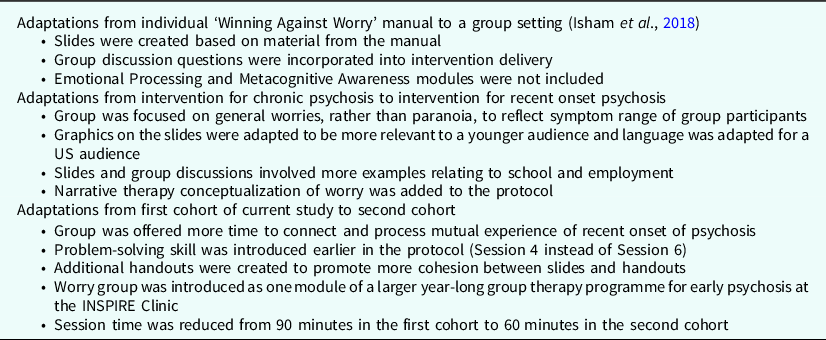
The cognitive behavioural worry intervention was adapted for a group setting based on the individual psychotherapy ‘Winning Against Worry’ (WIT) manual of Freeman et al. (Reference Freeman, Dunn, Startup, Pugh, Cordwell, Mander, Černis, Wingham, Shirvell and Kingdon2015). Isham and colleagues (Reference Isham, Grafahrend, Nickless, Pugh, Pleasants, Smedley, Freeman and Mulligan2018) had piloted the group format of the WIT intervention for individuals with chronic psychosis, and the current study adapted the PowerPoint slides and handouts from the pilot study of Isham et al. for the younger recent onset psychosis population. The adaptations were guided by consultation with the original developer of the group (Isham et al., Reference Isham, Grafahrend, Nickless, Pugh, Pleasants, Smedley, Freeman and Mulligan2018) and by the current study’s clinicians’ previous experience working with early psychosis populations. Based on feedback from the initial cohort in the current study, modifications to the group protocol were made for the second cohort (Table 2).
Adaptations to treatment protocol for group worry intervention

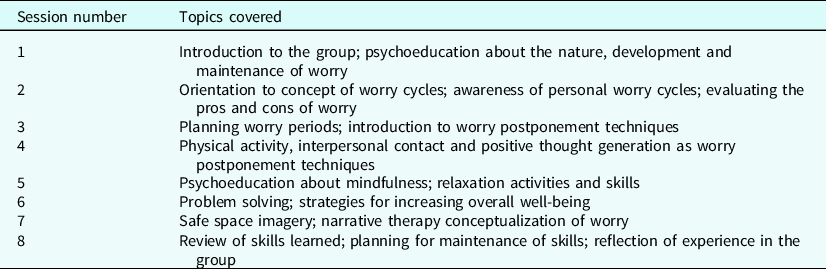
Led by licensed clinical psychologists and a clinical psychology doctoral student, sessions focused on the development of skills to address worry, group discussion, and review of application of skills at home (Table 3). Between each session, participants were sent a card in the mail summarizing the content of the session they completed, highlighting a skill they planned to practise over the course of the week, and reminding them of the upcoming session.
Overview of sessions for group worry intervention

Participants attended a 1-hour focus group upon completion of the 8-week intervention. A clinical psychology doctoral student blind to the study led the focus group, asking participants a series of open-ended questions about their experience in the group.
Measures
Feasibility measures
Attendance and attrition
Group participation and drop-out rates were recorded as a measure of the implementation of the intervention in a clinical setting.
Group Climate Questionnaire – Short Form (GCQ-S)
The GCQ-S (MacKenzie, Reference MacKenzie, Dies and MacKenzie1983) is a 12-item questionnaire used to assess the general social climate of therapy groups and is one of the most widely used assessment tools in group psychotherapy research. Group climate is rated across three subscales: Engagement, Conflict and Avoidance. Data from the GCQ-S were used as a measure of acceptability in the current study. The GCQ-S does not have official cut-off scores. For the purposes of the current study, we established cut-off scores based on participants’ responses on the 7-point scale (1, not at all; 2, a little bit; 3, somewhat; 4, moderately; 5, quite a bit; 6, a great deal; 7, extremely). For the Engagement subscale, we determined that a mean score of 25 or above indicated high group engagement. This cut-off score would indicate that, on average, group members rated engagement subscale items as 5 (quite a bit) or above on the 7-point scale.
Focus group
Group members were asked a series of questions about their experience in the group, including whether their expectations were met, whether they would recommend the group to others, helpfulness of the group, obstacles to implementing skills, and suggestions for improving the group. The qualitative data gathered during the focus group were used to support the acceptability of the piloted intervention.
Symptom measures
Participants completed all self-report measures at baseline (T1) and during the final group therapy session (T2), with the exception of the Group Climate Questionnaire, which was administered on a weekly basis.
Penn State Worry Questionnaire (PSWQ)
The PSWQ (Meyer et al., Reference Meyer, Miller, Metzger and Borkovec1990) is a 16-item self-report measure of worry. This instrument was used to assess change in worry from pre- to post-intervention, and to determine study eligibility, with a cut-off score of 45 or more signifying a clinical level of worry.
Generalized Anxiety Disorder-7 (GAD-7)
The GAD-7 (Spitzer et al., Reference Spitzer, Kroenke, Williams and Löwe2006) is a widely used and efficient 7-item self-report tool for measuring anxiety severity.
Patient Health Questionnaire-9 (PHQ-9)
The PHQ-9 (Kroenke et al., Reference Kroenke, Spitzer and Williams2001) is a well-established 9-item self-report tool for assessing severity of depressive symptoms.
Community Assessment of Psychic Experiences (CAPE)
The CAPE (Stefanis et al., Reference Stefanis, Hanssen, Smirnis, Avramopoulos, Evdokimidis, Stefanis, Verdoux and Van Os2002) is a 42-item self-report measure of psychotic symptoms. It consists of three subscales: positive symptoms, negative symptoms and depressive symptoms, and assesses level of distress surrounding each of these symptoms. This measure was not used in the first round of the group, but it was administered pre- and post-intervention in the second group.
Questionnaire about the Process of Recovery (QPR)
The QPR is designed to evaluate perceived degree of recovery from psychosis. The 15-item version of this self-report measure (Law et al., Reference Law, Neil, Dunn and Morrison2014) was used in the current study. The QPR was not used in the first round of the group, but was administered pre- and post-intervention in the second group.
Data analysis
Given the small sample size of the current study (n = 6), we did not expect to achieve statistical significance, and as such, descriptive statistics were computed for all quantitative measures. Qualitative data recorded from the focus group were transcribed. Participant responses to closed-ended questions (e.g. ‘Would you recommend this group to others?’) were tallied. Responses to open-ended questions (e.g. ‘What obstacles got in the way of implementing skills from the group?’) were categorized using thematic analysis, based on methodology described by Braun and Clarke (Reference Braun and Clarke2006).
Results
Feasibility analysis
Implementation
All study components, including the baseline assessment, the 8-week intervention, and the follow-up focus group, were successfully executed in a clinical setting for two rounds of the group. For the second round, the worry group was incorporated into a year-long group therapy programme at the INSPIRE clinic, whereby participants would attend other therapy modules upon completion of the worry group.
Attendance and attrition
All participants included in the study attended the initial baseline assessment. Five participants (Patients 1, 3, 4, 5 and 6) attended all eight sessions of the intervention, while Patient 2 attended five of the eight sessions. The average attendance rate across participants who completed the study was 7.5 out of eight sessions. All participants, except Patient 2, attended the focus group. Across both rounds of the group, a total of six participants withdrew from the study after the baseline assessment session, resulting in an attrition rate of 50%; two participants withdrew from the first cohort, and four participants withdrew from the second cohort. It should be noted that one of the four who withdrew from the second cohort opted out of the the research component but continued to attend the group, and one additional participant regularly attended the second cohort group without consenting to the research component. Reasons for withdrawal included no longer being interested in the group, scheduling conflicts, and not wanting to complete the study questionnaires.
Acceptability
Group Climate Questionnaire-Short Form (GCQ-S)
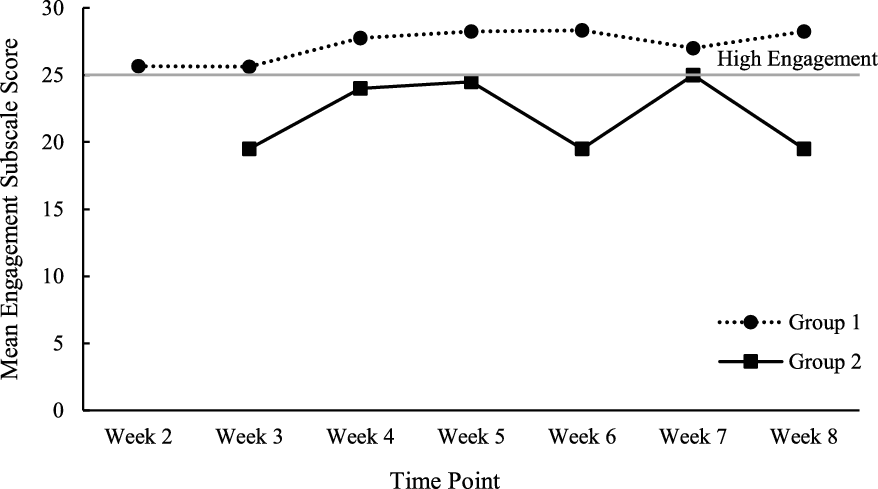
Participants’ perception of the social climate of the group, including group engagement, was evaluated on a weekly basis. Mean scores for both cohorts were calculated for the Engagement subscale of the GCQ-S. A mean score of 25 or above was determined to be an indication of high group engagement. Based on this cut-off score, the first round of the group consistently reported high engagement, while Engagement subscale scores for the second round consistently fell on or below the cut-off. Mean scores on the Engagement subscale for both rounds of the group are presented in Fig. 1.
Mean group GCQ-S Engagement subscale scores across study time points.


Symptom measure analysis
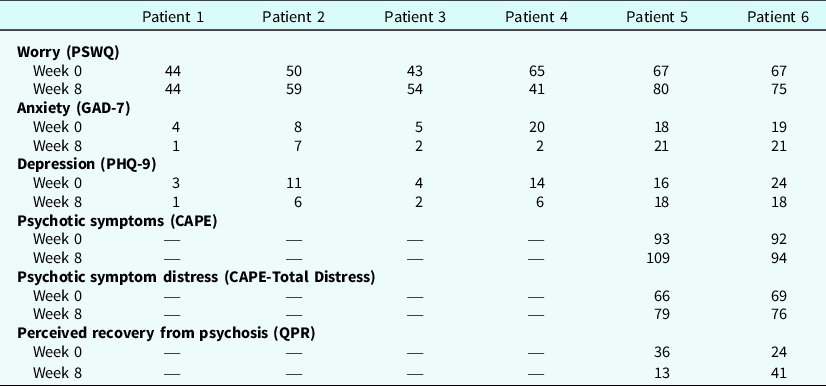
Contrary to prediction, there was not a consistent decrease in worry from pre- to post-treatment, as measured by the PSWQ. Across both groups, participants’ level of worry tended to remain the same or increase over the course of treatment. At an individual level, four participants (Patients 2, 3, 5 and 6) reported increased levels of worry on the PSWQ. Patient 1 reported no change in worry and remained at sub-clinical threshold. Patient 4 was the only participant to report a decrease in worry from pre- to post-treatment.
The results were variable for the secondary symptom measures. In terms of anxiety, all four participants from the first cohort (Patients 1–4) reported a decrease in anxiety on the GAD-7 upon completion of the treatment. Patients 5 and 6, both of whom participated in the second round of the group, experienced an increase in anxiety severity from baseline to treatment completion. Outcomes related to depression were more consistent across groups, with five of the six participants reporting a decrease in depressive symptoms on the PHQ-9 from baseline to treatment completion; Patient 5 reported an increase in depressive symptoms. Psychotic symptoms were only examined in the second cohort; Patients 5 and 6 both reported an increase in symptom severity from pre- to post-treatment on the CAPE. They also reported an increase in distress surrounding their symptoms. In terms of perceived recovery from psychosis, Patient 5 reported a decrease in perceived recovery on the QPR from pre- to post-treatment, whereas Patient 6 reported an increase in perceived recovery The symptom change results are summarized in Table 7.
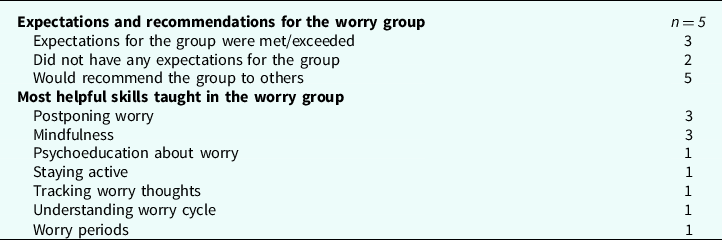
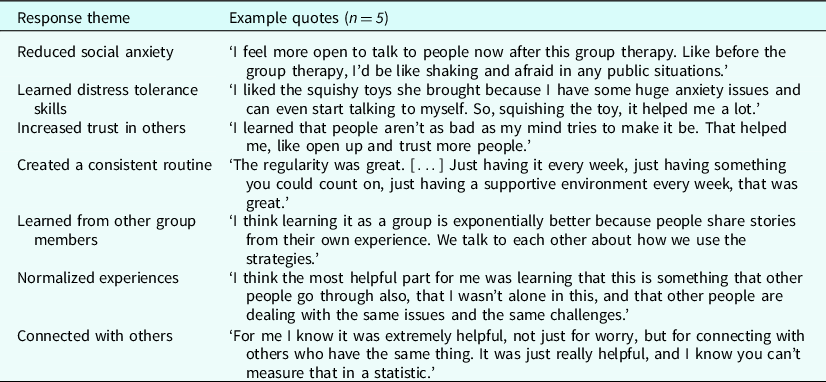
Participant response themes regarding helpfulness of the worry group

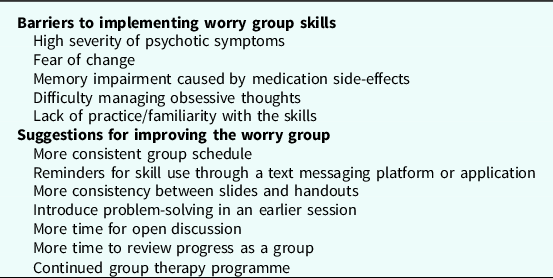
Participant response themes regarding barriers and suggestions for improvement

Individual symptom change during group worry intervention

Discussion
Feasibility
The primary aim of the current study was to investigate the feasibility of delivering a group worry intervention for young adults with recent onset psychosis. From an implementation standpoint, it appeared moderately feasible to deliver the intervention in a clinical setting. The research team for the current study was able to successfully recruit participants to run two rounds of the group and deliver all components of the intervention.
Attendance was high for those who completed the study, with five out of six participants attending all eight intervention sessions. With an average of 7.5/8 sessions attended, the attendance rate of the current study is greater than that of group worry interventions for individuals with a chronic psychosis presentation conducted by Courtney et al. (Reference Courtney, White, Richardson, Dasyam, Tedbury and Butt2019) and Isham et al. (Reference Isham, Grafahrend, Nickless, Pugh, Pleasants, Smedley, Freeman and Mulligan2018), who reported averages of 5/7 and 5.7/8 sessions, respectively. However, attrition for the current study was also high, with as many participants withdrawing from the research component of the study as participants completing it. Treatment disengagement is common in early psychosis populations, but the attrition rate from the current study of 50% appears to be higher than typical rates for this population, which tend to be around 30% (Doyle et al., Reference Doyle, Turner, Fanning, Brennan, Renwick, Lawlor and Clarke2014). It is also higher than the attrition rates from Courtney et al. (Reference Courtney, White, Richardson, Dasyam, Tedbury and Butt2019) and Isham et al. (Reference Isham, Grafahrend, Nickless, Pugh, Pleasants, Smedley, Freeman and Mulligan2018), with 18% and 7% attrition rates, respectively. Common factors predicting disengagement in FEP include low insight, substance abuse and lack of involvement of a family member (Doyle et al., Reference Doyle, Turner, Fanning, Brennan, Renwick, Lawlor and Clarke2014). Individual factors influencing disengagement were not directly examined in the current study, but it is noteworthy that attrition was higher for the second cohort than the first. Although a multitude of factors probably contributed to the higher attrition rate of the second cohort, it is worth considering that participants in the second cohort tended to present with a higher severity of symptoms at baseline than participants in the first cohort, which may have impacted their ability to remain engaged in the group. Furthermore, group members in the second cohort were billed for therapy and were not compensated for completing the assessments. It is also possible that the changes in group leaders and timing of the group between the first and second cohorts may have contributed to the higher attrition rate of the second cohort. Lastly, it should be noted that the attrition rate of the second cohort does not fully reflect participation level, as two group members continued to regularly attend the group therapy sessions without participating in the research component of the group.
Based on qualitative feedback obtained during the focus group, acceptability of the worry group was high. Participants who entered the group with expectations reported that their expectations had been met or exceeded, and all participants shared that they would recommend the group to others. The skills taught appeared to be well received, and mindfulness and postponing worry were identified as the most helpful skills. Barriers to implementing skills centred on severity of illness. Auditory hallucinations, medication side-effects, and obsessive thoughts were recognized as barriers to engaging in the group and effectively using the skills. Similarly, participants who were further along in their recovery process noted that it would be difficult for individuals with active psychosis to utilize the strategies presented. Participants provided recommendations on ways to improve the group, and with the exception of the suggestion of delivering reminders for skill use through texting or an app, all of the recommended changes were implemented for the second round of the group.
In addition to skills, group members emphasized how effective it was for them to connect with others through the group. The peer connection component of group therapy was one of the driving factors behind the decision to adapt the protocol to a group setting for young adults, and as expected, it seemed to be important for effective treatment. Participant-rated levels of engagement and group cohesion were consistently lower for the second cohort, and participants in the second cohort exhibited higher levels of attrition and seemed to benefit less from the intervention in terms of symptom change. The importance of engagement and alliance has been highlighted in several other studies with early psychosis populations. Goldsmith et al. (Reference Goldsmith, Lewis, Dunn and Bentall2015) indicated a strong relationship between therapeutic alliance and the effectiveness of therapy for early psychosis. Similarly, Haddock et al. (Reference Haddock, Lewis, Bentall, Dunn, Drake and Tarrier2006) found supportive counselling, with its emphasis on relational factors, to be more effective than CBT in terms of symptom reduction for younger individuals with recent onset psychosis. Lecomte et al. (Reference Lecomte, Leclerc and Wykes2018) extended these findings to a group setting, concluding that group cohesion is a pre-requisite for symptom reduction in group CBT for early psychosis.
Potential treatment impact
Contrary to expectations, group members did not report a consistent decrease in worry upon completion of the group. These results stand in contrast to the findings from the WIT study, where participants experienced a significant reduction in worry after the 8-week intervention (Freeman et al., Reference Freeman, Dunn, Startup, Pugh, Cordwell, Mander, Černis, Wingham, Shirvell and Kingdon2015). One hypothesis for the reported increase in worry in four out of six group members is that participants developed better awareness of their worries through the group, as increasing awareness of worry thoughts, cycles and triggers was a primary focus of the intervention. Participants may have learned to be more conscious of their worries, and consequently reported more frequent worries on the PSWQ.
The findings in terms of anxiety and psychotic symptoms were varied. While some participants reported symptom reduction, others reported an increase in symptoms over the course of treatment. It is worth noting that participants in the second cohort tended to present with higher baseline scores and more chronic courses of psychosis than the first cohort, and they also reported increased anxiety. With lower reported group cohesion in the second cohort, participants may have felt less comfortable and at ease in the group setting, and consequently may have experienced higher levels of anxiety.
Findings were more consistent for depressive symptoms, with all but one participant reporting a decrease in symptomatology. Response themes consistently indicated an appreciation for the social connection afforded by the group. In a qualitative study of depression in FEP, social withdrawal and isolation emerged as a central theme in participants’ subjective experience of depression (Sandhu et al., Reference Sandhu, Ives, Birchwood and Upthegrove2013), and as Leclerc and Lecomte (Reference Leclerc and Lecomte2012) note, one of the benefits of group therapy is that it provides social connection with peers to an extent that individual therapy cannot.
Limitations and clinical considerations
The current study was primarily limited by its small sample size. Consequently, the findings may not be generalizable to a larger recent onset psychosis population and should be interpreted with caution. The high attrition rate is also a limitation of this study. With 50% of participants withdrawing from the study after the baseline assessment, the remaining pool of participants was somewhat self-selected and may not be representative of the larger recent onset psychosis population. Minimal feedback was obtained from those who withdrew from the group, making it difficult to implement changes that might decrease disengagement.
The current study is furthermore limited by its relatively broad focus; in contrast to the original WIT protocol, which focused more narrowly on symptoms of paranoia in relation to worry, the current study included a wider range of psychotic symptoms. The measurement of psychotic symptoms was also a limitation of the current study. Conducting a clinician-administered assessment of psychotic symptoms was not a possibility due to limited resources, and the CAPE, a self-report measure, was administered instead. Given that self-report measures of psychosis are not considered standard practice, the psychotic symptoms data should be interpreted with caution. As previously mentioned, participants in the second cohort tended to present with more severe and chronic symptomatology; however, other factors commonly associated with symptom severity in psychosis, such as duration of untreated psychosis and medication adherence, were not directly examined in the current study and warrant investigation in future research.
A noteworthy attribute of the current study’s sample was the cultural diversity of participants. With three participants identifying as Asian/Indian, two identifying as multiracial, and one identifying as White, the study sample is more diverse than that of the original WIT study, where 93% of participants identified as White (Freeman et al., Reference Freeman, Dunn, Startup, Pugh, Cordwell, Mander, Černis, Wingham, Shirvell and Kingdon2015). Further research is needed to determine the extent to which culture and ethnicity play a role in participants’ worries and their treatment outcomes. The current study focused on adapting the group for a younger age group, but cultural adaptations may also be indicated to meet the needs of a diverse population.
The qualitative findings from the current study indicate that the adaptation of the worry intervention protocol to a group setting and younger audience was moderately successful. Given the small sample size of the current study, participants’ subjective experience of the group provides valuable insight into the feasibility of the intervention. Their positive feedback on both the content and the format of the intervention indicates high acceptability of the group and suggests that a better powered study is warranted to explore the clinical effectiveness of the intervention.
Nevertheless, the high attrition rate and varied treatment outcome results from the current study should not be ignored. Recent onset psychosis is characterized by a broad spectrum of symptom presentation, and adaptations to the protocol may be necessary to reach the full range of individuals under the early psychosis umbrella. In future iterations of the group, additional efforts should be made to promote group cohesion with this population; for example, extending the length of treatment may allow more time for group alliance to develop. Clinicians and researchers might also consider implementing strategies found to promote treatment engagement in this population, such as involving a family member. It will be important for future research to directly assess the impact of treatment engagement and group cohesion on changes in psychotic symptoms, worry, and other secondary symptoms. Lastly, it is recommended that future iterations of the group examine the impact of symptom severity on treatment engagement and outcome to determine whether the intervention meets the needs of individuals with more severe symptomatology.
Acknowledgements
We would like to extend our gratitude to Dr Nichole Olson, Dr Alena Lee, Rachel Weiler, Alix Simonson and the providers at the INSPIRE Clinic for their assistance with the various stages of this project.
Financial support
This work was supported by the pilot departmental grant series at the Department of Psychiatry and Behavioral Sciences, Stanford University.
Conflicts of interest
None.
Ethical statements
The authors abided by the Ethical Principles of Psychologists and Code of Conduct as set out by the APA. Ethical approval for this study was obtained through the Stanford University IRB 37039.
Data availability
The data are available upon request from the authors.
Key practice points
-
(1) Based on qualitative feedback obtained from group members, acceptability of a group-based worry intervention for individuals with recent onset psychosis was high, and the group format may be a good fit for this population.
-
(2) Attrition rate of the group was also high. Clinicians working with individuals with recent onset psychosis should consider implementing strategies found to promote treatment engagement in this population, such as involving a family member.
-
(3) Symptom measure data were variable and may have been impacted by group cohesion and baseline symptom severity of participants. It is recommended that clinicians working with recent onset psychosis poulations in a group setting incorporate specific interventions to promote group cohesion and to address the needs of individuals with more severe symptomatology.
-
(4) While the effectiveness of the worry intervention was not demonstrated in the current study, worry still remains an important symptom for clinicians to consider when working with recent onset psychosis populations.




Comments
No Comments have been published for this article.