Middle grades education has long been the object of efforts to remediate US education in order to address a wide array of social problems. Districts have sought out K-8 models to create smaller learning communities, require fewer school transitions, and allow more sustained connections with students. This paper offers a historical analysis of K-8 schools, drawing on statistical and spatial methods and using a DisCritFootnote 1 intersectional lens to illustrate how creating K-8 schools in one urban district performed another important function—producing enclaves of privilege.
Since the mid-1980s, K-8 schools in our target district have become both whiter and wealthier than district averages. Although the enrollment patterns of students with disabilities as a whole tend to parallel enrollment patterns for all students with regard to race, in K-8 schools, students with particular disability labels had a greater likelihood of enrollment in their neighborhood K-8 school. Thus, because students of color associated with particular disability categories were overrepresented, enrollment patterns of students with disabilities such as autism, intellectual disability, and emotional disturbance intensified racial segregation in the district.
Students with disabilities attending K-8 schools also tended to be placed in more inclusive classrooms, where they were more likely to be integrated alongside nondisabled peers than counterparts attending traditional middle schools, who tended to be placed in more restrictive (e.g., segregated) special education classrooms. It could be that as K-8 schools offered more inclusive settings for students with disabilities, families with the means to move into these attendance zones did so. It is also possible that families with more cultural capital attending these schools pushed for more inclusive settings for their disabled children. In either case, over time K-8 schools in the district became increasingly white, privileged, and inclusive.
Historical Context
Since 1975, the federal special education law, now known as the Individuals with Disabilities Education Act (IDEA), mandated that students with disabilities be educated “to the maximum extent appropriate” with students without disabilities and that their removal “from the regular educational environment occurs only when the nature or severity of the disability of a child is such that education in regular classes with the use of supplementary aids and services cannot be achieved satisfactorily.”Footnote 2 The principle of the least restrictive environment (LRE) is one of six foundational tenets of special education policy and practice, and the basis for inclusive education.Footnote 3 States must report the percent of students aged six through twenty-one with disabilities served by the general education class—the generally accepted federal metric for “inclusion” for students with disabilities is participation in general education settings for 80 percent of the school day or more. However, access to general education environments for students with particular disability labels varies widely, such as intellectual disability and emotional disturbance.Footnote 4 For example, in the most recent Office of Special Education Programs report to Congress, 63.1 percent of students with disabilities were educated in inclusive environments (80 percent or more of the school day), 13.4 percent in mainly special classes (less than 40 percent of the school day), and 5.1 percent in other environments. However, this varies both within and across states and by disability category. For students served under the IDEA categories of intellectual disability and emotional disturbance, 17.0 percent and 47.2 percent, respectively, are taught in inclusive contexts nationally.Footnote 5 However, little research has been done examining factors associated with the wide variability in educational environments.
Over four decades of research indicates that students with disabilities—regardless of severity or type of disability—have better, or at least comparable, academic and social outcomes in general education contexts than in segregated ones.Footnote 6 In the few observational studies conducted to compare the learning environments of segregated and inclusive contexts, students with disabilities tend to have more access to the general education curriculum and more opportunities to engage in the general education curriculum in inclusive contexts.Footnote 7
Although variation exists, the larger body of research on postschool outcomes for students with disabilities shows a positive relationship between placement in general education contexts and improved postschool outcomes for students with both mild and more complex disabilities.Footnote 8 Another body of research highlights what is commonly referred to as disproportionality, which shows how, even controlling for socioeconomic status, race is an undeniably significant factor in the likelihood that a child will be labeled as disabled in school.Footnote 9 Moreover, in addition to being overrepresented in particular disability categories, students of color are also more likely to be placed in more restrictive (or segregated) educational environments. Because receiving special education services often results in some degree of exclusion from general education settings, particularly for students of color who tend to be placed in more restrictive settings, special education has historically functioned as a form of racial resegregation in otherwise desegregated schools.Footnote 10 The relationship between racial segregation and disability exclusion has a long and interconnected history.
Historians of education have explored the history and development of special education by analyzing archival documents, including government records, school board records, newspaper articles, and editorial pages. In tracing the development of special education, historians have documented the ways that school practices have perpetuated race, class, and ability privilege. Mandated to serve a broader population of students, many of whom had been previously excluded from public education, schools created special classes and even special schools as a means to manage the influx of less desirable students.Footnote 11 Over time, these practices have taken on a variety of forms and configurations yielding similar results.
Despite the landmark Brown v. Board of Education decision in 1954, for instance, students of color are now more likely than ever to be educated in racially segregated schools in communities struggling with concentrated poverty. Similarly, although the IDEA guaranteed students with disabilities the right to be educated in an LRE, these students continued to spend significant portions of their day isolated in self-contained classrooms.Footnote 12 Although we could point to the failings of both Brown and the IDEA, it is the collusive nature of racism and ableism that has contributed to students of color being overidentified and hypersegregated in schools.
In analyzing editorials marking the ten year anniversaries of Brown, for instance, principals and teachers often pointed to perceived academic difference as a justification for segregating students of color in special education or remedial classes.Footnote 13 Examining the shift from segregating students between schools based on race (before desegregation) and within schools based on ability (after desegregation) highlights the role that special education, like ability tracking more generally, played in creating schools within schools, demarcated by race, but under the guise of perceived dis/ability. In other words, special education often conceived as a benevolent system of supports for students, in practice, has a more complex and problematic relationship to racial oppression. Likewise, the configuration of K-8 schools, which can be seen as simply an administrative decision or a way to better serve students, has obscured the interworkings of power and privilege that may have resulted from or motivated their creation.
Leveraging Race, Class, and Ability
Schools, regardless of configuration, always reflect the interests of dominant groups. School zones, for instance, have long been gerrymandered to ensure race and class homogeneity.Footnote 14 Recent movement of middle-class families back to urban communities may provide a welcome influx of “cultural, material, and social capital” to urban communities and schools. Middle-class parents may choose to send their children to urban schools in response to a commitment to multiculturalism, a desire for their children to have a more cosmopolitan identity, or simply out of a commitment to supporting public schools. Yet middle-class parent involvement in schools can also have a “troubling underside . . . leading to greater levels of inequality within and across schools.”Footnote 15 Benefits largely depend on whether parents are individually focused on advantages accrued to their own children or on more collective benefits to the school community as a whole.Footnote 16
In a groundbreaking study of parents (primarily mothers) in high-income elementary schools in 2003, for instance, Brantlinger identified the contradictory desires of middle-class white parents who “were attracted to socially inclusive, integrated ideals of education, but were intent on having advantaged circumstances for their own children.”Footnote 17 In subtle ways, parents in her study espoused ideologies that allowed them to deny or downplay their own advantaged positioning, while further legitimizing that privilege. The ability to leverage parent involvement becomes all the more important to interrogate as the state assumes less and less responsibility for educating students through neoliberal reforms (e.g., school choice, charter schools, and voucher programs) and parents are increasingly expected to take on an ever greater responsibility for advocating for their own children's education.Footnote 18 In fact, high levels of parent involvement are now perceived as essential elements of good parenting. Thus, parents who can gain greater access to educational resources may ensure that the educational system benefits their own children, but not necessarily in ways that benefit others.Footnote 19
Because of the clinical and bureaucratic nature of special education discourse, parents of disabled children have an added layer of complexity to negotiate.Footnote 20 Although special education laws require and expect parent involvement, and this is seen as essential to due process rights, parents from less privileged backgrounds continue to face higher “rates of stigmatizing disability diagnoses among their children; more placements in special education contexts that segregate their children from mainstream students; and inferior special education services.”Footnote 21 In fact, “rather than leveling the playing field, [special education] legislation and its focus on parent involvement has created new opportunities for children of privileged parents to enjoy a relative advantage in the public education system, further entrenching the social class and racial-ethnic hierarchies within the relationship between families and schools.”Footnote 22 Students of color and students from less privileged backgrounds experience less access to inclusive education and general education content and curriculum, with significant negative consequences as a result of labeling. Despite an overwhelming body of research suggesting that students with disabilities experience improved academic and social-behavioral outcomes when given access to general education settings, students with disabilities continue to have inequitable access to general education curriculum and contexts and poor outcomes.Footnote 23
Development of K-8 Schools
In September of 2005, the Board of Education of SCSD, a large urban school district in a mid-size city in New York State, initiated a Small Schools Plan designed to reconfigure several elementary schools in the district into K-8 school buildings. The plan would eliminate the only remaining traditional middle school in one quadrant of the city. Administrators touted the plan, claiming the K-8 schools would “improve graduation rates by lessening student transitions and offering programs of excellence in all schools.”Footnote 24 In the Board minutes, administrators also expressed a desire to “establish safe and secure schools.”Footnote 25 Although these were not the first K-8 schools in the district (the district had opened one K-8 school in 1984, another in 1993, and two others in 1995), the 2005 Board decision marked a significant shift in the building configuration and enrollment patterns in an area of Syracuse adjacent to several public and private universities and hospitals.Footnote 26 In other words, the quadrant of the city that stood to benefit the most by this change included many highly educated and relatively more affluent families than other quadrants of the district.
The creation of K-8 schools in SCSD over the last four decades is part of a larger tradition of school reform initiatives designed to solve social problems by configuring and then reconfiguring middle grades education.Footnote 27 In the nineteenth and early twentieth centuries, many children entered the workforce upon leaving school, regardless of the number of years successfully completed. During the first half of the twentieth century, a variety of different educational models and grade configurations emerged to provide academic and social opportunities for adolescent students prior to entering high school.Footnote 28 Tracing these various reforms across the decades, Kelly Bedard and Chao Do suggest that reformers aimed to provide middle grade students access to developmentally appropriate curriculum and instruction without exposing them to older teenagers.Footnote 29 The changing bodies and minds of middle grade students also made them an inappropriate or unwelcome presence in elementary schools, due to the onset of puberty and their need for a more rigorous curriculum. Thus, the emergence of school spaces devoted to the middle grades meant that young adolescents would be the sole focus of this newly configured “middle” school.Footnote 30
By the mid-1990s, however, studies began to show declines in academic performance and other areas as students transitioned from middle school to high school. Students making this transition were found to experience academic achievement loss and increased dropout rates, lowered self-esteem and self-perception, and decreased social supports and involvement with school.Footnote 31 Some districts, particularly in urban areas, began to convert their middle schools to K-8 schools in an attempt to increase academic performance.Footnote 32 Other districts, like SCSD, selectively replaced some middle schools with K-8 schools, while retaining others. Despite persistent dissatisfaction with middle grades education, research shows mixed support for improvement in “students’ performance or well-being” associated with either of the two grade configurations.Footnote 33 C. Kenneth McEwin, Thomas Dickinson, and Michael Jacobson found that, overall, separately configured middle schools better met the developmental and academic needs of young adolescents.Footnote 34 However, other research suggested that K-8 schools provided the same or better academic and social outcomes for students as they transition to high school.Footnote 35 In three large-scale studies comparing grade configurations in Philadelphia, Vaughan Byrnes and Allen Ruby, Martha Abele Mac Iver and Douglas Mac Iver, and Christopher Weiss and Christine Baker-Smith found that older, more firmly established K-8 schools outperformed both middle schools and newer K-8 schools, and that newer K-8 schools were marginally more effective than middle schools.Footnote 36 Where better outcomes were noted, researchers found that in many cases the K-8 schools that outperformed their middle school counterparts were actually serving students from more advantaged neighborhoods. These researchers advise caution when translating research findings into policies to convert middle schools to K-8 schools, especially if the demographic and socioeconomic populations remain unchanged.Footnote 37 However, no existing studies looked at particular outcomes or factors related to students with disabilities who receive special education services and attend one or the other of these middle grade school configurations.
In this paper, we augment the historical surround of the formation of K-8 schools in one urban school district by drawing on statistical and spatial methods.Footnote 38 Moreover, in addition to reviewing relevant documents and board proceedings, we also ground this work in a DisCrit intersectional lens to illustrate how these newly configured K-8 schools performed an important function as enclaves of privilege within one urban district.Footnote 39 Specifically, we explore how practices of inclusion and exclusion developed alongside and within these K-8 spaces within a district plagued by hypersegregation and situated within a city with some of the highest concentrations of African American and Latinx poverty in the nation.Footnote 40 By focusing on the complicit nature of racism and ableism, along with other social markers, and drawing on the tools of critical race spatial analysis (CRSA) and statistical analyses, we explore how schools function as fiercely contested sites of segregating/excluding practices, imbued with racist and ableist ideologies that are made to appear natural and neutral.Footnote 41 In the particular contested site we examine in this study, the Syracuse City School District (SCSD), we show how creating K-8 schools maintained pockets of race and class privilege as well as allowed for more inclusive placements for students with disabilities within the district.
Our findings illustrate that using spatial and statistical analyses reveals how educational placement and school configuration reflect an interplay of social, historical, and political forces. As schools are inextricably linked to local contexts, their “relationship to political, economic, cultural, and racialized spaces makes schools . . . important locales for spatial inquiry.”Footnote 42 Mapping disability, race, and class as interrelated functions of school configuration, this work reveals the “unjust geographies” that magnify marginalized students’ experience within urban contexts, as well as how whiteness, ability, and goodness serve as interlocking forms of property in schools.Footnote 43
CRSA is a powerful tool for illuminating the complex interplay of race, class, disability, and socioeconomic status.Footnote 44 Drawing on CRSA, we spatially examine “how structural and institutional factors influence and shape racial [and disability] dynamics and the power associated with those dynamics over time.”Footnote 45 In addition to CRSA, DisCrit provides key analytic tools for tracing the collusive nature of racism and ableism, which disproportionately impacts how minoritized students with disabilities experience compounding forms of educational disadvantage.Footnote 46 Like Ellen Brantlinger, however, we also look at the workings and maintenance of privilege and how the actions of dominant groups leverage and solidify that privilege.Footnote 47 In other words, rather than focus on the marginalization and oppression that minoritized groups experience, we instead turn the analytic lens to uncovering how the creation of K-8 schools functioned to create pockets of privilege within one urban school district.
Location matters when it comes to educational variables, in addition to social, cultural, political, and resource factors.Footnote 48 As a majority of local government decisions are made with geography in mind, it is crucial for education researchers to consider spatial factors.Footnote 49 A geograhic information system (GIS) is an important computer-based tool for exploring, visualizing, and analyzing data. GIS analyses make visibile both variable values and their spatial relationships and reveal relationships that are difficult to ascertain through descriptive or inferential statistics.Footnote 50 Thus, this research responds to K. Animashaun Ducre and Eli Moore's call to use the concept of “racialized spaces . . . to describe the partition of urban spaces,” in the context of the formation of K-8 schools in the SCSD.Footnote 51 Informed by DisCrit, our analysis accounts for intersecting domains of race/ethnicity, disability category, and rates of inclusion.
K-8 Schools in Syracuse, New York
Syracuse is a mid-size, postindustrial city located in Onondaga County, New York. It is situated on land and on the shores of Onondaga Lake, which are both sacred to the Haudenosaunee (Iroquois) people, who are members of the Onondaga Nation located in territory just south of Syracuse. Syracuse is also one of the largest refugee resettlement areas and one of the most hypersegregated cities in the country, with the highest concentration of African American and Latinx poverty in the nation.Footnote 52 In the 1950s, a primarily African American and Jewish neighborhood was razed in order to build US Route 81, a major interstate that bisects the city today.
The SCSD has twenty-six schools serving students from kindergarten through 8th grade (fifteen elementary schools, six middle schools, and five K-8 schools). Students are assigned a “neighborhood” school within their particular attendance zone; however, the SCSD has an extensive school choice program and families may apply for placement in most of the twenty-six schools in the district. Further, many students with disabilities are placed in “nonneighborhood” schools due to limited availability of some special education programs and services. The district also includes two lottery-only schools, two charter schools, one gifted elementary school that requires a testing/application process, and four alternative schools. Approximately 20 percent of SCSD students are classified as students with disabilities, well above the 14 percent national classification rate. The interstate that runs through the middle of the city bisects the SCSD, dividing it racially and socioeconomically, rendering some SCSD quadrants hypersegregated by race and socioeconomic status. Additionally, the northwestern quadrant hosts the majority of resettled refugee families. The SCSD has several schools in receivership and one of the lowest graduation rates in the state for students with disabilities. Despite having more inclusive placements than some of the other large urban districts in the state, district-level administrators are concerned about the large number of students taught in self-contained classes and the lack of data informing inclusive reform efforts.
Out of eighteen school districts located in Onondaga County, only three districts have K-8 schools: SCSD (the only urban district in the county); the LaFayette Central School District, which has the only Indigenous nation school in the county; and theLyncourt Union Free School District, one of the most rural districts in the county. There are currently no K-8 schools in any of the suburban districts that surround the SCSD.
Although one local elementary school in the district transitioned to a K-8 model in 1984, another in 1993, and two more in 1995, the most significant restructuring involving K-8 schools in the SCSD occurred in the mid-2000s, when two additional elementary schools were reconfigured to K-8 buildings in the fall of 2007.Footnote 53 Located in the southeast quadrant of the city, all students in these newly formed K-8 schools would now feed directly into one of the high schools, as no traditional middle school would remain in that quadrant of the city. The stated goal of the reconfiguration was to “improve education all the way up the line, especially in middle school, [and] to increase graduation rate.”Footnote 54 The plan was promoted as offering greater flexibility, creating smaller communities within schools, and providing more sustained opportunities for teachers to get to know their students.
The SCSD school board's argument for the restructuring rested largely on a concern about retaining middle-class families from this section of the city, which was located adjacent to a private research university, two smaller public universities, and several public and private hospitals. District leadership outwardly expressed a goal of curbing the “attrition of middle-class families” from this area.Footnote 55 In other words, although many factors may have motivated the district to pursue the restructuring plan, it seems likely to have been a response to shifting demographics and a stated desire to keep more middle-class and white families in the city. In particular, there was a growing concern at the time that more financially secure families were opting to leave the city district for neighboring suburban districts or choosing to attend private schools once their children left the elementary grades.Footnote 56 Families quoted in the local paper at the time expressed concerns about the safety of middle schools in the district and the quality of the academic opportunities that were available to their children in district schools.Footnote 57 One parent, who expressed concern about maintaining “standards for excellence,” worried that the parents of the “cream of the crop, [or] the kids at the top level” at this particular elementary school were not going to send their children to the middle school.Footnote 58 A chorus of parents shared similar stories of families planning to move out of the district or send their children to private schools because they perceived SCSD middle schools as unsafe and substandard.Footnote 59 As parents across the district weighed in, proposed changes sent a ripple effect across the district. A parent at one of the schools that was slated to close as a result of the plan was dismayed that the district was closing her daughter's school in order to offer a “safety net” for parents not wanting to send their children to SCSD middle schools.Footnote 60 The struggles in the district have a much longer history—one that cannot be separated from the history of the city itself.
Then and Now: Redlining and Syracuse
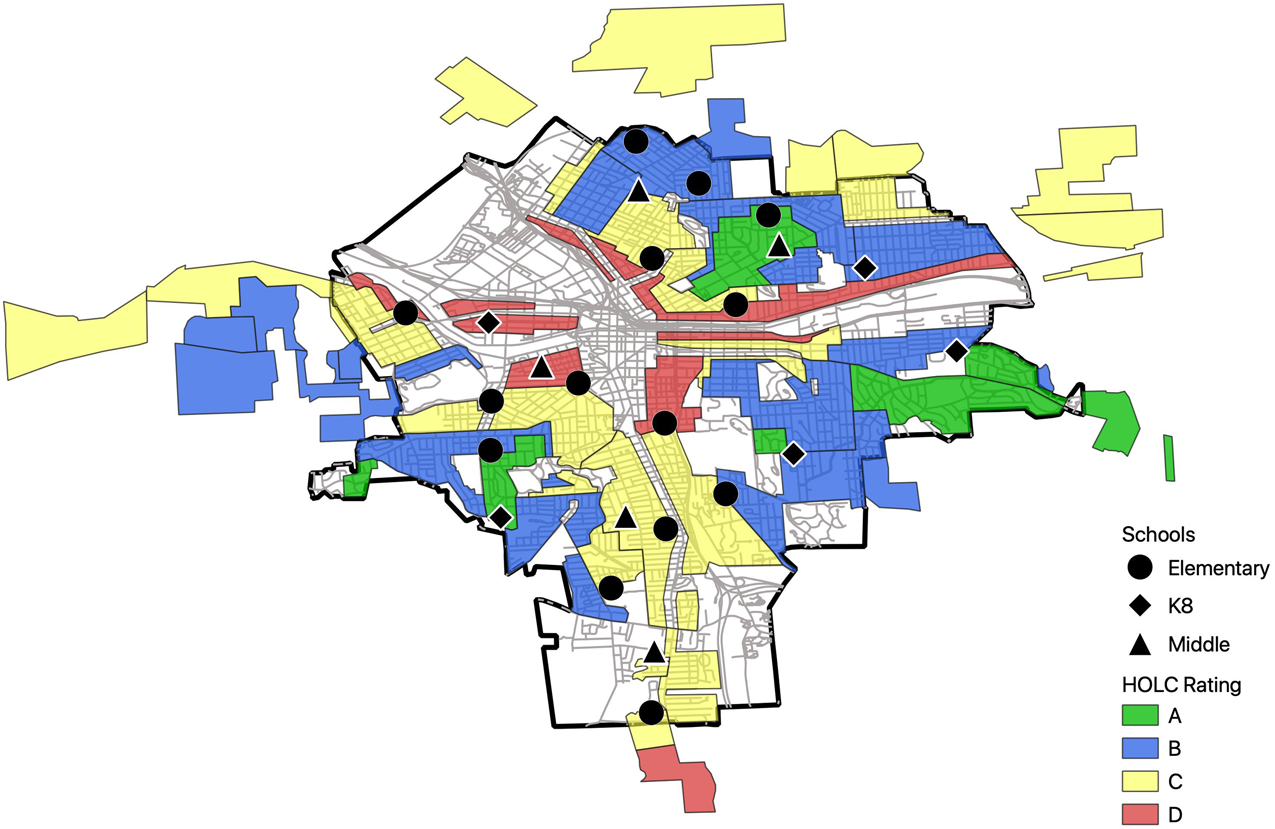
Syracuse was one of over two hundred cities mapped by the federal government's 1933 Home Owners’ Loan Corporation (HOLC). The HOLC was created to provide refinancing for home mortgages to stave off foreclosure due to the 1929 Wall Street crash and the subsequent housing market crisis. The HOLC maps were created to chart and assess lending risk by neighborhood type and, in fact, constituted “racial geograph[ies]” of these cities.Footnote 61 Neighborhood areas were graded and color-coded by purported quality: Grade A (green), Grade B (blue), Grade C (yellow), and Grade D (red). The maps were accompanied by Security Area Descriptions, which rated neighborhoods according to building type, price, and construction; the state of building repairs; and the percent of owner-occupied buildings. The area descriptions also provided a demographic rating that adopted the “scientific” vocabulary of the eugenics movement, which included residents’ class and occupation; percentage of “foreign born” and “Negro” families; percentage of “relief families”; an indicator of whether the population was increasing, decreasing, or static; and the quality of housing.Footnote 62 The maps also included a designation for “infiltration,” which specified an influx of any particular groups moving into a neighborhood—infiltrating groups were also named on the maps. The presence of any type of resident, other than the unnamed “white” resident, decreased the ratings of neighborhoods; rankings indicated a direct inverse relationship between percentage of inhabitants deemed “foreign-born,” “Negro,” or “Semitic”—what the Federal Housing Authority labeled “inharmonious racial groups”—and the area's grade.Footnote 63
For example, Grade A areas were described as being inhabited by business people and professionals, whose homes showed a “pride of ownership.”Footnote 64 In other words, Grade A areas had no relief families, foreign-born, or Negros, and no infiltration other than “an influx of the Semitic race”Footnote 65 in one A neighborhood. Grade B areas were characterized as such because of a slight infiltration of French- or German-born inhabitants, “higher type of factory employee”Footnote 66 or “junior executive”Footnote 67 residents. The B grade area was diminished by the “proximity of [a] state school for mental defectives,”Footnote 68 a tubercular sanatorium, an eleemosynary institution (i.e., a poorhouse), as well as “cheap construction.”Footnote 69 Grade C areas were characterized by many “relief” families, residents who were railroad or factory workers, with a high percentage of infiltration of Polish and Italian families, presence of “half-breeds from the Indian reservation located to the south,”Footnote 70 and “evidence of little pride”Footnote 71 in their homes. The Grade D areas were inhabited by laborers and factory workers, a large number of relief families, and high percentages of Italian, Polish, Jewish, and African American families. These areas were also designated as “shunned by lenders.”Footnote 72
We can still see the impact of the 1930s HOLC practices eighty years later.Footnote 73 Of the over two hundred cities the HOLC mapped, former Grade A neighborhoods are still overwhelmingly (91 percent) white and in higher income brackets, and 75 percent of Grade D neighborhoods remain communities of color (African American and Latinx) and in lower income brackets.Footnote 74 This holds true in Syracuse. We overlaid the current SCSD K-8 and other elementary and middle schools onto the 1937 HOLC map (see Figure 1). This map shows that, with the exception of one K-8 school in a former Grade D neighborhood, K-8 schools in the SCSD are located in Grade A and Grade B areas. Other than schools in the north of the district, few schools outside of K-8 schools are represented in Grade A or B areas.
SCSD K-8, elementary, and middle schools overlaid with the HOLC map.

In this study we analyzed and mapped demographic, educational environment, and school type for students with disabilities in the SCSD. Although students with disabilities are increasingly receiving special education services in general education contexts, students with particular disability labels, such as intellectual disability, emotional disturbance, and autism, and students of color with disabilities, continue to be taught in more restrictive (segregated) environments and have poorer outcomes.Footnote 75 Our analysis was broadly focused on the racial and ethnic distribution of students with disabilities who were enrolled in K-8 schools in the SCSD. We also looked for trends in the data related to K-8 enrollment and disability categories.
Findings from statistical and geospatial analysis of special education, as well as elementary and middle school attendance data from the SCSD, indicate that K-8 schools can (and do) produce whiter, wealthier, and more inclusive pockets of school attendance within larger, more diverse urban districts. This is particularly true in districts like the SCSD, where several school configurations exist within the same district.
K-8 Schools: Enclaves of Privilege
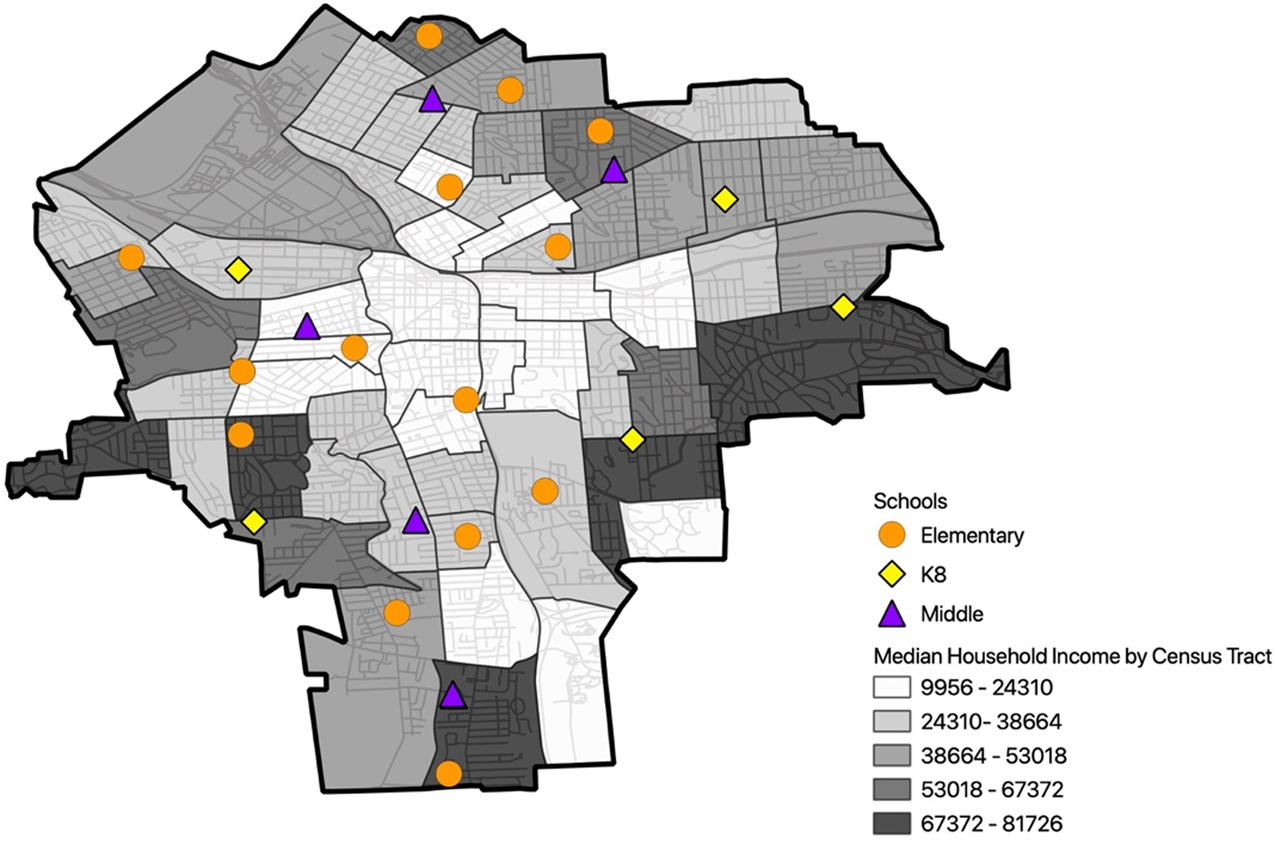
The 2010 median household income by census tract data remains closely aligned with the eight-decades-old HOLC maps (see Figure 2). Of the five K-8 schools in the SCSD, three of them are at the borders of the highest income tracts in the city (which are also former Grade A or Grade B HOLC areas), one is in the next highest income tract (a former Grade B HOLC area), and one is in the second lowest income tract (a former Grade D HOLC area). Two of the schools are close, almost adjacent to the district border, while three are further inside the district, but still relatively close to the border.
SCSD K-8, elementary, and middle school location overlaid with 2010 median household income by census tract map

Demography, Space, Race, Ability, and Schooling
On average, students in K-8 schools are whiter and wealthier than district averages and than their counterparts in traditional elementary and middle schools, a finding that our study corroborated.Footnote 76 Fewer Latinx and African American students with disabilities were enrolled in their neighborhood K-8 schools than Asian, Native American, and white students. Of the five K-8 schools in the SCSD, three are both whiter and wealthier than the district average. Of the remaining two, one is whiter and the other is wealthier. During the 2016–2017 school year, only five other schools in the entire district were both whiter and wealthier than the district average, including the two lottery schools. Schools with higher percentages of white students with disabilities were geographically concentrated at the periphery of the SCSD. Students with autism, orthopedic impairment, and visual impairment were more likely to be enrolled in K-8 schools, while students with emotional disturbance, multiple disabilities, and traumatic brain injury were less likely to be enrolled in K-8 schools.
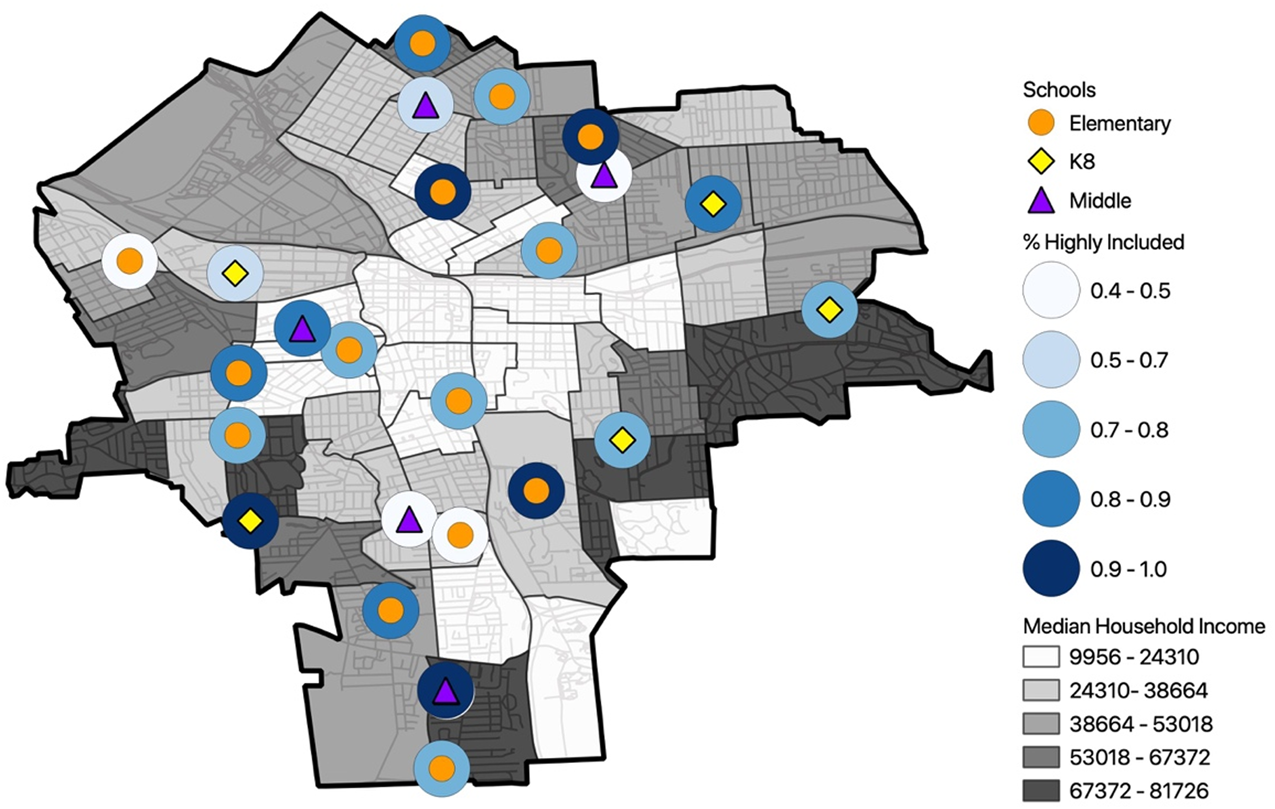
Students with disabilities who were enrolled in K-8 schools continued to be highly included (integrated with nondisabled peers) compared with students in other types of schools. For example, one K-8 school, in the southwest quadrant, had the highest levels (90–100 percent) of inclusion for students with disabilities. Another K-8 school, in the northeast quadrant, had extremely high (80–90 percent) levels of inclusion, two K-8 schools (one in the northeast quadrant and one in the southeast quadrant) had high (70–80 percent) levels of inclusion, and one school in the northwest quadrant had a lower rate, but still relatively high, of inclusion (50–70 percent) than almost all of its surrounding elementary and middle schools (see Figure 3).
SCSD K-8 school enrollment and educational environment.

Discussion and Implications
There were many stated (and unstated) reasons why the SCSD opted to restructure several schools into K-8 buildings, including a desire for smaller schools, fewer transitions for students, retention of white middle-class families within the district, and a response to growing concerns over safety. However, despite the motivations behind creating K-8 schools, it is clear that K-8 buildings in the SCSD do not match the district's larger demographic patterns. This first finding was not specific to students with disabilities but rather set the stage for the rest of the findings that followed. Of the five K-8 buildings currently in operation, student populations of three of the K-8 schools are both whiter and wealthier than the district average. Further, when we mapped the schools’ locations onto the census tract and redlining maps, K-8 schools tended to be located in census tracts with higher median incomes and former A and B HOLC grades. While this data alone is insufficient to claim intentional maintenance of privilege, it is clear that advantages and disadvantages related to redlining persist many years after these decisions were made.
While the general demographic data tells an interesting story, seeking to account for how race and disability might complicate or amplify this larger story, we focused also on students with disabilities within the SCSD. In particular, we wanted to know how the various demographic factors, including race, class, disability category, and time in general education might reveal the workings of an intersectional relationship between and among these categories. Following the tenets of DisCritFootnote 77, we explored what an intersectional lens might bring to the consideration of school enrollment and inclusion within the context of K-8 schools. Our findings were significant, but perhaps in many ways unsurprising. We found that Asian and White students with disabilities were more likely to be enrolled in their neighborhood K-8 school than their Black, Latinx, and Native American peers. In other words, the enrollment patterns of students with disabilities were similar to the larger enrollment patterns for all students with regard to race.
We also found that students with particular disability labels had a greater likelihood of enrollment in K-8 schools. It was particularly interesting to note the decreased likelihood of K-8 enrollment for students with the label of emotional disturbance. Students of color, particularly Black and Brown students, are disproportionally represented in the emotional disturbance category nationwide. If K-8 schools are whiter, it stands to reason that certain disability categories will be more present in these schools. If one of the motivators for the move to K-8 in the SCSD was to keep middle-class white families in the city, perhaps particular bodies (e.g., those labeled with emotional disturbance, a disproportionate number who are also students of color) are less desirable in those spaces.
In addition to being whiter and more affluent on average, K-8 schools in the SCSD were also more inclusive. While far fewer students with disabilities are served in K-8 schools compared to traditional schools, those attending K-8 schools are more likely to be educated in inclusive settings. Said another way, students in K-8 settings are less likely to face segregated placements. It appears that K-8 schools are not only enclaves of racial and class privilege but they also afford disabled students greater opportunities for access to general education and typical peers.
Limitations and Future Research
This spatial, statistical, and historical analysis is only a first step, but it lays an important foundation upon which we can build and layer further analyses, and it illustrates the value in interdisciplinary methods. Although one study cannot tell us the why or how of these enrollment and inclusion patterns, examining archival sources to document parent and district voices provides a window into the social context and decision-making at the time. Neither can our study account for factors such as the presence or absence of particular programs within these schools that might explain why some disability categories are over- or underrepresented—although history tells us that we should not assume that particular programs are placed without intention or purpose. We have also not accounted for parental education and other such markers of privilege that could explain particular placement decisions, nor have we linked these enrollment and inclusion statistics with student outcomes.
Additional research is needed to explore how and why this systemic privilege continues and the role that parental choice and parent advocacy, special education policies and service delivery, and even real estate practices and historical legacies of redlining work in tandem to uphold a system of continued privilege. We intend to pair statistical and spatial analyses with interviews and further analysis of district policies and documents to explore the interplay between policy and practice. We also hope to focus on student movement and placement patterns by analyzing particular case studies of individual schools. We further aim to consider student outcome data in relation to the placement patterns within the district. While many more avenues can be explored, our current findings illustrate the value of an intersectional and multimodal analysis. Drawing on statistical methods, GIS mapping, and qualitative methods contributes to a more nuanced examination of how school structures and enrollment decisions both reflect and perpetuate complex and intersecting forms of advantage and disadvantage.