1. Introduction
Although the potential of digital resources in language teaching has been recognized by scholars at the beginning of the 21st century with several publications dedicated to the topic of open educational resources (OERs) (Bax, Reference Bax2003), the full potential of OERs has remained largely unexplored (Pérez-Paredes, Ordoñana Guillamón & Aguado Jiménez, Reference Pérez-Paredes, Ordoñana Guillamón and Aguado Jiménez2018). However, the global COVID-19 pandemic of recent years has triggered a significant shift to digital teaching and learning in education in general, namely, the Great Online Transition (Howard, Tondeur, Hutchison, Scherer & Siddiq, Reference Howard, Tondeur, Hutchison, Scherer and Siddiq2022), and this caused a change from traditional teaching methods to increased use of digital sources across different teaching contexts (Gastaldi & Grimaldi, Reference Gastaldi, Grimaldi, Radić, Atabekova, Freddi and Schmied2021).
The challenges brought by this new teaching and learning setting were the main motivation to replicate the study of Pérez-Paredes et al. (Reference Pérez-Paredes, Ordoñana Guillamón and Aguado Jiménez2018) within the Polish, Portuguese, and Turkish contexts. Their research findings have gained importance currently due to the pandemic and the intensification of OER use. The authors of the current study believe that a replication study in different contexts is timely, and makes a valuable contribution to the field. The choice of Poland, Portugal, and Turkey resulted from the fact that these are geographically dispersed countries with considerably distinct linguistic backgrounds and educational contexts. Moreover, the authors of the original paper admit that there are limitations in their research, stating that “although our sampling strategy has been widely adopted in similar types of research, a study with a broader number of subjects would yield more definite conclusions” (Pérez-Paredes et al., Reference Pérez-Paredes, Ordoñana Guillamón and Aguado Jiménez2018: 537), which strengthens the need to conduct further research into the field and reinforces the credibility of the findings. Therefore, the current paper aims to conduct further research with a broader number of subjects and contribute to the knowledge base in this area with new findings. By conducting a similar study four years later, it was possible to explore the changes in the researched problem and to add to the recommendations of the Pérez-Paredes et al. (Reference Pérez-Paredes, Ordoñana Guillamón and Aguado Jiménez2018) study, considering the new contexts. The significance of the current study can also be related to the development of online materials for learners, their design and functionality, as well as the curricular development of teacher training programs.
2. Background to the study
Mobile-assisted language learning (MALL) refers to the use of mobile devices in educational contexts, extending the potential of the learning process by making it independent of a set time and location (Kukulska-Hulme, Reference Kukulska-Hulme and Chapelle2012). Global migration and the long-lasting pandemic period stimulated the rapid development and implementation of technologies supporting learner autonomy (Loewen et al., Reference Loewen, Crowther, Isbell, Kim, Maloney, Miller and Rawal2019) and optimizing the efficiency of teaching time (Shadiev, Wang, Liu & Yang, Reference Shadiev, Wang, Liu and Yang2022). Recent research has demonstrated the possibility of the application of digital tools at different teaching stages and in various contexts (Cheng & Chen, Reference Cheng and Chen2022), which enables addressing various learner needs, facilitating at the same time the learning-teaching process.
Although many users associate OERs simply with resources available free of cost, the meaning and application of the term are much more complex (Mishra, Reference Mishra2017). According to UNESCO (2021), OERs are learning, teaching, and research materials located in the public domain or released under an open intellectual property licence (usually Creative Commons licence; Beaven, Reference Beaven2013) that permits no-cost access, use, adaptation, and redistribution by others. OERs’ growing popularity (Perifanou & Economides, Reference Perifanou and Economides2022) is the result of the flexible reapplication of their content, enabling them to fill gaps in the availability of educational materials.
Regardless, OERs have become adaptable, accessible, and easy-to-reuse materials, which support autonomy and reflectivity (Petrides, Nguyen, Jimes & Karaglani, Reference Petrides, Nguyen, Jimes and Karaglani2008). In this respect, UNESCO (2020) also highlights the need for the development and application of open resources: “Education cannot thrive with ready-made content built outside of the pedagogical space and outside of human relationships between teachers and students” (p. 6).
Among the main benefits resulting from OER use are the increase in creativity and innovativeness in the search for new teaching methods and tools (Farrow et al., Reference Farrow, Pitt, de los Arcos, Perryman, Weller and McAndrew2015), the reduction of teaching-learning costs, easy accessibility and flexibility of education for everyone, and the enhancement of learning quality by sharing and promoting a co-creation principle among learners (Pitt, Jordan, de los Arcos, Farrow & Weller, Reference Pitt, Jordan, de los Arcos, Farrow and Weller2020). However, one of the biggest challenges of OER use is their discoverability (Luo, Hostetler, Freeman & Stefaniak, Reference Luo, Hostetler, Freeman and Stefaniak2020).
Current research areas on the use of OERs in foreign language teaching concentrate on three fields: the design, use, and adoption of OERs (Rets, Coughlan, Stickler & Astruc, Reference Rets, Coughlan, Stickler and Astruc2023), the impact on the foreign language teaching and learning process (Aşık et al., Reference Aşık, Köse, Yangın Ekşi, Seferoğlu, Pereira and Ekiert2020), and methodology (Mellati & Khademi, Reference Mellati and Khademi2020). The shift to digitalisation and remote teaching led to the rediscovery of the potential of OERs in language teaching as well. Despite growing interest from both researchers and teachers, there are several knowledge gaps in the field of OER research. Most studies concentrate on the direct effects of OERs, or‘ how the conditions for OER use can be created, such as the usability and user friendliness of OER repositories, empirical effects of the use of OERs on established pedagogical approaches, and potential impacts on conventional educational practices too. Studies investigating how OERs are used and perceived are still rare. Also, contributions developing recommendations for further research or promoting OERs are missing (Otto, Schroeder, Diekmann & Sander, Reference Otto, Schroeder, Diekmann and Sander2021).
Natural language processing (NLP) opened up new ways of analysing written and spoken text employing the use of statistics, probability theory, and computational linguistics (Verma, Pandey, Jain & Tiwari, Reference Verma, Pandey, Jain and Tiwari2021) and making the automatic conversion of language possible (Pérez-Paredes et al., Reference Pérez-Paredes, Ordoñana Guillamón and Aguado Jiménez2018). Data-driven learning (DDL) (Johns, Reference Johns, Johns and King1991) refers to language learners working with written or spoken data, leading to “increased language sensitivity, noticing, induction, and ability to work with authentic data” (Boulton & Cobb, Reference Boulton and Cobb2017: 349). DDL methodology enables the acquisition of competences through the use of corpora. The uses and benefits of DDL for language learning are widely reported in the literature (Boulton & Vyatkina, Reference Boulton and Vyatkina2021), including recent studies on the ways of combining DDL methodology with current theories and practices of second language acquisition, such as the constructivist and learner-centred approaches (Pérez-Paredes et al., Reference Pérez-Paredes, Ordoñana Guillamón, Van de Vyver, Meurice, Aguado Jiménez, Conole and Sánchez Hernández2019). DDL operates on open data and applies them as a potential material in learning activities (Coughlan, Reference Coughlan2020), enhancing learners’ linguistic awareness and leading to the development of autonomy and metalinguistic competences (Crosthwaite, Luciana & Wijaya, Reference Crosthwaite and Wijaya2021).
When working with corpora, learners are confronted with authentic and updated linguistic material in digital form. Corpus-based exercise collections are discussed as an example of OERs in Vyatkina (Reference Vyatkina2020). Many open resources can be digitally redesigned and used for pedagogical purposes and used as OERs. In that way, DDL delivers the methodology for the creation of authentic, up-to-date learning and teaching materials, which are tailored to meet the needs and preferences of individual learners. For example, DDL can also be used to provide real-time feedback to students, enabling them to track their progress and adjust their learning strategies as needed. This can lead to more effective and efficient language learning and provide students with a more personalized and autonomous learning experience.
3. Methodology
The degree of development of the information infrastructure, access to various technologies and, above all, the use of OERs in language learning and teaching varies in different countries. Pérez-Paredes et al. (Reference Pérez-Paredes, Ordoñana Guillamón and Aguado Jiménez2018) conducted a study in Spain and the UK to explore “the role of Mobile Assisted Language Learning (MALL) and teachers’ perceptions of Natural Language Processing Technologies (NLPTs) as Open Educational Resources (OERs)” (p. 523). The current research is a replication of that study in Poland, Portugal, and Turkey; as such, the authors of this paper have meticulously followed the methodology in the original research for reasons of reliability and accuracy. The following are the research questions for the replication study:
-
1. To what extent are language teachers familiar with the use of mobile devices in Poland, Portugal, and Turkey? Do teachers use them for language teaching?
-
2. To what extent are language teachers familiar with OER NLPTs in Poland, Portugal, and Turkey? Do they use them at all? If so, what resources are most widely used?
3.1 Research design
The current study used a quantitative research methodology using an online survey for data collection from participants in three countries to gain insight into the use of mobile devices and familiarity with and the use of OER NLPTs. The main focus of this survey methodology included determining the participants’ self-reported experience of these technologies in the language classroom. An approximate replication is a study that changes one or more nonmajor variables, such as participants and settings, while trying to keep all other areas close to the original study (Morrison, Reference Morrison2022). One major variable was changed in the replication; that is, the location and the participants of the study included English as a foreign language (EFL) teachers in three countries: Poland, Portugal, and Turkey. This type of replication study is expected to serve the generalizability of the findings of the original study.
3.2 Data collection and analysis
In this study, data were collected using a survey adopted from the original study (Pérez-Paredes et al., Reference Pérez-Paredes, Ordoñana Guillamón and Aguado Jiménez2018) investigating the use of language processing–related technologies in language teaching across Europe. The original survey used is available at https://www.tellop.eu/wp-content/uploads/2015/09/TELL-OP-Survey-ENG.pdf. Following the suggestion presented by the aforenamed authors, ours is a replication study carried out under closely related conditions, between November 2021 and January 2022, involving the dissemination of a similar online questionnaire.
The survey document was divided into three distinct sections and combined 18 separate questions, including multiple-choice, 5-point Likert scale, and open-ended questions. Section A focused largely on gathering information about respondents’ background (e.g. age group, level of education, experience in teaching), whereas Section B dealt with respondents’ knowledge and use of technology and mobile devices in the classroom (e.g. access to Wi-Fi on school premises, computer literacy skills, devices used in language teaching). The resources and the technologies presented in the online questionnaire were based on the original study, which tried to include the available websites and resources following thorough research conducted for each NLPT to ensure free and open options to explore.
Finally, Section C addressed knowledge and use of OERs by teachers (e.g. familiarity with designated NLPTs and frequency of use). Although there might be several other recent tools and resources that have emerged and started to be used, the NLPTs presented in this third section of the questionnaire were left unchanged, not only because they were varied and verified OERs but also in an attempt to validate the findings of Pérez-Paredes et al. (Reference Pérez-Paredes, Ordoñana Guillamón and Aguado Jiménez2018). This questionnaire was composed in English, in accordance with the original study, and subsequently administered electronically as an open link via Google Forms. Teachers from Poland, Portugal, and Turkey were invited by email or social media to participate in the survey, and their consent was obtained before completing the questionnaire.
The data obtained from different sources were analysed in different statistical procedures. The descriptive statistics were provided as percentages, averages (mean), and standard deviations (SD). While Spearman rank-order correlations were calculated for the familiarity and frequency of use, chi-square tests were used to compare the differences between qualitative variables. When the data were not normally distributed, non-parametric tests, such as Mann–Whitney U tests or Kruskal–Wallis, were used, when appropriate, to analyse the statistical differences. The significance level was set at p < .05 with two-tailed statistical calculations, which were performed with IBM SPSS 25 (Windows).
3.3 Participants
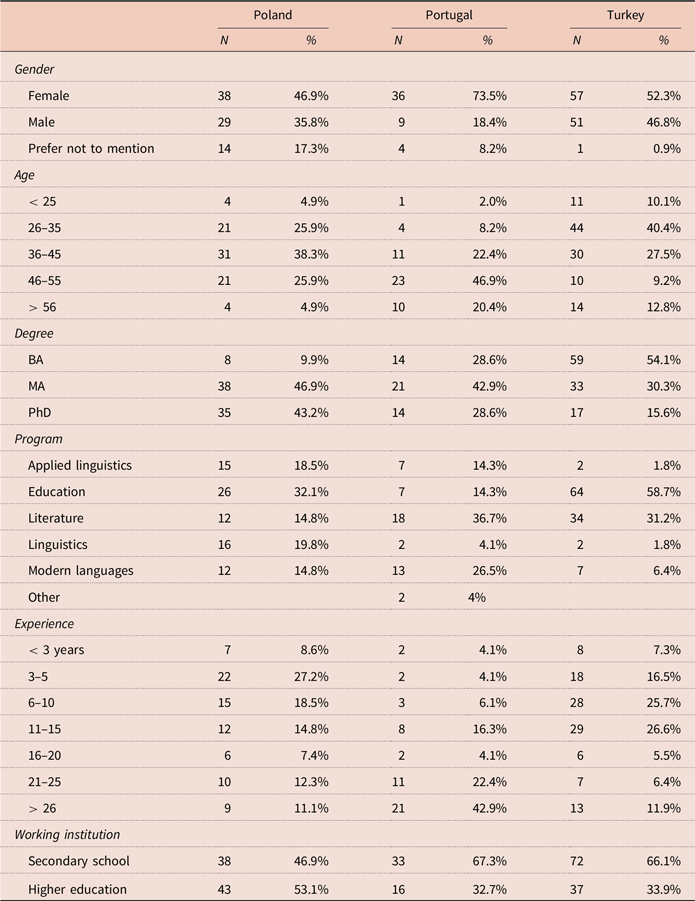
The participants in this research study were EFL teachers employed by Polish, Portuguese, and Turkish educational institutions. Convenience sampling was employed to collect data as this sample was the easiest for the researchers to access due to their willingness to participate in the research. The total number of participants from these three countries is 239, and Table 1 presents a detailed profile of the sample collected in terms of gender, age group, qualification, training background, years of experience in teaching, and working institutions.
Characteristics of the participants

From what we can observe, although respondents in all three contexts are mostly female, there are significant differences in terms of their age group. Participants from the Polish context were mainly between the ages of 36 and 45, but Portuguese language teachers were largely between the ages of 46 and 55. In fact, over two thirds (67.3%) of these respondents were over 46 years of age, which substantiates previous concerns over the ageing teacher population in Portugal (Aşık et al., Reference Aşık, Köse, Yangın Ekşi, Seferoğlu, Pereira and Ekiert2020). This is all the more significant since older teachers may not have received the same amount of preservice technology integration instruction as part of their teacher education when compared to their younger counterparts. By contrast, Turkish educators are the youngest, as most respondents were aged between 26 and 35. Most participants based in Poland (46.9%) and Portugal (42.9%) hold an MA, while a BA is the most common qualification for teachers in Turkey (54.1%). Concerning training background, education (in Poland and Turkey) and literature (in Portugal) were the most prevalent answers. The majority of teachers in Portugal have over 26 years of experience in language teaching (42.9%) in comparison with 11 to 15 years in Turkey, and 3 to 5 in Poland. Higher education (colleges and universities) was the most common working institution for Polish-based participants, in contrast to secondary education institutions (middle and high schools) in Portugal and Turkey.
4. Results
4.1 Research question 1. Technology and mobile devices in the classroom
The majority of the language teachers surveyed indicated that their institutions provided students with Wi-Fi connection (Poland: 87.7%; Portugal: 98.0%; Turkey: 88.1%). The institutions encouraging the use of mobile devices are reported more frequently in Portugal (75.5%) and Poland (70.4%) than in Turkey (52.3%) (χ2 = 10.556, p = 0.005). A similar pattern has been found for the training received regarding the use of mobile devices (Poland: 61.7%; Portugal: 46.9; Turkey 45.0%). However, the difference was not statistically significant (χ2 = 5.648, p = 0.059). On a scale from 1 to 5, where 5 indicated “expert computer skills”, 83.7% of all the participants perceived their computer skills as medium-high (between 3 and 4), and there were no significant differences.
Figure 1 shows the use of different types of devices used in English language teaching. The majority of the responses lean towards teaching and learning online platforms (between 65% and 80% in both countries), while computer labs at school were least used after tablets. Web services and smartphones were the second most used devices and tools. Although there were not any statistically significant differences among the countries regarding the use of computer labs and tablets, the teachers in Turkey seem to be relying less on computer labs and tablets compared to the teachers in the other countries. In response to the question on the frequency of using mobile devices in the classroom, the highest percentage answered “on a weekly basis” in Turkey (67.0%), Poland (35.8%), and Portugal (30.6%). This was followed by the response “monthly” in Turkey (26.6%) and in Poland (22.2%), whereas in Portugal, the highest percentage of participants answered “a few times a year” (28.6%). However, the percentage in Portugal was similar to the other countries (22.4%).
Use of different types of devices in the classroom

4.2 Research question 2. Natural language processing technologies as open educational resources
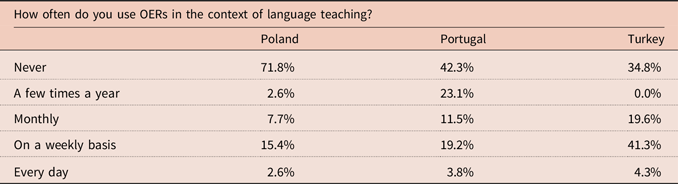
Table 2 shows participants’ familiarity with OERs. Significant differences were found among the countries (χ2 = 26.210, p = 0.000). In Turkey, 31 of the teachers (28.4%) indicated that they were familiar with OERs, 64.2% were not familiar with these resources, and 7.3% had heard about them but never used them. Of the respondents in Portugal, 32.7% reported that they were familiar with OERs, while 46.9% indicated that they did not know about OERs. Compared to the other countries, in Poland, the percentage of familiarity was lower (13.6%), while 51.9% indicated that they had not heard about these resources, and 34.6% of Polish participants had heard about but never used OERs. There were 39 teachers in Poland, 26 in Portugal, and 46 in Turkey who confirmed that they were familiar with OERs, and there were apparent significant differences among the countries (χ2 = 30.059, p = 0.000). While most of these teachers “never” used OERs in their context of language teaching, Turkey seems to be the leading country whose teachers used OERs “on a weekly basis” (41.3%).
Results for teachers’ frequency of use of open educational resources (OERs)

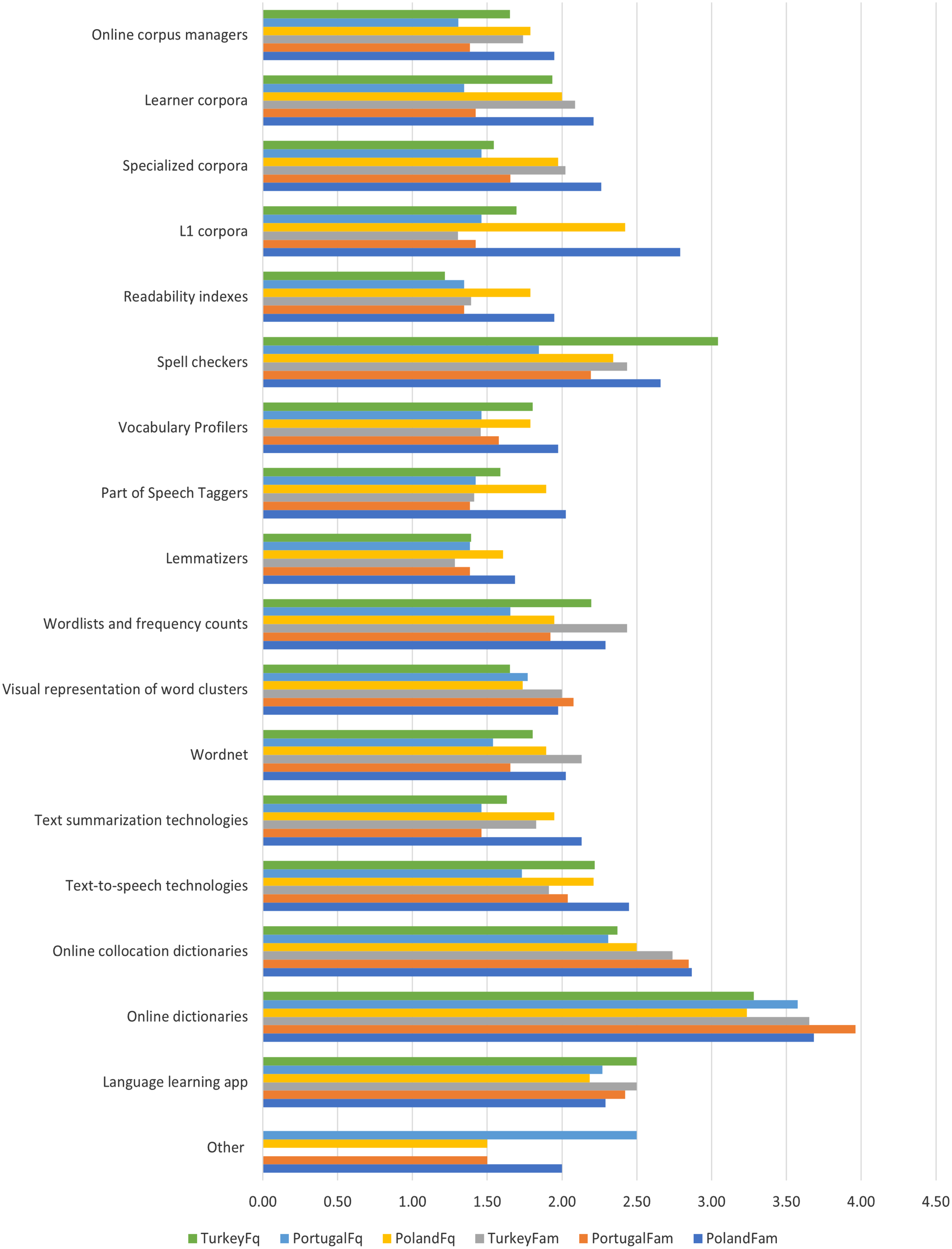
These participants were also presented a set of various language processing technologies as OERs: Language learning apps (e.g. Duolingo, etc.), online dictionaries (e.g. Oxford dictionaries, etc.), online collocation dictionaries or databases (e.g. http://forbetterenglish.com/index.cgi), text-to-speech technologies (e.g. Naturalreaders, etc.), text summarization (e.g. Text Compactor, etc.), WordNet, visual representation of word clusters (e.g. https://www.visualthesaurus.com/), automated word lists and frequency counts (e.g. http://www.wordcounter.net/), lemmatizers (e.g. http://textanalysisonline.com/nltk-wordnet-word-lemmatizer), automated part-of-speech taggers (e.g. CLAWS, Penn Tagger, etc.), vocabulary profiling (e.g. Lextutor, etc.), spell checkers (e.g. JSpell, etc.), text density/readability index (e.g. Textanalyser, etc.), L1 corpora (e.g. British National Corpus, COCA, etc.), specialized corpora/lexical databases (e.g. scientific language, etc.), learner corpora (LINDSEI, ICLE, etc., or your own), and online corpus management tools (e.g. Sketch Engine and CQPweb). The participants were then asked to indicate to what extent they were familiar with these technologies and how often they used each one using a scale from 1 to 5, where 1 = never, 2 = a few times a year, 3 = monthly, 4 = on a weekly basis, and 5 = every day. The responses were summarized via mean scores for the familiarity and frequency of use in Figure 2. Figure 2 indicates that online dictionaries, spell checkers, online collocation dictionaries, and language learning applications are the technologies that participants are most familiar with. On the other hand, readability indexes, part-of-speech taggers, lemmatizers, and vocabulary profilers were the least known and used among the technologies presented to the participants.
Language teachers’ frequency of use and familiarity with open educational resources

Figure 2 also reveals that the participants’ perceived familiarity levels with all these technologies seem to be higher than their frequency of use in the language classroom. Spearman rank-order correlations were calculated between participants’ familiarity with the technologies and their use. The correlation was found to be statistically significant for all OERs in the survey, except WordNet (p < 0.05). Although the participants were familiar with this tool, no statistically significant correlation was determined. However, for all the other OERs, the participants’ familiarity was significantly linked with how frequently they used these technologies in their language classrooms.
Based on the Kruskal–Wallis analyses, statistically significant differences were found among countries in the familiarity with online dictionaries, H(2) = 19.767, p = 0.000, WordNet, H(2) = 12.426, p = 0.002, word lists and frequency counts, H(2) = 11.284, p = 0.004, part-of-speech taggers, H(2) = 7.688, p = 0.021, L1 corpora, H(2) = 28.963, p = 0.000, and online corpus management tools, H(2) = 7.780, p = 0.020. Post hoc Mann–Whitney U tests using a Bonferroni-adjusted alpha level of 0.05 were used to compare all pairs of groups. The differences in online dictionaries were significant between Poland and Turkey, and Portugal and Turkey; in WordNet between Turkey and other countries, in word list and frequency counts between Poland and Turkey, and Portugal and Turkey, in part-of-speech taggers between Poland and Turkey, in L1 corpora between Poland and other countries, and finally in online corpus management tools between Poland and other countries. Regarding the use of corpora and management tools, the participants in Poland seem to be the leading users.
There were also statistically significant differences found among countries in the frequency of use of online dictionaries, H(2) = 11.366, p = 0.003, in online collocation dictionaries, H(2) = 6.045, p = 0.049, in text summarization, H(2) = 15.257, p = 0.000, in part-of-speech taggers, H(2) = 9.299, p = 0.010, vocabulary profilers, H(2) = 6.505, p = 0.039, spell checkers, H(2) = 8.764, p = 0.013, readability indexes, H(2) = 11.356, p = 0.003, and L1 corpora, H(2) = 11.340, p = 0.003. Post hoc Mann–Whitney U tests using a Bonferroni-adjusted alpha level of 0.05 were used to compare all pairs of groups. The differences in online dictionaries were significant between Poland and Turkey, and Portugal and Turkey, in text summarization and vocabulary profilers between Turkey and Poland, in spell checkers between Turkey and Portugal, and finally in readability and L1 corpora in Turkey and between the other two countries. These analyses indicate that significant differences emerge mainly in Turkey as to the frequency of use.
Based on the statistical analysis conducted via the Mann–Whitney U test, the frequency of using devices such as mobile phones and tablets has a relevant association with the effect of training in the use of mobile devices (U: 1214, p < .001) and institutions fostering the use of these tools (U: 1287, p < .001). The impact of the training on the familiarity and frequency of use of OERs was not found to be statistically significant except for the impact on the familiarity with spell checkers (U: 1100, p = .011) and the impact on the frequency use of online dictionaries (U: 1085, p = .007).
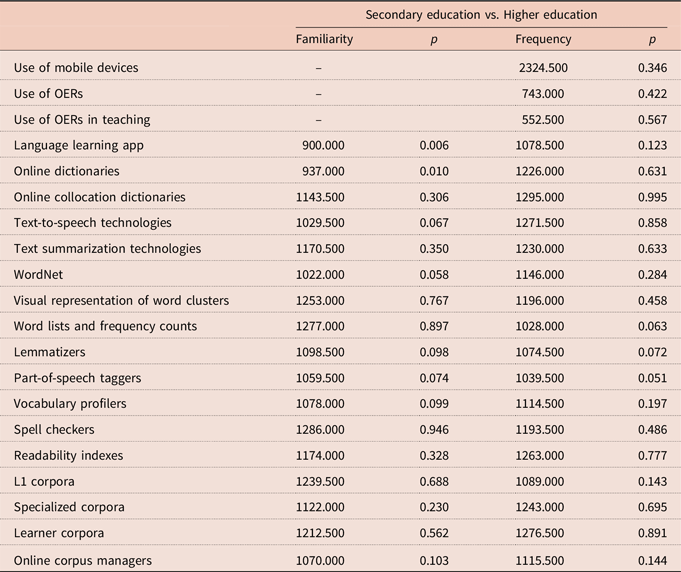
Considering the institutions’ encouragement of the use of mobile devices in the language classroom, data analysis indicates that participants use these devices more frequently compared to the participants where institutions do not foster the use of mobile devices (U: 1452, p < .001). However, fostering can be associated with familiarity with online dictionaries (U: 1245, p = .034) and online collocation dictionaries (U: 1187, p = .038), and the frequency of use of online dictionaries (U: 1356, p = .024). The participants’ place of work, in other words, their institution, indicates statistically significant differences in familiarity with language learning applications and online dictionaries (Table 3). The difference in familiarity with language learning applications leans towards higher scores for higher education participants, while the difference in online dictionaries means higher levels for secondary education participants. Despite not being statistically significant, several differences were noted in text-to-speech technologies, WordNet, part-of-speech taggers, and vocabulary profilers. Regarding the frequency of use of OERs, although participants in higher education seem to be more familiar with word lists and frequency counts, lemmatizers, and part-of-speech taggers, no statistically significant differences were found.
Mann–Whitney U tests for participants’ institution and familiarity and frequency of use of mobile devices and open educational resources (OERs)

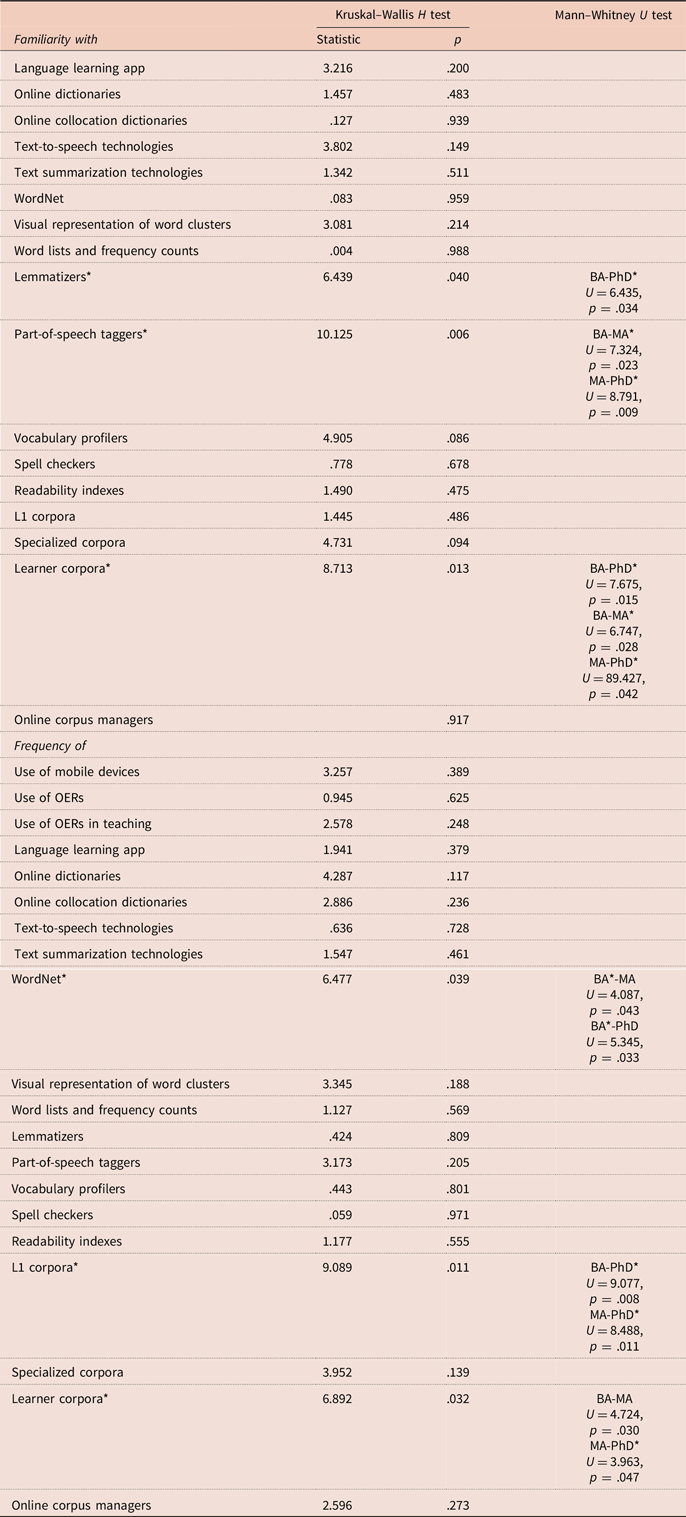
The degree or qualification of the participants (BA, MA, and PhD levels) reveals that the higher the degree held by the participants, the more likely they will be familiar with a certain OER (Table 4). The familiarity with certain corpora tools – lemmatizers, part-of-speech taggers, and learner corpora – led to statistically significant differences. The data also suggest that PhD holders have overall higher scores than MA and BA holders; however, these differences were not statistically significant for the frequency of use except WordNet, L1 corpora, and learner corpora. As for the other variables, such as gender, age, and years of teaching experience, the data did not show any association with familiarity or frequency of use in any of the OERs surveyed.
Differences between teachers’ degrees (BA, MA, and PhD) and familiarity and frequency of use of mobile devices and open educational resources (OERs)

* Statistically significant difference, p < .05.
5. Discussion
This study replicated the research conducted by Pérez-Paredes et al. (Reference Pérez-Paredes, Ordoñana Guillamón and Aguado Jiménez2018) on language teachers’ perceptions on the use of OER language processing technologies in MALL, motivated by the challenges brought on by the global pandemic of recent years. The significant shift to digital teaching and learning in education necessitated the increased use of digital sources across different teaching contexts globally. The present study expanded the initial research study by adding Polish, Portuguese, and Turkish educational contexts, surveying 239 EFL teachers in these three countries. As highlighted by Pérez-Paredes et al. (Reference Pérez-Paredes, Ordoñana Guillamón and Aguado Jiménez2018: 525), “research shows that there is still a scarcity of information about the factors associated with both the familiarity and the frequency of use of OERs that may contribute to the promotion and the spreading of their implementation across learning contexts”. The current study contributes to the knowledge base in this area with new findings.
The main findings indicate that there are several differences among the three countries, including institutional support regarding the use of mobile devices and the training provided to the teachers. The research conducted by Pérez-Paredes et al. (Reference Pérez-Paredes, Ordoñana Guillamón and Aguado Jiménez2018) indicated that although in both the UK and Spain, teachers were encouraged and offered training in the use of mobile devices, the UK seemed to be ahead of Spain in the integration of mobile devices and MALL in official curricula and training. In contrast, the current replication study showed that the use of mobile devices and training was found more often in Portugal and Poland than in Turkey. In the original study, smartphones and tablets were found to be the least used compared to computer labs, teaching and learning online platforms, or websites, while the current study indicated that teaching and learning online platforms were the most used resources, followed by web services and smartphones, which were the second most used devices. This finding seems to be consistent with the training provided regarding the use of mobile devices. Unlike the findings obtained in the original study, there was a high frequency of mobile device use in the classroom, with the highest percentage in Turkey (67.0%), compared to Poland (35.8%) and Portugal (30.6%). This might be attributed to the wide access and use of mobile devices, as well as the formal and informal training provided to teachers. In other words, the shift in preference might be attributed to the recent developments in technology and the wide use of mobile devices such as smartphones (Loewen et al., Reference Loewen, Crowther, Isbell, Kim, Maloney, Miller and Rawal2019) and the possible influence of the COVID-19 pandemic. However, this change in preference could have also been due to the different contexts examined in the original and the current replication study.
Teachers in Turkey seemed to rely more on mobile devices than on computer labs compared to teachers in the other two countries. The findings show that mobile devices are mainly used for teaching and learning on online platforms, and smartphones were one of the most used devices used in English language teaching, whereas the original study “found that teachers prefer computer-based environments over mobile devices such as smartphones and tablets” (Pérez-Paredes et al., Reference Pérez-Paredes, Ordoñana Guillamón and Aguado Jiménez2018: 522). Furthermore, regarding the technologies available, the results of the study reveal the participants are most familiar with online dictionaries, spell checkers, and online collocation dictionaries, and the participants’ qualifications correlate with certain differences in the familiarity with and use of technologies in the classroom. One of the significant findings of the current study is that the frequency of using devices such as mobile phones and tablets is clearly associated with training in the use of mobile devices and institutions fostering the use of these mobile devices.
Another finding of the current study is the fact that the higher the degree held by the participants, the more likely they are to be familiar with a certain OER. Although the relationship between the participants’ degree and familiarity with a certain OER may be complex, providing incentives and support for teachers pursuing higher degrees might increase teachers’ familiarity with OERs. The study also found that online dictionaries, spell checkers, online collocation dictionaries, and language learning applications are the technologies that participants were most familiar with, which might be attributed to the easy access and the use of mobile devices such as smartphones in the classroom. In replicating Pérez-Paredes et al. (Reference Pérez-Paredes, Ordoñana Guillamón and Aguado Jiménez2018), the current study explored how OERs are perceived by teachers in Poland, Portugal, and Turkey in terms of familiarity and use. One of the findings of this study is that a majority of teachers in all countries surveyed reported that they were not familiar with OERs, although with some differences among countries. Moreover, the findings of the current study indicated the participants’ familiarity was significantly linked with how frequently they used these technologies in their language classrooms. These results on low rate of familiarity and frequency of use align with Pérez-Paredes et al. (Reference Pérez-Paredes, Ordoñana Guillamón and Aguado Jiménez2018), who also point out the existence of “a widespread lack of knowledge about OER NLPTs and what they can be used for” (p. 534).
In the original study, the participants in the UK tended to use OERs in language teaching more often than Spain on a weekly basis, while in the current study, the participants in Turkey and Portugal seem to be the leading countries whose teachers used OERs “on a weekly basis”. In addition to raising the awareness of future teachers about OERs, it is necessary to make OERs available to teachers who already have extensive educational experience and to support their usage. Institutional support and training for the use of mobile devices and OERs have become more important than ever. We suggest that both teacher training programs and the schools where teachers work should offer training in the use of mobile devices and foster the use of these mobile devices. While the need for the application of freely accessible resources is transparently visible in the field of foreign language teaching (Colpaert, Reference Colpaert2012), it is recognized that materials in languages different from English are underrepresented. For instance, Zancanaro and Amiel (Reference Zancanaro and Amiel2017) systematically trawled 64 sources to identify 107 publications in Portuguese concerning OERs. They noted an increase in the number of publications over time, though the total output remained low. We agree with Berti (Reference Berti2018) that more research and initiatives are needed so that less commonly taught languages become more visible. Rets et al. (Reference Rets, Coughlan, Stickler and Astruc2023) suggest making English OERs more accessible to the global OER audience by reducing the linguistic complexity of OER materials, which might help increase their reach and accessibility to a wider range of learners, regardless of their English proficiency level. It is worth emphasizing that concerning the original research, the study described in this paper took place in a new, more digitalised reality, and this certainly implies that OERs are no longer a choice but a necessity in education. One of the biggest challenges of OER use is its discoverability (Luo et al., Reference Luo, Hostetler, Freeman and Stefaniak2020). Although the shift to digitalisation and remote teaching led to the rediscovery of OERs’ potential, and even if there is growing interest from both researchers and teachers, there are still several gaps in the field of OER research. As suggested by Pérez-Paredes et al. (Reference Pérez-Paredes, Ordoñana Guillamón and Aguado Jiménez2018), “lack of teachers’ familiarity and use of such resources may be depriving language learners of opportunities to further enhance their learning experiences in MALL contexts” (p. 536). We suggest that an important reason why teachers are more familiar with these tools and make use of them more frequently in their teaching is the integration of mobile devices and MALL in the official curricula, which provided opportunities for teachers to use mobile devices and NLPTs in their classrooms. The past few years of challenges and possibilities have transformed learning, teaching, and teacher education. With the significant shift to digital teaching and learning in education that led to the Great Online Transition (Howard et al., Reference Howard, Tondeur, Hutchison, Scherer and Siddiq2022), it is crucial that teachers become familiar with as many OERs as possible and use them in their teaching. OERs selected for language learning can make a significant contribution to the field by providing students and educators with access to high-quality, up-to-date, and relevant materials that can be used, reused, and adapted as needed. It should be also noted that when OERs, including the ones selected in the current study, are created using DDL principles, they might be more effective when they provide learners and teachers with access to high-quality, recent, and relevant materials that can be used, reused, and adapted as needed. Moreover, when these materials can be designed using DDL principles, they might be more effective in promoting language teaching and learning, since DDL can be used to gather data on student learning behaviours, preferences, and outcomes. However, there are not many authors who have approached DDL using an OER framework, which might be attributed to the fact that the use of DDL requires skills and analysis of data, whereas OERs provide ready-made materials to be used in teaching and learning contexts.
6. Conclusions and suggestions for further research
This study is a replication of Pérez-Paredes et al. (Reference Pérez-Paredes, Ordoñana Guillamón and Aguado Jiménez2018), which offers an overview of how mobile devices, MALL, and OER NLPTs are perceived and used by language teachers in the UK and Spain. The current replication study included 239 EFL teachers working in Poland, Portugal, and Turkey. We found several differences among these three countries regarding institutional support for the use of mobile devices and training provided to the participants. Unlike the findings obtained in the original study, the current study found that mobile devices were mainly used for teaching and learning via online platforms rather than computer labs at schools. Our participants were most familiar with OERs such as online dictionaries, collocation websites, and spell checkers, which was the same as in the original study. These findings have implications for policy and practice. Teacher training institutions need to create opportunities for pre-service and in-service teachers to become familiar with OERs. At the policy level, educational decision makers should become familiar with these resources, so that they can support their use for effective teaching and learning in schools. To help teachers become familiar with OERs and use them effectively in their classes, strategies and programs should be developed to foster teacher-to-teacher sharing and learning. Peer learning may be very fruitful in supporting teachers’ familiarity and confidence in using these resources. The findings of the study about DDL and language processing technologies as OERs have significant implications. From a constructive viewpoint, DDL improves learners’ linguistic awareness and metalinguistic competences (Crosthwaite et al., Reference Crosthwaite and Wijaya2021). When language learners work with written or spoken authentic data, their consciousness and noticing are raised (Boulton & Vyatkina, Reference Boulton and Vyatkina2021). Yet, similar to the findings of Pérez-Paredes et al. (Reference Pérez-Paredes, Ordoñana Guillamón and Aguado Jiménez2018), the current study conducted amid the global pandemic suggests that when teachers are not familiar with OERs, they “may be depriving language learners of opportunities to further enhance their learning experiences in MALL contexts” (p. 536). Although issues related to the development of online materials for language learners were beyond the scope of this study, we suggest relevant stakeholders take action to develop effective online materials using OERs responding to learner and teacher needs globally and locally. Our findings highlight that OERs should be more accessible not only in and for English but also in languages other than English. Finally, both OERs and language learners’ profiles are constantly changing; therefore, there is a need to evaluate and align OER content to quality criteria and the diversity of learners, teachers, and contexts. In this context, the fact that our study did not investigate the different socioeconomic contexts of the institutions and funding models of private and public institutions could be seen as a limitation. Therefore, future studies should investigate contextual factors and the support and resources provided by the institutions to understand fully that institutional support and resources could affect teachers’ familiarity with and use of OERs.
Acknowledgements
The authors would like to express their gratitude and appreciation to all the participants, as well as to the three anonymous reviewers, who provided invaluable comments and suggestions.
Author contributions
Joanna Kic-Drgas prepared the introduction and the literature review, and Ricardo Pereira focused on the methodology section. Ferit Kılıçkaya analysed the data obtained via the survey and prepared the results, while Gölge Seferoğlu discussed these findings in relation to the relevant literature and concluded the study. All the authors checked, revised the whole manuscript, and provided revisions and suggestions, which led to further improvements in the manuscript.
Ethical statement and competing interests
The authors confirm that they ensured quality and integrity of the current research. They obtained informed consent from and respected the confidentiality and anonymity of research respondents, avoided any harm to the participants, and ensured that the research was independent and impartial. The authors declare no competing interests.
About the authors
Joanna Kic-Drgas is an assistant professor in Teaching Languages for Specific Purposes in the Institute of Applied Linguistics at the Faculty of Modern Languages and Literature of the Adam Mickiewicz University in Poznań, Poland.
Gölge Seferoğlu is a faculty member at California State University, San Bernardino, USA. Her research interests include social justice in ELT, technology-enhanced language learning and teaching, pre- and in-service teacher education, and quality in education.
Ferit Kılıçkaya is a faculty member at Burdur Mehmet Akif Ersoy University, Turkey. His interests and publications include the beneficial and harmful effects of using technology in language teaching, learning, and assessment practices.
Ricardo Pereira is an associate professor at the Polytechnic of Leiria, Portugal, and a researcher at the University of Lisbon Centre for English Studies, Portugal. His research interests include English as a lingua franca, teacher education, and ICT integration in ELT.
Author ORCIDs
Joanna Kic-Drgas, https://orcid.org/0000-0002-8133-9190
Gölge Seferoğlu, https://orcid.org/0000-0001-7587-6822
Ferit Kılıçkaya, https://orcid.org/0000-0002-3534-0924
Ricardo Pereira, https://orcid.org/0000-0003-4885-0795