Introduction
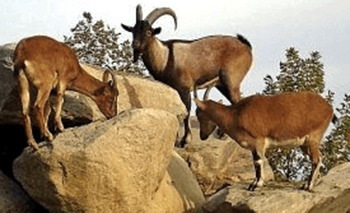
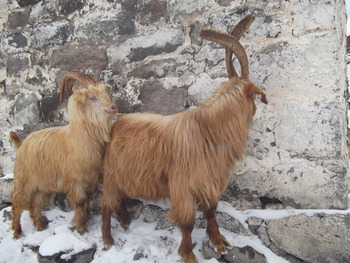
The wild goat or bezoar (Capra aegagrus; Figure 1) ranges widely in Turkey, from east of the Datca peninsula, through the Taurus and Anti-Taurus mountains in the mountainous regions of southeastern, eastern and northeastern Anatolia (Kence, Reference Kence1987). It is, however, declining principally because of over-hunting throughout its range and the total population is believed to be less than 10 000 mature individuals, with no subpopulation larger than 1000 mature individuals (Weinberg et al., Reference Weinberg, Deidi, Masseti, Nader, de Smet and Cuzin2008).
Family group of Bezoar goats in the Taurus Mountains (Photo: courtesy of wowturkey.com).

Goats were among the first animals to be domesticated beginning about 10 000–11 000 years ago. Neolithic farmers in the Near East began keeping small herds of goats for their milk and meat, for fertilizer and fuel and for materials such as clothing and building including hair, skin, bone and sinew. In view of the presence of bezoar, it is not surprising that archaeological data suggest that the Euphrates river valley at Nevali Çori in southeast Turkey was one of the two distinct places of goat domestication some 11 000 years ago, the other being the Zagros Mountains of Iran at Ganj Dareh somewhat later about 10 000 years ago. Other possible sites of domestication include Cayönü at the foot of the Taurus Mountains in southern Turkey also about 10 000 years ago (Machugh and Bradley, Reference MacHugh and Bradley2001). This local origin for domestic goats makes their study in Turkey particularly rewarding.
Recent publications on Turkish goats in international literature have generally been somewhat limited in outlook. They include papers on short-term fattening experiments (Ugur et al., Reference Ugur, Sava, Dosay, Karabayir and Atasoglu2004; Ocak et al., Reference Ocak, Guney, Onder and Darcan2006), reproduction (Ince, Reference Ince2010; Konyali et al., Reference Konyali, Tolu, Ayah and Akbag2011), reproductive diseases (Ataseven et al., Reference Ataseven, Ataseven, Tan, Babur and Oguzoglu2006) and the performance of cross-bred animals (Gunes et al., Reference Gunes, Horst, Evrim and Valle-Zárate2002; Kosum et al., Reference Kosum, Alcicek, Taskin and Oneng2003). The current paper is based on the knowledge and experience of the authors and also aims at collating, complementing and bringing up-to-date earlier publications on Turkish goats and to provide information on the goat genetic resources of the country. It introduces some perceptions of numbers and output, provides descriptions of 17 breeds and types present or known to have been present in Turkey and describes current conservation activities. The paper is one of a series (Wilson, Yilmaz & Ertugrul Reference Wilson, Yilmaz and Ertugrul2011; Yilmaz, Ertugrul & Wilson Reference Yilmaz, Ertugrul and Wilson2011, Reference Yilmaz, Ertugrul and Wilson2012; Yilmaz et al., Reference Yilmaz, Akin, Metin Yener, Ertugrul and Wilson2012a) that will eventually cover all the nation's domestic animal species.
Production systems
Products – meat, milk, eggs, fibre and hides – from the livestock subsector in Turkey contribute 30 percent of total agricultural gross domestic product (GDP). Some 96 percent of the country's 4 million agricultural enterprises are mixed crop–livestock farms. The average number of animals per farm is low. Farm sizes are less than 5 ha for 65 percent of holdings, which accounts for only 22 percent of the agricultural land, whereas the remaining 35 percent of holdings with an individual area of greater than 5 ha occupy 78 percent of the land. An overwhelming proportion of output is for subsistence use with any surplus usually being disposed of through middlemen because of the distance to markets. In spite of its small and fragmented nature, agriculture directly contributes more than 45 percent to household income and agriculture is the key component of rural household livelihoods (Gursoy, Reference Gursoy, Ramalho Ribeiro, Horta, Mosconi and Rosati2006).
Poverty levels in Turkey are high. More than one-third of the population relies on the agricultural sector for employment and income generation. The family owned and managed farm is the basic unit of agricultural production and family members provide most of the farm labour. Household food security is very important to the impoverished populations of the rural and peri-urban areas and small-scale farms contribute significantly to the nation's food supply and to local economies. Almost all goats are still managed traditionally, rely mainly on extensive and low-quality grazing for their nutriments and receive very little in the way of veterinary care. The situation is exacerbated in winter as housing standards are low, feed is often of even poorer quality and cold and crowding produce stress that reduces tolerance to disease. The fragmented nature of traditional agriculture is often accepted as the norm and its sustainability as well as its contribution to national welfare is neglected. Small-scale farms nonetheless contribute to human welfare (especially that of old and infirm people and children), are guardians of the common wealth and work, within their limits, to protect the soil, water and air and to maintain and enhance biodiversity in addition to producing essential and often high-quality animal protein for the betterment of everyone. The income derived from small farms is not only used to buy additional items of food but also helps to pay for various items including health services, school fees, water, electricity and new assets.
Goat production is economically and socially important in Turkey. An estimated 500 000 farm households keep goats and goat production contributes directly to the income of nearly 3 million people (Dellal and Dellal, Reference Dellal and Dellal2005). Turkish goats are produced under four distinct husbandry systems and in two of them production is generally secondary to crop production. It needs to be remembered, however, that in Turkey as elsewhere because of the feeding habit of goats and their predilection for feeding on browse trees and shrubs, they are complementary to sheep and, in addition, both small ruminant species combined contribute, with cattle and other domestic herbivores, to maintaining and enhancing vegetative biodiversity.
The first production system is the “small household” common in western and northwestern Turkey. Each family has a small number of animals with a maximum holding of 10–15 head. Milk is the primary output with meat production fulfilling a secondary role. The second type is a “settled village flock” system found all over Turkey, but this system applies less to goats than it does to sheep (Yilmaz et al., Reference Yilmaz, Akin, Yener, Ertugrul and Wilson2012b). Family flock sizes range from 8–10 to as many as 30 goats. In this system, goats are released by their owners early in the morning and a village flock is constituted. This flock is managed by a goatherd who is assisted in protecting them by several dogs. In both the first two systems, goats are grazed on common land in the spring and recover much of the body condition they have lost during the winter when they have been fed on cereal straws and bran. By the end of June grass has matured but the cereal harvest takes place in July and stubbles become available. Animals now reach peak condition. The third system is denominated as “highland” and is common in northeastern, eastern and southern Turkey. Goats are kept in the villages during the winter season and in early spring. As grass matures and dries in late spring and early summer, the flocks are taken to highlands from where they return, after 3–5 months when feed is exhausted and the cold sets in, to their villages for the winter. The “nomadic” system is found in eastern and southeastern Turkey. Goats stay and graze during the cold season in the lower lands of the southeastern plains of Turkey. During the hot season, the tribes migrate to the higher lands of eastern Turkey. Members of nomadic tribes always live in goat hair tents when they are with their flocks (Sonmez, Reference Sonmez1978; Ertugrul et al., Reference Ertugrul, Akman, Askin, Cengiz, Firatli, Turkoglu and Yener1993; Soysal, Reference Soysal2009).
Increased demand for goat milk and cheese has led to some intensification of production in modern facilities. Milk dairies in Turkey are located mainly in the Aegean, Marmara and Thrace regions (Ince, Reference Ince2010) and make much use of exotic breeds and their crosses with local stock.
Numbers and output
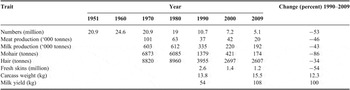
Goat numbers seem to have been at an all-time high in Turkey in about 1960 when there were estimated to be some 24.6 million goats in the country (Table 1). Over the succeeding 50 years, numbers have declined drastically, one might say precipitously, to little over one-fifth of that number in 2009. The goat population diminished by about 44 percent between 1980 and 1990 and another 50 percent was lost in the 20-year period (1990–2009), although goats are still an ever present component of livestock production systems all over the country (Figure 2). There has been an even greater proportionate loss in the iconic Angora goat than in the general goat population from Angoras representing 20.9 percent of all goats in 1951 to 2.5 percent in 2009 (Arik, Reference Arik2011; Turkstat, 2011). There have been concomitant reductions in output of the main products of goats which are milk, meat, fibres (hair and mohair) and skins (Table 1).
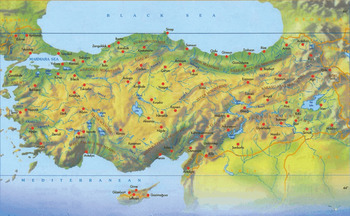
Map of Turkey showing places referred to in the text (provinces generally take their names from the principal town).

Trends in goat numbers and products in Turkey, 1951–2009.

Source: Arik (Reference Arik2011) and Turkstat (2011).
Among the manifold reasons for the reduction in numbers are changes in the structure of agriculture, smallholder farmers turning to other products or other employment, low returns to producers from goats, changing internal and external market conditions, a move away from red meat by consumers and lack of government support. Unlike the cattle subsector where reduced numbers have been compensated for by higher individual performance (Yilmaz et al., Reference Yilmaz, Akin, Metin Yener, Ertugrul and Wilson2012a), there has been no or very little increase in output per head of goats. Much of the market for meat has been taken over by the enormous increase in the numbers of poultry and structural changes in poultry production from low input extensive to high input very intensive systems. In the case of mohair (and thus Angora goats), competition especially from southern Africa (in both quantity and quality) and changes in world demand for natural fibres and their substitution by synthetics have had a drastic effect on numbers. Turkish government policy with respect to forest protection (all forestry areas are owned by the state) and dissuasion or the banning of goats from using these areas has also had a negative effect on numbers.
Genetic resources
Over the years, the goat has differentiated from its wild progenitor into more than 300 breeds that are adapted to a very broad range of climates and ecological zones. During the period of domestication body weight has increased, growth rate has accelerated, in some breeds hair has become longer and finer and other morphological changes such as changes in the shape and size of horns have occurred (Ertugrul et al., Reference Ertugrul, Akman, Askin, Cengiz, Firatli, Turkoglu and Yener1993). Turkey has contributed to these changes and to biodiversity in the development of local breeds although sources differ with respect to the number and nomenclature of breeds in the country. It should also be noted that some “native” breeds are transboundary groupings.
The first listing of goat types in Turkey mentions only three breeds (Yarkin, Reference Yarkin1965). A comprehensive account of sheep and goats that covers, among other subjects, management practices, population, production and research provides data on four native breeds and one cross-breed and briefly mentions four exotic breeds (Yalcin, Reference Yalcin1986). A publication on biodiversity in Turkey published in the mid 1980s lists four breeds. The definitive dictionary on the world's types of livestock provides succinct information on nine breeds of which one is exotic (Mason, Reference Mason1996). A treatise on the agriculture of Turkey states simply that there are four breeds of goats in the country, but fails to name any of them (MARA/FAO, 2001). Finally, the United Nations repository of breed information has 11 breeds – the information on which is mostly minimal and often restricted to just a name – in its catalogue of which one is the wild progenitor of Capra hircus, two are exotic and two are cross-breeds (DAD-IS, 2010).
The remainder of this section provides detailed descriptions of the breeds and types, and provides both English and Turkish names where these are distinct.
Angora (Ankara Kecisi, Tiftik Kecisi)
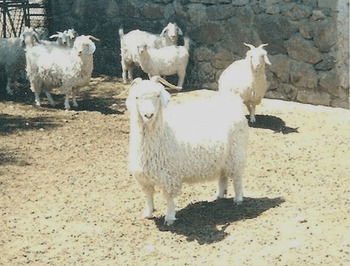
In its natural environment and in traditional systems of production, the Angora is a hardy animal needing, and getting, little care, shelter or feed. Animals are at home in rocky and rugged areas and are tolerant to sudden changes in feeding and climatic conditions (Anon., 2009). The name Angora is the ancient name for present day Ankara where the breed originated. The Angora (Figure 3) is thus a breed of Central Anatolia. It is small in size (Table 2) with a narrow but graceful body. White is the preferred coat colour, but other colours do occur. In Konya Province and its vicinity in southcentral Anatolia yellow and creamy yellow colours are also found. In extreme southeastern Anatolia, there are goats with silver grey, brown and black coats. Both sexes are horned, those of the male being lightly ribbed and growing backwards in a graceful curve. Some polled goats have been bred (MRC, 2011). Twin births are very rare and the overall litter size is 1.02 (DAD-IS, 2010). Some milk and meat is produced, but this is a specialist fibre goat and the only true producer of mohair in the world. Fibre diameter in yearlings has been determined as 23.9 µm and staple length as 15.4 cm (Gerstmayra et al., Reference Gerstmayra, Gunes, Yalcin and Horst1995) with other results giving fibre diameter in kids as 25.8 µm and in adults as 35.3 µm (DAD-IS, 2010).
Angora buck and does at Lalahan Livestock Central Research Institute (Photo: R. Trevor Wilson).

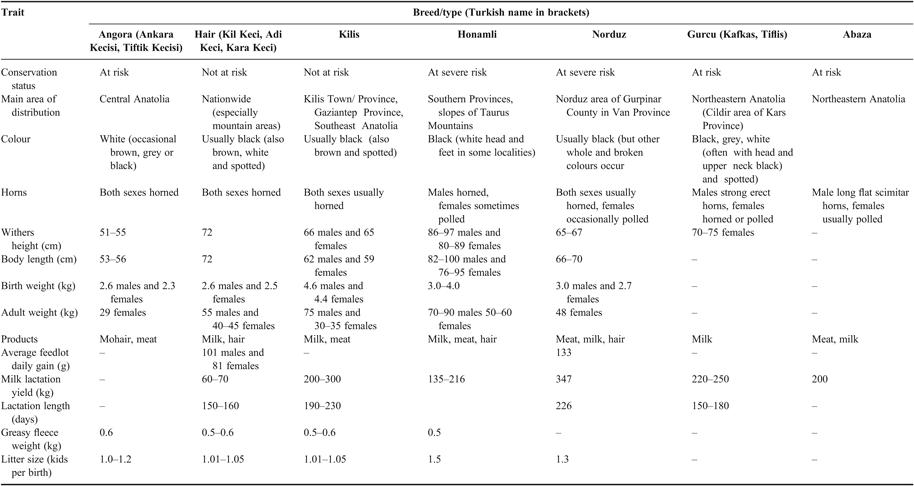
Conservation status, areas of distribution, morphological characteristics and some production traits of Turkish goats.
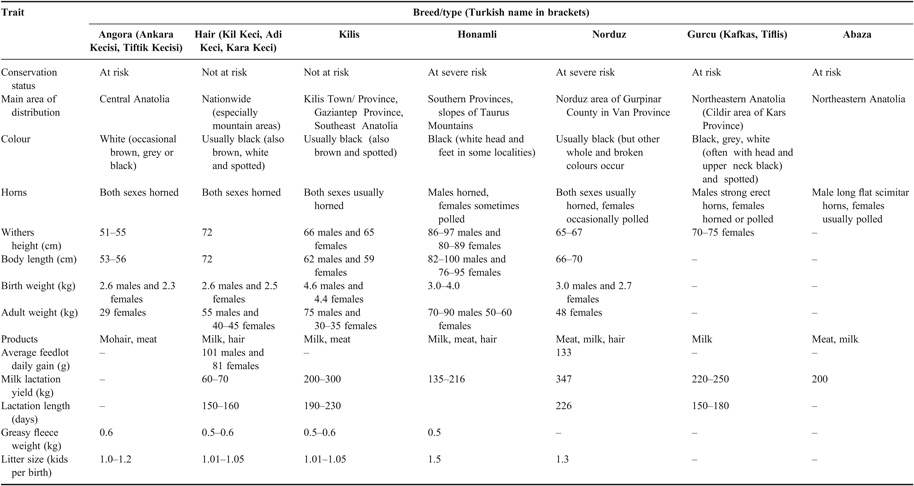
Source: Sonmez (Reference Sonmez1975, Reference Sonmez1978), Ertugrul et al. (Reference Ertugrul, Akman, Askin, Cengiz, Firatli, Turkoglu and Yener1993, Reference Ertugrul, Dellal, Elmaci, Akin, Pehlivan, Soysal and Arat2010), Daskiran and Cedden (Reference Daskiran and Cedden2004), Anon (2009), Bingol et al. (Reference Bingol, Gokdal, Aygun, Yilmaz and Daskiran2012).
The Angora goat was “discovered” by a Dutchman in 1550 and in 1554 a pair was presented to the Pope in Rome (BAGS, 2011). Further exports were forbidden until the middle of the nineteenth century when small numbers of males and females were exported to southern Africa in 1838 following a treaty between the Ottoman Empire and the United Kingdom (Yigit, Reference Yigit2011). Further goats were exported to the USA in the 1840s and then to Australia in the early part of the twentieth century from where they were re-exported to many other countries including Argentina, Canada, France, Russia and then the United Kingdom in 1981. In the UK (which has a Breed society and Herdbook as do most other nations where the Angora goat is found), it was imported from Australia and Canada, the Angora goat is very fashionable with a certain type of farmer and is a prime candidate for diversification schemes. The Turkish Angora is the origin of all Angora/mohair goats throughout the world, but exports were the harbingers of doom of the breed in its own land. Productivity and the quality of mohair in Turkey and the quality of mohair are lower than abroad and ironically most recent attempts at improvement have involved the import and use of “foreign” animals (Gerstmayra et al., Reference Gerstmayra, Gunes, Yalcin and Horst1995; Gunes et al., Reference Gunes, Horst, Evrim and Valle-Zárate2002). The decline in numbers of the Angora goat from more than 6 million in 1960 to 147 000 in 2009 has been greater proportionately than that of all goats from about 20 percent to 2.5 percent of the total number of goats. There has been a commensurate loss of mohair production from 6800 tonnes in 1970 to 179 tonnes in 2009 (Turkstat, 2011). A principal reason for the decline in goat numbers and output is that outside Turkey mohair has been replaced in the world textile industry by synthetic fibres and the remaining market is for a quality product that Turkey can no longer supply (it even imports mohair from abroad!). Internally, the decrease is related to socio-economic and political factors including rural–urban migration, reduced income from mohair compared with milk and meat, restrictions on goats close to woodland areas and inadequate government support in general. The producers' own organization – Tiftikbirlik (Union of Mohair Producers) with 12 registered cooperative establishments comprising 19 000 producers – is inadequate in its support and as a monopoly purchasing and onward selling business often seems to act against its members' best interests (Yigit, Reference Yigit2011). The Angora goat is at risk in its area of origin and the situation could become very much worse (Sonmez, Reference Sonmez1975; Ertugrul et al., Reference Ertugrul, Akman, Askin, Cengiz, Firatli, Turkoglu and Yener1993; Soysal, Reference Soysal2009).
Hair goat (Kil Keci, Adi Keci, Kara Keci) or Turkish Native Black Hair (Türkiye yerli kil)
The Hair goat, Turkish Native Black Hair or Anatolian Black (Mason, Reference Mason1996) is by far the most common type in Turkey and is akin to the Syrian Mountain type. Three subtypes are sometimes recognized: a small one is known as Pavga, a medium one as Candir and a large one as Davar or Kabakulak. The Hair goat is the most numerous breed and probably accounts numerically for more than 90 percent of the national goat flock. It is widespread and found nationwide, but especially in the south and southwest in hilly and mountainous environments. It is probably the hardiest of all Turkish goat resources, well adapted to climatic extremes, to rough and rocky terrain, to poor feed and resistant to local diseases and to managerial indifference. The predominant coat colour is black but other colours, especially brown (Figure 4), occur as do goats of broken colours: many individuals have brown or white dots on their face from eyes to muzzle. Both males and females usually have rather light horns which curve backwards and outwards (Table 2). This is mainly a meat goat with a low milk yield. Both growth rate and milk production are, however, low (Olfaz, Tozlu & Onder, Reference Olfaz, Tozlu and Onder2011). Hair is an important by-product with the main outer coat used by the nomadic Yoruk people for the making of tents, rugs, saddlebags, sacks and items of clothing: in one study hair production (fleece weight per year) was 381 g, fibre diameter 76.7 µm and fibre length 13.6 cm (Toplu and Altinel, Reference Toplu and Altinel2008). The inner down makes a useful cashmere, but the down weight is only about 46 g per goat with fineness of 16.6 µm and a length of 2.5 cm (Gokmen and Boztepe, Reference Gokmen and Boztepe2004). Reproductive performance is poor with only about 2 percent of goats producing twins to give an overall litter size of 1.02 (Olfaz, Tozlu & Onder, Reference Olfaz, Tozlu and Onder2011).
Hair goats showing variation in coat colour (Photo: Orhan Yilmaz).

Kilis
Widely accepted as a native breed, the Kilis is in fact a result of “natural” crossing between Damascus (Aleppo/Halep) and Hair goats (Mason, Reference Mason1996; Gursoy, Reference Gursoy and Iniguez2005). Named after the town of Kilis in Kilis Province, its natural distribution is there and in the surrounding provinces of Gaziantep, Hatay, Kahramanmaras and Sanliurfa in southcentral Turkey bordering Syria and the Mediterranean Sea. The breed is mostly kept by small holders (2–10 goats), but there are some larger specialist breeders (20–200 goats) (Anon. 2009). The breed is adapted to rugged terrain and extreme climatic conditions, and is resistant to most local diseases. There is considerable sexual dimorphism in this medium-sized breed (Table 2). When horns are present, those of the males are thick and strong with females having shorter and finer horns. Around Kilis the facial profile tends to be convex, but elsewhere it is flatter. The pendulous ears are up to 28 cm in length (Figure 5). Whole colours, brown or black, are the norm but there are also pied and multicoloured animals. The Kilis is a specialist milk breed with a fairly good lactation yield. Much of the milk is used to make the famous ice cream Kahramanmaras beaten ice cream (Kahramanmaras dovme dondurma) and cheeses such as tulum, orme, keci peyniri, kelle, sepet and tel (Gursoy, Reference Gursoy and Iniguez2005).
A heavy milking Kilis doe showing pendulous ears (Photo: Orhan Yilmaz).

Honamli
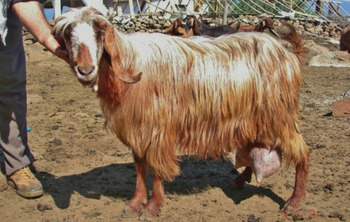
The largest of all Turkish goats the Honamli is native to Antalya, Isparta and Konya Provinces in the foothills of the Taurus Mountains. This genotype which is noted for its docility and hardiness, and its thriftiness on poor quality feed (Anon., 2009) is mainly kept by Yoruk nomads who spend the summer on the highland plateaux and the winter on lower ground. It is massive in body size (Table 2), has a convex (“Roman nose”) facial profile with a prognathous lower jaw, prominent eyes and short and thick ears. The tail is longer than in other native Turkish goats and has a prominent tassel on the end. A supposed indication of breed purity is the space between the horn bases which should be 2 cm. The skin is black and the predominant coat colour is also black (Figure 6), but goats from Antalya often have a white or brown forehead and feet. Milk, which is high in fat, is the main output. The coarse hair is shorter than that of the Native Black Hair goat. This prolific goat is also renowned for its mothering ability. A small population size coupled with a restricted geographical distribution puts this breed at some risk.
Honamli goat with whitehead and feet typical of Antalya Province (Photo: Orhan Yilmaz).

Norduz
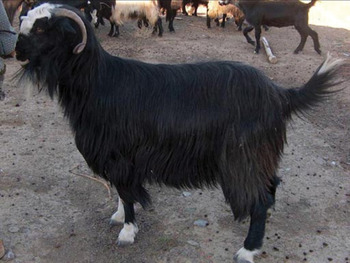
A recently described “breed”, the Norduz is mainly raised in Gurpinar County of Van Province and is well known by producers in the Norduz area (Daskiran and Cedden, Reference Daskiran and Cedden2004). Recent mitochondrial DNA studies have shown this type to be distinct from Angora, Hair, Kilis and Honamli types (Kul and Ertugrul, Reference Kul and Ertugrul2011). The goat's home tract is hilly, but has good pasture and water resources. It is mainly housed in winter and fed on dry feed. The animal is of medium size and usually black in colour but white, cream, grey, brown and broken colour patterns also occur. The ears are lopped and the male has long thin backward- and outward-curving horns (Figure 7): females have smaller horns or are polled. The products are meat, a moderate amount of milk (which is usually processed to butter and cheese) and hair. The rather coarse hair (74.4: diameter in 3-year-olds, 53.7: in 1-year-olds; Daskiran et al., Reference Daskiran, Cedden, Bingol and Abkin2008), in addition to being used for tents, is much used in cottage industries that produce blankets, gloves and caps. The breed is quite prolific and shows favourable pre-weaning viability and growth (Daskiran et al., Reference Daskiran, Bingol, Kor, Demir and Karaca2006; Reference Daskiran, Bingol, Karaka, Yilmaz, Cetin and Kor2010). The progressive decrease in the population of this goat is attributed to the high rate of rural–urban migration and the breed can be described as at critical risk (Daskiran and Cedden, Reference Daskiran and Cedden2004; Bingol et al., Reference Bingol, Gokdal, Aygun, Yilmaz and Daskiran2012).
Norduz from Van in eastern Turkey with classic long thin horns and lop ears (Photo: Orhan Yilmaz).

Gurcu
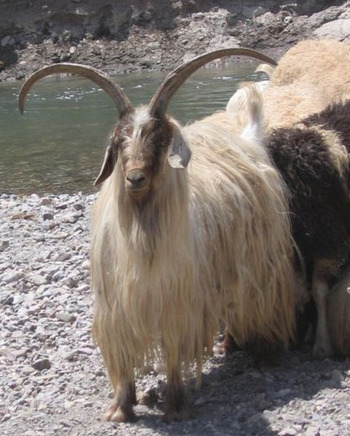
Known as Gurcu, Tiflis or Kafkas in Turkey this transboundary breed is the same as the Mingrelian of western Georgia (Mason, Reference Mason1996). It is mainly raised in Cildir County of Kars Province at Turkey's boundary with the Republic of Georgia (Table 2). It is a medium to large goat of various colours, but the lighter coloured ones usually have a black or dark head and neck. In males, the twisted horns are up to 50 cm long and grow erect (Figure 8), whereas if carried in females they are shorter and finer: the lop ears are turned up at the ends. This is primarily a milk breed with a moderately good yield produced in a lactation of up to 6 months. Meat and hair are secondary products (Ureyen, Reference Ureyen1995; Kor et al., Reference Kor, Keskin, Bingol and Daskiran2006). Low numbers and a restricted geographical range put this breed at risk (DAD-IS, 2010).
Upright heavy male and finer curved female horns of Gurcu goats in their home tract in Cildir county (Photo: Orhan Yilmaz).

Abaza
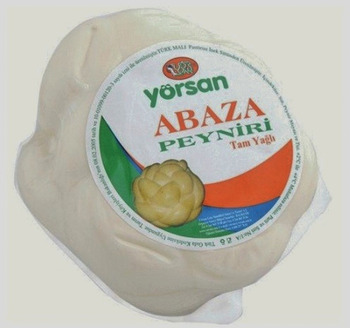
Located in northeast Turkey the Abaza is pinkish white with coloured marks around the mouth and eyes and on legs. Males carry horns, whereas females are usually polled (Mason, Reference Mason1996). Recent studies have shown a high degree of in-breeding in this type (Cañón et al., Reference Cañón, García, García-Atance, Obexer-Ruff, Lenstra, Ajmone-Marsan and Dunner2006) and it can be considered at risk. The semi-hard lightly salted cheese made from the milk of this goat (Figure 9) is renowned in Turkey and internationally (Kambera, Reference Kambera2007).
Commercially produced Abaza cheese (Image: courtesy of Yorsan Gida Mamulleri San. Ve Tic. A.S.).

Kurdi
The Kurdi or Maraz is listed by FAO as a Turkish breed (DAD-IS, 2010). This is a transboundary type (Mason, Reference Mason1996) kept by Kurdish people in areas where they reside in Turkey, Iraq, Iran, Syria and Armenia. A small goat weighing 25–30 kg at maturity, it has a fleece weight of about 700 g. Overall some 27 percent of the fleece is down (cashmere) with a fibre diameter of 22.5: and a length of 58 mm, but this is hardly used by owners who use the longer guard hairs in traditional crafts (Aziz, Reference Aziz2009).
Damascus, Maltese, Saanen and other European breeds
Goats not native to Turkey have been imported on numerous occasions and it is certain that many imports have gone unrecorded. There have been two principal reasons for imports, the first often by private individuals for localized and specialized milk production, the second through official sources for structured cross-breeding with native types. There has not, however, been as much interest in cross-breeding goats as in sheep where a veritable industry produced a plethora of at least 18 named types of varied utility (Yilmaz et al., Reference Yilmaz, Akin, Yener, Ertugrul and Wilson2012b).
The Damascus goat, known as the Aleppo (Halep) in Turkey, is uncommon in the country and found mainly in small numbers in urban and peri-urban areas of southern Turkey where its milk supplies a specialized market. A lowland goat by breeding it does not thrive well in the colder parts of Turkey (Yalcin, Reference Yalcin1986). It has been used in formal crossing to produce the Kilis and in multi-breed crosses in southeastern Turkey (Darcan and Guney, Reference Darcan, Guney, Gabiña and Bodin1997). There has undoubtedly also been informal crossing with local goats by private owners.
The Maltese goat is rare in Malta and more common in southern Italy (Mason, Reference Mason1996). There are few Maltese goats in Turkey and these are mainly in Izmir Province and neighbouring areas of the Mediterranean coast (Yalcin, Reference Yalcin1986). Used as a pure animal or for cross-breeding with local goats, it is a specialist dairy animal that is mainly supplied to a niche market. It may also have been used to a limited extent in the development of the Kilis (Yalcin, Reference Yalcin1986).
Saanen goats were brought to Turkey in 1959 and continue to be raised as pure animals (Ince, Reference Ince2010). Under station conditions twinning rates of 2-year-old ones are 22.7 percent (overall litter size = 1.13) and of older females are 42.3 percent with triplet births amounting to 11.5 percent (overall litter size = 1.47). Birth weights are 3.1 kg and 90-day weight 12/9 kg. The Saanen's main role, however, has been the basis for cross-breds (Kosum et al., Reference Kosum, Taskin, Akbas and Kaymakci2004).
At least three other foreign breeds, the Anglo-Nubian, German-Improved White (GIW) and German-Improved Fawn have also been used to a limited extent for experimental purposes. It is likely that other outside breeds have also been brought into the country, but have passed largely unnoticed.
Cukurova, Taurus and Bornova
These three synthetic breeds are of minor importance. The first two are based on Saanen crosses with local goats, whereas the third is derived only from exotic blood.
The Cukurova, also known as the Akkeci or White goat, of the lowlands of southeast Turkey originated in 1973 from Saanen × (Saanen × Kilis) and is considered as a dairy and meat animal (Mason, Reference Mason1996). The Taurus of the southeast highlands is also a dairy and meat type whose breeding is Saanen × (Saanen × Hair) also originating in 1973. One study has shown litter size to be 1.63 for Cukurova and 1.61 for Taurus with the Cukurova giving a lactation yield of 352 kg of milk, whereas the Taurus produced 376 kg in a slightly longer lactation (Guney Bicer & Torun Reference Guney, Bicer and Torun1992; Guney et al., Reference Guney, Cebeci, Torun, Bicer, Gabiña and Bodin1997).
The most bizarre of all attempts at cross-breeding in Turkey must be the Bornova. A complicated composite of Anglo-Nubian × (GIW × Maltese) and Anglo-Nubian × (GIW × [GIW × Maltese]) with no Turkish blood whatsoever, it has its origins in 1985 at Ege University in Izmir Province (Mason, Reference Mason1996). Bred as a dual purpose milk–meat type in one experiment the Bornova produced 246 kg of milk in 193 days and outyielded the Saanen which produced 180–200 kg in 150–180 days (Takma, Akbas & Taskin Reference Takma, Akbas and Taskin2009). On the other hand, Saanen goats fattened for 56 days had a higher rate of daily gain at 161.5 g than Bornova at 132.0 g (Kosum et al., Reference Kosum, Alcicek, Taskin and Oneng2003). In a third study, birth weight was 3.4 kg and litter size 1.6 making this breed one of the most prolific in Turkey (Sengonca et al., Reference Sengonca, Kaymakci, Harnes, Flood and Steinbach2002).
Conservation measures
The number of goats in Turkey has fallen steadily since the middle of the twentieth century. Concomitant to the loss in numbers has been a reduction in the genetic resource with the result that several recognized types are of such low numbers or of such limited geographic distribution that they are considered to be endangered and at possible risk of extinction in the future. Alarmed, perhaps belatedly, by this situation, the Turkish government began to apply conservation policies in an attempt to prevent further decline and to conserve Turkish indigenous goat breeds.
Three breeding programmes were initially pursued by universities and government institutions. First, Angora goats were bred at Yerkoy Livestock Research Institute by the University of Ankara, Faculty of Agriculture for triple purpose production of mohair, meat and milk. Second, Kilis and Saanen goats were bred at both the University of Ankara, Faculty of Agriculture and the Department of Animal Science and the F1 progeny backcrossed again to Saanen to produce the Akkeci (White goat), which has a milk yield of 500 kg per lactation, which is a huge amount for a smallholder. Third, native Hair goats were selected for within breed performance to increase meat and milk yields, with encouraging results (Ertugrul et al., Reference Ertugrul, Akman, Askin, Cengiz, Firatli, Turkoglu and Yener1993).
More recently, the Genetic Engineering and Biotechnical Institute (GEBI), Marmara Research Centre (MRC), The Scientific and Technological Research Council of Turkey (STRCT) Gebze, Kocaeli, prepared a project entitled the “In Vitro Conservation and Preliminary Molecular identification of some Turkish Domestic Animal Genetic Resources (TURKHAYGEN-I)” in 2005 (Arat, Reference Arat2011). Consequently on several iterations the project was approved by STRCT in March 2007 with a budget of 9.1 million Turkish Lira (about US$ 5.0 million). The implementation period was 4.5 years with the project expected to be completed by the end of 2011 (Arat, Reference Arat2011).
As indicated in the project document, its expected outcomes were:
• establishment of DNA and viable cell banks (gametes, embryos, somatic cells and tissue samples) of animal genetic resources through cryopreservation at GEBI and at Lalahan Central Livestock Research Institute (LCLRI);
• genetic characterization and registration of valuable species and breeds; and
• enhancement of the competitiveness of national human resources in the area of animal husbandry and the building of a critical mass of researcher capacity.
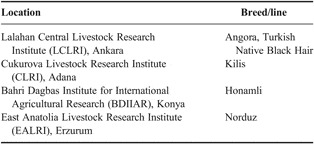
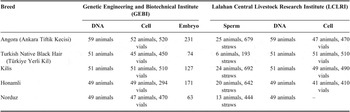
Collection of genetic material for cattle had begun in 2006 and goats were included in the programme in 2007. Some five conservation flocks of goats have been established at various research stations (Table 3) and an extensive bank of genetic material has been established for these same breeds as a result of the project (Table 4). It is expected that this resource will be expanded for preservation, conservation and use of Turkey's native genetic resources in the future. A flock of 70 Norduz goats is being maintained independently at the Research Farm of Agricultural Faculty of Van University in the far east of Turkey (Koyun, Reference Koyun2011).
Locations and breeds of goat under conservation activities at Government centres.

Source: Anon (2009).
Genetic material conservation status of Turkish goat breeds in May 2011.

Source: MRC (2011).
In addition to direct government and university activities, subsidies are paid to encourage local farmers in community-based conservation and improvement programmes. The subsidies are of two types, the one for in situ conservation, the other for improvement of stock under farmer management conditions. The breeds for which subsidies are paid are Angora, Kilis, Honamli and Norduz for 1000 head of each breed. The in situ subsidy is equivalent to Euro 30 per head and the improvement subsidy is Euro 17.
Discussion
Locally developed breeds are a pool of irreplaceable genetic material of unacknowledged merit and value that must not be lost but must be conserved for possible unknown and unseen future use (Wilson, Reference Wilson2009). Impoverishment of the nation's natural capital is not acceptable under any circumstances but the modest start of conservation measures by the government augurs well for the future and for safeguarding the country's heritage. Livestock production will not remain sustainable if the nation's gene pool is not fully characterized and preserved for use by future generations who will face as yet unforeseen circumstances.
Turkey is a country that is still on the road to development. Livestock production remains an important economic activity, but its produce is inadequate to supply the nutritional requirements of its people. Native goats are generally of low output, but still constitute almost the entirety of the national flock. Efforts should continue to characterize and improve their productive traits alongside the use of exotic breeds with possibly and potentially superior productivity but lower adaptability. The government, universities and the mass of livestock producers and ancillary industries should work together to conserve and improve the native goat breeds of Turkey.