Introduction
Rice is one of the most important crops, providing food for billions of people worldwide. Rice is grown in a wide variety of agroecosystems with diverse management strategies and constraints (Global Rice Science Partnership 2013). Weedy rice, also called red rice, is a conspecific relative of cultivated rice that infests cultivated rice fields (Langevin et al. Reference Langevin, Clay and Grace1990) and has likely been present in rice production since rice was first domesticated in Asia (Wedger and Olsen Reference Wedger and Olsen2018). It has become more problematic with the modern shift from traditional hand transplanting and hand weeding to direct-seeding cultivation and mechanized farming (Chauhan Reference Chauhan2013). Weedy rice is currently a pest in almost every rice-growing region in the world, including in the United States (Londo and Schaal Reference Londo and Schaal2007), southern Europe (Fogliato et al. Reference Fogliato, Vidotto and Ferrero2011), South America (Merotto et al. Reference Merotto, Goulart, Nunes, Kalsing, Markus, Menezes and Wander2016), Asia (He et al. Reference He, Kim and Park2017; Qiu et al. Reference Qiu, Zhu, Fu, Ye, Wang, Mao, Lin, Chen, Zhang, Guo, Qiang, Lu and Fan2014; Sun et al. Reference Sun, Qian, Ma, Xu, Liu, Du and Chen2013), and Africa (Federici et al. Reference Federici, Vaughan, Tomooka, Kaga, Wang, Doi, Francis, Zorrilla and Saldain2001). Weedy rice biotypes vary phenotypically in different regions, but are typically characterized by red pericarp, high rates of seed shattering, and high rates of seed dormancy (Gealy Reference Gealy, Norman, Meullenet and Moldenhauer2005; Huang et al. Reference Huang, Young, Reagon, Hyma, Olsen, Jia and Caicedo2017; Noldin et al. Reference Noldin, Chandler and McCauley1999).
Weedy rice presents unique challenges to weed management in rice. It is phenotypically similar to cultivated rice during the vegetative stage, making it difficult to identify until late in the growing season. The phenotypic and physiological similarities of weedy rice to cultivated rice make it difficult to control in season with either hand weeding or chemical weed control methods. In some rice-growing systems, cultivated rice varieties bred to be resistant to imidazolinone or quizalofop herbicides allow for the use of these herbicides during the growing season to control weedy rice (Lancaster et al. Reference Lancaster, Norsworthy and Scott2018; Tan et al. Reference Tan, Evans, Dahmer, Singh and Shaner2005). Weedy rice is not naturally resistant to these herbicides, although there are concerns about movement of herbicide-resistance traits from cultivated rice into the weed (Burgos et al. Reference Burgos, Norsworthy, Scott and Smith2008; Singh et al. Reference Singh, Singh, Black, Boyett, Basu, Gealy, Gbur, Pereira, Scott, Caicedo and Burgos2017b). These herbicide-resistant traits are not available in all rice-growing regions, including California. Rather, weedy rice in these regions must be controlled through cultural practices, such as using a stale seedbed, planting clean seed, hand pulling, or fallowing.
Weedy rice is highly competitive with cultivated rice. Weedy rice seedlings from a population in China had a higher photosynthetic rate than did cultivated rice, allowing for vigorous early growth (Dai et al. Reference Dai, Song, He, Valverde and Qiang2016). Weedy rice from the southern United States grows taller than cultivated rice varieties and produces more tillers and biomass (Estorninos et al. Reference Estorninos, Gealy, Gbur, Talbert and McClelland2005). It has higher nitrogen use efficiency when in competition with cultivated rice (Chauhan and Johnson Reference Chauhan and Johnson2011), absorbing up to 60% of applied nitrogen and reducing the amount of nitrogen available to the crop (Burgos et al. Reference Burgos, Norman, Gealy and Black2006). The higher nitrogen use efficiency of weedy rice is possibly related to more root growth and a stress-adaptive mechanism related to nitrogen and sucrose availability (Sales et al. Reference Sales, Burgos, Shivrain, Murphy and Gbur2011).
Studies of yield loss due to weedy rice competition indicate maximum yield losses from 49% to 90% (Estorninos et al. Reference Estorninos, Gealy, Gbur, Talbert and McClelland2005; Marambe and Amarasinghe Reference Marambe, Amarasinghe, Baki, Chin and Mortimer2000; Shivrain et al. Reference Shivrain, Burgos, Gealy, Smith, Scott, Mauromoustakos and Black2009), depending on experimental conditions, cultivar, and weed biotype. Yield loss increases with later rice planting dates and higher weed density in the southern United States (Shivrain et al. Reference Shivrain, Burgos, Gealy, Smith, Scott, Mauromoustakos and Black2009). The impact of weedy rice on cultivated rice yield also depends on the rice variety. Cultivated varieties that are taller, produce more tillers, and have greater leaf area generally are more competitive against weedy rice (Estorninos et al. Reference Estorninos, Gealy and Talbert2002; Kwon et al. Reference Kwon, Smith and Talbert1992). Cultivated rice in China is more competitive against weedy rice when direct seeded rather than transplanted (Cao et al. Reference Cao, Li, Song, Cai and Lu2007). The competitive ability of weedy rice can also vary greatly between weedy biotypes (Dai et al. Reference Dai, Dai, Song, Lu and Qiang2013; Estorninos et al. Reference Estorninos, Gealy, Gbur, Talbert and McClelland2005), with variation in seed size, timing of seedling emergence, plant height, shoot biomass, time to flowering, and time to maturation affecting competition with cultivated rice (Chauhan and Johnson Reference Chauhan and Johnson2011; Gealy et al. Reference Gealy, Saldain and Talbert2000; Shivrain et al. Reference Shivrain, Burgos, Scott, Gbur, Estorninos and McClelland2010; Zhao et al. Reference Zhao, Xu, Song, Dai, Dai, Zhang and Qiang2018). In addition to rice yield loss, weedy rice infestations can reduce the value of harvested rice, due to reduced grain quality and contamination with red-bran rice (Shivrain et al. Reference Shivrain, Burgos, Scott, Gbur, Estorninos and McClelland2010; Singh et al. Reference Singh, Burgos, Singh, Gealy, Gbur and Caicedo2017a).
In California, weedy rice was reported in the 1930s, shortly after the beginning of commercial rice production in the region, and was hypothesized to have originated from contaminated seed transported from the southern United States (Bellue Reference Bellue1932). In the 1950s, weedy rice was thought to be eradicated (Miller and Brandon Reference Miller, Brandon and Wilson1979) as a result of adopting a continuously flooded system and the use of certified seed. In 2003, however, a single biotype of weedy rice was reported in a dry-seeded rice field (Kanapeckas et al. Reference Kanapeckas, Vigueira, Ortiz, Gettler, Burgos and Fischer2016). Since then, weedy rice has been identified infesting more than 130 fields and 5,600 ha in California as of 2018 (Luis Espino, personal communication, August 4, 2019), consisting of several distinct biotypes. These biotypes are distinguishable from each other by phenotypic differences, including presence and length of awns, hull color, and grain size (Table 1). They are also genetically distinct and have separate origins from diverse rice ancestors (De Leon et al. Reference De Leon, Karn, Al-Khatib, Espino, Blank, Andaya, Andaya and Brim-DeForest2019). Although the effects of weedy rice competition on cultivated rice yield has been studied for other locations and weedy rice biotypes, the effects of competition on growth and yield of California rice cultivars due to local weedy rice biotypes have not been previously investigated, to our knowledge.
Descriptions of the five weedy rice biotypes from California used in this study.

To understand and quantify the effects of weedy rice infestation on cultivated rice, plant competition between cultivated rice and weedy rice in California was investigated in this study. The objectives of this study were to (1) measure the impact of weedy rice competition on cultivated rice growth and yield components using an additive design competition experiment, (2) examine how growth rates of cultivated and weedy rice are altered under competitive conditions, and (3) characterize the differing competitive strategies of weedy rice biotypes in California.
Materials and Methods
Weed Competition Experiment
The most widely grown rice variety in California (California Cooperative Rice Research Foundation 2019), ‘M-206’, a medium-grain, temperate japonica variety, was selected for this study, as were five weedy rice biotypes from California (Table 1). Weedy rice biotypes were obtained from rice fields in the northern Sacramento valley of California.
Competition growth experiments were conducted in a greenhouse because of a lack of field sites where weedy rice could be grown uncontrolled. An additive design competition experiment was conducted in a randomized complete block design. Blocks were planting time, and treatments were weedy rice density and weedy rice biotype. Each block consisted of 25 pots(18.9-L), each containing four M-206 rice plants, representing a density of 32 plants m−2. Each pot also contained one of five weedy rice biotypes at a density of 0, 1, 2, 3, or 5 weedy rice plants pot−1, representing a planting density of 0, 8, 16, 24, or 40 plants m−2. Pregerminated rice was direct seeded into the pots. The experiment was repeated in time, with four successive plantings 2 wk apart in August and September 2017, in a greenhouse set at 33/17 C day/night temperature, 33%/84% relative humidity, and ambient light at the Rice Experiment Station in Biggs, CA. Pots were fertilized with 10 g pot−1 15-15-15 NPK fertilizer 2 wk after planting and then kept at water saturation for the duration of the experiment. Beginning 1 wk after planting, the height and tiller number of each M-206 and weedy rice plant were measured weekly for 12 wk. At maturity 40 d after M-206 flowered, M-206 yield-component measurements were taken for plant height, tiller number, panicle number, panicle weight, seed weight adjusted to 14% moisture content, fresh biomass, and dry biomass. Panicle weight and fresh biomass were measured immediately after harvesting before seeds were removed and were not adjusted for moisture content. For 100-seed weight, weight was measured for pooled M-206 plants from each pot, because individual plants at high weed densities produced small quantities of seeds. Yield-component measurements for the high-density treatment of weedy rice biotypes were collected for plant height, tiller number, panicle number, panicle weight, fresh weight, and dry weight.
Data Analysis
Two-way ANOVA was conducted for weekly M-206 rice plant height and tiller number data with repeated measures to determine significance of block, weed biotype, and weed density at each week. R software, version 3.5.1 was used (R Foundation for Statistical Computing, Vienna, Austria). Differences among biotypes were tested by a Tukey honest significant difference (HSD) test. Harvest yield-component measurements were analyzed by ANOVA, and differences among biotypes were tested by a Tukey HSD test. Logarithmic transformation was applied when data did not meet normality or homogeneity of variance. For data that were transformed, detransformed means are reported with detransformed SEs. Weekly growth and harvest yield-component data for weedy rice were analyzed in the same manner for only the highest weed density treatment, because at lower weed densities, the weedy rice sample sizes were very small.
To more closely examine differences in M-206 growth at varying weed density treatments and between M-206 and weedy rice, relative growth rate analysis was conducted using the weekly plant height measurements. For comparison of M-206 growth with and without competition, data for competition from all weedy rice biotypes were combined because all biotypes affected M-206 height growth similarly, with no significant differences among weedy rice biotypes. Three-parameter logistic curves were fitted to M-206 weekly height data for the 0 and 40 plants m−2 treatments and to weedy rice measurements for 40 plants m−2 using the self-starting logistic model function SSlogis in R, using the following model:
 $${{dM} \over {dt}} = rM\left(1 - {M \over K}\right)$$
where M is plant height, r is growth rate, and K is the upper asymptote (Paine et al. Reference Paine, Marthews, Vogt, Purves, Rees, Hector and Turnbull2012). Absolute growth rate and relative growth rate per unit time were calculated from the logistic function, following the method of Paine et al. (Reference Paine, Marthews, Vogt, Purves, Rees, Hector and Turnbull2012).
Results and Discussion
Effect of Competition on Rice
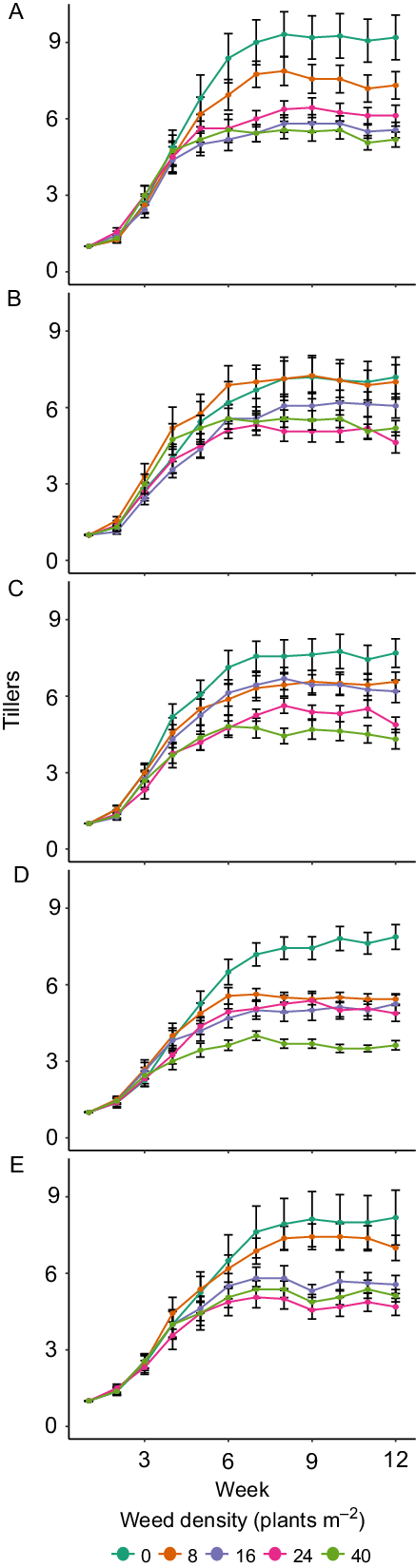
When grown in the absence of competition, M-206 rice plants initially grew rapidly before leveling off at 99.6-cm tall with 8.2 tillers at 12 wk as plants approached maturity (Figures 1 and 2). In the presence of weedy rice competition, M-206 tiller production during early growth was reduced by varying amounts by different weedy rice biotypes (Figure 1A–1E). For type 4, the lowest weed density tested of 8 plants m−2, or 1 weedy rice plant pot−1, resulted in a substantial reduction in tiller number from 7.9 tillers plant−1 to 5.4 tillers plant−1 by week 12 (Figure 1D). In contrast, the same density of type 2 or type 5 weedy rice resulted in a small and not significant decrease in tiller number at most time points (Figure 1B and 1E). At higher weed densities, competition from all five weedy rice biotypes resulted in a significant decrease in M-206 tiller production, with tiller numbers ranging from 4.3 tillers when competing with type 2 to 5.2 tillers when competing with type 5 at 12 wk after planting (Figure 1). Differences in tiller number among weed density treatments became significant by week 3 for all five weedy rice biotypes (Figure 1A–1E).
Weekly early growth measurements of M-206 rice tillers plant−1 when grown in competition with types (A) 1, (B) 2, (C) 3, (D) 4, (E) 5 weedy rice at varying weed density.

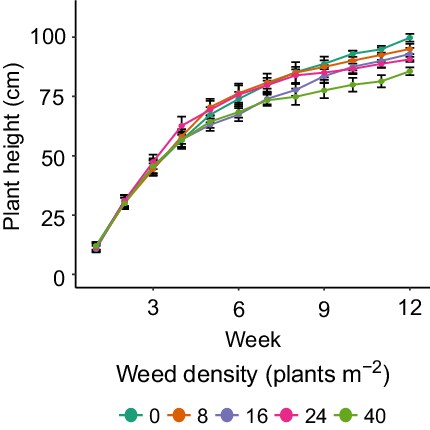
Weekly early growth measurements of M-206 rice height plant−1 when grown in competition with weedy rice biotypes at varying weed density. Effects of competition on rice height was not significant between biotypes.

Competition from all weedy rice biotypes resulted in similar trends of reduction in M-206 rice height with increasing density, with a maximum height reduction of 13% (Figure 2). Differences in height between weed density treatments became significant by week 2 and resulted in diverging plant height over time between weed density treatments.
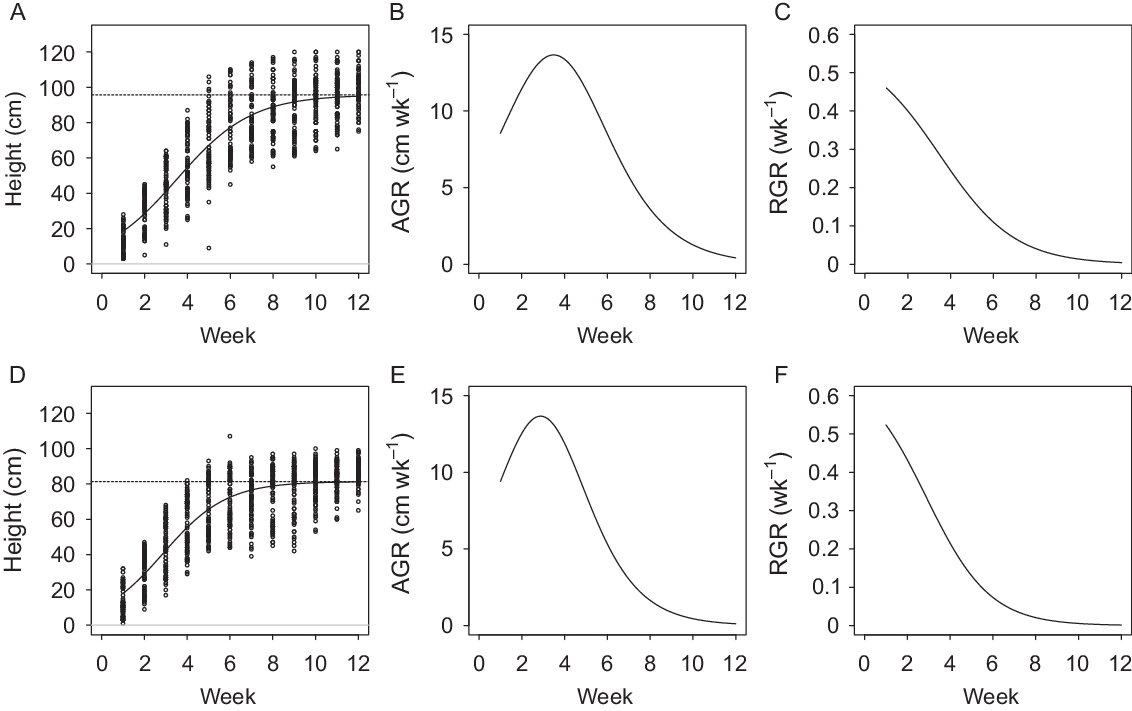
To examine further the effects of weedy rice competition on M-206 growth, relative growth analysis was conducted for weekly plant height measurements in the absence of competition and at high weed density competition. Three-parameter logistic curves were fitted to plant height data (Figure 3A and 3D; Table 2). Absolute growth rate, calculated as change in plant height wk-1, increased initially in the early weeks of growth (Figure 3), reaching a maximum rate of 13.6 cm wk−1 at 3.6 wk after planting in the absence of competition (Figure 3B; Table 2). M-206 growth peaked earlier under high competition conditions, at a growth rate of 13.8 cm wk-1 at 2.9 wk after planting (Figure 3E; Table 2). In both cases, absolute growth rate declined to approach 0 as plants approached mature size. The relative growth rate, calculated as change in plant height relative to the already accumulated height of the plant wk-1, showed that rice grew fastest relative to its size initially and slowed over time (Figure 3C and 3F). M-206 growth was already affected by competition at the earliest measured growth stages, with an initial relative growth rate of 0.47 cm−1 wk−1 without competition (Figure 3C) versus 0.53 cm−1 wk−1 with competition (Figure 3F). Competition then resulted in a steeper decline in relative growth rate over time. This indicates that M-206 rice detects and responds to competition very early on, initially growing rapidly to compete with the weed. But this competition slows growth earlier and results in a shorter mature size than rice grown in the absence of competition.
Growth rates of M-206 rice over time grown with (A–C) no weedy rice competition and with (D–F) high-density weedy rice competition, with logistic curves fitted to (A, E) plant height data; (B, E) absolute growth rate (AGR) over time; and (C, F) relative growth rate (RGR) per unit time.

Calculated relative growth rate parameters for three-parameter logistic curves of M-206 plant height with no weedy rice competition and with high competition.

a Abbreviations: AIC, Akaike information criterion of model; RMSE, root mean square error of model; Scal, scalar factor of the model equivalent to the inverse of growth rate at time Xmid; Xmid, time at which plants reach maximum absolute growth rate; Ymax, maximum plant height at maturity.
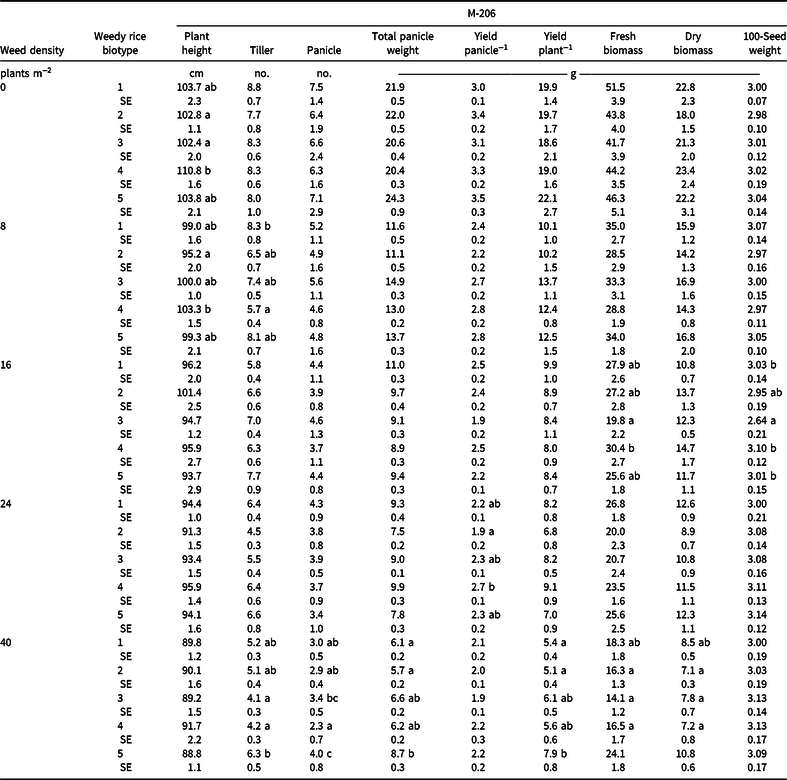
Yield-component measurements at harvest of M-206 rice showed a negative impact of weedy rice competition on most yield components (Table 3). Some yield components were not very sensitive to weedy rice competition and decreased less than 30% with increasing weedy rice density. For example, competition reduced M-206 plant height by 14.4 cm averaged across all biotypes (Table 3). Competition from type 5 weedy rice reduced M-206 tiller number by 1.7 tillers plant−1, and competition from type 1 weedy rice reduced M-206 yield panicle−1 by 0.9 g. In contrast, panicle number, total panicle weight, yield per plant, and aboveground biomass of M-206 rice were highly sensitive to weedy rice competition, with yield reduction of more than 50% for each yield component at 40 plants m−2 (Table 3). The greatest losses were observed for total panicle weight and yield plant−1, with 69% yield reduction for each component. The exception to the trend of decreasing yield with increasing weed density was 100-seed weight, which did not decrease significantly (Table 3). Because M-206 rice has been bred to be a medium-grain variety, the size and weight of grains would not be expected to vary much. This result contrasts with that of a previous study of Asian weedy rice competition, in which seed weight declined with increasing weed density (Dai et al. Reference Dai, Dai, Song, Lu and Qiang2013), but this may be attributable to differences in the rice cultivar.
Final measurements of yield components of M-206 rice at varying densities of competition from five weedy rice biotypes.

a For measurements at weed densities where differences among biotypes were significant, letters indicate significant differences among biotypes at that weed density, determined by Tukey test (α = 0.05).
Even at low weedy rice densities, competition resulted in large reductions in M-206 rice yield for some yield components. Yield plant−1 was reduced from 19.5 g at 0 plants m−2 to 11.8 g at 8 plants m−2 averaged across all biotypes, and panicle weight was reduced from 21.4 g to 12.9 g at the same densities (Table 3). These results agree with findings of a study of Asian weedy rice competition on cultivated rice yield using a replacement series experimental design in which weedy rice infestations of less than 20% relative density reduced the relative cultivated rice yield by more than 50% (Dai et al. Reference Dai, Dai, Song, Lu and Qiang2013). Unlike in the southern United States, where significant numbers of severely infested fields have been reported (Burgos et al. Reference Burgos, Norsworthy, Scott and Smith2008), California does not currently have any known fields with high-density weedy rice infestations. In a recent survey, California rice growers and pest control advisors reported only one or sparse patches of weedy rice per infested field (unpublished data). It is likely that such localized weedy rice infestations would have limited yield effects at the scale of a rice field. But these results do suggest that small infestations should be taken seriously by growers because they could locally affect rice yield in addition to contributing to future weedy rice infestations if not controlled.
Weedy Rice Competitive Strategies
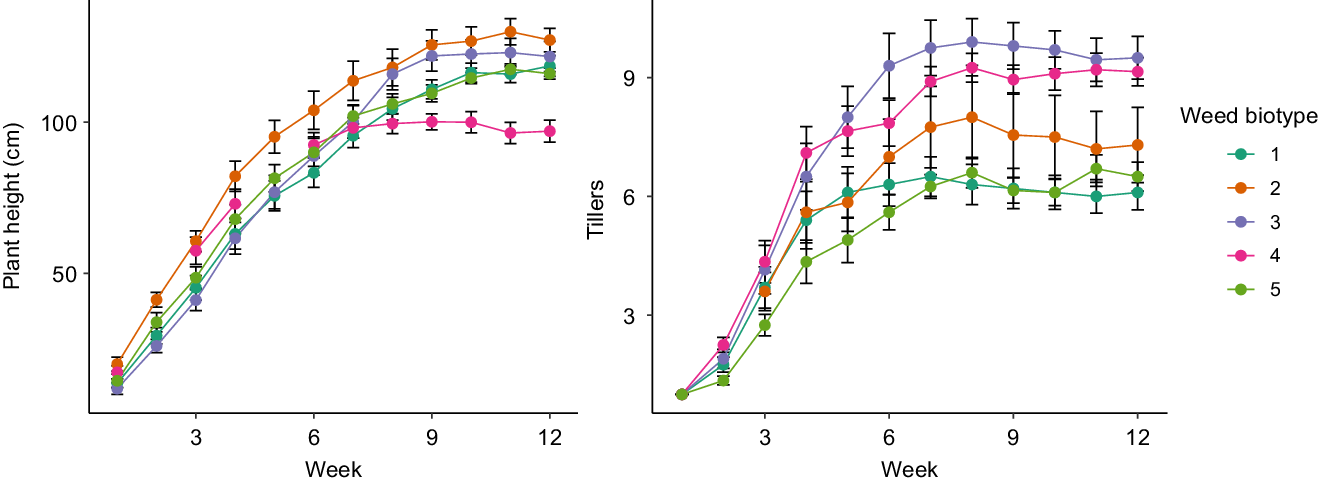
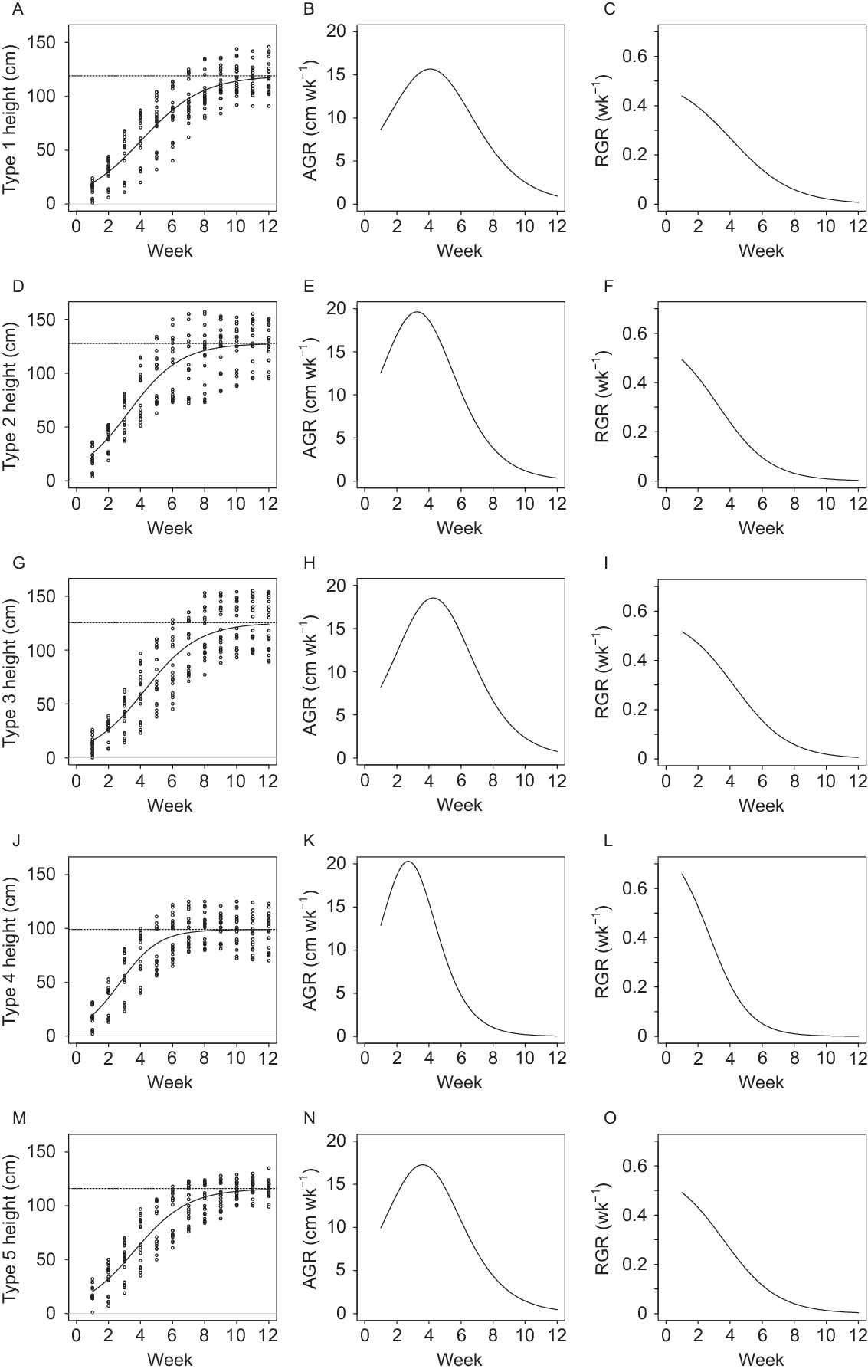
Differences in the impact of weedy rice biotypes on M-206 yield components may be due to differences in the competitive abilities of biotypes to take up available resources required for M-206 growth. Overall growth patterns are similar between weedy rice biotypes and M-206 rice (Figures 1, 2, and 4), but weedy rice biotypes vary in their early growth and final yield components. Only the highest-density weedy rice treatment of 40 plants m−2 is considered here, because lower-density treatments had correspondingly smaller sample sizes. When grown in competition with M-206 rice, differences in height and tiller growth among weedy rice biotypes became significant by week 2 (Figure 4). By week 8, type 3 weedy rice produced 9.9 tillers plant−1, whereas type 1 and type 5 produced only 6.3 and 6.6 tillers plant−1, respectively (Figure 4B). Type 2 and type 4 weedy rice initially had high absolute height growth rates of 12.2 cm wk−1 and 12.5 cm wk−1, respectively (Figure 5E and 5K). Although type 2 maintained its relatively tall plant height, type 4 weedy rice growth was decreased sharply due to competition (Figure 5L). Type 4 weedy rice reached its maximum growth rate earlier than other biotypes, at 2.7 wk after planting (Table 4).
Weekly early growth measurements of plant (A) height and (B) number of tillers for weedy rice biotypes during the vegetative growth stage.

Growth rates of weedy rice over time under high competition conditions (n = 40) weedy rice plants m−2 for types (A–C) 1, (D–F) 2, (G–I) 3, (J–L) 4, and (M–O) 5, with logistic curves fitted to plant (A, D, G, J, M) height data, (B, E, H, K, N) absolute growth rate (AGR) over time, and (C, F, I, L, O) relative growth rate (RGR) per unit time.

Calculated relative growth rate parameters and error estimates for three-parameter logistic curves of plant height for weedy rice biotypes at 40 plants m−2 weed density.

a Abbreviations: AIC, Akaike information criterion of model; RMSE, root mean square error of model; Scal, scalar factor of the model equivalent to the inverse of growth rate at time Xmid; Xmid, time at which plants reach maximum absolute growth rate; Ymax, maximum plant height at maturity.
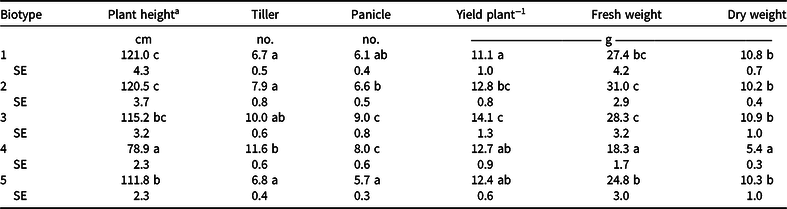
Measurements of yield components of weedy rice at harvest showed significant phenotypic diversity among biotypes when grown in competition with M-206 rice. Most weedy rice biotypes were tall relative to M-206 rice, with an average final height of 109.4 cm across all biotypes versus 89.9 cm in M-206 under competitive conditions, although type 4 weedy rice was short, with a final height of only 78.9 cm (Tables 3 and 5). Weedy rice biotypes had correspondingly high or low biomass accumulation relative to plant height. Type 4 weedy rice produced the most tillers (11.6 tillers plant−1) (Table 5) compared with 4.2 tillers in M-206 rice when competing with each other (Table 3). All weedy rice biotypes had higher yield plant−1 under high competition than did M-206 rice (Tables 3 and 5), indicating these biotypes are highly successful competitors. The wide variation in growth and yield components between weedy rice biotypes suggests multiple strategies for success as a weed with differing allocation of resources to height, tillering, or seed production. Tall plant height and tiller production, like that seen in many biotypes, may contribute to competitive ability in the current growing season, whereas the high allocation to seed production seen in type 3 could lead to a larger weedy-rice seed bank and more severe infestations in future growing seasons if not controlled effectively. Significant diversity in plant height, tiller and panicle production, and other yield and seed characteristics has been reported in previous studies of weedy rice from other regions, and these affect the competitive abilities of biotypes (Chauhan and Johnson Reference Chauhan and Johnson2011; Shivrain et al. Reference Shivrain, Burgos, Scott, Gbur, Estorninos and McClelland2010).
Final measurements of yield components of weedy rice biotypes when grown at a density of 40 plants m−2 in competition with M-206 rice.

a Letters indicate significant differences between weed biotypes arranged vertically, determined by Tukey test (α = 0.05).
It is possible in some areas that multiple weedy rice biotypes could be present in the same field, and it is unclear whether the combined action of different weedy rice biotypes may result in greater yield loss, similar levels of yield loss as observed for each biotype alone, or if their competitive strategies may interfere with each other, resulting in lower M-206 yield loss. It is also unclear from this study how competitive California weedy rice biotypes would be against other cultivars of rice, because cultivars can differ in their competitive abilities (Estorninos et al. Reference Estorninos, Gealy and Talbert2002). M-206 rice accounted for 46% of California rice acreage in 2018 (California Cooperative Rice Research Foundation 2019).
Additional study would be needed to determine whether the results of this greenhouse study translate into similarly high rice yield losses under field conditions. Field studies of weedy rice competition in other areas have shown yield losses ranging from 22% to 90% (Estorninos et al. Reference Estorninos, Gealy, Gbur, Talbert and McClelland2005; Marambe and Amarasinghe Reference Marambe, Amarasinghe, Baki, Chin and Mortimer2000; Shivrain et al. Reference Shivrain, Burgos, Gealy, Smith, Scott, Mauromoustakos and Black2009; Vidotto and Ferrero et al. Reference Vidotto, Ferrero and Ressel2005), putting the results of this greenhouse study in the top half of that range. Additional weedy rice experiments have recently begun in research fields. To limit the spread of weedy rice, weedy rice cannot be grown uncontrolled for yield-loss studies in grower fields. However, it is clear from the results of this study that California weedy rice biotypes are highly competitive and have the potential to cause high yield losses in rice.
Acknowledgements
The authors thank the California Rice Research Board for providing the funding for this research. The authors also thank the California Rice Experiment Station and the director, Dr. Kent McKenzie, who provided greenhouse space. Puja Upadhayay and Michael Lee provided assistance in the greenhouse. No conflicts of interest have been declared.