Introduction
In every aspect of their life, animals have to make choices when confronted to fitness-related situations (e.g. food selection, refuge, mating). Those that affect more strongly their fitness should be under an intense selective pressure; thus, individuals with an optimal ability for searching and exploiting resources should be favoured (Hoffmeister & Roitberg, Reference Hoffmeister and Roitberg1997). Parasitoid insects lay their eggs inside or outside a host organism and immature stages are generally unable to search or move to another host (Salt, Reference Salt1936), depending solely on the quality and quantity of the resources available in the host selected by their mother. Considering this constrain, the oviposition choice of the female will be of fundamental importance.
Solitary parasitoids are defined as those that are able to produce only one offspring per host, even when one or more eggs are deposited in or on a host (Mackauer, Reference Mackauer, Mackauer and Ehler1990). This situation, termed superparasitism (Salt, Reference Salt1934), is frequently observed both in nature and in laboratory colonies (see examples in van Lenteren, Reference van Lenteren and Nordlund1981; van Alphen & Visser, Reference van Alphen and Visser1990; Böckmann et al., Reference Böckmann, Tormos, Beitia and Fischer2012). Initially considered as a mistake or inability of females to discriminate parasitized from unparasitized hosts (van Lenteren, Reference van Lenteren and Nordlund1981), superparasitism was, later on, considered to be adaptive. Several studies have shown that even when females were able to discriminate, they frequently incurred in superparasitism under specific combinations of internal (physiological, genetic) and external (environmental) factors (van Lenteren, Reference van Lenteren and Nordlund1981; Mackauer, Reference Mackauer, Mackauer and Ehler1990; van Alphen & Visser, Reference van Alphen and Visser1990; Brodeur & Boivin, Reference Brodeur and Boivin2004). Such combinations determine that laying an egg in an already parasitized host is a better strategy that avoiding that particular host and invest more time and energy in search for an unparasitized host (van Alphen & Visser, Reference van Alphen and Visser1990). Self-superparasitism (superparasitism by the same female) can also be advantageous if the presence of more than one egg per host increases the survival probability of the progeny (Rosenheim & Hongkham, Reference Rosenheim and Hongkham1996). This has been proposed in cases where superparasitism correlates with a more efficient suppression of the host immune response (van Alphen & Visser, Reference van Alphen and Visser1990). Likewise, when several females are foraging within the same patch, self-superparasitism increases the survival probability of its own offspring (Rosenheim & Mangel, Reference Rosenheim and Mangel1994). An alternatively, non-evolutionary explanation to superparasitism was proposed by Varaldi et al. (Reference Varaldi, Fouillet, Ravallec, López-Ferber, Boulétreau and Fleury2003, Reference Varaldi, Ravallec, Labrosse, Lopez-Ferber, Boulétreau and Fleury2006) who found that this phenomenon could be associated with symbiotic viruses that manipulate the oviposition behaviour to favour horizontal transmission.
For solitary parasitoids, superparasitism will always imply the suppression of supernumerary eggs or larvae (Salt, Reference Salt1961; van Lenteren, Reference van Lenteren and Nordlund1981; González et al., Reference González, Montoya, Perez-Lachaud, Cancino and Liedo2007), thus there is a clear cost for those that do not succeed in developing into the adult stage. Furthermore, superparasitism could have additional negative effects on the parasitoid that eliminates their competitors and emerges as adult due to larval competition. In this context, the effects can be more or less severe depending on the life cycle of the parasitoid species (Tunca & Kilincer, Reference Tunca and Kilincer2009). In koinobiont species, the host is attacked in early stages, but it continues feeding and growing until pupation, making resource availability to vary during parasitoid development. The opposite situation occurs for idiobiont species, for which parasitoid eggs are laid in paralysed or (almost) immobile stages (Sequeira & Mackauer, Reference Sequeira and Mackauer1992). Hosts parasitized by solitary, idiobiont species normally show a decrease in behavioural activity and development (Harvey et al., Reference Harvey, Jervis, Gols, Jiang and Vet1999). For these parasitoids, larval competition should have a strong effect given that no further feeding by the host takes place to balance its consumption. The costs of superparasitism for some species are evidenced through an increase in the duration of the larval stage, generating an increase in the exposure of developing parasitoids to mortality factors (Simmonds, Reference Simmonds1943; Wylie, Reference Wylie1983; Eller et al., Reference Eller, Tumlinson and Lewis1990; Mayhew & van Alphen, Reference Mayhew and van Alphen1999). In other species, the adult size is negatively affected by superparasitism (Eller et al., Reference Eller, Tumlinson and Lewis1990), although some counter examples exist (Bai & Mackauer, Reference Bai and Mackauer1992; Mackauer & Chau, Reference Mackauer and Chau2001).
Another aspect that will modulate the consequences of the intraspecific competition caused by superparasitism is the mechanism of elimination of the supernumerary parasitoid larvae (Salt, Reference Salt1936; Fisher, Reference Fisher1961, Reference Fisher1971). Elimination can occur directly through physical combats (common in species with highly sclerotized mandibles) (Fisher, Reference Fisher1961; Chow & Mackauer, Reference Chow and Mackauer1986) and indirectly through physiological suppression. In the latter, elimination is attained by a number of mechanisms, such as starvation, anoxia, changes in haemolymph as a defensive reaction after the first parasitization, toxins secreted by the first larva, cytolytic enzymes, teratocytes [reviewed in Vinson & Hegazi (Reference Vinson and Hegazi1998)]. This is common when competitors have a distinctive age difference, being the oldest one, the winner (Godfray, Reference Godfray1994). On the other hand, when elimination is achieved via physical combats, a first-instar (L2) larva with strong mandibles usually kills a second-instar (L2) larva, which has not such aggressive structures (Bakker et al., Reference Bakker, van Alphen, van Batenberg, van der Hoeven, Nell, van Strien-van Liempt and Turlings1985; Chau & Maeto, Reference Chau and Maeto2008). Hence, the costs associated with sharing the host until the elimination of all the competitors should be, in general, higher when the elimination is mediated by physical combat.
Diachasmimorpha longicaudata Ashmead (Hymenoptera: Braconidae) is a solitary, koinobiont, endoparasitoid, native to Southeast Asia (Wharton & Gilstrap, Reference Wharton and Gilstrap1983) and it is widely used as a biological control agent. Females attack late L2- and third-instar (L3) larvae (Fisher, Reference Fisher1971) from several Tephritidae (Diptera) fruit fly species, just before they pupate. During development, the fly is killed and the adult parasitoid emerges from the puparium of the fly. Superparasitism by this species has been studied associated to Anastrepha suspensa Loew and Anastrepha ludens Loew (Diptera: Tephritidae). Supernumerary larvae developing in A. suspensa have an abrupt mortality 24–36 h during the L1 (Lawrence, Reference Lawrence1988), suggesting physical combats and substances secreted by L1 larvae as elimination mechanisms (Clausen et al., Reference Clausen, Clancy and Chock1965; Lawrence Reference Lawrence1988). Montoya et al. (Reference Montoya, Liedo, Benrey, Barrera, Cancino and Aluja2000) and González et al. (Reference González, Montoya, Perez-Lachaud, Cancino and Liedo2007) found evidences of moderate negative effects of superparasitism by D. longicaudata on A. ludens. For the system D. longicaudata – C. capitata there is a lack of knowledge about the potential costs of superparasitism, which would be essential for the expansion of this method of pest control when using this host species in massive rearings.
The aim of this work was to assess the occurrence of superparasitism and its potential effects during larval development as well as in the emerged adults, using D. longicaudata reared in C. capitata larvae in a semi-massive rearing context. We hypothesized that the existence of supernumerary parasitoid eggs inside a single host will negatively affect immature development and adult performance in a dose-dependent way [the highest the level of superparasitism (LSP), the more detrimental for the parasitoids]. We carefully examined the dynamics of supernumerary larvae elimination, in order to understand the observed patterns. These results may contribute to the efficiency of the massive rearing of this parasitoid used as a biological control agent against economically important fruit flies.
Materials and methods
Insects
Ceratitis capitata and D. longicaudata were obtained from the experimental rearing kept at the Instituto de Genética ‘E. A. Favret’ (IGEAF), INTA Castelar, Buenos Aires, Argentina. Rearing of insects followed standard protocols (Ovruski et al., Reference Ovruski, Colin, Soria, Oroño and Schliserman2003; Viscarret et al., Reference Viscarret, La Rossa, Segura, Ovruski and Cladera2006). Ceratitis capitata originated from a colony reared in the Mendoza Insectary, Argentina and established in the laboratory at INTA Castelar Argentina on September 1994. Larvae were reared using an artificial diet (as per Terán, Reference Terán1977), and adult flies were provided with water and a mixture of sugar and brewer's yeast. The colony of D. longicaudata was initiated with individuals from CIRPON, San Miguel de Tucumán (Ovruski et al., Reference Ovruski, Colin, Soria, Oroño and Schliserman2003) in 2001 and immatures were reared in a laboratory strain of C. capitata. Adult parasitoids were provided water and honey.
Unless specified, the experimental conditions were 25 ± 1 °C, 60 ± 10% RH and a 14 : 10 (light : dark) photoperiod.
Experiment 1. Superparasitism in an artificial rearing
To determine the occurrence and LSPs (i.e. the number of parasitoids developing inside a single host) in the semi-massive artificial rearing of D. longicaudata from IGEAF, L3 larvae of C. capitata were exposed to 25 female parasitoids and 25 male parasitoids inside a 4 litres glass, randomly taken from the rearing (7–20-day-old, with previous oviposition experience). C. capitata larvae, together with the larval diet, were placed inside a small Petri dish (5 cm Ø), wrapped in a piece of voile cloth [oviposition unit (OU)] and exposed for 4 h to the parasitoids. Exposed larvae were transferred to a container with fresh diet and vermiculite to allow pupation. Forty-eight hours after parasitization, a sample of 20 pupae from each OU was dissected under a stereomicroscope (60×) (Olympus, Japan). The number of parasitoid eggs and larvae found inside each host pupa were recorded determining the LSP. Ten replicates (i.e. OU) were obtained using different parasitoid containers.
Experiment 2. Effects of superparasitism on immature stages
Experiment 2.1. Dynamics of supernumerary larvae elimination
As a solitary parasitoid species, elimination of all but one immature individual will occur before adult emergence. Assuming that high LSP will negatively affect adult performance, we hypothesize that elimination of competitors should occur at the initial stages of development in order to neutralize this effect. To test this, a series of dissections of parasitized pupae were performed 48, 72, 96 and 120 h after parasitization (eggs take approximately 48 h to hatch). A random sample of 2000 L3 C. capitata larvae were exposed to the parasitoids as in Experiment 1. Afterwards, they were held in plastic containers with fresh diet and vermiculite. Two hundred pupae were randomly sampled for each time lapse (noted the exception for 48 h). Pupae were dissected and the number, developmental stage (i.e. egg, L1 or L3), and status (i.e. dead or alive) of the parasitoids found inside were recorded. According to the total number of parasitoids per host, each pupa was assigned to LSPs 1, 2, 3, 4, 5 and LSP >5 (i.e. grouping hosts containing more than five parasitoid eggs/host). Unparasitized or dead pupae were not included in the data set. The total numbers of pupae considered for analyses were 26 for 48 h, 132 for 72 h, 138 for 96 h and 121 for 120 h. A descriptive analysis was performed.
Experiment 2.2. Effects of superparasitism on the size of the surviving parasitoid larva
In order to estimate the impact of the LSP on the surviving larva, the size of the L2 was assessed. Immediately after dissecting parasitized pupae (Experiment 2.1), each L2 detected was immersed for 10 s in hot water (80 °C) to fix the body structure. Parasitoid larvae were then mounted on a microscope slide and photographed (40×) (Motic DM39 Stereomicroscope, Motic China Group Co., Ltd.). The maximum length and the area of each larva was measured using Motic Images Plus 2.0 software (Motic China Group Co., Ltd.). For each 96 or 120 h treatment (L2 were found only here), each variable was independently compared among LSPs by means of a one-way ANOVA when normality and homoscedasticity assumptions were met. When a mild deviation from equal variances was found, a Kruskal–Wallis test was carried out. When heteroscedasticity was severe, a one-way ANOVA was carried out with transformed data [log(x + 1)] (Zar, Reference Zar1996).
Experiment 2.3. Effects of superparasitism on percentage of emergence, sex ratio and developmental time
Ceratitis capitata L3 were exposed to female parasitoids in such a way that it was possible to determine exact LSPs without dissecting the exposed larvae. For this purpose, a method involving direct observation of the ovipositions was used: females were confined in a container with a piece of cloth as lid and larvae were supplied in a controlled way from the outside, one by one using soft tweezers. A set of criteria was established in order to decide that a successful oviposition had taken place (assayed in a preliminary experiment): (1) the female penetrates the larva with its inner valves leaving the outer sheets outside; (2) the larva writhes vigorously trying to escape, as response to the attack. If the larva is retained, it is quickly paralysed; (3) the female stays still, with its abdomen pointing up and with the ovipositor inside the larva; (4) after paralysation, oviposition duration lasts 44.42 ± 2.95 s (mean ± SE; n = 72), after which the female withdraws the ovipositor; (5) the larva remains immobile and completes full mobility after 6.56 ± 0.31 min (mean ± SE; n = 32).
To produce increasing LSP with this method, a group of 15 females was used to sequentially parasitize larvae until the desired LSP. This number of females allowed for a low probability of superparasitism. Between oviposition bouts (for LSP >1) larvae were let to recover full mobility. Parasitized larvae were individually transferred to small Petri dishes containing fresh larval medium and vermiculite. Petri dishes were placed inside an incubator (SANYO MRL 350, Japan) and kept under controlled temperature and humidity (25 ± 1 °C; 70 ± 5% HR). For LSPs 1 (control), 2, 3, 5 and 10, the numbers of replicates were 106, 70, 69, 62 and 29, respectively [LSP 4 was not included to simplify the methodology, considering that low (LSPs 2–3), intermediate (LSP 5) and high (LSP 10) LSPs comprised sufficiently well the whole range of situations found in the rearing (see ‘Results’ section)]. Petri dishes were checked and pupae were recovered, counted and transferred to new containers for adult emergence. The date of emergence and the sex of adult parasitoids was recorded, and then were individually kept in glass containers (400 ml) with honey and water for further assays.
Developmental time was considered as the number of days elapsed between oviposition (larval exposure) and adult emergence. This variable was analysed by means of a two-way ANOVA considering LSP and sex as factors. To fulfil the normality assumption data were transformed to its logarithm. The total number of emerged and unemerged parasitoids was compared among LSPs by means of a χ2 test of homogeneity. LSP 10 was excluded from the analysis because no parasitoid emerged. Viability of C. capitata larvae used for these experiments was evaluated by checking the emergence of flies coming from unexposed larvae (LSP 0; n = 82). These data were not included in the statistical analyses.
Experiment 3. Effects of superparasitism on adult stage
Experiment 3.1. Female fecundity, parasitism rate and sex ratio of the progeny
Females emerged from the different LSPs from Experiment 2.3 were held in a room at 22 ± 1 °C, 60 ± 10% HR and 14 : 10 (light : dark) with water, honey and one male that was randomly taken from the artificial rearing. Four days after female emergence and during the period of higher fertility [i.e. 3 weeks according to Viscarret et al. (Reference Viscarret, La Rossa, Segura, Ovruski and Cladera2006)], a series of larval exposures was performed every 48 h in small OUs (Segura et al., Reference Segura, Nussenbaum, Viscarret, Devescovi, Bachmann, Corley, Ovruski and Cladera2016). Exposed larvae were transferred to small Petri dishes with fresh artificial diet and vermiculite. Pupae were recovered and preserved until adult emergence. The number of flies and parasitoids was recorded, as well as the sex of emerged parasitoids. With these data, the following parameters were estimated: realized fecundity (i.e. total number of offspring produced per female across the entire period of larval exposure); sex ratio in the progeny (i.e. number of emerged females/total number of emerged parasitoids); parasitism rate [i.e. (total number of emerged parasitoids/number of exposed larvae) × 100]. Despite larvae were offered ad libitum in each OU, the actual number was not controlled, thus fecundity was compared between LSPs by means of an analysis of co-variance (ANCOVA) using the number of exposed larvae as covariate. Sex ratio was compared among LSPs using confidence intervals. Parasitism rate was analysed by means of a one-way ANOVA checking normality and homoscedasticity assumptions.
Experiment 3.2. Adult survival
Mortality of females and males (i.e. number of dead insects) developed under the different LSPs that were obtained in Experiment 2.3 was checked daily. Dead adults were preserved in 70% ethanol for Experiment 3.5). A survival analysis (Kaplan–Meier estimate; Weibull distribution) was performed for each sex to compare the effects of the different LSPs. Parasitoids living more than 60 days were censored. As no statistical differences were found between sexes, they were pooled together. Survival of 28, 24, 20 and 20 individuals (replicates) from LSPs 1, 2, 3 and 5, respectively, was recorded.
Experiment 3.3. Starvation resistance
In order to evaluate whether superparasitism negatively affects the energy reserves of the individuals that succeeded immature development, a new set of adults emerged from LSPs 1, 2, 3 and 5 were kept individually in 400 ml glass flasks with no food (only water was provided). Mortality (i.e. number of dead insects) was assessed on a daily basis. Dead adults were preserved in 70% ethanol for Experiment 3.5). Starvation resistance was assessed in 45, 42, 43 and 30 individuals (replicates) for LSPs 1, 2, 3 and 5, respectively. The statistical analysis was performed by means of a survival analysis as in Experiment 3.2.
Experiment 3.4. Flight ability
To evaluate the effect of superparasitism on the flight ability, namely a parameter that could affect mate and host finding in nature, a standard quality control procedure was used (Cancino et al., Reference Cancino, Cancino, Martínez, Liedo, Leppla, Bloem and Luck2002). Following the method described in Experiment 2.3, 70, 78, 74 and 56 C. capitata larvae were individually parasitized with 1, 2, 3 and 5 parasitoid eggs, respectively. Parasitized pupae were kept at 25 °C and 70% RH until 48–72 h before adult emergence (5 days approximately). At that moment, the pupae from each LSP were transferred inside a cylindrical PVC tube (15 cm high, 10 cm in diameter), vertically positioned in the centre of a cubic cage (50 litres; wooden frames with plastic mosquito net). The inner surface of the tube was coated with a thin layer of talc to ensure parasitoids could not exit it by walking. All cages were located close to a window with natural and artificial (fluorescent tubes) to stimulate a flight response. Twice a day the number of parasitoids inside and outside the PVC tube from each LSP was recorded. Flyers were taken from the cage and preserved in 70% ethanol for Experiment 3.5. This procedure was repeated for 10 days since parasitoids emergence. The percentage of flying individuals was compared among LSPs by means of aχ2 test of homogeneity (Zar, Reference Zar1996).
Experiment 3.5. Estimation of adult body size
To evaluate the effects of superparasitism on adult body size, insects from Experiments 3.2, 3.3 and 3.4 were used for morphometric analyses. As body size estimators, the length and width of the right anterior wing and the length of the right posterior tibia were used (López et al., Reference López, Hénaut, Cancino, Lambin, Cruz-López and Rojas2009; Meirelles et al., Reference Meirelles, Redaelli and Ourique2013). Wings and legs were excised, mounted on microscope slides, photographed under a stereomicroscope (20×) (Motic DM39 Stereomicroscope) and measured using Motic Images Plus 2.0 software. Between 12 and 34 replicates were measured for each combination of sex and LSP. Each variable was analysed by means of a one-way ANOVA, separately for each sex.
Statistical analyses were performed with STATISTICA 10 (StatSoft Inc. 1984–2011). Normality of the residuals and homoscedasticity were checked for parametric tests.
Results
Experiment 1. Levels of superparasitism in an artificial rearing
Results showed that D. longicaudata frequently superparasitizes C. capitata larvae when reared under semi-massive conditions (IGEAF) (fig. 1). From the 206 dissected pupae, 32.6 ± 3.9% (mean ± SE) were not parasitized (i.e. LSP 0), 7.9 ± 1.7% presented only one parasitoid per host (i.e. LSP 1), and 59.5 ± 4.4% presented more than one parasitoid per host (i.e. LSP >1 = superparasitized). Each of these superparasitized larvae contained a mean number of 10.8 ± 1.1 parasitoid eggs. It was estimated that 87.7 ± 2.2% of the deposited eggs did not complete development due to larval elimination in a context of superparasitism.
Frequency distribution of Ceratitis capitata larvae parasitized by different number of Diachasmimorpha longicaudata eggs in a semi-massive rearing.

Experiment 2. Effects of superparasitism on immature stages
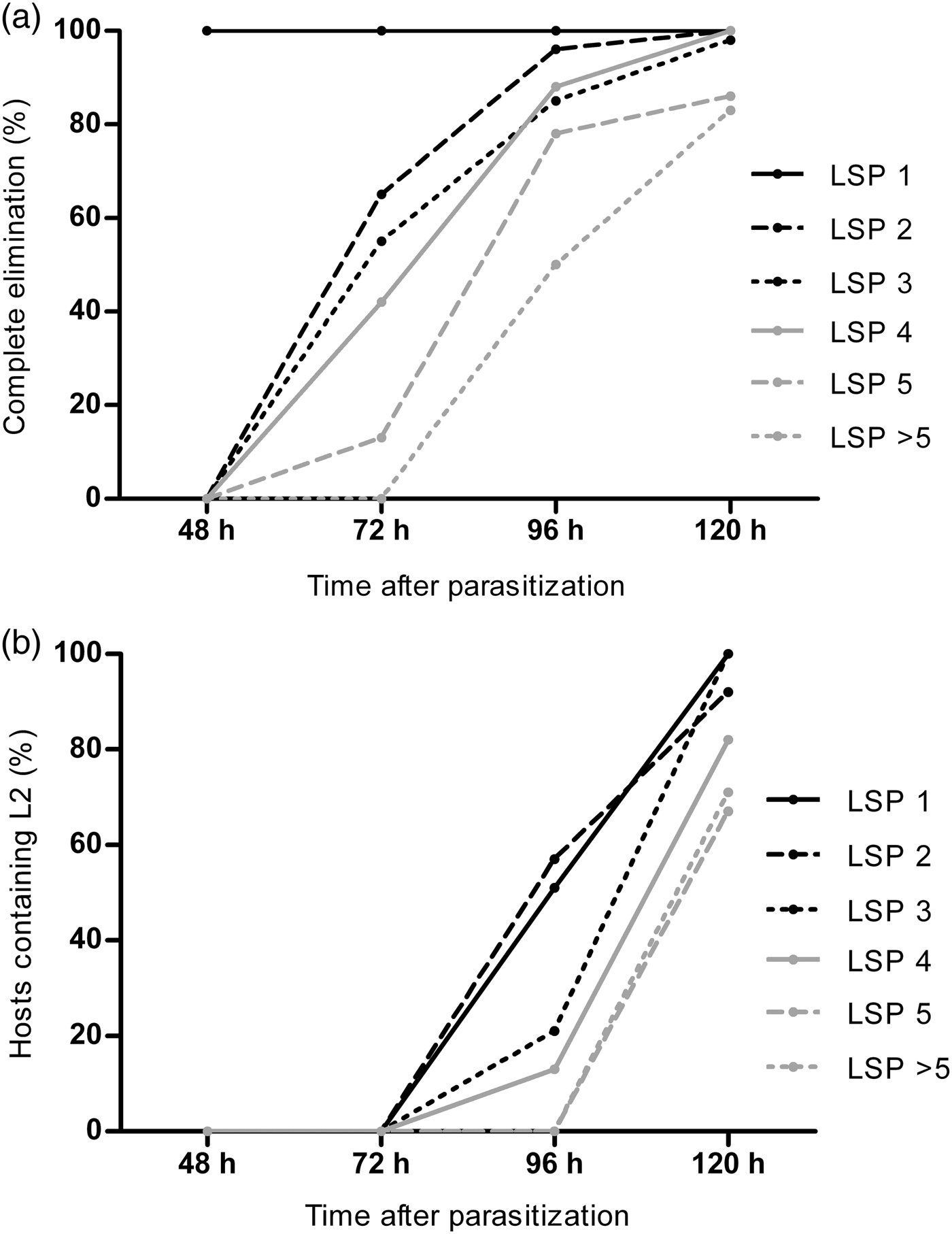
Quantification of the number of parasitoid eggs or larvae per host (LSP) through dissections of parasitized C. capitata pupae showed a LSP ranging from 0 to 10. Fig. 2 describes the percentage of dissected pupae (LSP ≥ 1), in which one of the developing larvae completed the elimination of all competitors under different LSPs and the occurrence of L2 larvae along the first 120 h after parasitization. A general progressive trend in the complete elimination was observed in every treatment and a delay in this process (curves shifted to the right) was observed with increasing LSP (fig. 2a). As elimination and time proceeded, L2 started to be found, showing a similar pattern of progression as well as a delay at increasing LSPs (fig. 2b). At 48 h, only LSP 1 (the control case) contained one single developing parasitoid (fig. 2a) and no L2 was observed in any LSP (fig 2b). At 72 h, complete elimination occurred more frequently in lower LSPs and still no L2 was observed. At 96 h, the percentage of hosts with a single winner rose but with a certain delay with increasing LSP and L2 started to be detected only in LSPs 1 (n = 21), 2 (n = 20), 3 (n = 5). An exceptional case with two alive L2 was found in LSP 2. At 120 h, elimination of supernumerary larvae was completed in the lowest LSPs (LSPs 2, 3) and in around 80% of the hosts with LSP 5 and >5. At this point, all winner larvae were in L2 stage in those LSPs in which elimination finished [n = 37 for LSP 1 (control); n = 41 for LSP 2; n = 32 for LSP 3; n = 3 for LSP 5; n = 5 for LSP >5]. Also, a second case with two alive L2 (and one dead L1) (LSP 3) was found. For the higher LSPs only some hosts showed L2 larvae. Both at 96 and 120 h the L2 larva was the only one alive, together with a varying number (according to the LSP) of dead L1 larvae.
(a) Dynamics of supernumerary larvae elimination until only one parasitoid larva remained alive. (b) Dynamics of the development of immature stages from egg to L2 of Diachasmimorpha longicaudata between 48 and 120 h after parasitization in hosts containing different initial number of competitors (LSPs 1–5 and >5).

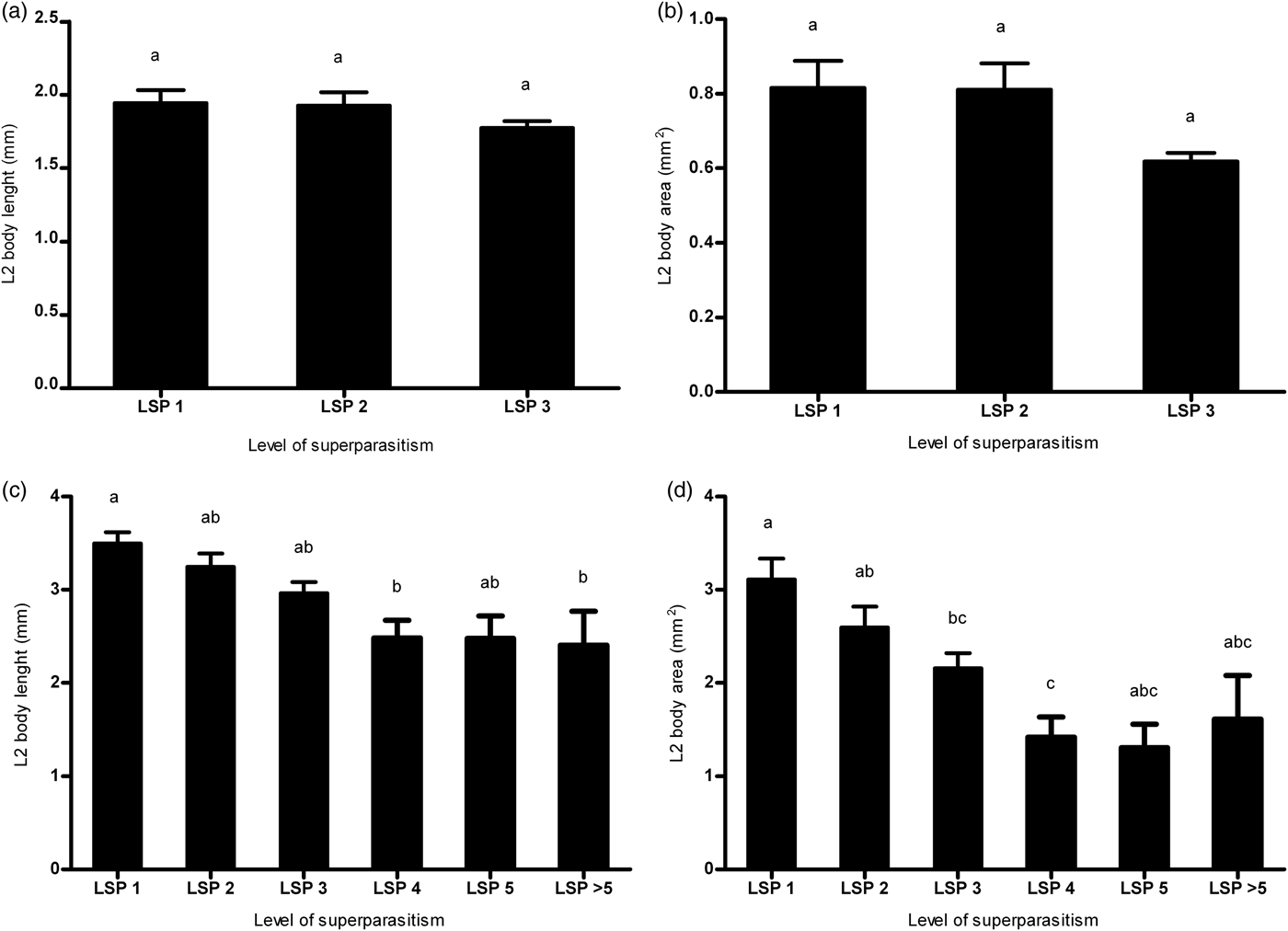
The body size estimation of L2 larvae did not differ among LSPs 1, 2 and 3, when measured 96 h after parasitization (fig. 3a, b) [body length: H (2) = 0.485, P = 0.785, n = 46; body area: H (2) = 0.691, P = 0.708, n = 46]. The low number of replicates obtained from LSP 3 (n = 5) may have accounted for the lack of significance.
Larval (L2) body length of Diachasmimorpha longicaudata (a) 96 h and (c) 120 h after parasitization, and body area of L2 (b) 96 h and (d) 120 h after parasitization, compared among LSPs. Letters above bars show statistical results (α = 0.05). The statistical analysis on (d) was made on transformed data [log(x + 1)]. Error bars represent the SE of the mean.

For hosts dissected 120 h after parasitization, mean length of L2 larvae was statistically different among LSPs [F (5, 123) = 4.82; P < 0.01]. Multiple comparisons indicated that the mean length of L2 larvae from LSP 1 was significantly greater than that of LSP 4 (P = 0.002) and LSP >5 (P = 0.042), whereas the rest of the LSPs took intermediate values (fig. 3c). The mean area of the larvae also differed among LSPs [F (5, 123) = 5.20; P < 0.01 (fig. 3d). Multiple comparisons showed significantly larger values for LSP 1 compared with LSP 3 (P = 0.046) and LSP 4 (P < 0.01), and also values from LSP 2 were larger than those from LSP 4 (P = 0.040). For both variables, LSP 5 and >5 were respectively represented by only three and five replicates. This low number of replicates (caused by the delayed moulting, fig. 2) probably accounted for the lack of significant differences.
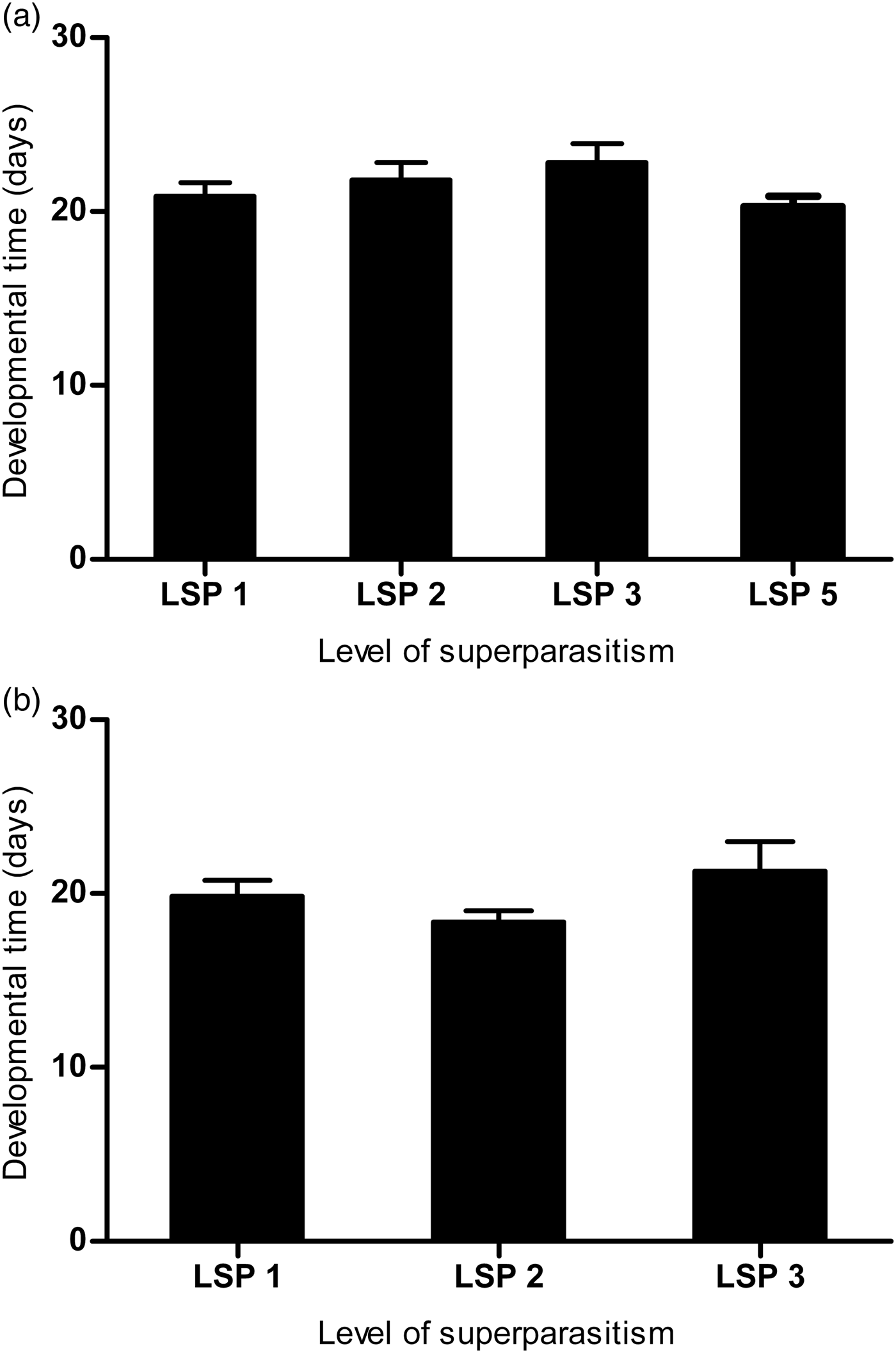
Egg–adult developmental time did not differed between LSPs, both for females [F (3, 81) = 0.932; P = 0.429] and males [F (2, 33) = 1.77; P = 0.186] (fig. 4). The emergence took 21.2 ± 0.4 days (mean ± S.E.; n = 85) for females and 19.4 ± 0.5 days (mean ± S.E.; n = 36) for males. Because only one male emerged from LSP 5, this category was excluded from this analysis (this male took 15 days to emerge).
Mean developmental time for (a) females and (b) males developed under different LSPs. Error bars represent the SE of the mean.

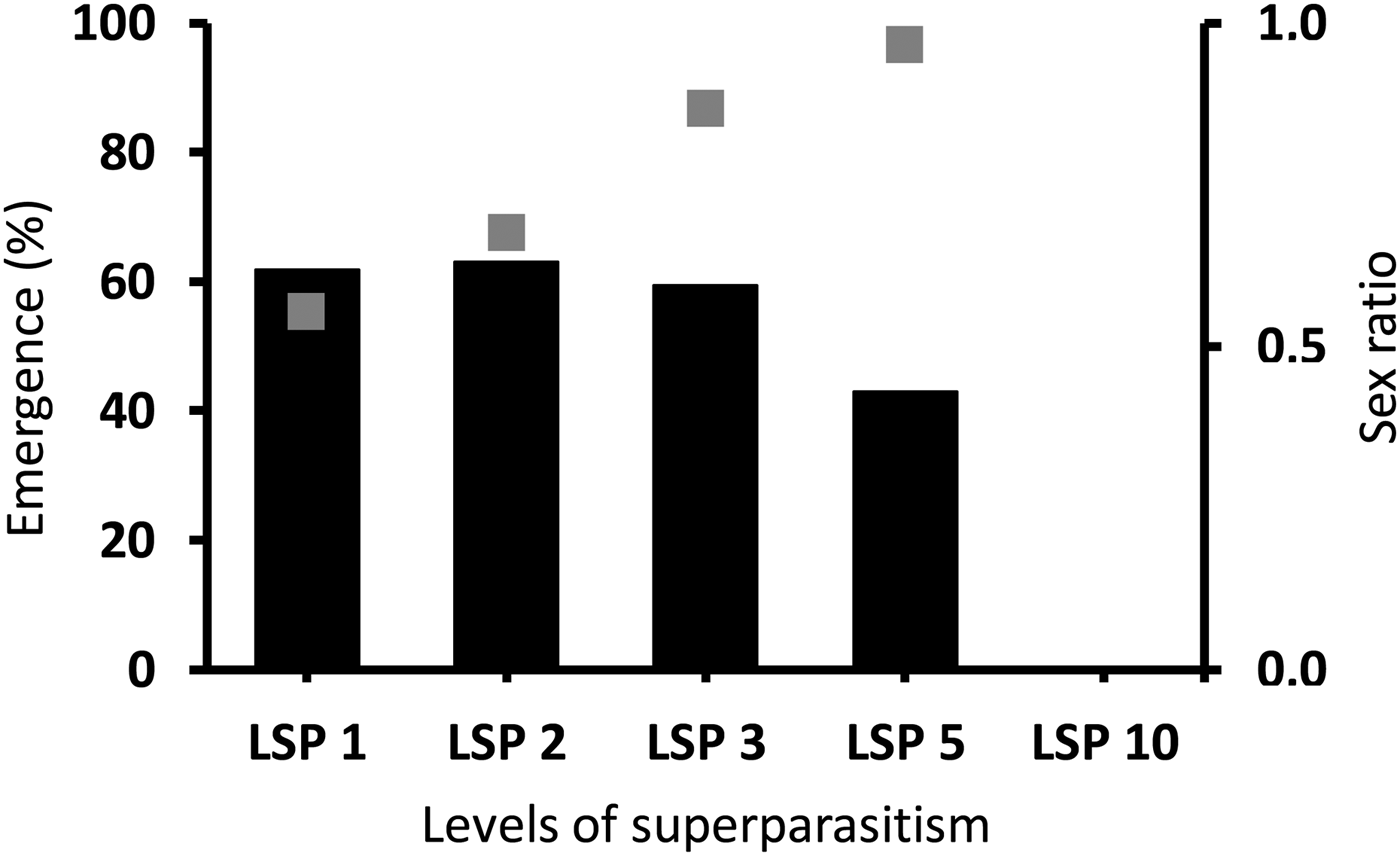
Percentage of adult emergence differed between LSPs 1, 2, 3 and 5 (χ2 = 16.02; d.f. = 3; P = 0.001; n = 668), showing similar values among LSPs 1, 2 and 3 and lower percentages for LSP 5 (fig. 5). For LSP 10 there were no emerged parasitoids (n = 29). No fly emerged from any LSP. For LSP 0 (host quality control) there was 81.7% (n = 82) of fly emergence. Sex ratio was statistically different between LSPs (χ2 = 48.41; d.f. = 3; P < 0.01; n = 385), showing a higher bias towards females at increasing LSPs (fig. 5).
Percentage of emerged parasitoids (black columns) and sex ratio (grey squares) in individually parasitized Ceratitis capitata larvae with different number of parasitoid eggs (LSP).

Experiment 3. Effects of superparasitism on adult stage
No differences on female fecundity was found among LSPs [effect of LSP: F (3, 67) = 0.77; P = 0.515; effect of the number of offered larvae (co-variable): F (1, 67) = 44.03; P < 0.01] (fig. 6a). Likewise, mean parasitism rate produced by these females did not differ among LSPs [F (3, 68) = 1.18; P = 0.324] (fig. 6b). Mean F1 sex ratio was similar among LSPs (tested by 95% confidence interval overlap), with a general bias towards female production (fig. 6c).
Effect of superparasitism on adult parameters: (a) mean fecundity, (b) mean parasitism rate and (c) mean sex ratio in the F1 for different LSPs. Error bars represent the SE of the mean.

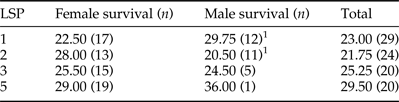
Overall, females lived 26.63 ± 1.51 days and males 25.12 ± 2.39 days (mean ± SE). A male from LSP 1 lived for 78 days and another male from LSP 2 lived for 123 days, which were censored at day 60. For LSP 5 only one 36-day-living male was obtained. Table 1 describes the data for each LSP and sex. Comparisons of survival curves between sexes within each LPS showed no significant differences (P > 0.05); therefore, data on survival of males and females were grouped within each LSP. After grouping, survival curves showed no statistical differences among LSPs (χ2 = 1.96; d.f. = 3; P = 0.580) (fig. 7). Survival of parasitoids deprived of food did not statistically differ among LSPs (χ2 = 0.83; d.f. = 3; P = 0.841) (fig. 8) as neither did the percentage of adults that successfully exited the PVC tube by flying (χ2 = 2.53; d.f. = 3; P = 0.470; n = 197) (fig. 9).
Survival of adults emerged from the different LSPs, provided with food and water. One male from LSP 1 and another from LSP 2 were censored at day 60.

Survival of adults emerged from the different LSPs, provided only with water.

Percentage of Diachasmimorpha longicaudata adults developed under different LSPs that succeeded to fly out of the PVC tube.

Survival days assessed on the emerged parasitoids developed under different LSPs. Median values and the number of replicates in brackets are presented.

1 Censored data (see text) were included as original values.
None of the estimators of adult body size showed statistical differences among females [anterior right wing length: F (3, 122) = 0.63; P = 0.597; anterior right wing width: F (3, 121) = 0.83; P = 0.482; posterior right tibia length: F (3, 121) = 1.63; P = 0.186] (fig. 10a–c) nor males [anterior right wing length: F (2, 68) = 0.71; P = 0.493; anterior right wing width: F (2, 67) = 0.81; P = 0.448; posterior right tibia length: F (2, 68) = 1.07; P = 0.348] (fig. 10d–f) from the different LSPs.
Adult body size of females (a–c) and males (d–f) developed under different LSPs, estimated by the right wing length, the right wing width and the right tibia length. Error bars represent the SE of the mean.

Discussion
Superparasitism was highly frequent in C. capitata larvae when attacked by D. longicaudata under semi-massive rearing conditions. As immatures, increasing LSPs led to a delay in moulting to L2, and the size of the resulting L2 larvae was negatively affected. This may have resulted from the process of complete supernumerary larvae elimination, which does not extend beyond the L1. Nevertheless, the total developmental time (egg to adult) was similar among LSPs, suggesting that the winner can overcome this delay even though facing a smaller size after coming out victorious. Emergence was strongly affected by superparasitism, producing no parasitoids due to the death of all competing larvae at extreme LSPs (i.e. LSP 10) and also reduced at LSP 5. On the other hand, no relevant effects of superparasitism on the adults were detected under laboratory conditions. Interestingly, sex ratio was biased towards females at increasing LSP, as previously showed by González et al. (Reference González, Montoya, Perez-Lachaud, Cancino and Liedo2007) and Montoya et al. (Reference Montoya, Cancino, Pérez-Lachaud and Liedo2011) in a different host species. This result, however, did not extend to the following generation, that showed a low but constant female-biased sex ratio along LSPs, suggesting that the effects of superparasitism are a direct result of larval competition.
Our study of superparasitism during parasitoid development revealed a relatively quick elimination of competitors (compared to the entire immature period that lasts around 18 days) up to a certain LSP. Under low and intermediate LSPs (2–5), elimination occurred between 72 and 120 h after parasitization and always before moulting to L2. The corresponding dynamics under LSP 10 was not possible to assess because all parasitoid larvae died. It is not within the scope of the present work to unravel the mechanism by which elimination is attained, but our observations seem to indicate that the presence of strong, sclerotized and opposable mandibles in L1 would be of fundamental importance for the elimination of competitors, as previously shown for other solitary endoparasitoids (Salt, Reference Salt1961; Vinson & Iwantsch, Reference Vinson and Iwantsch1980) and suggested for D. longicaudata parasitizing A. suspensa (Lawrence, Reference Lawrence1988). However, we cannot discard the possibility that physiological suppression is also involved.
The entire process of elimination was delayed with the increasing number of competitors causing also a progressive delay in the time needed for moulting to L2. The time normally used for feeding under no superparasitism (i.e. LSP 1) had to be probably used for searching and fighting with the different number of competitors, which may be considered as time and energy-consuming. In turn, this affected the size of L2 at the highest LSPs. Up to the LSP 3, the elimination of supernumerary larvae was quick, evidenced through a seemingly unaffected development towards L2 (96 h after parasitization) and no effect on larval size. On the other hand, those larvae that succeeded in developing to L2 under LSP 5 moulted later (120 h after parasitization) and resulted in a smaller body size. Interestingly, despite these detrimental effects, the same egg-adult developmental time was observed among all LSPs, suggesting that the winner quickly monopolizes the available resources overcoming the possible effects of the competition (Bai & Mackauer, Reference Bai and Mackauer1992). In other species, superparasitism was related to a longer time to complete development (Wylie, Reference Wylie1983; Eller et al., Reference Eller, Tumlinson and Lewis1990), which may represent a higher risk of predation or further parasitism in the field. A prolonged time, as observed in L1 and L2 in the highest LSPs, may also expose immature parasitoids to host defence mechanisms (e.g. encapsulation) (Gross, Reference Gross1993).
Parasitoid emergence was not threatened under LSPs 1, 2 and 3, but under LSP 5 it suffered a decrease, and adults from LSP 10 did not emerge at all. This may result from an increasing stress generated by the mechanisms of supernumerary larvae elimination, but also a reflection of the numerous injuries caused to the host by the piercings during oviposition and probing (González et al., Reference González, Montoya, Perez-Lachaud, Cancino and Liedo2007). Similar effects were observed in the mass rearing of D. longicaudata using irradiated A. suspensa as host (Montoya et al., Reference Montoya, Liedo, Benrey, Barrera, Cancino and Aluja2000; González et al., Reference González, Montoya, Perez-Lachaud, Cancino and Liedo2007), as well as in other solitary endoparasitoids (Santolamazza-Carbone & Cordero-Rivera, Reference Santolamazza-Carbone and Cordero-Rivera2003; Tunca & Kilincer, Reference Tunca and Kilincer2009). As previously suggested by other authors (van Alphen & Visser, Reference van Alphen and Visser1990; Godfray, Reference Godfray1994), if the survival probability of an egg is adversely affected by the host immune system, then the presence of more parasitoid eggs could improve the chances of avoiding encapsulation through different proposed mechanisms, such as virus injection (González et al., Reference González, Montoya, Perez-Lachaud, Cancino and Liedo2007). The results presented here suggest that this mechanism would have a limit above which superparasitism is highly risky and this limit would be somewhere between 5 and 10 eggs, at least when they are laid within a short time frame (i.e. a maximum time interval of 3 h depending on the specific LSP; see Experiment 2.3).
Superparasitism had also a noticeable effect on the sex ratio, a parameter with applied importance. The sex ratio was always biased towards females and it also increased with higher LSP, reaching almost 100% of female production under LSP 5. González et al. (Reference González, Montoya, Perez-Lachaud, Cancino and Liedo2007) and Montoya et al. (Reference Montoya, Cancino, Pérez-Lachaud and Liedo2011) found similar results in this species, as did Wang & Messing (Reference Wang and Messing2003) studying Diachasmimorpha tryoni Cameron (Hymenoptera: Braconidae) attacking C. capitata. Some authors suggest that superparasitism is the cause for this bias (Darrouzet et al., Reference Darrouzet, Bignon and Chevrier2007), but there are also evidences of the opposite (i.e. higher production of males) (Wylie, Reference Wylie1965; Santolamazza-Carbone & Cordero-Rivera, Reference Santolamazza-Carbone and Cordero-Rivera2003) or no effects at all (Rivers, Reference Rivers1996). Many hymenopteran parasitoids are able to assign the sex of the egg that is going to be laid and that decision can be influenced by factors like the density and quality of the host, previous experience or presence of con-specifics (King, Reference King, Wrensch and Ebbert1993; Santolamazza-Carbone & Cordero-Rivera, Reference Santolamazza-Carbone and Cordero-Rivera2003), among many others. Under specific circumstances and facing a superparasitized host, a female should lay an egg of the most competitive sex (King, Reference King1987; van Dijken & Waage, Reference van Dijken and Waage1987), being usually the female gender (Lebreton et al., Reference Lebreton, Chevrier and Darrouzet2010). Moreover, if females are not deciding their eggs’ sex, a differential mortality among the sexes (favouring females) may also explain these results, as suggested for Anaphes victus Huber (Hymenoptera: Mymaridae) (van Baaren et al., Reference van Baaren, Landry and Boivin1999).
Superparasitism had no effect on the fecundity of females developed under LSPs 1, 2, 3 or 5 and on the sexual proportion or parasitism rate produced by these females (in F1). Nor was survival with or without food supply, suggesting for this last situation that energetic reserves acquired during development were similar among LSPs. Different levels of superparasitism affected neither flight ability nor adult size, which agrees with González et al. (Reference González, Montoya, Perez-Lachaud, Cancino and Liedo2007) who did not find effects on fecundity, survival or flight ability in similarexperiments on irradiated A. ludens. Nevertheless, in the current work fecundity and survival were assessed simultaneously ignoring a possible interaction between these parameters.
In sum, our results suggest that the effects of superparasitism are crucial during parasitoid development, where only one or even none of the supernumerary conspecific larvae will survive. Thus, in a mass rearing facility, the number of produced parasitoids may decrease if holding conditions promote high levels of superparasitism. Even though there was a delay in the elimination of supernumerary competitors and in the time needed in moulting to L2, those parasitoids that were able to reach the adult stage did not show a significant impact on their performance. Furthermore, intermediate LSP enhanced female production, an aspect of a great importance for biological control purposes, because females directly contribute to a higher mortality of the pest (Heimpel & Lundgren, Reference Heimpel and Lundgren2000; Montoya et al., Reference Montoya, Pérez-Lachaud and Liedo2012). However, the loss of all but one egg in superparasitized host represents a waste of eggs (both from an evolutionary and an applied point of view) that could be otherwise distributed among unparasitized hosts. Some parameters studied here showed a trend towards a decrease in their values with the increase of LSP, such as adult body size (both males and females). This parameter is usually associated with flight ability and fecundity, which were not affected here, under laboratory conditions. In the field, with a more restricted access to food and hosts, a smaller body size may decrease searching efficiency and the impact of these wasps as biological control agents. Further studies under natural conditions may allow unravelling subtle effects of superparasitism and thus contribute to fully address the effect of this phenomenon.
Acknowledgments
The authors thank Fabián Milla and Germán Crippa for supplying flies and parasitoids. FD was granted with a Ph.D. scholarship from CONICET.