Introduction
The use of a cervical collar and long backboard constitutes the main component of spinal immobilization in the stabilization of the prehospital trauma patient. If necessary precautions are not taken, unstable spinal injuries lead to an increase in pre-existing neurological damage or the formation of secondary neurological damage. Reference Kwan, Bunn and Roberts1,Reference Fischer, Perina and Delbridge2 On the other hand, it has been reported that the use of a backboard and cervical collar may create negative effects such as changes in vital findings, the deterioration of respiratory functions, an increase in intracranial pressure, feelings of discomfort, and an increase in pain levels. Reference Çorbacıoğlu, Akkuş and Çevik3–Reference Mobbs, Stoodley and Fuller6 These potentially damaging effects of spinal immobilization have prompted researchers to look for new models to mitigate them. In previous studies involving healthy volunteers, it was asserted that spinal immobilization at 20° improved respiratory functions compared to spinal immobilization at 0°, and that it did not create a positive or negative difference in terms of cerebral oxygenation and intracranial pressure. Reference Özdoğan, Gökçek and Katırcı7–Reference Aksel10 However, other potential effects of this recommendation should be investigated so that spinal immobilization at 20° can be used in clinical practice. When patients with multiple traumas are evaluated from a single point of view, spinal immobilization represents only a limited part of the approach applied for these patients. The follow-up of their hemodynamics is one of the most challenging and demanding tasks in the assessment of their conditions. Reference Kuster, Exadaktylos and Schnüriger11 The adequacy of intravascular volume is of great importance in maintaining the hemodynamic balance. Reference Baker, Deitch and Li12 It can be difficult to clinically predict the current status of intravascular volume. Therefore, clinicians may need various imaging tools to clarify the clinical presentation. Although echocardiography is not a golden standard test to assess hemodynamic status, it has been used more commonly for measuring the hemodynamic parameters due to its availability and usability at every clinical condition. The validity of echocardiography in the measurements of hemodynamic parameters has been demonstrated by the results of numerous studies. Reference Blanco, Aguiar and Blaivas13–Reference Hutchings and Rees18 This study was conducted with the aim of determining whether spinal immobilization at the position of 20° instead of 0° alters the hemodynamics of healthy subjects, according to the results of transthoracic echocardiographic measurements.
Methods
Study Population
This cross-over type design, prospective study was conducted in the Department of Emergency Medicine from February 15, 2019 through May 15, 2019. Based on measurements of the pilot group, 45 participants were required to achieve 90% power to detect a significant change in inferior vena cava (IVC) diameter with an alpha level of 0.05. Fifty-three healthy male and female volunteers, ages 22 to 47 years, participated in the study. Volunteers who had any type of acute or chronic disorder were not included. Specific exclusion criteria were systolic heart failure (EF <50%), coronary and peripheral artery disease, hypertension, hyperlipidemia, congenital heart disease, valvular heart disease, chronic renal dysfunction, malignancies, obesity (body mass index [BMI] ≥30kg/m2), asthma or chronic obstructive lung disease, infections, connective tissue disorders, neurological problems, psychiatric diseases, endocrine disease, pregnancy, the use of any tobacco and nicotine-containing products, alcohol and drug abuse, and the use of medications for hormonal treatment. Patients whose fasting blood glucose levels were measured as 126mg/dl or higher or who used oral anti-diabetic medication and insulin were considered to be diabetic, while patients whose systolic arterial pressure (SAP) was measured as 140mmHg or higher, diastolic arterial pressure (DAP) as 90mmHg or higher, or who used antihypertensive drugs were considered hypertensive. Patients with total cholesterol of 200mg/dL or higher or who were receiving hyperlipidemia treatment were diagnosed as having hyperlipidemia. The BMI was calculated by dividing the body weight by the square of the body height (kg/m2). All subjects who were examined agreed to participate in the study and written informed consent was obtained from each participant. This study was carried out in accordance with the Declaration of Helsinki and it was approved by the Bozok University Faculty of Medicine (Yozgat-Turkey) Ethics Committee for Clinical Research (Approval no: 2017-KAEK-189_2019.02.28_03).
Study Protocol
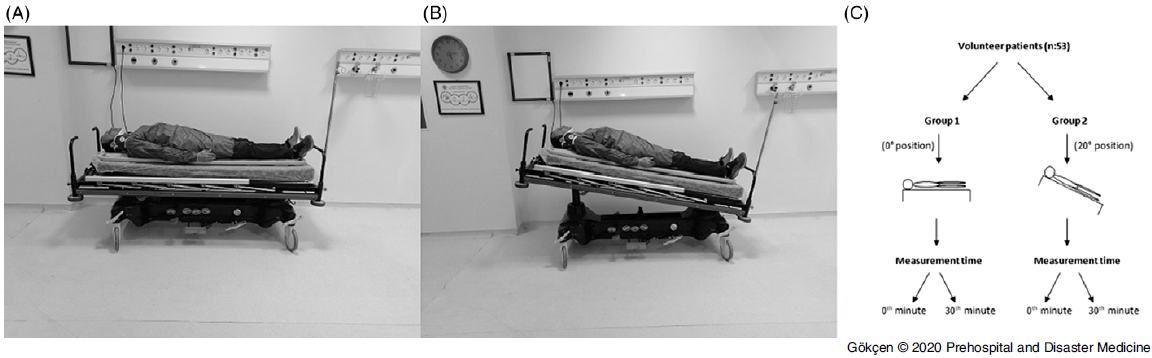
All participants were screened through transthoracic echocardiography before the study. The patients who were found to suffer from valvular, myocardial, or pericardial pathologies in the echocardiographic screening were excluded. All volunteers were instructed to sleep for at least eight hours the day before; to not consume caffeinated beverages or stimulants in the 12 hours leading up to participation; and to stop the intake of orally consumed solid and liquid food in the last two hours before the test in the morning. The patients who underwent spinal immobilization with a cervical collar and backboard were kept in the 0° position for 30 minutes (Figure 1-A). Their vital parameters and ultrasonographic measurements were recorded at the 0th and 30th minutes, and these cases formed Group 1. Following 20 minutes of resting, spinal immobilization was performed on the subjects at the 20° position with the use of a cervical collar and backboard for 30 minutes, and these cases formed Group 2. A 20° elevation is defined as the position that the body is laid supine on a 20-degree incline with the head elevated above the feet (Figure 1-B). The same measurements were made at the 0th and 30th minutes in this position. Individual differences that could be observed between the two groups were eliminated by creating both groups with the same people (Figure 1-C). The measurements were performed in a spacious room with a stable temperature of 22°C that had an outside view to minimize environmental stress.
Spinal Immobilization at (A) 0° Line Position; (B) 20° Position; and (C) Flowchart.

Ultrasonographic Measurements
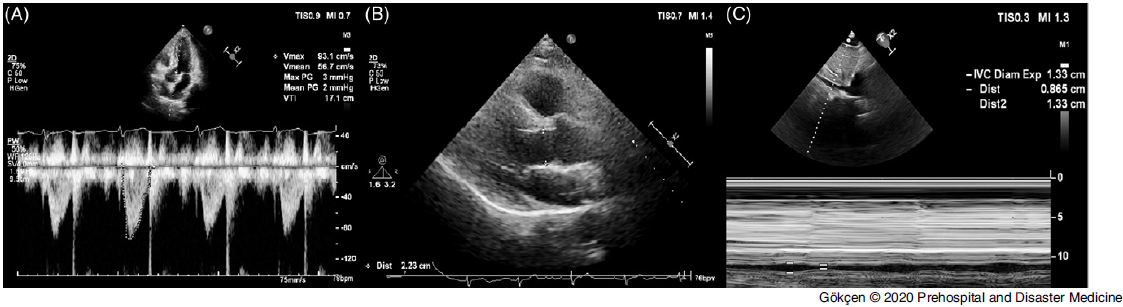
Transthoracic echocardiographic examinations were performed with a Philips Affiniti 50 echocardiography device (Philips Healthcare; the Netherlands) according to the recommendations of the American Society of Echocardiography (Durham, North Carolina USA). B-mode, M-mode, pulse, and continuous-wave Doppler measurements were recorded in the left lateral decubitus position by using images of the parasternal long axis, apical four cavities, and apical five cavities. The IVC measurements of the transthoracic echocardiographic device with a linear 5MHz to 12MHz transducer probe were obtained through imaging from the subxiphoid window in the supine position. Following the longitudinal detection of IVC, its exit from the heart and proximity to the hepatic vein were displayed. A caudal precursor with an approximate size of 1.0cm was placed from the IVC and hepatic vein junction at this stage, and an M-mode image was obtained. After the IVC was monitored for a certain number of respiratory cycles, the image was immobilized and measurements were taken from the spots where the IVC was the narrowest and the widest. The IVC diameter expiratory (exp) and IVC diameter inspiratory (insp) values were measured (Figure 2). Therefore, the IVC minimum diameter (Vmin) in the inspiratory and the IVC maximum diameter (Vmax) in the expiratory between the respiratory cycles were obtained in the M-mode. For each patient, the IVC collapsibility index (IVC-CI) was calculated with the formula (IVC-CI) = (Vmax–Vmin)/Vmax. The probe was placed transthoracically across from the left ventricular outflow tract (LVOT) in the apical five cavity images. The velocity time integral (VTI) was measured by Doppler with the current signal (cm/s). The LVOT diameter data were recorded by finding the average of three measurements taken manually at the entry point of aortic valves in the middle systole. The cross-sectional area of the aorta was measured in the same location from the parasternal long-axis window with 2D echocardiographic imaging (Figure 2). The left ventricular stroke volume (LVSV) was calculated by multiplying the VTI of the LVOT and the LVOT area through echocardiography. The Doppler cardiac output (CO) was identified by multiplying the heart rate (HR) by the LVSV (L/min). The mean arterial pressure (MAP) was indicated by dividing the total SAP and the two diastolic DAP values by three (mmHg). Three consecutive measurements were taken for each parameter, and the average of the three was recorded.
Left Ventricular Outflow Tract (A) Velocity Time Integral (LVOT- VTI); (B) Diameter (LVOT); and (C) Vena Cava Inferior Diameter.

Statistical Analyses
Statistical analyses were carried out by using the statistical software program SPSS (IBM SPSS Statistics 22; IBM Corp.; Armonk, New York USA). The compatibility of variables with normal distribution was analyzed through visual (histogram and probability graphics) and analytical methods (Kolmogorov-Smirnov). Descriptive analyses were conducted with median and interquartile intervals for the variables that were not distributed normally. The changes in hemodynamic variables with spinal immobilization were analyzed with a paired t-test for the parameters with normal distribution and with the Wilcoxon test for the parameters with non-normal distribution. Delta values (∆) of the IVC diameter (exp), IVC diameter (insp), LVOT-VTI, LVSV, CO, IVC-CI, MAP, SAP, DAP, and HR over time for spinal immobilization at the 0° and 20° positions were evaluated by use of the Wilcoxon test. Conditions in which the P value was below .05 were defined as statistically significant.
Results
This study was performed on 53 volunteers, consisting of 33 male and 20 female subjects with an average age of 35.2 (SD = 5.84) years. The average weight of the subjects was 75.1 (SD = 10.25) kg and the average height was 1.73 (SD = 0.078) m. The average BMI of all subjects was calculated as 24.95 (SD = 2.5) kg/m2.
Parameters Varying in Time
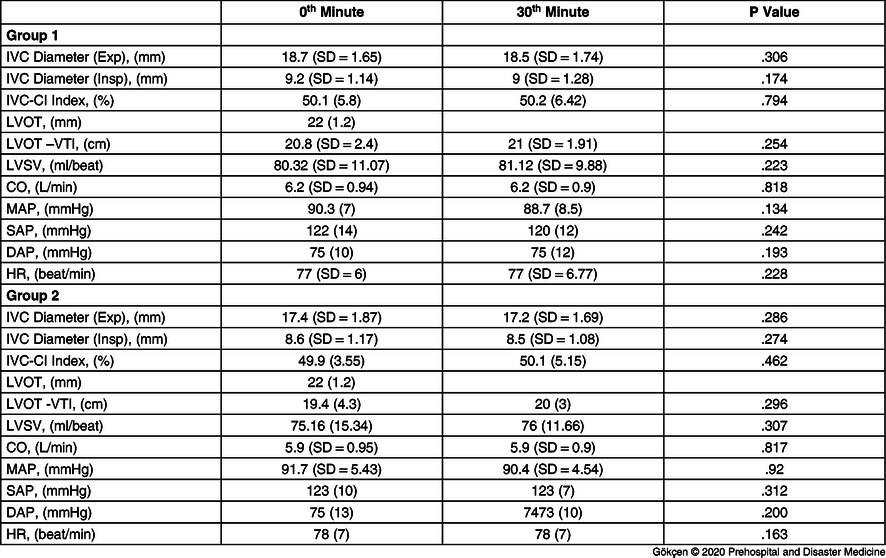
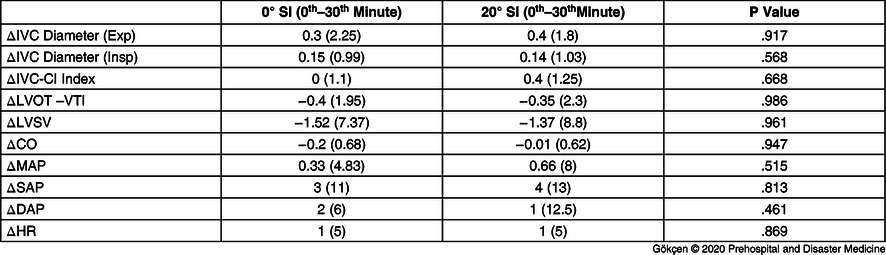
Measurements taken initially (at the 0th minute) and at the 30th minute in Group 1 were compared. Similarly, measurements taken initially (at the 0th minute) and at the 30th minute in Group 2 were compared. No statistically significant results were found in either group in terms of the parameters of the IVC diameter (exp), IVC diameter (insp), LVOT-VTI, LVSV, CO, IVC-CI, MAP, SAP, DAP, or HR (Table 1). Also, the differences between the baseline and subsequent measurements were compared for each parameter (∆ value). There were no statistically significant differences between Group 1 and Group 2 in terms of the values of the ∆IVC diameter (exp), ∆IVC diameter (insp), ∆LVOT-VTI, ∆LVSV, ∆CO, ∆IVC-CI, ∆MAP, ∆SAP, ∆DAP, or ∆HR (Table 2).
Comparison of Measurements Taken at the Initially (0th Minute) and in the 30th Minute in Group 1 and Group 2

Note: Data were expressed as mean (SD) and median (interquartile range).
Abbreviations: IVC-CI, inferior vena cava collapsibility index; IVC, inferior vena cava; IVC diameter (exp), IVC diameter expiratory; IVC diameter (insp), IVC diameter inspiratory; LVOT, left ventricular outflow tract; LVOT-VTI, left ventricular outflow tract velocity-time integral; CO, cardiac output; LVSV, left ventricular stroke volume; MAP, mean arterial pressure; SAP, systolic arterial pressure; DAP, diastolic arterial pressure; HR, heart rate.
The Comparison Over time in Delta Values of Hemodynamic Parameters in Spinal Immobilization at 0° and 20°

Note: Data were expressed as mean (SD) and median (interquartile range).
Abbreviations: SI, spinal immobilization; IVC-CI, inferior vena cava collapsibility index; IVC, inferior vena cava; IVC diameter (exp), IVC diameter expiratory; IVC diameter (insp), IVC diameter inspiratory; LVOT, left ventricular outflow tract; LVOT-VTI, left ventricular outflow tract velocity-time integral; CO, cardiac output; LVSV, left ventricular stroke volume; MAP, mean arterial pressure; SAP, systolic arterial pressure; DAP, diastolic arterial pressure; HR, heart rate.
Parameters Varying After a Positional Change
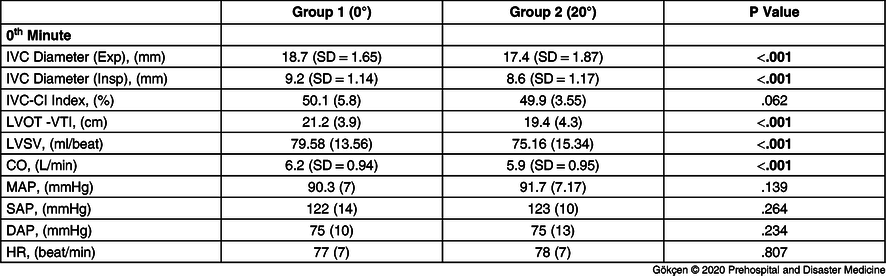
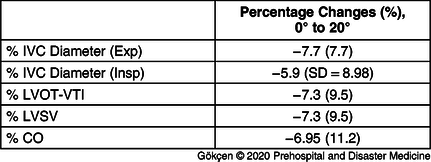
Measurements taken initially (at the 0th minute) in Group 1 were compared with initial measurements in Group 2. In the transition from the 0° position to the 20° position, a statistically significant difference was found in the parameters of the IVC diameter (exp), IVC diameter (insp), LVOT-VTI, LVSV, and CO, which were listed among the values measured at the 0th minute. However, no statistically significant difference was found in the IVC-CI, MAP, SAP, DAP, or HR parameters (Table 3). In the transition process from the 0° position to the 20° position, the IVC diameter (exp) showed a decrease of 7.7% (3.5 to 11.2); the IVC diameter (insp) showed a decrease of 5.9% (SD = 8.98); the LVOT-VTI showed a decrease of 7.3% (0.9 to 10.4); the LVSV showed a decrease of 7.3% (0.9 to 10.4); and the CO showed a decrease of 6.95% (-2.22 to 9.01); theses were also among the parameters that showed statistically significant differences (Table 4).
Comparison of Measurements Taken at the Initially (0th Minute) in Group 1 and Group 2

Note: Data were expressed as mean (SD) and median (interquartile range).
Abbreviations: IVC-CI, inferior vena cava collapsibility index; IVC, inferior vena cava; IVC diameter (exp), IVC diameter expiratory; IVC diameter (insp), IVC diameter inspiratory; LVOT, left ventricular outflow tract; LVOT-VTI, left ventricular outflow tract velocity-time integral; CO, cardiac output; LVSV, left ventricular stroke volume; MAP, mean arterial pressure; SAP, systolic arterial pressure; DAP, diastolic arterial pressure; HR, heart rate.
Percentages Changes of Measurements Taken from Initially (0th Minute) in the Transition from 0° Position to 20° Position

Note: Data were expressed as mean (SD) and median (interquartile range).
Abbreviations: IVC, inferior vena cava; IVC diameter (exp), IVC diameter expiratory; IVC diameter (insp), IVC diameter inspiratory; LVOT-VTI, left ventricular outflow tract velocity-time integral; CO, cardiac output; LVSV, left ventricular stroke volume.
Discussion
This study has two important main results. The first result is related to the hemodynamic changes caused by an angular difference of 20° as compared to 0°. The IVC diameter (exp), IVC diameter (insp), LVOT-VTI, LVSV, and CO parameters measured at the initial stage (0th minute) showed a decrease in the 20° position compared to the 0° position, while no significant change was detected in the SAP, DAP, MAP, or HR. The second main finding may be the answer to an important question: “Does the follow-up at 20° spinal immobilization cause hemodynamic problems compared to the spinal immobilization at 0°?” In this study, ∆ values of hemodynamic parameters (∆IVC diameter [exp], ∆IVC diameter [insp], ∆LVOT-VTI, ∆LVSV, ∆CO, ∆IVC-CI, ∆MAP, ∆SAP, ∆DAP, and ∆HR) were similar during the spinal immobilization at 0° and 20°. In the hemodynamic follow-up of trauma patients, arterial blood pressure and HR are the first findings to be evaluated among the vital parameters. Reference Wilson, Davis and Coimbra19,Reference Pottecher, Ageron and Fauché20 The effects of spinal immobilization on blood pressure and HR are not yet completely clarified. The authors of two studies conducted on healthy volunteers concerning this topic have reported different results. In the study of Çorbacıoğlu, et al, Reference Çorbacıoğlu, Akkuş and Çevik3 it was posited that immobilization significantly reduces SAP values, whereas Bruijns, et al Reference Bruijns, Guly and Wallis21 showed that immobilization does not have an effect on blood pressure and HR. In this study, no significant change was observed in the values of SAP, DAP, MAP, or HR in terms of an increase or decrease following immobilization in the specified time period or after positional changes. These results may indicate that the SAP and HR follow-up of patients who are hemodynamically stable and spinally immobilized at 20° will provide similar benefits compared to the follow-up performed at 0°. It has been shown in previous studies that the IVC diameter and the IVC-CI can be useful tools in the evaluation of acute blood loss and volume status. Reference Yanagawa, Nishi, Sakamoto and Okada22–Reference Dipti, Soucy, Surana and Chandra25 There have been a limited number of studies showing how IVC diameters change with the positional changes of the body. In the study of Mookadam, et al, which included healthy volunteers, the researchers found lower IVC measurements in the left lateral decubitus position compared to the supine position. They argued that this result may be due to the increased intra-abdominal pressure in the left lateral position and the compression effect of the liver on the vena cava. Reference Mookadam, Warsame and Yang26 In another study, it was reported that the calculated IVC-CI values may not have completely reflected reality, as the IVC dimensions in the left lateral position were under-sized. Reference Nakao, Come, McKay and Ransil27 Due to the drawbacks of the left lateral decubitus position, the IVC measurements were made only in the supine position. Therefore, the intra-abdominal compressive forces that could affect the vena cava were eliminated. It can be said that the measurements became more standardized in this way. In a study in which researchers investigated how vena cava diameters changed in the supine and upright positions, vena cava measurements of dialysis patients were made in both positions before and after dialysis. The results indicated that IVC measurements did not show any difference in these positions. Reference Panebianco, Shofer and Cheng28 In another study, it was found that central venous pressure decreased during the 20-minute head-up tilt test. Reference Van Lieshout, Harms and Pott29 In the work of Cunningham, et al, a decrease in venous return was reported while switching to the head-up position from the horizontal position. They noted that the above-mentioned result could be observed with a decrease in the left ventricular end-diastolic area. Reference Cunningham, Turner, Rosenbaum and Rafferty30 In this study, a statistically significant decrease was found in the IVC diameter (exp) and the IVC diameter (insp) after the positional change. This result may be explained by the correlation between the decrease in central venous pressure and the decrease in the vena cava diameter, as shown in previous studies. Reference Wiwatworapan, Ratanajaratroj and Sookananchai31–Reference Arthur, Landolfo, Wade and Castresana33 These findings may be a reflection of the early hemodynamic compensation response. On the other hand, when the ∆IVC diameter (exp), ∆IVC diameter (insp), and ∆IVC-CI values measured between the 0th and 30th minutes were examined, no difference was found between the two groups. For this reason, the fact that IVC measurements are not affected by the time period in the 20° position may be an indicator that IVC measurements are trustworthy tools in the clinical follow-up of volume status at the 20° position in hemodynamically stable patients. The LVSV plays a key role in the evaluation of hemodynamics; it can be calculated by multiplying LVOT-VTI by the LVOT area. Changes taking place in LVSV due to this equation will be reflected in LVOT-VTI. Reference Hutchings and Rees18 In the upright position, a decrease in preload is observed due to the accumulation of venous blood in the lower extremities and abdominal organs. Reference Zaidi, Benitez and Gaydecki34 This may result in a decrease in stroke volume. In previous studies conducted by the use of tilt test, LVSV and CO were found to be lower in the upright position than in the supine position at various angles. Reference Van Lieshout, Harms and Pott29,Reference Jans, Tollund and Bundgaard-Nielsen35,Reference Harms, van Lieshout and Jenstrup36 Ensuring optimal preload and CO in hemorrhagic trauma patients is of great importance in their management. Reference Chang, Blinman and Rutherford37 An increase in sympathetic activity is observed as a compensation mechanism due to the decreasing preload in hemorrhage-related volume deficiencies in traumas. As a result, this condition leads to an increase in HR and contraction strength, and changes are also seen in pulse pressures due to systemic vasoconstriction. Reference Chang, Blinman and Rutherford37,Reference Grubb and Kimmel38 Cardiac output is equal to LVSV multiplied by HR. Even if LVSV is reduced, the body will try to prevent the increase in the HR and the decrease in the CO to preserve hemodynamics. In this case, it can be said that the decrease in LVSV would be higher compared to CO. Reference Blanco, Aguiar and Blaivas13 Accordingly, LVSV and LVOT-VTI can be said to be more reliable indicators for ventricular preload compared to CO. In one study, an approximate decrease of 16% was found in LVSV and an approximate increase of two percent was detected in HR in the 20° upright position compared to the supine position. Reference Critchley, Conway and Anderson39 The authors cited an average decrease of 7.7% in LVSV and LVOT-VTI, and a decrease of 6.95% was detected in CO in the 20° position compared to the 0° position. Although there was no statistically significant difference in the HR, it is highly possible that the lower decrease in CO compared to LVSV and LVOT-VTI may be due to the increases in HR within physiological limits. Additionally, it can be said that the trauma patients followed in the 20° position may be more susceptible to blood loss due to the lack of preload compared to those followed in the 0° position. However, more evidence is needed to evaluate the clinical reflection of this change caused by the positional difference. On the other hand, there was no difference between Groups 1 and 2 in terms of ∆LVOT-VTI, ∆LVSV, and ∆CO values. These findings may demonstrate that spinal immobilization performed at 20° would not result in significant hemodynamic changes over time compared to immobilization performed at 0°.
Limitation
There were certain limitations in this study. Primarily, it was conducted on healthy and young individuals. The results cannot be generalized to elderly subjects, patients with chronic diseases, or multi-trauma patients with intravascular volume deficiency.
Conclusion
Hemodynamic differences of spinal immobilization at 20° compared to 0° were examined under two headings, namely “effects after positional change” and “effects after a 30-minute time period.” The effects that occurred with positional change were observed to be a decrease in the IVC diameters (exp), IVC diameters (insp), SV, CO, and LVOT-VTI values. However, there was no significant change in the vital parameters such as blood pressure and HR. In addition, the ∆ values of hemodynamic parameters (∆IVC diameter [exp], ∆IVC diameter [insp], ∆LVOT-VTI, ∆LVSV, ∆CO, ∆IVC-CI, ∆MAP, ∆SAP, ∆DAP, and ∆HR) measured between the 0th and 30th minutes were similar in both groups. Although there is no definitive judgment on this issue, these findings may indicate that spinal immobilization performed at 20° compared to 0° does not deteriorate hemodynamic parameters on the management of hemodynamically stable subjects. However, the hemodynamic effects of spinal immobilization at 20° on the patients with intravascular volume deficiency should be clarified by future studies.
Conflicts of interest/funding
The authors report no conflicts of interest. This research did not receive any specific grant from funding agencies in the public, commercial, or not-for-profit sectors.