INTRODUCTION
When parasites infect their hosts it often leads to a reduction in host reproduction. Host castration, here defined as the temporary or permanent cessation in reproduction, is the most extensive form of reduction in host reproduction and has received a great deal of attention with respect to its adaptive value. It has been suggested to be a parasite adaptation since the resources diverted from host reproduction could be utilized to increase host survival and/or parasite growth and reproduction (Obrebski, Reference Obrebski1975; Dawkins, Reference Dawkins1982; Ebert and Herre, Reference Ebert and Herre1996; Jaenike, Reference Jaenike1996; Hurd, Reference Hurd2001; O'Keefe and Antonovics, Reference O'Keefe and Antonovics2002; Hall et al. Reference Hall, Becker and Cáceres2007; Lafferty and Kuris, Reference Lafferty and Kuris2009). However, it has also been suggested to be a host adaptation since the diverted resources could also be used to increase host survival and/or resistance to the parasite, resulting in increased lifetime reproduction (Hurd, Reference Hurd2001; Sorensen and Minchella, Reference Sorensen and Minchella2001; Day and Burns, Reference Day and Burns2003; Lafferty and Kuris, Reference Lafferty and Kuris2009). Host castration could also be mutually adaptive to both the parasite and the host, or a non-adaptive side effect of parasitism (Hurd, Reference Hurd2001). However, any temporary reduction in reproduction, even if initially a side effect of parasitism, would be selected for if it resulted in increased fitness for the parasite and/or the host.
For castration to be a host adaptation the host has to be able to regain reproduction (Hurd, Reference Hurd2001; Sorensen and Minchella, Reference Sorensen and Minchella2001; Day and Burns, Reference Day and Burns2003). However, to our knowledge only a few studies on trematode-snail systems have demonstrated that castrated hosts can regain reproduction (Coelho, Reference Coelho1954; Etges and Gresso, Reference Etges and Gresso1965; reviewed by Esch and Fernandez, Reference Esch and Fernandez1994). In addition, none of these studies has tested the adaptive value of castration to both the host and the parasite. Therefore, it is important to the understanding of host castration to test its adaptive value in a system where the host can regain reproduction.
The Pasteuria ramosa-Daphnia magna parasite-host system has been used extensively to study host castration. Castration is considered to be permanent in this system (Ebert, Reference Ebert2005) and has been explained as a parasite adaptation since the parasite seems to benefit from the castration (e.g. Ebert et al. Reference Ebert, Carius, Little and Decaestecker2004; Jensen et al. Reference Jensen, Little, Skorping and Ebert2006; Vale et al. Reference Vale, Stjernman and Little2008). However, infection with P. ramosa does not destroy the reproductive system of the host, since treatment with antibiotics has been shown to result in the regain of reproduction among Daphnia (Little and Ebert, Reference Little and Ebert2000). P. ramosa has been shown to greatly reduce host fecundity both in the laboratory (e.g. Ebert et al. Reference Ebert, Carius, Little and Decaestecker2004; Vale et al. Reference Vale, Stjernman and Little2008) and in nature (Decaestecker et al. Reference Decaestecker, Declerck, De Meester and Ebert2005). However, another field study found a non-significant reduction in percentage of infected females carrying eggs when compared to uninfected females (Stirnadel and Ebert, Reference Stirnadel and Ebert1997). These findings suggest that permanent castration is not the only possible result of the parasite-host interaction in nature.
This study is based upon further analysis of an experiment (unpublished observations) used to test one of the prerequisites of the temporal storage hypothesis (Ebert et al. Reference Ebert, Carius, Little and Decaestecker2004). In the experiment, D. magna exposed to P. ramosa were maintained in lake water containing 5% filtered straw extract. Approximately half of the infected females regained reproduction. This regain of reproduction makes it possible that the castration is a host adaptation and not necessarily a parasite adaptation. It also resulted in 2 distinct levels of castration (permanent or temporary), which makes the experiment suitable for studying the adaptive value of host castration. We analysed the data from this experiment with respect to timing and duration of host castration, host ability to regain reproduction, and parasite and host fitness proxies. This allowed us to test whether the castration of parasitized hosts is adaptive for the parasite, the host or both, or whether it is a non-adaptive side effect of parasitism.
Based on the various adaptive explanations for host castration we can make several predictions which are testable in the P. ramosa-D. magna system. (1) If host castration is adaptive to the parasite, we expect parasite spore production to be higher in permanently than in temporarily castrated hosts. (2) If castration is adaptive to the host, fitness must be maximized through saving resources for later reproduction. Host lifetime reproduction should therefore be maximized for a given duration, or age at initiation, of a temporary castration period. (3) For parasite-induced castration of the host to be mutually adaptive both predictions above have to hold true. (4) If neither of the predictions above hold true then castration of parasitized hosts is a non-adaptive side effect of parasitism.
MATERIALS AND METHODS
The host-parasite system
Daphnia magna Straus (Cladocera: Crustacea) is commonly found in eutrophic lakes and ponds. Females can produce offspring both through sexual and asexual reproduction. Both female and male offspring are typically produced asexually. However, males are primarily produced in response to seasonal changes in environmental conditions. Sexual reproduction leads to the production of resting eggs (ephippia), which hatch into females when the period of reduced habitat quality is over. In the laboratory asexual reproduction can be assured by maintaining females individually. Under standard laboratory conditions (e.g. Jensen et al. Reference Jensen, Little, Skorping and Ebert2006) they reproduce every 3–4 days. The D. magna used in this experiment were of the clone Fi-X which produces a substantial number of males in the laboratory. It was originally isolated from an area of rock pools at Tvärminne, Southern Finland.
Pasteuria ramosa Metchnikoff 1888 (Bacteria) is a common parasite of D. magna in many natural populations (Ebert, Reference Ebert2005). It is found within the body cavity of the host and is an obligate parasite of Daphnia. It castrates and induces gigantism in female hosts (e.g. Ebert et al. Reference Ebert, Carius, Little and Decaestecker2004; Jensen et al. Reference Jensen, Little, Skorping and Ebert2006) without destroying the reproductive system (Little and Ebert, Reference Little and Ebert2000). The initial infection of the host leads to a rapid multiplication of parasite spores which often will completely fill the host's body cavity. At this stage infected animals can be easily distinguished from their uninfected counterparts. The multiplication occurs through vegetative growth of the original infecting spores. During the process the parasite goes through 6 distinctive stages in which only the final stage, the spore, is infective. The parasite eventually kills the host and spores have been found to be transmitted to new hosts horizontally, but not vertically (Ebert et al. Reference Ebert, Rainey, Embley and Scholz1996). The P. ramosa used in this experiment was originally found in a pond in Garzerfeld, Northern Germany.
The experimental procedure
All D. magna used in the production of animals for this experiment and all the animals used in this experiment were maintained in a special growth medium (‘straw water’). The main component of the medium (95%) was water collected from Lake Myravatn, in Bergen, Norway. It was first filtered through a rough filter (20 μm) and subsequently through a fine filter (0 45 μm). The water was also oxygenated before use. The remaining 5% of the medium was made up of ‘straw extract’. The ‘straw extract’ was made by immersing 1 g hay (Sluis Comfort Hay) in 500 ml of the lake water mentioned above. After approximately 12 h (over night) the ‘straw extract’ was filtered through a 60 μm filter and added to the filtered lake water to complete the medium. The nutrient content of ‘straw extract’ was analysed by Eurofins Norwegian Environmental Analysis AS. The addition of straw led to an increase, measured in mg per litre, from 0 0079 to 4 1 total phosphorous, from 2 8 to 160 total organic carbon, from 6 5 to 12 5 sulphate, from 1 5 to 26 potassium, and from 1 2 to 3 5 magnesium. For the other water quality measures performed (Alkalinity, Ca, Cl, Cu, Fe, Na, and Tot. N), there were only minor changes.
Fifty-six female D. magna of the Fi-X clone were maintained to produce the offspring used in this experiment. These animals were maintained in groups of 8 in 300 ml jars, and were daily transferred to new growth medium and given excess of food. From the third batch of these females 450 offspring were used in the experiment and 50 controls were maintained to determine whether the original population was infected with P. ramosa. In total, 400 animals were exposed to a suspension of P. ramosa with a concentration of 5000 spores/ml for 5 days (1–6 days old). The spore suspension was made by grinding up infected D. magna of the Fi-X clone and diluting the suspension with the growth medium until the required concentration was reached. During the exposure to P. ramosa the D. magna were maintained individually in 20 ml of growth medium and fed with 2 million algae cells (Scenedesmus sp. from chemostat cultures).
Throughout the experiment the hosts were maintained in a climate chamber at 19°C with a light:dark cycle of 16:8 h. From day 7 the animals were fed 4 million cells of Scenedesmus sp. every day. From this day the animals were also maintained individually in 60 ml of growth medium and were transferred with a pipette to a glass with new medium every 5 days. The glasses with the new medium were acclimatized in the climate chamber for approximately 12 h before transfer.
From the animals that were 2 days old we checked if any D. magna had died and/or produced offspring. Any dead animals were removed, sexed, and placed in Eppendorf tubes containing 0 2 ml of water and frozen. From the animals that were 9 days old any dead animals were ground up and studied under the microscope to determine infection status before the mixture was frozen for future analysis. Any offspring born during the experiment were removed from the glasses and the numbers of live offspring were counted. The experiment was terminated when the last infected animal died at 63 days old. Frozen samples of the infected animals were later analysed to determine spore loads. Three samples of 2 2 μl from each Eppendorf tube were examined under the microscope using a Weber counting chamber with Thoma ruling and the spore load for each animal was estimated.
Data analysis
Controls were only maintained to determine their infection status and were excluded from all further analysis. All males (n=159) and animals in which we could not determine infection status (n=69) were excluded from further analysis. The remaining females (n=172) were used to determine the prevalence of the parasite. Infected females were categorized as not being castrated, permanently castrated or regaining reproduction (as defined by being castrated for at least 10 days before regaining reproduction). Both infected females containing immature (n=17) and mature parasite stages (spores) (n=105) were used to determine the percentage of infected females that regained reproduction.
In the analyses of spore production and host life-time reproduction all females which contained mature spores were included, except for 1 individual that did not become castrated. These animals were either categorized as permanently castrated (n=44) or regaining reproduction (n=60), as described above. In the analysis of the relationship between parasite spore production and host reproduction all these animals were included (n=104). When independently analysing host pre-castration reproduction, total host reproduction, and parasite spore production the individuals in these two categories were compared. For the analyses of pre- vs post-castration reproduction and optimal host lifetime reproduction dependent on age at castration or duration of castration, respectively, all females that regained reproduction were included.
Statistical analysis
R version 2.12.1 (R Development Core Team, 2011) was used to perform all statistical analyses. To evaluate the magnitude of the regain of host reproduction we compared the reproduction before castration and after regain of reproduction for the group with temporary castration. Since this comparison involves dependent observations we performed a paired Wilcoxon rank sum test.
To test for differences in parasite and host fitness proxies depending on host type generalized linear models (glm) were used. Glms were used since the response variable in both models represents count data. The R syntax for the models were: glm(Response∼Age+host.type, quasipoisson). Quasipoisson error term and F-test were used to account for over-dispersed data. Response is either parasite spore production or host lifetime reproduction. The predictor host.type contains the levels: permanently castrated females and females which regained reproduction. Age was added as a covariate to control for the effect of host longevity. When testing if the parasite benefits from reduced host fitness we also performed Spearman rank correlations between parasite and host lifetime reproduction. This was done both within each host type and for the 2 host types combined.
A glm was also used to test whether there is an optimum duration of the castration period or an optimum age at castration that maximizes host fitness. In these models, total number of offspring for each individual was used as the response variable and duration of castration or age at castration were the predictor variables. Polynomial models were used to test for unimodality in offspring production depending on the predictor in question. The significance of the second-order predictor was evaluated through model selection using a backward elimination procedure. The R syntax for the most complex model was: glm(Offspring∼poly(Duration.of.castr,2), quasipoisson). Since there is a possibility of individual optimization depending on spore load, we also performed the same analyses of host fitness with individual spore loads as covariate. If castration is a host strategy to save resources for later reproduction, one may expect the reproduction before castration to be lower in the hosts which regained reproduction compared to those which were permanently castrated. To test for this a glm with the R syntax, glm(Response∼Age+host.type, quasipoisson) was performed. In this analysis Response only includes host reproduction before castration.
RESULTS
No controls were infected with P. ramosa. Out of the 172 D. magna females, in which infection status could be determined, 70 9% were infected with P. ramosa. 49 2% of the infected females regained reproduction, with a duration of castration lasting from 17 to 26 days. The mean reproduction per female before castration and after regain of reproduction for the group with temporary castration was 64 and 62 offspring, respectively, which was not statistically different (paired Wilcoxon rank sum test, P=0 69).
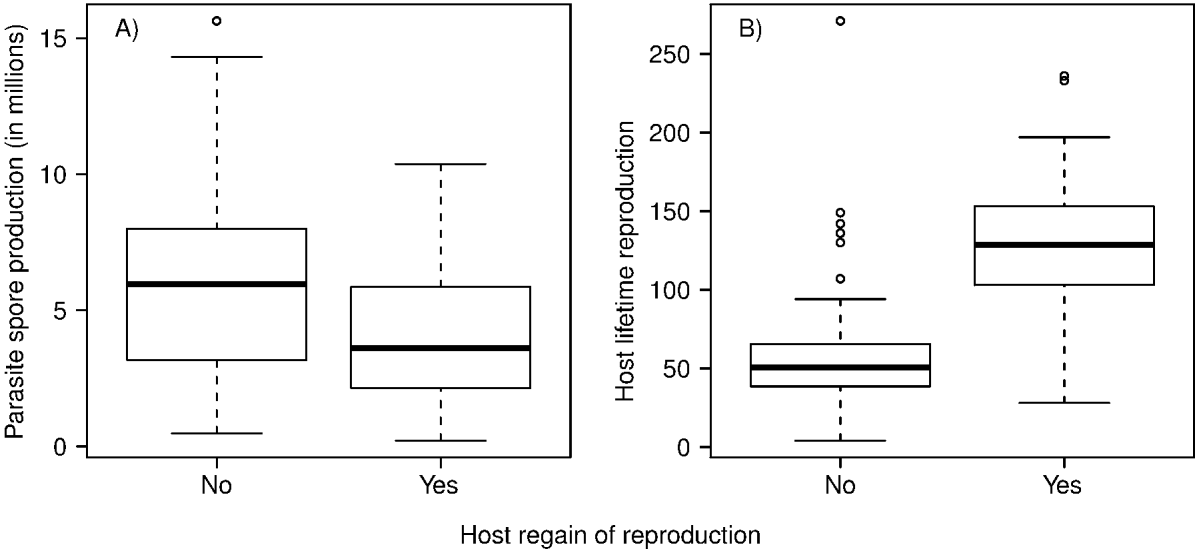
The results from the parasite fitness proxy (Fig. 1A) show that parasites produced significantly more spores in hosts which were permanently castrated than in hosts which regained reproduction (glm; resid. d.f.=101, resid. deviance=193 51, F=10 20, P<0 01). Further, the results for the host fitness proxy (Fig. 1B) show that females that were permanently castrated had a significantly lower lifetime reproduction compared to females that regained reproduction (glm; resid. d.f.=101, resid. deviance=2042 50, F=43 91, P << 0 01). When comparing the fitness proxies directly, there was a significant negative correlation between host and parasite lifetime reproduction (Spearman rank correlation; rs=−0 28, P<0 01). The same analysis within females that were permanently castrated and within those which regained reproduction resulted in no significant correlations (Spearman rank correlation; rs=0 03, P=0 85 and rs=−0 09, P=0 49, respectively).
Parasite versus host fitness proxies. (A) Parasite spore production in permanently castrated females and in females that regained reproduction. (B) Host lifetime reproduction in permanently castrated females and in females that regained reproduction. The values portrayed are the standard box-and-whisker plot in R, i.e. median, and first and third quartile. The whiskers are max. and min. values except for outliers. An outlier is defined as 1 5 times the length of the box away from the box, and is indicated by an open circle.

When testing if hosts which regained reproduction could maximize their fitness at an optimum duration of castration, none of the models revealed any optimality. There is neither an association when duration of the castration is a polynomial predictor (glm; resid. d.f.=57, resid. deviance=946 58, F=1 22, P=0 30) nor when it is a first order predictor (glm; resid. d.f.=58, resid. deviance=947 34, F=2 43, P=0 12). When testing for optimality in offspring production based on age at castration, the polynomial model was not statistically better than the first order model (glm; resid. d.f.=57, resid. deviance=872 71, F=2 80, P=0 10). However, there was a significant effect of age at castration as a first order predictor (glm; resid. d.f.=58, resid. deviance=915 76, F=4 52, P=0 04), and the parameter estimates show a positive association between age at castration and total number of offspring (glm; slope=0 71, t=2 17, P=0 03, note that the slope is not back-calculated from the log-link function used in the glm). This means that the later in life a host becomes castrated, the more offspring it produces. When performing the same analyses with individual spore load as a covariate they gave similar P-values and identical conclusions. The mean reproduction before castration per female for the permanently and temporarilly castrated groups were 63 and 64 offspring, respectively, which was not statistically different (glm; resid. d.f.=101, resid. deviance=1662 80, F=0 02, P=0 88).
DISCUSSION
We found that 49 2% of castrated D. magna infected with P. ramosa regained reproduction and that the offspring born during this period were as many as those born before castration. Such a substantial regain of reproduction has never been described for this system before and opens up the possibility that host castration potentially could be adaptive to the host. However, our findings support the hypothesis that host castration is adaptive to the parasite, because D. magna females which were permanently castrated contained significantly more spores than those which regained reproduction. In addition, we found a negative correlation between parasite and host lifetime reproduction when testing for this relationship among all the animals containing mature spores. However, we did not find any such relationship when testing for it within the two groups. These findings suggest that the parasite benefits from reduced host reproduction and that the regain of reproduction explains the negative correlation found. With this in mind it is interesting to note that the lowest number of spores was found in the one infected female which did not become castrated (results not shown).
For castration to be adaptive to the host we predicted host lifetime reproduction to be maximized for a given duration, or age at initiation, of the temporary castration period. We found that approximately half of the castrated female D. magna infected with P. ramosa did not regain reproduction and that these females had a significantly lower lifetime reproduction than those which regained reproduction. This means that almost half of the females completely failed if castration is a host strategy. Even with this in mind one could argue that the females which regained reproduction could benefit from castration. However, we did not find host lifetime reproduction to be maximized unimodally for a given duration, or time at initiation, of the temporary castration period. The only significant linear relationship was found between host lifetime reproduction and age at castration. This association was positive, which suggests that it is optimal for the host not to be castrated at all. It is therefore interesting to note that the highest lifetime reproduction observed in this study was that of the one infected female which did not become castrated (results not shown). Further, the magnitude of the reproduction before castration for the permanently and temporarily castrated groups was the same. Thus, there are no indications that the temporarily castrated group was saving resources for later reproduction. Based upon these findings we conclude that castration is not adaptive to the host in this parasite-host interaction.
Since there are strong effects of host clone and parasite isolate on parasite-host interactions in the P. ramosa-D. magna system (e.g. Decaestecker et al. Reference Decaestecker, Vergote, Ebert and De Meester2003; reviewed by Ebert, Reference Ebert2005 and Ebert, Reference Ebert2008) we cannot conclude that our findings, which are based upon one clone, are generally applicable to this system. However, we have found substantial regain in all clones we have tested in lake water (FiX, this study, DG-1-106 and EL-75-69, (unpublished observations)), while no such regain has been reported from previous studies (e.g. Ebert et al. Reference Ebert, Carius, Little and Decaestecker2004; Jensen et al. Reference Jensen, Little, Skorping and Ebert2006) using a standard artificial growth medium (Klüttgen et al. Reference Klüttgen, Dulmer, Engels and Ratte1994; or as modified by Ebert et al. Reference Ebert, Rainey, Embley and Scholz1996; or Ebert et al. Reference Ebert, Zschokke-Rohringer and Carius1998). These findings suggest that D. magna infected with P. ramosa may not be permanently castrated in nature. That such a regain occurs is somewhat surprising since models on the evolution of host castration state that it is optimal for horizontally transmitting parasites to totally castrate their hosts (e.g. Obrebski, Reference Obrebski1975; Jaenike, Reference Jaenike1996; O'Keefe and Antonovics, Reference O'Keefe and Antonovics2002). The negative correlation between parasite and host lifetime reproduction found here and in a previous study (Ebert et al. Reference Ebert, Carius, Little and Decaestecker2004) suggests that this is the case for the P. ramosa-D. magna system. Therefore, it is no surprise that the regain clearly benefits the host and through doing so it opens up the possibility that host castration could be a host adaptation. However, our findings support previous studies in concluding that host castration is adaptive only to the parasite in this system (e.g. Ebert et al. Reference Ebert, Carius, Little and Decaestecker2004; Jensen et al. Reference Jensen, Little, Skorping and Ebert2006; Vale et al. Reference Vale, Stjernman and Little2008). Whether this is generally the case when regain of reproduction occurs in this system needs further investigation.
From an evolutionary perspective any reduction in host reproduction could be adaptive to a parasite, whether it leads to the complete cessation of reproduction or not. This would be the case as long as it leads to increased parasite fitness in the form of increased parasite survival and/or reproduction. For a reduction in current reproduction to be adaptive to a host it has to be followed by an increase in future reproduction that maximizes fitness. The increase in future reproduction would have to outweigh the fact that an offspring born earlier in life is often of greater fitness value than an offspring born later. We therefore suggest that reduction in host reproduction is more likely to evolve as a property favouring parasites rather than hosts.
Our study indicates that environmental conditions can alter parasite-host interactions in the P. ramosa-D. magna system in such a way that reduction in current host reproduction could potentially be a host adaptation. However, even with the regain in reproduction our results support the view that parasitic castration of the host is adaptive to the parasite. The regain of reproduction among D. magna containing mature P. ramosa spores could open up the possibility of vertical transmission in this parasite-host system. If this was found to be the case the regain of reproduction is likely to be a parasite adaptation to maximize transmission.
ACKNOWLEDGEMENTS
For comments and suggestions on the manuscript we wish to thank Per J. Jakobsen and Arne Skorping (University of Bergen). The latter also helped plan the original experiment. We would also like to thank two anonymous reviewers for their valuable comments.
FINANCIAL SUPPORT
This study was funded by the research groups Evolutionary Ecology and Aquatic Behavioural Ecology at the Department of Biology, University of Bergen, Norway.