

Introduction
The quality of policy implementation varies widely across and within countries. For scholars in the growing field of comparative public policy, this is a very important and highly relevant topic. Low state capacity can result in outcomes such as lack of access to potable water, poorly developed transportation systems and widespread crime. Even among countries with relatively high-quality policy implementation, such as the US, state capacity has emerged over time and, most argue, within the last century (Skocpol Reference Skocpol1982; Carpenter Reference Carpenter2001). Understanding the ability of states to implement policy – that is, their state capacity – is thus a central concern of social science.
State capacity is widely discussed by scholars in public policy and political science, but there is no consistent definition nor agreed upon measure of the concept. In this paper, we review the prominent definitions and measures of state capacity and demonstrate that an underlying theme in the various definitions is the ability of a state to implement public policy. We adopt a definition of state capacity that focuses on policy implementation and propose to measure the construct by examining the proportion of total tax revenue from income taxes. We make three specific contributions in this paper. First, unlike other scholars, we focus our measure explicitly on income tax collection rather than overall tax collection. Second, we demonstrate the construct validity of our measure. Third, we compare our measure to the most commonly used indicator for state capacity, total tax revenue as a percentage of gross domestic product (GDP), to demonstrate the theoretical and statistical differences between the measures and how ours is a better measure of state capacity for a large sample of cases.
The most important argument of this article is that the choice of state capacity measures depends on the theoretical construct being measured and the ability of a measure to capture this construct empirically. The various indicators of state capacity that we examine in this paper represent different underlying theoretical constructs and measures and, therefore, they are not simply substitutes for each other. Scholars need to think seriously about what they mean by state capacity when choosing a measure for their research. This discussion follows in the tradition of Sartori (Reference Sartori1970) and Adcock and Collier (Reference Adcock and Collier2001) who encourage scrupulous examination of the measurement of key concepts in social science. As with other contested concepts such as democracy (Bollen Reference Bollen1980; Munck and Verkuilen Reference Munck and Verkuilen2001), the appropriate construct and measure must be clearly described and tested for its validity before we can accept the findings that come from quantitative research. The income tax measure that we advocate captures one construct of state capacity that we see as both very common in the literature and not captured by existing measures. This construct and measure is applicable to many fields, especially public policy research.
The article proceeds as follows. In the “What is state capacity?” section, we define state capacity with reference to supporting literature. In the “Our measure” section, we present our income tax measure of capacity and review the most common tax-based measures of state capacity. In the “Construct validity of income tax measures” section, we demonstrate construct validity of our measure by explicating its theoretical justification and “face validity”. We also show the empirical validity of the measure by directly comparing it with the most commonly used tax-based measures. In the “Assessing alternative specifications of taxation measures” section, we address alternatives to the empirical construct of our measure. The last section concludes.
What is state capacity?
A single, clear definition of state capacity is largely absent in policy research. However, many studies that utilise state capacity implicitly adopt a definition of capacity focused upon the state's ability to effectively implement policy. Various definitions meant to break down the concept, such as “top-down” theories of capacity by autonomous or coercive states (Johnson Reference Johnson1982; Haggard Reference Haggard1990; Grindle Reference Grindle1996; Carpenter Reference Carpenter2001) and theories of “synergy” between state and society (Migdal Reference Migdal1988; Evans Reference Evans1995), differ in their views on the drivers of capacity, not on the definition of capacity as effective policy implementation. At their core, definitions of state capacity emphasise the ability of states to enforce policy, even against the preferences of citizens (Mann Reference Mann1993).
Building upon this literature, we define state capacity as the ability of a state to implement public policy. If a state wants to change the status quo by enacting and enforcing a policy choice and it cannot do so, then it lacks capacity. A state capable of implementing policy, even or especially against societal resistance, is a high capacity state. In this definition, a high capacity state is able to effectively implement a wide range of policies. Importantly, even the most powerful state will not be able to put into place every type of policy or execute all policies perfectly. Our definition does not suggest this. Rather, it focuses on a state's ability to implement policy relative to the ability of other states or to itself over time. A highly capable state will be better able to implement policy than a less capable state.
State capacity in public policy research
Recent public policy research increasingly recognises the importance of examining state capacity to give a full picture of the policy process and policy evaluation. Several trends in public policy analysis highlight the need for state capacity measures, including comparative public policy (particularly in the developing world), sub-national policy research and historical public policy. In all of these contexts, analysts must question the most basic assumptions about technical and political capacity in order to explain variance in outcomes. For example, in a recent prescriptive article on the age of globalisation, Farazmand (Reference Farazmand2009) emphasised capacity-building as critical to growth and development in the world. Policy studies in Africa (Mead Reference Mead1996), Eastern Europe (Staronova Reference Staronova2010), Asia (Tsao Reference Tsao2009) and cross-nationally (Kettl Reference Kettl1997) feature capacity or capacity-building as the most important issue in comparative bureaucracy. Moreover, studies of state and local policy, even in developed nations such as the US, critique the ability of those governments to implement legislated policies (cf Reeves Reference Reeves1982). Despite the importance of capacity measures in public policy research, especially for establishing base levels of capacity in comparative context, little analysis of the validity of these measures has been undertaken.
Our measure
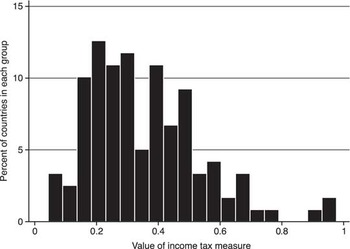
We operationalise state capacity as individual and corporate income taxes divided by total central government tax revenue. To create the income tax measure, we use the average value of total income taxes and total tax revenue for a three-year period spanning the years 2006–2008, which helps to remove minor year-to-year variation. We draw our data on tax collection from the IMF's Government Finance Statistics Consolidated Central Government data set.Footnote 1 Our measure of state capacity ranges from 0.04 to 0.97, and the numerator includes all individual and corporate income taxes. In Table 1, we present summary statistics, and, in Figure 1, we show a histogram of the distribution of the state capacity measure. The measure ranges from almost no income tax revenue to almost all central government revenue coming from income taxes. Figure 1 suggests that our measure captures tremendous variation in state capacity.Footnote 2
Summary statistics for income tax measure

Income tax/total tax data distribution.

Our measure builds upon Tilly's (Reference Tilly1978) assertion that state capacity refers to the power of raising revenue. Additionally, effective taxation, unlike most public policies, can be directly observed and measured. Also, in contrast to other policies such as universal education or national healthcare, the decision of whether to tax citizens is not a matter of debate for nearly all modern states (Rose Reference Rose1985). Weyland (Reference Weyland1998) succinctly describes these important qualities of taxation:
Since taxation is a core task of the state, states embark on especially determined action in this area… Thus taxation is one of the “least likely” cases for a decline in state capacity. If such a decline can nonetheless be documented in this area, it is probably even farther reaching in other areas (p. 53).
While this sentiment is common in state capacity literature, taxation data is not widely used as a capacity indicator in public policy research, and the focus on income taxation, rather than total taxation, is mostly missing in the social science literature. Moreover, no studies have demonstrated, quantitatively, that taxation is a good construct for capacity. The existing literature that uses tax collection as a measure of state capacity typically only discusses the face validity of the measure. Face validity helps to show that the measure is a reasonable representation of the construct, but arguments for face validity do not provide evidence that the measure is empirically valid, which is necessary for us to have confidence in the measure. After we briefly review other measures of state capacity and argue they are not sufficient for our use, we demonstrate construct validity of our measure.
Existing tax-based measures of state capacity
Taxation-based capacity measures examine observable behaviour to capture evidence of successful policy implementation. Our measure follows in the tradition of these taxation-based indicators and the broader fiscal sociology literature that views taxation as a window to state−society relationships. Importantly, the indicators that we review in this section and examine in subsequent sections are distinct, both in theoretical construct and empirical measurement, from our measure and from each other.Footnote 3
The most common tax-based measure of capacity is total tax revenue as a percentage of GDP (Peters Reference Peters1991; Steinmo Reference Steinmo1996; Cheibub Reference Cheibub1998). In this formulation, the ability to collect a large proportion of revenue relative to the size of the economy provides evidence that a state is able to extend its authority over economic activity. We agree with the intuition to use actual state behaviour to measure capacity, but we propose an improved measure based on the properties of different taxes. The total tax measure includes all types of government taxes, both the easy and difficulty taxes, obfuscating important differences in capacity required for collection. Customs taxation, excise taxation and some forms of sales taxes are achievable by nearly all states. Total taxation as a percentage of GDP, then, is too coarse a measure, both theoretically and empirically, that we can improve upon through a tax properties construct. We focus our demonstration of validity on comparing this measure (total taxes/GDP) to our measure (income tax/total tax) in the next section.
Relative political capacity (RPC) is another widely used capacity measure, particularly in international relations research (Organski and Kugler Reference Organski and Kugler1980; Arbetman and Kugler Reference Arbetman and Kugler1997). RPC is a measure of actual taxation compared to the amount of tax a country is expected to collect based on the structure of its economy. This measure of capacity is very useful for cross-country and inter-temporal analysis of tax extraction, but it is a different construct than state capacity as policy implementation.
RPC does not incorporate the difficulty of tax administration in its construction. Included in this measure is all revenue, including taxes that are easy to collect. Rather than focusing on how much a state taxes overall, we view the difficulty of tax types as providing valuable information about state capacity. Accordingly, a state that collects a very large amount of revenue from trade and natural resources relative to its economic structure would be high capacity according to RPC.Footnote 4 Unless it also extracted significant wealth from income taxes this state would be low on our measure. Lieberman (Reference Lieberman2004) supports the exclusion of natural resource revenue in measures of state capacity, because it requires “little technical or political capacity to procure it” (p. 98). The existing measures do not make use of the properties of taxes that relate to the difficulty of certain taxes, namely those on income.Footnote 5
We also build upon past capacity measures that utilised income taxation but did not demonstrate construct validity. For example, Chaudhry (Reference Chaudhry1997) sees direct taxation, especially income tax collection, as vital to state building. Levi's (Reference Levi1988) exploration of “quasi-voluntary compliance” focuses primarily on income taxes because the high enforcement costs of incomes taxes make them particularly strong tests of citizen cooperation with states and state force. Neither author analyses whether this construct is an accurate measure of what they intend to study. Our measure of state capacity is clearly in the same family as other measures based on tax collection. However, as we reveal in the theoretical and empirical sections below, we are proposing a distinct measure of state capacity and, unlike previous studies, we demonstrate construct validity for this measure.
Construct validity of income tax measures
In this section, we demonstrate construct validity for our measure to show it is a valid indicator for state capacity. Showing construct validity is necessary for any good measure; this has been performed for many of the most utilised measures in social science. For instance, Perry (Reference Perry1996) evaluated the construct reliability and validity of measures of public service motivation. Poole and Rosenthal (Reference Poole and Rosenthal1985) explicated the validity of their NOMINATE measure of legislator ideology, and Berry et al. (Reference Berry, Ringquist, Fording and Hanson1998) scrutinised measures of citizen and government ideology in the American states.
Shadish et al. (Reference Shadish, Cook and Campbell2002) argue there are two fundamental requirements for construct validity. First, researchers must start with a well-explicated construct of interest by specifying exactly what is being measured and how it represents the definition. Second, researchers must be able to determine whether there is a reasonable match between the construct and, their data; they must go beyond arguing that the construct is reasonable and actually show that it is so. We demonstrate the construct validity of state capacity according to these guidelines.
As we elaborated in the “Introduction” section, our definition focuses on the state's ability to implement policy. Our measure – income tax collection – captures a state's broader ability to implement policy and, in this section, we present evidence that income tax revenue is a valid measure. We provide evidence for construct validity by arguing that the measure has face validity and demonstrating that the income tax measure has the predicted pattern of empirical correlations with other outcomes.
Face validity: collecting taxes requires effort and capability
Face validity necessitates that a measure of a given construct is, “on its face”, a reasonable measure. In this section, we provide a thorough discussion of income taxation to demonstrate face validity. There are three key points to our argument for face validity. First, we believe that tax collection, in general, is a good starting place for a construct of state capacity, because collected taxes represent the outcome of an implemented state policy. Second, we focus on income taxes as a more specific measure of state capacity, because income taxation is a particularly difficult type of tax collection and therefore provides a more refined measure of the concept. Third, we argue that a state's ability to collect income taxes will be related to the state's ability to implement other types of policy.
Our indicator of state capacity assumes that states need and want to collect revenue. This is a reasonable assumption, because, without revenue, a state cannot accomplish any tasks it deems necessary. Furthermore, this assumption is consistent with many theories of the state (North Reference North1981; Tilly Reference Tilly1992) and with other measures of state capacity (Levi Reference Levi1988; Therkildsen Reference Therkildsen2000). The methods used to acquire fiscal resources, however, are a political choice. These choices, we argue and demonstrate, vary systematically with states’ capabilities, making it a useful indicator of state capacity.
Taxation requires substantial effort from states, and income taxation requires the highest level of effort (Atkinson and Stiglitz Reference Atkinson and Stiglitz1975; Slemrod Reference Slemrod1990; Tanzi Reference Tanzi1991; Lieberman Reference Lieberman2004). An extensive literature in political science and economics has demonstrated the importance of taxation as a crucial linkage between state and societal actors (Musgrave Reference Musgrave1969; Levi Reference Levi1988). States must provide services to citizens in exchange for tax resources, and states must therefore interact with citizens to monitor economic behaviour and to collect and spend tax resources. Taxation of any kind, however, requires a functional state bureaucracy. The types of taxes collected require widely differing levels of effort by the state and its bureaucratic apparatus (Aizenman and Jinjarak Reference Aizenman and Jinjarak2009). Moreover, Besley and Persson (Reference Besley and Persson2009) argue that financial capacity, or taxation, and legal capacity are inseparable. All state capacity, they argue, is dependent on taxation and measure capacity with income taxation. As we argue below, income taxation is a particularly compelling measure of state capacity, because it is lucrative for states but requires substantial capabilities to implement.
Income taxation is an indicator that can capture many diverse aspects of state capacity related to policy implementation. The properties of income tax collection – difficult to administer and enforce – reveal state capacity. As a cross-national measure, it can capture both the national capabilities, or “the extent of resources at its (the central states’) disposal for exercising power via its institutions of control”, and the weight of the state, or “how the exercise of state power shapes the society it controls” (Soifer Reference Soifer2008, 235–236).
Capacity indicators based on the properties of taxes are also adaptable. Some types of research will require capacity measures other than national income taxes. Public policy research, for example, often examines regional or sub-national (state/province or municipal) differences in policy outcomes that cannot be captured by national-level income tax indicators. For research where income tax measures are not appropriate, we advocate using other types of taxes that similarly demonstrate effort by the state. For example, at the sub-national level in developing countries, effective property tax collection reveals successful policy implementation (Bird Reference Bird1992; Rogers Reference Rogerssubmitted). What is crucial for tax-based capacity measures is the theoretical construct that they reveal effort and effective bureaucratic function in the jurisdiction of interest.
We assume not only that governments seek revenue in general, but that they seek tax revenue. In particular, we presume, all else equal, that states would like to collect income tax revenue, because it has the following properties that states find attractive relative to most other taxes: low variance in year-to-year quantity collected, reach in all sectors of the economy and fewer distortions of economic behaviour.
In order for a government to tax effectively, however, three necessary conditions must be met by a state:
-
1. Economic actors must be known to the state.
-
2. The state must be able to determine an amount to tax the actors.
-
3. The state must be able to extract income using the results of conditions 1 and 2. This implies that economic actors voluntarily comply or the state uses force to extract revenue.
These conditions highlight the importance of information, monitoring and use of force for successful taxation. These conditions are agnostic to the type of taxes collected. Even where only small sectors of a state are taxed, as in so-called petro-states, governments must have knowledge of the actors involved in oil extraction, a formula for taxing oil and the ability to enforce compliance with imposed taxes.
Taxation requires meeting the three conditions above, and it will be relatively more or less difficult to meet these conditions depending on the type of tax implemented. One of the easiest forms to collect are trade taxes. All three conditions can be met for trade taxes with relative ease. For a government to collect a tax on international trade, enforcement is largely limited to officials at borders and ports.Footnote 6 Since trade must flow through these critical “gates”, government interaction with the actors that must use them provides the information required for conditions 1 and 2 to be met. Condition 3, enforcement and collection, is also less demanding than other taxes, because force can be concentrated at these “gates”. The ease of collecting these taxes helps to explain why countries have relied on them for considerable amounts of revenue, both historically and currently in many less-developed countries.
Trade taxes may be “easy”, but they impose considerable economic costs on a society and have limited revenue potential (Tanzi and Zee Reference Tanzi and Zee2004). Sales taxes can have high revenue potential, are moderately distortionary and are moderately difficult to collect (Lieberman Reference Lieberman2004; Bird and Zolt Reference Bird and Zolt2005). Importantly, income tax systems, especially once automated, are the steadiest and most lucrative form of tax revenue. All else equal, most governments would prefer to tax from the widest base possible and to do so in the least distortionary manner.
Of course, all else is not equal, political concerns weigh heavily into decisions about taxation. Nevertheless, if feasible, most governments would want to garner more from “efficient” taxes. The taxes with the widest, most stable bases are those on income and property. These are effectively applied in developed nations; once these governments were able to tax activities that are more difficult to monitor, such as income and goods and services, trade taxes became less important for government revenue. This suggests that states will prefer more difficult, information-intensive taxes if they are feasible to enforce. These taxes, however, require considerable amounts of information to meet the three necessary conditions for taxation.
Empirical demonstration of construct validity
Measures must not only have theoretical validity but also empirical grounding. In this section, we demonstrate empirically that our proposed measure of state capacity is a valid indicator of the underlying construct we identify. We take several approaches. First, we show that our measure of state capacity correlates positively with other observable indicators of high capacity states. We focus on correlations with two types of indicators – measures of infrastructure quality and measures of administrative quality. Both should be positively correlated with a state's ability to implement policies, which is the core of our theoretical construct. Second, we demonstrate that our measure does not correlate with attributes of a state that should be unrelated to our construct of state capacity.
We first discuss how our measure correlates positively with other indicators of a capable state, often called convergent validity (Trochim and Donnelly Reference Trochim and Donnelly2007). We focus, in particular, on activities that are related to a state's basic infrastructure functions. We expect the quality of physical infrastructure to correlate with state capacity, because state actors are usually central to the financing and construction of large infrastructure projects. Moreover, infrastructure in water and sanitation is typically the purview of states. We expect each measure to vary positively with state capacity, because basic infrastructure improvements require a government that can implement public policy.
In addition to the infrastructure indicators, we examine the correlation between our measure and the regulatory quality variable from the World Governance Indicators (Kaufmann et al. Reference Kaufmann, Kraay and Mastruzzi2009). This variable is defined as “perceptions of the ability of the government to formulate and implement sound policies and regulations that permit and promote private sector development”. The focus of this measure on policy implementation is appropriate given our construct for state capacity. We also examine our measure's correlation with the government effectiveness variable from the same data set. This variable attempts to capture “perceptions of the quality of public services, the quality of the civil service and the degree of its independence from political pressures, the quality of policy formulation and implementation, and the credibility of the government's commitment to such policies”. Both of these measures capture legal and financial infrastructure, which Besley and Persson (Reference Besley and Persson2009) view as inseparable from state capacity. Although these measures of institutional quality are imperfect, they are commonly used in research and, importantly, we did not collect the data or design the indicator, thus it is independent validation of our measure.
We turn now to correlations between our measure of capacity and other variables that should be positively correlated with a state's ability to implement public policy. In assessing a measure's validity, it is important to understand how it correlates with other relevant variables, and it is also important to consider how alternative measures correlate with those other data. To that end, we also examine how total tax/GDP relates to these other correlates of state capacity.
For all of our variables, we compute the average value for a three-year period spanning the years 2006–2008, which helps to remove minor year-to-year variation. If a particular country has data for only one or two of the three years, we still retain them in the comparisons. In Table 2, we report the correlations between the two primary measures of state capacity and the infrastructure and the World Governance Indicators measures.
State capacity indicators and state attributes

In each cell, we report the pairwise correlation coefficient and in parentheses the level of significance of the correlation and the number of observations.
The data reveal what we expect – consistent correlations between the income tax measure and measures of infrastructure quality. This is empirical evidence that income tax collection is related to a government's ability to actually implement public policy. Although the magnitude of the correlations varies across the different variables, the correlations are uniformly positive and significant, as we would expect if our state capacity measure captures the ability of a state to implement policy. Just as importantly, the total tax measure features consistently lower correlations with these different empirical measures, and at times the correlations are either insignificant or in the opposite direction. For instance, in Table 2, there is a negative correlation between the total tax measure and the total kilometres of roads in a country, which indicates that total taxation does not correlate with road infrastructure, an indicator for state reach in policy making and evidence of one type of policy delivery. Total tax/GDP is also unrelated to other measures of health policy implementation, including improving sanitation and access to potable water. The total tax measure of state capacity fails to show a consistent correlation with the other outcomes that a high capacity state will likely achieve.Footnote 7 Therefore, if one accepts that a measure of state capacity should correlate with other attributes of an effective state, these results suggest that the income tax/total tax measure is superior to the most common alternative measure of state capacity. It may be that total taxation is a good measure for another concept of state capacity, but it does not seem that the total tax measure is as good a measure of the construct we identify for state capacity.
Turning now to Table 3, we examine whether the measures of state capacity correlate with variables that should not be correlated with capacity. The crucial task in this empirical exercise is to choose variables for which a correlation would suggest that our measure of state capacity actually captures something that is unrelated to, but correlated with, state capacity (Trochim and Donnelly Reference Trochim and Donnelly2007). In this vein, we examine two measures of population (total population and population density) and two measures of military strength (size of the armed forces and military spending) from the World Development Indicators (World Bank 2012).
State capacity indicators and theoretically unrelated attributes

In each cell, we report the pairwise correlation coefficient and in parentheses the level of significance of the correlation and the number of observations.
The results in Table 3 show that the income tax measure correlates with neither the population measures nor the military measures, but the total tax measure does correlate with total population and total military spending. The absence of a correlation between our income tax measure and the population measures is important, because tax-based measures could correlate with either of these measures for reasons unrelated to a state's actual capacity. It is plausibly more difficult to collect taxes when populations are large and density is low, which places a greater administrative burden on the tax collection bureaucracy. Therefore, the absence of a correlation with the population variables demonstrates that it is not simply more densely populated states that are able to tax income at a higher level. A correlation between density and income taxation would call into question whether or not our measure captured the state's actual capacity. If the correlation existed, it would suggest that greater income taxation is a function of demographic variables rather than the actions of the state. It is illustrative, therefore, that total tax/GDP is significantly correlated with one of the population measures. This suggests that these measures may be tapping into attributes of a state that reflect geographic or demographic characteristics more than state action.Footnote 8
The income tax measure is also not statistically related to the measures of military size and spending. This is consistent with our measure's focus on policy implementation, which is not inherently related to military capability. Total tax/GDP is correlated with military spending, suggesting that these variables are either tapping into attributes of a state that are not related to state capacity or that their construct is different – they want to capture an alternative definition of capacity (perhaps capacity for fighting war) rather than public policy implementation.
These results show that income taxes as a proportion of total government taxation do not correlate with measures that should be unrelated to state capacity. This is an important, if somewhat unusual, way to demonstrate the value of a proposed measure. If we had found that income taxation had a significant correlation, with indicators for which we did not expect a correlation then it would appear that some other, unmeasured variable determined both income taxation and land usage and military attributes of a state. The empirical results provide consistent evidence that our measure captures state capacity, and that the total tax measure does not as effectively capture the policy implementation aspect of state capacity.
The last step we take in this paper is to compare directly our proposed measure of capacity to the measure based on total government tax revenue divided by GDP. The correlation between the two measures is only 0.07 for the three-year average of 2006–2008, which means that the two measures are not only theoretically but also empirically distinct. The very low correlation between the two measures makes it imperative to use the measure that is most appropriate for a given construct.
To investigate the validity of the two measures, we examine the countries where the two measures are most divergent from each other. To do so, we determined the countries that are above the 75th percentile on one measure and below the 25th percentile on the other measure. This creates two groups of countries – one group that is high capacity on the income tax measure but low capacity on the total tax measure and one group that is low capacity on the income tax measure but high capacity on the total tax measure. Although the 25th and 75th percentile cutoffs are arbitrary, the goal is to identify the countries for which the two rankings are widely different. The countries ranked as high capacity on the income tax measure but low on the total measure include: Bhutan, Canada, Iran, India, Japan, Kazakhstan, Singapore, Spain and the US. The countries ranked as high capacity on the total tax measure, but low on the income tax measure include: Argentina, Belarus, Benin, Cuba, Estonia, Macao, Madagascar and Lesotho.
The question now becomes, which measure seems more appropriate for each group of countries? It is difficult to answer that definitively, but we question the validity of a measure that places the US, Canada and Japan as among the world's least capable states. At the same time, the total tax measure ranks Lesotho and Madagascar as among the most capable states. These results strike us as, on face, problematic for the total tax measure. In addition, these groupings highlight the theoretical challenges of the highly aggregated total tax measure. Lesotho, for example, is highly dependent on trade taxation (over 40 per cent of total taxation) to meet its needs. This characteristic of a weak state makes Lesotho appear capable on the total tax measure. Lesotho, moreover, performs very poorly on many indicators of high quality policy implementation, especially health outcomes and infrastructure development, relative to their wealth and their neighbours (CIA World Factbook 2012). Argentina also appears misplaced in these rankings. While not a failing state, it is widely regarded as having low taxation capacity relative to the world, its neighbours and its level of development (Bergman Reference Bergman2003).
Assessing alternative specifications of taxation measures
Our measure of income tax/total taxes is only one possible way to utilise the income tax construct. In this section, we specify different ways we could have measured the numerator as well as alternatives to total tax as the denominator. We also discuss why we did not use the value added tax (VAT) to capture difficult taxation, rather than income taxes. We emphasise the theoretical reasoning behind our choices with references to empirical findings in the online appendix.
Why not individual income tax as the numerator?
Total income tax values include collection of individual income taxes and corporate income taxes. These two taxes have different incidence – the former is collected from all eligible citizens and the latter from businesses. In terms of state reach and administrative difficulty, the individual income tax may be the most challenging tax a state collects. Scholars could argue on this basis that the corporate tax dilutes the income tax variable because it is easier.
If there are states that collect substantial corporate income taxes but minimal personal income taxes, then, by combining the two elements into the numerator, we might unintentionally claim that states that collect taxes from businesses (easier) are as equally capable as states that collect taxes from individuals (harder). Overall, the relationship between the ratio of total corporate income taxes to GDP and the ratio of total individual income taxes to GDP show a correlation of only 0.07.Footnote 9 To further examine the different types of income taxes, we again look at countries that are highly ranked by the corporate income tax measure but ranked low on the income tax measure. The countries that are above the 75th percentile on corporate income tax collection and below the 25th percentile on individual income tax collection are: Cuba, Brunei, Kazakhstan, Trinidad and Tobago, and Uruguay. If the concern about tax incident is correct, then our measure using total income taxes may overstate the capability of these states. But since the list above includes states that are both high and low capacity on our total tax measure, it is unclear if the total tax measure is consistently wrong for these states or if there are few states ranked high on the corporate measure but low on the individual measure.Footnote 10 This gives us confidence that combining the two types of income taxes does not weaken our measure.
Aside from the empirical evidence, it is not obvious that collecting corporate income taxes is easy in theory. The corporate income tax involves fewer actors, but it is arguably more challenging politically and administratively due to sophisticated corporate avoidance or evasion methods. The business sector is better organised to counter income tax claims and better able to use the tax code to their advantage (Slemrod Reference Slemrod2007). It is also likely important for state capacity that the state is able to extract from these powerful actors. For both empirical and theoretical reasons, we believe the choice to combine corporate and income taxes in the numerator is justified.
Why not GDP as the denominator?
Income taxation, as the numerator in a capacity ratio, is the important innovation for a measure of state capacity that we stress in our research. The choice of denominator for income tax revenue, however, is also consequential for the measure of state capacity. We argue that income taxes/total tax collection is the best theoretical measure to capture our understanding of state capacity, therefore challenging both the numerator and denominator of the most popular measures of capacity.
Other tax-based measures of state capacity use either total taxes (or revenue) as the numerator in a ratio but typically use a measure of economic size (i.e. GDP) as the denominator. We do not adopt this approach in our measure, because it conflates normative and positive theories of state capacity. Measures that utilise an economic outcome (such as GDP) in the denominator are essentially measuring how much of the economy that state chooses to collect in tax revenue. This is true whether the numerator is total taxes, income taxes or some other type of tax-based measure. In this view, capacity is a function of the amount of the total economy that the state extracts. However, this measure is subtly normative; that is, different views of the appropriate relationship between the state and society have different implications about the ideal size of the relationship between the government's tax collection and the economy.
We prefer a measure that does not make claims that a larger government is also a more capable government. Rather, our measure addresses the following question: conditional on the size of the government sector, how does the government choose to pay for its activities? We view the structure of revenue as consequential and income taxes specifically indicative of state capacity.Footnote 11 The total tax revenue denominator emphasises the tradeoffs that states face in balancing their revenue needs with the states’ means to collect them. Nonetheless, this denominator has drawbacks, namely that it suffers when comparing states with very different incidence of total tax revenue, because even modest income taxation will appear significant when divided by very modest total tax revenue. For comparisons across very different levels of total taxation, therefore, the inclusion of GDP as a control variable or thoughtful research design groupings can help to calibrate comparisons across levels of development (Lieberman Reference Lieberman2004).Footnote 12
Why not the VAT?
Income taxation is widely believed to be the most difficult tax to enforce because of its administrative complexity and the reach it requires into society. Those familiar with complex VATs, common across the globe, might reasonably suggest that effective collection of the VAT is also an indicator of high state capacity. We argue that VAT collection is a weaker indicator of state capacity in theory – the VAT is easier to collect than income tax (Slemrod Reference Slemrod1990; Lieberman Reference Lieberman2004; Bird and Zolt Reference Bird and Zolt2005; Bird and Gendron Reference Bird and Gendron2006; Di John Reference Di John2006). Lieberman (Reference Lieberman2004), for example, argues that domestic consumption taxes, like the VAT, “require extensive coverage, but monitoring/enforcement less than income taxes” (p. 99). Bird and Zolt (Reference Bird and Zolt2005) specifically argue against using the income tax as a revenue-generating tax in the developing world because of developing countries’ limited capacity to collect it in comparison to the easier VAT (pp. 1665–1671).Footnote 13
The specification of these measures is a consequential theoretical and empirical choice. We have offered evidence that our measure has validity for the construct of state capacity as public policy implementation. For researchers with other constructs in mind, alternatives to our measure should be considered. Most importantly, researchers should evaluate the existing measures of capacity to match both their theoretical and empirical connection with the construct of capacity that they have in mind.
Conclusion
In this article we presented a definition of state capacity that focuses on the ability of a state to implement public policy. This is at the core of most prior characterisations of state capacity, but this definition has not been plainly explicated and linked to a measure tested for construct validity. We demonstrated in this paper that measuring our concept of state capacity as the proportion of total tax revenue from income tax collection has a solid theoretical and empirical foundation. Income tax collection is a good measure for our construct of state capacity, because income taxes represent the outcome of particularly difficult policy implementation. We demonstrate construct validity for our proposed measure through face validity, convergent validity and discriminant validity. Importantly, we show that our measure is a better representation, theoretically and statistically, than the dominant measures of capacity focused upon total tax collection. The variety of ways that we demonstrate construct validity gives us confidence that our measure indeed is appropriate for our construct of state capacity.
Foundational concepts in social science research demand careful thought and testing. Our construct and measure of state capacity is one potential construct of the concept that we believe is widely accepted in public policy research and many other fields. As we have demonstrated theoretically and empirically, the choice of state capacity indicators is important, because there are considerable differences between the different indicators. Researchers should thus clarify the concept they intend to capture and choose the measure that best captures that concept. We have shown that, if scholars want to study the ability of a state to implement policy, they would be well served to utilise a measure based on the state's ability to collect income taxes.
Acknowledgements
The authors thank the editors of this journal and three anonymous reviewers for their valuable comments and suggestions.