Introduction
Amphetamine-type stimulant use is an expanding global problem, with an estimated 18.2 million consumers of amphetamine or methamphetamine world-wide in 2018 (United Nations Office on Drugs and Crime, 2018). The highest prevalence is found in Australasia and high-income North American countries (Farrell et al., Reference Farrell, Martin, Stockings, Bórquez, Cepeda, Degenhardt and McKetin2019). The increase in industrial-scale production of purer crystalline forms of methamphetamine is leading to more harm (United Nations Office on Drugs and Crime, 2018). Both smoking and injection of crystalline methamphetamine are associated with high dependence liability and use can rapidly escalate into addiction (Cho, Reference Cho1990; Cook et al., Reference Cook, Jeffcoat, Hill, Pugh, Patetta, Sadler and Perez-Reyes1993; McKetin, Kelly, & McLaren, Reference McKetin, Kelly and McLaren2006). Dependence on amphetamines now affects an estimated 7.4 million people worldwide (Farrell et al., Reference Farrell, Martin, Stockings, Bórquez, Cepeda, Degenhardt and McKetin2019), and is a substantial contributor to the global burden of disease (Degenhardt et al., Reference Degenhardt, Baxter, Lee, Hall, Sara, Johns and Vos2014). Psychosis related to methamphetamine use is one such significant public health concern (Cruickshank & Dyer, Reference Cruickshank and Dyer2009; Farrell et al., Reference Farrell, Martin, Stockings, Bórquez, Cepeda, Degenhardt and McKetin2019; McKetin et al., Reference McKetin, Leung, Stockings, Huo, Foulds, Lappin and Degenhardt2019; McKetin, Lubman, Baker, Dawe, & Ali, Reference McKetin, Lubman, Baker, Dawe and Ali2013), with an estimated 40% of people who use the drug experiencing transient psychotic symptoms (Glasner-Edwards & Mooney, Reference Glasner-Edwards and Mooney2014). This paranoid state is due to excessive synaptic dopamine release and altered availability of dopaminergic receptors and transporters in the striatum and parts of the limbic system (Cruickshank & Dyer, Reference Cruickshank and Dyer2009). Acute episodes of psychosis have a devastating impact on frontline services and the broader community because they are often associated with agitated or violent behaviour (Lappin, Sara, & Farrell, Reference Lappin, Sara and Farrell2017; McKetin et al., Reference McKetin, Lubman, Najman, Dawe, Butterworth and Baker2014) and are extremely resource intensive to manage (Bunting, Fulde, & Forster, Reference Bunting, Fulde and Forster2007). There is also an elevated risk of developing a subsequent chronic psychotic disorder (Callaghan et al., Reference Callaghan, Cunningham, Allebeck, Arenovich, Sajeev, Remington and Kish2012; Niemi-Pynttäri et al., Reference Niemi-Pynttäri, Sund, Putkonen, Vorma, Wahlbeck and Pirkola2013).
The population level impact of methamphetamine use on psychosis risk, either acute or chronic, is not clear. This is because no studies have examined the risk of psychotic symptoms associated with methamphetamine use in general population samples. Previous studies that quantify the risk of psychotic symptoms have been conducted within sentinel samples (e.g. people who inject drugs, or who are seeking treatment for methamphetamine use), clinical samples (e.g. people admitted to hospital for psychosis) or criminal justice samples (McKetin et al., Reference McKetin, Leung, Stockings, Huo, Foulds, Lappin and Degenhardt2019). This literature shows that methamphetamine use is associated with a doubling of the risk of psychosis (McKetin et al., Reference McKetin, Leung, Stockings, Huo, Foulds, Lappin and Degenhardt2019), while periods of very frequent use increase the risk of psychosis by more than tenfold among people dependent on the drug (McKetin et al., Reference McKetin, Lubman, Baker, Dawe and Ali2013). However, these samples typically include participants with multiple other risk factors for psychosis, including trauma, other substance use and major mental illness. It is not clear whether these data can be extrapolated to the general population, in which these risk factors are less prevalent.
To understand the population-level risk of psychosis related to the use of methamphetamine, we measured the association between self-reported use of methamphetamine and psychotic symptoms, from age 18 to 35, in a New Zealand birth cohort. This study had three aims:
1. To measure the association between methamphetamine use and psychotic symptoms in a general population sample, before and after controlling for confounding and time-dynamic covariate factors.
2. To examine the dose−response profile of the association between lifetime methamphetamine use frequency and psychosis symptoms.
3. To examine the evidence for persisting psychosis among people with a history of frequent methamphetamine use.
Methods
Participants
The Christchurch Health and Development Study (CHDS) is a birth cohort study comprising 1265 children (635 male, 630 female) born in Christchurch (New Zealand) in 1977 (Fergusson & Horwood, Reference Fergusson and Horwood2001; Fergusson, Horwood, Shannon, & Lawton, Reference Fergusson, Horwood, Shannon and Lawton1989). Members of the cohort were studied at birth and 4 months, then every year from age 1–16 years. Thereafter they were studied at age 18, 21, 25, 30, and 35. Analyses reported here used exposure and outcome data from the last five waves. Participants and/or their parent provided signed consent. A New Zealand Health and Disability Ethics Committee approved the study.
Measures
Exposure to methamphetamine
Amphetamine-type stimulant exposure since the previous wave of data collection was ascertained at age 18, 21, 25, 30, and 35 for the age periods 16–18; 18–21; 21–25; 25–30; and 30–35 respectively. Participants were asked whether they had ever used ‘methamphetamine, speed, P, ice, etc’ in that period, and if so, how often they had used. Most of this stimulant use is likely to have been methamphetamine, since most participants lived in New Zealand during the follow-up period and methamphetamine was by far the most commonly used amphetamine-type stimulant available in New Zealand over that time (Wilkins, Sweetsur, & Griffiths, Reference Wilkins, Sweetsur and Griffiths2017). An ordinal methamphetamine use variable (no use; once or twice only; no more than monthly; weekly or more frequent) was used in a subsequent analysis on the dose−response profile summed across follow up periods (see Statistical Analysis). Repeated measures analyses used a dichotomous methamphetamine use variable (use/no use) due to the low number of participants who reported using methamphetamine on a regular basis.
Psychosis outcomes
At each assessment from age 18 to age 35, cohort members were administered a comprehensive mental health interview designed to assess a number of aspects of the individual's mental health and psychosocial adjustment. As part of this interview, participants were questioned regarding psychotic symptomatology. For ages 18, 21, and 25, cohort members were asked to report on their symptoms over the past month. At ages 30 and 35, participants were asked to report on their symptoms since the previous assessment (the difference in time frames was corrected in the statistical analyses; see below). At ages 18, 21, and 25 these questions were derived from the by the Symptom Checklist 90 (SCL-90; Derogatis, Lipman, & Covi, Reference Derogatis, Lipman and Covi1973), while at ages 30 and 35 questions were derived from the Diagnostic Interview Schedule (DIS) (Robins, Cottler, Bucholz, & Compton, Reference Robins, Cottler, Bucholz and Compton1995). These items spanned a range of symptom areas, including: hallucinations and delusions; paranoid ideation; and related symptoms. Confirmatory factor analysis of the SCL-90 item set has shown previously that the items formed a unidimensional scale reflecting the extent of psychotic symptomatology (Fergusson, Horwood, & Swain-Campbell, Reference Fergusson, Horwood and Swain-Campbell2003). These measures were used to generate two outcome measures: a dichotomous measure indicating whether the participant reported at least one symptom at each assessment; and a count of the number of symptoms of psychosis experienced by each participant during each assessment period. The reliability of the scales at each age was moderate (coefficient α ranged from 0.71 to 0.75). The items used for each measure are presented in the online Supplementary Tables S1 and S2.
Individual factors and early environmental confounders
A series of covariate factors was selected from the CHDS database on the basis of their known or posited association with the exposure variable or outcomes. These factors were:
1. Family socio-demographic background: family living standards (0–10 years).
2. Family functioning: family instability (changes of parents 0–16 years); parental intimate partner violence (0–16 years); parental history of alcohol problems, criminality and illicit drug use; quality of parenting/relationship with parents (parental bonding 0–16 years).
3. Child abuse: severity of exposure to childhood sexual abuse (0–16 years) and physical abuse (parental use of physical punishment 0–16 years).
4. Childhood characteristics: sex; severity of childhood conduct and attention problems (7–13 years).
5. Adolescent adjustment: self-esteem (15 years); novelty seeking (16 years); history of conduct disorder (14–16 years), anxiety disorder (14–16 years); and affiliations with delinquent or substance using peers (15 years).
Detailed description of these measures is provided in the Online Supplementary Material.
Time-dynamic covariate factors (ages 18–21, 21–25, 25–30, and 30–35 years)
To control for time-dynamic factors contributing to the associations between methamphetamine and symptoms of psychosis during each assessment period (ages 16–18, 18–21, 21–25, 25–30, and 30–35 years), covariate factors were chosen from the study database. These included: major depression; anxiety disorder; alcohol use disorder; frequency of cannabis use; and life stress; (see Online Supplementary Material for details).
Statistical analyses
First, unadjusted analyses were performed, tabulating the raw percentage of participants reporting symptoms of psychosis in each of the five assessment periods, according to whether the participant reported any methamphetamine use in that time period. The population-averaged odds ratios (ORs) for the dichotomous outcome, and incidence rate ratio (IRR) for the count measure across the five assessment periods were then estimated using logistic (for the dichotomous measure) and negative binomial (for the count measure) generalized estimating equations (GEE; Liang & Zeger, Reference Liang and Zeger1986), fitted in Stata version 15.0. Models treated the five repeated measures of methamphetamine exposure and the five repeated measures of symptoms of psychosis as time-dynamic variables. GEE models deal with the issue of missing data by including all participants with at least one point of repeated measures data.
The models fitted were of the form:

where Yit was log odds (for the dichotomous measure) or the log rate (for the count measure) of the outcome for person i at time t, B0 was the intercept term, and B1Xit was the estimate of the effect of methamphetamine on psychotic symptomatology for person i at time t (error terms not shown). Estimates of the OR and IRR were obtained by exponentiation of the estimate B1 (eb).
Second, two series of adjusted GEE analyses were then performed, including covariates representing (a) individual factors and early environmental exposures likely to confound the association between methamphetamine use and psychotic symptoms (Model 1; see above for list of these factors), and (b) those covariates listed in (a), plus covariates representing time-dynamic exposures from age 16–35 (Model 2; see above for list of these factors). These models were of the form:

where ΣBjXj represents the effects of confounding factors on the association (Model 1), and ΣBkXit represents time-dynamic covariation for person i at time t (Model 2).
These models also included a scale (SCL-90/DIS)*methamphetamine exposure interaction term, to ensure that the strength of the association between methamphetamine exposure and psychosis outcomes did not differ according to which scale was used to assess psychotic symptomatology (SCL-90 at ages 18, 21, 25; DIS at ages 30, 35). An estimate of the E-value, which estimates the amount of unmeasured confounding that would render the methamphetamine-psychosis link to be rendered null, was obtained via the “evalue’ procedure in Stata using the OR model.
Third, a model assessing the dose–response profile of methamphetamine and symptoms of psychosis was fitted. Data sparseness for the more frequent methamphetamine use categories (particularly in the two later age periods) prevented repeated measures analyses from being performed on this series. Instead, a lifetime (age 16–35) maximum methamphetamine use frequency was computed according to the most frequent use reported in any of the five age periods. A binary variable representing the lifetime (age 16–35) reporting of at least one symptom of psychosis was also created. The associations between greatest methamphetamine use frequency and psychotic symptoms were then estimated using logistic regression, after adjustment for fixed confounding factors selected on the basis that these were statistically significant (p < 0.05) multivariate predictors of psychosis outcomes in Model 1 described above. Dummy variables were used to represent levels of methamphetamine use, with pairwise tests of statistical significance derived from chi-squared likelihood ratio tests.
For the purposes of conducting a sensitivity analysis, the two most commonly reported SCL-90 items that may lack face validity (‘having ideas or beliefs that others do not share’ and ‘never feeling close to another person’) were removed from the scale scores, and the analyses were repeated using the revised scale scores.
Estimates of statistical power
With an effective sample size of n = 1056, it was calculated that the analyses had at least 90% power to detect odds ratios of 1.2 or higher.
Population attributable fraction (PAF) estimate
The PAF is a measure of the extent to which (assuming causality), the amount of an exposure that would be prevented if the exposure had not existed. The PAF for methamphetamine in relation to the outcomes considered in this study was estimated using the following formula (Khosravi & Mansournia, Reference Khosravi and Mansournia2019):

where pc is the lifetime prevalence of methamphetamine use among those with the outcome, and AOR is the adjusted odds ratio of the outcome for those with a history of methamphetamine use compared to those without. The population-averaged estimate of the association between methamphetamine use and symptoms of psychosis at age 16–35 from Model 2 (see above) was used to calculate the AOR.
Proximal/distal use of methamphetamine
In order to examine whether earlier methamphetamine use has an effect on psychotic symptomatology later in life, the cohort members were classified into three groups: those never using methamphetamine; those who used methamphetamine prior to age 30, but not during the period 30–35 years; and those who used methamphetamine both prior to age 30 and during the period 30–35 years. The percentage reporting at least one symptom of psychosis during the period was compared across these groups using the Mantel−Haenszel test of significance. The comparison was then repeated using only those cohort members who had reported at least one symptom of psychosis prior to age 30.
Sample size and sample bias
The sample sizes for the present analyses were based on cohort members with at least one completed wave of data at ages 18, 21, 25, 30, and 35 years. These sample sizes were 1025 (age 18), 1011 (age 21), 1003 (age 25), 987 (age 30) and 962 (age 35), representing 79–82% of the surviving cohort at each age. To examine the effects of sample losses on the representativeness of the sample, the obtained samples with complete data at each age, were compared with the remaining sample members on a series of socio-demographic measures collected at birth. This analysis suggested that there were statistically significant (p < 0.01) tendencies for the obtained samples to under-represent individuals from socially disadvantaged backgrounds characterized by low parental education, low socio-economic status and single parenthood. To address this issue, the data weighting methods described by Carlin, Wolfe, Coffey, and Patton (Reference Carlin, Wolfe, Coffey and Patton1999) were used to examine the possible implications of selection effects arising from the pattern of missing data. These analyses produced essentially the same pattern of results to those reported here, suggesting that the conclusions of this study were unlikely to have been influenced by selection bias.
Results
Rates of methamphetamine use and psychotic symptoms over time
Table 1 shows that rates of self-reported methamphetamine use peaked at 22.4% at age 21–25 and declined after that. The percentage of participants reporting at least one symptom of psychosis peaked at 41.8% at age 18–21, with a steep decline at age 25–30, in part reflecting the change in the psychosis measure used. The mean number of symptoms reported also reflected this trend, peaking at age 18–21 and declining thereafter.
Percent reporting methamphetamine use and psychotic symptoms, and rates of psychotic symptoms, ages 16–18, 18–21, 21–25, 25–30, and 30–35 years

Associations between methamphetamine use and psychotic symptoms, ages 16–35
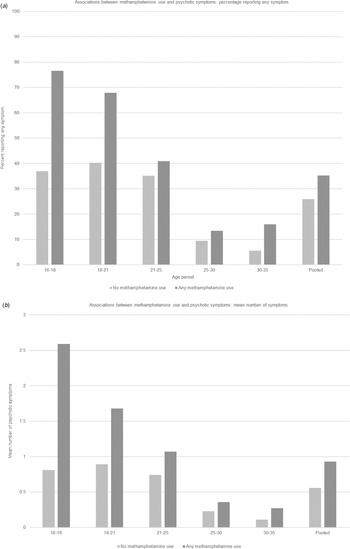
Figure 1 shows the cohort classified into those who reported using methamphetamine, and those who reported not using methamphetamine, for each of the five assessment periods. The figure shows the percentage who reported at least one symptom of psychosis, according to whether they had used methamphetamine or not (Panel A), and the mean number of symptoms reported for each group at each assessment period (Panel B). Finally, the figure also shows the pooled (population-averaged) percentage of those who reported at least one symptom of psychosis, and the pooled mean for each group, over the period 16–35 years. Cohort members who reported methamphetamine use were significantly (p < 0.0001) more likely to report at least one symptom of psychosis, and had significantly (p < 0.0001) elevated rates of symptoms as compared with those who reported no methamphetamine use. Rates of symptom reporting ranged from 1.2 to 2.9 times higher for those who reported methamphetamine use, and the number of symptoms reported ranged from 1.5 to 3.2 times higher among those who reported using methamphetamine.
(a) Associations between methamphetamine use and psychotic symtoms: percentage reporting any symptom, (b) associations between methamphetamine use and psychotic symtoms: mean number of symptoms

Associations between methamphetamine use and psychotic symptoms, before and after control for covariates
As noted in Methods, it could be argued that the associations between methamphetamine use and psychotic symptoms, as depicted in Fig. 1, may arise due to the potential influence of both (a) fixed factors measured in childhood and adolescence that confound the association between methamphetamine use and psychosis; and (b) by time-dynamic covariate factors that are related to both methamphetamine use and psychosis during the period of observation (ages 16–35; see online Supplementary Table S3 in the Online Supplementary Material for the associations between the covariates and both methamphetamine use and psychotic symptoms). In order to examine these issues, the fixed confounding factors and time-dynamic covariate factors described in Methods were entered into two GEE models. The first model was a logistic GEE predicting one or more symptoms of psychosis, and the second a negative binomial GEE predicting the count measure of the number of symptoms of psychosis. The models were fitted over three steps: unadjusted; adjusted for fixed confounding factors; and adjusted for both fixed confounding factors and time-dynamic covariate factors.
The results of these analyses are shown in Table 2, which displays estimates of the odds ratio (OR) and incidence rate ratio (IRR) for the associations between methamphetamine use and both the dichotomous and count measures of psychotic symptoms, for each of three levels of adjustment. The table shows:
1. Adjustment for childhood and adolescent fixed confounding factors had relatively little impact on the estimate of association between methamphetamine use and psychotic symptoms. For the dichotomous measure, the estimated OR increased somewhat, while for the count measure the increase was considerably smaller.
2. In Model 3, adding time-dynamic covariate factors to the model reduced the magnitude of the association between methamphetamine use and psychotic symptoms, but these remained statistically significant (p = 0.033, 0.030, respectively). After adjustment, the associations between methamphetamine use and psychotic symptoms were relatively small (OR = 1.33; IRR = 1.24), but detectable, suggesting that some portion of the association could not be accounted for by either confounding or time-dynamic covariation.
3. Examination of the scale*methamphetamine exposure interaction term revealed no evidence of a statistically significant interaction (p = 0.13), suggesting that the magnitude of the association between methamphetamine exposure and psychosis outcomes did not differ according to the scale used to measure these.
4. Estimation of the E-value for unmeasured confounding suggested that control of additional unmeasured confounding of an OR value of 1.571 (CI: 1.11) would render null the association between methamphetamine use and psychotic symptoms.
Odds ratios for the associations between methamphetamine use and psychotic symptoms, before and after adjustment for (a) confounding factors, and (b) time-dynamic covariate factors

Dose–response profile
Table 3 displays the lifetime (age 16–35) percentages of those experiencing at least one symptom of psychosis according to the lifetime (age 16–35) maximum methamphetamine use frequency, adjusted for fixed confounding factors (childhood family SES; gender; child IQ; anxiety disorder in adolescence; exposure to childhood physical and sexual abuse; affiliation with deviant peers; symptoms of attention deficit disorder in childhood and adolescence). There was evidence of a dose–response pattern: the odds ratios for psychotic symptoms among those with a history of at least weekly methamphetamine use was 2.85 (95%CI: 1.21, 6.69). Conversely, the odds of psychotic symptoms among less frequent users was only modestly elevated compared to non-users (odds ratios ~1.3), and was not statistically significant (p = 0.18, 0.25 respectively).

Sensitivity analyses
For the purposes of ascertaining the robustness of the present findings, the analyses above were repeated after omitting two of the most commonly reported SCL-90 items (‘having ideas or beliefs that others do not share’ and ‘never feeling close to another person’) which appear to lack some degree of face validity. The results of these sensitivity analyses were equivalent to those presented above.
Estimate of the population attributable fraction (PAF)
As noted in Methods, we estimated the population attributable fraction using the adjusted odds ratio from Model 2. This estimate suggested that methamphetamine exposure accounted for approximately 8.0% (95% CI: 2.2%–14.7%) of the psychosis symptomatology in the cohort.
Proximal/distal use of methamphetamine
Finally, the incidence of psychosis symptoms from age 30 to 35 was compared across three groups: those who have never used methamphetamine; those who used methamphetamine prior to age 30 but not during the period 30–35 years; and those who had used methamphetamine both prior to age 30, and during the period 30–35. These comparisons were performed on the full cohort, and again for only those who had reported at least one symptom of psychosis prior to age 30. The results of these comparisons are shown in Table 4. The comparisons show similar rates of reporting at least one symptom of psychosis for both the ‘never used’ and ‘used prior to age 30’ groups. However, those who had used methamphetamine both before age 35 and during the period 30–35 years had significantly (p < 0.05) higher rates of reporting at least one symptom of psychosis than either of the other groups (irrespective of prior history of psychotic symptomatology). These data suggest that psychotic symptoms are associated with recent, rather than historical methamphetamine use.
Percent reporting symptoms of psychosis, classified by past and current methamphetamine use, ages 30–35

a Mantel–Haenszel chi square test.
Discussion
The present study examined methamphetamine use and psychotic symptomatology in a New Zealand birth cohort born in 1977. Rates of both methamphetamine use and psychotic symptoms were high, with methamphetamine use peaking around age 25, and with self-reported use rates reflecting the comparatively high rates of use in New Zealand (Wilkins et al., Reference Wilkins, Sweetsur and Griffiths2017). The analyses showed that methamphetamine use was associated with an elevated risk of psychotic symptoms in this sample. However, after accounting for confounding factors including the concurrent use of other substances, the size of this effect was modest. This was because the increased risk of psychosis was concentrated in a small group (about 5% of the sample) who had ever used methamphetamine at least weekly. This finding is consistent with the known relationship between methamphetamine use frequency and psychosis risk (Arunogiri, Foulds, McKetin, & Lubman, Reference Arunogiri, Foulds, McKetin and Lubman2018). Overall, we estimated that about 8% of the burden of psychotic symptoms in the population is explained by exposure to methamphetamine.
Ours is the first longitudinal study to examine the role of methamphetamine as a risk factor for psychosis in a general population cohort. The size of the unadjusted association between any use of methamphetamine and the presence of psychosis in the present study is consistent with the existing literature, most of which comes from samples with a higher baseline risk of psychosis than the general population. However, our findings suggest the effect of methamphetamine on psychotic symptoms is modest after accounting for the role of other psychosis risk factors, including use of other substances and trauma exposure (Bell, Foulds, Horwood, Mulder, & Boden, Reference Bell, Foulds, Horwood, Mulder and Boden2019; Fergusson et al., Reference Fergusson, Horwood and Swain-Campbell2003). While we were able to show a dose-response relationship, our sample did not contain enough very heavy methamphetamine users to show the large effects on psychosis which have been previously been shown among people who are using methamphetamine almost daily (McKetin et al., Reference McKetin, Lubman, Baker, Dawe and Ali2013).
It is well established that methamphetamine use is associated with a dose-dependent increase in psychotic symptoms (McKetin et al., Reference McKetin, Lubman, Baker, Dawe and Ali2013), and this is consistent with the known effects of repeated methamphetamine administration on dopaminergic functioning in the brain. Psychotic symptoms typically resolve once methamphetamine use ceases (McKetin, Reference McKetin2018), but in a subset of people they may persist, leading to a clinical syndrome which closely resembles schizophrenia (Lappin et al., Reference Lappin, Sara and Farrell2017). We did not find evidence for long-term persistence of psychotic symptoms among people with frequent methamphetamine use. However, this analysis was derived from a small number of participants who had used methamphetamine at least weekly then stopped, so it is possible this phenomenon does exist but is uncommon in the general population.
This transient effect of methamphetamine on psychosis risk stands in contrast to that seen for cannabis use, where the drug is more clearly related to the development to persistent psychotic symptoms (Kuepper et al., Reference Kuepper, van Os, Lieb, Wittchen, Hofler and Henquet2011) and the subsequent risk of schizophrenia (Vaucher et al., Reference Vaucher, Keating, Lasserre, Gan, Lyall, Ward and Holmes2018). In terms of overall risk, the effects we found for methamphetamine use (adjusted odds ratio 1.3 (95% CI 1.0–1.7) for any methamphetamine use and 2.9 (1.2–6.7) for at least weekly use) are at least comparable to those seen for cannabis. For example, the pooled adjusted odds for psychosis associated with cannabis use in prospective population cohorts is 1.4 (95% CI 1.2–1.7) (Vaucher et al., Reference Vaucher, Keating, Lasserre, Gan, Lyall, Ward and Holmes2018), and the adjusted odds for cannabis dependence in this cohort (using a similar study approach) was 1.8 (95% CI 1.2–2.6) (Fergusson et al., Reference Fergusson, Horwood and Swain-Campbell2003).
The main strength of this study is its ability to account for the effect of a large range of confounding factors, which most previous studies have not accounted for, although we cannot exclude potential unmeasured confounding. The chief limitation was the use of two different psychosis outcome measures over the course of follow up. We attempted to address this limitation by analysing outcome data as both dichotomous and count measures, and secondly, including an interaction term in models which represented the measure used, to rule out the likelihood that the strength of association varied depending upon the measure used. The high prevalence of psychotic symptoms, particularly in the first three age periods in which the SCL-90 psychoticism subscale was used, raises the question of whether these were ‘true’ psychotic experiences. The SCL-90 psychoticism scale includes some items, for example ‘feeling lonely with others’ which arguably do not capture genuine psychotic experiences. A further limitation is that this study comprises a sample born in one location in one year, which may limit generalizability. People with psychotic symptoms, particularly paranoid ideas, are less likely to be retained in this type of study, which may have introduced non-response bias. Lastly, methamphetamine use and psychotic symptoms were both relatively uncommon outcomes in this cohort, particularly in later age periods. This sparseness constrained the types of models which could be fitted to the data, and did not allow for causal modelling. Combined analysis of multiple cohorts, as previously undertaken for some cannabis-related outcomes (e.g. Horwood et al., Reference Horwood, Fergusson, Hayatbakhsh, Najman, Coffey, Patton and Hutchinson2010) would help overcome this limitation.
Our findings suggest that public health policy aimed at decreasing the morbidity from psychosis should include strategies to target people who use methamphetamine frequently. These strategies might include demand reduction, supply reduction, and lowering barriers to accessing treatment. Harm minimization strategies which aim to help methamphetamine users to reduce their frequency of use may also be worthwhile, given the evidence of a dose–response relationship between methamphetamine use and psychotic symptoms shown in this study, and previous ones (Arunogiri et al., Reference Arunogiri, Foulds, McKetin and Lubman2018). As most people in the general population who are using methamphetamine are not in contact with specialized mental health or addiction treatment agencies, there is a need for mental health literacy about psychotic symptoms in this group. In particular, people who use methamphetamine frequently and their support persons need to be able to recognize psychotic symptoms and their associated risks, and to know when and how to access help. Agencies who come into contact with people who use methamphetamine including primary care and law enforcement should also be aware that these people may be experiencing psychotic symptoms, including persecutory ideas. The presence of these symptoms and the fear and mistrust they bring about often shapes interactions with these agencies. Law enforcement agencies in particular should be aware that their response to these people (who may at times be suspicious, fearful or inclined to misinterpret events in their environment) can inadvertently reinforce psychotic symptoms or exacerbate risks such as violence or suicidal behaviour.
In conclusion, methamphetamine use is an independent risk factor for psychosis in the general population. An increased risk of psychosis is largely concentrated among people who have used at least weekly. Public health strategies aiming to reduce the burden of psychosis attributable to methamphetamine should focus on people who use the drug frequently, and should emphasize reducing frequency of use as a harm minimization strategy.
Supplementary material
The supplementary material for this article can be found at https://doi.org/10.1017/S0033291721002415.
Financial support
The CHDS is funded by the Health Research Council of New Zealand (Programme Grant 16/600)
Conflict of interest
The authors report no conflicts of interest.
Ethical standards
The authors assert that all procedures contributing to this work comply with the ethical standards of the relevant national and institutional committees on human experimentation and with the Helsinki Declaration of 1975, as revised in 2008.