Introduction
Deficits in cognitive control are a hallmark across a variety of mental disorders (McTeague et al., Reference McTeague, Huemer, Carreon, Jiang, Eickhoff and Etkin2017; McTeague, Goodkind, & Etkin, Reference McTeague, Goodkind and Etkin2016). A key component in cognitive control is to actively and consistently monitor and adjust one's performance outcome in order to keep the behaviors in an orderly and correct way. Such active cognitive adjustment, in particular following the occurrence of a conflict or error, plays an essential role in maintaining goal-directed behaviors such as learning (Holroyd & Coles, Reference Holroyd and Coles2002; Taylor & Ivry, Reference Taylor and Ivry2014), planning (Taylor & Ivry, Reference Taylor and Ivry2014), and the coordination of movement, language, and thought (Peterburs & Desmond, Reference Peterburs and Desmond2016; Wagner & Luo, Reference Wagner and Luo2020). Among many common mental disorders such as schizophrenia (Barch & Sheffield, Reference Barch and Sheffield2017; Kerns et al., Reference Kerns, Cohen, MacDonald, Johnson, Stenger, Aizenstein and Carter2005), attention deficit hyperactivity disorder (ADHD) (Balogh & Czobor, Reference Balogh and Czobor2016; Janssen, van Atteveldt, & Oosterlaan, Reference Janssen, van Atteveldt and Oosterlaan2020), and obsessive-compulsive disorder (Endrass et al., Reference Endrass, Schuermann, Kaufmann, Spielberg, Kniesche and Kathmann2010; Liu, Gehring, Weissman, Taylor, & Fitzgerald, Reference Liu, Gehring, Weissman, Taylor and Fitzgerald2012), aberrant post-conflict and post-error cognitive processing has been hypothesized as a core contributor to their behavioral anomalies and clinical symptoms, making the understanding of neural substrates underlying such deficits extremely critical to penetrate the pathophysiology of major psychiatric disorders.
Using a stop-signal task and a relatively large sample of healthy subjects, we have previously shown that post-success and post-error cognitive controls are associated with distinct neurobiological mechanisms particularly in relation to the prefrontal-cerebellar circuitry (Cao & Cannon, Reference Cao and Cannon2021). In particular, during ‘go’ trials immediately following a successful stop, significant excitatory bottom-up connectivity from the cerebellum to the lateral prefrontal cortex was present, while top-down connectivity from the lateral prefrontal cortex to the cerebellum was inhibited. By contrast, during ‘go’ trials immediately following an unsuccessful stop, the top-down prefrontal-cerebellar connectivity was positively enhanced, suggesting a dynamic cognitive adjustment mechanism underpinning behavioral flexibility via the modulation of prefrontal-cerebellar interactions.
Dysfunction in both the prefrontal cortex and cerebellum has long been implicated in psychopathology. In particular, reduced gray matter and altered functional connectivity in the prefrontal cortex appear to be highly robust biomarkers for transdiagnostic risk for psychiatric disorders (Elliott, Romer, Knodt, & Hariri, Reference Elliott, Romer, Knodt and Hariri2018; McTeague et al., Reference McTeague, Huemer, Carreon, Jiang, Eickhoff and Etkin2017; Romer et al., Reference Romer, Elliott, Knodt, Sison, Ireland, Houts and Melzer2021), which per se is strongly associated with cognitive deficits (McTeague et al., Reference McTeague, Huemer, Carreon, Jiang, Eickhoff and Etkin2017). Similarly, in recent studies using data from large imaging consortia, decreased cerebellar volume has been shown as the most prominent brain structural alterations in patients with schizophrenia (Moberget et al., Reference Moberget, Doan, Alnaes, Kaufmann, Cordova-Palomera and Lagerberg2018) and may also relate to general psychopathology (Moberget et al., Reference Moberget, Alnæs, Kaufmann, Doan, Córdova-Palomera, Norbom and Westlye2019; Romer et al., Reference Romer, Knodt, Houts, Brigidi, Moffitt, Caspi and Hariri2018). Moreover, mounting studies have pointed to an altered functional interaction between the prefrontal cortex and cerebellum in disorders such as schizophrenia (Andreasen, Paradiso, & O'Leary, Reference Andreasen, Paradiso and O'Leary1998; Brady et al., Reference Brady, Gonsalvez, Lee, Ongur, Seidman, Schmahmann and Halko2019; Cao et al., Reference Cao, Chen, Chung, Forsyth, McEwen, Gee and Cannon2018, Reference Cao, Wei, Hu, Zhang, Xiao, Zeng and Gong2021; Cao & Cannon, Reference Cao and Cannon2019), which possibly stands for a causal mechanism for the pathogenesis (Brady et al., Reference Brady, Gonsalvez, Lee, Ongur, Seidman, Schmahmann and Halko2019). These lines of evidence raise the hypothesis that abnormal communications between the prefrontal cortex and cerebellum during post-error cognitive adjustment may underlie major psychiatric disorders.
We tested this idea in the present study using data acquired from the Consortium for Neuropsychiatric Phenomics [CNP (Poldrack et al., Reference Poldrack, Congdon, Triplett, Gorgolewski, Karlsgodt, Mumford and Bilder2016)]. A total of 136 patients with three diagnosed disorders [schizophrenia (SZ), bipolar disorder (BD), and ADHD] and 89 healthy controls were included, and all participants underwent a stop-signal task. Here, we specifically asked the question as whether individuals with diagnosed mental disorders would show different connectivity patterns in regard to the prefrontal-cerebellar circuitry during post-success and post-error cognitive controls. Following the procedure of our previously published work (Cao & Cannon, Reference Cao and Cannon2021), we started by between-group comparisons of brain activation patterns for post-success and post-error trials. After confirming the activations of the prefrontal cortex and cerebellum, dynamic causal modeling (DCM) was further employed to examine how effective connectivity between these two regions would dynamically change to support cognitive adjustment in patients and controls. We posited significant alterations in the prefrontal-cerebellar circuitry in patients, which may be particularly evident in disorders characterized by more severe executive functioning impairment such as SZ and ADHD.
Methods
Subjects
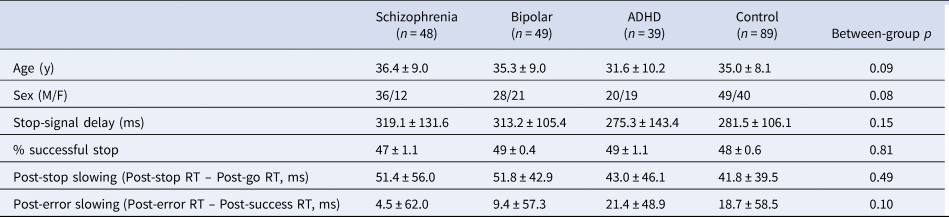
The data used in this study were collected by the Consortium for Neuropsychiatric Phenomics (CNP) and were publicly available (https://openneuro.org/datasets/ds000030). In this study, a total of 48 patients with SZ, 49 patients with BD, 39 patients with ADHD, and 89 healthy subjects were drawn from the dataset. The control subjects were selected from a larger sample in order to match the patients in terms of demographics and behavioral performance (stop-signal delay, post-stop and post-error slowing, see Table 1), thereby mitigating potential confounding factors that would complicate the interpretation of the results. The patients were diagnosed based on the Structured Clinical Interview for DSM-IV and Adult ADHD Interview, and healthy participants were excluded if they had a life-time diagnosis of an Axis-I psychiatric disorder. For details of this public dataset see previous publications (Gorgolewski, Durnez, & Poldrack, Reference Gorgolewski, Durnez and Poldrack2017; Poldrack et al., Reference Poldrack, Congdon, Triplett, Gorgolewski, Karlsgodt, Mumford and Bilder2016). All participants provided written informed consent following protocols approved by the Institutional Review Board at the University of California, Los Angeles.
Characteristics of the studied sample

fMRI paradigm
Each participant completed a stop-signal task to evaluate cognitive control functioning during fMRI scans [details see Poldrack et al. (Poldrack et al. Reference Poldrack, Congdon, Triplett, Gorgolewski, Karlsgodt, Mumford and Bilder2016)]. In brief, the subjects were instructed to press either a left or right button according to the arrow directionality shown on the screen, but to withhold the response when they heard a ‘stop-signal’ tone. The stop-signal delay (time interval between the arrow and the stop signal) was tailored for each individual so that all participants would successfully inhibit on approximately half of the stop trials. A total of 96 go trials and 32 stop trials were performed during the task based on an event-related design. The effects of post-stop and post-error cognitive adjustments were assessed by post-stop slowing (reaction time of post-stop trials minus reaction time of post-go trials) and post-error slowing (reaction time of post-error trials minus reaction time of post-success trials), respectively.
Data acquisition
The fMRI data were acquired using EPI sequence on 3 T Siemens Trio scanner (TR = 2 s, TE = 30 ms, flip angle = 90°, matrix = 64 × 64, FOV = 192 mm, slice thickness = 4 mm, and 34 slices). High-resolution T1-weighted images were acquired using MPRAGE sequence (TR = 1.9 s, TE = 2.26 ms, FOV = 250 mm, matrix = 256 × 256, slice thickness = 1 mm, and 176 slices).
Data preprocessing
Imaging data preprocessing was performed using the standard pipeline implemented in the Statistical Parametric Mapping software (SPM12, https://www.fil.ion.ucl.ac.uk/spm/), including slice-time correction, motion realignment, registration to individual T1-weighted structural images, and spatial normalization to the Montreal Neurological Institute (MNI) template. The normalized images were smoothed with an 8 mm full-width at half-maximum (FWHM) Gaussian kernel. To mitigate potential head motion effects, we calculated frame-wise displacements (FD) for each individual based on the previous definition (Power et al., Reference Power, Mitra, Laumann, Snyder, Schlaggar and Petersen2014), and excluded those with an average FD > 0.3 mm during the scan. This led to the rejection of two schizophrenia patients, two bipolar patients, and one healthy participant.
Brain activation analysis
The analysis for brain activations during post-success and post-error cognitive controls followed our previous publication (Cao & Cannon, Reference Cao and Cannon2021). Specifically, trials during the task were classified into five categories: (1) ‘successful stop’ trials; (2) ‘unsuccessful stop’ trials; (3) ‘post-success’ trials (i.e. ‘go’ trials immediately following a successful stop); (4) ‘post-error’ trials (i.e. ‘go’ trials immediately following an unsuccessful stop); and (5) ‘post-go’ trials (i.e. ‘go’ trials immediately following another ‘go’ trial). The concurrent cognitive control was subsequently estimated by contrasting ‘successful stop’ and ‘unsuccessful stop’ trials v. ‘go’ trials. The post-success cognitive control effect was assessed by contrasting ‘post-success’ trials v. ‘post-go’ trials, and the post-error cognitive control effect was assessed by contrasting ‘post-error’ trials v. ‘post-go’ trials (Cao & Cannon, Reference Cao and Cannon2021).
In doing so, general linear models were conducted for each individual where the five types of trials were included as regressors after convolved with the canonical hemodynamic response function. Additionally, the 24 head motion parameters (i.e. the 6 rigid-body parameters generated from the realignment step, their first derivatives, and the squares of these 12 parameters) and the FD at each time point were also included in the model to control potential head motion effects. The resulting individual contrast images were then entered into second-level group analysis to examine significantly activated regions for each contrast using random-effects models, with group as the variable of interest and age, sex, and FD as covariates. Statistical significance was set at p < 0.05 after family-wise error (FWE) correction across all voxels in the brain.
Dynamic causal modeling
To evaluate the dynamic interactions between the prefrontal cortex and cerebellum during post-success and post-error trials, DCM was employed to quantify effective connectivity between the two regions. Here, regions of interest (ROIs) were defined with two steps following our previous procedure (Cao & Cannon, Reference Cao and Cannon2021). First, at the group level, we extracted the activated clusters peaked in the right prefrontal cortex and left cerebellum from the group contrast maps. The cluster of the prefrontal cortex was then superimposed on an anatomical mask of Brodmann areas 9/46, and the cluster of the cerebellum was superimposed on an anatomical mask of the left cerebellum. The overlaps between the functional clusters and the anatomical masks were subsequently extracted as group-level ROIs. Second, at the individual level, we searched for subject-specific peak voxels within the group-level ROIs during each contrast. Individualized ROIs were subsequently defined by drawing a 5 mm radius sphere around the peak voxels, and the time series for each individualized ROIs were obtained. The time series were further corrected for 24 head motion parameters and FD, and were used for further DCM analysis.
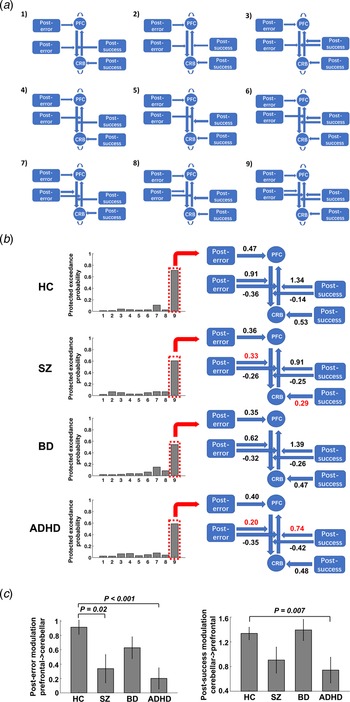
For the three dynamics modeled by DCM (intrinsic connectivity, driving input, modulatory effect), we here were particularly interested in the modulatory effects of post-success and post-error cognitive controls on the effective connectivity of the prefrontal-cerebellar circuit. Therefore, we fixed the other two dynamics in our DCM models based on prior findings (Cao & Cannon, Reference Cao and Cannon2021) as well as the results in the present sample (Fig. 2). In particular, bidirectional intrinsic connectivity between the two regions was modeled. In addition, driving input to the prefrontal cortex was modeled during post-error and driving input to the cerebellum was modeled during post-success. In terms of modulatory effect, three possibilities were considered for each condition (i.e. the effect on top-down connectivity from the prefrontal cortex to the cerebellum, the effect on bottom-up connectivity from the cerebellum to the prefrontal cortex, and effects on both top-down and bottom-up connectivity), thereby generating a total of 3 × 3 = 9 models for each individual. An illustration for all defined models is present in Fig. 3a.
The likelihood of the nine defined models was estimated using random-effects Bayesian model selection (Stephan, Penny, Daunizeau, Moran, & Friston, Reference Stephan, Penny, Daunizeau, Moran and Friston2009), which essentially compares model evidence based on a trade-off between model accuracy and model complexity, given the present data. Here, the optimal models for each of the four studied groups were determined by the protected exceedance probability, which quantifies the probability that one model is more likely than others in the comparison set, corrected for an overconfidence bias. Since the optimal model structure may differ between individuals and groups, Bayesian model averaging was used to quantify model parameters at the individual level, which is effective to account for between-subject heterogeneity (Stephan et al., Reference Stephan, Penny, Moran, den Ouden, Daunizeau and Friston2010). Here, model parameters were determined by weighted averages across the entire comparison set, where the weights were decided by the posterior probability of each model. The derived model parameters were then subjected to group-level analysis using one-way ANCOVA, where group was modeled as the variable of interest, controlling for age, sex, and FD. Significance was determined at p < 0.05 after FWE correction for all examined parameters.
Correlational analysis with behavioral and clinical data
To understand the behavioral correlates of the calculated model parameters, partial correlational analysis was performed to associate model parameters with post-stop and post-error slowing, measures quantifying cognitive adjustment effects during the stop-signal task. Clinical correlations were conducted on the total scores of the Brief Psychiatric Rating Scale (BPRS). Age and sex were controlled in both analyses as covariates.
Results
Brain activations during concurrent and post-stop cognitive controls
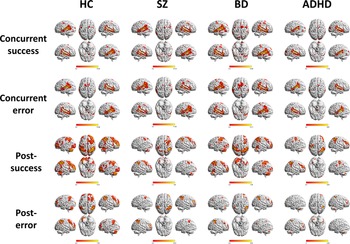
Same as the results in the previous work (Cao & Cannon, Reference Cao and Cannon2021), we observed distinct neural mechanisms related to concurrent and post-stop cognitive processing, which was consistent in both healthy subjects and patients. Specifically, both concurrent successful and unsuccessful cognitive controls significantly activated the cingular-opercular network, in particular the dorsal anterior cingulate cortex (dACC), insula, superior temporal gyrus, as well as the secondary motor and visual cortices. By contrast, both post-success and post-error cognitive controls significantly activated the frontoparietal network including the prefrontal cortex and posterior patrial cortex, together with the posterior cerebellum (Fig. 1). For locations of activated regions during these conditions, see previously published paper (Cao & Cannon, Reference Cao and Cannon2021). Importantly, the activation maps were in high consistency across all studied groups, and no significant differences were observed in any patient groups compared with controls after correction across all voxels in the brain. The result remained nonsignificant when only corrected for voxels within the prefrontal cortex and cerebellum.
Activation maps for concurrent, post-success, and post-error cognitive controls in the four studied groups. Consistent with our prior work (Cao & Cannon, Reference Cao and Cannon2021), both concurrent successful and concurrent erroneous trials significantly activated the cingular-opercular network, while both post-success and post-error trials significantly activated the frontoparietal network and posterior cerebellum. However, no significant between-group differences were identified. For presentation purpose, the maps were thresholded at cluster-level p < 0.001, with voxel size > 20.

Associations between concurrent and post-stop activations
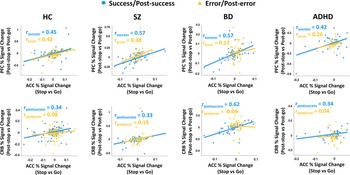
We have previously shown a double dissociation for post-success and post-error cognitive controls in healthy individuals (Cao & Cannon, Reference Cao and Cannon2021). Specifically, during successful trials, concurrent regional activations were significantly correlated with ensuing post-success activations in both the prefrontal cortex and cerebellum, while such correlations were only present for the prefrontal cortex but not the cerebellum during erroneous trials. To investigate whether these observations would generalize to clinical populations, we calculated the percent signal changes in ACC during concurrent success and concurrent error trials and percent signal changes in prefrontal cortex and cerebellum during post-success and post-error trials, separately for each of the four studied groups. We found that the disassociated correlations could still be detected between ACC and cerebellum in all groups (r > 0.33, p < 0.03 for successful trials and r < 0.19, p > 0.20 for erroneous trials, respectively). For correlations between ACC and prefrontal cortex, significance was detected for successful trials across all groups (r > 0.42, p < 0.007), and for erroneous trials in healthy subjects and patients with SZ (r > 0.38, p < 0.009, Fig. 2). These findings suggest that the previously detected correlational dissociations in healthy individuals could to a large degree generalize to patients with psychiatric disorders, in particular between ACC and cerebellum. As such, we modeled the post-success driving input to the cerebellum and post-error driving input to the prefrontal cortex in the subsequent DCM analysis, which is commensurate with the results in our prior publication (Cao & Cannon, Reference Cao and Cannon2021).
Associations between ACC activity during concurrent cognitive control and prefrontal and cerebellar activities during post-stop cognitive control. Upper panel: Significant correlations between ACC and prefrontal cortex were found for both successful and erroneous trials in healthy subjects and patients with SZ, and for successful trials in patients with BD and ADHD. Lower panel: Significant correlations between ACC and cerebellum were only observed for successful trials but not erroneous trials in all groups.

Prefrontal-cerebellar effective connectivity during post-stop cognitive control
The DCM analysis identified the same winning model for all four groups (protected exceedance probability > 0.54, Fig. 3b). Specifically, the winning model demonstrated modulatory effects on both top-down (prefrontal->cerebellar) and bottom-up (cerebellar->prefrontal) connectivity during both post-success and post-error cognitive controls. Similar to our prior findings (Cao & Cannon, Reference Cao and Cannon2021), during post-success trials, the bottom-up connectivity from the cerebellum to the prefrontal cortex was positively modulated (i.e. excited), while the top-down connectivity from the prefrontal cortex to the cerebellum was negatively modulated (i.e. inhibited). By contrast, the exact opposite effects were detected during post-error trials- that the bottom-up connectivity from the cerebellum to the prefrontal cortex was inhibited while the top-down connectivity from the prefrontal cortex to the cerebellum was excited. In comparison of model parameters between groups, we observed significant group differences in the modulation of cerebellar->prefrontal connectivity during post-success processing and prefrontal->cerebellar connectivity during post-error processing (pFWE = 0.04 and 0.02, respectively). The post-hoc tests further revealed that the observed differences were particularly driven by reduced post-success modulation on cerebellar->prefrontal connectivity in ADHD (p = 0.007), and by reduced post-error modulation on prefrontal->cerebellar connectivity in both ADHD and SZ (p < 0.02, Fig. 3c). In addition, we also observed significant group differences in the driving input to the cerebellum during post-success (pFWE = 0.04), which was driven by reduced input in patients with SZ (p = 0.001).
Prefrontal-cerebellar effective connectivity during post-success and post-error cognitive controls as revealed by DCM. (a) A total of nine models were defined based on previous work (Cao & Cannon, Reference Cao and Cannon2021) and present results shown in Fig. 2. Modulatory effects on top-down connectivity (prefrontal->cerebellum), bottom-up connectivity (cerebellum->prefrontal), and both directionalities were examined for both conditions. (b) The DCM analysis revealed the same winning model for all groups. The winning model showed modulatory effects on both top-down and bottom-up connectivity between the prefrontal cortex and cerebellum during both conditions. In comparison of model parameters with healthy control subjects, significantly reduced modulatory effects on top-down connectivity from the prefrontal cortex to cerebellum during post-error processing were found in patients with SZ and ADHD. Moreover, patients with ADHD were also associated with significantly decreased modulatory effect on bottom-up connectivity from the cerebellum to the prefrontal cortex during post-success processing. Parameters with significant differences compared to healthy subjects were marked in red. (c) Bar plots of model parameters with significant group differences. Error bars indicate standard errors.

Behavioral and clinical correlates of model parameters
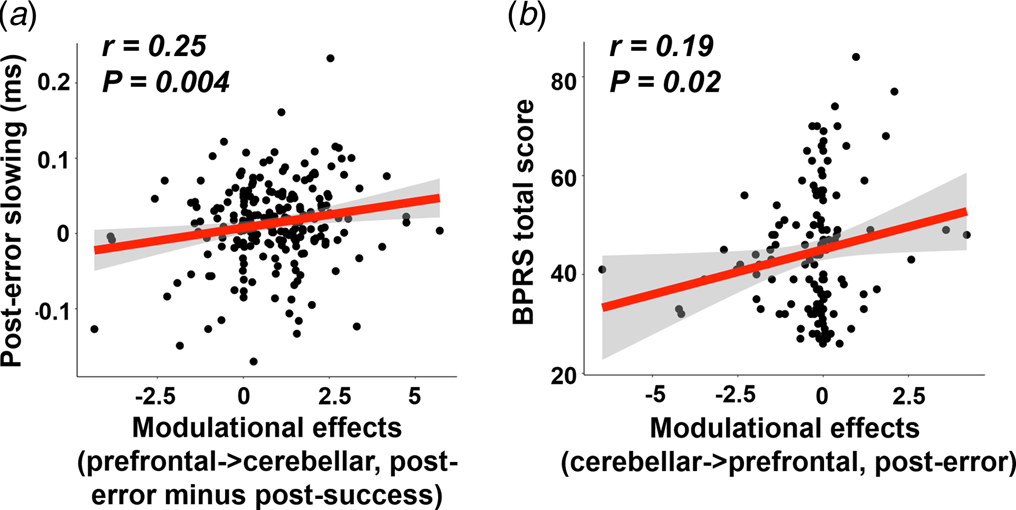
Based on the results above, we calculated the modulational differences between post-success and post-error on top-down and bottom-up connectivity (i.e. model parameters during post-error minus model parameters during post-success) for each subject, which essentially reflect the magnitudes of modulational changes on the prefrontal-cerebellar connectivity when switching from a post-success condition to a post-error condition. Here, we observed a significant correlation between modulational changes on top-down prefrontal->cerebellar connectivity and post-error slowing (r = 0.25, p = 0.004, Fig. 4a). No significant correlations were found between modulational changes on cerebellar->prefrontal connectivity and behavioral measures of the task.
Association of DCM model parameters with task performance and clinical symptom. Significant positive correlations were observed between modulational differences on prefrontal->cerebellar connectivity (post-error minus post-success) and post-error slowing (Panel A), and between post-error modulational effects on cerebellar->prefrontal connectivity and BPRS total scores (Panel B).

When associating model parameters with clinical symptoms, we found a significant correlation between post-error modulation on cerebellar->prefrontal connectivity and BPRS scores (r = 0.19, p = 0.02, Fig. 4b), suggesting that higher positive (i.e. less inhibitory) modulations on bottom-up connectivity during post-error processing are associated with more severe symptoms.
Discussion
This study tested the hypothesis that people with psychiatric disorders were associated with altered connectivity pattern in the prefrontal-cerebellar circuitry during post-success and post-error cognitive controls. Using a stop-signal task, we demonstrated that (1) Similar to healthy subjects, the cingular-opercular network was actively involved in concurrent stop trials while the prefrontal-cerebellar circuitry was actively involved in post-success and post-error trials in patients; (2) For both healthy subjects and patients, the concurrent activity of ACC was significantly correlated with the post-stop activity of cerebellum during successful trials but not erroneous trials; and (3) While the connectivity pattern of the circuitry was qualitatively similar across groups, markedly quantitative differences in model parameters were shown during post-success and post-error cognitive controls in patients. In particular, significantly attenuated post-error modulation of top-down connectivity was evident in SZ and ADHD, and significantly reduced post-success modulation of bottom-up connectivity was present in ADHD, suggesting loss of sufficient connectivity dynamics for post-stop cognitive adjustments in the prefrontal-cerebellar circuitry in patients.
To begin with, the present study not only replicates our previous finding for double dissociation of concurrent and post-stop cognitive processing (Cao & Cannon, Reference Cao and Cannon2021), but also extends such finding to multiple clinical populations. The lack of significant differences in brain activations during post-success and post-error trials in patients suggests relatively intact engagement of these systems after the occurrence of a conflict or error. In other words, both healthy participants and patients are able to utilize the frontoparietal system and cerebellum in the aim of solving a prior conflict or error and adjusting one's behavior. This is consistent with a previous report that similar activations in the prefrontal cortex, parietal cortex, and cerebellum during conflict processing were shown in patients with schizophrenia compared with controls, albeit with a different task (Becerril & Barch, Reference Becerril and Barch2013). This also broadly agrees with the prevailing notion that the frontoparietal network and cerebellum are key systems in monitoring behaviors on a trial-to-trial basis in order to adjust the outcome performance (Dosenbach et al., Reference Dosenbach, Fair, Miezin, Cohen, Wenger, Dosenbach and Petersen2007; Dosenbach, Fair, Cohen, Schlaggar, & Petersen, Reference Dosenbach, Fair, Cohen, Schlaggar and Petersen2008; Peterburs & Desmond, Reference Peterburs and Desmond2016; Schmahmann, Reference Schmahmann2019; Wagner & Luo, Reference Wagner and Luo2020). It is thus likely that the involvement of these systems maintains to be active in major mental disorders characterized by cognitive deficits.
The active and simultaneous engagement of the prefrontal cortex and cerebellum during post-success and post-error processing in all studied groups suggests that these two regions are likely to be interacted in a certain way to subserve dynamic behavioral adjustment, and such interactions may be commonly shared across different populations. In line with this assumption, both patients and controls showed positive modulations of connectivity from the cerebellum to the prefrontal cortex during post-success and from the prefrontal cortex to the cerebellum during post-error, which is also in high consistency with our past findings (Cao & Cannon, Reference Cao and Cannon2021). The excitatory bottom-up connectivity and inhibitory top-down connectivity during post-success control may indicate an ensuing feedback from the cerebellum to the prefrontal cortex, conferring a ‘safety’ or ‘go’ signal after comparing the preceding outcome with the prior expectation, thereby suppressing unnecessary interruptions from the higher-order cortex and solidating the consistency of ongoing responses (Cao & Cannon, Reference Cao and Cannon2021; Strick, Dum, & Fiez, Reference Strick, Dum and Fiez2009; Taylor & Ivry, Reference Taylor and Ivry2014; Wagner & Luo, Reference Wagner and Luo2020). In contrast, the excitatory top-down connectivity and inhibitory bottom-up connectivity during post-error control may in turn signify a strengthened influence of the prefrontal cortex on the cerebellum given the prior failure, in order to command or instruct the cerebellum for error solution and behavioral adjustment (Cao & Cannon, Reference Cao and Cannon2021; Strick et al., Reference Strick, Dum and Fiez2009; Taylor & Ivry, Reference Taylor and Ivry2014; Wagner & Luo, Reference Wagner and Luo2020). This interpretation is substantiated by the observed behavioral correlates, where individuals with a larger degree of modulational change in the top-down connectivity from post-success to post-error showed longer response slowing and thus stronger effect in cognitive adjustment. This is also consistent with the detected association between post-error modulation on bottom-up connectivity and clinical symptoms, which may suggest that insufficient inhibition of cerebellar autonomy during post-error relates to stronger deviation from normal behaviors.
Under this interpretation framework, decreased positive modulation on prefrontal->cerebellar connectivity during post-error trials is likely to imply attenuated instructive or guiding signals for the top-down cognitive adjustment in patients with SZ and ADHD, possibly due to dysfunction in prefrontal output and/or cerebellar input. For one, a large number of EEG studies in the literature have revealed reduced error-related negativity (ERN) and/or error positivity (Pe) in both disorders (Balogh et al., Reference Balogh, Kakuszi, Papp, Tombor, Bitter and Czobor2017; Bates, Kiehl, Laurens, & Liddle, Reference Bates, Kiehl, Laurens and Liddle2002; Bellato et al., Reference Bellato, Norman, Idrees, Ogawa, Waitt, Zuccolo and Shephard2021; Ehlis, Deppermann, & Fallgatter, Reference Ehlis, Deppermann and Fallgatter2018; Foti, Kotov, Bromet, & Hajcak, Reference Foti, Kotov, Bromet and Hajcak2012; Herrmann et al., Reference Herrmann, Mader, Schreppel, Jacob, Heine, Boreatti-Hümmer and Fallgatter2010; Llerena, Wynn, Hajcak, Green, & Horan, Reference Llerena, Wynn, Hajcak, Green and Horan2016; Mathalon et al., Reference Mathalon, Fedor, Faustman, Gray, Askari and Ford2002), which have been proposed as a reflection of functional disturbances in error monitoring in the ACC and subsequent recruitment of the prefrontal cortex for error solution (Botvinick, Cohen, & Carter, Reference Botvinick, Cohen and Carter2004; Carter & van Veen, Reference Carter and van Veen2007). Therefore, such disturbances would plausibly affect the output of the prefrontal cortex, generating insufficient top-down control over the cerebellum to further adjust one's behavior. For another, since cerebellar structural abnormalities are widely implicated in the risk for these disorders (Moberget et al., Reference Moberget, Alnæs, Kaufmann, Doan, Córdova-Palomera, Norbom and Westlye2019; Romer et al., Reference Romer, Knodt, Houts, Brigidi, Moffitt, Caspi and Hariri2018), diminished top-down modulation may also reflect impaired cerebellar functional input resulted from structural changes. In terms of post-success condition, both reduced positive modulation on cerebellar->prefrontal connectivity in ADHD and reduced driving input to the cerebellum in SZ may reflect performance monitoring deficits in the cerebellum, thereby lacking continuous bottom-up feedback for the behavioral accuracy and bringing difficulty to stabilize the ongoing responses. Such interrupted feedback may relate to the cerebellar dysfunction per se, but could also stand for a downstream effect of attentional deficit in the disorders (Haarmeier & Thier, Reference Haarmeier and Thier2007). Notably, all these findings were detected in patient samples that were well-matched with controls in task performance, thereby precluding the possibility that the observed modulational changes are simply recapitulations of different degrees in error awareness, cognitive effort, and/or attentional engagement during the task. Instead, such changes may reflect a pathophysiological anomaly related to the disorders per se.
Having said that, it should be noted that the sample examined in this work only included chronic patients with long-term illness and medication, and therefore whether the observed findings would somehow relate to disease chronicity and treatment is unclear. Future studies with larger samples at an early stage of the disorders are certainly required to further replicate these results. In addition to the sample feature, the present observations were also based on a typical stop-signal task using fMRI. While other imaging modalities (such as EEG) and other task paradigms (such as a Stroop task) have been widely used in the literature to study conflict and error processing effects, whether and how our findings would be generalized to and incorporated with other imaging modalities and paradigms is an open question worthy of further investigation. Both of these limitations could possibly relate to the negative findings in patients with BD, as deficits in executive functioning are more relevant to the mania phase in bipolar disorder (Dixon, Kravariti, Frith, Murray, & McGuire, Reference Dixon, Kravariti, Frith, Murray and McGuire2004). It is possible that the lack of significant results in BD is due to the specific sample and fMRI paradigm.
In sum, using a stop-signal task and DCM, we found initial evidence for decreased modulations of post-success and post-error cognitive controls on the prefrontal-cerebellar circuit in SZ and ADHD. The findings in this study highlight altered neural processing during cognitive adjustment in major psychiatric disorders, and suggest that disrupted dynamic interactions between the prefrontal cortex and cerebellum may underlie their cognitive impairments.
Acknowledgements
This work is supported by faculty start-up funds in the Feinstein Institutes for Medical Research. The author would like to thank the PIs in the Consortium for Neuropsychiatric Phenomics for data sharing.
Conflict of Interest
The author reports no conflicts of interest.