Standardized care protocols, including clinical practice guidelines (CPGs), have been heralded by practitioners and researchers as a solution to issues involving inconsistency in care quality and outcomes (Grimshaw et al., Reference Grimshaw, Thomas, MacLennan, Fraser, Ramsay and Vale2004b; Grol & Grimshaw, Reference Grol and Grimshaw2003). Nevertheless, although numerous practice standards have been generated over the past two decades, their uptake and impact in real-world settings has been generally disappointing (Kastner et al., Reference Kastner, Estey, Perrier, Graham, Grimshaw and Straus2011; Scott, Reference Scott2007; Shaw et al., Reference Shaw, Cheater, Baker, Gillies, Hearnshaw and Flottorp2006; Wright et al., Reference Wright, Warren, Reeves, Bibby, Harrison and Dowswell2003) and highly variable across sectors (Dijkstra et al., Reference Dijkstra, Wensing, Thomas, Akkermans, Braspenning and Grimshaw2006; Grimshaw et al., Reference Grimshaw, Eccles and Tetroe2004a). This includes the long-term care (LTC) sector (Gambassi et al., Reference Gambassi, Lapane, Sgadari, Landi, Carbonin and Hume1998; Gurwitz, Monette, Rochon, Eckler, & Avorn, Reference Gurwitz, Monette, Rochon, Eckler and Avorn1997; Levine & Totolos, Reference Levine and Totolos1994; Orsted & Attrell, Reference Orsted and Attrell1999; Xakellis, Frantz, Lewis, & Harvey, Reference Xakellis, Frantz, Lewis and Harvey1998), as well as other health care sectors. Research to date on standards and guideline implementation has clearly demonstrated “that guidelines alone are not the solution for inappropriate care and that they are certainly not self-implementing” (Solberg et al., 2000, p. 173). To succeed, organizations, and the individuals in them, need to be equipped with implementation-relevant knowledge, in addition to clinical care knowledge (Berta et al., Reference Berta, Teare, Gilbart, Ginsburg, Lemieux-Charles and Davis2010).
The primary aim of our study was to better understand how care protocolsFootnote 1 are implemented in LTC homes operating in Ontario, and to learn what processes, structural mechanisms, and knowledge sources are relevant to their implementation. LTC institutional settings are generally under-studied in implementation science. We focused on the implementation of care protocols relating to six clinical issues in Ontario LTC homes, and addressed the following questions to directors of care within LTC homes: What motivates decisions to use care protocols? How are protocol selection decisions made? What information sources are regarded as important to protocol implementation? How is staff prepared to implement protocols? Finally, what structural-process factors contribute to successful protocol implementation? A secondary interest was to study the influence of context on approaches to implementation, and to examine relationships between implementation approaches and a modest set of organizational characteristics shown to influence knowledge uptake in health care (Dijkstra et al., Reference Dijkstra, Wensing, Thomas, Akkermans, Braspenning and Grimshaw2006; Emmons, Weiner, Fernandez, & Tu, Reference Emmons, Weiner, Fernandez and Tu2012; Grimshaw et al., Reference Grimshaw, Eccles and Tetroe2004a) and in other settings (Argote, Reference Argote1999; Damanpour, Reference Damanpour1996; Damanpour & Schneider, Reference Damanpour and Schneider2006; Lewin, Massini, & Peeters, Reference Lewin, Massini and Peeters2011).
Our study responds to calls for knowledge translation research (Niessen, Grijseels, & Rutten, Reference Niessen, Grijseels and Rutten2000; Richardson, Moreland, & Fox, Reference Richardson, Moreland and Fox2001) that affords insights into factors and processes relating to the uptake and implementation of new knowledge (Greenhalgh, Robert, MacFarlane, Bate, & Kyriakidou, Reference Greenhalgh, Robert, MacFarlane, Bate and Kyriakidou2004). Here, our focus is on new knowledge embodied by care standards, guidelines, and care practices (Dijkstra et al., Reference Dijkstra, Wensing, Thomas, Akkermans, Braspenning and Grimshaw2006; Estabrooks, Winther, & Derksen, Reference Estabrooks, Winther and Derksen2004; Grimshaw et al., Reference Grimshaw, Thomas, MacLennan, Fraser, Ramsay and Vale2004b; Grimshaw et al., Reference Grimshaw, Eccles and Tetroe2004a; Kastner et al., Reference Kastner, Estey, Perrier, Graham, Grimshaw and Straus2011; Sekimoto, Imanaka, Kitano, Ishizaki, & Takahashi, Reference Sekimoto, Imanaka, Kitano, Ishizaki and Takahashi2006). Implementation scientists contend that a more nuanced understanding of the social and contextual factors influencing implementation efforts and effective organizational behaviour change is critical to developing effective strategies to improve guideline application. As well, such an understanding is also essential to more fully and consistently realize the promise of care practice standards (Grimshaw et al., Reference Grimshaw, Thomas, MacLennan, Fraser, Ramsay and Vale2004b; Rycroft-Malone, Reference Rycroft-Malone2007) and of other knowledge predicated on research evidence (Straus, Tetroe, & Graham, Reference Straus, Tetroe and Graham2011).
Theoretical Background
One of the most comprehensive theories applicable to studies of knowledge translation is organizational learning theory. A meta-theory originating in the social sciences, organizational learning theory considers the context in which learning about new knowledge takes place. Context, broadly conceived, includes (a) organizational and individual-level factors that influence learning about new knowledge, (b) micro- and macro-environmental influences on application and learning, and (c) the impact that the nature of the knowledge or innovation itself has on learning (Argote, Reference Argote1999; Damanpour & Schneider, Reference Damanpour and Schneider2006; March, Reference March1991; Nonaka, Reference Nonaka1994). Social science theories are particularly relevant to studying knowledge translation in health care settings (Rycroft-Malone, Reference Rycroft-Malone2007) since it is a highly complex, social, and processual phenomenon (Graham & Tetroe, Reference Graham and Tetroe2007).
A key facet of the theory is absorptive (or learning) capacity, a concept that refers to an organization’s ability to recognize the value of new knowledge and information, assimilate it, and then apply it to make high-quality decisions (Cohen & Levinthal, Reference Cohen and Levinthal1990; Lewin, Massini, & Peeters, 2011; Zahra & George, Reference Zahra and George2002). Conceptually, absorptive capacity is similar to capabilities inherent to knowledge application discussed in the knowledge translation literature (Graham & Tetroe, Reference Graham and Tetroe2007) or to knowledge application capacity (Berta et al., Reference Berta, Teare, Gilbart, Ginsburg, Lemieux-Charles and Davis2010).
Barnsley, Lemieux-Charles, and McKinney (Reference Barnsley, Lemieux-Charles and McKinney1998) referred to the relevance of absorptive capacity to health services organizations’ abilities to assimilate innovations. More recently, Lewin et al. (Reference Lewin, Massini and Peeters2011) proposed a nuanced model of absorptive capacity that recognizes the importance of external absorptive capacity – that is, the meta-routines that contribute to an organization’s ability to import and apply new knowledge – and internal absorptive capacity, which relates to meta-routines that enable organizations to initiate change from within, or to innovate (see Damanpour, Reference Damanpour1991). Understanding what contributes to absorptive capacity – and what factors differentiate good organizational learners from poor organizational learners, or innovators from those that aren’t – is important to understanding how to optimize decision making and outcomes related to performance improvement efforts. Greenhalgh et al. (Reference Greenhalgh, Robert, MacFarlane, Bate and Kyriakidou2004) called for research that offers insights into how to “improve the absorptive capacity of service organizations for new knowledge … In particular, what is the detailed process by which ideas are captured from outside, circulated internally, adapted, reframed, implemented and routinized in a service organization, and how might this process be systematically enhanced?” (p. 618). Our study goes some way towards responding to this call.
Knowledge application and absorptive capacity are thought to be influenced by factors in the implementation setting, including organizational characteristics (Bierly, Damanpour, & Santoro, Reference Bierly, Damanpour and Santoro2009). Indeed, one of the main tenets of learning theory is that context matters to learning, in that it exerts a profound influence on absorptive capacity (Caccia-Bava, Guimaraes, & Harrington, Reference Caccia-Bava, Guimaraes and Harrington2006; Cohen & Levinthal, Reference Cohen and Levinthal1990). In the organization sciences, the linkages between absorptive/learning capacity and context have been examined using an array of organizational variables including size, ownership, structure, and micro-environment (Argote, Reference Argote1999; Damanpour, Reference Damanpour1992; Emmons, Weiner, Fernandez, & Tu, Reference Emmons, Weiner, Fernandez and Tu2012; Greenhalgh et al., Reference Greenhalgh, Robert, MacFarlane, Bate and Kyriakidou2004; March, Reference March1991). Therefore, in addition to identifying processes that are in place in nursing homes to facilitate knowledge application and guideline implementation, we examined their association with five organizational-contextual features linked empirically to knowledge uptake in health care (Dijkstra et al., Reference Dijkstra, Wensing, Thomas, Akkermans, Braspenning and Grimshaw2006; Emmons et al., Reference Emmons, Weiner, Fernandez and Tu2012; Grimshaw et al., Reference Grimshaw, Eccles and Tetroe2004a) and in other settings (Argote, Reference Argote1999; Damanpour, Reference Damanpour1996; Damanpour & Schneider, Reference Damanpour and Schneider2006; Lewin et al., Reference Lewin, Massini and Peeters2011) including these: (a) rural/urban location (Burns & Wholey, Reference Burns and Wholey1993), (b) nursing home size (Greve & Baum, Reference Greve, Baum, Baum and Greve2001; Schnelle, Ouslander, & Cruise, Reference Schnelle, Ouslander and Cruise1997), (c) chain membership (Argote, Reference Argote1999; Szulanski, Reference Szulanski1996, Reference Szulanski2000), (d) type of ownership (Robinson, Reference Robinson2001), and (e) accreditation status.Footnote 2
Methods
We developed and administered a survey to DOCs of LTC homes in Ontario that was designed to increase our understanding of both protocol implementation in these organizations, including approaches to care protocol implementation, and the influence of contextual factors on these approaches. We focused on six clinical issues: (a) preventive skin care, (b) wound/ulcer care, (c) restraint use, (d) management of incontinence (promotion of continence), (e) management of difficult behaviours, and (f) antimicrobial resistance. These issues have been identified in prior research as particularly important to resident care by LTC staff (Richardson et al., Reference Richardson, Moreland and Fox2001). DOCs oversee, plan, coordinate, and supervise the nursing program for residents in LTC homes; they assist nursing home administrators in preparing and implementing budgets relating to nursing care in the home; and they are integral to regulatory review processes. DOCs therefore were well situated to respond to our survey focusing on protocol implementation. We supplemented these survey data with secondary data on organizational characteristics.
Survey Development
In the early stages of survey development, we collected descriptive, qualitative data (via 7 focus groups with 35 senior clinical staff – some of whom were DOCs – representing 15 Ontario nursing homes) on the stages of implementation that respondents identified in their homes, and the activities typically associated with these stages. Analysis of these data led us to identify six implementation stages: (a) scanning; (b) planning and discussion; (c) training and piloting; (d) implementing; (e) implementing and collecting performance data; and (f) reflecting on performance and improving practice/protocol.
Survey questions were developed that queried important aspects of all implementation stages, as described by focus group participants. Aspects that we queried, for example, were their motivations for protocol use (scanning); protocol selection decision processes they used (planning and discussion); approaches to staff training and education they employed (training and piloting); important sources of implementation information they relied upon (implementing); factors they felt to be important to protocol implementation success (implementing and collecting performance data); and implementation features that afforded feedback on which to continuously improve (reflecting and improving). Early drafts of the survey were prepared in consultation with an advisory committee comprised of LTC nurses (n = 2), physicians delivering LTC (n = 2), LTC DOCs (n = 2), regulators (government) (n = 1), representatives from provincial LTC home association executives (n = 2), and researchers with extensive expertise in LTC quality initiatives (n = 2) and in knowledge utilization research (n = 1). Consultations with our advisory committee served to establish the content validity of the survey items as they related to aspects of knowledge translation and application in health care settings.
We piloted the survey for face validity and clarity with a convenience sample of two DOCs employed in two Ontario LTC facilities in the spring of 2005. These were not the DOCs engaged as advisory committee members, and they were excluded from subsequent survey administration. Minor revisions to wording were made as a consequence of the pilot. Subsequently, we administered the survey to two other DOCs, and assessed test-retest reliability by administering the survey twice over a span of three weeks; a high level of reliability was observed.
The final version of the survey included nine questions (see Appendix, which is available at www.journals.cambridge.org/cjg2013001). Question 1 related to use/consideration or non-use/consideration of care protocols for each of the six clinical issues. Question 2 queried distinct stages of protocol implementation; in reply, respondents indicated which implementation stage (1 of 6) had been achieved for each clinical issue for which they had responded Yes in Question 1 (see Berta et al., Reference Berta, Teare, Gilbart, Ginsburg, Lemieux-Charles and Davis2010). Questions 3 through 7 related to implementation approaches that reflected input from focus group participants in the early survey development phase (all part of a larger study; see Berta el al., 2010). For Questions 3 through 7, respondents were asked to rank the items in terms of importance, relevance, or frequency of use, using 5-point Likert scales. Question 8 queried indicators of effectiveness of protocols in use. Question 9 was qualitative in nature and offered respondents the opportunity to mention other factors they felt to be important to the implementation of care protocols in their nursing home. An exploratory factor analysis was completed that demonstrated a six-factor solution, in which survey items loaded perfectly on those factors relating to each of Questions 3 through 8; all loadings were ≥ .40 with the exception of one item for the factor relating to Question 4 regarding the item“head office or chain headquarters instructs us to use care protocols” (factor loading was .39). However, in this article, we report on findings related to Questions 1 through 7 only: data from Question 8 were excluded from this analysis as they were not considered directly relevant to our study focus on implementation approaches. Data from Question 9 were excluded as this open-ended question garnered negligible response.
Survey Administration
The survey was mailed, along with an explanatory cover letter, to DOCs of all LTC facilities in Ontario that were not involved in the pilot survey (n = 543) in November 2005. A listing of LTC homes and DOCs was provided by the Ontario Ministry of Health and Long-Term Care (MOHLTC). DOCs were asked to complete and return their surveys via postal mail in a supplied self-addressed envelope. Each responding facility was entered into a draw to win an all-expense-paid five-day session for two facility staff members to attend the Registered Nursing Association of Ontario’s Summer 2006 Best Practice Guideline Institute.
Following a modified Dillman method (1978), a reminder card was sent two weeks after the first survey mailing, thanking those who had completed the survey for doing so and reminding those who had yet to complete the survey to do so. In January 2006, copies of the survey and explanatory letters were sent to DOCs who had yet to complete a survey. A final reminder card was sent in February 2006. Thereafter, we engaged a research assistant to follow up with non-respondents by telephone to encourage them to complete the survey. We concluded data collection in late February 2006.
Inclusion of Administrative Data
The organizational characteristics identified as important to organizational learning, innovation, knowledge application and learning capacity, and, in particular, to operating in the LTC industry in Ontario, were derived separately and merged with the survey data prior to analysis. We used secondary data available to us from the Canadian Healthcare Association’s 2005 Guide to Canadian Healthcare Facilities for the facility characteristic size (categories as described above) and chain membership (chain, non-chain). Further, ownership (for-profit, not-for-profit, and government) and accreditation status (accredited, not accredited) was ascertained using a facility listing provided by the Ontario MOHLTC and confirmed with a listing provided by the Ontario Long Term Care Association. Location was identified as rural or urban based on the Forward Sorting Area of a facility’s postal code.
Analytical Strategy
We used logistic regression to examine the relationship between protocol use/non-use and organizational characteristics. For questions relating to care protocol implementation approaches, we examined differences in rank responses by groups, based on the same set of organizational characteristics, using non-parametric methods. We used Mann-Whitney U tests to examine differences in survey question responses across three of the organizational characteristics – location (rural, urban), ownership (chain, non-chain), and accreditation (accredited, not accredited). We used Kruskal-Wallis one-way analysis of variance by ranks to test for differences in rank responses by ownership (independent for-profit, not-for-profit, government) and by nursing home facility size (small: < 50 beds; medium: 50 to 149 beds; large: ≥ 150 beds). IBM SPSS software was used for all analyses.
Ethics Approval
The study protocol was approved by the University of Toronto’s Ethics Review Board, Health Services I Committee, prior to initiating the overall program of research in May 2003.
Findings
Respondents
We achieved a response rate of 72 per cent; 392 surveys were completed and returned. Facility-level characteristics of returned surveys reflected the composition of the LTC industry at the time: 76 per cent were located in urban areas; 43 per cent were chain-owned homes; 19 per cent were non-profit homes, 64 per cent were for-profit homes, while 17 per cent were government-operated homes; 33 per cent were large facilities, 61 per cent were medium-sized facilities, and 6 per cent were small facilities; and 66 per cent were accredited while 34 per cent were not accredited.
Reported Protocol Usage and Stages of Implementation
The first question in the survey queried the extent to which, for the six clinical issues, care protocols were being used or were under consideration for use. The only significant difference in reported protocol use and context we observed related to the clinical issue of management of incontinence, where the odds of using a care protocol for incontinence management was greater among accredited nursing homes compared to homes that were not accredited (β = .69, p = .02).
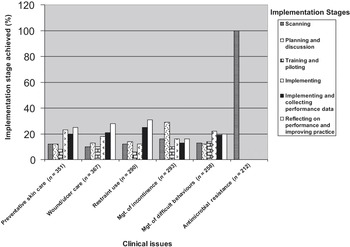
For each clinical issue for which respondents indicated there was a protocol in use or under consideration, DOCs were asked to identify the stage of implementation. Figure 1 summarizes responses to this survey question and shows that implementation was advanced for clinical issues relating to skin care, with up to three quarters of the homes reported as being at the “implementation” stage or beyond for preventative skin care (75%) and wound/ulcer care (69%). Protocols for restraint use were at the implementation or later stages for 65 per cent of nursing home respondents. Sixty per cent of homes reported protocols at the implementation or later stages for management of difficult behaviours. In contrast, the majority of respondents (57%) reported protocols for management of incontinence at earlier stages, predominantly at the “planning and discussion stage”. All respondents reporting use of protocols for antimicrobial resistance indicated that they were in the “scanning” stages of protocol implementation.
Reported stages of care protocol implementation by clinical issue

Protocol Implementation Processes
The remaining survey questions (Questions 3 through 7) queried specific aspects of care protocol implementation in LTC homes based on the responding DOCs’ general experiences with care protocol implementation in their homes. Responses may therefore reflect care protocol implementation experiences that extend beyond the six clinical issues identified in the survey; however, they are reflective of the implementation approaches used in the LTC homes that respondents represented.
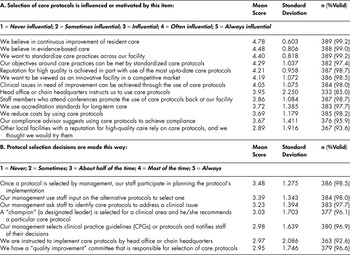
Motivations for care protocol use/selection are summarized in Table 1, Section A. Items are presented in descending order by mean score. The three primary motivations for care protocol selection related to a belief in continuous improvement, a belief in evidence-based care, and a desire to standardize care practices.
Care protocol selection in LTC homes (n = 392)

The only significant differences detected in the ranking of responses regarding motivations for protocol use were by ownership. Responses regarding the belief in continuous improvement of resident care were ranked higher among for-profit homes compared to not-for-profit homes (p < .05, Kruskal-Wallis test), and higher among government-operated homes than not-for-profit homes (p < .05, Kruskal-Wallis test). The responses of for-profit homes were ranked higher than those of not-for-profit homes with respect to the question regarding head office involvement (“We are instructed to implement care protocols by head office or chain headquarters”) in protocol implementation (p < .001, Kruskal-Wallis test).
Respondents were asked to describe how selection decisions were made in their nursing homes. The three most highly ranked responses were indicative of staff participation in care protocol selection decisions (see Table 1, Section B). Respondents from larger nursing homes reported that decision making as entailing management selection and staff notification (“Our management selects CPGs or protocols and notifies staff of their decisions”), significantly more so than respondents from medium-sized and small homes (p < .01, Kruskal-Wallis test); no other significant differences in responses by organizational characteristics were found relating to the questions of “how” and “who”.
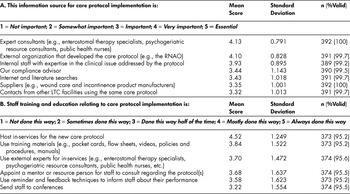
Table 2 summarizes responses to questions relating to resources relied upon for protocol implementation. Respondents indicated the importance of various sources of information for protocol implementation, and indicated the chief means by which staff is trained and educated for protocol implementation. Sources of information and types of training/education are presented in descending order by mean score. No significant differences in responses by organizational characteristic were found relating to the sources of implementation information referred to (see Table 2, Section A).
Resources for care protocol implementation in LTC homes (n = 392)

Identical patterns of training and education were reported for regulated staff (e.g., registered nurses and registered practical nurses) and unregulated staff (e.g., health care aides, personal support workers); therefore, only responses relating to regulated staff training and education are provided in Table 2, Section B. Rank responses of for-profit homes were significantly higher than government-operated homes with respect to the extent to which in-service education (p < .01) and conferences (p < .01) were used to inform and educate regulated staff of new care protocols. Not-for-profit homes’ rank responses were significantly higher than government-operated homes’ rank responses regarding the use of conferences to educate regulated staff regarding new care protocols (p < .001).
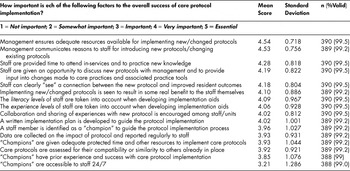
Finally, DOCs were asked to rate the importance of a number of factors to the overall success of implementing care protocols. Table 3 summarizes the importance ratings across all factors potentially contributing to the overall success of protocol implementation. The factors are once again listed in descending order of importance, by mean score. Rank responses of for-profit home respondents were significantly higher than those of government-operated-home respondents regarding the importance of champions to the overall success of implementing care protocols (p < .01). For-profit homes’ rank responses were significantly higher than not-for-profit homes’ responses regarding the importance of staff experience levels to the success of care protocol implementation (p < .01).
Factors important to successful care protocol implementation in LTC homes (n = 392)

Discussion
Our primary objective was to better understand how care protocols are implemented in LTC homes operating in Ontario, and what processes, structural mechanisms, and knowledge sources are relevant to their implementation. In addition, we were interested in examining the influence of organizational context on approaches to implementation.
To better clarify our study context, note that the first two questions of our survey inventoried the use of care protocols in participating homes across the six clinical issues. Skin care-related protocols, and protocols relating to restraint use and management of difficult behaviours, were at more advanced stages of implementation compared to protocols relating to incontinence management and antimicrobial resistance. Likely, this finding reflected differences in the availability and maturity of guidelines at the time the survey was administered because skin care guidelines predated guidelines relating to other clinical areas by several years.
The remainder of the survey focused on our gaining insights into approaches to care protocol implementation taken by Ontario nursing homes. Here, we discuss the practical implications of our findings for nursing home administrators and managers who are desirous of introducing practice change through care protocol implementation.
Motivations for Protocol Use
Nursing homes are motivated to select and use care protocols for a variety of reasons. The majority of respondents expressed motivations founded on their beliefs in continuous improvement and in evidence-based care. Other homes were influenced by factors that were more operational in nature, including a desire to standardize care across their facility. Additional factors that were frequently cited were strategic in nature. Respondents selected care protocols in order to meet objectives around care practices, for example, or because they were concerned for their reputations as facilities delivering high-quality care, or to serve their interest in being viewed as innovative in the marketplace.
Approaches to Protocol Selection
Of the different approaches to protocol selection that we examined in this study, most respondents espoused a participative approach. Here, management involved staff in some way in protocol selection, whether through inviting staff participation in the implementation planning stage, soliciting staff input regarding alternative protocols, or asking staff or a representative “champion” to identify protocols.
Sources of Implementation Information
Respondents indicated a high reliance upon external and internal experts for protocol implementation. The most highly relied upon external sources included consultants with specific clinical expertise and protocol developers like the Registered Nurses Association of Ontario (RNAO). Internal staff members possessing expertise in relevant clinical areas were also referred to as among the most important sources of implementation information, as were compliance advisors (agents of oversight).
Preparing for Implementation – Training and Educating Staff
The dominant means of training and educating both regulated and unregulated staff was through in-service education, in which experts external to the organization were engaged to discuss the application-specific care protocols. This high reliance upon external sources for implementation information speaks generally to the lack of in-house experience relating to the application of care protocols in LTC settings at the time the survey was conducted.
The Influence of Context
We observed no differences in reported care protocol usage across the six clinical issues as a function of the organizational characteristics we studied, with the exception of a reported higher use of incontinence management protocols among accredited homes where incontinence management programs were required. Incontinence management programs are more resource-intensive than alternative approaches to incontinence (Eaton, Reference Eaton2000), which explains why homes without accreditation status at the time of the study were unlikely to report incontinence management protocol use.
Of the five organizational-contextual characteristics we examined, the significant differences we detected in approaches to implementation arose chiefly as a consequence of differences in organizational ownership. While we noted differences in approaches to protocol selection decisions by facility size, we did not observe evidence of the purported benefits of size (affording more resources that might be applied to learning), of chain ownership (structural capabilities relating to standardization of practices), or of the dense micro-environments of urban settings that are generally thought to afford more resources. The significant differences we observed are summarized as follows:
Differences in Motivation. A belief in continuous improvement for resident care was higher among for-profit respondents and government-operated homes than not-for-profit homes. To the extent that government-operated homes are more like not-for-profit homes in terms of their missions and philosophy, this finding is consistent with theory (O’Neill, Harrington, Kitchener, & Saliba, 2003). However, our finding relating to for-profits compared with not-for-profits is seemingly at odds with theory, where organizations pursuing non-profit missions are portrayed as having performance improvement imperatives and are less concerned with the cost efficiencies that concern for-profits. One possible explanation is that continuous improvement of resident care is seen as a means of improving efficiencies by for-profit homes, and the motivations are philosophically and operationally linked from the perspective of our for-profit respondents.
Differences in Approaches to Protocol Selection. Respondents from larger nursing homes reported significantly more autocratic decision-making approaches than medium-sized and small nursing homes. This may be necessitated due to the challenges of managing a larger facility, and a concomitantly larger staff.
Differences in Preparation for Implementation. For-profit homes relied significantly more on external sources of training and education – expert-led in-service education, and conferences – than did government-operated homes in Ontario, and not-for-profit homes relied more on conferences than did government-operated homes. This may be indicative of particularly resource-constrained environments of government-operated homes – or, it may simply be indicative of different philosophies regarding staff preparation.
Practice Implications
Our findings relating to implementation success factors are those most directly relevant to practice. Factors that respondents identified as important to implementation success in this study are similar to those found in prior studies situated in long-term care and in other health care settings (see Dijkstra et al., Reference Dijkstra, Wensing, Thomas, Akkermans, Braspenning and Grimshaw2006; Emmons et al., Reference Emmons, Weiner, Fernandez and Tu2012; Estabrooks, Midodzi, Cummings, & Wallin, Reference Estabrooks, Midodzi, Cummings and Wallin2007). Our respondents distinguished several factors, described next, as very important or essential to protocol implementation success in nursing home settings.
Adequately resourcing for implementation was identified as essential or very important to implementation success by most respondents. A related factor, the provision of time (a resource) to receive training and to learn experientially, was also among the factors most frequently cited as very important or essential to implementation success. It is important, then, for management to commit adequate and appropriate resources (Emmons et al., Reference Emmons, Weiner, Fernandez and Tu2012), including protected time, against the implementation-related activities required of staff. One of the chief resources identified for implementation information, and for training and educating staff, was external experts who could equip staff with adequate and contemporary knowledge regarding care protocols and general implementation intelligence. Our respondents also relied on appointing staff as internal experts for specific clinical areas. Situating the knowledge regarding a clinical issue/protocol with one staff member strikes us as efficient – and may be necessary due to the general scarcity of available training and education resources in this sector – but this also exposes an organization to risk in the event that the staff member leaves the organization.
The contextualization of impending practice change was regarded as important, whereby the need or rationale for change is communicated transparently to those who will be charged with implementing change. Beyond the general importance of achieving buy-in among implementers, and overcoming resistance to change – both classic aspects of change management theory (Kotter, Reference Kotter1996) – contextualization is likely to be particularly important in organizations like LTC homes where resources are scarce, and practice change demands the energies of staff who are already taxed for time. Under these conditions, contextualization may be necessary to compel or promote change. The importance of contextualization relates to our findings regarding motivations for care protocol use. Regardless of the motivation that drives the decision to use a care protocol, change management theory suggests that it is important for leaders to clearly communicate motivations to those charged with implementation (Djikstra et al., 2006), and to those likely to be impacted by the change in care practice, in order to facilitate buy-in.
Ensuring that staff are afforded opportunities to provide input into protocol implementation processes, and are encouraged to do so, was also identified as highly important to implementation success. The change management literature describes this as one means of effectively enhancing buy-in and feelings of ownership or investment; it also signals management’s commitment to supporting the activities of those charged with orchestrating change (Kotter, Reference Kotter1996). Approaches to guideline development and implementation that promote a sense of ownership among staff have been shown to be positively associated with outcomes measures in acute and primary care settings (Dijkstra et al., Reference Dijkstra, Wensing, Thomas, Akkermans, Braspenning and Grimshaw2006). We observed three different approaches to protocol selection in this study; however, the hybrid-participative approach – and the approach most respondents referred to as that used in their homes – is one that affords the opportunities to offer input into implementation.
Demonstrable and unambiguous connections between practice change and outcomes, on the part of staff involved in implementation, was highlighted as very important or essential to implementation success. This factor relates to observability, a concept discussed by Rogers (Reference Rogers1995) and others (e.g., Szulanski, Reference Szulanski1996, Reference Szulanski2000) that highlights the importance of being able to confidently draw causal links between the application of an innovation and outcomes. Observability is facilitated by putting in place evaluation mechanisms and by developing indicators a priori that will provide staff with the ability to reliably monitor and evaluate the protocol’s impact over time. Managers are advised, therefore, to allocate resources for evaluation planning – and for data collection, analysis, and reporting – when developing protocol implementation plans.
Related to observability, underscoring the benefits of practice change for both residents and staff – time efficiencies or workload reductions, for example – was highlighted as very important or essential to implementation success. In a prior study, we found that care protocols that led to improved resident outcomes and reduced workload for staff were viewed more favourably than protocols that afforded benefits exclusively to residents (Berta et al., Reference Berta, Teare, Gilbart, Ginsburg, Lemieux-Charles and Davis2010). In the interests of enhancing uptake and participation, managers and administrators should consider the potential benefits of protocols, prior to their implementation, vis-à-vis the staff who will use them and then communicate the benefits to staff prior to, and during, implementation.
Consideration of staff literacy levels and experience levels when developing implementation aids – described in the survey as including training sessions, tracking forms, flow sheets, and diagrams – was deemed very important by respondents. This corroborates findings of prior work that highlighted low literacy among direct care staff, the value of experienced staff, and the difficulty inherent in retaining experienced staff as factors that impact knowledge application efforts and influence the relationship between operational efficiency and care quality in LTC settings (Almeida & Kogut, Reference Almeida and Kogut1999; Berta et al., Reference Berta, Teare, Gilbart, Ginsburg, Lemieux-Charles and Davis2010). The importance given to these factors (literacy and experience levels) in the present study underscores the need to resource adequately, and appropriately, for preparing staff to implement new – or change existing – care practices.
Collaboration among staff/units involving the sharing of implementation experiences regarding new protocols was regarded as very important or essential to overall implementation success by most respondents. In organizations where resources are constrained, like LTC homes, collaboration may serve as a means to maximize the value of relatively few learning opportunities. It is important, therefore, for managers and administrators to provide opportunities, and permit the allocation of staff time, to exchange information and collaborate: for example, through internal presentations or in less-formal venues designed to encourage sharing of implementation experiences and reports of progress.
Finally, the study respondents felt that the development of implementation aids, including training and education, should be commensurate with the experience levels of staff.
Future Research
The ownership-related differences that we observed related to motivations for protocol use, approaches to protocol selection, and to approaches to staff preparation for care protocol implementation. The long-term implications of these differences for protocol-related sustainability and performance differences merit further exploration. For example, do those protocols selected and implemented through more inclusive/participative processes afford superior performance and longevity? If so, should larger organizations try to replicate the processes developed by their smaller counterparts?
Beyond ownership-related differences, questions of sustainability are highly relevant to the area of guideline implementation and to knowledge application generally. Recent work by Stirman et al. (Reference Stirman, Kimberly, Cook, Calloway, Castro and Charns2012) and Greenhalgh et al. (Reference Greenhalgh, Robert, MacFarlane, Bate and Kyriakidou2004) has reinforced the importance of studying the long-term sustainability of innovations.
Study Limitations
This study had five limitations. First, it was a cross-sectional study, and we were able only to demonstrate significant relationships between variables, not causality. Further, we chose to administer our survey only to DOCs. Acknowledging that the experiences and views of direct-care staff regarding care protocol implementation approaches – in particular, factors that influence the success of implementation initiatives at the working level – would have provided more and possibly divergent information regarding protocol implementation approaches. Third, while cross-sectional studies such as this serve to inform some aspects of knowledge translation (Graham & Tetroe, Reference Graham and Tetroe2007), knowledge translation is most appropriately examined through longitudinal studies that afford insights into the dynamism of knowledge, and of processes relating to knowledge uptake, implementation, and sustainability (Stirman et al., Reference Stirman, Kimberly, Cook, Calloway, Castro and Charns2012). Fourth, while health information technology (HIT) is now being applied usefully to facilitate protocol implementation in nursing homes and to realize improvements in quality of care (Cherry, Ford, & Peterson, Reference Cherry, Ford and Peterson2011), we did not specifically query on the use of HIT in our survey. Finally, and arguably most significantly, this study did not address the question of how (divergent) protocol implementation processes influenced the quality of resident care.
Conclusions
Implementation science research on guideline use has led to the development of frameworks to guide implementation (see Dobbins, Ciliska, Cockerill, Barnsley, & DiCenso, 2002; Graham et al., Reference Graham, Harrison, Lorimer, Piercianowski, Friedberg and Buchanan2005; Kitson, Harvey, & McCormack, Reference Kitson, Harvey and McCormack1998; Rycroft-Malone et al., Reference Rycroft-Malone, Kitson, Harvey, McCormack, Seers and Titcen2002; Rycroft-Malone et al., Reference Rycroft-Malone, Seers, Titchen, Harvey, Kitson and McCormack2004); comprehensive reviews of guideline dissemination strategies (Graham, Harrison, & Brouwers, Reference Graham, Harrison, Brouwers, Pickering and Thompson2003; Grimshaw et al., Reference Grimshaw, Eccles and Tetroe2004a); and a number of initiatives that seek to identify factors that influence the use of research in clinical practice (see Nursing Research July/August 2007 Supplement).
The work in this study has been facilitated by the research of others to systematically review what is known regarding innovation diffusion, innovative capacity, and absorptive capacity in health services organizations (Greenhalgh et al., Reference Greenhalgh, Robert, MacFarlane, Bate and Kyriakidou2004) and to augment the promising work on absorptive capacity (Lewin et al., Reference Lewin, Massini and Peeters2011). Our study complements these efforts, offering detailed insights into actual processes employed in nursing homes intended to facilitate the detection, selection/consideration, and implementation of care protocols, along with associated approaches to staff preparation intended to improve resident care. A number of the processes, structural mechanisms, and knowledge sources we have discussed here are resonant with the concept of absorptive capacity, and they can be generalized to other health care settings.