INTRODUCTION
Pseudopolydora Czerniavsky, 1881 is a small and comparatively well distinguished group of spionid polychaetes comprising 16 described species. Most of them were reported from the western Pacific, occurring intertidally and in shallow water along the coast of Asia (Imajima & Hartman, Reference Imajima and Hartman1964; Radashevsky & Hsieh, Reference Radashevsky and Hsieh2000) and Australia (Blake & Kudenov, Reference Blake and Kudenov1978; Hutchings & Turvey, Reference Hutchings and Turvey1984). From the Atlantic coast of North America and the Caribbean, there were reports of Pseudopolydora sp. from Florida (Santos & Simon, Reference Santos and Simon1980; Sheridan, Reference Sheridan1997), and Pseudopolydora antennata (Claparède, 1868) from Guadeloupe (Amoureux, Reference Amoureux1985; Gillet, Reference Gillet1986). In South America, Pseudopolydora sp. was reported from the coast of Rio de Janeiro (Omena & Creed, Reference Omena and Creed2004), and Pseudopolydora achaeta Radashevsky & Hsieh, Reference Radashevsky and Hsieh2000 and Pseudopolydora diopatra Hsieh, 1992 were reported from Paraná (Lana et al., Reference Lana, Santos, Garraffoni, Oliveira and Radashevsky2006); both localities in Brazil. The only species reported from the Pacific coast of South America, Ecuador, Pseudopolydora primigenia Blake, 1983, likely belongs in Pygospio Claparède, 1863 (Radashevsky, in preparation).
Reproductive biology of polychaetes from the Atlantic coast of South America is poorly known. The information is limited to some data about asexual reproduction of Dipolydora armata (Langerhans, 1880) (Radashevsky & Nogueira, Reference Radashevsky and Nogueira2003), reproduction and larval development of Polydora cornuta Bosc, 1802 (Radashevsky, Reference Radashevsky2005), and morphology of some Spionidae larvae (Radashevsky & Migotto, Reference Radashevsky and Migotto2006); all studies carried out in Brazil.
Adults and larvae of a new Pseudopolydora species were found in southern Brazil during a taxonomic study on spionid polychaetes surveyed by the authors in South America. They are described and illustrated in the present paper.
MATERIALS AND METHODS
Extensive field collections were carried out in Paranaguá Bay, Paraná, in August 1998 and 2001–2004, and in Espírito Santo Bay, Espírito Santo, in January–April 2004, but neither adults nor larvae of Pseudopolydora were found. Bottom and plankton samples were also collected in São Sebastião Channel, São Paulo, from November 2003 through to June 2004, and in June 2007. Some of these latter samplings were successful and produced 16 pelagic larvae and 12 adult mature individuals of a new Pseudopolydora species, all females, some with egg capsules inside their tubes. Sediment samples were collected using SCUBA equipment. Samples were processed in the field using a 500 µm mesh sieve, and polychaetes were removed from the residue under a stereomicroscope in the laboratory at the Centre of Marine Biology, University of São Paulo (CEBIMar), São Sebastião. The 4-chaetiger larvae hatched from the egg capsules were grown to the 12-chaetiger stage in the laboratory at room temperature (20–25°C) in April 2004. Plankton tows were made with a 150 µm mesh plankton net. Adult worms and the larvae were relaxed in isotonic magnesium chloride and examined alive with light microscopes. Larvae were measured using an ocular micrometer to the nearest 10 µm; the precision of measurement of the unpigmented ocelli was to the nearest 0.5 µm.
Photographs were taken using a Nomarski interference contrast microscope equipped with a digital camera. Sketches were prepared with the aid of a camera lucida. Stages of larval development described herein do not represent a growth series from a single specimen, but are from selected individuals reared in the laboratory or caught in the plankton. After examination, adult worms were fixed in 10% formaldehyde solution, rinsed in fresh water, and transferred to 70% ethanol; two individuals were fixed in alcohol for a molecular analysis. Formaldehyde-fixed material is deposited in the Museu de Zoologia, Universidade de São Paulo, São Paulo, Brazil (MZUSP); the Museu de Zoologia da Universidade Estadual de Campinas, Campinas, Brazil (ZUEC-BPO); the Institute of Marine Biology, Vladivostok, Russia (IMBV); and the Senckenberg Museum, Frankfurt am Main, Germany (SMF). Alcohol-fixed material is deposited in a private collection of one of the authors (V.I.R.).
Additional material from Rio de Janeiro was identified in the Museu Nacional do Rio de Janeiro, Brazil (MNRJ).
Pseudopolydora sp. A: Radashevsky & Migotto, Reference Radashevsky and Migotto2006: figure 2a.
Pseudopolydora rosebelae sp. nov. Adult female morphology. (A) Anterior end, dorsal view in dissecting light; (B) same in incident light, showing pigmentation pattern comprising large melanophores and small stellar yellow chromatophores; (C) general left lateral view of a complete individual, palps missing; (D) chaetiger 5 left lateral view, showing reflected J-shaped arrangement of major notopodial spines; (E) chaetigers 5–7, dorsal view, showing largest paired (double in each side) glandular pouches in chaetigers 6 and 7; (F) middle fertile chaetigers, left lateral view, showing intraovarian vitellogenic oocytes and distal parts of metanephridial ducts ascending along anterior end and turning to mid-dorsal side of chaetigers. (A–E) paratype ZUEC-BPO 20, photographed in life. Scale bars: A, B, E, F, 0.3 mm; C, 2 mm; D, 0.2 mm.

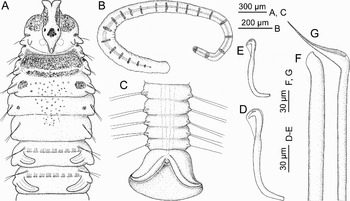
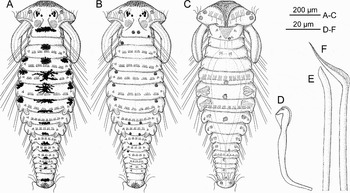
Pseudopolydora rosebelae sp. nov. Adult morphology. (A) Anterior end, dorsal view; (B) palp, showing black bands across frontal ciliated groove; (C) posterior end, dorsal view; (D) bidentate hooded hook from neuropodium of chaetiger 8; (E) bidentate hooded hook from a posterior neuropodium; (F) chaetiger 5 posterior row notochaeta, heavy falcate spine; (G) chaetiger 5 anterior row notochaeta, enlarged capillary with swollen limbation. (A) paratype ZUEC-BPO 20; (B–G) paratype MZUSP 241.

TYPE MATERIAL
São Paulo, São Sebastião Island (Ilhabela): off Praia do Sino, 23°44.82′S 45°20.9′W, 3–5 m, silty sand, 24 March 2004, MZUSP 242 (paratype + 1 individual examined but not fixed); 15 April 2004, MZUSP 243 (holotype), IMBV (paratype); 26 June 2007, ZUEC-BPO 20 (2 paratypes), SMF 16856 (2 paratypes fixed in formaldehyde), VIR 13237 (2 specimens fixed in alcohol for molecular analysis). São Sebastião: Saco Grande, 23°49.75′S 45°25.53′W, 8 m, silty sand, 16 June 2004, MZUSP 241 (paratype).
OTHER MATERIAL
Rio de Janeiro, Parati: Saco da Velha, 23°13′S 44°37′W, 3 m, fine sand, sea grass bed, coll. E.P. Omena, February 1999, MNRJ 67 (1 specimen).
ADULT MORPHOLOGY
Up to 20 mm long and 1.1 mm wide for 55 chaetigers. Holotype complete female 18.6 mm long and 1 mm wide for 53 chaetigers, with oocytes in chaetigers 14–30. Body transparent, light yellowish in life, with intensive black pigment on lateral sides of anterior part of prostomium, middle part of prostomium between palps, dorsal sides of peristomium, and on dorsal side of 5–6 anterior chaetigers (Figures 1A, B & 2A). Small stellar yellow chromatophores scattered on dorsal side of prostomium, peristomium, and 5–7 anterior chaetigers (Figure 1B). Faint yellow pigment present along ciliated food groove of palps. Of 12 examined individuals, six worms were with palps, comprising two individuals with only yellowish pigment along frontal ciliated groove, and four individuals separately with 6, 7, 21 (holotype) and 22 small black transverse bands regularly arranged along each palp. Black bands extending across ciliated groove on frontal surface of palps (Figure 2B). No pigmentation on ventral side of body. Black pigmentation retained, but yellow pigments disappeared after fixation in formaldehyde.
Prostomium anteriorly bifid, with two conical lobes, in middle part broadened, posteriorly narrowing and extending as a caruncle to end of chaetiger 1. Two to three pairs of black eyes present on prostomium, comprising one median pair and one to two lateral pairs, usually obscured with black pigment. Short occipital antenna present on posterior end of caruncle. Nuchal organs as narrow ciliary bands running along anterior edge of chaetiger 1 from notopodial postchaetal lamellae medially to caruncle and then posteriorly along sides of caruncle. Palps as long as body, with frontal longitudinal groove lined with fine cilia, short non-motile compound cilia arising directly from palp surface and sparsely scattered on lateral and abfrontal surfaces.
Chaetiger 1 weakly separated from peristomium, with short capillaries in neuropodia and small postchaetal lamellae in both rami; notochaetae lacking. Chaetigers 2–4 and 6 with slender capillaries in both rami. Notochaetae of chaetiger 7 smooth slender capillaries with narrow limbation. Posterior notopodia with a few long alimbate capillaries.
Thin transparent hood, an extension of epithelium, arising from dorsal anterior edge of chaetiger 3. Hood oriented forward and upward at an angle of 30–45° to body surface and forming a prominent pouch above chaetiger 2. Lateral sides of hood curved anteriorly and laterally situated near notopodial postchaetal lamellae of chaetiger 2, but not joined to these (Figure 2A).
Chaetiger 5 similar in size and shape to chaetigers 4 and 6, with two kinds of major notopodial spines arranged in a double vertical J-shaped row (Figure 1D), dorsal superior capillaries slightly shorter and fewer than those chaetae on chaetigers 4 and 6, and ventral capillaries same in length and number as those chaetae on chaetigers 4 and 6; postchaetal lamellae reduced in notopodia, but short lamellae present in neuropodia. Anterior row notopodial spines pennoned, with curved pointed tip, without subdistal constriction (Figure 2G), up to 10 in a series; posterior row notopodial spines simple falcate (Figure 2F), up to 8 in a series; newly developed spines in lower part of each row slightly larger than older spines in upper part of row.
Hooded hooks in neuropodia from chaetiger 8, up to 10 in a series, not accompanied by capillaries. Hooks bidentate, with small upper tooth closely applied to main fang; upper part of shaft with constriction, lower part of shaft bent at right angle. Hooks in anterior neuropodia larger than in posterior neuropodia (Figure 2D, E).
Branchiae from chaetiger 7 to chaetigers 20–23, up to 17 pairs, full-sized from chaetigers 7–9, greatly reduced on posterior chaetigers. Branchiae flattened, with surfaces oriented perpendicular to body axis, ciliated along inner edges; free from notopodial postchaetal lamellae.
Nototrochs from chaetiger 7 composed of single rows of cilia, on branchiate chaetigers running from tip of one branchia to tip of the other. Several separate ciliary cells scattered on dorso-lateral sides of branchiate chaetigers, between successive notopodia.
Pygidium a large cup with wide dorsal gap (Figure 2C); white colour due to numerous fusiform glandular cells with striated content.
Glandular pouches from chaetiger 1, largest and paired on either side in chaetigers 6 and 7 (Figure 1E), single on either side in other chaetigers.
Digestive tract without ventral buccal bulb and gizzard-like structure, inner wall lined with fine cilia throughout. Oesophagus narrow, extending through 11–12 anterior chaetigers. Midgut widened, with fleshy wall containing yellowish lipid globules. Posterior gut narrow, weakly separated from midgut, without pigmentation.
Circulatory system well developed. Main dorsal vessel extending above oesophagus through 11–12 anterior chaetigers and transforming into gut sinus at the beginning of midgut. Main ventral vessel extending length of body. Heart body absent. Blood transparent, without elements and coloured respiratory pigment.
Segmental organs in anterior sterile chaetigers excretory metanephridia, beginning from chaetiger 4 and opening to exterior on anterior dorso-lateral sides of chaetigers. Metanephridial organs in fertile chaetigers serving both excretory and gamete-releasing functions. Anterior part of these metanephridia composed of widely opened ciliated funnel. The funnel narrowing into metanephridial duct, ascending along lateral body wall, passing medially beneath dorsal epithelium and along anterior part of chaetigers (Figure 1F), and opening to exterior on anterior mid-dorsal side of chaetigers. Paired metanephridia of each fertile chaetiger open to exterior through a common mid-dorsal nephridiopore. Nephridiopores and distal part of metanephridia appearing milky white in living mature females due to presence of glandular cells with granular content.
HABITAT
Adults of P. rosebelae sp. nov. were found occasionally off the states of São Paulo and Rio de Janeiro on muddy-sand substrata 3–8 m at the depth. The population density of the species was about 1 individual m−2. The worms inhabited silty tubes up to 50 mm long and 2.5 mm wide. Most of the tube was embedded vertically into sediment, with up to 5 mm of the tube protruding. The worms were observed collecting food particles from the surrounding water and sediment with their long palps extending out of the tube.
REPRODUCTION
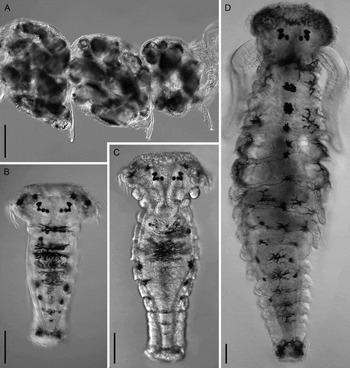
Of 12 examined individuals, all were females. They had previtellogenic and vitellogenic oocytes of various sizes in paired ovaries attached to the segmental blood vessels from chaetigers 14–15 to chaetigers 24–36 (Figure 1C, F). Free oocytes up to 150 µm in diameter were floating in the coelomic cavity in fertile segments. Broods of recently laid oocytes about 150 µm in diameter, embryos, and developing larvae were found inside the tubes in March–June. They comprised up to 23 capsules joined to each other in a string and together these contained up to 400 propagules. Each capsule was attached by thin single stalk to the inner wall of the tube and included up to 20 propagules (Figure 3A). Females brooding larvae in capsules had next generation vitellogenic oocytes developing in the ovaries.
Pseudopolydora rosebelae sp. nov. Larval morphology. (A) a fragment of egg capsule string with 4-chaetiger larvae inside; (B) a 6-chaetiger pelagic larva, dorsal view; (C) an 8-chaetiger pelagic larva, dorsal view; (D) an 18-chaetiger pelagic larva, dorsal view. (A–D) photographed in life. Scale bars: A, 0.2 mm; B, C, D, 0.1 mm.

LARVAL DEVELOPMENT INSIDE EGG CAPSULES
All the eggs in broods developed synchronously into similar-sized larvae.
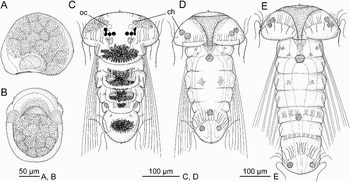
Trochophore about 180 µm long (Figure 4A, B). Prototroch composed of two pairs of small ciliated cells situated on anterior lateral sides. Eyes and apical tuft of cilia absent. Most of interior space of larva occupied by large entodermal macromeres filled with yolky globules. Narrow mouth lined with fine cilia and leading into a short oesophagus. One pair of ciliary patches present on ventro-lateral sides of larva. Posterior gut and anus not yet developed.
Pseudopolydora rosebelae sp. nov. Larval morphology. (A) a trochophore, left lateral view; (B) same, ventral view; (C) a 4-chaetiger larva, dorsal view; (D) same, ventral view; (E) a 7-chaetiger larva, ventral view. ch, yellow chromatophores; oc unpigmented ocelli.

Four-chaetiger larvae 350–400 µm long (Figure 4C, D). Chaetae as long serrated bristles, all notopodial, longest in chaetiger 1. Achaetous segment 5 well differentiated externally. Fine yellow pigment diffused in anterior part of prostomium and peristomium. One pair of subspherical yellow chromatophores present in anterior dorso-lateral sides of prostomium; two pairs of similar chromatophores in lateral lips of peristomium, close to ventral side. Paired yellow chromatophores also present in dorso-lateral sides of segment 5 and in ventral side of pygidium; unpaired midventral subspherical yellow chromatophores present between chaetigers 1 and 2, and in segment 5 (Figure 4C, D, yellow chromatophores). Mid-dorsal ramified melanophores present on all segments apart from 2, and on pygidium; melanophores on segments 3–5 situated on anterior part of each segment and extending on posterior part of preceding segment (Figure 4C).
One pair of unpigmented ocelli about 10 µm in diameter present in anterior part of prostomium (Figure 4C, unpigmented). Three pairs of black eyes present, comprising two pairs of lateral eyes and one pair of median eyes. Lateralmost eye on each side elongated, dumbbell-shaped, almost divided into two equal parts by deep constriction. Nuchal organs as one pair of rounded ciliated patches on posterior dorso-lateral sides of prostomium, medial and anterior to prototroch. Small boss with non-motile cilia 15–20 µm long present within each nuchal patch. Paired compound cilia about 65 µm long arising medial to lateral eyes; compound cilia about 80 µm long present on lateral and ventral sides of peristomial lips between ciliated cells of prototroch; shorter compound cilia present on inner sides of lateral peristomial lips.
Gastrotroch on chaetiger 3, composed of one pair of oblique cells with long cilia (Figure 4D).
Oval glandular cells about 8×12 µm in diameter with striated content scattered in epithelium on dorsal side of prostomium, peristomium, segments and pygidium.
Lateral organs as pits, 2–3 µm in diameter, with bunch of non-motile sensory cilia 15–17 µm long situated below notopodia on chaetigers 3 and 4. Single motile cilia up to 25 µm long present on tips of notopodia on chaetigers 2–4.
Lateral lips of peristomium lined with fine numerous cilia beating towards mouth, forming voluminous vestibulum leading into short oesophagus. Ventral buccal bulb absent below oesophagus. Voluminous midgut separated from narrow oesophagus and posterior gut by muscular sphincters. Several yolky globules present in wall of midgut in some larvae, depleted and absent in others.
Circulatory system and excretory organs not evident.
The broods with 4-chaetiger larvae were maintained in Petri dishes with seawater in the laboratory. When the maternal egg yolk was consumed and the larvae grew to about 400 µm long, they started to move very rapidly inside the capsules, hatching soon after, probably by cutting the thin wall of the capsules with their long serrated notopodial bristles.
LARVAL DEVELOPMENT IN THE PLANKTON
Pelagic larvae were easily recognized in plankton samples due to their characteristic pigmentation. Three pairs of yellow subspherical chromatophores in the prostomium and peristomium, numerous chromatophores on the dorsal and ventral sides of segments, and large ramified mid-dorsal melanophores were observed in living larvae.
Seven-chaetiger larvae about 550 µm long (Figure 4E). Unpigmented ocelli about 12 µm in diameter. Palps not yet developed. Chaetae all larval serrated bristles, in notopodia only. Nototrochs and grasping cilia from chaetiger 3 onwards. Grasping cilia holding bristles along dorsal side of body in swimming larvae. Gastrotrochs on chaetigers 3, 5 and 7; that on chaetiger 3 as two small cells oriented obliquely or almost parallel to body axis; other gastrotrochs each composed of six and eight cells arranged in a transverse row across segment. Glandular pouches absent. Two pairs of protonephridia in chaetigers 1 and 2, each about 3 µm in diameter.
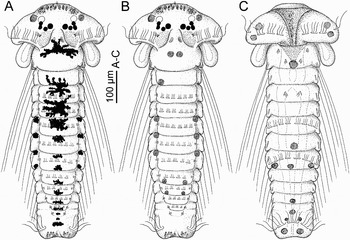
Eleven-chaetiger larvae about 800 µm long (Figure 5A–C). Unpigmented ocelli 14–15 µm in diameter. Chaetae larval serrated bristles in all notopodia, 1–2 short adult capillaries in neuropodia from chaetigers 1–2 to chaetiger 7, and 1–2 small hooded hooks in neuropodia from chaetiger 8 onwards. Gastrotrochs on chaetigers 3, 5 and 7; gastrotroch on chaetiger 3 as two small cells with short cilia; gastrotrochs on chaetigers 5 and 7 each composed of eight cells bearing long cilia. Glandular pouches in chaetigers 6 and 7 each composed of 3–5 small flask-shaped cells. Circulatory system developed; blood transparent. Two pairs of protonephridia in chaetigers 1 and 2.
Pseudopolydora rosebelae sp. nov. A 11-chaetiger pelagic larva. (A) dorsal view, showing arrangement of melanophores, chromatophores on segments omitted; (B) same, showing arrangement of chromatophores, melanophores omitted; (C) same, showing complete pigmentation, ventral view.

Fifteen-chaetiger larvae about 1200 µm long (Figure 6A–F). Yellow pigment diffused on anterior part of prostomium, dorso-lateral sides of peristomium, dorsal side of pygidium and occasionally on some chaetigers. Three pairs of subspherical yellow chromatophores in prostomium and peristomium as described in earlier stages. Number and arrangement of yellow chromatophores on segments greatly variable. One pair of dorsal chromatophores usually present on chaetiger 1, situated close to midline of chaetiger. Unpaired chromatophores often present on dorso-lateral side of chaetigers 1–4. Large paired dorso-lateral chromatophores usually situated on anterior part of chaetigers 5–7; smaller paired dorsal chromatophores usually situated on posterior part of chaetigers, from chaetiger 8 to 9–10; additional paired and unpaired chromatophores present on posterior chaetigers in some larvae. Midventral unpaired yellow chromatophores usually present on chaetiger 1 and variably present on chaetigers 5–15. Ventro-lateral paired chromatophores present on posterior part of chaetiger 7 in some larvae. One pair of large ventral yellow chromatophores on pygidium, posterior to telotroch, and one to two smaller ventral chromatophores anterior to telotroch.
Mid-dorsal melanophores on chaetiger 1 and from chaetiger 3 onwards; large on chaetigers 1, 3 and (often) 4, smaller on posterior chaetigers. Mid-dorsal melanophores on chaetigers 3–6 one per chaetiger, situated on anterior part of chaetiger, anterior to nototroch, usually extending over posterior end of preceding chaetiger. Two mid-dorsal melanophores present on chaetiger 7, one on anterior part and another on posterior part of chaetiger. Single mid-dorsal melanophores from chaetiger 8 onwards, situated on posterior part of chaetigers, posterior to nototrochs. Lateral melanophores from chaetigers 4–5 to chaetigers 6–10, following pattern of arrangement of median melanophores: single lateral melanophores present on each side of all chaetigers except chaetiger 7, where they doubled. Melanophore shape and size varied from compact to greatly ramified, depending on illumination, whereas chromatophores had more regular shape and usually appeared as subspherical bodies.
Prostomium anteriorly rounded. Unpigmented ocelli about 20 µm in diameter. Three pairs of black eyes present, comprising one pair of simple cup-shaped median eyes, one pair of simple lateral eyes, and one pair of double lateral eyes. Caruncle low, extending over anterior part of chaetiger 1. Nuchal organs as rounded ciliary patches on either side of caruncle; bosses with non-motile cilia absent within nuchal patches. Nuchal antenna absent on caruncle. Palps arising from postero-lateral edges of peristomium, posterior to prototroch, as long as about four chaetigers, with frontal longitudinal groove lined with fine cilia.
Larval serrated bristles in all notopodia, absent in neuropodia, as long as 1–3 chaetigers, longest in chaetiger 1. Adult winged capillaries in all notopodia except chaetiger 1, and in neuropodia of chaetigers 1–7. Heavy spines in notopodia of chaetiger 5 among adult winged capillaries and larval bristles; spines comprising 3–4 enlarged capillaries with pennoned geniculate distal end having wide striated wing on convex side (Figure 6F), and 1–2 simple falcate chaetae (Figure 6E). Hooks in neuropodia from chaetiger 8 onwards, 1–4 in a series, not accompanied by capillaries. Hooks bidentate, with constriction on upper part of shaft, lower part of shaft bent at right angle (Figure 6D).
Pseudopolydora rosebelae sp. nov. A 15-chaetiger pelagic larva ready for settlement and metamorphosis. (A) dorsal view, showing arrangement of melanophores, chromatophores on segments omitted; (B) same, showing arrangement of chromatophores, melanophores omitted; (C) same, showing complete pigmentation, ventral view; (D) bidentate hooded hook from neuropodium of chaetiger 8; (E) chaetiger 5 posterior row notochaeta, heavy falcate spine; (F) chaetiger 5 anterior row notochaeta, enlarged capillary with swollen limbation.

Nototrochs and grasping cilia from chaetiger 3 onwards. Short triangular neurotroch on chaetiger 1. Two pairs of small accompanying ciliated cells situated on sides of neurotroch on chaetiger 1. Gastrotrochs on chaetigers 3, 5, 7 and 12; that on chaetiger 3 composed of two ciliated cells, on chaetigers 5 and 7 of ten ciliated cells, and on chaetiger 12 of eight ciliated cells.
Branchiae on chaetigers 7–9; nototrochs extending on inner edge of each branchia.
Pygidium with dorsal incision.
Glandular pouches in chaetigers 6–11; those in chaetigers 6 and 7 largest and paired in each side; pouches on other chaetigers small and single in each side.
Large lateral lips of peristomium forming voluminous vestibulum lined with fine numerous cilia beating towards mouth. Short oesophagus extending through middle of chaetiger 3. Ventral buccal bulb and gizzard-like structure absent in digestive tract. Wall of voluminous midgut with numerous lipid globules up to 20 µm in diameter.
Circulatory system developed. Wall of main dorsal blood vessel contracting, pumping blood in anterior direction. Blood transparent.
Two pairs of protonephridia in chaetigers 1 and 2. Adult metanephridia in chaetigers 4–10.
Seventeen-chaetiger larvae about 1250 µm long. Palps as long as about five chaetigers. Branchiae on chaetigers 7–10. Glandular pouches in chaetigers 5–12.
Largest larva caught in plankton about 1550 µm long for 18 chaetigers (Figure 3D). Palps as long as about six chaetigers, with longitudinal ciliated groove, non-motile cilia arising directly from palp surface and scattered on lateral and abfrontal palp surfaces. One pair of faint black spots present on distal part of each palp. Gastrotrochs on chaetigers 3, 5, 7 and 12. Hooded hooks in neuropodia from chaetiger 8, up to 6 in a series. Glandular pouches in chaetigers 4–12, largest and paired in chaetigers 6 and 7, single in other chaetigers. Protonephridia in chaetigers 1 and 2, and metanephridia in chaetigers 4–11.
Fifteen-chaetiger larvae caught in the plankton settled in Petri dishes in the laboratory. In the sea, they appear to be able to postpone settlement and metamorphosis and continue growing until 18 chaetigers in the plankton (Figure 3D).
ETYMOLOGY
Adult individuals of the species are very delicate, fragile and at the same time among the most beautiful spionids ever seen by the authors. The name of the species is a compound word formed from the Latin rosa and bellus, meaning beautiful rose. It is dedicated to a marine biologist Rosebel Cunha Nalesso.
DISTRIBUTION
Brazil: São Paulo and Rio de Janeiro.
DISCUSSION
Adults of P. rosebelae sp. nov. are unique among Spionidae in their pigmentation pattern, presence of a dorsal pouch over segment 2, and absence of coloured respiratory pigment in the blood. The pouch is formed by a prominent hood arising from the dorsal anterior edge of segment 3 (chaetiger 3) and is not fused to the notopodial postchaetal lamellae. It was well developed in all examined individuals. Since only females were found in this study, it is not known whether this structure is sex-related. Among spionids, a similar dorsal pouch is present over segment 3 (chaetiger 2) in Streblospio Webster, 1880 adults. In the latter, however, the pouch is formed by a hood arising from the anterior edge of segment 4 (chaetiger 3) and dorso-lateral sides of segment 3 (chaetiger 2), and it is fused to the notopodial postchaetal lamellae of segment 3. A large transverse ventral fold is present on chaetiger 4 in adults of Boccardia perata (Chlebovitsch, 1959). This fold and ventro-lateral longitudinal folds on chaetigers 1–3 form a large pouch opening anteriorly and not associated with the neuropodial lamellae. The dorsal hoods in P. rosebelae sp. nov. and Streblospio, and ventral pouch in B. perata are possibly involved in the tube formation.
Prominent transverse membranous crests are present in adults of various Prionospio Malmgren, 1867 species. These crests link parapodial (usually notopodial postchaetal) lamellae on postbranchiate segments and appear to be derivatives of these expanded lamellae. They are probably used to regulate water flow within the burrow, but details of such a regulation are not known. Spiophanes Grube, 1860 adults have characteristic transverse ridges, fleshy elevations of dorsal body wall on middle and posterior chaetigers, usually beginning from chaetigers 15–17. These ridges are not joined to notopodial lamellae. They bear heavy cilia of nototrochs on their upper edge and provide water flow within the tube (authors' unpublished observations).
Little information is available about blood composition in polychaetes, but alive adults of more than 200 spionid species examined by us all had red blood. This is probably due to the presence of the dissolved respiratory pigment erythrocruorin, a kind of extracellular haemoglobin which is common for many polychaete taxa (see de Haas et al., Reference de Haas, Taveau, Boisset, Lambert, Vinogradov and Lamy1996a, Reference de Haas, Zal, You, Lallier, Toulmond and Lamyb). Adults of more than 10 Pseudopolydora species examined by us, all had red respiratory pigment dissolved in the blood, whereas all examined individuals of P. rosebelae sp. nov. had transparent blood without pigment.
Pseudopolydora rosebelae sp. nov. is similar to Pseudopolydora pulchra (Carazzi, 1893) originally described from the Gulf of Naples, Italy (see Rullier, Reference Rullier1963; Eleftheriou, Reference Eleftheriou1970). Adults of both species have prominent black pigment on dorsal side of anterior chaetigers, prostomium anteriorly incised and posteriorly extending as a caruncle to end of chaetiger 1, occipital antenna on the prostomium, numerous black bands on palps, and cup-shaped pygidium without dorso-lateral extensions. In addition, glandular pouches are largest and paired in chaetigers 6 and 7 in both species. Larvae of both species also have prominent subspherical yellow chromatophores in the peristomium. The two species differ, however, in that P. rosebelae sp. nov. adults have a dorsal hood on chaetiger 3, and larvae have mid-dorsal unpaired melanophores from chaetiger 3, whereas P. pulchra adults have no dorsal hood, and the larvae have only dorsal paired melanophores from chaetiger 3. Mid-dorsal unpaired melanophores as in P. rosebelae sp. nov. are characteristic for Boccardia Carazzi, 1893 and Carazziella Blake & Kudenov, Reference Blake and Kudenov1978 larvae, but are absent in other Pseudopolydora larvae. Patterns and homology of larval pigmentation in these taxa will be discussed elsewhere (Radashevsky, in preparation).
ACKNOWLEDGEMENTS
Our sincere thanks are due to the anonymous referees for valuable comments on the manuscript. Financial support was provided by the State of São Paulo Research Foundation (FAPESP) within the BIOTA/FAPESP—The Biodiversity Virtual Institute Program (www.biota.org.br) (proc. No. 1998/07090-3; 2003/08688-0); Petróleo Brasileiro S.A. (PETROBRAS) through the Centro de Pesquisas da Petrobras (CENPES) within the Campos Basin Deep Sea Environmental Project (OCEANPROF); and the Russian Foundation for Basic Research (RFBR Project 06-04-49508).