Despite an increasing focus on feeding and growth following neonatal cardiac surgery, providing adequate post-operative nutrition can be a challenge for infants. Reference Medoff-Cooper and Ravishankar1–Reference Marino, Johnson and Davies14 Gastrointestinal discomfort (poor gut profusion, delayed emptying and constipation related to perioperative medications), oral motor feeding readiness (fatigue, weakness, tone, endurance), medical complications (necrotising enterocolitis, chylous effusions, infections), respiratory support (length of intubation, high flow support), noxious environment (lights, sounds, painful stimulation, sleep disruptions), and nerve paralysis are common challenges for infants with CHD that may negatively impact growth and feeding readiness. Reference Indramohan, Pedigo, Rostoker, Cambare, Grogan and Federman15–Reference Jadcherla, Vijayapal and Leuthner20 Ongoing dietary support focuses on optimising nutrition to promote adequate energy utilisation for tissue repair and growth. Reference Kelleher, Laussen, Teixeira-Pinto and Duggan11,Reference McHoney, Eaton and Pierro21–Reference Slicker, Hehir and Horsley23 Additionally, early post-operative growth and feeding success have been linked to longer term neurodevelopmental improvements. Reference Costello, Gellatly, Daniel, Justo and Weir9,Reference Mehrizi and Drash12,Reference Vaidyanathan, Nair and Sundaram24,Reference Schwalbe-Terilli, Hartman and Nagle25
For post-operative feeding and nutrition therapy, parents and caregivers share a principal goal of oral feeding without supplemental tube feeding. However, utilisation of supplemental feeding to support long-term neurodevelopment and oral feeding success is crucial to an infant recovering from cardiac surgery. Feeding-related stress, mixed messages surrounding feeding and nutrition plans from medical teams, and a poor understanding of who oversees these issues negatively impact families caring for infants with CHD. Reference Hartman and Medoff-Cooper26,Reference Hill, Silverman, Noel and Bartz27 Consistent and prolonged confusion surrounding feeding and nutrition compounds the risk for poor oral feeding outcomes over time. Reference Indramohan, Pedigo, Rostoker, Cambare, Grogan and Federman15–Reference McKean, Kasparian, Batra, Sholler, Winlaw and Dalby-Payne18,Reference Butler, Sadhwani and Stopp28,Reference Lisanti, Allen, Kelly and Medoff-Cooper29 Caregiver stressors may have a long-term impact on future oral nutrition and neurodevelopment. Reference Peterson7,Reference Wernovsky and Licht30,Reference Goday, Huh and Silverman31
As reported by conversations with families and physicians at our centre, the time of highest inconsistency and uncertainty related to oral feeding and tube weaning occurred after the neonatal hospital discharge. Approximately 80% of our infants <30 days who underwent cardiac surgery were discharged with a nasogastric feeding tube when medically stable. As a matter of preference, our centre primarily sends infants home with nasogastric tubes and rarely uses surgically placed gastric tubes (g-tubes). Not all the infants referred to the feeding clinic had feeding tubes, as clinic referrals may also include preoperative infants with a heightened risk for growth discrepancy and any infant with CHD struggling to gain weight or with oral feeding. In response to a clinical need, we created a multidisciplinary outpatient feeding clinic to address feeding concerns for infants with CHD. Clinical services provided by a dietician, speech language pathologist, and physical therapist included feeding tube weaning plans, safe oral feeding advancement, nutritional support, growth monitoring, and progressive developmentally supportive activities. A cardiologist and cardiothoracic advanced practice practitioner were available if needed for medical concerns but were not standardly part of the feeding clinic visit.
The aim of our study was to improve long-term feeding outcomes and decrease the time to full oral feeding in patients who have undergone cardiac surgery through the implementation of an outpatient feeding clinic.
Materials and methods
Study design and patient population
This retrospective cohort study described feeding outcomes in infants with CHD before and after the implementation of a multidisciplinary feeding clinic in March 2016. The primary analysis group included individuals who underwent surgery with cardiopulmonary bypass at less than 30 days of age at Primary Children’s Hospital. The pre-clinic cohort was a convenience sample of neonates who met inclusion criteria between August 2015 and February 2016. The pre-clinic cohort was limited in number due to the retrospective nature of this quality improvement project and the inconsistencies in charting methods in this era that pre-dated our current electronic charting system. The post-clinic cohort was between March 2016 and December 2019. Patients were excluded if they were first treated in the feeding clinic greater than 21 days after hospital discharge or if their feeding primary outcome was unknown. A subgroup of post-clinic infants was created containing only patients who underwent univentricular palliation because several of these patients continued to attend the feeding clinic after the second stage of surgical palliation.
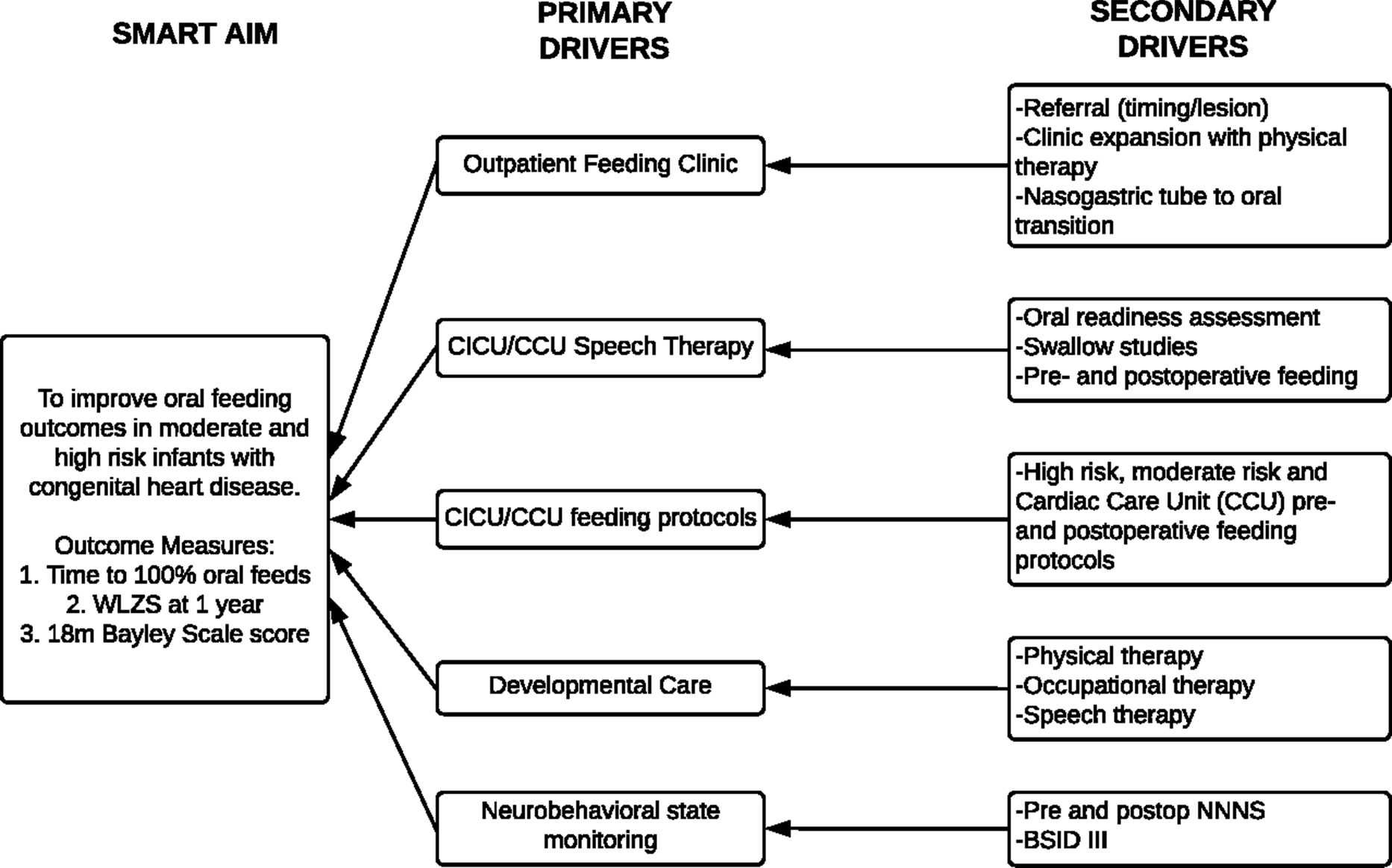
The study was approved by the University of Utah Institutional Review Board and was exempt from patient and parental consent. This study was embedded in a quality improvement effort and endpoints were selected from a key driver diagram (Fig 1) created to identify primary and secondary drivers of oral feeding transitions in infants with CHD.
Cardiac feeding clinic key driver diagram.

Intervention: cardiac feeding clinic
Stakeholders and referral criteria
The feeding clinic was created in March 2016 with collaborative support from key Heart Center stakeholders (cardiologists, cardiothoracic surgeons, critical care nursing and physicians, and acute care therapy) to bridge the perceived gap in feeding and nutrition services after hospital discharge. The clinic was staffed by a registered dietitian who adjusted nutrition to optimise caloric intake to meet metabolic needs, a speech language pathologist who assessed oral readiness and provided concrete plans for a safe transition to oral feeds, and a physical therapist who provided progressive neck and trunk strengthening activities for development. Patients were eligible for referral to the clinic if they underwent cardiac surgery at <30 days of age or an anticipated surgical date at 4–6 months of age; however, the latter population was not included for analysis in this study. Infants were referred at the time of surgical hospital discharge or by outpatient cardiologists for poor weight gain and/or oral feeding difficulty. Feeding clinic appointments were coordinated with the first post-operative visit when applicable. The clinical service area included patients who lived within approximately 100 miles. Patients outside the clinical service area were referred to home health or early intervention for feeding and nutrition support. These infants could be seen in the clinic initially in coordination with their post-op visit while waiting for services near their home.
Clinical and visit structure
The feeding clinic opened in March 2016 for infants with two-ventricle physiology due to this population having fewer follow-up opportunities with cardiothoracic advanced practice practitioners where feeding concerns may have been addressed. One month later, the interstage advance practice practitioners and cardiologists requested a feeding clinic day for univentricular infants to coordinate with their bimonthly appointments, so in April 2016, another day was added to the feeding clinic for infants with univentricular physiology. The clinic occurred 2 days a week and was staffed with a speech language pathologist and registered dietitian who was also a certified lactation consultant. In July 2018, the feeding clinic was restructured and a physical therapist was added to extend feeding support. In October 2018, a tube feeding protocol was initiated in the step-down unit to standardise the process of condensing tube feeds before discharge to 18-hour continuous feeds with two 3-hour breaks due to perceived benefits related to this management style observed in the feeding clinic. Patients who needed additional support such as medications for severe intestinal discomfort, referral for g-tube consult due to critical aspiration, or flexible endoscopy for vocal cord paresis were referred to gastroenterology or otolaryngology.
As part of the clinic visit, patient anthropometrics were measured on a consistent scale with dry diaper to provide individualised nutrition plans based on that infants’ needs. Providers documented a comprehensive home nutritional plan, daily routines, and the percent of tube and oral feedings. Techniques to support breastfeeding and adjustments to bottle feeds were trialed. Based on these observations, the feeding therapist and dietitian discussed tube feed manipulations, oral readiness, and identified opportunities to advance oral feeds.
The physical therapist supported neurodevelopmental progression by providing neck and trunk strengthening and endurance activities to complement the feeding assessment. Parents were educated on early intervention services and their longitudinal participation in the Heart Center Neurodevelopmental Program clinical services.
The visit terminated with a collaborative, multidisciplinary, printed summary and recommendations from the clinic visit for parental use and implementation. Patients were billed for an outpatient therapy session from each discipline. Feeding plans and progress notes were communicated to the cardiologist or the primary care physician via communication in the medical record or phone call updates.
Outcome measures
The primary outcome measure was time in days to 100% oral feeding, which was defined as days from post-operative sternal closure to the point when the infant accepted all nutrition orally. Goal for oral feeds was normal growth velocity without supplementation from the feeding tube, verified via dry diaper only weights on the consistent scale in the feeding clinic every 1–2 weeks. Pre-clinic weight gain and loss data were not collected from the medical record due to the inconsistencies in pre-electronic charting methods. Post-clinic weight gain and loss were charted by the dietitian, but not collected for this study. The patient’s feeding tube was removed after tolerating full oral nutrition for 3 days with adequate weight gain as demonstrated on a home scale, paediatrician, or health department weight check.
Secondary outcome measures included time to first feeding clinic visit after hospital discharge, duration of feeding clinic enrollment, and the number of feeding clinic visits. These measures were included to assess the impact of timing and duration of specialised feeding therapy on the primary outcome measure.
Demographic variables collected included gender, race, age at surgery, cardiac diagnosis, hospital length of stay, and age at first feeding clinic visit. Cardiac diagnoses were defined per the Society of Thoracic Surgeons and were categorised by the authors as: coarctation of the aorta/hypoplastic aortic arch/interrupted aortic arch, d-transposition of the great arteries, hypoplastic left heart syndrome, total anomalous pulmonary venous return, tetralogy of Fallot, univentricular physiology other than hypoplastic left heart syndrome, truncus arteriosus, and other.
Statistical analysis
We summarised demographics and clinical outcomes of interest using mean and standard deviation, median and interquartile range, and range if the variable was continuous; counts and percentages were reported for categorical variables. We compared these variables between pre- and post-clinic within univentricular neonates and within two-ventricle neonates separately, and lastly compare univentricular versus two-ventricle among post-clinic neonates, using Exact Wilcoxon signed-sum test for distribution skewed continuous variables, and chi-squared or Fisher’s exact test for categorical variables. We assessed the associations between the outcome time from sternal closure to full oral feeding and risk factors of interest among the post-clinic univentricular and two-ventricle neonates, using univariable and multivariable Cox regression model. Hazard ratio and 95% confidence interval were reported. Statistical significance was assessed at the 0.05 level. Statistical analyses were implemented using R v. 3.6.0 (R Core Team, 2019).
Results
Patient population
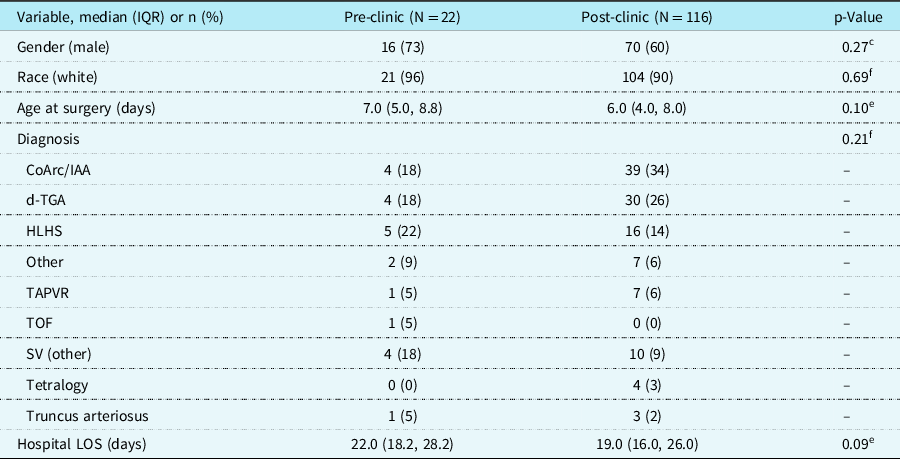
During the study period, 280 patients were seen in the feeding clinic out of total 320 patient eligible for the clinic. The 40 eligible patients who were not seen in the feeding clinic lived >100 miles from our centre and received services elsewhere. One hundred and sixteen patients were included in the primary outcome analysis as the post-clinic cohort. One hundred and sixty-four patients were excluded, 85 did not undergo cardiac surgery with cardiopulmonary bypass <30 days of age and 79 patients had missing data for the primary outcome measure (none or feeding clinic at their first post-op visit, then transitioned to services closer to home due to living >100 miles or out-of-state). The pre-clinic cohort included a convenience sample of 22 with primary outcome data. There was no statistical difference in demographic variables or cardiac diagnoses between the groups (Table 1).
Pre- and post-clinic demographic and clinical characteristics. * median (IQR)

cChi-squared test, fFisher’s exact test, eExact Wilcoxon.
CoArc/IAA = coarctation of the aorta, hypoplastic aortic arch, or interrupted aortic arch; d-TGA = d-transposition of the great arteries; HLHS = hypoplastic left heart syndrome; TAPVR = total anomalous pulmonary venous return; TOF = tetralogy of Fallot; SV = single ventricle; LOS = length of stay.
Number of missing: Age at first feeding clinic visit = 22/0.
Post-clinic patients
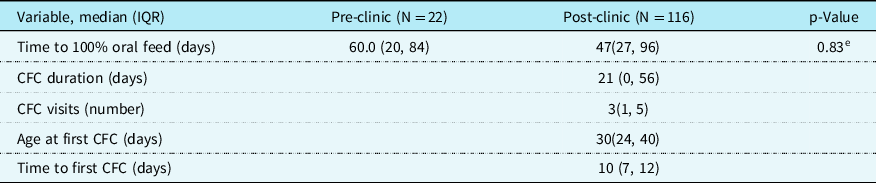
Infants were seen for their first feeding clinic visit at a median of 30 days of age (interquartile range: 24, 40) and 10 days (interquartile range: 7, 12) after principal surgical hospital discharge. Median patient feeding clinic attendance was 3 visits (interquartile range: 1, 5) over 21 days (interquartile range: 0, 56) (Table 2).
Pre- and post-clinic feeding characteristics

cChi-squared test, fFisher’s exact test, eExact Wilcoxon.
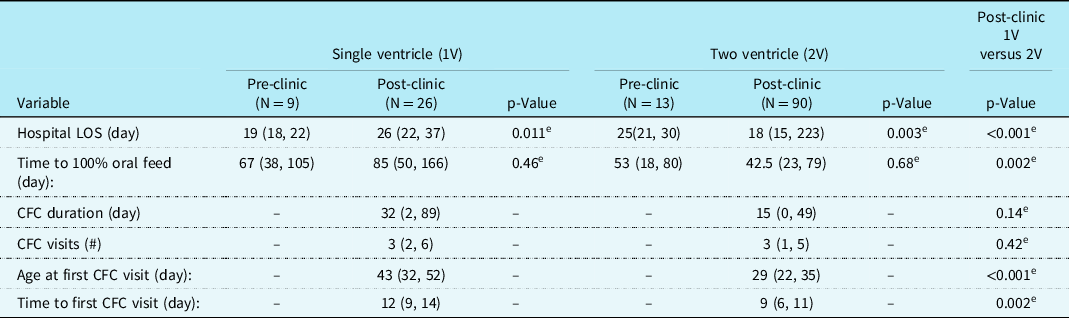
When univentricular (n = 26) and two-ventricle post-clinic patients (n = 90) were compared, there was a statistically significant difference in median time to first clinic visit from surgery (12 versus 9 days, p = 0.02). Median age at first clinic visit was 29 versus 43 days (p ≤ 0.001). There was no difference in the duration of clinic follow-up between these two groups with median 32 versus 15 days (p = 0.14) (Table 3).
Pre- and post-clinic feeding characteristics in single ventricle and two ventricle patients

cChi-squared test, fFisher’s exact test, eExact Wilcoxon, sChi-squared test by Monte Carlo simulation.
SD = standard deviation; IQR = interquartile range.
Oral feeds
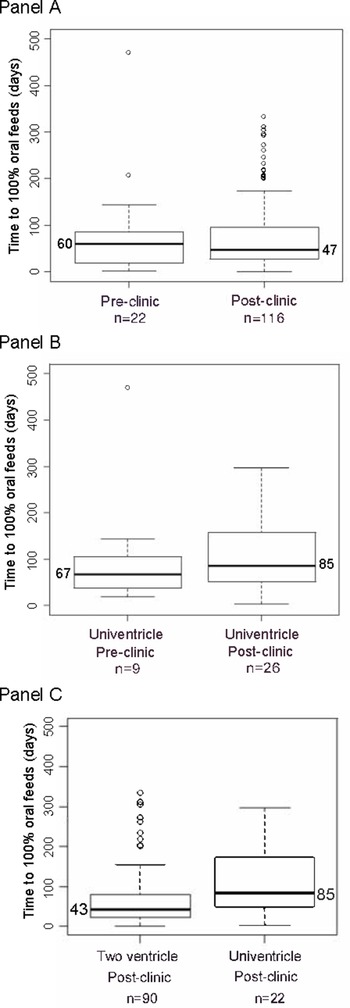
Prior to the feeding clinic implementation, patients achieved 100% oral feeds by a median of 60 days (interquartile range: 20, 84) versus 47 days (interquartile range: 27, 96) for patients who attended the feeding clinic (p = 0.83, Table 2, Fig 2a). Univentricular patients prior to clinic implementation achieved 100% oral feeds within a median of 67 days (interquartile range: 38, 105) versus 85 days (interquartile range: 50, 166) for patients who attended the feeding clinic (p = 0.46) (Table 3, Fig 2b). When compared to two-ventricle post-clinic patients, the univentricular post-clinic patients had a significantly longer time to 100% oral feeds (85 versus 43 days, p = 0.002) (Table 3, Fig 2c).
Panel a: Box plot pre- and post-clinic for time to 100% oral feeds. Panel b: Box plot univentricular pre-clinic and post-clinic time to 100% oral feeds. Panel c: Box plot two-ventricle post-clinic and univentricular post-clinic time to 100% oral feeds.

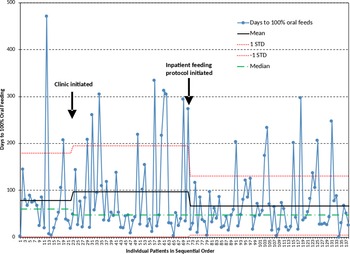
Overall, post-clinic patients did not have a significant decrease in time to 100% oral feeds, but there was an overall trend towards improved oral feeding after the initiation of a step-down unit feeding protocol with a shift towards a decrease in the mean and median time to full oral feeds (Fig 3). The greatest variability appeared at the initiation of the feeding clinic (Fig 3).
Run chart of days to full oral feeds.

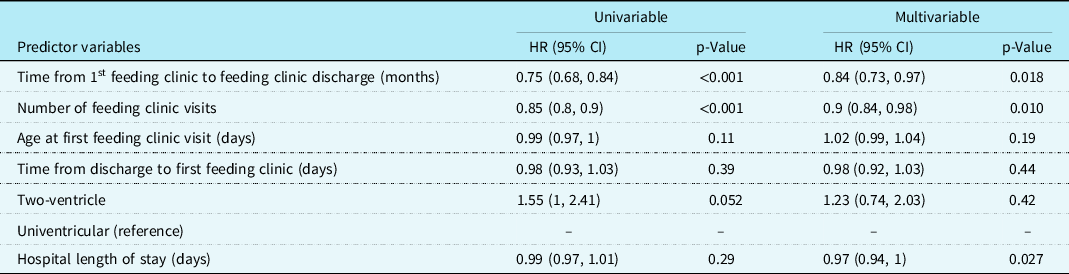
Univariable Cox regression showed that duration in days from the first to last feeding clinic visits and number of feeding clinic visits was associated with full oral feeding (p < 0.01) among the 116 post-clinic neonates. The longer the duration of feeding clinic involvement or the more frequent the feeding clinic visits, the less likely the patient was to reach full feed. The relationship persists in the multivariable modelling results, where each 1 month increase in duration decreased the odds of full oral feeding by 16% (hazard ratio 0.84; 95% confidence interval: 0.73, 0.97, p = 0.018) controlling for other risk factors. More frequent feeding clinic visits (hazard ratio 0.9; 95% confidence interval: 0.84, 0.98; p = 0.01) and longer hospital length of stay (hazard ratio 0.97; 95% confidence interval: 0.94, 1; p = 0.027) were also associated with decreased odds of reaching full oral feeds when adjusting for other risk factors (Table 4).
Univariable and multivariable Cox regression on time-to-100% oral feed in post-clinic neonates

Discussion
Post-operative feeding clinics are not the standard of care for infants with CHD, but we found that our cardiac feeding clinic was feasible and well-utilised and appears to have a clinical impact with a trend towards increased oral feeding success (Fig 3). With a therapist run clinic, patients were able to be seen at a higher frequency and lower cost. While not statistically significant, a decrease in days to full oral feeding is clinically important to families weaning off tube feeds in addition to receiving specific and individualised support with feeding, a reported contributor to parental stress. Reference Medoff-Cooper and Ravishankar1,Reference Medoff-Cooper, Naim, Torowicz and Mott2,Reference Peterson7,Reference Lisanti, Allen, Kelly and Medoff-Cooper29,Reference Diffin, Spence, Naranian, Badawi and Johnston32
It is well-known that infants with univentricular physiology have longer length of stays, difficulty with poor growth, and delayed neurodevelopmental outcomes. Reference Williams, Zak and Ravishankar5,Reference Miller, Zak and Shrader6,Reference Slicker, Hehir and Horsley23,Reference Marino, Lipkin and Newburger33 The univentricular cohort also took significantly longer to achieve 100% oral feeds despite the institution of multiple measures to augment oral feeding success. In fact, the post-clinic univentricular group time to 100% oral feeds increased. With this at-risk population, growth velocity is not spared for transition to full oral feeding given the association of poor growth with intelligence quotient. Reference Williams, Zak and Ravishankar5,Reference Marino, Johnson and Davies14,Reference Kirkegaard, Möller and Wu34 Most infants are discharged with a feeding tube to ensure adequate nutrition for growth while fostering 100% cue-based transition to oral feeding. Reference Miller, Zak and Shrader6,Reference Kirkegaard, Möller and Wu34 Families understood discharging with a feeding tube provides nutritional support while following the infants cues for tube weaning with follow-up support in a cardiac-specific feeding clinic. Adequate growth may be more valuable than timing to 100% oral feeds because of well-known long-term neurodevelopmental impact from 0 to 3 months of age. However, in our study, because date of 100% oral feeds was more consistently charted than weights outside of clinic that may determine transition to discontinuation of feeding tubes, we used 100% oral feeds as a surrogate for adequate growth because 100% oral feeding could not be achieved without the infant demonstrating stability with weight gain. Future efforts should focus on highlighting feeding clinic infants’ growth as a valuable metric for a clinic focused on long-term infant-driven oral feeding, individualised growth velocity based on metabolic demands, residual lesions, and genetic syndromes all in an effort to improve developmental outcomes.
Our data are limited by an era effect of culture shifts to cue-based feeding. The outcome of time in days to 100% oral feeds may be disproportionately affected by those individuals that are not showing appropriate cues for positive feeding. Our data suggest there is a higher proportion of outliers in the post-clinic cohort (Fig 3). Furthermore, when thinking about long-term neurodevelopment goals, prioritisation of the outcome of 100% oral feeds may be inappropriate without considering the impact on growth and development. An infant eating 100% by mouth, but not gaining weight, is not truly 100% oral feeds, which we could not discern from the pre-clinic cohort. Proportion of oral feeds may not fully capture the impact of the feeding clinic on long-term patient outcomes due to the neurodevelopmental complexities of feeding (e.g., cue-based feeding, individual recoveries from surgery, achieving adequate nutrition while recovering, impact of intestinal comfort on feeding advancement, and neurodevelopmental trajectory). Reference Jones, Desai and Fogel19,Reference Anderson, Iyer and Schidlow22–Reference Schwalbe-Terilli, Hartman and Nagle25,Reference Shaker35–Reference Shaker37 Supporting cue-based feeding advancement is important for long-term feeding success and may be better represented by feeding route at 1–2 years of age, weight for length z-score, and head circumference z-scores as well as other markers of development such as gestational age, birth weight, and length of intubation which may be impacted by a cue-based approach to feeding and developmental care. Reference Peterson7,Reference Shaker35–Reference Whetten40
The standardised feeding protocol initiated in the step-down unit to promote 100% infant-driven feeding was developed from patterns observed in the clinic. Infants appeared to wean off tube feedings faster on 18 continuous feeds with two 3-hour breaks for oral feeding trials. With this approach, less time was spent focused on tolerating bolus feeds before discharge, and more time was spent following the infants’ cues during the 3-hour breaks. Once infants started tolerating their 3-hour volume by bottle or breastfeeding, then tube feeds were held and they were offered oral feeds every 3 hours, first during the day and then at night. The continuity of care from inpatient to outpatient offered the ability to trial an unconventional step-down unit discharge protocol which may have an impact on long-term feeding success. Though overall changes were not significant, it appears that following this effort, there is a trend towards decreased time to 100% oral feeds.
Infants who struggled with oral feeding advancement were seen more frequently in the clinic to support stepwise transition, so it was not unexpected that the longer the patient was in clinic, the lower the odds of reaching full oral nutrition. This clinic was infant and family driven, and therefore individualised for each family’s need. Influence on the approach to infant tube weaning was not spared from the well-meaning advice families may receive from other family members, websites, internet groups, and social media that may affect adherence to research supported tube weaning. Reference McKean, Kasparian, Batra, Sholler, Winlaw and Dalby-Payne18,Reference Morag, Hendel, Karol, Geva and Tzipi39,Reference Martin, Williams, Haskard and Dimatteo41–Reference Jacobs, Boyd, Brennan, Sinha and Giuliani45
This study was limited by several factors. This study was retrospective and the pre-clinic data were confounded by manual chart review of cardiology visit notes with high reporting variability and difficulty discerning amount of weight gain or loss with the 100% oral feeding with the pre-clinic cohort. Additionally, there was missing feeding data for our infants not seen in the feeding clinic for the entirety of their tube weaning (n = 79) due to follow-up services closer to home or in-home. These services documentation was not accessible.
This study’s goal was to describe and evaluate the effectiveness of a post-discharge feeding clinic. We found that the clinic was used by more than three-fourths of the patients and more than half of the post-clinic cohort was observed weaning to full oral feeds. This study was an important first step in evaluating relevant feeding data from a post-operative clinic that promotes long-term feeding success for infants with CHD. Future studies will focus on modifiers of oral feeding success (gastrointestinal symptoms, tube feeding rates, oral readiness cues, modified barium swallow studies, and thickening oral feeds), degree of family stress associated with feeding and tube weaning, family satisfaction with feeding support post-discharge, growth anthropometrics, social determinants of health related to feeding, and the impact of global neurodevelopment on feeding outcomes.
Supplementary material
To view supplementary material for this article, please visit https://doi.org/10.1017/S1047951121002833.
Acknowledgements
Claudia Delgado, Mike Puchalski, Bonnie Clay, Sonja Ohsiek, Annie Brazell, Emilee Glenn, Aaron Eckhauser, Janine Wood, and Teresa Golley who supported the creation of a cardiac feeding clinic.
Financial support
This investigation was supported by the University of Utah Population Health Research (PHR) Foundation, with funding in part from the National Center for Research Resources and the National Center for Advancing Translational Sciences, National Institutes of Health, through Grant UL1TR002538 (formerly 5UL1TR001067-05, 8UL1TR000105 and UL1RR025764).
Conflicts of interest
The authors have no conflicts of interest relevant to this article to disclose.
Ethical standards
The authors assert that all procedures contributing to this work comply with the ethical standards of the relevant national guidelines and with the Helsinki Declaration of 1975, as revised in 2008, and has been approved by the University of Utah Institutional Review Board.