INTRODUCTION
Sorghum (Sorghum bicolor) is an important multi-purpose crop in the dry areas of Central America. In the dry marginal areas of Nicaragua, where maize production is uncertain due to irregular and erratic rainfall, white-grain sorghum is an essential subsistence crop for resource-poor farmers. Here, farmers traditionally grow two sorghum types for human consumption. The ‘millón’ sorghums are tall and photoperiod-sensitive landraces with white or yellow grains which are generally intercropped with maize on hillsides. The ‘tortillero’ sorghums are white-grain, short-cycle improved varieties that are commonly grown in semi-intensified cropping systems on flatlands. Farmers have been cultivating the millón sorghums in Central America since the sixteenth century (Quinby and Martin, Reference Quinby and Martin1954). Extensive breeding activities were carried out in Honduras and El Salvador with the aim of reducing plant height and increasing the harvest index of the best local landraces. The adoption rate of these modern height-reduced millón varieties has been low. This can be attributed firstly to unfavourable traits, as these varieties do not adapt well to the low-fertility soils of hillsides, are less photoperiod-sensitive than local landraces and have small grain size. Inadequate seed production and distribution strategies have also been connected with the low adoption rate. Tortillero sorghum is a more recent introduction to the Central American region. In Nicaragua, this new type has largely been adopted by small- and medium-scale farmers, who first started using it in the early 1990s. In contrast to millón, the tortillero varieties offer the advantages of early maturing (necessary for coping with increasing drought conditions), better fodder quality and generally better grain quality for making tortillas, the typical unleavened bread of Central America and Mexico, traditionally made with white-grain maize. Dissemination of the tortillero cultivars grown in northern Nicaragua has been accomplished largely through informal cross-border seed exchange from Honduras and El Salvador (Trouche et al., Reference Trouche, Hocdé, Aguirre Acuña, Martínez and Gutiérrez Palacios2006a). Nevertheless, farmers emphasized that the tortillero varieties currently available need to be improved in order to adapt to low-fertility soils and post-flowering drought. The essential traits to be improved are earliness, grain and fodder yield, plant type and grain size (Martínez Sánchez, Reference Martínez Sánchez2003).
In light of these insufficiencies, in particular the failure of the modern millón varieties, breeders began considering participatory plant breeding as an alternative approach to sorghum improvement in Nicaragua. Participatory breeding aims to develop varieties better adapted to farmers' needs (i.e. a more client-orientated approach) by involving farmers at key stages of variety development and by promoting interaction between breeders and farmers in the research processes (Sperling et al., Reference Sperling, Ashby, Smith, Weltzien and McGuire2001, Witcombe et al., Reference Witcombe, Joshi, Gyawali, Musa, Johansen, Virk and Sthapit2005). Moreover, by working directly in the target environments, participatory breeding takes into account specific agro-climatic constraints as well as local cropping practices, resulting in more effective selection for those conditions (Ceccarelli et al., Reference Ceccarelli, Grando, Tutwiler, Baha, Martini, Salahieh, Goodchild and Michael2001; Simmonds, Reference Simmonds1991). Participatory breeding is commonly divided into participatory varietal selection (PVS), where farmers are involved in the evaluation and selection of finished or near finished breeding products, and participatory plant breeding in the narrow sense (PPB), where farmers participate in the selection work in segregating generations (Witcombe et al., Reference Witcombe, Joshi, Joshi and Sthapit1996).
The research project on participatory breeding of sorghum in Nicaragua was geared towards resource-poor farmers in dry vulnerable areas. CIRAD (Centre de Coopération Internationale en Recherche Agronomique pour le Développement) and CIAT (Centro Internacional de Agricultura Tropical) agreed to jointly manage a research project on participatory breeding of upland rice and sorghum for small- and medium-scale farmers in Central America. This research has been in operation in Nicaragua since 2002 in three areas of the dry belt; each of these areas represents one or more villages/communities situated in a delimited geographical region The current paper describes the PVS work launched to improve farmers' variety options for tortillero and millón sorghums and to simultaneously learn about farmers' selection criteria. The results acquired on germplasm selection and capacity building, as well as feedback for future breeding work, both conventional and participatory, are analysed.
MATERIALS AND METHODS
Partnership
The project activities were conducted in collaboration with the Nicaraguan agriculture research institution (INTA) and with various national non-governmental organisations (NGOs) working for family agriculture enhancement and their associated farmer groups. As an entry point, the project team decided to work with farmer groups that had already benefited from training in previous farmer researchFootnote 1. The roles and responsibilities of each group of participants in this research are described in a previous paper (Trouche et al., Reference Trouche, Hocdé, Aguirre, Lançon, Weltzien and Floquet2006b). The research team for this project included one INTA and one CIRAD sorghum breeder, a CIAT agronomist and the technician(s) of the locally involved NGO.
Research sites
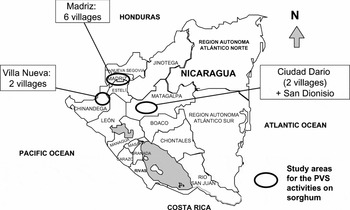
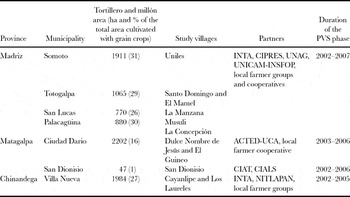
The PVS activities were started in 2002 in six villages located in three provinces (Figure 1). Five more villages were incorporated into the project in 2004 (Table 1). All sites were chosen in dialogue with the project partners. In the study areas, the rainy season has a bimodal distribution and extends from May to November with two crop seasons, the primera (May–August) and the postrera (August–November), separated by a short dry season of irregular intensity and length (generally between mid-July and mid-August) called the canícula. Rainfall is low and highly variable (geographical and inter-annual variations), between 650 and 1200 mm for the entire season (Rapidel and Rodríguez, Reference Rapidel and Rodríguez1989). Millón sorghums are planted during the primera season and harvested in December or January. Tortillero sorghums are mainly grown during the postrera season.
Location of the study areas for the sorghum PVS research in Nicaragua.

Total sorghum area, partners and duration of the research at the study sites of the sorghum PVS work in Nicaragua.

Genetic materials
The germplasm resources used in the PVS work comprised inbred lines developed in Burkina Faso by the CIRAD-INERA joint programme, photoperiod-sensitive African landraces from the CIRAD sorghum collection, improved photoperiod-sensitive lines developed in the region (INTSORMIL-EAP Zamorano Honduras and CENTA El Salvador), and local millón and tortillero cultivars collected and described during the diagnostic work, in addition to inbred lines and commercial varieties from the Nicaraguan research institute INTA.
Presenting and testing new diversity with farmers
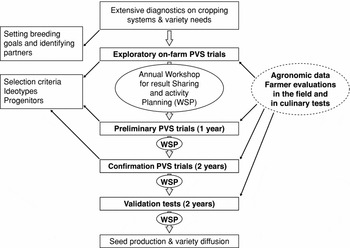
Figure 2 summarizes the general approach used for implementing the sorghum PVS work in each study village.
General scheme used for implementing the PVS sorghum work in Nicaragua.

In an initial diagnostic phase, priority setting for the sorghum improvement programme was conducted with farmers via group discussions, participatory rural appraisal tools such as land-use charts, village historical calendars (including dates of the sorghum crop's greatest changes) and diversity inventories (Pasolac, Reference Pasolac2001). Semi-structured individual interviews and field observations were also used in one study area (Martínez Sánchez, Reference Martínez Sánchez2003).
In addition to this diagnostic work, exploratory on-farm trials with diverse sorghum cultivars, chosen for possessing one or more of the principal plant traits mentioned by farmers during the diagnosis, were established in each village in the course of the first year, and evaluated by farmers by means of individual trait scoring and ranking exercises. These exploratory trials were designed, on the one hand, to evaluate farmers' preferred key traits and how they are assessed by farmers, and on the other hand, to test the capacities of the ‘exotic’ genetic material to adapt to the local agro-climatic conditions and farming practices. From this diversity, farmers chose the best entries suited to their needs. At the same time, the research team carried out observations on the most important agro-morphological traits, such as flowering date, plant height, disease and pest resistance, grain and fodder yield, and 1000-grain weight. The preferred and best-performing entries were subsequently included in a large-scale three-stage participatory evaluation scheme, which incorporated preliminary, confirmation and validation tests, as shown in Figure 2. This evaluation scheme was specifically designed for this project as a participatory and decentralized adaptation of the national evaluation scheme. The approach is, however, in line with other PVS approaches, such as the mother and baby trials scheme (Snapp, Reference Snapp1999), as the preliminary and confirmation trials were similar to mother trials and the validation trials could be compared to baby trials, as farmers individually selected the lines to be planted on their farm. As in baby trials the validation plots are managed according their own cropping practises and without any research orientations, except the expected plot area.
More and more farmers volunteered to join the programme each year, managing PVS trials on their own farms and participating in the evaluation exercises (Trouche et al., Reference Trouche, Hocdé, Aguirre, Lançon, Weltzien and Floquet2006b).
Randomized complete block (RCB) designs with two or three replications planted in the same farmer's field were commonly used for the preliminary PVS trials. The same RCB design was applied to the confirmation PVS trials, but with 3–8 replications per village, and each farmer managing one replication. The preliminary and confirmation trials contained 8–18 lines with harvested plot sizes of 8–12 m2 and 28–50 m2 respectively. The trials were managed according to customary farming practices, including traditional soil preparation, sowing mode and distances, and typically without chemical fertilizer. These cropping conditions were determined in collaboration with the research farmers during the planning meetings. The validation trials included two to five lines compared with a variety control in production plots of 200–500 m2.
Identifying farmers' criteria and carrying out evaluation and selection of new lines
Evaluation and selection of lines were carried out in field workshops during the crop maturity phase. In addition to the research farmers, other farmers from the same village and the vicinity interested in new sorghum varieties were also invited to participate. Anywhere from 10 to 20 male and female farmers participated in any one workshop. As most of the farmers were literate and had some experience in managing agricultural experiments, dialogue with the research team was direct and fairly interactive in the course of the workshops. These PVS field workshops comprised three steps:
1. Identification and classification of farmers' criteria: An open group discussion was held in order to identify farmers' selection criteria for accepting a new variety. Firstly, each participating farmer wrote down what he/she considered the five or six most important criteria for each sorghum type, sometimes giving some quantification (i.e. for yield, height or earliness objectives). In a further group discussion, the identified criteria were ranked according to the frequency at which they had been mentioned, with the farmers being encouraged to explain their criteria. The final ranking of the reported criteria had to be consensually approved by the group, especially if various criteria were ranked at the same frequency. Then the group proceeded to choose the four most relevant criteria to be used for subsequent germplasm evaluation in the field. This choice depended on the specific agronomic and climatic conditions faced by the trial, and here the research team gave adequate information about how the trials were managed up to that date; then a first brief visit to the trial plots was also often necessary to give the farmers a general overview of trial conditions. The feasibility of evaluating the criteria-related traits in the field was also considered. Here, the breeder stimulated the discussions and gave certain necessary explanations about possible interactions between the identified criteria. The same criteria were used as a basis for discussion in the workshops held in subsequent years at the same site.
2. Evaluation and selection based on farmers' criteria: The performance of each entry in the trial was scored on a scale of 1 (bad) to 4 (excellent) for the four most important criteria rising from the open discussion. With the aim of understanding farmers' priorities better, a score for the ‘overall appreciation’ of each entry was included in the exercise. The farmers took part in this evaluation exercise individually or in small groups of 3–6 people. An NGO technician or a research team representative helped the farmer groups to enter the scores given for each criterion and the overall appreciation as well as relevant comments on an evaluation sheet. The evaluation exercise was usually performed in two or three replications of the trial. After completing the evaluation of the trial, farmers were asked to select their preferred entries in each observed replication.
3. Synthesis of the exercise: During a final group dialogue a synthesis of the exercise was held to share and to discuss common ground or differing opinions of the evaluation and selection work.
Culinary tests for evaluating tortilla quality were carried out only with the best entries identified at the confirmation stage during the dry season. These tests included identification of the selection criteria concerning the cooking process and tortilla quality, definition of the cooking conditions and the evaluation of each entry based on further criteria by 10–20 female and male farmers.
Decision-making
The decision-making process for identifying the best entries for progressing to the following stage was based on four principal components: agronomic data analysis, farmers' evaluations (scoring), farmers' selection in the field and farmers' selection during culinary tests. The results of all these components were presented and discussed between scientists and farmers during the annual result-sharing and activity-planning workshops (Figure 2). Final decisions on the entries to be selected or discarded were formulated in a collegiate manner.
Statistical analysis
The data (agronomic and scoring) were statistically analysed with XLSTAT 13.3 2005 software. The correlation tests between farmers' trait scorings and trait measurements were performed using the correlations/associations test procedure. Chi-square tests were performed in order to quantify the contribution of each individual selection criterion in regard to the farmers' selection decisions, using the data description/contingency tables and chi-square procedures of the programme. Chi-square values were calculated from contingency tables created by crossing farmers' selection decisions (selected or not selected) with farmers' scores (1–4) for each criterion.
RESULTS
Precision of the on-farm trials
To assess the precision of the on-farm trials evaluated by farmers, analysis of variance (ANOVA) was performed for the measured quantitative traits from seven on-farm preliminary PVS trials (four tortillero and three millón) conducted in six villages during the 2003 rainy season. Considering the observed coefficient of variation (CV) and repeatability values, all the trials displayed good precision for the traits ‘days to flowering’ (CV and repeatability values of 1.4–4.7% and 0.66–0.94, respectively) and ‘1000-grain weight’ (5.4–8.7% and 0.56–0.94), except one tortillero trial. For grain and fodder yield, the results were more heterogeneous. For grain yield, the CV and repeatability values ranged from 20 to 29% and 0.21 to 0.82, respectively, with the exception of two trials. Compared with the observed results in nine on-station (tortillero) trials with similar designs and numbers of lines, the on-farm trials showed globally higher CV and lower repeatability values, albeit still in range. Fodder yield generally showed lower CV and higher repeatability values compared with grain yield.
Assessment of relevant selection criteria
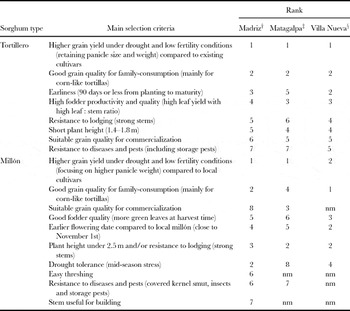
The most important selection criteria for adopting a new variety of tortillero or millón sorghum were arrived at through group discussions and ranking exercises with farmers in their villages. These are listed in Table 2.
Ranking of the most relevant plant traits used as selection criteria for accepting a new variety as identified in open-ended discussions and confirmed with the first evaluations performed by farmers in the three study areas in Nicaragua.

†Overall ranking for 4 villages; ‡Overall ranking for 2 villages; §Overall ranking for 2 villages; nm: trait not mentioned.
In all three regions, enhanced grain yield and adequate grain quality for family consumption were the two main selection criteria for tortillero sorghum. Fodder production and quality was another key criterion. In Madriz and Villa Nueva, farmers ranked earliness in second or third place, looking for very early maturing varieties (90 days from planting to harvest), whereas in the Matagalpa area farmers placed less importance on this characteristic. The short plant height criterion was ranked in fourth place in Matagalpa and Villa Nueva with a view to facilitating harvest operations and permitting higher density with fewer lodging problems.
For millón sorghum, higher grain yield compared to traditional cultivars was the first selection criterion in both Madriz and Matagalpa and ranked second in Villa Nueva. The villages differed in opinion, however, when it came to ranking the other traits. For instance, in Matalgalpa and Villa Nueva farmers valued plant height and/or grain quality for commercialization; in this region, particularly in the Ciudad Dario area, grains of millón type are more commercialized than in the northern region. In contrast, in Madriz priority was given to grain quality for family consumption and tolerance to mid-season drought during the canícula.
Correlations between agronomic observations and farmers' scores
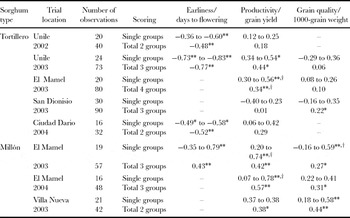
Correlations between the measured duration of the growing cycle (number of days from sowing to flowering) and farmers' scoring of earliness were relatively high and significant. Farmers’ evaluation of earliness was the most confident among the evaluated traits, for both sorghum types, with correlation coefficients between −0.43 and −0.77 (Table 3).
Spearman correlation coefficients between farmers' scores and agronomic observations calculated for eight different PVS trials.

†Values correspond to women's group evaluations.
*p < 0.05; **p < 0.01.
As regards the tortillero type, concordance between farmers' scores for grain yield and measured grain yield varied greatly between sites and farmer groups (Table 3). In most cases, the correlations were significant at El Mamel and Unile for the 2003 evaluations. For the Unile-2002 and San Dionisio-2003 trials, all the correlations were non-significant. Farmers’ scoring of grain quality was only linked to the 1000-grain weight – the only grain-quality-related field observation available – in one case, San Dionisio–2003.
At El Mamel, where farmers are very familiar with the millón type, high and significant correlations between measured data and farmers' scoring were found for yield and grain quality in the two evaluation years (except for one group in both years). At Villa Nueva, correlations for yield assessment were lower but still significant. At El Mamel, women's evaluations of grain yield and grain quality in terms of size gave the highest correlation values with the measured data when compared with the men's evaluations for both the tortillero and millón types.
Correlations between fodder suitability and fodder yield were almost always low and non-significant (data not shown). Regarding this trait, farmers preferred plant types with a high proportion of leaves and thin stems, regarded as of interest for cattle feed, whereas measured fodder yield is greatly influenced by the relative importance of the thickness and length of the stems.
Contribution of the selection criteria to the farmer's selection decisions
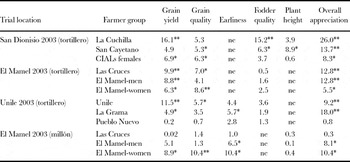
Except for one farmer group in the El Mamel 2003 millón trial, ‘overall appreciation’ was always significantly linked to farmer's selection decisions (FSD) (Table 4). Grain yield and grain quality appreciation also significantly influenced the FSD in half or more of the cases (Table 4). Female farmers' assessment of grain quality contributed most to the FSD for both tortillero and millón sorghum. Fodder quality was only a significant contributing trait to the FSD on two occasion (two farmer groups at San Dioniso where the main use of sorghum was for cattle feed). Plant height scoring only once made a significant contribution to the FSD for tortillero type, at the San Dionisio site. Although plant height appeared to be a major selection criterion for millón sorghum during the diagnosis and subsequent selection criteria assessment work, the farmers did not place any great emphasis on this trait when it came to selecting or discarding a line in the field.
Chi-square values from contingency tables crossing the single selection criteria, including the overall appreciation, and farmer's selection decisions calculated for four PVS trials in 2003.

*p < 0.05; **p < 0.01.
ne: trait not evaluated by farmer.
New experimental breeding lines identified with new traits or trait combinations
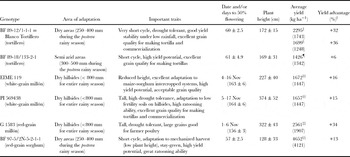
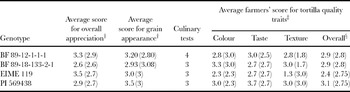
Table 5 presents the potential area of adaptation, the main beneficial traits and the average grain yields of the best performing lines selected with farmers during the PVS process. Table 6 summarizes the farmers' overall appreciation in the field and appreciation of grain quality for making tortillas, as evaluated during the culinary tests using the four most promising white-grain lines.
Main traits, days to flowering, plant height and average yields of the most promising lines identified from the PVS approach.

†Yield advantage over mean of the variety control.
‡Mean of 10 on-farm trials with small plots (8–12 m2) carried out in the northern region 2002–2004; in brackets, the mean of the commercial variety Tortillero Precoz.
§Mean of 21 on-farm validation trials, 2005/2006 (plots of 200–500 m2); in brackets, the mean of the farmers' variety.
¶Average yields for 15 on-farm validation trials, 2005/2006 (plots of 200–500 m2); in brackets, the mean of the farmers' millón cultivar.
††Average yields for 12 on-farm validation trials, 2005–2007 (plots of 100–500 m2); in brackets, the mean of the farmers' millón cultivar.
‡‡Average yields for six on-farm validation trials, 2005–2007 (plots of 100–500 m2); in brackets, the mean of the farmers' millón cultivar.
§§Average yields for two on-station trials, 2005; in brackets, the mean of the red-grain commercial variety INTA SR 16.
Synthesis of farmers' evaluations of four promising lines in the field and in the tortilla culinary tests.

†Farmers’ evaluation in the field using a 1–4 scale where 1 = bad; 2 = acceptable; 3 = good; 4 = excellent.
‡Farmers’ evaluation in the culinary tests using a 1–4 scale where 1 = bad; 2 = acceptable; 3 = good; 4 = excellent.
§Synthetic index for seven tortilla quality and yield criteria.
In brackets, value of the respective best variety control.
For the tortillero type, the BF 89-12/1-1-1 line, officially registered in 2007 with the local name Blanco Tortillero, was the best performer for the low-input cropping systems of the driest areas. Its main qualities are a very short cycle, stable and good productivity under low fertility and drought conditions, high disease resistance, and excellent grain quality for both tortilla preparation and commercialization. BF 89-18/133-2-1 (Oro Alto) exhibited almost the same qualities as the previous line, with a slightly longer cycle and higher yield potential under favourable conditions, and was thus preferred by farmers in the more favourable areas. For the millón cropping systems, two African landraces, PI 569438-Coludo Nevado (Sudan) and 1583-Rojo Gigante (Cameroon), demonstrated high drought tolerance and adaptation to low-fertility soils, as well as producing better yields than local landraces and better grain quality (colour, size and/or tortilla quality). These two African landraces also displayed greater flexibility than the local landraces for the planting date, giving fairly good yields when sown in August when the first rainy season failed. The reduced plant-height lines EIME 119, 99 PREEIME 119 and 99 PREEIME 117, promise higher yield potential and improved fodder production, and were thus good options for hillsides with intermediate fertility conditions.
As regards the red-grain germplasm, the farmer groups at the Chinandega sites first expressed the need for new varieties as well as defining the expected plant-type. The following selection generations and the first yield trials were managed on-station. The best line derived from this work, BF 97-5/2N-5-2-1-1, later aroused interest among farmers from other regions.
DISCUSSION
Learning about selection criteria
Establishing a list of relevant selection criteria with farmers is a relatively straightforward matter, yet breeders need to be aware that understanding how farmers assess these criteria may be more complex than the breeders’ definition of the criteria. This was highlighted in additional discussions with farmers during or after the evaluation work which indicated that farmers' assessment of grain quality includes various traits. While breeders, for instance, generally observe colour, endosperm texture and grain size (by measuring the 1000-grain-weight) for grain appearance evaluation, Nicaraguan farmers also assess colour and size but have no real preference for endosperm texture, simply discarding completely floury grains for being more susceptible to storage pests. Instead, they consider other characteristics of the grain and spikelet: shape, taste (sweet or bitter) and suitability for manual threshing. As regards manual threshing, important characteristics are easiness, non-adherent glumes, and low production of ajuate (the dust irritation to the eyes and skin produced by some varieties during the manual threshing process, depending on glumes types). Indeed, farmers use a set of fairly precise sub-criteria for assessing grain quality, which should be complementary to the standard breeders’ observations. This tallies with several studies carried out on sorghum for human consumption in Africa (Mulatu and Belete, Reference Mulatu and Belete2001; vom Brocke, unpublished data). For the tortillero type, fodder quality is a selection criterion needing greater attention from breeders, in particular for those areas where farmers are looking for dual-purpose varieties. Given the farmers' priorities, grain value for the market and resistance to storage pests should also be considered in breeding schemes.
Quality of the farmers' evaluation
When considering the correlation results between farmers' scores and agronomic observations, we noted that farmers' assessments of earliness were generally highly correlated with breeders’ observations of days to 50% flowering. We deduce that farmers and breeders have the same definition of earliness, even though varying responses to photoperiod existed in the evaluated lines. This stands in contrast with results for sorghum in Burkina Faso, where a different understanding of the earliness trait was observed between farmers and breeders, resulting in divergent evaluation (vom Brocke, personal communication). However, several other studies agree that the earliness trait is generally well assessed by farmers, as reported by authors working on rice (Joshi and Witcombe, Reference Joshi and Witcombe1996) and maize (Mulatu and Zelleke, Reference Mulatu and Zelleke2002). For yield assessment, our results were variable between sites and farmer groups. Farmers’ knowledge of the different sorghum types and/or their motivation for the evaluation exercise appeared to affect the quality of the scoring results. For example, at the San Dionisio site, the relatively limited knowledge of farmers on the sorghum crop may have been the cause of the inconsistency between assessed and measured yield. At this site, which had moderate fertilizer application, the tall phenotypes (2–2.5 m) turned out to be those with the highest yields (up to 5.5 t ha−1). Farmers on the other hand, influenced by their preference for short phenotypes with dense foliage, assessed the short lines very positively and the tall lines negatively. The correlations between yield scores and measured yields were higher and often significant at the Unile 2003 and El Mamel sites, an old sorghum-growing area where farmers have a broad knowledge of the crop. The divergence between the 2002 and 2003 results at the Unile site could therefore have been due to a learning process. At the El Mamel site, the women's group assessment of yields was closer to the measured yields. Although women in this region do not usually manage the sorghum crops directly, they do harvest the sorghum whenever the men leave to take part in coffee bean harvesting at the time of sorghum maturity. In this way the women have acquired a certain amount of knowledge for evaluating the crop production in the field.
Generally, farmers' scores of grain quality and 1000-grain weight were poorly correlated; this result confirms that for farmers this trait includes several distinct components, of which large grain size may be important but not decisive.
The selection decision
Testing the relationship between farmers' scoring data for each trait and their selection decision in the field, depending on the locality and the evaluating farmer groups, may be helpful for indicating the weight of the different selection criteria. This would help to pinpoint possible geographical or gender priorities.
Our data shows that overall appreciation, grain yield and grain quality are the farmer's major criteria for selecting a line. Despite the great importance given by farmers in the diagnosis phase, fodder quality for the tortillero type and intermediate height for the millón type did not play a major role in the actual selection exercises in the field. A key example of the changing importance of plant height preference is the farmers' willingness to accept the African cultivar PI 569438, which grows up to 3.5 m high (however, it has long bending panicles), when previously they expressed preferences for the intermediate height of 2–2.5 m. Similar results were highlighted by Mulatu and Belete (Reference Mulatu and Belete2001) studying sorghum, although in the opposite direction (initial preference for the high phenotypes preferred for different stalk uses but ultimate acceptance of short-type varieties presenting other important traits including earliness). We interpret these lacks of agreement between expressed preferences on fodder quality or plant height and actual varietal choices as showing that farmers cannot find among the germplasm tested the adequate combinations of these traits with earliness, high grain yield and good grain quality characteristics.
Some other interesting information from this data analysis was the observation of divergences between farmer groups at the same sites. This may have been due to different production constraints or objectives, thus leading to different priorities between the traits (if a group had more interest in a specific criterion, it generally had higher expectations and scoring was more discriminating) or distinct preferences for one trait (e.g. for grain quality or plant height), as reported by other authors (Crossa et al., Reference Crossa, Bellon, Franco, Bellón and Reeves2002; Mulatu and Belete, Reference Mulatu and Belete2001). It may also indicate differing knowledge about the crop and/or differing capability to conduct the evaluation exercise.
Identification of preferred and high-performing lines
This PVS strategy was based on early involvement of farmers in defining their selection criteria, an exploration of large but pre-focused genetic and phenotypic diversity, rigorous farmer evaluations and agronomic data through adequate designs and methods, in addition to continuous dialogue with farmers during all evaluation steps. This approach enabled rapid identification of high-yielding and well-appraised lines with relatively low research costs. After six years, around 8–10 lines are now in the process of being adopted by the research farmers, who are also now disseminating those to other farmers via informal seed exchange. Furthermore, the strong involvement of the main NGO partner CIPRES (Centro para la Promoción, la Investigación y el Desarrollo Rural y Social) led to formal registration of the Blanco Tortillero variety and the initiation of a decentralized seed production capacity managed by farmer co-operatives formed with the research farmers. This type of support ensured a wider diffusion of the new varieties even beyond the initial target regions. Compared to a conventional breeding process, this strategy also made it possible to gain at least three years for registering a new variety and achieving appreciable adoption, as reported in other studies (Pandey and Rajatasereekul, Reference Pandey and Rajatasereekul1999; Joshi et al., Reference Joshi, Musa, Johansen, Gyawali, Harris and Witcombe2007). The tortillero germplasm selected with farmers in northern Nicaragua is also performing well under low-input cropping systems in other dry regions of Nicaragua and Honduras. It thus confirms that PPB approaches, contrary to certain preconceptions, can develop germplasm with fairly wide adaptation, as supported by Joshi et al. (Reference Joshi, Musa, Johansen, Gyawali, Harris and Witcombe2007).
Outputs for both participatory and conventional breeding: a win-win experience
The germplasm evaluations with farmers provided relevant inputs for further conventional and participatory sorghum breeding programmes, in Nicaragua and more widely in the Central America region. This included the incorporation of new progenitors and selection criteria (e.g. the farmers' grain quality components) into the mating designs and adjusting the relative weight of some traits (e.g. earliness and fodder quality). Such a progenitor identified with the PVS work was Souroukoukou, an African dwarf late photoperiod-sensitive landrace, which performs well in the sorghum–maize intercropped cropping systems of Nicaragua but presents a deficient grain quality for direct use (very floury grain with testa). New dwarf photoperiod-sensitive lines are now being developed from crosses between Soroukoukou and some high-grain quality landraces.
Research farmers involved in the project acquired a better understanding of the sorghum crop and improved their ability to manage trials and evaluate germplasm. This know-how is now being applied to other crops such as bean and maize. Moreover, the farmers now have access to new variety options, which helps reduce production risks in their very variable climatic environments, in other words, improved food security. New income sources are expected for the local farmer organizations through their involvement in seed production and commercialization of the released varieties. The PVS phase also helped to consolidate capacities in farmer groups and organizations, as well as strengthening ties between them, NGOs and INTA, for implementing future PPB work.
Acknowledgements
The authors are grateful to Rafael Obando (INTA) for logistical support at the CNIA station and seed delivery, René Gomez (NITLAPAN), German Díaz (ACTED-UCA) and the San Dionisio CIAT team for their support at the Villa Nueva, Ciudad Dario and San Dionisio sites respectively and to Myriam Duque and James Silva (CIAT Colombia) and Philippe Letourmy (CIRAD) for their support for statistical analysis; and to P. Biggins and T. McGowan for their helpful suggestions and revision of the English. We sincerely thank all the research farmers involved in this study in Nicaragua for their essential contribution.