Chronic conditions, combined with normal physical, sensory, and cognitive changes that accompany aging, place homebound individuals at heightened risk of harm during a disaster.Reference Daugherty, Eiring and Blake 1 , Reference Phreaner, Jacoby and Dreier 2 A recent survey of adults in the United States showed that being older, having a decreased level of functioning as assessed by activities of daily living, having lower educational attainment, and being of lower income were all independently associated with a lower overall level of preparedness.Reference Al-Rousan, Rubenstein and Wallace 3 As the elderly population grows, the proportion of the population at heightened risk during a disaster increases. In response to recent natural disasters, some measures, such as a citywide registry of the homebound and increased emphasis on outreach and recovery plans, have been undertaken to try to improve the support networks available to homebound individuals.Reference Dostal 4
Home health providers, clinicians who provide care to patients in their homes and thus act to connect the community-dwelling population with the broader health care system, are natural partners for efforts to assess and improve the preparedness of their patients. The Veterans Health Administration (VHA) has a unique Home-Based Primary Care (HBPC) program that provides primary care services to its homebound patients.Reference Leftwich Beales and Edes 5 Although this population varies widely in functional abilities and needs, all veterans receiving HBPC are an especially at-risk population served by the VHA owing to high rates of physical, functional, and psychological limitations. These vulnerabilities also make it more challenging for HBPC patients to be adequately prepared for disasters.
The importance of this relationship between home health providers and their homebound patients is recognized in the newly passed Centers for Medicare & Medicaid Services (CMS) rule, Emergency Preparedness Requirements for Medicare and Medicaid Participating Providers and Suppliers (CMS-3178-P), 6 which increases the disaster preparedness responsibilities of home health care agencies. 7 [Note that Medicare defines home health agencies as those providing services in a beneficiary’s home including skilled nursing care; physical, occupational, and speech therapy; medical social work; and home health aide services. 6 ] An assessment of the disaster preparedness policies and procedures of VHA HBPC programs found 4 main themes concerning the role that home health agencies could play in disasters: (1) individual programs are generally tasked with developing their own disaster preparedness policies, (2) practitioners receive limited training about HBPC program preparedness, (3) practitioners receive limited training about how to prepare their patients for a disaster, and (4) HBPC programs should foster patient self-sufficiency rather than presenting practitioners as first responders.Reference Claver, Wyte-Lake and Dobalian 8 - Reference Wyte-Lake, Claver and Griffin 10
These findings are further supported by the broader literature outside of the VHA.Reference Daugherty, Eiring and Blake 1 , Reference Laditka, Laditka and Cornman 11 Since individual home health sites and HBPC sites often have little support in developing preparedness guidelines, and often lack training or expertise in this area, there exists a wide spectrum of emergency preparedness policies developed by local home health programs. Although guidelines and recommendations exist, 12 , Reference Zane and Biddinger 13 there is limited evaluation of their implementation or effectiveness.Reference Wyte-Lake, Claver and Dalton 14 Nevertheless, increased sharing of best practices could improve response consistency and aid in the identification of patient care needs during a very vulnerable period such as a disaster or emergency.
HBPC Disaster Preparedness Toolkit
In response to these findings about home health care in general and HBPC program disaster preparedness specifically, the authors created a HBPC Disaster Preparedness Toolkit. The toolkit is based on best practices identified from the field.Reference Claver, Wyte-Lake and Dobalian 8 - Reference Wyte-Lake, Claver and Griffin 10 , Reference Wyte-Lake, Claver and Dalton 14 The toolkit takes into account an all-hazards approach, in which regardless of the emergency or disaster, factors are addressed that all HBPC programs must be prepared for, such as extreme heat, electricity outages, and evacuation, and understanding how to shelter-in-place. Additionally, it allows each community to identify additional needs that are unique to the characteristics of that geographic area and particular disaster situation.
The toolkit, which was the final piece of a 3-phase study, was piloted with program managers from 8 HBPC sites that participated in earlier phases of the study. Interviews were conducted with the program managers. The results of the interviews indicated that the initial draft of the toolkit was overly detailed and too comprehensive and would likely not be implemented in consideration of the multiple and increasing tasks required of HBPC programs. Respondents furthermore indicated that the main guidelines currently used for disaster preparedness were the Joint Commission requirements.
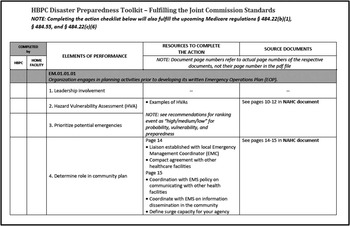
Following this feedback from the pilot sites, the toolkit was redesigned to better align with the Joint Commission requirements for home health agencies around disaster preparedness. 15 The basic structure of the toolkit is a table, which lists each applicable standard and element from the Joint Commission requirements. Aligned to each element are suggested source documents to accomplish the identified task. The primary source documents include The National Association of Home Healthcare and Hospice’s Emergency Preparedness Packet for Home Health Agencies, 12 the Agency for Healthcare Research and Quality’s Home Health Patient Assessment Tools: Preparing for Emergency Triage,Reference Zane and Biddinger 13 and 2 addendums created by the project team that address issues identified in the literature and case studies not sufficiently covered in the former documents. These extensive source documents provide checklists, suggestions, and concrete examples of tools that would be useful to the HBPC programs.
The updated version of the toolkit (Figure 1) was once again distributed to the pilot HBPC program managers, and final feedback was obtained through telephone interviews. The final HBPC Disaster Preparedness Toolkit was then disseminated to all VHA HBPC programs nationwide (see Methods). This study aimed to assess the utility of this evidence-based toolkit among VHA HBPC programs across the United States, looking specifically to understand if the toolkit effectively translated the extensive, and often complex, Joint Commission guidelines into a usable tool in practice. Additionally, the study endeavored to evaluate opportunities for improving disaster preparedness activities at the program level and identify remaining barriers to implementation.
Snapshot of the Home-Based Primary Care (HBPC) Disaster Preparedness Toolkit.

METHODS
The authors were invited to introduce the HBPC Disaster Preparedness Toolkit during a national call for all VHA HBPC program directors in March 2016. The toolkit itself was posted to VA Pulse, a web-based, Veterans Administration (VA) intranet tool that allows document sharing, which all program directors could access. Two days after the presentation, an invitation was sent to all 146 VA HBPC program directors across the country to participate in a web-based evaluation survey of the toolkit. A week later a reminder e-mail was sent out by the national director of the VHA HBPC program, and 3 additional reminder letters were sent out at 1-week intervals by the project team. The survey was open for a total of 4 weeks.
Study Instrument
The project team designed a 20-item web-based survey using the RedCap software (RedCap Consortium, Vanderbilt University). The survey consisted of 15 multiple-choice, close-ended questions and 5 open-ended questions (see the HBPC Toolkit Evaluation in the online data supplement). The main topic areas covered in the survey included the current level of the program’s disaster preparedness activities, helpfulness of the toolkit, relevance of toolkit content, recommendations for improvement, and opportunities to outline requests for additional resources.
Analysis
In this article, we examine the association of length of time spent at the HBPC program with helpfulness of the toolkit in 3 distinct areas: clarity of the toolkit design, comprehensiveness of the information in the toolkit, and overall impression of the toolkit. We also examined the association of perceived robustness and relevance of the HBPC program with frequency of implementation of the disaster preparedness protocol. Descriptive statistics were used to describe the characteristics of each site. Bivariate analyses using chi-square tests were conducted to test the significance of the above-mentioned associations. The significance level was set at P<0.05. All statistical analyses were performed by using Stata v.12 (Stata Corp, College Station, TX).
For the 5 open-ended questions, the written responses were compiled into a matrix and were analyzed by using content analysis methods. Data in the responses were coded and then grouped into themes to describe the respondents’ general impressions about what they liked most about the toolkit, what aspects of the toolkit they felt could be improved, how they saw themselves using the toolkit, information about disaster preparedness they would like to have in the future, and types of support that would be useful for implementing the toolkit.
The VA Greater Los Angeles Healthcare System Institutional Review Board approved this study as a quality improvement initiative, and the study was therefore exempt from needing human subjects approval.
RESULTS
From a total of 146 possible respondents (the program manager from each of the HBPC programs in the United States), 80 study respondents initiated the survey. Three were dropped for not completing at least 50% of the survey. The final number of respondents for whom data were available for analysis was 77/146 (53% response rate), with respondents representing programs based in 40/50 US states.
Respondent Characteristics
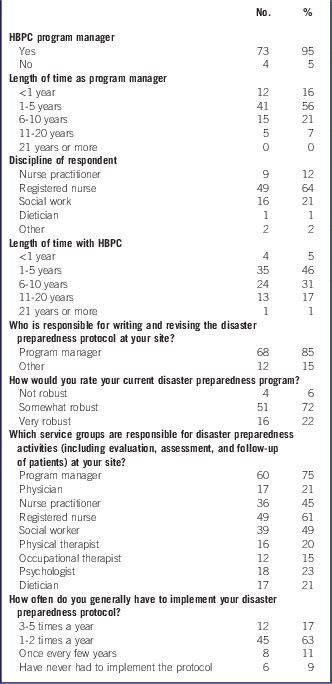
The majority of respondents (95%) to the HBPC Disaster Preparedness Toolkit survey were HBPC program managers, with only 16% relatively new to their position, and even fewer (5%) new to the HBPC program (Table 1). The majority had a nursing background, with 12% nurse practitioners and 64% registered nurses; greater than 20% came from a social work background.

We asked 2 questions to further understand the nature of the HBPC team in terms of disaster preparedness responsibilities: (1) Please indicate who is responsible for writing and revising the disaster preparedness portion of your standard operating procedures (SOP). (2) Please indicate which service groups are responsible for disaster preparedness activities (including evaluation, assessment, and follow-up of patients) at your site. The vast majority (85%) reported that the program manager is responsible for writing and revising the disaster preparedness protocol at their site. Of the 12 sites that reported “other,” the response list included chief of occupational health and safety, hospital medical directors, emergency management officers, and nurse managers. For the second question, the results indicated that registered nurses and social workers were most responsible for disaster preparedness activities (61% of sites and 49% of sites, respectively), and the service groups reported to be least involved were physical therapists and occupational therapists (20% and 15% of sites, respectively; Table 1).
To understand how often HBPC programs implemented their current disaster preparedness protocols, we asked, How often do you generally have to implement your disaster preparedness protocol at your facility? Over two-thirds implemented their protocol at least once or twice a year (63%). Very few (9%) never implemented their protocol, 11% implemented once every few years, and 17% implemented frequently, or 3 to 5 times a year (Table 1).
Length of Time With the HBPC Program
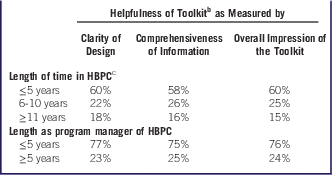
Table 2 provides information on the helpfulness of the toolkit in relation to the length of time of the respondent as a staff member of the HBPC program. Of those respondents who found the toolkit very helpful (for clarity of design, comprehensiveness of information, and overall impression of the toolkit) approximately 60% had been part of the HBPC program for 5 years or less. The percentage of respondents who reported the toolkit to be helpful decreased as length of time in the HBPC program increased (22-25% for 6-10 years and 15-18% for ≥11 years). These results indicate that helpfulness of the toolkit was associated with fewer number of years with the HBPC program (P<0.05). Length of time in the HBPC program manager role was not found to be associated with perceived helpfulness of the toolkit.
Perceived Helpfulness of the Toolkit Relative to Time in HBPCFootnote a

a Abbreviations: HBPC, home-based primary care.
b Table presents percentage of respondents who rated the toolkit “very helpful or extremely helpful” for the categories indicated.
c P<0.05.
Frequency of Implementation
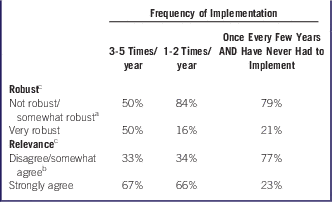
The study respondents were asked, How would you rate your current disaster preparedness program? The 3 response categories were (1) not robust, (2) somewhat robust, and (3) very robust. Owing to sparse data, the 2 categories (not robust and somewhat robust) were grouped into 1 category. As shown in Table 3, frequency of implementation of the HBPC program’s disaster preparedness protocol was related to perceived level of robustness of the protocol. Of those who implemented their program’s disaster preparedness protocol the most (3-5 times/year), half (50%) reported their program to be very robust. Of those who implemented their protocol twice a year or less, only 16% to 21% reported their protocol to be very robust (P values <0.05).
Helpfulness of the Toolkit Relative to Frequency of Implementation

a Only 4 respondents indicated “not robust.”
b Includes “strongly disagree,” “somewhat disagree,” and “somewhat agree.” Zero respondents indicated “strongly disagree” and 2 respondents indicated “somewhat disagree.”
c P<0.05.
On a 4-point Likert scale, respondents were asked if they agreed or disagreed that the topics covered in the toolkit were relevant to their preparedness protocol. Table 3 shows of those who implemented their disaster preparedness protocol more frequently (3-5 times/year or 1-2 times/year), two-thirds (66%-67%) strongly agreed that the topics covered in the toolkit were relevant. Conversely, of those who implemented their protocol very infrequently or never, only 23% strongly agreed that the topics covered in the toolkit were relevant to their work (P values <0.05).
When asked, How often do you see yourself using this toolkit?, only 8% of respondents indicated that they will never use the toolkit. The rest indicated that they would use the toolkit moderately or extensively (data not shown).
Open-Ended Responses
When asked what respondents liked most about the toolkit, responses included the comprehensiveness of the toolkit (“Very comprehensive review of all areas that need to be addressed in emergency preparedness”); its ease of use (“Contained valuable information that is readily accessible and easy to find”), in part owing to its organization into components or phases; the fact that it identifies Joint Commission guidelines; its foundation in evidence-based, best practices (“I liked the inclusion of the literature review and the site evaluations”); its inclusiveness of all types of emergencies (“It has information about all aspects of emergency planning: natural disasters, power outages, dangerous situations, etc”); its specificity for veterans (“Based on what makes sense for veterans in the home”) and specific disciplines (“How other programs are using each discipline to achieve the goal!”); and its usefulness in developing an emergency management plan.
Several respondents felt that they needed to work with the tool before they could make recommendations for improvement, but others suggested additions or amendments to the tool. They were interested in receiving updates to the tool, as appropriate. One respondent suggested adding local information. Further training about how to use the tool, perhaps through talking points provided with the training slides, was requested. There were mixed reviews about the length and level of detail in the tool, with some saying it was too lengthy and should be condensed into one document (“It is very lengthy but I am not sure it can be condensed without losing some of the needed information”) and others saying they wanted more bullet points and examples of policy. Last, there was a call for the involvement of all interdisciplinary team members in this area. One respondent said it “would be helpful if all areas to be covered could somehow be simplified into [a] chart/checklist that could be divided among all disciplines.” Another mentioned that “more people could go over the toolkit than just the SW [social worker] and OT [occupational therapist].”
Respondents indicated that they would use the HBPC toolkit for education/training for new and existing staff, as a reference or adjunct to information currently used, to guide revision of their HBPC program’s existing materials (“Will have staff review and evaluate our current process and make recommendations for improvements”), and in preparation for reviews and drills (“Preparation for tabletop drills…”). One mentioned that they would use specific tools in the toolkit, such as the Home Care Emergency Preparedness Assessment. Others said that the tool would be used for review with veterans and their caregivers (“Reviewing with veteran and caregiver(s) at each initial and annual SW [social work] assessment and as needed”) and to modify scripts for “calling the most vulnerable vets.” One of the most experienced HBPC program managers said, “If I were a ‘newbie’, this [toolkit] would be my bible.”
HBPC program representatives were asked to describe the types of support they would need to implement the toolkit. They suggested speaking with others who have implemented the toolkit, sharing it with leadership and hospital-wide committees, collaborating with local law enforcement and receiving online training (“Perhaps some online training for the team with those that developed the toolkit”), especially discipline-specific training (“Education for each discipline”) as well as interdisciplinary training (“There is often resistance from disciplines in taking on duties that they feel should belong to the NP [nurse practitioner]/PCP [primary care provider]”). They also indicated that they would appreciate reminders about the toolkit.
DISCUSSION
In this study, we sought to examine the utility of a Disaster Preparedness Toolkit among VHA HBPC programs to evaluate opportunities for improving disaster preparedness activities at the program level and to identify remaining barriers to implementation. We also explored the level of involvement of different members of the HBPC team in disaster preparedness activities at their program sites. As responsibilities around disaster preparedness increase for home health agencies, 6 , 7 agencies will need robust resources to ensure they are properly and effectively fulfilling their requirements. Health care administrators and clinicians tasked with fulfilling these requirements often lack expertise in these topics. Toolkits have been shown to be one way in which to effectively translate evidence-based practice into clinical care.Reference Yamada, Shorkey and Barwick 16
There are several key findings from this study. First, the interdisciplinary nature of the HBPC team is unique and there are many opportunities for the different service groups to contribute to the disaster preparedness of a program in a way that is appropriate for their background and training. The findings of this study support earlier case study reports, which indicated that although it is generally considered the responsibility of the program manager and nursing staff to take the lead on all disaster preparedness activities, often other service groups are the de facto leaders.Reference Wyte-Lake, Claver and Dobalian 9 , Reference Tubbesing, Obal and Brazier 17 The open-ended comments suggest both that more disciplines (outside of nursing) should be a part of the disaster preparedness activities and that sometimes there is resistance from non-nursing service groups to take on these tasks. Sections of the toolkit provide examples of the varied preparedness roles and responsibilities of the HBPC team, providing opportunities for sites who have resistant members to understand ways other sites have engaged their members, and underscoring the importance of disaster preparedness being a team effort.
Interestingly, the 2 groups reported as least frequently involved were occupational therapists and physical therapists, clinicians who are often involved in assessing and supporting the functional mobility of patients as well as safe exit strategies and assistive devices. These strategies and devices are a large part of preparedness plans for the homebound. Engaging these clinicians further could serve to strengthen a patient’s personal preparedness plan. In some programs, other hospital offices are in charge of all emergency preparedness details, such as the office of occupational health and safety or emergency management. This issue of shared responsibility between HBPC and other hospital offices in disaster preparedness arose in the piloting of the toolkit as well. To address this point, a column was added to the toolkit to note whether the responsibility of the specific task was that of the HBPC team or the greater hospital system. This allows all parties to know that all tasks are being effectively covered.
Helpfulness of the toolkit was found to be highest among those respondents who were newest to the HBPC program. This was supported by both the open-ended and close-ended data. There may be a few reasons for this. One, the roles and responsibilities of home-based care are distinct from most other clinical care responsibilities in that care takes place in a patient’s home. Understanding how to establish a disaster preparedness program that address the structural needs of the office, the organizational needs of the clinical staff, and the personal needs of the patient is likely a daunting and unfamiliar task to those new to the field. Furthermore, with the highly vulnerable population being served,Reference Aldrich and Benson 18 the patient preparedness portion of the disaster preparedness planning requires attention to many additional details not generally required for the general population, such as electrical-dependent equipment, medication, and mobility issues, to name a few.Reference Daugherty, Eiring and Blake 1 , Reference Ruder 19 Finally, disaster preparedness often falls outside of the clinical expertise of most of the clinicians on the team, and yet they are still tasked with complying with the complex Joint Commission standards. Interestingly, as opposed to newness to the HBPC program, newness to the program manager role itself was not found to be significant in relation to how helpful the toolkit was rated. This may be due to the highly interdisciplinary nature of the HBPC team, where disaster preparedness activities become a regular part of the team’s responsibilities and the team as a whole becomes familiar with them, rather than disaster preparedness falling under the sole purview of the program manager. It could also be due to the new program managers being overwhelmed with learning all of the program needs and not viewing disaster preparedness as a priority. However, team members change and even well-established programs have the potential of losing important parts of the emergency management program if it is not thoroughly evaluated, reviewed, and tested regularly.
Often it is not until a community served by a HBPC program experiences a disaster that leadership and staff realize they need to review their preparedness protocol.Reference Hunter Revell and McCurry 20 , Reference King 21 Our findings concur. Those program managers who implemented their disaster protocols more frequently strongly agreed that the topics covered in the toolkit were relevant to their work. Sites who may not be situated in areas where natural disasters such a severe weather regularly occur may be less inclined to prioritize disaster preparedness. Yet, power outages can occur anywhere, and as concerns around terrorism grow, all communities need to be prepared to support their most vulnerable populations.Reference Doherty 22
The literature shows that home health agencies, both within and outside of the VHA, often have very limited disaster plans and capabilities.Reference Daugherty, Eiring and Blake 1 , Reference Claver, Wyte-Lake and Dobalian 8 , Reference Laditka, Laditka and Cornman 11 To that end, we were gratified that the vast majority of respondents responded that they would use the toolkit “moderately” to “extensively.” Using the toolkit on an annual basis is very appropriate as a way to review current plans for an annual disaster drill or to prepare for Joint Commission review. Because home health agencies outside of VHA are under the same Joint Commission emergency management regulations, the toolkit could serve in a similar fashion to support their emergency preparedness activities. For programs or agencies who have newer members, or for program managers who need to develop new protocols, the toolkit is a way to provide evidence-based resources to enhance trainings and provide guidelines.
Limitations
With an N of 77, the sample size of this study was small. However, the response rate greater than 50% provides some assurance that the survey results are representative of HBPC programs across the country.
Given that the survey was fielded shortly after distribution, the results depend on perception of the toolkit rather than an evaluation of actual implementation. Actual implementation should be evaluated in a future study. Nonetheless, assessing whether HBPC program managers would turn to the toolkit to support their own activities suggests the potential for use in the future.
CONCLUSION
Given the vulnerability of homebound persons during disasters, there is movement within the disaster preparedness field to recognize the importance of programs that serve these individuals in bolstering a community’s resiliency. Programs are often required to fulfill requirements that fall out of their clinical expertise as well as to support patients during a disaster who are highly vulnerable. Engaging all members of the team with their diverse clinical skills is one way to address this charge. A disaster preparedness toolkit can help to bridge the gap by providing evidence-based practices to the field. In particular, the toolkit can help support the education of new practitioners and refine the protocols of those programs that infrequently implement their disaster preparedness protocols. In particular, programs that rarely implement their protocols may be in greatest need of “off-the-shelf,” readily adaptable, evidence-based toolkits such as the one we describe here.
Contributors
T. Wyte-Lake drafted the article and led the writing. Both T. Wyte-Lake and M. Claver led the conceptualization of the research, the writing of the survey questions, collection of the data and the interpretation of the data. C. Der-Martirosian supported the statistical analyses. D. Davis supported the survey design and data collection. A. Dobalian had ongoing involvement in the design of the study. All authors read, edited, and approved the final article.
SUPPLEMENTARY MATERIAL
For supplementary material/s referred to in this article, please visit https://doi.org/10.1017/dmp.2016.145