Introduction
Polystomatids of anuran hosts in the Palaearctic realm are represented by the genera Diplorchis Ozaki, 1931 and Polystoma Zeder, 1800. In this geographical area Polystoma is represented by 18 species found in the anuran genera Hyla, Pelobates, Pseudepidalea, Rana and Rhacophorus. During a study of the helminth fauna of the eastern spadefoot Pelobates syriacus Boettger in Turkey some specimens were found to be infected with a new species of Polystoma. Two Polystoma species are known from the host Pelobates Wagler, namely Polystoma fuscus Biserkov & Hadjinikolova (Reference Biserkov and Hadjinikolova1993) from Pe. fuscus (Laurenti) from Bulgaria and P. pelobatis Euzet & Combes, Reference Euzet and Combes1966 from Pe. cultripes (Cuvier) from France. Polystome species known from Turkey include P. macrocnemis Biserkov et al., 2001 from Rana macrocnemis Boulenger, P. skrjabini Bukvarov, 1984 from Hyla arborea (Linnaeus), P. viridis Euzet, Combes & Batchvarov, 1974 from the frog Pseudepidalea viridis (Laurenti) (formerly known as Bufo viridis Boulenger) (see Yildirimhan et al., Reference Yildirimhan, Altunel and Ugurtas2006a, Reference Yildirimhan, Goldberg and Berseyb). The specimens recovered from Pe. syriacus differed substantially from the other polystomes known to infect the host Pelobates and this is a formal description of the new species.
Materials and methods
Collection and examination of frogs
A total of 91 specimens of Pe. syriacus were collected from three localities in Turkey. Twenty-five specimens were collected from Bursa (40°16′N, 29°02′E) during May 1995, 24 specimens from the Edirne (41°51′N, 26°38′E) during May 2000, 19 specimens from the Seydişehir (37°20′N, 32°06′E) during July 2000, seven specimens during August 2002 and 16 specimens during June 2003.
Prior to dissection, frogs were anaesthetized by injecting them with 100 mg/kg body weight sodium pentobarbitone. Mature parasites were obtained from the urinary bladders and fixed under cover slip pressure for 24 h in 70% ethyl alcohol. Flattened specimens were stained in iron acetocarmine (Georgiev et al., Reference Georgiev, Biserkov and Genov1986), dehydrated, cleared and mounted in Entellan. Specimens were later remounted using Canada balsam.
Mounted parasites were examined using a Nikon (IMP, Boksburg, South Africa) E800 microscope fitted with a Nikon DXM1200 digital microscope camera connected to a PC. Measurements were taken using Eclipse network software (Nikon). All parasite measurements are in micrometres. Measurements are presented as the mean, followed by the range in parentheses and based on seven mature specimens.
Morphometrical comparison of the marginal hooklets
Marginal hooklet size and shape are of taxonomic importance when comparing polystomes. The protocol developed by Du Preez & Maritz (Reference Du Preez and Maritz2006) was applied and a plot prepared.
Molecular analyses
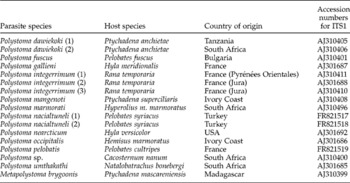
Two polystome specimens from Pe. syriacus and one single individual from Pe. cultripes were analysed. We followed the molecular procedure described in Verneau et al. (Reference Verneau, Du Preez, Laurent, Raharivololoniaina, Glaw and Vences2009) for DNA extractions and ITS1 amplifications. Polymerase chain reaction (PCR) was performed with Forward S1, 5′-ATTCCGATAACGAACGAGACT-3′ and Reverse IR8, 5′-GCTAGCTGCGTTCTTCATCGA-3′ primers (Sinnappah et al., Reference Sinnappah, Lim, Rohde, Tinsley, Combes and Verneau2001; Kaci-Chaouch et al., Reference Kaci-Chaouch, Verneau and Desdevises2008) that anneal in the 18S rRNA and 5.8S rRNA genes, respectively. PCR products of approximately 850 bp were purified with the kit Wizard SV Gel and PCR Clean-Up System of Promega (Charbonnières, France) and sequenced with the Forward and Reverse primers by GATC Biotech (France). DNA sequences were subsequently edited and corrected using SequencherTM software (Gene Codes Corporation, Ann Arbor, Michigan, USA) and aligned using Clustal W (Thompson et al., Reference Thompson, Higgins and Gibson1994) which is implemented in MEGA version 4 (Tamura et al., Reference Tamura, Dudley, Nei and Kumar2007) with 15 other polystome sequences extracted from GenBank (table 1). After excluding indels and ambiguous characters, the maximum likelihood (ML) phylogenetic analysis was performed on 553 characters. A search for the best ML tree was done using the general time reversible +γ model selected by the akaike information criterion in Modeltest (Posada & Crandall, Reference Posada and Crandall1998) and following a heuristic procedure under the tree bisection and reconnection branch swapping option with PAUP* 4.0b9 (Swofford, Reference Swofford2002). It was rooted with Polystoma nearcticum, according to Bentz et al. (Reference Bentz, Leroy, Du Preez, Mariaux, Vaucher and Verneau2001) and Verneau et al. (Reference Verneau, Bentz, Sinnappah, Du Preez, Whittington and Combes2002). ML bootstrap support values were inferred with the same model of sequence evolution under the nearest neighbour interchange branch swapping option. Uncorrected pairwise divergences (p-distances) were also estimated within each pair of polystome taxa using PAUP* 4.0b9 to validate the taxonomic status of species.
List of parasites included in the molecular analysis, their host species, country of origin and GenBank accession numbers.

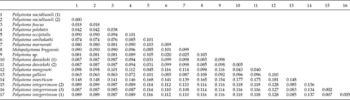
Mean character differences inferred from comparisons of ITS1 sequences (553 aligned positions after excluding gaps and ambiguous characters).

Results
Levels of infection
Only host specimens from the sandy shores of Sigla Lake (Seydişehir) were infected. Of the 19 host specimens (13♂, 6♀) collected in July 2000, one male was infected with a single polystome (prevalence 5.3%); of the seven specimens (4♂, 3♀) collected in August 2002, one male was infected with two polystomes (prevalence 14.3%); and of the 16 specimens (9♂, 7♀) collected in June 2003, five males were infected with one polystome each, while one female was infected with three polystomes (prevalence 38%, mean intensity 1.3). For the total sample the prevalence was 19.4 and mean intensity 1.4. In total 11 Polystoma specimens were collected with a maximum of three specimens found per host. Of these, one specimen was lost, one badly damaged and two used for molecular analyses. The description is thus based on seven sexually mature worms.
Description of Polystoma nacialtuneli n. sp.
Deposition of type specimens. Holotype (HKMUK 2011.2.28.1) and one paratype (HKMUK 2011.2.28.2) in the Parasitic Worms Collection, Natural History Museum, London; two paratypes (NMB-P326 and NMB-P327) deposited in the Parasitic Worm Collection, National Museum, Aliwal Street, 9300 Bloemfontein, South Africa; three paratypes deposited in the helminth collection of Uludag University, Museum of Zoology, Bursa, Turkey.
Type host. Pelobates syriacus Boettger, 1889.
Site. Urinary bladder.
Type locality. Seydişehir (37°20′N, 32°06′E).
Etymology. The species is named after Professor Naci Altunel, University of Uludag, Turkey who made significant contributions to the development of parasitology in Turkey.
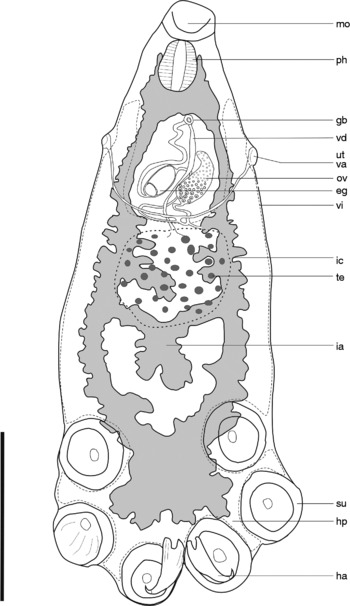
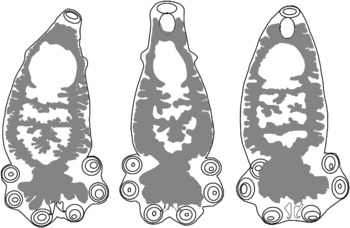
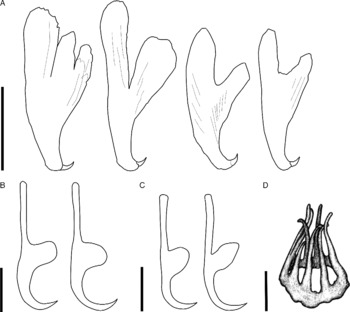
Morphological characteristics. General characteristics (fig. 1) fit in with the generic characteristics for Polystoma. Body pyriform, tapering anteriorly. Body length 5067 (3412–7013), greatest width at the level of the testis 1815 (1228–2771), width at vagina 1230 (887–1631). Haptor 1472 (993–2061) long, 2190 (1476–3286) wide, with three pairs of laterally located cup-like suckers, 468 (303–658) diameter, hamuli and 16 marginal hooklets. Eyespots not observed in adults. False oral sucker 565 (470–768) with oral cavity subterminal. Pharynx pear shaped, 393 (319–521) long, 371 (275–507) wide. Intestine bifurcate, intestinal caeca join in haptor to form a haptoral anastomosis. Up to 33 (18–47) lateral diverticula and 15 (13–19) medial diverticula per side. Medial diverticula branched forming up to two anastomoses (fig. 2). Six of the specimens with two hamuli and the holotype with only one hamulus (fig. 1). Hamulus with shallow incision between the two roots (fig. 3A), length 410 (275–545), recurved point 45 (40–51) long (fig. 3A), small compared to other polystomes from Pelobates. Placement of marginal hooklets as for other polystomes; pairs 1 and 2 posterior-most between suckers 1; pairs 3, 4 and 5 at bases of suckers and pairs 6–8 anterior in haptor between suckers 3; no oncomiracidia were available and marginal hooklets were measured in mature specimens. Although the length for several hooklets was measurable, only three marginal hooklets 1 were in a flat orientation enabling us to prepare drawings. Hooklet 1, longest and largest with length 31 (30–32) (fig. 3B); hooklets 2–8 of equal length 24 (21–26) (fig. 3C). Testis single, large, follicular, post-ovarian, ventral and situated in mid body. Vas deferens widens slightly anteriorly forming a seminal vesicle, narrows to open at common genital bulb. Genital bulb armed with seven or eight genital spines (fig. 3D). Genital spine length 44 (42–45), curved with branched root on proximal end and sharp point distally, arranged in single file in the form of a bud, located anterior to ovary and posterior to intestinal bifurcation (fig. 1). Vaginae, two on lateral margins just anterior to the level of the ovary; vaginal ducts descend to respective vitelline ducts, main left and right vitelline ducts unite medially to form a vitelline reservoir, posterior duct connects to oviduct. Vitellarium follicular, diffuse, extending throughout most of the body except the area occupied by the ovary and uterus as well as around the haptoral suckers. Ovary pear-shaped, 522 (339–666) long, 268 (155–331) wide, one-third from anterior end of body (fig. 1). Oviduct leaves ovary in posterior direction, turns anteriorly and receives duct from vitelline reservoir, forms an ootype, surrounded by the Mehlis' gland. Uterus tubiform, relatively short and has a single yellowish-tan, operculated, oval-shaped egg 235 (234–236) long, 168 (156–180) wide in utero in four of the seven specimens examined. Oncomiracidium not known. Genito-intestinal canal arises just before entry of posterior vitelline duct, connecting oviduct to left caecum.
Polystoma nacialtuneli n. sp., ventral view; dotted line indicates the outline of the vitelline system. Abbreviations: eg, egg; gb, genital bulb; ha, hamulus; hp, haptor; ia, intercaecal anastomosis; ic, intestinal caecum; mo, mouth; ov, ovary; ph, pharynx; su, sucker; te, testis; ut, uterus; va, vagina; vd, vas deferens; vi, vitellarium. Scale bar: 1 mm.

Polystoma nacialtuneli n. sp., variation in intestinal arrangement.

Polystoma nacialtuneli n. sp. (A) hamuli; (B) marginal hooklets 1; (C) marginal hooklets 2–8; (D) genital spines. Scale bars: (A) 200 μm, (B) 10 μm, (C) 10 μm, (D) 20 μm.

Phylogenetic position
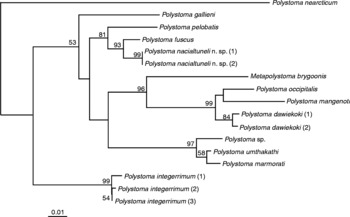
Regarding the genetic divergences estimated within each pair of polystomes, conspecific parasites of Rana temporaria, i.e. P. integerrimum, diverge from each other from 0.2 to 0.7% (table 2). Similarly, two conspecific individuals of P. dawiekoki which infests Ptychadena anchietae in allopatry show a divergence of 0.5%. On the other hand, the two most related African polystome species, namely P. marmorati of Hyperolius m. marmoratus and P. umthakathi of Natalobatrachus bonebergi (fig. 4) diverge from each other by 0.9%. Therefore, a threshold of about 1% divergence may be considered in order to assign individuals into separate species. Bentz et al. (Reference Bentz, Leroy, Du Preez, Mariaux, Vaucher and Verneau2001) suggested that for Polystoma a 1% difference in ITS1 be considered as a separate species. Because the two individuals of P. nacialtuneli n. sp. diverge from their closest relative, i.e. P. fuscus of Pe. fuscus, by 1.8%, we should consider P. nacialtuneli n. sp. as a new polystome species. Figure 4 shows that P. nacialtuneli n. sp. falls within a clade of polystomes infesting archaeobatrachian hosts of family Pelobatidae, namely Pe. cultripes, Pe. fuscus and Pe. syriacus. This result suggests that these three polystome species may have coevolved with their host species, as is also the case for polystomes of Ptychadena in Africa (Bentz et al., Reference Bentz, Leroy, Du Preez, Mariaux, Vaucher and Verneau2001).
Best maximum likelihood tree (score = 2182.70105) inferred from an analysis of 553 characters in the ITS1. Values along branches correspond to bootstrap proportions after 1000 replicates.

Diagnosis
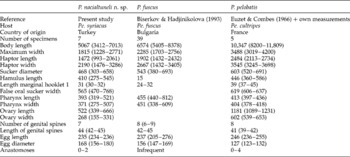
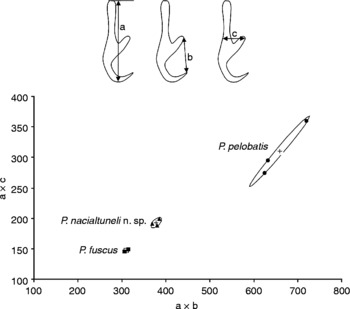
Polystoma nacialtuneli n. sp. differs from other polystomes known from Pelobates (table 3). Morphologically it is very similar to P. fuscus and body measurements overlap to some degree. The two species can, however, be separated on hamulus morphology. In P. fuscus the hamulus is totally underdeveloped and merely 15 μm long while in P. nacialtuneli n. sp. the hamulus is well developed with an average length of 410 μm. Polystoma nacialtuneli n. sp. differs from P. pelobatis in Pe. cultripes by a combination of characteristics. Polystoma pelobatis is double the size of P. nacialtuneli n. sp., with the smallest known specimen of P. pelobatis much larger than the largest P. nacialtuneli n. sp. Both species have prehaptoral intestinal anastomoses but P. nacialtuneli n. sp. has a maximum of two whereas P. pelobatis may have up to four. Hamulus length expressed as percentage of total body length is 8.2% (6.6–10.8%) for P. nacialtuneli n. sp. compared to 4.3% for P. pelobatis. In a plot of the products of the total length (a in fig. 5) and the width at the level of the guard (c in fig. 5) versus the product of the total length versus the length of a tangent between the tip of the blade to the guard (b in fig. 5) of marginal hooklet 1 as proposed by Du Preez & Maritz (Reference Du Preez and Maritz2006), P. nacialtuneli n. sp. occupies a distinct position completely separated from P. fuscus and P. pelobatis (fig. 5).
Characteristics of Polystoma species known from Pelobates (all parasite measurements are in micrometres; measurements are presented as the mean, followed by the range in parentheses).

Scatter diagram of a × b plotted against a × c for Polystoma fuscus, P. pelobatis and P. nacialtuneli n. sp. Measurements for P. fuscus were calculated from the drawings in the species description by Biserkov & Hadjinikolova (Reference Biserkov and Hadjinikolova1993); and marginal hooklets for P. pelobatis and P. nacialtuneli n. sp. were measured from mounted mature specimens.

Discussion
The newly described polystome species has a combination of characteristics that place it in the monogenean genus Polystoma Zeder, 1800, namely an attachment organ with three pairs of suckers, one pair of hamuli, intestinal caeca confluent to form a haptoral anastomosis, postovarian testis, short uterus, two vaginae and a follicular vitellarium. Because of limited interspecific variation in morphological characters used in identifying polystome species (Tinsley, Reference Tinsley1973), much emphasis has been placed on host-specificity. This is also true for European polystomes. The first attempt to investigate the degree of host-specificity displayed by polystomes was conducted by Combes (Reference Combes1966). He conducted cross-infection experiments with two European polystome species. In cases where oncomiracidia became established in a substitute host tadpole, parasites progressively disappeared and no parasites were able to migrate to the urinary bladder. Combes (Reference Combes1968) conducted further cross-infection experiments and confirmed the strict host-specificity displayed by European polystomes. Euzet et al. (Reference Euzet, Combes and Batchvarov1974b) described P. viridis and showed that the new parasite was strictly host-specific and stated that, although the various European polystomes must have a common ancestor, they have adapted to their ‘new’ hosts to such an extent that an exchange of hosts is impossible. Several other authors commented on the strict host-specificity of the Polystomatidae and, in particular, the genus Polystoma (Tinsley, Reference Tinsley1973, Reference Tinsley1974; Euzet et al., Reference Euzet, Bourgat and Salami-Cadoux1974a; Bourgat & Salami-Cadoux, Reference Bourgat and Salami-Cadoux1976; Combes & Channing, Reference Combes and Channing1979; Murith, Reference Murith1981, Reference Murith1982; Kok & Van Wyk, Reference Kok and Van Wyk1986; Kok & Du Preez, Reference Kok and Du Preez1987; Du Preez & Kok, Reference Du Preez and Kok1992, Reference Du Preez and Kok1993, Reference Du Preez and Kok1997). This high degree of host-specificity has led to the acceptance that host species identity plays a key role in identifying a species.
Although the hamuli of P. nacialtuneli n. sp. are on average marginally smaller that those for P. pelobatis (410 for P. nacialtuneli n. sp. and 446 for P. pelobatis), the relative size of the hamulus expressed as a percentage of the total body length is double that of P. pelobatis. Since the hamuli for P. fuscus are very small (15), Biserkov & Hadjininikolova (Reference Biserkov and Hadjinikolova1993) compared this species with all anuran polystomes lacking hamuli, namely Eupolystoma, Riojatrema and Pseudodiplorchis, and concluded that, apart from the hamulus, P. fuscus fits within the genus Polystoma.
The Polystomatidae is an ancient group of parasites tracking the evolutionary history of the first aquatic tetrapods following the Actinopterygii–Sarcopterygii transition in the Palaeozoic age (Verneau et al., Reference Verneau, Bentz, Sinnappah, Du Preez, Whittington and Combes2002). Bentz et al. (Reference Bentz, Leroy, Du Preez, Mariaux, Vaucher and Verneau2001) hypothesized that the genus Polystoma had its origin in South America, from where it spread to Europe and to Africa. A strongly supported hypothesis is that the ancestor of Pelobates carried Polystoma into Africa. They proposed that this invasion could have taken place during the Miocene when, for a short period, Spain and Morocco were connected. This period matches the molecular calibrations by Bentz et al. (Reference Bentz, Leroy, Du Preez, Mariaux, Vaucher and Verneau2001). Of the four currently recognized Pelobates species, only Pe. varaldii Pasteur & Bons is known from the African continent, where it occurs in Morocco. The other three, namely Pe. cultripes, Pe. fuscus and Pe. syriacus are all known from Europe. All three European species harbour closely related Polystoma species. Further recovery of a polystome in Pe. varaldii will be very significant as it would provide an opportunity to test the hypothesis that Polystoma was introduced to Africa through ancestral Pelobates.