1. Introduction
Fluid-mediated phase transformation during complex metamorphic reactions with increasing grade causes the redistribution of elements on a regional scale, resulting in various minerals including chlorite, epidote, sericite and scapolite (Putnis & Austrheim, Reference Putnis and Austrheim2010). Such mobilizations on a larger scale may significantly affect formations of more extensive economic deposits (e.g. Plümper & Putnis, Reference Plümper and Putnis2009; Elburg et al. Reference Elburg, Anderson, Bons, Weisheit, Simonsen and Smet2012; Kaur et al. Reference Kaur, Chaudhri, Hofmann, Raczek, Okrusch, Skora and Koepke2014, Reference Kaur, Zeh, Okrusch, Chaudhri, Gerdes and Brätz2016) owing to destabilization of the fluid-transported ligands. Scapolite is a common mineral in metamorphic rock formed during interactions with the crustal fluid (Kullerud, Reference Kullerud, Stober and Bucher2000; Putnis & Austrheim, Reference Putnis and Austrheim2010; Dumańska-Słowik et al. Reference Dumańska-Słowik, Powolny, Heflik and Sikorska-Jaworowska2020) that serves as an indicator for tracking the mixing processes and fluid sources in complex hydrothermal systems (Hammerli et al. Reference Hammerli, Spandler, Oliver and Rusk2014). The importance of scapolite appeals to its ability to act in various metamorphic conditions as the origin or the absorbent for fluid sources (CO3, SO4, Cl) (Vanko & Bishop, Reference Vanko and Bishop1982; Oterdoom & Wenk, Reference Oterdoom and Wenk1983; Mora & Valley, Reference Mora and Valley1989; Moecher & Essene, Reference Moecher and Essene1991; Harley et al. Reference Harley, Fitzsimons and Buick1994; Faryad, Reference Faryad2002). Owing to the ability of scapolite to incorporate volatiles (e.g. Cl, CO2 and SO3), it is stable over a wide range of pressures and temperatures. Thus, it acts as a potential indicator of the activities of these volatiles during various crustal processes (Mora & Valley, Reference Mora and Valley1989; Kullerud, Reference Kullerud, Stober and Bucher2000).
Scapolites occur in diverse geological settings and environments (Shaw, Reference Shaw1960 a) that include regional metamorphic rocks and veins (e.g. amphibolite-facies calcareous gneisses, Shaw, Reference Shaw1960 b; marbles and calc-silicate rocks, White, Reference White1959), igneous rocks (Goff et al. Reference Goff, Arney and Eddy1982; Dumańska-Słowik et al. Reference Dumańska-Słowik, Powolny, Heflik and Sikorska-Jaworowska2020), granulitic xenoliths in basaltic and kimberlitic rocks (Lovering & White, Reference Lovering and White1964; Dawson, Reference Dawson1971; Stolz, Reference Stolz1987; Satish-Kumar, Reference Satish-Kumar1996; Satish-Kumar & Harley, Reference Satish-Kumar and Harley1998) and contact metamorphic rocks (e.g. calc-silicates, Kerrick et al. Reference Kerrick, Crawford and Randazzo1973). In some cases, it is related to the hydrothermal effects induced by the intrusion of plutonic masses (Criss et al. Reference Criss, Ekren and Hardyman1984) or deformation events (Goergen et al. Reference Goergen, Fruchey and Johnson1999; Kullerud & Erambert, Reference Kullerud and Erambert1999). Scapolites have also been reported in world-class mineral deposits and could be attributed to being a proxy indicator of hydrothermal venting. For example, in the Mary Kathleen Fold Belt, northern Australia (part of the Mt Isa inlier of Queensland, Australia, and iron oxide copper gold (IOCG) belt), contact metamorphism is the main reason for scapolite formation (Cartwright & Oliver, Reference Cartwright and Oliver1994; Oliver et al. Reference Oliver, Rawling, Cartwright and Pearson1994; Oliver, Reference Oliver1995; Hammerli et al. Reference Hammerli, Spandler, Oliver and Rusk2014). Scapolites are present within the calc-silicate rocks of the Aravalli Group of India (early Precambrian) formed during the amphibolite–granulite transition facies (Sharma, Reference Sharma1981). Different workers have reported the occurrences of scapolite in the Khetri basin, India, and their origin has been discussed. As per their studies, metasomatic and metamorphic scapolite with a marialitic composition from the metasedimentary rocks of the North Khetri Copper Belt, India (Kaur et al. Reference Kaur, Zeh, Chaudhri, Gerdes and Okrusch2013, Reference Kaur, Zeh, Okrusch, Chaudhri, Gerdes and Brätz2016, Reference Kaur, Chaudhri and Eliyas2019; Baidya et al. Reference Baidya, Paul, Pal and Upadhyay2017) have been interpreted. In this copper belt, an extremely Cl-rich amphibole supports a Na- and Cl-rich fluid leading to the formation of albitite and marialitic scapolite, which is further supported by the presence of metasedimentary rocks of the cover sequence supporting the metasomatized ultramafic rocks of the nearby Khetri region. Hence, the role of the Cl-rich fluid as a carrier for the base metal mineralization is suggested (Kaur et al. Reference Kaur, Chaudhri and Eliyas2019).
Recent reports of metamorphic and metasomatic Cl-rich marialitic scapolite in the metasedimentary rocks of the cover sequence (Kaur et al. Reference Kaur, Zeh, Okrusch, Chaudhri, Gerdes and Brätz2016; Baidya et al. Reference Baidya, Paul, Pal and Upadhyay2017) and also in the metasomatized ultramafic rocks (Kaur et al. Reference Kaur, Zeh, Chaudhri, Gerdes and Okrusch2013) of the Khetri complex, India, as well as scapolite zones in the Cu deposits of the Alwar belt, India (Khan et al. Reference Khan, Rai and Sahoo2013) lend support to this contention that Na- and Cl-bearing brines were the albitizing fluids in the region (Kaur et al. Reference Kaur, Chaudhri and Eliyas2019). In these studied locations, scapolites are noticed within the metasedimentary rock units, which are closely associated with the low-grade copper deposits of this belt. The Cu mineralization is linked to a hydrothermal source with a moderate salinity and a deep source of the mineralizing fluid (Sharma et al. Reference Sharma, Sahoo, Mahanta, Akella, Babu and John2020). Since the area has undergone multiple episodes of deformation and is affected by Na-metasomatism, a thorough study of the scapolite formation and its spatial and genetic relationship with the Cu mineralization would lead to the unravelling of the fluid interaction model. The mineral chemistry of scapolites can aid in understanding the chemical processes and substitution that occur during the metasomatic event. Specifically, from the mineral chemistry, the spatial occurrence of the scapolite, the scapolite–sulfide relationship in the host rocks, and fabric and deformational features, a hydrothermal origin for the scapolite is advocated.
2. Geology of the study area
The Proterozoic Delhi Supergroup of India represents a thick volcano-sedimentary sequence deposited in shallow water conditions in a marginal-marine environment (Singh, Reference Singh1988). These sediments were deposited in an intracratonic rift basin, preserving various sedimentary facies. The age of metamorphism of the rocks of the Delhi Supergroup is considered to be in the range of 952 ± 16 Ma to 945 ± 14 Ma (Pant et al. Reference Pant, Kundu and Joshi2008). Several granite bodies have intruded into the metasediments and basement rocks spanning from 1.7 Ga to 0.85 Ga (Kaur et al. Reference Kaur, Zeh, Okrusch, Chaudhri, Gerdes and Brätz2016, Reference Kaur, Chaudhri and Eliyas2019). In western India, high-grade Pb, Zn and Cu mineralizations are found in association with the Aravalli–Delhi Fold Belt. The Khetri Copper Belt is the largest copper repository located within the Proterozoic North Delhi Fold Belt, India. The Khetri Copper Belt is an established IOCG-type deposit (Knight et al. Reference Knight, Lowe, Joy, Cameron, Merrillees, Nag, Shah, Dua, Jhala and Porter2002; Chen et al. Reference Chen, Zhou, Li, Gao and Hou2015). Pocket/lensoidal iron oxide copper gold – iron oxide apatite (IOCG–IOA) type magnetite-rich bodies of mineable scale are found within the albitites and metasediments of the Nim ka Thana belt (Dwivedy & Sahoo, Reference Dwivedy and Sahoo2021). The adjoining metasediment-hosted Cu mineralization in the Nim ka Thana belt also bears some magnetite content and sulfide minerals. However, the mineable-scale magnetite bodies in the metasediments do not host any sulfide mineralization. On a regional scale, these metasediments host both iron ores and sulfides (deposited from a hydrothermal source) and are classified as IOCG-type deposits (Sharma et al. Reference Sharma, Sahoo, Mahanta, Akella, Babu and John2020). The area, affected by metasomatism, manifests hydrothermal alteration events such as chloritization, biotization, Fe–Mg metasomatism and silicification (Knight et al. Reference Knight, Lowe, Joy, Cameron, Merrillees, Nag, Shah, Dua, Jhala and Porter2002). The hydrothermal Cu–(Au) mineralization in the Khetri Copper Belt occurred at 833 to 840 Ma, which is coeval with the regional Ca–Na-metasomatism in the Khetri Copper Belt (Li et al. Reference Li, Zhou, Williams-Jones, Yang and Gao2019).
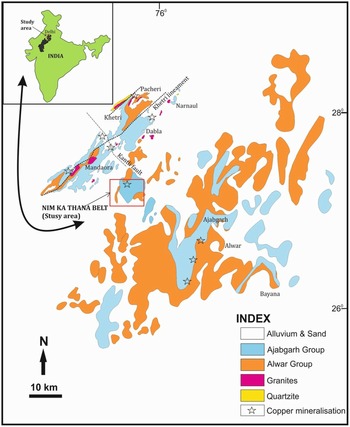
Besides the Khetri Copper Belt, a few locations are recognized as low-grade copper mineralized blocks. Our study area, the Nim ka Thana copper belt is one of them; it adjoins the Khetri copper deposit in the SE part (Fig. 1). The Nim ka Thana belt is significant in that it hosts the only bornite-dominated copper deposit of India (Mukhopadhyay, Reference Mukhopadhyay2004; S. Mukhopadhyay, Geological Survey of India, unpub. report, 2006; S. Mukhopadhyay, Geological Survey of India, unpub. report, 2007; Sharma et al. Reference Sharma, Sahoo, Mahanta, Akella, Babu and John2020). It is considered a sub-basin of the Khetri Copper Belt (Sharma et al. Reference Sharma, Sharma, Khan and Golani2015). The rocks exposed in the belt region are primarily from the Ajabgarh Group of the Delhi Supergroup, where mineralization is limited chiefly to the Kushalgarh Formation; the formation primarily consists of arenaceous, calcareous and argillaceous rocks (K. K. Behera et al., Geological Survey of India, unpub. report, 2007; Sharma et al. Reference Sharma, Sahoo, Mahanta, Akella, Babu and John2020). The major rock types present in the belt area are amphibole-rich marble, scapolite-bearing metapelite, scapolite-bearing dolomitic marble and scapolite tremolite marble. The general strike of the litho units of the area is NNE–SSW, with steep dips towards the WNW or ESE. The area manifests greenschist- to amphibolite-facies metamorphism and the development of garnet and staurolite within the metapelite sequence (Kaur et al. Reference Kaur, Zeh and Chaudhri2017). Regarding the metamorphism, the peak pressure–temperature (P–T) conditions in the area have been inferred to be 550 °C and 3.5 kbar (Kaur et al. Reference Kaur, Zeh, Okrusch, Chaudhri, Gerdes and Brätz2016).
A regional geological map showing the location of the Khetri Copper Belt and Nim ka Thana belt (study area) with an inset map of India (Sharma et al. Reference Sharma, Sahoo, Mahanta, Akella, Babu and John2020).

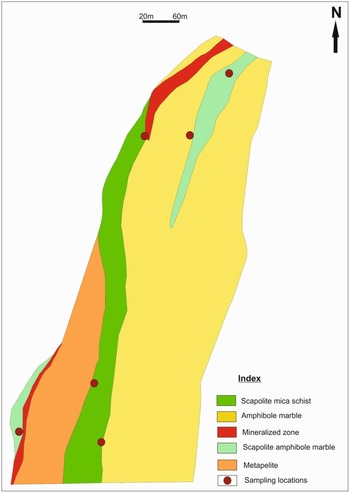
The area has low-grade Cu mineralization (average grade of 0.36 wt %) that occurs in the form of dissemination, stringers and fracture fillings within the calcareous rocks and metapelites. The Cu mineralization is mainly confined to the metapelites and impure dolomite zone and adjoining zones of the scapolite-bearing dolomitic marble, scapolite-bearing metapelite and scapolite tremolite marble. Scapolites are primarily associated with the metapelites, giving a spotted or patchy appearance to the rock in places (Fig. 2). In the area, there are numerous calcite veins that vary in width of a few centimetres and in length from a few centimetres to 15 m; they are mostly emplaced in a NW–SE orientation in the dolomitic marble body. These veins show both parallel and cross-cutting relationships with S1 and S2 foliation planes. The area has undergone three phases of folding based on planar and linear structures, and superposition of minor folds (Heron, Reference Heron1923). The scapolites in the area are round to elliptical to elongate in shape; in places, the elliptical-shaped scapolites occurs with their long axes parallel to the L1 lineation. Spatially, the scapolite is well developed along the fissile zones and zone of hydrothermal activities, as evidenced by the presence of mineralized quartz–calcite–barite veins.
A reproduced geological map (after Mondal et al. Reference Mondal, Debnath and Dewangan2019) showing the spatial association of the mineralized sulfide zones and the scapolite-bearing bands and sampling points in parts of the Nim ka Thana belt (study area), western India.

3. Sampling and methodology
We undertook fieldsite documentation of exposed rocks in accessible parts of the belt area. We used surface as well as drill core samples for the preparation of thin- and polished sections of different lithologies hosting scapolites. We analysed these sections for mineralogy textural characteristics and mineral chemistry studies. A Leica DM 27 microscope was used for the petrographic studies. For analysis of major and minor elements including F and Cl, representative sections were studied using a CAMECA SX-5 electron probe micro-analyser (EPMA). The EPMA is equipped with four wavelength dispersive spectrometers; this instrumentation facility is available at the Central Research Facility (CRF), Indian Institute of Technology (Indian School of Mines), Dhanbad, India. The instrument was run at a high-vacuum (<10−6 Torr), with the electron beam set to 1–3 μm diameter with a beam current of 15 nA and excitation voltage of 15 kV. Spectra were collected for 30 s on peak and 10 s on the background. We calibrated the instrument against internal mineral standards such as albite (Na), periclase (Mg), almandine (Al, Si), orthoclase (K), apatite (Ca), synthetic rutile TiO2 (Ti), rhodonite (Mn) and haematite (Fe). Using proprietary CAMECA software, we corrected the raw data applying a ZAF-algorithm. We also carried out X-ray mapping of some representative samples to understand the elemental distribution pattern of the various growth patterns of the scapolite in the area. In our use of EPMA, we also analysed the feldspar minerals surrounding the different types of scapolites.
4. Mode of occurrence and scapolite mineralization
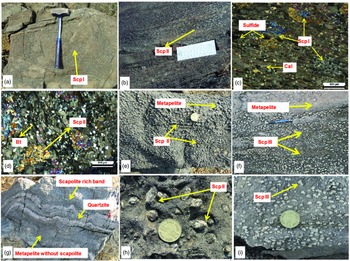
Lithologically, the area exposes a carbonate–metapelite assemblage belonging to the Ajabgarh Group of the Delhi Supergroup. Scapolite-rich bands are well developed within the sequence of the metasedimentary rocks comprising interbanded garnetiferous staurolite-bearing biotite schist, copper mineralized metapelite, dolomite and massive dolomite. Scapolite bands are seen to be developed along the contact zones of the metapelite and dolomite and occasionally along the quartz–carbonate veins intruded along the metapelites (Fig. 3a, b, g) with variable widths ranging from a few centimetres to a few metres. However, the scapolites are mainly observed to be associated with the metapelites, i.e. the coarse-grained calcareous biotite schist (Fig. 3b, e–i). Though the link between metasomatism and IOCG deposits has been established, the extent of this metasomatic alteration in the metasediments has remained elusive (Kaur et al. Reference Kaur, Chaudhri, Hofmann, Raczek, Okrusch, Skora and Koepke2014). A well-developed foliation can be seen in the sediments bearing the scapolites, mainly defined by the parallel alignment of the quartz, biotite, feldspar and opaque minerals (Fig. 3c, d). The banded nature of the schists is conspicuously developed with biotite and siliceous-rich partings (fine layers). Aggregates of carbonates with interlocking grains with the biotites and scapolites are visible (Fig. 3d).
Field photographs showing (a) scapolite-rich metapelite band bounded by siliceous dolomite along the limb part; (b) stretched/elongated scapolite grains within the metapelite. (c) Photomicrograph showing the presence of sulfides (bornite) along the peripheral part of the scapolite along with the carbonate vein – metapelite contact. (d) Photomicrograph showing the association of scapolite within the calcareous quartz biotite schist. (e) Field photograph showing the densely segregated scapolite along the hinge margin of the mesoscopic fold. (f) Field photograph showing the round to elliptical to elongate scapolites giving the spotted appearance to the rocks with white patches. (g) Field photograph showing the scapolite-rich banding with metapelite and quartzite. (h) Field photograph showing indurate scapolite grains standing out within the carbonate-rich metapelite. (i) Field photograph showing the stretched and well-developed scapolite in biotite-rich grains along the limb part. Length of hammer for scale is 40 cm; length of pen is 13 cm; length of scale card is 15 cm; diameter of the coin is ∼2 cm.

In the field, the scapolites occur as circular to elliptical grains with distinct bands of variable width (from 1 cm to 50 cm) within the metapelite–impure dolomite front either in a scattered or segregated manner (Fig. 3e). Coarse-grained elliptical to rounded scapolites provide a spotted appearance to the rock (Fig. 3e, f, i). Mineralized carbonate veins are ubiquitously seen in close vicinity to the metapelites bearing the scapolites. A scapolite-rich zone is present proximal to the Cu mineralization. The elongated/elliptical scapolites are the result of deformation in the rocks. In this area, the scapolite formation is restricted only to the metapelite sequence. In most cases, the coarse-grained scapolites, up to 1–2 cm in diameter, are found along the hinge zone of the mesoscopic folds because of the low stress regime and have been segregated due to the easier hydrothermal fluid flow (Fig. 3h). In the limb part, the scapolites are segregated and are elliptical in geometry due to compression during the regional deformation (Fig. 3i).
5. Results
5.a. Petrography and scapolite types
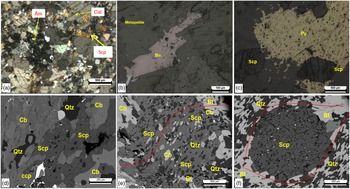
In our petrographic studies, results point to the development of elliptical/rounded to skeletal scapolites as an alteration mineral within the metapelite sequence (Fig. 4a). Sericitization and epidotization in the host rocks were also observed during the petrographic analysis. Other major minerals that can be observed are quartz, biotite, amphibole, plagioclase and carbonate (Fig. 4b, c). These minerals are found within the metapelites and the impure marble in variable proportions. Local development of garnet and staurolite is also seen in the metapelites. Well-grown scapolite is also seen in contact with the chalcopyrite (Fig. 4c). Under the microscope, the scapolites from the study area are fine to coarse grained, stretched (symmetrically) parallel to the foliation, which shows high birefringence. Based on the morphological differences as observed under the microscope, the mineral chemistry and associations, we have classified the scapolites in the study into three categories, i.e. (i) scapolites showing partial development like an amoeboidal growth pattern or patchy with a dominant carbonate-rich matrix (Scp-I) (Fig. 4d), (ii) partially developed scapolites having a disease-like form with carbonate inclusions and parallel to biotite bands (Scp-II) having a post-metamorphic growth (Fig. 4e), and (iii) well-developed, rounded to elliptical scapolites associated with the biotite-rich zones (Scp-III) (Fig. 4f).
Photomicrographs showing (a) the association of amphibole (Am), calcite (Cal) and amoeboidal scapolite (Scp) in the impure dolomite; (b) bornite-chalcocite (Bn) within the metapelite proximal to the scapolite-rich zone; (c) the occurrence of scapolite around a large clot of pyrite (Py) suggesting some evidence of scapolite development owing to hydrothermal fluid – wall rock interaction. (d) BSE image of a scapolite grain showing partial development with an amoeboidal-like growth pattern or patchy with a dominant carbonate-rich matrix (Cb) (Scp-I). (e) BSE image of a scapolite grain showing partial development, having a disease-like form with carbonate inclusions and parallel to biotite (Bt) bands (Scp-II) having a post-metamorphic growth. (f) BSE image of a scapolite grain showing a well-developed, rounded to elliptical shape associated with the biotite-rich zones (Scp-III). The swerving pattern around the grain shows the direction of flow of the formation process.

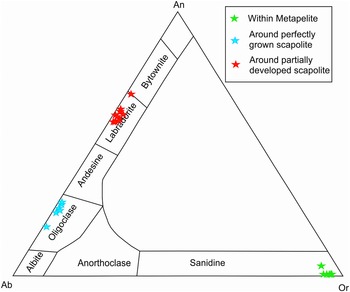
Based on the chemical compositions, orthoclase, labradorite and oligoclase (Fig. 5) have been identified within the metapelite rocks and in close association with the scapolite (Fig. 4d, e, f). It is observed that oligoclase is mostly found around the perfectly developed scapolite (Scp-III), which is developed in a quartz–biotite–feldspar-rich zone. In the moderately developed scapolite (Scp-II) in a slightly carbonate-rich metapelite sequence, oligoclase is observed along the boundaries with a few inclusions/remnants inside the scapolite grains. However, in Scp-I, which is found along the borders between the biotite-rich metapelite and the dolomitic band, labradorite is the most dominant plagioclase feldspar in and around the amoeboidal growth. Orthoclase is invariably found around all the types of scapolites, but the modal distribution is scanty as compared to the plagioclase feldspar.
Feldspar composition diagram of the feldspar minerals around different types of scapolites. Bytownite is the most dominant plagioclase feldspar in and around the amoeboidal growth.

5.a.1. Scapolite Type I
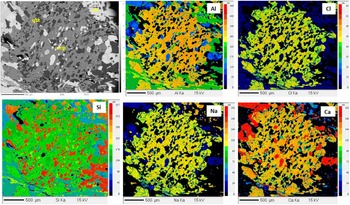
In some cases, the scapolites show partial development, such as an amoeboidal growth pattern (Scp-I) or patchy (Fig. 4d) patterns in which the scapolite grains are surrounded by carbonates (calcite + dolomite) and a carbonate-rich matrix. Carbonate inclusions are also present throughout the scapolite grains, and the carbonates are randomly oriented. The Scp-I is found chiefly within the dolomite zone traversed by multiple hydrothermal quartz–carbonate veins. Occasional magnetite grains are seen around the scapolites, and the crude foliation in the rock may be due to the lack of abundant biotites. Scapolites of Type I have low Cl content as compared to the other two varieties (see online Supplementary Material). Further, their sizes are relatively smaller and not well distinguishable in a fresh dolomitic sample. However, they are well visible as wide-spaced spotted grains on the weathered surface.
5.a.2. Scapolite Type II
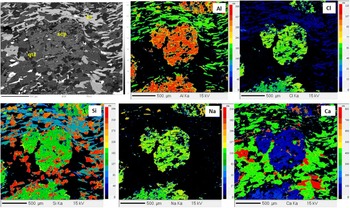
Scapolites of Type II are partially formed in some samples, with disease-like forms (Scp-II) (Fig. 4e). Here, even though the matrix is carbonate-rich, biotite bands are present surrounding it following the foliation plane. The carbonates and biotites are present proportionally in the exact same percentage; however, the scapolites are found within the carbonates. The biotites swerve in places but end abruptly, indicating post-metamorphic growth rather than pre-deformational growth (Fig. 4e). Thick bands of carbonates are seen parallel to the biotites. The Cl content is slightly more than in the Scp-I. The scapolites of Type II in close proximity to the sulfide phases, viz. pyrite and chalcopyrite, contain significant SO3 content, probably because of the diffusion from the ore-bearing fluid. In some instances, these scapolites are partially developed in a combined matrix of biotites and carbonates (Scp-II) (Fig. 4e). Carbonate inclusions are present within the scapolite grains and are parallel to the biotite bands. The scapolite grains are coarse grained and angular; the biotite bands are parallel to the foliation plane. Scapolites in some samples are disoriented or organized in a random pattern (Scp-II) (Fig. 4e). The matrix composition contains both carbonate and biotite-rich bands. The biotite bands are thinner and aligned to the foliation plane, whereas the carbonates are not present as bands and rather randomly oriented.
5.a.3. Scapolite Type III
In certain specimens, the scapolite grains are primarily well developed or matured (Scp-III) (Fig. 4f). They are coarse grained, rounded and mostly aligned along the foliation plane surrounded by biotite. The perfect growth of scapolite or well-developed scapolite in a biotite-rich zone, confirmed from their respective backscattered electron (BSE) images, shows a swerving pattern of the biotites around the scapolite. It depicts the direction of flow of the hydrothermal fluid during the formation of the porphyroblasts (i.e. Na is coming from the fluid resulting in the perfect growth). The swerving of biotite around the scapolite porphyroblasts suggests a perfect development or well-developed scapolite (Scp-III) (Fig. 4f) that marks the termination of the interaction with the hydrothermal fluid. The Cl content in these scapolites is the highest out of the three varieties of scapolites.
5.b. Scapolite chemistry
From the EPMA, the types of scapolite with variable growth patterns are constrained. Some growth patterns are amoeboidal or irregularly shaped (Scp-I, Scp-II) and some are perfectly shaped (Scp-III). Some of the varieties of scapolites are either surrounded by carbonates or by biotites and quartz. There are some intermediate phases (Fig. 4e) that clearly show the development of the scapolite due to the fluid interaction. The formulas of scapolites were calculated by normalizing Si + Al = 12 atoms per formula unit (apfu) as per the suggestions of Teertstra & Sherriff (Reference Teertstra and Sherriff1997). The resultant M-site cations were below the ideal value of 4; hence, no recalculation was required. F, Ba, Ti, Mg and Mn contents are negligible, i.e. <0.02 apfu; hence, they were discarded. Fe contents were also relatively low. Si + Al contents, relative to Na + Ca + K contents, indicate that the tetrahedral sites are contended by Fe3+.
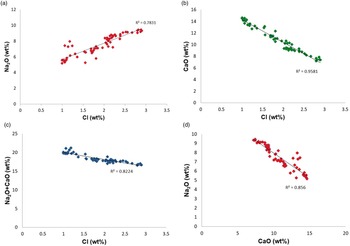
Mineral chemical analysis of the scapolite varieties (Scp-I, II, III) shows distinct compositional variations along with textural patterns. Variation in NaO, CaO and Cl contents has been detected in the scapolite types (Fig. 7a–d). As we can see from the X-ray images (Figs 8–10), the Al concentration is very high (22.24–27.04 wt %) whereas the Na (5.27–9.34 wt %) and Ca (7.41–14.63 wt %) concentration is almost similar, with Ca being slightly more. The presence of Cl (1.0–2.9 wt %) can also be seen. This substantial rise in Al versus Cl is intriguing because it is not found in scapolites linked with other ore deposits (Edwards & Barker, Reference Edwards and Barker1954; Shaw et al. Reference Shaw, Schwarcz and Sheppard1965; Sharma, Reference Sharma1981). The scapolites in the area portray a large variation in the Cl content of 0.24 apfu to 0.58 apfu (see online Supplementary Material). Si and Na show a strong positive correlation (Fig. 7a) with the Cl content, whereas Al and Ca show a similar negative correlation (Fig. 7b) with the Cl content. Such kinds of correlations among the variables can be used to discuss the end-member components: two end-member components are suggested, one Cl-free and one with the A-site completely occupied by Cl (Kullerud, Reference Kullerud, Stober and Bucher2000).
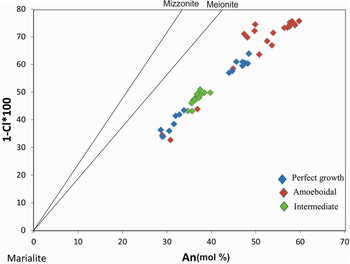
The scapolite characterization plot showing that most of the scapolites from our study area fall in the marialite–meionite zone, suggesting a calcic to sodic end-member composition. It is clear from this plot that scapolites in this area are of intermediate composition.

Binary plots of scapolites indicating the interaction of hydrothermal fluid. From the binary plots, we can see that as Cl is increasing Na2O is also increasing, whereas CaO is decreasing. However, the Na2O % + CaO % overall content remains unchanged, favouring the intermediate composition of the scapolites in the study area. This indicates the influence of hydrothermal fluid interaction, suggesting a post-depositional feature.

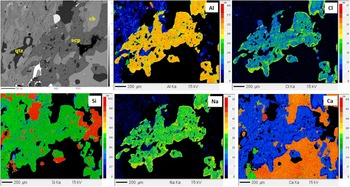
X-ray mapping of scapolite showing scanty or amoeboidal growth of scapolite (Scp-I) in the metapelite within a carbonate-rich zone. The grain boundaries of the scapolites are enriched in Cl, suggesting the source and fixation of Cl from the surroundings.

X-ray mapping of scapolite showing developing growth in a metapelite-rich zone showing the elemental distribution pattern (Scp-II).

X-ray mapping of scapolite showing well-developed scapolite in a metapelite-rich zone showing the elemental distribution pattern (Scp-III).

6. Discussion
Scapolite occurrences are reported from various mineral deposits, including many skarn and IOCG deposits (Seward et al. Reference Seward, Williams-Jones, Migdisov, Holland and Turekian2014; Williams-Jones & Migdisov, Reference Williams-Jones, Migdisov, Kelley and Golden2014). Marialite, the Na end-member with Cl-rich constituents, has been found within albitized metasediments, in which the host rock has been infiltrated by Cl-rich fluids, derived from the ore-bearing fluid (Engvik et al. Reference Engvik, Putnis, Fitz Gerald and Austrheim2008, Reference Engvik, Mezger, Wortelkamp, Bast, Corfu, Korneliussen, Ihlen, Bingen and Austrheim2011). During scapolitization, the plagioclase is altered into scapolite, through fluid mobilization and related dissolution and reprecipitation (Engvik et al. Reference Engvik, Golla-Schindler, Berndt, Austrheim and Putnis2009; Putnis & Austrheim, Reference Putnis and Austrheim2010; Dumańska-Słowik et al. Reference Dumańska-Słowik, Powolny, Sikorska-Jaworowska, Heflik, Morgunc and Xuan2019). However, the fluid may be related to a fertile source capable of precipitating the metals or a barren fluid without any metal deposition. Although scapolite is a metamorphic–metasomatic mineral well developed in amphibolite- to granulite-facies rocks all over the world, including the Aravalli–Delhi Fold Belt of Rajasthan, India, the occurrence of scapolite in the Khetri Copper Belt is often connected with copper-bearing host rocks. Unlike the scapolite in the granulite-facies metamorphic rocks of the basement gneisses and schists of the Aravalli belt (Sharma, Reference Sharma1981), these scapolites are texturally and compositionally different (ranging from marialite to meionite). Although, scapolite occurrences have previously been reported in the Alwar Basin of the North Delhi Fold Belt, these scapolites are found in felsic volcanic rocks (Khan et al. Reference Khan, Sahoo and Rai2014). However, in our area, the Na entered the system through metasomatism, and the granitic emplacement produced the thermal influx necessary for fluid mobilization for the source of the Cu mineralization. Since both the carbonates and metapelites host the scapolite, as constrained in this paper, we are trying to correlate the evolution of the scapolite by the interaction of the hydrothermal fluid.
6.a. Scapolite versus host rocks
From the field studies, it can be seen that the metapelites are developed across the Nim ka Thana basin, but the scapolites are developed across a particular zone, suggesting the control of matrix composition along with the nature of the fluid. The peak metamorphic conditions around this belt have been estimated as 550–600 °C temperature at 3–5 kbar pressure (Lal & Shukla, Reference Lal and Shukla1975), which are also favourable conditions for scapolite formation (Mora & Valley, Reference Mora and Valley1989). The textural differences between the scapolites from the petrographic studies, the lack of zoning in the scapolites and the feldspar composition (Fig. 5) suggest that the fluid played a major role in changing the composition of the scapolites, thereby confirming the effect of metasomatism in an open system. It seems that the local variations in fluid–rock interactions have produced a variation in the scapolite chemistry (cf. Vanko & Bishop, Reference Vanko and Bishop1982). The scapolites in our study area, developed in the metapelites, are affected by deformational events as evidenced by elongation and brecciation, suggesting a pre-deformational nature, which could also be linked to the mineralizing episode, i.e. D-2 deformation in the area.
The introduction of saline fluids generated by mobilization of evaporites during orogenesis is a possible mechanism for the formation of scapolite, as comprehended by a study in the Mary Kathleen district of Queensland, Australia (Engvik et al. Reference Engvik, Mezger, Wortelkamp, Bast, Corfu, Korneliussen, Ihlen, Bingen and Austrheim2011). During prograde metamorphism of common pelitic composition rocks, a small amount of base metals is released into the metamorphic fluid, which is not considered to be enough for precipitation at the deposit scale (Qiu et al. Reference Qiu, Fan, Liu, Yang, Hu and Cai2017). In a few deposits, the sulfide assemblages associated with the quartz veins are considered to be produced by ore-bearing hydrothermal activity during the retrograde cooling (Qiu et al. Reference Qiu, Fan, Liu, Yang, Hu and Cai2017). In our study area, hydrothermal Cu mineralization is associated with quartz–carbonate–barite veins; this is an unlike association derived from the retrogressive cooling. Further, stable isotopic signatures of the sulfide-bearing carbonate veins suggest the influx of a deep source of hydrothermal fluid in configuring the deposit (Sharma et al. Reference Sharma, Sahoo, Mahanta, Akella, Babu and John2020).
Abundant Na-rich plagioclase in the metasediments and the lack of Na-plagioclase as a relict or major phase in the scapolite suggest the formation of scapolite at the expense of Na-rich plagioclase interacting with the hydrothermal brine during the regional Na-metasomatism. The regional metasomatism corroborates the mineralizing event at 833 to 840 Ma (Li et al. Reference Li, Zhou, Williams-Jones, Yang and Gao2019). Kaur et al. (Reference Kaur, Zeh, Okrusch, Chaudhri, Gerdes and Brätz2016) observed that the albite plagioclase (An4.7 ± 0.4) compositions have been transformed into scapolite. The scanty to partially developed or anhedral shape of the scapolites (Scp-I) is also seen (Fig. 4d). This indicates the development stage because of the fluid interaction: Na deficiency as fluid interaction is moderate, leading to partial development of the scapolite. Na content for the development of marialitic scapolite is not sufficient in the particular belt; therefore scapolite shows amoeboidal growth. Previous studies have pointed out that the cover sequences of the Alwar and Khetri complexes have experienced scapolitization and albitization processes in a ubiquitous manner; such a standpoint leans towards the involvement of Cl-rich metasomatizing fluids for carrying the metals (in this context the Cu mineralization; Kaur et al. Reference Kaur, Chaudhri and Eliyas2019). Mechanisms of similar fluid–rock interactions can be applicable to our study region given the similarities our study region bears. Scapolite formation usually involves an increase in Ca and Al and a corresponding loss of Si. Thus, the excess Si is often seen as tiny blebs of quartz inside large crystals of scapolite (Scp-I) (Ekstrom, Reference Ekstrom1972).
6.b. Fluid source for scapolite
The end-member composition of scapolite is largely defined by the original composition of the host rock. The existence of Cl-rich fluids in the process is significant because it works as a ligand, or carrier, for base metals, primarily Cu and rare earth elements (Seward et al. Reference Seward, Williams-Jones, Migdisov, Holland and Turekian2014; Williams-Jones & Migdisov, Reference Williams-Jones, Migdisov, Kelley and Golden2014; Kaur et al. Reference Kaur, Chaudhri and Eliyas2019). Chlorine, one of the essential elements in the formation of scapolite, may be a part of the country rock, such as evaporites or an external component migrated from another source (Qiu et al. Reference Qiu, Fan, Tomkins, Brugger, Etschmann, Liu, Xing and Hu2021). However, in our study area, there is no evaporite horizon to provide an external source of Cl, and the country rocks are deficient in Cl for the formation of scapolite. The epigenetic Cu mineralization and thick bands of scapolite mineralization within the metasedimentary rocks may suggest that the mineral-bearing fluid responsible for the Cu mineralization acted as an external source of Cl for the scapolite formation in this region. As per previous studies from global locations, scapolitization is an alteration of the wall rock (Ekstrom, Reference Ekstrom1972); also it acts as an indicator of the salinity of the coexisting fluids (Ellis, Reference Ellis1978; Mora & Valley, Reference Mora and Valley1989; Satish-Kumar & Harley, Reference Satish-Kumar and Harley1998; Satish-Kumar & Santosh, Reference Satish-Kumar and Santosh1998). In these respects, it can be said that scapolite is an exclusive metamorphic product. However, findings from this paper are intriguing as they point out that scapolites can rather be considered as a metasomatization product during the hydrothermal event.
The presence of Cl-rich fluids is vital because the Cl-anion functions as a ligand for Cu mineralization, which can be linked to Cu mineralization in the scapolitized metasedimentary rocks of Khetri and the adjoining Nim ka Thana area (Knight et al. Reference Knight, Lowe, Joy, Cameron, Merrillees, Nag, Shah, Dua, Jhala and Porter2002; Kaur et al. Reference Kaur, Chaudhri, Hofmann, Raczek, Okrusch, Skora and Koepke2014, Reference Kaur, Chaudhri and Eliyas2019; Baidya et al. Reference Baidya, Paul, Pal and Upadhyay2017). Since the degree of scapolitization is mass dependent on the Cl saturation, permeability and the composition of the precursor rocks, the absence of Cl-rich rock like evaporite in the study area provides plausible evidence of a strong hydrothermal fluid interaction with the metapelitic rock. In the study area, granites in the vicinity are anorogenic in nature, suggesting that they are unable to generate new fluid, hence they bring about the thermal influx throughout the basin by themselves, acting as the source and carrier. The presence of scapolite indicates high-T Na(-Ca) alteration assemblages, including the presence of abundant scapolite–actinolite mineralization, as these assemblages require high temperatures (>400 °C) for formation (Vanko & Bishop, Reference Vanko and Bishop1982). So, feldspar composition is the major contributor to scapolite development, whereas the Ca content is contributed by carbonate.
The involvement of CO2 and Cl during scapolitization is indisputable. Chlorine-rich solutions have penetrated the rocks through the hydrothermal fluid leading to a high activity of Cl in scapolitization, even though it is not the only essential factor for scapolitization. Simply a high activity of Cl is not sufficient for scapolitization as evidenced from the petrography and EPMA studies, i.e. the occurrence of calcite veins in the vicinity indicates the high activity of CO2 as most of the sections carry this mineral. The presence of calcite has triggered a buffering effect on it, possibly leading to the constant composition of the scapolites in the vicinity (cf. Ekstrom, Reference Ekstrom1972). As confirmed from the fluid inclusion and isotopic studies, a low to moderate salinity (10.2 wt % to 20.5 wt % NaCl equiv.) hydrothermal fluid (Sharma et al. Reference Sharma, Sahoo, Mahanta, Akella, Babu and John2020) has interacted with the metapelite in the study area; it thus facilitated the CO2 buffering and Cl activity resulting in the scapolite formation. Diffusion of SO2 in the scapolite in close association with the sulfide mineral phase (chalcopyrite) supports the involvement of ore-bearing fluid in the development of the scapolite.
The X-ray images (Figs 8, 9, 10) of the different varieties of scapolite show the spatial distribution of carbonate mineral phases in variable proportions, which is guided by the matrix composition viz. a carbonate-dominated zone or a pelite-dominated zone. The scapolite characterization plot (Fig. 6) shows that most of the scapolites from the study area fall in the marialite-dominated zone, suggesting a sodic to low calcic end-member composition. Metamorphic and metasomatic Cl-rich marialitic scapolite in the metasedimentary rocks of the cover sequence (Kaur et al. Reference Kaur, Zeh, Okrusch, Chaudhri, Gerdes and Brätz2016; Baidya et al. Reference Baidya, Paul, Pal and Upadhyay2017) and the metasomatized ultramafic rocks (Kaur et al. Reference Kaur, Zeh, Chaudhri, Gerdes and Okrusch2013) of the Khetri complex lend support to this contention that Na- and Cl-bearing brines were the albitizing fluids in the region (Kaur et al. Reference Kaur, Chaudhri and Eliyas2019).
6.c. IOCG setting scapolite
The binary plots between Na2O % versus Cl % (Fig. 7a) and CaO % versus Cl % (Fig. 7b) show positive and negative correlations, respectively, suggesting the active participation of the Na-plagioclase end-member in the metapelite with the ore-bearing fluid saturated with Cl. The scapolite formation event is synchronous with the regional Na-metasomatism, which is presumed to be the hydrothermal fluid evolution from the granitic emplacements in the study area. Ultimately, the reaction has resulted in the formation of marialite, and probably the carbonates (calcite and dolomite) have not participated in the reaction. The Na2O % + CaO % versus Cl % plot (Fig. 7c) shows a positive correlation, showing that the overall content remains unchanged, which favours the intermediate composition of the scapolites in the study area. Barring a few cases of scapolite where the SO2 is dispersed into the scapolite from the ore-bearing fluid, as indicated by sulfide precipitation, the SO2 content is negligible. All these factors are suggestive of a post-deformational feature. Compositional changes in sulfate-free scapolites can be represented by substitution combinations as,

Orville (Reference Orville1975) suggested that increasing the temperature allows for a broader range of stable scapolite compositions (Vanko & Bishop, Reference Vanko and Bishop1982). The exchange of NaCl and CaCO3 between scapolite and fluid can be written:
 $${\rm{NaC}}{{\rm{l}}_{{\rm{Scapolite}}}} + {\rm{CaC}}{{\rm{O}}_{3{\rm{fluid}}}} \leftrightarrow {\rm{\;CaC}}{{\rm{O}}_{3\,{\rm{Scapolite}}}} + {\rm{NaC}}{{\rm{l}}_{{\rm{fluid}}}}$$
From this reaction, it can be inferred that the variations in the composition of scapolite were related to variations in the activity ratio (aNa+*aCl−)/(aCa2+* a (CO3)2−) of the equilibrium grain-boundary fluid during scapolite growth. The wide varieties of syn-orogenic mineral deposits across IOCG belts are mainly due to the migration and regional evolution of fluid (e.g. Caraja’s, Grainger et al. Reference Grainger, Groves, Tallarico and Fletcher2008; Gawler Craton, Reid & Fabris, Reference Reid and Fabris2015; Werneke Breccias, Hunt et al. Reference Hunt, Baker and Thorkelson2007; Mount Isa, Morrissey & Tomkins, Reference Morrissey and Tomkins2020). A source of Cu and other metals provided by continental rift basins in IOCG deposits are temporally Mesoproterozoic from a mineral deposit perspective (Morrissey & Tomkins, Reference Morrissey and Tomkins2020). The occurrences of scapolite are well known from IOCG deposit types, such as the Mary Kathleen Fold Belt of the Mt Isa Inlier, Australia, which is produced by of Na-metasomatism. Characteristics, such as a large-scale Na-metasomatism resulting in albitites, low-grade secondary copper-dominated mineralization found throughout the metasedimentary rocks, moderate to low salinity conditions and an established IOCG deposit type in the study area (Sharma et al. Reference Sharma, Sahoo, Mahanta, Akella, Babu and John2020) all point to a rift-related copper mineralizing belt in the study area. A strong hydrothermal fluid influx with a moderate salinity and mesothermal temperature window (225–320 °C) established for the Cu mineralization supports the role of the hydrothermal fluid in scapolite formation. The scapolite formation is attributed to the second stage of Cu mineralization, which is synchronous with the hydrothermal activity (Sharma et al. Reference Sharma, Sahoo, Mahanta, Akella, Babu and John2020).
7. Conclusion
The presence of copper mineralized quartz–carbonate veins in the vicinity of the scapolite-rich zones, and the intricate spatial relationship between the scapolite-bearing lithounits and the copper mineralized zones strongly suggest a hydrothermal influence for the formation of scapolite. Interaction of the low- to moderate-salinity hydrothermal fluid with the Na-plagioclase feldspar in the metasediments was possibly responsible for the formation of marialitic scapolite in the study area. The lack of zoning and a post-deformational and metamorphic fabric preserved in the scapolite do not support a convincing metamorphic evolution of the scapolites. The absence of meionite and silvilaite could be linked to the relatively moderate-temperature metamorphism and low sulfidation index of the hydrothermal fluid even if carbonate phases and calc-silicates are significantly present in the area. The event of scapolite formation and large-scale albitization is attributed to the granitic emplacement in the area.
Supplementary material
To view supplementary material for this article, please visit https://doi.org/10.1017/S0016756822000681
Acknowledgements
The authors are thankful to the director, Indian Institute of Technology (Indian School of Mines), Dhanbad, for providing support and EPMA facility at CRF, IIT(ISM) Dhanbad. JPS would like to thank IIT(ISM) Dhanbad for providing a research fellowship for her Ph.D. work. The authors are indebted to the DST, India (http://www.dst.gov.in/) for providing financial support to setup the ‘DST-FIST Level-II Facility’ (No. SR/FST/ESII-014/2012(C)) at the Department of Applied Geology (AGL), IIT(ISM) Dhanbad, India, and DST-SERB, Govt. of India for financial support vide R & D Project No. ECR/2017/003106 to PRS. We are extremely thankful to the two reviewers and Prof. Tim Johnson, editor, Geological Magazine for their constructive suggestions and encouragement in upgrading the quality of the manuscript.
Conflicts of interest
We declare that we have duly acknowledged the funding agency for carrying out a part of the research work. We also do not have any conflict of interest on the data or any content of the manuscript.