Episodes of peer victimization and aggression are a common occurrence for many children in the classroom and on the playground (Craig et al., Reference Craig, Harel-Fisch, Fogel-Grinvald, Dostaler, Hetlan and Simons-Morton2009). Peer victimization refers to the experience of hurtful acts of interpersonal aggression committed by one or more peers that violate norms for socially accepted behavior toward others and that typically occur within a relational context (Finkelhor, Turner, & Hamby, Reference Finkelhor, Turner and Hamby2012). Peer aggression is interpersonal in nature and is characterized by intentionally harmful behaviors directed at another child (Espelage & Swearer, Reference Espelage and Swearer2003; Finkelhor et al., Reference Finkelhor, Turner and Hamby2012).
Data from North American and Europe indicate that 5% to 15% of children and adolescents experience moderate to frequent victimization by peers (Craig et al., Reference Craig, Harel-Fisch, Fogel-Grinvald, Dostaler, Hetlan and Simons-Morton2009; Jansen et al., Reference Jansen, Verlinden, Dommisse-van Berkel, Mieloo, van der Ende, Veenstra and Tiemeier2012; Nansel et al., Reference Nansel, Overpeck, Pilla, Ruan, Simons-Morton and Scheidt2001, Reference Nansel, Craig, Overpeck, Saluja and Ruan2004; Williford, Brisson, Bender, Jenson, & Forrest-Bank, Reference Williford, Brisson, Bender, Jenson and Forrest-Bank2011). Similarly, about 5% to 20% of children and adolescents engage in moderate to frequent aggression against peers, including bullying perpetrationFootnote 1 (Craig et al., Reference Craig, Harel-Fisch, Fogel-Grinvald, Dostaler, Hetlan and Simons-Morton2009; Jansen et al., Reference Jansen, Verlinden, Dommisse-van Berkel, Mieloo, van der Ende, Veenstra and Tiemeier2012; Nansel et al., Reference Nansel, Overpeck, Pilla, Ruan, Simons-Morton and Scheidt2001, Reference Nansel, Craig, Overpeck, Saluja and Ruan2004; Williford et al., Reference Williford, Brisson, Bender, Jenson and Forrest-Bank2011). Prevalence rates can differ between studies conducted in childhood and adolescence, cross-sectional and longitudinal studies, and by form of victimization and aggression. Overall, these various prevalence rates raise questions about heterogeneity in the developmental course of peer victimization and aggression.
Interest in the developmental course of peer victimization and aggression has been accompanied by the growing use of person-centered approaches to answer questions about whether there are qualitatively distinct subgroups of children who follow different patterns of change in their experiences of peer victimization and enactment of peer aggression. This research has identified two to five patterns of change over time in peer victimization and aggression in childhood (Barker, Boivin, et al., Reference Barker, Boivin, Brendgen, Fontaine, Arseneault, Vitaro and Tremblay2008; Boivin, Petitclerc, Feng, & Barker, Reference Boivin, Petitclerc, Feng and Barker2010; Ettekal & Ladd, Reference Ettekal and Ladd2015; Ladd, Ettekal, & Kochenderfer-Ladd, Reference Ladd, Ettekal and Kochenderfer-Ladd2017; Leadbeater & Hoglund, Reference Leadbeater and Hoglund2009) and adolescence (Chen, Zhang, Ji, & Deater-Deckard, Reference Chen, Zhang, Ji and Deater-Deckard2019; Ehrenreich, Beron, Brinkley, & Underwood, Reference Ehrenreich, Beron, Brinkley and Underwood2014; Goldbaum, Craig, Pepler, & Connolly, Reference Goldbaum, Craig, Pepler and Connolly2003). These studies indicate some differences in the frequencies and shape of these trajectories between childhood and adolescence and between relational and overt forms of victimization and of aggression.
Accompanying this focus on heterogeneity in the developmental course of peer victimization and aggression is interest in the developmental co-occurrence of these phenomena. Until recently research on the co-occurrence of peer victimization and aggression commonly used discrete panel data to examine the covariance between these constructs at discrete points in time (e.g., Hoglund & Chisholm, Reference Hoglund and Chisholm2014; Leadbeater & Hoglund, Reference Leadbeater and Hoglund2009; Vaillancourt, Brittain, McDougall, & Duku, Reference Vaillancourt, Brittain, McDougall and Duku2013) or variable-centered approaches to classify subgroups of children using a priori cut points, such as 1 SD above the mean on these constructs, at one point in time (e.g., Arseneault et al., Reference Arseneault, Walsh, Trzesniewski, Newcombe, Caspi and Moffit2006; Hanish & Guerra, Reference Hanish and Guerra2004; Veenstra et al., Reference Veenstra, Lindenberg, Oldehinkel, De Winter, Verhulst and Ormel2005; Schwartz, Reference Schwartz2000). However, discrete panel and variable-centered approaches can yield limited information on the dynamic co-occurrence of victimization and aggression across age or time.
More recently, person-centered analytical approaches have been used to examine the dynamic co-occurrence of patterns of change in peer victimization and aggression and also in peer victimization and bullying perpetration. Studies using longitudinal person-centered approaches (latent class growth analysis, growth mixture modeling) have yielded four to six joint trajectories of peer victimization and aggression in adolescence (Orpinas, McNicholas, & Nahapetyan, Reference Orpinas, McNicholas and Nahapetyan2015) and of peer victimization and bullying perpetration in adolescence (Barker, Arseneault, Brendgen, Fontaine, & Maughan, Reference Barker, Arseneault, Brendgen, Fontaine and Maughan2008; Haltigan & Vaillancourt, Reference Haltigan and Vaillancourt2014). Studies using cross-sectional person-centered approaches (latent class analysis, latent profile analysis) have also identified three to five latent classes of co-occurring peer victimization and aggression in childhood to adolescence (Ettekal & Ladd, Reference Ettekal and Ladd2017; Williford et al., Reference Williford, Brisson, Bender, Jenson and Forrest-Bank2011). Panel data further indicate that the co-occurrence of peer victimization and aggression emerges in early to middle childhood (Boivin et al., Reference Boivin, Petitclerc, Feng and Barker2010; Hoglund & Chisholm, Reference Hoglund and Chisholm2014; Leadbeater & Hoglund, Reference Leadbeater and Hoglund2009). However, limited research has used a person-centered approach to examine the dynamic co-occurrence of peer victimization and aggression during these formative years. In particular, there is limited information on the early co-occurrence of relational victimization and aggression and of overt victimization and aggression. Identifying how these early peer behaviors change or stabilize across early to middle childhood and converge with patterns identified in adolescence is needed to inform a developmental perspective on these phenomena (see Ettekal & Ladd, Reference Ettekal and Ladd2017).
Guided by a developmental psychopathology perspective and the idea that to best understand patterns of psychopathology we need to understand patterns of typical development (Cicchetti, Reference Cicchetti, Cohen and Cicchetti2006), the current study uses a person-centered approach with a cohort-sequential research design to estimate heterogeneity in the dynamic co-occurrence of (a) relational victimization and aggression and (b) overt victimization and aggression across an accelerated 6-year age span, from age 4.5 to 10.5 years. The objectives of the current study are to: inform understanding of heterogeneity in the early developmental patterns of relational and overt forms of peer victimization and aggression and their early developmental co-occurrence; and test a set of risk and promotive factors as common or unique correlates of these co-occurring trajectories.
Theoretical Framework Guiding the Focus on Heterogeneity
A developmental psychopathology perspective (Cicchetti, Reference Cicchetti, Cohen and Cicchetti2006) guides the focus on heterogeneity in the developmental patterns of relational and overt forms of victimization and aggression and in their developmental co-occurrence from early to middle childhood. This perspective draws attention to individual differences in typical and atypical developmental pathways that unfold across childhood. Typical developmental pathways reflect what might be normative for many children at given ages. Atypical pathways are rare for most children but can represent a meaningful proportion of children, such as children who follow trajectories that indicate a high frequency of victimization and aggression across time or age. A developmental perspective also draws attention to the reality that what may represent typical or normative developmental patterns in one developmental period, such as early childhood, may be reflective of atypical developmental patterns in a different developmental period, such as adolescence. For example, peer victimization and aggression may occur frequently in early childhood as children learn how to negotiate the sharing of resources with peers and how to self-regulate their behaviors (Monks, Smith, & Swettenham, Reference Monks, Smith and Swettenham2005). By adolescence, victimization and aggression may decrease in frequency for most but become a chronic experience for a select few (Cleverley, Szatmari, Vaillancourt, Boyle, & Lipman, Reference Cleverley, Szatmari, Vaillancourt, Boyle and Lipman2012; Ladd et al., Reference Ladd, Ettekal and Kochenderfer-Ladd2017; Underwood, Beron, & Rosen, Reference Underwood, Beron and Rosen2009; Williford et al., Reference Williford, Brisson, Bender, Jenson and Forrest-Bank2011). It may also be that these patterns differ by form of victimization and aggression, with relational forms remaining stable or increasing and the frequency of overt forms decreasing across childhood to adolescence (Boivin et al., Reference Boivin, Petitclerc, Feng and Barker2010; Chen et al., Reference Chen, Zhang, Ji and Deater-Deckard2019; Côté, Vaillancourt, Barker, Nagin, & Tremblay, Reference Côté, Vaillancourt, Barker, Nagin and Tremblay2007; Ettekal & Ladd, Reference Ettekal and Ladd2017; Giesbrecht, Leadbeater, & MacDonald, Reference Giesbrecht, Leadbeater and MacDonald2011; Orpinas et al., Reference Orpinas, McNicholas and Nahapetyan2015).
A developmental psychopathology perspective also highlights the role of risk and promotive factors that may relate to the developmental course of pathological outcomes that can emerge across childhood (Cicchetti, Reference Cicchetti, Cohen and Cicchetti2006; Sameroff, Reference Sameroff2000). Risk factors, such as internalizing or peer status problems, may give rise to adverse outcomes like trajectories of chronic victimization (Casper & Card, Reference Casper and Card2017; McDougall & Vaillancourt, Reference McDougall and Vaillancourt2015). Promotive factors, such as being well liked by peers, may support more positive developmental trajectories and lessen risks for chronic victimization or aggression (Casper & Card, Reference Casper and Card2017; McDougall & Vaillancourt, Reference McDougall and Vaillancourt2015).
Developmental Patterns of Peer Victimization and Aggression
The first aim of the current study is to chart the heterogeneity in the developmental patterns of peer relational and overt victimization and of relational and overt aggression from early to middle childhood. This focus on heterogeneity in the developmental patterns of victimization and aggression is grounded in the hypothesis that there are qualitatively unique subgroups of children who follow distinct trajectories of change in peer victimization and aggression. Person-centered analytical approaches are particularly suited to capture variability within and between subgroups and in patterns of change over time. An advantage of this approach is that it systematically identifies whether longitudinal patterns in the data support the hypothesis that there are qualitatively unique subgroups of children who follow distinct trajectories of victimization and aggression (Muthén, Reference Muthén and Kaplan2004; Nagin & Tremblay, Reference Nagin and Tremblay2001).
Peer victimization
Peer victimization can occur as a single isolated episode, as transient episodes, or as chronic episodes over time. Isolated and transient episodes of victimization can substantially undermine children's adjustment, but chronic episodes are expected to result in the greatest maladjustment for children and adolescents (McDougall & Vaillancourt, Reference McDougall and Vaillancourt2015; van der Ploeg, Steglich, Salmivalli, & Veenstra, Reference van der Ploeg, Steglich, Salmivalli and Veenstra2015). Several forms of peer victimization have been identified, including relational and overt forms. Relational victimization includes being the target of rumors, purposeful exclusion from peer activities, and threats of friendship withdrawal (Crick & Grotpeter, Reference Crick and Grotpeter1996). Overt victimization includes experiencing incidents of bodily harm, such as being pushed or hit, and also threats of such harm (Crick & Grotpeter, Reference Crick and Grotpeter1996; Espelage & Swearer, Reference Espelage and Swearer2003; Turner, Finkelhor, Hamby, Shatmtuck, & Ormrod, Reference Turner, Finkelhor, Hamby, Shatmtuck and Ormrod2011).
Peer relational and overt victimization emerge as early as preschool (Godleski, Kamper, Ostrov, Hart, & Blakely-McClure, Reference Godleski, Kamper, Ostrov, Hart and Blakely-McClure2015; Monks et al., Reference Monks, Smith and Swettenham2005). In early childhood, episodes of peer victimization tend to be frequent but transient and less focused on specific children than in middle childhood (Monks et al., Reference Monks, Smith and Swettenham2005; Reavis, Keane, & Calkins, Reference Reavis, Keane and Calkins2010). As children transition from early to middle childhood, episodes of victimization tend to become less frequent for the overall population of children but more targeted at specific children (Giesbrecht et al., Reference Giesbrecht, Leadbeater and MacDonald2011; Ladd et al., Reference Ladd, Ettekal and Kochenderfer-Ladd2017; Rudolph, Troop-Gordon, Hessel, & Schmidt, Reference Rudolph, Troop-Gordon, Hessel and Schmidt2011). This decrease in overall frequency toward more targeted episodes is illustrated in data that indicate average levels of victimization tend to be low and stable or decrease from early to middle childhood (Giesbrecht et al., Reference Giesbrecht, Leadbeater and MacDonald2011; Ettekal & Ladd, Reference Ettekal and Ladd2017; Leadbeater & Hoglund, Reference Leadbeater and Hoglund2009; Rudolph et al., Reference Rudolph, Troop-Gordon, Hessel and Schmidt2011). This average trend can differ by form of victimization. On average, overt victimization remains low and stable or decreases in frequency from early to middle childhood and into adolescence (Boivin et al., Reference Boivin, Petitclerc, Feng and Barker2010; Giesbrecht et al., Reference Giesbrecht, Leadbeater and MacDonald2011; Ladd et al., Reference Ladd, Ettekal and Kochenderfer-Ladd2017; Rudolph et al., Reference Rudolph, Troop-Gordon, Hessel and Schmidt2011). The developmental course of relational victimization is less clear as most longitudinal studies of peer victimization focus on overt victimization or a combination of relational and overt forms. The few studies examining the developmental course of relational victimization suggest that, on average, this also decreases in frequency across childhood and adolescence (Giesbrecht et al., Reference Giesbrecht, Leadbeater and MacDonald2011; Orpinas et al., Reference Orpinas, McNicholas and Nahapetyan2015).
Studies using longitudinal person-centered approaches have identified substantial heterogeneity in the growth trajectories of peer relational and overt victimization during early childhood (Barker, Boivin, et al., Reference Barker, Boivin, Brendgen, Fontaine, Arseneault, Vitaro and Tremblay2008), middle childhood (Biggs et al., Reference Biggs, Vernberg, Little, Dill, Fonagy and Twemlow2010; Boivin et al., Reference Boivin, Petitclerc, Feng and Barker2010; Leadbeater & Hoglund, Reference Leadbeater and Hoglund2009), and adolescence (Barker, Arseneault, et al., Reference Barker, Arseneault, Brendgen, Fontaine and Maughan2008; Goldbaum et al., Reference Goldbaum, Craig, Pepler and Connolly2003; Haltigan & Vaillancourt, Reference Haltigan and Vaillancourt2014). These studies have found evidence for two to five distinct latent class trajectories of peer victimization (commonly an aggregate score of diverse forms) over a period of 2–3 years, with the majority of children (about 50%–70%) showing low to moderate levels of victimization and a smaller proportion (about 4%–15%) showing high stable or increasing levels of victimization (Boivin et al., Reference Boivin, Petitclerc, Feng and Barker2010; Kochenderfer-Ladd & Wardrop, Reference Kochenderfer-Ladd and Wardrop2001; Ladd et al., Reference Ladd, Ettekal and Kochenderfer-Ladd2017; Leadbeater & Hoglund, Reference Leadbeater and Hoglund2009). For instance, with a sample of children followed from age 6 (Grade 1) to age 8 (Grade 3), Leadbeater and Hoglund (Reference Leadbeater and Hoglund2009) used an aggregate score of relational and physical victimization and identified three latent class victimization trajectories: a high decreasing trajectory (12% of children), a low increasing trajectory (17% of children), and a low stable trajectory (71% of children). With a sample of adolescents followed from age 10 (Grade 5) to age 14 (Grade 9), Haltigan and Vaillancourt (Reference Haltigan and Vaillancourt2014) used an aggregate score of physical, verbal, social, and cyber victimization and identified two latent class victimization trajectories: a moderate decreasing trajectory (14.5% of adolescents) and a low decreasing trajectory (85.5%). In one of the few long-term studies to span from early childhood to adolescence, Ladd et al. (Reference Ladd, Ettekal and Kochenderfer-Ladd2017) used an aggregate score of physical and social victimization to examine heterogeneity in the trajectories of peer victimization from kindergarten to high school. Ladd et al. (Reference Ladd, Ettekal and Kochenderfer-Ladd2017) identified five latent class victimization trajectories: a high chronic trajectory (24% of children), a high decreasing trajectory (25.8%), a moderate increasing trajectory (17.8%), a low trajectory (25.8%), and a no victimization trajectory (6.5%). With a sample of adolescents followed from Grade 6 to 12, Orpinas et al. (Reference Orpinas, McNicholas and Nahapetyan2015) identified three latent class trajectories of relational victimization: a high decreasing trajectory (8.8% of adolescents), a moderate stable trajectory (43.1%), and a low stable trajectory (48.1%). There is, however, limited information on heterogeneity in the distinct trajectories of relational and overt victimization from early to middle childhood and their dynamic co-occurrence with their same form of aggression.
Peer aggression
Children who aggress against other peers are not necessarily selective in their targets but often enact aggression toward a peer who is less physically or socially powerful (Smith & Sharp, Reference Smith and Sharp1994). Peer aggression can be enacted as isolated or transient episodes directed at different peers or chronically directed toward one or more peers. Like victimization, peer aggression can take different forms, including relational and overt forms. Relational aggression includes behaviors with the intent to harm another child's social status and relationships with peers, such as by spreading rumors, threats to end friendships, or excluding the child from activities (Archer & Coyne, Reference Archer and Coyne2005; Crick & Grotpeter, Reference Crick and Grotpeter1995; Espelage & Swearer, Reference Espelage and Swearer2003). Overt aggression includes intentional acts to inflict physical harm on another child, such as hitting or pushing, or threats to cause bodily harm (Card, Stucky, Sawalani, & Little, Reference Card, Stucky, Sawalani and Little2008).
Peer aggression emerges in early childhood, with overt aggression the most common form in these early years (Broidy et al., Reference Broidy, Nagin, Tremblay, Bates, Brame, Dodge and Vitaro2003; Côté et al., Reference Côté, Vaillancourt, Barker, Nagin and Tremblay2007; Arsenio & NICHD Early Child Care Research Network, Reference Arsenio2004; Salvas et al., Reference Salvas, Vitaro, Bendgen, Lacourse, Boivin and Tremblay2011). Rates of peer aggression tend to decrease from early childhood to adolescence, but up to about 35% of children continue to engage in peer aggression across childhood and into adolescence (Cleverley et al., Reference Cleverley, Szatmari, Vaillancourt, Boyle and Lipman2012; Côté et al., Reference Côté, Vaillancourt, Barker, Nagin and Tremblay2007; Leadbeater & Hoglund, Reference Leadbeater and Hoglund2009; Underwood et al., Reference Underwood, Beron and Rosen2009, Reference Underwood, Beron and Rosen2011; Vaillancourt, Miller, Fagbemi, Côté, & Tremblay, Reference Vaillancourt, Miller, Fagbemi, Côté and Tremblay2007). This average trend can vary by form of aggression, with rates of overt aggression typically decreasing from early to middle childhood (Boivin et al., Reference Boivin, Petitclerc, Feng and Barker2010; Côté et al., Reference Côté, Vaillancourt, Barker, Nagin and Tremblay2007) and from late childhood to adolescence (Cleverley et al., Reference Cleverley, Szatmari, Vaillancourt, Boyle and Lipman2012; Underwood et al., Reference Underwood, Beron and Rosen2009). The developmental course of relational aggression is less clear. There is some evidence that relational aggression increases or remains stable from early to middle childhood (Chen et al., Reference Chen, Zhang, Ji and Deater-Deckard2019; Côté et al., Reference Côté, Vaillancourt, Barker, Nagin and Tremblay2007; Ettekal & Ladd, Reference Ettekal and Ladd2017; Murray-Close, Ostrov, & Crick, Reference Murray-Close, Ostrov and Crick2007; Vaillancourt et al., Reference Vaillancourt, Miller, Fagbemi, Côté and Tremblay2007) and increases from age 11 to 14 years and then declines (Karriker-Jaffe, Foshee, Ennett, & Suchindran, Reference Karriker-Jaffe, Foshee, Ennett and Suchindran2008). Other research suggests relational aggression decreases from late childhood to adolescence (Cleverley et al., Reference Cleverley, Szatmari, Vaillancourt, Boyle and Lipman2012; Underwood et al., Reference Underwood, Beron and Rosen2009).
Studies using longitudinal person-centered approaches have identified heterogeneity in the trajectories of peer relational and overt aggression during early childhood (Vaillancourt et al., Reference Vaillancourt, Miller, Fagbemi, Côté and Tremblay2007), middle childhood (Leadbeater & Hoglund, Reference Leadbeater and Hoglund2009), and adolescence (Ettekal & Ladd, Reference Ettekal and Ladd2015; Orpinas et al., Reference Orpinas, McNicholas and Nahapetyan2015), and in bullying perpetration during adolescence (Barker, Arseneault, et al., Reference Barker, Arseneault, Brendgen, Fontaine and Maughan2008; Haltigan & Vaillancourt, Reference Haltigan and Vaillancourt2014; Pepler, Jiang, Craig, & Connolly, Reference Pepler, Jiang, Craig and Connolly2008; Reijntjes et al., Reference Reijntjes, Vermande, Goossens, Olthof, van de Schoot, Aleva and van der Meulen2013). These studies have typically found evidence for two to four distinct subgroups of peer relational and overt aggression over a period of 2–4 years. Across these studies, the majority of children (about 65%–87%) showed low to moderate levels of aggression and a smaller proportion (about 7%–16%) showed high stable or increasing levels of aggression. For instance, Vaillancourt et al. (Reference Vaillancourt, Miller, Fagbemi, Côté and Tremblay2007) followed a nationally representative sample of children from age 2 to age 10 and identified two latent class trajectories of indirect aggression, with one group of children (35%) showing increasing levels of indirect aggression and the majority of children (65%) demonstrating low stable levels of indirect aggression. Leadbeater and Hoglund (Reference Leadbeater and Hoglund2009) identified three latent trajectory classes of peer physical aggression: a high stable trajectory (7% of children), a moderate stable trajectory (10%), and a low stable trajectory (83%). With a sample of adolescents followed from Grade 6 to 12, Orpinas et al. (Reference Orpinas, McNicholas and Nahapetyan2015) identified three latent class trajectories of relational aggression: a high decreasing trajectory (6.5% of adolescents), a moderate stable trajectory (39%), and a low stable trajectory (54.5%). Aside from these studies, examination of heterogeneity in peer aggression has typically focused on composite assessments that combine forms of aggression and few studies have examined their dynamic co-occurrence with peer relational and overt victimization from early to middle childhood.
Developmental Co-occurrence of Peer Victimization and Aggression
The second aim of the current study is to investigate the dynamic co-occurrence of peer relational victimization and aggression and of peer overt victimization and aggression from early to middle childhood. Research on the dynamic co-occurrence of peer victimization and aggression has often been limited by the use of variable-centered approaches to identify victimization–aggression subgroups using predefined cut-offs to yield four subgroups of children: those who primarily experience victimization but are not aggressive (“pure victims”), who primarily enact aggression but are not victimized (“pure aggressors”), who are victimized and aggressive (“aggressive victims”), and those who show little victimization or aggression (Arseneault et al., Reference Arseneault, Walsh, Trzesniewski, Newcombe, Caspi and Moffit2006; Hanish & Guerra, Reference Hanish and Guerra2004; Kochenderfer-Ladd, Reference Kochenderfer-Ladd2003; Schwartz, Reference Schwartz2000; Veenstra et al., Reference Veenstra, Lindenberg, Oldehinkel, De Winter, Verhulst and Ormel2005). This approach presupposes that there are four distinct subgroups, that victimization and aggression only cluster together above predefined benchmarks, can exaggerate differences between groups, neglects within-cluster variability, and overlooks patterns of change in victimization and aggression and how these may travel together over time. A modern method of assessing the dynamic co-occurrence of victimization and aggression is grounded in person-centered approaches that capture variability within and between subgroups and in patterns of change over time. An advantage of this approach is that it systematically identifies whether longitudinal patterns in the data support the hypothesis of heterogeneity in these trajectories, with qualitatively unique subgroups of children who follow distinct trajectories of victimization and aggression (Muthén, Reference Muthén and Kaplan2004; Nagin & Tremblay, Reference Nagin and Tremblay2001).
A person-centered approach is consistent with a developmental psychopathology perspective that focuses attention on continuities and discontinuities in developmental trajectories and on comorbidities in psychopathologies that children may experience. Comorbidities are most commonly considered among clinical disorders, such as depression and anxiety. It is evident from research using variable-centered approaches that peer victimization and aggression are relationship problems that co-occur for a number of children. What is less clear from variable-centered approaches is how these travel together over time for groups of children. Investigation of heterogeneity in the dynamic co-occurrence of forms of peer victimization and aggression has received modest attention, particularly across the transition from early childhood (about age 4.5) to middle childhood (about age 10).
A few studies on adolescence have examined heterogeneity in the dynamic co-occurrence of peer victimization with aggression (Orpinas et al., Reference Orpinas, McNicholas and Nahapetyan2015) and with bullying perpetration (Barker, Arseneault, et al., Reference Barker, Arseneault, Brendgen, Fontaine and Maughan2008; Haltigan & Vaillancourt, Reference Haltigan and Vaillancourt2014). Orpinas et al. (Reference Orpinas, McNicholas and Nahapetyan2015) examined the co-occurrence of relational victimization with relational aggression and identified nine joint latent class trajectories: high co-occurring (3.1% of adolescents), moderate co-occurring (25.1%), moderate victimization (16.3%), moderate aggression (8.5%), high decreasing victimization (5.2%), and typical low-risk (37.4%) trajectories. The remaining trajectories had very low probabilities of occurring. Barker, Arseneault, et al. (Reference Barker, Arseneault, Brendgen, Fontaine and Maughan2008) and Haltigan and Vaillancourt (Reference Haltigan and Vaillancourt2014) examined the dynamic co-occurrence of peer victimization and bullying perpetration (assessed as aggregates of multiple forms) and identified similar co-occurring trajectories. For example, Haltigan and Vaillancourt (Reference Haltigan and Vaillancourt2014) identified four joint latent class trajectories of victimization and bullying perpetration from age 10 to 14: a moderate co-occurring trajectory with decreasing victimization and increasing bullying (6% of adolescents), a moderate decreasing victimization trajectory (10%), a moderate increasing bullying trajectory (11%), and a typical low-risk trajectory (73%). Studies using a cross-sectional person-centered approach identified similar latent classes of co-occurring peer victimization and aggression in childhood and early adolescence, with modest continuity in these latent classes across grades (Ettekal & Ladd, Reference Ettekal and Ladd2017; Williford et al., Reference Williford, Brisson, Bender, Jenson and Forrest-Bank2011). Limited studies have examined the dynamic co-occurrence between relational and overt forms of victimization and aggression from early to middle childhood. This leaves it unclear whether heterogeneity in the developmental co-occurrence of peer victimization and aggression from early to middle childhood exists and converges with that found in adolescence and across relational and overt forms.
Correlates of Co-occurring Peer Victimization and Aggression
The third aim of the current study is to investigate how a set of risk and promotive factors relate to heterogeneity in the developmental co-occurrence of peer victimization and aggression from early to middle childhood. A developmental psychopathology perspective informs the investigation of risk and promotive factors that may discriminate among the co-occurring victimization and aggression trajectories (Cicchetti, Reference Cicchetti, Cohen and Cicchetti2006; Sameroff, Reference Sameroff2000).
Psychopathology
Commonly investigated psychopathology correlates of relational and overt forms of peer victimization and aggression include internalizing symptoms (anxiety and depression) and also hyperactive behaviors (Arseneault et al., Reference Arseneault, Walsh, Trzesniewski, Newcombe, Caspi and Moffit2006; Barker, Arseneault, et al., Reference Barker, Arseneault, Brendgen, Fontaine and Maughan2008; Boivin et al., Reference Boivin, Petitclerc, Feng and Barker2010; Goldbaum et al., Reference Goldbaum, Craig, Pepler and Connolly2003; Haltigan & Vaillancourt, Reference Haltigan and Vaillancourt2014; Hoglund & Chisholm, Reference Hoglund and Chisholm2014; Marshall, Arnold, Rolon-Arroyo, & Griffith, Reference Marshall, Arnold, Rolon-Arroyo and Griffith2015; Pepler et al., Reference Pepler, Jiang, Craig and Connolly2008; Troop-Gordon & Ladd, Reference Troop-Gordon and Ladd2005). There is substantive evidence indicating that internalizing symptoms are commonly associated with peer relational and overt victimization (Casper & Card, Reference Casper and Card2017; Cook, Williams, Guerra, Kim, & Sadek, Reference Cook, Williams, Guerra, Kim and Sadek2010; Hoglund & Chisholm, Reference Hoglund and Chisholm2014; Goldbaum et al., Reference Goldbaum, Craig, Pepler and Connolly2003; Prinstein, Boergers, & Vernberg, Reference Prinstein, Boergers and Vernberg2001; Reijntjes, Kamphuis, Prinzie, & Telch, Reference Reijntjes, Kamphuis, Prinzie and Telch2010; Vaillancourt et al., Reference Vaillancourt, Brittain, McDougall and Duku2013). Internalizing symptoms are also more strongly associated with peer victimization than aggression (Cook et al., Reference Cook, Williams, Guerra, Kim and Sadek2010; Hoglund & Chisholm, Reference Hoglund and Chisholm2014) and with relational than overt victimization (Casper & Card, Reference Casper and Card2017; Hoglund & Leadbeater, Reference Hoglund and Leadbeater2007). Research using variable- or person-centered approaches of the co-occurrence of victimization and aggression (aggregate relational and overt forms) indicates that children who are victimized but not aggressive experience more internalizing symptoms than children who experience little victimization or are aggressive (Arseneault et al., Reference Arseneault, Walsh, Trzesniewski, Newcombe, Caspi and Moffit2006; Goldbaum et al., Reference Goldbaum, Craig, Pepler and Connolly2003). Children who are highly victimized and aggressive also appear to be vulnerable to experiencing internalizing symptoms (Arseneault et al., Reference Arseneault, Walsh, Trzesniewski, Newcombe, Caspi and Moffit2006; Cook et al., Reference Cook, Williams, Guerra, Kim and Sadek2010; Giang & Graham, Reference Giang and Graham2008). These findings suggest that children's propensity for experiencing internalizing symptoms might predict their membership in a chronic victimization trajectory as well as a co-occurring victimization and aggression trajectory, particularly relational forms. Children who are vulnerable to feeling sad or are overly anxious may be perceived as viable targets for peer abuse because they are timid and do not fight back with words or behaviors. Yet some children may retaliate in an attempt to end the abuse but this may be ineffective, elevating risks for peer aggression (Card et al., Reference Card, Stucky, Sawalani and Little2008; Hoglund & Chisholm, Reference Hoglund and Chisholm2014; Marshall et al., Reference Marshall, Arnold, Rolon-Arroyo and Griffith2015; Prinstein, Cheah, & Guyer, Reference Prinstein, Cheah and Guyer2005; Reijntjes et al., Reference Reijntjes, Kamphuis, Prinzie and Telch2010).
In a meta-analytical review, externalizing problems, such as hyperactive behaviors, were found to be one of the most robust correlates of peer aggression and bullying behaviors and weakly related to peer victimization (Cook et al., Reference Cook, Williams, Guerra, Kim and Sadek2010). Person-centered research has also identified that children who show more hyperactive, disruptive, generally aggressive and delinquent behaviors show a higher likelihood of being classified in a chronic bullying trajectory (aggregate of relational and overt forms; Barker, Arseneault, et al., Reference Barker, Arseneault, Brendgen, Fontaine and Maughan2008; Haltigan & Vaillancourt, Reference Haltigan and Vaillancourt2014; Pepler et al., Reference Pepler, Jiang, Craig and Connolly2008). Children who are hyperactive may have difficulty regulating their emotional responses to perceived threats or hostility by peers (Bettencourt, Farrell, Liu, & Sullivan, Reference Bettencourt, Farrell, Liu and Sullivan2013). These hyperactive behaviors may mark children's difficulty reigning in their impulsivity to retaliate against peers’ perceived hostility. The combination of emotional dysregulation and impulsivity may be underlying processes by which hyperactive behaviors potentiate in chronic peer aggression or co-occurring victimization and aggression trajectories, both relational and overt forms (Crick, Grotpeter, & Bigbee, Reference Crick, Grotpeter and Bigbee2002; Salmivalli & Nieminen, Reference Salmivalli and Nieminen2002).
Peer social status
Peer social status, including peer popularity, likeability, isolation, and rejection, has been associated with experiences of peer victimization and aggression (Cillessen & Mayeux, Reference Cillessen and Mayeux2004; Cook et al., Reference Cook, Williams, Guerra, Kim and Sadek2010; Ettekal & Ladd, Reference Ettekal and Ladd2015; Hanish & Guerra, Reference Hanish and Guerra2004; Hoglund & Chisholm, Reference Hoglund and Chisholm2014; Prinstein et al., Reference Prinstein, Boergers and Vernberg2001; Schwartz, Reference Schwartz2000; Troop-Gordon & Ladd, Reference Troop-Gordon and Ladd2005; Tseng, Banny, Kawabata, Crick, & Gau, Reference Tseng, Banny, Kawabata, Crick and Gau2013; Veenstra et al., Reference Veenstra, Lindenberg, Oldehinkel, De Winter, Verhulst and Ormel2005). Children who are not liked by the peer group have been found to be vulnerable to being relationally and overtly victimized by peers possibly because they interact with peers in a way that is displeasing and have few friends who can support them (Cook et al., Reference Cook, Williams, Guerra, Kim and Sadek2010; Hanish & Guerra, Reference Hanish and Guerra2004; Hoglund & Chisholm, Reference Hoglund and Chisholm2014). Peer dislike has also been associated positively with peer relational and overt aggression possibly because these children are quick to get upset and retaliate with anger against peers, and peers generally find their behaviors aversive (Card et al., Reference Card, Stucky, Sawalani and Little2008; Ettekal & Ladd, Reference Ettekal and Ladd2015; Hanish & Guerra, Reference Hanish and Guerra2004; Reijntjes et al., Reference Reijntjes, Vermande, Goossens, Olthof, van de Schoot, Aleva and van der Meulen2013). Nonetheless, some research indicates that peer liking may be positively associated with relational aggression but negatively associated with overt aggression (Card et al., Reference Card, Stucky, Sawalani and Little2008; Tseng et al., Reference Tseng, Banny, Kawabata, Crick and Gau2013). Variable-centered research indicates that children who are disliked by peers are often classified as highly aggressive (aggregate relational and overt forms) or as highly victimized and aggressive (Hanish & Guerra, Reference Hanish and Guerra2004; Schwartz, Reference Schwartz2000; Veenstra et al., Reference Veenstra, Lindenberg, Oldehinkel, De Winter, Verhulst and Ormel2005). Person-centered approaches have not typically been used to examine how peer likeability relates to co-occurring peer victimization and aggression. Children who are disliked by peers may have few opportunities for positive interactions with classmates, be censured by peers for their perceived aversive behaviors, and have few friends who can offer support in peer conflicts (Ettekal & Ladd, Reference Ettekal and Ladd2015; Hanish & Guerra, Reference Hanish and Guerra2004; Hodges & Perry, Reference Hodges and Perry1999; Lansford, Malone, Dodge, Pettit, & Bates, Reference Lansford, Malone, Dodge, Pettit and Bates2010; Schwartz, Reference Schwartz2000). These children may be vulnerable to peer relational and overt victimization and respond to perceived or real threats with relational or overt aggression, elevating vulnerability to co-occurring victimization and aggression (Ettekal & Ladd, Reference Ettekal and Ladd2015).
Aggressive social cognitions
Aggressive social cognitions include hostile attributions that refer to the tendency to attribute intentional hostility to events that may be accidental or benign (Crick & Dodge, Reference Crick and Dodge1994). According to social information processing (SIP) theory (Crick & Dodge, Reference Crick and Dodge1994), children's accumulation of social experiences shapes the way they interpret social cues and make inferences of peers’ behaviors. Such inferences can include whether during provocative interactions there is hostile or benign intent. In turn, these interpretations are proposed to guide the ways that children respond to peers’ behaviors, such as with aggression. Consistent with this theory, hostile attributions have been consistently and positively associated with peer aggression, including both relational and overt forms (Crick et al., Reference Crick, Grotpeter and Bigbee2002; Dodge et al., Reference Dodge, Lansford, Burks, Bates, Pettit, Fontaine and Price2003; Lansford et al., Reference Lansford, Malone, Dodge, Pettit and Bates2010; Orobio de Castro, Veerman, Koops, Bosch, & Monshouwer, Reference Orobio de Castro, Veerman, Koops, Bosch and Monshouwer2002; Prinstein et al., Reference Prinstein, Cheah and Guyer2005). Few studies have examined how hostile attributions relate to peer victimization, but some evidence suggests these attributions relate positively to relational and overt victimization (Cook et al., Reference Cook, Williams, Guerra, Kim and Sadek2010; Hoglund & Leadbeater, Reference Hoglund and Leadbeater2007).
Studies using a variable-centered or person-centered approach have rarely examined aggressive social cognitions as a correlate of co-occurring peer victimization and aggression. In their meta-analysis, Cook et al. (Reference Cook, Williams, Guerra, Kim and Sadek2010) reported that children who attribute hostility toward peers are may be classified as chronically aggressive or as both victimized and aggressive. For example, a 6-year longitudinal study on trajectories of overt aggression across toddlerhood to middle childhood found that hostile attributions predicted membership in a high chronic trajectory of overt aggression (Arsenio & NICHD Early Child Care Research Network, Reference Arsenio2004). Children who attribute hostile intent to peers’ ambiguous behaviors may be likely to experience relational and overt forms of co-occurring victimization and aggression and chronic aggression because they experience their social world as inherently hostile and perceive aggression as an acceptable way to react to hostility from peers (Crick et al., Reference Crick, Grotpeter and Bigbee2002; Dodge et al., Reference Dodge, Lansford, Burks, Bates, Pettit, Fontaine and Price2003; Hoglund & Leadbeater, Reference Hoglund and Leadbeater2007; Lansford et al., Reference Lansford, Malone, Dodge, Pettit and Bates2010). Still, children who attribute hostility to ambiguous behaviors may be vulnerable to being chronically victimized, relationally or overtly, given their ongoing exposure to peer negativity (Hoglund & Leadbeater, Reference Hoglund and Leadbeater2007; Prinstein et al., Reference Prinstein, Cheah and Guyer2005; Troop-Gordon & Ladd, Reference Troop-Gordon and Ladd2005). Overall, children who interpret peers’ ambiguous behaviors as hostile may have difficulty reading social interactions, be biased toward expecting hostility, and endorse aggression as a way to resolve conflicts (Crick et al., Reference Crick, Grotpeter and Bigbee2002; Arsenio & NICHD Early Child Care Research Network, Reference Arsenio2004). These children may be vulnerable to relational and overt forms of chronic victimization, peer aggression, or co-occurring victimization and aggression (Cook et al., Reference Cook, Williams, Guerra, Kim and Sadek2010; Hoglund & Leadbeater, Reference Hoglund and Leadbeater2007; Lansford et al., Reference Lansford, Malone, Dodge, Pettit and Bates2010; Schwartz, Reference Schwartz2000).
The Current Study
Guided by a developmental psychopathology framework, the current study used an accelerated longitudinal research design to chart heterogeneity in the co-occurring trajectories of peer relational victimization and aggression and of overt victimization and aggression across an accelerated 6-year age span, from 4.5 to 10.5 years. It was hypothesized that there would be at least two latent class trajectories of peer victimization and of peer aggression and at least four co-occurring victimization and aggression trajectories, for both relational and overt forms (Barker, Arseneault, et al., Reference Barker, Arseneault, Brendgen, Fontaine and Maughan2008; Ettekal & Ladd, Reference Ettekal and Ladd2015; Haltigan & Vaillancourt, Reference Haltigan and Vaillancourt2014; Orpinas et al., Reference Orpinas, McNicholas and Nahapetyan2015). It was expected that the relational forms of co-occurring victimization and aggression would be more likely to show increases than the overt forms that would be more likely to show decreases across this accelerated age period. A set of psychopathology, peer social status, and social–cognitive constructs were tested as predictors of the joint latent class trajectories.
Method
Participants
Participants included 503 children (51% girls; average age = 6.9 years, SD = 1.2 years) recruited from 63 kindergarten to Grade 3 classrooms in 10 elementary schools in a large city in Western Canada. According to school board records, all participating schools were in the top 25th quartile of high needs schools in the district based on student mobility and proportion of Aboriginal students, English language learners, and children with behavioral difficulties. The sample was equally represented by grade (27.0% kindergarten, 28.8% Grade 1, 21.9% Grade 2, and 22.3% Grade 3) and was ethnically diverse (50.5% Caucasian, 12.5% Aboriginal, 10.3% Black/African, 8.8% Southeast/East Asian, 6.6% Arab and South Asian, 6.3% Latino/Hispanic, 5.0% multiple ethnicities). Based on parent reports, 35.9% of children were first- or second-generation Canadians, 31% lived in a single-parent household, 21.5% of mothers and 25.4% of fathers did not graduate high school, 40.2% of mothers and 14.4% of fathers were not employed, and 50% had an annual income below Statistics Canada's low-income cut-off.
Procedures
Following University and School Board Research Ethics approval, consent packages in the predominate languages spoken in the schools (e.g., English, Spanish, Somalian, Tagalog) were sent home to all parents of children in kindergarten to Grade 3 informing them of the study and seeking active consent for their child to participate. Teachers gave regular reminders to parents to return consent forms and the researchers attended parent–teacher evenings to inform parents about the research project and to answer any questions. Parents who did not return a consent form within two-weeks were provided with a second form. Parents were asked to return the consent form regardless of whether they granted consent. In total, 66.5% of parent consent forms were returned and the majority of these parents (78.5%) granted consent. Of all eligible children, 45.5% had active parental consent to participate in this study.
Data were collected on six occasions across two school years, with each collection period lasting approximately one month across the 10 schools. Baseline data were collected at the start of the winter term in Year 1 (January, Wave 1). Follow-up data were collected in the early spring (March, Wave 2) and late spring (May, Wave 3) of Year 1, and in the fall (October, Wave 4), winter (January, Wave 5), and late spring (May, Wave 6) of Year 2.
Children completed surveys rating their peer victimization and aggressive social cognitions independently in small class groups (n = 5 to 20) during a 40 minute in-class block. Children also completed surveys rating their internalizing symptoms and peer nominations of peer aggression and likeability one-on-one with a research assistant during a 30-minute period. All questions were read aloud by a research assistant. Children who did not have consent or who did not assent worked on an alternative activity at their desk. Data collection was rescheduled within two-weeks for absent children. Teachers rated the hyperactive behaviors of each child in their class who had parental consent to participate.
Measures
Child-rated victimization and peer-nominated aggression were measured at each wave. The psychopathology, peer, and social–cognitive correlates were assessed at Wave 1. All scale scores were calculated as the average of their respective items. Internal consistencies of the measures were moderate to high across grades and waves, with the exception of hostile attributions at Wave 1. Internal consistency values for each measure are presented in the Supplementary Material Table S1.
Peer victimization
Peer victimization was assessed at each wave from children's reports of relational and overt victimization on the Social Experiences Questionnaire (Crick & Grotpeter, Reference Crick and Grotpeter1996). Children rated how often in the past month they experienced peer relational victimization (five items; for example, “say they won't like you unless you do what they want,” “leave you out on purpose when it is time to do an activity”) and overt victimization (five items; for example, “kick you or pull your hair,” “yell at you”). Items were rated on a 3-point scale that was depicted visually using different sized bubbles: 0 (never), 1 (sometimes), and 2 (all the time). The subscale items were averaged within subscale to calculate peer relational and overt victimization indices at each wave.
Peer aggression
Peer aggression was assessed at each wave via peer nominations of relational and overt aggression (Crick & Grotpeter, Reference Crick and Grotpeter1995; Crick, Ostrov, & Werner, Reference Crick, Ostrov and Werner2006). The peer nominations were conducted using an adapted version of the Revised Class Play (Masten, Morison, & Pellegrini, Reference Masten, Morison and Pellegrini1985). Research assistants reviewed a roster of all classmates with the children and showed them a picture board of consented children in their class. Children were asked to nominate children in their class who engaged in relational (two items; “a kid who tells lies about other kids,” “a kid who leaves other kids out during an activity or play time”) or overt (two items; “a kid who hits, kicks, or shoves other kids,” “a kid who yells at other kids”) aggression toward peers. Proportional scores were calculated by totaling nominations received and dividing this by the number of participants in the class (Coie, Dodge, & Coppotelli, Reference Coie, Dodge and Coppotelli1982). The relational items were moderately correlated at each wave (rs = .25–.44, p < .01). The overt items were also moderately to highly correlated at each wave (rs = .46–.72, p < .01). Items were averaged within subscale to calculate peer relational and overt aggression indices at each wave.
Psychopathology
Psychopathology included assessments of children's internalizing symptoms and their hyperactive behaviors at Wave 1. Internalizing symptoms were assessed from children's reports on the anxiety and depression subscales of the Behavior Assessment System for Children II (BASC II; Reynolds & Kamphaus, Reference Reynolds and Kamphaus2004). Children rated how often during the past month they experienced symptoms of anxiety (12 items; for example, “I worry about what is going to happen,” “I am afraid of a lot of things”) and depression (13 items; for example, “I feel sad,” “nothing is fun anymore”). Items were rated on a 3-point scale that was depicted visually with different sized bubbles: 0 (never), 1 (sometimes), and 2 (all the time). The anxiety and depression scores were strongly correlated (r = .81, p < .01) and items were averaged to compute an overall internalizing index.
Hyperactive behaviors were assessed from teacher's reports on the hyperactivity subscale of the BASC II (Reynolds & Kamphaus, Reference Reynolds and Kamphaus2004). Teachers rated how often in the past month children showed symptoms of hyperactivity (12 items; for example, “has trouble staying seated,” “acts without thinking”). Items were rated on a 4-point scale: 0 (never) to 3 (always). These items were averaged to create a hyperactivity index.
Peer social status
Peer likeability was assessed via peer nominations on an adapted version of the Revised Class Play (Masten et al., Reference Masten, Morison and Pellegrini1985). Children were asked to nominate classmates who fit the description of “a kid who everyone wants to play with”. The proportional likeability score was calculated as described for peer aggression (Coie et al., Reference Coie, Dodge and Coppotelli1982).
Aggressive social cognitions
Aggressive social cognitions included an assessment of children's hostile attributions assessed from children's responses on a reduced version of the Why Kids Do Things Questionnaire (Crick et al., Reference Crick, Grotpeter and Bigbee2002). Children were read six hypothetical vignettes where the provocateur's intent was ambiguous (e.g., a child overhears classmates talking about a party that the child has not been invited to). Three vignettes were instrumental scenarios (e.g., a child's art project was ruined) and three vignettes were relational scenarios (e.g., a child was not invited to a party). Four of the original vignettes were not used due to time constraints and because the children would not be familiar with the scenario (e.g., event occurred in the cafeteria). Following each vignette, children were asked to select one of four possible reasons for the provocation: two responses depicted benign intent (e.g., “the kid was planning to invite me later”) and two depicted hostile intent (e.g., “the kid was trying to get back at me”). Each vignette was scored on a binary scale: 0 (benign) and 1 (hostile). Scores for each vignette were averaged to calculate an overall attribution index.
Missing Data
This study had planned missing data due to the accelerated longitudinal design. Planned missing data are considered to be missing completely at random (Laursen, Little, & Card, Reference Laursen, Little and Card2012). Each cohort had at least three waves of overlap with another cohort across the 2-year study period (e.g., the Grade 1 cohort had three waves of overlap with the kindergarten and Grade 2 cohorts). The kindergarten cohort contributed solely to the first year (ages 4.5 to 5.5) and the Grade 3 cohort contributed solely to the last year (ages 9.5 to 10.5) of the accelerated age span.
Data from participants were also missing due to child non-response, absences, non-assent, attrition, or new entrant status and to teacher non-consent or non-response. Children were included in the analyses if they contributed data to at least one of six waves. Of the 503 children, 264 (52.5%) had child-rated data at all six waves, 67 (13.3%) had data at five waves, 22 (4.4%) had four waves of data, 102 (20.3%) had three waves of data, 32 (6.4%) had two waves of data, and 16 (3.1%) had data at one wave. Comparisons between children with child-rated data at all waves and children missing child-rated data at one or more waves indicated no differences by gender (χ2[501] = .09, ns) or age (t[501] = .60, ns). Children missing child-rated data at one or more waves reported more overt victimization at Wave 3 (M = .49, SD = .51) than children with child-rated data at all waves (M = .37, SD = .42; t[434] = 2.71, p < .05; d = .25). There were no other significant differences between these groups in peer victimization or aggression.
Of the 503 children, 300 (59.6%) had teacher-rated data at Wave 1. Comparisons between children with teacher-rated data and children missing teacher-rated data indicated children missing teacher-rated data were more likely to be older (M = 7.3, SD = 1.1) than children with teacher-rated data (M = 6.6, SD = 1.2; t[501] = −6.74, p < .01; d = .61). There were no other significant differences between these groups by gender or in rates of victimization or aggression.
Missing data on the peer victimization and aggression constructs were estimated using full information maximum likelihood (FIML) estimation with robust standard errors. FIML estimation uses data available from each case to produce unbiased parameter estimates and standard errors. The likelihood estimate was computed separately for cases with incomplete data and for cases with complete data, integrating estimates over all possible values to produce parameter estimates that are most likely to have resulted in the observed data (Allison, Reference Allison2002; Enders & Bandalos, Reference Enders and Bandalos2001). As FIML does not impute missing covariate values, missing psychopathology, peer social status, and social–cognitive values at Wave 1 were imputed using multiple imputation with Bayesian estimation in Mplus 7.3. The multinomial logistic regression models were conducted using the imputed data values.
Data Analysis Plan
Three sets of analyses were conducted. First, the factorial invariance of the victimization and aggression constructs across grade at Wave 1 and across the six waves of data were established using confirmatory factor analysis in Mplus 7.3 (Muthén & Muthén, Reference Muthén and Muthén1998–2012). The descriptive properties of all constructs were also examined.
Second, a series of accelerated latent growth mixture models (LGMM) were tested using Mplus 7.3 to identify latent class trajectories of relational and overt victimization and of relational and overt aggression across the six waves of data. LGMM is a person-oriented approach that relaxes the single population assumption of latent growth modeling and allows distinct subgroups of individuals to vary around different mean curves (Bauer & Curran, Reference Bauer and Curran2003). This is accomplished through the addition of a latent categorical classification variable that influences the growth factors rather than a priori decisions categorizing individuals into groups.
The separate LGMMs were used as the starting point for the sequential process LGMM examining the co-occurrence of the relational victimization and aggression trajectories and the overt victimization and aggression trajectories. A sequential process model relates the latent class trajectories of victimization and aggression and indicates the probability that these co-occur across time (Muthén, Reference Muthén and Kaplan2004). The LGMMs were conducted using maximum likelihood estimation with robust standard errors (MLR). Model fit precision was assessed using four criteria: (a) the Bayesian information criterion (BIC), (b) entropy, (c) a conceptually clear model, and (d) a model with a sufficient sample size in each group to examine group differences. The BIC is a commonly used fit index where lower values indicate a more parsimonious model (Raftery, Reference Raftery1995). Entropy is a measure of classification accuracy, with values closer to one indexing greater precision in predicting class membership (range = 0 to 1). The Lo–Mendell–Rubin likelihood ratio test (LMR–LRT) is commonly used in LGMM to identify the ideal number of extracted trajectories but is not available for random mixture models.
To capitalize on the cohort-sequential research design, adjacent segments of data from each cohort were linked by age to estimate growth curves that modeled change from age 4.5 to 10.5 years (Collins, Reference Collins2006; Duncan, Duncan, & Hops, Reference Duncan, Duncan and Hops1996; Laursen et al., Reference Laursen, Little and Card2012). The accelerated models used children's age as the time metric rather than wave of assessment to capture the individually varying times of assessment and chronological distance between measurement occasions. At Wave 1, the average age and range in years within grade were as follows: kindergarten, M = 5.5 years, range = 4.5–6.4; Grade 1, M = 6.5 years, range = 5.9–7.6; Grade 2, M = 7.5 years, range = 6.2–8.8; and Grade 3, M = 8.5 years, range = 7.8–9.4. The age variables at each wave were centered on the mean age of the kindergarten cohort, 5.5 years, to estimate trajectories based on the average child in kindergarten (Collins, Reference Collins2006).
Third and finally multinomial logistic regression analysis was used to identify whether child gender and the set of psychopathology, peer social status, and social–cognitive indicators at Wave 1 differentiated between the sequential process latent class trajectories.
Results
Preliminary data analysis
Measurement models testing the invariance of the victimization and aggression constructs across cohort at Wave 1 and across the six waves of data indicated invariance of these constructs across cohort and wave (Widaman, Ferrer, & Conger, Reference Widaman, Ferrer and Conger2010). These analyses along with the descriptive statistics are presented in the Supplementary Material (see Tables S1 and S2).
Accelerated latent growth mixture modeling
Latent growth mixture models
We tested a series of random (accelerated) LGMM for relational and overt victimization and for relational and overt aggression with age as the time metric. The number of latent classes extracted was sequentially increased to identify the optimal number of trajectories. LGMMs run separately by gender indicated that the number and shape of the trajectories did not differ between girls and boys (see Table S3 in the Supplementary Material). Thus the main analyses combined the samples of girls and boys. The LGMMs indicated that a two-class solution fit the data best for both relational and overt victimization and for both relational and overt aggression (see Supplementary Material, Table S3). These results are described in the Supplementary Material.
Sequential process LGMMs
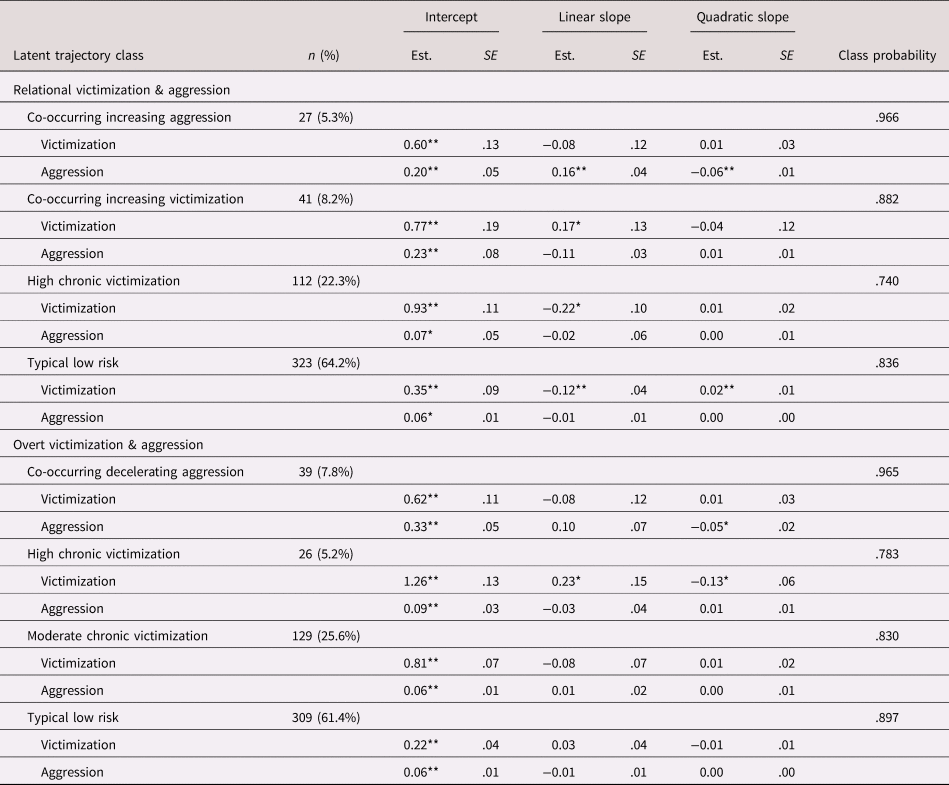
Accelerated sequential process LGMMs were used to estimate the developmental co-occurrence of peer relational victimization and aggression and of peer overt victimization and aggression from early to middle childhood. These analyses identified four joint latent class trajectories of relational victimization and aggression; BIC = −3,899.28, Entropy = .72 (see Table 1). A small proportion of children (n = 27; 5.3%) were classified in a co-occurring increasing relational aggression trajectory where the early frequency of relational victimization was estimated to be moderate and stable from 4.5 to 10.5 years and the level of relational aggression was estimated to be moderate and to increase from age 4.5 to 7.5 years and then slow in that increase by age 10.5. A small proportion of children (n = 41; 8.2%) were classified in a co-occurring increasing relational victimization trajectory where the early frequency of relational victimization was estimated to be moderate and to increase from age 4.5 to 10.5 years and the level of relational aggression was estimated to be moderate and increase from age 4.5 to 10.5 years. A modest proportion of children (n = 112; 22.3%) were also classified in a high chronic relational victimization trajectory where the early frequency of relational victimization was estimated to be high and to decrease from age 4.5 to 10.5 years, with a low and stable level of relational aggression. The majority of children were classified in the typical low-risk relational trajectory (n = 323; 64.2%), where early levels of relational victimization and aggression were estimated to be low, with victimization decelerating gradually from age 4.5 to 10.5 years. The posterior probabilities showed a good match of children to their latent class trajectory (.74 to .97).
Growth factor estimates from the sequential process latent growth mixture models

Note. *p < .05. **p < .01.
The sequential process analyses also identified four joint latent class trajectories of overt victimization and aggression; BIC = −2,629.04, Entropy = .79 (see Table 1). A small proportion of children (n = 39; 7.8%) were classified in a co-occurring decelerating overt aggression trajectory; the early frequency of overt victimization was estimated to be moderate and stable from age 4.5 to 10.5 years, and the level of overt aggression was estimated to be high and to increase modestly from age 4.5 to 7.5 years and then decrease to age 10.5. A small proportion of children (n = 26; 5.2%) were classified in a high chronic overt victimization trajectory where early levels of overt victimization were estimated to be high and to increase from age 4.5 to 7.5 years and then slow in that increase by age 10.5, with a low and stable level of overt aggression. A modest proportion of children (n = 129; 25.6%) were classified in a moderate chronic overt victimization trajectory; the early frequency of overt victimization was estimated to be moderate and remain stable from age 4.5 to 10.5 years, with a low and stable level of overt aggression. The majority of children were classified in the typical low-risk overt trajectory (n = 309; 61.4%), where early levels of overt victimization and aggression were estimated to be low and stable from age 4.5 to 10.5 years. The posterior probabilities showed a good match of children to their sequential process latent class trajectory (.78 to .97). Membership in the most likely sequential process latent class trajectory of relational victimization and aggression and of overt victimization and aggression was used for the next set of analyses.
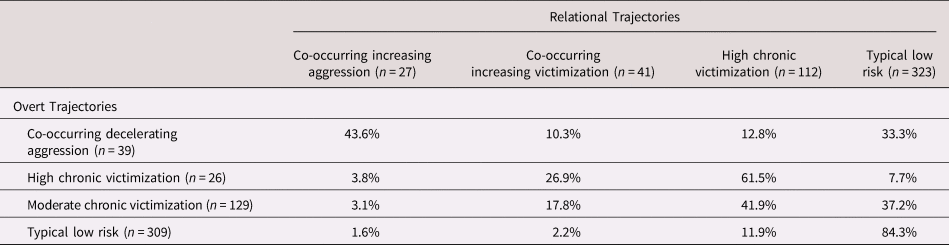
There was a substantial overlap of the classification between the relational and overt typical low-risk trajectories; 84.3% of children classified in the typical low-risk overt trajectory were also classified in the typical low-risk relational trajectory (see Table 2). There was moderate overlap of the chronic victimization trajectories; 61.5% and 41.9% of children classified in the high and moderate chronic overt victimization trajectories, respectively, were also classified in the high chronic relational victimization trajectory. In addition, 26.9% of children classified in the high chronic overt victimization trajectory were classified in the co-occurring increasing relational victimization trajectory. The other co-occurring trajectories also showed moderate overlap; 43.6% of children classified in the co-occurring decelerating overt aggression trajectory were classified in the co-occurring increasing relational aggression trajectory.
Classification overlap of the relational and overt sequential process latent class trajectories
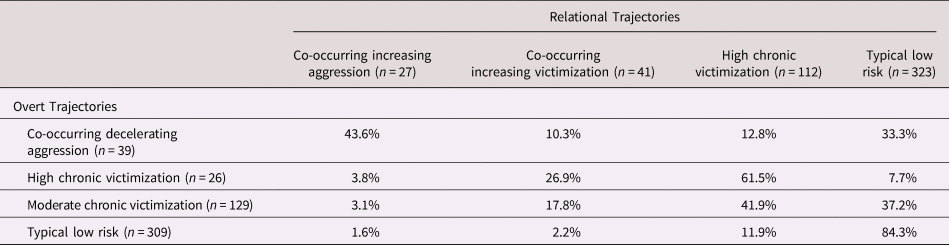
Note. Percentages indicate the proportion of children classified in the overt trajectories that were also classified in the relational trajectories.
Multinomial logistic regression analysis
Multinomial logistic regression analysis was used to examine child gender and the set of psychopathology, peer social status, and social–cognitive indicators at Wave 1 as predictors of the extracted sequential process latent class trajectories. The set of predictors were entered simultaneously for the co-occurring relational victimization and aggression models and for the co-occurring overt victimization and aggression models. The typical low-risk trajectory was examined as the referent group for both the relational and overt models.
Relational models
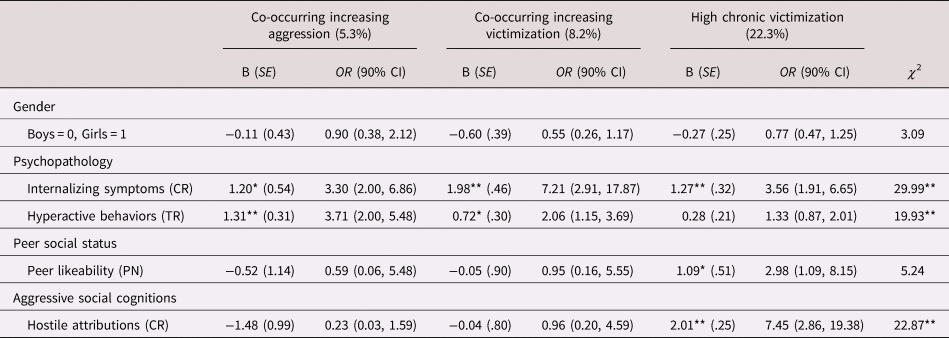
The multinomial logistic regression results for the relational models are presented in Table 3. Relative to the typical low-risk relational trajectory, children who showed more internalizing symptoms and children who displayed more hyperactive behaviors at Wave 1 had greater odds of being classified in the co-occurring increasing aggression trajectory and the co-occurring increasing victimization trajectory. Children who showed more internalizing symptoms, children who endorsed more hostile attributions, and children who were more liked by peers all had greater odds of being classified in the high chronic victimization trajectory than in the typical low-risk trajectory. We tested whether hyperactive behaviors differentiated the co-occurring increasing aggression trajectory from the co-occurring increasing victimization trajectory but this comparison was not significant. We also examined whether internalizing symptoms differentiated between the two co-occurring trajectories and the high chronic victimization trajectory. These comparisons yielded no significant differences.
Differences in the relational victimization and aggression sequential process latent class trajectories by child gender and the psychopathology, peer, and social–cognitive factors at Wave 1

Note. Referent class is the typical low-risk latent class trajectory (64.2%). OR = Odds ratio. CR = child report. TR = teacher report. PN = peer nomination. *p < .05. **p < .01.
Overt models
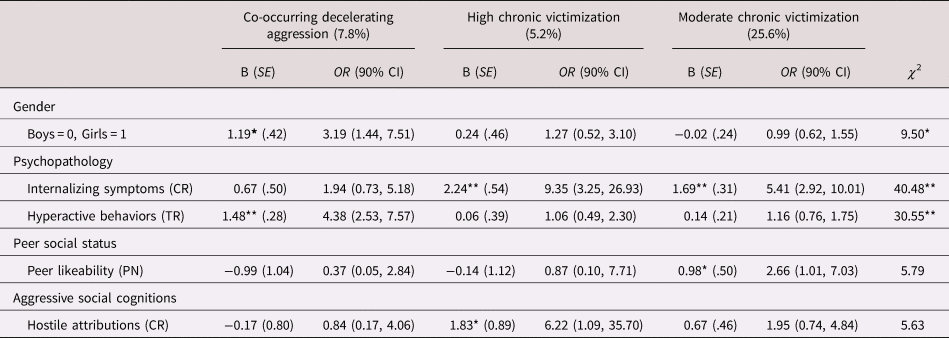
Multinomial logistic regression results for the overt sequential process models are presented in Table 4. Children who showed more hyperactive behaviors had higher odds of being classified in the co-occurring decelerating aggression trajectory relative to the typical low-risk trajectory. Girls were more likely than boys to be classified in the co-occurring decelerating aggression trajectory than the typical low-risk trajectory. Children who showed more internalizing symptoms and children who endorsed more hostile attributions had greater odds of being classified in the high chronic overt victimization trajectory than in the typical low-risk trajectory. Children who showed more internalizing symptoms and children who were nominated as more liked by peers had greater odds of being classified in the moderate chronic victimization trajectory than the typical low-risk trajectory. We tested whether internalizing symptoms differentiated between the high and moderate chronic victimization trajectories. This comparison yielded no significant differences between the chronic victimization trajectories.
Differences in the overt victimization and aggression sequential process latent class trajectories by child gender and the psychopathology, peer, and social–cognitive factors at Wave 1

Note. Referent class is the typical low-risk latent class trajectory (61.4%). OR = Odds ratio. CR = child report. TR = teacher report. PN = peer nomination. *p < .05. **p < .01.
Discussion
Findings from this study make three important contributions to knowledge on the early developmental course and co-occurrence of peer victimization and aggression. First, this study identified heterogeneity in the developmental trajectories of peer victimization and aggression during an early developmental period that has received limited attention in this line of study. We extended this by examining the trajectories of relational and overt forms of victimization and aggression. Second, we identified co-occurring and chronic victimization trajectories for both relational and overt forms, with some similarities and differences across these forms. No pure aggression trajectories were identified, differentiating this early developmental period from that found in middle to late childhood and adolescence. Third and finally we identified that children classified in the co-occurring relational and overt trajectories evidenced some common and unique risk factors, as did children classified in the chronic relational and overt victimization trajectories.
Heterogeneity in the developmental trends of peer victimization and aggression (Aim 1)
The first aim and contribution of this research was identification of heterogeneity in the early developmental trajectories of relational and overt forms of victimization and aggression across an estimated age from 4.5 to 10.5 years. Most studies on heterogeneity in victimization and aggression have focused on overt forms or have combined physical, relational and verbal forms (e.g., Barker, Arseneault, et al., Reference Barker, Arseneault, Brendgen, Fontaine and Maughan2008; Haltigan & Vaillancourt, Reference Haltigan and Vaillancourt2014; Ladd et al., Reference Ladd, Ettekal and Kochenderfer-Ladd2017; Orpinas et al., Reference Orpinas, McNicholas and Nahapetyan2015). We extended this by identifying two latent class trajectories of relational and overt forms of victimization and of aggression, with modest differences in the frequencies.
The majority of children showed low to moderate levels of both forms of victimization and aggression across the accelerated age period, consistent with evidence in middle childhood and adolescence (Barker, Arseneault, et al., Reference Barker, Arseneault, Brendgen, Fontaine and Maughan2008; Barker, Boivin, et al., Reference Barker, Boivin, Brendgen, Fontaine, Arseneault, Vitaro and Tremblay2008; Boivin et al., Reference Boivin, Petitclerc, Feng and Barker2010; Goldbaum et al., Reference Goldbaum, Craig, Pepler and Connolly2003; Haltigan & Vaillancourt, Reference Haltigan and Vaillancourt2014; Leadbeater & Hoglund, Reference Leadbeater and Hoglund2009; Orpinas et al., Reference Orpinas, McNicholas and Nahapetyan2015; Reijntjes et al., Reference Reijntjes, Vermande, Goossens, Olthof, van de Schoot, Aleva and van der Meulen2013). A substantial proportion of children were classified in a high chronic relational (19.1%) or overt (24.1%) victimization trajectory. These prevalence rates converge with Ladd et al. (Reference Ladd, Ettekal and Kochenderfer-Ladd2017) where about 24% of children followed a trajectory where rates of victimization (aggregate relational and physical forms) were initially high in kindergarten and then declined through to high school. Prevalence rates of relational and overt victimization here align with expectations that peer victimization is more frequent for younger children, with average rates that typically decrease from childhood to adolescence (Barker, Arseneault, et al., Reference Barker, Arseneault, Brendgen, Fontaine and Maughan2008; Haltigan & Vaillancourt, Reference Haltigan and Vaillancourt2014; Orpinas et al., Reference Orpinas, McNicholas and Nahapetyan2015; Kochenderfer-Ladd & Wardrop, Reference Kochenderfer-Ladd and Wardrop2001; Ladd et al., Reference Ladd, Ettekal and Kochenderfer-Ladd2017; Orpinas et al., Reference Orpinas, McNicholas and Nahapetyan2015). Still some studies have found that 6%–10% of children experience increasing or chronic levels of victimization (aggregate relational and overt forms) from Grade 3 to 5 and 6 (Biggs et al., Reference Biggs, Vernberg, Little, Dill, Fonagy and Twemlow2010; Boivin et al., Reference Boivin, Petitclerc, Feng and Barker2010). Thus, a small proportion of children's experiences of relational or overt victimization in early childhood may persist and increase as they transition across childhood into adolescence (Barker, Arseneault, et al., Reference Barker, Arseneault, Brendgen, Fontaine and Maughan2008; Haltigan & Vaillancourt, Reference Haltigan and Vaillancourt2014; Ladd et al., Reference Ladd, Ettekal and Kochenderfer-Ladd2017; Orpinas et al., Reference Orpinas, McNicholas and Nahapetyan2015; Vaillancourt et al., Reference Vaillancourt, Miller, Fagbemi, Côté and Tremblay2007).
There were some differences between the victimization and aggression trajectories, with more children classified in the chronic victimization trajectories than in the chronic aggression trajectories. A small proportion of children showed a high chronic trajectory of relational aggression (7.4%) or overt aggression (6.8%) across the accelerated period, extending evidence that aggression toward peers may emerge in early to middle childhood for a small proportion of children (Cleverley et al., Reference Cleverley, Szatmari, Vaillancourt, Boyle and Lipman2012; Orpinas et al., Reference Orpinas, McNicholas and Nahapetyan2015; Reijntjes et al., Reference Reijntjes, Vermande, Goossens, Olthof, van de Schoot, Aleva and van der Meulen2013; Underwood et al., Reference Underwood, Beron and Rosen2009). Highly aggressive children may be indiscriminate in who they target, contributing to discrepancies in prevalence rates between aggression and victimization. The proportion of children who show early emerging aggressive behaviors toward peers may increase in prevalence through childhood to early adolescence before declining in late adolescence (Barker, Arseneault, et al., Reference Barker, Arseneault, Brendgen, Fontaine and Maughan2008; Cleverley et al., Reference Cleverley, Szatmari, Vaillancourt, Boyle and Lipman2012; Haltigan & Vaillancourt, Reference Haltigan and Vaillancourt2014; Underwood, Beron, & Rosen, Reference Underwood, Beron and Rosen2011).
Co-0ccurring trajectories of peer victimization and aggression (Aim 2)
Informed by a developmental psychopathology perspective on the developmental co-occurrence of psychopathologies in childhood, the second aim and most significant contribution of this research was the identification of the developmental co-occurrence of peer relational victimization and aggression and of peer overt victimization and aggression across early to middle childhood. The sequential process analyses identified four co-occurring peer victimization and aggression trajectories for both relational and overt forms. These findings are unique in the inclusion of both relational and overt forms as previous research has often assessed the co-occurrence of overt victimization and aggression (see Dukes, Stein, & Zane, Reference Dukes, Stein and Zane2009; Orpinas et al., Reference Orpinas, McNicholas and Nahapetyan2015).
Nonetheless, the classification of the co-occurring and chronic victimization trajectories overlapped substantially across the relational and overt forms. This is consistent with meta-analyses indicating about 50% of an overlap in the variance between relational and overt forms of victimization (Casper & Card, Reference Casper and Card2017) and aggression (Card et al., Reference Card, Stucky, Sawalani and Little2008). Findings here suggest that across early to middle childhood, children who are chronically victimized by peers are likely targeted with both relational and overt forms. Similarly, for children who evidence co-occurring victimization and aggression this may manifest both relationally and overtly.
Consistent with other person-centered research in childhood and adolescence (Barker, Arseneault, et al., Reference Barker, Arseneault, Brendgen, Fontaine and Maughan2008; Cleverley et al., Reference Cleverley, Szatmari, Vaillancourt, Boyle and Lipman2012; Ettekal & Ladd, Reference Ettekal and Ladd2017; Haltigan & Vaillancourt, Reference Haltigan and Vaillancourt2014; Orpinas et al., Reference Orpinas, McNicholas and Nahapetyan2015; Williford et al., Reference Williford, Brisson, Bender, Jenson and Forrest-Bank2011), the majority of children were classified in the typical low-risk relational (64.2%) and overt (61.4%) trajectories. Of these, 84.3% of children classified in the low-risk overt trajectory were also classified in the low-risk relational trajectory. While the frequency of relational and overt forms of victimization and aggression was low for most children across early to middle childhood, there were substantive intraindividual differences in the co-occurrence of victimization and aggression, for relational and overt forms.
The co-occurrence of victimization and aggression was more common for relational than overt forms; 13.5% of children followed a co-occurring relational trajectory in contrast to 7.8% of children who followed a co-occurring overt trajectory. There was also modest overlap in these co-occurring relational and overt trajectories; 43.6% of children in the co-occurring overt trajectory were also classified in the co-occurring increasing relational aggression trajectory. The prevalence and patterns of the co-occurring relational and overt trajectories converge with estimates in middle to late childhood and adolescence (Arseneault et al., Reference Arseneault, Walsh, Trzesniewski, Newcombe, Caspi and Moffit2006; Barker, Arseneault, et al., Reference Barker, Arseneault, Brendgen, Fontaine and Maughan2008; Haltigan & Vaillancourt, Reference Haltigan and Vaillancourt2014; Hanish & Guerra, Reference Hanish and Guerra2004; Orpinas et al., Reference Orpinas, McNicholas and Nahapetyan2015; Schwartz, Reference Schwartz2000). The pattern of these co-occurring trajectories suggests that a proportion of children who are chronically targeted by peers, relationally or overtly, concomitantly retaliate with aggression. Retaliatory aggression may be a learned response to being victimized and used to respond to peer abuse and perceived threats (Haltigan & Vaillancourt, Reference Haltigan and Vaillancourt2014; Schwartz, Reference Schwartz2000), as suggested by estimates in the co-occurring increasing relational aggression trajectory. Others have also found relational aggression increasingly converges with relational victimization in adolescence (Orpinas et al., Reference Orpinas, McNicholas and Nahapetyan2015; Williford et al., Reference Williford, Brisson, Bender, Jenson and Forrest-Bank2011). This may be due to a higher prevalence of relational than overt aggression in late childhood to early adolescence, with roots that emerge in early childhood (Underwood et al., Reference Underwood, Beron and Rosen2009). Aggression toward peers, particularly relational, may persist and increase in prevalence as it becomes normalized in the peer group and used to achieve popularity, visibility, and social dominance among the peer group (Cillessen & Mayeux, Reference Cillessen and Mayeux2004; Ettekal & Ladd, Reference Ettekal and Ladd2017; Reijntjes et al., Reference Reijntjes, Vermande, Goossens, Olthof, van de Schoot, Aleva and van der Meulen2013; Underwood et al., Reference Underwood, Beron and Rosen2011). The proportion of children who persist or increase in their use of overt aggression likely begins to decrease across childhood as peers increasingly disapprove of these behaviors and use victimization to censure aggressive children (Cillessen & Mayeux, Reference Cillessen and Mayeux2004; Underwood et al., Reference Underwood, Beron and Rosen2011).
We also identified a substantial proportion of children who followed a chronic relational victimization trajectory (22.3%) and a high chronic overt (5.2%) or moderate chronic overt (25.6%) victimization trajectory. There was substantial overlap across these trajectories with 61.5% and 41.9% of children in the high and moderate overt victimization trajectories, respectively, also classified in the high relational victimization trajectory. These proportions of chronically victimized but not aggressive children align with other person- and variable-centered research in childhood and adolescence (e.g., Arseneault et al., Reference Arseneault, Walsh, Trzesniewski, Newcombe, Caspi and Moffit2006; Biggs et al., Reference Biggs, Vernberg, Little, Dill, Fonagy and Twemlow2010; Cleverley et al., Reference Cleverley, Szatmari, Vaillancourt, Boyle and Lipman2012; Haltigan & Vaillancourt, Reference Haltigan and Vaillancourt2014; Orpinas et al., Reference Orpinas, McNicholas and Nahapetyan2015), as well as with cross-national research (Nansel, Craig, Overpeck, Saluja, & Ruan, Reference Nansel, Craig, Overpeck, Saluja and Ruan2004). Findings here also uniquely identified some differences between the chronic relational and overt trajectories, with the frequency of chronic relational victimization decreasing across early to middle childhood while the frequency of chronic overt victimization tended to be stable. The victimization experienced by these children may be elevated and persist because children are too anxious to try to stop the abuse or have few friends available who could stand up for them and instill a sense of confidence in their abilities to stop the abuse (Cook et al., Reference Cook, Williams, Guerra, Kim and Sadek2010; Hoglund & Chisholm, Reference Hoglund and Chisholm2014; Leff, Kupersmidt, & Power, Reference Leff, Kupersmidt and Power2003).
In contrast to expectations, we did not identify a “pure” relational or overt aggression trajectory. Relational and overt aggression in these early years appear to coexist with experiences of relational and overt victimization, respectively. Children's enactment of relational and overt aggression may begin to diverge from experiences of victimization as they transition into late childhood and adolescence (Boivin et al., Reference Boivin, Petitclerc, Feng and Barker2010; Hanish & Guerra, Reference Hanish and Guerra2004; Williford et al., Reference Williford, Brisson, Bender, Jenson and Forrest-Bank2011). The comorbidity of relational and overt forms of peer aggression with victimization identified here may be due to the higher overall frequency of victimization often found in early to middle childhood (Arseneault et al., Reference Arseneault, Walsh, Trzesniewski, Newcombe, Caspi and Moffit2006; Hanish & Guerra, Reference Hanish and Guerra2004). As evidenced by the co-occurring increasing relational aggression trajectory, some children may begin to experience decreases in victimization while concurrently increasing in their aggression as they transition from childhood to adolescence (Barker, Arseneault, et al., Reference Barker, Arseneault, Brendgen, Fontaine and Maughan2008; Haltigan & Vaillancourt, Reference Haltigan and Vaillancourt2014; Orpinas et al., Reference Orpinas, McNicholas and Nahapetyan2015). These children may gradually become less viable as targets of victimization by late childhood because they learn to regulate their emotional responses of anger and behavioral tendencies to retaliate, gradually gaining the acceptance of peers. Yet a proportion of these children may increase in their use of peer relational aggression in particular as they move through adolescence because they gain a measure of peer acceptance and popularity and are able to aggress against peers without the risk of retribution (Barker, Arseneault, et al., Reference Barker, Arseneault, Brendgen, Fontaine and Maughan2008; Cillessen & Mayeux, Reference Cillessen and Mayeux2004; Haltigan & Vaillancourt, Reference Haltigan and Vaillancourt2014; Orpinas et al., Reference Orpinas, McNicholas and Nahapetyan2015).
Psychopathology, peer, and social–cognitive risks (Aim 3)
Guided by a developmental psychopathology perspective on comorbidity, the third aim and contribution of this research was the identification of common and unique correlates of the sequential process latent class trajectories. Findings aligned with the proposition that children in the co-occurring relational and overt trajectories would evidence comorbidity in their risk factors common to victimization and aggression, with modest differences (Cook et al., Reference Cook, Williams, Guerra, Kim and Sadek2010).
Hyperactive behaviors predicted the co-occurring relational and overt trajectories, converging with previous research (Arseneault et al., Reference Arseneault, Walsh, Trzesniewski, Newcombe, Caspi and Moffit2006; Barker, Arseneault, et al., Reference Barker, Arseneault, Brendgen, Fontaine and Maughan2008; Haltigan & Vaillancourt, Reference Haltigan and Vaillancourt2014; Schwartz, Reference Schwartz2000). Externalizing problems, including hyperactive behaviors, are one of the most robust correlates of peer aggression (Barker, Arseneault, et al., Reference Barker, Arseneault, Brendgen, Fontaine and Maughan2008; Cook et al., Reference Cook, Williams, Guerra, Kim and Sadek2010; Haltigan & Vaillancourt, Reference Haltigan and Vaillancourt2014; Pepler et al., Reference Pepler, Jiang, Craig and Connolly2008). Hyperactivity may underlie children's vulnerability to co-occurring victimization and aggression, relational and overt forms, because they are unpredictable and impulsively react to conflict with anger, making them disliked targets for victimization (Haltigan & Vaillancourt, Reference Haltigan and Vaillancourt2014). These children may be easily irritated and struggle to regulate anger, elevating their impulse to use relational or overt aggression as a strategy when challenged by peers (Salmivalli & Nieminen, Reference Salmivalli and Nieminen2002). Peers may censure these children with victimization for their impulsive, anger-driven behaviors that are perceived to violate social norms (Cook et al., Reference Cook, Williams, Guerra, Kim and Sadek2010; Dodge et al., Reference Dodge, Lansford, Burks, Bates, Pettit, Fontaine and Price2003). In contrast, hyperactive behaviors did not predict chronic relational or overt victimization, possibly as these children do not share this anger-driven reactivity (Cook et al., Reference Cook, Williams, Guerra, Kim and Sadek2010; Salmivalli & Nieminen, Reference Salmivalli and Nieminen2002).
Internalizing symptoms also predicted the co-occurring relational but not overt trajectories. Vulnerability to feelings of melancholy and anxiety may potentiate children's risks for co-occurring relational victimization and aggression because their emotional sensitivity makes them rewarding targets for gossip or threats of friendship withdrawal (Cook et al., Reference Cook, Williams, Guerra, Kim and Sadek2010; Dodge et al., Reference Dodge, Lansford, Burks, Bates, Pettit, Fontaine and Price2003; Hoglund & Leadbeater, Reference Hoglund and Leadbeater2007; Peets & Kikas, Reference Peets and Kikas2006). These children may have difficulty regulating emotional reactivity to relational threats because they ruminate over adverse social interactions and are easily irritated by peers’ behaviors, retaliating in kind to avert or stop peer hostility (Cook et al., Reference Cook, Williams, Guerra, Kim and Sadek2010; Crick et al., Reference Crick, Grotpeter and Bigbee2002; Hoglund & Leadbeater, Reference Hoglund and Leadbeater2007).
Internalizing symptoms, hostile attributions, and peer likeability all uniquely predicted the chronic relational and overt victimization trajectories, diverging from expectations of specificity in risks for chronic victimization. Consistent with research on heterogeneity in peer victimization (Arseneault et al., Reference Arseneault, Walsh, Trzesniewski, Newcombe, Caspi and Moffit2006; Biggs et al., Reference Biggs, Vernberg, Little, Dill, Fonagy and Twemlow2010; Boivin et al., Reference Boivin, Petitclerc, Feng and Barker2010; Goldbaum et al., Reference Goldbaum, Craig, Pepler and Connolly2003; Orpinas et al., Reference Orpinas, McNicholas and Nahapetyan2015), children who reported a greater frequency of feelings of sadness and anxiety were more likely to be classified in the chronic relational and overt victimization trajectories relative to children in the typical low-risk trajectories. These findings converge with other evidence to mark internalizing symptoms as a pervasive risk for chronic relational and overt victimization (Goldbaum et al., Reference Goldbaum, Craig, Pepler and Connolly2003; Hoglund & Chisholm, Reference Hoglund and Chisholm2014; Reijntjes et al., Reference Reijntjes, Kamphuis, Prinzie and Telch2010; Vaillancourt et al., Reference Vaillancourt, Brittain, McDougall and Duku2013). Children who are visibly melancholy, sad, and anxious may be chronically victimized relationally and overtly, because they do not fight back due to their anxiety or timid behaviors that are not sufficient to stop the peer abuse or to elicit support from other children (Goldbaum et al., Reference Goldbaum, Craig, Pepler and Connolly2003; Marshall et al., Reference Marshall, Arnold, Rolon-Arroyo and Griffith2015; Prinstein et al., Reference Prinstein, Boergers and Vernberg2001). They may also have little confidence in their abilities to stop peer abuse or few peers who stand up to support them (Cook et al., Reference Cook, Williams, Guerra, Kim and Sadek2010).
Hostile attributions was also a common correlate of the high chronic relational and overt victimization trajectories, aligning with social–cognitive theory that the way children interpret social interactions is influential for adverse social experiences (Crick & Dodge, Reference Crick and Dodge1994; Selman, Reference Selman2003). Children with a propensity to attribute hostility to peers’ ambiguous behaviors may be vulnerable to chronic relational and overt victimization because they are self-critical, misinterpret social cues from peers and infer negativity, and ruminate over these interactions (Cook et al., Reference Cook, Williams, Guerra, Kim and Sadek2010). Inferences of hostility along with self-criticism and rumination may characterize a distress vulnerability for children in the high chronic relational and overt victimization trajectories (Cook et al., Reference Cook, Williams, Guerra, Kim and Sadek2010; Crick et al., Reference Crick, Grotpeter and Bigbee2002; Hoglund & Chisholm, Reference Hoglund and Chisholm2014).
Children who were well liked by peers also had a greater likelihood of being classified in the chronic relational victimization and moderate chronic overt victimization trajectories, consistent with some evidence (Card et al., Reference Card, Stucky, Sawalani and Little2008; Tseng et al., Reference Tseng, Banny, Kawabata, Crick and Gau2013). Children who peers want to play with may be preferred because they are socially visible (Cillessen & Marks, Reference Cillessen, Marks, Cillessen, Schwartz and Mayeux2011). By being socially visible these children may have more opportunities to engage with peers, increasing their exposure to aggressive peers and opportunities for relational or overt victimization (Hanish, Ryan, Martin, & Fabes, Reference Hanish, Ryan, Martin and Fabes2005). While well liked, some socially visible children may possess fewer social skills that enable them to effectively manage peer conflicts, contributing to ongoing risks for relational and overt victimization (Cook et al., Reference Cook, Williams, Guerra, Kim and Sadek2010). These children may be likely to acquiesce to dominant peers’ requests or demands, particularly during conflicts. These children may also be perceived as easy to manipulate because they do not challenge dominant peers and others are unwilling to support them, contributing to risks for being victimized relationally or overtly.
Limitations and Future Directions
The current study adds to the literature on heterogeneity in peer relational and overt victimization and aggression by documenting the early emergence of co-occurring victimization and aggression across the transition from early to middle childhood. While our accelerated longitudinal design has notable advantages (e.g., less participant burden), this design assumes that together the cohorts inform a single growth trajectory (Collins, Reference Collins2006; Duncan et al., Reference Duncan, Duncan and Hops1996). It may be that some cohorts had different experiences of victimization or aggression than other cohorts, potentially biasing the estimation of the growth trajectories. Nonetheless, this is also a strength of this modeling approach that captures age-related differences across the cohorts to model estimated rates of change in victimization and aggression.
Our modest child consent rates may limit the generalizability of our findings. Almost 40% of children did not have parent consent and about 40% of the children with consent did not have teacher-rated data despite multiple strategies to get parents to consent and teachers to complete their forms. Even so, consented children without teacher-rated data did not differ substantially from children with these data, suggesting the findings were not overly influenced by missing teacher-rated data. These data reflect the joint trajectories of victimization and aggression for children who may be from less economically vulnerable households in high needs schools. Research replicating these joint trajectory findings across early to middle childhood with higher consent rates for vulnerable populations is needed.
We relied on child-reports for victimization and on peer nominations for aggression to minimize potential inflation of the joint trajectory findings due to shared method bias (Demaray, Malecki, & Lyell, Reference Demaray, Malecki and Lyell2013). Incorporation of peer-nominated and teacher-rated victimization and child- and teacher-rated aggression may further sharpen understanding of how these co-occur in early to middle childhood and relate to a set of correlates (Casper & Card, Reference Casper and Card2017; Demaray et al., Reference Demaray, Malecki and Lyell2013; Reijntjes et al., Reference Reijntjes, Kamphuis, Prinzie and Telch2010). A focus on proactive and reactive aggression may also help identify how the function and not just form of aggression co-occurs with victimization.
Findings for the child-, teacher-, and peer-rated correlates of the latent class trajectories of victimization and aggression broadly converged with expectations (Cook et al., Reference Cook, Williams, Guerra, Kim and Sadek2010; Giang & Graham, Reference Giang and Graham2008; Goldbaum et al., Reference Goldbaum, Craig, Pepler and Connolly2003; Haltigan & Vaillancourt, Reference Haltigan and Vaillancourt2014). Nonetheless, children also reported on their internalizing symptoms, potentially inflating associations found with the victimization trajectories (Casper & Card, Reference Casper and Card2017; Marshall et al., Reference Marshall, Arnold, Rolon-Arroyo and Griffith2015; Reijntjes et al., Reference Reijntjes, Kamphuis, Prinzie and Telch2010). Children who experience elevated internalizing symptoms may be biased toward interpreting negativity in ambiguous peer interactions, possibly magnifying associations of internalizing symptoms with the chronic victimization trajectories identified here (Prinstein et al., Reference Prinstein, Cheah and Guyer2005).
Peer likeability is a subjective measure of how well liked and preferred children are by peers (Cillessen & Marks, Reference Cillessen, Marks, Cillessen, Schwartz and Mayeux2011). Our assessment of likeability may reflect children's reputation of likability rather than subjective preferences as children were asked to nominate classmates who other kids most want to play with. Our findings for how likeability relates to the chronic relational and overt victimization trajectories may be more about children's social visibility and reputation.
Correlates not examined here might also differentially predict between the co-occurring trajectories and differentiate these from the chronic victimization trajectories. For example, social dominance (Reijntjes et al., Reference Reijntjes, Vermande, Goossens, Olthof, van de Schoot, Aleva and van der Meulen2013), moral disengagement (Pepler et al., Reference Pepler, Jiang, Craig and Connolly2008) and poor friendship quality (Ettekal & Ladd, Reference Ettekal and Ladd2015; Goldbaum et al., Reference Goldbaum, Craig, Pepler and Connolly2003) might differentiate children in the co-occurring relational and overt trajectories. Social withdrawal might distinguish children in the chronic victimization trajectories (Boivin et al., Reference Boivin, Petitclerc, Feng and Barker2010).
Reliability for some of our measures was low and in particular for the hostile attribution measure. This may have limited our ability to detect effects for these constructs. Nonetheless, findings were broadly consistent with some findings for peer victimization but did not converge with associations often found between hostile attributions and both relational and overt aggression (Crick et al., Reference Crick, Grotpeter and Bigbee2002; Orobio de Castro et al., Reference Orobio de Castro, Veerman, Koops, Bosch and Monshouwer2002). Our consent rates may have implications for the reliability of the peer-nominated social status data (Marks, Babcock, Cillessen, & Crick, Reference Marks, Babcock, Cillessen and Crick2013). In addition, our peer-nominated aggression indices relied on two indicators of both the relational and overt forms that may have further limited their reliability.
While we identified four co-occurring trajectories for relational and overt forms, the sample size of the co-occurring relational and overt trajectories was small. Thus findings for these trajectories should be interpreted with caution. It is important for future research to validate these trajectories and correlates with larger sample sizes and higher consent rates. Nonetheless, these trajectories were extracted in each set of preliminary analyses and in the final analyses presented, suggesting that these are stable groups of vulnerable children.
To date, research on the joint developmental course of peer victimization and aggression has given little attention to the emergence of these co-occurring trajectories in early to middle childhood. Research has primarily focused on global assessments of victimization and aggression rather than on differentiating relational and overt forms. The current study extends this by documenting heterogeneity in the early emergence of relational and overt forms of co-occurring victimization and aggression and chronic victimization across an estimated age span from early to middle childhood. Children who evidenced vulnerability to psychopathology showed risks for co-occurring victimization and aggression, with hyperactive behaviors a common risk factor for relational and overt forms and internalizing symptoms a unique risk for co-occurring relational trajectories. Children who showed internalizing symptoms and attributions of hostility but also some children who were well liked experienced chronic relational and overt victimization.
Findings here suggest that concentrated efforts to help children regulate hyperactive behaviors in early childhood may be key to lessen risks for both relational and overt forms of co-occurring victimization and aggression (Dodge et al., Reference Dodge, Lansford, Burks, Bates, Pettit, Fontaine and Price2003; Haltigan & Vaillancourt, Reference Haltigan and Vaillancourt2014; Pepler et al., Reference Pepler, Jiang, Craig and Connolly2008). Early efforts to support children's ability to manage feelings of sadness and anxiety and aggressive social cognitions also appear critical to reduce risks for chronic relational and overt victimization (Biggs et al., Reference Biggs, Vernberg, Little, Dill, Fonagy and Twemlow2010; Goldbaum et al., Reference Goldbaum, Craig, Pepler and Connolly2003; Hoglund & Chisholm, Reference Hoglund and Chisholm2014; Prinstein et al., Reference Prinstein, Boergers and Vernberg2001). Integrating social-emotional learning strategies into early school curriculum may help to reduce peer problems (Bradshaw, Reference Bradshaw2015; Jones & Bouffard, Reference Jones and Bouffard2012).
Supplementary Material
The supplementary material for this article can be found at https://doi.org/10.1017/S0954579421000523
Acknowledgments
Appreciation is extended to the children, teachers, and schools who graciously participated in this research. Gratitude is also extended to the many student research assistants who committed tireless hours to this project.
Funding Statement
This research was supported by a Standard Research Grant from the Social Sciences and Humanities Research Council of Canada (SRG #410-2009-0864) awarded to W. Hoglund.
Conflicts of Interest
None.