A major complaint against cultural theories is that they cannot explain political change (Lockhart Reference Lockhart, Ellis and Thompson1997). Cultural and institutional accounts of politics are also often seen as antagonistic (Chai Reference Chai, Ellis and Thompson1997; Grendstad and Selle Reference Grendstad and Selle1995; Lockhart Reference Lockhart1999). The cultural theory (CT) developed by Mary Douglas, Aaron Wildavsky, and others (see, e.g., Schwarz and Thompson Reference Schwarz and Thompson1990; Thompson, Ellis, and Wildavsky Reference Thompson, Ellis and Wildavsky1990), by contrast, offers a theory of culture that includes a theory of cultural change that integrates institutions into its explanation of change (Lockhart Reference Lockhart, Ellis and Thompson1997, Reference Lockhart1999; Thompson, Ellis, and Wildavsky Reference Thompson, Ellis and Wildavsky1990, 69–81; Wildavsky Reference Wildavsky1985). Moreover, CT can help specify the cultural conditions for sudden, big institutional and policy change, thereby, I argue, strengthening Frank Baumgartner and Bryan Jones's “punctuated equilibria” (PE) theory of change (Baumgartner and Jones Reference Baumgartner and Jones1993, Reference Baumgartner and Jones2002). The plausibility of this CT of PE change is illustrated in this article by using it to explain dramatic changes in forest and wildlife management in the Pacific Northwest (PNW) (building on Swedlow Reference Swedlow2002a, Reference Swedlowb, Reference Swedlow2003, Reference Swedlow2007, Reference Swedlow2009, and Reference Swedlow2011a, Reference Swedlowb).Footnote 1
In the late 1980s and early 1990s, environmentalists argued and federal judges agreed that federal land and wildlife management agencies were not doing enough to protect the northern spotted owl. These judges enjoined all federal timber sales in the owl's range in Washington, Oregon, and Northern California and ordered federal agencies to protect not just the owl but ecosystems. President Clinton appointed a scientific advisory committee to respond to these orders. The committee recommended and the President implemented a plan to manage ecosystems on 24 million acres of federal land, an area nearly six times the size of Connecticut, to protect not just the owl but 1,000 other species associated with older forests. To achieve this, the plan called for a 75% permanent reduction in federal timber sales, which was expected to harm about 300 rural communities.
USING CULTURAL THEORY TO SPECIFY THE INTERACTING IDEAS, INTERESTS, AND INSTITUTIONS OF PUNCTUATED EQUILIBRIA THEORY
In PE theory, certain interactions among ideas, interests, and institutions produce negative feedback, dampening institutional and/or policy change, keeping it incremental or roughly in equilibrium. Other interactions among ideas, interests, and institutions produce positive feedback, leading to dramatic institutional and/or policy changes, punctuating this equilibrium. Benjamin Cashore and Michael Howlett (Reference Cashore, Howlett and Repetto2006, Reference Cashore and Howlett2007) use PE theory to explain the same dramatic changes in forest and wildlife management in the PNW that are the subject of this article. They emphasize institutional causes of PE, which they believe are often slighted in PE analyses. Cashore and Howlett are correct that institutions are important in explaining PE change in this case, but their institutional account is mis-specified in that it gives too much agency to “the law” and too little to courts (Swedlow Reference Swedlow2011a) and, as I argue here, to cultural surprises.
More importantly, no scholar using PE theory has yet supplied a theory about the types of societal interests and governmental institutions that are involved in producing dramatic policy changes. Consequently, PE scholars have not provided a theory about what kinds of ideas cause different types of societal interests to demand, and social and political processes and governmental institutions to produce, dramatic policy changes. This article argues that CT can be used to specify four basic kinds of societal interests and governmental institutions as well as to specify the sources of cultural surprises that can lead to PE policy change.
In CT, ideas and interests are seen as reflections of beliefs and values (Wildavsky Reference Wildavsky1991, Reference Wildavsky1994), whereas institutions are viewed as manifestations of social and political relations (Chai Reference Chai, Ellis and Thompson1997; Grendstad and Selle Reference Grendstad and Selle1995; Lockhart Reference Lockhart1999). Cultural theorists hypothesize that different types of social and political relations are accompanied by beliefs and values, including constructs of nature, that allow people to justify these relationships to each other. In other words, different kinds of social and political relations, beliefs, and values are thought to be interdependent or functionally related. The corollary of this hypothesis is that these different kinds of relations, beliefs, and values cannot be mixed and matched. To live one way and think another is unsustainable, a pathway for cultural change. Changes in beliefs and values are expected to lead to changes in relations, and vice versa. Thus, relations constrain beliefs and values, and beliefs and values constrain relations. Compatible relations, beliefs, and values are what Douglas and others call “cultures,” and compatible beliefs and values together are what they term “cultural biases” or ideologies (Swedlow Reference Swedlow2002b, Reference Swedlow2008, Reference Swedlow2011b; Thompson, Ellis, and Wildavsky Reference Thompson, Ellis and Wildavsky1990).
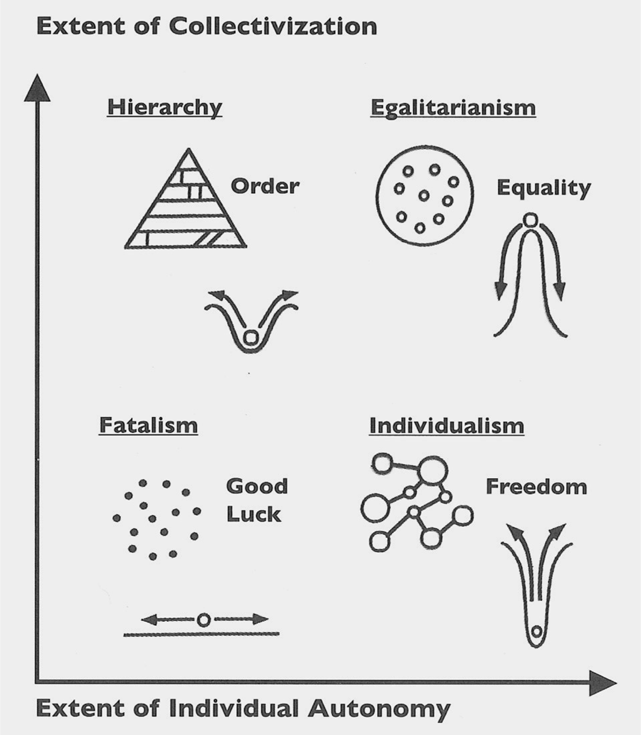
Douglas and colleagues' next move is more controversial, as it involves an attempt to characterize these cultural packages in a way that is parsimonious and still exhaustive of the possibilities at a particular level of abstraction. Like many social scientists, they think that much of the variation in social and political relations is captured by the extent of individual autonomy and collectivism in those relations.Footnote 2 Unlike other social scientists, Douglas and colleagues believe that these conditions are independent of each other rather than inversely related. Instead of lying on opposite ends of the same continuum, individual autonomy and collectivism vary separately on their own dimensions. More of one condition does not necessarily mean less of the other. These dimensions and the resulting patterns of social relations are depicted in figure 1.
Dimensions of Culture, Types of Institutions, Political Values, and Constructs of Nature
Note: Figure 1 previously appeared in Swedlow Reference Swedlow2011b.

This conceptual shift allows analysts to account for four, rather than two, patterns of social and political relations. People in individualistic and fatalistic relations are not part of a collective undertaking, but individualists retain their autonomy, while fatalists do not. People in egalitarian and hierarchical relations, meanwhile, are part of a collective undertaking, but egalitarians retain much more of their autonomy than hierarchs.
Hierarchical relations are highly structured, with everyone and everything having his, her, and its place, represented by an organizational pyramid in figure 1. In this cultural environment, legitimate decisions are made by persons with the proper authority to make particular types of decisions: “the proper authority decides.”Footnote 3 Individualistic relations, by contrast, are highly fluid, and subject to individual choice, represented by a network in figure 1: “I decide.” Fatalistic relations, meanwhile, are tenuous and unreliable, driven by the “whim and caprice” of others, represented by atomized individuals in figure 1: “others decide.” Finally, people in egalitarian relations retain their autonomy by giving everyone an equal voice in (and thus the power to veto) collective decisions: “we decide.” The egalitarian desire to “have it all”—that is, to retain individual autonomy while acting collectively—is represented here by something that looks like a chocolate chip cookie in figure 1.
Each of these four patterns of social and political relations is hypothesized to be justified by and in turn justify (and make plausible) particular kinds of values and beliefs. Not surprisingly, cultural theorists hypothesize that individualists value freedom, egalitarians value equality, hierarchs value order, and fatalists value (good) luck (see figure 1; Coyle Reference Coyle, Coyle and Ellis1994; Ellis and Thompson Reference Ellis and Thompson1997; Swedlow Reference Swedlow2008).
THE CULTURAL CONSTRUCTION OF NATURE AND PUBLIC POLICY IN CULTURAL THEORY AND THE PACIFIC NORTHWEST
Michael Thompson has been particularly instrumental in characterizing the cultural constructs of nature in Douglas's theory (Schwarz and Thompson Reference Schwarz and Thompson1990, 8–13; Thompson, Ellis, and Wildavsky Reference Thompson, Ellis and Wildavsky1990, 26–33). Adapted from Thompson's work, the constructs of nature that are functional for the different patterns of social relations are mapped on the dimensions of social relations in figure 1, where a ball in a landscape represents the constructs of nature:
• In the individualistic construct of nature, the ball is in a deep pocket, difficult to knock out: this represents nature as benign, resilient, or even robust or cornucopian.Footnote 4
• The egalitarian construct of nature is most nearly the opposite of the individualistic: the ball is perched precariously on top of a pinnacle; the slightest disturbance will send it irretrievably downhill: this represents nature as fragile or ephemeral.
• The hierarchical construct of nature combines these two constructs: the ball is in a shallow pocket; small disturbances will not dislodge it, but large ones will; nature is construed as being benign or resilient within limits, beyond which it is fragile, ephemeral, or unpredictable.Footnote 5
• In the fatalistic construct of nature, the ball is on a flat surface; it can roll in any direction; this represents the unpredictability or capriciousness of nature; sometimes benign, resilient, or even robust or cornucopian, sometimes fragile or ephemeral, without discernable rhyme or reason.
The scientific debate regarding owls and ecosystems in the PNW can be characterized as an argument between environmentalists and their academic sympathizers, on the one hand, and federal and industry scientists, on the other, over how shallow the pocket was, or whether the ball was in a pocket at all. However, federal scientists came fairly close to arguing that ecosystems were unpredictable—being “not only more complex than we think, but more complex than we can think”—while scientists working for industry argued for the resiliency and adaptability of the owl and ecosystems. The debate effectively concluded when environmentalists and their academic sympathizers persuaded federal judges that the ball was teetering on the lip of the pocket or, alternatively, about to fall off its pinnacle perch.
From these constructs of nature it is also possible to deduce the types of environmental policies that each of the four cultural types will pursue. Individualists will offer a hands-on, transformative approach, which is indeed what the timber industry advocated: “Tell us what owl habitat looks like and we'll grow it.” They suggested building nest boxes and breeding owls in captivity and then shipping the owls between habitat areas rather than retaining old trees with nesting cavities and providing forested migratory routes for these birds. Egalitarians will take a hands-off, “tread lightly” approach, which is what environmentalists wanted when they advocated the complete halt of timber harvests that was nearly achieved. Hierarchs will be activist, but only to a point that is sustainable, which was the approach the US Forest Service has historically taken with respect to timber harvesting. Fatalists will remain passive in the face of nature's fickle moods, a position that (in addition to the egalitarian “tread lightly” approach) significantly influenced the approach taken by President Clinton's scientific advisers.
CULTURAL SURPRISES, PUNCTUATED EQUILIBRIA, AND POLICY CHANGE IN CULTURAL THEORY AND THE PACIFIC NORTHWEST
“But if preferences and perception are socially constructed in such a way as to justify particular patterns of social relations, how does change ever occur?,” ask Michael Thompson, Richard Ellis, and Aaron Wildavsky in their seminal refinement of Douglas's theory (Reference Thompson, Ellis and Wildavsky1990, 69). “Much the same way,” they answer, “as scientific theories lose and gain adherents: the cumulative impact of successive anomalies or surprises.” Anomalies and surprises occur because “nature, for all its accommodating ways, does not meekly accept every cultural construction we try to impose on it, and, in fighting back, it generates a countervailing force: the natural destruction of culture …”
In other words, cultural theorists locate a catalyst for scientific, cultural, and policy change in surprises generated by encounters with nature in which nature displays properties or reveals characteristics that are at odds with scientifically or culturally generated expectations. Stipulating the world is one way and finding out that it actually appears to be another leads to a variety of predictable consequences, which can lead to such changesFootnote 6 (see also Coyle and Wildavsky Reference Coyle and Wildavsky1987; Lockhart Reference Lockhart, Ellis and Thompson1997; Lodge and Wegrich Reference Lodge and Wegrich2011, this issue; Swedlow Reference Swedlow2011c, this issue; Wildavsky Reference Wildavsky1985).
One area where the natural destruction of science, culture, and policy appeared to occur in the PNW was in the influence changing scientific understandings of older forests had on forest and wildlife science and management. The US Forest Service, which manages most of the federal lands in the region, had been an exemplary hierarchically organized federal agency since its founding in the early 1900s. It championed scientific management to produce a sustained yield of timber by managing forests much as one would manage any other crop. The Forest Service called for the harvest of old-growth forests not set aside as Wilderness Areas or National Parks because it wanted to replace these slower-growing, decadent, diseased “biological deserts” with faster growing, healthier, younger stands.
Research beginning in the early 1970s challenged the Forest Service's view that old-growth forests were lifeless “cellulose cemeteries” that needed to be harvested. Researchers at the H.J. Andrews Experimental Forest in Oregon found that these older forests were home to a wide variety of interdependent life forms. Proceeding roughly in parallel with the research of the H.J. Andrews team was the research of wildlife biologist Eric Forsman on the relationship between the northern spotted owl and old-growth forests. Environmental groups were excited by this research because it gave them additional reasons to value and, with respect to the owl, a legal means to preserve older forests.
In other words, research on old-growth forest ecosystems, and specifically on the relationship between spotted owls and old-growth, constructed nature in ways that were functional for egalitarian environmental groups. The development of this research and environmental groups' interest in this research thus is one significant area where political cultural conditions were ripe for punctuated equilibria in policy change to occur.
Accordingly, after obtaining further supportive owl habitat and population modeling analyses from another scientist, environmentalists began suing the federal land and wildlife management agencies on behalf of the northern spotted owl. They argued, and federal judges agreed, that federal land and wildlife managers were not doing enough to protect the owl, violating several environmental laws.
No judge played a more significant role in facilitating the rise of ecosystem management in the PNW than district court Judge William Dwyer. Not only was he the first to enjoin federal timber sales to protect the owl, but his injunction against the Forest Service fundamentally altered the politics of the issue. This temporary but 100% reduction in sales [when extended to Bureau of Land Management (BLM) lands by another judge's injunction] created the policy window for President Clinton's scientists to propose and the President to implement a 75% permanent reduction in sales.
Judge Dwyer also ordered the agencies to develop plans that would protect not only the owl but “biological communities.” This order implied that only an owl management plan that also managed ecosystems would be sufficient to lift the injunction. This order was the result of considerable judicial activism, with Judge Dwyer finding a mandate for ecosystem management in regulations written by Forest Service biologists. These regulations required the agency to maintain “viable populations of vertebrates” on agency lands, arguably going beyond the Endangered Species Act's focus on the recovery of individual species, but not requiring ecosystem management per se. Judge Dwyer also read another environmental law to require assessment of the environmental impact of owl management on agency lands, and, furthermore, he allowed the Clinton administration to extend ecosystem management to BLM lands and to invertebrates on both BLM and Forest Service lands.
Judge Dwyer barely acknowledged industry experts in his opinions that lead to the injunction of Forest Service timber sales, but he lent an especially sympathetic ear to critiques of agency owl plans offered by scientists who testified on behalf of environmentalists. The conservation strategy developed by the land and wildlife management agencies afforded vastly more protection for the owl than set-asides for owl pairs, and Judge Dwyer initially was impressed by this strategy. But Judge Dwyer was soon persuaded that the agency conservation plan might not go far enough when government biologists produced an analysis that suggested that owl populations were declining faster than previously thought. Then, academic scientists testified that the owl's decline might even be worse than that, having passed a threshold from which the owl could not recover. This led Judge Dwyer to enjoin Forest Service timber sales.
The spotted owl cases, relying on scientifically and culturally surprising new findings about the owl's old-growth dependence and decline, thus resulted in a dramatic, PE transformation of federal land and wildlife management in an egalitarian direction. Judicial injunctions of federal timber sales reflected the egalitarian view of nature as fragile, while court orders to manage biological communities, and President Clinton's effort to manage ecosystems, institutionalized the policies and social and political relationships that egalitarians preferred.
Thus, CT provides a plausible specification of the kinds of ideas, interests, and institutions that interact to produce PE change, as well as a plausible specification of the kinds of cultural surprises that can lead to PE change. CT consequently significantly strengthens the PE theory of policy and institutional change.