INTRODUCTION
This article seeks, firstly, to give an account of the development of National Service (NS) in Eritrea, and the changes it has undergone especially as a result of the 1998–2000 ‘border’ war; secondly, to describe the goals of NS in the context of the general literature on military service; thirdly, to discuss the different international instruments with regard to modern forms of slavery or forced labour; and fourthly, to analyse the extent to which the Eritrean NS and the Warsai-Yikaalo Development Campaign (WYDC) constitute forced labour as defined by international law.
The May 1991 victory of the Eritrean People's Liberation Front (EPLF) over sub-Saharan Africa's largest army (see Welch Reference Welch and Dietz1991) was awesome. One of the critical factors that influenced the outcome of the war was the ability of the EPLF to create a highly organised, disciplined, committed and cohesive army with an impressive organisational and fighting capability. This was a major achievement in a society comprising disparate faith and ethnic communities. Both the EPLF and its successor – the Eritrean People's Front for Democracy and Justice (PFDJ) – perceive the social capital produced during the thirty years' war as the foundation of the edifice on which Eritrean patriotism and Eritrean national identity rest (see Kibreab Reference Kibreab2008; Putnam Reference Putnam1993, Reference Putnam1995 and Reference Putnam2000). This was manifested in powerful social norms of solidarity, unity, mutual trust and allegiance to what was perceived to be the ‘common good’ of all Eritreans.
As Bernard Crick (Reference Crick2000: 82) perceptively states: ‘A communion of oppression can create a community of passionate intensity. The only question now is, the past being past, will this intensity tolerate diversity once the alien is gone?’ He further observes (ibid.: 82–3): ‘The struggle against imperialism [read Ethiopian occupation] has to be continued, long after the imperialists have gone, because the enemy alone creates the unity by which the governing party can hope to perpetuate itself in office.’ The PFDJ and the Eritrean government were aware that this social capital could be lost with the attainment of independence, and with it the unity and cohesiveness of the multi-faith and multi-ethnic community engendered during the war. To prevent this, the Eritrean government and ruling party introduced the NS as a means of transmitting the social capital produced during the war, and maintaining the high level of vigilance and sense of insecurity – the siege mentality – that characterised the war period. This was perceived by the ideologues of the ruling party, Isaias Afwerki and his inner circle, as an indispensable instrument for creating Eritrean national identity, nation-building and consolidation, as well as averting perceived internal and external threats.
Without such efforts, the government feared that the spectacular achievements of the war would be squandered. For example, the president has in a number of interviews expressed serious concerns about the potential threats that inward-looking and exclusionist political and civil society organisations, fostering and reinforcing identities based on region, ethnicity and religion, are likely to pose to national Eritrean identity and the country's political viability. When asked about the lack of political parties in the country by the PFDJ's monthly magazine, Hidri, he said that they do not want to ‘create another Rwanda, Yugoslavia, Somalia, and Liberia. There will never be any political parties that are based on clan, tribe and religion in this country’ (Afwerki Reference Afwerki1996: 15). Allowing such organisations would ‘amount to saying that there should be no Eritrea’, he said (ibid.: 15, emphasis added). He told Robert Kaplan (Reference Kaplan2003, emphasis added) of the Atlantic Monthly: ‘All that we have achieved, we did on our own … But we have not yet institutionalised social discipline, so the possibility of chaos is still here. Remember, we have nine language groups and two religions.’ These statements epitomise the rationale that underpins the president's and his party's conception of Eritrean society: that in the absence of a Leviathan (Hobbes Reference Hobbes1972), its viability may be threatened. The president seems to believe that, without carefully crafted systems of social engineering and rigorous and vigilant political control, the ‘nine language groups and the two religions’ may be unable to live in harmony.
In this article, it is argued that the NS and WYDC were conceived and implemented as instruments for creating a cohesive national identity, as well as moulding a political community. In the Eritrean government's view, the danger of multi-ethnic and multi-faith ‘chaos’ can be avoided only by inculcating national values on the hundreds of thousands of conscripts who originate from disparate ethnolinguistic groups. This is not surprising: as Krebs (Reference Krebs2006: 2) argues in the 1950s and 1960s, service in the army was ‘widely saluted, by practitioners and scholars alike, as “modernising” and “nationalising”’, and would help new countries overcome communal rifts. This idea was embraced by most governments worldwide across the ideological spectrum. It was said that national service functions on the one hand as an agency for socialisation and national identity formation, and, on the other, as a means of overcoming parochial kinship loyalties that are prejudicial to national unity (see Beattie Reference Beattie2001; Janowitz Reference Janowitz1964; Johnson Reference Johnson1962; Jones Reference Jones1985; McCann Reference McCann2004; Rakowska-Harmstone Reference Rakowska-Harmstone, Erickson and Feuchtwanger1979 and Reference Rakowska-Harmstone and Dreisziger1990).
In Eritrea, the government expects the common experiences that men and women of disparate religious, ethnic and regional backgrounds gain during the training and afterwards to promote the development and consolidation of national identity and cohesion, as well as social solidarity. As the following discussion shows, this expectation is consistent with most governments' conceptions of national service.
THE NS AND WYDC
All Eritrean nationals, men and women, between eighteen and forty years of age are required by law to perform active national service (ANS) (Proc. 82/1995, Art. 8). This consists of six months military training presently at Kiloma (Martell Reference Martell2008),Footnote 1 and twelve months ‘of active military service and development tasks in military forces for a total of 18 months’ (Art. 8). No exemptions are allowed except for ‘fighters and armed peasants who prove to have spent all their time in the liberation struggle’ (Art. 12), and ‘citizens who suffer from disability, such as invalidity, blindness and psychological derangement’ (Art. 14 (5)).Footnote 2 Even conscientious objectors such as the Jehovah's Witnesses are forcibly conscripted or risk indefinite incommunicado detention (AI 2004a; UNHCR 2005). Although the first proclamation on NS was enacted in 1991, military training began for the first time in July 1994 (Teateq 2004).Footnote 3
Before May 1998, the first four cohorts in the service were demobilised after eighteen months as required by law.Footnote 4 However, everything changed when in May 1998 a border war broke out between Eritrea and Ethiopia (see Jacquin-Berdal & Plaut Reference Jacquin-Berdal and Plaut2005; Lata Reference Lata2003; Negash & Tronvoll Reference Negash and Tronvoll2000). Not only did the government remobilise those who had been demobilised, but most nationals who were drafted after May 1998 have not been demobilised. This is in spite of the government's promise to demobilise 200,000 soldiers, including conscripts, after the signing of the peace agreement in December 2000 (IMF 2003).Footnote 5 Instead of demobilising the conscripts, the Eritrean government extended the NS indefinitely in May 2002 under a new label, WYDC (Afwerki Reference Afwerki2002a). This was introduced by the Head of State and approved by the cabinet in a meeting held on 7–8 May 2002. With this, the NS became open-ended and indefinite (see AI 2003; Dorman Reference Dorman, Abbink and van Kessel2005; UNHCR 2004; USDS 2002, 2006 and 2008).
National Service as an agency of socialisation, nation-building, development and social change
In May 1994, the Eritrean president promised that the NS, besides helping to build ‘an army to safeguard the nation's unity and sovereignty’, would have positive psychological effect on the youth and would inculcate ‘in them love of work’ and promote ‘persistence [perseverance]’ and ‘physical well-being’ (Eritrea Profile 1994a). The NS was expected to serve as an instrument for socialising Eritrean youth into the values and characteristics of the EPLF. It is the means by which the legacy of the thirty years' war is to be transmitted to the new generation of Eritreans. These objectives are clearly stated in Chapter ii, Article 5 of Proc. 82/1995, namely to:
(i) establish strong defence force … ensure a free and sovereign Eritrea; (ii) preserve and entrust for future generations the courage, resoluteness of the heroic episodes shown by our people in the past thirty years; (iii) create new generation characterised by love of work, discipline, ready to participate and serve in the reconstruction of the nation; (iv) develop … the economy of the nation by investing in development work of our people as a potential wealth; and (v) foster national unity among our people by eliminating sub-national feelings [emphasis added].
Soon after the enactment of the proclamation, on 18 November 1995, Defence Minister Sibhat Ephrem (Reference Ephrem1995) added that the NS was multi-faceted. He argued that the war took such a long time to win because it was fought by devoted volunteers only, and expressed doubt whether Eritrea's sovereignty could be sustained by relying only on a volunteer fighting force as was the case during the thirty years' war. ‘Our country is small and its population is small too’, he said. The main aims of the NS are therefore, he said, to produce trained citizens who can ensure the survival and continuity of the country, create ‘morally sound citizens’, counter the depletion of the country's human resources, promote the ‘work ethic’, as well as to fill the ‘big generation gap’ created by the thirty years' war.
In October 2002, the Eritrean head of state was asked to spell out the objectives of the NS, as well as the rationales that underpinned it. He said: ‘When we first initiated the national service, we had no clue that there would be war’ (Afwerki Reference Afwerki2002b).Footnote 6 The NS was intended to: (i) contribute to the country's growth and development (ibyet); (ii) enhance national unity (hadinet); (iii) create a new society (hadish hibreteseb mimsrat); and (iv) transform this country, in the long-term, into one worthy of being called a nation (nihawaru neza hager izi'a ab hager itibehalelu nimbzah).Footnote 7 He also pointed out that, although the question of safeguarding national security (wahsinet nay hager) was taken into account when the NS was initiated, it was not the main aim.Footnote 8
The Eritrean head of state and the ruling party perceive the NS and the WYDC as being the ‘school of the nation’, where a prototype of disciplined model citizen imbued with the national values and characteristics of the ex-EPLF fighters is created and systematically reproduced. As the minister of defence said: ‘It is through the NS that we intend to transfer the noble values developed during the armed struggle – steadfastness and dedication – to coming generations’ (Ephrem Reference Ephrem1995). The graduates of Sawa are called Warsai, which in Tigrinya means heir or one who inherits the legacy of the struggle. The Yikaalo (former EPLF fighters) are said to be endowed with such qualities and values, without which independence ‘against all odds’ would have been inconceivable. The term Yikaalo means someone who is capable of doing a miracle – ‘omnipotent’.
During the Second Youth Festival held in July 2006, the president said: ‘Sawa training centre was founded not for military purpose … the aim was to ensure the nation's continuity and pass over generational responsibility’ (Afwerki Reference Afwerki2006). He reiterated similar views during the Third Youth Festival held in July 2008 (Afwerki Reference Afwerki2008).
The NS is presented by the president and the defence minister as an existential matter. In the defence minister's words, “One of the pillars upon which the very existence of this country stands, is the NS” (Ephrem Reference Ephrem1995). In the opening ceremony of the Second Youth Festival, the president noted that ‘Sawa symbolises a permanent symbol for our continued existence as a people and nation’ (Afwerki Reference Afwerki2006). ‘Nationalism’, he said, ‘is not a matter of automatic phenomenon [that occurs naturally] but one that needs to be deliberately nurtured [fostered]’ (ibid.). Sawa is, therefore, ‘the school of the nation’, where Eritrean nationalism is re-produced, nurtured and inculcated in the hundreds of thousands of draftees.Footnote 9 As Fouad Makki (Reference Makki1996) observes, ‘The overriding emphasis in the process of state formation in Eritrea has correspondingly been on nationalism as an integrative force, and the assertion of the primacy of “national” loyalties over “primordial” affiliations deemed divisive or prejudicial to the “national interest”.’ According to the defence minister (Ephrem Reference Ephrem1995), Sawa enables youngsters who come from different corners of the country to know each other and to live in harmony. This ‘helps in getting rid of feelings of suspicion … caused by lack of interaction, and in creating instead a new dynamic Eritrean generation’. This is consistent with Cynthia Enloe's (Reference Encloe1980: 53) description of governments' attitudes towards conscription. She states that ‘conscription in the nation-state period was considered an integrative process. Conscription was a form of mass mobilisation that would increase each citizen's (or, at least, each male citizen's) sense of affiliation with the political system and his stake in the maintenance of that system.’
NS is thus perceived by the Eritrean authorities as an instrument of social change, economic development, socialisation, nation-building, and for transmitting the social and political values developed during the thirty years' war to the present and future generations. No attempt is made to measure the extent to which the NS has effected these changes. Such a task is far beyond the scope of this article. Nevertheless, the outcomes of NC as perceived by the Eritrean government are consistent with most governments' conceptions of national service worldwide. Governments in both developed and developing societies emphasise the social virtues of military service (see Brown Reference Brown and Dietz1991; Butler Reference Butler and Dietz1991; Jones Reference Jones1985; Krebs Reference Krebs2006; Lerner & Robinson Reference Lerner and Robinson1960). For example, President Roosevelt and his contemporaries expected that military training would ‘americanise’ immigrants (Krebs Reference Krebs2006: 1). Brezhnev also believed that ‘service in the Red Army would forge a unified Soviet citizenry committed to the Socialist Motherland’ (quoted in Rakowska-Harmstone Reference Rakowska-Harmstone, Erickson and Feuchtwanger1979: 139).
Ellen Jones (Reference Jones1985: 148) argues that in the ongoing debate on the advantages and disadvantages of manpower systems based on conscription, those in favour of conscription in Western democracies perceive it as a ‘socialising experience’. In the US, military service has been perceived as a vehicle for ‘inculcating spiritual and moral ideals in support of American democracy’. She further states: ‘The Israeli defence forces have been regarded since their inception as “the workshop of the new Israeli culture”, instilling civic spirit and patriotism’ (Azaria in Jones Reference Jones1985: 148). The same was said to be true in West Germany. States believed that ‘the experience of service has a measurable impact on social and political attitudes’ (ibid.). Conscription is seen by governments as a vehicle of homogenisation and national integration (Enloe Reference Encloe1980; Johnson Reference Johnson1962; Krebs Reference Krebs2006; Lefever Reference Lefever1970; Lerner & Robinson Reference Lerner and Robinson1960). Morris Janowitz (Reference Janowitz1964: 80–1) argues:
the military also serves as an agent of social change. At a minimum, this implies that the army becomes a device for developing a sense of identity – a social psychological element of national unity – which is especially crucial for a nation which has suffered because of colonialism and which is struggling to incorporate diverse ethnic and tribal groups. At a maximum, this implies that experience in the military gives the officer and enlisted man a perspective which is compatible with, or essential for, economic development.
In his view, unlike in other institutions of a new nation, in the military ‘the probability of equal treatment is greater. The result is a sense of cohesion and social solidarity, because men of various regional and ethnic backgrounds are given a common experience and come to think of themselves as Indians, Egyptians, or Nigerians’ (ibid.: 81).
However, other academics have questioned the developmental and integrative capability of the military. For example, Enloe (Reference Encloe1980: 11) identifies three potential impacts of the military on ethnicity, namely ‘no independent effect, i.e. it would simply reflect the balance of power in the society; second, it could act in a manner that dismantles and disarms any ethnic identities so that ethnic divisions would disappear; and third, the military could consciously operate so as to maintain or reinforce ethnic identification’. This suggests that whether the military serves as an instrument of integration, socialisation, development and social change is dependent on ‘several conditions’ (ibid.: 202).
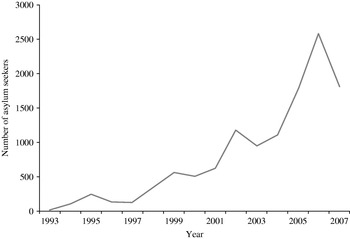
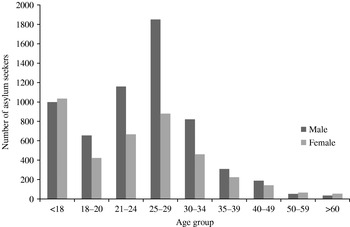
Whether the Eritrean NS and the WYDC function as integrative or disintegrative forces remains to be seen. However, the use of the NS and the WYDC as post-conflict reconstruction strategy is legitimate and, as discussed earlier, the goals the government expected to achieve as a result are consistent with those of most governments that had or still have policies of universal conscription. Nevertheless, the problem in Eritrea is not the national service per se, but rather its open-endedness and the resentment this engenders as reflected in widespread evasions and desertions (see Figs. 1 and 2), as well as the cruel punishments the armed forces met out to ensure compliance, and deter others from evasion and desertion.
The remaining part of the paper examines the extent to which the NS and the WYDC, initiated as legitimate programmes to create a new generation of Eritrean nationals imbued with the characteristics and values of the EPLF, have instead become ones that qualify as modern forms of slavery under international law.
FORCED LABOUR IN INTERNATIONAL LAW
Article 2 (1) of the Convention Concerning Forced Labour (FLC 1930) defines ‘forced or compulsory labour’ as ‘all work or service which is exacted from any person under the menace of any penalty and for which the said person has not offered himself voluntarily’. Involuntary exaction of labour or service and the use or threat of penalty are the two critical elements in the definition of forced labour. International efforts to prohibit governments, state agencies, private companies, political parties, army generals and individuals from recourse to forced or compulsory labour have been inextricably linked to the efforts to eradicate slavery and other institutions and practices that are either associated with or similar to it. One such practice is the institution of forced or compulsory labour which is referred to as ‘slavery-like practice’ (ILO 1998; UN 1994). The Slavery Convention (SC 1926), inter alia, states: ‘The High Contracting Parties recognise that recourse to compulsory labour or forced labour may have grave consequences and undertake … to take all necessary measures to prevent compulsory or forced labour from developing into conditions analogous to slavery’ (SC 1926, Art. 5, emphasis added). FLC 1930, Art.5 (3), limits the conditions under which forced labour may be exacted and vests the responsibility for exacting forced labour in ‘competent central authorities of the territory concerned’.
Article 25 of FLC 1930 states: ‘The illegal exaction of forced or compulsory labour shall be punishable as a penal offence and it shall be an obligation on any Member ratifying this Convention to ensure that the penalties imposed by law are really adequate and are strictly enforced.’ The framing of this proviso clearly indicates the international community's determination to eradicate the ‘slavery-like practice’ of forced labour. The provisions of the 1930 Convention were reinforced by the General Conference of the ILO's adoption of the Convention Concerning the Abolition of Forced Labour (AFLC 1957). This stipulates that states that ratify the Convention are required to ‘suppress and not to make use of any form of forced or compulsory labour: (a) as a means of political coercion or education … (b) as a method of mobilizing and using labour for purposes of economic development; as a means of labour discipline’ (ibid., Art. 1 (a–c)).
Other international instruments proscribing such practices suggest that the international norm against forced or compulsory labour is deeply embedded in international human rights law. The Report of the Commission of Inquiry on Forced Labour in Myanmar (ILO 1998), for example, states: ‘The prohibition of recourse to forced labour, including the right to the free choice of employment, is closely related to the protection of other basic human rights: the right not to be subjected to torture or to other cruel, inhuman or degrading treatment …’ The Year Book of the International Law Commission, 1980 concluded that:
there exists now in international law a peremptory norm prohibiting any recourse to forced labour and that the right not to be compelled to perform forced or compulsory labour is one of the basic human rights. A state which supports, instigates, accepts or tolerates forced labour on its territory commits a wrongful act for which it bears international responsibility; furthermore, this wrongful act results from a breach of an international obligation that is so essential for the protection of the fundamental interests of the international community that it could be qualified, if committed on a widespread scale, as an international crime under the terms of Article 19 of the draft articles of the International Law Commission on state responsibility. (quoted in ILO 1998: 70, emphasis added)
The importance attached to the eradication of forced labour is also clearly reflected in Article 1 (1) of FLC 1930, in which it is stated that any state that ratifies this Convention ‘undertakes to suppress the use of forced or compulsory labour in all its forms within the shortest possible period’.
States are therefore compelled not to exact forced labour, nor to tolerate or condone directly or indirectly its exaction by individuals or agencies within their territories, and to repeal all laws that allow such practices. States are also required to ensure that ‘the illegal exaction of forced or compulsory labour shall be a penal offence’ and ‘that the penalties imposed by law are really adequate and are strictly enforced’ (FLC 1930, Art. 25).
Eritrea ratified FLC 1930 and AFLC 1957 on 22 February 2000.Footnote 10 Consequently, it is obliged to prohibit the practice within its territory. This responsibility, as pointed out by the International Law Commission, is ‘a peremptory norm’ – jus cogens – ‘A Norm Accepted and Recognised by the International Community of States as a Whole as a Norm from which no Derogation is Permitted’ (Rozakis Reference Rozakis1976: 73). Therefore all states regardless of whether or not they are signatories to the conventions on slavery and forced labour must comply with the unconditional principles and norms of international law.
DO THE ERITREAN NS AND THE WYDC QUALIFY AS FORCED LABOUR?
Some observers have referred to the open-ended nature of the NS and WYDC as constituting a modern form of slavery. For example, the exiled former Attorney General, Adhanom Gebremariam (Reference Gebremariam2002), one of the group of fifteen senior EPLF officials who publicly criticised President Afwerki in 2001,Footnote 11 has labelled the open-ended NS and the WYDC as ‘slave labour’. He uses the ‘slavery’ metaphor because, regardless of the formally stated aims, the NS and the WYDC have given rise to ‘slavery-like’ practices. Slavery, as defined in international law, refers to ‘the status or condition of a person over whom any or all of the powers attaching to the right of ownership are exercised’ (SCAS 1956). Although the Eritrean state, the army and the ruling party exercise unfettered power in terms of exaction of unpaid labour from the agelglot (draftees) and the participants in the WYDC, the relationship between the State and the agelglot and WYDC participants is not one of ownership.
Nevertheless, in international law, forced or compulsory labour is defined as a modern form of slavery (see SC 1926, Art. 5; FLC 1930; AFLC 1957), and therefore, if it can be established that: (i) the works or services are exacted involuntarily; (ii) the exaction of labour or services takes place under the menace of penalty; and (iii) these are used as a means of political coercion, education or as a method of mobilising and using labour for purposes of economic development, as well as means of labour discipline, then it may be safe to conclude that they constitute modern forms of slavery. Drawing on data derived from fieldwork in different parts of Eritrea,Footnote 12 Rome, Milan and Stockholm,Footnote 13 supplemented by data elicited from conversations with key informants (deserters) in the United Kingdom,Footnote 14 and using data from reports of human rights organisations and the US State Department, an attempt is made to establish the extent to which the NS and the WYDC constitute forced labour or modern form of slavery.
A cautionary note regarding the reliability of the data elicited from draft evaders and deserters is in place here. The interviewees in Italy, Sweden and the UK are not disinterested parties. They are people who sought protection from persecution allegedly perpetrated by the Eritrean authorities. They have an ‘axe to grind’, and may therefore have an incentive to overstate the extent of human rights violations associated with the NS and the WYDC. Nor do the interviewees constitute a representative sample of conscripts, and the data elicited from them are therefore indicative rather than conclusive. However, the data elicited from conscripts who were still in the country performing NS or the WYDC and the data collected from the reports of reputable human rights organisations are consistent with those elicited from refugees in the UK, Sweden and Italy. I have also excluded asylum seekers because of the concern that they may have an incentive to overstate their plight.
The involuntary nature of the NS and the WYDC
There is no freedom of press and expression in Eritrea, and consequently it is difficult to gauge public opinion regarding the NS. All privately owned newspapers are banned, and the journalists who worked for them are either in incommunicado detention or in exile (AI 2004a; RwB 2006). In the course of fieldwork undertaken between 1994 and 2002, interviews with elders, conscripts, deserters and draft evaders in different parts of Eritrea were conducted in an attempt to shed some light on how the NS and the WYDC are perceived.
The issue of military training featured in most of the discussions in both rural and urban areas. Many of the interviewees said that it was wrong to embark on large-scale military training before people had time to recover from the devastating effects of the thirty years' war. An elderly female interviewee said, ‘It is absurd to send our children to agelglot before our tears of blood had dried up.’Footnote 15 The majority said that the families which had lost loved ones during the thirty years' war were opposed to the idea of sending, yet again, their remaining children to the malaria-infested Sawa military training camp.Footnote 16
The data elicited from interviewees indicate that the call for military service not only rekindles unpleasant memories of the dark days and losses of family members, but also engenders fears of possible future wars. Ahmed, for example, said: ‘When they called the youngsters to join the military service, we asked ourselves: if the government is not expecting a war in the future, why would it prioritise military training when the country was still on its knees?’Footnote 17 Jemeel who also objected to NS said, ‘What we needed then [at the time NS was launched] were seeds and tools rather than bullets and guns.’Footnote 18 Many elders whom I interviewed in Asmara, Adi Mongonti, Keren, Ela Ber'ed, Hagaz, Tessenei, Alebu, Goluj, Ela Ber'ed and Barentu shared these concerns.
Nevertheless, until the second half of 2001, I came across only a few informants who questioned the moral authority of the government in adopting such a policy, and the duty of the citizens to comply with it. The elders whom I talked to in different parts of the country recognised the causes of the families' concerns, but still said that they were urging people to send their children to perform their national obligation. In Tessenei, Ibrahim, ex-ELF fighter, said:
No matter how well-intentioned the large-scale military training might be, it is likely to have unintended counter-productive effects on our relations with the neighbouring countries. If our neighbours misconstrue our intentions, this may set in motion a chain reaction. They may feel threatened and therefore embark on their own similar large-scale military training of their citizens. Our government may react to this by further mobilisation. Ultimately, this may lead to military confrontation endangering the hard-won security in our country and the region.Footnote 19
When the border war broke out in May 1998, many of the people I interviewed saw the military training received by the youth as a blessing in disguise because, in their view, without the NS or the Warsai, the country's independence might have been compromised. However, after the cessation of hostilities and the signing of the peace agreement in December 2000, the families whose children were in the trenches expected the government to embark on large-scale demobilisation programme immediately. To their consternation, the government embarked on forced conscription by conducting round-ups that were implemented insensitively and aggressively.
After the government's failure to demobilise those who had completed the legal requirement of eighteen months, a large majority of the persons interviewed in 2001 and 2002 who were opposed to the open-ended nature of NS seized every opportunity to evade or to flee from it. Many conscripts and draft evaders have been fleeing the country in spite of the government's ‘shoot to kill’ policy at the Ethiopian and Sudanese borders (see Martell Reference Martell2007; Awate.com 2007a). This indicates that the de facto open-ended requirement of the NS and the WYDC, and consequently the works and services performed within their realms, are exacted involuntarily. Many conscripts and people approaching the age of conscription have fled the country to seek asylum, including in the UK (see Fig. 1).
Eritrean asylum seekers in UK, 1993–2007.

Because many of those eligible are unwilling to join national service voluntarily, and many of those already conscripted seize every opportunity to abscond, the government conducts periodic round-ups (giffas) in search of deserters and draft evaders. During fieldwork in July 2002, I personally witnessed a large-scale giffa in Asmara which was conducted by the army rather than the police. As the Home Office (2002: 6) report states, ‘during 2001, the Government deployed military police periodically in Asmara and other cities to find deserters and draft evaders. The military police detained persons who had not completed the national service requirement’ (see also UNHCR 2004; USDS 2008).
A grandmother, Tsehaitu, who had lost tens of grandchildren and close relatives in the war of independence and who did not, at the time of the interview, know the whereabouts of another three (after the border war), said: ‘The giffa rekindled the horrific memories of the Dergue's ftesha (house search). The fact that the giffa was carried out by the Eritrean army and the ftesha by the tor serawit (Ethiopian army) makes no difference. Both were carried out viciously.’Footnote 20 During the thirty years' war, the Ethiopian army conducted house-to-house searches to look for weapons, urban guerrillas in hiding, literature, or to terrorise the civilian population. The ftesha was deeply resented by the Eritrean people because, it was often accompanied by violence and looting. The fact that this elderly interviewee compared the giffa with the ftesha reflects the level of resentment the NS and consequently the giffa had engendered amongst the public.
By 2002, the level of popular resistance to the open-ended NS and the WYDC reflected in large-scale desertions and evasions had reached such heights that the head of state stated:
These days, there are deliberate attempts to undermine the national service. Asmara, in particular, has become a jungle (tchaka) – a hiding place for fugitives, absconders, people who run away from fulfilling their obligations, youth who commit crimes, and who engage in indecent and corrupt activities. (Afwerki Reference Afwerki2002b)
The fact that the president referred to Asmara, considered by many observers as ‘one of Africa's … safest cities’ (Sanders Reference Sanders2007) as a jungle indicates the involuntary nature of the NS and the WYDC, and the intensity of resistance. The open-endedness of the NS and the WYDC, the giffa and the exploitation of the labour and services of conscripts have also engendered parental resistance. As UNHCR (2004) observes, ‘there have been reports of resistance, especially by parents of draft-age girls, which resulted in deaths of both soldiers and civilians’. Debessay Hedru (Reference Hedru2003) notes ‘youth resentment as the period of military service was repeatedly extended; the rural areas were particularly affected by the loss of labour power’. Although not confirmed by other sources, Magnus Treiber (Reference Treiber2006) states: ‘An armed if spontaneous and chaotic revolt of recruits in the central military training camp of Sawa … in the summer of 2001 was put down with much bloodshed.’ Since 2005, the government has arrested relatives of deserters and draft evaders. Only those who can afford to pay the equivalent of US $3,500 are released (HRW 2006).
All these data clearly indicate the involuntary nature of the service. Otherwise, not so many people would have ‘voted with their feet’. Human Rights Watch's (2007a) 2007 report states: ‘Spurred by the rigors and abuses of the national service system, draft-age Eritreans and high school seniors have been fleeing the country in the thousands over the past five years or have gone into hiding.’ Refugee agencies estimated that each month in 2006 about 700 Eritreans fled to Sudan and another 400 to Ethiopia.
In recent years, Eritrea has become a major refugee-producing country. This is contrary to expectation in view of the fact that the EPLF came to power on the back of a popular struggle promising to relegate to the dustbin of history the factors that previously forced Eritreans to flee their country in search of international protection. For example, between 2001 and 2007, 9,995 Eritreans (excluding dependents) sought asylum in the UK (see Fig. 1). The corresponding figure for the whole of Africa for the same period was 114,585 (Home Office 2005, 2006 and 2008). The population of Eritrea represents 0·4% of the total African population, but 9% of all Africans who sought asylum in the UK between 2001 and 2007 were from Eritrea. It is clear that the NS and later the WYDC, especially after the border war, constituted the most important causes of forced migration (see Fig. 1). For example, between 1998 and 2007, the annual average of Eritreans, excluding dependents, seeking asylum in the UK was 1,146. Before the border war, i.e. between 1993 and 1997, the corresponding annual average was 127 (Fig. 1). In 2007, Eritreans were one of the top four applicant nationalities in the UK, accounting for 8% percent of total applications (Home Office 2008). Eritreans also had the highest rate of acceptance (31%), followed by Somalis (23%) and Zimbabweans (7%). Many Eritrean asylum seekers were granted refugee status in the UK because they were and still are considered to be fleeing from real danger of persecution. The punishments suffered by draft evaders and deserters are regarded as persecutory.Footnote 21 In 2005, of the 1,065 unaccompanied minors who sought asylum in the UK from sub-Saharan Africa, 195 were from Eritrea. The corresponding figures for 2006 and 2007 were 340 out of 1,195 and 280 out of 900, respectively. In comparison with the figures of January–March 2007, the number of Eritreans who sought asylum during the first quarter of 2008 (January–March) increased by 38%.Footnote 22 In Sweden, in 2006 and 2007, Eritrean asylum seekers were the fourth largest among fifty nationalities.Footnote 23
A website belonging to an Eritrean refugee organisation based in Sudan, <www.omaal.net>, states that although the large majority do not register with the Sudanese Commission's Office for Refugees (COR) for fear of being forced to stay in the rural reception centres, between March and November 2006 7,148 ‘escapees’ were registered in Sudan (Awate.com 2007a). Although the flow has continued since then, the exact number is unknown. In January 2007, there were a total of 15,710 Eritrean refugees in Ethiopia (UNHCR 2007). On 2 August 2008, Ethiopian TV reported that the total number of Eritrean refugees had reached 30,000 (BBC Monitoring 2008). However, given the hostility between the two governments, Ethiopia has an incentive to exaggerate the figures in order to discredit the Eritrean government, and the figures cannot therefore be considered reliable unless they are corroborated by neutral sources.
Notable is the fact that the large majority of those who have been leaving the country illegally are either within or approaching the age of conscription. For example, 90% of the Eritreans who sought asylum in the UK between 2001 and 2007 were thirty-four years old or younger, and 61% and 39% are male and female, respectively (see Fig. 2). This again indicates that the major cause of displacement in Eritrea is the NS and the WYDC.
Eritrean asylum seekers in UK, 2001–2007: by age and gender.

The fact that a large number of young people have been leaving the country is even acknowledged by the head of state. For example, in a rare interview with international journalists, the Eritrean head of state on 13 May 2008 accused the CIA for being behind the large-scale flight of youngsters from the country. Jack Kimball and Andrew Cawthorne (Reference Kimball and Cawthorne2008), who interviewed the president, wrote: ‘Eritrea accused the CIA and other Western agencies on Tuesday of luring young people away from the Red Sea state in a plot to weaken a nation seen as a threat to U.S. interests in the region.’ In the Eritrean head of state's view, ‘it's an orchestrated, organised operation financed by the CIA … to deplete this nation of its young’.
According to Reuters (Reference Reuters2008), ‘thousands of Eritrean refugees, many fleeing mandatory military service or jail, have arrived in Sudan in the past year and need help’. Erika Feller, UN assistant high commissioner for refugees, who visited Sudan in February 2008 said: ‘A lot of it relates to the compulsory military service and the penalties for not doing the services and the penalties that are imposed on family members’ (ibid.).
Before it became clear that the NS and WYDC had become open-ended, i.e. between 1991 and 2002, there were very few Eritreans, if any, who fled the country to Sudan illegally. I was conducting research along the Eritrean–Sudanese border during that period, and the obvious trend for people who were not affected by the NS was to return from Sudan rather than leave Eritrea for Sudan. This is confirmed by UN statistics. After the signing of the ceasefire deal between the Eritrean and the Ethiopian governments in June 2000, tens of thousands of Eritreans who had fled because of the war returned home. According to the UN (2000), ‘since July 2000, some 104,000 Eritrean refugees have returned from Sudan’. The return movements that occurred in the immediate aftermath of Ethiopia's third offensive are documented by Alex Last (Reference Last2001), the BBC correspondent stationed in Eritrea. This does not suggest that, had it not been for the open-ended NS and the WYDC, no Eritreans would have fled the country. Some would have left the country in search of a better life, but not on such a scale (see, for example, Fig. 1).
Exaction of work and service ‘under the menace of penalty’
This section examines the extent to which the works and services performed during the twelve-month NS and the open-ended WYDC are exacted under ‘the menace of any penalty’. This is indeed amply documented. Under the 1995 Proclamation on NS, penalties imposed for non-compliance consist of a fine, or a term of imprisonment of up to five years, or both. The five years penalty applies to those who escape abroad to avoid national service (Proc. 82/1995, Art. 37). The proclamation also stipulates that draft evaders' and deserters' ‘rights of license, visa, land tenure, and the rights to work will be suspended’ until the age of fifty (ibid., Art. 37). These penalties show that citizenship is a function of performance of NS. This is evidenced by the Jehovah's Witnesses case. According to a presidential statement (25.10.1994) and a ministry of interior statement regarding Jehovah's Witnesses, the latter lost their citizenship rights because, inter alia, they refused to perform national service (see Radio Eritrea in BBC SWB 1995).
In times of emergency, and general mobilisation and war, the penalties stipulated in the Eritrean Transitional Penal Code may apply to draft evasion and desertion. These provide (i) ‘rigorous imprisonment of up to ten years for draft evasion’,Footnote 24 and (ii) ‘rigorous imprisonment from five years to life, or, in the gravest cases, with death’Footnote 25 for desertion from a unit, post or military duties, or for failure to return to them after an authorised period of absence. In reality, draft evaders, deserters, those who are caught fleeing and deportees are invariably subjected to inhuman and degrading treatment (AI 2004a; USDS 2008).
The inhuman treatment of deserters and draft evaders who were deported to Eritrea from Malta and Libya is amply documented (AI 2004a). According to data elicited from deserters now residing in the UK, conscripts who overstayed their authorised permissions, conscripts who left their units or assignments to visit their families without permission, draft evaders caught either in round-ups or while fleeing the country illegally suffered inhuman treatment. They were subjected to the almaz Footnote 26 and otto methods of torture, detention in underground or shipping containers and to hard labour. In 2001 and 2002, some of those caught absconding and hiding were sent to the Zara gold mine, about 140 km north-east of Keren. Abdu in TesseneiFootnote 27 and Yohannes in KerenFootnote 28 said that a number of conscripts were buried in the pits in Zara, and the government stopped sending conscripts partly because it was dangerous and, more importantly, the yields were too low. These accounts were confirmed by data elicited from Ahmed in Newcastle.Footnote 29
The existence of detention facilities and widespread practices of torture were reported by all conscripts interviewed by the author inside and outside the country. Aman, a deserter who lives in Nottingham, said that he was subjected to the helicopter method of punishment, i.e. his hands and feet were tied behind his back and he was laid on the ground with his face down from time to time for three months.Footnote 30 He said that, though the nights were very cold, water was poured on his body every now and then to make him freeze more. His ‘crime’ was leaving for Asmara while working in a horticultural farm belonging to a colonel in the Barka Valley after his request to visit his family had been turned down repeatedly. He returned voluntarily after one month. He was in Division 32 and Brigade 4. Asked whether this form of punishment was common, he said that up to 65–70% of the conscripts in his platoon were subjected either to the helicopter or the otto (eight) method of punishment.
Anyone who answered back to a unit, platoon, brigade or division commander or refused to provide personal service (washing clothes, socks, or cooking) was also subjected to such treatment. According to interviewees, the majority of the punishments were meted out after the persons concerned had completed the eighteen months Active National Service. Asked to explain why, most of the respondents said that, before the NS became open-ended with the introduction of the WYDC in May 2002, most male Eritreans wanted to get on with it so that they could subsequently apply for business licences, exit visas, land and employment in the job market. This was because, according to Proc. 82/1995, Art. 37, only persons who perform NS could access such rights. It is thus clear that, when the NS became open-ended, many began to engage in desertion or evasion, which resulted in the introduction of severe punishment regime.
Aman also said that several conscripts were executed. In his division alone (c. 6,000 men and women), thirteen people were executed after Ethiopia's third offensive (May 2000). He said: ‘You don't see these things happen. They are subsequently announced by commanders who state, “measures were taken against one–two, etc. cowards”.’ However, in his view, ‘it was mainly the brave who were executed. They were the ones who challenged the commanders or exposed the failure of their leadership in meetings that took place subsequent to battles.’Footnote 31
The fact that draft evaders, deserters or individuals approaching the age of conscription who are caught fleeing the country illegally are subjected to persecutory or inhuman treatment is acknowledged by the Asylum and Immigration Tribunal in the UK. In the landmark 2007 decision, Eritrea – Country Guidance, senior immigration judges Goldstein, Jarvis and Mr R. Baines, JP stated:
A person who is reasonably likely to have left Eritrea illegally will in general be at real risk on return if he or she is of draft age, even if the evidence shows that he or she has completed Active National Service (consisting of 6 months in a training centre and 12 months military service). By leaving illegally while still subject to National Service (which liability in general continues until the person ceases to be of draft age), that person is reasonably likely to be regarded by the authorities of Eritrea as a deserter and subjected to punishment which is persecutory and amounts to serious harm and ill-treatment. (UK Asylum and Immigration Tribunal 2007)
This shows not only the severity of the punishment that draft evaders and deserters who depart from the country illegally face, but also that the NS remains open-ended until the person concerned reaches forty years, regardless of whether he or she has performed the required eighteen months NS. For men, the age of conscription has been raised to fifty (Ministry of Defence, Eritrea 2007).
These data are consistent with reports from human rights organisations and the US Department of State (see AI 2004a and 2004b; USDS 2008). As we saw earlier, forced or compulsory labour in international law refers to work or service exacted firstly against the will of the persons concerned and secondly, under ‘the menace of penalty’ (FLC 1930, Art. 2 (1)). The data presented in the preceding discussion show that the works and services performed within the NS are exacted against the will of the people concerned and under the menace or use of severe forms of penalty, and therefore fall within the definition of forced or compulsory labour.
The use of forced labour for political education, mobilisation, economic development and instilling discipline
The national service and the WYDC are means of: transmitting the values and characteristics of the EPLF; instilling discipline and love of work; mobilising and using labour for national reconstruction and economic development, as well as fostering national identity and unity (Proc. 82/1995, Art. 5; Afwerki in Eritrea Profile 1994a, 1994b; Ephrem Reference Ephrem1995). As seen earlier, the Convention Concerning the Abolition of Forced Labour, 1957 strictly prohibits the use of compulsory labour as a means of education, as a method of mobilising and using labour for the purposes of economic development and labour discipline. As shown below, this has been the case with the NS and the WYDC.
During the six months of military training at Sawa and as long as they continue in the armed forces, ministries, departments and regional governments, conscripts are inculcated with a sense of Eritrean history and a fundamental understanding of the values and norms that led the EPLF to victory. This indoctrination not only provides the conscripts with an understanding of the core values and governing principles of post-independence Eritrea, but also seeks to link the Yikaalo (ex-EPLF combatants) to the Warsai. The aim of the political education regime at Sawa and lately at Kiloma based on the EPLF's version of the nationalist history of Eritrean nationalism and on the perceived core values of the EPLF – discipline, commitment, steadfastness, hard work, perseverance, Eritreaness and selflessness – is to educate and socialise the different ethnic groups in order to create a homogenous community by assimilating them into the ethos of the EPLF. The government hopes that the agelglot (conscripts) will carry the values they learned in the service into the larger Eritrean society.
According to interviewees who joined Sawa in 1994 and 1997, the educational regime put great emphasis on how the EPLF's core values were developed and consolidated during the liberation struggle, and on their indispensability in the process of development and consolidation of national identity, nation-building, reconstruction and economic development. Since joining the NS and later the WYDC, the conscripts have been performing different types of unpaid works and services under the national reconstruction programme. These include building of all sorts of infrastructure – roads, residential homes for army officers, schools, clinics, hospitals, airports, dams, bridges – and performing agricultural labour in farms owned by the state and the PFDJ and army officers (Abrehe Reference Abrehe2002; Tesfamariam Reference Tesfamariam2007; State of Eritrea 2005; Futur Reference Futur2005Footnote 32; Gebrehiwet Reference Gebrehiwet2005Footnote 33). As G. Schroder (n.d., 18) states:
Under the WYDC regular soldiers and NS recruits are employed in various economic activities. Some of them are deployed to government and party institutions and economic enterprises, often to work places they had occupied before being called up to serve with the armed forces. The majority of them, however, were engaged as a military organised labour force on the agro-industrial estates linked with PFDJ/GOE/EDF, in the infrastructural projects … particularly road construction but also terracing, well-digging, etc. and in the various housing projects of the GOE/PFDJ.
Peter Martell (Reference Martell2007) states: ‘Most are then [after training] assigned to military, agricultural or construction jobs.’
The major beneficiaries of the NS and the WYDC are the government, the ruling party and senior army officers. During fieldwork, I visited different construction sites where the large majority of the workers in the PFDJ construction firms were agelglot. For example, in 1997–8, Segen, the PFDJ's construction company, built fifty-eight villas behind the Cagnew Station in Asmara. The villas were subsequently allocated to generals, high-ranking security and party officials, and selected ambassadors. Soon afterwards, about fifty additional houses were built by the same firm in the same area using conscripts' unpaid labour, and given to high-ranking members of the armed forces. The party is now transferring ownership to the occupiers at a fraction of their market value.Footnote 34 When the asphalt road between Agordat and Tessenei was built, I was undertaking fieldwork in the area and most of the workers were conscripts. I also saw conscripts working in different ministries, departments, regional governments, agricultural schemes, digging wells, etc.
The party's firms, such as Segen, Bidho and Horn Construction, are the main property developers throughout the country, and the large majority of the manual workers, engineers, consultants, guards, cleaners, etc. are agelglot.Footnote 35 Besides being common knowledge in Eritrea, these observations are confirmed by data elicited from two people who worked in the PFDJ's office of economic affairs.Footnote 36 The author has also interviewed conscripts inside the country and deserters in Rome, Milan, London, Stockholm, Newcastle, Sheffield and Nottingham who had worked for the government, PFDJ firms, as well as in farms and building sites belonging to army colonels. For example, Mesfin, who lives in Sheffield, was drafted in 1995. After receiving six months military training at Sawa, he worked in different construction sites belonging to the government and the PFDJ. He was discharged at the end of the eighteen months but was later remobilised when the border war broke out. After the ceasefire agreement in June 2000, Mesfin and fifty others were issued menkesakesi (passes) and were taken to Mendefera from Senafe to build a house for an army commander. They worked on the site for two months.Footnote 37
On another occasion, he and 700 others were taken from Senafe to take part in horticultural development in the Barka Valley, although the land had already been allocated by the government to a private investor. The landowner could however not develop it because it was covered with trees which were at the time protected by the Ministry of Agriculture. Because the Ministry of Defence was the only government body authorised to cut down the trees, the private developer leased the undeveloped land to an army commander known as Techela (nickname), in order to evade the law on environmental protection and to cut the cost of clearing the land. The latter agreed to clear the land using conscript labour in return for three seasons' harvests, after which he would hand over the developed land to the investor. However, all the crops, mainly tomatoes and vegetables, were destroyed by flood during the first season and the interviewee did not know what happened to the farm afterwards. All the labour needed for land clearing, sowing and weeding was performed by conscripts. Asked if the government was aware of what was going on, Mesfin said he was not sure but added, ‘how could it not be aware when this involved as many as 700 conscripts?’
In 2003, an army truck loaded with cement and conscripts overturned on the way to a construction site at Dubarwa belonging to an army colonel. Between seven and ten conscripts were said to have been killed.Footnote 38 Although this incident was on many Eritreans' lips both in Asmara and in the surrounding villages such as Shiketi where it occurred, as well as in the diaspora, it was not reported in the government media.
The fact that high-ranking military officers exploited conscript labour is reported by all interviewees. Members of the old cohorts said that, in 1994, every battalion and brigade opened small shops to supply some consumer goods, such as cigarettes, soaps, matches and other basic goods. Initially, the profits were used for the benefit of all members. However, by 1997–8, most of the brigades and battalions dug a large number of wells and established horticultural projects using conscript labour. The produce was sold to the civilian population, including in nearby towns, using government trucks and unpaid conscript labour. According to the informants, the proceeds were appropriated by high-ranking military commanders. A number of interviewees said that sometimes the commanders forced the conscripts to buy some of the produce if they could not sell it in the market using the ‘sweetener’ funds.Footnote 39
These accounts were consistently repeated by the interviewees in Eritrea, Rome, Milan, London, Nottingham and Stockholm. HRW (2006) stated: ‘Conscripts are often used for public works projects, such as road building. There have been persistent reports that they are also used as labourers on party, military, and officers’ personal farms.' In the course of my fieldwork in the Gash Barka area in 1997, 1998 and 2001, I saw many conscripts working in horticultural farms owned not only by the state, the ruling party and army officers, but also by private investors. In fact, I saw hundreds of conscripts working on a large-scale farm project owned by a returnee investor called Wodi Leges in the vicinity of Tessenei in the Gash Valley. Three of the deserters interviewed by the author in Rome said they had worked in Wodi Leges' farms.Footnote 40 According to a former PFDJ official, the four military command zones currently run diversified economic activities, including trading, farming, property development and construction of infrastructure using unpaid conscript labour.Footnote 41 This was confirmed by deserters who came to the UK to seek asylum.
Since April 2006, only PFDJ construction firms are allowed to engage in construction activities after private firms and individual entrepreneurs were banned from the construction industry as part of the government's crackdown on the private sector. On 3 April 2006, the government issued a directive ordering all ‘contractors, consultants, practicing professionals and studio operators’ to submit to the Technical Office of the Central Region their original licences, detailed accounts, addresses, types and sizes of their projects, owners' names, estimated total costs, on the day after the directive was issued.Footnote 42 On 7 April 2006, the government ordered all of them to cease their activities within ten days. The prohibition is still in force. The major beneficiaries of the ban are the ruling party's more than forty enterprises, which dominate every aspect of the country's economy, the enterprises of the PFDJ's mass organisations,Footnote 43 and the construction firms belonging to the Ministry of Defence.
Before the state withdrew all licences belonging to contractors, consultants and other professionals in the construction industry in April 2006, conscripts were hired out to private firms and property developers in the private sector, but their wages were paid to the Ministry of Defence. In January 2000, the government issued a directive intended ‘to alleviate the severe shortages of skilled and professional labour supply in the commercial sector of the economy created by mobilisation’.Footnote 44 The directive, called ‘Regarding the Procedure of Hiring and Payment of Salaries’ of conscripts, allowed employers in the private sector to apply to the Ministry of Defence to hire conscripts. Employers were however required to pay the wage or salary of the hired conscript to the Ministry of Defence's bank account GOV: 20-101-0092 in accordance with the salary scale set by the ministry.Footnote 45 The conscripts were not allowed to accept payment from such employers, except pocket money equivalent to that paid by the Ministry of Defence.Footnote 46
Exceptions to forced or compulsory labour
The Forced Labour Convention (FLC 1930, Art. 2) provides some exemptions from forced or compulsory labour and therefore, in the following part of the article, the extent to which the labour or services exacted under the NS and WYDC fall within the purview of such exceptions or exemptions is discussed. It states that the ‘term forced or compulsory labour’ shall not include ‘any work or service exacted in virtue of compulsory military service laws for work of a purely military character’. Does the fact that work performed in virtue of military service is excluded from the purview of the Convention imply that those who are participating in the Eritrean NS and the WYDC can be legitimately called up for public works or national reconstruction? If this were the case, neither the lawyers who drafted the Convention nor the states that subsequently ratified it would have found it necessary to state the conditions under which compulsory work by draftees is allowed. If any such work or service is exacted involuntarily from people in compulsory military service for non-military purposes, e.g. public works and economic development, this would fall within the purview of the Convention and therefore would constitute forced labour or slavery-like practice.
In its 1979 General Survey on the abolition of forced labour, the Committee of Experts on the Application of Conventions and Recommendations revisited the records of the discussions that took place when the General Conference of the ILO considered the draft Convention on Forced or Compulsory Labour in order to understand and ‘explain both the purpose and scope of this exception’ (ILO 1998). The Report of the Commission of Inquiry on Forced Labour in Myanmar, drawing on the report of the Committee of Experts, stated: ‘There was general agreement that compulsory military service as such should remain beyond the purview of the Convention.’ This suggests that states, including Eritrea, are within their rights to impose compulsory military service on their citizens, as this does not fall within the purview of compulsory labour. However, the Commission of Inquiry pointed out (ibid.: 68, emphasis added):
Considerable discussion however took place with regard to systems existing at the time in various territories, whereby persons liable to military service but not in fact incorporated in the armed forces might be called up for public works. It was pointed out that to sanction this form of labour implicitly by excluding it from the scope of the Convention would be to sanction a system which ran counter to the avowed purpose of the Convention – namely the abolition of forced or compulsory labour in all its forms, for public purposes as well as for private employers.
This clearly shows that exaction of work or service from draftees of military service for public works constitutes compulsory or forced labour. As seen earlier, in Eritrea, NS and WYDC conscripts are not only forced to take part in public works, but also work for firms owned by the ruling party, and for personal enrichment of senior army officers. Prior to the demise of the private construction industry, conscripts were also hired out to the private sector in return for payment of wages to the Ministry of Defence (see USDS, quoted in Home Office 2002: 6).
The reason why compulsory military service is exempted from being classified as compulsory or forced labour is the ‘necessity for national defence, but … no such reason or justification existed for imposing compulsory service obligations for the execution of public works’ (ILO 1998). The Committee of Experts also pointed out that the provisions of FLC 1930 relating to compulsory military service do not apply to regular members of the armed forces. Though the Convention does not prohibit members of the armed forces from doing non-military work provided it is voluntary, they have the ‘right to leave the service either at certain reasonable intervals or by means of notice of reasonable length’ (General Survey on the Abolition of Forced Labour, quoted in ILO 1998). It is further stated that the career servicemen's ‘right to free choice of employment is inalienable’.
FLC 1930 (Art. 2 (b)) also exempts from its provisions ‘any work or service which forms part of the normal civic obligations of the citizens of a fully-governing country’. What does ‘normal civic obligation’ mean? Can the large-scale exaction of services from the agelglot and WYDC participants fall under the category of ‘normal civic obligation’ in Eritrea? The Committee of Experts on the Application of Conventions and Recommendations identifies three exceptions specifically provided for in the Forced Labour Convention (quoted in ILO 1998: 70). These are:
compulsory military service, work or service required in cases of emergency, and minor communal services. Other examples of normal civic obligations mentioned by the Committee of Experts are compulsory jury service and the duty to assist a person in danger or to assist in the enforcement of law and order. The Committee pointed out that these exceptions must be read in the light of other provisions of the Convention and cannot be invoked to justify recourse to forms of compulsory service which are contrary to such other provisions.
This shows that the open-ended and large-scale involuntary exaction of works and services under the menace of inhuman treatment for public works and economic development, as well as for the benefit of the state, enterprises of the ruling party and senior army officers cannot be considered as ‘normal civic obligation’.
The Convention also exempts from its scope ‘any work or service exacted in cases of emergency, that is to say, in the event of war or of a calamity or threatened calamity, such as fire, flood, famine, earthquake, violent epidemic or epizootic diseases, invasion by animal, insect or vegetable pests, and in general any circumstance that would endanger the existence or the well-being of the whole or part of the population’ (FLC 1930, Art. 2 (d)). The concept of emergency in the Convention refers to ‘a sudden, unforeseen happening calling for instant counter-measures. To meet the exception provided for in the Convention, the power to call up labour should be confined to genuine cases of emergency. Moreover, the duration and extent of compulsory service, as well as the purpose for which it is used, should be limited to what is strictly required by the exigencies of the situation’ (ILO 1998).
When the Ethiopian army invaded sovereign Eritrean territories in May 2000, it was legitimate on the part of the government to call upon its able-bodied citizens not only to defend the country but also to repair, maintain and rebuild the economic, social and physical infrastructure necessary for the well-being of the people, facilitating the movement of the armed forces, ensuring the supply of essential goods and services, and the movement of people from unsafe to safer areas. However, these requirements cannot be extended indefinitely. The obligations should cease once the emergency phase is over. Although the dispute over the border between Eritrea and Ethiopia still remains unresolved and a state of no-war-no-peace exists, it has been over seven years since the two countries singed a peace agreement in December 2000. The state of emergency as perceived by the Convention ceased with the signing of the peace agreement.
FLC 1930 (Art. 2 (2)) also exempts from its provisions ‘minor communal services of a kind which, being performed by the members of the community in the direct interest of the said community, can therefore be considered as normal civic obligations incumbent upon the members of the community, provided that the members of the community or their direct representatives shall have the right to be consulted in regard to the need for such services’.
The interesting questions that arise in connection to these exemptions are, on the one hand, how to identify the criteria by which the limits of this exception are determined and, on the other, how to distinguish this exception from the other forms of compulsory services which, under the provisions of the Convention, must be abolished, e.g. forced labour for general or local public works (ILO 1998). The Commission of Inquiry drawing on the Committee of Experts identifies the criteria as follows:
the services must be ‘minor services’, i.e. relate primarily to maintenance work and, in exceptional cases, to the erection of certain buildings intended to improve the social conditions of the population of the community itself (a small school, a medical consultation and treatment room, etc.); the services must be ‘communal services’ performed ‘in the direct interest of the community’, and not relate to the execution of works intended to benefit a wider group.
The Commission further observes that the ‘members of the community’ (i.e. the community which has to perform the services) or their ‘direct’ representatives (e.g. the village council) must ‘have the right to be consulted in regard to the need for such services’.
The large-scale and extended obligations of NS and WYDC participants go far beyond the exceptions spelled out in Article 2 (e) of the Convention, and therefore cannot fall outside the scope of forced or compulsory labour which the Convention and the other international instruments are intended to abolish. With a few exceptional cases such as digging of local wells and minor activities of weeding and harvesting in farms belonging to vulnerable individual farmers or villages during the peak seasons, the overwhelming majority of the activities in which the conscripts take part are intended to benefit the government, the ruling party, and individual high-ranking army officers.
* * *
Despite the fact that the Eritrean government is signatory to FLC 1930 and AFLC 1957, it uses forced labour as a means of political education and mobilisation, and for purposes of economic and infrastructural development, as well as for instilling work-ethic and discipline under a rigorously enforced punishment regime. It has also failed to suppress the use of forced labour by the ruling party's firms and high-ranking officers of the armed forces contrary to the spirit and letter of the conventions. In addition, the government also hires out conscripts to the private sector contrary to the conventions to which it is a party.
Although opinions concerning the desirability of NS that included military training were divided, at least until mid 2002, the large majority of the conscripts, parents and elders interviewed by the author in different parts of the country were in favour of it. However, after the introduction of the WYDC in May 2002, which turned the programme into an indefinite and open-ended obligation, the legitimacy of the NS seems to have been eroded considerably. This is inter alia reflected in the fact that a large number of conscripts, persons within the eligibility age or approaching that age have been either hiding within the country or fleeing elsewhere to seek international protection. In an attempt to counter this, the government has been resorting to severe measures, including detaining or imposing hefty fines on parents even though the latter have not committed any crime. These, and the persecutory treatment that draft evaders, deserters and people caught fleeing the country are subjected to, are further corroding the legitimacy of the NS and its concomitant, the WYDC.