Implications
It was hypothesized that low birth weight (LBW) litters would benefit more from maternal marine n-3 LCPUFA (mLCPUFA) supplementation than higher birth weight litters, and when fed only to sows with a predicted LBW phenotype, supplementation would reduce differences in growth rate between low and higher birth weight litters. However, mLCPUFA supplementation only improved growth rate in LBW litters in the finisher phase when no competition for food or space occurred and decreased carcass quality. We conclude that maternal mLCPUFA supplementation is not an effective strategy for mitigating the negative effects of a LBW litter phenotype.
Introduction
Growth uniformity after weaning is an important factor in the efficient use of all-in/all-out systems (Deen, Reference Deen1997). Considering the lower growth rate in low birth weight (LBW) litters found by Smit et al. (Reference Smit, Spencer, Almeida, Patterson, Chiarini-Garcia, Dyck and Foxcroft2013b), and the increased growth potential of pigs born from gilts supplemented with n-3 LCPUFA (Smit et al., Reference Smit, Patterson, Webel, Spencer, Cameron, Dyck, Dixon and Foxcroft2013a), it was suggested that feeding marine n-3 LCPUFA (mLCPUFA) to sows with a predicted LBW phenotype would increase the growth rate of their offspring. This would decrease the gap in growth rate between LBW and higher birth weight litters and the variation in BW at slaughter. However, before implementing a selective management strategy of only feeding mLCPUFA to sows with a predicted LBW phenotype, it was important to investigate whether mLCPUFA enrichment of the sow diet results in the same increase in growth rate in LBW litters, as seen when feeding the entire sow population. Based on the results reported by Smit et al. (Reference Smit, Patterson, Webel, Spencer, Cameron, Dyck, Dixon and Foxcroft2013a), nutritional supplementation with mLCPUFA in gestation appeared to have the potential to help LBW pigs express more of their postnatal growth potential.
The goal of this research was to study the effects of mLCPUFA enrichment to the sow from weaning until the end of the next lactation, on growth performance and carcass quality of litters with an LBW. Maternal mLCPUFA supplementation was hypothesized to increase growth performance and improve carcass quality of these LBW litters.
Previous work showed that litter average birth weight is repeatable within sows (Smit et al., Reference Smit, Spencer, Almeida, Patterson, Chiarini-Garcia, Dyck and Foxcroft2013b). The context and overall design of the current trial was described in an initial paper (Smit et al., Reference Smit, Spencer, Patterson, Dyck, Dixon and Foxcroft2014): the data presented confirmed our previous findings that litter average birth weight is repeatable within sows, described the effects of mLCPUFA supplementation to all sows on trial on litter quality and growth until weaning, and explored the interactions between mLCPUFA supplementation and litter birth weight phenotype. The present paper presents data from subsets of lower birth weight litters from sows fed control diets or diets supplemented with mLCPUFA on their growth performance from birth until slaughter and assessed carcass quality. Fatty acid profiles of sow serum, colostrum, milk and stillborn tissues were used to confirm adequate transfer of n-3 LCPUFA from the sows’ diet to the offspring.
Material and methods
Animals and treatments
The overall design of the experiment and the treatments applied were described in detail by Smit et al. (Reference Smit, Spencer, Patterson, Dyck, Dixon and Foxcroft2014). In short, 163 parity 4 to 8 sows (mean parity=4.9±0.9) that were a part of five consecutive weekly breeding groups were rebred after weaning and pair-matched (blocked) by parity and litter average birth weight recorded for the previous three litters. By ranking sows based on the mean litter average birth weight of the previous three litters, the birth weight phenotype (LBW, medium or high birth weight (MBW or HBW)) of sows could be predicted (Smit et al., Reference Smit, Spencer, Almeida, Patterson, Chiarini-Garcia, Dyck and Foxcroft2013b). Within pairs (n=80), sows were allocated to be fed either standard corn/soybean meal-based gestation and lactation diets (CON; see Smit et al., Reference Smit, Spencer, Patterson, Dyck, Dixon and Foxcroft2014) or the same diets enriched at the expense of corn with 0.5% of an existing mLCPUFA supplement rich in eicosapentaenoic acid (EPA) and docosahexaenoic acid (mLCPUFA; Gromega Ultra 365; JBS United Inc., Sheridan, IN, USA; see Smit et al., Reference Smit, Spencer, Patterson, Dyck, Dixon and Foxcroft2014) stabilized to prevent auto-oxidation. Pair-matching sows based on predicted litter birth weight phenotype ranking increased the chance of including similar numbers of sows with LBW phenotypes in each treatment group (control and mLCPUFA). Diets were fed from weaning, during rebreeding, throughout gestation and from farrowing until the end of a 21-day lactation.
Sows were housed in gestation crates and fed gestation diets from weaning until a few days before farrowing, and were then moved to farrowing crates (mean sow BW including fetuses: 269.3±32.6 kg) where they received lactation diets until weaning (mean sow BW: 261.9±25.6 kg). In gestation, sows were fed to body condition, with an average feed intake of 2.4 kg per day. Lactation feed was started at ~2.6 kg per day. After farrowing, a step-up regimen was implemented to achieve full feed intakes (6.7 to 7.0 kg) by day 7 post-farrowing. Water was freely available through a nipple drinker. Creep feed was not provided to piglets at any point during the lactation period.
Each litter between 9 and 16 total pigs born was classified as LBW, MBW or HBW litter average birth weight, as described previously (Smit et al., Reference Smit, Spencer, Almeida, Patterson, Chiarini-Garcia, Dyck and Foxcroft2013b), independent from sow dietary treatment. In short, for each litter size between 9 and 16 total pigs born, litter average weights more than one standard deviation below or above the mean litter birth weight for that litter size were designated as LBW and HBW, respectively.
For the purposes of the analyses described in this paper, litters from four of the five breeding groups of sows receiving dietary treatments were selected to be studied from birth to weaning, in the nursery and grow–finish phases, and at slaughter. Within breeding groups, litters that had between 9 and 16 total pigs born were ranked within treatment (CON and mLCPUFA) by litter average birth weight. The six litters per treatment and breeding group with the lowest litter average birth weights were selected for study. The selected litters were pair-matched between treatments based on their litter birth weight ranking. This provided a total of 48 litters (2 treatments×4 breeding groups×6 litters/treatment per breeding group) with the lowest average birth weights for study. All results in this paper are based on these 48 selected litters. Of the 24 selected CON litters, seven were classified as LBW and 17 as MBW. Of the 24 mLCPUFA litters, 10 were classified as LBW and 14 as MBW.
Measurements before weaning
Within 24 h after birth and before cross-fostering, sow ID, parity, date of birth, total number of piglets born, number of piglets born alive, number of stillborns, number of mummies, and individual birth weight and sex of all pigs born, were recorded for each litter. Mean litter average birth weight for all litters on trial was 1.42 kg.
Up to a maximum of two male and two female stillborn piglets, or piglets that died within 12 h after birth, from any litter were dissected within 24 h after birth. Samples of brain, liver, and muscle tissues were saved and stored at −20°C until fatty acid analysis. One day before weaning a blood sample (~10 ml) was taken from each sow in the morning after meal distribution into non-heparinized vacutainer tubes (BD, Fisher Scientific, Ottawa, ON, Canada) and held at ambient temperature until centrifugation (Jorvet J-502; Jorgensen Laboratories, Loveland, CO, USA) at 1034×g. Serum was then harvested and frozen at −20°C until fatty acid analysis. Colostrum samples were obtained, without oxytocin administration, from as many sows as possible. The aim was to obtain the colostrum sample within 12 h after farrowing of the first piglet. However, this was not always achieved, and the range of colostrum sample collection was from 10 h before to 25 h after farrowing. Samples were ‘milked’ manually from all teats, pooled within a sow, and then stored at −20°C until fatty acid analysis. Milk samples were also taken from as many sows as possible 1 day before weaning, when milk letdown was stimulated by intramuscular injection of oxytocin (VetTek Inc., Blue Springs, MO, USA) and the samples taken from two anterior and two posterior teats were pooled and stored at −20°C until fatty acid analysis.
Management after weaning
At weaning, the 48 selected litters were moved to nursery pens with three to six pigs per pen at the Burton Russell Farm (JBS United Inc.). All pigs in a litter were paired by individual birth weight and the pairs split between two pens, to establish two pens per litter with the same weight range. Nursery pens were 1.35 m2.
At the end of the 5-week nursery period, two barrows and two gilts from each litter that had individual birth weights closest to their litter average birth weight, were moved to experimental grow–finish pens (barn A), where they were housed as two pigs per pen, sorted by sex within litter. Pens were 1.99 m2. Remaining pigs in each litter were moved to another grow–finish barn (barn B) where they were kept in mixed-sex pens of up to 10 littermates. Pens were 11.15 m2. After 8 weeks, one of the two pigs in each pen in barn A was relocated to the pens holding their respective litter mates in barn B. The barrow and gilt that initially had the individual birth weight closest to the litter average birth weight remained individually housed in the pens in barn A until slaughter.
A common, commercially available, four-phase nursery feeding program was utilized for the first 6 weeks after weaning for progeny originating from both sow treatment groups (Supplementary Table S1) as follows; pigs were fed a pelleted Phase 1 diet for the 1st week, followed by a succession of meal-based Phase 2, 3 and 4 diets, fed for 1 week, 1 week and three weeks, respectively. Common grow–finish diets were corn and soybean meal-based diets with added energy provided by the inclusion of 3% choice white grease (Supplementary Table S2). Each phase was fed for 21 days until pigs were marketed.
Measurements after weaning
BW was measured on a pen basis at the start of the nursery period and after 1 and 3 weeks. Individual weights were then recorded at the end of the 5-week nursery period. Average daily feed intake (ADFI), scour scores and mortality were also recorded on a pen basis. In the grow–finish phase, pigs in barn A were weighed individually and pigs in barn B on a pen basis every 3 weeks, and on the day before slaughter. ADFI was measured in barn A only. Pigs in barn A were slaughtered at the same time as their littermates in barn B at an average litter live weight of 127 kg.
Carcass data were received individually from the slaughterhouse, where fat depth, loin depth and lean meat percentage were measured using the Animal Ultrasound System (Animal Ultrasound Services and Co. Inc., Ithaca, NY, USA). Grade and yield payments were paid on carcass weights, paying a premium for preferred carcass grades and discounting undesirable grades. Grade premiums or discounts were applied using a predetermined formula grid method.
Fatty acid composition analysis in serum, colostrum, milk and tissues
Fatty acid composition of sow serum, whole colostrum and whole milk, and brain, liver and Semitendinosus muscle from necropsied pigs were analyzed for the litters that had at least one necropsied pig available (14 CON and 18 mLCPUFA litters). If more than one necropsied pig was available within a litter, the pig with the individual birth weight closest to the litter average birth weight was chosen for analysis. The tissue samples were kept frozen and ground with a mortar and pestle. Fatty acid analysis of all samples was performed as previously described for serum (Smit et al., 2013a). In short, a measured amount of sample (1 to 4 ml serum, 1 ml colostrum, 2 ml milk, 1.26 to 2.09 g brain, 1.95 to 3.57 g liver or 0.43 to 3.11 g Semitendinosus muscle) was used to extract lipids using methanol and chloroform in a 1 : 2 ratio. Lipids were evaporated to dryness under nitrogen. The extracted lipids were then methylated using methanolic HCl (Sigma-Aldrich Inc., St. Louis, MO, USA). A 1 : 1.5 ratio of water and hexane was added, and after separation of the layers, the hexane layer was transferred to another tube containing a pinch of anhydrous sodium sulfate (Sigma-Aldrich Inc.). Samples were centrifuged and ∼1 ml was transferred to chromatography vials.
Fatty acids were analyzed by a gas chromatograph (model Varian 3400; Varian Inc., Mississauga, ON, USA), and used a flame ionization detector. It was equipped with a Varian 8100 auto sampler and using a SP-2560 fused silica capillary column (100 m×0.25 mm i.d.×0.2 µm film thickness; Supelco Inc., Bellefonte, PA, USA). Hydrogen was the carrier gas. A cool on-column injection was used. The injector program started at 50°C and was immediately increased to 230°C at 150°C/min and held for 83 min. The column was operated at 45°C for 4 min, then temperature-programmed at 13°C/min to 175°C, held there for 27 min, programmed at 4°C/min to 215°C and finally held there for 35 min; total run time was 86 min. The identity of each fatty acid peak was determined by comparison of peak retention time to authentic lipid standards (463 fatty acid methyl ester; Nu-Chek, Elysian, MN, USA). Data were integrated using Galaxie Chromatography Data System (Varian Inc., Mississauga, ON, USA). The relative amount of each fatty acid (% of total fatty acids) was quantified by integrating the area under the peak and dividing the result by the total area for all fatty acids extracted. To calculate the actual amount of each fatty acid (µg/ml serum or µg/g tissue) an internal standard (C17:0) was used.
Statistical analysis
All data collected before weaning were analyzed using the MIXED procedure of SAS (SAS Institute, Cary, NC, USA) as a randomized incomplete block design, with blocks based on sow pairs. The model included sow treatment (CON or mLCPUFA) as a fixed effect and pair as a random effect. Sow was used as the experimental unit for all parameters before weaning, including treatment effects on litter growth, and all individual measurements of piglets before weaning were averaged within a litter (sow) before statistical analysis. For nursery data, a nested design was used for pig growth and feed intake, with pen-within-sow as the experimental unit. The model included sow treatment and sex as a fixed effect. Litter pairing at weaning was used as a random effect. Repeated measures analysis was used for piglet BW. An appropriate covariance structure was selected by comparing the goodness-of-fit measures of different structures. The Kenwardroger approximation was used for the denominator degrees of freedom.
In the grow–finish phase, data of barn A were again set up as a nested design, with pen-within-sow as the experimental unit, while barn B was set up as a randomized incomplete block design, with blocks based on litter pairing at weaning. Individual carcass data of both barns was analyzed as a nested design, with pig-within-litter as the experimental unit. Categorical data like scour scores and pre-weaning mortality were analyzed separately, using the generalized logit function (proc CATMOD in SAS). Data in the text and figures are presented as least square means, unless otherwise stated. Probability values <0.05 were considered significant and values <0.10 were used to describe trends.
Results
Birth until weaning
For this subset of lower birth weight litters, the total number of pigs born (12.7 and 13.7) and born alive (11.8 and 13.1) were lower (P=0.05) in mLCPUFA than CON sows, respectively, while the number of stillborn and mummified pigs were similar between treatments (Supplementary Table S3). All other litter characteristics at birth, and growth performance of these lower birth weight litters to weaning, were similar between treatments (Supplementary Table S3).
Nursery data
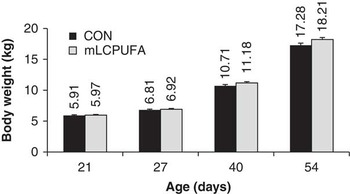
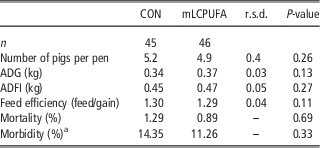
The number of pigs per pen, average daily gain (ADG), ADFI and feed efficiency (pen feed intake/pen weight gain) were similar between treatments (Table 1). Overall, BW in the nursery was not different between treatments at any time point, and no interaction between treatment and time occurred (Figure 1). Mortality rate and morbidity rate (calculated as the number of pigs receiving individual medication), and scour scores in the nursery (1=no scours, 2=mild scours, 3=severe scours: average score for progeny from CON=1.07 and from mLCPUFA-enriched sows=1.08, respectively; P=0.65) were also not different between treatments (Table 1).
BW during the nursery period for litters from sows fed either with (marine n-3 LCPUFA (mLCPUFA); n=46 pens) or without (CON; n=45 pens) diets enriched with mLCPUFAs. Overall effect of treatment, P=0.13: effect of time, P<0.001: interaction between treatment and time, P=0.18. Data are the LSmeans+standard error.

Nursery data for litters with a low average birth weight from sows fed either control diets (CON) or diets enriched with marine n-3 LCPUFAs (mLCPUFA)

r.s.d.=residual standard deviation; ADG=average daily gain; ADFI=average daily feed intake.
Data are the LSMeans.
a Calculated as number of pigs given individual medication.
Grow–finish and carcass data barn A
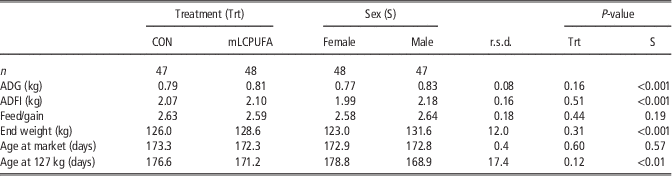
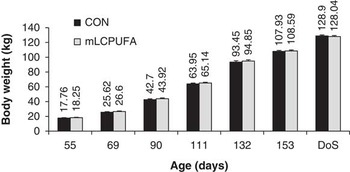
There was a significant interaction between treatment and time for BW (P<0.01). BW was not different at the start of, and in the first half of the grow–finish phase, but was higher (P<0.01) for mLCPUFA than CON pigs in the second part of the grow–finish phase (Figure 2). However, ADG, ADFI and feed efficiency were similar between treatments in barn A (Table 2 and Supplementary Figure S1) and mortality rate in barn A was not different between treatments (0% for CON and 2.1% for mLCPUFA, P=0.60).
BW change during the grow–finish period in barn A littermates from sows fed diets either with (marine n-3 LCPUFA (mLCPUFA); n=47 pens) or without (CON; n=48 pens) enrichment with mLCPUFAs. There was a significant interaction between treatment and time (P<0.01). *Denotes ages at which treatment means differed, P<0.01. data are the LSmeans+standard error. DoS=day of slaughter.

Grow–finish data of barn A for litters with a low average birth weight from sows fed either control diets (CON) or diets enriched with marine n-3 LCPUFAs (mLCPUFA)
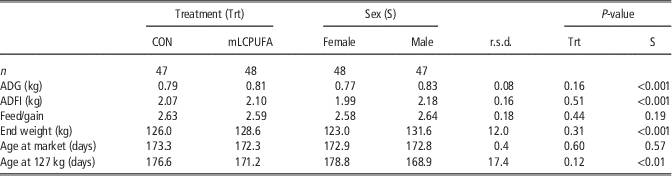
r.s.d.=residual standard deviation; ADG=average daily gain; ADFI=average daily feed intake.
Data are the LSMeans.
No significant interactions between treatment and sex occurred.
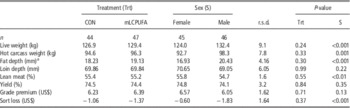
By design, market weight was similar between treatments (Table 2). Both the actual age at slaughter, and the calculated age at a fixed slaughter weight of 127 kg, were also not different between treatments (Table 2). Of the 47 CON pigs, two were not shipped to the slaughterhouse and one was rejected in the slaughterhouse. Of the 48 mLCPUFA pigs, one was not shipped to the slaughterhouse, and the percentage of pigs slaughtered was similar between treatments (P=0.32). Carcass weights were similar between treatments (Table 3) and there was also no difference in loin depth, lean meat percentage, yield percentage, premium paid and sort loss (money lost on the carcass due to lower quality) between treatments (Table 3). There was an interaction (P<0.01) between treatment and sex for fat depth. Fat depth was higher (P=0.01) in females from mLCPUFA-enriched sows (18.55±0.88 mm) than from CON sows (15.31±0.94 mm), whereas there was no difference in fat depth between treatments in males (19.71±0.90 and 21.15±0.90 mm for males from mLCPUFA-enriched and CON sows, respectively: P=0.25).
Carcass data for littermates housed in barn A selected from low average birth weight litters born to sows fed either control diets (CON) or diets enriched with marine n-3 LCPUFAs (mLCPUFA)

r.s.d.=residual standard deviation.
Data are the LSMeans.
a There was a significant interaction for treatment and sex for fat depth (P<0.01), see text. No other significant interactions between treatment and sex occurred.
Grow–finish and carcass data barn B
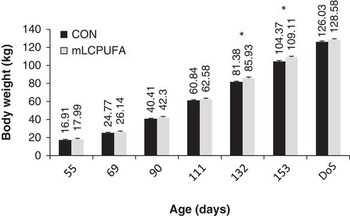
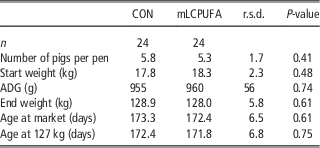
Number of pigs per pen was not different between treatments (Table 4). Start and end weight, ADG, age at slaughter and calculated age at a fixed slaughter weight of 127 kg were also not different between treatments (Table 4 and Supplementary Figure S1). Overall, BW was not different between treatments, and there was no interaction between BW and time (Figure 3). Mortality rate in barn B was similar between treatments (1.1% and 1.2% for progeny from CON and mLCPUFA-enriched sows, respectively, P=0.95). The percentage of pigs not slaughtered was higher (P=0.05) in litters from mLCPUFA (14/169=8.3%) than CON (6/180=3.3%) sows.
BW change during the grow–finish period in barn B littermates from sows fed diets either with (marine n-3 LCPUFA (mLCPUFA); n=24 pens) or without (CON; n=24 pens) enrichment with mLCPUFAs. Overall effect of treatment, P=0.57: effect of time, P<0.001: interaction between treatment and time, P=0.98. Data are the LSmeans+standard error. DoS=day of slaughter.

Grow–finish data for littermates housed in barn B from low average birth weight litters born to sows fed either control diets (CON) or diets enriched with marine n-3 LCPUFAs (mLCPUFA)

r.s.d.=residual standard deviation; ADG=average daily gain.
Data are the LSMeans.
No significant interactions between treatment and sex occurred.
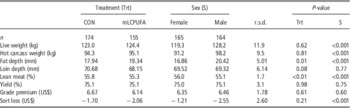
Live weight and carcass weight were similar between treatments (Table 5). Fat depth was higher (P=0.01) and loin depth tended to be lower (P=0.08) in pigs from mLCPUFA-enriched sows compared with pigs from CON sows, which resulted in a lower lean meat percentage (P<0.01) for pigs from mLCPUFA-enriched sows (Table 5). There was no difference in yield percentage, premium paid and sort loss between treatments (Table 5).
Carcass data for littermates housed in barn B from low average birth weight litters born to sows fed either control diets (CON) or diets enriched with marine n-3 LCPUFAs (mLCPUFA)

r.s.d.=residual standard deviation.
Data are the LSMeans.
No significant interactions between treatment and sex occurred.
Fatty acid concentration in serum, colostrum, milk and stillborn tissues
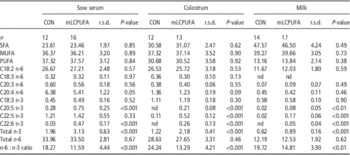
MLCPUFA sows had increased (P<0.01) EPA and DHA concentrations in serum, colostrum and milk compared with CON sows (Table 6 and Supplementary Table S4). This resulted in an increased total concentration of n-3 LCPUFA, and a decreased n-6 : n-3 ratio in mLCPUFA v. CON sows (Table 6 and Supplementary Table S4).
Fatty acid concentration (as % of total fatty acids) in sow serum during lactation, colostrum and milk for sows fed either with (mLCPUFA) or without (CON) a supplement rich in marine n-3 LCPUFA

r.s.d.=residual standard deviation; SFA=saturated fatty acids; MUFA=mono-unsaturated fatty acids; PUFA=poly-unsaturated fatty acids; nd=not detectable.
Data are the LSMeans.
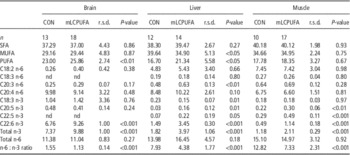
DHA concentration was also increased (P<0.05) in brain, liver and Semitendinosus muscle from stillborn piglets born to mLCPUFA sows compared with CON sows (Table 7 and Supplementary Table S5). EPA concentration was higher (P<0.05) for stillborns born to mLCPUFA than CON sows in liver and muscle (as % of total fatty acids only), but was not affected in the brain. Again, total n-3 LCPUFA concentration was increased and n-6 : n-3 ratio decreased in the measured tissues from stillborn pigs from mLCPUFA v. CON sows (Table 7 and Supplementary Table S5).
Fatty acid concentration (as % of total fatty acids) in brain, liver and Semitendinosus muscle tissues from stillborn piglets, born to sows fed either with (mLCPUFA) or without (CON) a supplement rich in marine n-3 LCPUFA

r.s.d.=residual standard deviation; SFA=saturated fatty acids; MUFA=mono-unsaturated fatty acids; PUFA=poly-unsaturated fatty acids; nd=not detectable.
Data are the LSMeans.
Discussion
Consistent with the findings reported by Smit et al. (Reference Smit, Spencer, Almeida, Patterson, Chiarini-Garcia, Dyck and Foxcroft2013b), pre-weaning mortality was very high in the subsets of lower birth weight litters studied, regardless of treatment. Although the effect of mLCPUFA enrichment of the sow was not significant, it did decrease pre-weaning mortality by 5% points, which translates into at least half a pig more at weaning in litters of 10 or more pigs. If this trend was substantiated in larger studies it could be of economic importance in practice. However, there is presently no clear consistency in the literature on the effects of n-3 LCPUFA supplementation on pre-weaning mortality (Rooke et al., Reference Rooke, Shanks and Edwards2000 and Reference Rooke, Sinclair, Edwards, Cordoba, Pkiyach, Penny, Penny, Finch and Horgan2001b; Smit et al., Reference Smit, Patterson, Webel, Spencer, Cameron, Dyck, Dixon and Foxcroft2013a). On the other hand, the number of stillborns seemed to be higher in mLCPUFA litters, although this was again not significant. As discussed by Smit et al. (Reference Smit, Patterson, Webel, Spencer, Cameron, Dyck, Dixon and Foxcroft2013a), interpretation of effects of mLCPUFA treatment on survivability may be difficult due to confounding effects of gestation length and the use of induced farrowing, as was again the practice in the present trial.
Although brain weight was not different between treatments (Smit et al., Reference Smit, Spencer, Patterson, Dyck, Dixon and Foxcroft2014), the DHA concentration in brain tissue was higher in stillborns from mLCPUFA-fed sows compared with controls, which is in agreement with other research (Rooke et al., Reference Rooke, Shanks and Edwards2000 and Reference Rooke, Sinclair and Edwards2001a), and was not surprising considering the importance of DHA for brain development (Innis, Reference Innis2007). Higher DHA levels in the brain could lead to increased postnatal growth rates due to a change in behavior. DHA concentration was also increased in liver and Semitendinosus muscle tissues of pigs from treated sows, which is again in agreement with other reported findings (Rooke et al., Reference Rooke, Shanks and Edwards2000 and Reference Rooke, Sinclair and Edwards2001a; Missotten et al., Reference Missotten, De Smet, Raes and Doran2009) and confirms that DHA must have been available to the fetus during gestation. This is in agreement with our previous findings that EPA and DHA were higher in serum during gestation in gilts fed mLCPUFA, and that DHA concentration was increased in embryos at day 30 of gestation (Smit et al., Reference Smit, Patterson, Webel, Spencer, Cameron, Dyck, Dixon and Foxcroft2013a). Effects of maternal mLCPUFA supplementation on EPA concentration were variable between tissues. EPA concentration was not affected by maternal mLCPUFA supplementation in the brain, which is not in agreement with previous findings (Rooke et al., Reference Rooke, Bland and Edwards1999, Reference Rooke, Shanks and Edwards2000 and Reference Rooke, Sinclair and Edwards2001a). This suggests preferential uptake of DHA over EPA by the brain. EPA was increased in liver, which is in agreement with Rooke et al. (Reference Rooke, Shanks and Edwards2000 and 2001a) and Missotten et al. (Reference Missotten, De Smet, Raes and Doran2009). EPA was only increased in the Semitendinosus muscle when expressed as percent of total fatty acids, while Missotten et al. (Reference Missotten, De Smet, Raes and Doran2009) found increased EPA when expressed as mg/100 g tissue. These results confirm the belief that piglets can benefit from mLCPUFA supplementation to the sow prenatally, when developing fetuses have access to DHA and later on also EPA. Increases in EPA and DHA concentration in sow serum during lactation are consistent with results from Fritsche et al. (Reference Fritsche, Huang and Cassity1993). Because EPA and DHA concentrations were also increased in colostrum and milk from mLCPUFA sows, again consistent with previous findings (Fritsche et al., Reference Fritsche, Huang and Cassity1993; Taugbol et al., Reference Taugbol, Framstad and Saarem1993; Leonard et al., Reference Leonard, Sweeney, Bahar, Lynch and O’Doherty2010), piglets can also benefit postnatally from maternal mLCPUFA supplementation when litters consume colostrum and milk containing elevated concentrations of EPA and DHA. Both pre- and postnatal exposure to higher EPA and DHA levels may be important to enhance postnatal growth performance. Indeed, Gabler et al. (Reference Gabler, Radcliffe, Spencer, Webel and Spurlock2009) showed that ex-vivo glucose uptake in the jejunum of pigs at weaning was substantially increased when sows were fed with n-3 LCPUFA during only gestation, only lactation or both: although n-3 LCPUFA supplementation in gestation seemed more important in this effect than n-3 LCPUFA supplementation during lactation, the best result was seen when feeding n-3 LCPUFA during both gestation and lactation, as was the case in the present study. An increase in glucose uptake could result in higher growth rates, and this is one of the mechanisms by which n-3 LCPUFA supplementation to sows could affect offspring growth rates.
As already reported (Smit et al., Reference Smit, Spencer, Patterson, Dyck, Dixon and Foxcroft2014), in the complete data set there was an interaction between mLCPUFA treatment and litter birth weight classification, so that mLCPUFA enrichment of the sow improved ADG and BW at weaning in pigs from MBW and HBW, but not LBW litters. As most of the litters allocated to the current detailed analysis of post-weaning growth performance were from the lower rankings of litter birth weight, the lack of a response to n-3 LCPUFA enrichment of these sows on ADG and BW at weaning was not surprising. As discussed by Smit et al. (Reference Smit, Spencer, Patterson, Dyck, Dixon and Foxcroft2014), it is possible that fatty acid transfer in LBW pigs is not as efficient as in MBW and HBW pigs, and therefore, less of the DHA would reach those fetuses. Thus, glucose uptake may not be improved to the same extent in pigs from LBW litters.
Again, as most pigs included in the present complementary study had LBWs, the data presented in the companion paper (Smit et al., Reference Smit, Spencer, Patterson, Dyck, Dixon and Foxcroft2014) would suggest that they would have undergone intra-uterine growth retardation (IUGR). D’Inca et al. (Reference D’Inca, Gras-Le Guen, Che, Sangild and Le Huërou-Luron2011) showed that IUGR pigs had a reduction in the surface area of exchange in the gut of more than 60% during the 1st days of life. Moreover, Alvarenga et al. (Reference Alvarenga, Chiarini-Garcia, Cardeal, Moreira, Foxcroft, Fontes and FRCL2013) showed that LBW pigs within a litter had a lower height of the duodenal mucosa layer at birth compared with pigs with a HBW, and that this difference persisted until 150 days of age. These studies clearly show the negative effects of LBW on intestinal morphology, which could contribute to growth failure (D’Inca et al., Reference D’Inca, Gras-Le Guen, Che, Sangild and Le Huërou-Luron2011). Interestingly, therefore, Leonard et al. (Reference Leonard, Sweeney, Bahar, Lynch and O’Doherty2011) have shown that feeding n-3 LCPUFA from day 109 of gestation until weaning increased villous height and villous height to crypt depth ratio in the jejunum and ileum mucosal surface at 9 days after weaning. Thus, the uptake of n-3 LCPUFA through milk had lasting effects on gut health and a decrease in scour scores in the nursery phase might have been expected if mLCPUFA supplementation of sows improved gut development of piglets. However, scour scores were not different between treatments in the current trial, in which most scours occurred in the 1st week after weaning, indicating that the n-3 LCPUFA ingested by piglets through the milk was insufficient to prevent scours in the nursery.
BW was not affected by mLCPUFA supplementation in barn B. In barn A, BW was higher for pigs from mLCPUFA-fed sows compared with Control sows only after the pigs were housed individually. This suggests that mLCPUFA supplementation of sows with a lower birth weight phenotype only improves growth performance of their offspring if pigs are not dealing with any competition for food or space in a pen. Despite the higher BW in barn A for pigs born from n-3 LCPUFA-fed sows, the calculated 5-day difference in age at a fixed slaughter weight of 127 kg was not significantly different. In barn B also, no effect of treatment was seen on age at market or calculated age at a fixed market weight of 127 kg. Together with the observation that mLCPUFA enrichment did not affect ADG, ADFI or feed utilization efficiency in either barn, this suggests that in a commercial setting, supplementing sows with a predicted LBW phenotype with mLCPUFA during gestation and lactation would not be a good management strategy.
To our knowledge, nobody to-date has looked at the indirect effect of maternal mLCPUFA supplementation on carcass traits of the offspring. However, in one study that looked at effects of different levels and sources of lipids (but not n-3 LCPUFA) to sows during pregnancy and lactation on meat quality of the offspring, Gerfault et al. (Reference Gerfault, Romao, Mourot, Etienne and Mounier2000) reported that inclusion of 2.9% copra oil, sunflower oil or lard during the whole of pregnancy and lactation did not affect growth performance and carcass quality of their progeny at 100 kg. However, the number of adipocytes per gram of adipose tissue of the pigs at 100 kg was increased when the maternal diet had been supplemented with lipids. They concluded that the quantity of fat added to sow diets could affect fat content in the carcass of their offspring. Inclusion of n-3 LCPUFA in the sow’s diet might, therefore, also increase fat content in the carcass of the offspring. Indeed, fat depth was higher in pigs from mLCPUFA-enriched sows than from control sows in barn B, and there was a similar, but sex-specific increase in fat depth in females from mLCPUFA enriched sows in barn A.
The current trial hoped to establish a positive effect of maternal mLCPUFA enrichment that would offset the possible negative effects of LBW on carcass quality (Wolter et al., Reference Wolter, Ellis, Corrigan and DeDecker2002; Bee, Reference Bee2004; Gondret et al., Reference Gondret, Lefaucheur, Juin, Louveau and Lebret2006). Instead, maternal mLCPUFA enrichment either did not affect carcass traits (barn A), or increased fat depth, tended to decrease loin depth and decreased lean meat percentage (barn B). In other words, the mLCPUFA enrichment of sows did not affect carcass traits for individually housed pigs, while it resulted in a negative effect on exactly the same parameters that were also negatively affected by LBW in pigs housed in groups. Therefore, it can be concluded that mLCPUFA enrichment of sows is not a good mechanism to improve carcass quality in LBW litters.
In conclusion, this detailed study of postnatal growth performance of lower birth weight litters confirmed that mLCPUFA enrichment of sows from weaning, during rebreeding, during gestation and until the end of lactation, increased DHA concentration in all tissues analyzed, and EPA concentration in some tissues of stillborn pigs, and increased EPA and DHA concentration in sow serum, colostrum and milk. However, supplementation of the sow until the end of lactation did not affect ADG, ADFI or feed utilization efficiency of the offspring in the lower birth weight litters studied. BW was higher in the second half of the grow–finish phase in pigs from mLCPUFA-fed sows compared with controls, but only when space and competition for feed was minimal, as in barn A. Maternal mLCPUFA enrichment had some effects on carcass fat depth, loin depth and decreased lean meat percentage in pigs housed in groups and had no effects on pigs housed individually. Collectively, these results suggest that nutritional supplementation of the sow can have lasting effects on litter development, but that feeding mLCPUFA to sows during gestation and lactation was not effective in improving growth rates, and was actually detrimental to carcass quality, in LBW litters.
Acknowledgements
The authors would like to thank the JBS United team for the care of the animals and their expertise in trial conduct, as well as Joan Turchinsky for her help in the lab. The authors acknowledge financial support of Embryogene, ALMA, PIC, Alberta Innovates and Canadian Swine Research and Development Cluster.
Supplementary material
To view supplementary material for this article, please visit http://dx.doi.org/10.1017/S175173111400319X