Delegates to the Federal Convention of 1787 discussed and voted on proposals to vest the power of appointment of judges in the executive alone (Farrand Reference Farrand1966, 2:37). Like many of the proposals that gave one branch alone the power to appoint, the appointment of judges by the executive was criticized for inviting “political dealing, patronage, favouritism, and intrigue” (Gauch Reference Gauch1989, 343). Madison “was not satisfied with referring the appointment to the Executive” (Farrand Reference Farrand1966, 1:120), and Rutledge—though he might have had later cause to regret it (Gauch Reference Gauch1989, 337)—was not “disposed to grant so great a power to any single person” (Farrand Reference Farrand1966, 1:119). Though objections to any executive involvement continued to be raised, the present system of involving both the executive and the legislature in the appointment of judges was eventually agreed to.
Historically, however, most common-law countries have been content to grant this “great power” of judicial appointment to the executive, either vesting it in a single minister or ministers of the executive acting in collaboration. In England and Wales between 1880 and 2005, the power to appoint judges to the different levels of the English judicial hierarchy was given to two ministers, the lord chancellor and the prime minister, whose decisions were subject only to pro forma ratification by the Crown. In Canada between 1875 and 2004, the power to appoint judges to federal courts rested either with the cabinet acting on the advice of the attorney general or, in the case of appointments to the post of chief justice of the Supreme Court of Canada, with the prime minister (Morton Reference Morton1984, 61)—though once again these decisions were subject to pro forma ratification by the Crown’s representative in Canada, the governor general. Finally, in Australia between 1903 and (with minor exceptions) the present day (Lynch Reference Lynch2014), the power to appoint judges to federal courts has lain with the cabinet, upon the advice of the attorney general, and pursuant to pro forma ratification by the governor general (Evans Reference Evans2001).
In each of these four countries, the appointment of judges by ministers has been criticized for permitting precisely the political dealing and patronage that delegates to the Federal Convention warned of. In Britain in particular, appointment by ministers alone was memorably described by a committee of the House of Commons (a committee with a Conservative majority at a time of Conservative government) as “nothing short of naked political control” (Rozenberg Reference Rozenberg1997, 14). Because of the risk that ministerial appointment might cause appointments to be seen as “political,” the Constitutional Reform Act of 2005 moved the power to nominate judges to nonpolitical judicial appointment committees, though again the decisions made by these committees must be ratified by the lord chancellor (Malleson and Russell Reference Malleson2006). This move was nearly contemporaneous with moves in Australia and Canada (now since abandoned) to create advisory panels to recommend candidates to the attorney general (Ziegel Reference Ziegel2006; Lynch Reference Lynch2014).
Despite the end of the system of ministerial appointment, it is important to study the English system as it operated between 1880 and 2005 and in particular to study the characteristics of appointees. This is so for two reasons. First, the system is an example of a broader system of ministerial appointment of judges that is still present in many common-law countries around the world, including not just Australia and Canada but also New Zealand (where reform was again proposed but abandoned; Chalmers Reference Chalmers2008), and in non-common-law systems such as Sweden, where appointment to the Supreme Court (Högsta Domstolen) is a matter for the government alone. Thus, the investigation of a historical system allows us to draw conclusions pertinent for currently existing systems. Second, the English system merits investigation because it was ordinarily taken to be so influenced by the judiciary that professional considerations excluded any possibility for political patronage.
Although in theory the lord chancellor and prime minister could appoint any lawyer of sufficient standing, in practice appointment was largely from within the (necessarily finite) ranks of existing judges. Moreover, the lord chancellor’s recommendations were made after considerable input from the lord chief justice and other senior judges. For some, judicial appointments in England seemed to follow the practice recounted by that other delegate to the Federal Convention, Benjamin Franklin, who, in “brief and entertaining manner related a Scotch mode, in which the nomination proceeded from the Lawyers, who always selected the ablest of the profession in order to get rid of him, and share his practice” among themselves (Farrand Reference Farrand1966, 1:120). Franklin may have been wrong about judicial appointments in Scotland (they remained a matter for the Crown and its ministers until the 2002 establishment of the judicial appointments board for Scotland) and about the quality of the resulting nominees (Phillipson Reference Phillipson1990, 7), but his assessment of the dominance of the legal profession would have been shared by many who analyzed the system that operated in England between 1880 and 2005.
For this reason, England offers a hard test for the commonly held view of judicial appointment according to which appointment by a single political body acting alone is likely to result in political preferment.Footnote 1 If political preferment is found under a system of ministerial appointment where appointment is severely constrained by the legal profession or by a de facto requirement for appointment from within the ranks of existing judges, then a fortiori political preferment is likely also to exist in other systems of ministerial appointment that lack these constraints.
In this article, I analyze appointment to the Court of Appeal and the Appellate Committee of the House of Lords between 1880 and 2005, corresponding to the period between the passage of the Judicature Acts and the creation of the modern English court system (1873–80), on the one hand, and the reform of the system of judicial appointments initiated by the Blair government (2005–6), on the other hand. I begin by describing the structure of the system created by the Judicature Acts, before going on to discuss the existing literature on judicial appointments in the United Kingdom. I make an argument for the use of discrete choice models in analyzing English judicial appointment and present the results of a conditional logit model of appointment with independent variables tapping class, educational, legal, and political factors. I argue that appointments to the Court of Appeal and to the Lords are partly political, in that judges previously appointed by a political party have better promotion prospects when that party is in power. In the conclusion, I suggest that my findings concerning judicial appointments in England show that other countries with similar systems of appointment (Australia, New Zealand, Canada) will have to move away from ministerial appointment if they wish to eliminate the role of political preferment.
I. Senior Courts and Senior Judges
A. The Court System
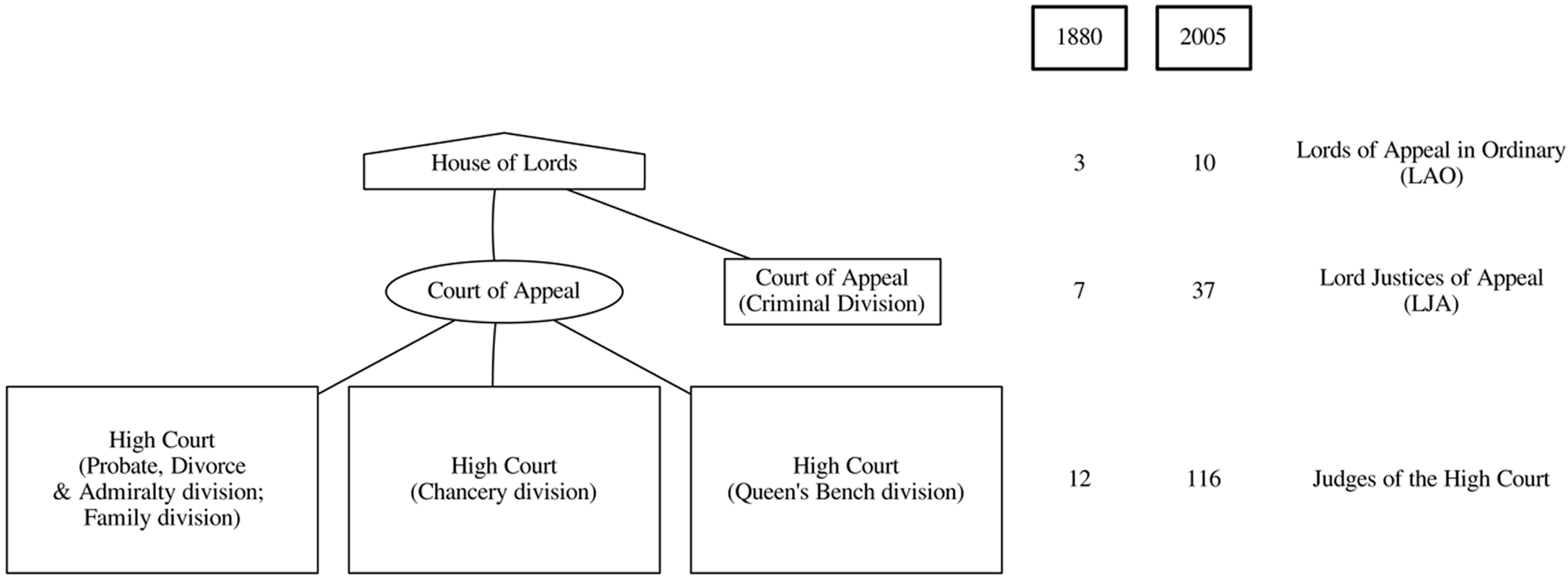
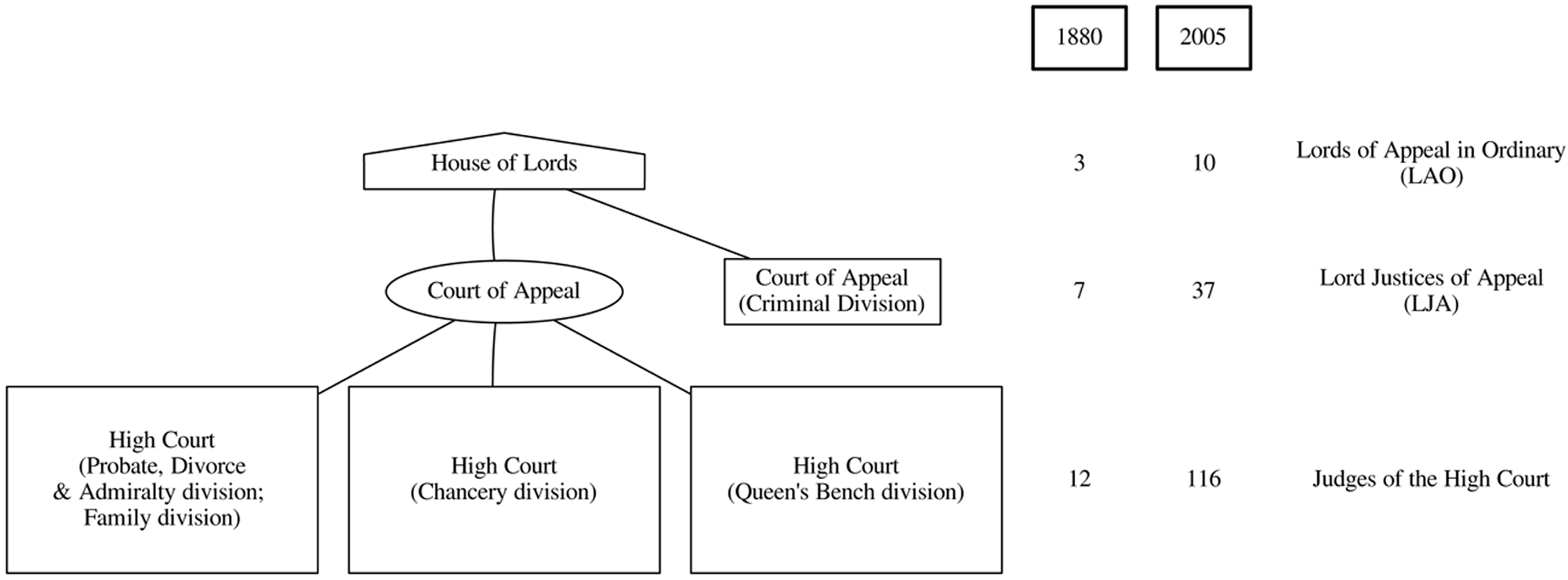
The English court system is not now, and never has been, a model of rational organization. It owed what structure it had to the Judicature Acts of 1873 and 1875. These established three “senior courts”: the High Court, the Court of Appeal, and the Appellate Committee of the House of Lords (hereafter, the Lords). The relationship between these courts, their internal divisions, and the number of judges at each level at the start and end of this period are shown in figure 1.
English judicial hierarchy
I focus on the English court system, which covers England and Wales. The legal systems of Scotland and Northern Ireland are separate (though the Lords, in its judicial capacity, had final appellate jurisdiction over Scottish civil cases and Northern Irish civil and criminal cases). Although Scottish and Northern Irish judges were appointed to the Lords, I do not consider these appointments here, because the different court systems make it impossible to compare the career trajectories of judges in the respective systems.
The High Court has both original and limited appellate jurisdiction. At the end of the period in question, the High Court had three divisions: the Chancery division, which hears cases relating to taxation, property, and trusts, among other issues; the Family division, which hears cases relating to divorce, family property, and proceedings relating to children; and the Queen’s Bench division, by far the largest of the three, which deals with the remaining areas of law, and contains within it a number of specialized courts. This division has changed over time. Before the 1970 Administration of Justice Act, the Family division was a larger Probate, Divorce, and Admiralty division, “a strange rag-bag of specialties that had grown out of the ecclesiastical court jurisdiction” (Coleridge Reference Coleridge2004).
The Court of Appeal had, as the name suggests, appellate jurisdiction only. It gained appellate jurisdiction in criminal cases with the 1907 Criminal Appeal Act, which created the Court of Criminal Appeal, now the Court of Appeal (Criminal division).
The last court of the three was not strictly speaking a court at all but rather (for much of the period) a committee of the legislature.Footnote 2 The Appellate Committee of the House of Lords was made up of senior judges who heard appeals on civil and criminal issues from English, Northern Irish, and some Scottish cases.
B. Types of Judge
These three courts are staffed by three different types of judges: judges of the High Court; lords justices of appeal; and lords of appeal in ordinary. Normally, only lords of appeal in ordinary may decide cases in the Lords. In theory, the lord chancellor—an office that mocked the separation of powers, given that he was head of the judiciary, member of the executive, and speaker of the upper chamber—could join cases in the Lords, but given the political sensitivity of such participation this power was rarely exercised after the Second World War (Woodhouse Reference Woodhouse2001, 116).
Only lords justices of appeal (including two figures of equivalent or greater rank, the master of the rolls, head of the Civil division of the Court of Appeal, and the lord chief justice, head of the Criminal division) may hear civil cases in the Court of Appeal; but some High Court and more junior judges participate in Criminal division cases given that division’s heavy workload. Judges of the High Court may hear cases either in the High Court (where they may often be joined by circuit judges) or in the Court of Appeal (Criminal division).
In this article, I am primarily interested in appointment as lord justice of appeal or lord of appeal in ordinary, since these are the only judicial appointments that are professionally constrained in the manner described above. Although appointments at lower levels are important, particularly insofar as they act as a bottleneck on the number of judicial aspirants from nontraditional backgrounds, they cannot be modeled in the same way.
C. Eligibility
For most of the period under study, appointment to any of these positions (judge of the High Court, lord justice of appeal, or lord of appeal in ordinary) was restricted to barristers—lawyers specialized in courtroom advocacy, as distinct from solicitors. This changed in 1990 with the passage of the Courts and Legal Services Act, which enabled those who had held rights of audience in the High Court or higher courts for at least 10 years (thus including certain solicitors), or who had served as a circuit judge for 2 years or more, to be appointed to the High Court. Lords justices of appeal may either
-
1. be appointed directly from those who meet the former criterion, or
-
2. be appointed from the ranks of High Court judges.
Lords of appeal in ordinary must have either
-
1. held higher rights of audience for 15 years, or
-
2. have been a member of the High Court, Court of Appeal, or the highest Scottish or Northern Irish courts, for at least 2 years.
With rare exceptions, English appointees have met both criteria.
D. Method of Appointment
The method of appointment for lords justices of appeal and lords of appeal in ordinary—which was entirely based on custom rather than legislative provisions (Shetreet and Borrie Reference Shetreet1976, s47n9)—is described well in one text summarizing the English legal system toward the end of this period: “Appointment to the positions of … Lord of Appeal in Ordinary and Lord Justice of Appeal are made by the Queen, acting by convention on the advice of the Prime Minister, who in turn will have consulted the Lord Chancellor. The effective voice in all appointments is normally that of the Lord Chancellor, following consultations with members of the judiciary and leading members of the legal profession. Occasionally, the Prime Minister may override the Lord Chancellor’s views in relation to senior staff appointments” (Bailey et al. Reference Bailey2002, 253–54). This system was grossly antiquated by the time of its abolition in 2005; for it involved two party politicians within the executive deciding unilaterally to make an appointment without any element of open competition or any attempt to solicit applications.
Only by making very strong assumptions about the force of recommendations is it possible to dismiss the possibility of political control of the appointments process. One might, for instance, argue that judicial recommendations acted as a hard constraint on both lord chancellor and prime minister. But this is not true. Even Lord Chief Justice Coleridge (1880–94), faced with one of the most partisan Lord Chancellors (Halsbury) had to acknowledge the “the absolute right and the sole responsibility of the Chancellor in regard to these appointments” (Heuston Reference Heuston1964, 42). A century later, senior judges consulted on the appointment of a successor to Lord Chief Justice Taylor (not, strictly, an appointment considered in this article but one that was governed by the same procedure) were considerably aggrieved when Mackay simply failed to pass on their recommendations, none of which endorsed the eventual appointee (Sir Thomas Bingham, later Lord Bingham) (Rozenberg Reference Rozenberg1997, 14).
Nor can one argue that the recommendations of the Lord Chancellor act as an apolitical hard constraint on prime ministers. Of the 28 Lord Chancellors during this period, only four—Mackay of Clashfern, Simonds, Maugham, and Sankey—had never stood for Parliament, and Maugham had considered it. Most were therefore political actors, and those that were not political actors were only chosen for lack of a better alternative. Sankey was a member of a Labour government that had few supporters among the bar or judiciary; Mackay of Clashfern was only drafted in (initially as lord advocate for Scotland, and subsequently, after becoming a Conservative party member, as lord chancellor) because the other likely candidate, Conservative MP for Kinross Nicholas Fairbairn QC, was regarded as too flamboyant.
Even if the Lord Chancellor were avowedly nonpartisan, or took very seriously the traditional role of protecting judicial independence, his recommendations would not have binding force. Mackay’s (rank-ordered) recommendations were overturned on at least one occasion either by Thatcher or Major (Rozenberg Reference Rozenberg1997, 16), and there is a “suggestion that Mrs Thatcher [also] refused to accept Lord Hailsham’s advice over the appointment of Sir John Donaldson as Master of the Rolls” (Woodhouse Reference Woodhouse2001, 134).
There are, therefore, good grounds for believing that, subject to the de facto constraint that appointment be from within the ranks of existing High Court or Court of Appeal judges, the method of appointment to these two posts—lord justice of appeal and lord of appeal in ordinary—is dominated by the executive, and as such offers an exciting opportunity to test the relative importance of political factors vis-à-vis other factors in judicial appointment.
E. Generalizability
In the preceding section, I have described the system used to appoint judges in England and Wales. Inevitably, much of this discussion has been cast in terms that are either unique to England and Wales or that have analogs only in other systems inspired by England and Wales. I nonetheless wish to suggest that conclusions derived from the study of the English case can be generalized insofar as (1) the English system is an example of a particular kind of system used to appoint judges and (2) within that kind, differences of degree suggest that the English system is less likely to result in political preferment, such that any positive findings of political preferment should apply with greater force to other systems of this kind.
Generally, we may say that the British system prior to 2005 is a system of ministerial appointment. That is, the nomination, proposal, and ratification of candidates for appointment to the apex court is the exclusive de jure responsibility of one or two members of the executive, acting jointly or separately. In this respect it is to be distinguished from systems where nomination, proposal, and ratification of candidates are the nonexclusive responsibility of the executive—as is the case in a number of apex courts where judges are appointed in part by the executive, in part by parliament, and in part by the judiciary—or where the executive is involved in one, two, or three stages of the appointments process and where other bodies (judicial appointments commissions, the legislature, the court itself) are involved in the remaining stages. As signaled in the introduction, many of the countries that employ this system are former British colonies. Some are Scandinavian (Denmark prior to 1999; Norway prior to 2002; Sweden and Finland); and others—such as Japan—display more complicated genealogies (see, generally, Malleson and Russell Reference Malleson2006; O’Brien Reference O’Brien2006; Grendstadt, Shaffer, and Waltenburg Reference Grenstadt2014, chap. 2).
Within this system, England is unusual in that de facto eligibility requirements severely limit the discretion available to ministers. The de facto requirement that judges are appointed to the Court of Appeal/House of Lords from within the ranks of existing High Court/Court of Appeal judges plays a dual role in this article. Technically, it helps ensure that we can identify the characteristics that are valued by ministers. Substantively, it means that England is a least likely case for political preferment. The more discretion is limited, the more difficult it is for ministers to exercise any kind of preferment.
II. Previous Research
In this section, I discuss factors affecting appointment raised by other authors. These concern class, education, legal concerns, and politics. This is not an exclusive listing: other factors have affected promotions at specific times and places (the most notorious example being the postwar Labour government’s refusal to appoint Catholic judges on the grounds that they could not grant divorce; Woodhouse Reference Woodhouse2001, 145). Some factors are not considered here because there is insufficient variation in the associated variables. There can be no variation in the weight of ethnicity on appointment to the Court of Appeal or the Lords, for the first nonwhite High Court justice was appointed only at the end of 2004 (Linda Dobbs QC). The limited number of female High Court judges also limits attempts to test the effect of gender.
A. Class Considerations
If “class is the basis of all British politics” (Pulzer Reference Pulzer1967), then it ought to be true that class is the basis of all judicial politics in Britain. Certainly, the popular image of judges in Britain is of white males drawn exclusively or at least predominantly from the upper-middle and upper classes (Darbyshire Reference Darbyshire2011, 21) and liable to act in the interests of that class (Griffith Reference Griffith1977). Indeed, early quantitative research on appointment to the appellate judiciary suggested that family status had a positive effect on promotion prospects (Tate Reference Tate1992; but see Thomas Reference Thomas2004). The most plausible mechanism is the role of the judiciary in recommending or warning against particular nominees, thereby replicating its current characteristics and patterns of privilege. Darbyshire (Reference Darbyshire2011, 97) reprints a number of derogatory comments made by judges about judicial applicants (“down and out scruffy,” “off-puttingly headmistressy”) in the transition period to the new appointments regime; it is not difficult to imagine other, similar comments in earlier periods that, though perhaps phrased more gracefully, might give an advantage to higher-status candidates. Consider, for example, Lord Halsbury’s comments on one candidate in a letter to Lord Salisbury: “He [Edward Ridley] is also a poet and has translated Lucan but these I do not insist on as judicial qualifications”(!) (Heuston Reference Heuston1964, 50).
One particular and peculiarly British mechanism of class advantage is the participation of class elites in particular social circles, specifically gentlemen’s clubs. These organizations—clubs like the Atheneum, the Reform Club, or the Garrick—still play an important structuring role in certain parts of British politics today (Bond Reference Bond2012), despite their now-unfashionable character and taint of social elitism. For much of this period, club membership provided a means for individuals to parlay inherited position into social capital.
B. Educational Considerations
Given the strong links between class and educational attainment in Britain, many of the factors listed under education overlap with factors listed under class. This is particularly true since one obvious measure of educational attainment—having attended a university or not—is of little use in discriminating between candidates for promotion, and thus what measures that remain—having attended either Oxford or Cambridge, and attending elite colleges within those two institutions—are moderately correlated with class. Nevertheless, we might expect that an undergraduate degree from a good university might aid future promotion.
If the advantages of education are purely to do with signaling, or with generalized cultural capital, then any undergraduate degree will be of benefit. If, conversely, the advantage of education is subject specific, then candidates with undergraduate degrees in law should have an advantage. Conventional wisdom has largely viewed an undergraduate education in law as either a waste of time or as an undue restriction on future judges’ intellectual horizons. Heuston (Reference Heuston1964) describes the view that talented Oxford undergraduates would do best to secure a First in an unrelated subject and then pick up law in barristers’ chambers. Recently, erstwhile medieval historian Lord Sumption has argued that “it is best not to read law as an undergraduate” and that individuals who have studied other subjects perform better as barristers or judges (Daily Telegraph 2012).
C. Legal or Professional Considerations
The third strand of literature on appointment to appellate courts concerns the very idea of “promotion.” The traditional view was that “there is no system of promotion of judges in England” (Shetreet and Borrie Reference Shetreet1976, 78) and that “a man who accepts the office of a judge in England must reckon that he will stay in that position always. … This is the same whether he is a high court judge or a … stipendiary magistrate” (Denning Reference Denning1955, 18). This traditional view is certainly not true now: most superior court judges are promoted (Thomas Reference Thomas2004, 214), and the claim on appointment grows with time: as one judge put it, “I had done eight years on the High Court bench. … I think I would have been quite disappointed not to have been put in the [Court of Appeal]” (Darbyshire Reference Darbyshire2011, 93).
Exceptions concern the lower ranks: “able barristers who wish to be appointed to the High Court [and, a fortiori, to higher ranks] do not accept an appointment to a judicial office below the level of a High Court judgeship” (Shetreet and Borrie Reference Shetreet1976). Although such barristers might accept a part-time role as a recorder (a judge who sits in Crown or county courts)—and indeed were encouraged to do so toward the latter part of this period—they would not such a role as a full-time job. Just as accepting an initial full-time judicial office below the level of the High Court can “scar” a future candidate, so too does early progress in the legal profession mark him/her out for future success. Those who are made Queen’s Counsel or appointed to the High Court at a young age are marked out as “high-fliers” and are likely to progress further.
Although early progress is a boon in any field, progress in commercial law is a particular advantage (Malleson Reference Malleson2009), while progress in family law is little valued: as one family law judge chided his colleagues, “most of you will admit that your private perception of the Family division is, in every sense, as the Third Division, the Leyton Orient of the High Court [a perennially struggling soccer team]” (Darbyshire Reference Darbyshire2011, 264).
D. Political Considerations
The current conventional wisdom is that political considerations play no part in judicial appointments. For Derry Irvine (Lord Chancellor under Tony Blair), “politics has never been a factor in appointment to the professional judiciary and as far as I am concerned it never will be nor should be” (Malleson Reference Malleson2009). This statement is clearly false for at least some of the period under study. As Laski (Reference Laski1926, 533–34) noted, “of the 139 judges appointed in that period [1832–1906], eighty were members of the House of Commons at the time of their nomination; eleven others had been candidates for Parliament.” Lord Chancellor Halsbury was notorious for appointing poor quality judges who were active Conservatives; his prime minister, Salisbury, was claimed (by his daughter Gwendolen) to operate on the maxim that “within certain limits of intelligence, honesty, and knowledge of the law, one man would make as good a judge as another, and a Tory mentality was, ipso facto, more trustworthy than a Liberal one” (Heuston Reference Heuston1964, 37).
There are different kinds of political considerations that play a role in appointment (Paterson Reference Paterson1974). First, parties may reward individuals who have previously been active for that party, either by standing for the party in an election or by performing some other service. Paterson (Reference Paterson1974) calls these “reward motive appointments.” Second, parties may appoint individuals who they believe share similar ideological preferences to their own. Call these “consensus motive appointments.” Third, parties may appoint individuals who have held political office, or have carried out other political tasks, on the grounds that these individuals have, in virtue of their office, developed greater social awareness and broader experience.
Most scholars claim that reward motive appointments ceased some time before 1912 to the High Court and Court of Appeal, and some time before the late 1920s for appointments to the Lords (Stevens Reference Stevens1993, 41). It is not clear, however, that consensus motive appointments also stopped at the same time. Margaret Thatcher’s decision to appoint Donaldson as master of the rolls—after he had been passed over for promotion by the Wilson and Callaghan governments, angry at the National Industrial Relations Court over which Donaldson presided—is sometimes given as a relatively recent example. Generally, testing whether consensus motive appointments exist is difficult, since there is no UK equivalent of either the Segal-Cover scores or the Martin-Quinn scores (Segal and Cover Reference Segal and Cover1989; Martin and Quinn Reference Martin and Quinn2002). Previous research has had to rely on the appointment history of judges and to test whether judges, once appointed by a particular party, are more likely to be promoted by that party. Unfortunately, the only existing test (Salzberger and Fenn Reference Salzberger1999) found no effect of past appointment by a party on future appointment prospects and no effect of ruling against the government.
E. Hypotheses
On the basis of this previous research, I formulate the following hypotheses. Hypotheses 1 and 2 link to the discussion of class and education, respectively; hypotheses 3–6 refer to professional and legal considerations; and hypotheses 7–8 refer to political considerations:
Hypothesis 1: The higher a candidate’s social standing, the more likely she is to be promoted.
Hypothesis 2: The more and better educated a candidate, the more likely she is to be promoted.
Hypothesis 3: The earlier a candidate’s first judicial appointment, the more likely s/he is to be promoted.
Hypothesis 4: The more experienced a candidate, the more likely s/he is to be promoted.
Hypothesis 5: Candidates whose first full-time judicial position was to the High Court are more likely to be promoted.
Hypothesis 6: Candidates specializing in Chancery work are more likely to be promoted than candidates specialized in Queen’s Bench work, who are in turn more likely to be promoted than family judges.
Hypothesis 7: Candidates who have the same party affiliation as the governing party are more likely to be promoted.
Hypothesis 8: Candidates who were previously appointed by the governing party are more likely to be promoted.
III. Modeling Strategy
A. Previous Research
Previous quantitative research on judicial appointments has used one of two inappropriate strategies of statistical modeling. The first strategy is to treat appointment as an appellate judge as a binary variable (Tate Reference Tate1992; Thomas Reference Thomas2004) and to model promotion using standard (logistic or probit) regression techniques, where independent variables enter into the regression equation. The second strategy is to treat appointment as an appellate judge as a risk alongside resignation and to model promotion using survival models where independent variables multiply the baseline hazards of appointment or resignation (Salzberger and Fenn Reference Salzberger1999).
Each of these strategies has considerable problems. The first strategy cannot cope with the fact that information on recent judges’ promotion is effectively right censored: they would have been promoted had we continued to observe them. This problem can only be ameliorated by dropping data toward the end of the sample. The second strategy can cope with this censoring. However, it cannot easily cope with changing characteristics of the judge and of the appointer (in order to investigate Labour and Conservative appointment, Salzberger and Fenn [Reference Salzberger1999] had to split their sample), cannot cope with promotion to the Court of Appeal followed by promotion to the Lords, and cannot cope with the increased number of opportunities for promotion. The number of Court of Appeal judges has increased considerably over the years, from 18 (under the Senior Courts Act 1981) to 37 (under the Maximum Number of Judges Order 2002). Any characteristic of the candidate pool that has increased over this time will thus have a positive effect on the likelihood of promotion in either a survival or binary regression model. However, this positive effect will be an artifact of the increase in the total number of appointments made. What we really wish to identify is the contribution of each independent variable to being promoted given the characteristics of other candidates.
B. Conditional Logit
Accordingly, I use a conditional logit model, previously used in the same context by Vidal and Leaver (Reference Vidal2010). The conditional logit model estimates the probability of candidate j ∈ 1, …, J will be appointed on a given occasion i ∈ 1, …, N, or p i,j. This is linked to the binary (1 = appointed; 0 = not appointed) outcome using a categorical distribution:

The probability of a particular candidate being selected is equal to the sum (ui,j) of the values, for that candidate at that appointment opportunity, of each of the independent variables (X) multiplied by each of the associated coefficients (β), divided by the sum of these values for all of the candidates:
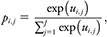

where ɛ is an independently and identically distributed extreme value.
This means that the probability of a given judge j being appointed depends not on the absolute value of the independent variables for that judge, but the relative value. An extra month’s experience will not improve a judge’s promotion prospects if all other eligible judges have also gained an extra month’s experience. Conversely, a judge j’s promotion prospects might improve without any change in his characteristics if other, better-suited judges drop out of the candidate pool due to death, retirement or promotion, leaving j relatively more qualified.
C. Constructing the Candidate Pool
A key issue when using conditional logit models is the definition of the choice set. In many applications, the choice set is uncontroversial. In consumer choice, it is restricted to the products on offer. In coalition formation, it is simply the number of combinations of parties present in the legislature, minus the combination with no parties. In this context, I suggest that the choice set for an appointment can be defined as the set of all judges with lower rank than the post in question. That is, the choice set for appointments to the Lords consists of all Court of Appeal judges and all High Court judges, as well as the master of the rolls and the lord chief justice. I therefore treat the roles of master of the rolls and the lord chief justice as equal or greater in status than the role of lord justice of appeal. The choice set for appointments to the Court of Appeal consists of all High Court judges. I argue that interpreting the choice set in this way is permissible, because of the practice of appointing judges from within the ranks of the judiciary, discussed in Section I.
D. Exceptions
There are exceptions to this general rule. One exception is easily dealt with. Scottish and Northern Irish judges appointed to the Lords are not drawn from within the ranks of the English judiciary. I therefore ignore them in my analysis.
The remaining exceptions are cases where candidates who had not previously served on the High Court were appointed to the Court of Appeal (six appointments) or to the House of Lords (one appointment). For the period in question, the last direct appointment to the Court of Appeal was in 1935; the last direct appointment to the House of Lords was in 1949. More recently (in 2012), Jonathan Sumption was appointed to the Supreme Court (the replacement for the Appellate Committee of the House of Lords) directly from the bar—but this falls outside the period under study. I have excluded these appointments from my analysis.
E. Refusal
One potential problem with conditional logit models concerns the possibility of unobserved choice set variation. As Desposato (Reference Desposato2005, 1) puts it, conditional logit “might be used to model workers’ employment decisions, students’ university choices, and prime ministers’ choice of government partners. But unbeknownst to the analyst, some choices simply aren’t in the choice set. … A prime minister can’t add an extremist party to her governing coalition if that party rejects the invitation.”
The possibility of refusal is present here, given that (for much of the period in question) appointment was offered to candidates; candidates were not invited to apply. However, the general impression is that promotion was an offer that could not be refused. One judge interviewed by Darbyshire (Reference Darbyshire2011, 94) said that he had never heard of anyone refusing promotion; other judges confessed to being reluctant to leave the “camaraderie of the Court of Appeal” but ultimately accepted (102).
F. Appointment Opportunities
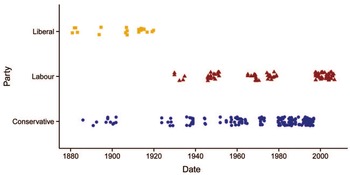
After removing appointments of Scottish and Northern Irish judges, I was left with 282 separate appointment opportunities. Figure 2 plots the distribution of these appointment opportunities across time and party of the appointing Lord Chancellor; plotted points’ y-positions are jittered to prevent overplotting.
Appointments by time and party
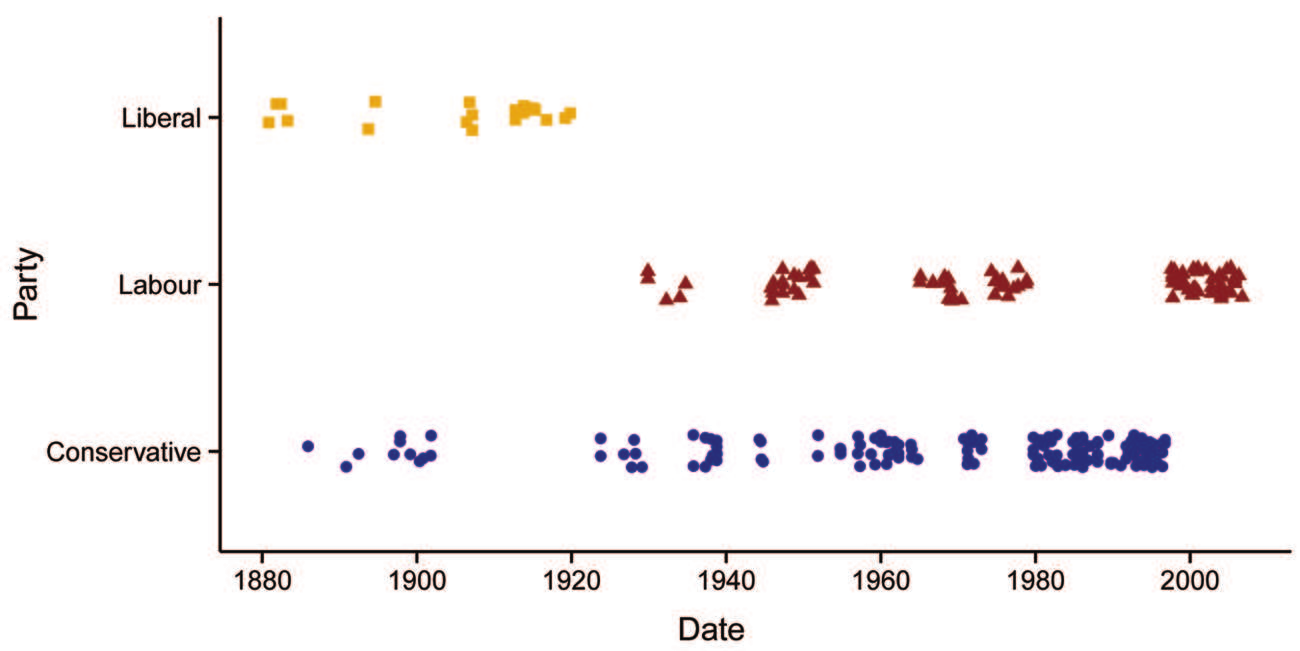
Confirming the impression from figure 1, figure 2 shows the increasing number of appointment opportunities over time. Derry Irvine, Lord Chancellor for 6 years under Tony Blair, made almost twice as many appointments as all of the Liberal Lord Chancellors between 1905 and 1922. The figure also shows occasional periods of one-party dominance, most notably the long period of Conservative rule between 1979 and 1997.
IV. Data
My data are based on the data collected by Tate (Reference Tate1992), as updated by Thomas (Reference Thomas2004), and supplemented by detailed information on the timing of appointments from Sainty (Reference Sainty1993) and the front matter of the All England Law Reports. These data contain information on 500 judges eligible for promotion at 282 appointment events over the period 1880–2005.
A. Class
I operationalize class using three variables: Clarendon, a dummy variable that has value of 1 if the judge attended one of the elite private schools mentioned in the 1864 Clarendon Commission report (Eton, Winchester, Westminster, Charterhouse, St Paul’s, Merchant Taylors’, Harrow, Rugby, and Shrewsbury); Clubbishness, equal to the log of 1 plus the number of gentlemen’s clubs to which the judge belongs/has ever belonged; and family status, which is an additive variable, similar to that used by Tate (Reference Tate1992) and Thomas (Reference Thomas2004), which is incremented by one if the judge’s father had an entry in Who’s Who or the Oxford Dictionary of National Biography; if the judge’s father had a title; if the judge’s father was an elected official or senior civil servant; and if the judge’s father or grandfather was a judge. Combining these four items is permissible since the value of Cronbach’s α > 0.7 (0.73); and since including other class variables results in a value < 0.7. These operationalizations all follow previous literature (Tate Reference Tate1992).
B. Educational
I operationalize education using a general additive index, Education, which has a value of 0 if the judge never attended university, a value of 1 if the judge did attend university; a value of 2 if the judge attended Oxford or Cambridge; and a value of 3 if the judge attended one of the most prestigious Oxbridge colleges (Trinity College [Cambridge]; Balliol, New College, Christchurch [Oxford]). I also use a dummy variable law degree, which has a value of 1 if the judge studied law as an undergraduate.
C. Legal and Professional
I use four variables operationalizing legal and professional factors. These are Experience, which is the number of years since the judge was appointed to their first full-time judicial position at the level of the High Court or above; Age at first appointment, which is equal to the age at which the judge was first appointed to the High Court or higher judicial office; High-flier, which has a value of 1 if the judge’s first full-time judicial appointment was in the High Court or higher; and Speciality Probate, Divorce, Admiralty and Speciality Chancery, which have values of 1 if the judge served in either of these divisions of the High Court, or the Probate, Divorce, and Admiralty division’s successor, the Family division (this leaves the Queen’s Bench division as the baseline category).
D. Political
I use two separate variables to test the effect of political considerations. Belonging to the same party as the lord chancellor has a value of 1 if the judge has an identifiable party affiliation, and if this is the same as the party affiliation of the appointing Lord Chancellor; a value of 0 if the judge has no identifiable party affiliation, and a value of −1 if the judge has an identifiable party affiliation that is not the same as the party affiliation of the appointing Lord Chancellor; except that from 1924 I counted Liberal appointees as if they were Labour appointees. PastPartyMatch is a variable equal to the number of times a judge has been appointed by the Lord Chancellor’s party minus the number of times that that judge has been appointed by another party, except that from 1924 I counted Liberal appointees as if they were Labour appointees.
I treat Liberal appointees as though they were Labour appointees because I surmise that if hypotheses 7 and 8 were correct, Liberal appointees would be likely to be favored by Labour governments over Conservative appointees, and because in the early part of this period, Labour governments had no Labour appointees to favour. Certainly, the Labour lord chancellor at the start of this period—Viscount Haldane—had migrated from the Liberal party, suggesting closeness (see fig. 3).
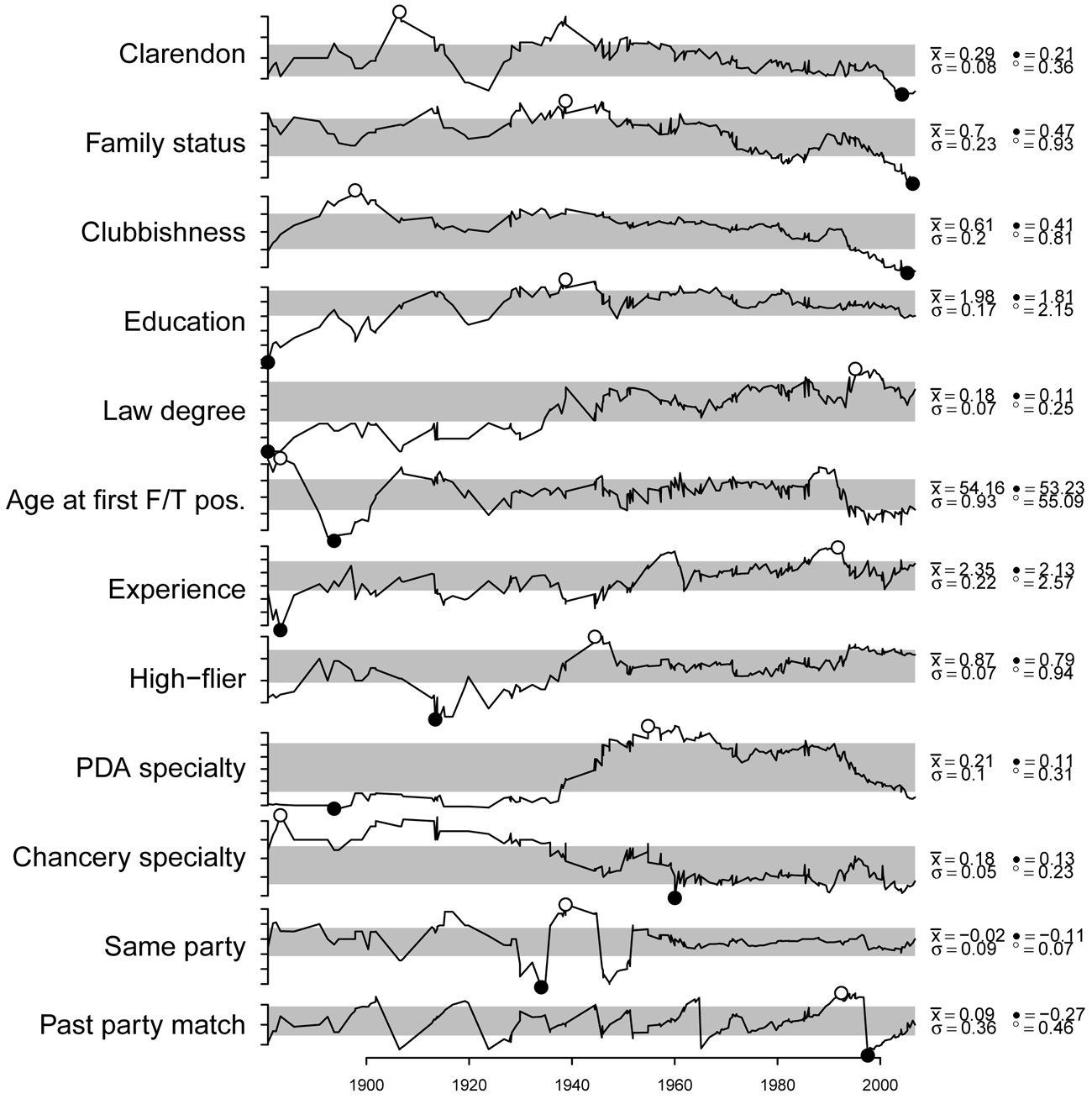
Sparklines and summary statistics
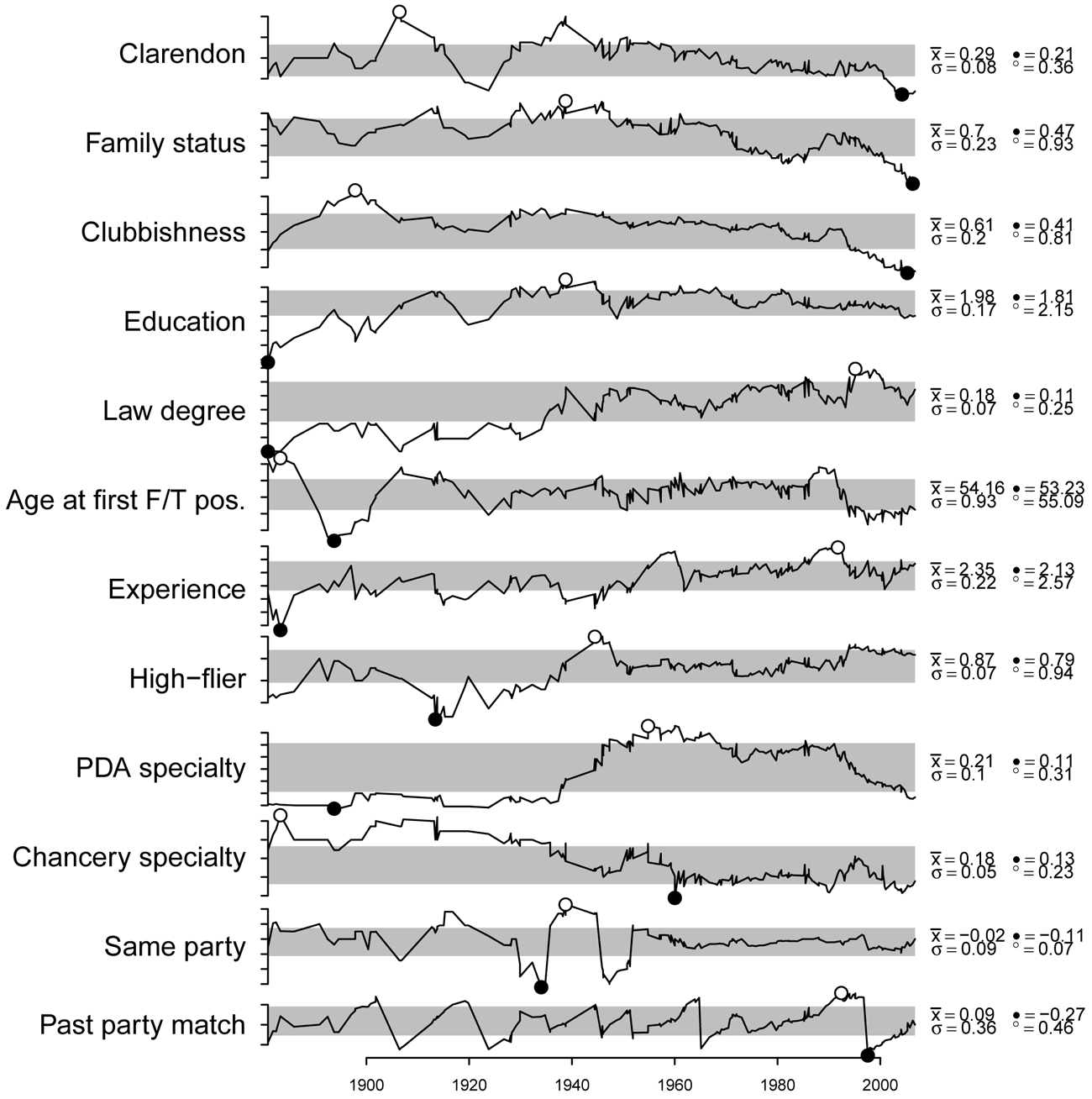
Sparklines of these variables showing averages at each appointment occasion are shown in the figure, together with information on the mean, standard deviation, and minimum and maximum across appointment opportunities. The height of the gray shading behind each sparkline corresponds to the standard deviation. The two class variables show a general decline starting from the Second World War. The same is true for the education variable, although this decline is largely due to the increased representation of universities other than Oxford or Cambridge. A law degree is a curio until the 1930s, when it begins to be found among a fifth of the senior judiciary. As far as the political variables are concerned, most postwar values are tightly bunched around 0; the maxima and minima are broached within the space of 4 years, from the (Labour) Lord Chancellor Sankey to the (Conservative) Lord Chancellor Hailsham, both serving in national coalition governments.
Even at their lowest points, the variables tapping class and elite education mark out the pool of eligible judges as very different to the general population. To take the most obvious marker of class—attendance at a Clarendon private school—it is astonishing that even at the lowest point (in 2005), more than a fifth of judges came from these seven schools—higher than the equivalent figure for the parliamentary Conservative party at that time (13.6%).
V. Results of Analysis
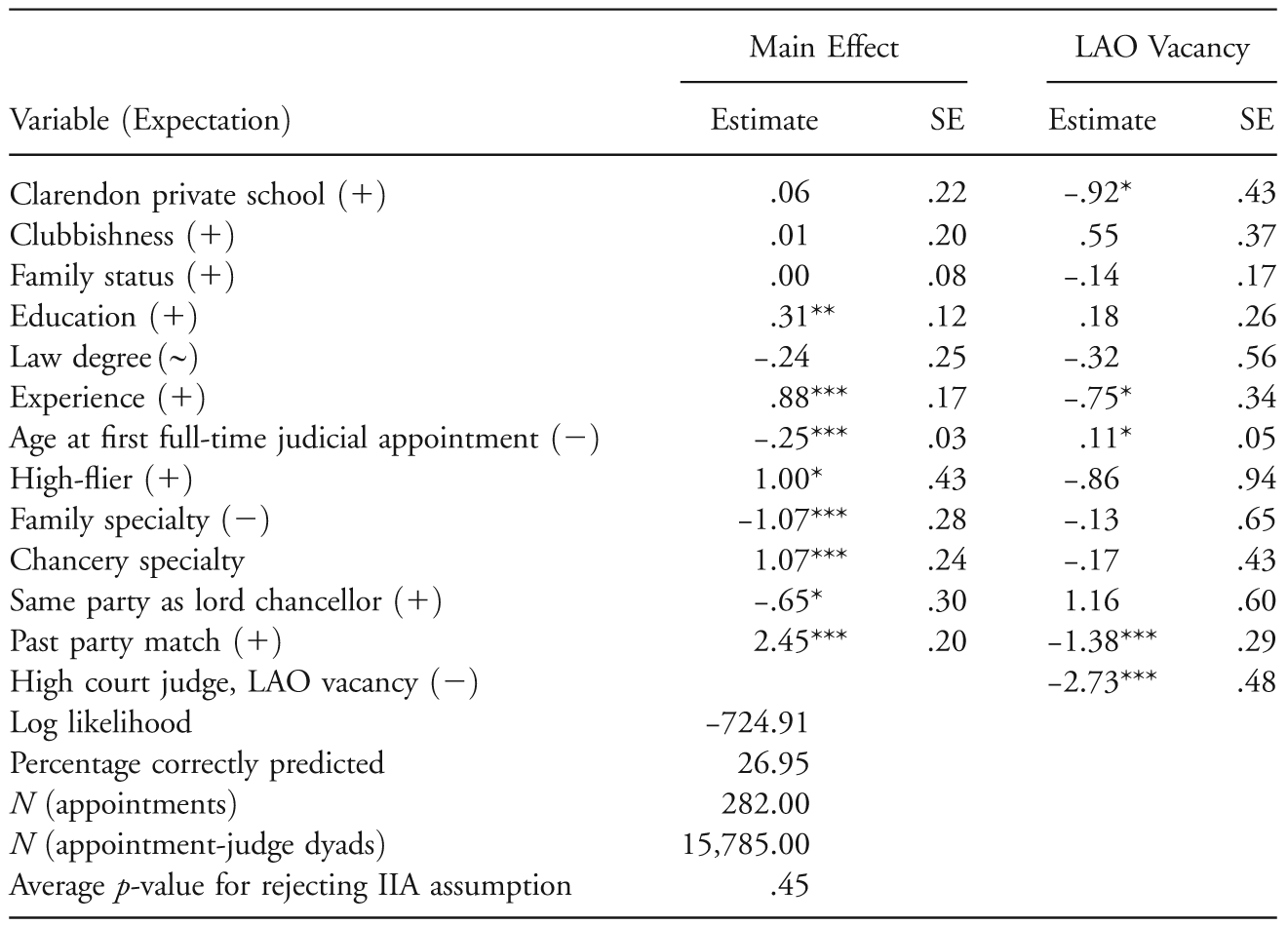
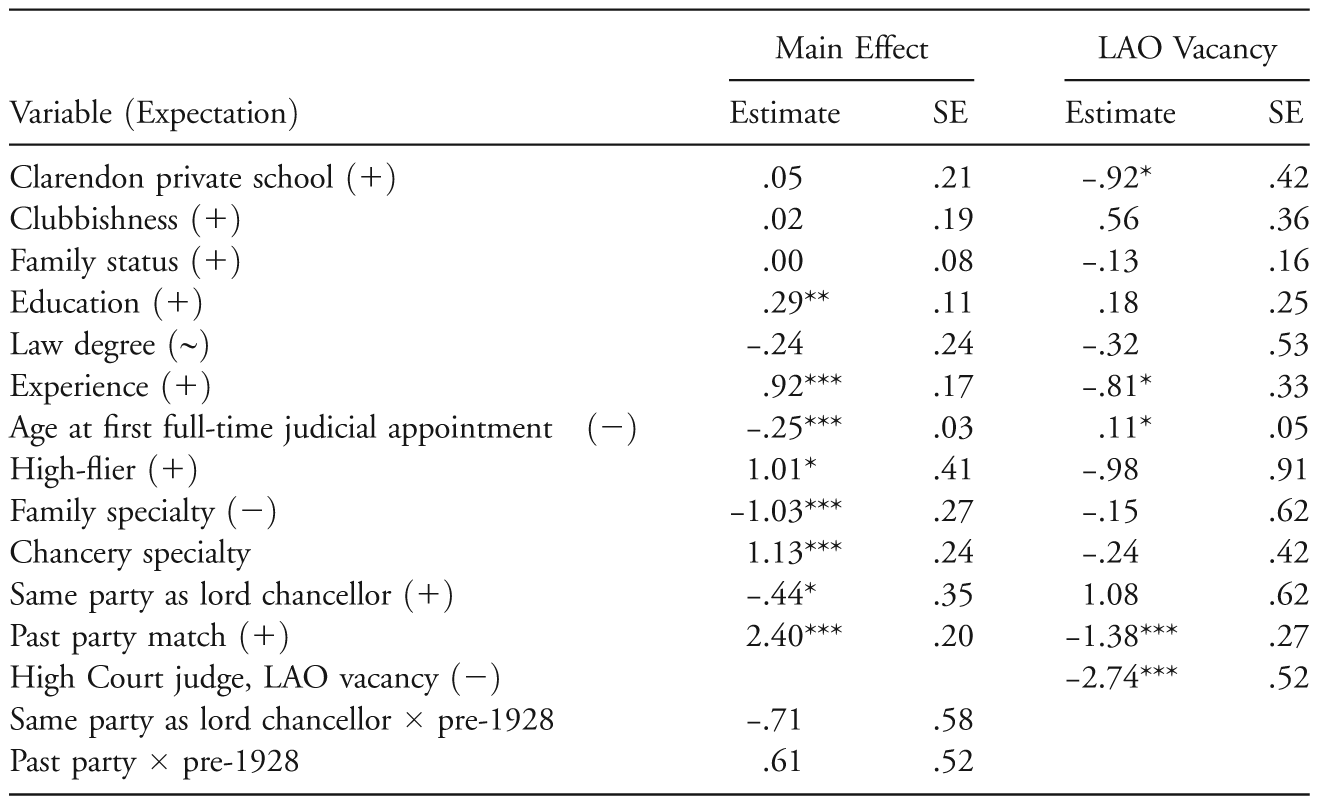
The results of the conditional logit are shown in table 1. All variables mentioned above are entered in to the model; all of these variables are subsequently interacted with a dummy variable that has a value of 1 when the post in question is the post of lord of appeal in ordinary. These interactions, in the spirit of a Chow test, allow us to account for differences in significant factors between different levels of the judicial hierarchy. An additional interaction term is included, which has a value of 1 when the post in question is the post of lord of appeal in ordinary and the candidate is a High Court judge.Footnote 3 The expectation regarding each variable is also listed.
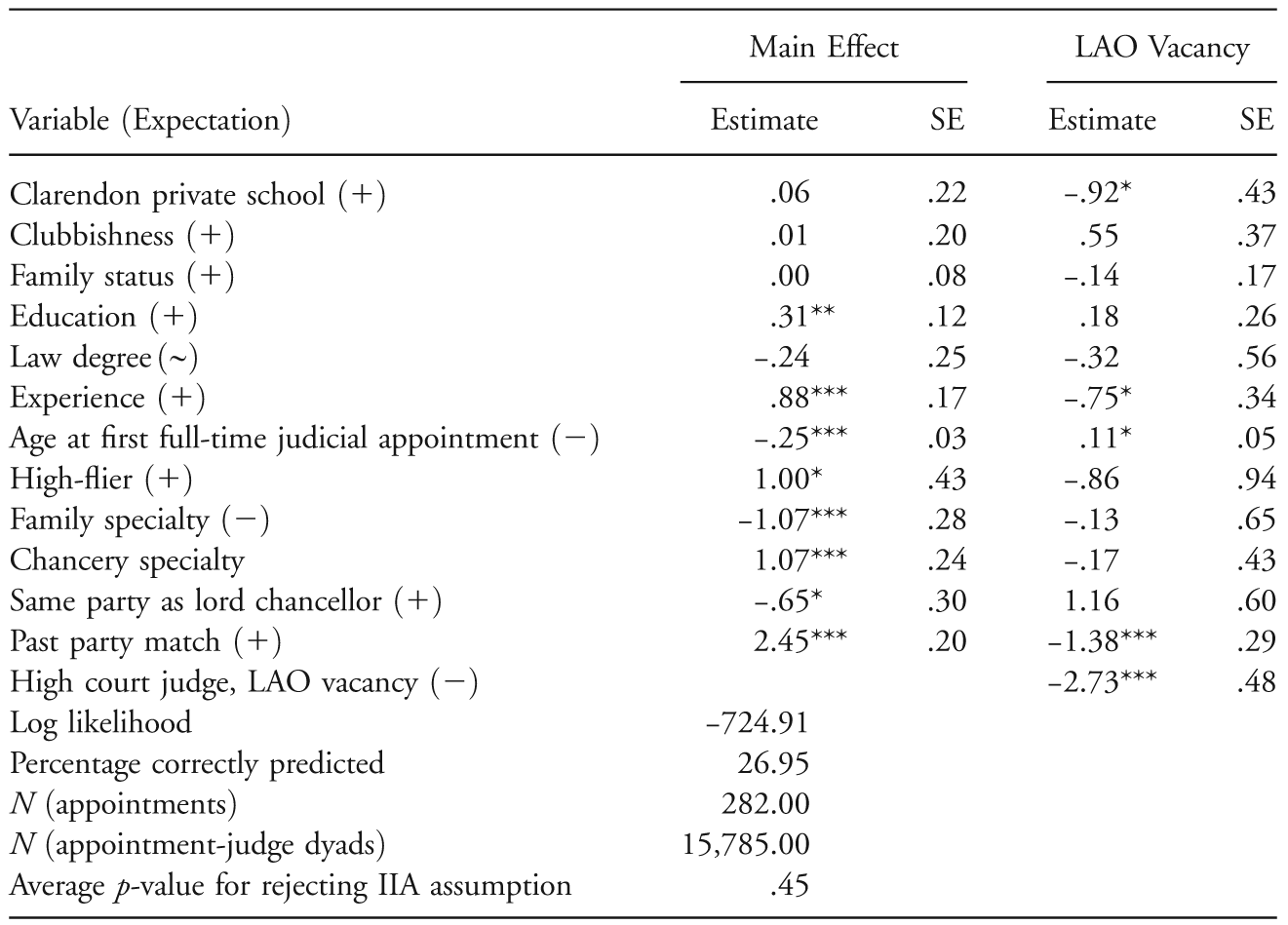
Note.—LAO = lord of appeal in ordinary; SE = standard error. Right-hand column shows coefficients for the reported variables interacted with a vacancy in the Lords.
* p < .05.
** p < .01.
*** p < .001.
Conditional logit models may produce incorrect estimates if the independence of irrelevant alternatives (IIA) assumption is violated. One way of testing for violations of IIA is to carry out a Hausman test between the same model evaluated on two sets of data: one full set of data, and one set of data where, for each appointment opportunity, a random 10% sample of unselected choices is dropped. To the extent that the Hausman test reveals significant differences between these two models, the IIA assumption is violated. I report the average p-value across 20 replications of this procedure (Martin and Stevenson Reference Martin and Stevenson2001). Since the p-value is greater than .05, we cannot reject the IIA assumption, and may use a conditional logit model.
The predictive performance of the model can be assessed by the percentage of appointments correctly predicted, which, at 26.95%, may seem low—but then it must be borne in mind that the percentage correctly predicted by a null model, where each individual in the pool of candidates has an equal chance of being selected, is even lower, at approximately 1/56, or 1.79%.
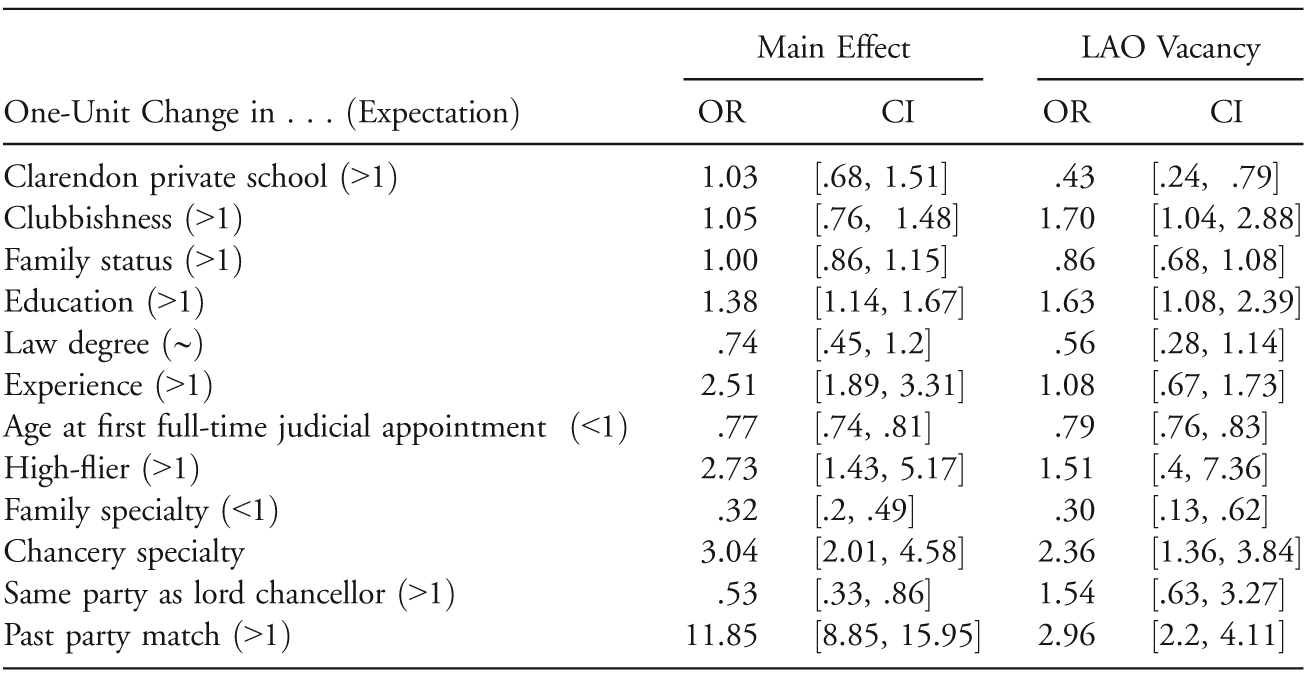
The coefficients in the model can be interpreted as log-odds ratios, such that a change of one unit in Xi improves the odds of appointment relative to other candidates by e β i . For ease of interpretation, these exponentiated coefficients are shown in the left-hand side of table 2. The right-hand side of the same table shows the sum of the main effect together with the interaction effect found when the vacancy is for a lord of appeal in ordinary. Both sides of the table show the associated 95% credible intervals for these variables.
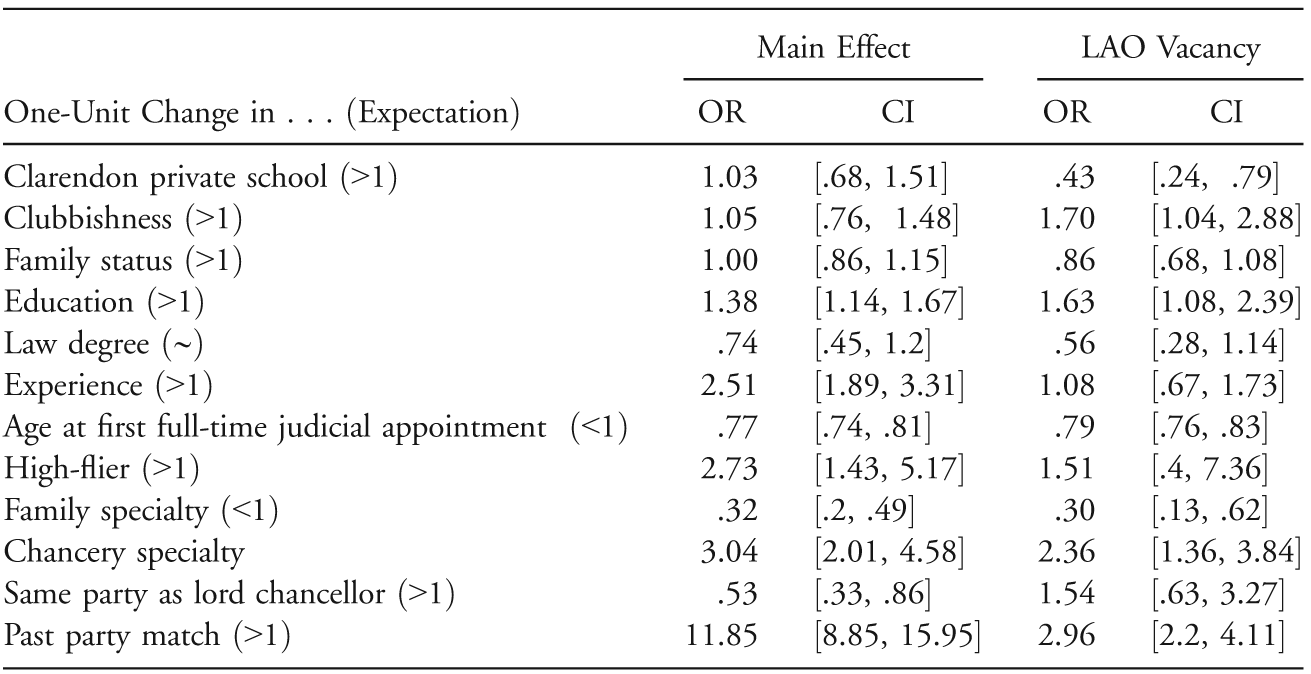
Note.—LAO = lord of appeal in ordinary; OR = odds ratio; CI = 95% credible interval. The left-hand column shows, for promotion to the Court of Appeal, the ratio of the odds following a one-unit change in the relevant variable, holding all other variables constant. The right-hand column shows the same information except for promotion to the Lords.
A. Class
Of the three class variables, none have a significant main effect, and although all of these main effects have the right sign, their magnitude is in all cases very close to zero. Considering the effect of class for appointment as a lord of appeal in ordinary, there are mixed findings. Family status and attendance at a Clarendon private school have a negative sign, and the effect of attending a Clarendon private school is significantly different from zero. However, higher values of clubbishness—which, unlike the other two variables, is not primarily ascriptive—positively affect candidates’ odds of being promoted to lord of appeal in ordinary. The least favored candidate will therefore be a candidate who has attended a very expensive private school but who has not parlayed this status into broad social connections through the use of gentlemen’s clubs.
B. Education
Education in general is an aid to promotion; but there is no (statistically significant) additional advantage when it comes to promotion to the Lords rather than just the Court of Appeal. As expected, having an undergraduate law degree does not aid promotion, though there at least no evidence that it has a statistically significant negative effect. Consequently, holding all other factors (including family status) constant, the most favored candidates will therefore be those who have attended one of the more prestigious Oxbridge colleges but who need not have studied jurisprudence while there.
C. Legal and Professional
Many of the legal and professional variables are important predictors of the likelihood of promotion. However, the influence of these variables differs importantly across the two levels in ways not immediately obvious from inspecting the values of the coefficients themselves. Considering first appointment as lord justice of appeal, we see that greater experience and having taken up a first full-time post at the High Court level aid promotion, as does being younger at the time of one’s first full-time judicial position. Of these three, being a high-flier has the largest effect.
Inspecting the values of the coefficients for the interaction terms involving these variables might suggest that these boons become banes at a later stage—but in fact, all that happens is that two of these factors—experience and high-flier status—cease to discriminate between candidates for appointment as lord of appeal in ordinary. Precocious judges who acquired their first full-time position early do, however, retain their advantage, the magnitude of which is almost unchanged.
The relative prestige of Family/Probate, Divorce, and Admiralty and Chancery specialties is confirmed, as those with the former specialty are very roughly as disadvantaged with respect to the baseline category (the Queen’s Bench division) as Chancery judges are advantaged with respect to that same baseline. These differences are very slightly smaller when it comes to appointment as lord of appeal in ordinary. High Court judges are, as should perhaps be obvious, greatly disadvantaged when it comes to promotion to the Lords: lords justices of appeal are 15 times more likely to be appointed as lords of appeal in ordinary as High Court judges are to be appointed to the same level, leapfrogging past the Court of Appeal. This is the largest substantive effect from a dichotomous variable found in the model.
D. Political
I made two separate hypotheses concerning political factors: the first, pertaining to clear partisan affiliation, and the second, pertaining to the past history of appointees. Insofar as clear partisan affiliation is no longer common among the judiciary, and insofar as partisan affiliation might be a boon for reward motive appointments of a kind that most commentators believe died out in the early part of the 20th century, the hypothesis concerning partisan affiliation was ex ante less likely. Indeed, the effect of Same Party as Lord Chancellor is significant in terms of appointment as lord justice of appeal—but it is significant in the wrong direction. Thus, if anything, lord chancellors reward partisans of different colors. Although there is a statistically significant positive effect when it comes to promotion as lord of appeal in ordinary, once again inspect of the odds ratios and their associated 95% credible intervals shows that this merely means that the negative effect at one level is ameliorated when it comes to appointment to the Lords.
Concerning the past history of appointees, there are substantively large and statistically significant effects in the expected direction for promotion as lord justice of appeal and as lord of appeal in ordinary. The odds ratios show that High Court judges appointed by the incumbent party (i.e., with a value of Past Party Match equal to 1) are almost 12 times more likely to be appointed than High Court judges with a politically balanced appointment history (e.g., a judge who had been appointed to the High Court by one type of government and was then appointed to a different division of the High Court by a government of a different type). Thus, having the right appointment history is worth almost as much for appointment to the Court of Appeal as being a Court of Appeal judge is for subsequent promotion to the Lords. Although the substantive effect of having the right appointment history is smaller when it comes to appointment as a lord of appeal in ordinary, the effect is still considerable.
E. Context
The model discussed above concerns appointments made over the period 1880–2005. It might reasonably be objected that many things changed over this period and that it is therefore misleading to characterise the weight of particular characteristics by use of a single coefficient applicable at any time during this period. In particular, it might be thought that the findings with respect to political characteristics are not characteristic of the entire period, but rather characterise the early part of this period.
For example, Stevens (Reference Stevens1993) has argued that what he called reward motive appointments ceased by the late 1920s. I therefore reestimate the model including interaction terms between (a) a dummy indicating whether the appointment is made before the March 28, 1928 (before the end of Viscount Cave’s tenure as Lord Chancellor), and (b) either Past Party Match, or Same Party as Lord Chancellor. If these interaction terms are significant and positive, it would indicate that the weight of political considerations in this early period is greater than the weight of political considerations during the remainder of the period.
As table 3 shows, neither of these interaction terms is significant, and the coefficients have opposing signs. Therefore we cannot conclude that the effect of political factors on appointments during the early part of this period was significantly different. This may simply be due to the limited number of appointments during this period, compared to the much larger number of appointments from the nineteen eighties onward, as the number of vacancies increased.
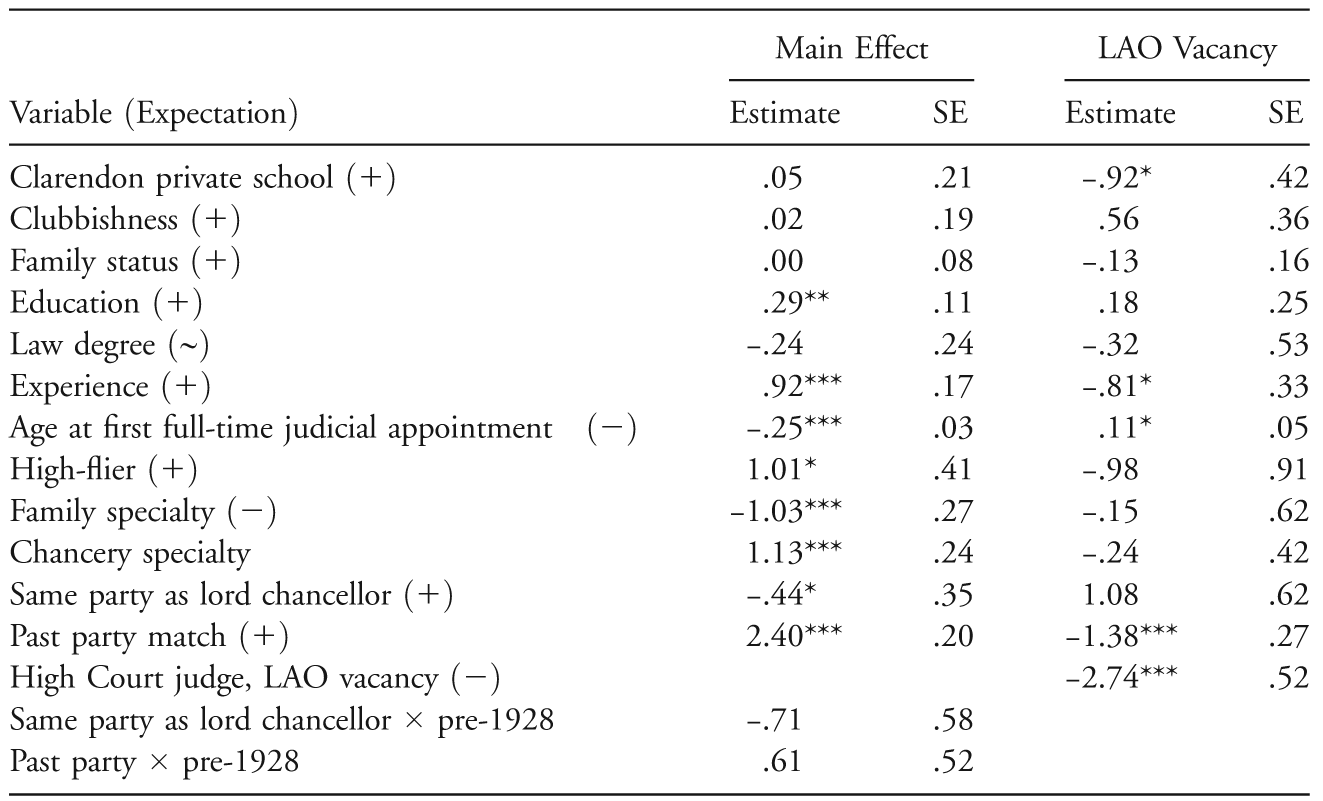
Note.—LAO = lord of appeal in ordinary; SE = standard error.
* p < .05.
** p < .01.
*** p < .001.
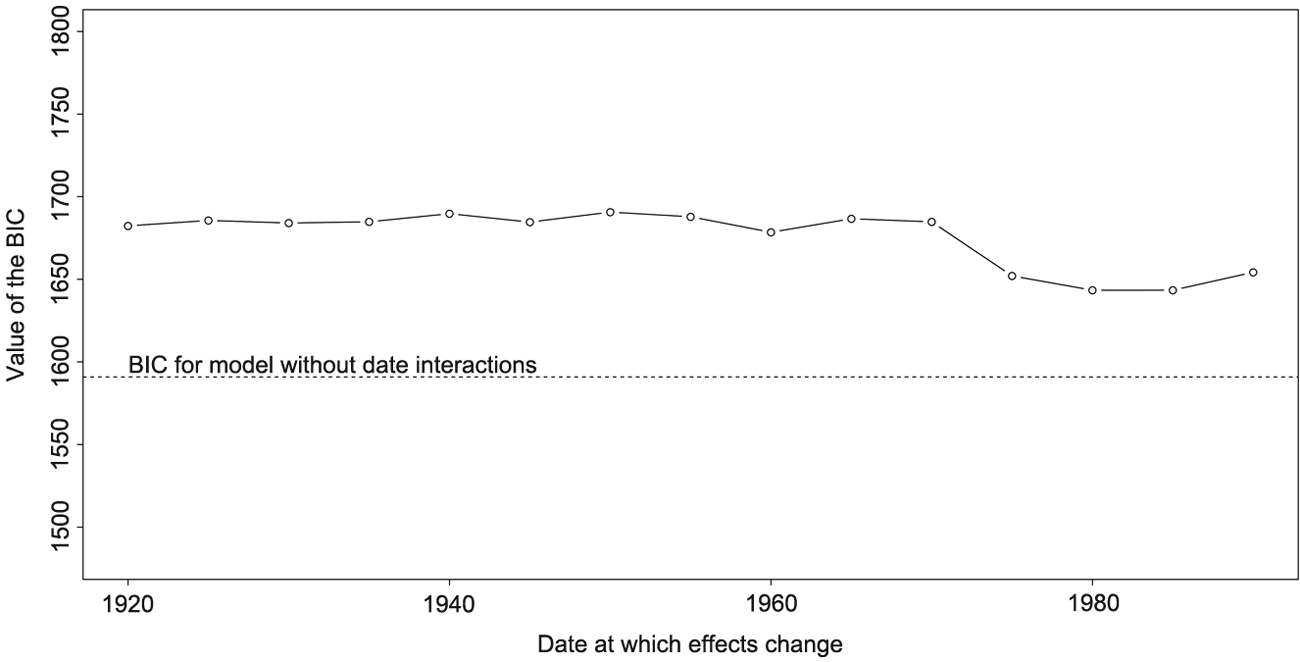
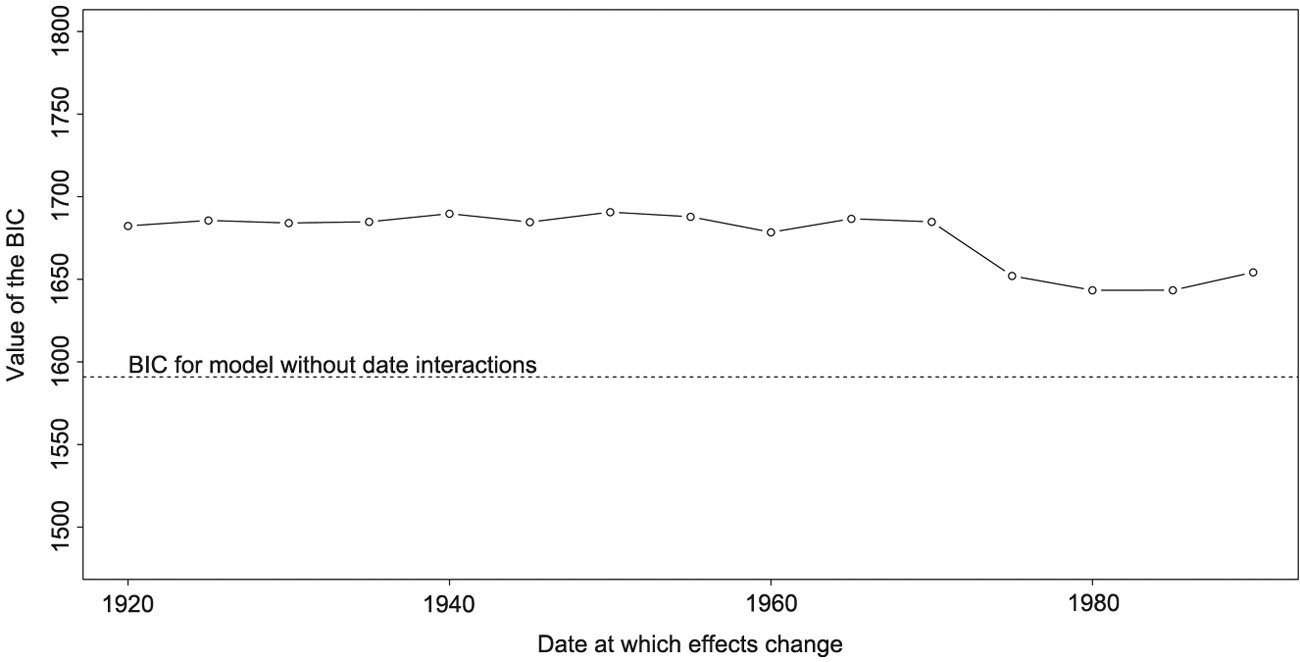
More generally, we can interact all of the variables in the model with a time dummy, thereby allowing for changes in the effects of these variables over time. We can then check whether models that include these interactions (at various points in time) result in a significant improvement in model fit. I therefore calculate the value of one particular model fit statistic, the Bayesian information criterion (BIC), on models interacted with date dummies that have a value of 1 if the date is after the January 1, 1920, 1925, 1930, up until 1990. The BIC measures model fit, but also includes a penalty that increases the more parameters are included in the model. The smaller the value of the BIC, the better the fit (fig. 4). As the line shows, there is no value of the BIC for the models with date interactions that is smaller than the value of the BIC for the model without date interactions. Therefore, allowing the effects of all of these variables to vary over time does not improve model fit by this measure.
Changes over time in the Bayesian information criterion
VI. Conclusion
In this article, I have argued that the method by which judges are appointed to the Court of Appeal and the Appellate Committee of the House of Lords makes it possible to identify the characteristics that matter for selection in a way that has often not been possible in the study of judicial selection. Using a conditional logit model, and data spanning 120 years, I showed that while class generally matters little, political preferment does matter for appointment to these courts, in that judges with the right appointment history enjoyed a considerable advantage over other candidates for the same post.
These findings challenge a stream of research about top-level judicial appointments in Britain. First, the null finding with respect to class cuts against the grain of much qualitative and quantitative research on British judges. Certainly, status advantage is at the heart of existing quantitative research on judicial selection in the United Kingdom (Tate Reference Tate1992; Thomas Reference Thomas2004; Vidal and Leaver Reference Vidal2010). However, it is important to qualify this finding. Just because class does not matter for appointment to the Court of Appeal or the House of Lords does not mean that class does not matter in general. There are considerable barriers to candidates from nontraditional backgrounds entering the law (Zimdars Reference Zimdars2010), entering elite barristers’ chambers, and entering the judiciary (Genn Reference Genn2008). What this research shows is that, had those barriers earlier in the promotions pipeline been resolved, the Court of Appeal and House of Lords would not have remained a bastion of the upper class.
Second, these findings challenge the conventional wisdom that the appointments process is nonpolitical. This is conventional wisdom not just because governments have repeatedly argued that the appointments process is nonpolitical, but because the academic literature so far has not been able to demonstrate a link between politics and selection (Salzberger and Fenn Reference Salzberger1999). Of course, as I have argued, previous research has used modeling strategies that do not capture the competitive and relative nature of judicial appointments.
This does not imply that judges’ behavior once they arrive in the Court of Appeal or House of Lords in any way reflects this political pattern found in appointments. Previous research argued that it is simply not possible to identify political splits between judges in the House of Lords; all one can identify are differences in propensity to dissent (Hanretty Reference Hanretty2013). It is possible that judges might display differing political worldviews in their ratio decidendii, or in their obiter dicta, but such differences (if they exist) are difficult to test for.
Third, these findings offer lessons for other systems of ministerial appointment. Generally, systems of ministerial appointment outside of England give more discretion to ministers, in that ministers may appoint from outside of the judiciary. What this research suggests is that reforms that aim to eliminate political preferment cannot stop at stricter eligibility requirements but must instead move the locus of decision making away from ministers. This would not have been achieved by some recent reform proposals in countries with ministerial appointment. The reforms proposed by Australian Attorney General Robert McLelland, for example, involved “the use of an Advisory Panel, comprising the head of the relevant court or their nominee, a retired judge or senior member of the Federal or State judiciary, and a senior member of the attorney general’s department to assess potential candidates, possibly through interviewing them, before making a report to the attorney general listing those found to be “highly suitable for appointment’” (Lynch Reference Lynch2014). This advisory panel would have formalized the degree of involvement of the British judiciary—which, as we have seen, did not preclude political preferment. While the McLelland proposals have not been taken up by McLelland’s Liberal successor, George Brandis, it seems that they would not have achieved their stated aims of recruitment on merit alone. Similarly, the reforms proposed in Canada by the Martin government (Ziegel Reference Ziegel2006), which involved the creation of an advisory committee including representatives of the judiciary and the bar with the power to select three nominees from a long list of seven, would have failed on the same measure. These reforms—which were both abandoned—might have reduced the role of political preferment but still would have left Canada and Australia as jurisdictions where the appointment of judges is by ministers alone.