1. Introduction
The Scandinavian Caledonides is an archetypal collisional orogen, containing some of the world’s best-preserved and most spectacular examples of deeply buried continental rocks. The mountain belt formed between the late Cambrian (Furongian) to early Ordovician and the late Silurian to early Devonian (e.g. Gee et al. Reference Gee, Janák, Majka, Robinson and van Roermund2013 and references therein), when the Iapetus basin contracted towards closure and multiple subduction–collision events occurred between the hyper-extended margin of Baltica and the outboard terranes (island arcs and/or microcontinents). The terminus of this period was the collision between Baltica and Laurentia, with the former undergoing transient subduction deeply beneath the latter (e.g. Krogh, Reference Krogh1977; Andersen et al. Reference Andersen, Jamtveit, Dewey and Swensson1991; Brueckner & van Roermund, Reference Brueckner and van Roermund2004; Majka et al. Reference Majka, Rosén, Janák, Froitzheim, Klonowska, Manecki, Sasinková and Yoshida2014). The various subduction–collision processes produced a multitude of (ultra-)high-pressure (UHP-HP) rock types yielding various ages of peak metamorphism. The most pronounced of the early (late Cambrian and early to mid-Ordovician) UHP-HP events are those recorded in the Middle Allochthon (sensu e.g. Gee et al. Reference Gee, Juhlin, Pascal and Robinson2010), which is exposed along the entire length of the Scandinavian Caledonides. UHP rocks are currently known from several localities spanning almost the full length of the outcrop of the Middle Allochthon, a few of which contain well-established metamorphic microdiamond (e.g. Smit et al. Reference Smit, Scherer, Bröcker and van Roermund2010; Janák et al. Reference Janák, van Roermund, Majka and Gee2013; Majka et al. Reference Majka, Rosén, Janák, Froitzheim, Klonowska, Manecki, Sasinková and Yoshida2014; Gilio et al. Reference Gilio, Clos and van Roermund2015; Klonowska et al. Reference Klonowska, Janák, Majka, Froitzheim and Kośmińska2016, Reference Klonowska, Janák, Majka, Petrík, Froitzheim, Gee and Sasinkowá2017; Bukała et al. Reference Bukała, Klonowska, Barnes, Majka, Kośmińska, Janák, Fassmer, Broman and Luptáková2018). While these occurrences are widely spaced and UHP metamorphism may not have been continuous or exactly contemporaneous between them, subduction of the Baltica continental margin was clearly an important and widespread process during the Caledonian orogenic cycle prior to the final Scandian collision.
Vestiges of the Middle Allochthon also occur as deep infolds or tectonic intercalations within the largest UHP-HP province in the Scandinavian Caledonides (Terry & Robinson, Reference Terry and Robinson2004; Robinson et al. Reference Robinson, Roberts, Gee, Solli, Corfu, Gasser and Chew2014), the Western Gneiss Region (WGR), which is a large tectonic window in which the Baltic cratonic margin, intensively reworked, emerges in the hinterland through the pile of allochthons. This giant UHP terrane represents the deeply subducted margin of Baltica (Krogh, Reference Krogh1977; Cuthbert et al. Reference Cuthbert, Harvey and Carswell1983). Here, the Middle Allochthon is intimately associated with HP or UHP Baltica basement rocks (Terry & Robinson, Reference Terry and Robinson2004). Differences between the ages for UHP metamorphism in the Middle Allochthon in Sweden (Ordovician) and in the basement orthogneisses of the WGR (latest Silurian to early Devonian) suggest that inliers of the Middle Allochthon in the WGR could have undergone both Ordovician and Silurian–Devonian metamorphism and thus may have been subducted at least twice during the Caledonian orogenic cycle.
The possibility of dual or even multiple subduction episodes was embodied in the ‘dunk tectonics’ evolutionary model proposed by Brueckner & van Roermund (Reference Brueckner and van Roermund2004) and Brueckner (Reference Brueckner2006) and revived by Majka et al. (Reference Majka, Rosén, Janák, Froitzheim, Klonowska, Manecki, Sasinková and Yoshida2014), in which a continental margin is repeatedly subducted into the mantle (‘dunked’) during successive collisions with arcs and continental fragments during ocean closure, including the climactic final continental collision. The dunk tectonics model predicts repeated UHP-HP metamorphism across laterally extensive domains of the terranes now dispersed among the thrust stack in the orogenic foreland. If this is the case, the early to mid-Ordovician subduction-related metamorphism recorded in the Seve nappes exposed in Sweden (e.g. Janák et al. Reference Janák, van Roermund, Majka and Gee2013; Klonowska et al. Reference Klonowska, Janák, Majka, Petrík, Froitzheim, Gee and Sasinkowá2017; Bukała et al. Reference Bukała, Klonowska, Barnes, Majka, Kośmińska, Janák, Fassmer, Broman and Luptáková2018) should also have affected the Blåhø Nappe (Middle Allochthon) in the WGR, but would have been strongly overprinted by the late Silurian – Devonian ‘Scandian’ collision between Baltica and Laurentia and the resulting (U)HP metamorphism that is so spectacularly recorded in the WGR basement. Tracing this early subduction record into the highest-grade domains of the WGR deep within the orogenic core has, indeed, proved difficult thus far. (U)HP rocks in these domains mostly belong to the Baltic basement and record only Siluro-Devonian (Scandian; 425–400 Ma) overprinting. However, a well-known but enigmatic occurrence of high-grade pelitic gneiss outcropping in the Nordøyane area of western Norway has yielded microdiamond (Dobrzhinetskaya et al. Reference Dobrzhinetskaya, Eide, Larsen, Sturt, Trønnes, Smith, Taylor and Posukhova1995) and thus shows petrological similarity to some metapelitic UHP rocks in the Seve Nappe Complex near the Caledonide foreland (Klonowska et al. Reference Klonowska, Janák, Majka, Petrík, Froitzheim, Gee and Sasinkowá2017). To trace the history of high-grade allochthonous rocks in the WGR and ultimately test the efficacy of the dunk tectonics model, we subjected zircon from this unusual lithology to U–Pb zircon chronology. These rocks have long been ascribed to the Seve–Blåhø Nappe of the Middle Allochthon (e.g. Krill, Reference Krill, Gee and Sturt1985) and thus may provide a record of earlier metamorphic cycles that are otherwise overlooked or lacking.
2. Geological setting
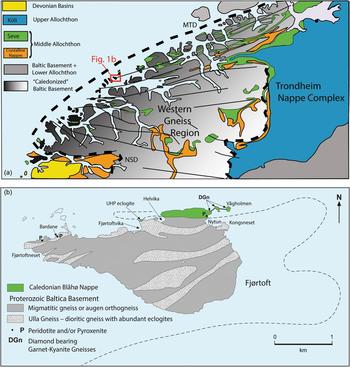
This study focuses on high-grade gneisses exposed within the northern part of the WGR (Fig. 1a) – a giant Baltic (U)HP terrane exposed in the high-grade core of the Scandinavian Caledonides of western Norway (e.g. Hacker et al. Reference Hacker, Andersen, Johnston, Kylander-Clark, Peterman, Walsh and Young2010, Reference Hacker, Kylander-Clark, Holder, Andersen, Peterman, Walsh and Munnikhuis2015). The WGR is predominantly composed of felsic-to-intermediate orthogneisses and psammitic metasediments with Mesoproterozoic and Neoproterozoic protoliths derived from the Fennoscandian craton and its pre- to syn-orogenic metasedimentary cover (the ‘para-autochthon’) rocks (e.g. Krill, Reference Krill1980, Reference Krill, Gee and Sturt1985; Gaál & Gorbastschev, Reference Gaál and Gorbastschev1987; Tucker et al. Reference Tucker, Krogh, Råheim, Gower, Rivers and Ryan1991, Reference Tucker, Robinson, Solli, Gee, Thorsnes, Krogh, Nordgulen and Bickford2004; Robinson et al. Reference Robinson, Roberts, Gee, Solli, Corfu, Gasser and Chew2014; Young, Reference Young2018). Near the southeastern margin of the WGR, the terrane is dominated by rocks resembling the pristine Baltican basement rocks of the foreland. Towards the northwest and west, however, the basement rocks are intensely Caledonized, i.e. reworked by Caledonian tectonism and metamorphism, and show widespread evidence for (U)HP metamorphism, mainly in the form of abundant pods of eclogite, but also HP or UHP felsic rocks (Krogh, Reference Krogh1977; Griffin & Brueckner, Reference Griffin and Brueckner1985; Cuthbert et al. Reference Cuthbert, Carswell, Krogh-Ravna and Wain2000; Hacker et al. Reference Hacker, Andersen, Johnston, Kylander-Clark, Peterman, Walsh and Young2010). In the highest-P parts of the WGR, several isolated bodies of mantle-derived ultramafic rocks including dunite, garnet peridotite and garnet pyroxenites appear (e.g. Brueckner et al. Reference Brueckner, Carswell, Griffin, Medaris, Van Roermund and Cuthbert2010), reinforcing the evidence that the WGR rocks have been subducted into the mantle. The eclogite-facies mineral assemblages have been pervasively overprinted by amphibolite and granulite-facies parageneses associated with exhumation, decompression, partial melting and late flattening and shearing (Wilks & Cuthbert, Reference Wilks and Cuthbert1994; Labrousse et al. Reference Labrousse, Jolivet, Agard, Hebert and Andersen2002; Hacker et al. Reference Hacker, Andersen, Johnston, Kylander-Clark, Peterman, Walsh and Young2010). However, the overprint was not total, and fresh eclogite bodies are still frequent across the WGR.
(a) Simplified geological map of the Western Gneiss Region (modified after Brueckner & Cuthbert, Reference Brueckner and Cuthbert2013) with (b) generalized geological map of Fjørtoft (after Carswell & van Roermund, Reference Carswell and van Roermund2005) showing the location of the diamond-bearing garnet kyanite gneiss. NSD – Nordfjord-Sogn detachment zone; MTD – Møre Trondelag detachment zone; black dashed line – early E/SE late W/NW décollements; black thin lines – W/NW vergent lineation directions.

An exceptional effort in multi-method chronology during the past decades has constrained the age of (U)HP metamorphism to between 425 and 400 Ma, i.e. during the Scandian Orogeny (Hacker et al. Reference Hacker, Andersen, Johnston, Kylander-Clark, Peterman, Walsh and Young2010 and references therein). During this time, the hyper-extended Baltic margin was buried beneath the Laurentian continental lithosphere at rates of c. 5 mm a−1 (Cutts & Smit, Reference Cutts and Smit2018), ultimately reaching depths of 100 km or more (Hacker et al. Reference Hacker, Andersen, Johnston, Kylander-Clark, Peterman, Walsh and Young2010 and references therein). The (U)HP stage was followed by amphibolite-facies overprinting between 400 and 385 Ma (Terry et al. Reference Terry, Robinson, Hamilton and Jercinovic2000a; Kylander-Clark et al. Reference Kylander-Clark, Hacker and Mattinson2008; Krogh et al. Reference Krogh, Kamo, Robinson, Terry and Kwok2011) and cooling below 400°C by c. 375 Ma (Hacker & Gans, Reference Hacker and Gans2005; Root et al. Reference Root, Hacker, Gans, Ducea, Eide and Mosenfelder2005; Walsh et al. Reference Walsh, Hacker, Gans, Wong and Andersen2013).
The WGR basement is bounded by the major Caledonide thrust complexes of the Middle and Upper Allochthons. The Middle Allochthon comprises discrete lithotectonic units that vary along the orogen. In southern Norway it is dominated by Proterozoic crystalline complexes with metasandstones, e.g. the Jotun Nappe Complex, Lindås and Jaeren Nappes. In central and northern Sweden and northern Norway, Caledonian high-grade rocks, e.g. migmatite, granulite, metasandstone, augen gneiss, amphibolite and eclogite of the Seve and Kalak Nappe Complexes, dominate (see e.g. Gee et al. Reference Gee, Janák, Majka, Robinson and van Roermund2013 and references therein). The Middle Allochthon is interpreted to represent the distal continental margin of Baltica and may include microcontinental fragments (Cuthbert et al. Reference Cuthbert, Harvey and Carswell1983; Andersen et al. Reference Andersen, Jamtveit, Dewey and Swensson1991; Emmett, Reference Emmett and Brewer1996; Gee et al. Reference Gee, Juhlin, Pascal and Robinson2010, Reference Gee, Janák, Majka, Robinson and van Roermund2013). The Upper Allochthon contains a diverse assemblage of ophiolite and arc rocks that originated outboard of Baltica within the Iapetus Ocean between 490 and 440 Ma (Stephens & Gee, 1985, Reference Stephens, Gee and Dallmeyer1989; Stephens, Reference Stephens1988).
Both allochthons underwent reworking and final emplacement onto the Baltican continental margin during the Scandian collision. In addition, however, they show evidence of earlier tectonometamorphic episodes. In the large Seve Nappe Complex in Sweden, as well as in small slivers of allochthonous rocks in southwesternmost Norway, this is indicated by (U)HP metamorphism at c. 460–445 Ma, which has been attributed to a pre-Scandian arc-continent collision (e.g. Brueckner et al. Reference Brueckner, van Roermund and Pearson2004; Brueckner & Van Roermund, Reference Brueckner and van Roermund2004, Reference Brueckner and van Roermund2007; Smit et al. Reference Smit, Scherer, Bröcker and van Roermund2010, Reference Smit, Bröcker, Kooijman and Scherer2011; Majka et al. Reference Majka, Be’eri-Shlevin, Gee, Ladenberger, Claesson, Konecny and Klonowksa2012, Reference Majka, Rosén, Janák, Froitzheim, Klonowska, Manecki, Sasinková and Yoshida2014; Root & Corfu, Reference Root and Corfu2012; Grimmer et al. Reference Grimmer, Glodny, Drüuppel, Greiling and Kontny2015; Klonowska et al. Reference Klonowska, Janák, Majka, Froitzheim and Kośmińska2016, Reference Klonowska, Janák, Majka, Petrík, Froitzheim, Gee and Sasinkowá2017; Fassmer et al. Reference Fassmer, Klonowska, Walczak, Andersson, Froitzheim, Majka, Fonseca, Münker, Janák and Whitehouse2017). Yet older, c. 500–485 Ma (U)HP metamorphic rocks are also recognized in the Seve Nappe Complex of northern Sweden (Mørk et al. Reference Mørk, Kullerud and Stabel1988; Root & Corfu, Reference Root and Corfu2012; Barnes et al. Reference Barnes, Majka, Schneider, Walczak, Bukała and Kośmińska2019).
In the foreland regions of southern Norway, and central and northern Sweden, an additional nappe complex, the Lower Allochthon, underlies the Middle Allochthon and comprises thrusted repetitions of basement and sedimentary cover derived from the Fennoscandian shield (hereafter termed the Baltican basement). These rocks record the long-lived thrusting of the allochthons onto the Baltic margin during the Scandian.
Outcropping within the high-grade sections of the Baltican basement in the WGR are belts (inliers) of more diverse lithological assemblages including psammitic and pelitic metasediments, anorthosites and distinctive megacrystic augen gneisses. Such assemblages may represent basement-cover repetitions derived from the Baltica slab (i.e. Lower Allochthon), although they commonly also exhibit lithological similarities with the Middle Allochthon in the main allochthon exposures (Krill, Reference Krill1980; Robinson, Reference Robinson1995; Robinson et al. Reference Robinson, Roberts, Gee, Solli, Corfu, Gasser and Chew2014).
These inliers of the allochthons are conventionally regarded as being above the main mass of orthogneisses in the tectonostratigraphy and down-folded into these (Krill, Reference Krill, Gee and Sturt1985; Tucker et al. Reference Tucker, Robinson, Solli, Gee, Thorsnes, Krogh, Nordgulen and Bickford2004; Robinson & Hollocher, Reference Robinson, Hollocher, Robinson, Roberts and Gee2008). The complete sequence is (from base to top above the Baltican basement) the Risberget nappe (augen orthogneisses, anorthosites, metagabbros); Saetra Nappe (quartzite with deformed dykes of metadolerite); Blåhø Nappe (high-grade metapelite, calc-silicate, marble, amphibolite and mafic granulite); Støren Nappe (ophiolitic and arc rocks of greenschist to low amphibolite facies). The last of these is part of the Upper Allochthon, while the others are correlated with the Middle Allochthon. The Blåhø Nappe is correlated with the high-grade Middle Seve Nappe in the main allochthon outcrop in central and northern Sweden. Their structural evolution has been established in the northeastern WGR in the Trollheimen–Trondheim district (Robinson et al. Reference Robinson, Roberts, Gee, Solli, Corfu, Gasser and Chew2014), where tectonostratigraphic units of the Middle Allochthon were thrust over the Baltican basement, then this combined sequence was folded to form a basement cored nappe that was translated eastwards towards the foreland along the late, out-of-sequence, Storli Thrust. The nappe core contains eclogite dated at 425 ± 10 Ma (Beckman et al. Reference Beckman, Möller, Söderlund, Corfu, Pallon, Chamberlain, Corfu, Gasser and Chew2014), but the lower basement unit below the thrust is devoid of eclogite. The same sequence can be traced to Moldefjord and the southern part of the Nordøyane, far to the west (Fig. 1; see also Robinson, Reference Robinson1995). A similar structural evolution was demonstrated by Young (Reference Young2018) in the central WGR, where allochthonous rocks (‘mixed rocks’) were tectonically imbricated and infolded following emplacement onto the Baltica basement along major foreland-vergent shear zones.
The allochthons have also been mapped out eastwards into the main allochthon outcrop in the frontal zone in central Sweden (e.g. Gee et al. Reference Gee, Juhlin, Pascal and Robinson2010). Here, the Middle Allochthon is more continuously exposed, is several km thick and bounded by major thrusts. In the WGR, however, these nappes are either extremely attenuated to a few metres in thickness or excised entirely (Robinson, Reference Robinson1995). In the Trondheim area and southwestwards to Moldefjord the upper boundary of the Middle Allochthon against the Upper Allochthon is a major west-vergent, late orogenic ductile detachment fault, the Agdenes Detachment (Robinson et al. Reference Robinson, Roberts, Gee, Solli, Corfu, Gasser and Chew2014).
2.a. Nordøyane ultra-high-pressure domain
The sample investigated here comes from the island of Fjørtoft (Fig. 1b) in the Nordøyane archipelago, immediately west of Moldefjord, which lies within the northernmost UHP domain of the WGR (Root et al. Reference Root, Hacker, Gans, Ducea, Eide and Mosenfelder2005). The Middle Allochthon sequence established in the Trollheimen–Moldefjord area has been mapped across the Nordøyane by Terry & Robinson (Reference Terry and Robinson2003, Reference Terry and Robinson2004). The lithology of interest is a pelitic garnet–kyanite gneiss in an assemblage also including biotite–garnet migmatite, calc-silicate, marble and eclogite, all correlated with the Blåhø Nappe. The structural and fabric evolution in the Nordøyane provides key constraints in the interpretation of the zircon dating set out in the following sections.
There are two major structural domains in Nordøyane (Terry & Robinson, Reference Terry and Robinson2003, Reference Terry and Robinson2004) separated by a major late-orogenic, steep sinistral discontinuity, the Åkre-Midøy shear zone. To its south the structural evolution resembles the situation in Trollheimen and Moldefjord. The northern structural domain has been brought in against the southern domain from the NE by motion along the Åkre–Midøy shear zone (Terry & Robinson, Reference Terry and Robinson2003, Reference Terry and Robinson2004). Evidence for UHP metamorphism is found in the Baltican basement, the allochthons and in mantle-derived ultramafic massifs (Dobrzhinetskaya et al. Reference Dobrzhinetskaya, Eide, Larsen, Sturt, Trønnes, Smith, Taylor and Posukhova1995; Terry et al. Reference Terry, Robinson, Hamilton and Jercinovic2000a; Carswell et al. Reference Carswell, Van Roermund and Wiggers Devries2006; Vrijmoed et al. Reference Vrijmoed, Van Roermund and Davies2006; Spengler et al. Reference Spengler, Brueckner, van Roermund, Drury and Mason2009; Butler et al. Reference Butler, Jamieson, Steenkamp and Robinson2013). The Middle Allochthon is only represented by the Blåhø Nappe, which has been folded into the core of a large recumbent, isoclinal synform with dioritic to granitoid gneisses of the Baltican basement on either limb (Terry & Robinson, Reference Terry and Robinson2004). The contact is coincident with an eclogite- (or HP granulite-)facies shear zone that extends through Blåhø and a few hundred metres into the adjacent basement, and in which mylonite lineations and rotated porphyroclasts show top-SE shear sense when the folds are restored to pre-folding geometry (Terry et al. Reference Terry, Robinson, Hamilton and Jercinovic2000a; Terry & Robinson, Reference Terry and Robinson2004). These fabrics are associated with transformation of two metagabbro lenses to eclogite (Mørk, Reference Mørk1985; Terry & Robinson, Reference Terry and Robinson2004) dated at 410 ± 2 Ma (Krogh et al. Reference Krogh, Kamo, Robinson, Terry and Kwok2011; see also Mørk & Mearns, Reference Mørk and Mearns1986). Terry et al. (Reference Terry, Robinson, Hamilton and Jercinovic2000a) and Terry & Robinson (Reference Terry and Robinson2004) proposed that this shear zone emplaced the UHP Blåhø Nappe over Baltican basement that had only experienced HP eclogite conditions, but Carswell et al. (Reference Carswell, Van Roermund and Wiggers Devries2006) showed that nearby eclogites in the Baltican basement equilibrated under UHP conditions, in which case the shear zone operated during exhumation and the metamorphic assemblages are retrograde. It remains possible, however, that all the UHP eclogites are part of the sheared basement pediment attached to the underside Blåhø Nappe and a cryptic HP basement unit lies at a deeper structural level.
Lenses of garnet peridotite and pyroxenite derived from subcontinental mantle decorate the basement-cover contact and are scattered through the Baltica basement in a zone a few hundred metres below it, confirming the existence of a fundamentally important tectonic contact here. Late fabrics defined by UHP mineral assemblages in these garnet pyroxenites at Bardane, Fjørtoft and Flemsøy give P ≈ 6 GPa at sub-geotherm temperatures for cratonic mantle (e.g. Vrijmoed et al. Reference Vrijmoed, Van Roermund and Davies2006; Scambelluri et al. Reference Scambelluri, van Roermund and Pettke2010). A mineral isochron age of 429 ± 3.1 Ma for this mineral assemblage was interpreted to represent an early stage in the subduction of the outermost Baltica continental margin (Spengler et al. Reference Spengler, Brueckner, van Roermund, Drury and Mason2009).
Two kyanite eclogites from the Blåhø Nappe very close to its lower boundary record P–T conditions overlapping the diamond stability field (Terry et al. Reference Terry, Robinson, Hamilton and Jercinovic2000a), and one of these gives a Lu–Hf mineral age of 404.9 ± 7.9 Ma (Cutts & Smit, Reference Cutts and Smit2018). A distinctive feature of the Blåhø in the Nordøyane and Moldefjord area is that eclogites and other mafic rocks are a common part of the rock assemblage, while these are less common in the main outcrop of the equivalent Seve Nappe in Sweden. An eclogite from the island of Gossa, adjacent to Fjørtoft, gives a Scandian Sm–Nd mineral isochron age of 413.9 ± 3.7 Ma (Kylander-Clark et al. Reference Kylander-Clark, Hacker, Johnson, Beard, Mahlen and Lapen2009). Another two from the mainland along-strike from Nordøyane have given Scandian ages for (U)HP metamorphism (418 ± 27 Ma, Tverfjell north of Molde (Griffin & Brueckner, Reference Griffin and Brueckner1985); and 415.2 ± 0.6 Ma, Averøya, near Kristiansund (Krogh et al. Reference Krogh, Kamo, Robinson, Terry and Kwok2011)).
The age of UHP metamorphism in the Baltican basement in the northern domain is constrained by a U–Pb zircon date of 405 ± 1 Ma from an eclogite at Midsund, Otrøy (Krogh et al. Reference Krogh, Kamo, Robinson, Terry and Kwok2011), although, puzzlingly, Kylander-Clark et al. (Reference Kylander-Clark, Hacker and Mattinson2007) derived Lu–Hf garnet and Sm–Nd garnet whole-rock ages for this eclogite of 380 ± 14 Ma and 388 ±10 Ma, respectively, which are significantly younger than any other UHP eclogite ages in the WGR; they are, however, Scandian. Zircons from the Svartberget microdiamond-bearing metasomatic veins in garnet websterite within Baltican basement orthogneiss give a robust U–Pb (laser ablation inductively coupled plasma mass spectrometry (LA-ICP-MS)) age for a cluster of concordant points of 410.6 ± 2.6 Ma (A Quas-Cohen, unpub. PhD thesis, Univ. Manchester, 2013) which is taken to date metasomatism and microdiamond formation. Samples from the same body also yielded significantly younger and perhaps less robust dates by U–Pb on zircon using isotope dilution thermal ionization mass spectrometry (ID-TIMS), which gave a discordia intercept of 397.2 ± 1.2 Ma (Vrijmoed et al. Reference Vrijmoed, Austrheim, John, Hin, Corfu and Davies2013), and Sm–Nd mineral isochrons yielded dates of 393 ± 3 Ma to 381 ± 6 Ma (Vrijmoed et al. Reference Vrijmoed, Van Roermund and Davies2006), interpreted to be cooling ages.
Overall, it is possible to reconstruct an evolution for this northern, UHP domain, based on the tectonic model of Terry & Robinson (Reference Terry and Robinson2004) in Nordøyane and adjacent areas:
1) The Blåhø Nappe is emplaced on to the Baltica basement (time uncertain but before 430 Ma).
2) Baltica basement and Blåhø Nappe are subducted deep enough to capture mantle ultramafic rocks (at least 200 km) at ~430 Ma during the early stages of the Scandian continent–continent collision.
3) UHP eclogites form, or continue to equilibrate, in both units until ~410 Ma.
4) The Blåhø Nappe and a detached pediment of Baltica Basement rise as a nappe over the (still descending?) deeper basement, generating the top-southeast HP eclogite or HP granulite shear fabrics (≤410 Ma).
The available evidence favours a common, roughly synchronous, Scandian diamond-eclogite facies metamorphism for both the Blåhø Nappe and the Baltica basement in the northern domain of Nordøyane, with a basement-cover nappe similar in geometry to the Trollheimen–Moldefjord region but operating at much deeper levels. The whole basement-cover package in both northern and southern structural domains has then been refolded about upright folds associated with a pervasive, sinistral or top-west amphibolite-facies fabric with horizontal lineations and fold axes (Terry & Robinson, Reference Terry and Robinson2003) dated at 396 Ma from boudin-neck pegmatites (Krogh et al. Reference Krogh, Kamo, Robinson, Terry and Kwok2011). (U)HP lithologies and fabrics are preserved only as rare relics where they have survived overprinting by the late-orogenic deformation. Any signature of pre-Scandian metamorphism must have survived both this and the Scandian UHP tectono-metamorphism.
3. Sample description
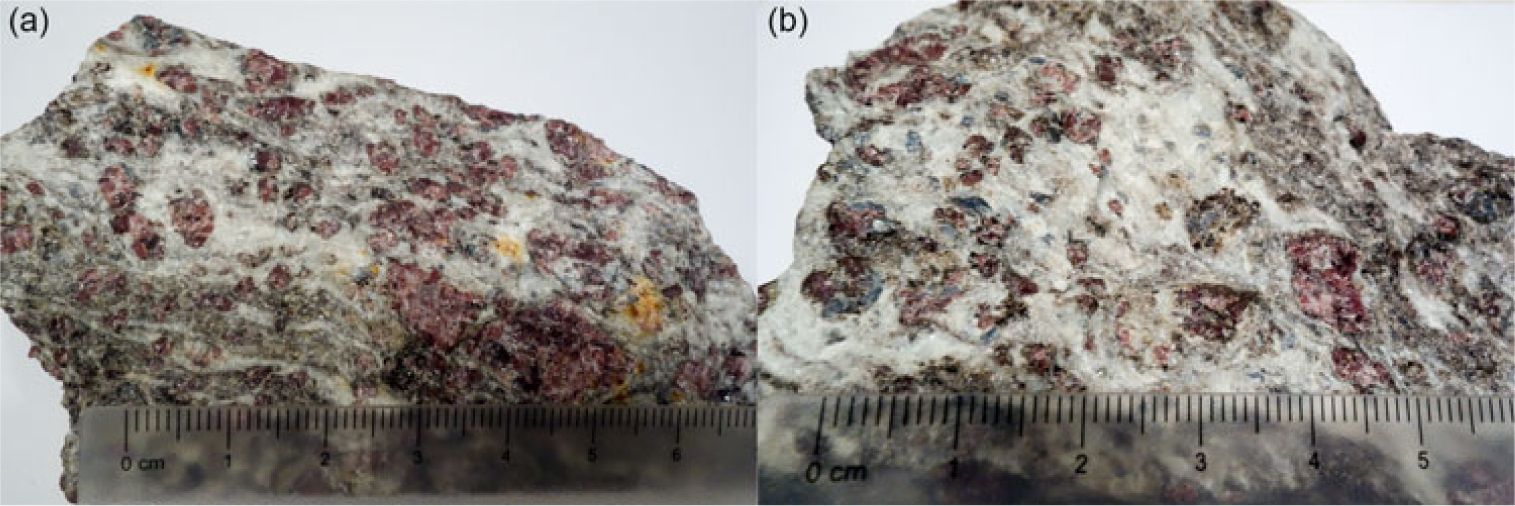
The sample investigated here was collected from an old quarry at Vågholmane, just north of the ferry terminal. It is the residue of the same sample (ID: Fj-19; Fig. 2) from which Dobrzhinetskaya et al. (Reference Dobrzhinetskaya, Eide, Larsen, Sturt, Trønnes, Smith, Taylor and Posukhova1995) extracted metamorphic diamond by a chemical dissolution process performed on a crushed block. The lithology has been described previously by Dobrzhinetskaya et al. (Reference Dobrzhinetskaya, Eide, Larsen, Sturt, Trønnes, Smith, Taylor and Posukhova1995), Holder et al. (Reference Holder, Hacker, Kylander-Clark and Cottle2015), Liu & Massone (Reference Liu and Massone2019) and Terry et al. (Reference Terry, Robinson and Ravna2000b); the latter’s sample (recoded by them as UHP1) was a thin-section cut from the microdiamond-bearing sample, so is the same sample block from which our zircons were sourced. It is composed of garnet, kyanite, phlogopite, K-feldspar, plagioclase, quartz, graphite and additionally rutile, sulphides, monazite and zircon. Garnet is abundant, pale mauve-coloured, typically 0.5–1.0 cm in size, and locally occurs as globular megacrysts of 3–5 cm surrounded by conspicuous coronas of felsic minerals. It shows distinctive zoning with low-Ca garnet cores (Terry et al. Reference Terry, Robinson and Ravna2000b; Holder et al. Reference Holder, Hacker, Kylander-Clark and Cottle2015; Liu & Massone, Reference Liu and Massone2019; authors’ unpublished data) enclosing abundant, small needles of kyanite. High-Ca rims contain larger inclusions of kyanite, quartz, rutile, graphite, perthitic feldspar and sulphides, along with rationally orientated needles of rutile. It has not often been recognized that the rock is a blastomylonite with streaky appearance suggesting pre-tectonic migmatization. Relics of granitic (partial) melt are preserved as embayments, and inclusions in the garnet rims and are composed of perthite, quartz and phlogopite. Monazite and zircon are found in both cores and rims of garnet. The rock matrix is generally composed of fine-grained plagioclase and K-feldspar (from the breakdown of coarse perthite and garnet), quartz and large flakes of phlogopite and graphite. No microdiamond has yet been found in situ, nor any other (U)HP phases, although muscovite inclusions in garnet associated with phlogopite may be relics after phengite. Larsen et al. (Reference Larsen, Eide and Burke1998), who described the rock as a ‘felsic granulite’, estimated P = 16–23 kbar at 600–800 °C for the matrix assemblage assuming equilibrium with garnet rims. However, the recent detailed study by Liu & Massone (Reference Liu and Massone2019) suggests that this rock most probably underwent a prolonged anticlockwise P–T path, with peak conditions around 1.35–1.45 GPa and 770–820 °C and an earlier equilibration event at c. 1.2–1.3 GPa and c. 880 °C.
Hand specimen of the diamond-bearing garnet–kyanite gneiss from Fjørtoft (sample ID: Fj-19).

In the field, two linear fabrics can be recognized in the Blåhø Nappe felsic gneisses (Terry et al. Reference Terry, Robinson, Hamilton and Jercinovic2000a; Terry & Robinson, Reference Terry and Robinson2004). The earlier fabric is represented by the sample UHP1 described above, and is defined by mineral-aggregate rods and common orientation of kyanite. Kinematic indicators on steep foliation surfaces include rotated kyanite and garnet porphyroclasts indicating north-side-up shear that translates to top-southeast shear when the effects of later folding are removed, as found in the eclogite-facies shear zones described above. Terry & Robinson (Reference Terry and Robinson2004) attributed the tectonite fabrics of the basement metagabbros and dioritic orthogneisses to the same kinematic system as this early fabric in the Blåhø Nappe gneiss, suggesting that it operated at c. 410 Ma, postdating an episode of partial melting, and was related to foreland-directed transport of a (U)HP basement with associated Seve–Blåhø allochthon.
The later fabric is a mineral-aggregate rodding lineation defined by sillimanite replacing deformed, fish-shaped kyanite porphyroclasts or disseminated in the matrix, which displays extreme grain-size reduction. Garnet porphyroclasts are dismembered and strung out in the lineation (Terry et al. Reference Terry, Robinson and Ravna2000b). Mica- and sillimanite-rich elements of the matrix display S-C fabrics. The lineations and associated fold axes are roughly horizontal, and the kinematic indicators show consistent top-west or sinistral shear. This fabric overprints and reorientates the steeper kyanite lineation. This late top-west shear fabric also dominates large parts of the allochthons and some of the adjacent basement gneisses in the westernmost WGR, indicating a top-to-the-west transport. This was related to reversal of motion on the major thrust surfaces, the development of Agdenes Detachment and Nordfjord–Sogn Detachment Zone and the late-orogenic Old Red Sandstone basins (Norton, Reference Norton1987; Wilks & Cuthbert, Reference Wilks and Cuthbert1994; Brueckner & Cuthbert, Reference Brueckner and Cuthbert2013; Robinson et al. Reference Robinson, Roberts, Gee, Solli, Corfu, Gasser and Chew2014; Young, Reference Young2018).
Zircons in the mineral separate that we obtained from sample Fj-19 contain micro-inclusions of quartz, feldspar, mica, apatite, graphite and rutile (H-J Massonne, pers. comm., 2005). No HP or UHP indicator micro-inclusions such as diamond, coesite, phengitic mica or jadeitic clinopyroxene have been found. Monazite from the microdiamond-yielding sample has been analysed by electron microprobe (Th–U–total-Pb) and secondary ionization mass spectrometry (U–Th–Pb), along with a sample of porphyroclastic mylonite with the younger lineation from 1 km west of Vågholmane (Terry et al. Reference Terry, Robinson, Hamilton and Jercinovic2000a; their samples UHP1 and 929, respectively). The analyses yield a cluster of dates between 1100 and 950 Ma, a few scattered dates between 900 Ma and 500 Ma, and other clusters at c. 415, 408, 395 Ma and c. 375 Ma. The older dates of 415.0 ± 6.8 Ma (secondary ion mass spectrometry) and 408.0 ± 5.6 Ma (electron-probe microanalysis) were obtained from the same monazite inclusions in garnet and have been interpreted as indicating the maximum age of garnet growth. The two youngest dates were interpreted to represent different phases of exhumation from deep subduction conditions. Recently, Holder et al. (Reference Holder, Hacker, Kylander-Clark and Cottle2015) have also performed in situ monazite U–Th–Pb dating using laser ablation split stream inductively coupled plasma mass spectrometry. These authors dated two samples of the same rock and obtained the following results: a cluster of ages between 1200 and 900 Ma, Caledonian concordia ages peaking at 431.1 ± 1.7 Ma, 426.8 ± 1.7 Ma, 425.5 ± 3.0, 393 ± 3.0 Ma and 391.3 ± 2.7 Ma. Contrasting rare earth element (REE) patterns for inclusions and matrix grains dated at c. 425 Ma suggest that garnet growth took place at this time, but other inclusions as young as c. 390 Ma may indicate either continued growth to this time or resetting. A continued growth of monazite is also suggested by Liu & Massone (Reference Liu and Massone2019), who reported Th–U–total-Pb monazite dates spanning from 460 to 380 Ma and interpreted them to reflect a prolonged residence time under relatively high temperatures due to two burial events that have never reached UHP conditions. We differ by not ruling out diamond-stable P–T conditions at some time during the rock history, as some stages of it may have been destroyed during overprinting, for example during partial melting.
To our knowledge, no zircon dates have so far been documented in the literature for this unusual and widely studied rock.
4. Methods
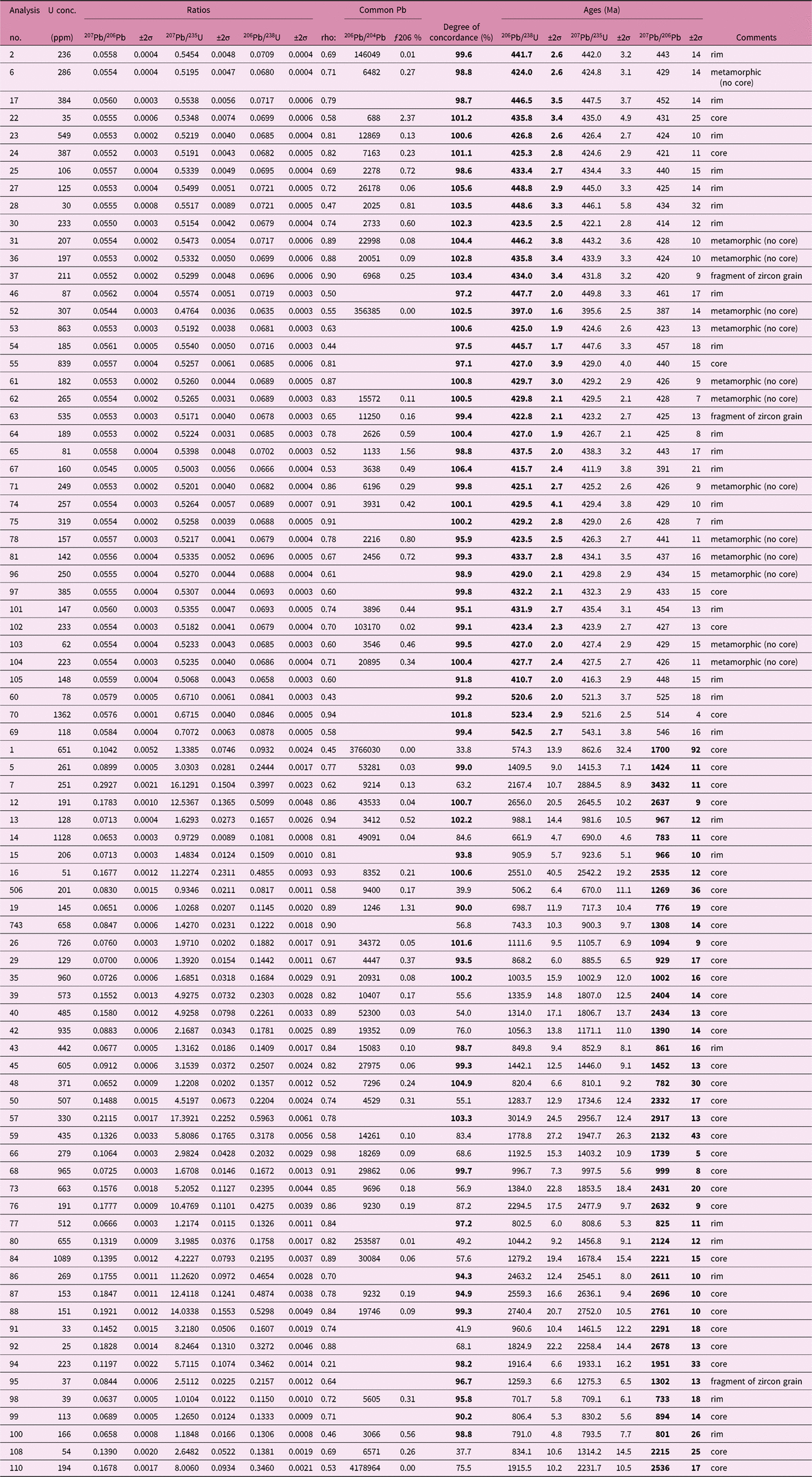
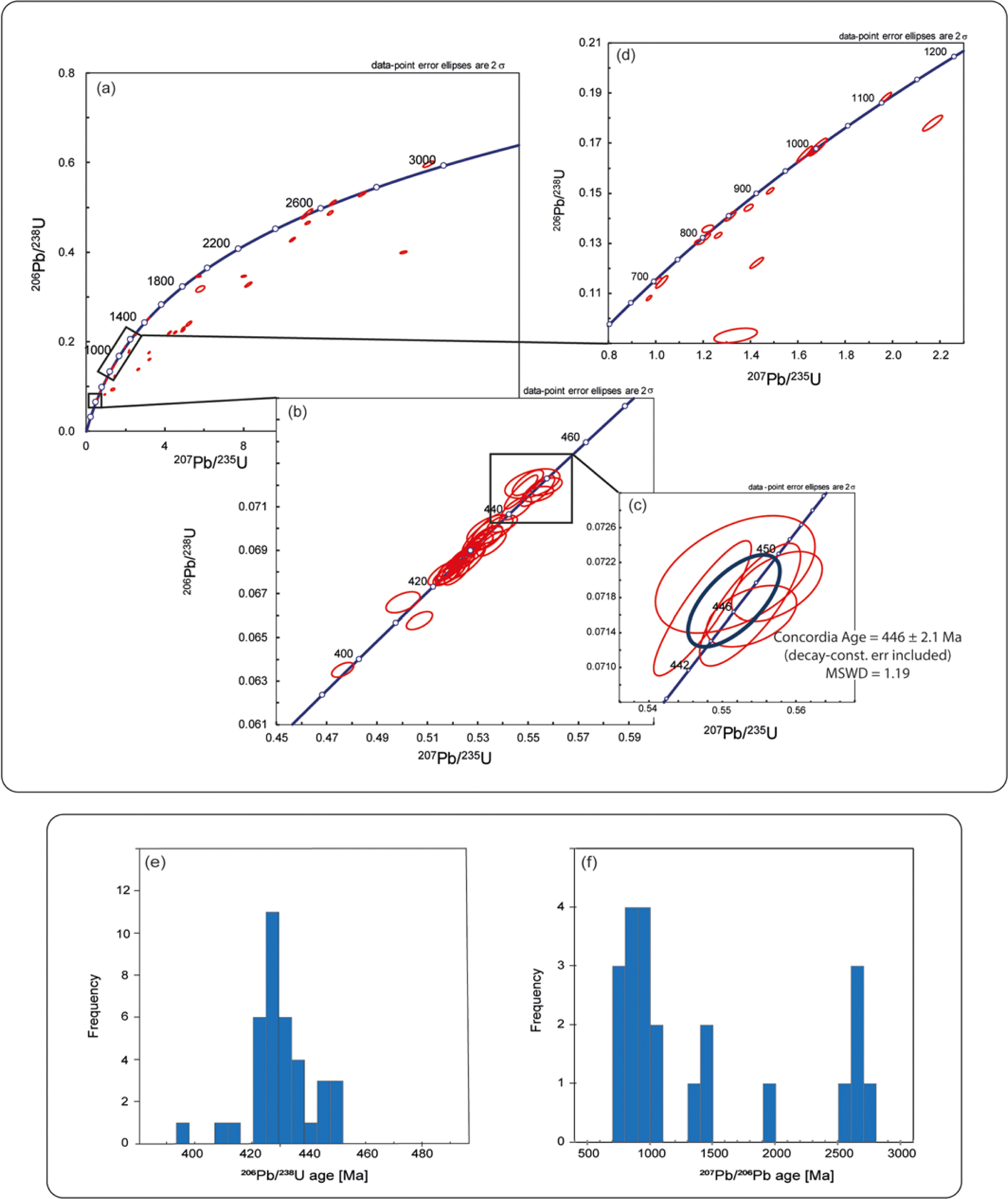
U–Pb dating was performed on zircon grains initially separated by DA Carswell and H-J Massonne for studies of inclusions; the separate was kindly provided by H-J Massonne, who mounted and polished the grains in an epoxy mount. The zircon grains are from the same rock volume from which microdiamond was isolated (Dobrzhinetskaya et al. Reference Dobrzhinetskaya, Eide, Larsen, Sturt, Trønnes, Smith, Taylor and Posukhova1995). The grains are 100–250 μm in length and were polished to their geometric core. U–Pb dating of zircon was performed at the Swedish Museum of Natural History, Stockholm, using a Nu Instruments Plasma II multi-collector inductively coupled plasma mass spectrometry (MC-ICPMS) instrument coupled to an ESI NWR193UC excimer laser ablation system. The m/z (mass-to-charge ratios) corresponding to masses 202, 204, 206, 207 and 208 were measured on ion counters, and those corresponding to 232, 235 and 238 were measured on Faraday collectors. The laser was fired for 35 s with a fluence of 3.5 J cm−2, a pulse rate of 8 Hz and a spots size of 15 μm. Helium was used as a sample carrier gas (0.3 L min−1) to flush the laser cell and was mixed with argon sample gas (0.9 L min−1) before entering the ICP-MS. Analyses were corrected for mass bias and elemental fractionation using the protocols of Kooijman et al. (Reference Kooijman, Berndt and Mezger2012). The 91500 zircon reference material (1065 Ma; Wiedenbeck et al. Reference Wiedenbeck, Allé, Corfu, Griffin, Meier, Oberli, von Quadt, Roddick and Spiegel1995) was used for normalization, and repeated analyses indicated external reproducibility of 1.0 % 2RSD for the 207Pb–206Pb age and 1.2 % 2RSD for the 206Pb–238U age (n = 58). Accuracy was assessed by analysing the secondary reference zircons Plešovice (337 Ma; Sláma et al. Reference Sláma, Košler, Condon, Crowley, Gerdes, Hanchar, Horstwood, Morris, Nasdala, Norberg, Schaltegger, Schoene, Tubrett and Whitehouse2008), GJ-1 (609 Ma; Jackson et al. Reference Jackson, Pearson, Griffin and Belousova2004) and Temora 2 (417 Ma; Black et al. Reference Black, Kamo, Allen, Davis, Aleinikoff, Valley, Mundil, Campbell, Korsch, Williams and Foudoulis2004). We obtained 336 ± 11 Ma (Plešovice; n = 8), 606 ± 3 Ma (GJ-1; n = 8), and 416 ± 9 Ma (Temora 2; n = 5), all of which agree within 1 % of published age estimates for these materials. Data reduction employed in-house Excel macros. Age calculations and construction of concordia diagrams were prepared using the Excel extension Isoplot 3.75 (Ludwig, Reference Ludwig2012). All uncertainties are reported at the 2σ level. Age data are illustrated in Figure 4 below and presented in Table 1.
Summary of the U–Pb zircon analyses from the diamond-bearing garnet kyanite gneiss

5. Results
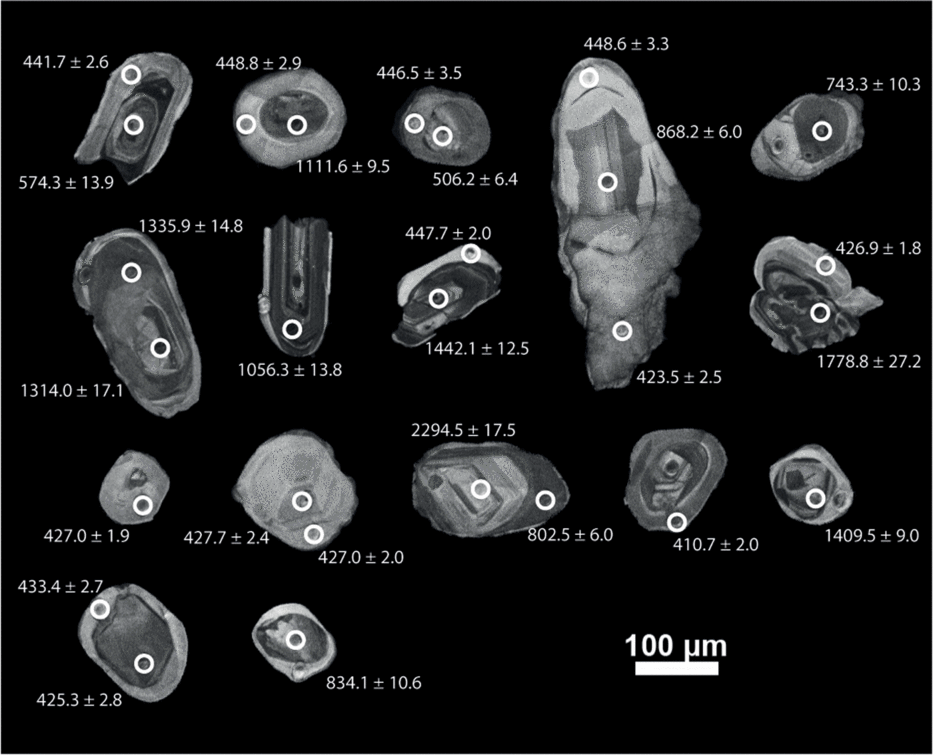
Separated zircon grains are spherical or slightly elongated in shape, with rounded edges. Cathodoluminescence (CL) images reveal complex internal structure, and most zircons display obvious multi-stage growth features (Fig. 3). Most commonly, zircon grains display cores with well-defined concentric oscillatory zoning, typical of magmatic zircon, which is overgrown by bright-CL rims. Such rims show no visible zoning and are likely of metamorphic origin. U–Pb isotope data obtained from the dated grains are presented in Table 1 and reveal a complex multi-component age signature. The majority of dates older than 700 Ma were obtained from zircon cores and display significant degrees of discordance (Fig. 4a, d, f). Several 207Pb–206Pb date clusters can be distinguished among the obtained results: (1) a Neoarchaean cluster between 2.8 and 2.5 Ga (n = 6); (2) a small cluster in the Mesoproterozoic (1.5–1.3 Ga; n = 3); (3) late Mesoproterozoic to early Neoproterozoic dates between 1.1 and 0.9 Ga (n = 6); and (4) a group of Neoproterozoic dates between 0.9 and 0.7 Ga (n = 7). A small group of three concordant dates between 540 and 520 Ma (Table 1) was also obtained, one of which is from a core domain, whereas the other two were obtained from rims. A notable number of Caledonian spot dates range from 450 to 400 Ma (Fig. 4b). Two subgroups of dates can be distinguished among the concordant results (Fig. 4e). Five of the oldest Caledonian dates cluster between 450 and 440 Ma and give a concordia age of 446.6 ± 2.1 Ma (Fig. 4c). Another cluster of concordant dates is observed between 437 and 423 Ma, and yields a weighted average 206Pb–238U date of 428.3 ± 1.7 Ma. The three youngest dates are c. 415 Ma and younger.
Cathodoluminescence images of representative zircon crystals from the Fjørtoft diamond-bearing garnet kyanite gneiss. White circles mark analytical spots, and given numbers indicate 206Pb–238U dates.

(a–d) U–Pb concordia diagram for zircon analyses: (a) all analyses for both metamorphic and detrital zircon domains; (b) concordia diagram of zircon with Caledonian ages with inset (c) showing ages for which concordia age has been calculated; (d) magnification of the fragment of concordia diagram (a) showing late Precambrian dates. (e) Histogram of 206Pb–238U age frequency of metamorphic zircon domains. (f) Histogram of 207Pb–206Pb age frequency of concordant detrital zircon (10 % discordance accepted).

6. Discussion
6.a. Provenance and exotic nature of the Fjørtoft diamondiferous gneiss
The oldest detrital ages (2.8–2.5 Ga) are not known from the Baltica basement rocks of the WGR. Such detrital ages are, however, observed in the Lower and Middle Allochthons in Sweden (e.g. Gee et al. Reference Gee, Ladenberger, Dahlqvist, Majka, Be’eri-Shlevin, Frei, Thomsen, Corfu, Gasser and Chew2014, Reference Gee, Andréasson, Lorenz, Frei and Majka2015; Ladenberger et al. Reference Ladenberger, Be’eri-Shlevin, Claesson, Gee, Majka, Romanova, Corfu, Gasser and Chew2014), as well as in southwesternmost Norway (Smit et al. Reference Smit, Bröcker, Kooijman and Scherer2011). Two younger groups, 1.5–1.3 Ga and 1.1–0.9 Ga, correspond to the Gothian and Sveconorwegian orogenies, respectively. The older group is widespread in the WGR and marks a major episode of magmatism within the Fennoscandian basement (e.g. Corfu & Andersen, Reference Corfu and Andersen2002; Tucker et al. Reference Tucker, Robinson, Solli, Gee, Thorsnes, Krogh, Nordgulen and Bickford2004; Krogh et al. Reference Krogh, Kamo, Robinson, Terry and Kwok2011). The younger group is also common across the WGR, both in the allochthons and in the basement; it derives from magmatism and metamorphism during the Sveconorwegian Orogeny (e.g. Tucker et al. Reference Tucker, Boyd and Barnes1990; Bingen & van Breemen, Reference Bingen and van Breemen1998; Bingen et al. Reference Bingen, Davis and Austrheim2001; Corfu & Andersen, Reference Corfu and Andersen2002; Røhr et al. Reference Røhr, Corfu, Austrheim and Andersen2004; Walsh et al. Reference Walsh, Hacker, Gans, Grove and Gehrels2007; DesOrmeau et al. Reference DesOrmeau, Gordon, Kylander-Clark, Hacker, Bowring, Schoene and Samperton2015). Terry et al. (Reference Terry, Robinson, Hamilton and Jercinovic2000 a) recognized a similar group of ages among monazite cores from the diamond-bearing gneiss on Fjørtoft. These age components clearly establish the Baltic provenance of this rock, indicating that its sedimentary protolith was deposited within the Baltic continental realm or its Iapetus Ocean margin.
Neoproterozoic ages between 0.9 and 0.7 Ga are less common within the Baltic basement (Bingen & Solli, Reference Bingen and Solli2009). They are, however, reported from detrital zircons in the Seve Nappe Complex in Sweden (Gee et al. Reference Gee, Ladenberger, Dahlqvist, Majka, Be’eri-Shlevin, Frei, Thomsen, Corfu, Gasser and Chew2014), and igneous bodies of similar age are also known from other parts of the Middle Allochthon. Paulsson & Adréasson (Reference Paulsson and Adréasson2002) reported c. 845 Ma U–Pb age of the Vistas granite in the Seve Nappe Complex in northern Sweden, while c. 840 and 710 Ma ages are typical of granitic magmatism in the Sørøy–Seiland and Havvatnet nappes of the Kalak Nappe Complex in northernmost Norway (Kirkland et al. Reference Kirkland, Daly and Whitehouse2006). Walker et al. (Reference Walker, Thirlwall, Strachan and Bird2016) have also reported a c. 725–700 Ma tectonothermal event recorded in the Caledonides of Shetland. Several of these possible sources derive from Neoproterozoic magmatism and tectonism (Renlandian and Knoydartian) whose products were subsequently involved in the northern Iapetus–Caledonide cycle (Cawood et al. Reference Cawood, Strachan, Cutts, Kinny, Hand and Pisarevsky2010). The exact source of zircons with 0.9–0.7 Ga ages in the Fjørtoft sample remains unresolved, but it is clear that these data represent an exotic component acquired when the sedimentary protolith was located in a palaeogeographic location distal to the Baltic craton.
A similar explanation may be proposed for the small group of 540–520 Ma ages, which were also obtained by Terry et al. (Reference Terry, Robinson, Hamilton and Jercinovic2000 a), but who left them uninterpreted. The dates are concordant and form a distinct cluster, indicating that they have geological meaning. Components of similar age are extremely rare in the present-day Scandinavian Caledonides, and are mainly restricted to the Kalak Nappe Complex (e.g. Roberts et al. Reference Roberts, Corfu, Torskvik, Hetherington and Ashwal2010). Interestingly, dates in the range 650–500 Ma are rare but persistently found in the mantle-derived ultramafic rocks and enclosed eclogite in Nordøyane (Jamtveit et al. Reference Jamtveit, Carswell and Mearns1991; Spengler et al. Reference Spengler, Brueckner, van Roermund, Drury and Mason2009) and in the central WGR (Medaris et al. Reference Medaris, Brueckner, Cai, Griffin and Janák2018), suggesting magmatism or tectonism in the Iapetus realm during this interval that may have also had a crustal expression.
The spectrum of different age populations further distinguishes the Fjørtoft gneiss from the adjacent basement orthogneisses and confirms its profoundly allochthonous nature and reinforces its correlation with the Seve–Blåhø Nappe. Moreover, it suggests a previously unrecognized link between this lithotectonic unit and the terranes of the north-Norwegian and Swedish Caledonides.
6.b. Caledonian ages and evidence for double-dunking
U–Pb zircon dates from the Fjørtoft gneiss corresponding to the span of the Caledonian orogenic cycle cluster around c. 447 Ma and c. 437–423 Ma, with three younger dates ≤ c. 415 Ma. The oldest the aforesaid ages was not identified in published monazite age studies by Terry et al. (Reference Terry, Robinson and Ravna2000 b) or Holder et al. (Reference Holder, Hacker, Kylander-Clark and Cottle2015). This age is significantly earlier than almost all previous higher-precision ages for (U)HP-HT metamorphism in the WGR.
This Ordovician age peak may be compared with dates in other outcrops of the allochthons in the WGR. Zircon U–Pb dates of 470–430 Ma were reported for eclogites in allochthonous units (Blåhø Nappe?) in the western and eastern-central parts of the WGR but were attributed to protolith ages (Walsh et al. Reference Walsh, Hacker, Gans, Grove and Gehrels2007 – discordant dates; DesOrmeau et al. Reference DesOrmeau, Gordon, Kylander-Clark, Hacker, Bowring, Schoene and Samperton2015). We speculate that these are lower Palaeozoic metavolcanics similar to the layered eclogites described in the Blåhø Nappe on Fjørtoft by Terry & Robinson (Reference Terry and Robinson2004) and on the mainland north of Molde by Carswell & Harvey (1985). Walsh et al. (Reference Walsh, Hacker, Gans, Grove and Gehrels2007) also reported a protolith (detrital?) zircon age of 480 ± 12 Ma from a pelite in the Blåhø Nappe. However, our zircon ages are clearly metamorphic and do not represent growth in magmatic protoliths. In contrast, Gordon et al. (Reference Gordon, Whitney, Teyssier, Fossen and Kylander-Clark2016) presented U–Pb zircon age populations of c. 467 and c. 439 Ma obtained from leucosomes in metapelites of the Seve–Blåhø Nappe north of Trondheim, which they interpreted to represent (U)HP zircon growth and subsequent migmatization.
The younger of our two larger Caledonian U–Pb zircon age-peaks matches well with the timing of Ca-rich garnet rims as indicated by in situ monazite ages of c. 425 Ma and perhaps as old as 430 Ma (Holder et al. Reference Holder, Hacker, Kylander-Clark and Cottle2015) corresponding to an episode of migmatization evidenced by granitic melt inclusions enclosed in Ca-rich garnet rims. It is also not much younger than the earliest ages attributed to Scandian subduction of the Baltica margin around 430 Ma as indicated by garnet pyroxenites in mantle-derived ultramafites in Nordøyane (Jamtveit et al. Reference Jamtveit, Carswell and Mearns1991; Spengler et al. Reference Spengler, Brueckner, van Roermund, Drury and Mason2009) and elsewhere (Medaris et al. Reference Medaris, Brueckner, Cai, Griffin and Janák2018). These ages are all significantly older than the timing of HP-eclogite facies SE-vergent shearing involving the metagabbros in Nordøyane (Terry et al. Reference Terry, Robinson, Hamilton and Jercinovic2000 a; Terry & Robinson, Reference Terry and Robinson2004) at 410 ± 2Ma (Krogh et al. Reference Krogh, Kamo, Robinson, Terry and Kwok2011) which has been correlated with the SE-vergent shear overprinting the migmatite fabric in the Fjørtoft gneiss. This puts a younger age bracket on the duration of migmatization. Also, ages around 410 Ma are relatively scarce in our dataset, suggesting that during this foreland-directed shearing little new zircon was generated, and/or there was little resetting of the zircon U–Pb isotopic system.
The late Ordovician age components in our dataset (c. 447 Ma) are uncommon or absent in the WGR, but widely recognized within the Seve Nappe Complex of Jämtland in Sweden and in tectonic slivers of probable Middle Allochthon rocks in southwesternmost Norway (e.g. Brueckner et al. Reference Brueckner, van Roermund and Pearson2004; Brueckner & van Roermund, Reference Brueckner and van Roermund2007; Smit et al. Reference Smit, Bröcker, Kooijman and Scherer2011; Majka et al. Reference Majka, Be’eri-Shlevin, Gee, Ladenberger, Claesson, Konecny and Klonowksa2012; Root & Corfu, Reference Root and Corfu2012; Ladenberger et al. Reference Ladenberger, Be’eri-Shlevin, Claesson, Gee, Majka, Romanova, Corfu, Gasser and Chew2014; Grimmer et al. Reference Grimmer, Glodny, Drüuppel, Greiling and Kontny2015; Fassmer et al. Reference Fassmer, Klonowska, Walczak, Andersson, Froitzheim, Majka, Fonseca, Münker, Janák and Whitehouse2017; Klonowska et al. Reference Klonowska, Janák, Majka, Petrík, Froitzheim, Gee and Sasinkowá2017). These terranes record a mid- to late Ordovician episode of (U)HP metamorphism. The lithologies in the Åreskutan Nappe, Middle Seve Nappe in Jamtland, central Sweden, are similar to the Fjørtoft gneiss in that they are metapelitic sillimanite or kyanite-bearing migmatites that record a pre-migmatite, diamond-stable UHP metamorphism. Granulite-facies metamorphism and migmatization has been dated at c. 439 Ma during decompression and partial melting, following UHP metamorphism at c. 455 Ma (Majka et al. Reference Majka, Be’eri-Shlevin, Gee, Ladenberger, Claesson, Konecny and Klonowksa2012). Emplacement of these rocks as a hot nappe above the Lower Seve Nappe Complex was dated from monazite in basal mylonites at 424 ± 6 Ma (Majka et al. Reference Majka, Be’eri-Shlevin, Gee, Ladenberger, Claesson, Konecny and Klonowksa2012) which was within error of the age for crystallization of post-migmatite, pre-mylonite pegmatites during nappe emplacement at c. 430–428 Ma (Ladenberger et al. Reference Ladenberger, Be’eri-Shlevin, Claesson, Gee, Majka, Romanova, Corfu, Gasser and Chew2014). The close correspondence of the age for this migmatization with the earliest Caledonian ages from the Fjørtoft gneiss encourages the tentative proposal that migmatization took place there, too, at that time. While this may be true, the c. 430–428 Ma age for pegmatite intrusion at Åreskutan during Scandian nappe emplacement corresponds closely to the evidence for growth of high-Ca garnet rims in the Fjørtoft gneiss around 430–425 Ma (Holder et al. Reference Holder, Hacker, Kylander-Clark and Cottle2015), which we attribute to partial melting. This suggests that partial melting of the Fjørtoft gneiss took place during the earliest phase of exhumation of the far-western, Blåhø segment of the Seve Nappe Complex. If two episodes of partial melting took place in these rocks (late Ordovician and mid-Silurian), evidence must have been obscured by the subsequent intense ductile shearing. If the Blåhø Nappe in western Norway can be directly correlated with the Seve Nappe Complex in central Sweden, the evidence that the Blåhø Nappe, and possibly a sheared pediment of Baltica basement orthogneisses, was still moving forelandwards around 410 Ma suggests deformation at the base of the Åreskutan Nappe transferred to a deeper structural level soon after c. 425 Ma.
The interpretations above, based on geological evidence and previous geochronological studies, suggest that partial melting may have been significant in generating the zircon U–Pb age pattern. If representative of the rock, the 447 Ma and 437–423 Ma zircon age clusters probably represent discrete stages in which new zircon formed. This may have involved complete neocrystallization and/or recrystallization of pre-existing zircon. The latter is common in (U)HP granulites in other collisional orogens (e.g. Bröcker et al. Reference Bröcker, Klemd, Kooijman, Berndt and Larinov2010), as well as in (ultra-)high-temperature (UHT-HT) rocks (e.g. Mezger & Krogstad, Reference Mezger and Krogstad1997; Kooijman et al. Reference Kooijman, Upadhyay, Mezger, Raith, Berndt and Srikantappa2011), where partial melting was an important process. In the Fjørtoft rocks there was an apparent cessation in zircon crystallization (or neocrystallization) during a period of c. 15 Ma, which also requires explanation.
Zircon crystallization in felsic rocks can take place following an excursion beyond the solidus (Yakymchuk & Brown, Reference Yakymchuk and Brown2014), either by transient decompression or heating or both. The following two options are hence proposed for the interpretation of the 447 and 437–423 Ma age clusters: (1) they postdate two distinct cycles of high-grade, possibly kyanite-stable HT metamorphism, one before 447 Ma and the other before 423 Ma; (2) they bracket two thermal excursions beyond, and back to, the solidus during a single protracted stage of possibly kyanite-stable HT metamorphism. Regardless of which of the two options proves true or which of these may be associated with microdiamond growth, the history and context of the rocks, as set out in the foregoing text, requires at least one pulse of pre-Scandian metamorphism.
Previously published ages derived from the (U)HP eclogites in the Nordøyane and adjacent region in the WGR, mainly in the range 415–400 Ma, are only represented in our dataset by one concordant date of c. 415 Ma and a slightly discordant, similar date (Fig. 4b). The presence of Scandian UHP eclogites in the basal parts of the Blåhø Nappe in Nordøyane (404.9 ± 7.9 Ma; Cutts & Smit, Reference Cutts and Smit2018) suggests that the Blåhø Nappe of Fjørtoft underwent Scandian, perhaps diamond-stable, UHP metamorphism. This apparently resulted in very little new zircon growth or recrystallization in the sample examined here. Scandian UHP eclogite formation in the allochthons and Baltica basement evidently continued well after migmatization of the Blåhø metapelitic gneisses such as those at Fjørtoft (there is evidence that gneisses in this area underwent partial melting during UHP metamorphism; see e.g. Vrijmoed et al. Reference Vrijmoed, Austrheim, John, Hin, Corfu and Davies2013; A Quas-Cohen, unpub. PhD thesis, Univ. Manchester, 2013).
The single concordant metamorphic zircon date at c. 396 Ma is identical within error with a cluster of U–Th–Pb ages for matrix monazites in the Fjørtoft gneiss (Terry et al. Reference Terry, Robinson and Ravna2000b ). This also closely corresponds to a regionally distributed suite of titanite U–Pb ages (Tucker et al. Reference Tucker, Krogh, Råheim, Gower, Rivers and Ryan1991) interpreted to date a widespread cessation of Pb loss during exhumation of the WGR from below the major extensional Agdenes Detachment (Tucker et al. Reference Tucker, Robinson, Solli, Gee, Thorsnes, Krogh, Nordgulen and Bickford2004). The late horizontal lineation and sinistral shear fabric in northern Fjørtoft may be attributed to this late-Scandian tectonism.
The zircon U–Pb dataset presented here demonstrates an early Caledonian, pre-Scandian metamorphic event in the northwestern WGR that corresponds to a mid-Ordovician to early Silurian subduction episode recorded in the main outcrop of the Seve Nappe. The evidence for coeval Scandian UHP metamorphism of the Blåhø Nappe and in the Baltica basement in Nordøyane (and probably more widely in the WGR) strongly suggests that both underwent subduction in the late Silurian and early Devonian, and thus a ‘double-dunk’ for the Blåhø-Seve Nappe of Fjørtoft.
The ‘double-dunk’ hypothesis (Brueckner & van Roermund, Reference Brueckner and van Roermund2004; Brueckner, Reference Brueckner2006) predicts both subduction and eduction of a continental margin, so evidence is required for an episode of exhumation of the subducted slab between any two ‘dunks’; if this is lacking it is difficult to refute a single, prolonged subduction episode. In the WGR, evidence for pre-Scandian tectonism and metamorphism has been effectively obliterated by Scandian deformation and overprinting. All that can be deduced is that assembly of the Middle Allochthon nappe stack and its emplacement onto the Baltica basement was the earliest discernible event (e.g. Robinson et al. Reference Robinson, Roberts, Gee, Solli, Corfu, Gasser and Chew2014). However, petrological evidence for migmatization during decompression in the correlative Åreskutan Nappe in the foreland Seve Nappe Complex (Majka et al. Reference Majka, Be’eri-Shlevin, Gee, Ladenberger, Claesson, Konecny and Klonowksa2012; Klonowska et al. Reference Klonowska, Majka, Janak, Gee, Ladenberger, Corfu, Gasser and Chew2014) shows that the Seve Nappe did, at least partially, exhume following the Ordovician subduction event, but before the Scandian subduction and climactic collision. The distribution of concordant ages in our U–Pb zircon dataset, while showing clear clustering at specific time intervals, does indicate some continuity of Caledonian zircon generation, which may be due to incomplete eduction after the first dunk and stalling at fairly deep, hot crustal levels during the relatively brief interval before the Scandian dunk. Overall, the age pattern from our new geochronological evidence for the Middle Allochthon within the WGR is consistent with the predictions of the dunk tectonics model.
The sample from which our zircon set was separated has been iconic in UHP metamorphic studies since the discovery of microdiamonds within it by Dobrzhinetskaya et al. (Reference Dobrzhinetskaya, Eide, Larsen, Sturt, Trønnes, Smith, Taylor and Posukhova1995), as this was the first metamorphic microdiamond find in the Caledonides and one of the first globally. Yet this sample remains enigmatic because no microdiamond has yet been found in situ within it. The demonstration of multiple metamorphic events in this rock, of which two are probably high- or ultrahigh-grade, begs the question of the genesis of the diamonds, although this is challenging because of their lack of petrographic context. The possible double-dunk scenario for the Fjørtoft gneiss set out above permits that these rocks passed through diamond-stable physical conditions twice during the Caledonian cycle. Hence, a priority for future work is to find the microdiamonds in situ, although several workers have already made great efforts to do this. A possible barrier to success is the late structural–metamorphic overprint that this belt of Blåhø has suffered, so future efforts might be better focused on adjacent areas where this overprint is less complex and intense.
Finally, it is worth noting the comparison between the zircon dates presented above and previously published monazite dates (Terry et al. Reference Terry, Robinson and Ravna2000 b; Holder et al. Reference Holder, Hacker, Kylander-Clark and Cottle2015; Liu & Massone, Reference Liu and Massone2019), which reinforce the common observation that zircon and monazite age records are complementary and that both only rarely provide the same age results, and represent the same petrological process, in a single rock (Kooijman et al. Reference Kooijman, Smit, Ratschbacher and Stearns2017).
7. Conclusions
(1) The diamond-bearing gneiss from Fjørtoft in the Nordøyane UHP domain of the Western Gneiss Region contains detrital zircon cores that reveal Baltic provenance. This is consistent with previously proposed affinity of the studied gneiss to the Seve–Blåhø Nappe of the Middle Allochthon. A few Archaean ages are, however, clearly exotic in respect to the local basement of the WGR directly underlying the studied gneiss. Thus, a more exotic source is required for these zircons both at Fjørtoft and in the other diamond-bearing gneisses of the Seve Nappe Complex.
(2) At least two distinct high-grade metamorphic events preceding the final stage of the Scandian collision are recorded by the diamond-bearing gneiss from Fjørtoft: (1) at 446.6 ± 2.1 Ma; and (2) prolonged or multiple event(s) lasting from c. 437 to c. 423 Ma. None of the above-mentioned ages can yet be unequivocally linked directly to UHP metamorphism; they instead could represent P–T excursions related to episodes of partial melting, each most likely following an episode of UHP metamorphism.
(3) The youngest obtained metamorphic zircon dates, scattering from c. 415 to c. 397 Ma, suggest a metamorphic overprint subsequent to the previous events, likely related to the exhumation following final stages of the Scandian phase of the Baltica–Laurentia collision, first of all by translation toward the foreland, then by motion on major west-vergent detachments, but both relating to exhumation of Scandian UHP rocks.
(4) Multiple zircon growth events recorded in the Fjørtoft gneiss reflect its complicated and protracted metamorphic evolution. It is inferred that such a complex metamorphic zircon ages pattern resulted from several subduction–exhumation cycles, as predicted by the dunk tectonics model for the Scandinavian Caledonides.
(5) The data are consistent with predictions of the dunk tectonics model, indicating that it provides a plausible explanation for the development of a major part of the Scandinavian Caledonides.
Acknowledgements
This paper is dedicated to the memory of our fantastic colleague and great geologist Peter Robinson, who has unfortunately passed away while the manuscript was still under review. The rock we described here was one of his favorite research targets. We thank Melanie Schmitt for her assistance with the laser ablation analysis. Hannes Brueckner and David Young are acknowledged for their helpful reviews. K.W., S.C. and J.M. were supported by the National Science Centre (Poland) CALSUB project no. 2014/14/E/ST10/00321. This is Vegacenter publication #016.
Declaration of interest
None.
Author ORCIDs
Katarzyna Walczak, 0000-0001-8944-1053; Simon Cuthbert, 0000-0002-1029-6357; Ellen Kooijman, 0000-0003-2377-8272; Jarosław Majka, 0000-0002-6792-6866; Matthijs A. Smit, 0000-0001-9046-8982.