INTRODUCTION
Animal pollinators provide essential ecosystem services worldwide: approximately 87.5% of the world's flowering plants rely on animal pollination (Ollerton et al. Reference OLLERTON, WINFREE and TARRANT2011). Plant–pollinator interactions have been widely studied, as pollinators are a key component of global biodiversity (Potts et al. Reference POTTS, BIESMEIJER, KREMEN, NEUMANN, SCHWEIGER and KUNIN2010). In tropical lowland rain forests, almost all flowering plant species are pollinated by animals (Bawa Reference BAWA1990), and most tropical tree species are self-incompatible (Bawa et al. Reference BAWA, PERRY and BEACH1985). The majority of plant species in tropical rain forests are pollinated by insects, particularly bees (Bawa Reference BAWA1990). Wild, native bees are known to provide important pollination services to various plant species worldwide (Crane Reference CRANE1991, Klein et al. Reference KLEIN, VAISSIERE, CANE, STEFFAN-DEWENTER, CUNNINGHAM, KREMEN and TSCHARNTKE2007, Kremen et al. Reference KREMEN, WILLIAMS and THORP2002), yet most work has focused on the pollination of diurnally blooming ones. The crepuscular and nocturnal foraging behaviour of bees, and their contribution to the pollination of night-blooming plant species, are still relatively unknown.
Durian (Durio zibethinus Murray) is a chiropterophilous canopy tree species found in South-East Asian tropical rain forests, and is commonly planted in tropical countries. Several studies have shown that flower-visiting bats, especially the cave-dwelling nectarivorous bat, Eonycteris spelaea, are the principal pollinators of durian (Acharya et al. Reference ACHARYA, RACEY, SOTTHIBANDHU and BUMRUNGSRI2015, Bumrungsri et al. Reference BUMRUNGSRI, SRIPAORAYA, CHONGSIRI, SRIDITH and RACEY2009, Reference BUMRUNGSRI, DUNCAN, COLIN, SRIPAORAYA, KITPIPAT and RACEY2013; Sritongchuay et al. Reference SRITONGCHUAY, KREMEN and BUMRUNGSRI2016, Stewart & Dudash Reference STEWART and DUDASH2017). However, bats presumably contribute little to pollination success in areas where they are scarce. For example, durian trees located far from cave roosts set fewer fruit than trees near to such roosts (Sritongchuay et al. Reference SRITONGCHUAY, KREMEN and BUMRUNGSRI2016). Moreover, in some areas, bat colonies have been extirpated, which can lead to low fruit set in durian (Bumrungsri et al. Reference BUMRUNGSRI, SRIPAORAYA, CHONGSIRI, SRIDITH and RACEY2009). In such areas where bat pollinators are less common, insects may also contribute to durian pollination, as several studies have reported that insects also visit the flowers (Aziz et al. Reference AZIZ, CLEMENTS, MCCONKEY, SRITONGCHUAY, PATHIL, YAZID, HAFIZI, CAMPOS-ARCEIZ, FORGET and BUMRUNGSRI2017, Boongird Reference BOONGIRD1992, Bumrungsri et al. Reference BUMRUNGSRI, SRIPAORAYA, CHONGSIRI, SRIDITH and RACEY2009, Soepadmo & Eow Reference SOEPADMO and EOW1976, Sritongchuay et al. Reference SRITONGCHUAY, KREMEN and BUMRUNGSRI2016).
Previous studies have reported that the giant honey bee (Apis dorsata) is the major insect visitor to semi-wild durian at night (Aziz et al. Reference AZIZ, CLEMENTS, MCCONKEY, SRITONGCHUAY, PATHIL, YAZID, HAFIZI, CAMPOS-ARCEIZ, FORGET and BUMRUNGSRI2017, Bumrungsri et al. Reference BUMRUNGSRI, SRIPAORAYA, CHONGSIRI, SRIDITH and RACEY2009, Sritongchuay et al. Reference SRITONGCHUAY, KREMEN and BUMRUNGSRI2016), yet no studies have assessed its contribution to durian pollination success. Although Bumrungsri et al. (Reference BUMRUNGSRI, SRIPAORAYA, CHONGSIRI, SRIDITH and RACEY2009) found that insects played a limited role in semi-wild durian pollination, insects may be more important to the fruit set of cultivated durian due to differences in floral biology. While the anthers of semi-wild durian dehisce at 19h30–20h00 and the style is exserted beyond the anthers (Bumrungsri et al. Reference BUMRUNGSRI, SRIPAORAYA, CHONGSIRI, SRIDITH and RACEY2009), anthesis in the ‘Monthong’ cultivar begins earlier (when diurnal insects still forage) and the flowers demonstrate a lower degree of heterostyly (Honsho et al. Reference HONSHO, YONEMORI and SUGIURA2004a). Given that the anthesis and morphology of ‘Monthong’ differ from previously studied cultivars, we predict that the ‘Monthong’ cultivar is less dependent on bats than semi-wild durian, and that small insect visitors may facilitate pollen transfer.
In the present study, we thus aimed to determine the role of insects in ‘Monthong’ durian pollination using a pollination experiment, as well as observing both floral biology and floral visitors. We hypothesized that insects help pollinate the ‘Monthong’ durian cultivar, especially A. dorsata since this species can forage long distances (Wongsiri et al. Reference WONGSIRI, CHANCHAO, DEOWANISH, AEMPRAPA, CHAIYAWONG, PETERSEN and LEEPITAKRAT2000) and, unlike other bee species, continues foraging after sunset on bright moonlit nights (Suwannapong et al. Reference SUWANNAPONG, BENBOW, NIEH and Florio2012).
STUDY SITE
The present study was carried out in four durian orchards in southern Thailand: three in Phatthalung Province (7°9ʹN, 100°6ʹE; 7°11ʹN, 100°5ʹE; 7°11ʹN, 100°6ʹE) and one in Songkhla Province (close to Prince of Songkla University). Durian orchards in southern Thailand are typically small, isolated patches surrounded by forest fragments and other agricultural practices (primarily rubber and oil palm plantations; Sritongchuay et al. Reference SRITONGCHUAY, KREMEN and BUMRUNGSRI2016). We collected data during the durian flowering period (late April–May 2016). Five to eight study trees were randomly chosen in each orchard. These study trees varied in age from 15–30 y old, with tree girths ranging between 66–110 cm. The main surrounding agricultural practices consisted of rubber plantations, mixed fruit orchards and oil palm plantations. The forested Nakhon Si Thammarat Mountain Range is near the study area (~5 km). Locations of bat caves in the study area are unknown. During the durian flowering period, the mean daily maximum temperature was 37.7°C and the mean daily minimum temperature was 25.4°C. The mean daily maximum and minimum relative humidity were 98.7% and 44.9%, respectively.
STUDY SPECIES
Durio zibethinus (Malvaceae, previously Bombacaceae) is probably a native plant of Borneo, Sumatra and Peninsular Malaysia (Morton Reference MORTON and Morton1987, Subhadrabandhu & Ketsa Reference SUBHADRABANDHU and KETSA2001). Approximately 200 durian cultivars have been recognized in Thailand (Somsri Reference SOMSRI2008) and the leading Thai cultivar ‘Monthong’ was used in this study since it comprises about 46% (by land area) of durian grown in Thailand (Somsri Reference SOMSRI2008). ‘Monthong’ flower buds appear on primary or secondary scaffold branches and grow in clusters of 20–30 flower buds per inflorescence. The average corolla diameter is 5 cm and the flower consists of an epicalyx, calyx, five creamy yellow petals, five bundles of stamens and a pistil (Honsho et al. Reference HONSHO, YONEMORI and SUGIURA2004a). Since a durian flower usually contains five locules in the ovary, each holding five to seven ovules, the number of ovules per flower is 25–35 (Kozai et al. Reference KOZAI, CHUSRI, CHUTINANTHAKUN, TONGTAO, HIGUCHI and OGATA2014, Stewart & Dudash Reference STEWART and DUDASH2017).
Durian fruits are oval or ellipsoid, ranging from green to brown, and covered with sharp spines on a thick rind. The fruits are segmented into three to five compartments, each containing one to six seeds covered by white to yellowish coloured pulp (aril) (Paull & Ketsa Reference PAULL and KETSA2011). Generally, 12–20 arils are found in a single durian (Lim & Luders Reference LIM and LUDERS1998). ‘Monthong’ durian fruit reaches full size at around 60 d (Bumrungsri, pers. obs.) and farmers usually harvest at 120–130 d after pollination (Chattavongsin & Siriphanich Reference CHATTAVONGSIN and SIRIPHANICH1990).
METHODS
Floral biology
Durian anthesis was determined using five trees per orchard (at least 30 flowers per orchard); we used trees from two Phatthalung orchards for all time periods except 16h00 and 16h30, during which trees from only one Phatthalung orchard were used. The flowers were checked for anther dehiscence every 30 min from 16h00–19h00. A handheld magnifier was used to observe whether an anther had dehisced (i.e. pollen grains visible at the longitudinal slit). The percentage of anther dehiscence during each time interval was calculated as the number of flowers from tree i with dehisced anthers divided by the total number of flowers observed for tree i, multiplied by 100.
The effective pollination period (EPP) is defined as the period during which pollination results in fruit production (Williams Reference WILLIAMS1965), and is used to assess flower receptivity. In this study, the time of receptivity was examined using two approaches: (1) hand-pollinating flowers at different times after anthesis, and then checking whether fruits were produced (Thomson & Barrett Reference THOMSON and BARRETT1981) and (2) using the hydrogen peroxide (H2O2) test following Zeisler (Reference ZEISLER1938).
To determine EPP via hand-pollination, 30 inflorescences from 10 study trees were randomly chosen. Each inflorescence was thinned to six flowers and bagged with a plastic net cage covered with a nylon bag before anthesis; the bag was only removed during hand pollination, and was immediately replaced afterward. The study flowers were emasculated before anthesis occurred. Within each inflorescence, a different flower was hand-pollinated at 17h00 and 19h00 on the night of anthesis, as well as at 07h00, 11h00, 15h00 and 19h00 on the following day. Pollen grains were placed directly on the stigma of the emasculated flower, and each flower was marked with a different coloured thread. Pollen grains were obtained from the anthers of different durian trees at anthesis and kept in a paper envelope, since pollen grains are viable for at least 24 h after anthesis (Honsho et al. Reference HONSHO, SOMSRI, TAKUYA, YAMASHITA, YAPWATTANAPHUN and YONEMORI2007a). Fruit set was checked 2 wk after pollination.
To determine EPP via the H2O2 test, a total of 30 flowers from six trees in one orchard were randomly chosen. One drop of 3% H2O2 solution was placed on a stigma at different times of anthesis, and bubbling indicated stigma receptivity. Bubbling activity was scored as none, little, moderate and intense.
Pollen viability and germination
Six study trees from the Songkhla orchard (close to Prince of Songkla University) were used to examine pollen viability and germination, and three inflorescences per tree were randomly chosen. Three fully opened flowers with anthers completely dehisced were collected per inflorescence at 18h00–19h00, and then taken to the university laboratory. A subset of pollen grains was removed from the collected anthers with a needle every 12 h for 120 h after collection. Fifty-four samples (6 trees × 3 inflorescences per tree × 3 flowers per inflorescence) were examined at each 12-h time mark. Ten different microscopic fields were randomly chosen for each sample to estimate per cent pollen viability and germination, and then averaged in each tree. Thus, a total of six replications (one per tree) were performed at each 12-h time mark.
Pollen viability was examined using 1% TTC (2,3,5-triphenyl tetrazolium chloride) solution. One drop of the solution was placed on a microscope slide with pollen grains. The sample was then covered with a cover slip, placed in a chamber kept humid via some drops of water, and kept in the dark at room temperature. After 12 h, the pollen grains were observed with a light microscope at 40× magnification. Pollen grains that had turned red were considered viable (Cook & Stanley Reference COOK and STANLEY1960).
For pollen germination, we used BK solution medium consisting of 100 mg L−1 H3BO4, 200 mg L−1 MgSO4·7H2O, 300 mg L−1 Ca(NO3)2·4H2O and 100 mg L−1 KNO3 (Brewbaker & Kwack Reference BREWBAKER and KWACK1963). Since 10% sucrose is the optimal concentration for germination of ‘Monthong’ cultivar pollen (Honsho et al. Reference HONSHO, SOMSRI, TAKUYA, YAMASHITA, YAPWATTANAPHUN and YONEMORI2007a), one drop of the BK solution with 10% sucrose was placed in a concave microscope slide. Pollen grains were placed in the germination medium, kept humid in a chamber loaded with a few drops of water, and kept in the dark at room temperature. After 12 h, germinated pollen grains were fixed with Formalin Acetic Acid (FAA) II and counted under a light microscope at 100× magnification. Pollen was considered germinated if the length of the pollen tube was greater than the diameter of the pollen grain.
Pollination experiments
The pollination experiment was conducted in the three Phatthalung study orchards using five to eight study trees per orchard (n = 19 trees over the course of 10 nights). Since durian inflorescences have many flower buds, each study inflorescence was thinned to 10 flowers to minimize the effect of flower number on pollination success (Bumrungsri et al. Reference BUMRUNGSRI, SRIPAORAYA, CHONGSIRI, SRIDITH and RACEY2009). To evaluate the contribution of insects towards durian pollination, four pollination treatments were used: (1) automatic autogamy: all pollinators were excluded by a plastic cage (30-cm diameter, 35 cm high) covered with a nylon bag before anthesis occurred; (2) hand-crossed pollination: inflorescences were bagged, anthers were removed before anthesis, and stigmas were hand-pollinated directly with a brush using pollen grains from other trees; (3) insect pollination: inflorescences were covered with plastic cages (3-cm mesh size, 30-cm diameter, 35 cm high) allowing insects to visit the flowers but not bats; and (4) open pollination (control): inflorescences were unmanipulated and potentially exposed to all pollinators. We selected four study inflorescences (thinned to ten flowers) per study tree, and randomly assigned a different pollination treatment to each. Fruit set was counted at 2, 4 and 8 wk after pollination.
Flower visitor observations
A 200 Pro HDR time-lapse camera (Brinno, Taiwan), which provides near complete records of floral visitation (Edwards et al. Reference EDWARDS, SMITH and MCENTEE2015), was used in this study. The time-lapse camera was set up at a distance of ~0.5 m from a target inflorescence from 16h00–07h00. During night filming, a red light was aimed at the inflorescence since this camera does not have its own light source. All time-lapse videos, which were date- and time-stamped, were scored for all visits on a frame-by-frame basis using VLC media player 2.2.0. Visitation was tracked within a camera frame. The entire length of time that an animal stayed at an inflorescence was considered a single visit, regardless of the number of times it moved around the inflorescence. If a visitor left the camera frame, and another of the same species entered, the new visitor was recorded as a new visit. Moreover, five camera traps (M-1100i Moultrie, USA) were set up at a distance of 1.5–2 m from durian inflorescences to capture bat visitation at night. Fifteen-second video and still pictures were taken when the cameras were trigged by heat and movement within 15 m. Insect visits were probably underestimated by the camera traps, therefore camera traps were not used in calculating insect visitation. The camera traps recorded all activity between 18h00–06h00; a 5-s delay was set for when movement sensors were triggered, while it was set to record immediately (within 0.5 s) when the infrared sensors were triggered. Flower visits were counted when a bat contacted the reproductive structures of the flowers.
Visual observation was also conducted to estimate the percentage of stigma contact for the most common insect species that visited durian flowers. For each common insect species, the percentage was calculated as the number of visits where the insect contacted a stigma divided by the total number of visits, multiplied by 100. Since insect visitors commonly forage on durian flowers in the late afternoon and in the morning, the observations occurred at 16h30–19h30 (during anthesis, n = 240 inflorescences) and 07h00–09h00 (morning after anthesis, n = 140 inflorescences). Visual observations occurred over four days of data collection at 11 different trees in three orchards.
Pollen loads
Stigmatic pollen load per visit (the number of pollen grains deposited on a virgin stigma following a single insect visit) and vector pollen load (the number of pollen grains collected from an insect vector) (Kearns & Inouye Reference KEARNS and INOUYE1993) were determined in this study. Based on our field observations, bees seemed to be the most important insect visitors of durian. In this study, the giant honey bee (A. dorsata) and the Asian honey bee (A. cerana) were commonly observed and easily distinguished, thus we categorized them to species level. However, since stingless bees were small and difficult to identify in the field, they were categorized as a single group. Stigmatic and vector pollen loads of these three bee taxa were collected between 18h00–20h00, when durian flowers were completely open.
For the stigmatic pollen load, a target inflorescence was bagged to exclude flower visitors, and once flowers were fully open, the flowers were uncovered and observed until a single insect visitor landed on a stigma. Then, the stigma was rapidly removed with forceps. Fuchsin gel contained in a modified 1-mL syringe (following Stewart & Dudash Reference STEWART and DUDASH2016) was tapped against the stigma to pick up pollen grains (which adhere to the tacky gel). This gel was then melted on a microscopic slide, covered with a cover slip, and re-solidified during cooling to fix the pollen grain sample (Srithongchuay et al. Reference SRITHONGCHUAY, BUMRUNGSRI and SRIPAO-RAYA2008). The number of pollen grains collected per stigma was counted under a light microscope.
To determine vector pollen loads, insect visitors were collected using a plastic bag and anaesthetized with acetyl acetate. Fuchsin gel was swabbed along each insect to remove pollen grains from its body, except from the pollen baskets on its hind legs, as these pollen grains do not further contribute to pollination. The gel was placed on a microscope slide, melted and covered with a cover slip. The pollen load collected from each insect was counted under a light microscope.
Data analysis
All statistical analyses were performed in R version 3.3.2 and RStudio version 1.0.143. One-way ANOVAs were used for pollen viability and germination data. Per cent pollen viability and germination were subjected to square root and natural logarithm transformation before analysis, respectively. Multiple comparisons of means were then performed by Tukey's test. A generalized linear mixed model (GLMM) was used for the pollination experiment data, since data were not normal and random effects were present. The data were analysed using the glmmADMB package with a negative binomial distribution. The fixed effects were pollination treatment and time after pollination, and the random effects included site, tree and inflorescence. The best predictive model was selected as the model with lowest AIC value. Function lsmeans () from the package lsmeans was used to perform pairwise comparisons, and Tukey's HSD adjustment was applied.
RESULTS
Floral biology
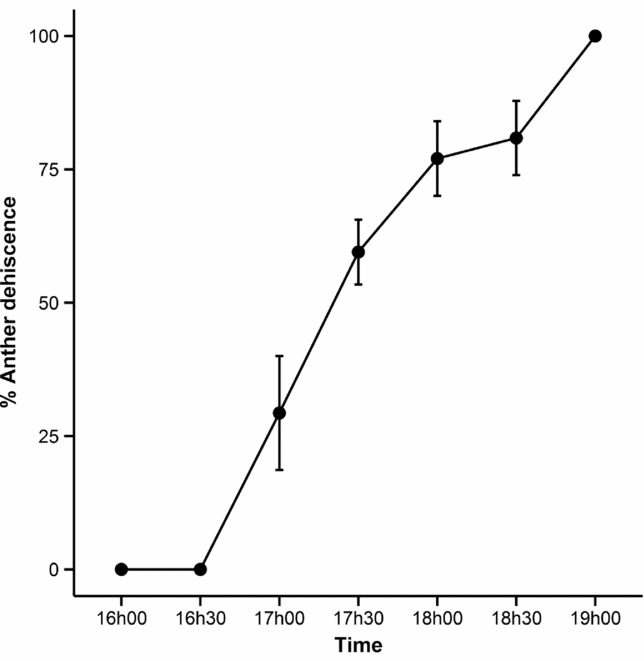
In southern Thailand, ‘Monthong’ flowers bloomed from late April to the end of May in 2016. Petal lobes began to separate gradually around 16h00–16h30 and were completely open around 18h30. At 17h00, only 29.3% ± 10.7% (mean ± SE) of anthers had dehisced, while it was 77.0% ± 7.0% by 18h00 (n = 10 trees) (Figure 1). In this study, all anthers had dehisced by 19h00, thus we considered anthesis of ‘Monthong’ flowers to be complete at 19h00. From video observation, the androecium began to drop around midnight and had abscised completely by 02h00. By the following morning, nearly all floral parts had completely abscised except the gynoecium.
Mean (± SE) per cent anther dehiscence over time from 16h00–19h00 in ‘Monthong’ durian in southern Thailand (n = 10 trees each, except trees at 16h00 and 16h30).

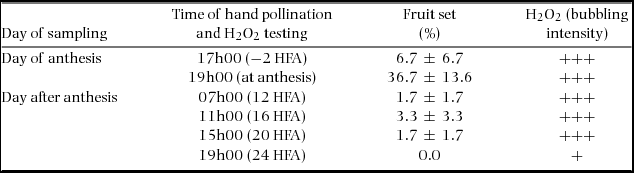
For stigma receptivity, our results showed that stigmas started to become receptive 2 h before anthesis, with a fruit set (mean ± SE) of 6.7% ± 6.7% (when hand pollinated). Of the six time periods we tested via hand-crossed pollination, per cent fruit set was highest at anthesis (36.7% ± 13.6%). By the following day, fruit set had decreased to 1.7% ± 1.7%, 3.3% ± 3.3% and 1.7% ± 1.7% at 12, 16 and 20 h after anthesis, respectively. There was no fruit set 24 h after anthesis, and the intensity of bubbles from the H2O2 test was minimal by this time (Table 1).
Mean (±SE) per cent fruit set (from hand-crossed flowers; n = 10 trees each) and degree of effervescence (from the H2O2 test; n = 6 trees each) at different times before and after anthesis in ‘Monthong’ durian flowers in southern Thailand. HFA = hours from anthesis, and bubbling intensity is scored as none (–), minimal (+), moderate (++), or intense (+++).

Pollen viability and germination
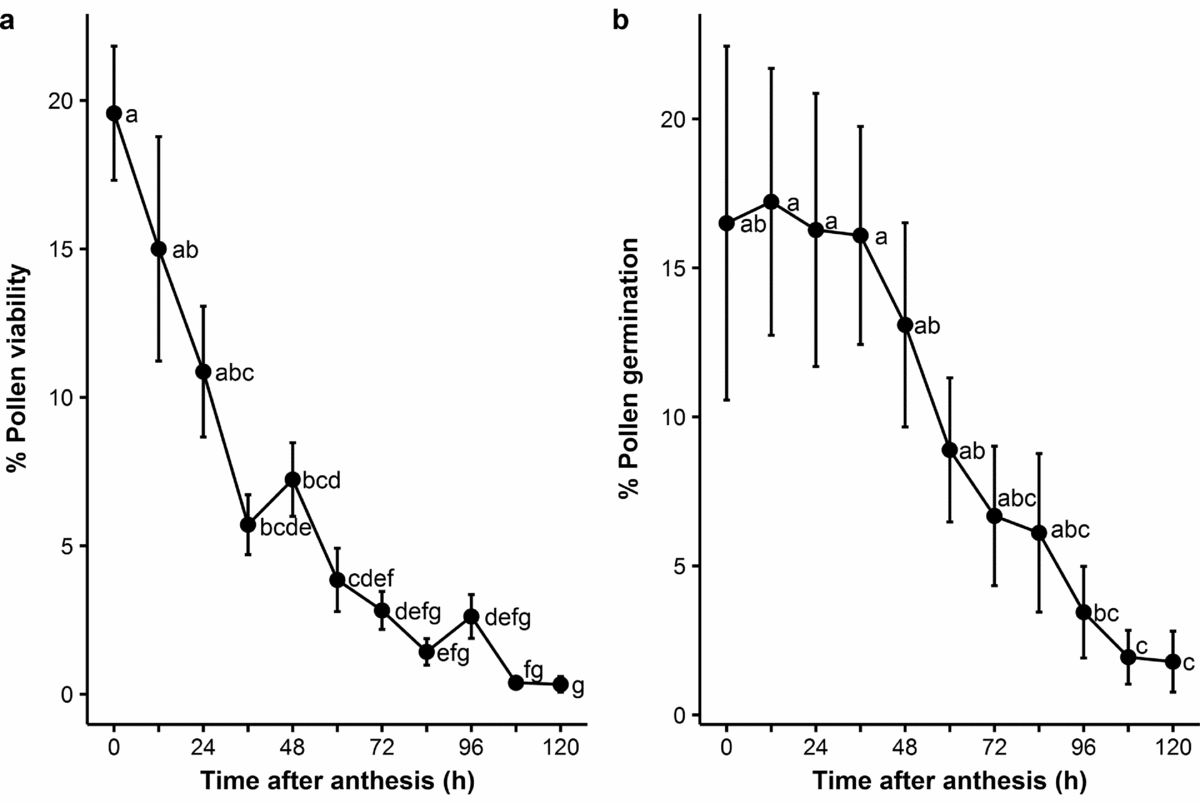
Pollen viability decreased steadily after anthesis (F = 20.0, df = 10, P < 0.001; Figure 2a). The average per cent viability at anthesis (mean ± SE: 19.6% ± 2.3%) was significantly greater than viability 36 h after anthesis and all following time periods (Figure 2a).
Percentage of pollen viability (a) and pollen germination (b) over time following anthesis in ‘Monthong’ durian in southern Thailand (n = 6 trees each). Means (± SE) with different letters are significantly different (Tukey's test, P < 0.05).

Pollen germination was also affected by time after anthesis (F = 7.5, df = 10, P < 0.001; Figure 2b). However, the average per cent pollen germination at anthesis (16.5% ± 5.9%) was not significantly different from other time periods until 108 h after anthesis (Figure 2b).
Pollination experiments
The best predictive model of fruit set included pollination treatment, time after pollination, and the interaction between pollination treatment and time after pollination. We performed one set of analyses using only 2-wk and 4-wk data, and another set using all data (2, 4 and 8 wk). Here, we present the model results using the 2- and 4-wk dataset, as this model fit the data well. The model using 2-, 4- and 8-wk data did not fit well due to small sample sizes at week 8 (when few fruits still remained), but the results are consistent with our analysis of the 2- and 4-wk dataset.
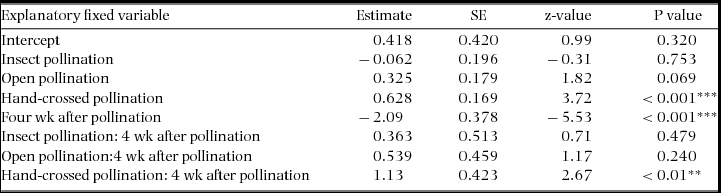
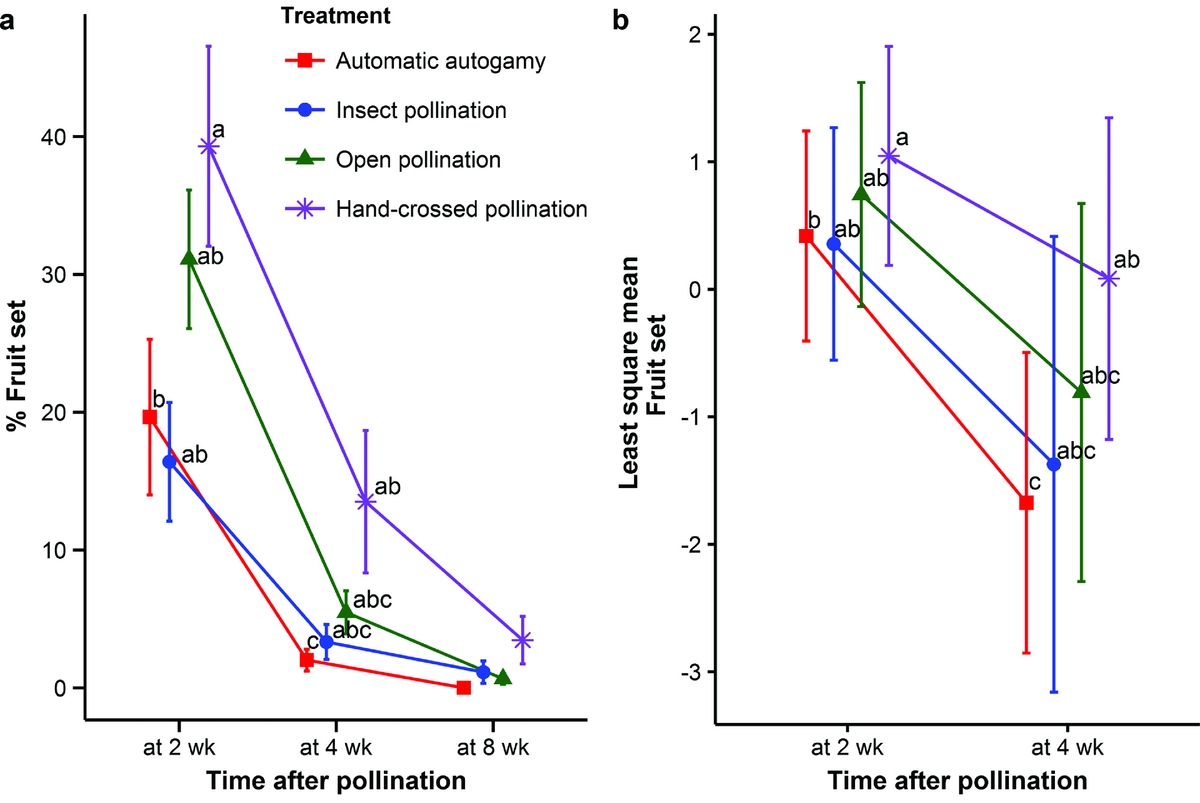
Results of the pollination experiment showed a significant difference across treatments (n = 19 trees per treatment, GLMMadmb, G2 = 162, df = 7, P < 0.001; Table 2). At 2 wk after pollination, fruit set was highest for hand-crossed pollination (mean ± SE: 39.3% ± 7.3%), followed by open pollination (31.1% ± 5.0%), automatic autogamy (19.6% ± 5.6%) and insect pollination (16.4% ± 4.3%) (Figure 3a). The yields from insect pollination, open pollination and automatic autogamy were not significantly different (P>0.05), but hand-crossed pollination was significantly greater than automatic autogamy (P < 0.01).
Results of the best predictive generalized linear mixed model for ‘Monthong’ durian fruit set in southern Thailand (AIC = 1054.3). The fixed effects were pollination treatment (hand-crossed pollination, open pollination, insect pollination, or automatic autogamy) and time after pollination (2 or 4 wk). Random effects included site, tree and inflorescence.

Mean (± SE) fruit set of ‘Monthong’ durian in southern Thailand (from raw data) at 2, 4 and 8 wk after pollination (n = 19 trees each) (a). Least square (LS) means of fruit set (from the generalized linear mixed model predictions) at 2 and 4 wk after pollination; error bars indicate 95% confidence intervals (b). Means with different letters are significantly different (Tukey's test, P < 0.05).

At 4 wk after pollination, pollination treatment continued to have a significant effect on the number of fruits set. Fruit set from hand-crossed pollination (13.5% ± 5.2%) still differed significantly from automatic autogamy (2.0% ± 0.8%) (P < 0.001). Moreover, the yields of open pollination (5.5% ± 1.6%), insect pollination (3.3% ± 1.3%) and automatic autogamy were not significantly different (P>0.05), similar to the 2-wk results (Figure 3a).
At 8 wk after pollination, no fruits remained from the automatic autogamy treatment. In contrast, the hand-crossed, open, and insect pollination treatments all retained fruit at 8 wk (mean ± SE: 3.5% ± 1.7%, 0.6% ± 0.4% and 1.1% ± 0.8%, respectively). Fruit abortion occurred in all treatments, especially in automatic autogamy, where abortion rates were highest. Based on model predictions, automatic autogamy was the only treatment in which fruit set differed significantly (P < 0.001) between 2 and 4 wk after pollination (Figure 3b).
Flower visitor observations
There were 13 species of six genera from four families (three orders) of insect visitors captured by sweep net. Two families in the order Hymenoptera, Apidae and Halictidae, were observed. For the family Apidae, we found Apis dorsata (Fabricius, 1793), A. cerana (Fabricius, 1793), A. andreniformis (Smith, 1858), Tetragonula laeviceps (Smith, 1857), T. fuscobalteala (Starr & Sakagami 1987), Tetragonilla collina (Smith, 1857), Tetragonilla atripes (Smith, 1857), Lepidotrigona ventralis (Smith, 1857), Lophotrigona carifrons (Smith, 1857) and unknown Tetragonula. In the family Halictidae, Lasioglossum sp. was found. A scarab beetle, Holotrichia sp. (Coleoptera: Scarabaeidae), and a sphinx moth, Hippotion rosetta (Swinhoe, 1892) (Lepidoptera: Sphingidae), were also observed in this study. Bothrogonia sp. (Hemiptera: Cicadellidae), Chrysomya megacephala (Fabricius, 1794) (Calliphoridae), and Muscidae (Diptera) visited the non-reproductive parts of flowers.
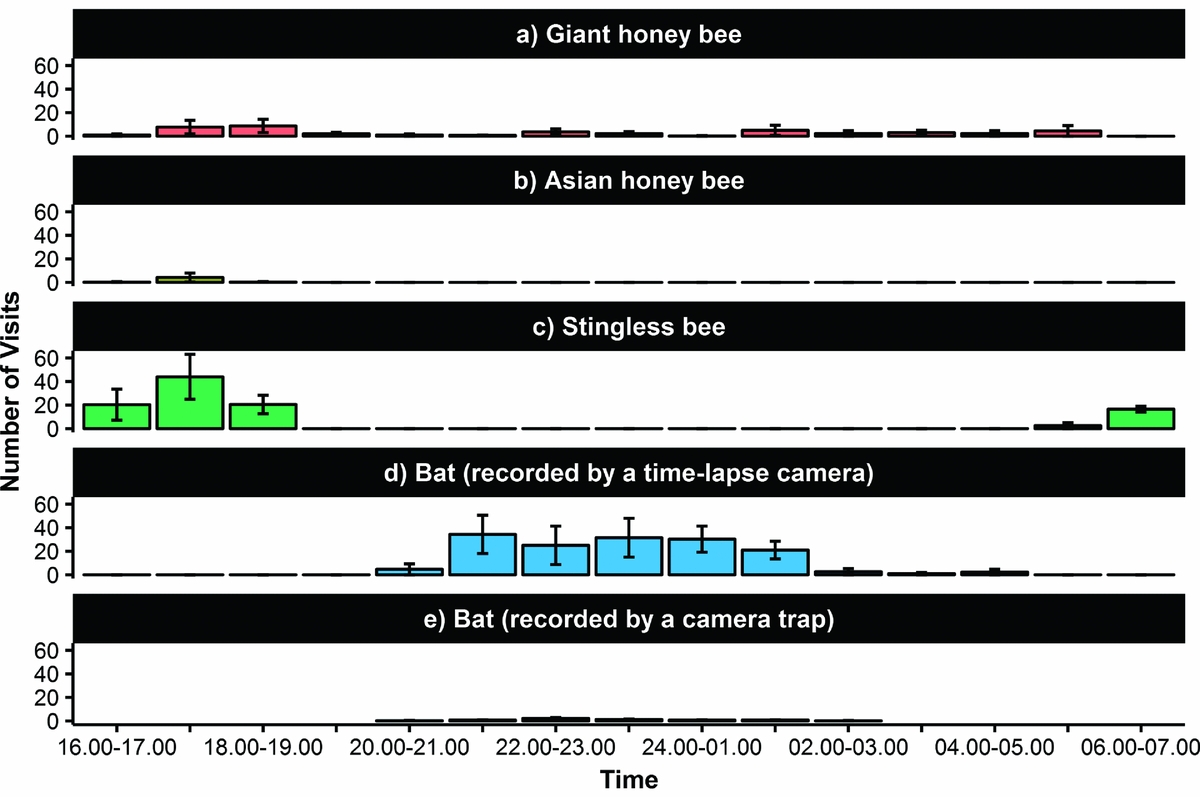
The time-lapse camera recorded visitor observations to 11 inflorescences from nine different trees. The results showed that visitation rates of floral visitors varied by time of anthesis. Insect visitors started to forage on the flower from late afternoon, and bees were the predominant insect visitor. Giant honey bees visited durian flowers during both day and night, with peak visitation at 18h00–19h00 (mean ± SE = 8.7 ± 5.7 visits per inflorescence, n = 10 nights) (Figure 4a). For Asian honey bees, the highest average visitation was at 17h00–18h00 (4.2 ± 3.7 visits per inflorescence, n = 9 nights) (Figure 4b). Stingless bees foraged on flowers from 16h00–19h00 and in the morning, and the peak of visitation was during 17h00–18h00 (44.0 ± 19.1 visits per inflorescences, n = 9 nights) (Figure 4c). Nectarivorous bats were found to be the principal visitor at night; all were identified as Eonycteris spelaea. For bat visitation, the first bat arrived at flowers around 20h00, and peak visitation occurred during 21h00–22h00 (34.3 ± 16.2 visits per inflorescence, n = 3 nights) (Figure 4d). Moreover, other visitors (moths, ants and flies) were observed in this study with peak visitation (1.5 ± 0.5 visits per inflorescence) at 06h00–07h00.
Floral visitors of ‘Monthong’ durian over time in southern Thailand. Mean number of visits per inflorescence by main visitors over time in May 2016: giant honey bee visits (a), Asian honey bee visits (b), stingless bee visits (c), bat visits recorded by a time-lapse camera (n = 11 inflorescences at nine trees) (d) and bat visits recorded by a camera trap (n = 24 inflorescences at 11 trees) (e).

The five camera traps recorded visitors to 24 inflorescences from 11 trees filmed over 12 nights (144 trap hours). A total of 103 clips of 15-s videos and 59 still pictures were taken that documented a floral visitor. The nectarivorous bat E. spelaea was the principal visitor, recorded in 76 clips (73.8%) and 39 still pictures (66.1%). Bats started to forage on durian flowers at 20h00, and peak visitation was at 21h00–22h00; afterwards, visitation decreased gradually, with the last visits occurring at 03h00 (Figure 4e). Bats visited each inflorescence 6.3 ± 5.5 times per night, on average. There was high variation, and some inflorescences were scarcely visited by bats. In addition to bats, the giant honey bee (A. dorsata) was observed in 19.4% of video clips and 32.2% of still pictures, and moths were filmed in only 6.8% of clips and 1.7% of still pictures.
Pollen loads
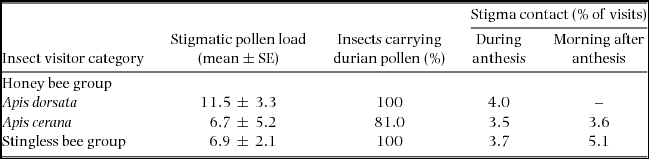
Apis dorsata (giant honey bee) transferred the highest average stigmatic pollen load (11.5 ± 3.3 grains, n = 33 stigmas) (Table 3). Moreover, giant honey bees consistently carried at least two, and sometimes over 200 pollen grains (n = 23 bees). In contrast, A. cerana (Asian honey bee) deposited only 6.7 ± 5.2 pollen grains per stigma (n = 3 stigmas), and only 81.0% of Asian honey bees carried pollen on their bodies (range = 0–78 grains, n = 21 bees). For the stingless bee group, the mean stigmatic pollen load was 6.9 ± 2.1 grains (n = 13 stigmas); 100% of stingless bees carried pollen on their bodies, which ranged from 1 to over 200 pollen grains (n = 38 bees). From visual observations in the field, giant honey bees contacted stigmas 4.0% of the time while visiting during anthesis, but never made contact the following morning after anthesis (after corollas and androecium had dropped, but while gynoecium were still intact). Asian honey bees contacted stigmas both during anthesis (3.5%) and in the morning (3.6%). Stingless bees contacted stigmas 3.7% of the time during anthesis and 5.1% of the time during the following morning.
Average stigmatic pollen load of the ‘Monthong’ durian cultivar, the percentage of insects carrying durian pollen grains on their bodies, and the percentage of durian stigmas contacted by each insect group in southern Thailand.

DISCUSSION
Floral biology
In our study area of southern Thailand, ‘Monthong’ durian trees flowered from late April through May, which is slightly later than previous studies (Bumrungsri et al. Reference BUMRUNGSRI, SRIPAORAYA, CHONGSIRI, SRIDITH and RACEY2009), perhaps due to the exceptionally dry year. In general, durian in southern Thailand flowers much later than reports from the southern part of eastern Thailand, which flowers throughout January (Honsho et al. Reference HONSHO, YONEMORI and SUGIURA2004a). Yet in both regions, the flowering season is ~3 mo after the onset of the dry season. Honsho et al. (Reference HONSHO, YONEMORI and SUGIURA2004a) surmised that water stress or relative humidity could be essential factors that induce floral initiation. Moreover, Salakpetch (Reference SALAKPETCH and Nagao2005) mentioned that a dry period for 7–14 consecutive days can trigger the emergence of durian flower buds. Lim & Luders (Reference LIM and LUDERS1998) also reported that weather conditions can influence durian flowering. Thus, it appears that durian is generally induced to flower through environmental cues.
Our results demonstrate that ‘Monthong’ durian can be pollinated starting in late afternoon. Flower blooming started at ~16h30 and was complete by 18h30, while anther dehiscence began around 17h00 and was complete by 19h00 in this study, which is similar to the timing in eastern Thailand (Honsho et al. Reference HONSHO, YONEMORI and SUGIURA2004a). Results from artificial (hand) pollination showed that fruit set was highest at anthesis, but stigma receptivity actually started about 2 h before anthesis. By 24 h after anthesis, no fruit set occurred, indicating a loss of pollination capacity. Our results indicate that the EPP of ‘Monthong’ durian is very short, as pollination capacity dropped dramatically following 12 h after anthesis. Moreover, the hydrogen peroxide test indicates that stigma receptivity decreased following 24 h after anthesis. In eastern Thailand (Trat Province), the highest fruit set of ‘Monthong’ was obtained at 6 h before anthesis (12%), with 8.7% fruit set at anthesis (Honsho et al. Reference HONSHO, SOMSRI, TETSUMURA, YAMASHITA and YONEMORI2007b). However, at different locations using different cultivars, fruit set was highest at anthesis (as in our study), and Honsho et al. (Reference HONSHO, SOMSRI, TETSUMURA, YAMASHITA and YONEMORI2007b) suggested that such fruit-set variation may be due to differences in cultivars or microclimate. In addition, we found that ‘Monthong’ androecia gradually dropped starting at midnight, and by the following morning, all floral parts had completely abscised except the gynoecium. It therefore appears that the EPP in ‘Monthong’ durian is synchronized with flower longevity, as reported in Honsho et al. (Reference HONSHO, SOMSRI, TETSUMURA, YAMASHITA and YONEMORI2007b), even though stigmas are reported to be receptive for much longer (48 h; Salakpetch et al. Reference SALAKPETCH, CHANDRAPARNNIK and HIRANPRADIT1992). Since ‘Monthong’ durian flowers start opening during the late afternoon, and anthers dehisce after the start of anthesis (mostly after 17h30), all visitors after 17h30 could potentially contribute to pollination success.
For ‘Monthong’ pollen, germination between 0–96 h after anthesis was not significantly different, and pollen viability was highest at anthesis before decreasing dramatically 24 h after anthesis. These results are similar to a previous study, which revealed that pollen grains maintained germination ability until at least 24 h after anthesis, and for at least 5 d under desiccation (Honsho et al. Reference HONSHO, SOMSRI, TAKUYA, YAMASHITA, YAPWATTANAPHUN and YONEMORI2007a). Although the androecia of durian abscised and started to drop around midnight, Asian honey bees and stingless bees continued to visit durian flowers the following morning. They occasionally touched stigmas as they foraged on pollen and nectar from large inflorescences, where some bundles of stamens still hung from the inflorescences (Wayo, pers. obs.). While uncommon, this stigma contact in the morning could contribute to some pollination if pollen grains are transferred to a stigma, since our study found that stigmas remained at least partially receptive up to 20 h after anthesis.
Breeding system and effective pollinators
Our results corroborate those of previous studies reporting that the breeding system of ‘Monthong’ durian is highly self-incompatible. At 4 wk after pollination, fruit set from the automatic autogamy treatment was very low (2.0%) compared with findings by Lo et al. (Reference LO, CHEN and CHANG2007) and Honsho et al. (Reference HONSHO, YONEMORI, SOMSRI, SUBHADRABANDHU and SUGIURA2004b), which reported that in self-pollinated durian flowers, average fruit set values were 15% at 35 d after pollination and 7.7% at harvest, respectively. Another study found that non-pollinated flowers of ‘Monthong’ abscised within 8 d (Lo et al. Reference LO, CHEN and CHANG2007). The few fruits that were set in automatic autogamy in our experiment could have resulted from flowers that were shaken or rubbed against each other by strong wind. Such movement could cause pollen grains to be deposited on stigmas, since pistil length is < 1 cm longer than stamen length just before anthesis (Honsho et al. Reference HONSHO, YONEMORI and SUGIURA2004a).
Despite some fruit set resulting from automatic autogamy at 4 wk after pollination, our results support a late-acting self-incompatibility mechanism, as proposed by earlier studies (Bumrungsri et al. Reference BUMRUNGSRI, SRIPAORAYA, CHONGSIRI, SRIDITH and RACEY2009, Honsho et al. Reference HONSHO, YONEMORI, SOMSRI, SUBHADRABANDHU and SUGIURA2004b). The results of our GLMM revealed a significant treatment by time interaction, and fruit abortion was highest for the automatic autogamy treatment. Presumably, flowers in the automatic autogamy treatment received only self (or geitonogamous) pollen. These flowers then experienced higher fruit abortion than flowers in the other treatments (hand-crossed, open and insect pollination), which all have the potential to receive cross pollen. Moreover, hand-cross pollinated flowers, which received only cross pollen, had the lowest abortion rates. Although seed set was not examined in the present study, Lim & Luders (Reference LIM and LUDERS1998) mentioned that self-pollinated durian flowers produced fruits with few arils. As our findings suggest that the breeding system in ‘Monthong’ is highly self-incompatible, natural pollinators are vital for its pollination.
Our pollination experiment revealed that the fruit set of insect- and open-pollinated inflorescences were not significantly different. Insect visitors thus appear to contribute to durian pollination in our study area starting during the late afternoon, as ‘Monthong’ durian flowers have nearly completely opened by 17h30, and anther dehisce is over 50% by this time. These results differ from those of Bumrungsri et al. (Reference BUMRUNGSRI, SRIPAORAYA, CHONGSIRI, SRIDITH and RACEY2009), which found that fruit set from open pollination was significantly greater than from insect pollination. These differences may be due to several different reasons, which are not mutually exclusive. Firstly, bat visitation rates observed in our study (recorded by camera traps) were only 24% of those observed by Bumrungsri et al. (Reference BUMRUNGSRI, SRIPAORAYA, CHONGSIRI, SRIDITH and RACEY2009), which may explain the low fruit set resulting from open pollination in this study compared with that of Bumrungsri et al. (Reference BUMRUNGSRI, SRIPAORAYA, CHONGSIRI, SRIDITH and RACEY2009). Secondly, our study used ‘Monthong’ durian, while Bumrungsri et al. (Reference BUMRUNGSRI, SRIPAORAYA, CHONGSIRI, SRIDITH and RACEY2009) used semi-wild durian, and the two cultivars have slightly different floral morphologies. While the style length of ‘Monthong’ durian is relatively similar to stamen length, semi-wild durian exhibits herkogamy, with the style exserted beyond the anthers (Bumrungsri et al. Reference BUMRUNGSRI, SRIPAORAYA, CHONGSIRI, SRIDITH and RACEY2009). This spatial separation between stigma and anthers may reduce the possibility of a small visitor (such as a bee) successfully transferring pollen to the stigma. Thirdly, the anthers of semi-wild durian dehisces around 19h30–20h00, which is after the foraging period of most bee species observed in our study. Thus, semi-wild durian, as examined by Bumrungsri et al. (Reference BUMRUNGSRI, SRIPAORAYA, CHONGSIRI, SRIDITH and RACEY2009), may be much more dependent on large, nocturnal bat pollinators than small, diurnal/crepuscular insects. We surmise that the degree of entomophily in semi-wild durian and cultivated ‘Monthong’ durian may differ due to their different morphologies and anthesis times.
Our findings suggest that bees can contribute to the pollination of ‘Monthong’ durian in areas with low bat visitation, as multiple groups of bees began visiting the flowers during the late afternoon. We estimated the pollination effectiveness of each major insect group by multiplying effective visitation rate (total number of visits where the stigma was contacted during the flower's lifespan) and quantitative pollen grain transfer (number of pollen grains deposited on the stigma per visit). Our data indicate that stingless bees (Meliponini) and the giant honey bee (A. dorsata) can transfer about 27 and 17 pollen grains per stigma during the flower's lifespan, respectively, while the Asian honey bee (A. cerana) can only transfer around 0.3 pollen grains per stigma during the flower's lifespan.
Incorporating behavioural observations suggests that A. dorsata could be the most legitimate and effective insect pollinator. Specifically, A. dorsata was the only insect species that commonly and consistently visited durian flowers at night, which was also found in previous studies (Aziz et al. Reference AZIZ, CLEMENTS, MCCONKEY, SRITONGCHUAY, PATHIL, YAZID, HAFIZI, CAMPOS-ARCEIZ, FORGET and BUMRUNGSRI2017, Bumrungsri et al. Reference BUMRUNGSRI, SRIPAORAYA, CHONGSIRI, SRIDITH and RACEY2009, Sritongchuay et al. Reference SRITONGCHUAY, KREMEN and BUMRUNGSRI2016). Moreover, A. dorsata was more likely to move between different durian trees (Wayo, pers. obs.), which is important for the highly self-incompatible ‘Monthong’ durian. Although stingless bees deposited relatively large stigmatic pollen loads, these bees spent most foraging time moving between inflorescences of the same tree rather than across trees (Wayo, pers. obs.), thus they may have a limited role in the pollination of this cultivar. Of the stingless bees observed in our study, Tetragonilla collina was the most common and visited durian flowers frequently, similar to the findings of a previous study (Boongird Reference BOONGIRD1992). Diurnally foraging Asian honey bees (A. cerana) may also pollinate durian, but they had low visitation rates, and occasionally foraged only on nectar by landing in the corolla without contacting floral reproductive structures (Wayo, pers. obs.).
Pollination research has primarily focused on diurnally blooming plant species, and there is still much to learn about night-blooming plants, and the nocturnal foraging activity of nectarivores. Thus, plant species that are typically considered ‘bat-pollinated’ or ‘moth-pollinated’ may actually have a greater diversity of visitors than previously realized. For example, Lassen et al. (Reference LASSEN, OUEDRAOGO, DUPONT, KJAER and NIELSEN2017) reported that honey bees (A. mellifera) can ensure the pollination of Parkia biglobosa, which is a night-blooming species normally pollinated by bats. Our findings demonstrate that nocturnally foraging bees can be important pollinators, even for plant taxa traditionally considered to be bat-pollinated. Given that we may not know all the pollinators of a particular plant species, it is important to preserve a wide array of natural habitat types, which will support a diverse pollinator community.
ACKNOWLEDGEMENTS
This study was funded by a Science Achievement Scholarship of Thailand (SAST) and, the Prince of Songkla University Graduate School. Thanks are due to Artorn Wayo, Pichate Liankattawa and Tuan Nguyen Ngoc for climbing durian trees during the experiments, and graduate students in the Biology Department of Prince of Songkla University for help in the field. We are very grateful to the owners of the durian orchards for permitting us to collect data, and for their hospitality during fieldwork. We also thank Tuanjit Srithongchuay for helpful suggestions and comments on earlier versions of the manuscript.