Introduction
Esping-Andersen's (Reference Esping-Andersen1990) The Three Worlds of Welfare Capitalism has cast a long shadow over comparative social policy debates for nearly twenty-five years, triggering a ‘welfare state modelling’ business that has dominated discussion. Scholars have argued over how many welfare types exist, where particular countries should be placed in typologies and whether key classifications omit important dimensions of welfare (see Abrahamson, Reference Abrahamson1999; Arts and Gelissen, Reference Arts and Gelissen2002; and, more recently, Abrahamson, Reference Abrahamson and Hwang2011; Aspalter, Reference Aspalter2011; Ferragini and Seeleib-Kaiser, Reference Ferragini and Seeleib-Kaiser2011; Powell and Barrientos, Reference Powell and Barrientos2011, for useful reviews of these debates). As the debate has expanded, it has become more complex, with a wide range of rival typologies created (Abrahamson, Reference Abrahamson and Hwang2011), the most appropriate indicators for analysis of types questioned (Clasen and Sigel, Reference Clasen and Siegel2007; Kühner, Reference Kühner2007) and the methods for analysis debated (Hudson and Kühner, Reference Hudson and Kühner2010). Some have also questioned the utility of typologies, even as a heuristic device (Baldwin, Reference Baldwin and Greve1996; Kasza, Reference Kasza2002).
Yet, despite the limitations, there has been considerable dynamism in the debate, particularly with respect to the range of countries covered by popularly cited typologies. While Esping-Andersen's original study covered just eighteen high income countries, major contributions to the field have expanded the purview of the modelling business by adding (amongst others) typologies that encompass Southern European (Leibfried, Reference Leibfried, Ferge and Kolberg1992; Ferrara, Reference Ferrara1996; Bonoli, Reference Bonoli1997), East Asian (Holliday, Reference Holliday2000, Reference Holliday2005; Holliday and Wilding, Reference Holliday and Wilding2003; Kwon and Holliday, Reference Kwon and Holliday2007), Eastern European (Bohle and Greskovits, Reference Bohle and Greskovits2007; Fenger, Reference Fenger2007), Latin American (Filgueria, Reference Filgueria and Roberts1998; Rudra, Reference Rudra2007; Martinez Franzoni, Reference Martinez Franzoni2008) and African (Seekings, Reference Seekings, Shapiro, Swensin and Donno2008) cases. In a recent contribution of our own (Hudson and Kühner, Reference Hudson and Kühner2012), we were able to exploit advances in data collection and methodological technique in order to include fifty-five cases. Expansion of the geographical coverage of the modelling business has also fuelled its continued growth, with new classifications producing new debates about methods, measures and conceptualisation, as well as prompting debates on erroneously classified cases.
In this review article, we focus on one dimension of this debate, which concerns the classification of East Asian welfare systems. An early criticism of Esping-Andersen's work was that he had misunderstood and, consequently, misclassified the only East Asian nation included in his original analysis: Japan (see Esping-Andersen, Reference Esping-Andersen1997). Others made broader criticisms of his approach for failing to highlight distinctive characteristics of welfare in East Asia that add up to form a fourth world of welfare (for example, Jones, Reference Jones and Jones1993; Goodman et al., Reference Goodman, White and Kwon1998). Connected to this, there has also been a long-running debate over the notion of productive welfare, with some theorists suggesting welfare systems in East Asia can be seen as distinct because of their productive intent (especially Holliday, Reference Holliday2000, Reference Holliday2005; Holliday and Wilding, Reference Holliday and Wilding2003). We might also add that the geographic scope of the East Asian welfare debate has gradually expanded over time too, from a focus on Japan and South Korea to a broader focus on the East Asian Tiger Economies (adding Hong Kong, Singapore and Taiwan to the mix). More recently there has been a growing interest in adding mainland China to these debates, and comparing mainland China with its neighbours.
We begin by reviewing debates on whether an East Asian welfare type exists before examining in more detail those around productive welfarism. Here we include some of our own recent work that has explored the productive welfarism thesis using data for a wide range of East Asian and non-East Asian cases. Finally, we look to future developments, highlighting ongoing trends in research and advances in data collection.
An East Asian welfare type?
Typologies of East Asian welfare have often been directly influenced by debates in Western comparative welfare research, either by attempting to fit individual country cases into mainstream welfare typologies (see, for example, Esping-Andersen, Reference Esping-Andersen1997; Ku, Reference Ku1997; Kwon, Reference Kwon1997; Lee and Ku, Reference Lee and Ku2007), or by utilising mainstream Western theories to explore welfare development and change such as the logic of industrialism (Midgley, Reference Midgley1986) or, more recently, partisanship (Aspalter, Reference Aspalter2001, Reference Aspalter2005), arguments about efficiency/compensation effects of globalisation and new social risks (Gough, Reference Gough2001). At the same time, however, there have been numerous parallel attempts to emphasise the uniqueness of East Asian welfare types and welfare state evolution by pointing towards cultural-historical and/or political-economic/developmentalist particularities within the region.
Pointing towards the significance of family and kin networks to provide welfare support, Chow (Reference Chow1987) was among the earliest scholars to emphasise cultural differences between Western and Chinese ideas on welfare, tracing the deep cultural-historical roots of the role of family and kin relationships back to the early Ch'ing Dynasty, where families and the local gentry carried most responsibility for welfare support (Lin, Reference Lin1990). The historical-cultural approach gained traction beyond the Chinese case when Jones (Reference Jones1990) introduced the concept of ‘oikonomic welfare states’ to describe the management of national ‘household economies’ in Hong Kong, Taiwan, Singapore and South Korea. In her view, culture presented a barrier to Western-style participatory democracy and was conducive to a top-down policy process in which states focussed on economic over social development and emphasised the role of the state as regulator over the role of provider of welfare (Jones, Reference Jones and Jones1993). Jones (Reference Jones1990) pointed towards a common core of Confucian beliefs, values and priorities, which emphasised the duties of citizens, rather than their rights and needs, as an explanation for the modest scale of state welfare transfers and services.
Goodman and Peng (Reference Goodman, Peng and Esping-Andersen1996: 193–5) came to a similar conclusion, identifying a common ‘language of Confucianism’ in Japan, South Korea and Taiwan, featuring ‘respect for seniors, filial piety, paternal benevolence, the group before the individual, conflict avoidance, loyalty, dutifulness, lack of complacency, striving for learning, entrepreneurship and meritocracy’. Furthermore, by pointing towards the colonial or occupying power and the impact of Japanese-style social welfare in the region, Goodman and Peng (Reference Goodman, Peng and Esping-Andersen1996: 195) saw ‘vital institutions, financial, industrial, educational and political, which still today have much in common with Japanese contemporary systems’ in Taiwan and South Korea. Thus, they identified common features describing a ‘Japan-focused East Asian social welfare regime’, most of which echo those highlighted by Jones (Reference Jones1990, Reference Jones and Jones1993). Indeed, Goodman and Peng (Reference Goodman, Peng and Esping-Andersen1996) pointed out that the intraregional emulation of welfare policies functioned as a homogenising factor across East Asian welfare systems, noting that other East and South East Asian states such as Thailand and Malaysia closely studied Japanese public programmes, suggesting that this model could spread even further.Footnote 1
However, while some, such as Rieger and Leibfried (Reference Rieger and Leibfried2003: 243), went so far as to see Confucian culture as ‘the fundamental cause of an independent [slow and restrained] path of welfare state evolution’ in East Asia, the explanatory power of cultural-historical approaches has been heavily critiqued by others (see, for example, White and Goodman, Reference White, Goodman, Goodman, White and Kwon1998; Jacobs, Reference Jacobs2000; Ramesh and Asher, Reference Ramesh and Asher2000; Peng, Reference Peng2002; Chan, Reference Chan, Bell and Hahm2003; Walker and Wong, Reference Walker, Wong, Walker and Wong2005). In particular, Kwon (Reference Kwon, Goodman, Kwon and White1998: 27) found that cultural-historical approaches, not unlike functionalist/modernisation theories, are relatively ‘weak in explaining the precise national profiles of social policy and differences between welfare systems’, and Kasza (Reference Kasza2006: 115) likened cultural explanations to a ‘gross brush’ approach (see also Aspalter, Reference Aspalter2005). Whether culture can be regarded as a cause of, or a factor in defining, differing welfare types has been debated over the years and while recent contributions have given more credence to the importance of cultural factors (van Oorschot et al., Reference Van Oorschot, Opielka, Pfau-Effinger, van Oorschot, Opielka and Pfau-Effinger2008; Jo, Reference Jo2011), methodological issues about how culture can be conceptualised and measured are far from resolved, so few empirical works have included culture indicators in quantitative cross-national studies for this region (but see Lee and Ku, Reference Lee and Ku2007, below). Confucianism does not say anything about old age pensions or unemployment insurance per se, and the diverse welfare policies found across space and time in East Asia undermine the Confucian welfare type thesis. Shinkawa (Reference Shinkawa2004: 66) points out that ‘group-oriented postures . . . are not unique in Confucian societies but common in any traditional society’. Consequently, Abrahamson (Reference Abrahamson and Hwang2011) concludes these issues have led to the notion being abandoned, while Aspalter (Reference Aspalter2005, Reference Aspalter2008) sees Confucianism, at best, as a secondary explanatory factor at the macro-level.
An alternative claim for an East Asian welfare type was heavily influenced by Johnson's (Reference Johnson1982, Reference Johnson and Woo-Cumings1999) notion of the ‘developmental state’, as he introduced a trichotomy of ideal types that he labelled ‘plan rational’ (Japan), ‘plan ideological’ (Stalinist Russia) and ‘regulatory’ (New Deal America) based on these states’ relationship to their domestic economy (Cumings, Reference Cumings and Woo-Cumings1999). Thus, East Asian states were distinguished from ‘regulatory’ and ‘plan-ideological’ states in viewing their primary long-term objective as improving national economic development through active and concerted government intervention. Attempts to establish linkages between the developmental approach and institutional characteristics of welfare programmes in newly industrialised countries followed swiftly from Johnson's contribution (for example, Dixon and Kim, Reference Dixon and Kim1985; Dixon, Reference Dixon1987; Dixon and Scheurell, Reference Dixon and Scheurell1989), but Midgley's (Reference Midgley1986) contribution stands out as he was the first to identify a ‘reluctant welfarism’ in East Asia that was specifically subordinated to the goal of fast economic growth and the developmental paradigm. Midgley's contribution in turn triggered numerous case studies of East Asian social policy (for example, Takahashi, Reference Takahashi1997; Ku, Reference Ku1997; Tang, Reference Tang1998; Kwon, Reference Kwon1999). In a variation, Deyo (Reference Deyo1989, Reference Deyo, Appelbaum and Henderson1992) argued that social development goals in East Asia were closely linked to the predominant model of export-oriented industrialisation (EOI) requiring policies supporting low wage and production costs, high productivity and skills, and low levels of labour conflict. More recently, Tang (Reference Tang2000: 137) has labelled state welfare development in Hong Kong, Singapore, South Korea and Taiwan as a ‘production-first’ approach, arguing (together with Midgley, Reference Midgley1995, Reference Midgley1997; Midgley and Tang, Reference Midgley and Tang2001) that in order to achieve EOI, East Asian governments used social policies to promote their legitimacy, pacify strategically significant parts of the labour force and guarantee investment in the education and health of the workforce. As a consequence, the East Asian welfare type features low public social expenditure, relative labour market flexibility and limited universalism and egalitarianism. Indeed, welfare reforms generally only occurred when the ruling parties faced real political challenges, such as a financial crisis. While statutory social assistance programs were established, the scope of these programs remained small and the level of benefits low compared to other industrialised countries. Kwon (Reference Kwon and Kwon2005a, Reference Kwonb) adds that social policies were designed mainly to target politically pivotal groups in the East Asian type, meaning stratification effects are commonly high and reinforce social inequalities.
In one of the few empirical studies to test the developmental state thesis using cross national data, Lee and Ku (Reference Lee and Ku2007) performed cluster and factor analysis on data for nineteen high income economies, including Japan, Korea and Taiwan. While their analysis provided a good degree of support for placing Korea and Taiwan in a distinctive ideal type with developmental characteristics, the evidence was less compelling for Japan, which had many features of Esping-Andersen's conservative types. Similar to the cultural-historical approach, this provides an indication that the developmental state thesis, although certainly useful as an analytical tool, may struggle to account for differences at the detailed programme level across East Asia. Moreover, Japan's conflicting classification may reflect its earlier industrialisation and hint at an anachronistic weakness in applying the developmental label to cases with OECD or near OECD levels of economic output.
East Asia and the productive welfare debate
The core argument that East Asian states emphasise economic over social policy also appears in a more nuanced fashion in Holliday's work (Holliday, Reference Holliday2000, Reference Holliday2005; Holliday and Wilding, Reference Holliday and Wilding2003; Kwon and Holliday, Reference Kwon and Holliday2007); it also offers the most explicit challenge to Esping-Andersen's three-way classification of welfare types. On the basis of case studies of five East Asian states – Japan, Hong Kong, Singapore, South Korea and Taiwan – Holliday argues it is ‘impossible to place [them] in Esping-Andersen's framework’ (Holliday, Reference Holliday2000: 711). Instead, he suggests there is a fourth welfare regime found in the region that he dubs the ‘productivist’ world of welfare capitalism (PWC), differing from those outlined by Esping-Andersen because it subordinates social policy to economic policy and so ‘productivist’ economic goals drive social policy (Kim, Reference Kim2008). By adding this fourth regime, Holliday (Reference Holliday2000: 709) distinguishes ‘a liberal world prioritizing the market, a conservative world defined by status, a social democratic world focused on welfare, and a productivity world premised on growth’.
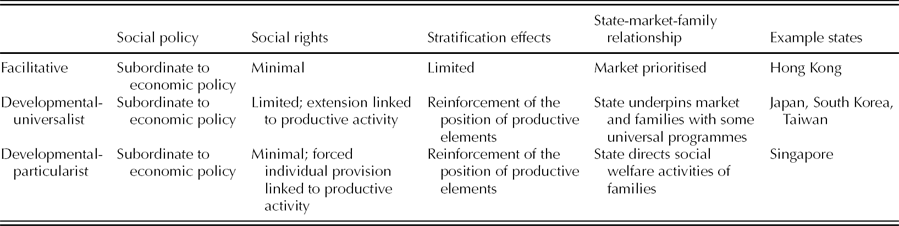
Holliday (Reference Holliday2000) identifies three clusters within productivist capitalism: a facilitative, developmental-universalist, developmental-particularist sub-type (see Table 1). The facilitative type is most similar to Esping-Andersen's (Reference Esping-Andersen1990) liberal type, except its social policy is more clearly subordinated to economic growth. As a result, facilitative types feature minimal social rights, limited stratification effects and the market is prioritised. In the developmental-universalist states, social rights are extended to productive elements of the population only. While the state plays an important role in economic policy, market and families are supported with some universal programmes. The developmental-particularist state is also characterised by minimal social rights. Here, welfare policy mainly aims to provide for the productive elements in society through individual mandatory programmes, while state mainly directs social welfare activities of families. Holliday (Reference Holliday2000) concludes that Japan, South Korea and Taiwan are best described as developmental-universalist types, whereas Hong Kong mainly features facilitative and Singapore developmental-particularist characteristics.

The frameworks of Esping-Andersen and Holliday have been adapted and extended by Gough (Gough, Reference Gough, Gough, Wood, Barrientos, Bevan, Davis and Room2004; Wood and Gough, Reference Wood and Gough2006; Gough and McGregor, Reference Gough and McGregor2007). Here the term ‘regime’ is redefined as at the most ‘general level an institutional matrix of market, state and family forms, which generates welfare outcomes’ (Gough, Reference Gough, Gough, Wood, Barrientos, Bevan, Davis and Room2004: 23) with: a ‘welfare state regime type’ comprised of states where ‘people can reasonably expect to meet (to a varying extent) their security needs via participation in labour markets, financial markets and the finance and provisioning role of a ‘welfare state’; an ‘informal security regime’ where ‘people rely heavily upon community and family relationships to meet their security needs, to greatly varying degrees’; and an ‘insecurity regime’ where ‘a set of conditions which generate gross insecurity and block the emergence of stable informal mechanisms to mitigate’ (Gough, Reference Gough, Gough, Wood, Barrientos, Bevan, Davis and Room2004: 33–4). East Asian states conceptually cluster in the ‘informal security regime’ as minimal social rights, social investment and the productive elements of welfare policy are emphasised (Gough, Reference Gough, Gough, Wood, Barrientos, Bevan, Davis and Room2004). Cluster analyses undertaken by Gough and colleagues largely confirm this classification, with East Asian cases classified as either ‘more effective’ (Wood and Gough, Reference Wood and Gough2006) or ‘successful’ (Abu Shark and Gough, Reference Abu Shark and Gough2010) informal welfare types, separating them from South East Asian (‘less effective-failing informal welfare states’) and other middle/high income Latin American and Eastern European countries (‘potential-proto welfare state regimes’).
There are, then, clear commonalities between the cultural-historical, political-economic/developmental and productivist/informal approaches to clustering East Asian welfare types. Scholars have continued to question whether it is analytically useful to talk about an homogenous East Asian welfare type that glosses over differences between cases (Kwon, Reference Kwon, Goodman, Kwon and White1998, Reference Kwon2005b; White and Goodman, Reference White, Goodman, Goodman, White and Kwon1998). Perhaps more importantly, while a majority have tended to hold on to the PWC thesis judging welfare reforms as merely programmatic/incremental (Holliday, Reference Holliday2005; Kwon and Holliday, Reference Kwon and Holliday2007; Aspalter, Reference Aspalter2011), a growing literature suggests a departure from PWC in the wake of democratisation in some territories and the impact of economic crises in East Asia since 1997. Ramesh (Reference Ramesh and Weiss2003) and Ku (Reference Ku, Holliday and Wilding2003) were among the first to find a divergence in welfare choices in these changing contexts, but this observation has generally become more salient in recent years (see also Choi, Reference Choi2012). For instance, Kim (Reference Kim2008) argues that welfare systems in Korea and Taiwan have become more redistributive over the last decade. While the Central Provident Fund (CPF) remains core to welfare in Singapore, public assistance has played a more crucial role in in Japan and Hong Kong (Wilding, Reference Wilding2008). In China, the situation is even more complex where the welfare system combines public funds, social insurances, and public assistances, which increasingly have been extended beyond the urban citizenry (Kasza, Reference Kasza and Kennedy2011; Ngok, forthcoming) and vary by province. Others have argued that since the mid-1980s various non-state actors, such as civil movements and labour unions, have played an increasingly important role in shaping and reforming welfare programmes in East Asia (Wong, Reference Wong2004; Peng, Reference Peng and Kwon2005), which runs counter to the argument that welfare programmes in East Asia have mainly been introduced for specific economic and political legitimisation purposes, rather than social needs (Holliday and Wilding, Reference Holliday and Wilding2003).
Finally, even if ‘productivism’ should prevail as the guiding principle of the East Asian welfare type, there remains an important question of how unique this focus of policy really is. Bonoli and Shinkawa (Reference Bonoli, Shinkawa, Bonoli and Shinkawa2005: 21) rightly point out that ‘welfare states everywhere help improve productivity and contribute to economic growth by facilitating social cohesion and peaceful class relationships. In that sense, all welfare states are productivist’. We cannot assume, therefore, that productive welfarism is unique to East Asia (Kim, Reference Kim2008). Indeed, there is a growing body of thought that suggests the productive dimensions of welfare are becoming increasingly central to social policy regimes across the OECD (Cerny and Evans, Reference Cerny and Evans1999; Jessop, Reference Jessop1999, Reference Jessop, Lewis, Gewirtz and Clarke2000; Castells and Himanen, Reference Castells and Himanen2002; and more recently, Vandenbrouke et al., Reference Vandenbrouke, Hemerijck and Palier2011; Morel et al., Reference Morel, Palier and Palme2012). A true understanding of how far, if at all, productive welfarism is unique to some or all of the East Asian welfare regimes can only come, therefore, through systematic comparison of East Asian cases with those countries that form the core of the worlds of welfare debate.
Productive welfare beyond East Asia
Taking these issues as a starting point, our own contribution to this debate has utilised fuzzy set ideal type analysis in order to facilitate comparison of productive welfare cross-nationally. One of the weaknesses in the productive welfare debate has been that few studies offer a systematic comparison of a broad range of cases, many offering case studies of a small number of cases within East Asia. To rectify this, we developed a framework for assessing the balance between productive and protective welfare that could be used to compare a broad range of cases and, in so doing, determine whether: (i) East Asian welfare systems placed an emphasis on productive rather than protective welfare and (ii) whether cases from outside of the region placed an emphasis on protective rather than productive welfare. We began by examining OECD member states, first including only Japan and South Korea from East Asia (Hudson and Kühner, Reference Hudson and Kühner2009), but then expanded our study to include five additional East Asian cases (Hudson and Kühner, Reference Hudson, Kühner and Hwang2011) and then a further 32 cases from across the globe (Hudson and Kühner, Reference Hudson and Kühner2012). In each instance, a central pillar of our work was the use of fuzzy set ideal type analysis (see Ragin, Reference Ragin2000, Reference Ragin2008).
Our initial study was based on the analysis of OECD indicators and so restricted to an analysis of 23 OECD nations (Hudson and Kühner, Reference Hudson and Kühner2009). The data we examined presented a direct challenge to Holliday's (Reference Holliday2000) productive welfare thesis. Firstly, neither of the two East Asian cases included appeared to have a dominant focus on productive welfare. Secondly, and as importantly, the data also suggested that two cases from outside of East Asia, the USA and New Zealand, were the best exemplars of a dominant focus on productive welfare. Added to this, our data also suggested that both Korea and Japan had shifted away from productive strategies over the course of the 1990s and early 2000s. Of course, in only including Japan and South Korea, this initial analysis missed many of the cases central to the East Asian welfare regimes debate. To address this, in a follow up study (Hudson and Kühner, Reference Hudson, Kühner and Hwang2011) we developed an approach for combining OECD data with corresponding measures from other databases compiled by the ADB, ILO and by other researchers. This allowed us to add a further five East Asian cases to our analysis: mainland China, Hong Kong, Malaysia, Singapore and Taiwan. We should not underplay the way data limitations restricted our analysis in this follow up study, but it nonetheless facilitated a broad brush approach that allowed us to plot membership of seven East Asian cases into a range of productive and protective welfare types. Again a diversity of approaches was found in the region. So, our earlier classifications of Japan and South Korea were confirmed. Mainland China and Taiwan were found to place more emphasis on protective rather than productive welfare, while Hong Kong shared many key features with Korea in terms of balancing productive and protective elements. Malaysia and Singapore had a clearer focus on productive elements though still less so than the USA or New Zealand. So, even expanding our sample left us with findings contrary to the suggestion that East Asian welfare regimes favour productive, over protective, social policies.
That said, as we note above, the productive welfarism debate itself has always been sensitive to differences in the region and it is not insignificant that Singapore emerged from our analysis as the most clearly productive welfare model in East Asia, for this matches with Holliday's (Reference Holliday2005: 152) suggestion that it is ‘perhaps the best fit with the productivist type’. Our approach deliberately used fuzzy set methods (Ragin, Reference Ragin2000, Reference Ragin2008) that limit the impact of strong outlier values on the final classification of cases, focused on policy inputs rather than policy outcomes, and, for the most part, on the balance of activities rather than their extent, all of which impacts on our findings. In short, while our analyses have questioned key aspects of the productive welfarism thesis, we would by no means suggest they are the final word. Indeed, given that the picture is a very dynamic one in terms of policies themselves, with some key cases in the region having witnessed considerable social policy change in recent years, no conclusions can be seen as final here.
Future directions
We conclude our review with a nod towards the future. Predicting what might come next is a challenging and somewhat risky venture, but we feel we are on safe ground in suggesting that more cross-national research will include cases from both Greater China specifically and East Asia more generally in the future. Partly this is because the rapid economic and social development of key cases here makes them highly useful comparators for OECD cases. When Esping-Andersen published The Three Worlds of Welfare Capitalism in 1990, Japan was the sole East Asian case included because it was the arguably the only territory in the region with a level of economic and social policy development similar enough to the core European and North American cases to warrant inclusion. South Korea joined the OECD as recently as 1996 but is now regularly included in cross-national comparisons of welfare. Hong Kong, Singapore and Taiwan share much in common with South Korea in terms of economic development and the extensity (if not type and generosity) of social policy frameworks. Arguably the same might be said of some parts of mainland China too. Although it still remains relatively uncommon to see cases beyond South Korea and Japan included in large cross-national studies at present, we feel such developments mean more comparative studies are likely to include these cases in their sample in the future. Indeed, as a case in point, the most recent version of the OECD's Programme for International Student Assessment (OECD, 2010) included Hong Kong, Macao, Singapore, Taiwan and, in mainland China, a city level survey of Shanghai.
Added to this, and a further factor likely to fuel the inclusion of a wider range of East Asian cases in comparative studies, there has been a significant growth in social policy as an academic discipline within East Asia. Partly – this is in response to social issues rising up the political agenda in the region, but it also reflects an expansion of social policy scholarship driven by intellectual agendas too. The rapid growth of the East Asian Social Policy (EASP) Research Network, which, in less than a decade, has become a key player in the international social policy academic community, is a case in point. As a pan regional body, it naturally facilities comparative analyses, but it is also worth noting that its inception owes much to what might be deemed an outcome measure of the productive model of welfare – the comparatively high number of East Asian students studying overseasFootnote 2 – for it was initially established by East Asian doctoral students studying social policy in the UK. The outward looking nature of this cadre of scholars permeates EASP conferences and is evident in the high number of papers that look to compare East Asian cases with European/North American cases, and/or that draw on frameworks that facilitate such comparisons.
Data limitations have prevented the inclusion of East Asian cases in many comparative studies to date, but increasingly detailed data sets are being developed that should help to bridge this gap. Scholars attached to EASP have helped establish the East Asian Data ProjectFootnote 3 that aims to facilitate the collection and sharing of data about social policy in the region. More formally, the Asian Development Bank produces an increasingly sophisticated Social Protection Index that includes key indicators on social protection spending and coverage by programme type, gender and poor/non-poor beneficiaries (Baulch et al., Reference Baulch, Weber and Wood2008; ADB, 2011). Although there is no source yet that can match the gold standard of the OECD's databases, as we note above, the OECD's PISA study now includes a wide range of cases from East Asia and Greater China, and Asia/Pacific versions of a number of OECD's key publications have been produced in recent years including Health at a Glance (OECD, 2012), Pensions at a Glance (OECD, 2011b) and Society at a Glance (OECD, 2011c). Weighing against this, we should note that in some databases, particularly IMF and World Bank sources, political factors restrict access to potentially very useful data on Taiwan.
Finally, in this short review article we have focused our attention on the main contours of the debate so far, and this has meant we have emphasised issues around the classification of welfare types. Although this has arguably been the core focus of the welfare modelling business generally, we should note that Esping-Andersen (Reference Esping-Andersen1990) deliberately used the term welfare regime, rather than welfare state or welfare type in order to flag that social policy frameworks are shaped by a broad set of historical, political and institutional legacies. Such issues have, of course, featured in key contributions to the debate about East Asian welfare systems (for example, Peng, Reference Peng2004; Haggard and Kaufman, Reference Haggard and Kaufman2008; Peng and Wong, Reference Peng and Wong2008) and welfare research (for example, Ku and Finer, Reference Ku and Finer2007; Choi, Reference Choi2012), but there is an enormous programme of work here, and as more East Asian cases are included in cross-national comparisons of welfare, questions about the pathways to welfare state development and the influence of different institutional frameworks and historical legacies on social policy will become an increasingly significant part of research agendas. Indeed, this seems likely to be particularly true in Greater China, where a diverse set of institutional frameworks and historical legacies are present within a set of closely connected territories that share many common cultural legacies. Here too we might also see this as one of the factors that will limit comparisons: much of the welfare regime debate rests on the analysis of cases that share key characteristics in terms of their social, political and economic institutions. While comparisons that look to classify welfare types (as in the productive welfare debate) or compare welfare outcomes (as in PISA) can sidestep such differences, this option is not open for those looking to analyse welfare regimes or the politics of welfare state development. Indeed, as quantitative data and case study evidence on cases across East Asia becomes more sophisticated, and as economic development matches OECD levels and social policy frameworks mature, comparative scholars will increasingly face a choice between taking the easy option of limiting samples to the most clearly similar cases, and the hard choice of widening their sample and developing new conceptual frameworks or explanatory theories to account for their increased diversity.