1. INTRODUCTION
The purpose of designing, among others, is to achieve functions. Designers formulate functions, and to achieve these, they develop designs at various levels of abstraction. Knowledge of functions is important for modeling, generation, modification, exploration, visualization, explanation, evaluation, diagnosis, and repair of designs (Chakrabarti & Blessing, Reference Chakrabarti and Blessing1996; Stone & Chakrabarti, Reference Stone and Chakrabarti2005).
In spite of years of research, several issues exist with the term function. It lacks a common meaning and definition; current definitions range from specific to generic (Keuneke, Reference Keuneke1991; Umeda et al., Reference Umeda, Ishii, Yoshioka, Shimomura and Tomiyama1996; Chandrasekaran & Josephson, Reference Chandrasekaran and Josephson2000). Researchers attribute different meanings to function and use it interchangeably with behavior, purpose, and operation (Ullman, Reference Ullman1992; Chittaro & Kumar, Reference Chittaro and Kumar1998). The issues create confusion in communication and archiving, and obstruct teaching and formalization (Vermaas, Reference Vermaas2011). Chakrabarti and Blessing (Reference Chakrabarti and Blessing1996) attribute the difficulties to the multiple interpretations of function: abstraction or indexing of intended behavior, relationship between a design and its environment, external or internal behavior of a design, and so on. Further, there are no clear relationships among the various definitions of function (Stone & Chakrabarti, Reference Stone and Chakrabarti2005; Kitamura & Mizoguchi, Reference Kitamura and Mizoguchi2010).
The three main issues that hinder progress in research into functions are the following:
1. There is no clear and overarching understanding of what function is and why these apparently disparate research attempts should be called a research area with common goals and outcomes.
2. While there are multiple views of function, all of which seem useful in various contexts, no overall justification exists as to why these views are not just pragmatic attempts at solving the problems at hand but theoretically inevitable in designing.
3. With the exception of Crilly (Reference Crilly2010), few have attempted to systematically relate these views to one another, as a means of improving communication across views and supporting functional reasoning across design contexts.
To help resolve these issues, the objectives of this paper are the following:
1. to review existing definitions of function and propose a common definition that underlies these (see Sections 2 and 3), and
2. to use an empirically, validated model of designing with the proposed definition to identify a set of views of function that should be present in designing, and to use the existing literature to validate their existence (see Sections 4 and 5).
2. VIEWS OF FUNCTION IN LITERATURE
Definitions and examples of function from the literature are reviewed in this section.
Rodenacker (Reference Rodenacker1971) defines function as a transformation from inputs (I) to outputs (O). The I/O are types of material, energy, or signal; for example, the function of a coffee mill is to convert coffee beans, electrical energy, and electrical signals into coffee powder, heat energy, and electrical signals.
Miles (Reference Miles1972) expresses function as to do something, for example, provide light, pump water, and indicate time. Miles distinguishes between primary and secondary functions, for example, the primary function of a domestic pump is to pump water and its secondary function is to operate at low noise level.
Pahl and Beitz (Reference Pahl and Beitz1977) define function as the intended I/O relationship of a system whose purpose is to perform a task. The task is I/O conversion; function is an abstraction of the task. The overall function is divided into subfunctions, which are connected to each other via I/O, with a temporal order. For example, in a fuel gauge, the overall function, which is to measure and indicate liquid quantities, is divided into subfunctions: receive, change, correct, channel, and indicate signal (Pahl & Beitz, Reference Pahl and Beitz2007).
Hubka and Eder (Reference Hubka and Eder1988) define function as the required or desired, internal and cross-boundary, capabilities of a future or an existing system to enable the system to perform its intended goals. They describe function as the transformation of desired and secondary inputs into desired and secondary outputs, within the system. Functions are categorized based on degrees of complexity, abstraction, and purpose.
Gero (Reference Gero1990) considers functions to fulfill the expectations of the purposes of the resulting artifact. For example, when designing windows, some functions are to provide daylight, to control ventilation, and so on. Gero identifies two kinds of behaviors (intended and actual), which are derived from function and structure, respectively. However, the actual behavior is not translated into function.
Keuneke (Reference Keuneke1991) defines function as the intended purpose of a device and describes the device's goals at an appropriate level of abstraction of interest at the device level. Functions are specified by the goals of activities of devices and components. Keuneke identifies ToMake, ToMaintain, ToPrevent, and ToControl as the types of expected functions that help achieve a specific partial state, achieve and sustain a desired state, keep a system out of an undesired state, and regulate state changes, respectively.
Ullman (Reference Ullman1992) defines function as a logical flow of I/O, as energy, material, or information, between objects, or as a change of state of an object caused by these flows. He represents the overall function, decomposable into subfunctions, in terms of I/O, for example, the function of a one-handed bar clamp as transforming the grip force of one hand to a controllable force for clamping objects together.
Function is defined as a description of behavior abstracted by humans through recognition of behavior in order to utilize it (Umeda et al., Reference Umeda, Ishii, Yoshioka, Shimomura and Tomiyama1996). The authors argue that it is difficult to represent function independent of the behavior from which it is abstracted and represent function as a combination of “to do something” and a set of behaviors that exhibit this. For instance, the behavior of “string oscillation” exhibits the function of “produce sound.” Functions are causal and task decomposed into subfunctions (e.g., “generate light” into “generate electricity” and “light a lamp with electricity”). Note that the authors' function–behavior–state modeler helps detect unintended phenomena, but these are not abstracted into unintended functions.
Simon (Reference Simon1996) proposes that fulfillment of a goal or adaptation to a purpose of an artifact involves a relationship among the goal, the character of the artifact, and the environment in which it performs. For example, the purpose of a clock, “to tell time,” can be described in terms of the gears, pendulum, spring forces, gravitational acceleration, and an environment with appropriate gravitational acceleration.
Chakrabarti et al. (Reference Chakrabarti, Johnson and Kiriyama1997) use I/O transformation (e.g., transform acceleration into voltage) for describing sensing functions (e.g., measure acceleration) that are satisfied using “solution principles” (e.g., using inertia effect). Effects are activated using “conceptual structures” that provide the properties and conditions necessary (Chakrabarti, Reference Chakrabarti2001, Reference Chakrabarti2004). Chakrabarti (Reference Chakrabarti1998) proposes two views of function: intended behavior, within, and purpose, outside, the system boundary. Intended behavior can be a subset of the expected behavior; for example, an intended behavior of a door latch is to press a door handle to retract a wedge, achieved by the expected behavior of a chain of components that transform the motion of the handle into that of the wedge. In purpose view, the door-latch function is to lock a door against wind.
Chittaro and Kumar (Reference Chittaro and Kumar1998) define function as the roles played by components in a system; functions convey what components are needed to do (e.g., a switch in an electrical lamp is a barrier/conduit for electrical current). They take function as purposes that are intentionally assigned by designers or users to a system and its operational conditions.
Chandrasekaran and Josephson (Reference Chandrasekaran and Josephson2000) make a distinction between the environment- and device-centric views of function. In the environment-centric view, function is an intended effect that a device has on its external environment; for example, a buzzer's function is to provide a means by which someone at one location may cause sound to be produced at another location. In the device-centric view, a function is an abstraction of the internal causal behaviors of the device; for example, a buzzer's function is to make sound come from a box when a switch in another box is closed.
Wood and Greer (Reference Wood, Greer, Antonsson and Cagan2001) define function as what a product must do. Function is represented as an action of the product on its inputs to produce outputs. I/O are material, energy, or signal. Product functions are decomposed into subfunctions to represent more elementary tasks (e.g., convert torque, transmit electricity). The functional basis ontology (Hirtz et al., Reference Hirtz, Stone, McAdams, Szykman and Wood2002) use flows (I/O) and functions (operations on I/O) together to represent functions.
Deng (Reference Deng2002) identifies purpose and action functions, which are at different levels of abstraction. Action is an interaction between two objects (e.g., components of a system, or the system and its environment); action function is an abstraction of intended behavior. Purpose function is an abstract and subjective description of a designer's intention or the purpose of a design. The overall function and some high-level subfunctions are taken as purpose functions; the lower level functions that implement these are action functions. For example, the purpose function of a clock is “to tell time,” which can be embodied by the action function “to rotate the hour, minute, and second hands about a pivot at a specific angular velocity.”
Kitamura et al. (Reference Kitamura, Koji and Mizoguchi2006) define function of a device as a role played by its behavior to achieve a specific goal under a context of use, based on a certain capability inherent to the device. Kitamura and Mizoguchi (Reference Kitamura and Mizoguchi2010) distinguish between actual and capacity functions. Actual function is a role played by a (device-oriented) behavior in a teleological context; it is a thing that a device performs (cannot have), exists outside, and is less dependent on, the device. Capacity function is a thing (property) that a device has (or is ascribed to a device), exists inside, and is dependent on, the device. Artifact and device functions are distinguished as follows: the first is an actual function intended by a user when an artifact is used externally by users and depends on users' intentions (e.g., the function of a screwdriver is to perform screwing or hammering function). Device functions are those performed by components in a system that contribute to the system's overall function and depend on the system's functional hierarchy. For example, a heat exchanger's function is to transfer heat, in a power plant whose function is to convert heat into electrical energy. The authors also distinguish between essential and accidental external functions of a system. The former is intended by designers of the system (e.g., a screwdriver's screwing function); the latter is not intended by them (e.g., a screwdriver's hammering function). Accidental functions are taken as affordances due to capacity functions. The properties that help perform an essential external function also afford the system to perform unanticipated, external functions.
Goel et al. (Reference Goel, Rugaber and Vattam2009) define function as a transition from an intended input to an intended output, with a reference to behaviors that satisfy the function. For example, the function of a gyroscope is to convert an input angular momentum of some magnitude and direction into a proportional output angular momentum in the same direction.
The following views of function are identified from the above literature review:
a. Level of abstraction view: In the literature, functions are addressed at various levels of abstraction. For example, function in Miles (Reference Miles1972), Gero (Reference Gero1990), Keuneke (Reference Keuneke1991), and so on, are defined as to do something or the purpose of an artifact. Function in Rodenacker (Reference Rodenacker1971), Hubka and Eder (Reference Hubka and Eder1988), and so on, are defined as transformation of inputs to outputs. We consider the latter as less abstract because the purpose of a transformation is the intent behind, and an interpretation of, the transformation. Chakrabarti (Reference Chakrabarti1998), Deng (Reference Deng2002), and so on, explicitly distinguish functions using levels of abstraction.
b. Requirement–solution view: Functions are described as to do something, purpose, or to transform from input to output. Overall function in Pahl and Beitz (Reference Pahl and Beitz1977), Ullman (Reference Ullman1992), and so on, is divided into subfunctions. Functions are therefore requirements to be fulfilled or solutions for fulfilling these requirements. Intent underlies both requirement and solution views; a proposal is not a solution unless it fulfills its requirements. In addition, a function-as-solution becomes a function-as-requirement at another level: subfunctions to achieve overall function are themselves requirements to be fulfilled. Note also that all functions are requirements, but not vice versa; the function of a shaft (to transfer motion) is a requirement, but a constraint on its size, a requirement, is not a function.
c. System–environment view: The literature describes functions as pertaining to the system or its effects on the environment. For example, functions in Gero (Reference Gero1990), purpose functions in Chakrabarti (Reference Chakrabarti1998), and so on, describe effects of a system on its environment. In contrast, secondary functions in Miles (Reference Miles1972), intended behavior in Chakrabarti (Reference Chakrabarti1998), and so on, focus on the system. In functions, relationships between system and environment are also described; for example, Rodenacker (Reference Rodenacker1971) describes these in terms of I/O that transit the system boundary, while Chandrasekaran and Josephson (Reference Chandrasekaran and Josephson2000) describe these using modes of deployment. System hierarchy with relationships among subsystems are also used; for example, Pahl and Beitz (Reference Pahl and Beitz2007) and Ullman (Reference Ullman1992), divide the overall function into subfunctions, with temporal, causal, and so on, relationships. Kitamura and Mizoguchi (Reference Kitamura and Mizoguchi2010) use system hierarchy between artifact and device functions that pertain, respectively, to system and system components.
d. Designer–user view: Functions in the literature are intended by designers or users; for example, the functions of Rodenacker (Reference Rodenacker1971), Gero (Reference Gero1990), essential functions in Kitamura and Mizoguchi (Reference Kitamura and Mizoguchi2010), and so on, are intended by designers, while accidental functions in Kitamura and Mizoguchi (Reference Kitamura and Mizoguchi2010) are intended by users but unintended by designers.
3. PROPOSAL FOR A COMMON DEFINITION OF FUNCTION
The above definitions and views of function, we argue, have the following attributes in common:
a. Function is always about intent: It is about what a device should do or what effect it should have on its environment. For example, Miles (Reference Miles1972), Keuneke (Reference Keuneke1991), and so on, define function as purpose or to do something. Function in Gero (Reference Gero1990), purpose function in Chakrabarti (Reference Chakrabarti1998), and so on, are effects on an artifact's environment.
b. Function is always about change: It is a change between two scenarios: a current or anticipated but undesired scenario and a desired scenario. For instance, Rodenacker (Reference Rodenacker1971), Stone and Wood (Reference Stone and Wood2000), and so on, define function as a transformation of inputs to outputs, where inputs would remain unchanged in the current/anticipated, undesired scenario, while these should change to outputs in the desired scenario. The change may also be to a desired scenario where the value of a parameter remains unchanged, from a scenario (before the device is introduced) where the value of that parameter keeps changing (e.g., “maintain room temperature”) where the function is to change the current scenario of a room with variable temperature, to that with constant temperature.
We therefore define function of a design as intended change between two scenarios, before and after the introduction of the design. We argue that for an intended change to be a function, it must be intended by designers, because all changes intended by users but not by designers are affordances. For instance, even though a user may hammer an object using a screwdriver, one never says the function of a screwdriver is to hammer objects. It is possible for changes originally intended by users to be subsequently included by designers as intended in order to improve current designs. In such cases, these changes will become functions in the subsequent designs. Changes unintended by both designers and users are considered side effects. For instance, even if a clock goes slow when its battery is down, one never says the function of a clock is to run slow when its battery is down. Our definition of function is descriptive rather than normative, but it excludes functions described as “unintended.”
Using this definition, several examples of function from the literature are now analyzed. “Operate at low noise level” (Miles, Reference Miles1972) is an intended change between two scenarios: while existing pumps operate at high noise level (current scenario), the new pump should operate at low noise level (desired scenario). “ToPrevent” (Keuneke, Reference Keuneke1991) is another example: it is an intended change, as a result of introducing the design that excludes an event (the one to be prevented) from the desired scenario, but it was included in the current scenario. Gero's example (Reference Gero1990) of a window to “Provide daylight” represents an intended change between two scenarios separated by introduction of the window from the expected, undesired scenario of a room with no daylight to the desired one of a room with daylight. Gero (Reference Gero1990) identifies two kinds of behavior, intended and actual, but not two kinds of function, which indicates that his work also agrees with function as encompassing only what is intended. Umeda et al. (Reference Umeda, Ishii, Yoshioka, Shimomura and Tomiyama1996) provide similar evidence, where unintended phenomena are identified but not abstracted into unintended functions.
4. A MODEL OF DESIGNING AND PROPOSED VIEWS OF FUNCTION
The various views of function (see Section 2) are important in various design contexts. In order to relate these to one another, we need not only a definition of function but also a model of designing that provides the contexts within which a function can be situated. For this, we use an empirically validated model of designing called the “extended GEMS of SAPPhIRE” model (e-GoS; Ranjan, Reference Ranjan2012; Ranjan et al., Reference Ranjan, Srinivasan and Chakrabarti2012), comprising the views of activity, outcome, requirement–solution–information, and system–environment.
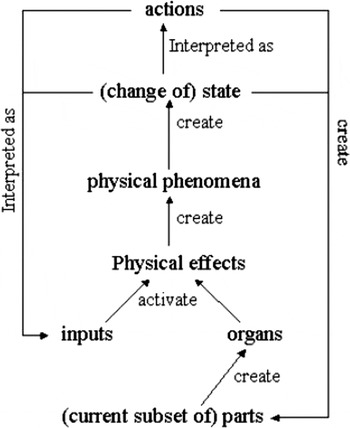
Srinivasan and Chakrabarti (Reference Srinivasan and Chakrabarti2010) proposed GoS by integrating the views of activity, outcome, and requirement–solution. The activity view comprises the following activities: generate, evaluate, modify, and select (GEMS). The requirement–solution view comprises requirements and solutions at various abstraction levels. The outcome view uses the state-change, action, part, phenomenon, input, organ, and effect (SAPPhIRE) model of causality, which is described as follows. Phenomenon is an interaction between an entity and its surroundings; for example, heat transfer from a body to its surroundings. State-change is a change in property of the entity due to the interaction; for example, change in thermal energy stored in the body. Effect is the principle underlying the interaction; for example, the rate of heat transfer, Q = h × A × ΔT, where h, A, and ΔT are the convective heat transfer coefficient, the surface area of the body, and the temperature difference between the body and surroundings, respectively. Action is a high level abstraction or interpretation of the interaction; for example, cooling of the body. Input is a physical quantity, in the form of material, energy, or signal, responsible for the interaction; for example, the temperature difference between the body and surroundings. Organ is a set of properties and conditions of the entity and its surroundings that are also responsible for the interaction; for example, the convective heat transfer coefficient. Part is a set of components and interfaces comprising the entity and its surroundings; for example, a body held in air. Parts of an entity and its surroundings have organs. Inputs, together with the organs, activate effects, creating phenomena, which create state-changes that can be interpreted as actions (Fig. 1). The activity, outcome, and requirement–solution views are empirically validated for their abilities to describe activities, outcomes, requirements, and solutions in designing at multiple levels of abstraction (Srinivasan & Chakrabarti, Reference Srinivasan and Chakrabarti2010; Ranjan et al., Reference Ranjan, Srinivasan and Chakrabarti2013).
The SAPPhIRE model of causality (Chakrabarti et al., Reference Chakrabarti, Sarkar, Leelavathamma and Nataraju2005).

Ranjan et al. (Reference Ranjan, Srinivasan and Chakrabarti2012, Reference Ranjan, Srinivasan and Chakrabarti2013) subsequently extended the GoS model by integrating to it the system–environment view, with the following constructs: element, subsystem, system, environment, and relationships. A system is the overall unit at any level of outcome abstraction, of which a subsystem is a subset. An element is a subset of a system or subsystem that cannot be further subdivided. An environment comprises all the subsets of the universe except the system. Relationships are how these are interlinked. Nidamarthi (Reference Nidamarthi1999) defines “related information as the information (facts or data), other than the contents of requirements and solutions, communicated through the design problem, colleague or any other source, concerning requirements or solutions,” which is adapted in this requirement–solution–information view (Ranjan, Reference Ranjan2012) as descriptions that are related to either requirements or solutions but are neither requirements nor solutions. Empirical validation shows that all these constructs are present in designing at various levels of abstraction of the SAPPhIRE model. According to e-GoS, during designing, GEMS activities are performed on SAPPhIRE outcomes, which evolve as requirements, solutions, or information of element, subsystem, system, environment, or relationship.
We propose the e-GoS and the common definition of function together as a framework for describing and integrating the various possible views of function. According to the framework, functions should be described using “requirements” (to represent intent) at any of the SAPPhIRE levels of abstraction, for an element, subsystem, system, environment, or relationship. Function at part level is not possible because it is a requirement that must be satisfied by a solution. Because part is the lowest abstraction level for a solution and because requirement must be at a higher abstraction level than that of its solution, the lowest possible abstraction level at which a function can exist is organ, one higher than the part level.
5. VALIDATION OF THE PROPOSED FRAMEWORK
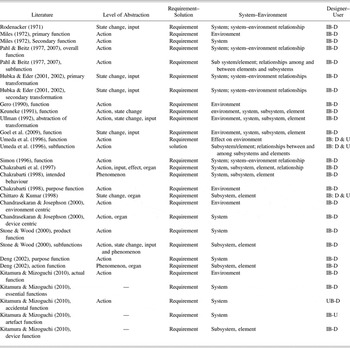
The framework is validated by analyzing whether the views expressed in the literature (through examples) are included within the proposed framework. The validation is summarized in Table 1.
Description of functions using the identified views

Note: IB, intended by; UB, unintended by; D, designers; U, users.
Rodenacker (Reference Rodenacker1971) considers transformations as requirements intended by designers (coffee beans to coffee powder). His function pertains to the system and shows relationship with environment through I/O, which is expressible as “Input” of the SAPPhIRE model. The transformation of I/O (coffee beans to coffee powder) is expressible as state-change (nonpowder to powder) of the SAPPhIRE model. Rodenacker also describes transformation of electrical energy to heat (i.e., loss of energy as heat) as part of the function of a coffee mill. However, we conjecture that, because dissipation of energy could not have been intended as a function of this machine, this must have been accepted later because it could not have been avoided. Imagine a situation where users notice that absorption of heat dissipated by the coffee powder increases retention of its quality over a longer period of time: an affordance (Brown & Blessing, Reference Brown and Blessing2005). The designers of the coffee mill subsequently become aware of this and decide to include this as a function of the mill: to heat coffee powder. In that case, the functions of “convert electricity to heat” and “use heat to warm coffee powder” would both be regarded as changes intended by the designers, and hence functions according to the proposed framework.
All functions in Miles (Reference Miles1972) are requirements intended by designers, and hence functions. The primary (pump water) and secondary (operate at low noise level) functions in the examples pertain to the environment and system level, respectively; both are expressible using “Action” of the SAPPhIRE model.
Both overall function and subfunctions in Pahl and Beitz (Reference Pahl and Beitz2007) are requirements intended by designers. The overall function in the example (measure and indicate liquid quantities) belongs to the system level. The subfunctions (receive, change, correct, channel, and indicate signal) pertain to subsystem or element levels, depending, respectively, on whether they are further subdivided. The system and environment are linked using I/O crossing the system boundary; subfunctions are interrelated using temporal relationships, showing existence of relationships among functions. All the functions are expressible using “Action” of the SAPPhIRE model. The I/O of Pahl and Beitz are similar to “Input” of the SAPPhIRE model.
Hubka and Eder (Reference Hubka and Eder1988) consider functions as intended requirements and transformation of intended primary and secondary I/O. The primary and secondary functions are at the system level because functions are taken as transformation of I/O entering and leaving the system, respectively. The system–environment relationship is explained using I/O, all of which transit the system boundary. The I/O are expressible using “Input” and their transformation using “State-change” of the SAPPhIRE model.
Gero (Reference Gero1990) treats functions as requirements intended by designers. The examples (provide daylight and control ventilation) are at the environment level and are expressible using “Action” of the SAPPhIRE model.
Keuneke's functions (Reference Deng1991) are requirements intended by designers. The examples (ToMake, ToMaintain, ToPrevent, and ToControl) can pertain to any level within the system–environment view. Keuneke's functions and states are similar, respectively, to “Action” and “State-change” of the SAPPhIRE model.
Ullman (Reference Ullman1992) defines (sub)function as transformation of I/O and the state-changes it enables; for example, the one-handed bar clamp function, transforming a single-handed grip-force into a controllable clamping-force, has I/O, transformation, and resulting state-change, all requirements intended by designers. I/O is similar to “Input” and the state-change (clamping objects together) is similar to “Action” of the SAPPhIRE model. The example transformation pertains to system; the state-change pertains to environment. Systems interact with environment through I/O. Ullman divides an overall transformation into subfunctions, suggesting the presence of system hierarchy for functions.
Function in Goel et al. (Reference Goel, Rugaber and Vattam2009) is taken as a requirement intended by designers. Function (a transition between I/O) can be described using “State-change” in the SAPPhIRE model; the function in the example (gyroscope taking an input angular-momentum to deliver a proportional, output angular-momentum) is at the environment level. At the behavior level, the overall transition from I/O is divided into a series of state transitions. This shows breaking down of the overall function into subtasks, which can be seen as I/O transitions of subsystems and elements within the system.
Because functions in Umeda et al. (Reference Umeda, Ishii, Yoshioka, Shimomura and Tomiyama1996) are interpreted from behaviors by humans, functions are taken as requirements intended by designers or users. The overall function in the example (produce sound) pertains to the environment level and the subfunction (oscillate string) at the system level; these are expressible, respectively, using “Action” and “Phenomenon” of the SAPPhIRE model. Decomposition of required functions (generate light) into subfunctions (generate electricity and light lamp with electricity) shows the presence of functions at subsystem or element levels with various relationships among them.
Simon (Reference Simon1996) considers functions as requirements intended by designers. The overall function of a clock in his example, to tell time, can be described using “Action” of the SAPPhIRE model. Simon argues that artifacts are designed to perform only in particular environment(s), signifying the relationship between system- and environment-level functions.
Sensing functions in Chakrabarti et al. (Reference Chakrabarti, Johnson and Kiriyama1997) and Chakrabarti (Reference Chakrabarti2004) are at various abstraction levels in the SAPPhIRE model, Action (measure acceleration), Input (transform acceleration to voltage), Effect (transform acceleration to force using inertia effect), and Organ (the properties and conditions needed to satisfy the effects), and can be at various system–environment levels. Both views in Chakrabarti (Reference Chakrabarti1998) treat functions as requirements intended by designers. The purpose (lock door against wind) and the intended behavior (press a door handle to cause a wedge to retract) views are, respectively, at the environment and the system/subsystem/element levels and are expressible, respectively, using the “Action” and “Phenomenon” levels of the SAPPhIRE model.
Functions in Chittaro and Kumar (Reference Chittaro and Kumar1998) pertain to components in a system, equivalent to functions of subsystems and elements in the proposed framework. Because functions are roles of components, they are requirements intended by designers or users. The overall function of an electrical switch in the example (turn on/off a lamp) is at the environment level and expressible using “State-change” of the SAPPhIRE model; the subfunctions (barrier or conduit for electrical-current) are “Organ”-level descriptions at the subsystem or element level.
The environment-centric function of Chandrasekaran and Josephson (Reference Chandrasekaran and Josephson2000) pertains to the environment level (buzzer's functions, to provide a means by which a person at one location may cause sound to be produced at another). Its device-centric function (to make sound come from a box when a switch in another box is closed) pertains to the system level. Both views are requirements intended by designers and expressible respectively, using the “Action” and the “Action and Organ” levels of the SAPPhIRE model.
Product-function in Stone and Wood (Reference Stone and Wood2000) pertains to the overall system and is a requirement intended by designers. This function (transmit torque) can be described using “Action” of the SAPPhIRE model. The subfunctions satisfying the overall product-function pertain to subsystems and elements. Subfunctions (e.g., in functional basis ontology) are expressible using “Action,” “State-change,” “Input,” and “Phenomenon” of the SAPPhIRE model.
Purpose-functions (indicate time) in Deng (Reference Deng2002) involve human interpretations and thus are requirements intended by designers or users; they are expressible using “Action” of the SAPPhIRE model and pertain to the environment. Action functions (rotate, constant angular velocity, etc.) are requirements intended by designers, at subsystem and element levels, and are expressible using “Phenomenon” (rotate) and “Organ” (constant angular velocity) of the SAPPhIRE model.
Actual-functions (screwing function) in Kitamura and Mizoguchi (Reference Kitamura and Mizoguchi2010) are at the environment level (engaging a screw with the wall) and are expressible using “Action” of the SAPPhIRE model. Capacity functions resemble function at a lower level than actual-functions because these are used to satisfy actual functions. Artifact functions are at the system level; device functions are at the subsystem or element level. Both are affordances because they are intended by users. Essential functions are requirements of systems intended by designers. Accidental functions are unintended by designers. Functions unintended by designers can mean intended or unintended by users. Functions unintended by both designers and users are not functions but side effects.
6. DISCUSSION
Little has been proposed in the literature to resolve the confusion in understanding and using functional descriptions. An exception is Vermaas (Reference Vermaas2013), who proposes several possibilities to resolve the difficulties in describing functions. The common definition of function proposed in this paper is along the lines of the third possibility proposed by Vermaas: to propose an overarching concept of function for accommodating the coexisting descriptions of function. The proposed definition encompasses views of multiple, coexisting, and apparently disparate descriptions of functions from the literature.
Analysis of the literature in Section 5 using the proposed framework shows that all the functions reviewed in this paper can be described using the following: all abstraction levels of the SAPPhIRE model except parts, all levels of the system–environment view, and requirements from the requirement–solution–information view because the requirement view alone is sufficient for representing both the requirement and the solution views, as explained in Section 2. The activity view is not required for describing functions. Using empirical studies, Eckert (Reference Eckert2013) identifies functions as being intentional and belonging to different levels of abstraction. These are similar to the requirement view and the level of abstraction view of functions, interpreted from the literature and reported in Section 2.
Analyses of the literature demonstrate that the various views on functions reported in the literature are not arbitrary but intended changes at every possible level of outcome and system abstraction that constitute designing; we argue that these enable designers to proceed from the highest (intended changes on the environment) to the lowest (intended organs to be provided by the system and its environment) level of abstraction. Together, these views, interlinked via the e-GoS model of designing, provide a coherent and interconnected tapestry of intents that a designer must formulate and satisfy in order to develop systems that have the desired effects on their environment.
Using a common, logically defendable platform to describe, compare, and determine relationships among the various descriptions of function has rarely been attempted in the past. Describing functions from the literature using a common framework, as attempted in this paper, is a step in that direction.
7. SUMMARY AND CONCLUSIONS
The literature reports many views of function, categorized using level of abstraction, requirement–solution, system–environment, and intention by designer-user. A common, overarching definition of function and a framework that combines this definition and an empirically validated model of designing are proposed; these are used to predict the set of views of function that are logically possible in designing. The framework is validated by comparing the views found in the literature with the predicted set of views. Validation reveals that all the views found in the literature are included in the predicted set. We conclude, therefore, that the framework provides a theoretical justification for coexistence of these views.
This demonstrates the potential of the framework as an enabler for comparison and integration of the various descriptions of function and paves way for better understanding and usage of functions in designing.
Amaresh Chakrabarti is a Professor at the Centre for Product Design and Manufacturing, Indian Institute of Science; Coordinator for the Innovation, Design Study and Sustainability Laboratory; and cofounder of the Virtual Reality Laboratory at the Centre for Product Design and Manufacturing. He received his PhD in engineering design from the University of Cambridge in 1992, his masters in mechanical systems design from the Indian Institute of Science in 1987, and his bachelors in mechanical engineering from the University of Calcutta in 1985. He led the design synthesis team for 10 years at the Engineering Design Centre, an Engineering and Physical Sciences Research Council Centre for Excellence in Engineering Design in the University of Cambridge's Department of Engineering. Prof. Chakrabarti's research interests include design synthesis, creativity, ecodesign, knowledge capture and reuse, collaboration, requirements engineering, computer-aided design, and design for variety.
V. Srinivasan has been a Postdoctoral Researcher at the Institute of Product Development, Technische Universität München, since mid-2011. He received his PhD in engineering design from the Indian Institute of Science in 2011 and his bachelors in mechanical engineering from the University of Madras in 2003. Dr. Srinivasan's research interests include design creativity, design theory and methodology, functional modeling, design synthesis, biomimetics, conceptual design, and engineering design.
B.S.C. Ranjan is a PhD student in the Innovation, Design Study and Sustainability Laboratory, Centre for Product Design and Manufacturing, Indian Institute of Science. He received his masters in engineering design from the Indian Institute of Science in 2012 and his bachelors in mechanical engineering from Visvesvaraya Technological University in 2007. His research interests include design methodologies, product design, embodiment design, machine tools, robotics, automotive engineering, and biomimetics.
Udo Lindemann has been a Professor and Head of the Institute of Product Development, Technische Universität München since 1995. He received Dr.-Ing from Technische Universität München in 1979 and Dipl.-Ing from Technische Universität Hannover in 1974. He has 15 years of diverse experience in industries like RENK AG and MAN Miller Printing Machines GmbH. Prof. Lindemann's research interests include design theory, methods, and product design in the following: innovative and creative design, design representations, creative problem solving, product design methodologies, integrated product development, industrial design, entrepreneurship, design to cost, knowledge management, cooperation and collaboration in distributed teams, lean development, structural complexity, change management, and strategic planning.