Conventional wisdom about the political resource curse holds that oil-rich autocracies can use their wealth to co-opt their citizens, buy security forces to repress them, or both. By these means, oil rich autocracies remain in power longer than dictatorships that lack these resources. Most research on the political implications of oil wealth examines only one form of regime change, the replacement of autocracy by democracy. Yet democratization is not the only way autocracies end. In fact, as Figure 1 shows, fewer than half the autocratic regimes that have ended since the Second World War have democratized.Footnote 1 Most have been replaced by another autocracy. This article examines how oil income influences both types of transition: to democracy and to new autocracy.
Number of democratic and autocratic regime transitions, by decade Note: Regime failures that end in a foreign occupation are excluded.

Though often overlooked in the political science literature, autocracy-to-autocracy transitions involve much more than substituting one dictator for another. Often violent, these transitions can lead to major social upheavals as well as the reversal of fortunes for supporters of the ousted dictatorship. In 1959, for example, an insurgency led by Fidel Castro ousted the dictatorship of Fulgencio Batista in Cuba, leading to mass expropriations, the flight into exile of much of the Cuban upper and middle classes, and the wholesale replacement of the military by the insurgent army. In a completely different setting, a military coup in 1962 ended the Yemeni imamate and the sayyid caste's birthright to rule; members of the Hamid al-Din extended family and their supporters were executed, jailed, or exiled, and their property was confiscated.Footnote 2 Many autocratic transitions are similarly destructive to supporters of the old regime. Regime leaders would thus be expected to guard against such ousters as assiduously as they guard against democratization.
By ‘regime change’ we mean fundamental changes in the formal and informal rules that identify the group from which leaders can be chosen and determine who can influence policy (the leadership group). Autocratic regimes can and often do include multiple dictators, particularly when the regime has an institutionalized mechanism for rotating leadership. In Mexico, for example, the ruling Institutional Revolutionary Party (PRI) selected a new president every six years (prior to 2000). In these cases, leaders leave office but the fundamental rules of the regime do not change. Indeed, many leadership changes in dictatorships, particularly the regular rotation of leaders on the expiry of an executive term limit, reflect a stabilizing mechanism for keeping the incumbent ruling elite in power.
While transitions from one autocratic regime to another are a common feature of the real world, the resource-curse literature has yet to consider them. With new data that identify autocracy-to-autocracy transitions, we have investigated whether oil resources increase autocratic regime survival by reducing the likelihood of transitions to new dictatorship, transitions to democracy, or both. We have used an empirical approach that assesses the influence of both between-country differences in oil wealth and changes in the level of oil wealth within countries.Footnote 3
We have found support for the resource-curse claim that higher oil wealth increases autocratic regime survival.Footnote 4 The mechanism through which this occurs, however, is not deterrence of the forces of democratization, as suggested in much of the literature. Like the recent study by Haber and Menaldo, we have found little evidence that decreasing oil income makes autocratic regimes more likely to democratize.Footnote 5 Instead, we have shown that as oil wealth rises, autocracies are less likely to be ousted by groups that would initiate new dictatorships if they were able to defeat the old one. Further, we have found evidence that oil income increases spending on the military, suggesting one avenue through which oil wealth helps autocratic regimes to survive.
These findings suggest that increasing oil rents stabilize dictatorships by suppressing challenges from future autocrats, rather than by quelling democratic opposition movements. Our study thus supports a basic idea in the resource-curse argument – that oil bolsters autocratic regimes – and identifies a new mechanism through which it does so. We first discuss the resource-curse literature and, specifically, what it says about oil and autocratic survival. We then outline our empirical strategy, present the results, and close by discussing the implications of this research.
Theoretical Background
The idea of the oil curse is rooted in the rentier state theory.Footnote 6 Drawing from experience in the Middle East, the theory claims that governments reliant on external revenue (such as oil income) can operate autonomously from societal interests, thus insulating them from accountability to their citizens and more likely to be autocratic.Footnote 7 Because the revenue accrues either from the profits of state-owned resources or from taxing foreign resource owners, it does not depend on the cooperation of citizen tax payers, leaving rulers free to act as they please with few repercussions.Footnote 8 Extensive revenues drawn from oil wealth allow rulers to protect themselves from overthrow by providing benefits to citizens and/or by building coercive capacity.
All dictatorships maintain power through a combination of two strategies: repression and co-optation.Footnote 9 Oil wealth makes both of these strategies easier to pursue. With state coffers full, autocratic governments have the financial capacity to beef up the security apparatus, rooting out potential threats to their control.Footnote 10 They can also use the state's oil wealth to co-opt potential opponents, by giving them jobs, lucrative government contracts, business subsidies, high wages, and low-priced fuel. They can discourage plotting and elite calls for political change by distributing more rents to discontented regime insiders, leaders of the opposition, and/or the security forces, while limiting popular demands for accountability by reducing taxes and/or offering subsidies. In these ways, autocracies can purchase elite cooperation and popular acquiescence, if not exactly support, and thus extend their time in office. In sum, because rentier autocratic regimes can use oil revenues to buy regime survival, they should be more resistant to collapse than other autocracies. This could occur because oil dampens pressure for democratization, prevents new autocratic groups from seizing power, or both.
The bulk of existing studies examine the first possibility, exploring whether oil prevents democratization. Building on Ross, these studies investigate the cross-national relationship between oil wealth and incremental measures of democracy and, by and large, find that oil lowers levels of democracy.Footnote 11 This relationship is confirmed by studies showing that oil-rich autocracies are less likely to democratize than autocratic countries with few oil resources.Footnote 12
A few recent studies, however, use unique empirical approaches to challenge these findings. Herb, for example, compares the level of development in resource-poor countries with resource-rich countries exclusive of their resource rents.Footnote 13 He finds that natural resources do not deter democracy, concluding that there is little reason to believe that the absence of resource wealth in oil-producing countries would have made any difference to their political futures. Dunning reconsiders the oil curse by exploring whether the relationship is context dependent.Footnote 14 He finds that oil rents encourage democracy in Latin America, but discourage it elsewhere, because the political impact of oil wealth depends on other factors, such as inequality. Haber and Menaldo also use a new strategy to evaluate the oil curse.Footnote 15 They argue that examining how oil influences democratization requires a process that unfolds over time to be modeled, though most empirical strategies used to test it do not use time-series centric methods or counterfactuals (Herb is an exception). To address this problem, Haber and Menaldo analyze fluctuations in a country's oil wealth over time and find little evidence that increases in oil wealth reduce the level of democracy, as measured by Polity.Footnote 16
Despite the many studies of how oil affects democratization, few have looked at its impact on autocratic regime survival more generally.Footnote 17 Yet the argument that oil wealth can buy political support or repress opposition also implies that regimes shaped and led by particular leadership groups should persist longer in oil producing countries, not just that some form of autocratic rule should prevail in oil-rich places. Oil wealth could potentially increase autocratic regime survival by deterring democratization, transitions to a new autocracy, or both. In this study we consider all these possibilities. New data that capture transitions from autocracy to autocracy, in addition to transitions from autocracy to democracy, are now available to us, and we now turn to them.
Measuring Regimes
Much of the literature on the oil curse uses data that identify the duration of non-democratic periods or levels of democracy, but not the beginnings and ends of autocratic regimes (unless they precede and follow democracy). This is appropriate if the subject of interest is democratization, but for those interested in oil's impact on autocratic regime survival, such data will omit about half of all autocratic regime collapses because autocracies are often replaced by new autocracies. For example, Iran was autocratic in the 1970s when the Shah was ousted as well as in the 1980s under Ayatollah Ruhollah Khomeini, but this is not a period of regime continuity. By standard definitions of the word regime, the 1979 Revolution was a regime change. Evaluating the effect of oil on autocratic regime survival, then, requires data that identify not only democratizations but also transitions to new autocracies.
Older data, however, do not capture this latter kind of transition. The Polity index, for example, which measures characteristics of political systems, is often interpreted as an indicator of how democratic a system is and widely used to measure transitions to and from democracy. Polity identifies changes in the exclusiveness of political systems and the level of constraint faced by executives, but it does not attempt to identify regime changes, other than those between democracy and dictatorships.
Autocracy-to-autocracy transitions may not involve changes in executive constraint or popular participation so they cannot be captured by Polity scores.Footnote 18 When Mobutu Sese Seko's regime in the former Zaire collapsed in 1997, for example, it was replaced by another dictatorship, led by former rebel commander Laurent Kabila. The combined Polity score for that country did not change when Mobutu's regime was ousted because the level of democracy did not change.Footnote 19
When used as a proxy for regime change, the Polity index not only ignores transitions between dictatorships, but can also conflate periods of relaxation or liberalization in ongoing dictatorships with democratic transitions.Footnote 20 The combined Polity score for former Zaire, for example, increases eight points (on a 21-point scale) from 1991 to 1992 due to the legalization of opposition political parties at that time, even though Mobutu's regime remained in power another five years and never held multiparty elections. This increase in Zaire's combined Polity score is comparable to the increase in Chile's combined Polity score from 1988 to 1989 (nine points), when that country democratized. In one case the large increase in combined Polity score is associated with the survival of a dictatorship (Zaire 1992) and in the other it is associated with regime collapse and democratic transition (Chile 1989).Footnote 21
The Polity Durable variable does not solve this problem.Footnote 22 This variable codes increases or decreases of three points or more (over three years) in the combined Polity score as instances of ‘regime change’. Using this measure, however, Iran's 1979 revolution, Mobutu's 1992 legalization of opposition parties, and Chile's 1989 democratic transition are identified as identical ‘regime change’ events because their combined Polity scores each increase by more than three points.Footnote 23 As these examples illustrate, studies that use this variable in effect treat instances of democratization (Chile 1989), autocracy-to-autocracy transition (Iran 1979), and a wily dictator's cosmetic changes leading to regime persistence (Zaire 1992) as equivalent events. In contrast, the data used in this article code autocracy-to-democracy transitions (Chile 1989) and autocracy-to-autocracy transitions (Iran 1979) as distinct types of regime collapse while treating periods of regime persistence (Zaire 1992) as non-transitions.
The other data source often used to measure democratization, Cheibub, Gandhi, and Vreeland's (CGV) dichotomous regime type measure, also ignores autocracy-to-autocracy transitions.Footnote 24 The 1968 Iraq transition from rule by a military faction that had forced most Ba'athist officers into retirement to the Ba'ath-dominated regime that gave Saddam Hussein his start shows the weaknesses of both measures. With the CGV data, no transition is observed.Footnote 25 With the Polity data, Iraq's combined Polity score decreases two points, which is insufficient to be considered regime change, as most scholars use the data. Indeed, Polity's Durable variable shows no change in Iraq from independence to 2002, though several regime changes occurred during this period, including the ouster of the monarchy in 1958. This is not to say these measures are not useful for many purposes, but they are ill-suited for studying autocratic regime survival.
In this study, we use autocratic regime data from Geddes, Wright, and Frantz.Footnote 26 These data code the start and end dates of autocratic regimes, defined as the set of basic formal and informal rules that identify the group from which leaders can come and the rules through which leaders and policies are chosen.Footnote 27 Regimes thus often span several leaders; and one autocratic regime can follow another during a period of non-democratic rule. An autocratic regime ends, by this definition, when the identity of the leadership group and other basic rules of the political game change, even if the succeeding government is autocratic. The data identify regime beginnings and ends to enable assessments of autocratic regime survival independent of whether democratization followed regime breakdown.
Empirical Approach
In this study, we examine the relationship between oil wealth and autocratic regime survival and, therefore, restrict the sample to autocratic cases. We use data on autocratic regimes from Geddes, Wright, and Frantz, which code each regime failure and the subsequent government as dictatorship or democracy.Footnote 28 We first test models that group all autocratic regime collapses together and then test models that estimate transitions to democracy and transitions to subsequent dictatorship separately. This enables us to identify whether oil affects autocratic survival by: alleviating pressures for democratization, deterring new autocratic challenges, or both. When we test the democratic transition model, we treat transitions to a subsequent dictatorship as right-censored (and vice versa). In the main sample used below, with 261 distinct autocratic regimes in 114 countries from 1947 to 2007, there are more transitions to subsequent dictatorship (103) than transitions to democracy (93). This means that studies that include only democratic transitions will miss more than half of the events that end autocratic regimes.
To measure oil, we use data on total oil income per capita from Haber and Menaldo and thus test arguments about oil wealth, as opposed to oil dependence.Footnote 29 This variable is the level of crude oil production multiplied by the world oil price and then divided by population size.Footnote 30 We prefer to follow other recent studies such as those by Haber and Menaldo and by Ross, which use a measure of oil wealth that does not include gross domestic product (GDP) in the denominator, because large fluctuations in GDP can independently influence autocratic survival.Footnote 31 This variable is highly skewed, so we calculate its natural log (plus one).
Because autocracies with oil may be richer than other dictatorships, we include a control for wealth: logged GDP per capita from the most recent version of Maddison.Footnote 32 There is also a large literature linking natural resource wealth to civil conflict.Footnote 33 To avoid conflating the effects of oil with those caused by conflict, we include a binary indicator of civil war (lagged one year) from the updated Gleditsch data.Footnote 34 Finally, we include a measure of neighboring country democratic transitions in the prior year to make our analysis as comparable to Haber and Menaldo's as possible.Footnote 35
Our analysis distinguishes between-country effects from within-country effects. Between-country effects measure whether different average levels of oil wealth bear on regime survival (i.e. whether autocratic regimes in countries like oil-rich Iraq last longer than those in countries like oil-poor Tunisia). Most previous research focuses on how differences in levels of oil wealth among countries affect politics. Within-country effects measure whether changes in amount of oil wealth in a single country alter its prospects for regime change. Haber and Menaldo focus on whether within-country changes in oil wealth affect levels of democracy. There is little consensus in the literature about whether theories of the resource curse imply between-country differences or within-country ones.Footnote 36 Both effects are of interest to academics and policy makers. The within-country effect better captures the idea that oil discovery sets nations on a different path of development, as proposed in the resource-curse literature and emphasized by Haber and Menaldo, but both relationships are important for understanding how oil affects autocratic durability.
Given the nature of our data, we estimate a non-linear model where the outcome variable is a binary indicator of regime change, and account for duration dependence with polynomials of duration time. This model estimates the probability of transition to a different regime (democracy or subsequent autocracy) in time t, given autocratic rule in t – 1.
Most of the empirical literature on the resource curse does not separate cross-national correlations (between-country effects) from variation within countries (within-country effects).Footnote 37 To compare our results with theirs, we begin with this specification:
 $${ Pr({{Y}_t}\, = \,{\rm{1}}|{{Y}_{t{\rm{ - 1}}}}\, = \,{\rm{0}})\, = \,{{\alpha }_{\rm{0}}}\, + \,{{\beta }_{\rm{1}}}{{O}_{t{\rm{ - 1}}}}\, + \,{{\beta }_{\rm{2}}}{{X}_{t{\rm{ - 1}}}}\, + \,{{\beta }_{\rm{3}}}{{\vartheta }_{i,t}}\, + \,{{\beta }_{\rm{4}}}{{\zeta }_t}\, + \,{{\mu }_{i,t}} \eqno(1)$$
In this equation, the measure of Oil (O) and the control variables (X) are lagged one year; (ζt
) is a calendar time trend to account for time-varying common shocks; and
 $$$\vartheta_{i,t}$$$
is a vector of duration time polynomials to account for duration dependence.Footnote
38
Yet, as Haber and Menaldo point out, this specification does not account for possible unit effects.Footnote 39 Their approach is to model unit heterogeneity directly by including country-fixed effects, thus isolating the within-country variation. With a quasi-continuous dependent variable (e.g., the Polity scale) a fixed effects model is straightforward.Footnote 40 With a binary dependent variable, however, researchers typically use a conditional logit model, which accounts for factors that vary by country and may be correlated with both the level of oil rents and the latent propensity for regime change.Footnote 41 This is the method used by Haber and Menaldo in their estimation of the within-country effects of changes in oil wealth on a binary measure of regime change.Footnote 42 The second model we estimate is thus a conditional logit.
This strategy, however, drops countries from the analysis that do not experience regime change. Haber and Menaldo's analysis of regime change drops the sixty-four autocratic countries that did not democratize during the period under study; the dropped cases include the Gulf monarchies and other autocratic oil producers like Angola and Libya. In the model that includes both types of regime collapse, a conditional logit drops twenty-six countries; in the democratic transition model, fifty-one countries; and in the model of transitions from autocracy to autocracy, fifty-seven countries. Dropping countries that do not experience regime change may bias estimates downward by selecting only those where regime change has occurred in the sample period, particularly if those stable political systems have high oil wealth. Below, we investigate the possibility that this restriction on the sample induces selection bias.
To account for unit heterogeneity and isolate the influence of differences in oil wealth within countries without dropping those that never experience regime change, we use an approach that simultaneously models both between-country and within-country effects.Footnote 43 To do this, we employ a model specification that conditions the marginal effects of the covariates on the country means for explanatory variables.Footnote 44 The logic of this estimation procedure is to decompose the independent variables into their between-country and within-country effects.Footnote 45 This technique yields the following specification:
 $$no{\quad\quad\quad\quad Pr({{Y}_t}\, = \,{\rm{1}}|{{Y}_{t{\rm{ - 1}}}}\, = \,{\rm{0}})\, = \,{{\alpha }_{\rm{0}}}\, + \,{{\beta }_{\rm{1}}}({{O}_{i,t{\rm{ - 1}}}}\,{\rm{ - }}\,\overline{{{{O}_i}}} )\, + \,{{\beta }_{\rm{2}}}({{X}_{i,t{\rm{ - 1}}}}\,{\rm{ - }}\,\overline{{{{X}_i}}} )\, + \,{{\beta }_{\rm{3}}}{{\overline{O} }_i}\cr \quad+ \,{{\beta }_{\rm{4}}}{{\overline{X} }_i}\, + \,{{\beta }_{\rm{5}}}{{\vartheta }_{i,t}}\, + \,{{\beta }_{\rm{6}}}{{\zeta }_t}\, + \,{{\mu }_{i,t}}$$
In Equation 2,
 $$$ {{\overline{O} }_i} $$$
and
 $$$ {{\overline{X} }_i} $$$
are the country-means of Oil and the vector of control variables (used to capture between-country effects), while
 $$$ ({{O}_{i,t{\rm{ - 1}}}}{\rm{ - }}\overline{{{{O}_i}}} ) $$$
and
 $$$ ({{X}_{i,t{\rm{ - 1}}}}\,{\rm{ - }}\,\overline{{{{X}_i}}} ) $$$
are the deviations from the country means with which we measure within-country differences.Footnote
46
Again we include calendar time trend (ζt
) and duration time polynomials (
 $$$\vartheta_{i,t}$$$
).
While this approach estimates the effect of within-country changes in oil wealth independently of between-country differences, it does not account for varying intercepts. In a non-linear model, excluding the country-specific intercepts may be problematic because the estimated marginal effect of covariates can be influenced by other covariates in the model, including the intercept, which is constrained to be the same for all countries in Equation 2. Therefore, we also test models that include the country mean of the regime change variable on the right-hand side of the equation, further accounting for unit heterogeneity by allowing the ‘intercept’ to vary by country.Footnote 47 Unobserved factors that vary by country and may also be correlated with the level of oil rents and the latent propensity for regime collapse should be captured in the unit means for regime change.
 $$no{ \quad\quad\quad\quad\quad Pr({{Y}_t}\, = \,{\rm{1}}|{{Y}_{t{\rm{ - 1}}}}\, = \,{\rm{0}})\, = \, {{\alpha }_{\rm{0}}}\, + \,{{\beta }_{\rm{1}}}({{O}_{i,t{\rm{ - 1}}}}\,{\rm{ - }}\,\overline{{{{O}_i}}} )\, + \,{{\beta }_{\rm{2}}}({{X}_{i,t{\rm{ - 1}}}}\,{\rm{ - }}\,\overline{{{{X}_i}}} )\, \, \cr & \quad + {{\beta }_{\rm{3}}}{{\overline{O} }_i}\, + \,{{\beta }_{\rm{4}}}{{\overline{X} }_i}\, + \,{{\beta }_{\rm{5}}}{{\vartheta }_{i,t}}\, + \,{{\beta }_{\rm{6}}}{{\zeta }_t}\, + \,{{\beta }_{\rm{7}}}\overline{{{{Y}_i}\,}} + \,{{\mu }_{i,t}} $$
The only difference between Equations 2 and 3 is the inclusion of
 $$$ \overline{{{{Y}_i}}} $$$
on the right-hand side of Equation 3.
Because the data transformations in Equation 3 are an attempt to mimic a conditional logit without dropping countries that do not experience transition during the sample period, we interpret the coefficient for the lagged deviations, β
1, as we would a coefficient from a conditional logit model: the marginal effect of changes in the level of oil within countries. In our tables,
 $$$ \overline{O} $$$
refers to between-country effects, or how variation in average levels of oil wealth across countries affects autocratic survival;
 $$$ Oi{{l}_{Dev}} $$$
refers to within-country effects, or how changes in oil wealth within a country affects survival.
 $$$ Oi{{l}_{Dev}} $$$
measures how different the current year's oil wealth is from the country's average oil wealth for the whole period, not year-on-year changes. It thus captures the effects of both new discoveries and international price increases.
Finally, we test Equations 2 and 3 both on the full sample of autocracies and on the restricted sample of those that experienced regime change to see whether omitting the most stable cases changes the results. The size of the restricted sample varies, depending on which type of regime change we examine. For all regime changes, the restricted sample includes eighty-eight countries (compared to the full sample of 114); for democratic transitions, it includes sixty-three countries; and for transitions to a subsequent dictatorship, it includes fifty-seven countries. Comparing the results from the restricted sample with those from the full sample helps us understand the extent to which sample restrictions necessitated by the use of conditional logit change estimates of the effects of oil on regime survival.
Results
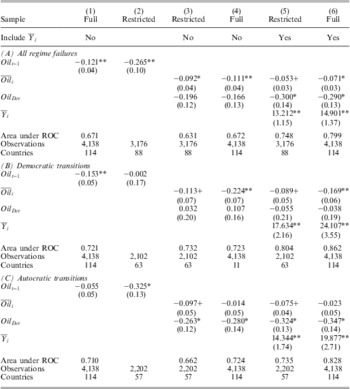
The first column of Table 1 reports the results of an ordinary logit model with lagged explanatory variables, the approach used in much of the literature; the second column reports the results of a conditional logit model, showing the effect of accounting for unit effects while dropping countries with stable authoritarianism; the third and fourth columns report ordinary logit models, but estimate effects of between-country and within-country differences in the explanatory variables separately (column 3 uses the restricted sample and column 4 the full sample); last, the fifth and sixth columns do the same, but include the mean of the dependent variable in the specification. The top panel (A) reports the results of these six models for all regime changes regardless of what kind of government followed the initial autocracy. The middle panel (B) shows results for autocratic collapses that resulted in democratization, and the bottom panel (C) for transitions to subsequent dictatorship.
Oil Income and Autocratic Regime Survival

Notes: Conditional logit in column 2. Ordinary logit with errors clustered on country in all other columns. Time dependence polynomials (3); calendar time polynomials (3); and control variables (GDP per capita, Civil War, Neighbor Democracy) included in all models but not reported. Years: 1947–2007. +p < 0.10; *p < 0.05; **p < 0.01.
Looking at all types of regime change (Panel A), the results indicate that oil resources are associated with a reduced likelihood of autocratic breakdown. This relationship holds regardless of the model used. Leaving out the most stable autocracies increases the effect of oil wealth in models that combine between-country and within-country effects (column 1 and 2), but has little effect in the models that estimate them separately. Estimates for differences in oil income within individual countries are only statistically significant at conventional levels when the mean of the dependent variable is included (columns 5 and 6), but the sign is the same in the specifications that do not include it. These tests suggest that greater oil wealth is associated with greater autocratic durability, both across countries and across differences in oil wealth within countries. Dictatorships in oil-rich countries are more able to resist ouster than dictatorships lacking these resources (a between-country effect); and increases in a dictatorship's oil rents, whether from new discoveries or price hikes, also make it more resilient to regime collapse (a within-country effect).
We next separate democratic transitions from autocratic transitions, which reveals a more nuanced picture. Looking only at democratic transitions (Panel B), as nearly all prior research has done, the ordinary logit model (column 1) that includes all cases and lumps between-country and within-country differences together yields a negative coefficient for oil, consistent with much of the literature.Footnote 48 The conditional logit model (column 2) that excludes all the cases that never democratized – one of the models used by Haber and Menaldo – shows no effect of oil wealth on the likelihood of democratization.Footnote 49 Eliminating the most stable cases while focusing on within-country variation prevents us from seeing the relationship. It should not be surprising that if about 45 percent of the most stable autocracies are excluded from the sample, a different estimate results.
When the between-country and within-country effects are disaggregated in columns 3 and 4, we find that exclusion of the most stable autocracies from the sample changes the estimate of the between-country differences but not the estimate of within-country differences.Footnote 50 The estimate for the full sample indicates a stronger negative between-country correlation between oil wealth and democratization. Changes in oil wealth within countries, however, have no effect on the likelihood of democratization, regardless of whether all cases are included in the analysis (as in columns 4 and 6) or not (as in columns 3 and 5). The negative between-country correlation is consistent with the bulk of the literature on the oil curse, while the absence of a within-country association is consistent with the main finding in Haber and Menaldo.Footnote 51 The results from Panel B suggest that the negative relationship between oil and the likelihood of democratization picked up in the ordinary logit model without unit effects (column 1) and revealed in much of the prior literature is due to the between-country variation in average levels of oil wealth. Below we discuss possible interpretations of this finding.
Since more than half of autocratic regime collapses are followed by new dictatorships, we also investigate the effect of oil wealth on the likelihood of collapse that is not followed by democratization in Panel C. We find that increases in oil wealth reduce the likelihood of autocracy-to-autocracy regime changes. This finding shows up in the conditional logit model in column 2 and is replicated in all models and samples that look separately at between-country and within-country effects (columns 3–6). Including the average of the dependent variable,
 $$$ \overline{{Dictatorship}} $$$
, as a control strengthens this result, but excluding the most stable countries has little effect on the estimate. Finally, we find little evidence that between-country differences in oil wealth deter autocracy-to-autocracy transitions, either in the ordinary logit model (column 1) or in the simultaneous models (as indicated by the coefficient for
 $$$ {{\overline{{Oil}} }_i} $$$
in columns 3–6). The only models in which these differences approach statistical significance use the restricted sample, which omits the most resilient half of the cases. The main result in this panel, then, is that increasing oil wealth within dictatorships decreases the likelihood of transitions to new dictatorships; but between-country differences in oil wealth do not affect the likelihood of such transitions.
Excluding cases that have not experienced transitions has less effect on estimates when the outcome is autocratic transition (Panel C) than when it is democratization (Panel B). That is, countries that have never democratized are more different from countries that have experienced at least one democratization than countries that have never experienced an autocracy-to-autocracy transition are from other countries that have been consistently autocratic.
Comparing the estimates of within-country effects shown in Panel B with those shown in Panel C indicates that higher levels of oil wealth relative to the country average prolong autocratic survival (as also shown in Panel A for the combined sample that includes both kinds of transition), even if they do not deter democratization. In short, increases in oil wealth fuel dictatorships by preventing ouster by groups that organize new dictatorships, not by undermining efforts to democratize.
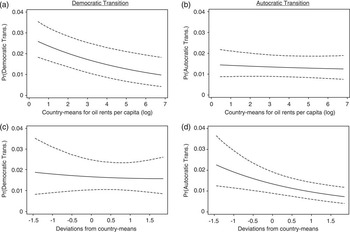
Figure 2 shows the substantive effect of the main results.Footnote 52 The upper left figure shows that moving the average level of oil income from the 10th percentile to the 90th percentile lowers the predicted probability of democratic transition from 2.6 percent to 0.9 percent (the effect of between-country differences). For autocracy-to-autocracy transitions, however, the between-country effect is negligible. The lower right panel shows that moving the change in oil income from the 10th percentile to the 90th percentile lowers the predicted probability of autocracy-to-autocracy transition from 2.3 percent to 0.7 percent (the within-country effect). That is, decreases in oil income are associated with a predicted risk of ouster by an autocratic challenger more than three times as large as the predicted risk when oil income in a country rises. Changes in oil income (within-country differences) have little influence on the likelihood of democratization.
Between and within effects of oil income, by type of regime failure Note: Top panel displays the simulated predicted probability of regime transition across a range of values for the average level of oil income, with deviations set at zero (the median value of deviations for countries with a mean oil income value greater than zero). The lower panel depicts the predicted probability of transition across a range of values for deviation in oil income within countries with mean levels greater than zero. Mean oil is set at the median above zero, or 3.18 log units. Dotted lines depict 90 percent confidence intervals. See fn. 50 for details on the simulations.

Robustness Tests
We report results from robustness tests in Appendix A. First, we test the main findings while excluding one geographic region at a time.Footnote
53
The results indicate that the main findings are robust to the exclusion of any one region. Only excluding the Middle East and North Africa produces a notable change in the model of democratization – a positive but non-significant coefficient for
 $$$ Oi{{l}_{Dev}} $$$
, the measure of within-country differences. This suggests that studies using models that exclude much of this region (for example conditional fixed-effects models that exclude countries that have not democratized) may produce upwardly biased estimates of the effect of within-country oil wealth on the likelihood of democratization.
The two main empirical results – the negative between-country effect of average oil wealth on democratic transition and the negative within-country effect of increases in oil wealth on transitions to subsequent dictatorship – are robust to different measures of oil: Ross's oil and gas rents and Haber and Menaldo's total fuel income.Footnote 54 Further, we show that the negative between-country correlation with democracy persists in a purely cross-sectional regression of unit means, and that the negative within-country result for transitions to subsequent dictatorship persists in a linear probability model with country and year fixed effects. We replicate the negative between-country correlation using the CGV data on democratic transitions, which is the measure of regime change used by Haber and Menaldo in their conditional logit model.Footnote 55 The results persist when we use year fixed effects and when we include a time-varying control for the world oil price.
Andersen and Ross point out that a wave of oil industry nationalizations in the 1960s and 1970s may have changed the way oil wealth influences political development in autocracies by vastly increasing the revenues they could use.Footnote 56 They argue that the most appropriate test of the oil curse should, therefore, focus on the period after 1979. Following their strategy of interacting the main oil variables with a time period dummy, we find that the main results are indeed stronger for the period 1980–2007 than for that of 1947–79. The effect of increases in oil income on the likelihood of transition to a new autocracy, however, remains statistically and substantively significant in the earlier period.
Endogenous Oil Income
A final robustness test addresses the potentially endogenous relationship between oil income and regime collapse. While we have directly modeled unobserved unit heterogeneity, time-varying expectations about regime survival may still influence oil investment and production. If autocratic elites believe opponents are likely to gain power in the future, they may reduce investment in the oil sector so opponents will not subsequently reap the benefits of this investment.Footnote 57 Alternatively, an unstable regime with a short time horizon may maximize current production to capture as much rent income as possible to survive an imminent crisis. Thus the bias introduced by potentially endogenous oil rents could work in either direction.
To address this issue, in Appendix D we use known oil reserves with a five-year lag as an instrument for oil income.Footnote 58 Oil reserves with a longer lag, though not a perfect excluded instrument, are less likely than oil income to be influenced by expectations about near-term political survival. Further, although reserves are not distributed randomly across the world, we can model time-invariant geological factors linked to both reserves and long-term political outcomes with unit fixed effects. Employing this instrument conditional on unit effects accounts for non-oil channels – such as factor endowments, the geographic determinants of trade, and long-term economic development – through which cross-sectional variation in reserves may influence politics.
We test the specification in Equation 3 with two estimators.Footnote
59
First, we use a two-stage probit model with
 $$$ Reserve{{s}_{Dev}} $$$
as an excluded instrument for
 $$$ Oi{{l}_{Dev}} $$$
. Second, we employ a two-stage linear probability model. F-tests from the first stage indicate a strong instrument; the partial R
2 for oil reserves is 0.46. Because the sample is restricted to observations with non-missing values for lagged reserves, we also report naïve models with the same sample for comparison.
The results are consistent with the findings in Table 1: a positive, though substantively small, relationship between differences in oil income and the likelihood of democratic transition, but a negative and substantively strong effect on the risk of transition to a new autocracy. With both estimators, the IV result is slightly weaker than the naïve result and only statistically significant at the 0.14 level or lower. These results suggest that if we believe lagged oil reserves are plausibly exogenous to short-term expectations about political survival, then once we account for time-invariant unit effects these correlations can be interpreted as causal.
Oil Income and Military Spending
The evidence presented here indicates that oil bolsters autocratic survival by reducing the likelihood of successful grabs for power by groups intent on displacing the current elite and initiating new forms of autocracy. In this section, we suggest a potential mechanism through which this could occur. Regime ousters that result in new dictatorships are usually brought about by military coups.Footnote 60 Officers can respond to decreased wages (and other problems that might be caused by declines in oil revenue) by ousting the regime more quickly than civilians can. Because officers’ cost of organizing is typically lower than that of civilians, coups can be carried out by small factions of the military. A few officers with control of a few hundred troops and weapons have toppled many governments. Civilian opponents of dictatorships, in contrast, typically have to organize large numbers to succeed. It may also be easier for autocratic regimes to use increasing oil wealth to co-opt challengers in the officer corps by buying new weapons, raising military wages, and providing other benefits, than to develop the kinds of institutions needed to reach masses of citizens with sufficient benefits to deter demands for democracy. For these reasons, fluctuations in oil revenues may have more effect on potential challenges that come primarily from the military than those that require widespread civilian support to be effective, as democratization usually does.
If increasing oil income reduces the threat from military insiders, we would expect oil wealth to be correlated with military spending. We test this proposition with an error-correction approach to model the influence of oil income on both short-term and long-term patterns of military spending.
 $$\Delta Spend\, = \,{{\alpha }_{\rm{0}}}\, + \,{{\beta }_{\rm{1}}}Spen{{d}_{t{\rm{ - 1}}}}\, + \,{{\beta }_2}\Delta Oil\, + \,{{\beta }_{\rm{3}}}Oi{{l}_{t{\rm{ - }}1}}\, + \,{{\beta }_{\rm{4}}}\Delta X\, + \,{{\beta }_{\rm{5}}}{{X}_{t{\rm{ - 1}}}}\, + \,{{\beta }_{\rm{6}}}{{\zeta }_t}\, + \,{{\mu }_{i,t}}.$$
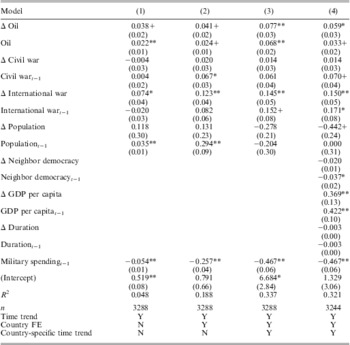
We use military spending data from the Correlates of War project. The dependent variable is logged real military spending. The specification in Equation 4 includes a common (quadratic) calendar time trend, ζt , and controls for civil and interstate conflict and population size in X. β 2 estimates the short-term influence of oil income on military spending, while β 3 estimates the long-term effect. The first column of Table 2 does not include country-fixed effects, while the second does. The third column adds country-specific time trends; and the fourth adds GDP per capita, neighbor democracy, and regime duration. In all specifications, estimates of β 2 and β 3 are positive and statistically different from zero.Footnote 61 The substantive effect in Model 2 is large: a one-standard deviation increase in oil income is associated with a 12 percent short-term increase in military spending, while the same change in oil rents is associated with a 6 percent long-run increase in spending. The estimate of the long-run multiplier suggests that this increase in oil income is associated with a 25 percent boost to the equilibrium level of military spending. In short, there is a strong correlation between oil income and military spending, lending credence to the proposition that oil wealth increases the survival of autocratic regimes by enabling them to buy the military's support and lower the risk of coups.
Oil Income and Military Spending

Notes: Dependent variable is ΔSpending. OLS with clustered standard errors. Country effects and quadratic time trend not reported. +p < 0.10; *p < 0.05; **p < 0.01. N = No, Y = Yes
Discussion
Our findings suggest that increases in oil wealth stabilize autocratic regimes, not by deterring democratization, but by reducing the vulnerability of dictatorships to ouster by groups that establish subsequent dictatorships. This finding implies that increases in oil rents reinforce the durability of regimes like Iran's, whereas falling oil prices or the exhaustion of reserves destabilizes them. Thus we find that oil makes dictatorships more resilient, but not by the means suggested in the existing literature. We find little evidence that increases in oil wealth prop up dictatorships by mitigating the threat of democratization. Rather, the evidence indicates that oil bolsters autocratic survival by reducing the likelihood of successful seizures of power by groups intent on displacing the current elite and initiating new forms of autocracy.
Other theories linking oil wealth to autocratic stability argue that groups outside the regime elite, such as mobilized poor citizens and revolutionary movements, are the key threats to regime leaders.Footnote 62 Our findings point to a different mechanism: increasing oil income over time reduces the risk that the military will topple the regime. This explanation is consistent with the general pattern of autocratic leader ousters, as well. Svolik, for example, shows that regime insiders, including the military, rather than opposition outsiders, cause the exit of more than two-thirds of non-constitutional leaders from dictatorships.Footnote 63
We also find support for the existence of a negative between-country correlation between average oil wealth and democratization. It may be that the average oil wealth for each country reflects the development of institutional configurations in many oil-producing countries – for example, the development of the administrative networks needed to deliver health care and other benefits to most citizens – and thus should be interpreted as confirming the resource-curse argument. If we believe that such institutions take time to develop, as Andersen and Ross have argued, and are characterized by substantial inertia, we would not expect institutional changes in short time periods.Footnote 64 Such institutional differences might be better captured by the between-country averages than by within-country fluctuations in oil wealth. We would not expect institutions such as legislatures that organize patronage distribution or administrative networks for the delivery of subsidies to large numbers of citizens, or the size of well-armed and trained security services to be much changed by short-term price changes, even if they were quite large. We would, however, expect the incremental development of such institutions if oil revenues are high on average and autocratic regimes can increase their chances of survival by spending oil revenue on co-optation and repression.
However, between-country differences in oil wealth may simply reflect differences in state capacity or something else that predates the discovery of oil. Haber and Menaldo argue that such preexisting conditions might themselves be the main cause of subsequent resistance to democratization, making the oft-found correlation spurious, a point that must be taken seriously.Footnote 65 The specification used in Table 1 cannot arbitrate between these possibilities (nor can most of those used in other empirical analyses of the oil curse). We see understanding whether the between-country correlation reflects characteristic and relatively stable institutional changes caused by oil wealth or simply identifies preexisting conditions as a next step in this research agenda.
Conclusion
The political resource-curse theory implies that autocratic regimes with oil wealth should survive longer than those lacking oil. Most studies have explored whether this occurs because oil-rich regimes are able to withstand pressures for democratization. As a result, previous research has focused on whether oil wealth is correlated with measures of democracy or ‘democraticness’, not the effect of oil on autocratic survival. Yet oil may also prolong dictatorships by protecting them from seizures of power by new autocratic groups. Earlier studies have largely ignored autocratic regime breakdowns not followed by democratization, though these constitute more than half of all autocratic regime collapses. We examined oil's impact on autocratic regime survival, exploring whether oil makes democratic transitions, as well as autocracy-to-autocracy transitions, more or less likely.
Most prior research also lumps between-country differences in oil wealth with within-country changes, making it impossible to be sure that the differences identified do not predate the discovery of oil. Haber and Menaldo overcome this problem, but their approach eliminates the most resilient autocracies, including a number of the countries that produce much of the world's oil, from the analysis.Footnote 66 We used a different approach to separate between-country effects from within-country effects while still incorporating information from the most stable autocracies.
We find that increases in oil income stabilize dictatorships, not by limiting prospects for democratization, but by helping to avert regime collapses that lead to subsequent dictatorship. These results indicate that upswings in oil wealth within particular countries stabilize autocracies by reducing the risk of ouster followed by a new dictatorship, but that changes in oil wealth do not affect the chances that a dictatorship will democratize. When oil wealth increases, autocratic regimes become more resilient to the threat of a new dictatorship, perhaps by enabling the regime to purchase the continued support of the military. Consistent with this interpretation, we find evidence that oil income increases spending on the military in dictatorships.
We also find evidence that higher average oil wealth is associated with reduced prospects for democratization, consistent with much of the literature. We are cautious about interpreting this finding, however. It may be that so long as oil-rich autocracies ‘share the wealth’, the quality of life for their citizens will be high enough to make democratization less appealing, as Ross suggests, and that higher average levels of oil wealth have made possible the long-term development of the institutions required for sharing it.Footnote 67 We cannot, however, rule out the possibility that the between-country differences reflect circumstances that predate the discovery of oil in many countries. Until future research disentangles whether preexisting conditions affect later regime stability, we cannot be sure that the apparent relationship is not spurious.
The central message of our study is that increases in oil wealth over time help dictatorships to hang on to power. This does not, however, imply that oil is a curse for citizens in countries endowed with it. Although such citizens might be better off in a democracy, they might be worse off in a country in which one dictatorship were to follow another in rapid, often bloody, succession.