Throughout much of the 20th century, psychology was portrayed as a fledgling discipline compared with other physical sciences. Less than five decades ago, the eminent philosopher Thomas Kuhn (Reference Kuhn1962) described psychology as preparadigmatic, with no established network of widely agreed upon principles or facts. Psychologists of the time were engaged in controversy over the proper approach to understanding human behavior, from unobservable unconscious motives at one end of the continuum to decontextualized operant behaviors at the other. Although the operant approach yielded some degree of prediction and control over behavior, as demonstrated by Hull's (Reference Hull1943) elaboration of Thorndike's (Reference Thorndike1911) law of effect, philosophers of science often compared psychology to physics and chemistry, which are replete with largely indisputable laws and axioms. These laws provide a level of precision in predicting future events that psychology will likely never achieve (see Beauchaine, Gatzke-Kopp, & Mead, Reference Beauchaine, Gatzke-Kopp and Mead2007; Beauchaine, Lenzenweger, & Waller, Reference Beauchaine, Lenzenweger and Waller2008).
Direct comparisons between psychology and the hard sciences are now recognized as simplistic, given the overwhelming number of causal influences affecting human behavior. Yet criticisms of psychology as a soft science and disagreement over the proper level of analysis for studying human behavior remain. This is particularly evi- dent in clinical psychology, where debates often emerge over appropriate foci of scientific inquiry. Many have argued that clinical psychology should be first and foremost an applied discipline that develops cognitive, behavioral, and social interventions to prevent and treat maladaptive behavior (e.g., Davison, Reference Davison1998). Some have even argued that focusing on genetic and neurobiological influences on behavior diverts our attention away from social and familial processes that promote psychopathology (e.g., Albee & Joffe, Reference Albee and Joffe2004). In contrast, others have advocated for a clinical science that examines genetic and neural mechanisms of vulnerability, assuming that understanding such mechanisms will improve our ability to reduce psychiatric morbidity and mortality (e.g., Beauchaine & Marsh, Reference Beauchaine, Marsh, Cicchetti and Cohen2006; Cicchetti & Dawson, Reference Cicchetti and Dawson2002; Davidson, Pizzagalli, Nitschke, & Putnam, Reference Davidson, Pizzagalli, Nitschke and Putnam2002; Fishbein, Reference Fishbein2000; Nelson et al., Reference Nelson, Bloom, Cameron, Amaral, Dahl and Pine2002).
Internecine squabbles over the identity of clinical psychology tend to emerge whenever the discipline reacts, often slowly, to paradigm shifts occurring in other areas of psychology. For example, behavioral principles offered by learning theorists including Hull (Reference Hull1943) and Skinner (Reference Skinner1938) led to a gradual shift in clinical thinking that culminated in the 1970s, when the power of operant principles in shaping and changing human behavior was acknowledged. As a result, behaviorism supplanted psychoanalysis as the dominant clinical paradigm of the time.
However, as most readers are undoubtedly aware, the heyday of behaviorism was short lived. During the late 1970s and 1980s, a cognitive revolution swept psychology, shifting emphasis away from strict stimulus–response models of learning toward social–cognitive motivations for behavior. As a result, clinical scientists including Beck (e.g., Beck, Rush, Shaw, & Emery, Reference Beck, Rush, Shaw and Emery1979), Ellis (e.g., Reference Ellis1981), and Linehan (Reference Linehan1993) formulated cognitive behavioral therapies for a wide range of psychiatric disorders. This change was less protracted than past paradigm shifts because cognitive models were fully compatible with the behavioral principles that preceded them. The two approaches could therefore be combined into an inclusive set of therapeutic methods. The cognitive behavioral approach that resulted remains the dominant paradigm in clinical psychology today.
By the late 1990s, yet another paradigm shift had permeated most of psychology. Basic scientists had begun using modern neuroscience techniques to probe the genetic and neural correlates of behavior. With sophisticated methods such as molecular genetics, electroencephalography (EEG), functional magnetic resonance imaging (fMRI), and positron emission tomography (PET), scientists were poised to tackle some of the most longstanding questions about learning and behavior. How do genes affect personality? Where are memories stored? How does the human brain learn? What are the brain bases of language? What neural processes give rise to emotions? How does psychopathology develop?
Despite the enormous promise of these methods, many early studies using molecular genetics and imaging technologies were crude because scientists did not yet appreciate the complexity of the systems they were observing. Naive searches for “the gene” controlling complex disorders such as depression and schizophrenia were not uncommon. Similarly, claims were made that the brain loci of mood disorders, anxiety, and emotion had been found. Although such simplistic assertions still appear in the popular press, geneticists and neuroscientists are now well aware that (a) genes do not control behaviors directly, (b) almost all behavioral traits emerge from complex interactions between multiple genes and environments, and (c) the brain bases of both personality and psychopathology are distributed across complex neural networks and are not caused by single loci, except in the most extreme cases of focal lesions. Thus, modern neuroscience is much more sophisticated than its earlier instantiations (Cicchetti & Posner, Reference Cicchetti and Posner2005; Davidson, Reference Davidson2003).
Biology, Neuroscience, and Prevention
The tendency of clinical psychology to respond slowly to paradigm shifts that are embraced by other areas of psychological science is clearly evident in neuroscience. Most clinical psychology programs offer minimal training in the brain bases of behavior, if they offer any such training at all, and clinical neuroscience articles are still a rarity in the Journal of Abnormal Psychology and the Journal of Consulting and Clinical Psychology, flagship journals of the profession. Perhaps of more importance, neuroscientific principles are almost completely absent from current theoretical formulations of prevention and intervention. Although exceptions to this generalization can be found in research on autism spectrum disorders (e.g., Dawson, this issue; Dawson et al., Reference Dawson, Webb, Schellenberg, Aylward, Richards, Dager and Friedman2002), posttraumatic stress disorder (PTSD; e.g., Bryant, Reference Bryant2006), and borderline pathology (e.g., Schnell & Herpertz, Reference Schnell and Herpertz2007), clinical psychology as a whole has not embraced neuroscience, despite extraordinary advances in our understanding of the brain bases of motivation, emotion, and self-control. Yet dysfunction in one or more of these aspects of behavior is observed in all forms of psychopathology. Even though neuroscientific findings have resulted in rich theoretical models of major psychiatric disorders (Berridge & Robinson, Reference Berridge and Robinson2003; Davidson et al., Reference Davidson, Pizzagalli, Nitschke and Putnam2002; Gatzke-Kopp & Beauchaine, Reference Gatzke-Kopp, Beauchaine, Coch, Dawson and Fischer2007a; Sagvolden, Johansen, Aase, & Russell, Reference Sagvolden, Johansen, Aase and Russell2005), they are usually not considered in clinical prevention or intervention programs.
To be fair, the behavioral and cognitive paradigm shifts described above yielded principles that were much easier to implement in applied clinical settings. Nevertheless, the current underappreciation of biological processes in prevention and intervention research is striking. Of the few studies that have included such variables, some have explored the effects of treatment on the functioning of biological systems implicated in stress reactivity and self-regulation (e.g., Fisher, Gunnar, Chamberlain, & Reid, Reference Fisher, Gunnar, Chamberlain and Reid2000), and others have examined the moderating effects of biological variables on treatment outcome. For example, Fishbein, Hyde, Coe, and Paschall (Reference Fishbein, Hyde, Coe and Paschall2004) examined the responses of adolescents to a preventive intervention for drug abuse. Skin conductance was included as one measure of emotional functioning, and differentiated in part between responders and nonresponders. Similarly, Raine, Mellingen, Liu, Venables, and Mednick (Reference Raine, Mellingen, Liu, Venables and Mednick2003) explored the potential moderating effect of children's autonomic functioning on schizotypy and antisocial behavior in adolescence and adulthood following a generic preschool prevention program. Although they did not find evidence for moderation, the preschool prevention program did yield significant increases in psychophysiological orienting and arousal (as measured by skin conductance and EEG) at age 11, perhaps suggesting enhanced information processing abilities (Raine et al., Reference Raine, Venables, Dalais, Mellingen, Reynolds and Mednick2001). Such use of biological markers in longitudinal outcome research represents a first step toward a more integrated prevention science.
In addition to exploring moderators of outcome, some researchers have included biological variables as indicators of vulnerability to psychopathology. Following arguments that etiological heterogeneity among high-risk groups should predict differential treatment responses (e.g., Beauchaine & Marsh, Reference Beauchaine, Marsh, Cicchetti and Cohen2006; Cicchetti & Rogosch, Reference Cicchetti and Rogosch2002), researchers have sought to identify particularly vulnerable individuals based on specific genetic and neurobiological markers (see, e.g., Gottesman & Gould, Reference Gottesman and Gould2003). Bryant (Reference Bryant2006), for example, explored heart rate as a marker of risk for PTSD following trauma. After reviewing a number of studies, he concluded that heart rate, in combination with diagnostic status shortly after the trauma (whether or not participants met criteria for acute stress disorder), predicted the emergence of PTSD. In molecular genetics research, Young, Lawford, Nutting, and Noble (Reference Young, Lawford, Nutting and Noble2004) conducted a series of meta-analyses examining the role of the dopamine receptor D2 (DRD2) A1 allele, concluding that it “shows promise as a marker of substance use, and of severe substance misuse in particular” (p. 1288). Such findings highlight the potential role of genetic and biological characteristics in identifying individuals who are at increased risk of adverse outcomes, and who are therefore most in need of prevention.
Despite such examples, inclusion of biological processes in prevention research lags well behind recent advances in our understanding of the neurobiological substrates of psychopathology. This may result in part from anachronistic notions about the respective roles of neurobiological and environmental influences on behavior. Indeed, decisions regarding whether and how to incorporate biological variables into prevention research often revolve around the degree to which psychological outcomes are conceptualized as stemming from biological vulnerabilities versus social and environment risk factors.
A recent special issue of the Journal of Primary Prevention explored the question of whether those at risk for psychopathology would be best served by a prevention science that emphasizes biological or psychosocial factors. Joffe (Reference Joffe2004) and others argued that emphasizing biological vulnerabilities frames psychological problems as medical illnesses, a comparison that many find unsatisfying, for a number of reasons. For example, Albee and Joffe (Reference Albee and Joffe2004) assert that there is insufficient evidence of reliable brain abnormalities in individuals with most psychiatric disorders. With the exception of conditions such as Alzheimer disease, they argue that “the evidence for mental disorders being caused by biochemical or structural abnormalities of the brain is generally sparse and inconsistent at best” (p. 425). Similarly, Boyle (Reference Boyle2004) stated that there is “no evidence of a causal relationship between schizophrenia diagnoses and any genetic or biochemical event or process” (p. 450).
In our view, such statements (a) oversimplify complex relations between biological vulnerabilities and environmental risk factors in producing psychopathology; (b) place too much emphasis on the main effects of biology and environment, when research in developmental psychopathology indicates that interaction effects often account for more variance in adverse outcomes (see below); and (c) are in some cases clearly inaccurate. For example, a large volume of research indicates that schizophrenia is about 80% heritable (see Rapoport, Addington, & Frangou, Reference Rapoport, Addington and Frangou2005), and is caused by genetic and neurobiological processes that give rise to compromises in both the structure and function of the brain (see, e.g., Gottesman & Gould, Reference Gottesman and Gould2003; Reichenberg & Harvey, Reference Reichenberg and Harvey2007). Although debate exists over the precise mechanisms that underlie these structural and functional compromises (e.g., Craddock, O'Donovan, & Owen, Reference Craddock, O'Donovan and Owen2007; Gottesman & Gould, Reference Gottesman and Gould2003; McClellan, Susser, & King, Reference McClellan, Susser and King2007), denying that schizophrenia has biological bases can only result from ignoring overwhelming evidence to the contrary, as discussed in later sections.
Arguments against psychopathology as medical illness are also based on the claim that psychiatric disorders do not represent distinct diagnostic entities, but instead reflect points along symptom continua. As noted by Albee and Joffe (Reference Albee and Joffe2004) and others (see Beauchaine, Reference Beauchaine2003; Lilienfeld & Marino, Reference Lilienfeld and Marino1999), decisions regarding where along such continua normative functioning ends and psychopathology begins are often based more heavily on value judgments than on knowledge about underlying biological mechanisms, clear and specific biobehavioral links, or established causal factors. However, this argument ignores the fact that many life-threatening medical conditions, such as hypertension and type II diabetes, are also expressed along symptom continua and have multiple etiological influences, both biological and environmental. Nevertheless, preventive interventions targeting those at highest biological risk for these medical conditions have saved uncounted numbers of lives, and can delay the onset of functional impairment by decades.
Related arguments against incorporating biological processes into prevention research also stem from beliefs that doing so wrongly reinforces a medical or “defect” model of psychopathology in which “all mental illnesses are caused by biological, biochemical, and/or other organic defects” (Albee & Joffe, Reference Albee and Joffe2004, p. 424). Yet contemporary models of psychopathology acknowledge the importance of both neurobiological and environmental influences on behavior. In developmental psychopathology, multiple etiologies for many psychiatric conditions are well recognized. Different individuals presenting with what appears to be a single psychiatric disorder can arrive at similar levels of functioning via diverse equifinal outcomes, some of which include strong biological vulnerability and less environmental risk, and others of which include less biological vulnerability and strong environmental risk (see, e.g., Beauchaine & Marsh, Reference Beauchaine, Marsh, Cicchetti and Cohen2006; Cicchetti & Rogosch, Reference Cicchetti and Rogosch1996). This is why it is critically important to measure both classes of variables and their interactions in clinical research.
Opponents of biological approaches to prevention and intervention also argue that by emphasizing genetic and neurobiological processes, we divert attention and resources away from important psychosocial causes of maladjustment, such as stress, poverty, and family interactions: “If all ‘mental illnesses’ result from pathologies in the brain … then efforts at prevention need pay little attention to the social environment in which the affected person lives and has developed” (Albee & Joffe, Reference Albee and Joffe2004, p. 434). Some authors have suggested that clinical research and prevention programs should therefore focus exclusively on environmental risks, and that individuals with psychiatric disorders are using normal mechanisms to adjust to aberrant environmental inputs (Silvestri & Joffe, Reference Silvestri and Joffe2004).
Other researchers have offered compelling reasons to include genetic and other biological processes in prevention research (e.g., Agrawal & Hirsch, Reference Agrawal and Hirsch2004; Ames & McBride, Reference Ames and McBride2006; Fishbein, Reference Fishbein2000; Gottlieb & Willoughby, Reference Gottlieb, Willoughby, Cicchetti and Cohen2006; Gunnar & Fisher, Reference Gunnar and Fisher2006). Perhaps most fundamentally, assessing biological variables advances our understanding of the etiological complexities of developing psychopathology, eventually leading to targeted interventions (Beauchaine & Marsh, Reference Beauchaine, Marsh, Cicchetti and Cohen2006). For example, although early conceptualizations of schizophrenia posited single genetic loci (e.g., Meehl, Reference Meehl1962), extensive research on the biological substrates of the disorder has revealed complex polygenic influences that interact with environmental risk to potentiate psychiatric morbidity (e.g., Gottesman & Gould, Reference Gottesman and Gould2003). As we outline in detail below, by specifying behavioral and biological endophenotypes that mark this genetic risk (e.g., Erlenmeyer-Kimling, Golden, & Cornblatt, Reference Erlenmeyer-Kimling, Golden and Cornblatt1989; Tyrka et al., Reference Tyrka, Cannon, Haslam, Mednick, Schulsinger and Schulsinger1995), prevention researchers can now identify children and adolescents who are particularly vulnerable to developing schizophrenia, and implement preventive interventions that reduce the likelihood of future psychosis and improve long-term prognosis (see, e.g., Beauchaine & Marsh, Reference Beauchaine, Marsh, Cicchetti and Cohen2006; McGorry et al., Reference McGorry, Yung, Phillips, Yuen, Francey and Cosgrave2002).
Similar interactive complexities have been identified at neurobiological levels of analysis. For example, psychophysiological research indicates that basic motivational and emotion regulatory mechanisms interact with one another to potentiate disorders of impulse control including attention-deficit/hyperactivity disorder (ADHD), conduct disorder (CD), and intentional self-injury (Beauchaine, Katkin, Strassberg, & Snarr, Reference Beauchaine, Katkin, Strassberg and Snarr2001; Crowell, Beauchaine, McCauley, Smith, Vasilev, & Stevens, Reference Crowell, Beauchaine, McCauley, Smith, Vasilev and Stevens2008; Gatzke-Kopp et al., Reference Gatzke-Kopp, Beauchaine, Shannon, Chipman-Chacon, Fleming and Crowell2007; Shannon, Beauchaine, Brenner, Neuhaus, & Gatzke-Kopp, Reference Shannon, Beauchaine, Brenner, Neuhaus and Gatzke-Kopp2007). These biobehavioral vulnerabilities also interact with environmental risk factors to predict adverse outcomes (Beauchaine et al., Reference Beauchaine, Gatzke-Kopp and Mead2007; Patterson, DeGarmo, & Knutson, Reference Patterson, DeGarmo and Knutson2000; Snyder, Schrepferman, & St. Peter, Reference Snyder, Schrepferman and St. Peter1997).
Finally, biologically informed research has already yielded tremendous advances in the prevention of some psychiatric disorders. Once thought to be solely the result of inadequate parenting (Klinger, Dawson, & Renner, Reference Klinger, Dawson, Renner, Mash and Barkley2003), autism spectrum disorders are now recognized to stem from multiple genes (Schellenberg et al., Reference Schellenberg, Dawson, Sung, Estes, Munson and Rosenthal2006), yet early environmental interventions for those exhibiting endophenotypic markers of risk offer profound protective effects for many children with the disorder (Dawson, this issue; Dawson & Zanolli, Reference Dawson, Zanolli, Bock and Goode2003).
Developmental Psychopathology and Prevention
Several tenets of the developmental psychopathology perspective are relevant to this discussion. Developmental psychopathologists acknowledge that both biological vulnerabilities and environmental risk factors contribute to adjustment and maladjustment, and that apparent maladaptation can often be understood as adaptation to noxious environmental contexts (e.g., Cicchetti, Reference Cicchetti, Cicchetti and Cohen2006). This framework emphasizes interactions between individuals and their environments (Rutter & Sroufe, Reference Rutter and Sroufe2000; Sroufe & Rutter, Reference Sroufe and Rutter1984), which occur at multiple levels of analysis, including genetic, epigenetic, neurobiological, familial, and social (Cicchetti, Reference Cicchetti2007; Cicchetti & Dawson, Reference Cicchetti and Dawson2002; Moffitt, Caspi, & Rutter, Reference Moffitt, Caspi and Rutter2006). This is a transactional approach, as influence flows across all levels of analysis. Family environments, social conditions, and psychological processes all affect biological processes, and biological functioning and predispositions influence the ways in which an individual selects and shapes the environment (see Rutter, Reference Rutter2002, Reference Rutter2007).
In acknowledging these interactive processes, developmental psychopathologists must also recognize the probabilistic nature of predicting adverse outcomes. Psychopathology results from unique combinations of environmental risk factors, genetic vulnerabilities, and biological processes specific to each individual. The same set of vulnerabilities may be associated with various outcomes depending on a multitude of intervening risk factors (multifinality), and individuals can arrive at the same outcome via different combinations of vulnerability and risk (equifinality; Cicchetti & Rogosch, Reference Cicchetti and Rogosch1996). Multifinality is demonstrated in studies of maternal depression, where children are at increased risk of both depression and CD (Kopp & Beauchaine, Reference Kopp and Beauchaine2007). Thus, the same risk factor operates differently for different children. Equifinality is also observed in the development of CD. Adolescents who meet criteria form a heterogeneous group, often varying in both developmental history and symptom presentation (Hinshaw & Lee, Reference Hinshaw, Lee, Mash and Barkley2003; Moffitt & Caspi, Reference Moffitt and Caspi2001).
Exploring biological processes is fundamental to the developmental psychopathology framework. For the past two decades, developmental psychopathologists have emphasized that including biological variables in studies of psychopathology will improve our understanding of risk factors and predictors of later functioning, both independently and in combination with various environmental and psychosocial characteristics. The very concept of prevention implies inferred risk to an individual, which may lead to a harmful outcome, either directly or through another potentiating risk factor (e.g., early-onset CD potentiates risk for substance use disorders [SUDs]).
In targeted prevention programs, individuals are selected for treatment based on exposure to one or more risk factors that are known to promote psychopathology. In the traditional approach to prevention research, these risk exposures are usually environmental (e.g., family history, neighborhood), although individual characteristics are sometimes targeted (e.g., IQ, age, gender). Yet, biological vulnerabilities may be equally important. Recent research indicates quite clearly that an individual's genetic constitution may confer risk directly or through interactions with adverse environments (e.g., Caspi et al., Reference Caspi, McClay, Moffitt, Mill, Martin and Craig2002; Cicchetti, Reference Cicchetti2007; Jaffee et al., Reference Jaffee, Caspi, Moffitt, Dodge, Rutter and Taylor2005).
It should also be noted, however, that biological markers of vulnerability are rarely deterministic. As we discuss in more detail, neurobiological systems that are implicated in vulnerability to psychopathology are often malleable (e.g., Raine et al., Reference Raine, Venables, Dalais, Mellingen, Reynolds and Mednick2001), especially early in life, which is sometimes overlooked by opponents of biological research. Thus, identification of biologically based vulnerabilities may provide fruitful targets for both prevention and intervention. Similarly, biological variables that moderate the relationship between various risk factors and adverse outcomes should be targets of treatment when possible.
From this discussion it should be clear that we strongly favor an approach to prevention and intervention that includes consideration and/or assessment of biological vulnerabilities, environmental risk factors, and their interactions. We state at the outset that we are not suggesting that biological variables be measured in all prevention and intervention trials, although there are many cases in which measuring appropriate biological systems will be fruitful. Rather, we suggest that the efficacy and/or efficiency of many treatment programs will be improved by considering biological mechanisms of psychopathology. In the following sections we provide 10 compelling reasons for such an inclusive approach, most of which are supported by one or more examples from existing research. Readers should note that any one of these items could be addressed in a full-length article, so our descriptions are necessarily limited in scope. Although several of these items are interrelated, points of emphasis vary enough to warrant separate sections for each.
Ten Good Reasons to Consider Biological Variables in Prevention and Intervention Research
Markers of biological vulnerability can identify those at greatest risk for psychopathology
Over four decades ago, Dawes and Meehl (Reference Dawes and Meehl1966) suggested that premorbid identification of individuals at risk for psychopathology should be a high priority because it is a necessary antecedent to prevention. Findings discussed briefly above suggest that by measuring relevant biological markers and/or endophenotypes (for discussion of the distinction between biomarkers and endophenotypes, see Gould & Gottesman, Reference Gould and Gottesman2006), we may be able to isolate those who are at risk for future psychopathology, and develop prevention and intervention programs targeting these individuals. Blanket prevention programs that enroll children at all levels of risk are often inefficient, and can result in underestimates of intervention effects because significant behavior change is not expected among children who are not at risk for psychopathology.
Research addressing biological risk among the offspring of a parent with schizophrenia provides a particularly compelling example of using endophenotypes to identify vulnerable children premorbidly (Beauchaine & Marsh, Reference Beauchaine, Marsh, Cicchetti and Cohen2006). By performing taxometric analyses on measures of sustained visual attention, neuromotor performance, and intelligence, Erlenmeyer-Kimling et al. (Reference Erlenmeyer-Kimling, Golden and Cornblatt1989) identified a discrete group of 7- to 12-year-old children of a parent with schizophrenia who were at especially high risk of developing the disorder. Although the base rate of genetic risk for schizophrenia (schizotypy) is 5% in the general population (Blanchard, Gangestad, Brown, & Horan, Reference Blanchard, Gangestad, Brown and Horan2000; Golden & Meehl, Reference Golden and Meehl1979; Korfine & Lenzenweger, Reference Korfine and Lenzenweger1995; Lenzenweger, Reference Lenzenweger1999; Lenzenweger & Korfine, Reference Lenzenweger and Korfine1992), 47% of children with an affected parent were members of the identified schizotypy taxon, compared with the expected 4% of controls. Of more importance, 43% of the schizotypy group were either hospitalized or had received significant treatment by age 22–29. Similar results were reported by Tyrka et al. (Reference Tyrka, Cannon, Haslam, Mednick, Schulsinger and Schulsinger1995), who used behavioral data derived from school reports and psychiatric interviews to identify a discrete schizotypy group of 10- to 19-year-old offspring of mothers with schizophrenia. The 48% taxon base rate was nearly identical to that reported by Erlenmeyer-Kimling et al. Moreover, 40% of taxon group members were diagnosed with a schizophrenia spectrum disorder 24–27 years later. Thus, taxometric analyses of selected behavioral and endophenotypic markers of genetic risk can identify particularly vulnerable individuals prospectively.
Implications for prevention and intervention
The importance of these findings for prevention is difficult to overstate. Blanket prevention programs for all children of parents with schizophrenia are inefficient because only 10–15% eventually develop a schizophrenia spectrum disorder (see Cornblatt, Obuchowski, Roberts, Pollack, & Erlenmeyer-Kimling, Reference Cornblatt, Obuchowski, Roberts, Pollack and Erlenmeyer-Kimling1999). Yet in the two studies cited above, taxon group members were at nearly 50% risk. This level of vulnerability renders schizophrenia (and other) prevention programs much more pragmatic (Cornblatt, Reference Cornblatt, Breier and Tran2001). Furthermore, advances in identification of endophenotypes that mark schizophrenia liability, including impaired attention, saccadic intrusions in smooth pursuit eye tracking, and spatial working memory deficits (Cornblatt & Malhotra, Reference Cornblatt and Malhotra2001; Glahn et al., Reference Glahn, Therman, Manninen, Huttunen, Kapiro and Lönnqvist2003; Lenzenweger, McLachlan, & Rubin, Reference Lenzenweger, McLachlan and Rubin2007; Reichenberg & Harvey, Reference Reichenberg and Harvey2007; Ross, Reference Ross2003), should facilitate premorbid identification at even younger ages. The earlier environmentally focused interventions are implemented, the more likely they are to prevent the onset of schizophrenia because accumulated environmental risk across development potentiates genetic vulnerability (see Goldsmith, Gottesman, & Lemery, Reference Goldsmith, Gottesman and Lemery1997; Gottesman & Gould, Reference Gottesman and Gould2003; Rutter et al., Reference Rutter, Dunn, Plomin, Simonoff, Pickles and Maughan1997).
Although these findings have not been incorporated into prevention trials to date, considerable advances in the prevention of schizophrenia have been reported. Prevention programs that include both cognitive behavioral and pharmacological components appear to be especially promising for those at risk for schizophrenia. McGorry et al. (Reference McGorry, Yung, Phillips, Yuen, Francey and Cosgrave2002) demonstrated that cognitive behavioral therapy (CBT), combined with a low dose of Risperidone (1–2 mg/day) substantially reduced the onset of first-episode psychosis in high-risk patients who had a positive family history and incipient but subthreshold symptoms. Those who took a low dose of Risperidone and participated in CBT were 95% psychosis-free 3 years later, compared with only 40% of patients who did not adhere to the Risperidone treatment and 30% of patients who received a typical needs-based intervention. These findings are important because early treatment of psychosis is associated with improved long-term prognosis (see Cornblatt, Lencz, & Kane, Reference Cornblatt, Lencz and Kane2001). Similar effects of early intervention on delaying the age of onset for bipolar disorder have recently been described (Chang, Gallelli, & Howe, Reference Chang, Gallelli, Howe, Romer and Walker2007; Miklowitz, Reference Miklowitz2007).
Heritable effects on behavior increase across the life span
Behavioral genetics studies have demonstrated increasing heritability coefficients across the life span for a wide range of psychiatric disorders (Lemery & Doelger, Reference Lemery, Doelger, Hankin and Abela2005). This generalization applies to almost all forms of psychopathology for which heritability has been assessed at different points in development, which (a) bears directly on the often repeated claim that environmental contexts are the primary “cause” of psychopathology (e.g., Albee & Joffe, Reference Albee and Joffe2004); (b) has received almost no attention in the clinical psychology and developmental psychopathology literature; (c) has direct implications for interpretations of the relative contributions of biological vulnerability and environmental risk for psychiatric disturbance; and (d) affects the long-term efficacy of prevention programs, which by nature target early environments to effect behavioral change.
A number of examples of rising heritability across development are noteworthy. Twin studies of depression indicate that heritability contributes minimally to symptom expression in childhood (Lemery & Doelger, Reference Lemery, Doelger, Hankin and Abela2005; Rice, Harold, & Thapar, Reference Rice, Harold and Thapar2002) yet increases during adolescence (Scourfield et al., Reference Scourfield, Rice, Thapar, Harold, Martin and McGuffin2003). By adulthood, most behavioral genetics studies yield large heritability coefficients for major depression, with nonsignificant environmental effects (Sullivan, Neale, & Kendler, Reference Sullivan, Neale and Kendler2000).
Heritability coefficients for eating disorders among females and antisocial behavior among males also increase across the life span (Hicks et al., Reference Hicks, Blonigen, Kramer, Krueger, Patrick and Iacono2007; Klump, McGue, & Iacono, Reference Klump, McGue and Iacono2000; Lyons et al., Reference Lyons, True, Eisen, Goldberg, Meyer and Faraone1995). Furthermore, although environmental factors contribute strongly to the initiation of smoking and drinking, behavioral genetics studies indicate that both smoking maintenance and heavy drinking are accounted for primarily by heritable effects (e.g., Boomsma, Koopsman, Van Doormen, & Orlebeke, Reference Boomsma, Koopsman, Van Doornen and Orlebeke1994; Koopsman, Slutzke, Heath, Neale, & Boomsma, Reference Koopsman, Slutzke, Heath, Neale and Boomsma1999; Koopsman, van Doornen, & Boomsma, Reference Koopsman, van Doornen and Boomsma1997; McGue, Iacono, Legrand, & Elkins, Reference McGue, Iacono, Legrand and Elkins2001; Viken, Kaprio, Koskenvuo, & Rose, Reference Viken, Kaprio, Koskenvuo and Rose1999).
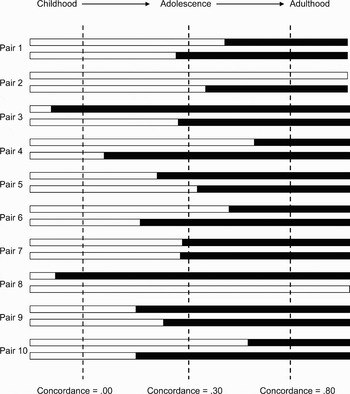
To explain such findings, researchers have speculated that the nature of psychiatric disorders may be qualitatively different in children than in adolescents and adults (e.g., Klein, Torpey, Bufferd, & Dyson, Reference Klein, Torpey, Bufferd, Dyson, Beauchaine and Hinshaw2008), different genetic factors operate in childhood versus adolescence (Jacobson, Prescott, & Kendler, Reference Jacobson, Prescott and Kendler2000), and observed differences in heritability may reflect diverse pathways to psychopathology (e.g., Silberg, Rutter, & Eaves, Reference Silberg, Rutter and Eaves2001; Silberg, Rutter, Neale, & Eaves, Reference Silberg, Rutter, Neale and Eaves2001). Although these and related mechanisms may be at play, developmental increases in heritability coefficients are a mathematical necessity in twin and adoption studies given individual differences in age of onset, even when the etiologies of the psychiatric disorder being assessed are quite similar across members of a population. This is illustrated in Figure 1, which depicts 10 hypothetical twin pairs, all of whom are at high genetic risk for schizophrenia. Because of differences in age of onset, concordance rates rise from childhood through adulthood. Because age of onset is dispersed across many years for most psychiatric disorders as a result of nonshared environmental effects, unmeasured stochastic effects, and allostatic load, heritability coefficients must increase across the life span.Footnote 1 The only exceptions to this rule are disorders with very early and relatively invariant ages of onset, such as autism.
A hypothetical distribution of individual differences in age of onset for schizophrenia across 10 twin pairs. Solid bars indicate age of onset for each individual. Concordance is determined by the proportion of the 10 twin pairs who are both afflicted. Because individual differences in age of onset are observed for almost all forms of psychopathology, concordance rates necessarily increase across the life span. Note that the final concordance rate of .80 indicates a highly heritable trait. Although dichotomous outcomes are used for simplicity of presentation, the same argument applies to continuously assessed traits.

Implications for prevention and intervention
There are several potential implications of such developmental increases in heritability for prevention. Although targeted preventions can delay and in some cases offset the emergence of highly heritable psychiatric conditions such as schizophrenia (McGorry et al., Reference McGorry, Yung, Phillips, Yuen, Francey and Cosgrave2002), life span increases in heritability suggest that the effectiveness of many prevention programs should erode over time. This is consistent with outcome data from a wide range of prevention and intervention studies. Although significant resources have been invested in both primary and targeted prevention for a range of disorders (see, e.g., Evans et al., Reference Evans, Foa, Gur, Hendin, O'Brien and Seligman2005), the long-term efficacy of many of these programs is limited at best (e.g., Fingeret, Warren, Cepeda-Benito, & Gleaves, Reference Fingeret, Warren, Cepeda-Benito and Gleaves2006; Foxcroft, Ireland, Lister-Sharp, Lowe, & Breen, Reference Foxcroft, Ireland, Lister-Sharp, Lowe and Breen2003; Lynam et al., Reference Lynam, Milich, Zimmerman, Novak, Logan and Martin1999). Worse yet, iatrogenic effects have been demonstrated for many prevention and early intervention programs that aggregate those who are at risk for psychopathology (see Dishion, McCord, & Poulin, Reference Dishion, McCord and Poulin1999; Lilienfeld, Reference Lilienfeld2007; Petrosino, Turpin-Petrosino, & Buehler, Reference Petrosino, Turpin-Petrosino and Buehler2003; Rhule, Reference Rhule2005). One possible explanation for these negative effects is that too little attention has been paid to the power of such programs to potentiate genetic risk via exposure to the high-risk behaviors of other enrollees. For example, children who are at high genetic risk for delinquency should not be aggregated with delinquent peers, as such exposure constitutes a potentiating (high risk) environment.
When we study only child and adolescent samples, as many prevention researchers do, it is easy to overlook the powerful role that heritability plays in the expression of adult psychopathology. Because heritability coefficients for childhood disorders are low, prevention researchers may conclude erroneously that environmental risk “causes” psychopathology, and that biological vulnerabilities are unimportant (e.g., Albee & Joffe, Reference Albee and Joffe2004; Boyle, Reference Boyle2004; Joffe, Reference Joffe2004). Even among prevention researchers who are aware of behavioral genetics data on child and adolescent psychopathology, the importance of heritability may be underestimated unless a life span approach is adopted. As the above discussion illustrates, the long-term costs of underestimating heritability may be high.
Prevention researchers should expect erosion of treatment efficacy over time, and design programs to mitigate such effects through empirically supported adjunctive treatments, including available medication management that targets neurobiological sequelae of genetic risk (see, e.g., Jensen, Hinshaw, Swanson et al., Reference Jensen, Hinshaw, Swanson, Greenhill, Conners and Arnold2001; McGorry et al., 2001) and intensive and regular follow-ups (“booster sessions”) that prevent behavioral drift (e.g., Lochman, Reference Lochman1992).
In addition, those who are at high genetic risk for psychopathology, as determined by family history interviews, genetic assays, or positive endophenotypes (see below), should not be aggregated in prevention or intervention trials unless there is clear evidence for the effectiveness of doing so.Footnote 2 Many group treatments constitute high-risk environments that can potentiate genetic risk for psychiatric morbidity and mortality.
Finally, prevention researchers should evaluate the effects of biological risk and Biology × Environment interactions in predicting long-term treatment outcomes. Such efforts will lead to advances in our understanding of complex disorders, and to refined treatments for subgroups of patients with different etiologies (Cicchetti, Reference Cicchetti2007; see the following).
Genetic vulnerabilities give rise to broad classes of homotypic disorder
Most disorders within the externalizing spectrum share a common heritable vulnerability, as do most disorders within the internalizing spectrum (Baker, Jacobson, Raine, Lozano, & Bezdjian, Reference Baker, Jacobson, Raine, Lozano and Bezdjian2007; Kendler, Prescott, Myers, & Neale, Reference Kendler, Prescott, Myers and Neale2003; Krueger et al., Reference Krueger, Hicks, Patrick, Carlson, Iacono and McGue2002; see also Krueger & Markon, Reference Krueger and Markon2006). These within-spectrum vulnerabilities give rise to homotypic comorbidity: the co-occurrence of multiple externalizing disorders within an individual or the co-occurrence of multiple internalizing disorders within an individual. For example, ADHD, oppositional defiant disorder (ODD), CD, antisocial personality disorder (ASPD), and SUDs often co-occur (Lewinsohn, Shankman, Gau, & Klein, Reference Lewinsohn, Shankman, Gau and Klein2004; Nadder, Rutter, Silberg, Maes, & Leaves, Reference Nadder, Rutter, Silberg, Maes and Leaves2002). Comorbidity of internalizing disorders, including depression, dysthymia, and many anxiety disorders, is also high (Angold & Costello, Reference Angold and Costello1993; Brady & Kendall, Reference Brady and Kendall1992; Cloninger, Reference Cloninger1990; Donaldson, Klein, Riso, & Schwartz, Reference Donaldson, Klein, Riso and Schwartz1997; Ferdinand, Dieleman, Ormel, & Verhulst, Reference Ferdinand, Dieleman, Ormel and Verhulst2007).
Traditionally, it has been assumed that comorbidity reflects distinct yet co-occurring disorders with different etiologies (see Beauchaine, Reference Beauchaine2003; Kopp & Beauchaine, Reference Kopp and Beauchaine2007). This interpretation is implied by the Diagnostic and Statistical Manual of Mental Disorders (American Psychiatric Association, 2000), which treats most comorbidity as a differential diagnostic issue. Yet when we assume that different syndromes within the internalizing or externalizing spectra are diagnostically distinct, our approach to science, including prevention and intervention, can become artificially fractionated. This is illustrated in research on externalizing disorders, where largely separate literatures, both basic and applied, have evolved to address different diagnostic syndromes. Researchers and clinicians alike tend to specialize in particular disorders, such as ADHD, CD, or substance use. Even though homotypic comorbidity among these disorders is extremely high (e.g., Beauchaine et al., Reference Beauchaine, Katkin, Strassberg and Snarr2001; Cohen, Chen, Crawford, Brook, & Gordon, Reference Cohen, Chen, Crawford, Brook and Gordon2007; Hinshaw, Reference Hinshaw1987), very different treatment approaches have evolved for each. Psychostimulants are the front line treatment for ADHD (MTA Cooperative Group, 1999), behavioral, and multisystemic interventions are preferred for CD (Brestan & Eyberg, Reference Brestan and Eyberg1998; Nock, Reference Nock2003), and motivational techniques are often favored for SUDs, particularly among adolescent users (Masterman & Kelly, Reference Masterman and Kelly2003; Monti et al., Reference Monti, Colby, Barnett, Spirito, Rohsenow and Myers1999).
With the exception of ADHD, most treatments for externalizing disorders were developed with little or no attention to biological vulnerabilities. This is understandable, given how little was known about the biological substrates of externalizing risk until quite recently. However, it is now clear that dysfunction in the mesolimbic dopamine (DA) system, including the ventral tegmental area and its projections to the nucleus accumbens, the caudate, and the putamen, is a core neural substrate of risk for all or most externalizing behaviors (Beauchaine & Neuhaus, Reference Beauchaine, Neuhaus, Beauchaine and Hinshaw2008; Gatzke-Kopp & Beauchaine, Reference Gatzke-Kopp, Beauchaine, Coch, Dawson and Fischer2007a, Reference Gatzke-Kopp and Beauchaine2007b; Gatzke-Kopp et al., Reference Gatzke-Kopp, Beauchaine, Shannon, Chipman-Chacon, Fleming and Crowell2007). Studies using both PET and fMRI indicate that inadequately low levels of DA and associated neural activity in the primary reward centers of the brain predispose to sensation seeking, irritability, negative affectivity, and low motivation, which are core symptoms of externalizing psychopathology (Beauchaine et al., Reference Beauchaine, Gatzke-Kopp and Mead2007; Durston, Reference Durston2003; Laakso et al., Reference Laakso, Wallius, Kajander, Bergman, Eskola and Solin2003; Leyton et al., Reference Leyton, Boileau, Benkelfat, Diksic, Baker and Dagher2002; Scheres, Milham, Knutson, & Castellanos, Reference Scheres, Milham, Knutson and Castellanos2007; Vaidya et al., Reference Vaidya, Austin, Kirkorian, Ridlehuber, Desmond and Glover1998). This central DA dysfunction is a likely endophenotype of genetic risk. As noted above, additive genetic effects account for roughly 80% of the variance in vulnerability to disorders across the externalizing spectrum (Krueger et al., Reference Krueger, Hicks, Patrick, Carlson, Iacono and McGue2002). Parallel findings apply to internalizing disorders as well (Kendler et al., Reference Kendler, Prescott, Myers and Neale2003).
In addition to explaining homotypic comorbidity, central DA dysfunction likely also accounts for homotypic continuity, or the sequential development of different internalizing or externalizing disorders across the life span (see, e.g., Ferdinand et al., Reference Ferdinand, Dieleman, Ormel and Verhulst2007). For example, seriously delinquent adult males are likely to have traversed a developmental pathway that began with hyperactive/impulsive behaviors in toddlerhood, followed by ODD in preschool, early-onset CD in elementary school, SUDs in adolescence, and ASPD in adulthood (see Loeber & Hay, Reference Loeber and Hay1997; Loeber & Keenan, Reference Loeber and Keenan1994; Lynam, Reference Lynam1996, Reference Lynam1998).
Implications for prevention and intervention
Depending on when in this developmental progression prevention or intervention is initiated, treatments are likely to be very different, having emerged from distinct intellectual and empirical traditions. As a result, many empirically supported treatments target specific diagnostic syndromes (e.g., SUDs), and are limited in their capacity to address homotypic comorbidities (e.g., ADHD, CD, delinquency; see, e.g., Conrod & Stewart, Reference Conrod and Stewart2005). Yet comorbidity that is mischaracterized may misdirect therapeutic efforts and reduce treatment efficacy. Furthermore, comorbidity can be a critical barrier to the dissemination of evidenced-based treatments, most of which do not address co-occurring disorders (Addis, Wade, & Hatgis, Reference Addis, Wade and Hatgis1999). Thus, a detailed understanding of biological risk for homotypic comorbidity and continuity has very tangible implications for prevention and intervention. Some of these implications are outlined below.
First, prevention and intervention programs should not focus on single disorders. Individuals who are vulnerable to one internalizing or externalizing disorder are usually vulnerable to others within the same spectrum. Homotypic comorbidity should be expected and addressed explicitly.
In addition, the effects of most prevention programs on distal outcomes will be modest at best. Treated individuals are likely to develop additional externalizing behaviors and/or disorders as they move into different developmental epochs. For example, children treated for ODD in preschool are at risk for serious conduct problems later (see Campbell, Shaw, & Gilliom, Reference Campbell, Shaw and Gilliom2000). Similarly, hyperactive boys with conduct problems who undergo pharmacological and/or behavioral treatments early in childhood are not protected from delinquency in later childhood, or from criminality as adults, even when short-term outcomes are favorable (Molina et al., Reference Molina, Flory, Hinshaw, Greiner, Arnold and Swanson2007; Satterfield et al., Reference Satterfield, Faller, Crinella, Schell, Swanson and Homer2007). Programs should therefore be designed to anticipate and mitigate homotypic continuity through empirically supported adjunctive treatments and intensive regular follow-ups.
Prevention and intervention programs should also be multifaceted. In the case of externalizing disorders, in addition to being treated for specific diagnostic syndromes such as CD, enrollees should also be taught strategies for coping with impulsivity, because this broad behavioral predisposition confers vulnerability to other externalizing disorders. Similarly, those being treated for specific internalizing disorders should also be taught strategies for coping with trait anxiety (see, e.g., Conrod, Stewart, Comeau, & Maclean, Reference Conrod, Stewart, Comeau and Maclean2006). In other words, prevention and intervention programs need to address risk for psychopathology across the internalizing or externalizing spectra, even for disorders that are not yet apparent but lie in homotypically continuous pathways. For example, interventions for CD should include substance use prevention modules, even when treated individuals have not yet developed SUDs.
Common genetic and neural effects influence diverse classes of heterotypic disorder
In contrast to comorbidity within the internalizing and externalizing spectra, comorbidity across domains (e.g., depression and CD) is more surprising given that symptoms overlap minimally. This has been referred to as heterotypic comorbidity because internalizing and externalizing disorders are often assumed to be of different origins, whether biological or environmental. Depression includes symptoms of depressed mood, anhedonia, and feelings of guilt or worthlessness, and is usually manifested in a withdrawn behavioral presentation. In contrast, CD is characterized by symptoms such as sensation seeking, lying, property destruction, and aggression. However, despite these different presentations, rates of comorbidity of CD and depression are far greater than expected by chance (e.g., Capaldi, Reference Capaldi1991; Drabick, Beauchaine, Gadow, Carlson, & Bromet, Reference Drabick, Beauchaine, Gadow, Carlson and Bromet2006).
A key assumption of most research on heterotypic comorbidity is that identifying which disorder is primary will lead to more effective prevention and intervention programs. Once the primary disorder is identified and treated, secondary disorders are expected to remit. For example, some have argued that among children with CD, comorbid depression follows from the consequences brought about by oppositional, aggressive, and otherwise delinquent behaviors (Capaldi, Reference Capaldi1991, Reference Capaldi1992; Patterson & Capaldi, Reference Patterson, Capaldi, Rolf, Masten, Cicchetti, Nuechterlein and Weintraub1990; Patterson, DeBaryshe, & Ramsey, Reference Patterson, DeBaryshe and Ramsey1989). These actions elicit peer rejection, restrict access to resources, promote school failure, and result eventually in institutionalization. Any or all of these consequences may precipitate an endogenous depression that is expected to abate after successful treatment of CD.
Following this reasoning, many researchers have used family history methods to ascertain whether CD or depression is primary in comorbid cases. Yet such family history analyses suggest that neither disorder is primary, and that CD and depression are transmitted across generations separately, through complex biological and environmental mechanisms (Kopp & Beauchaine, Reference Kopp and Beauchaine2007). This argues against targeting primary disorders to improve treatment efficacy, and implies that both disorders should be treated simultaneously.
Studies of overlapping biological vulnerabilities for CD and depression indicate why heterotypic comorbidity is so common. At the behavioral level, both disorders are characterized by negative affectivity, irritability, and anhedonia. At the neural level, each of these symptoms has been linked with reduced activation in DA-mediated structures involved in approach motivation, regardless of whether CD or depression is the “primary” disorder (Bogdan, & Pizzagalli, Reference Bogdan and Pizzagalli2006; Forbes, Shaw, & Dahl, Reference Forbes, Shaw and Dahl2007; Keedwell, Andrew, Williams, Brammer, & Phillips, Reference Keedwell, Andrew, Williams, Brammer and Phillips2005; Nestler & Carlezon, Reference Nestler and Carlezon2006; Shankman, Klein, Tenke, & Bruder, Reference Shankman, Klein, Tenke and Bruder2007). Neuroimaging studies reveal blunted activation in mesolimbic and mesocortical brain regions during reward tasks in both CD and depression (Epstein, Hong, Kocsis, Yang, Butler, & Chusid, Reference Epstein, Hong, Kocsis, Yang, Butler and Chusid2006; Forbes et al., Reference Forbes, May, Siegle, Ladouceur, Ryan and Carter2006; Gatzke-Kopp & Beauchaine, Reference Gatzke-Kopp, Beauchaine, Coch, Dawson and Fischer2007a; Scheres et al., Reference Scheres, Milham, Knutson and Castellanos2007; Vaidya et al., Reference Vaidya, Austin, Kirkorian, Ridlehuber, Desmond and Glover1998). Thus, these disorders appear to share a common neural deficiency that accounts for overlap in symptoms. This conclusion is consistent with results from behavioral genetics studies indicating common heritable vulnerability for depression and antisocial behavior (O'Connor, McGuire, Reiss, Hetherington, & Plomin, Reference O'Connor, McGuire, Reiss, Hetherington and Plomin1998).
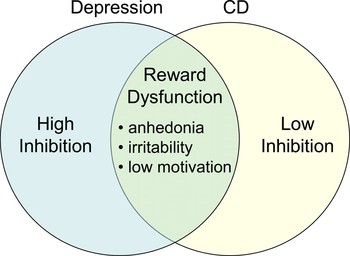
This deficiency in DA-mediated reward circuitry is moderated by other biologically influenced traits to affect behavior. One such trait is behavioral inhibition (see Figure 2), which differentiates between those who present principally with CD and those who present principally with depression (Beauchaine, Reference Beauchaine2001; Beauchaine & Neuhaus, Reference Beauchaine, Neuhaus, Beauchaine and Hinshaw2008). In this model, high trait anxiety potentiates depression among those with blunted reward systems, whereas low trait anxiety potentiates delinquency. Trait anxiety is modulated by an entirely different (primarily serotonergic) neural network, often referred to as the septohippocampal system (Gray & McNaughton, Reference Gray and McNaughton2000).
Symptom overlap in CD and depression. Both disorders are characterized by CNS reward dysfunction, leading to common symptoms. The disorders are differentiated by behavioral inhibition. [A color version of this figure can be viewed online at journals.cambridge.org/dpp]

Implications for prevention and intervention
Understanding common and unique mechanisms of internalizing and externalizing psychopathology has several implications for prevention and intervention. As noted above, treatment programs should not focus on single disorders. Individuals who are vulnerable to externalizing disorders such as CD may also be vulnerable to internalizing disorders such as depression, and vice versa. It should not be assumed that treating one disorder will eliminate the other. Although not as common as homotypic comorbidity, heterotypic comorbidity should be evaluated and addressed explicitly in prevention and intervention programs.
When possible, such programs should also be designed to capitalize on heterotypically comorbid conditions that moderate treatment response. For example, symptoms of anxiety are not uncommon among impulsive children with ADHD and CD (Angold, Costello, & Erkanli, Reference Angold, Costello and Erkanli1999; MTA cooperative group, 1999). Compared with their nonanxious counterparts, anxious children with ADHD and conduct problems are more responsive to behavioral interventions, and to interventions that include a classroom behavior management component (Beauchaine, Webster-Stratton, & Reid, Reference Beauchaine, Webster-Stratton and Reid2005; Jensen, Hinshaw, Kraemer et al., Reference Jensen, Hinshaw, Kraemer, Lenora, Newcorn and Abikoff2001). By assessing trait anxiety early in the treatment process, children can be assigned to intervention conditions from which they are most likely to benefit.
In addition, prevention and intervention programs should be designed to mitigate increased risk that is indicated by the presence or absence of heterotypically comorbid conditions (Conrod & Stewart, Reference Conrod and Stewart2005). For example, an impulsive child who is low on trait anxiety may be especially vulnerable to developing extremely serious externalizing disorders. Psychopathy, a behavior pattern characterized by manipulation of others, superficial charm, callousness, and lack of remorse, is probably the most intractable form of externalizing conduct (Lykken, Reference Lykken and Patrick2006). Psychopaths exhibit excessive approach behaviors that are coupled with a disturbing lack of anxiety and fear (e.g., Fowles & Dindo, Reference Fowles, Dindo and Patrick2006). Because their impulsive tendencies are not inhibited by impending consequences, callous and unemotional males with conduct problems are very resistant to current treatments (e.g., Hawes & Dadds, Reference Hawes and Dadds2005). Thus, further refinement of intervention programs for these individuals with these traits is needed.
Individual differences in neurobiologically based traits affect treatment response
Differential treatment responses of externalizing children with and without comorbid anxiety provide one example of a neurobiologically based trait that moderates intervention effects (Beauchaine et al., Reference Beauchaine, Webster-Stratton and Reid2005; Jensen, Hinshaw, Kraemer et al., Reference Jensen, Hinshaw, Kraemer, Lenora, Newcorn and Abikoff2001). Preliminary data suggest additional neurobiological moderators for other psychiatric conditions. For example, patterns of both amygdala and subgenual cingulate cortex reactivity to emotional stimuli predict treatment response for those with depression (Siegle, Carter, & Thase, Reference Siegle, Carter and Thase2006). Similarly, pilot data indicate that skin conductance reactivity to gambling tasks predicts prevention response to programs aimed at curbing adolescent substance use (Fishbein et al., Reference Fishbein, Hyde, Coe and Paschall2004). Finally, heart rate variability appears to moderate the effects of treatment for boys with conduct problems and depression (Beauchaine, Gartner, & Hagen, Reference Beauchaine, Gartner and Hagen2000).
A particularly compelling example comes from the work of Conrod and colleagues (Reference Conrod, Stewart, Comeau and Maclean2006), who have conducted a series of studies indicating that individual differences in biologically based personality traits affect both vulnerability to SUDs and intervention responses. Impulsive and sensation-seeking individuals tend to use substances for their reward properties, whereas those high on trait anxiety tend to use for the anxiolytic effects (Conrod, Pihl, Stewart, & Dongier, Reference Conrod, Pihl, Stewart and Dongier2000). These individual differences can be detected in part from physiological responses to alcohol (Conrod, Peterson, & Pihl, Reference Conrod, Peterson and Pihl1997; Conrod, Peterson, Pihl, & Mankowski, Reference Conrod, Peterson, Pihl and Mankowski1997; Conrod, Pihl, & Vassileva, Reference Conrod, Pihl and Vassileva1998). For example, men who score high on measures of reward sensitivity and sensation seeking show larger heart rate responses to alcohol than men who score low on such measures (Brunelle et al., Reference Brunelle, Assaad, Barrett, Avila, Conrod and Tremblay2004). Among women, those with depressive symptoms of introversion and hopelessness preferentially use substances with analgesic properties (Conrod et al., Reference Conrod, Pihl, Stewart and Dongier2000).
Implications for prevention and intervention
Until quite recently, most prevention and intervention programs aimed at curbing adolescent risk for SUDs were generic, with the same content applied to everyone (Conrod & Stewart, Reference Conrod and Stewart2005). Although outcome data on drug use are sparse, such programs have very limited effects on drinking behaviors (Stewart et al., Reference Stewart, Conrod, Marlatt, Comeau, Thush and Krank2005). Findings outlined above specifying different motives for substance use suggest that targeted interventions might improve treatment efficacy. Preliminary research supports this conjecture. Alcohol use interventions with treatment manuals targeting specific personality risk factors (anxiety sensitivity, sensation seeking, and hopelessness) and associated coping strategies yield beneficial effects in terms of abstinence, binge drinking, and drinking quantity. These interventions also yield Personality × Treatment Condition interactions in predicting outcome, suggesting an important role for targeted interventions in future research and practice (Conrod et al., Reference Conrod, Stewart, Comeau and Maclean2006). Moreover, such interventions can reduce the impact of comorbid psychological problems (depression, panic attacks, truancy) that are associated with personality risk (Castellanos & Conrod, Reference Castellanos and Conrod2006).
Although considerable research remains in the development of targeted interventions for SUDs, including additional treatment–outcome studies (Conrod & Stewart, Reference Conrod and Stewart2005), these results suggest a clear role for evaluating high-risk traits that predispose to different motives for use. It is important that, even though impulsivity, anxiety sensitivity, and sensation-seeking have clear genetic and neurobiological substrates (see Beauchaine, Reference Beauchaine2001; Cloninger, Svrakic, & Svrakic, Reference Cloninger, Svrakic and Svrakic1997; Corr, Reference Corr2004; Gray & McNaughton, Reference Gray and McNaughton2000; Sagvolden et al., Reference Sagvolden, Johansen, Aase and Russell2005), each can be assessed reliably using self-report measures.
Finally, assessing biological factors that affect treatment response can indicate why some children do not respond to current treatment approaches, information that can be used to develop targeted interventions that are more effective (see Beauchaine et al., Reference Beauchaine, Webster-Stratton and Reid2005; Gunnar & Fisher, Reference Gunnar and Fisher2006). As noted above, children, adolescents, and adults who exhibit callous unemotional traits and autonomic underarousal benefit little from current interventions for conduct problems and delinquency (see e.g., Fowles & Dindo, Reference Fowles, Dindo and Patrick2006; Hawes & Dadds, Reference Hawes and Dadds2005; Lykken, Reference Lykken and Patrick2006). Nevertheless, few prevention or intervention programs target such traits, a disservice to those at highest risk. Nearly a decade ago, Brestan and Eyberg (Reference Brestan and Eyberg1998) implored the child psychopathology research community to ask the questions “For whom does this treatment work?” and “When is this treatment not enough?” By identifying characteristics (both biological and psychological) that predict poor treatment response, we begin to address these important questions. To date, very little research aimed at refining prevention and intervention programs to accommodate such individual differences has been conducted.
Biological vulnerabilities moderate the effects of environment on behavior
In addition to their moderating effects on treatment outcome, biologically based vulnerabilities also moderate the effects of broader environmental contexts on behavioral adjustment. For example, respiratory sinus arrhythmia (RSA), a measure of parasympathetic-linked cardiac activity that is roughly 50% heritable (Kupper et al., Reference Kupper, Willemsen, Posthuma, De Boer, Boomsma and De Geus2005), consistently predicts strong emotion regulation capabilities in both children and adults (see Beauchaine, Reference Beauchaine2001; Beauchaine et al., Reference Beauchaine, Gatzke-Kopp and Mead2007), and protects children from developing psychopathology in high-risk environments. In a large study of conduct problems and depression among children and adolescents, high RSA offered partial protection from the development of conduct problems among participants with antisocial fathers (Shannon et al., Reference Shannon, Beauchaine, Brenner, Neuhaus and Gatzke-Kopp2007). In the same study, high RSA also conferred partial protection from the development of depression among participants of mothers with symptoms of melancholia.
Similarly, children with high RSA who witness marital conflict and hostility or are exposed to problem drinking by their parents are buffered from associated risk of developing both internalizing and externalizing behaviors (El-Sheikh, Reference El-Sheikh2005; El-Sheikh, Harger, & Whitson, Reference El-Sheikh, Harger and Whitson2001; Katz & Gottman, Reference Katz and Gottman1995, Reference Katz and Gottman1997). Thus, across a wide range of environmental risks, high RSA confers partial protection from psychopathology. According to the nomenclature proposed by Luthar, Cicchetti, and Becker (Reference Luthar, Cicchetti and Becker2000), these are protective–reactive interactions. Similar results were obtained by Boyce et al. (Reference Boyce, Essex, Alkon, Goldsmith, Kraemer and Kupfer2006), who reported that children's autonomic reactivity moderated the effect of father involvement on later mental health outcomes.Footnote 3
Implications for prevention and intervention
A corollary of these findings is that children with low RSA are particularly vulnerable to developing psychopathology in high-risk environments. In the study of conduct problems and depression cited above, children with low RSA were vulnerable to developing both conduct problems and depression (Shannon et al., Reference Shannon, Beauchaine, Brenner, Neuhaus and Gatzke-Kopp2007). These findings imply that assessing RSA may help to identify children who are in greatest need of prevention services given familial risk factors including parental antisocial behavior, depression, marital conflict, and problem drinking (see also Beauchaine et al., Reference Beauchaine, Gatzke-Kopp and Mead2007).
Similar findings have been reported for other neurobiological systems. For example, Davies, Sturge-Apple, Cicchetti, and Cummings (Reference Davies, Sturge-Apple, Cicchetti and Cummings2007) reported that low cortisol reactivity among kindergarteners in response to parental conflict marked risk for developing externalizing behaviors at 2-year follow-up. This longitudinal relation indicates some degree of prospective risk identification. Early detection of risk is extremely important given the well-documented erosion of treatment effects across development for programs aimed at curbing externalizing behaviors (Dishion & Patterson, Reference Dishion and Patterson1992; Ruma, Burke, & Thompson, Reference Ruma, Burke and Thompson1996). The earlier at-risk children are enrolled in prevention programs, the better. Thus, any means of identifying risk prospectively should be embraced by researchers and practitioners (Beauchaine & Marsh, Reference Beauchaine, Marsh, Cicchetti and Cohen2006).
Many null findings for biological (and other) treatment moderators are likely the result of underpowered statistical tests
One argument for questioning the role of biological vulnerabilities as moderators of treatment response and other outcomes is that few such moderators have been identified to date, with several null findings reported (e.g., Coryell & Turner, Reference Coryell and Turner1985; Insel & Goodwin, Reference Insel and Goodwin1983; Klein-Hessling & Lohaus, Reference Klein-Hessling and Lohaus2002; Raine et al., Reference Raine, Mellingen, Liu, Venables and Mednick2003).Footnote 4 An often underappreciated reason for null findings in tests of moderation is that statistical interactions, which specify the moderation effect, have considerably less power than the main effects in a regression or analysis of variance (ANOVA) model (Aiken & West, Reference Aiken and West1991; Beauchaine & Mead, Reference Beauchaine and Mead2006; Kraemer, Wilson, Fairburn, & Agras, Reference Kraemer, Wilson, Fairburn and Agras2002; Whisman & McClelland, Reference Whisman and McClelland2005). Although there are several reasons for this, three issues stand out as particularly important. First, the power to detect any effect in statistics depends on the reliability of the measures used. The more measurement error, the lower the statistical power. Unreliability is compounded when testing moderation effects because the reliability of the interaction term (α × β) equals the product of the reliabilities of the main effects. Even with high reliabilities for both the independent variables (IV) and the moderator (e.g., .85 each), the reliability of the interaction term is reduced considerably (.85 × .85 = .72). As a result, achieving a conventionally acceptable power level of .80 (α = .05) to detect a medium-sized interaction effect (partial r 2 = .13; see Cohen, Reference Cohen1988) requires a 50% increase in participants over that required to detect a medium-sized main effect (r 2 = .24). Thus, many studies with adequate power to detect main effects do not have sufficient power to detect moderation. Because most researchers conduct power analyses only for main effects, frequent null findings for interaction effects should be expected.
Second, many moderating effects in psychological research are ordinal, particularly in treatment–outcome studies. In other words, the slopes of the regression lines for different treatment groups have the same sign at different levels of the moderator. Such is the case when two groups improve during treatment, but one group improves more than the other. Power to detect moderators is considerably less for ordinal interactions than for crossover interactions (see Whisman & McClelland, Reference Whisman and McClelland2005).
Third, despite stern warnings from statisticians, many researchers dichotomize variables to test for moderation. It remains a common practice to first divide the putative moderator (often by performing a median split) and then test the correlation between the IV and the dependent variable (DV) in the resulting subgroups, a strategy advanced originally by Baron and Kenny (Reference Baron and Kenny1986). Although it is essential to interpret a moderating effect by examining the relation between the IV and DV at different levels of the moderator, this should be done only after a significant effect is found using the continuous product term (α × β) to compute the interaction. Although there are several compelling reasons to avoid dichotomizing continuous variables (MacCallum, Zhang, Preacher, & Rucker, Reference MacCallum, Zhang, Preacher and Rucker2001), the point here is that doing so results in further erosion of statistical power for effects that are already underpowered given the considerations noted.
Implications for prevention and intervention
Many studies in which moderators of treatment outcome are tested do not have sufficient power to detect interaction effects. Tests of Biology × Environment (and any other) interactions are often ancillary to tests of main effects on which power calculations are based. The likely aggregate effect is a literature-wide underestimation of the importance of treatment moderators, including biological vulnerabilities. Indeed, an interaction effect that is considerably larger than a significant main effect may go undetected in the same study. This may be in part responsible for some concluding that biological moderators are irrelevant for prevention and intervention (e.g., Albee & Joffe, Reference Albee and Joffe2004).
Accordingly, prevention and intervention researchers who consider biologically based individual differences as moderators of treatment outcome should calculate the statistical power of interaction effects in advance to ensure that any null findings are not the result of inadequate sample size (Kraemer et al., Reference Kraemer, Wilson, Fairburn and Agras2002; Whisman & McClelland, Reference Whisman and McClelland2005). As summarized above, ignoring issues of power often leads to erroneous null conclusions (Type II errors). This suggests that many null findings from tests of moderation should be revisited.
Biology × Environment interactions sometimes explain more variance in outcome than main effects
Despite the problems with power noted above, Biology × Environment interactions sometimes account for considerably more variance in key outcomes than main effects. Yet in the history of clinical science, most research has evaluated the effects of single variables (either biological or environmental) on behavior (see Porges, Reference Porges2006). Questions such as “What are the genetic determinants of schizophrenia?” and “How do neighborhood influences promote delinquency?” reflect a predominant focus on main effects. Although such questions are clearly important, evaluating main effects in isolation can obscure equally important interactions between biological vulnerabilities and environmental risk factors in predicting psychopathology. This can lead researchers to conclude that one class of variables (biology or environment) is unrelated to outcome, even when such variables are critical determinants of adjustment.
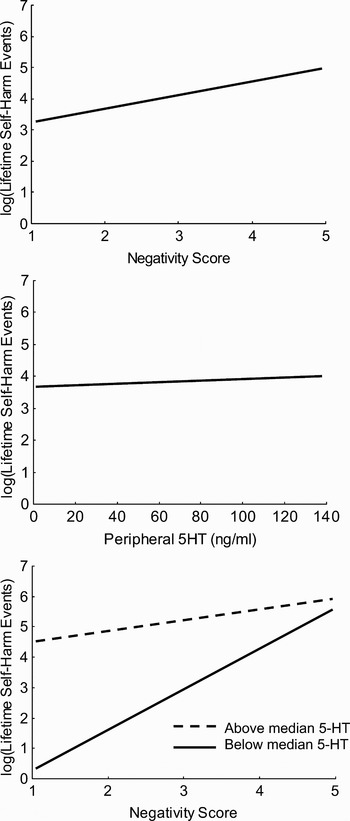
For example, in our research on self-injury among adolescent girls (see Crowell et al., Reference Crowell, Beauchaine, McCauley, Smith, Stevens and Sylvers2005, Reference Crowell, Beauchaine, McCauley, Smith, Vasilev and Stevens2008; Crowell, Beauchaine, & Lenzenweger, Reference Crowell, Beauchaine, Lenzenweger, Beauchaine and Hinshaw2008), we reported a significant interaction between participant's peripheral serotonin levels and the quality of dyadic discussions with their mothers in predicting self-harm (e.g., cutting, overdoses, etc.). Adolescent girls with low levels of peripheral serotonin tended toward self-harm regardless of observed dyadic negativity with their mothers. In contrast, girls with high levels of peripheral serotonin were only at risk when dyadic interactions with their mothers were highly negative. Yet serotonin levels and dyadic negativity were unrelated to one another, and accounted for only 3 and 23% of the variance in self-harm, respectively. However, by adding a Serotonin × Dyadic Negativity interaction term into the model, we accounted for 64% of the variance in self-harm. In this case, had we measured only peripheral serotonin, we would have concluded that it is unrelated to self-harm. Similarly, had we measured only dyadic negatively, we would have vastly underestimated its importance. As illustrated in Figure 3, only by assessing the interaction between both variables were we able to explain so much variance in a critically important outcome.
The main effects of (top) dyadic mother–daughter negativity and (middle) adolescent peripheral serotonin on lifetime self-harm events in a sample of 41 adolescent girls. Negativity and peripheral serotonin accounted for 23 and 3% of the variance in self-harm, respectively. In contrast, (bottom) the conjoint effects of negativity and peripheral serotonin accounted for 64% of the variance in self-injury. From “Parent–Child Interactions, Peripheral Serotonin, and Self-Inflicted Injury in Adolescents,” by S. E. Crowell, T. P. Beauchaine, E. McCauley, C. J. Smith, C. A. Vasilev, and A. L. Stevens, Reference Crowell, Beauchaine, McCauley, Smith, Vasilev and Stevens2008, Journal of Consulting and Clinical Psychology. Copyright 2008 by American Psychological Association. Adapted with permission.

Fortunately, much greater appreciation for interactions between biology and environment has evolved in recent years (see Moffitt et al., Reference Moffitt, Caspi and Rutter2006; Rutter, Reference Rutter2002, Reference Rutter2007). Many researchers are now evaluating the combined effects of endogenous and exogenous influences on behavior, which form the crux of both diathesis–stress and moderation models of psychopathology (e.g., Beauchaine et al., Reference Beauchaine, Webster-Stratton and Reid2005; Gottesman & Gould, Reference Gottesman and Gould2003; Kraemer, Stice, Kazdin, Offord, & Kupfer, Reference Kraemer, Stice, Kazdin, Offord and Kupfer2001). It is now widely recognized that Gene × Environment and Neurobiology × Environment interactions are critical in the expression of diverse classes of disorder (Cicchetti, Reference Cicchetti2007), including schizophrenia (e.g., Gottesman & Gould, Reference Gottesman and Gould2003; Lenzenweger, Reference Lenzenweger2006) delinquency (e.g., Beauchaine et al., Reference Beauchaine, Gatzke-Kopp and Mead2007; Caspi et al., Reference Caspi, McClay, Moffitt, Mill, Martin and Craig2002; Lynam et al., Reference Lynam, Caspi, Moffitt, Wikström, Loeber and Novak2000), depression (e.g., Caspi et al., Reference Caspi, Sugden, Moffitt, Taylor, Craig and Harrington2003) posttraumatic stress disorder (e.g., Orr et al., Reference Orr, Metzger, Lasko, Macklin, Hu, Shalev and Pitman2003; Stein, Jang, Taylor, Vernon, & Livesley, Reference Stein, Jang, Taylor, Vernon and Livesley2002), ADHD (e.g., Seeger, Schloss, Schmidt, Rüter-Jungfleisch, & Henn, Reference Seeger, Schloss, Schmidt, Rüter-Jungfleisch and Henn2004), and SUDs (e.g., Kendler et al., Reference Kendler, Prescott, Myers and Neale2003). This research reveals that for many forms of psychopathology, neither biological vulnerabilities nor high-risk environments are sufficient in isolation to explain etiology; their combined effects must be considered (Beauchaine, Hinshaw, & Gatzke-Kopp, Reference Beauchaine, Hinshaw, Gatzke-Kopp, Beauchaine and Hinshaw2008).
Environments potentiate and mollify biological vulnerabilities through mechanisms of epigenesis, neural plasticity, and pruning
Although underappreciated until quite recently, environmental influences shape and maintain biological vulnerabilities for psychopathology in a number of ways. Adverse experiences, particularly trauma and adverse rearing conditions faced early in life, can alter gene expression, with downstream consequences for both central nervous system development and behavior. The term epigenesis refers to changes in gene expression that result from alterations in DNA structure (as opposed to sequence; Hartl & Jones, Reference Hartl and Jones2002). Such alterations are mediated by methylation processes that are triggered by environmental events. For example, Weaver et al. (Reference Weaver, Cervoni, Champagne, D'Alessio, Sharma and Seckl2004) reported epigenetically transmitted genetic variation in the glucocorticoid receptor gene promoter in the hippocampi of rat pups that experienced high levels of maternal licking, grooming, and arched-back nursing compared with pups that experienced low levels of these rearing behaviors. This epigenetic maternal programming effect transmits adaptive variations in stress responding to offspring (see Meany, Reference Meany, Romer and Walker2007). Rat pups reared in high-risk environments where normal maternal behaviors are compromised have more reactive hypothalamic–pituitary–adrenocortical responses, and are therefore more fearful and wary. Thus, they are better prepared for the high-risk environment that they are likely to face as they continue to develop.
Although clear epigenetic effects among humans have yet to be identified (see Rutter, Reference Rutter2007), mammals are particularly susceptible to environmentally mediated changes in gene expression (Hartl & Jones, Reference Hartl and Jones2002), and increasingly divergent patterns of DNA methylation emerge over the life spans of monozygotic twins (Fraga et al., Reference Fraga, Ballestar, Paz, Ropero, Setien and Ballestar2005). Accordingly, several authors have noted the potential importance of epigenetic effects for research in child psychopathology (e.g., Kramer, Reference Kramer2005; Rutter, Reference Rutter2005). However, demonstrating these effects in humans is difficult because it requires random assignment of groups to different environments (e.g., impoverished vs. enriched). Nevertheless, theoretical models of antisocial behavior that include epigenetic effects have been described (Tremblay, Reference Tremblay2005). Moreover, recent studies suggest that brain-derived neurotrophic factor, which is involved in the differentiation of DA neurons in developing mesolimbic structures, may be susceptible to paternally mediated epigenetic effects that confer risk for ADHD and other externalizing behaviors (Kent et al., Reference Kent, Green, Hawi, Kirley, Dudbridge and Lowe2005).
In contrast to epigenesis, neural plasticity refers to structural and functional brain changes that result from development, experience, and/or learning. Plasticity has been defined as “permanent functional transformations … in particular systems of neurons as a result of appropriate stimuli or their combination” (Konorski, Reference Konorski1948). Mechanisms of plasticity alter the efficiency, activation thresholds, and time course of responding within and across neural systems (see Ciccetti & Blender, 2006; Pollak, Reference Pollak2005). These transformations include both short-term modulations at neural synapses and long-term changes involving anatomical growth and pruning of neural connections. Pruning refers to the selective elimination of cells and synapses, and may occur as a result of programmed cell death or experience. Presumably, pruning eliminates unused and inefficient connections to improve the overall efficiency and specificity of neurotransmission.
Plasticity, programmed cell death, and pruning are critical mechanisms of neural development (see Perry, Reference Perry, Beauchaine and Hinshaw2008). These processes are widespread prenatally, but continue postnatally, and to a lesser extent, into adulthood. Both heredity and experience impact neural plasticity and pruning, shaping the function of neural systems subserving motivation, emotion, and self-control. An individual's genes create boundaries on developmental trajectories, functioning, and plasticity of neural systems, and provide the bases for later integration of experience (Cicchetti & Curtis, Reference Cicchetti, Curtis, Cicchetti and Cohen2006; Hammock & Levitt, Reference Hammock and Levitt2006). The impact of experiences on neural and behavioral development is influenced by the timing, duration, and intensity of stimuli, and by biological vulnerabilities, resiliencies, potentiating risk factors, and protective effects (Gunnar & Fisher, Reference Gunnar and Fisher2006; Pollak, Reference Pollak2005). Hammock and Levitt (Reference Hammock and Levitt2006) describe how the timing of an adverse event is a critical determinant of the brain region affected. For example, postnatal disruptions in maternal infant care in rodents result in delays of synaptic formation in the developing amygdala, cortex, and brain stem, but not in other regions that developed prenatally such as hypothalamic–brain stem connections. Such studies also document how disturbances in early maternal care create long-lasting changes in neural development that persist into the rodent homologues of human adolescence and adulthood (see Gunnar & Fisher, Reference Gunnar and Fisher2006).
The prenatal period is a critical time of development during which exposure to teratogens can result in structural and functional brain changes and persistent risk for severe psychopathology (see Fryer, Crocker, & Mattson, Reference Fryer, Crocker, Mattson, Beauchaine and Hinshaw2008). For example, in addition to the well-known effects of in utero ethanol exposure on children's risk for psychiatric disturbance, maternal nicotine exposure during pregnancy is associated with risk for externalizing behaviors among offspring. It is important that significant second-hand exposure may be just as harmful as maternal smoking. In a recent study of 7- to 15-year-olds, children of mothers who did not smoke but reported regular exposure to second-hand smoke during pregnancy, either at home or in the workplace, were at similar risk for impulsivity and conduct problems compared with children whose mothers smoked (Gatzke-Kopp & Beauchaine, Reference Gatzke-Kopp and Beauchaine2007b). In addition to inducing long-term reductions in central DA reactivity (Kane, Fu, Matta, & Sharp, Reference Kane, Fu, Matta and Sharp2004), nicotine mimics the effects of acetylcholine neurotransmission (Oliff & Gallardo, Reference Oliff and Gallardo1999), eliciting changes in a number of cellular processes including replication, differentiation, and sensitivity to later stimulation (Slotkin, Reference Slotkin1998). These alterations in both dopaminergic and cholinergic neurotransmission are enduring enough to translate into problems with externalizing psychopathology well into childhood and adolescence.
As noted, neural plasticity effects are not limited to prenatal and perinatal development. Genetic predispositions toward fearfulness may interact with environmental events to alter neural circuits involved in the experience and expression of emotion, thereby amplifying and maintaining anxious behavior throughout the life span (Fox, Hane, & Pine, Reference Fox, Hane and Pine2007).
Implications for prevention and intervention
In addition to these negative effects, neural plasticity and pruning may provide opportunities for resilience and positive adaptation (Cicchetti & Blender, Reference Cicchetti and Blender2006; Cicchetti & Curtis, Reference Cicchetti, Curtis, Cicchetti and Cohen2006, Reference Cicchetti and Curtis2007; Masten, Reference Masten, Romer and Walker2007). Rodent studies of optimal maternal care document changes in gene expression in offspring associated with improved stress resilience (Kaffman & Meaney, Reference Kaffman and Meaney2007). Among humans, effective psychosocial interventions may result in adaptive changes in brain function well into adulthood. For example, CBT for adult patients with PTSD results in functional brain changes as measured by MRI (Felmingham et al., Reference Felmingham, Kemp, Williams, Das, Hughes and Peduto2007). Improvement in PTSD symptoms is associated with increased activity in the anterior cingulate cortex and decreased activity in the amygdala during fear processing. Functional brain changes resulting from psychotherapy have been reported for a host of other disorders as well (e.g., Baxter et al., Reference Baxter, Schwartz, Bergman, Szuba, Guze and Mazziotta1992; Goldapple et al., Reference Goldapple, Segal, Garson, Lau, Bieling and Kennedy2004; Paquette et al., Reference Paquette, Lévesque, Mensour, Leroux, Beaudoin and Bourgouin2003). These changes are often effected through the same neural pathways that are targeted by pharmacologic interventions (see Kumari, Reference Kumari2006).
Although some degree of epigenesis and neural plasticity are observed across the life span (e.g., Eriksson et al., Reference Eriksson, Perfilieva, Bjork-Eriksson, Alborn, Nordborg and Peterson1998), neural adaptations are more frequent and occur more readily in childhood (see e.g., Perry, Reference Perry, Beauchaine and Hinshaw2008), with certain exceptions for later-maturing brain regions such as the oribitofrontal and prefrontal cortices, areas that exhibit considerable plasticity into adulthood (Sowell et al., Reference Sowell, Peterson, Thompson, Welcome, Henkenius and Toga2003). This general trend of decreasing plasticity across development underscores points outlined above concerning the urgency of initiating prevention and early intervention programs as soon as possible for those at highest risk for psychopathology (Beauchaine & Marsh, Reference Beauchaine, Marsh, Cicchetti and Cohen2006). Because younger brains are more malleable, early intervention provides greater opportunities for (a) conferring protective long-term functional changes in neural systems subserving mood, motivation, and self-regulation; (b) halting the progression of emergent neural vulnerabilities; and (c) reversing existing neural vulnerabilities.
Extensive neural plasticity during prenatal, perinatal, and early childhood development also underscores the need to develop more effective prevention programs targeting young and expectant mothers and their families. Improved prenatal and early childhood care and increased public health awareness are areas where universal prevention programs are potentially most effective. Indeed, nonspecific early educational and health-promoting interventions for disadvantaged preschoolers confer long-term functional changes in autonomic arousal, and protect enrollees from developing both antisocial and schizotypal behaviors as adults (Raine et al., Reference Raine, Venables, Dalais, Mellingen, Reynolds and Mednick2001; Raine et al., Reference Raine, Mellingen, Liu, Venables and Mednick2003). Expansion and rigorous evaluation of such programs should therefore be a high priority for prevention researchers.
Despite compelling arguments for the earliest interventions possible, we are not suggesting that all is lost for older children and adolescents who experience psychopathology. As noted above, the prefrontal cortex (PFC) maintains considerable plasticity into young adulthood (Sowell et al., Reference Sowell, Peterson, Thompson, Welcome, Henkenius and Toga2003). Given the importance of the PFC in executive functioning, planning, and affect regulation, interventions should be developed that capitalize on skill acquisition in these areas. Indeed, some have suggested that attentional neural networks including the PFC may be modifiable through targeted interventions (see Rueda, Rothbart, Saccomanno, & Posner, Reference Rueda, Rothbart, Saccomanno, Posner, Romer and Walker2007).
Early developing neural systems affect the organization and functioning of later developing neural systems
As the discussion above indicates, neural functioning is affected throughout the life span by an individual's developmental history, including both exogenous and endogenous influences. Environmental events affect brain development beginning in utero and extending into adulthood, interacting with genetic predispositions to shape the structure and function of neural pathways subserving behavior regulation. Often these heritable and environmental influences on development are interdependent (see, e.g., Rutter, Reference Rutter2007). For example, heritable vulnerabilities in early-maturing neural systems can predispose individuals to behaviors that elicit and/or exacerbate environmental risk. In turn, educed environmental risk can feed back to influence continuing brain development through mechanisms of neural plasticity (see above). Over time, these evocative Biology × Environment interactions can solidify behavior patterns that were previously malleable.
One behavioral trait that often evokes self-reinforcing effects is impulsivity. Highly impulsive children present with difficult to manage behaviors, which can elicit and strengthen ineffective parenting practices that, in turn, amplify risk for progression to more serious externalizing behaviors (Beauchaine et al., Reference Beauchaine, Webster-Stratton and Reid2005; Patterson et al., Reference Patterson, DeBaryshe and Ramsey1989, Reference Patterson, DeGarmo and Knutson2000). As noted above, deficient mesolimbic DA activity is a primary neural substrate of impulsivity and disinhibition (Gatzke-Kopp & Beauchaine, Reference Gatzke-Kopp, Beauchaine, Coch, Dawson and Fischer2007a, Reference Gatzke-Kopp and Beauchaine2007b). Deficient mesolimbic DA functioning can result from a number of causes, included heritable vulnerability, prenatal exposure to stimulants, hypoxia, and head injury (Beauchaine & Neuhaus, Reference Beauchaine, Neuhaus, Beauchaine and Hinshaw2008; Gatzke-Kopp & Shannon, Reference Gatzke-Kopp, Shannon, Beauchaine and Hinshaw2008). In the case of prenatal stimulant exposure, abnormally low mesolimbic DA activity in childhood reflects a lingering neural adaptation to earlier overactivation at the time of exposure (e.g., Kane et al., Reference Kane, Fu, Matta and Sharp2004). Thus, excessive mesolimbic activation from DA agonists leads to downregulation of a key neural system of behavioral control. In turn, downregulated DA activity predisposes to sensation-seeking behaviors characteristic of conduct problems, criminality, antisocial behavior, and SUDs (Gatzke-Kopp & Beauchaine, Reference Gatzke-Kopp, Beauchaine, Coch, Dawson and Fischer2007a, Reference Gatzke-Kopp and Beauchaine2007b; see also Sagvolden et al., Reference Sagvolden, Johansen, Aase and Russell2005).
Each of these conditions may further exacerbate neurological vulnerabilities, particularly through early and prolonged exposure to substances of abuse in childhood and adolescence, which induces further changes in DA functioning in mesolimbic structures (e.g., Catlow & Kirstein, Reference Catlow and Kirstein2007). In this manner, biological vulnerabilities and environmental risk factors reinforce one another, leading to worse outcomes than either factor alone. Similar evocative effects have been described for other high-risk traits, such as anxiety (Fox et al., Reference Fox, Hane and Pine2007).
In addition to cumulative effects within discrete neural systems, evocative cascades that begin in childhood may compromise later developing neural networks, conferring additional vulnerability for heterotypically continuous disorders. The mesolimbic DA system, which develops very early in life, is modulated in adolescence and adulthood by the mesocortical DA system (see Halperin & Schulz, Reference Halperin and Schulz2006; Spear, Reference Spear, Romer and Walker2007), a frontal neural network that exhibits experience-dependent development into young adulthood (see above). Animal studies identify adolescence as a period of maximum DA activity in the PFC (Tunbridge et al., Reference Tunbridge, Weickert, Kleinman, Herman, Chen and Kolachana2007), and as a period marked by a DA-dependent shift in the effects of stimulant drugs from dysphorigenic to euphorigenic (Andersen, Leblanc, & Lyss, Reference Andersen, Leblanc and Lyss2001).
Children with already compromised yet mature mesolimbic DA systems are placed at even higher risk for psychopathology if neurodevelopment of immature frontal DA systems is also compromised by adverse events. Thus, functional deficiencies in the mesolimbic DA system that give rise to impulsive behaviors and risk for externalizing disorders may be amplified by neuroregulatory processes and evoked environments that compromise experience-dependent neuromaturation of cortical DA networks (see Beauchaine & Neuhaus, Reference Beauchaine, Neuhaus, Beauchaine and Hinshaw2008).
Implications for prevention and intervention
The influence of early developing neural systems on later developing neural systems suggests the opportunity for targeted prevention programs. For example, individuals with known prenatal exposure to substances are likely to experience atypical neural development and resulting behavioral and psychological difficulties (Fryer et al., Reference Fryer, Crocker, Mattson, Beauchaine and Hinshaw2008), marking a clear need for early intervention. Furthermore, regardless of the source, functional deficiencies in key neural systems may confer vulnerability for maladaptive neurodevelopment in later-maturing brain regions, giving rise to additional behavioral difficulties that were not apparent at earlier ages. As already discussed, early dysregulation of the mesolimbic DA system that underlies impulsivity also confers vulnerability for later prefrontal dysfunction, which is associated with deficiencies in complex reasoning, planning, and self-regulation. Early intervention programs should provide protective environments by (a) minimizing exposure to neighborhood risk, delinquent peers, and early initiation of substance use (all of which have been linked with especially poor outcomes for impulsive children), and (b) teaching empirically supported strategies to encourage attentional control and self-regulation (see Rueda et al. Reference Rueda, Rothbart, Saccomanno, Posner, Romer and Walker2007), which may serve to dampen or halt escalating cascades of interdependency among biological vulnerabilities and environmental risks.
It is worth reemphasizing that heterogeneous sources of vulnerability may be important moderators of prevention and intervention outcomes. A single behavioral outcome (e.g., impulsivity) may stem from multiple etiologies across individuals, despite similar behavioral presentations (equifinality). It is possible that impulsivity derived from one source (e.g., brain injury) responds differently to prevention and intervention programs than impulsivity derived from another source (e.g., heritability). For example, although both prenatal ethanol exposure and heritable DA deficiencies give rise to impulsivity, the former condition is typically associated with more widespread neurodevelopmental compromises that are more resistant to current treatment approaches (O'Malley & Nanson, Reference O'Malley and Nanson2002). For these children, new interventions may be required. Thus, an understanding of the specific vulnerabilities and insults underlying adaptive and maladaptive behaviors within individuals, and an understanding of how resulting behavioral trajectories are likely to unfold over time, are critical to the design, evaluation, and implementation of the next generation of interventions.
Conclusion
Each of the points outlined above underscores the value of adopting an explicit developmental psychopathology approach to prevention and intervention. Almost all forms of psychopathology emerge over the course of development as a result of complex interactions between biological vulnerabilities and environmental risks, neither of which can be ignored in efforts to prevent and treat debilitating psychiatric conditions. Trajectories to psychopathology typically begin very early in development, often expressed initially as heritable vulnerabilities such as impulsivity and trait anxiety. Although insufficient alone to produce severe impairment, these traits interact with high-risk environments (e.g., ineffective parenting, abuse, neglect, neighborhood crime) to potentiate psychopathology in affected individuals. Often cascades of evocative effects begin very early in life, initiating trajectories of maladjustment that become more intractable over time. Accordingly, prevention efforts should be initiated as early in development as possible, and continue throughout childhood and adolescence to prevent the emergence of heterotypically continuous disorders. At the same time, the effectiveness of prevention programs is likely to vary for children with different biological vulnerabilities, even when such vulnerabilities are expressed similarly (equifinality). Thus, children presenting with the same disorders may require different intervention approaches, as demonstrated for those with pure ADHD versus ADHD plus comorbid anxiety (Jensen, Hinshaw, Kraemer, et al., Reference Jensen, Hinshaw, Kraemer, Lenora, Newcorn and Abikoff2001).
Among the points outlined above, one theme that arises consistently is that considering biological mechanisms in prevention science will increase program efficiency. For some disorders, biological indicators of risk can already identify those most in need of prevention, information that could be used to direct limited resources more effectively. Moreover, understanding biological vulnerabilities that moderate treatment response facilitates more efficient matching of individuals to treatments. As outlined above, this strategy is already yielding important advances in substance abuse interventions for adolescents (e.g., Castellanos & Conrod, Reference Castellanos and Conrod2006; Conrod et al., Reference Conrod, Stewart, Comeau and Maclean2006). Finally, knowledge of the neurobiological substrates of heterotypic continuity allows us to identify those at especially high risk of life-long impairment, which could facilitate more concentrated and targeted treatment programs.
As discussed, clinical psychology is often slow to respond to paradigm shifts that affect other areas of science much earlier. We have argued that this reluctance slows progress in prevention science, and that efforts to understand biological processes involved in the expression of psychopathology should be embraced. It is our hope that the promise of neuroscience will extend to prevention research and practice in the years ahead, and that more at risk children will benefit as a result.