The Trump administration’s punitive policies toward immigrants have brought discussions of immigration and immigrant policy into the center stage of American politics. The previous administration aimed to end birthright citizenship, vowed to make it harder for immigrants to enter the country, and limited immigrants’ access to government welfare programs, all of which has created a harsher environment for immigrants in the United States (Wagner, Dawsey, and Sonmez., Reference Wagner, Dawsey and Sonmez2018; Shear and Sullivan Reference Shear and Sullivan2019). As an integral part of American society, immigrants’ participation in public and political life is essential to American democracy. Immigration also plays an important role in shaping the historical development of the American welfare system (Hero and Preuhs Reference Hero and Preuhs2007; Fox Reference Fox2012).
Previous research suggests that a hostile environment created by punitive immigrant policies could make legal and eligible immigrants shy away or even withdraw from governmental programs, causing a “chilling effect” (Fix and Passel Reference Fix and Passel1999; Haider et al. Reference Haider, Schoeni, Bao and Danielson2004; Haider et al. Reference Haider, Schoeni, Bao and Danielson2004; Lofstrom and Bean Reference Lofstrom and Bean2002; Pedraza et al. Reference Pedraza, Nichols and LeBrón2017; Van Hook Reference Van Hook2003). Research on legal immigration federalism and exclusive anti-immigrant policies highlights how exclusive policies such as “self-deportation” and “attrition through enforcement” can have negative spillover effects on legal immigrants by creating social inequality in access to public services and welfare benefits (Ramakrishnan and Gulasekaram Reference Gulasekaram and Ramakrishnan2015; Rocha et al. Reference Rocha, Hawes, Fryar and Wrinkle2014, Reference Rocha, Knoll and Wrinkle2015; Pedraza et al. Reference Pedraza, Nichols and LeBrón2017), by increasing perceived discrimination in legal immigrant communities (Almeida et al. Reference Almeida, Biello, Pedraza, Wintner and Viruell-Fuentes2016) and decreasing ethnic minorities’ trust in government (Nicols et al. Reference Nichols, LeBrón and Pedraza2018). Amid the heightened hostility against immigrants in the Trump era, it is important to explore the impact of punitive immigrant policies on social equity.
In this paper, we use Temporary Assistance for Needy Families (TANF), the major public cash assistance program, as an example to examine the effects of exclusive immigrant policies on the inequality of social safety net participation between immigrants and citizens. More specifically, we explore how generous/exclusive state immigration policies may affect social disparities between citizens and immigrants in the social safety net coverage. The wide variation in state-level immigrant welfare policies provides a fruitful empirical context for us to study whether exclusive state immigrant welfare policies cause declines in immigrants’ welfare usage and a wider citizen-immigrant gap in using this public program. Following the 1996 federal welfare reform, American states adopted a wide range of policies on immigrant welfare provisions. While some states embraced more progressive reforms to their public assistance programs, other states tightened welfare eligibility rules which led to welfare exclusion of immigrants. The emergence of states’ anti-immigrant welfare policies reflects a long-standing history of immigrant exclusion from social welfare (Fox Reference Fox2012). As Fox (Reference Fox2012) points out, such exclusive policies create different assistance to needy families based on racial identities and immigration status and raise normative questions over how the American welfare system defines equal citizenship.
Indeed, scholars argue that the concept of citizenship, traditionally defined as state-centric and unidimensional, is about a broad range of individual rights impacted by the federal, state, and local governments (Colbern and Ramakrishnan Reference Colbern and Ramakrishnan2021). In other words, federally recognized legal status in the form of citizenship does not provide a simple gateway to individual rights; rather, states can expand or repress legal immigrants’ rights through state immigrant policies (Colbern and Ramakrishnan Reference Colbern and Ramakrishnan2021). In the United States, some states offer “progressive state citizenship” and expand legal immigrants’ rights exceeding the rights granted at the federal level, while other states erode these federal-level rights through offering “regressive state citizenship” (Colbern and Ramakrishnan Reference Colbern and Ramakrishnan2021; Commins Reference Commins2021, 21). Explorations of the relationship between federalism, state immigrant policies, and social equity will help us understand the political and social implications of immigrant policy-making in the era of rising populism and anti-immigrant sentiment.
Existing studies have explored how immigration, federalism, and states’ exclusive eligibility rules might drive retrenchment in benefit generosity (Hero and Preuhs Reference Hero and Preuhs2007). We contend that it is important to unpack how these exclusive policies may also have distributional implications and produce unequal access to public benefits. Behind tightened welfare eligibility rules are normative concerns about equal citizenship and equal access. We extend the existing literature by arguing that exclusive state immigrant policies lead to sharper decreases in TANF participation rates among immigrants as well as a wider citizen-immigrant gap in welfare participation in these states because of the chilling effects and negative social constructions among the immigrant population triggered by such punitive policies.
Furthermore, we explore whether factors such as a larger immigrant population or rapid growth in the foreign-born population could counter some of these negative effects. We argue that the relationship between state immigrant policies and immigrants’ welfare participation is conditional upon immigrant population density: the positive effect of exclusive immigrant TANF policy on the immigrant-citizen TANF gap is weakened in states with a growing immigrant population. This is because a denser immigrant population can on the one hand provide important networks for immigrants to gain information about welfare eligibility and alleviate negative social construction about welfare participation and on the other hand increase the descriptive representation power of immigrant groups.
By using a Cross-Section-Time-Series (CSTS) dataset of American states from 2001 to 2016, our analyses show strong support for our hypotheses, suggesting that both state immigrant TANF policies and immigrant population context play a role in immigrants’ participation in public welfare programs and immigrant-citizen TANF participation gap. Drawing from the theoretical traditions in immigration federalism, citizenship, race, and immigration, we highlight how the interplay between formal policy institutions (e.g., states’ welfare laws) and immigrant-supporting networks shapes immigrants’ participation in public programs. Our research shows the importance of both inclusive immigrant policies and the practice of creating supportive networks in promoting more equitable safety net coverage. Our findings also highlight the broader significance of state laws and the practice of immigrant inclusion on equal citizenship and democratic participation (Smith Reference Smith2021). Our research speaks to the American political development literature in that it shows how restrictive social welfare policies at the state level have become an integral part of the national-level political development, especially the politics that alienate immigrants, even immigrants with legal status (Colbern and Ramakrishnan Reference Colbern and Ramakrishnan2021; Molina Reference Molina2014; Ngai Reference Ngai2004). We find that citizen-immigrant participation gaps rise due to restrictive welfare policies and the lack of supportive social networks. Based on this finding, we suggest that reforming restrictive welfare policies and promoting immigrant-support networks may help to reduce disparities in welfare participation.
Federalism, policy devolution, and the welfare exclusion of immigrants
In 1996, the federal government passed the Personal Responsibility and Work Opportunity Reconciliation Act (PRWORA), which barred most immigrants from major federal-funded welfare programs in the first five years after they enter the United States. At the same time, the states were given the discretion to provide immigrants welfare assistance at their own costs. Under the major means-tested cash assistance program, TANF, states could make their own immigrants’ eligibility rules in three areas: (1) whether to provide pre-enactment immigrants (i.e., immigrants who entered the United States before the PRWORA reform) benefits; (2) whether to offer post-enactment immigrants (i.e., immigrants who arrived in the United States after the PRWORA reform) benefits during the five-year bar; and (3) whether to give post-enactment immigrants benefits after the five-year bar set by the federal government (Tumlin et al. Reference Tumlin, Zimmermann and Ost1999; Bilter and Hoynes Reference Bitler, Hoynes, Card and Raphael2013).
Following the 1996 PRWORA, states have adopted quite different immigrant TANF policies, with some generously offering state funds to provide immigrants cash assistance but others not providing any additional assistance. For example, right after the reform, states such as California, Connecticut, Delaware, Georgia, Illinois, Maine, Maryland, Minnesota, Nebraska, New Mexico, Oregon, Vermont, Washington, Wisconsin, and Wyoming immediately decided to use state funds and provide TANF assistance to all three immigrant scenarios mentioned above. On the other hand, states such as Mississippi and Montana refused to provide any TANF assistance to immigrants in the above-mentioned three scenarios. States such as Arkansas, Idaho, and Texas stood in between the two extremes: while agreeing to offer TANF assistance to pre-enactment immigrants, they refused to provide assistance to post-enactment immigrants either during or after their first five-year stay.
Situating our research in the broad literature on state immigrant policy and access to social safety net programs, we focus on how progressive and conservative states differ in their policy designs regarding the rights of legal and undocumented immigrants in the social welfare area. Previous studies in immigration federalism define state immigrant policy (or alienage policy) as “laws and rules that regulate the political, economic, and social rights of noncitizens” (Filindra and Goodman Reference Filindra and Goodman2019, 502), for which states play important roles in making decisions regarding how noncitizens are incorporated or excluded in the society. Empirical studies on states’ immigrant policies and healthcare suggest inclusive immigrant policies in health care produce positive spillover effects on immigrants’ take-up in other major safety net programs, while anti-immigrant policies operate as a legal exclusion for undocumented immigrants and de facto exclusion for legal immigrants (Perreira and Pedroza Reference Perreira and Pedroza2019; Pedraza et al. Reference Pedraza, Nichols and LeBrón2017). Scholars also find welcoming or restrictive alienage policies produce far-reaching consequences on immigrants’ political attitudes and participation behavior (Filiandra and Manataschal Reference Filindra and Manatschal2020).
Scholars have long explored the impact of federalism on racial and immigrant minorities’ rights and especially their access to social rights. Federalism as a type of government system allows variations in state policies, creating inequalities in access to social rights based on geography rather than needs (Rocco Reference Rocco2018; Michener Reference Michener2018). Michener (Reference Michener2018) argues that the geographical inequalities in social provisions can result in a weaker democracy. Under federalism, policy devolution (i.e., devolve core state functions to lower jurisdiction) has been long used as a tool to harm the interests of racial minorities and therefore amplify racial disparities (Van Hook Reference Van Hook2003; Keiser, Mueser, and Choi Reference Keiser, Mueser and Choi2004; Soss et al. Reference Soss, Fording and Schram2008; Soss et al. Reference Soss, Schram, Vartanian and O’brien2001). With local welfare control, areas with a high concentration of minorities almost always had the toughest welfare eligibility rules historically, producing racial disparities (Lieberman Reference Lieberman1998; see also Soss et al. Reference Soss, Fording and Schram2008). The American welfare state has a long history of using local control to exclude racial minorities. For example, policy-makers of the State Mothers’ Pensions “used local control to focus aid on white mothers and immigrants deemed capable of assimilation,” which resulted in excluded minorities only receiving a very small portion of the benefits (Reese Reference Reese2005; Gordon Reference Gordon1994; see also Soss et al. Reference Soss, Fording and Schram2008, 550). In the 1980s, Congress restricted immigrants’ access to public assistance in the first three years after their official settlement (Van Hook Reference Van Hook2003). In the 1990s, California “barred unauthorized aliens from public education, non-emergency health benefits, and social services” with Proposition 187 (Van Hook Reference Van Hook2003, 615).
Exclusive state welfare policies not only create a legal and policy barrier in preventing immigrants from participating in welfare programs but also cause a “chilling effect” on eligible immigrants’ decisions of participation. These policies could send a signal of hosting states’ inhospitality, and as a result, immigrants could either be intimidated or confused about their eligibility and end up not applying for certain public programs even if they are eligible (Fix and Passel Reference Fix and Passel1999; Lofstrom and Bean Reference Lofstrom and Bean2002). Hostile immigrant welfare policies could also make immigrants distrust the American government and shy away from government-provided goods and services (Ellwood Reference Ellwood, Lynn-Dyson, Niskanen, Kruse, Blasi, Blank and Ellwood2000; Bilter et al. Reference Bitler, Gelbach and Hoynes2005; Ku Reference Ku, Michael and New York2009). Condon, Filindra, and Wichowsky (Reference Condon, Filindra and Wichowsky2016) argue that punitive immigrant policies not only directly affect targeted immigrants and deter them from participating in public programs but also have spillover effects on second-generation immigrants and the whole ethnic community that immigrants identify themselves with. Colbern and Ramkrishnan (Reference Colbern and Ramakrishnan2021) focus on punitive immigration federalism and find that when states adopt exclusive immigrant eligibility rules in their social safety net programs, these policies have substantial consequences in defining citizenship and rights of access. As such, legal immigrants’ participation in public welfare programs is often encouraged by inclusive state policies and depressed by exclusive policies. The broader literature on immigration and social welfare also suggests that exclusive immigrant policies such as punitive interior enforcement activities may increase fear, perceived discrimination, and distrust in government (Almeida et al. Reference Almeida, Biello, Pedraza, Wintner and Viruell-Fuentes2016; Nichols et al. Reference Nichols, LeBrón and Pedraza2018; Rocha et al. Reference Rocha, Knoll and Wrinkle2015).
Additionally, restrictive or punitive immigrant policies could create negative social construction (i.e., stigma) that directly influence the targeted population’s behavior of welfare participation (Schneider and Ingram Reference Schneider and Ingram1993). Yoo (Reference Yoo2008) notes that congressional policy hearings leading to the 1996 welfare reform constructed immigrants as “undeserving,” “fraudulent,” “irresponsible,” “negligent,” “noncontributing,” and “burden to taxpayers.” Likewise, exclusive state policies could also create a hostile policy environment for immigrants by associating them with negative social labels, such as “being lazy,” “undeserving,” and “abusing welfare.” Through such stigmatization, exclusive state policies could send negative signals to all immigrants and make them feel ashamed to participate in these welfare programs. As Filindra et al. (Reference Filindra, Blanding and Coll2011, 174) argue, inclusive immigrant policies “represent a positive signal from the state that immigrants are to be accommodated and their needs respected. Conversely, punitive policies operate as a negative signal to immigrants that their presence and their cultural distinctiveness are not welcome.” Using survey data from several hundreds of community health center patients, Stuber and Kronebusch (Reference Stuber and Kronebusch2004) find that states that enacted stricter welfare reform policies have seen decreasing welfare participation because stigma associated with recipients depressed recipients from taking up benefits from these programs.
Prior research suggests that legal eligible immigrants were more likely to withdraw from governmental programs compared to citizens after exclusive or punitive immigrant policies were issued. Numerous studies find that welfare caseloads and Medicaid participation rates disproportionally drop among noncitizens after the welfare reform, suggesting that the law may have created an anti-immigrant environment and caused a chilling effect among the immigrant community (Bell Reference Bell2001; Borjas Reference Borjas, Rebecca and Haskins2001; Fix and Passel Reference Fix and Passel1999, Reference Fix and Passel2002; Bilter, Gelbach and Hoynes Reference Bitler, Gelbach and Hoynes2005; DeLeire, Levine and Levy Reference DeLeire, Levine and Levy2006). Fix and Passel (Reference Fix and Passel1999) find that welfare receipts for noncitizen households declined by 35% between 1994 and 1997, but it only dropped by 14% among citizen households, and similar patterns were found for TANF, SSI, food stamps, and Medicaid. Other research shows that this chilling effect led to decreased participation rates among immigrants whose eligibility was not affected by the welfare reform (Kandula, Grogan, Rathouz and Lauterdale Reference Kandula, Grogan, Rathouz and Lauderdale2004; Kaushal and Kaestner Reference Kaushal and Kaestner2005). Punitive immigrant policies may also impact children of immigrants who are citizens. Watson (Reference Watson2014) finds robust evidence that immigration enforcement is negatively associated with Medicaid participation among children of noncitizens, though these children themselves are citizens.
In a number of single-state studies, scholars find similar chilling effects of punitive state immigrant welfare policies. Eligible immigrants in Texas withdrew from certain welfare programs due to Texas’ exclusive immigrant welfare eligibility rules (Hagan et al. Reference Hagan, Rodriguez, Capps and Kabiri2003). Approved applications for Medi-Cal and TANF in Los Angeles County, California, dropped by 71% among legal noncitizen families but no reduction was observed among citizens between 1996 and 1998 (Zimmermann and Fix Reference Zimmermann and Fix1998). This chilling effect caused by the 1996 federal welfare reform happened even when “there was no change in legal immigrants’ eligibility for these programs in California and denial rates in the county remained steady during the period examined” (Zimmermann and Fix Reference Zimmermann and Fix1998; see also Fix and Passel Reference Fix and Passel1999, 1).
Considering the legal barrier, chilling effect, and negative social construction caused by hostile immigrant welfare policies, we argue that in states with more exclusive immigrant TANF policies, immigrant participation in TANF programs will decrease not only because ineligible immigrants are barred from TANF, but also because of the chilling effect on eligible immigrants. Consequently, the citizen-immigrant TANF participation gap in these states will be greater. Therefore, we develop our first set of hypotheses.
H1-a: Exclusive immigrant TANF policies are negatively associated with immigrants’ TANF participation rates.
H1-b: Exclusive immigrant TANF policies are positively associated with the citizen-immigrant TANF participation gap.
Immigrant network and descriptive representation power
State immigrant TANF policies could influence immigrants’ participation in TANF and potentially enlarge the gap of citizen-immigrant participation in these programs. Yet, a larger or denser immigrant population should condition this effect for two reasons: (1) immigrant network from a denser population can facilitate new immigrants’ participation in welfare programs by providing more information and alleviate negative social constructions, and (2) a larger immigrant population represents more political power and social influence of immigrants in the state. The United States has witnessed a new immigration wave since the 1970s, and the foreign-born population has more than quadrupled during this time period (U.S. Census Bureau 1999; 2007). Yet, the foreign-born population is not evenly distributed among American states. Certain states such as California, New York, New Jersey, Texas, Arizona, and Hawaii host a large immigrant population but states such as West Virginia, Montana, North and South Dakota, Mississippi, Wyoming, and Maine only have less than 2.5% foreign-born population.
Immigrant networks often proliferate in states with large and/or rapidly growing immigrant populations. Immigrant networks that connect immigrants with each other play an important role in immigrants’ welfare participation. As Van Hook points out, the welfare reform “increased the complexity of immigrant welfare policy and may have confused immigrants about whether they are eligible for benefits” (Van Hook Reference Van Hook2003, 616). In the post-reform period, immigrants’ eligibility for TANF is influenced by a complex set of factors such as their length of stay, immigration status, work history, and whether an immigrant entered the state before or after the 1996 welfare reform. In addition, many states changed their immigrant eligibility rules for TANF more than once since the 1996 welfare reform, and states have different eligibility rules from one another. Therefore, it is a highly challenging task for an immigrant individual to master the information and track changes of such policy. Immigrants who have lived in the United States for a long time might not even be fully aware of various welfare eligibility rules in their residing state. What has made the situation even worse is that the information on immigrant TANF eligibility rules is rarely made public in any state. In a survey, Capps and colleagues (2002) find that about 40% of immigrant families gave wrong answers to at least two out of three questions about welfare eligibility rules and the impact of welfare receipt on their legal status and future naturalization.
Considering the fact that immigrant TANF eligibility rules are complex and volatile, we argue that the information spillovers through immigrants’ networking with other immigrants are crucial for them to gain information and learn about how to participate in various welfare programs. As Van Oorschot (Reference Van Oorschot1991) points out, “at the individual or client level the most important factor in determining whether an individual will pursue a means-tested claim is information…usually the largest part of non-take-up is directly caused by simply not being aware of a scheme’s existence, followed, among these who are aware, by misperceptions of eligibility” (Ernst et al. Reference Ernst, Nguyen and Taylor2013, 1290-1291).
Furthermore, welfare participation in means-tested programs is often stigmatized; especially “if a staff member is accusatory and rude or, conversely, inviting, this may have an effect on the potential client’s willingness to engage in benefit claiming” (Ernst et al. Reference Ernst, Nguyen and Taylor2013, 1290-1291). Socializing with other immigrants, especially other immigrant welfare recipients, will not only make individuals more likely to obtain information about various welfare programs and whether or not they are eligible to receive welfare benefits but also make them less shameful of taking welfare benefits. Bertrand, Luttmer, and Mullainathan (Reference Bertrand, Luttmer and Mullainathan2000) find that immigrants with more contacts with other immigrants, especially immigrants with knowledge of welfare programs, are much more likely to participate in welfare programs themselves.
A large or growing immigrant population also suggests more or increasing political power of the minority groups, especially Latinos. For instance, Keiser et al. (Reference Keiser, Mueser and Choi2004, 318) suggest that increases in immigrant population lead to increases in Latino political power, which will not only “increase the political power of community groups who act on behalf of minorities” but also make elected officials “more likely to exert political influence on behalf of minorities” and bureaucracies more likely “to hire more minorities as supervisors and caseworkers.” Previous research suggests that in states with larger Latino populations, the racial backlash effect on welfare benefit levels can be offset by the political representation of Latinos (Preuhs Reference Preuhs2007), and in these states, Latinos are also more likely to participate in politics (Jeong Reference Jeong2013). Greater political influence through descriptive representation will likely empower immigrants and offset the chilling effect and negative social constructions from hostile political environments and unfriendly policies.
Based on this contention, we hypothesize that the effect of a state’s immigrant TANF policy on immigrants’ welfare usage (either by itself or in comparison with citizens’ usage) is conditional upon immigrant population density in that state because immigrant network from a denser population can facilitate new immigrants’ participation in welfare programs by providing more information and alleviate negative social constructions, and a larger immigrant population represents more political power and social influence of immigrants in the state. Therefore, in states with a large or growing immigrant population, the negative effect of restrictive immigrant TANF policy on immigrant TANF participation will be weakened, and the positive effect of exclusive TANF policy on the immigrant-citizen TANF gap will be also attenuated.
H2-a: The negative effect of exclusive immigrant TANF policy on immigrant TANF usage should be weakened in states with a larger or growing immigrant population.
H2-b: The positive effect of exclusive immigrant TANF policy on the immigrant-citizen TANF gap should be weakened in states with a larger or growing immigrant population.
Research design
To test our hypotheses, we build a cross-section-time-series (CSTS) dataset based on American states from 2001 to 2016. We estimate immigrants’ TANF rates and citizen-immigrant TANF gap as a function of immigrant TANF eligibility rule, immigrant population density, the interaction of the two, as well as a full set of control variables. The Augmented Dickey-Fuller unit-root test and Phillips-Perron test show that our dependent variables, immigrant TANF caseload rate and citizen-immigrant TANF caseload gap, are both panel stationary. Following De Boef and Keele’s (Reference De Boef and Keele2008) suggestion, we start off with a general ECM specification coupled with several joint F tests to determine if our models can be more parsimonious. Following these diagnostic analyses, our empirical models include both lagged and first difference of the core independent variables, but only the lagged terms of all control variables. Detailed data diagnosis process and alternative model specification are included in the Supplementary Material.
We use the Panel-Corrected-Standard-Error procedure (PCSE) to correct cross-state heterogeneity and contemporaneous correlation in the CSTS analysis (Beck and Katz Reference Beck and Katz1996; Beck Reference Beck2001). By analyzing standardized residuals after fitting a baseline OLS model, we detect Florida, Hawaii, Indiana, Michigan, Minnesota, and Utah as outlier states and therefore control them with dummy variables of these states. We report results based on the ECM specification and also present results from a static model and a full ECM model as robustness checks in the Supplementary Material.
Dependent variables
Immigrant TANF Caseload Rate: We collect data on the total number of adult TANF recipients and the percentage of adult citizen and noncitizen recipients from the Department of Health and Human Services (DHHS) Office of Family Assistance. We use the percentage of adult citizen recipients out of the total number of recipients as the measure for citizen TANF caseload rate and the percentage of qualified immigrant adult recipients out of the total number of recipients as the measure for immigrant TANF caseload rate.
We realize that household surveys such as the U.S. Census Bureau Current Population Surveys (CPS) are widely used in research on poverty and welfare benefit use. However, welfare take-up estimates by subgroups (such as immigrants or foreign-born population) based on the CPS survey are particularly prone to measurement errors due to survey nonparticipation, nonresponses, and misreporting.Footnote 1 Indeed, when we use CPS data to tabulate the percentage of foreign-born individuals using cash assistance by states, we find that roughly one-third of the observations were 0. In other words, for about one-third of the state year cases, no foreign-born respondents indicated using cash assistance in the past year. However, data that we collected from the DHHS administrative records show that only 6% of the state years reported 0 immigrant recipients. This type of large measurement error in household survey data prevents us from making reliable estimations of the relationships between our key variables. Therefore, after careful considerations of the pros and cons, we decided to use the administrative records data from the DHHS as our dependent variables in our main models, which provide more accurate information on the number of TANF recipients and their citizenship status for each state year. However, we use the self-reported TANF participation data from CPS as a robustness check and the results are presented in the robustness check section below.Footnote 2
Citizen-immigrant TANF caseload gap
To compare the difference in TANF usage between citizens and immigrants, we use the citizen-immigrant TANF gap as our second dependent variable. This variable is measured by the difference of TANF caseload rates by adult citizens and noncitizens based on administrative records data from the DHHS. In a robustness check, we use the gap between citizen and immigrant TANF participant rates based on the CPS data as the dependent variable to verify our findings.
Independent variables
Immigrant TANF eligibility score
Our key policy variable measures the level of inclusion of immigrants into state TANF programs. Following Tumlin, Zimmermann, and Ost (Reference Tumlin, Zimmermann and Ost1999), we draw data from Urban Institute’s State Welfare Rules Database and examine the key aspects of immigrant TANF eligibilities from 2001 to 2016. Specifically, we measure seven aspects of the policy: (1) whether states cover pre-PRWORA immigrants in their TANF program; (2) whether states use their own state funds to provide post-PRWORA immigrants TANF benefits during the five-year bar of federal benefits; (3) whether states grant TANF eligibility to post-PRWORA legal permanent residents (LPRs) after the five-year federal bar; (4) whether states grant TANF eligibility to post-PRWORA asylees/refugees after the five-year bar; (5) whether states grant TANF eligibility to post-PRWORA deportees after the five-year bar; (6) whether states grant TANF eligibility to post-PRWORA parolees after the five-year bar; and (7) whether states grant TANF eligibility to post-PRWORA battered noncitizens after the five-year bar.
We code each of the seven items as “1” if eligibilities are provided to all immigrants in that area, 0.5 if benefits are only provided to some immigrants in that particular area, and 0 if immigrants in that area are ineligible. We then use principal component factor analysis to combine the seven policy items into a factor index. All the seven policy items load positively on a single factor, with an eigenvalue of 3.70. Cronbach’s alpha scale reliability coefficient is 0.84, which passes the conventional scale reliability threshold. The resulting factor index captures how inclusive or exclusive a state is toward immigrants’ access to TANF benefits, with a higher value referring to more inclusive states and a lower value referring to more exclusive states.
Immigrant population density
Our second independent variable is measured by the percentage of the foreign-born population out of the total population in each state year. Data on immigrant population density are collected from the Census Bureau Current Population Surveys. In two robustness checks, we gather data on immigrant voting power and immigrant network strength, respectively, to use them as alternative measures of immigrant population density to verify our findings.
Immigrant TANF eligibility score × immigrant population density
In order to capture the conditional effect of immigrant population density on the relationship between immigrant TANF eligibility score and each of the two dependent variables, we also include a multiplicative term of the two independent variables.
Control variables
Socioeconomic controls
We have included four socioeconomic control variables in our model. The first one is the racial/ethnic diversity of the state population. Previous literature has pointed out that racial and ethnic diversity could influence the generosity of the welfare state, and therefore, it might affect both citizens’ and immigrants’ participation in social welfare programs such as TANF (Esses et al. Reference Esses, Dovidio, Jackson and Armstrong2001; Hero and Preuhs Reference Hero and Preuhs2007). We measure racial and ethnic diversity based on the Blau Index, calculated by the equation below, where i and t denote state and year, j denotes a particular racial/ethnic group, and p denotes the proportion of group j in the total population (Blau Reference Blau1977; Hero Reference Hero1998; Tolbert and Hero Reference Tolbert and Hero2001). Five racial groups (White, Black, Hispanic, Asian, and others) are considered, and the measure is scaled from perfect racial homogeneity (0) to perfect racial heterogeneity (100).
The second socioeconomic control variable is union density. Considering unions’ pro-immigrant attitudes in recent American history and the fact that unions represent workers’ and lower class’ interests, we argue that unions should reduce disparities between immigrants and citizens. This variable is measured by the percentage of nonagricultural wage and salary employees who are labor union members.
Drawing data from the U.S. Census Bureau’s Current Population Surveys (CPS), we also control for state-level unemployment and poverty rate. We argue that the unemployed and poor both represent groups with high demands for welfare assistance; therefore, they should both influence government redistribution in general (Lowery and Berry Reference Lowery and Berry1983; Lewis-Beck and Rice Reference Lewis-Beck and Rice1985).
State political contexts
We have included three political contextual variables that affect states’ social welfare and immigrant policies. First, we control for mass liberalism in that voters’ liberal-conservative orientation affects the overall welfare generosity and welfare eligibility toward immigrants (Erikson et al. Reference Erikson, Wright and McIver1993; Hero and Preuhs Reference Hero and Preuhs2007). We use the mass liberalism measure by Berry et al. (Reference Berry, Ringquist, Fording and Hanson1998). Second, we control for governors’ partisanship as Bartels (Reference Bartels2008) suggests that partisan control of political executives influences levels of inequality, and we expect Democratic governors to decrease economic and social inequality. Last, considering that left-wing partisanship is often connected with more generous welfare spending (Hibbs Reference Hibbs1977; Tufte Reference Tufte1980; Bradley et al. Reference Bradley, Huber, Moller, Nielsen and Stephens2003; Bartels Reference Bartels2008), we include the percentage of Democratic state legislators and expect it to negatively associate with the immigrant-citizen disparity.
Geographical location
We include a dummy variable for southern states because of their unique racial history and recent aggressive anti-immigrant law enforcement record (Key Reference Key1949; Rocha et al. Reference Rocha, Hawes, Fryar and Wrinkle2014). We include a dummy variable for states that share a border with Mexico and another dummy variable for states with major ports because these states are subject to the immediacy of immigration flows.
Findings
Table 1 reports two dynamic ECM models, both of which use ΔImmigrants’ TANF Caseload Rate as the dependent variable. In Model (1), we only include the lagged and first-difference versions of the two key independent variables, Immigrant TANF Eligibility and states’ Immigrant Population Density. In Model (2), we also include two interaction terms between these two variables.
Dynamic models on immigrants TANF caseload rates, 2001-2016

Significance levels: + 0.10 level, *0.05 level, **0.01 level, ***0.001 level.
In Model (1), we observe that lagged dependent variables Immigrants’ TANF Caseload Rate t-1 (b = −0.090, p < 0.001) have a negative and significant effect, suggesting that immigrants’ TANF usage rates declined over time. ΔImmigrant TANF Eligibility (b = 0.548, p < 0.001) has a positive and significant effect on the dependent variable, but Immigrant TANF Eligibility t-1 does not have a significant effect. Taken together, these results suggest that if states change their immigrant TANF policy to be more inclusive, it will significantly promote immigrants’ TANF participation in the short run; however, it does not seem to have a significant effect in the long run. Conversely, decreases in policy inclusiveness toward noncitizens will follow by an immediate decline in noncitizens’ TANF participation. More specifically, a one-unit increase in Immigrant TANF Eligibility will increase immigrants’ TANF participation by 0.548 percentage points in the following year. These results provide support for our H1-a: exclusive immigrant TANF policies are negatively associated with immigrants’ TANF caseload rates in the short run.
Both ΔImmigrant Population Density (b = 0.322, p < 0.01) and Immigrant Population Density t-1 (b = 0.046, p < 0.01) have positive and significant effects on the dependent variable, suggesting that states with either a large or increasing immigrant population will experience an increase in immigrants’ TANF caseload rate. More specifically, with a one-percent increase in immigrant population this year, immigrants’ TANF caseload rate is expected to increase by 0.322 percentage points in the following year. Immigrant population also has a long-term effect on immigrants’ TANF usage. When holding all other factors constant, a one percentage point increase in the immigrant population will result in an increase in immigrants’ TANF caseload rates by 0.51 percentage points in the long run.Footnote 3
The most interesting finding in Model (2) is that the coefficients of ΔImmigrant TANF Eligibility, ΔImmigrant Population Density, and their interaction term ΔImmigrant TANF Eligibility × ΔImmigrant Population Density are statistically significant, meaning that the effects of changes in states’ immigrants’ eligibility policies are conditional upon changes in immigration population, and vice versa. Substantively, this finding suggests that changes in states’ TANF eligibility rules and changes in immigration population density interactively influence immigrants’ TANF caseload rates, which provides support for H2-a. To facilitate the substantive interpretation of the aforementioned interaction effects, we use the Clarify program (Tomz, Wittenberg, and King Reference Tomz, Wittenberg and King2003) in STATA 16 to plot how changes in states’ TANF eligibility policies and changes in immigration jointly affect immigrants’ TANF caseload rate, when holding all other variables constant.
Figure 1. (a) shows the effects of ΔTANF Immigrant Eligibility on ΔImmigrants’ TANF Caseload Rate in states with increased and decreased immigrant populations.Footnote 4 We observe that for states with an increased immigrant population, ΔTANF Immigrant Eligibility has a positive and significant effect on ΔImmigrants’ TANF Caseload Rate. In these states, when immigrant TANF eligibility rules are changed to be more inclusive, the predicted values of Δ Immigrant TANF Caseload Rates are positive, suggesting that states with an increasing immigrant population and more inclusive immigrant TANF policy will witness increases in immigrants’ TANF caseload rates. However, even in states with an increasing immigrant population, if the state government tightens immigrant TANF eligibility rules (i.e., when X-axis, ΔTANF Immigrant Eligibility, is negative), immigrants’ TANF caseload rate will not go up, as the predicted values of Δ Immigrant TANF Caseload Rates are either negative or not significantly different from zero in Figure 1(a).
State immigrant policy, immigrant population, and immigrant TANF caseload rates. (a) Effects of change in immigrant TANF policy on immigrant TANF caseload rate in states with increased/decreased immigrant population (b) Effects of change in immigrant population on immigrant TANF caseload rates in states with tightened/loosened immigrant TANF policies

The flatter line in Figure 1(a) displays the effect of ΔTANF Immigrant Eligibility on ΔImmigrants’ TANF Caseload Rate in states with a decreased immigrant population. This line shows that in states with a decreased immigrant population and when these states tighten their immigrant TANF eligibility rules, the predicted values of Δ Immigrant TANF Caseload Rates are negative. This suggests that states with a decreased immigrant population and tightened immigrant TANF policy will witness a decrease in TANF usage among immigrants. In states with a decreased immigrant population and loosened up immigrant TANF policy, immigrant TANF caseload rates do not seem to change.
Because a multiplicative interaction term often indicates symmetric conditional relationships (Berry et al. Reference Berry, Fording, Ringquist, Hanson and Klarner2013), in Figure 1(b), we show the effects of ΔImmigrant Population on ΔImmigrants’ TANF Caseload Rate in states with tightened or loosened immigrant TANF policies.Footnote 5 We see that in states with loosened TANF immigrant policy, ΔImmigrant Population has a positive and significant effect on ΔImmigrants’ TANF Caseload Rate. When these states experience a growing immigrant population (i.e., when X-axis, ΔImmigrant Population, is positive), they will witness an increase in immigrants’ TANF usage. But when these states experience a decreased immigrant population, they will witness a decrease in immigrants’ TANF caseload rates. The flatter line indicates states with tightened TANF immigrant policy, and we find that ΔImmigrant Population does not have a significant effect on ΔImmigrants’ TANF Caseload Rate.
Overall, both Figure 1 (a) and (b) show a significant interaction effect between state immigrant TANF policy and state immigrant population density on immigrants’ TANF participation, lending support for H2-a.
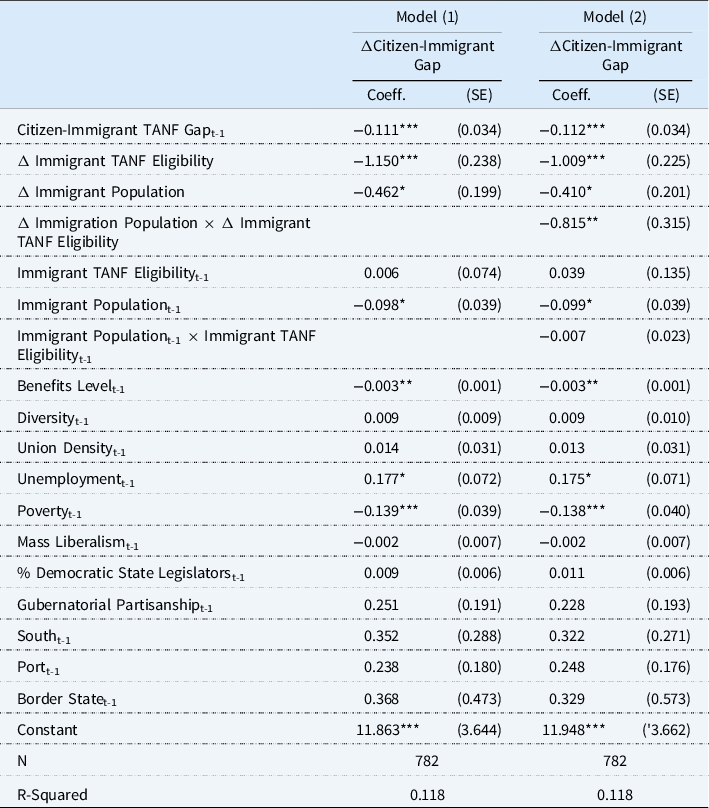
Moving to Table 2 in which we use Δ Citizen-immigrant TANF Caseload Gap as the dependent variable, we present two models, with the first model without any interaction terms, and the second one with the two interaction terms. We observe in Table 2 Model (1) that ΔImmigrant TANF Eligibility has a negative and significant coefficient (b = −1.149, p < 0.001). In other words, states that have broadened their TANF eligibility rules and become more inclusive toward immigrants will see decreases in the citizen-immigrant TANF caseload gap, which supports our H1-b. Both ΔImmigrant population (b = −0.462, p < 0.1) and Immigrant population t-1 (b = −0.098, p < 0.1) have negative and significant coefficients, suggesting that states with a larger or growing immigrant population are associated with a smaller citizen-immigrant TANF caseload gap than those with a smaller or decreasing immigrant population. More specifically, a one-percent increase in the state’s population is expected to close down the citizen-immigrant caseload gap by 0.462 percentage points. In a long run, a one percentage point increase in a state’s immigrant population will result in a decrease of 0.883 percentage points in the citizen-immigrant TANF caseload gap.Footnote 6
Dynamic models on citizen-immigrant TANF caseload gap, 2001-2016

Significance levels: + 0.10 level, *0.05 level, **0.01 level, ***0.001 level.
In Model (2) where we add the interaction terms, we notice that ΔImmigrant TANF Eligibility still has a negative and significant coefficient (b = 1.009, p < 0.001). Both ΔImmigrant population and Immigrant population t-1 still have negative and significant coefficients. The interaction term, ΔImmigrant TANF Eligibility × ΔImmigrant Population Density, also has a significant coefficient, suggesting that the effects of changes in states’ TANF policies on changes in citizen-immigrant caseload gap are contingent upon changes in states’ immigrant population.
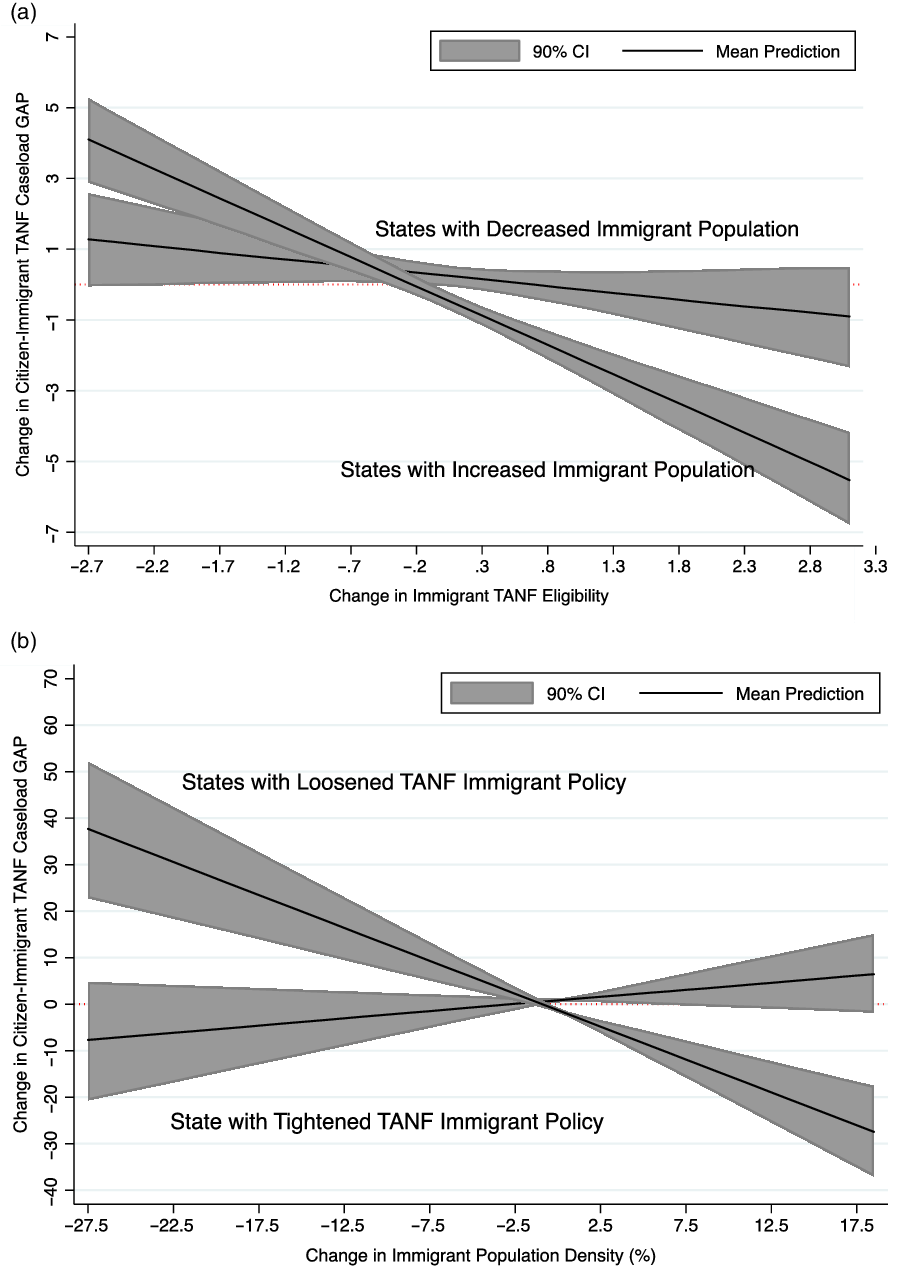
We visualize the interaction effect in Figure 2. Figure 2 (a) shows the predicted ΔCitizen-Immigrant Caseload Gap across observed ΔImmigrant TANF Eligibility Rules in states with increased and decreased immigrant populations.Footnote 7 We see that for states with an increased immigrant population, ΔTANF Immigrant Policy has a negative effect on ΔCitizen-Immigrant TANF Caseload Gap, suggesting that loosening up immigrant TANF eligibility rules can significantly reduce the citizen-immigrant caseload gap in these states. However, in states with a decreased immigrant population, ΔTANF Immigrant Eligibility does not have a significant effect on ΔCitizen-Immigrant TANF Caseload Gap. Taken together, Figure 2(a) shows strong support for our H2-b, where we posit that the positive effect of exclusive immigrant TANF policy on the immigrant-citizen TANF gap should be weakened in states with a larger immigrant population.
State immigrant policy, immigrant population, and citizen-immigrant TANF caseload gap. (a) Effects of change in immigrant TANF policy on citizen-immigrant TANF caseload gap in states with increased/decreased immigrant population. (b) Effects of change in immigrant population on citizen-immigrant TANF caseload gap in states with tightened/loosened TANF immigrant policies

In Figure 2(b), we present the predicted citizen-immigrant caseload gap across observed changes in the immigrant population in states with loosened and tightened TANF immigrant policy.Footnote 8 Consistently, we observe increases in the immigrant population are associated with decreases in the citizen-immigrant TANF caseload gap, but only so in states that loosened up their immigrant TANF eligibility rules. In states that have tightened eligibility rules, changes in the immigrant population do not significantly affect the citizen-immigrant caseload gap. Figure 2(b) shows consistent support for our H2-b that the positive effect of exclusive immigrant TANF policy on the immigrant-citizen TANF gap is weakened in states with a larger immigrant population.
Regarding the control variables, our dynamic panel models in Table 1 and Table 2 report consistent findings. First, TANF cash benefit levels and poverty rates are both positively associated with immigrants’ TANF caseload rates but negatively associated with the immigrant-citizen TANF gap, suggesting that states with more generous TANF cash benefit levels and higher poverty rates will likely witness higher TANF caseload rates by immigrants and a smaller gap in between citizens and immigrants. In contrast, unemployment rates have a negative and significant effect on immigrants’ TANF caseload rate but a positive and significant effect on the immigrant-citizen TANF gap, suggesting that states with higher unemployment rates will witness lower caseload rates by immigrants and a higher citizen-immigrant gap. This is perhaps because higher unemployment rates and harsher labor market conditions will result in higher competition between citizens and immigrants in TANF application.
Robustness checks
Replacing the dependent variable with CPS-based TANF gap
In order to verify that our results are robust, we conduct two sets of robustness checks. In the first robustness check, we use CPS self-reported TANF participation data instead of the administrative data from DHHS. First, by using the CPS data, we generate a measurement of the citizen-immigrant TANF participation gap calculated by the following equation:
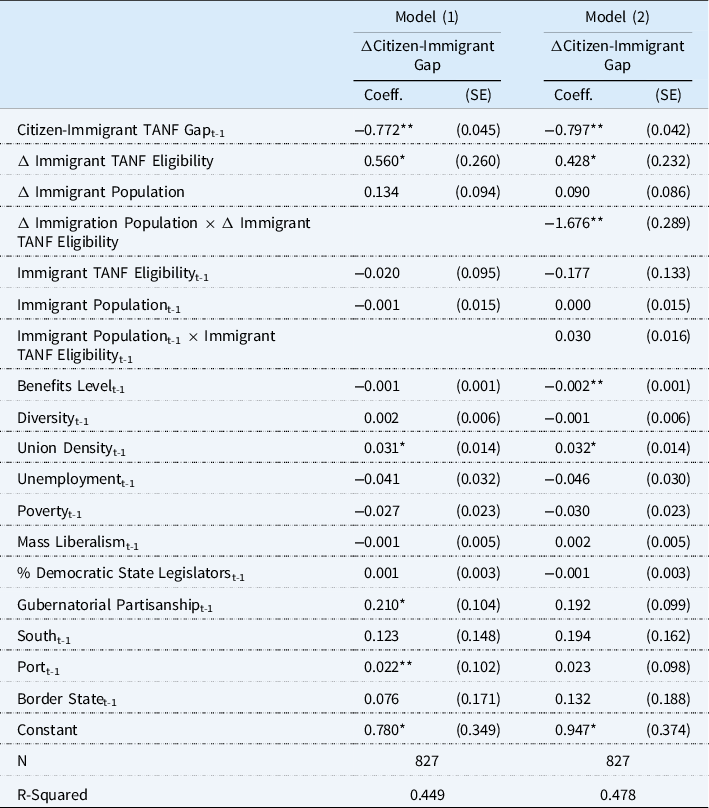
We use this new dependent variable to run a robustness check, and in the new model, we use the same independent variables. The results of this robustness check are presented in Table 3 below. As one can see from Table 3, the interaction term, Δ Immigration Population × Δ Immigrant TANF Eligibility, has a significant effect on the dependent variable. To facilitate the substantive interpretation of the interaction effects, we use the Clarify program (Tomz, Wittenberg, and King Reference Tomz, Wittenberg and King2003) in STATA 16 to plot how changes in states’ TANF eligibility policies and changes in immigration jointly affect the new citizen-immigrant TANF participation gap dependent variable. We have included the figures in Supplementary Materials. Figure 1(a) in the Supplementary Materials shows the conditional effect of Δ Immigration Population on the relationship between Δ Immigrant TANF Eligibility and Δ Citizen-Immigrant Gap, and Figure 1(b) in the Supplementary Materials shows the conditional effect the other way. Overall, in states with an increased immigrant population, ΔTANF Immigrant Policy has a negative effect on ΔCitizen-Immigrant TANF Take-up Gap, suggesting that loosening up immigrant TANF eligibility rules can significantly reduce the citizen-immigrant TANF gap in these states. However, in states with a decreased immigrant population, ΔTANF Immigrant Eligibility has a positive effect on ΔCitizen-Immigrant TANF Take-up Gap, suggesting that in states with decreasing immigrant population, loosening immigrant TANF eligibility rules does not necessarily reduce the citizen-immigrant TANF gap, but instead could even increase the gap.
Dynamic models on citizen-immigrant TANF gap (based on CPS data), 2001-2016

Significance levels: + 0.10 level, *0.05 level, **0.01 level, ***0.001 level.
Taken together, the first robustness check shows support for our H2-b, where we posit that the positive effect of exclusive immigrant TANF policy on the immigrant-citizen TANF participation gap should be weakened in states with a larger immigrant population. Indeed, in states with growing immigrant populations, a more generous TANF policy will lead to a reduction in the gap.
Replacing immigrant population density with immigrant network and voting power
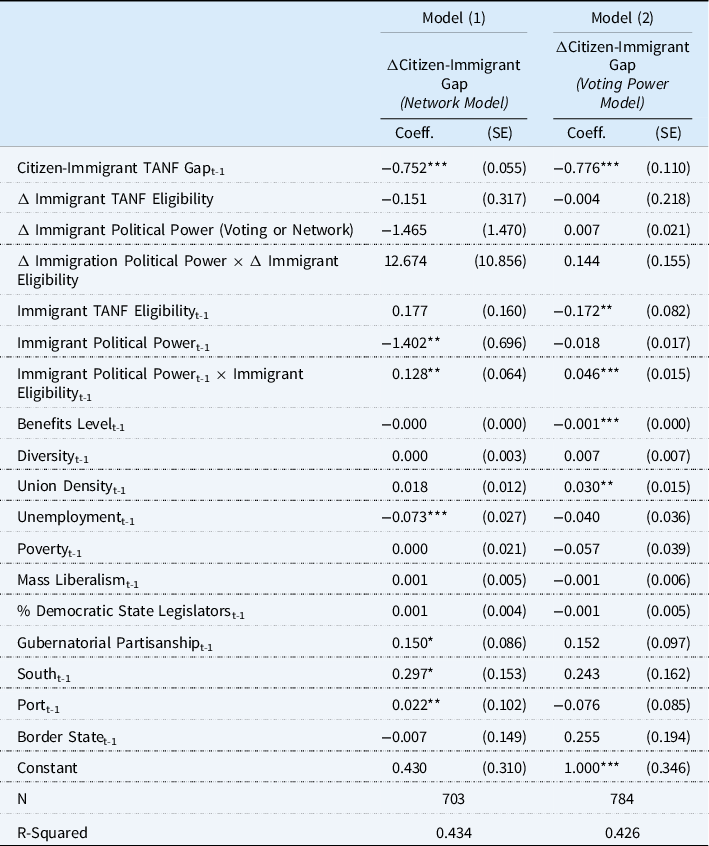
On top of the first robustness check, we further replace one of the key independent variables, immigrant population density, with two separate measures of immigrant political power. The first measure captures immigrant network strength and is measured by the number of immigrant advocacy groups divided by the immigrant population based on data from the Urban Institute National Center for Charitable Statistics (NCCS). The second measure captures immigrant voting power and is measured by the percentage of registered immigrant voters out of all registered voters based on the CPS November data. We use each of these two measures to replace the immigrant population density variable in the main model. Below Table 4 shows the results of these models.
Dynamic models on immigrant political power, immigrant TANF eligibility, and citizen-immigrant TANF Gap, 2001–2016

Significance levels: + 0.10 level, *0.05 level, **0.01 level, ***0.001 level.
As Table 4 shows, the two models convey very similar results. In both models, the interaction term Immigrant Political Power t-1 × Immigrant Eligibility t-1 has a significant effect in both Model 1, whether political power is measured by network strength or voting power. To interpret the conditional effects more intuitively, we draw two figures by using Clarify with Stata 16 (Tomz, Wittenberg, and King Reference Tomz, Wittenberg and King2003), and these figures are included in the Supplementary Materials as Figure 3(a) and (b). Both figures show similar patterns: in states with a weaker immigrant network (or voting power), a state’s immigrant TANF policy from the previous year has a negative effect on the citizen-immigrant TANF participation gap. This suggests that in states with weaker immigrant political power, a more inclusive immigrant policy will help close the gap. However, in states with stronger immigrant political power, the effect is different. Generally, states with strong immigrant power will almost always see a reduction in the gap. However, it is when these states also see very exclusive immigrant policy in the previous year, and the reduction in the gap will be the most. This makes sense because in states with a very inclusive immigrant policy previously, the gap is small to begin with and there are fewer “improvements” that can be made. This result is still in line with our argument that immigrant political power conditions the effect of immigrant TANF policy on the citizen-immigrant TANF participation gap. We still decide to use immigrant population density in the main model because it can serve as a proxy for both aspects of network and voting power.
Concluding discussions
The United States has had a long history of using policy devolution to exclude racial minorities and immigrants from welfare programs. The impact of such punitive state or local policies is pervasive and long-lasting. In this paper, we use TANF as the policy context to explore the distributive effects of punitive state immigrant policies. We find consistent evidence that states’ immigrant policies do have profound implications on immigrants’ participation in safety net programs as well as disparity in welfare usage between citizens and immigrants. While previous studies have examined policy outcomes of restrictive federal welfare reforms (Hero and Preuhs Reference Hero and Preuhs2007; Condon, Filindra, and Wichowsky Reference Condon, Filindra and Wichowsky2016), much less is known about how state-level immigrant policies shape inequality between citizens and immigrants. This gap in the literature is unfortunate because policy-making power on immigrants’ social and economic rights largely falls on the state governments after the 1996 welfare reform. In their systemic assessment of the American states’ immigrant welfare eligibility policies, Hero and Preuhs (Reference Hero and Preuhs2007) call for more research on social issues regarding immigration in American states. In her book Welfare States and Immigrant Rights, Sainsbury (Reference Sainsbury2012, 2) cautions that “comparative scholarship on welfare states in the last decade has continued to ignore immigrants.” Considering the increasing immigrant population, the devolution of immigration-related policies to states, and the heated policy debates on these issues, the paucity of research in this area is found to be surprising (see Jeong Reference Jeong2013, 1257).
Our paper speaks to Hero and Preuhs (Reference Hero and Preuhs2007) as well as Sainsbury (Reference Sainsbury2016)’s call by integrating research on subnational-level social issues regarding immigration, welfare policies, and inequality outcomes. Examining how American states’ immigrant welfare policies influence the inequality in TANF participation between citizens and immigrants, our analysis covers a critical time period after the 1996 federal welfare reform, when the states could freely decide upon their immigrant welfare policy. We show that states’ policy decisions to include or exclude immigrants from their cash assistance programs have an important impact on immigrants’ usage of the benefits and the equity of usage between citizens and immigrants. Our paper also shows that the relationship between state immigrant welfare policies and inequality in welfare caseload is not monotonic. Instead, state rules regarding immigrants’ welfare eligibility exhibit heterogeneous effects on the TANF caseload gap between citizens and immigrants in American states, depending on the size of its immigrant population. Broadening immigrant eligibility policies is associated with increases in immigrants’ usage of TANF and decreases in the citizen-immigrant gap, but this effect is only seen among states with large immigrant influxes. These key findings, taken together, suggest states are important stakeholders when it comes to inequality in welfare participation, and it is state immigrant policies and state immigrant contexts that together influence the policy outcomes. In this regard, our research also answers Hochschild, Chattopadhyay, Gay, and Jones-Correa’s (2013, 10) call that scholars of immigrant incorporation should “give more attention to perceptions of inclusion, including a sense of conditionality.”
Our study is not without limitations. First, our analysis does not reveal the size of the TANF recipient population as the proportion of the total income-eligible population, as the DHHS administrative records do not report how many citizens/immigrants are income-eligible to receive TANF in each state. Even though we can generate estimates on the size of immigrant or citizen populations that are under the poverty line, the estimate for the immigrant group is not accurate due to small samplesFootnote 9 . As a result, we could only conduct a robustness check by using immigrant (or citizen) TANF participants as a percentage of the total immigrant (or citizen) population, which luckily verifies our findings. Even though our dependent variable has its limitations, we believe that consistently comparing the citizen-immigrant TANF composition based on administrative records data can still show us important inequality patterns that are overlooked in many previous studies on immigrants and welfare benefit usage. Second, our data analyses primarily focus on state-level immigrant eligibility policies and do not capture punitive policy development at the national level during the past three years. Therefore, even though our conclusions have broad implications on how punitive immigrant policies may influence social equity, our paper does not directly answer how punitive national immigrant policies under the Trump administration have influenced social equity. A natural extension of our research will be to explore immigrant and immigration policies in the context of American federalism and to evaluate the relative influence of national- and state-level policies on social equity.
In a recent study, Condon, Filindra, and Wichowsky (Reference Condon, Filindra and Wichowsky2016, 427) find that inclusive state immigrant TANF policy could help promote more equal education outcomes between immigrants and citizens. Given that immigrant welfare policies have important implications on social equity in relation to over 40 million immigrants in the United States, a natural extension of our research and that of Condon et al. (Reference Condon, Filindra and Wichowsky2016) would be to explore various state- and federal-level immigrant welfare policies and their social and political implications on social inequality in the American democracy.
In August 2019, the Trump administration announced a new rule that poor immigrants who used or have the tendency to use public welfare programs in the future will be likely denied permanent residence (Shear and Sullivan Reference Shear and Sullivan2019). This rule, directly linking public welfare use with green card application, is an extension of the punitive federal immigrant policy implemented in 1996. Our research suggests that punitive state immigrant policy has a negative impact on immigrants’ participation in public welfare programs, and this conclusion can shed light on punitive immigrant policies on the federal level. Indeed, New York Times estimates that this new rule will likely prompt more than 324,000 noncitizens to drop out or not enroll in public benefit programs (Shear and Sullivan Reference Shear and Sullivan2019). Future research is encouraged to study the consequences of this new punitive immigrant policy at the federal level. Last but not least, considering the most recent wave of political rhetoric targeting certain ethnic groups, such as Latinos, in the issue area of immigration politics and policy, future research is encouraged to examine the possible heterogeneous effects of punitive immigrant policies on different ethnic noncitizen groups.
Supplementary material
For supplementary material accompanying this paper visit https://doi.org/10.1017/rep.2021.41