INTRODUCTION
In most barley cultivars, the husk is retained after threshing, due to the production of a lipid (Taketa et al. Reference Taketa, Amano, Tsujino, Sato, Saisho, Kakeda, Nomura, Suzuki, Matsumoto, Sato, Kanamori, Kawasaki and Takeda2008) that causes the husk to adhere to the caryopsis. Production of this lipid is regulated by a single gene (Taketa et al. Reference Taketa, Amano, Tsujino, Sato, Saisho, Kakeda, Nomura, Suzuki, Matsumoto, Sato, Kanamori, Kawasaki and Takeda2008) and mutation at this locus, on chromosome 7H (Kikuchi et al. Reference Kikuchi, Taketa, Ichii and Kawasaki2003), can give rise to the hull-less (naked) phenotype. A spontaneous mutation that prevented production of this lipid appears to have occurred at an early stage in barley domestication, as the mutation has not been detected in wild barley accessions (Taketa et al. Reference Taketa, Kikuchi, Awayama, Yamamoto, Ichii and Kawasaki2004). Hull-less barley was first used for human consumption more than 8000 years ago (Zohary & Hopf Reference Zohary and Hopf1988) and remains an important food crop in some mountainous areas such as Tibet (Xu Reference Xu1982; Tashi Reference Tashi, Grando and Gomez Macpherson2005).
The barley husk is indigestible for non-ruminants and hull-less cultivars have been developed in western Canada from the 1970s as feed for monogastric animals such as pigs and poultry (Bhatty et al. Reference Bhatty, Christison and Rossnagel1979). Since the husk dilutes the endosperm components, hull-less barley has a larger proportion of starch than the hulled form, so would also be a possible substrate for fuel alcohol production (Ingledew et al. Reference Ingledew, Jones, Bhatty and Rossnagel1995; Thomas et al. Reference Thomas, Dhas, Rossnagel and Ingledew1995; Nghiem et al. Reference Nghiem, Hicks, Johnston, Senske, Kurantz, Li, Shetty and Konieczny- Janda2010). In addition, hull-less barley has attracted interest for possible use in malting and brewing (Edney & Rossnagel Reference Edney, Rossnagel and Logue2000; Sole Reference Sole2003; Edney & Langrell Reference Edney and Langrell2004), particularly with the introduction of methods for wort separation such as mash filters and centrifugation (Edney & Rossnagel Reference Edney, Rossnagel and Logue2000), which remove the need for husk particles to form a filter bed. The Scotch whisky distilling industry has also investigated the use of hull-less barley for both malt and grain distilling (Agu et al. Reference Agu, Bringhurst and Brosnan2008, Reference Agu, Bringhurst, Brosnan and Pearson2009).
With a lack of hull-less cultivars of suitable malting quality, some initial experiments to determine the effect of the husk on quality traits were carried out using malting barley that had been chemically de-husked (Agu et al. Reference Agu, Devenny, Tillett and Palmer2002; Edney & Langrell Reference Edney and Langrell2004). However, the development of the cultivar Penthouse (Agu et al. Reference Agu, Bringhurst and Brosnan2008) and subsequent breeding lines in the UK (Agu et al. Reference Agu, Bringhurst, Brosnan and Pearson2009) made it possible to carry out direct comparisons between hulled and hull-less types.
Hull-less barley also has potential for inclusion in human food (Bhatty Reference Bhatty1999), particularly in conjunction with either the waxy or high-amylose starch mutations (Box & Eglinton Reference Box, Eglinton, Ceccarelli and Grando2010). These combinations lead to higher levels of β-glucan, which is associated with a range of health benefits, including lowering of cholesterol (Newman et al. Reference Newman, Newman and Graham1989) and slowing the absorption of carbohydrates from the gut (Rendell et al. Reference Rendell, Vanderhoof, Venn, Shehas, Arndt, Rao, Gill, Newman and Newman2005), preventing sharp rises in post-prandial blood glucose levels. Hull-less barley thus offers a number of actual and potential benefits compared with hulled barley, but loss of the husk reduces grain yield. Improving yield is thus clearly a key target for hull-less barley breeding and increasing thousand grain weight (TGW) is a potential target trait.
However, in naked oats which, like hull-less barley, are subject to embryo damage during harvest, larger grain size was shown to be associated with greater damage (Peltonen-Sainio et al. Reference Peltonen-Sainio, Muurinen, Vilppu, Rajala, Gates and Kirkkari2001). The protrusion of the embryo may also be a factor in hull-less barley, making it more prone to damage than appears to be the case in wheat, but differences in embryo protrusion did not clearly associate with variation in susceptibility to embryo damage in naked oats (Thornton Reference Thornton1986). Modifying the shape, rather than increasing the size, of the hull-less barley grain could therefore be a more useful alternative. Grain that was shorter but more globular in shape, i.e. more similar in appearance to wheat grain, could provide greater resistance to embryo damage, without an overall reduction in TGW and yield. Additionally, it would have the advantage of reducing the potential for high losses (screenings) among hull-less cultivars in industries such as malting, where grain is sieved prior to use (Grime et al. Reference Grime, Tarr and Boyd2007).
A population was derived from cvar Penthouse by mutation (Swanston et al. Reference Swanston, Middlefell-Williams, Forster and Thomas2011), with the intention of creating novel variations in grain shape (B. P. Forster, personal communication). However, although a total of 37 advanced lines from this population have been studied for a range of traits related to malting quality (Swanston et al. Reference Swanston, Middlefell-Williams, Forster and Thomas2011; Swanston & Middlefell-Williams Reference Swanston and Middlefell-Williams2012a , Reference Swanston, Middlefell-Williams, Zhang, Li and Liu b ), there has been little published on variation for other traits, or whether differences in yield or quality remain consistent across contrasting seasonal conditions. If the lines show genotype × season interaction for traits such as yield and grain size, it could be postulated that grain nitrogen (N) content and malting quality characteristics would also be affected. Nor has there been any identification of lines showing variation in grain size or shape. While this could be readily observed in a small population by visual examination, developing an effective rapid screening procedure would be beneficial for initial phenotypic selection within a much larger population of lines.
The research reported in the current paper consequently had a number of objectives. The first was to identify whether a well-established method for assessing grain dimensions on small samples of grain could also be useful for identifying lines that may carry mutations for grain shape. Secondly, it was intended to observe whether effects on grain size and shape also impacted on variation in other traits. A further objective was to identify whether contrasting seasons would influence the expression of both agronomic and quality traits and if this would lead to genotype × season interactions within the population. Finally, it was intended to assess the variation within the population for yield and quality attributes to consider, in particular, the potential yield of alcohol per hectare of the mutant lines in comparison with their parent variety and a hulled variety that has been used extensively by the distilling industry.
MATERIALS AND METHODS
Field trials
A total of 37 mutant lines, derived from selected M3 plants that were produced by treatment of the hull-less spring barley cultivar Penthouse with Ethyl-Methane Sulphinate, were first included in the trial as M5 lines in 2008 (Swanston et al. Reference Swanston, Middlefell-Williams, Forster and Thomas2011). These lines were included in subsequent trials in 2009 and 2011 at the James Hutton Institute's farm near Dundee (56°29′N, 3°7′W; 70–120 m a.s.l), with plot sizes and treatments as described by Swanston et al. (Reference Swanston, Middlefell-Williams, Forster and Thomas2011). During each growing season date of ear emergence was determined for each plot as the number of days after 1 June when 50% of the plot had reached growth stage 53 (Zadoks et al. Reference Zadoks, Chang and Konzak1974) and, after stem extension was completed, plant height (cm) was measured to the base of the ear. At harvest, grain from each plot was dried to an average moisture content of 12–14%. The grain was weighed, moisture contents were accurately determined and plot yields at 15% moisture calculated.
Grain and malt quality analyses
After harvest grain samples were cleaned and grain retained by a 2·2 mm sieve was used for subsequent analysis. The grain dimensions, i.e. mean length and mean width, were determined using a Marvin digital analyser (GTA Sensorik, Germany) and used to calculate the grain length/width ratio (L : W). The software also counts the number of grains in the sample, so weighing the sample permitted TGW to be determined.
Malting was carried out as described by Swanston et al. (Reference Swanston, Middlefell-Williams, Forster and Thomas2011) for all samples from the trial in 2008 and also for the 2011 trial. Prior to malting, grain N was determined by near-infrared transmission, using a FOSS 1241 grain analyser (FOSS UK, Warrington) with calibration supplied by the manufacturer. In both years, samples were germinated for 4 days after completion of steeping, prior to kilning. Hot water extract and fermentability were determined on each malt sample, using a scaled-down version of the Institute of Brewing Recommended Method of Analysis (Swanston & Thomas Reference Swanston, Thomas, Slinkard, Scoles and Rossnagel1996) and the predicted spirit yield (PSY) calculated, using a formula developed by the Scotch whisky distilling industry (Bringhurst et al. Reference Bringhurst, Brosnan, McInnes and Steele1996). Statistical analyses were carried out using version 15 of Genstat (VSN International 2012).
RESULTS
Grain dimensions and yield
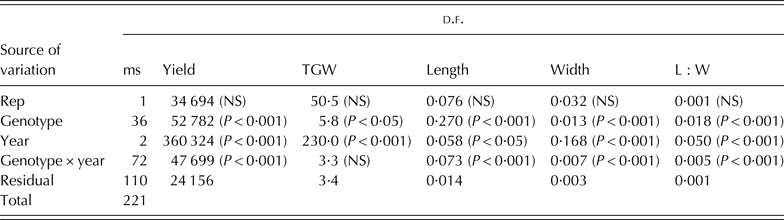
There was highly significant genotype × year interaction (P < 0·001) for the grain shape parameters, length, width and L : W (Table 1). All these characters also showed a highly significant effect (P < 0·001) of genotype and for both width and L : W there was a highly significant effect (P < 0·001) of year. For length, the effect of year was significant, but of a lower magnitude (P < 0·05), suggesting that while grain fill on the transverse axis was highly dependent on environment and probably associated with the extent of grain swelling, fill on the longitudinal axis was less affected. Slightly longer grain could thus reflect a season in which a number of growth parameters were more strongly expressed under lush growing conditions. In contrast, TGW showed a highly significant effect (P < 0·001) of year, but no significant genotype × year interaction. The effect of genotype was significant, but of a lower magnitude (P < 0·05) than the effect of year.
Analysis of variance for grain yield and grain traits thousand grain weight (TGW), length, width and grain length to width ratio (L : W), over three seasons, in 37 mutant lines in the barley cultivar Penthouse

NS, non-significant.
Values for the traits are mean squares from the analysis of variance.
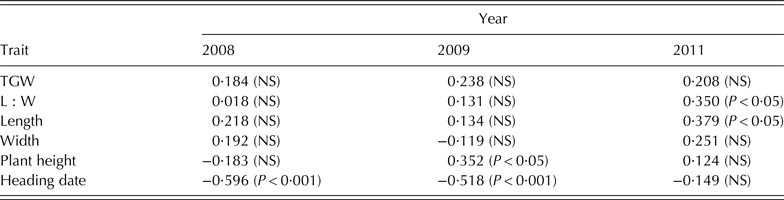
Grain yield showed highly significant effects (P < 0·001) of genotype and year and a highly significant (P < 0·001) genotype × year interaction (Table 1). However, grain yield was not significantly correlated with any of the grain size and shape parameters in either 2008 or 2009 (Table 2). In 2011, yield showed a significant positive correlation (P < 0·05) with grain length and, consequently, a positive correlation with L : W. In both 2008 and 2009, however, grain yield was significantly (P < 0·001) and negatively correlated with heading date. R 2 values would have exceeded 0·25 in both seasons, indicating that heading date explained greater than 25% of yield variation. No correlation between those traits was observed in 2011. A significant correlation (P < 0·05) between yield and plant height was observed only in 2009.
Correlations (r) between grain yield and grain and field characters over three seasons

NS, non-significant.
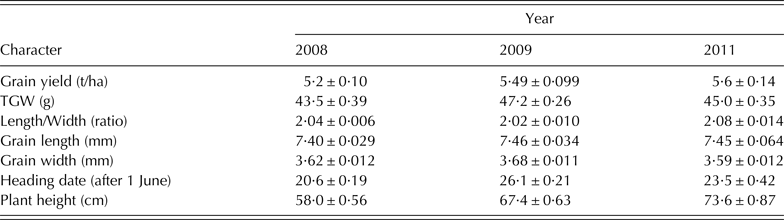
These results were further investigated by exploring the variation observed for yield and grain parameters in more detail and also considering the differences between the seasons in weather conditions. The lowest yields were in 2008 (Table 3) when TGW was also lowest. Grain width and length were also both slightly lower in 2008 compared with 2009. Heading dates were earliest in 2008, but plant heights were very much lower than in either of the other two seasons. Although there was above average rainfall in March, which had delayed sowing, rainfall during the main stem extension and grain filling periods were considerably below average (Fig. 1). Given the reduction in growth parameters, it is likely that the slightly elevated location of the trial site and the free-draining nature of the soil contributed to a degree of drought stress, with the later maturing lines affected to a greater degree. This would have led to the negative association between heading date and yield (Table 2).
Accumulated rainfall (a) and average daily temperatures (b) during the growing season from April to August in the years 2008, 2009 and 2011.

Mean values (±s.e.m.) for grain yield, and grain and plant characteristics in 2008, 2009 and 2011 (mean values are derived from 37 samples in all cases)

TGW, thousand grain weight.
Yield and TGW are expressed at 85% dry matter content.
There was a complete contrast in 2011, with high rainfall from May through to August and generally lower mean temperatures (Fig. 1). As a consequence, there was rather more vegetative growth and plant height was expressed most strongly in that season. However, although mean grain length was similar in 2009 and 2011, mean grain width in 2011 was lower than in either of the other years, suggesting that lower than average levels of sunshine had adverse effects on grain swelling. Heading dates were latest in 2009 and low rainfall in June may have induced some drought stress, particularly among the shorter lines as there was a significant correlation (P < 0·05) between plant height and yield. Later maturing lines also appear to have been disadvantaged as there was a strong negative correlation between yield and heading date. Mean yield level was slightly but not significantly lower than in 2011 (Table 3), but grain size was greater than in the other 2 years.
Given the contrast between seasons, changes in ranking order between the lines for yield were not surprising. Yields over the three seasons for all the mutant lines are depicted in Fig. 2 and some lines, e.g. numbers 3 and 11, show a high level of stability, with very similar yield levels in all 3 years. In contrast, lines 7 and 28 show very large differences between their highest and lowest yields. Some lines, e.g. 21 and 31, gave below average yields in all seasons while others, e.g. 8, 17 and 35, were consistently above average, with line 8 out-yielding the parent line Penthouse in all three seasons. Lines with the highest yield potential under optimal conditions were numbers 28 and 30, with highest yield levels expressed in 2011. These were the only lines to out-yield the covered variety, Optic, which gave very consistent yields across seasons. Penthouse gave low in yield in 2008, but was above the average of the mutant lines in both 2009 and 2011.
Plot yields over three seasons for all the cultivars. The average value of all 37 lines and the yields of Penthouse and the covered variety Optic are also indicated.

Malting data and associations with other characters
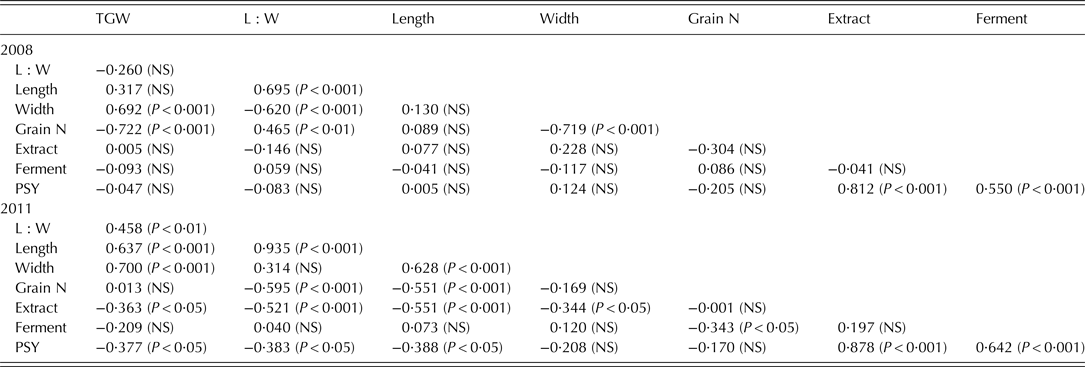
Analysis of variance showed highly significant effects of year (P < 0·001) for both extract and fermentability (Table 4). Predicted spirit yield, which is the product of these two factors, also showed a highly significant effect of year (P < 0·001), with a significant effect of genotype (P < 0·05) and a significant genotype × year interaction (P < 0·05). Extract showed a significant effect of genotype (P < 0·05) and a significant genotype × year interaction (P < 0·01), but neither of these was significant for fermentability. Because of the significant effects of year and genotype × year interaction, associations with grain traits were assessed separately for each season. In 2008, TGW showed a highly significant negative association (P < 0·001) with grain N percentage (Table 5) and grain N was significantly (P < 0·01) but positively associated with L : W. This suggested that smaller or narrower grain had a higher protein composition, but this was not reflected in significant correlations with any of the malt attributes.
Analysis of variance for malting traits, extract, fermentability (ferment) and predicted spirit yield (PSY) over two seasons, in 37 mutant lines in the cultivar Penthouse

NS, non-significant.
Values for the traits are mean squares from the analysis of variance.
Correlations between grain and malting characters, over two seasons, in 37 mutant lines in the cultivar Penthouse

NS, not significant; PSY, predicted spirit yield.
Grain N is measured as g/kg weight. Predicted spirit yield is the yield of alcohol anticipated after distillation calculated from the alcohol percentage of the fermented wort.
In contrast, in 2011 extract and PSY showed significant negative correlations with TGW (P < 0·05) and L : W (P < 0·05 and P < 0·001, respectively), although L : W also showed a significant negative correlation (P < 0·001) with grain N concentration (g/kg). Grain length showed significant negative correlation with grain N concentration (P < 0·001), extract (P < 0·001) and PSY (P < 0·05), but grain width only showed a significant and negative correlation (P < 0·05) with extract. Grain from 2011 was longer than in 2008, but narrower than in the other years, so it is likely that greater length was the determinant of better grain filling that led to reduced N concentration. Long, narrow grain may not, however, have modified well during malting, leading to lower extracts, despite a lower concentration of N.
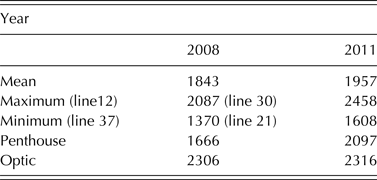
By combining grain yield and PSY, it is possible to predict the alcohol yield per hectare. Mean values for the Penthouse lines were higher in 2011 compared with 2008 (Table 6), following the pattern of grain yield rather than alcohol yield. Optic gave very consistent results between years, but Penthouse was considerably lower in 2008 compared with 2011. The best-performing mutant line in 2008 was line 12, with line 30 highest in 2011. Line 30 was the only line to give a higher alcohol production than Optic in 2011 and, over both years, it was the best-performing of the mutant lines.
Summary of alcohol yield per hectare results for 2008 and 2011 (all results are in litres/hectare, with grain moisture at 15%)

Screening for mutations affecting grain dimensions
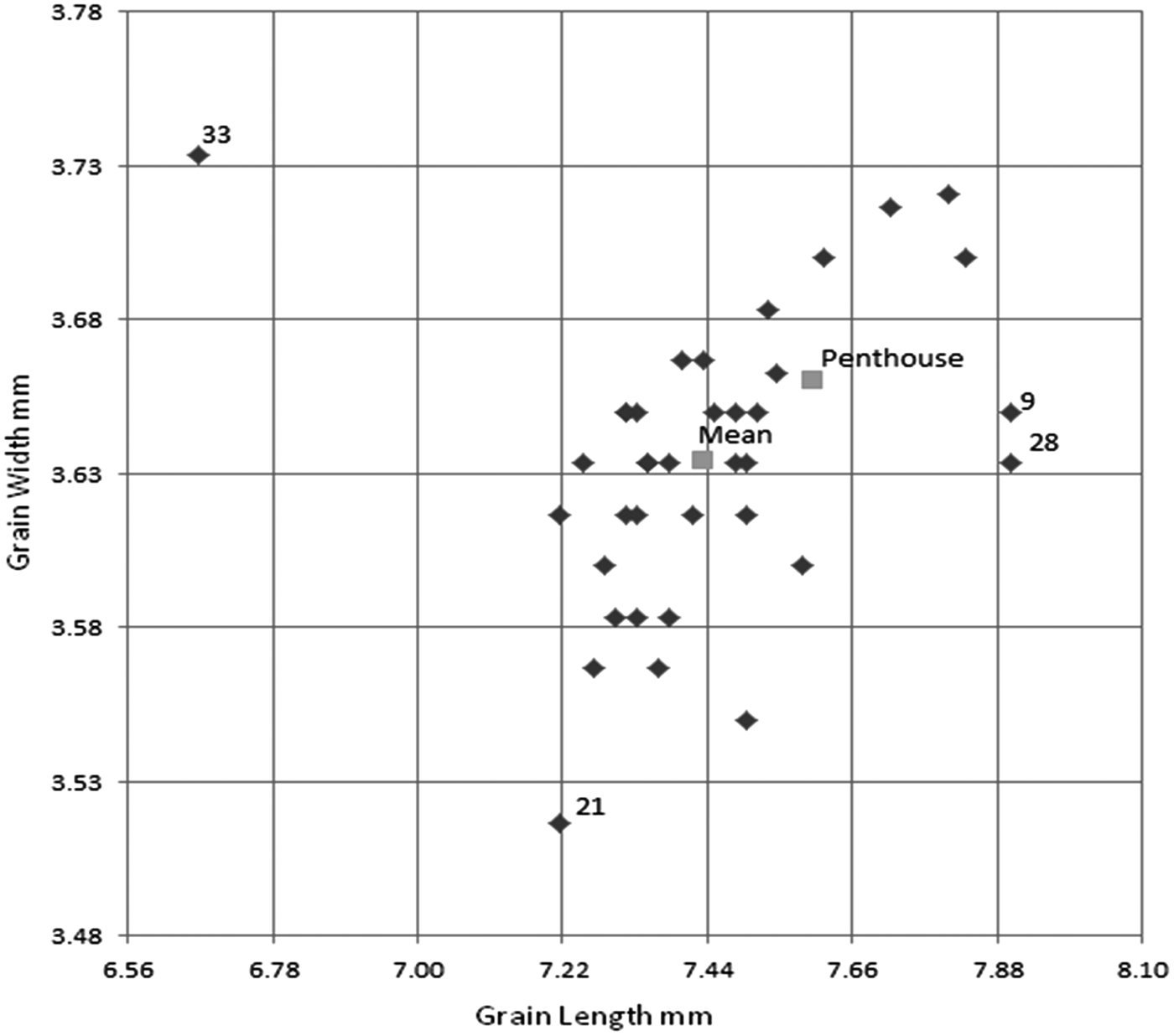
For all the lines, mean values, across seasons, were calculated for grain length and width. Width was plotted against length (Fig. 3) to demonstrate the variation in grain shape across the population compared with Penthouse. Most of the lines showed a fairly similar L : W to that of Penthouse, but with slightly lower values for both length and width, although a few produced slightly larger grain. Several lines, however, appeared to be noticeably different from the rest. Line 21 had similar L : W to Penthouse, but was very much smaller in both dimensions, while lines 9 and 28 had grain of similar width to the parent cultivar, but were longer. The most distinct type was line 33 which, while only slightly wider than Penthouse, had grain which was very much shorter and phenotypically resembled a globosum mutant.
Mean values across seasons for grain length plotted against mean values for grain width, in 37 mutant lines in the cultivar Penthouse. Vertical and horizontal lines indicate sd from the mean value for all lines. Lines with length : width ratio outside two s.e. from the mean value are identified.

Means and standard deviations were calculated for length and width and the margins within which 95% of the observations would be expected to fall are indicated in Fig. 3. Lines falling outside these limits were therefore regarded as containing possible additional mutations affecting grain shape. These data showed line 33 to be significantly shorter (P < 0·01) than the mean value, with lines 9 and 28 significantly longer (P < 0·05). Line 21 was significantly narrower (P < 0·05), but not significantly shorter. Plant height and heading data (not shown) also indicated that line 21 was consistently 6–7 cm shorter than the mean of the mutant lines and later than the mean for ear emergence.
DISCUSSION
In addition to line 30, with its potential for high yield and alcohol production, two mutants of particular interest on the basis of their field and grain data were lines 21 and 33. Line 21 was shorter and lower yielding than its parent. It was also one of the genotypes included for a study on starch-degrading enzymes (Swanston & Middlefell-Williams Reference Swanston, Middlefell-Williams, Zhang, Li and Liu2012b ) and gave high values for both β-amylase activity and diastatic power, an overall measure of starch-degrading activity. In this regard it closely resembles the mutant MM23, produced in the cultivar Maris Mink (Allison et al. Reference Allison, Ellis, Hayter and Swanston1979; Ellis et al. Reference Ellis, Powell, Swanston and Thomas1986). Like Penthouse, Maris Mink contained the sdw1 dwarfing gene and MM23 was considered to contain an additional erectoides dwarfing gene (Allison et al. Reference Allison, Ellis, Hayter and Swanston1979). It is likely, therefore, that line 21 contains an additional dwarfing gene and future studies will seek to identify the specific mutation. Indeed line 21 had been originally selected for inclusion in the trials on the basis of its shorter stature when grown in the field for the M4 generation in 2007.
Line 33 was identified as different from the other lines on the basis of its results for L : W and has a shorter and more rounded phenotype compared with its parent cultivar. A number of globe-shaped (globosum) mutants have been detected in barley, but have been associated with reduced kernel size and lower yield (Franckowiak Reference Franckowiak1997). However, Grime et al. (Reference Grime, Tarr and Boyd2007) considered the more rounded shape would be beneficial to reduce screenings over a 2·5 mm sieve in seasons with poorer grain filling. In addition, globosum grain is likely to improve pearling efficiency in grain for food use (Grime et al. Reference Grime, Tarr and Boyd2007) and, while hull-less barley can be rolled, flaked or milled without pearling (Baik et al. Reference Baik, Newman, Newman and Ullrich2011), it is often pearled to improve the brightness of the end-product, or to meet demands of specific markets. Line 33 was noted as a potential globosum type from its M4 phenotype in the field in 2007. In addition, it had a brachytic phenotype (W. T. B. Thomas, unpublished data), so the more globe-shaped grain could also be due to a mutation at a brachytic locus and further studies are necessary to establish the locus that was mutated to produce line 33. Line 33 was also identified to give improved malting performance from a slightly reduced steeping regime (Swanston & Middlefell-Williams Reference Swanston and Middlefell-Williams2012a ), so it appears to be a useful genotype for inclusion in future crosses.
Lines 21 and 33 were both identified as outliers from the data collected by the grain analyser. This is a rapid screening procedure requiring only a small sample of grain, which could be provided by individual plants sown at sufficient spacing to encourage tillering. It would therefore be a highly useful phenotypic screen to identify grain dimension variants within the much wider range of lines, generated within this population, that have not yet been subject to detailed investigation.
Although the population studied was comparatively small, comprising only 37 advanced lines, there were clear differences for a range of characters. Differences in malting performance have previously been demonstrated within this population (Swanston et al. Reference Swanston, Middlefell-Williams, Forster and Thomas2011; Swanston & Middlefell-Williams Reference Swanston and Middlefell-Williams2012a ), but also within a population derived by mutation within the cultivar Triumph (Swanston et al. Reference Swanston, Sopena, Moralejo and Molina-Cano2002). Data from the Triumph mutant lines showed significant effects of environment and genotype × environment (G × E) interaction on several quality traits. Significant genotype × season interaction was demonstrated here for traits related to distilling quality, in comparing two very contrasting seasons.
The 2008 trial was comparatively late sown, in mid-April, with low mean yields and plant heights. These results suggested a degree of stress, resulting from climatic conditions in that year, which was supported by the strong negative correlations shown between grain N composition and both TGW and grain width. Highest N levels were therefore observed in lines with smaller, narrower grain, but this was not reflected in significant negative correlations between grain N (g/kg) and extract or PSY. Agu et al. (Reference Agu, Bringhurst and Brosnan2008) suggested that hull-less barley requires a shorter malting time, so the smaller grain size in 2008 may have encouraged a degree of over-modification in some of the lines, thus eroding the advantages that lower N composition would have conferred.
In contrast, 2011 showed much stronger expression of plot yield, plant height and grain size. The relationships between traits in this year also showed grain length contributing much more to variation in TGW and L : W than in 2008. Grain length and L : W had highly significant effects in reducing grain N (g/kg), but also reduced extract and, as a consequence, there was no significant negative correlation between extract and grain N concentration. Aastrup & Munck (Reference Aastrup, Munck, Asher, Ellis, Hayter and Whitehouse1981) demonstrated that cell wall modification proceeds across the endosperm, from the embryo to the distal tip. The results observed in the current paper could therefore, be explained by longer grain modifying more slowly, despite having slightly lower N concentration.
There was considerable genotype × season interaction for yield and none of the mutant lines out-yielded the parent cultivar in all three seasons. However, some of the lines did appear to show some advantage, overall, for yield, with line 30, which was characterized by well-filled grain and low N concentration, demonstrating a very high yield potential in a year with relatively low temperatures and high rainfall. These lines will, however, need to be tested over a wider range of sites and seasons. Where there were differences in yield stability, e.g. in cultivars 7, 28 and 30, these tended to be associated with a very high yield in 2011, but a below average yield in 2009, when there was a significant negative correlation between yield and date of ear emergence. In this season, later-maturing genotypes appeared to be at a disadvantage and this could have resulted from the timing of a particular stress factor such as low soil moisture content.
Because the husk comprises around 0·10–0·13 of the weight of the grain (Bhatty Reference Bhatty1986; Palmer Reference Palmer and Palmer1989), hull-less barley is intrinsically lower yielding than covered barley and none of the lines out-yielded the covered cultivar Optic over all 3 years of the current experiment. However, the husk also dilutes endosperm components, so hull-less barley has the potential to produce higher extracts and alcohol yields, but is also more prone to embryo damage, which will affect germination, if malting is required prior to alcohol production. For that reason, hull-less barley may be more readily deployed in situations where alcohol is produced from un-malted grain (Swanston & Middlefell-Williams Reference Swanston, Middlefell-Williams, Zhang, Li and Liu2012b ). Barley is used for ethanol production in parts of the USA where maize is not grown (Nghiem et al. Reference Nghiem, Hicks, Johnston, Senske, Kurantz, Li, Shetty and Konieczny- Janda2010) and a key factor for both the cost and the energy balance is the yield of alcohol per hectare. As starch, which comprises much the greatest proportion of the endosperm, is largely conserved during the malting process, it is possible to use the alcohol yield from malted barley as a predictor of the likely alcohol yield when un-malted barley is used as a feedstock for potable or fuel alcohol production. As with wheat (Swanston et al. Reference Swanston, Smith, Thomas, Sylvester-Bradley, Kindred, Brosnan, Bringhurst and Agu2014), the current results showed that grain yield is the key determinant of alcohol production per hectare, with line 30 out-performing Optic under the environmental conditions of 2011. Selection for high grain yield would, therefore, be essential in hull-less barley. One option would be to exploit the high-yielding capacity of six-row winter barley, especially as hull-less types could be used for the production of hybrid seed (Swanston Reference Swanston and Hasanuma2014). This would give a further advantage in earlier harvesting, with the potential, particularly in more northern environments, for lower grain moisture at harvest. This has been identified in naked oats as a key factor in reducing embryo damage during threshing (Peltonen-Sainio et al. Reference Peltonen-Sainio, Muurinen, Vilppu, Rajala, Gates and Kirkkari2001). Nghiem et al. (Reference Nghiem, Hicks, Johnston, Senske, Kurantz, Li, Shetty and Konieczny- Janda2010) have also been able to increase alcohol yields from barley by around 3%, by the addition of enzymes that will break β-glucan down to fermentable sugars. This, coupled to loss of the husk will reduce the fibre component of the spent grain, giving a higher protein feed constituent, suitable for non-ruminant and ruminant livestock and with a higher lysine content than the residue from distillation with maize (Hicks et al. Reference Hicks, Montanti, Nghiem, Shewry and Ullrich2014). Although the regulations which cover both malt and grain whisky distillation in Scotland preclude the use of additives, addition of enzymes in the production of other distilled beverages, or ethanol for other purposes is not affected. Consequently, hull-less barley could be a potentially useful feedstock.
In conclusion, the Penthouse mutant lines have been shown to display considerable variation in grain size and shape in addition to differences in yield and quality, despite being in the same genetic background. Furthermore a rapid grain test has successfully identified lines containing additional mutations. Future studies will seek to identify and locate the genes affected by the putative globosum/brachytic and ‘double-dwarf’ mutants, lines 33 and 21, while a wider number of lines from within the mutant population will be screened. While grain dimensions do not appear to be accurate predictors of performance in yield trials or in malting and distilling, high levels of G × E were observed for a number of traits over the three seasons, so ranking orders varied among the lines. Lines with greatest yield potential or more consistent performance may be used as parents for future crossing, although winter barley may provide the optimal combinations of yield and early harvest for hull-less barley.
The James Hutton Institute receives funding from the Scottish Government, Rural and Environment Science and Analysis Services (RESAS) Division. Drs K Houston and L Ramsay are thanked for valuable discussion of the manuscript.