Staphylococcus aureus is a major cause of healthcare–associated infections worldwide.Reference Garvey, Winfield, Wiley, Reid and Cooper 1 – Reference Simor and Loeb 3 Methicillin-resistant S. aureus (MRSA) has become prevalent in most parts of the world.Reference Garvey, Winfield, Wiley, Reid and Cooper 1 – Reference Robotham, Graves and Cookson 4 Despite the decline in the incidence of MRSA in several European countries, infection remains a major cause of avoidable morbidity and mortality in patients admitted to the hospital.Reference Garvey, Winfield, Wiley, Reid and Cooper 1 – Reference Robotham, Graves and Cookson 4 MRSA infection increases the length of hospital stay, risk of death, and treatment costs.Reference Robotham, Graves and Cookson 4 Colonized and infected patients act as reservoirs for spread of MRSA within hospitals.Reference Baldwin, Gilpin and Tunney 5 , Reference Robicsek, Beaumont, Thomson, Govindarajan and Peterson 6 Isolation and decolonization are the 2 main targeted control measures for reducing the transmission of MRSA in hospitals.Reference Bode, Kluytmans and Wertheim 7 , Reference Cepeda, Whitehouse and Cooper 8
With government and public concern about the rates of MRSA infection between 2001 and 2004 in England and Wales, legislation and various prevention and control interventions were introduced.Reference Robotham, Deeny, Fuller, Hopkins, Cookson and Stone 9 As a result, annual rates of MRSA bacteremia cases fell from 17.7 to 7.8 cases per 100,000 bed days between April 2005, and March 2009.Reference Robotham, Deeny, Fuller, Hopkins, Cookson and Stone 9 , Reference Coia, Duckworth and Edwards 10 Until April 2009, national guidance recommended targeted screening of patients admitted to high-risk specialty units such as an intensive care unit (ICU).Reference Coia, Duckworth and Edwards 10 In 2011, Leonhardt et alReference Leonhardt, Yakusheva and Phelan 11 suggested that increased screening does not correlate with decreased MRSA rates; however, universal MRSA decolonization in the ICU has been associated with cost-effectiveness in reducing the incidence of MRSA.Reference Robotham, Deeny, Fuller, Hopkins, Cookson and Stone 9 , Reference Gidengil, Gay, Huang, Platt, Yokoe and Lee 12 , Reference Ziakas, Zacharioudakis, Zervou and Mylonakis 13 The UK Department of Health (DoH) introduced universal mandatory MRSA screening of all elective and emergency admissions to UK hospitals in 2010. In 2012, the DoH commissioned a national audit (National One Week Prevalence Audit of MRSA) to review the implementation of universal MRSA screening and its impact on patient management.Reference Fuller, Robotham and Savage 14 The audit found that implementation of universal screening was poor and that MRSA admission prevalence (new cases) was low; it suggested that UK hospitals should seek to improve the implementation of the current MRSA screening policy.Reference Fuller, Robotham and Savage 14 The report also made recommendations to stop routine screening in large teaching hospitals.Reference Fuller, Robotham and Savage 14 Subsequent cost-effectiveness studies showed that screening all admissions for MRSA is unlikely to be cost-effective in the United Kingdom. In 2016, Robotham et alReference Robotham, Deeny, Fuller, Hopkins, Cookson and Stone 9 suggested that screening admissions to high-risk specialties is likely to represent a better use of resources in terms of cost per quality-adjusted-life-year gained.
In response to the National One-Week Prevalence Audit of MRSA, University Hospitals Birmingham (UHB) NHS Foundation Trust implemented a revised strategy for the control of MRSA.Reference Fuller, Robotham and Savage 14 Prior to 2014, all intensive care unit (ICU) patients at UHB received universal MRSA decolonization therapy regardless of their MRSA status. In August 2014, UHB discontinued the use of universal decolonization in the ICU and stopped MRSA screening of low-risk patients such as day-case patients. However, UHB did continue to screen elective and emergency admissions. We report the effect of universal decolonization in an ICU on the incidence of MRSA acquisition and bacteremia cases across the UHB.
MATERIALS AND METHODS
Setting
University Hospitals Birmingham (UHB) NHS Foundation Trust is a tertiary referral teaching hospital in Birmingham, United Kingdom, that provides clinical services to nearly 1 million patients every year. UHB has one of the largest co-located ICUs in the world (100 beds). It has major specialty centers for burns, plastic surgery, and neurosciences, as well as a cancer center.
MRSA Screening
MRSA screening of all emergency and elective surgical patients admitted to UHB is standard practice. Swabs are taken from the nose, groin, and throat as well as any wounds or sites of invasive devices. Inpatients with stays >28 days are rescreened every 4 weeks. Only 1 change to MRSA screening was undertaken at UHB during this study period: in August 2014, MRSA screening of low-risk patients such as day-case patients was discontinued.
MRSA Acquisitions
At UHB, a patient is defined as acquiring MRSA if the patient has a negative admission screen and then has MRSA isolated from a subsequent screen or clinical specimen 48 hours after admission. Only MRSA acquisitions at UHB were included in the analysis. All MRSA acquisitions are molecularly typed to identify transmission links.Reference Garvey, Pichon, Bradley, Moiemen, Oppenheim and Kearns 15
MRSA Bacteremia
All MRSA bacteremia cases were attributed as healthcare associated or nonhealthcare associated using the criteria of the Centers for Disease Control and Prevention/National Healthcare Safety Network for national reporting purposes. 16 All bacteremia cases undergo a postinfection review process to assign attribution to the acute-care hospital, the clinical commissioning group (CCG, which is community based), or a third party, regardless of attribution as healthcare or nonhealthcare associated. 16 The third part of the amendment allows the assignment of a case of MRSA bloodstream infection to a third party through the arbitration process led by the Regional Director of Nursing or Regional Medical Director. Third-party assignment provides an acknowledgment of the complex nature of MRSA bloodstream infections being reported, which previously may have been allocated by default to acute-care hospitals or CCGs that were not involved in the patient’s care or that provided a strong case following the postinfection review that there were no possible failings in patient care. Only bacteremia cases assigned to the acute-care hospital (UHB) were included in the analysis. 16 All MRSA bacteremia cases were molecularly typed to identify transmission links.Reference Garvey, Pichon, Bradley, Moiemen, Oppenheim and Kearns 15
Decolonization of MRSA-Positive Patients Before August 2014
Screening of patients is conducted before any decolonization commences. Before August 2014, all MRSA-positive patients at UHB were decolonized with 5 days with nasal mupirocin 2% ointment (1 application, both nostrils, thrice daily) and chlorhexidine 4% body wash (Figure 1A). A set of post-decolonization screening swabs (nose, throat, and groin) were collected at least 48 hours after treatment. Patients who were not decolonized after a single course of treatment were prescribed another course; this pattern of decolonization therapy and screening continued until a patient had a negative screen (Figure 1A). Patients who were MRSA positive and had successful decolonization were screened weekly until 3 negative screen results were achieved. If, during the weekly screens, these patients became positive for MRSA, they underwent a second course of decolonization treatment that continued as described above until a negative screen result was obtained.
Flow diagram for decolonization of MRSA positive patients across UHB pre August 2014.

Change in Decolonization of MRSA-Positive Patients After August 2014
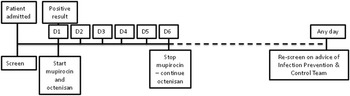
Screening of patients is carried out before any decolonization commences. A decolonization course was commenced for each patient colonized with MRSA (Figure 1B). Treatment involved 2% mupirocin nasal ointment thrice daily to both nostrils for a total of 5 days only and daily octenidine hydrochloride solution applied as a liquid soap directly on to the skin for the duration of the patient stay (Figure 1B). No rescreening was carried out if the patient was undergoing decolonization treatment, except with specific reasons, such as a long patient stay or clinical need.
Flow diagram for decolonization of MRSA positive patients across UHB post August 2014.

UHB’s MRSA decolonization regimen was changed for 2 reasons: (1) octenidine hydrochloride solution was preferred by patients, and (2) the average length of stay for a patient at UHB was 4 days, while infection prevention and control audits revealing re-screening often did not occur after the initial 5-day treatment. Moving to this decolonization regimen made it easier for UHB to manage MRSA patients and the decolonization regimen.
ICU Decolonization Timeline
Before August 2014, all ICU patients at UHB received universal MRSA decolonization therapy regardless of their MRSA status (Figure 1A). Between August 2014 and December 2015, universal decolonization therapy of all ICU patients was withdrawn, and only MRSA-positive patients received MRSA decolonization therapy (Figure 1B). In December 2015, UHB reintroduced universal MRSA decolonization therapy to all ICU patients regardless of their MRSA status (Figure 1B).
Break-Point Time Series
A “break point” time series analysis model was used to detect significant changes in the cumulative monthly numbers of MRSA acquisitions and bacteremia cases from April 2013 to August 2016.Reference Hughes, Nickerson and Enoch 17 The Changepoint package in R 18 was used to calculate the break points and fitted means for the MRSA acquisition and bacteremia rates. The package utilized a segment neighborhood algorithm with cumulative sum statistics, using a likelihood-based framework for detecting break points.
Regression Analysis
Regression analysis was performed to ascertain whether universal decolonization was associated with MRSA acquisition and bacteremia rates. Nonparametric kernel regressions were performed using the nonparametric (np) package in R. 18 Nonparametric regression was chosen to avoid making unwarranted distributional assumptions about the data.
Audits
Regular audits were conducted by the UHB Infection Prevention and Control Team during the study period. Audits included monitoring hand-hygiene compliance, monitoring the appropriate use of personal protective equipment, and monitoring environmental cleanliness.
RESULTS
MRSA
The number of MRSA cases across the UHB increased from 1 to 2.8 per 100,000 patient bed days in the 1-year period following the discontinuation of routine MRSA decolonization therapy in the ICU (Table 1 and Figure 2A; 4 vs 14 bacteremia cases, a 250% increase). In the 6-months following re-introduction of routine MRSA decolonization therapy in the ICU, the number of MRSA cases in the UHB decreased from 2.8 to 0.9 per 100,000 bed days (Table 1 and Figure 2A; 14 vs 3 bacteremia cases). The break-point model identified 4 probable break points in the rate of MRSA bacteremia cases across UHB, one that was coincident with the withdrawal of decolonization therapy and another that occurred immediately after its resumption.
Using break-point changes hospital-wide monthly MRSA bacteremia rates (A) and MRSA acquisition rates (B) per 100,000 bed days between August 2013 and August 2014 (prior to the discontinuation of universal MRSA decolonization therapy to patients in the ICU), between August 2014 and December 2016 (discontinuation of MRSA decolonization therapy in the ICU), and between January and June 2016 (reintroduction of universal MRSA decolonization therapy in the ICU). The break-point model identified 4 probable changes in rate, with the fitted means of the segments either side indicated by horizontal blue bars. The dotted vertical lines in August 14 and December 15 indicate the discontinuation and reintroduction of decolonization therapy, respectively.

Total Number of Patients Admitted to the ICU and to the Hospital During the 3 Study PeriodsFootnote a

NOTE. ICU, intensive care unit; MRSA, methicillin-resistant Staphylococcus aureus; UHB, University Hospitals Birmingham.
a The total number of MRSA acquisitions and bacteremia cases across UHB are shown during the 3 study periods.
b Non-parametric kernel regression found that the mean and 95% confidence intervals for each group were 27.1±2.8 for no decolonization therapy, and 18.4±2.1 for decolonization therapy. The difference between the 2 groups was found to be highly significant (P<0.001).
c Non-parametric kernel regression found that the mean and 95% confidence intervals for each group were 2.0±0.4 for no decolonization therapy, and 0.9±0.4 for decolonization therapy. The difference between the 2 groups was found to be highly significant (P<0.001).
MRSA Acquisition
The number of MRSA acquisitions in the UHB increased from 13.8 to 32.8 per 100,000 patient bed days in the 1-year period following the discontinuation of routine MRSA decolonization therapy in the ICU (Table 1 and Figure 2B; 76 vs 183 acquisitions, 240% increase). In the 6-month period following reintroduction of universal MRSA decolonization therapy into the ICU, the number of MRSA acquisitions in the UHB decreased from 32.8 to 21.5 per 100,000 bed days (Table 1 and Figure 2B; 183 vs 59 acquisitions). The break-point model again identified 4 probable break points in the rate of MRSA acquisition across UHB; 1 occurred 2 months prior to the withdrawal of decolonization therapy and another occurred 1 month after its resumption.
Auditing
Audits revealed no significant changes in hand-hygiene compliance, appropriate use of personal protective equipment, or environmental cleanliness during these periods (data not shown). MRSA screening rates for emergency and elective patients have averaged 90% and 92% respectively, over the past 2 years at UHB. At UHB, prescribing is done electronically, so all patients who are MRSA positive receive decolonization therapy.
DISCUSSION
The break-point model identified 4 probable changes in both MRSA cases and acquisition rates across UHB. After the discontinuation and reintroduction of universal MRSA decolonization therapy in the ICU, 2 break points occurred. The temporal association was particularly marked for MRSA bacteremia cases. Kernel regression analyses found that the period without universal decolonization therapy was associated with increased rates of MRSA acquisition and bacteremia cases (P<.001). While it is not possible to definitively link a break point with a particular intervention, we believe it likely that these break points are at least partly explained by the discontinuation and reintroduction of universal MRSA decolonization therapy to patients in the ICU. The data suggest that the use of universal MRSA decolonization in a large ICU is associated with reducing the incidence of MRSA across the entire hospital.
Our results are not surprising. In 2011, Robotham et alReference Robotham, Graves and Cookson 4 reported that the use of universal decolonization can reduce MRSA incidence and is a cost-effective method of controlling MRSA in ICUs.Reference Gidengil, Gay, Huang, Platt, Yokoe and Lee 12 , Reference Ziakas, Zacharioudakis, Zervou and Mylonakis 13 However, this does not explain the results seen across the whole of UHB. When universal decolonization therapy was discontinued in the ICU, an increase in MRSA bacteremia cases and acquisitions was seen across UHB. When universal decolonization was reintroduced into the ICU, MRSA bacteremia cases and acquisitions decreased across UHB. The percentage of inpatients passing through the 100-bed ICU at UHB is 5%–10% and accounts for 5.5% of total bed days. We hypothesize that by decolonizing this percentage of the inpatient population, we were, in effect, creating herd protection for the entire patient group at UHB, to a degree that reduced the biological burden to a level associated with the previous rate of MRSA incidence (before discontinuation of universal decolonization therapy). This phenomenon is not entirely uncharacterized; in 2013, Huang et alReference Huang, Septimus and Kleinman 19 reported that universal decolonization therapy resulted in reductions of all MRSA bacteremia cases. Another reason for the reduced number of MRSA cases and acquisition rates could be due to the masking of poor MRSA screening within UHB. MRSA screening is not completely effective at detecting all patients with MRSA carriage; in some cases, sensitivity has been reported as low as 50.5%.Reference Dodémont, Verhulst, Nonhoff, Nagant, Denis and Kluytmans 20 Universal MRSA decolonization of patients in the ICU could be masking ineffective screening; thus, patients who are not known to be MRSA positive would be receiving decolonization therapy. In turn, this could reduce the spread of MRSA within the ICU setting and across the UHB. Further work is warranted to explain the results of this report.
The strengths of this study include the use of a break-point time series model, which is less prone to bias than time-series analyses where break points are specified a priori.Reference Hughes, Nickerson and Enoch 17 Importantly, the study was performed in a low-prevalence setting, with a baseline rate of 0.8 MRSA bacteremia cases per 100,000 patients. Other factors, and not universal MRSA decolonization in ICUs, may partly explain the differences observed in the rates of MRSA cases and acquisitions across the UHB. Considering other variables that could have contributed to the increase in MRSA, we sought to determine whether poor infection control procedures played a role in our results. We found no significant evidence that hand hygiene, use of personal protective equipment, and environmental cleanliness had undergone reductions in compliance; audit data provided by UHB demonstrated comparable rates during periods of discontinuation and reintroduction of universal decolonization in ICU. We did not undertake any analysis of the aforementioned factors, which could have contributed to the observed result, nor did we perform a cost-effectiveness evaluation of the discontinuation or reintroduction of universal MRSA decolonization.
The results of this study suggest that routine decolonization for MRSA with screening in a large ICU is an effective strategy to reduce the spread and incidence of MRSA across the whole hospital.
ACKNOWLEDGMENTS
We would like to thank the Infection Prevention and Control Team and staff on the intensive care unit at the University Hospitals Birmingham NHS Foundation Trust.
Financial support: No financial support was provided relevant to this article.
Potential conflicts of interest: All authors report no conflicts of interest relevant to this article.