Burkholderia cepacia complex (BCC) is a complex group of at least 17 different species of ubiquitous opportunistic pathogens.Reference Martin, Winterfeld and Kramme1 Pseudomonas cepacia, or B. cepacia as it is now known, was first discovered by Walter Burkholder in 1949.Reference Burkholder2 It was identified as a human pathogen in the 1950s, and it grew to prominence in the 1970s and 1980s when it was described as a pulmonary pathogen in cystic fibrosis.Reference France, Dodd and Govan3 The name B. cepacia replaced P. cepacia in 1992 with the creation of the new genus Burkholderia; today, BCC encompasses a group of organisms with a complex taxonomy.Reference France, Dodd and Govan3 They are aerobic, gram-negative bacilli that exist in aquatic environments, and they are well documented to be found in fluids used in the healthcare settings.Reference Vardi, Sirigou and Lalayanni4 Although B. cepacia does not typically result in clinical infection when it colonizes healthy hosts, it is well reported as a source of healthcare-associated infection (HAI) in immunocompromised patients,Reference LiPuma5 and it typically presents as sepsis.Reference Huang, Jang and Liu6 In terms of 30-day mortality associated with B. cepacia HAIs in critically ill patients, different rates are described in the literature, and rare BCC species have higher mortality rates than common species such as B. cenocepacia and B. cepacia. Reference Chien, Liao and Sheng7 In terms of point sources, only half of the outbreak reports indicated a confirmed point source for B. cepacia HAIs.Reference Boszczowski, do Prado and Dalben8–Reference Anderson, Kuhns and Vasil11 Confirmed point sources included contaminated solutions and medications such as mouthwashes,Reference Zurita, Mejia and Zapata12 respiratory equipment and ventilators,Reference Lucero, Cohen and Trevino13 disinfectants,Reference Berkelman, Lewin and Allen14 hemodialysis machines,Reference Magalhaes, Doherty and Govan15 intravenous catheters,Reference Meyer16 medication vialsReference Zou, Li and Liu17 and ultrasound gels.Reference Shaban, Maloney and Gerrard18 The published evidence describing B. cepacia HAIs worldwide is disparate and may present challenges for infection control professionals (ICPs) attempting to source current evidence to plan intervention strategies. In this integrative review, we present our analysis of a series of published outbreak reports to determine the global burden, associated point sources, and successful outbreak prevention and control measures described for B. cepacia HAIs worldwide.
Methods
Study design
An integrative review of published papers describing outbreaks of B. cepacia HAIs was conducted to answer 3 main questions: (1) What is the global burden of documented outbreaks of B. cepacia HAIs? (2) What are the point sources of outbreaks of B. cepacia HAIs? And (3) which infection prevention and control measures are successful to prevent and control outbreaks of B. cepacia HAIs?Reference Whittemore and Knafl19
Data sources and search strategy
The taxonomic complexity of B. cepacia–like organisms as well as the lack of widespread and generally accepted identification make it difficult to conduct research that examines the roles played by, and the pathogenic significance of, the different B. cepacia–like organisms.Reference Coenye, Vandamme and Govan20 Our search of the literature accommodated this taxonomic complexity. We used Medical Subject Headings (MeSH) terms within several electronic databases: MEDLINE, PubMed, Embase, ProQuest and the Cumulative Index to Nursing and Allied Health Literature (CINAHL). We searched these databases using a combination of MeSH (mh) and a more focused version of a keyword search in titles and abstracts (tiab). We used the following search string strategy: “Burkholderia cepacia”[mh] OR “Burkholderia cepacia complex”[mh] OR “Pseudomonas cepacia”[tiab] AND “healthcare”[tiab] OR “healthcare associated infection”[tiab] OR “nosocomial’[tiab] OR “cross infection”[mh] OR “infection”[mh] OR “disease transmission”[mh] OR “outbreak”[tiab] OR “epidemiology”[mh]. We used Burkholderia and Pseudomonas as an OR string term to accommodate the microbiological taxonomic challengesReference Coenye, Vandamme and Govan20 associated with the review.
Published papers were eligible for inclusion if they reported a B. cepacia HAI outbreak taking place between January 1970 and October 2019. The initial year of 1970 was used because this was the first year with an available full-text scientific publication reporting healthcare-associated infection in humans due to P. multivorans, an organism which now belongs to the B. cepacia complex. Letters to the editor and/or short communications with detailed information describing an outbreak were also included. Publications in conference abstract format, non–peer-reviewed literature, and papers written in languages other than English were excluded.
Titles and abstracts of all identified publications were examined independently by 2 of the investigators (C.S. and S.N.) and were assessed for relevance and appropriateness to the objectives. Upon independently reviewing batches of 20 articles, the lists of included studies were compared to discuss and resolve potential conflicts as well as ensuring consistency between reviewers, research question, and aim of the study. The paper eligibility and selection criteria are outlined in Figure 1.
Prisma flow diagram for papers eligibility.

Data collection and variables
The data collection involved reviewing the abstracts, body text (including summary tables and figures), and available supplementary materials. A data collection form in Excel software (Microsoft, Redmond, WA) was designed for extracting relevant information from the reviewed papers. This form included 78 numerical and open-text analytic data variables grouped into the 3 domains of inquiry: (1) global burden, (2) identified point sources, and (3) effective infection control and prevention measures. The infection prevention and control measures were subcategorized into environment-related, patient-related, and staff-related measures. The papers were randomly assigned to and analyzed by a team of 2 investigators (C.S. and S.N.) using the data collection form. The data were then reviewed by the lead investigator (R.Z.S.) and other investigators (C.L., D.M., B.M., and P.R.) for accuracy, completeness, and missing information. The key reported variables and their definitions are listed in Supplementary Table 1 (online).
Data analysis
Each paper was examined by the reviewers to determine whether the outbreak was reported following the Guidelines for Outbreak Reports and Intervention Studies of Nosocomial Infections (ORION), first published in 2007,Reference Stone, Cooper and Kibbler21,Reference Stone, Cooper and Kibbler22 based on whether the paper made reference to these guidelines. Descriptive analyses of the extracted data of interest including central tendency measures and statistical dispersion; when unreported, these were calculated. All analyses were performed using SPSS version 25 software (IBM, Armonk, NY).
Results
Global burden of B. cepacia HAIs
A total of 125 papers reporting B. cepacia HAIs were published between January 1970 and October 2019, each reported a single outbreak (see Supplementary Table 2 online). None of them explicitly mentioned the use of the ORION guidelines. In total, 3,287 patients had B. cepacia HAIs. The first of these outbreak reports was published in June 1970 in Europe. Among the 125 reported outbreaks of B. cepacia HAIs worldwide, 88 (70.4%) took place from January 2000 onward. Also, 36 outbreaks (28.8%) occurred in healthcare facilities within the United States. Among those outbreaks in other countries, India (n = 11, 8.8%), Japan (n = 7, 5.6%) and Brazil (n = 6, 4.8%) reported the most. Cases identified as B. cepacia HAIs included neonates (<4 weeks old) to 89-year-old patients, but 60 outbreaks (48%) affected only adults. In 63 outbreak reports (50.4%), the specific organisms responsible were referred to as Pseudomonas cepacia and Burkholderia cepacia complex as the general causative group identified, with no further description provided in terms of species. Speciation was only documented from 1991 onward in the other 62 outbreak reports.
The number of patients in each B. cepacia outbreak ranged from 3 to 162 (mean, 26.72; SD, 27.75), and 22 papers (17.6%) reported outbreaks involving ≥50 patients. In addition, 106 outbreaks (84.8%) were identified using a combination of clinical and environmental sampling. Among the 112 studies indicating whether the initial organism identification was incidental or triggered, 57 (51%) reported the identification as occurring during routine surveillance and 55 outbreaks (49%) were identified as a result of clinical signs or symptoms of infection in a patient, typically bacteremia. In the 82 outbreaks where patients had sepsis, there were 4 outbreaks with only 1 patient with sepsis, and one outbreak with 69 patients with sepsis. In terms of mortality, 70 outbreak reports indicated associated deaths, ranging from 9 outbreaks (12.9%) with 1 death to 1 outbreak (1.4%) with 41 deaths. This deadly outbreak occurred in Taiwan and had a duration of 192 weeks.
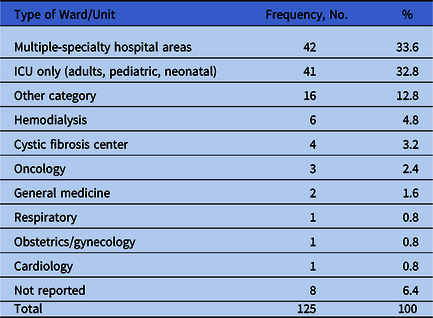
The median duration of the B. cepacia HAI outbreaks was 20 weeks (mean, 33.46; SD, 39.21; range, 1–224 weeks), with no peak outbreak season. However, 37 outbreaks (29.6%) occurred during winter season, and 20 outbreaks (16%) persisted for more than a year. An outbreak in Japan had a duration of 224 weeks between the index case identification and the end of the outbreak. All 125 outbreaks were described as single-center outbreaks, and 35 outbreaks occurred in tertiary-care facilities (n = 45, 36%). Intensive care units (ICUs) were the most frequently involved wards (n = 41, 32.8%), and 8 outbreaks (19.5%) occurred in neonatal intensive care units (NICUs). Also, 42 outbreaks (33.6%) involved multiple specialty hospital areas. These data are listed in Table 1.
The Ward/Units Where the 125 Documented B. cepacia Outbreaks Occurred

Note. ICU, intensive care unit.
Official notification to the parent facility was reported in 71 of the 125 published studies of B. cepacia HAI outbreaks (56.8%), with time frames ranging from 1 day to 9 months. Official notification to a national protection agency, either the Center for Disease Control and Prevention (CDC) and/or the US Food and Drug Administration (FDA) equivalent, was described in 50 outbreak reports (40%).
Overall, 106 reports of outbreaks of B. cepacia HAIs (84.8%) included a description of clinical risk factors among cases. The presence of an indwelling intravascular or urinary catheters in place at the time of the outbreak was described in 74 studies (59.2%). Of these, 65 outbreaks (87.8%) included patients with intravascular devices. Other risk factors identified included oncological disorders, cardiovascular disorders, presence of cystic fibrosis (CF), as well as other respiratory illnesses and nononcological immunosuppression. The clinical risk characteristics in all reported outbreaks are detailed in Supplementary Table 3 (online).
Point sources for B. cepacia HAIs
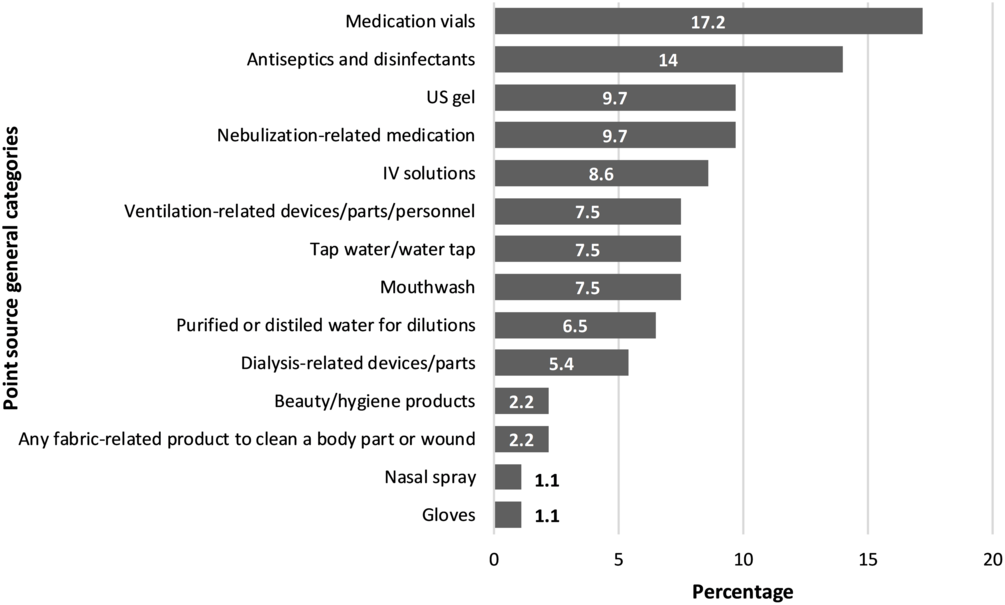
Moreover, 93 reports of outbreaks of B. cepacia HAIs (74.4%) documented a definitive point source, and they varied in nature. Of these 93 outbreaks, 16 (17.2%) were identified as originating from contaminated medication vials including liquid laxatives, antiemetics, anesthetics, analgesics, antibiotics, eye drops, anticoagulants, and antacids. Antiseptics and disinfectants were reported as the point source in 13 outbreaks (14%), with chlorhexidine being reported as the most commonly contaminated disinfectant involved (n = 8, 61.5%). Nebulization medications and contaminated ultrasound gel were also identified as point sources in 9 outbreaks (9.7%). Additional point sources identified are listed in Fig. 2.
Definite point sources for 93 outbreaks of B. cepacia HAIs.

Identification techniques varied depending on the period when the outbreak took place. Overall, 121 outbreak reports described the nature of the diagnostic tests carried out during the epidemiological investigations. In the 28 outbreaks (23.1%) during the 1970s, culture-based testing was used. It was replaced in the 1980–1990s by polymerase chain reaction (PCR)–based molecular testing, which was used in 91 outbreaks (75.2%). The use of whole-genome sequencing (WGS) was only described in 2 outbreak reports from 2017 and 2018 (1.7%).
Effective infection prevention and control measures
In total, 95 outbreak reports (76%) documented the infection control and prevention measures that were effective in stopping the B. cepacia outbreak. We grouped these measures into 3 categories: environmental-, patient-, and staff-related. Only 33 of the 95 documented outbreaks (34.7%) describing infection control and prevention measures reported using a combination of all 3.
Environmental measures. Of the 95 outbreak reports of B. cepacia HAIs, 52 (54.7%) indicated that only environmental measures were employed to arrest the outbreak. These included removal of contaminated medications or agents, amendments to medication administration protocols, establishment of new environment maintenance and disinfection protocols, modifications to existing environment maintenance and disinfection protocols, and introduction of environmental surveillance and screening.
Staff-related measures. Successful staff-related infection control and prevention measures were reported in 42 of these 95 outbreak studies (44.2%). These included reviewing and modifying healthcare-worker aseptic technique knowledge and practice, improving healthcare-worker compliance with sanitation and disinfection policy, and training staff in additional infection prevention and control procedures.
Patient-related measures. Patient-related infection control and prevention measures were reported in 34 of these 95 outbreak studies (35.8%). A single outbreak (2.9%) indicated solely implementing patient-related measures. In terms of antibiotic therapy use among the 34 outbreaks, 22 reports (64.7%) indicated >1 type and class of antibiotics used. Susceptibility testing prior to antibiotic therapy was conducted in 31 outbreaks (91.2%), and resistance was reported in 20 of these (64.5%). Resistance to ≥5 antibiotics was indicated in 22 of these outbreaks (71%). Other effective patient-related measures included isolating and quarantining infected patients and patient educational interventions.
Discussion
In this integrative review, we had 3 aims. First, we aimed to determine the global burden of B. cepacia HAIs. Second, we aimed to describe the point sources identified in the reported B. cepacia HAIs. Third, we aimed to describe infection prevention and control measures used to contain and arrest the outbreaks. B. cepacia HAIs have been documented in patients from various age groups including neonates,Reference Kotsanas, Brett and Kidd23–Reference Patra, Bhat and Lewis26 pediatric patients,Reference Jacobson, Wray and Kovach27–Reference Loukil, Saizou and Doit32 young adults,33,Reference Lo Cascio, Bonora and Zorzi34 adultsReference Matrician, Ange and Burns35–Reference Abdelfattah, Al-Jumaah and Al-Qahtani39 and ageing patients,Reference Keizur, Lavin and Leidich40,Reference Hua and Tokeshi41 yet it is mostly reported in adults. Like many opportunistic pathogens, members of BCC affect immunocompromised individuals including patients affected with cystic fibrosis,Reference Whiteford, Wilkinson and McColl31,Reference Dallal, Telefian and Hajia42–Reference Smith, Gumery and Smith46 patients with hematological diseases,Reference Vardi, Sirigou and Lalayanni4,Reference Heo, Kim and Jeong47–Reference Baul, De and Mandal49 postoperative patients,Reference Sunenshine, Schultz and Lawrence36,Reference Siboni, Olsen and Ravn50,Reference Lalitha, Das and Purva51 and hemodialysis patients.Reference Lo Cascio, Bonora and Zorzi34,Reference Berkelman, Godley and Weber52–Reference Souza, Moreira and Pasternak55 This accounts for the predominance of reported outbreaks in adult,Reference Zurita, Mejia and Zapata12 pediatric,Reference Antony, Cherian and Boloor29 and neonatalReference Lee25 intensive care units (ICUs), where mechanically ventilated patients are at an increased risk of HAI.Reference Kutty, Moody and Gullion56 Additionally, because these patients are at an increased risk of infection, respiratory cultures are frequently collected to increase the chance of identifying B. cepacia colonization. A similar concept applies to hemodialysis centers, where outbreaks have been frequently reported. B. cepacia can successfully colonize water supplies, filter membranes, and antiseptic solutions during hemodialysis sessions, thus allowing the bacteria to move across contaminated dialysate compartments reaching the patient’s bloodstream.Reference Lo Cascio, Bonora and Zorzi34,Reference Berkelman, Godley and Weber52–Reference Souza, Moreira and Pasternak55
The identified point sources of B. cepacia HAIs are diverse and involve processes from manufacturing to contamination of products at the hospital setting.Reference Zou, Li and Liu17,Reference Abdelfattah, Al-Jumaah and Al-Qahtani39,Reference Berkelman, Godley and Weber52,Reference Alvarez-Lerma, Maull and Terradas57–Reference Berthelot, Grattard and Mahul59 For those 4 outbreaks pointing to an environmental source associated with the implementation of a new product for patient care, namely prefabricated moist washcloths and moisturizing body milk, this is a pivotal point if the product was developed mainly for highly vulnerable patients. This finding emphasizes the need for product manufacturing companies to provide detailed recommendations on how the product should be utilized.Reference Martin, Christiansen and Caspari60 Over the years, BCCs have been recognized among the most frequent sources of nosocomial outbreaks due to their widespread opportunistic ability to colonize various environments and surfaces.Reference Nannini, Ponessa and Muratori61 A significant number of reported outbreaks made reference to the association of infection and indwelling catheters, which is not surprising because device insertion, in the bustling hospital environment, is sometimes suboptimal in aseptic practice. It is critical, when using ultrasound gel for the placement of both central and peripheral cannulas, to ensure both the sterility of the coupling gel and the ultrasound probe and that an aseptic cannula insertion technique is used at all times, especially when dealing with high-risk patients.Reference Shaban, Maloney and Gerrard18
In terms of effective infection prevention and control measures that managed to cease the rising number of cases associated with each reported outbreak, the most effective approaches used a combination of environmental-, staff- and patient-related measures. For instance, those outbreaks in which a combination of actions, such as equipment maintenance, routine education programs for staff and patient confinement were reported, were shorter.Reference Shaban, Maloney and Gerrard18,Reference Heo, Kim and Jeong47,Reference Panlilio, Beck-Sague and Siegel62–Reference Manzar, Nair and Pai64
Findings from the review suggest that the point sources for B. cepacia HAIs were often contaminated fluids, which in some instances were contaminated during manufacture. Substandard manufacturing of products distributed globally undermines the efficiency of implemented control measures and may boost the trend of outbreak-related cases worldwide.Reference Shaban, Maloney and Gerrard18,Reference Abdelfattah, Al-Jumaah and Al-Qahtani39,Reference Martin, Christiansen and Caspari60,Reference Brooks, Mitchell and Miller65–Reference Sommerstein, Fuhrer and Lo Priore68 When a microbiologically contaminated product is found, it is critical that infection control and prevention advice is disseminated promptly, so existing outbreaks can be arrested and future ones prevented. When outbreaks of B. cepacia HAIs occur, infection control professionals should have a high index of suspicion of contaminated fluids and medical equipment, given that these are the most widely reported point sources.Reference Berkelman, Lewin and Allen14,Reference Heo, Kim and Jeong47,Reference Bassett, Stokes and Thomas58,Reference Panlilio, Beck-Sague and Siegel62,Reference Lee, Han and Kim69–Reference Romero-Gomez, Quiles-Melero and Pena Garcia71
This study has several limitations. The search was limited to outbreaks reported in English, and several outbreaks in Asia and other jurisdictions were not examined because they were published in other languages. The ORION (Outbreak Reports and Intervention Studies of Nosocomial Infection) guidelines were first established in 2007, and none of the published papers after 2007 reported its use, which restricted the interpretability of some of the reported data. Finally, as noted earlier, the evolving knowledge of the bacteriology of the B. cepacia group and changing taxonomies and nomenclature is such that we may have missed studies that reported outbreaks due to organisms within the B. cepacia complex but were not described as such in our keywords.
In conclusion, outbreaks of Burkholderia cepacia HAI are not uncommon, and they are a contemporary HAI risk among patients that are immunocompromised in a range of clinical settings. Effective infection prevention and control measures have been developed for a range of point sources. These findings will assist the efforts to arrest, prevent, and control future outbreaks of Burkholderia cepacia HAIs.
Supplementary material
To view supplementary material for this article, please visit https://doi.org/10.1017/ice.2020.184
Acknowledgments
We acknowledge Ms Julie Potter for her general support with this study.
Financial support
This study was an investigator-initiated research and did not receive financial support from funding agencies in the public, commercial, or not-for-profit sectors.
Conflicts of interest
The authors have no conflicts of interest to declare.