INTRODUCTION
The role of religiosity in partisan identification has been well-researched over the years. We know that higher levels of individual religiosity, religious commitment, and church attendance have been associated with stronger Republican Party identification or conservative ideology (Jelen Reference Jelen1991; Wilcox and Larson Reference Wilcox, Larson and Rimmerman2006; Olson and Green Reference Olson and Green2006). And since at least the 1980s, the “Christian Right”Footnote 1 has established itself as a major element of the Republican Party machine ( Wilcox and Larson Reference Wilcox, Larson and Rimmerman2006; Campbell Reference Campbell2006). Religiosity however does not only affect the political leanings of evangelical or fundamentalist Christians. It has also been used to explain why other social groups have been closer aligned with a particular party. For example, African-Americans have used religious institutions as a gathering place for those who sought inclusion into the political process (McDaniel and Ellison Reference McDaniel and Ellison2008; Tate Reference Tate1994; Calhoun-Brown Reference Calhoun-Brown1996; Mattis Reference Mattis2001; Alex-Assensoh and Assensoh Reference Alex-Assensoh and Assensoh2001). This social networking formed the basis of an eventual African-American bloc vote for the Democratic Party. As seen, religiosity is known to have a strong impact on partisan identification of White and Black Americans.
However, not all religious groups enjoy equal levels of inclusion in American society. In particular, many people have questioned or investigated whether religious minority groups, both Christian and non-Christian alike, can be integrated politically into a historically Protestant Christian dominant political system (Huntington Reference Huntington1993; Yang and Ebaugh Reference Yang and Ebaugh2001). In this article, we take up the case of American-Muslims, a growing, but understudied religious minority.
Throughout American history scholars have been interested in this question and investigated Quakers, German Catholics, Jews, Irish and Italian Catholics, Amish, Mormons, Latino Catholics, and other religious minority groups (Quakers (Nash Reference Nash1968; Bauman Reference Bauman1971); German Catholics (Helbich and Kamphoefner Reference Helbich and Kamphoefner2004); Jews (Glazer and Moynihan Reference Glazer and Moynihan1970; Gamm. Reference Gamm.1989; Elazar Reference Elazar1995); Irish & Italian Catholics (Glazer and Moynihan Reference Glazer and Moynihan1970); Mormon (Flake Reference Flake2004; Sells Reference Sells2005); Latinos (Jones-Correa and Leal Reference Jones-Correa and Leal2001; Lee and Pachon Reference Lee and Pachon2007)). In fact, published work on religious minorities began as early as the mid-1600s, where Rawson (Reference Rawson1660) defended a Massachusetts Court's decision to execute three Quakers based on their religious differences. Although today we have constitutional separation of church and state, religion has been and continues to be a dominant orienting institution in political life in America (Jelen and Wilcox Reference Jelen, Wilcox, Wayne and Armonk1995; Greenberg Reference Greenberg2000). Yet, it is not clear that religiosity operates equally for the partisan identification of non-Christian religious groups. As America has become more religiously diverse, it is especially important to extend our analysis of religiosity and political life to new religious minority groups, especially those of non-Christian denominations.Footnote 2
MUSLIM-AMERICANS, RELIGIOSITY, AND PARTY IDENTIFICATION
One of the newer and most discussed religious minority groups is Muslim-Americans. Numbering between 2.3 million and 7 million (Bagby, Perl, and Froehle Reference Bagby, Perl and Froehle2001; Smith Reference Smith2002; ul-Huda Reference ul-Huda2006; Kohut et al. Reference Kohut2007), Muslim-Americans have been the focus of considerable debate regarding religion and American political inclusion. For example, some pundits claim that religiosity among Muslims is the culprit for the terrorist attacks and for other acts of political violence both in the United States and abroad (Emerson Reference Emerson2002; Pipes Reference Pipes2002; Kushner and Davis Reference Kushner and Davis2004; Horowitz Reference Horowitz2006; Emerson Reference Emerson2006; Williams Reference Williams2007). In contrast, other authors believe that religiosity is driving political incorporation among Muslim-Americans and that mosque and association leaders are urging engagement among their congregations and memberships (Barreto et al. Reference Barreto, Bozonelos, Dana, Masuoka and Ozyurt2007; Bagby, Perl, and Froehle Reference Bagby, Perl and Froehle2001; Nyang and Bukhari Reference Nyang and Bukhari2001; Bukhari and Nyang Reference Bukhari and Nyang2004; Council on American-Islamic Relations 2006; Kohut et al. Reference Kohut, Lugo, Keeter and Smith2007).
The more subtle and relevant story nonetheless might be the effect of religiosity on Muslim-American party identification. Recent scholarship suggests that religiosity may drive political ideology and/or partisanship among Christian Americans (Wald 1987, Reference Wald, Kellstedt, Leege, Leege and Kellstedt1993; Kohut 2000). We argue that religiosity also has an influence on Muslim-American party identification, however not in the same manner as with Christian denominations. First, Christian evangelicals tend to be middle-class, white, and older in their demographics. Thus, any effect of religiosity on partisanship should be uniformly distributed within a denomination. In contrast, Muslim-Americans are highly diverse and one would expect that religiosity should not have a similar effect and consequently have less influence. However, Muslim-Americans go through similar experiences regardless of background and this socialization process has impacted the policy preferences of Muslim-Americans as a group. While the two major political parties encourage religiosity among Protestants, Jews, and Catholics, often campaigning for votes in Churches, Synagogues, and Cathedrals, they are either silent or opposed to religiosity among Muslims within their parties.
What we do know is that religious guidance, church attendance, and religious attitudes influence both traditional and evangelical Christian and Catholic political engagement and partisanship (Kellstedt and Green Reference Kellstedt, Green, Leege and Armonk1993; Jelen and Wilcox Reference Jelen, Wilcox, Wayne and Armonk1995; Corbett and Corbett Reference Corbett and Corbett1999). On the other hand, not much is known about how religiosity might influence Muslim-American political engagement and partisanship (Ayers and Hofstetter Reference Ayers and Hofstetter2008). Much of this can be attributed to the limited number of surveys on Muslim-American political behavior before the terrorist attacks of September 11. Of the surveys that were completed, their results are now only found within journal articles or books written after the fact. For example, the American-Muslim Council reported that for many years Muslim-Americans were evenly split between the Democrats and Republicans. However, the American-Muslim Council is now defunct and only in Findley's book do the results still exist (Findley Reference Findley2001). Similarly, Duran (Reference Duran1997) looks at surveys by the Pakistan Link, an ethnic newspaper, and by United Muslims of America, a Muslim-American civic organization, and finds that the Muslim vote went solidly for Clinton over Dole in the 1996 presidential election. However, he is quick to point out that this did not mean a shift in partisanship as the author points out the relative balance in partisanship (and further, it is not clear that the 1996 surveys were a representative cross-section of Muslim-Americans).
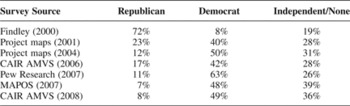
The 1996 presidential election represented the first major attempt at a Muslim bloc vote over issues that Muslim-Americans promoted. These included domestic policy concerns over immigration and civil rights, and foreign policy concerns about Palestine and responses to terrorism (Rose Reference Rose2001). It was the 2000 presidential election although that saw Muslim-Americans voting take on more importance. Various Muslim-American civic organizations began conducting their own research charting Muslim-American support for Democratic Party candidate Al Gore, Republican Party candidate George Bush, and Green Party candidate Ralph Nader.Footnote 3 The surveys indicate that Muslim-Americans closed ranks behind Bush and the Republican Party, despite split ideological leanings, and also evidenced the very high support for third party candidate Nader who is of Lebanese descent. Findley (Reference Findley2001) reports that support for the Republican nominee surged from 28% in June 2000 to 40% in September 2000 to 72% by the time of election. Even more interesting is the remark by Findley that 15% of African-American-Muslims voted for Bush in 2000, double the amount the candidate received from Christian African-Americans.Footnote 4
This across the board support for Bush and the Republicans in 2000 among Muslim-Americans had its roots in several factors. First, the foreign policy issue of Jerusalem as the “undivided and undisputed” capital of Israel weighed heavily on Muslim-Americans in 2000. If any one issue has the ability to unite Muslim-Americans of all backgrounds, is it the plight of the Palestinian people and the status of the Occupied Territories. Thus, the displeasure with former President Clinton's policies toward Israel, strong support for Israeli actions on the part of Democratic Party candidate Gore, and the selection of Joseph Lieberman, an observant Orthodox Jew, as his running mate, put the Muslim-American vote in reach of the Republicans (Findley Reference Findley2001). Second, Muslim-American organizations began to realize the potential effect of bloc voting. A number of associations banded together to create the American-Muslim Political Coordination Committee (AMPCC). This political action committee held talks with all three major candidates, pressing each on Muslim-American issues. In early October 2000, the leaders in AMPCC met with Bush in Detroit where the candidate promised to address Muslim-American concerns with respect to foreign and domestic issues. Later that month, the AMPCC enthusiastically endorsed Bush (Findley Reference Findley2001).
Further, other factors traditionally associated with party identification also explain the support for Bush and Republicans in 2000. Muslim-Americans report higher than average college education rates, household incomes above the median, and a very high rate of small business ownership — all factors associated with Republican partisanship (Nyang and Bukhari Reference Nyang and Bukhari2001; Bukhari and Nyang Reference Bukhari and Nyang2004; Council on American-Islamic Relations 2006, 2008a, 2008b, 2008c).
However, in the post-September 11 era, support for Bush and the Republican Party has dropped dramatically. Table 1 chronicles this decline among several national surveys. This decline is likely attributable to the reactions of the Bush administration to the September 11 terrorist attacks. First, Bush quickly abandoned the foreign policy pledges made to the Muslim-American community during the 2000 campaign (Council on American-Islamic Relations 2006, 2008a). Bush became a strong supporter of Israeli policies towards Palestinians in the Occupied Territories, tying the fight against terrorism with the violence faced by the Israeli public during the second Palestinian Intifada. Further, the management of the war in Iraq was often perceived as an American occupation in the Middle East. Second, many of the changes in domestic policy designed to increase security were perceived as discriminatory toward Americans of Muslim background and Middle Eastern descent. Many Muslim-Americans were questioned, detained, or deported without cause (Feldman Reference Feldman2002; Iftikhar Reference Iftikhar2007). Third, Muslim-Americans bore the brunt of communal anger about the event and many believed that the Bush administration did little to keep the anger from spilling over into violence and outright discrimination, or worse administration officials encouraged such discrimination (Ba-Yunus and Kone Reference Ba-Yunus and Kone2006).
Muslim American Party Identification 2000–2008

Major shifts among social groupings in partisan identification in relatively short periods of time are unusual. If they do occur, it could be the result of some exogenous treatment. For Muslim-Americans, this exogenous shock was the fallout from September 11. Other examples are the abandonment of the Democratic Party by Southern whites in the late 1960s and 1970s over the party's political stance on civil rights for African-Americans and California Latinos who abandoned the Republican Party in the mid-1990s over the party's anti-immigrant stance and support for Proposition 187. Consequently, any empirical insight into the underpinnings of this partisan swing can only add to the understanding of how this process unfolds. In particular, we are interested in estimating the effect of factors such as religiosity and mosque attendance on party affiliation of Muslim-Americans.
RELIGIOSITY, MINORITY GROUPS, AND PARTY IDENTIFICATION
Early studies of religiosity and partisanship focused on cleavages among Jews, Catholics, and Protestants in their vote choice. The seminal work addressing partisan identification, The American Voter (Campbell et al. Reference Campbell, Converse, Miller and Stokes1960) devotes a chapter to the importance of religions and religious identity in an individual's vote choice. These scholars asked, does a high sense of social group identity with one's religious group drive partisan tendencies — and they answered with a resounding “yes.” Jews were consistently found to be more likely to vote Democrat, as a result of high degrees of religious identity. Likewise, Catholics who identify strongly with the church behaved cohesively, regularly voting Democrat, and especially voting Democrat for Catholic candidates in the 1950s. Protestants and Evangelicals tended to vote Republican, especially as their degree of religiosity increased; however in 1976 they voted Democrat when Jimmy Carter, a born-again Southern Baptist, was the Democratic candidate. Denomination alone however may not be the dominant cleavage anymore in religion in politics, and several scholars now argue that degree of orthodoxy and intensity of religious identity are the most relevant variables in understanding political orientations (Welch and Leege Reference Welch and Leege1991; Layman Reference Layman1997; Jelen and Wilcox Reference Jelen and Wilcox1997).
In summary, religious groups in the United States do tend to have distinct patterns of partisanship, and religiosity has consistently been found to be a predictor of vote choice or party identification. However, an important point of contrast is that today, both major political parties in the United States regularly emphasize their support for Protestants, Catholics, and Jews, while they distance themselves from Muslims. In 2006, Republican Congressman Peter King called for increased Federal Bureau of Investigation surveillance of all mosques (Reilly 2007), and during the Reference Reilly2008 presidential election event organizers for Democrat Barack Obama prevented two Muslim women wearing the Hijab from sitting in the televised audience behind the candidate on stage citing concerns over their religion (Council on American-Islamic Relations 2008c) In the United States, religiosity, faith, and church attendance are consistently found to be correlated with political engagement and party identification, in no small part because candidates and parties often focus on mobilizing religious communities, while embracing the various “mainstream” religions.
Within the field of minority politics, scholars have addressed the role of the Black church in African-American political engagement (Harris Reference Harris1999; McDaniel and Ellison Reference McDaniel and Ellison2008; Mattis Reference Mattis2001; Alex-Assensoh 2001), Latino identity as Catholic or evangelical Christian in Latino political incorporation (Jones-Correa and Leal Reference Jones-Correa and Leal2001; Kelly and Kelly Reference Kelly and Kelly2005; Lee and Pachon Reference Lee and Pachon2007), and Asian-American Christian religiosity as a source of social and political assimilation (LienConway, and Wong 2004). For all three minority groups, religion and religiosity is known to be an important variable in party identification. Research on religion and the Black community finds that more religious individuals are more likely to vote Democrat, a result of the Black church's critical role in the civil rights movement. Higher church attendance has also been found to increase Democratic partisanship among Blacks, especially in the South. One contributing factor is social group identity and the concept of linked fate. Harris (Reference Harris1999) notes that Blacks have a high sense of linked fate, in part based on similar experiences within Black churches, which have promoted social group cohesion, group identity, and a sense of empowerment. While many studies tie religious conservativism with Republican identification among Whites, McDaniel and Ellison (Reference McDaniel and Ellison2008) find that religiosity does not operate the same way for Blacks, and that religiously conservative Blacks still side with the Democratic Party. Their findings are particularly important because they highlight the differences between religion and partisanship among Whites and minority groups in America, and suggest that scholars identify fresh perspectives for religion and politics for Blacks and Latinos, and we would argue, for Muslim-Americans. McDaniel and Ellison (Reference McDaniel and Ellison2008) argue, “the histories and cultures of racial/ethnic groups act as a prism, refracting the interpretation of religious texts through differences in group experiences” (183). If such differences exist among minority groups within Christianity, even deeper differences in how religiosity influences partisanship may exist for Muslims as a non-Christian, non-White religious minority group in a Christian society.
While religiosity has been most observable as an important variable in Black political engagement, more recently research on Latinos and Asian-Americans has emerged. Among Latinos, Lee and Pachon (Reference Lee and Pachon2007) examine religiosity and vote choice in the 2004 election and find that religiosity is a very salient variable for Latino evangelicals, who were significantly more likely to vote Republican, while religion had little to no effect for other Latinos who tended to vote Democrat regardless of religiosity. Looking at a pooled sample of National Election Studies (NES) data, Kelly and Kelly (Reference Kelly and Kelly2005) note that Latinos are religiously diverse, and that evangelicals and mainline Protestants are significantly more likely to be Republicans, while Catholics and non-religious Latinos are Democratically oriented. Likewise, Barreto and Pantoja (Reference Barreto and Pantoja2006) find born-again and evangelical Latinos to be significantly more conservative on education issues and more likely to be Republican. On the other hand, the Catholic church has provided fewer political cues and less mobilization for Latinos, and is seen as less of a source of political engagement (Verba, Schlozman, and Brady Reference Verba, Schlozman and Brady1995). However, the strong role of the Catholic Church in the 2006 immigrant rights marches may be changing this notion as the church plays a larger role in Latino political socialization.
Asian-Americans are a diverse group, and their religious practices are equally diverse; however the Pilot National Asian American Political Surey (PNAAPS), a major national survey of Asian-Americans found religiosity to be a relevant political force. Notably, Lien, Conway, and Wong (Reference Lien, Conway and Wong2004) finds that religiosity among Asian-Americans greatly shapes their ethnic identity, in turn influencing their partisanship and political attitudes. One reason religion has been important to Asian-Americans is the role of the church in providing services and also a sense of community. Kim (Reference Kim1996) found that the Korean Church serves four important sociological functions: a social center for immigrants; information on social services in America; leadership opportunities; and strengthens ethnic identification. While none of these functions is overtly political, they provide the basis for many in the community to engage the political system. Data from the PNAAPS suggests that religion does play a role in the political involvement of Asians. Lien, Conway, and Wong (Reference Lien, Conway and Wong2004) finds that Catholic Asians have the highest rates of citizenship, and Christians have the highest rates of voter registration. Beyond engagement, religion was found to influence Asian-American political preferences. Lien, Conway, and Wong (Reference Lien, Conway and Wong2004) note that “among Asians variation in religious preference are strongly related to variations in these mainstream political ideologies and parties.” She finds that Protestants and other Christians are the most likely to align themselves with the Republican Party. Similar analysis by Wong and Iwamura (Reference Wong, Iwamura and Hondagneu-Sotelo2007) also concludes that Asian-American Protestants were significantly more likely than non-Protestant Asians to be Republican, although the result is not as strong as among White Protestants (see also Wong et al. 2007). With respect to Muslim-Americans, no article has investigated the development of partisan identification. While religious institutions themselves can serve as sources of political socialization through sermons, religious beliefs, and degree of religiosity may also be a lens through which an individual evaluates candidates and political parties (Jelen Reference Jelen1991; Wilcox, Jelen, and Leege Reference Wilcox, Jelen, Leege and Kellstadt1993). Yet most of these established findings are based on Christian, Catholic, and Jewish Americans. Given differences in institutional structure, religious belief systems, and most importantly, their social status in American society, it is important to examine Muslim-Americans as a religious and/or ethnic minority group, and ask what role religiosity has in understanding partisan orientations.
THEORY AND HYPOTHESES
A standard view of Downsian voter preferences suggests that given a clear choice between two alternatives for partisan identification in a linear model (Republicans and Democrats), Muslim-Americans, as rational voters, would identify as Democrats, as this party comes closest to representing their current interests (Downs Reference Downs1957). Why then, have not more Muslim-Americans embraced the Democratic Party as their party of choice? Further, many Muslim-Americans regularly chose not to identify with any party, evidencing higher rates of picking “no party” than any other group in America. What then is driving Muslim-American partisanship and conversely, nonpartisanship?
Alternatively, Downsian theory also suggests that Muslim-Americans could choose not to identify with either party if neither Republicans nor Democrats approximated their interests and abstain from voting or registration. Among citizen adults, this does not appear to be the case with Muslim-Americans reporting similar rates of registration and voting as the general public (Kohut et al. Reference Kohut, Lugo, Keeter and Smith2007).
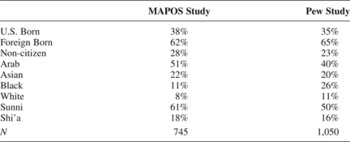
Part of the explanation for any variation in the partisanship or nonpartisanship of Muslim-Americans may come from the heterogeneity of the Muslim-American community itself. Natural cleavages exist along racial/ethnic lines, religious schools of thought, immigrant generation, and socioeconomic status that may preclude a cohesive shift to one party or another. For example, as compared to other immigrant and minority groups, Muslim-Americans have higher household incomes. Likewise, many Muslim-Americans exhibit high levels of college or post-graduate education as a result of their education and professional standing in their home countries. Higher income and education have been associated with identification for the Republican Party, and as the shift away from the Republican Party occurred in 2001, socioeconomic factors became less relevant. This can be contrasted with somewhat lower income and education levels of African-American-Muslims, who historically embraced Sunni Islam in the 1970s after the death of Elijah Mumammad, and the subsequent dismemberment of the Nation of Islam. This subgroup, which has historically been apolitical, may also explain some of the non-partisanship. (Table 2 gives an indication of the diversity that exists within Muslim American today.)
Demographics of 2007 Muslim American Public Opinion Survey (MAPOS)

Given this complex mosaic, we theorize that party identification of Muslim-Americans might be best explained by the political socialization experiences of Muslim-Americans. Whereas Downs suggests that in a two-party system, voters will maximize their utility by picking the party that most closely resembles their ideology, we suggest that past and current socialization experiences may prove more important in understanding partisan identification. This closely follows the work of Campbell et al. (Reference Campbell, Converse, Miller and Stokes1960) who posit that social groupings can exert influence over individual political behavior. The distinctive experiences of the social group lead to the development of a group identity, which can act as a proxy for partisan identification. In addition, group mobilization efforts and the effects of social institutions reinforce group influence over individual behavior (Dawson Reference Dawson1994).
However, we contend that the political socialization experiences for Muslim-Americans is different from the standard understandings of the process. Campbell et al. (Reference Campbell, Converse, Miller and Stokes1960) looked at groups who were fairly cohesive in their histories, backgrounds, and socioeconomic statuses. Thus, the experiences of African-Americans are similar to one another given the shared history of black communities in the United States. Today, similar remarks can also be made for a number of ethnic groups within the larger Latino and Asian communities. Yet, we argue succinctly that this discourse is less applicable to Muslim-Americans as the population is extremely diverse, not only in regard to race/ethnicity, but also in regard to religious sects (Sunni, Shia, Salafi), language (Arabic, Urdu, Farsi), immigrant-sending region (al-Sham, South Asia), and historical circumstances in this country (African-American-Muslims) (Smith Reference Smith1999; Halim Reference Halim2006; ul-Huda Reference ul-Huda2006).
Given this complexity, we do not believe that the political identities of Muslim-Americans should be analyzed only at the macro, or overall cohort, level as is traditionally done with other religious minority groups. Instead, we suggest that the political identities of Muslim-Americans, and for that matter other diverse minority groups in American society, whether religious or not, should be analyzed through different, yet complementary, political socialization experiences similar to Latinos and Asian-Americans. For example, Muslim-Americans as a national minority can have similar socialization experience because the individual lives as a Muslim in American society. Shared experiences of discrimination in the post-September 11 era are a common theme. Miller et al. (Reference Miller, Gurin, Gurin and Malanchuk1981) discuss at length how a group consciousness can develop when political awareness about a group's relative position in society. Likewise, group consciousness has been a strong predictor of increased political participation for other minority group such as Asian-Americans and Latinos (Masuoka Reference Masuoka2006; Sanchez Reference Sanchez2008).
However, a Muslim-American can have a different socialization experience depending on the region they immigrated from, just as scholars have found region to be key with other immigrant groups (Bueker Reference Bueker2005). Thus, those Muslim-Americans who immigrated from Bilad al-Sham (Greater Syria or Levant) region of the Middle East and their descendants differ in their socialization from African-American-Muslims who followed Imam Warithuddin Muhhamad into Sunni Islam (Jackson Reference Jackson2005). Yet these two political socialization experiences do not have to be mutually exclusive. The fluid nature of Muslim identity demands that the social scientist also be flexible in looking at the role of these experiences when attempting to understand political identifications.
The multiple identity levels of Muslim-American give us flexibility about the indicators that drive political identifications. The first indicators we look at are at the macro-level. The notion that an identifiable Muslim distinctiveness exists among the diverse group is a much-discussed topic. Most scholars on Muslim-Americans support the view that a transcendent identity has developed (Nyang Reference Nyang and Haddad1993; Haddad Reference Haddad and Esposito1998; Peek Reference Peek2005). This should not be too surprising although, Islam itself advocates that tribe, and by modern extension, ethnicity and nationalism, should be replaced by one Islamic identity. This strong wording is picked up on by Muslim scholars and preachers and resonates within Muslim-American communities (Khan Reference Khan and Esposito1998). In addition, this phenomenon is also reflected in a number of surveys that show that a good number of Muslim-Americans simply refuse to differentiate among themselves and prefer to just call themselves Muslim (in our 2007 MAPOS data, 21% did not pick a religious tradition within Islam such as Sunni or Shi'a) (Nyang and Bukhari Reference Nyang and Bukhari2001; Bukhari and Nyang Reference Bukhari and Nyang2004; Kohut et al. Reference Kohut, Lugo, Keeter and Smith2007; Barreto et al. Reference Barreto, Bozonelos, Dana, Masuoka and Ozyurt2007). Aspects of this national Muslim-American identity can be tested by looking at the degree of linked fate amongst Muslim-Americans and also through the feelings of discrimination. And in fact, recent work on the notion of a linked-fate within the Muslim-American community using survey work is underway (Barreto, Masuoka, and Sanchez Reference Barreto, Masuoka and Sanchez2008).
Adding to the development of a group consciousness among Muslim-Americans is the high level of discrimination and prejudice today that is currently unmatched. Haddad (Reference Haddad and Esposito1998) argues that a series of events, including the 1979 Iranian Revolution, the spectacular terrorist attacks of the 1980s, and the 1993 World Trade Center bombing, made Islam a target in the eyes of mainstream America. This discrimination surged exponentially in the post-September 11 era, and many argue has become institutionalized, where certain policies that have led to human rights violations, are viewed as inherently anti-Muslim. Throughout all post September 11 surveys, Muslim-Americans report high levels of discrimination, with the 2007 Council on American-Islamic Relations (CAIR) Civil Rights Report documenting a 9.2% increase in anti-Muslim hate crimes and a 25.1% increase in total number of civil rights complaints from the year before (Iftikhar Reference Iftikhar2007).
Underpinning the linked-fate mechanism and increase in-group consciousness is not only a shared recent history of discrimination, but also the commonality of Islam itself. Islam predicates itself on the oneness of God (tahwid) and intensity of how tahwid permeates all aspects of the religion is evident for all Muslims. The Qu'ran, centers on tahwid, the Hadiths confirm it and most writings on Islam all outreach and missionary activity, or dawa, incorporate it. Thus, despite the major differences that may exist among certain sects in Islam in regards to succession (Sunni/Shia), prayer rituals (Sufi), schools of thought, or madhabs (Hanafi/Hanbali/Maliki, etc), and a host of legal interpretations, including authenticity of hadiths, or varying isnah, fiqhs, qiyas, ijmas & ijtihads, there is a uniqueness to Islam that provides a common basis for membership (Smith Reference Smith1999; Ramadan Reference Ramadan2004). Also, given what we know about the role of religion as a mobilizing factor, Muslim-Americans are more likely to have their political behavior impacted by religious factors. And in fact, survey work by CAIR shows that those Muslim-Americans who follow Islam closely, or attend the mosque regularly, are more likely to participate in society, both in Muslim and non-Muslim activities (Council on American-Islamic Relations 2006, 2008a).
The second set of indicators is at the group level. There is strong evidence to support the idea that race/ethnicity and region of origin should matter and that they result in different but complementary socialization experiences. First, Jamal (Reference Jamal2005) points to the importance of breaking down the Muslim population into the three major groupings: Arab Americans, African-Americans, and South Asian-Americans. She shows how mosque attendance affects each group differently. In addition, the 2000 CAIR Masjid Project, headed by Dr. Ihsan Babgy, separates out by ethnicity or race if a mosque is homogenous or not. The study finds that 28% of all United States mosques are South Asian-dominant, 27% African-American-dominant, and 15% Arab-American-dominant. The remainder mosques are 16% mixed evenly between South Asian and Arab-American and 14% have no dominant group (Babgy and Froehle 2001). While Bagby and CAIR are simply reporting descriptive statistics and make no inferences from these reporting, the fact that they were able to succinctly separate most mosques into three distinct ethnic/racial groupings gives an indication that belonging to a specific race and/or ethnicity could have some impact on the socialization of Muslim-Americans and their partisan identifications.
The third set of indicators is at the individual level and parallels the literature in regards to their effect on partisan identifications. These include traditional indicators such as age, education, income, gender. Finally, immigrants bring with them a different set of circumstances that may also affect their participation (Cain, Kiewet, and Uhlaner Reference Cain, Kiewet and Uhlaner1991; Black, Niemi, and Powell Reference Black, Niemi and Powell1987). Ramakrishnan and Espenshade (Reference Ramakrishnan and Espenshade2001) find that while first generation immigrants vote less than later generations, this pattern is uneven. They note that some racial and ethnic groups vote less than others, but that this unevenness smoothes out with age as the likelihood of voting increases the longer one lives in the United States. Also, Ramakrishnan (Reference Ramakrishnan2005) notes that acquiring of citizenship, which hovers around nine to 10 years, might account for most of this leveling out. In addition, Ramakrishnan (Reference Ramakrishnan2005) cites differences in generational voting patterns. Given the diversity of the Muslim-American population, it makes sense to look at different levels of immigrant status: first-generation non-citizen, first-generation naturalized citizen, second generation, and third generation, as studies of Asians and Latinos have emphasized this as a key explanatory variable in understanding partisanship (Cain, Kiewet, and Uhlaner Reference Cain, Kiewet and Uhlaner1991).
DATA AND METHODOLOGY
To assess party identification among Muslim-Americans, we implemented a unique public opinion survey in 2007. Scholars familiar with the study of Muslim-Americans as well as racial and ethnic politics know well that very little empirical data exist regarding Muslims in America. Among the few Zogby polls that do exist, none contain the precise questions we are interested in analyzing, and other surveys fielded by the CAIR are not publicly available. Thus, we fielded an original survey of Muslim-Americans across six cities: Seattle, Washington; Dearborn, Mississippi; San Diego, California; Irvine, California; Riverside, California; and Raleigh-Durham, North Carolina. These cities are ideal for a number of reasons. First, the Dearborn area is the single largest concentration of Arab and Muslims in America, and represents a predominantly Arab population that has been established for at least 40 years. Southern California has the third largest number of Muslim-Americans (behind Dearborn and New York), and a population that is mixed across generational lines, including a significant United States born and African-American-Muslim population. Seattle too has a considerable Muslim population (the 10th largest in the United States), and its population is quite diverse with large communities from South Asia, the Horn of Africa, and the Middle East. Finally, the Research Triangle Park community in North Carolina includes a predominantly Pakistani-Muslim and Indian-Muslim immigrant population, adding to the overall diversity of our sample. In addition, a sizeable (United States born) African-American-Muslim population is represented in our study.
The survey was administered in an “exit-poll-style” whereby research assistantsFootnote 5 handed out clipboards to participants who completed the survey on their own. Participants were selected using a traditional skip pattern to randomize recruitment and could choose to answer the survey in English or in Arabic. Naturally, drawing a sample of Muslims in the United States is not easy or efficient given their relatively small population. To address this concern, the survey was implemented at randomly selected mosques and Islamic centers across the six locales. In total, respondents were interviewed at 16 different locations in the six cities. In addition, we gathered a large number of interviews outside the prayer services during Eid al Adha and Eid al Fitr.Footnote 6 In total, 745 surveys were completed across the six locations, and the demographics of our sample closely match those reported in a recent Pew survey of Muslim-AmericansFootnote 7 (see Table 2).
Given that our sample is drawn from religious centers and places of worship, the reader may question if there is any bias, given that some Muslim-Americans may never go to the mosque or attend Eid prayers. However, we are confident in our sample selection for two specific reasons. First, the main reason for concern would be that we exclude the “non-mosqued” population as well as the less religious population. Descriptive statistics of the survey data suggest this is not the case. Among our full sample, 34% state they are involved in activities at their mosque, 39% are not too involved, and 26% are not at all involved. Further, while exactly 50% of our sample say they follow the Qu'ran and Hadith very much in their daily life, 38% follow only somewhat, and 12% only a little. This ratio is quite consistent with the Pew survey of Muslim-Americans, which was a random telephone survey. In particular, the respondents that we selected at the two Eid prayers are expectedly quite diverse on the religious spectrum. Just as the Catholic Church goes from half-full to standing room only on Christmas and Easter Mass, the Islamic Eid prayers attract religious and secular Muslims, to the part-religious, part-cultural, part-family prayer service, including those who otherwise never go to Friday prayers (Ba-Yunus and Kone Reference Ba-Yunus and Kone2006).
Second, given our research question, we are far less interested in the most assimilated or least religious in the Muslim population. Rather, we are particularly interested in the more religious population to assess whether or not religiosity influences party identification among Muslim-Americans. Thus, if we err in our sample (which we don't believe to be the case), it is better to err toward the Muslim population that continues to actively practice their religion, as opposed to a sample that is predominantly secularized and assimilated. Overall, we are quite confident that our sample provides the appropriate mix of religiously oriented Muslims, and at the same time providing a spectrum of religiosity that ranges from very low to very high.
Variable Construction
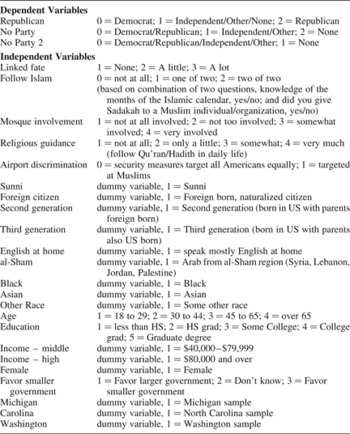
While party identification among most populations includes the simple Democratic/Independent/Republican categories, this is not the case among American-Muslims. As we state above, approximately one in four Muslims reports party identification to be none. To this end, we explore two different dependent variables related to party identification. First, we examined which party respondents identify with, and second, whether or not they identify with an American political party at all. The specific question respondents were asked was “which political party are you most closely affiliated with?” and answer options were: Democratic/Republican/Independent/Other/None. The first dependent variable is a trichotomous measure of party identification where Democrat = 0, Independent/Other/None = 1, and Republican = 2. In these models, positive values are associated with being Republican and negative values with being Democrat. The second dependent variable distinguishes between party identifiers and those who picked “none” as their party identification. We employ two different versions of this variable to capture the differences in partisanship. First, a trichotomous variable where Democrat or Republican = 0, Independent/Other = 1, and None = 2. This version allows us to distinguish among those who identify with a major party, independent or other party, and no party at all. Second, we create a dummy variable for respondents who selected “none” on party identification, whereby Democrat, Republican, Independent, or Other are all coded as zero. For the trichotomous variables, it is not clear that the Independent/Other grouping belongs ordered in the middle, so we use two different estimation techniques, multinomial and ordered logit regression. For the dichotomous/dummy variable, standard logit regression is used. In all cases, we report unstandardized coefficients, standard errors, and finally changes in predicted probability.
Independent Variables
We rely on traditional measures associated with partisanship and also unique variables for the Muslim-American community. Traditional predictors include age, education, income, gender, and preference for small/large government, church attendance, and degree of religiosity. Borrowing from literature on immigrant political incorporation, we include four levels of immigrant status: first-generation non-citizen, first-generation naturalized citizen, second generation, and third generation. We also control for whether or not English or some other language is the primary language spoken at home. Finally, we include several independent variables that are relevant to the Muslim-American population. In controlling for race, we include variables for al-Sham Arabs,Footnote 8 Black, Asian and Other race, and leave non-al-Sham Arab as the unexpressed category. For denomination or sect, we control for Sunni versus all other Muslims. Borrowing from the literature on African-American partisanship, we include a measure for linked fate (using Dawson's question) and also perceived discrimination (whether or not airport measures unfairly target Muslims). Finally, we include state dummy variables as simple controls. Detailed instructions on how our dependent and independent variables are coded can be found in Table 3.
Construction of Variables in Analysis

FINDINGS
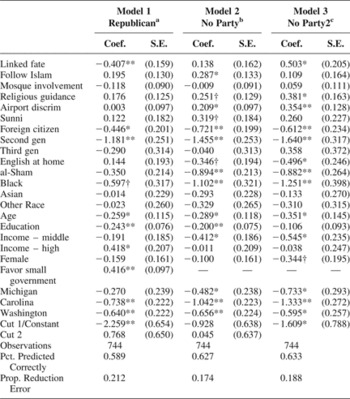
Our results suggest that ethnic and religious identity greatly shape party identification among American-Muslims. In our first model predicting which party respondents identify with, we find Muslims with a high degree of linked fate are significantly less likely to identify as Republicans, consistent with Dawson's (1994) research on African-Americans. Given that a plurality of Muslims identify as Democrats, it is reasonable that Muslims who more closely see their fate linked to the larger group also identify as Democrats. Further, given the current rhetoric surrounding the War on Terror, including calls by leading Republican officials that there is something “substantially Islamic about the form of terrorism that we're confronting today”, or that prison terms should be given for “adherence to the Shari'a” (Wolfowitz 2002; Yerushalmi Reference Yerushalmi2008), Muslims with linked fate are rationally moving away from the Republican Party in a classic Downsian sense. Looking to the changes in predicted probability, linked fate has a substantive impact on partisanship — moving from the lowest degree of linked fate to the highest, Muslims become 25% less likely to identify Republican. However, linked fate is the only Islam-based variable that moves respondents from Republican-to-Democrat. Perceptions of discrimination against Muslims, following Islam, Mosque involvement, and religious guidance all report no statistically significant effect on partisanship in Model 1. In contrast, a plethora of findings cited above suggest that similar variables such as church attendance or religiosity have a significant and consistent impact on the Democratic versus Republican partisanship of Whites, Blacks, Latinos, and Asians. However for Muslim-Americans, religiosity variables do not cause movement left or right on the partisan spectrum. We discuss these variables in more detail with respect to Models 2–3 below.
Besides linked fate, many other variables do influence Muslim partisanship. Foreign-born citizens and second generation Muslim-Americans are significantly more likely to be Democrats, a finding consistent with research on Latinos and Asian-Americans. Similarly, Blacks are statistically more likely to be Democrats. Interestingly, older and more educated respondents were found to be less Republican; however, higher income respondents were more Republican.
Among the non-Muslim public, age, education, and income are all correlated with moving closer to the Republican Party; however, among Muslims we find the opposite effects for age and education. Younger, United States born Muslims are likely to be more culturally assimilated than older Muslims, who are also more likely to be immigrants. Even controlling for immigrant status, age has a negative relationship that is quite interesting. Another factor could be the composition of the Muslim-American electorate. Since most Muslim-Americans are immigrants, older Muslim-Americans come from what Babgy (Reference Bagby, Bukhari, Sulayman, Ahmad and Esposito2004) terms Historically Sunni-African-American Mosques, which fall under the leadership of Warithuddin Muhammad. And traditionally, these older African-American-Muslims are partisan Democrat or at least Democrat leaning. With respect to education, higher levels of education correlate with political knowledge, and the consumption of political news. We expect more politically aware, higher educated Muslims to be opposed to the Republican Party, which is credited with pushing policies contrary to Muslim interests (the Federal Bureau of Investigation surveillance of mosques and Islamic centers, warrantless wiretaps of Arab and Muslim organizations, and the detention of thousands of Middle Eastern and Muslim individuals during routine travel). Higher income leads to higher levels of Republican identification, a finding, consistent with the general research on class and partisanship.
Finally, we include a variable for general outlook on the size of government. Respondents who favor a smaller federal government were significantly more likely to be Republican. So while many religiosity variables do not predict partisanship of Muslims as they do for the general public, attitudes toward government size are related to partisan identification, and in the manner we would predict. Those favoring larger government lean Democrat, while those favoring smaller government lean Republican.
NONE OF THE ABOVE
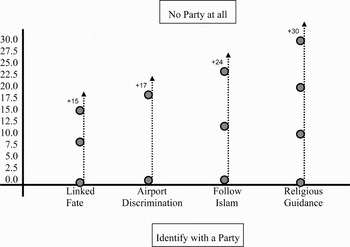
In addition to focusing on the classic left-right partisan dimension, we also explore the relatively high rates of choosing “none” as party identification. As stated above, approximately one-quarter of the sample selected none when asked which party they most closely identify with. While non-Muslims may select Independent or Other when faced with the same question, it is interesting that so many Muslim-Americans felt that none of the parties closely represent their interests. Looking to the ordered logit and logit regression results for Models 2–3 (Table 4) we find that several of the religious-based questions are statistically significant in predicting “no party” identification. Although we found a high degree of linked fate moved respondents away from the Republican party, it also moved respondents away from both major parties and toward picking the none category. In the dichotomous model, Muslims with a high degree of linked fate are 15% more likely to identify with no political party at all. At the same time, Muslims who most closely follow Islam (measured by the practice of Sadakah and knowledge of the Islamic calendar) are 24% more likely to identify as none as reported in Model 2. Religious guidance, which is statistically significant in both models 2 and 3, has the largest substantive impact. Muslims who follow the Qu'ran and Hadith very much in their daily life are over 30% more likely to select no political party as their partisan identification (see Fig. 1 for changes in predicted probability). Finally, perceptions of discrimination cause Muslims to move away from both political parties and list none when confronted with their partisanship. The only variable in this group that was not significant was mosque involvement, suggesting there was no difference at all in partisanship based on how frequently one attends, or is involved with their mosque. Instead, the individual-based measures were more salient such as degree of faith, degree of practice, perceptions of discrimination and linked fate.
Logistical Regression results predicting Muslim American Party Identification

** p < 0.010; * p < 0.050; † p < 0.100.
a Dependent variable is three-point partisanship, 0 = Democrat; 1 = Independent/Other/None; 2 = Republican.
b Dependent variable is three-point non-partisan scale; 0 = Democrat/Republican; 1 = Independent/Oth; 2 = None.
cDependent variable is dichotomous non-partisan measure; 0 = Democrat/Republican/Independent/Other; 1 = None distribution of dependent variable: Republican = 7%; Democrat = 48%; Independent/Other = 18%; None = 27%.
Similar to the findings for Democratic partisanship in Model 1, immigrant generation is also a statistically significant predictor of party identification versus no party identification. Foreign-born naturalized citizens and second generation Muslims are significantly more likely to identify with a political party (Democrats, as evidenced in Model 1), than are foreign-born non-citizens. Interestingly, third generation Muslims are indistinguishable from non-citizens on the spectrum of partisanship, and for both groups we note a considerable increase in the tendency to state “none” as their party affiliation. Another indicator of immigrant acculturation is the impact of language. Muslims who speak mostly English at home are about 15% less likely to state “none” as their party preference compared to non-English dominant Muslims, perhaps because quite literally, neither of the major parties is speaking to this population.
With regard to race, consistent findings emerge in Models 2–3 as in Model 1. Compared to none-al-Sham Arabs, the results show that al-Sham region Arabs and Black Muslims are significantly less likely to identify with no party. Because of their longer history in the United States and larger community size, both al-Sham Arabs and Blacks are more likely to be familiar with United States political parties, and especially more supportive of the Democratic party. Arabs from outside of Greater Syria, as well as South Asians and Muslims of other racial groups are all considerably more likely to affiliate with no political party at all. Younger and less educated Muslims are statistically more likely to select “none,” consistent with research suggesting such groups are less politically aware. Income shows little effect with middle-income respondents more likely to side with a political party; however, low-income (the unexpressed category) and high-income groups are indistinguishable, making a “pattern” hard to find. Finally, there is some evidence that men, not women, are more likely to choose no party affiliation. In model 3, the results suggest that men are about 6% more likely than women to state none when asked for their party affiliation. This may be somewhat surprising given that Islam is thought to discourage the role of women in society and politics (Ahmed Reference Ahmed1992). However, other recent empirical work has found that Muslim women are not necessarily less likely to participate in United States politics. Jamal (Reference Jamal2005) finds no statistical relationship between gender and political participation in her sample of Muslims in New York, and when she examines only Arab Muslims, she finds a positive and significant relationship suggesting Arab women are more likely to participate than men. Our dependent variable of party identification is not the same as political participation, but it is an important part of the political process, identifying with a political party, and the data suggest that Muslim women are more likely to identify with a political party than are Muslim men.
DISCUSSION
This research has taken an age-old question in political science, partisan identification, and applied it to a new subgroup in American politics: Muslim-Americans. Despite considerable growth in the Muslim-American population, almost no research in political science has looked at a systematic understanding of Muslim-American partisanship. In particular, affiliation with a political party is an important mechanism of participation and representation in the United States. However, the bulk of the research builds on the Downsian thesis that voter preferences are distributed somewhere between two competing parties on a single dimension and further, that parties or candidates compete to attract votes. Instead, Muslim-Americans have increasingly been placed at odds with both political parties in the United States. Over one-quarter of Muslim-Americans state “none” when asked with which political party they most closely identify, in part as a reaction to perceived discrimination in the United States. Especially since 2001, both political parties have toughened their rhetoric on Islamic communities in the United States and abroad, most notably, former chairman of the Homeland Security committee in the United States Congress, Peter King, who called for increased surveillance of American mosques (Reilly 2007).
For Muslims in the United States with a strong sense of linked fate, with a high degree of religious guidance, and who closely follow Islam, it is not clear which political party is closest on the Downsian spectrum. To the contrary, our findings suggest that many Muslims do not identify with any political party. Will this change? The evidence so far is mixed. In the 2004 presidential election, a solid majority of Muslim-Americans voted for John Kerry and the Democratic Party (Bukhari and Nyang Reference Bukhari and Nyang2004). But voting for Kerry did not translate into immediate gains for the Democratic Party. Part of this may be explained by Kerry's reluctance to embrace the civil rights concerns of Muslim-Americans (Magagnini Reference Magagnini2004; Associated Press 2004).
Finally, a recent poll by CAIR shows that 89% of Muslim-Americans voted for Obama, percentages higher than Latinos and Asian-Americans (Council on American-Islamic Relations 2008b). This occurred despite actions by the Obama campaign to distance him from overt Muslim-American support as questions over questions on his religious upbringing dogged his campaign.Footnote 9 This included the resignation of the campaign's Muslim outreach coordinator and the removal of two Muslim women wearing headscarves behind a podium to be occupied by Obama at a campaign rally (Council on American-Islamic Relations 2008c; Bacon Reference Bacon2008). In contrast, just 2% of Muslim-Americans voted for McCain. This low level of support among Muslims may be traced at least in part to efforts by pro-McCain organizations, such as the Clarion Fund, to use fear about Islamic extremism to drum up support for their candidate. The Clarion Fund distributed 28 million videos titled “Obsession: Radical Islam's War Against the West” and were widely condemned for making false claims about Muslims (Kindy Reference Kindy2008). Will this tilt Muslim-Americans toward the Democratic Party? Some think so, but much will depend on action taken by a new Obama administration (al-Marayati and Jacobs Reference al-Marayati and Jacobs2008; Ali Reference Ali2008).Footnote 10
Changes in predicted probability of not identifying with a political party.