


Created in the province of Perugia in 1462 by Franciscan monks, the Mont-de-Piété (MDP) had spread to every merchant city in northern Italy by the end of the fifteenth century. Then, in the early seventeenth century, it got a foothold in the United Provinces of the Netherlands and Flanders, driven by the development of modernised urban economies. There is a certain institutional consistency to be seen in this historic geography, underlining the importance of in-depth economic and social change in these two regions. The emergence of MDPs was the upshot of major social and economic contradictions at the end of the Middle Ages, when northern Italy and the United Provinces were undergoing an economic upturn with the emergence of capitalism. This process was associated with a loss of institutional protection for wage-earning workers. The philosophy of the creators of MDPs was based on the idea that the most effective solution to fight poverty was credit. This Franciscan invention should be analysed as a true social innovation. Charity was condemned because it was considered ineffectual; popular credit could provide an alternative (Fontaine Reference Fontaine1997, Reference Fontaine2008, Reference Fontaine2012). The prosperity and the development of MDPs can thus be explained by a number of phenomena: the poverty of the workforce linked to the insecurity of jobs and instability of income; a need for social protection; the growth in the use of money in all areas of social life; and the development of new approaches to social assistance driven by philanthropists, who considered that an individualised economic response was crucial.
The academic literature has examined the emergence, success and decline of MDPs and other private pawnbrokers in Europe and the remainder of the western world: Danieri (Reference Danieri1991) on the Paris MDP; Caskey (Reference Caskey1994) based on the pawnshops in the United States, including an historical perspective; Minkes (Reference Minkes1953) who looked into the reasons for the decline of pawnbroking in Great Britain. In these contributions the decline of pawnbroking appears as a consequence of social policy development and the expansion of the banking system. Caskey and Minkes describe similarities with the French case; pawnbroking appears as a response to usury, poverty and also financial integration. The French situation has been analysed in the works of various economists such as Marec (Reference Marec1983), Borderie (Reference Borderie1999), Faber (Reference Faber2003) and Pastureau (Reference Pastureau2013).
Two very recent papers have looked more closely at the institutional issue of the MDP in Europe. In an article devoted to the Irish MDP, Mclaughin (Reference Mclaughlin2013) explains why the establishment of such an institution did not succeed in Ireland. Irish promoters set out to transpose the continental MDP model, but mere imitation was not possible in view of the very many institutional differences. It is not that the Irish economy was less developed, rather that the existence of real competition with private loan shops would have prevented the Irish MDP from generating the economies of scale needed to guarantee profitability. At the same time, the French MDP had the benefit of an advantageous institutional environment, thanks most notably to the monopoly status granted to pawnbroking back in 1804. In another recent article, Carbonell-Esteller (Reference Carbonell-Esteller2012) investigates micro-finance institutions in Barcelona in the nineteenth century as institutions on the periphery of the financial system. Carbonell-Esteller stresses that the coexistence of several establishments appears to be highly complementary, including: the Montepio Barcelones, Caja de Ahorros de Barcelona and the Monte de Piedad. She shows that these saving and lending institutions not only reduced social costs related to industrialisation but also protected small producers in times of crisis. However, the customers using these establishments were different. These institutions strengthened social links and the city's economic development. The Barcelona MDP distributed a large volume of small loans, which gave the working poor access to credit.
In France, the MDP really came into its own at the beginning of the nineteenth century, in response to the deregulation of the labour market, which was no longer held in check by labour group corporations. Wage-earners gradually lost the institutions that offered protection, a section of the labour force was faced with a situation of insecurity and instability in terms of wages and income, and as a result the MDP helped to supplement their earnings. Thereafter, micro-credit gradually assumed a social function, introducing a specific use of money as a tool for protecting society from usurers. At the same time, it was also instrumental in the generalisation of monetary practices by way of pawnbroking.
As in Barcelona, the Bordeaux MDP contributed to social cohesion and was able to adapt to social and economic dynamics and changes in the social environment. By contrast, the Irish MDP was not successful. The Bordeaux MDP was protected by the loan monopoly and brought liquid funds not only for poor people but also for street artisans and traders. It was the only financial institution dedicated to a population excluded from financing networks. From the studies of Mclaughin (Reference Mclaughlin2013) and Carbonell-Esteller (Reference Carbonell-Esteller2012), it would be valuable to extend the analysis by studying the causes of the Bordeaux MDP's successful operation and development. The Bordeaux case is actually a good example of adaptation and institutional achievement and may serve as a complement to previous studies, delivering more empirical data regarding the place of micro-finance in social cohesion and economic development, and also the conditions under which the establishment could and did exist. The Bordeaux MDP was created in 1801 and has been through four different phases: development and heyday in the nineteenth century from 1801 to 1890; a slow and steady decline in activity at the beginning of the twentieth century; a major decline between 1945 and the 1980s; and finally a revival in the last twenty years. Our article is based on a specific and original research question: what can explain the success of the Bordeaux MDP in the nineteenth century in relation to other European experiences? With this in mind, the analysis focuses on the social demand for micro-credit from workers subject to monetary poverty. Moreover, protected by its monopoly status, pawnbroking was a tool for social assistance which assumed the form of financial support.
This article is organised as follows. In the first section, we present the development of MDPs, then more specifically the MDP in Bordeaux, the philosophy of its promoters and its environment. Section II is devoted to the study of the concrete reasons behind the success of the Bordeaux MDP in the nineteenth century, highlighting the idea of the existence of a social need. The third section is focused on the idea that the pawnshop promoted a charitable economy which was in contradiction with the social policies of the city of Bordeaux and explains why there could be a rapprochement with the Caisse d'Epargne.
I
In the eighteenth century, the city of Bordeaux was undergoing an economic boom, enjoying wealth generated by port operations and trading. Maritime trade furthered the city's economic growth and enrichment and the Port de la Lune was a vital crossroads in the trade routes headed for the Americas and the Caribbean. It turned Bordeaux into a major hub for international trading. The city's prosperity brought demographic growth; the population doubled during the eighteenth century to reach 110,000 inhabitants by 1789, making it the kingdom's third largest city. The eighteenth century was the golden age of Bordeaux, begun in 1705 with the creation of the Guyenne Chamber of Commerce, which boosted the city's economic and commercial development (Butel and Poussou Reference Butel and Poussou2007). It was all made possible by the emergence of local industry oriented towards trade, the chamber of commerce and the city's elite. The latter protected their business interests and promoted the development of productive industrial activities by opposing the limitations induced by the system of corporations, doing so in the name of entrepreneurial freedom and the general interest. The privileges granted to certain corporations were circumvented in order to increase the port's competitiveness (Passet Reference Passet1954).
The city's economic boom did not benefit the poorest sectors of the population, who lived off the port's activities. Social insecurity typified the poverty of the working classes, who had to cope with a number of hardships: workplace accidents, sickness and/or severe shortages (Roussy Reference Roussy2005). Despite the city's general prosperity, poverty and begging were widespread.Footnote 1 The working classes lived from hand to mouth and were unable to build up the reserves needed to cope with the hazards of life. An effective public policy to combat shortages caused by the rise in the price of bread was introduced by parliament and the city council by imposing a maximum price for bread, which partly offset the price hike, and by strengthening efforts to improve food supplies. But assistance was expected to come from the religious orders. In the society of the pre-revolution Ancien Régime, social aid came down to assistance or charity work and guilds had a significant place in society. This was no longer the case from 1791 onwards, when corporations and other workers' assemblies were banned. At the same time, there was no economic treatment of social issues, in contrast to the MDP. In the eighteenth century, Bordeaux underwent the radical changes that affected all of French society and the city grew under the impetus of capitalism, but not without social consequences (for social history in France, see Donzelot Reference Donzelot1984, Braudel and Labrousse Reference Braudel and Labrousse1993, Castel Reference Castel1995).
It was from this viewpoint that the necessity for an MDP became clear. The city was prosperous with a high concentration of capital, but working-class pauperism was intensified by the loss of former rights and solidarities and the levelling out of demand for labour. The local elites, under the guise of efficiency, gave the official seal to social aid outside the traditions of the church (Delbrel Reference Delbrel2006; Roussy Reference Roussy2005). The MDP, on account of its specific nature and objectives, could be a complement to local social action and a logical development from the ideology in force in the early nineteenth century. The MDP became a form of private social aid offering the most vulnerable populations the means to temporarily escape from a process of pauperisation and exclusion.Footnote 2
The advantage of the MDP was that it fought poverty without criminalising it, and by imposing a cost on aid every customer was forced to work. Danieri (Reference Danieri1991) mentions exactly the same motivations in Paris. The opening of the MDP in Bordeaux, as elsewhere in France, subscribed to a rationale of social aid. From the outset, the philosophy and motivations of promoters were centred on this logic of financial and social welfare oriented towards poor and unprotected wage-earners. We do not come across the idea of a real consumer loan.Footnote 3 It should be noted, as indicated by Hautcoeur (Reference Hautcoeur2011), that credit in France was primarily in the hands of major institutions and banks, and was oriented towards the financing of productive activity. Credit for the people, promoted by the MDP, was primarily a response to poverty and the uncertainty of income.
The real beginnings of the MDP in Bordeaux can be dated back to 16 March 1801, when the prefect, Dubois, asked the Administrative Commission of the Hospices to look into the creation of a collateral lending institution, thus building on a project put forward by M. Bonnaix, himself the owner of a private pawnbroking house. However, the commission refused to adopt the project and went on to turn down two further projects that were supported by a great number of citizens of Bordeaux. Further to these new rejections, the commission, under pressure from the prefect, adopted provisional regulations for the creation of such an establishment in Bordeaux. The city did indeed have to comply with the ministerial memorandum of 27 June 1801 (8th of Messidor, year IX in the Republican calendar), which set up MDPs in major French cities. It took a lot of strong political will, driven by the state, for MDPs to emerge in France, and the governmental protection of MDPs introduced in 1806 was a decisive step in their development. Prior to 1806, the first MDP in France was established in 1777 in Paris, but the French government refused the generalisation of this kind of institution, fearing the development of public usury (Danieri Reference Danieri1991; Faber Reference Faber2003; Pastureau Reference Pastureau2013). The French government demanded the creation of an MDP in each big industrial city at the beginning of the nineteenth century in response to usury and poverty. There are not many differences between the MDPs in France because each MDP had the same administrative organisationFootnote 4 and had to share profits with the Hospices. In Paris and Bordeaux, pauperism was at quite a high level due to industrialisation and therefore the MDP was considered as a good solution when no other local social aid existed (for more details on Paris see Danieri Reference Danieri1991 and Pastureau Reference Pastureau2013 for a global history).
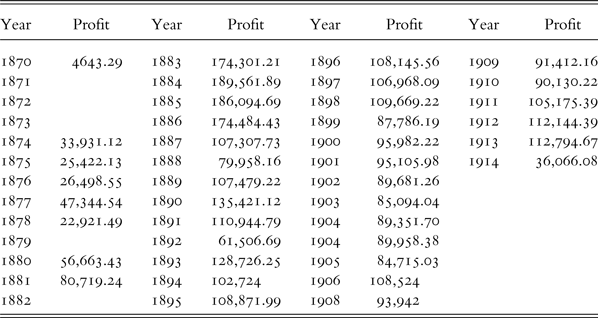
On 1 September 1801, the prefect signed an order incorporating the MDP of Bordeaux. The decree was motivated by three factors: the economic crisis affecting the port of Bordeaux; the development of private pawnbroking establishments; and the idea of delivering an economic response to poverty, ‘considering that it was in the greatest interest to provide the less well-off and the unfortunate with resources that are not illusory’ (from the archives of the Crédit Municipal of Bordeaux-ACM).Footnote 5 The Bordeaux MDP was a stock company whose capital was split between 12 shareholders. It was only in 1818 that all the shares were finally reimbursed and that the MDP adopted a specific half-public half-private structure. In 1851, it was taken over by the municipality and the city mayor became chairman of the establishment, as in all French MDPs. The city of Bordeaux refused to take any financial risk with the MDP, which had to be self-sufficient and profitable. Throughout its history, the municipality never once helped to refinance it. Yet, every year, without exception, the Bordeaux MDP showed a profitFootnote 6 (Table 1).
Profits of the Bordeaux MDP between 1870 and 1914 (FF)

Source: Archives of the Crédit municipal of Bordeaux.
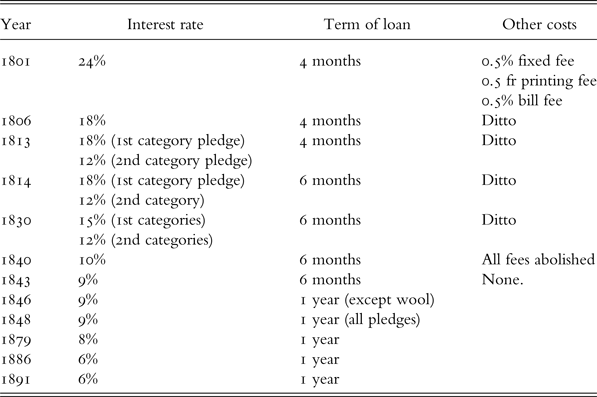
Up until 1847, profits were shared with the city's Hospices. More than its monopoly status, it was the unrestricted use of these profits that enabled the establishment to lower interest rates and to finance its activity. Many property investments were made to meet the high demand. Throughout the nineteenth century, the Bordeaux MDP worked to lower interest rates and bring them down to the legal rate. When the Bordeaux MDP was opened, there was a single fixed interest rate set at 24 per cent over four months, which came down to 18 per cent in 1806. As with the Irish MDP, several rates were proposed depending on the value of the goods, but this specific aspect only lasted from 1813 to 1840. Two rates were applied, 18 per cent for the first category collateral (gold, silver) and 12 per cent for the second category. The single fixed rate then fell from 10 per cent in 1840 to 6 per cent in 1891. The term of the loan also changed, from six months in 1814 to one year from 1846 onwards (Table 2). The first years of the Bordeaux MDP were sometimes fraught with complications, even though in 1803 dividends were paid to shareholders. The administrators were very quickly forced to lower the amount of the minimum loan, which was far too high for the burgeoning clientele. With daily wage rates of between FF 1.5 (£0.06) and FF 2.5 (£0.1), many workers were unable to bring goods of sufficient value and after a few months the minimum loan fell from FF 10 (£0.4) to FF 4 (£0.16). This minimum was gradually lowered further to FF 2 (£0.08); in Paris, this minimum was FF 3 between 1800 and 1853 (Danieri Reference Danieri1991). Administrators were then faced with a real dilemma inasmuch as small loans were often granted at a loss. In 1877, a study commissioned by the board of directors noted that loans of less than FF 11 were not profitable, i.e. 75.7 per cent of all loans granted in number, but only 21.6 per cent in actual amounts. McLaughlin (Reference Mclaughlin2013) observes a similar situation for the Irish MDP.
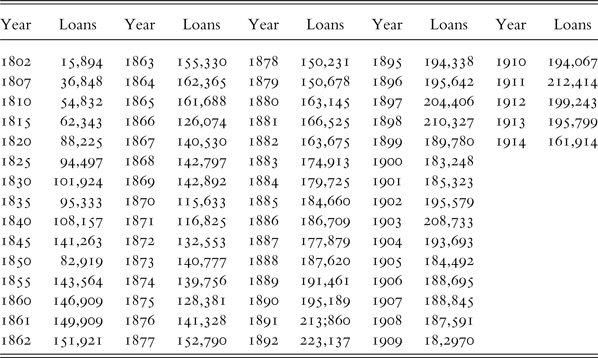
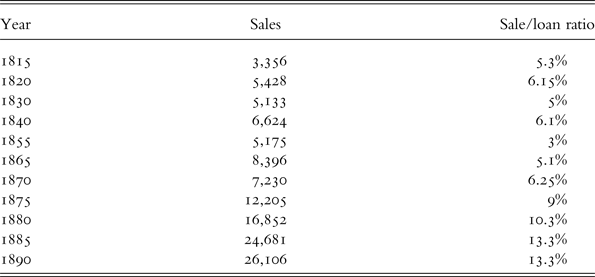
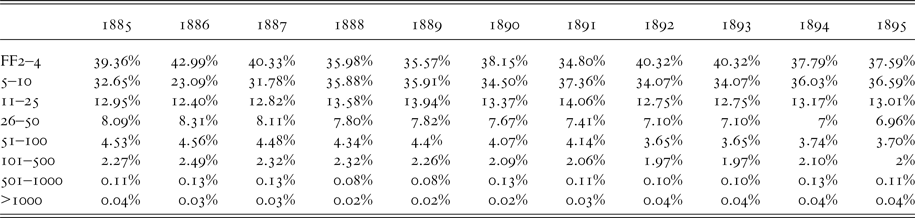
The difficulties faced by the establishment were primarily financial, with a temporary lack of liquidity to provide loans. However, the establishment was always able to find the finance it needed. To this end, savings vouchers (bonds) were issued at regular intervals, and found buyers. These savings bond issues were underwritten by the public authorities, and in addition there was a small amount of savings amongst the more privileged classes, which was regularly and faithfully invested. In this way, despite certain temporary difficulties with refinancing, which never actually jeopardised the existence of the MDP, the number of loans granted rose steadily between 1801 and 1895 (Table 3) and the Bordeaux MDP figured amongst the country's five biggest establishments.Footnote 7 We might draw a parallel between the 213,860 loans offered in 1891 and the population of Bordeaux, which in that same year was 252,415, figures that show the extent of MDP activity. A noteworthy and specific feature of these loans is just how effectively they were paid back. Table 4 shows the levels of sale of pawned objects for loans that were not reimbursed; over a long period of time, an average of over 90 per cent of loans were paid back.Footnote 8 In other words, MDP clients, often considered to be insolvent or high-risk, generally produced the necessary income. This rate of reimbursement also explains in part why the Bordeaux MDP performed so well. Defaulting on repayment came at a cost for the establishment and had an impact on its cash flow despite the sale of pawned goods. From 1895 onwards, we see a downward trend in the number of loans (Table 3), a situation that not only remained consistent up until the 1980s but was also observed in all French establishments (Marec Reference Marec1983, Reference Marec2006; Borderie Reference Borderie1999; Faber Reference Faber2003; Pastureau Reference Pastureau2013).
Number of loans at the Bordeaux MDP
Sources: Lequinat (Reference Lequinat1892), Archives of the Crédit municipal of Bordeaux.
II
The financial aid offered by the MDP was a social necessity and, economically speaking, effective. It was a social necessity because the indebtedness of the people made it possible to keep a poor population within the confines of society.Footnote 9 It was economically effective because the loans were repaid and people were learning how to use money (Lazarus Reference Lazarus2012). Behavioural patterns of effective money-management emerged among poor workers, a fact which, at the time, was not uncontroversial. There was, in fact, a moralising and patronising view surrounding the poorer populations, who were seen as being incapable of proper management of their cash resources.Footnote 10
The Bordeaux MDP was therefore a successful institution. It was created (i) to combat usury, (ii) to lower the rates of interest on credit for the people, (iii) to help poor workers without exploiting misery, and (iv) to maintain its financial independence, which it did. This last imperative, imposed by the city council, really lay at the heart of its success, as the establishment never had recourse to the city council to pursue its activity. These four objectives were achieved, and the two separate phases of MDP activity (Table 3) never led to the future of the establishment being called into question. It went through the nineteenth century making the profits it needed to operate effectively and refinanced operations at low cost, which meant initially being able to share a proportion of its profits with the Hospices and then to reinvest in order to improve the service on offer. The establishment's social role remained untouched, as it was able to lower interest rates to cut the cost of credit to the poorest populations, and to adapt to the economic environment: on several occasions administrators released goods free of charge for the most vulnerable customers. Despite the fall in the number of loans at the end of the nineteenth century, the establishment continued to meet all its obligations.
It is worth studying the reasons for this success. We would like to throw light on the hypothesis that the existence and the success of the MDP were grounded in the idea of a response to a social demand from wage-earners, characterised by the individual need to establish stability of income. Whenever income became more certain, the MDP would lose its appeal. But we need to look back at the concepts of social demand and the individual needs of wage-earners. These two notions emerge and develop in time with changes in the social and economic environment. The main reason why the Bordeaux establishment was successful is that it met a compelling social need from wage-earners and delivered an appropriate response.Footnote 11 Indeed, the nineteenth century was marked by a specific labour market in which salaries were not guaranteed and where work was insecure and unprotected. For this reason, a large proportion of workers found themselves in a state of poverty, characterised in France by the term worker pauperism. It is a situation that was inherent to the industrialisation and economic development of the nineteenth century. Additionally, this pauperism was a dynamic process, typifying a working population receiving a minimum subsistence income and with no protection from the risks of health, old age and unemployment. Philanthropy and charity came to the help of populations, although these forms of aid were often limited and had little impact (Castel Reference Castel1995; Ewald Reference Ewald1996; Bec Reference Bec1998). In Bordeaux, the whole policy for charity was founded on a logic of highly restrictive assistance in kind, considered to be more effective, i.e. not dissuading people from working (Roussy Reference Roussy2005). However, there was a lack of coherence between the social wants and needs of the time and the local support given. The end of the corporations resulted in a loss of rights and protection, especially regarding the guarantee of a wage deemed to be suitable. Consequently, a form of contradiction took root between inadequate specific aid and the evolution of society. The nineteenth century was also marked by the expansion of monetisation and the use of money (Servet Reference Servet2006; Gloukoviezoff Reference Gloukoviezoff2010), a loss of workers' rights and the hardship inherent to random levels of income. Support in kind, charity and philanthropy were unable to stabilise the incomes of poor wage-earners, whence the existence of a social demand for financial assistance which met an evident individual wage-earner's need. People were looking for ways to supplement income to meet poor workers' financial needs. This need for a supplementary wage had to maintain minimum levels of consumption and bring in cash in the event of social hazards. The social demand for protection and the need for additional income had two consequences: (i) the necessary individualisation of aid and so the offer of immediate liquidity, which explains the development of social micro-credit; and (ii) the institutional adaptation of aid with the emergence of social market economies and charities that included both the MDP and savings banks.
It is possible to express this social demand for protection and individual need by studying the structure of the clientele and of loans. We can base our thinking on several studies, and although statistics are few and far between, we have used the two reports by WattevilleFootnote 12 (Reference Watteville1846–Reference Watteville50), the statistical reports from the Bordeaux MDP and the directory of French statistics (ASF). We thus learn that the MDP primarily concerned wage-earners living on the borderline but not excluded from the world of work. In his report on the Bordeaux establishment from 1844, Watteville remarked that the institution was able to ‘offer effective, albeit momentary, relief to the man who was ready to use the possibility of work to pay off his debt’. Additionally, Watteville, reiterated by Lequinat, noted that the:
Monts-de-Piété are useful for the poor; they place limits on usury and help to reduce beggary by providing the working masses with the facility and means to provide for themselves in times of sickness, work unemployment or accidental distress; they help to preserve the honour of the poor citizen by preventing him from resorting to blameworthy means to obtain money. They also often support the credit of business dealers, and we may quote one such industrialist who in France was able to counter foreigners only through the relief offered by the Monts-de-Piété. (1892, p. 33)
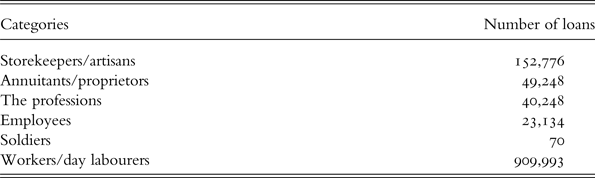
So the MDP customer base was made up primarily of workers and day labourers; in 1850, they represented 76.91 per cent of the clientele of the 25 largest French MDPs,Footnote 13 of whom 67 per cent took out loans worth less than FF 11. Artisans and merchants were the second category of borrowers, accounting for 12.9 per cent of customers, but unlike the first category their loans were of a higher value. More specifically, in Bordeaux loans taken out were for low amounts: in 1876, for example, 76 per cent of loans were for less than FF 10 (£0.4)Footnote 14 and concerned a population with low incomes. Over a longer period, from 1878 to 1895, we see a rate of between 70 and 80 per cent for loans of less than FF 10. The average loan was between FF 13 (£0.52) and FF 17 (£0.68) over the whole period fro 1820 to 1895 (ACM).
Categories of loan in Bordeaux
Source: Archives of the Crédit Municipal, statistics report.
Clientele in 1848 for the 21 largest establishments (including Bordeaux)
Source: Watteville (1848)
The main customers of the MDP thus came from two populations with very different motivations. The wage-earner was subjected to meagre wages which were a source of poverty. Artisans and merchants were excluded from the credit market and they used the MDP to obtain ready cash. Yet these two customer bases were complementary: wage-earners asked for low-value loans, often supplied at a loss, and artisans and merchants wanted higher and therefore more profitable loans. The result was a balance, created so that the MDP's operations would stay profitable. Poor workers and artisans and merchants were two categories that suffered from exclusion, the former socially, the latter financially. The role of the MDP was thus to rehabilitate these populations, something it did with considerable success. Indeed, each category provided the income needed to repay the loan in good time, thereby validating the activity of the MDP as a social lender, enabling the institution to make profits and to capture a share of small-scale savings for refinancing.Footnote 15
As far as poor workers are concerned, the question of wages is important, it being the variable from which individual needs originate. In an industrial society marked by pauperism and job insecurity, ‘while the absence of work’, to quote Marec (Reference Marec2006, p. 33), ‘often determined working class misery, insufficient wages made a telling contribution to the quasi-general poverty of the working classes’. This shows the institution's importance to a population prone to misery, helping to improve their condition.
When data are available, we see over the period under study that each fall in the average nominal wage was mirrored by a rise in the number of loans (ACM, Pastureau Reference Pastureau2013). The use of pawnbroking was buoyant over temporary periods of lower wages.Footnote 16 As a result, the loan obtained brought with it additional income, potentially able to make good the difference in wages between the two periods. If we reason in terms of protection, then the pawnbroker loan took effect when social and economic necessity were at their greatest. Boyer (Reference Boyer1978), who has studied changes in wages in France during the nineteenth century, emphasises that strong flexibility played a crucial part in the living conditions of a construction worker in the sense that wages were connected to employment. Wage levels and work time fluctuated in relation to the economic environment, creating a strong social dependence between workers and their wages. Boyer (Reference Boyer1978) highlights two stages of the real wage process. First of all, during the period from 1840 to 1856, real wages were low because of the high variability in the cost of living, a situation compounded by unchanging wage levels. From 1856 to 1902, real wages tended to increase, first in the form of nominal wage growth, which was higher than the cost of living (1856–60), then thanks to a decrease in the cost of living (1860–1902). Pawnbroking activity over the first period grew steadily (see Table 3). Over the second period, pawnbroking appeared to be prosperous initially (1860–90) but then entered a phase of decline. This downturn corresponded to the falling cost of living, allowing the poorest people to be less dependent and less vulnerable to fluctuations in the cost of food. The latter represented a significant proportion of the household budget. So the rise in nominal wages combined with a lower cost of living produced higher net incomes which, over the long term, were consistent with the fall in the demand for pawnbroking. The structure of household budgets shows that the non-food share fell from 70.7 per cent in 1856 to 60 per cent in 1930 (Boyer Reference Boyer1978, ASF). Consequently, compulsory spending or fixed expenses were relatively lower, generating a balance that was less prone to the vagaries of the cost of living. The development of pawnbroking was significantly related to falls in wage levels.
The legal environment was certainly advantageous, but the success of the Bordeaux MDP is linked to the response it provided to a social demand and individual need. The input of financial aid responds to in-depth institutional changes, to the loss of protection for wage-earners and the absence of a people's banking system. Actually, it was the unrestricted use of profits and some highly advantageous refinancing that were the key to the establishment's efficient operation. In addition, the structure of the customer base was complementary and, importantly, solvent, and the high levels of repayment both reduced the costs related to sales and improved cash flow. Costs were actually quite considerable and concerned most notably the expense involved in selling. The major risk for the MDP was an error in the estimation of the value of a good, which would be lost in sale in the event of over-estimation, and the loss of value when the good remained in the storehouse for too long. One important statistic should be emphasised: on average 70 per cent of pawned goods that were sold went for less than FF 10 (£0.4) (ACM), either in relation to loans that were unprofitable for the establishment or goods of little worth for which it was difficult to build any value when selling. The importance for the establishment of producing high rates of reimbursement was understandable for its survival, and in addition, the question of the scale of loan was also of significance. The minimum loan accepted in Bordeaux was FF 3 (£0.12), which fell in the second half of the nineteenth century to FF 2 (£0.08). As for the ceiling for loans – bigger loans being the most profitable – it reached FF 5,000 (£200) in 1850, as opposed to just £10 in Ireland.
In France, including Bordeaux, MDPs had the advantage of there being no competition from banking credit or private pawnshops. This was legal, owing to the monopoly status of MDPs, but also structural. There were no banksFootnote 17 or people's credit that could capture part of the clientele, as was the case in Ireland. The establishment in Bordeaux, and we might also extend this to all French MDPs, benefited from an advantageous social and economic environment and sat comfortably inside a process of charitable economy, which delivered economic responses to social issues in a period that was devoid of any general system of social assistance. A charitable social economy was complementary to charity, philanthropy and local social measures. The rise in public authority intervention to combat poverty in the world of labour was to gradually undermine the utility of MDPs.
III
The MDP went into a form of decline from the end of the nineteenth century, linked to the appearance of a new way of organising social assistance, which reduced the institution's usefulness to some extent. Pawnbroking brought a wage supplement whenever salaries varied with occasional or permanent cuts that resulted in a worsening of living standards. But the aim of social welfare was to remedy these variations in order to guarantee a minimum subsistence income. In periods when there were no social policies, local or otherwise, we see a long-term intensification of social micro-credit. Over periods where social welfare was institutionalised, social micro-credit became insignificant.Footnote 18 Social protection introduced a form of rigidity for wage cuts because it delivered a wage supplement, i.e. an ‘indirect wage’. Ultimately, this was the role of pawnbroking, namely a source of indirect income. The fall in the number of pledges between 1870 and 1913 corresponds to a period when local welfare action began to emerge and develop. From the end of the nineteenth century, municipal patronage gave way to more tightly targeted social political action, and in 1899 a free municipal investment office was created, followed in 1926 by an unemployment relief allocation. The authorities also established the beginnings of a family policy with the creation in 1920 of the Bordeaux and South-West family benefit fund. In 1929, the Bordeaux social action committee was set up and was instrumental in the introduction of national insurance (AMB).Footnote 19 The growth in the intensity of a local social policy came about during a period when the Bordeaux Crédit Municipal was running into a number of difficulties.
The introduction of wage supplements – family benefits – or aid for a return to employment was a means, at least in part, of reducing the mercantile aspect of aid. Additionally, contrary to the earlier situation, i.e. municipal patronage, aid tended to become widespread and monetary in form. This development of local welfare action began in the 1890s, when, for example, municipal subsidies for assistance organisations rose from FF 150,000 (in 1877) to over FF 450,000 in 1900 (AMB). Gradually, the input of a monetary supplement became possible outside the sphere of social micro-credit.
As part of a charitable social economy, social micro-credit at the MDP was characterised by the input of monetary aid, i.e. supplementary income in the absence of any institutionalised social assistance. Pawnbroking was a last-resort tool offering individual protection from social hazards. Its prosperity stemmed from a period when income from social entitlements was non-existent, with social aid thus being very limited. It sat within a rationale of societal protection, which introduced a charitable relationship from an economic institution. The economic tool was thus given added value either by savings or by social credit. Poor workers found the financial means to respond to insecurity of income and monies coming into a household, both of which were geared to economic activity. The individual was economically dependent, and while he was free, his options were limited to scraping together a few savings, or running into debt. Social micro-credit was legitimate as an individual and mercantile protection tool.Footnote 20
The MDP may be considered as a social credit institution for the poorer working classes and it was able to finance artisans who were excluded from formal funding. Misery was no longer treated with charity, instead low interest rates on temporary monetary resources were used to remedy precarious financial situations. The MDP was not a consumer credit institution, but it contributed to the stability of workers' income. It offered a source of funding to small producers and traders, excluded from the traditional banking system. Carbonel-Esteller (Reference Carbonell-Esteller2012) highlights the same reality in Barcelona. The MDP was a key player in a ‘charity-economy’. In both cases, we might use the words ‘charitable liberalism’ with Christian sensitivity. Asking a pawnshop for help was an individual act which required the temporary loss of a good or of savings, and implied abstinence and sobriety. So in each case, assistance came at a cost, savings were providential and pawnbroking offered the hope of avoiding social exclusion. In the case of savings banks, providential foresight was considered a virtue because it was conducive to individual responsibility. In the same way labour was seen as a vector of social integration. The link between labour and savings structured post-1789 French society. Foresight protected labour-related earnings and income. This type of social economy was based on a vertical structure of solidarity, from the elite to the people, a situation found in Ireland (McLaughlin Reference Mclaughlin2013). MDPs and savings banks were an answer to the contradictions of industrialisation and were part of an institutional approach valued by society. This argument also raised great interest in Barcelona, as explained by Carbonell (Reference Carbonell-Esteller2012), where the emergence of savings banks was viewed as a form of modernity even though integrated with, and complementary to, micro-credit institutions. The response to pauperism was local social assistance from private initiatives. Savings banks and MDP were designed to provide resources and capacities to the working class to overcome, or at least be protected against, the social risks in developing societies when no other institution existed. These two institutions were characterised by their non-profit-making vocation. In fact, the search for profit was not an end in itself. We can bracket together savings banks and MDPs because they were dedicated to the same idea of social assistance and were created and organised by elite groups.Footnote 21 The then current socio-economic system was certainly not rejected but the two institutions worked with the idea that this system seemed to be affected by the social issue of pauperism. As a result, it remained a social charitable economy which, through standard economic mechanisms (savings and lending), provided an economic response to social problems. We should also point out that the proposed merger between savings banks and the MDP in Bordeaux was a missed opportunity. The question was completely ignored and very little information is available as to why the merger was turned down.
The success of the Bordeaux establishment in the nineteenth century was related to several factors. While the legislative environment was advantageous (monopoly status for pawnbroking), the establishment prospered courtesy of the social and economic environment. There was indeed a high social demand for financial aid linked to the individual needs of a population finding itself in a situation of virtual exclusion. The MDP gave financial capacity to a population that was nonetheless solvent. The establishment in Bordeaux also benefited from high repayment rates, which limited additional costs, regularly found ways to refinance its operations and took advantage of there being no people's banking system. The MDP in Bordeaux spent five years competing with private lending shops, the closing-down of which was salutary, but its capacity to deliver an appropriate response was fundamental. As soon as customers found a new source of supplementary income and workers' wages achieved a level of stability, the MDP gradually lost its usefulness. The MDP suffered from high competition triggered by in-depth changes in social aid and welfare, when social demand from wage-earners found a response elsewhere (Minkes Reference Minkes1953).