Colonized or infected patients often contaminate their skin, clothing, and the environment with healthcare-associated pathogens. Reference Donskey1 Such contamination may serve as a source for transmission. The hands of healthcare personnel are generally considered the primary source for transfer of pathogens from patient to patient. Reference Donskey1 The clothing of personnel, portable equipment such as thermometers, and stethoscopes have also been implicated as potential sources of transmission. Reference Anderson, Addison and Lokhnygina2-Reference Longtin, Schneider and Tschopp9 However, although many studies have demonstrated frequent contamination of clothing and shared devices, there is uncertainty regarding the importance of these items in pathogen transmission. A better understanding of routes of transmission is needed to develop effective control strategies.
In several recent studies, cauliflower mosaic virus DNA markers have been used to as benign surrogate markers to study routes of pathogen transmission. Reference Oelberg, Joyner, Jiang, Laborde, Islam and Pickering10-Reference Alhmidi, Koganti, Cadnum, Jencson, John and Donskey14 For example, in a medical and surgical intensive care unit, it was demonstrated that a viral DNA marker inoculated onto shared portable equipment disseminated widely to surfaces in patient rooms and provider work areas and to other types of portable equipment. Reference John, Alhmidi, Cadnum, Jencson and Donskey11 The viral DNA marker is like C. difficile spores in that it is not affected by alcohol hand sanitizer or quaternary ammonium disinfectants but is denatured by sodium hypochlorite and reduced by mechanical washing or wiping. Reference Alhmidi, John, Mana, Koganti, Cadnum, Shelton and Donskey15 In simulations of patient care, a cauliflower mosaic virus DNA marker and C. difficile spores demonstrated similar dissemination to the environment, but the DNA marker was more frequently detected on skin and clothing of personnel after removal of personal protective equipment. Reference Alhmidi, John, Mana, Koganti, Cadnum, Shelton and Donskey15 In the current study, we used cauliflower mosaic virus DNA markers to examine routes of transfer of pathogens from patient to patient. We hypothesized that personnel clothing, stethoscopes, and portable devices would account for a substantial proportion of transfer events.
Methods
Evaluation of patient to patient transfer of cauliflower mosaic virus DNA
The study protocol was approved by the Institutional Review Board of the Louis Stokes Cleveland VA Medical Center. The study was conducted during a 3-month period from November 1, 2018, through January 31, 2019. A convenience sample of 31 patients hospitalized on general medical or surgical wards were enrolled as source patients (ie, source patients for potential dissemination of the viral DNA surrogate marker). Potential source patients were excluded if they were in contact precautions or if their anticipated length of stay was less than 1 day. One cauliflower mosaic virus DNA marker was applied to the skin (chest, abdomen and forearm) and clothing (front of shirt over the chest and abdomen). A second cauliflower mosaic virus DNA marker was applied to the bed rail and bedside table in the source patients’ room. 0.1 µg of each DNA marker was applied in 100-µL of sterile water and allowed to air dry for at least 15 minutes before the first patient care interaction was observed. After the DNA markers were applied, research personnel were stationed on the ward in view of the room to identify personnel interacting with the source patient.
For each source patient, up to 4 of the healthcare personnel providing care were observed during their interactions with the source patient. The personnel provided informed consent and were told that the goal of the study was to investigate how pathogens can be transmitted but were not informed of the DNA marker contamination. They were told to perform their activities as they would normally and to use personal protective equipment as indicated by their care activities. The interaction between the personnel and the source patient was observed by research personnel and sites and types of contact between personnel and the source patient were recorded (eg, hand or clothing contact with patient or environment, use of stethoscope). The areas where the DNA markers were inoculated and the type of contact were recorded (eg, hand, clothing, stethoscope contact). The interactions were not included in the subsequent assessment of transfer of the DNA marker if there was no contact with either the patient or the environment.
After the personnel provided care for the source patient, they were followed by research personnel during their interactions with up to 5 subsequent patients; only 1 care interaction was assessed for each subsequent patient. For subsequent patients, personnel were told to follow their usual practices including use of protective equipment. The interactions with these patients were observed to identify sites associated with personnel that contacted the patients or their environment (eg, hands, clothing, stethoscopes, other devices) and to identify sites associated with patients that were contacted (eg, bed rail, bedside table, patients’ skin or clothing). After each observed interaction, separate premoistened culture swabs (Becton Dickinson, Cockeysville, MD) were used to sample environmental and skin or clothing sites of the patients. If contacts were observed between personnel or equipment, these sites were sampled initially with the goal of identifying potential sources of transfer. For example, samples were collected from the area of the chest contacted only by a stethoscope diaphragm and from environmental sites only touched by the clothing of personnel or by hands of personnel. After collection of samples focused on specific areas of contact, swabs were used to sample environmental surfaces (5×20-cm areas of the bed rail and the bedside table) and skin and clothing (chest, abdomen, arm, hand, and anterior part of shirt) of the patients. To ensure that false-positive PCR results were not obtained during processing, 1 negative control (ie, no contact with a patient or environment) swab was included for each of the personnel participating in the study.
Cauliflower mosaic virus DNA marker generation and detection
The cauliflower mosaic virus DNA markers were synthesized and prepared as previously described. Reference Alhmidi, John, Mana, Koganti, Cadnum, Shelton and Donskey15 The marker applied to the skin and clothing contained 222 base pairs of DNA, including all 210 nucleotides of the cauliflower mosaic virus 35S promoter region with the addition of GAATTC terminal sequences on each end. Reference Alhmidi, John, Mana, Koganti, Cadnum, Shelton and Donskey15 The marker applied to the bed rail and bedside table contained 155 base-pairs of DNA, including all 140 nucleotides of the Glycine max transgenic cauliflower mosaic virus 35S promoter region with the addition of GAATTC terminal sequences on each end. The markers were detected by polymerase-chain reaction (PCR) as previously described. Reference Alhmidi, John, Mana, Koganti, Cadnum, Shelton and Donskey15 The PCR primers for the marker applied to the skin and clothing have been previously reported. Reference Alhmidi, John, Mana, Koganti, Cadnum, Shelton and Donskey15 For detection of the DNA marker applied to the environment, the forward primer was GTCTTCTTTTTCCACGATGCTCCTCGTGGG and the reverse primer was TGAAGATAGTGGAAAAGGAAGGTGGCTCCT.
Transfer of methicillin-resistant Staphylococcus aureus (MRSA) from colonized patients by fomites versus gloved hands
Because initial studies suggested that the DNA marker might be transferred by fomites (eg, stethoscopes, clothing, and portable equipment), we assessed the plausibility of transfer of a healthcare-associated pathogen via fomites versus gloved hands. For a convenience sample of 25 hospitalized MRSA-colonized patients not receiving chlorhexidine bathing, a 5×10-cm area of the skin of the chest and abdomen was contacted using gloved hands, a stethoscope diaphragm, and 6×6-cm sections of cloth from a physician’s white coat applied firmly or lightly (ie, brushed lightly against the skin). For the glove contacts only, the gloves were moistened with ~1 mL of sterile water and shaken dry prior to the contacting the skin as this method has been shown to provide good correlation between glove and bare hand pick up and transfer of microorganisms. Reference Kanwar, Mana, Cadnum, Alhmidi, Koganti and Donskey16 The gloved hands and the fomites were imprinted onto a ChromAgar plate containing 6 µg/mL of cefoxitin for recovery of MRSA. The plates were incubated for up to 48 hours and colonies consistent with MRSA were counted and confirmed as S. aureus as described previously. Reference Alhmidi, Cadnum and Koganti17 A vinyl blood pressure cuff cleaned with a commercial hydrogen peroxide disinfectant was also attached to the arm of the patients; premoistened culture swabs were then used to sample the blood pressure cuff followed by plating onto the selective media for MRSA. Finally, gloved hands were applied to the chest as described previously and then used to hold a patient name-band scanner, which was then sampled with a premoistened swab and plated onto selective media for MRSA.
Data analysis
The frequency of transfer of each of the DNA markers from the source patient to subsequent patients was calculated. Based on observations of contacts between personnel and patients and sites of recovery of the markers, potential routes of transfer were identified. Based on preliminary studies, we anticipated a frequency of transfer of approximately 50% for the DNA markers. Based on an estimated 150 patient care interactions, we calculated 80% power to detect a difference of 15% or more in the frequency of transfer from skin or clothing versus from environmental surfaces. The χ Reference Anderson, Addison and Lokhnygina2 test or the Fisher exact tests was used to compare the frequencies of transfer of each of the DNA markers. The Fisher exact test was also used to compare the frequency of transfer of MRSA from the skin of colonized patients to gloved hands and to fomites. For the assessment of transfer of DNA markers, additional analysis adjusted for the order of interaction with patients (1 through 5) and the efficiency of transfer defined as the percentage of contacts resulting in transfer: the number of transfers divided by the number of contacts for each potential route of transfer. Data were analyzed using R version 3.5.0 software (R Foundation for Statistical Computing, Vienna, Austria).
Results
Of 54 healthcare personnel participating in the study, 23 (42.6%) were physicians, 19 (35.2%) were nurses, 10 (18.5%) were nurse’s aides, and 2 (3.7%) were phlebotomists. The mean number of personnel interacting with each of the 31 source patients was 1.7 (range, 1–3). Of 240 total interactions with subsequent patients, 145 (60.4%) involved 1 or more contacts with the patient or the environment in the patient’s room. For individual personnel, the mean number of interactions with subsequent patients that were observed was 2.7 (range, 1–5).
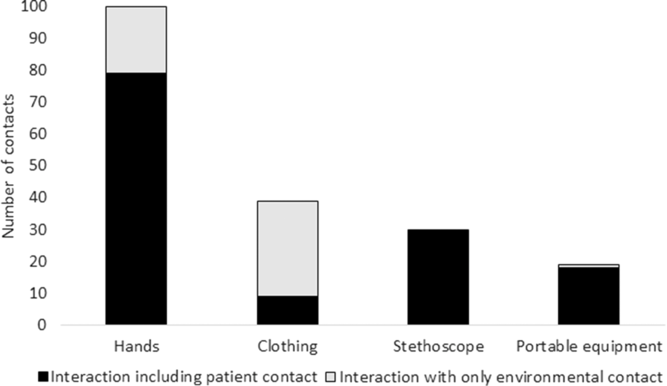
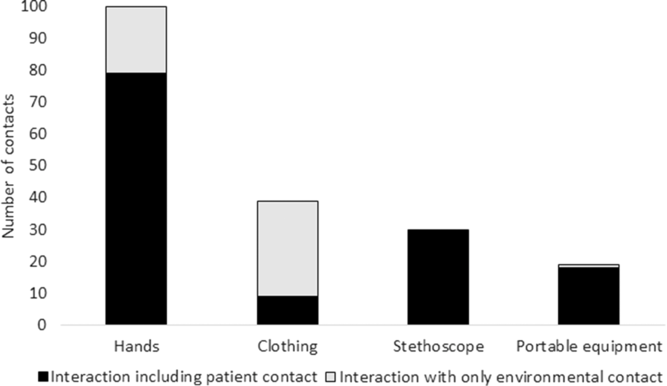
Figure 1 shows the numbers and types of contacts with subsequent patients and/or the environment. In total, 188 contacts with the subsequent patients or their environment occurred, including 51 (27.1%) that only included contact with the environment and 137 (72.9%) that occurred during interactions that only involved touching the patient or that included touching the patient and the environment. Of 100 hand or glove contacts, 37 (37%) occurred after the hands or gloves touched the clothing of personnel (eg, reaching into their pockets to retrieve note cards or cell phones). Of 39 direct contacts between personnel clothing and patients or the environment, 25 (64.1%) involved contact between clothing at sites other than sleeves (eg, white coat or scrubs contact the bed rail or bedside table) and 14 (35.9%) involved contact of the sleeves of long-sleeved clothing (eg, sleeve-cuff touches bed rail or patient in conjunction with hand contact). Hand sanitizer was used before and after 139 of 145 (95.9%) patient interactions, but stethoscopes were not cleaned after any of the 30 interactions in which stethoscopes were used. In addition, blood pressure cuffs and other portable equipment was not cleaned for any of the 19 interactions involving use of equipment.
Numbers and types of contacts during patient-care interactions between personnel and subsequent patients and/or the environment. Prior to the care interactions with subsequent patients, the personnel interacted with a source patient with skin and clothing and environmental contamination by cauliflower mosaic virus DNA markers.
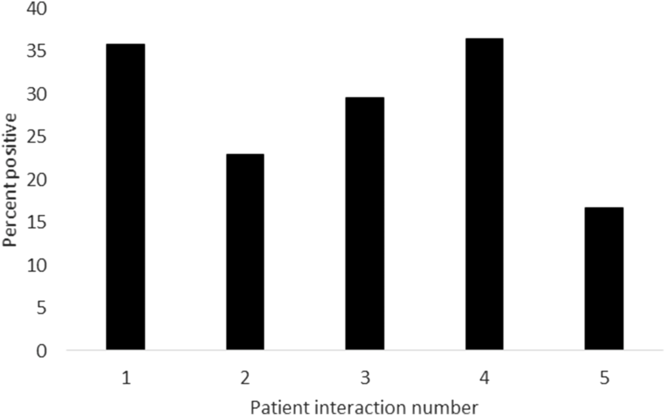
Of the 145 interactions involving 1 or more contacts with subsequent patients and/or the environment, 41 (28.3%) resulted in transfer of 1 or both DNA markers to the patient or the environment. Of the 41 interactions involving transfer of DNA markers, 2 (4.9%) resulted in transfer of both markers, 18 (43.9%) resulted in transfer only of the marker placed on environmental surfaces, and 21 (51.2%) resulted in transfer only of the marker placed on the source patients’ skin and clothing. Of 41 interactions involving DNA marker transfer, 5 (12.2%) resulted in transfer to both patients’ skin or clothing and environmental surfaces, 17 (41.5%) resulted in transfer only to patients’ skin or clothing, and 18 (43.9%) resulted in transfer only to environmental surfaces. As shown in Figure 2, there was no trend toward a decrease in the frequency of transfer as the number of patient interactions increased.
Percentage of subsequent patient care interactions with transfer of 1 or both cauliflower mosaic virus DNA markers, stratified by the number of the patient interactions following a prior interaction with a source patient with skin or clothing and environmental contamination with cauliflower mosaic virus DNA markers.
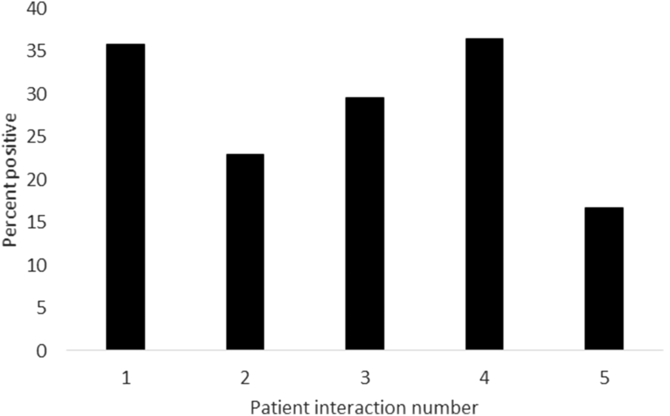
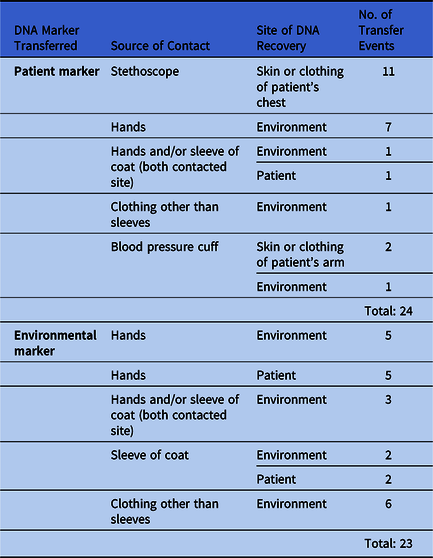
Table 1 shows putative routes of transfer of the DNA markers to subsequent patients based on observations of interactions and sites of recovery of DNA, stratified by transfer of the marker applied to the source patients’ skin or clothing versus environmental surfaces. The most common routes of transmission of the DNA marker applied to patients’ skin or clothing were stethoscopes (11 transfers) and hands (7 transfers), whereas the most common routes of transmission of the marker applied to environmental surfaces was the hands (10 transfers) and clothing (10 transfers). The efficiency of transfer was highest for stethoscopes (11 transfers in 30 contacts between stethoscopes and patients, 36.7%), clothing (11 transfers in 39 direct contacts between clothing and surfaces or patients, 28.2%), and hands (17 transfers in 100 direct contacts with patients or surfaces, 17%).
Putative Routes of Transmission of DNA Markers From Source Patients With Skin/Clothing and Environmental Surface Contamination to Subsequent Patients by Personnel During Care Interactions

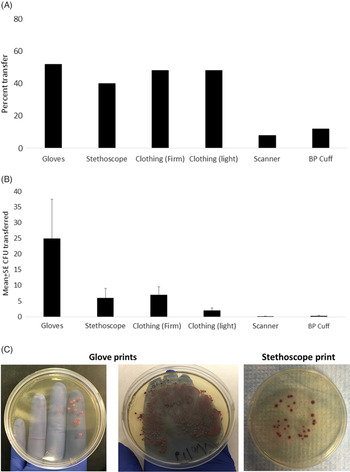
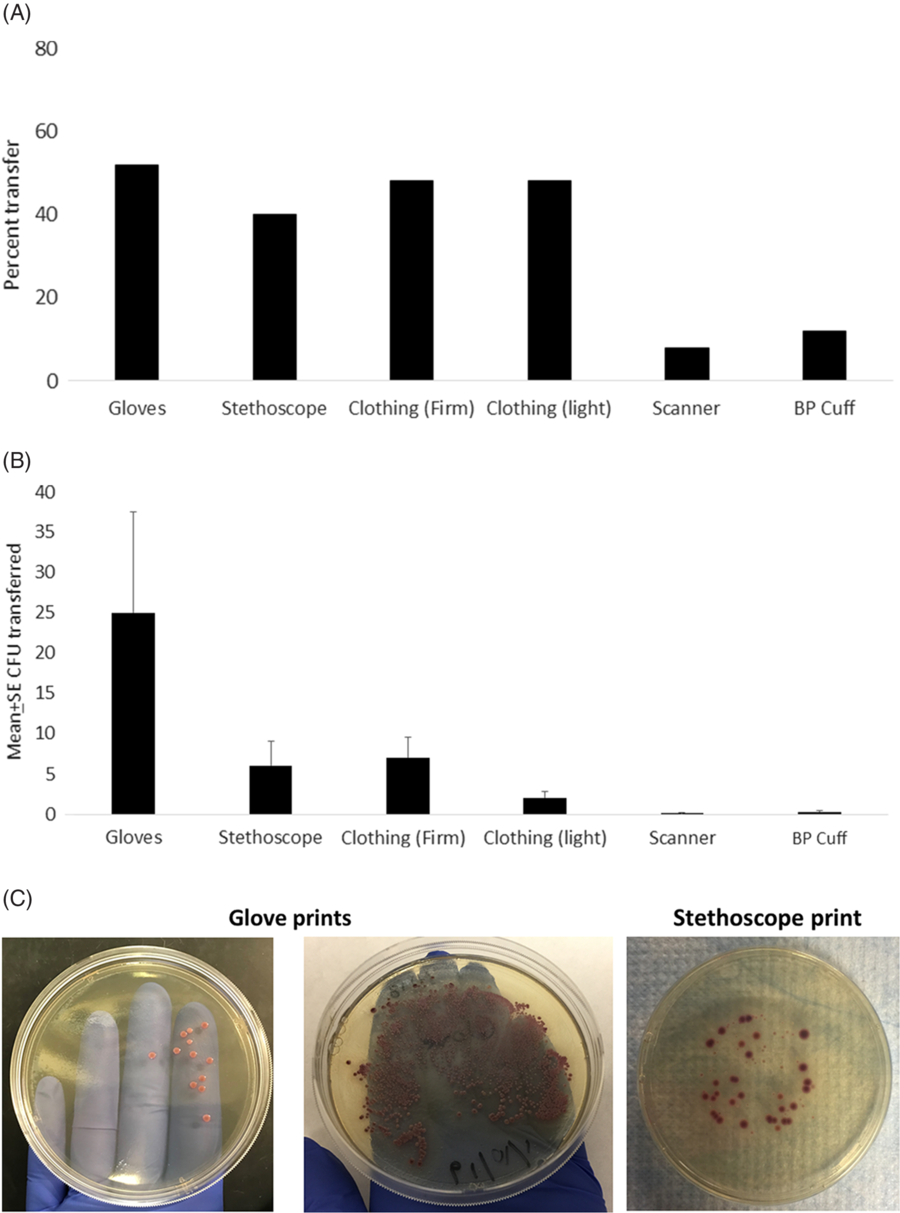
Figure 3 shows the frequency of transfer of MRSA from the skin of colonized patients and the number of colonies transferred with different types of contact. There were no significant differences in the percentages of transfer by gloved hands, stethoscope diaphragms, and clothing with firm or light contact (P > .05), whereas each of these types of contact were significantly more likely to transfer MRSA than the blood pressure cuff and the patient name-band scanner (P < .05). However, the mean colony-forming units (CFU) of MRSA transferred by gloved hands was significantly higher than the number of CFUs transferred by any of the other types of contact (P < .05). Figure 3C provides illustrations of MRSA acquired on gloved hands and on a stethoscope diaphragm with subsequent transfer by imprinting onto a selective culture plate.
Frequency (A) and number of colonies (B) of methicillin-resistant Staphylococcus aureus (MRSA) transferred from the skin of colonized patients via gloved hands and fomites including stethoscope diaphragms, clothing firmly applied to skin, clothing lightly brushed against skin, a patient name-band scanner, and a blood pressure cuff. The blood pressure cuff contacted the arms of patients, whereas the gloved hands and other fomites directly contacted the chest except for the scanner (ie, gloved hands contacted the chest and then touched the scanner which was then imprinted onto selective media).
Discussion
An understanding of the routes of transmission of healthcare-associated pathogens is essential for the development of effective control measures. Benign surrogate markers can provide a powerful tool in investigations of mechanisms of transmission. Reference Oelberg, Joyner, Jiang, Laborde, Islam and Pickering10-Reference Alhmidi, John, Mana, Koganti, Cadnum, Shelton and Donskey15 In the current study, benign cauliflower mosaic virus DNA markers were frequently transferred from an inoculated source patient and from surfaces in the source patient’s room to subsequent patients during routine clinical interactions. Based on observations of interactions and sites of DNA recovery, the hands of personnel were the most common source of DNA transfer, but stethoscopes, clothing of personnel, and blood pressure cuffs were also implicated as frequent sources of transfer of the DNA markers. The plausibility of pathogen transfer via stethoscopes, clothing, and equipment was confirmed in simulations with MRSA-colonized patients.
Many previous studies have demonstrated that fomites such as stethoscopes, portable equipment, and personnel clothing often become contaminated with healthcare-associated pathogens. Reference Anderson, Addison and Lokhnygina2-Reference Longtin, Schneider and Tschopp9 Our findings expand upon these studies by demonstrating the potential for such fomites to serve as a vector for transfer of pathogens from patient to patient during routine patient care activities. One implication of our results is that cleaning of stethoscopes and portable equipment between patient interactions should be emphasized to reduce the risk for transmission. Previous studies suggest that these devices are rarely cleaned. Reference Donskey4,Reference Vajravelu, Vajravelu, Guerrero, Jury and Donskey8,Reference Alhmidi, Cadnum, Jencson, Gweder and Donskey13 In the current study, hand hygiene compliance was excellent, but stethoscopes and portable equipment were never cleaned.
During patient care interactions, the clothing of personnel often contacted environmental surfaces or patients, and several transfers of DNA markers were potentially linked to clothing. Contamination of the clothing of healthcare personnel with healthcare-associated pathogens is common, Reference Anderson, Addison and Lokhnygina2,Reference Kanwar, Thakur, Wazzan, Satyavada, Cadnum, Jencson and Donskey18 and we demonstrated the potential for clothing to acquire MRSA from patient skin with subsequent transfer to a culture plate. In observations of patient-care interactions, the sleeves of long-sleeved shirts or coats accounted for 36% of the contacts with clothing. Thus, it is plausible that a “bare below the elbows” policy might reduce the risk for transfer from clothing. Reference John, Alhmidi, Gonzalez-Orta, Cadnum and Donskey3 However, contacts between clothing at sites other than sleeves (eg, white coat or scrubs contacting the bed rail or bedside table) were also common. Such contacts could potentially be reduced by wearing scrubs rather than coats as loose-fitting coats frequently brushed against surfaces such as bed rails or bedding during patient examinations.
Our study has some limitations. Simulations with surrogate markers typically represent worst-case scenarios for transmission and may not correlate with lower-level transfers of pathogens that occur in clinical settings. However, the simulation with MRSA-colonized patients demonstrated the plausibility of transfer via the routes of DNA marker transmission. As noted previously, the DNA marker is not affected by alcohol hand sanitizer. Therefore, the study results likely overestimate the risk for hand transfer of alcohol-susceptible pathogens. Finally, since the interactions with patients were observed, we cannot exclude the possibility that observation resulted in alteration of the actions of the participating personnel, including an increase in compliance with hand hygiene.
In summary, we demonstrated that benign cauliflower mosaic virus DNA markers were frequently transferred from an inoculated source patient and surfaces to subsequent patients during routine clinical interactions. Both hands and fomites such as stethoscopes, clothing, and portable equipment served as vectors for transmission. Future studies are needed to identify effective interventions to prevent transmission via fomites.
Acknowledgments
We thank the patients, physicians, and nursing staff at the Cleveland VA Medical Center for their participation in the study.
Financial support
This work was supported by the Centers for Disease Control and Prevention (contract 2018-27564 to C.J.D.) and by the Department of Veterans’ Affairs.
Conflicts of interest
C.J.D has received research grants from Pfizer, Clorox, PDI, and Boehringer Laboratories. All other authors report no conflicts of interest relevant to this article.