Introduction
The first performance of The Minotaur by Harrison Birtwistle was given at the Royal Opera House, Covent Garden, on 15 April 2008. This is Birtwistle's seventh opera and his second to be premièred at this venue;Footnote 1 like all the others, it demonstrates his predilection for familiar and/or mythical subject matter. Regarding the origins of the most recent opera, he says ‘the mythic beast was lurking’ in Earthdances (1985), while his later receipt of a ballet scenario on the theme of the Minotaur by Friedrich Dürrenmatt (published as a literary Ballade) ‘jogged his memory’;Footnote 2 Picasso's Minotauromachia was influential, too.Footnote 3 Finally it was to David Harsent, Birtwistle's librettist and collaborator on Gawain (his other Covent Garden opera), that he turned, ‘to develop a libretto and find a language for the characters’.Footnote 4
A particular preoccupation inhabits several of Birtwistle's operas: to quote Jonathan Cross, ‘It is usually just heads that interest him, disembodied’.Footnote 5 From Orpheus's, floating down the river, to Vermeer's painting (Head of a Girl with a Pearl Earring) in The Second Mrs Kong, to the headless horseman in Gawain (whose head actually speaks), we move on to the Minotaur, the ‘man with the head of a bull’, in this production memorably designed by Alison Chitty.
Synopsis
Before the opera begins, King Minos of Crete has received from Poseidon a snow-white bull; his wife, Pasiphae, has mated with it and given birth to Asterios, the Minotaur, the man-bull. (Her other child – by Minos – is Ariadne.) Minos has caged the inarticulate, fierce Asterios in the Labyrinth at Knossos, meanwhile compelling King Aegeus of Athens to send a group of young citizens to be sacrificed to the man-beast each year. As the opera opens, such a group arrives. This time, Theseus, Aegeus's son, accompanies the ‘Innocents’ in their black-sailed boat; he has come to slay the monster. Ariadne, her half-brother's keeper on the island (and therefore a prisoner herself), greets them. She protests that Theseus is not one of the chosen ones; holding out her clenched hands, she asserts that he will be eligible to go in to the Minotaur only if he should correctly select the one which conceals a pebble. He fails. Meanwhile, we are presented with the Minotaur in his lair; he cannot speak, but in his dreams he is coherent. The Innocents go in alone to the ‘bullring’ (at the centre of the Labyrinth) and are all gored to death; Keres (wild, vulture-like creatures) swoop down to feast on their remains. Ariadne, wishing to leave the island with Theseus, attempts to seduce him, but to no avail. She then learns from the Oracle the secret of exiting the Labyrinth: a ball of twine. This she gives to Theseus on condition he take her with him should he kill the Minotaur. He reluctantly assents. This time he negotiates the Labyrinth and meets his foe. In the bullring the Minotaur finally attains speech and is despatched by Theseus. The libretto directs that the black-sailed boat should be seen on the horizon, sailing away. A vulture-like Ker swoops down again. The opera ends here. (The myth continues, however: Theseus has promised his father Aegeus that if he is successful he will rig the boat with white sails. He forgets to do so; Aegeus, seeing the black sails, believes the worst; he throws himself into the sea and drowns.)
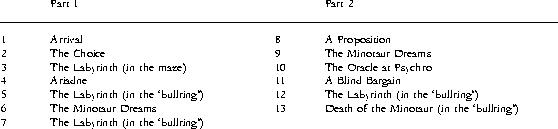
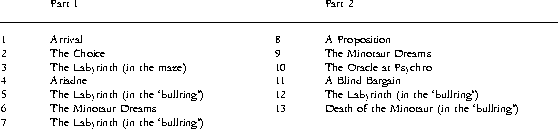
The opera is divided into two ‘parts’ (acts) which possess a certain balance. The titles of the thirteen scenes, with seven in the first part and six in the second, are shown in Table 1. The first part features the Innocents: after chronicling their arrival in Crete, this part culminates in their death in the bullring at the heart of the Labyrinth.Footnote 6 The second is more varied, but it also leads to a slaying in the bullring – that of Asterios (the Minotaur) by Theseus. Violent action is concentrated in the bullring scenes at the end of each part, each with a baying crowd to evoke the Roman sacrifice of Christian martyrs. These scenes include an intense exchange between the Minotaur and another character: his initial rape victim, a young girl, in scene 5, and then Theseus, an altogether better-matched opponent, in scene 12.Footnote 7 The first two bullring scenes are separated by ‘The Minotaur Dreams’ (scene 6) while the second pair (12 and 13) are conjunct, promoting a sense of time-compression at the end of the opera. Thus, despite the ‘extra’ scene in the first half, overall, the sense is of balance – and of violence – equally distributed.
Order of scenes in The Minotaur
Each part also includes a pair of scenes where we are allowed to witness the human aspect of the Minotaur who in his dreams is able to speak (sing). Here he confronts himself – as well as Ariadne and Theseus – in the mirror.Footnote 8 His reflection, ‘Minotaur 2’, is a (true) speaking part. The latter half of the opera includes a colourful musical diversion in scene 10 to the home of the Snake Priestess (where Ariadne obtains the secret of the Labyrinth), with arresting music and exotic characters. Tomtoms and bass drum herald the Snake Priestess's emergence from the underworld; the off-stage chorus chatters in constant repeated semiquavers. The Hiereus's emphatic translations of the Snake Priestess's spat-out syllables are marked ‘con gran declamazione’.
Three brief instrumental ‘toccatas’ also affect the pacing; they are placed after the first, extended, scene in each part, with another after the first Labyrinth scene (extending further the distance between the two violent scenes mentioned above). The utterly characteristic, Birtwistlean construction of all three is a reminder of the composer's substantial opus of purely instrumental music, bringing into relief the huge array of constantly changing colour and texture contributed by the orchestra.
Diary of the first production
Monday, 4 February 2008
It has been eight months since Harry Birtwistle invited me to write the programme essay on the music of The Minotaur for the Royal Opera House first production (as I did with Gawain) and also to attend rehearsals. I've received the scores from Boosey and Hawkes, two large tomes, in both the composer's manuscript and in software-generated notation (a mammoth editorial task), as well as most of a piano reduction (another mammoth task!). While the libretto contains stage directions, the score omits most of them, so, in a phone call, I ask the composer what his visual concept of the opera is, particularly in those places where even the libretto doesn't indicate what's going on. He says (describing the beginning), ‘It's all about mood: the boat to be distant and come closer. The atmosphere: heaving sea, her [Ariadne's] predicament – looking after her brother. She's frustrated in every sense.’ I comment that Theseus seems untouched by Ariadne's plight. Birtwistle is dismissive: ‘Theseus – if you follow the myth forward – that's not what he's come for’. I have a list of questions: first, about the ‘endless line’ – a theme of so many of his works. He confirms it's there, as always, but adds, ‘The real control is over intervals in the piece. It's quite consonant. I go off on something melodically – it's technical – I have two simultaneous whole-tone scales, jumping from one to another at certain places – like changing gear. I only exit at certain points, by certain intervals. There's a permanent state of switching between the two.’ This seems quite a challenge to a music analyst: two distinct whole-tone scales provide all the notes available! It's also another of Birtwistle's gleeful challenges to those who want to sift through his pitch materials and find a system.
In our discussion, Birtwistle seems to have a list: he asks what I think of the ‘toccatas’ and straightway tells me, as I'll hear him tell others later, ‘They all have the same function. They're like a car, when the engine is not in gear.’ ‘So the attention turns to the music?’ I ask. ‘Well there might be a video element …’ (he moves on to the next topic without finishing) ‘What do you think of the saxophone?’ I comment on the lovely writing, and he volunteers, ‘It's only around when she's [Ariadne's] around. But it's not supposed to be her alter ego, her voice.’ I ask about the drums on stage (accompanying the crowd in the bullring scenes), to which he replies, ‘They're proving a problem … they'd have to learn it … and they say they can't change the pedals without sitting down … it's in the process’. Then another prompt: ‘There's a quote by Auden you should follow up: he says that a good opera libretto should first be written as a dumbshow’.
I ask him what really interested him about the Minotaur – was it the split personality? He replies: ‘Yes, always the split personality’. ‘What about the violence – did that draw you?’ ‘That side of it doesn't worry me. It's also a game – in a sense – it could be a game in which nobody gets killed. These so-called Innocents are in a line. Happens every year.’ I protest: ‘But when I read through that part of the score, it overwhelmed me – I couldn't stop thinking about it.’ He retorts: ‘You obviously don't watch the same films I do!’ I don't let go of it: ‘But there are plenty of examples of violence in the world that seem to be happening “in a line” today … and it's not a game –’ Birtwistle defends his position: ‘Yes, but putting music to it … you can only treat these subjects – only with music. All the things in myth – you don't have to explain them. It's illogical. In the myth of Io, she is seduced by a god, and the super-god says she has to be stung forever by a bee. You just accept that – it is the story – it's the way it is.’
Tuesday, 19 February
I've spent a lot of time with the score and have more questions for the composer. I start with Ariadne. I ask again about her relationship with Theseus who so clearly scorns her – spits out his lines at her. Birtwistle agrees that this is so. He repeats what he said last time – that ‘she's in a terrible position … horrible half-brother …’. He says that originally there was going to be another scene in which the relationship with Theseus was to be developed – he mentions a love-duet – but that he and David Harsent cut this out. I observe that Ariadne has a much bigger part than Theseus. ‘But he kills the Minotaur’, Birtwistle responds. I ask about the saxophone: although it accompanies Ariadne most of the time, at certain important moments, it doesn't: is this significant? He replies, ‘The thing is, with the sax … when you hear the sax in the orchestra, it's the odd one out. We don't have the same attitude to the oboe. But the sax isn't slavishly associated with her [Ariadne] – it becomes increasingly related to her. I don't use the whole of the sax's range – it can go much higher – but its expressive qualities in the singer's tessitura are identical to hers.’ He says that he used the sax in the same way in The Triumph of Time. ‘And also in Mrs Kong?’ I ask. ‘Yes, but in Mrs Kong I used it to conjure up New York … I marked it “a bit jazzy”.’ ‘And here’, I laugh, ‘you mark it “a bit sleazy” – and then “not sleazy”! I like that!’ Birtwistle replies seriously, ‘Yes, I did. Because I wanted a change of style.’
I ask, ‘Do the notes ‘F’ or ‘F♯’ have a particular significance for Ariadne's line? Or is it that they are near the top of her range?’ He is ever-practical: ‘It's just that it's a high note for her. I sometimes go above. ’ I point out that it is quite a low part. ‘Well she's a mezzo.’ ‘But she could go to Ab …’ Birtwistle (quickly): ‘and she does…’ Me (interjecting); ‘but rarely …’. He assents. We move to his general style of writing for the voice. He asserts that is quite different in this opera. I remark that John Tomlinson's part has a lot of recitative, and that his arias have a lot of stepwise motion in them. (Tomlinson, of course, is the celebrated bass for whom the part was written. He was also the Green Knight/Bertilak, in Gawain, and again, the part was written for him.) Is it much easier to sing than Gawain? ‘Mm (yes)’, he replies. Pushing this line of questioning, I continue, ‘And at the important moments – at the ends of the recitatives, his important lines are all quite steady, and not angular?’ ‘Yes.’ (Birtwistle's interviewers always end up doing most of the talking, I observe to myself wryly!) But we move back to Ariadne, and he lights up. I remark that her lines almost all fall from a high note, like a sigh. He is strongly affirmative. ‘Yes! Well, that was intentional, all the way through, of course!’
I comment on his notational style: ‘Every phrase, every sub-phrase, every note – it's all marked so precisely! Yet, in a long and difficult opera where everything has to be memorised, it's inevitable that the performance won't have that “precision”. Does this bother you?’ He goes back to the comments I'd heard him make many times before and waxes quite lyrical: ‘Every note has got to have some kind of attack, some way of proceeding. You've got to put something down. To put nothing down wouldn't give any indication. There are so many ways to perform each note. So my notation is a starting point. This way it's clear what I don't want too. As far as the stage is concerned, I don't put a lot of dynamics in for the voice. I think that the lines, the words, they help define the way to sing the line.’
We next discuss the Minotaur, and his ‘Jekyll and Hyde’ character (Birtwistle's words). The composer explains, as he has done to others, that the dream-sequences (when the Minotaur transforms into a man) are needed so that he can use Tomlinson's singing voice. I observe that the man-part of the Minotaur is quite unpleasant; he doesn't seem to show much remorse – except for his own situation. Birtwistle considers this: ‘I don't think people like that do show remorse’. I try again: ‘But when he's actually questioning himself, he doesn't dwell on the damage he's done’. Birtwistle says firmly, ‘It's a myth. You can't go questioning a myth. But he has this aspect of himself where, when he's a man, he questions his whole existence.’ I persist in asking about his understanding the damage of his actions. Birtwistle replies, ‘Well, that's when he's a beast. We don't know what these rottweilers think when they attack little children. We can't get inside their brain. In the dream – I think – he's remorseful.’ So I raise an issue about the Minotaur's dream that has perplexed me: ‘Ariadne appears in the dream, and hears the Minotaur talk about the Oracle. Then, having heard this in the dream, in “real life”, she goes to the Oracle. So the dream-world and reality are mixed here?’ Birtwistle admits this, and says, ‘I would have made it clearer. What she should do, in the next scene, she should say, “I had a dream”.’ Our discussion turns back to scenes of the Minotaur goring the Innocents. ‘Those poor girls!’, Birtwistle remarks with what I assume is mock pity.
Monday, 3 March: first day of rehearsal
Rehearsal Room 2 at the Royal Opera House is a tall box of a room. The floor is almost completely filled by a large stage – though smaller than that of the auditorium – which is circular and raked. Embracing the back two-thirds of the stage are curved walls about eight feet high with two exit spots; these are actually stalls in which the chorus will sit. I see what Birtwistle meant about the ‘bullring’. The colours are drab, as in the production of Gawain (also designed by Alison Chitty). My early arrival gives me a chance to talk to Johan Reuter (Theseus) who is also early. He tells me that he has worked on his part at home in Copenhagen. He has talked to Birtwistle – sang for him in the summer of 2005. Afterwards, Birtwistle ‘changed some things to accommodate his voice’.
The rehearsal begins with the main characters seated in a small group in front of the stage. Tony Pappano is in a tall conductor's chair; Birtwistle is on his left and Susie Stranders, the repetiteur, at the grand piano on his right. The principals (only Christine Rice [Ariadne] and Johan Reuter [Theseus] at first) face the conductor. Stephen Langridge, the producer, is over to the conductor's left, often standing up. Beyond him are various other members of the production staff. This is an intensive rehearsal of scene 1 which calls upon the singers' work already done. Christine Rice has a full, carrying voice and a particularly good chest voice (a requirement for her part!). Johan Reuter is assured, his voice ringing out.
Every note is considered. Birtwistle is particularly concerned with the pick-ups: they're always very short in the score (e. g., ‘The’ in ‘The moon’) and the tendency of the singers is to string them out a little. During this session, which lasts until noon, Tony Pappano is very concerned with co-ordination, and the voice/orchestra relationship: for instance, he claims that Ariadne's line, ‘Except where I stand’, provokes ‘a reaction’ from the orchestra. Her lines are very often ad lib; a group of instruments works with her in her tempo while the rest of the orchestra moves in a fixed, separate, tempo. At certain points everything comes together. This, of course, poses a challenge to the conductor (and sub-conductor). It's particularly difficult for the repetiteur: at ‘Now they are here’ in scene 1, the piano, a split personality, stands for both the Ariadne group and the rest of the orchestra. Birtwistle wants Christine Rice to make the difference between arioso singing and factual delivery. Of ‘The moon …’, he says, ‘make a moment out of this’. He tells her, ‘At the beginning you're singing to anyone who will listen. The ship – that's very factual, not “aria”: it's telling the facts. Then it goes back again – “the wind” and all that …’ In the break I ask Birtwistle why he changed a particular few notes: they are in a refrain which elsewhere remains the same. He shrugs: ‘I changed it because he [Johan Reuter] wanted me to’.
At 12. 20 the session resumes with scene 2, ‘The Choice’, still with the two main characters, Theseus and Ariadne. Birtwistle and Tony Pappano spend much of the time on the words. Pappano: ‘“Asterios” – Harry says it's a key word … sculpt it in the audience's mind!’ He also picks out: ‘They are spo-ken for … marked’ … (‘I need the front of those’) ‘Who are’ … ‘You are’ …To Birtwistle: ‘Do you want it on the string?’ Birtwistle: ‘I never know what that means’. Pappano: ‘Do you want it da-da-da–?’ Birtwistle: ‘No’. The rehearsal continues intensely in this detailed fashion. There is a light moment when Johan sings ‘quay’ as ‘kay’. He's given the right pronunciation, which astonishes him. But he can't get it into his head, and repeats his mistake: a measure of how thoroughly he has learned his part. They work on his characterisation: ‘Maximum arrogance!’ says Birtwistle. A little later: ‘He's an arrogant little bugger … he doesn't like the woman either’. (‘Little’ seems a strange word to describe Reuter, a strapping young man!) Some issues of pronunciation arise with regard to the Greek words. They phone up Harsent, who says ‘Dee′-da-lus’. How do they get their notes in this dissonant work? A quick insight – at bar 185, Rice says she gets hers from her previous phrase (before a gap of several bars' rest!) It's ironic: once the singers get together with the orchestra, the remarkable (for Birtwistle) extent of doubling and instrumental support for the vocal lines will become obvious; but by that time, the singers won't require it!
Two and a half hours after they began, Reuter and Rice leave and the rehearsal moves on to scene 6 (‘The Minotaur Dreams’). John Tomlinson arrives for this – what a presence! He sails through his lines, everything done as Birtwistle wants, stresses in all the right places – and a big dramatic personality to boot! He sings his part and also speaks the interjected lines which are intended to be done electronically (from his mirror image). Tony Pappano is impressed: ‘Is it worth thinking about having him do them live?’ Birtwistle (stubbornly): ‘It has to come from the screen’. There's a question about bar 119 and a particular note (Ab or A♮). Birtwistle isn't sure. Tomlinson turns to him: ‘You actually phoned me up. You said, “It wouldn't be an Ab, now, would it?”’ (Laughs!) Of ‘I am Asterios’, Pappano says, ‘It's like in Wozzeck, “Wir arme leut”’. They stop for lunch. Afterwards they move forward to the end of the opera: ‘Death of the Minotaur’. Birtwistle explains to Tomlinson: ‘It's the sort of thing where you try to get up as you die, but you don't have the strength … there's a sword in your back – you're trying to get at it’. Then we get an insight as to how Tomlinson learned his part: ‘I'm waiting for the B and Bb – did that come?’ Pianist: ‘No, sorry’. Tomlinson (joking!): ‘Christ's sake!’
An hour and a half later, Tomlinson leaves and the Innocents arrive to rehearse their part of scene 1. The group sits in a semicircle and sings the difficult music. They are all young and seem rather scared – perhaps this is the first time they've sung with Pappano? They sing ‘I-o’. Birtwistle says that this music has a double function: they are arriving, but it is also a lament. It's very important that they sing ‘I’ with a strong accent. At one point, Pappano claims, ‘I don't sense fear’. Various of the group giggle, ‘Really?’ Then they work on the next scene, ‘The Choice’. The rehearsal ends for the Innocents at 4. 30 p. m., but scene 2 continues with the main characters, who have reappeared.
The question arises as to whether the principals are singing to or past each other in the duet: Birtwistle says, ‘They're telling what they dreamt … they're not dreaming’. Langridge notes, ‘These are interlocking dreams – that's why you [Ariadne] can say [later] that the Oracle [holds the key] – because you can actually go into the Minotaur's dream’. Birtwistle persists: ‘They're telling each other this: I saw this, and you saw that’. Langridge: ‘Somehow they're meeting: “I was lost / I was lost” – but it's not a straightforward conversation’. Birtwistle again: ‘But they're telling each other –’ Christine Rice adds a further complication: ‘Ariadne holds [the word] “streets” – and then can't hear Theseus!’, but Pappano dismisses this: ‘Whether she hears him is immaterial’. Birtwistle has the last word: ‘It's both: they hear and they don't hear’. This is a good example of how he negotiates – he likes to consider both sides of everything!
Saturday, 8 March
I get the chance to converse further with Birtwistle over dinner. He arrives quite elated – he's had an excellent rehearsal with Christine Rice and Tony Pappano for whom he is full of praise. They have been working on the opening of the opera. Pappano suggested that, before it began, someone had asked Ariadne a question such as, ‘What is the moon?’ So her opening lines, ‘The moon's a … . ’, are actually a reply.
Monday, 10 March: rehearsal
Today the two scenes to be rehearsed are the violent ‘bullring’ scenes with the Innocents, which frame Tomlinson's ‘Minotaur Dreams’ scene. They start with scene 5, with Tomlinson and Rebecca (Becky) Bottone, First Innocent – a slip of a girl with a high, clear voice. This includes a rape – a difficult scene! It opens with the Minotaur in the middle of the bullring. The chorus will stand in a semicircle, around and above him, goading him on. Timpanists will stand one at each end of the semicircle, facing each other (the ‘King-Kong effect’ as Pappano will later describe it). The Minotaur tries to speak: the score specifies, ‘SAHHHN!’ then ‘AHHUU!’, ‘THAHH!’ and ‘HNUHHLL!’ Birtwistle offers helpful practical comments: ‘At the beginning you can't get the words out – almost like constipation’. He describes the Minotaur's attitude as being ‘somewhere between pain and ecstasy’! They discuss the drum roll that will give Tomlinson a cue. He practises with Birtwistle, who says, ‘More vowel’. They re-do the scene: Tomlinson is listening for the drum. There are two pianos this time; a snare drum is added at the further piano to give Tomlinson the cue he needs. Birtwistle points out: ‘The first [roar] is your basic bull noise. Then it's “Son / of / the/ Bull”.’ The timps and chorus are not with the Minotaur – they'll need a separate conductor. Of this, Birtwistle says wryly: ‘My attempt at anarchy’.
After the first roars, Bottone comes in (‘The Chase’). Langridge wants Tomlinson to stand at the side of the stage when she enters, but he prefers to be centre stage – ‘more primitive, less thinking’. They go from bar 14; Tomlinson needs the chorus cue. He questions Ariadne's presence in the Labyrinth – he sees it as an anomaly. ‘I'm surprised she's here. In the dream I say, “Who are you?” and Ariadne says, “Don't you know your own blood?”.’ Since he doesn't acknowledge her in the Labyrinth, he decides that he can't really see her. They go through the rape again – it's currently very static. The Minotaur is in the middle of the stage, Bottone is clinging to the walls. The choir's bloodthirsty shouts are performed by various repetiteurs.
At the end of the break, Tomlinson gets back on the stage with Langridge and Philippe Girardeau, the choreographer ready to work out some more moves. Birtwistle, sitting next to Pappano, advises, ‘The sounds [made by the Minotaur] mustn't be too abstract’. Pappano: ‘Have you told him [Tomlinson]?’ Birtwistle: ‘No, I don't want to overload him’. They go from bar 37 again. The actions are getting clearer. Bottone makes a run for it; Tomlinson turns and grabs her wrist, but it's all futile – he knows she can't get away. After they stop, Pappano turns to Tomlinson: ‘We need to do the second dream. But you'll be alone [for the rehearsal] tomorrow’, to which Tomlinson replies, ‘I'll whistle the other parts through. My range is the same as a bass but two octaves higher. Bottom E to top F.’
Back on stage, Tomlinson, always mindful of his cues, observes that it would be helpful to rehearse with the solo instruments. He asks if he will be able to hear them. Pappano replies that he hopes he will: the music is quite sparse. ‘In the places where there's only one instrument they [the orchestra] will get to know it [your part]’. Langridge is working with Bottone on stage. A bucket is needed to hold the blood; it's to be placed behind the back wall. The gored Innocents in each scene can go back there and dip their hands in it – Girardeau shows how. He is obviously a dancer – his moves are graceful. At bar 58 Bottone has to put her hand in the bucket. The high clarinet provokes, and she responds, ‘Aie!’. They work on the ‘Catch’ now. The ‘chorus’ (again, various repetiteurs) cry, ‘Ha ha’ (bar 53), while the piano attempts to represent the high clarinet. Birtwistle asks, ‘Why can't that be the goring? If you want the goring to belong to the music that's the best place.’ They try it again and Langridge assents: ‘Yes, the “ha-ha” could be the goring. I think the structure is going to work.’
Now it's time for scene 7, where all the other Innocents are killed. As in scene 5, the first part includes the Minotaur's grunts as he tries to enunciate words, beginning with ‘Asterios’, then, ‘Man-beast’, ‘Hunchback’, ‘Man-freak’ and ‘Son of the Bull’ again. The subsequent action is divided into sections: four pairs of ‘Passes’ and ‘Kills’, beginning at bar 70. Tomlinson: ‘Is it the same recipe then – goring and raping – though no raping this time?’ Producer and choreographer talk about the Minotaur's moves. Langridge: ‘Often times the bull does nothing. Saw that in Spain actually. Then it suddenly rears around.’ (This is to become the very effective premise for all the bullring scenes.) The Innocents sing the fast ‘a-la-lai’ extremely well; it helps that the pitches aren't specified! Pappano (pleased with the pun): ‘It's the ‘Alalalai chorus!’ The rehearsal stops at 5. 30.
Monday, 17 March: rehearsal
Again the singers' rehearsal is in Rehearsal Room 2. Most of the morning is taken up with the two final scenes, with Tomlinson and Reuter the only two soloists present. Pappano is at a tuba rehearsal so Chris Willis (one of the main ROH repetiteurs and assistant conductor) is in charge. They rehearse scene 12 in which the two protagonists hold their duel. Birtwistle complains about the piano score: on p. 338, sextuplet tremolo chords are shown in full in the first bar, but are given in short-hand afterwards (marked ‘quasi trillo sim.’ above block chords). There are two or three other instrumental voices here as well. Susie Stranders plays the short-hand version, expeditiously omitting the tremolo-continuation; Birtwistle wants to hear it, though. He also wants the brass chords brought out – these are written as ‘ossias’ above the piano line. This certainly requires more than ten fingers! Birtwistle, the two pianists and Willis confer. They decide to add the other piano – the only way to get all of this across! By noon, Birtwistle has disappeared – presumably to the tuba rehearsal. They get to the point where the Minotaur recognises Theseus from his dream and gradually achieves speech, eventually articulating, ‘It was you!’. Birtwistle, having returned, listens to Tomlinson's rendition: ‘John, do it with the accents now: “I - wa – a –”. It's almost there.’
After lunch, the chorus arrives with their director, Renato Balsadonna. Willis is conducting. They concentrate on the baying shouts, ‘Theseus!/Asterios!’ It's tricky: they have to count a mixture of 3/8 and 5/16 bars, all quite fast. Willis advises them: ‘Always hear that “Am-ster-dam” rhythm in the timps’ (i. e. the on-stage drums). Birtwistle, going back to comments he made several rehearsals ago to the principals, points out that in ‘As-ter-i-os’, the pick-up is shorter. He also wants a shorter ‘Nai’ at bar 110 (where they all shout, ‘Nai nai nai nai nai…’). He is leaving for the first orchestral run-through, so I accompany him.
The orchestra is in the pit in the main auditorium. There are very few people in the darkened hall. Pappano is on the podium. Birtwistle surveys the ensemble. He sees two lots of percussion in the boxes at either side. Where are the others? Pappano points them out down in the pit. The issue of working with the two separate tempo-groups appears from the start. Pappano has a solution that doesn't please Birtwistle at bar 179. He tells the ad lib. group that their chords will occur ‘just after 1, just before 2, just after 4’, etc. In other words, he's co-ordinating them with the main group. But of course, they are supposed to be interjected between Ariadne's (free) lines. Birtwistle isn't happy, but this solution is temporary – Pappano wants to get through as much of the score as possible today in this run-through, so this is a convenient solution for the moment. The rehearsal reaches the end of the first act (‘part’). Pappano: ‘I've no idea what's happening at the end of the 7th scene.’ Then: ‘Sorry Harry – we'll get there!’.
Thursday, 3 April: rehearsal
This is the first rehearsal I've attended with the singers in the main auditorium. Today it's accompanied by piano (the inimitable Susie Stranders). Harsent and I arrive at the same time. We join Birtwistle, who is already sitting in the dark auditorium in front of his huge score. They chat for a while: Solaris is discussed briefly; I sense that Birtwistle's interest in this work is still alive.Footnote 9 (I realise later that the novel's reference to the sea as a living brain uncannily reflects the sea-videos for the toccatas.) On the stage, the end of the opera is being rehearsed, from scene 11, where Ariadne gives Theseus the ball of twine – a very large, glowing, pink ball of twine – and he goes down the ladder into the labyrinth (through a trap-door mid-stage). At the end of this scene the back scrim comes down. Onto it is projected an electronic version of a labyrinth – like a board-game – which shows the progress of the pink string as Theseus journeys to his goal. (For me, this invokes the journey in Gawain.) Then the curtain goes up; the Minotaur is standing in the middle of the bullring, as usual. Theseus appears at the back, on top of the wall, singing the same phrase with which he ended the previous scene, ‘Io dike phaneitai!’ (roughly, ‘Justice will be done!’), and jumps down towards the Minotaur. At the end, the dying Minotaur seems to blend into the scenery. The Ker screeches in. I realise later that, though the libretto indicates that, in the distance, the black-sailed boat is seen sailing way, no such ship is to be seen.
Thursday evening, 3 April: ‘Insight Evening’
This event takes place in the ‘Clore Studio Upstairs’ at the Royal Opera House. The seats (about 150 of them) are full, and the audience looks intense – they're all here to learn about the opera. Tom Service, from the BBC, in the chair, sits at the end of a long table; next to him are Birtwistle and Harsent, then Alison Chitty and Stephen Langridge. Service raises the usual opening issues – how did you get started? Birtwistle offers his by-now well-known approach: ‘I'm not a composer who looks for subject matter’. Then he explains that he ‘couldn't set something modern’ – ordinary language is not for him. He says only that he wanted ‘something suitable for John Tomlinson’. He invokes his usual refrain: ‘Auden said the best librettos are a dumbshow’. He adds, ‘If you can't understand the opera, the words aren't going to help you!’ and then, ‘Essentially for me, opera is about music’. The weight of this particular opera's theme is left to Harsent to impart: he keeps coming back to the same phrase, ‘I looked through the eyes of the beast to find the man’ (i.e. the man is little better than the beast). His other catchphrase is ‘Why Naxos?’, though he doesn't explain it to the audience. (It refers to the puzzle as to what happened to the relationship between Ariadne and Theseus there.) There's a discussion of the characters: Harsent proclaims, ‘For me the only truly innocent person involved is the Minotaur. Ariadne and Theseus have a corrupt pact. The Minotaur was born like that.’ There is a question about the Innocents: in the myth, some are saved. Harsent declares, ‘In my version they all die’.
The discussion moves to ‘mechanics’ – how do you make it work? Alison Chitty explains that the main question about the Labyrinth was, ‘Can we put it in shape in two hours and strike it in one?’ (This is because the theatre is used for another production on the nights after the Minotaur rehearsals.) Birtwistle mentions the ending: he and Harsent had conjured up a long section at the end where the birds ate the Minotaur. But ultimately, they decided to dispatch him quickly. Birtwistle illustrates this with a story about Harrison Ford where the film actor was similarly contemplating a convoluted send-off of some threatening thing. In the end he simply said, ‘Why don't I just take out my gun and shoot the f****r?’ General laughter!
Pappano comes in. He is asked about his experience of Birtwistle's music. He waxes lyrical: ‘It has a natural unforced depth and power that's unusual for modern music. It's challenging to the ear – but there are great depths to the orchestral music.’ He observes that it's also wonderfully written for the voices: ‘Through-and-through operatic’. He then goes over to the piano. Stranders is sitting there, attentive. He promises to give the audience a flavour of the music. At this point, Birtwistle strongly objects – he announces that the piano reduction won't sound a thing like the orchestral music! Pappano continues unchastened. He introduces the opening: ‘The main colour is one of darkness. Different threads of melodic material … the piece is woven…’ Pappano and Stranders, he conducting and describing, she playing, offer us a tour de force. Pappano is a real magician! Everyone claps enthusiastically.
At the end of the evening, Birtwistle speaks quite intimately of his compositional challenge: ‘Since music exists in time, the most difficult thing is to calculate how much time you're creating. A page of notes takes a day or at least half a day – and there are 400 pages, each lasting about ten seconds. You have to compose every single increment of that gesture. How do you control time slowed down?’
Friday, 4 April: rehearsal
Another rehearsal in the auditorium – the first with singers and orchestra. Before that I meet with Harsent and we spend about forty-five minutes in the coffee bar discussing the libretto. His various refrains come up: ‘Why Naxos?’; ‘I look into the eyes of the beast and see the man’. He tells me that he had wanted to include another incident at the end of the opera: Theseus raping Ariadne, to show that the Man is no better than the Beast. But, for now, Harsent defends Theseus: he does consider the mothers and the children, and expresses compassion. He's impelled by duty. I ask about the Innocents, and why they are all killed, despite some being saved in the myth. Harsent shrugged and smiled: ‘At a fairly early stage, Harry decided to kill them all … it was his “Hannibal Lector” moment!’
In the auditorium they're rehearsing the fourth scene – Ariadne's scene. She is standing in front of the curtain, next to a bull's head, but it has no body – on which, according to the libretto, Ariadne is meant to drape herself as she recounts her mother's coupling with the bull and the birth of Asterios. The voyeuristic aspect is lost: Ariadne's words and actions (or lack of them) don't match. It's surprisingly timid! Harsent tells me that ‘They gave her peony and yarrow… fenugreek and shepherd's purse … camomile, geranium, angelica’ is taken from another opera libretto he wrote; it wasn't used because that particular composer (whom he named) asked, ‘How can I possibly set such words?’ The rehearsal moves to scene 5 via a breath-taking scene change – Ariadne remains at the front, stage-right; the Minotaur first appears behind a scrim and looks like a distant model, as he's further back. Then the gauze is lifted and we see the bullring complete with chorus. The Minotaur seems to achieve full size; the Innocent (Bottone) seems tiny. The chorus sings its regret – an important ingredient. The Ker's ‘Mine, mine, mine’ – each word spoken at normal, lowish, pitch interspersed between hysterical screams – sounds faintly farcical.
As we listen, Harsent points out to me some of Birtwistle's ‘mis-setting’ – not stressing a particular word in the line that he (Harsent) wants stressed (‘My death or the Minotaur's or both’ comes out as ‘My death …’). He also tells me that in Gawain, he wrote a number of riddles, each varied and carefully crafted to its particular context; but when Birtwistle came to set them, he set the same words each time. Later, brightening, he tells me how he created the Snake Priestess's words: he wrote a line, changed ordinary words to extravagant words (for example – ‘go to the door’ might become ‘journey to the aperture’), then changed the word order, anagrammatised everything and reconstructed the anagrams to make them singable. I remark that there is a doctoral dissertation in that, once people have given up trying to unravel Birtwistle's pitch system!
Meanwhile the rehearsal goes on. It's scene 5 – the rape scene again. The crowd is still too quiet; radio mikes are added. Birtwistle requests that in ‘Man-freak’ we must hear both words at the same level. It's decided that the choir's ‘hymn’ to the dead Innocents will be ‘not in the house’. (Not amplified.) After ‘her eye loses its light’ (bar 81), the choir is miked again, but it brings out some obvious vibrato amongst the top sopranos. Birtwistle remarks that switching the mikes off at this point might make us realise that they were switched on before. After ‘Mine, mine mine’, the Keres pluck out hearts which look like they're made of pink plastic. (Lighting will alter this.) In the toccata that follows, we hear the heaving breathing of low brass – very effective.
Now it's scene 6, ‘The Minotaur Dreams’. The amplified, spoken Minotaur part is very loud, and a bit crass. We constantly hear sung, ‘As-ter-i-os’, while in Tomlinson's speaking, it's ‘As-ter-i-os’. End of scene; back to the bullring for scene 7. Rather anachronistically, a girl with headphones walks on stage, breaking the spell: ‘Ladies and gentlemen, you will have a little more time than that’. The Innocents rush off stage in turn to dip their hands in the ‘blood bucket’ and come back rubbing the gore across their chests. They tremble to death at the front of the stage. Birtwistle and Balsadonna discuss the chorus and the microphones – Birtwistle: ‘It's a lot better’. When Ker 1 (Amanda Echalaz) sings with a huge voice, ‘Their tripes, their lights’, I can hear Gawain-type accompaniment.
After attending the rehearsal, I get home at about 3 p.m. to find an e-mail awaiting me from the ROH telling me that ‘there's been a change to the Minotaur production, which affects the end of your essay… We do NOT now in fact see the ship at the end of the drama.’ There are requests for a few other changes in the programme essay. They are that I should temper my observations concerning Theseus's scorn for Ariadne and the two sexually charged scenes (Ariadne's mildly masturbatory scene 4, and the rape of the Minotaur's first female victim, both of which have been sanitised). I am also requested to delete some comments about the libretto's stock gender treatment of Ariadne and Theseus…
Monday, 7 April
I phone Birtwistle to get his opinion of the changes. Does he think the new ending negates the notion that the story continues after the end of the opera? He's quite emphatic that it doesn't: ‘We know what happens to them [Ariadne and Theseus]’. But he is concerned that there will be no black sails visible … He thinks about it briefly and immediately resigns himself to it – ‘It's technically difficult to strike the bullring’. ‘Does the bullring need to be struck in order to show the ship leaving in the distance?’ ‘Of course!’ Then I ask him whether Theseus is attracted to Ariadne. He thinks for a moment: ‘Oh … surely … at some level!’ He admits what Harsent had told me earlier, that they had originally contemplated a different ending: after Theseus had slain the Minotaur, Ariadne would come back on stage and Theseus would rape her. Anyway, I reflect, most of the requested changes allow my essay to conform more closely to the production (if not always the score/libretto).
Saturday, 12 April 2008, 11 a. m. : general rehearsal
The dress rehearsal is given to quite a full house. I am up in the ‘gods’ with about twelve students from City University. This is the first time I've seen the full production – and the first time I've sat so far away from the performers, but everything is (almost) totally audible. The first scene starts slowly. Ariadne's big voice impresses. The lighting is striking. This stage has much more depth than the rehearsal stage, and everything visual improves as a result. When the Innocents step out of the gloomy boat into a depression in the stage, they look so small and frail (actually, short). Theseus stands apart from the group: he's tall and strong (heroic!). His voice stands out too – rich and incisive. His Euro accent takes some getting used to; the surtitles help here. The Minotaur is definitely the ‘star’; his scenes are strategically placed, and when he is on stage, he's utterly the focus of the action. He looks the part too; the semi-transparent bull's head is very effective. A light shines onto his face from inside this head in the dream-scenes – now perhaps he's a little too human? The sound quality of the spoken part has been deftly honed; Tomlinson's speaking voice is quiet and calming. The rape in scene 5 takes place at the extreme left of the bullring – almost out of my sight. Afterwards, Bottone gropes her way across the floor of the stage very dramatically, singing bravely the while. For scene 10, ‘The Oracle at Psychro’, which I have not seen in rehearsal, I had imagined, via the score and its colourful music (with off-stage choral gibberish), a fantastical setting. But now the mostly empty set offers little respite from the dark tones of the Labyrinth. The singing is of the same high calibre as the rest of the opera: Andrew Watts, countertenor, is the Snake Priestess, and Philip Langridge, tenor (father of Stephen, and an ‘old Birtwistle hand’, still in fine voice!), the translater, Hiereus. Watts stands centrally on a high plinth, his long ‘skirt’ covering it, his ‘breasts’ mightily pointing outwards, Madonna-like. He stares at us from under his head-dress, open-eyed, impressive, while Hiereus stomps around the circular stage, bossy and severe.
The toccatas are ‘accompanied’ by video clips, impressive close-ups of a slowly moving, heaving sea, all slightly different from each other (though I note that a similar clip opens the opera too, for music which isn't a toccata!). For scene 3, its orchestral music punctuated by the cries of the Innocents, amplified singers, placed in the top tiers of the auditorium provide a ‘surround-sound’ effect (slightly reminiscent of Stockhausen's Donnerstag where the singer ran along the ROH corridors shouting ‘Knarr’) for their journey down through the Labyrinth, visually represented by ladders at the back of the stage. In scene 4, the pizzicatos that introduce Ariadne put you ‘on the alert’; this is true at the end of the opera too, where bass pizzicatos accompany Asterios's ‘Now I can speak’. The drummers, standing opposite each other, play small drums – with music! – for the ‘King Kong’ effect. The music of the Minotaur's death stroke is memorable – after ‘now is the right time – to die’ (uttered unaccompanied) the orchestral chord dramatically dissipates into the chorus's sigh, ‘Ahh’ – a vicarious release of the communal breath! A very different memorable sound is that of the high screams of the Innocents with stratospheric clarinets at the end of scene 7 (when the former are eviscerated by the Keres); this is probably the most chillingly horrifying sound I've ever heard in any musical production.
There are some exceedingly lovely moments too. As for the chorus, the amplification has been sorted out and the ‘hymns’ are beautifully blended. At the end of scene 6, the Minotaur's first dream sequence, the long quiet sustained orchestral interlude is gently placating; soft woodwind in unison is a sound rarely heard in Birtwistle's music. At the end of scene 8, Ariadne's moving lament adds considerable musical depth to her portrayal. But the oboe accompaniment to Asterios's last soliloquy, I realise at this hearing, is as significant as any of Ariadne's saxophone accompaniments. The oboe, responding freely to Asterios's ad lib. phrases, becomes his/its mouthpiece, as expressive of plaintive grief as an obbligato line in a Bach Passion.
Tuesday, 15 April: première
Seeing the opera from the orchestra stalls gives another perspective (also sound-world) entirely. From ground level, the four percussionists placed in boxes next to the stage on either side protrude from the orchestral texture – heard from the ‘gods’ they didn't. (In Gawain, the extra strings were placed in these boxes.) The atmosphere is different too – this first-night audience demands to be entertained! In the event, they are appreciative. The power of the work is hard to imagine. It's quite a shock – the very sudden ending; everyone is left stunned. Almost all the reviews in the next days are highly favourable; all are bowled over by John Tomlinson. This première has been a great success.
The Minotaur: a different sort of triangle
The epic operas, Gawain and The Minotaur, sharing composer, librettist and, for their first productions, designer, were both commissioned by Covent Garden; each offers an infinite variety of colourful orchestral textures and has a mythical, magical quality. Despite these similarities, however, the concerns of the two operas are quite different: Gawain's is with musical and dramatic organisation, with circles within circles; its construction is highly convoluted.Footnote 10The Minotaur, on the other hand, is primarily concerned with characterisation.
The extreme focus on structure in Gawain has drawn some complaints – that the structure is not rigorous enough! Robert Adlington bemusedly observes, ‘[T]he refusal of the composer to be pinned down by the contrived formal patterning of the libretto [at certain points] seems at odds with the imposing verse schemes that appear elsewhere in the work’.Footnote 11 This attitude to the libretto's structure is particularly vexing given Birtwistle's clear concern with the musical structure, in particular in the protracted ‘Seasons’ section in the first version of the work. As I have observed elsewhere, certain other devices in Gawain – the exact repetition of certain sections of music, for instance – seem less a response to the text than an expression of the composer's own musical preoccupation with the ‘reversal of Time’.Footnote 12 Notwithstanding, a preoccupation with cyclic structures and symmetry is at the heart of Gawain; superficially, The Minotaur echoes this for, according to the libretto, a ship on the horizon begins and ends the work and it too is divided into fairly equal, corresponding, halves. Despite this, The Minotaur is ultimately a ‘simple’ narrative, a straight line, made more intriguing by the changing focus on its characters, their emotions and motivation. One might conclude, therefore, that if there are any significant divergences between music and libretto in this opera, they will manifest themselves in the characterisation of the three principals.
It is, of course, the Minotaur (Asterios) that ultimately holds the spotlight and his presentation is the most unproblematic of the three main characters. The notion of ‘language born out of primitive sound’ was presented at the opening of Birtwistle's opera, The Mask of Orpheus; the man–creature dichotomy throughout the later Mrs Kong.Footnote 13 These elements converge in Asterios's development from creature to, not so much homo sapiens, as an unsexed embodiment of human frailty – his journey can be seen as a rejection of his (and it is ‘his’) gender. We meet him at his worst in the Labyrinth. His ‘duet’ with his rape victim (he, grunting like a wild boar, she, trilling like a wounded nightingale), is quite extraordinary; music intensifies the drama. Two scenes later he slaughters the rest of the Innocents, music and action as violent as before. Yet between these two excursions into bestiality, we see his half-human persona as he dreams: a vulnerable, troubled creature. In the first dream, poignant moments of song tempt our sympathy (‘In dreams I seem to speak like any man’); in the second, Asterios renews his melancholy, the final phrase of his aria, ‘I look through the eyes of the beast to find the man’, ending on a low Eb, the deepest sung note in the opera. Outside the dream scenes, Asterios remains an inarticulate beast until almost the end, the transformation occurring when he confronts Theseus. His stuttering ‘It … was … you’ becomes clearer each time until finally he exults, ‘Now I can speak … now I am almost human … now is the right time to die’. At this dramatic moment, we might expect a musical apotheosis; yet Asterios delivers only halting phrases within a very narrow range, almost a monotone. At the bitter words, ‘The gods look down and laugh’, his music briefly crosses the octaves and in the final scene, he manages another brave flourish on ‘Death is the sound of wing-beats’, reaching from his middle range down to low E – but then he returns to baleful repeated notes before expiring. The sudden, shrieking descent of the vulture-like Ker rapidly followed by the fall of the curtain is a Hitchcock-style shock: an emphatic musical jackboot stomps on the narrative.
Theseus's actions are those of a traditional hero. He volunteers to go into the Labyrinth; he risks his own life in this venture; he kills the Minotaur. His words are similarly heroic: in scene 2, he exclaims emphatically: ‘I choose, I choose myself!’ In the following aria, ‘I came with them from Athens’, the focal point is his firm, steady, ‘I came to take their place’ – set to slow repeated notes that (unlike Asterios's at the end of the opera) underline his strength of purpose. Immediately after the interval we are reminded again of his moral fibre; his opening words are, ‘I will go to him. I made a promise.’ For the denouement, he becomes ‘action-man’. His six-fold cry, ‘Io dike phaneitai’, culminates in a face-off with the Minotaur (while the chorus sings a faintly tango-esque ‘There comes – a day – in each man's life’). He shouts excitedly, ‘Blood calls for blood’, and then expels a war-cry reaching to high Ab. But Theseus's heroism is not the focus of this opera. He sings in only six scenes; in another two he is mute, a vision in the Minotaur's dream. After scene 3 he is absent from most of the rest of the first part. Most important, after he has stabbed the Minotaur, he exits almost unobtrusively, satisfied (‘The debt is paid, the bargain broken’), and the chorus returns its attention to Asterios. It is mostly a memory of Theseus's actions that remains after he has left; he has been but an instrument of the plot. The composer's words, documented in the diary entry for 19 February, sum up his role: ‘But he kills the Minotaur’.
One could argue that, despite the implications of its title, it is Ariadne's predicament, more than that of Asterios, Theseus or even the sacrificial Innocents, that underpins the work. Five scenes consist mostly of dialogues between Ariadne and Theseus; one other (scene 4) is hers alone. In fact, she is vocally present in every scene except the last. The Ariadne of the libretto, however, like Lady de Hautdesert and Morgan le Fay in Gawain, is a scheming, devious character. She moves a pebble from hand to hand and hides it to thwart Theseus's attempt to choose it; she lies even to the Oracle. The libretto also paints her as fearful – she admits this under duress. Thus she is assigned to operatic damnation: unlike the male heroes of this genre – or even, once in a while, a female like Leonore in Fidelio – she has no courage. Two rather puzzling aspects of the plot seem to hinge on this portrayal of Ariadne. One is that Theseus's intention of saving the Innocents is so easily thwarted, apparently because he fails to choose the stone in Ariadne's hand: nowhere is it explained why this should deny him permission to proceed – but of course it emphasises Ariadne's malevolence. The other puzzle is Ariadne's own easy negotiation of the Labyrinth: why couldn't she guide Theseus herself? This question, of course, underlines her passivity. To be fair, the latter conundrum arises from the myth itself – and, as Birtwistle says, ‘You can't go questioning a myth’.Footnote 14
But he does: Ariadne's musical characterisation is radically different from that of the libretto! First and foremost, her vocal writing is wonderfully expressive; her beautiful opening solo, ‘The moon's an eye that cannot blink’, is a mark of things to come. Each phrase of the song eloquently expresses her loneliness: it consists of a descending sweep of melody, filled with despair. Birtwistle's writing for Ariadne is a revelation and a mark of the evolution of his writing for the female voice in general. His operatic women have come down in tessitura over the years (starting with Pretty Polly in Punch and Judy, and continuing even into Gawain, where the high range of Morgan le Fay in particular often makes her words quite difficult to understand). Adlington's comments about the earlier works (in this case, admittedly, songs, but relevant to opera too) no longer seem to apply:
For some the proposal that Birtwistle's songs are expressive of the subjugation of women – the songs' vocal writing symbolising, first and foremost, a woman in a highly distressed condition – will be hard to accept … [but] … the vocally strained quality of many of Birtwistle's solo songs … [is] inescapable … No attempt to come to grips with these works can proceed without acknowledging the real difficulties that Birtwistle's treatment of the voice sometimes presents.Footnote 15
Indeed, this aspect of Birtwistle's style seems constantly to be developing. In a 2007 interview that ended with a discussion of the composer's plans, of his next piece of text-setting he said, ‘I feel it's a text for a woman. I don't know why I feel that, but we'll see.’Footnote 16
Beyond the sensitivity of Birtwistle's vocal writing for his female lead (one hesitates to call her his heroine!), Ariadne, alone of the three principals, has a special relationship with the orchestra: she has an instrument, the alto saxophone, to accompany her everywhere. This is not (despite the potential pun) her alter-ego; more, it is an extension of her voice. There are frequent unisons between voice and instrument but almost always the saxophone amplifies the expressive vocal line. The diary entry for 19 February indicates that Birtwistle was justifiably pleased with this choice of instrument to be Ariadne's companion. As he says, ‘[I]ts expressive qualities in the singer's tessitura are identical to hers’. Most important, the alto saxophone confirms her utterances, never contradicting them; while the libretto makes us distrust her, musically we are told that she is sincere. Similarly, though her words admit her fear, her musical lines tell another story. From the opening rhapsodic aria, many of her swooping, descending lines (and those of the saxophone), including her most significant utterances, begin on an F or F♯ an octave and a half above middle C and drop from here into despair. However, her three final, excited cries of ‘Alalai. Idou, O Zeu’, just before Theseus enters the Labyrinth, all end on the high F♮, this time maintaining it without further fall.
But the music does not paint Ariadne as one-dimensional. In her solo scene, where she re-enacts the episode of her mother's penetration by Poseidon, the ever-present saxophone is marked ‘a bit sleazy’ (reminiscent of the marking for the alto sax in Mrs Kong, II, 3 – ‘a bit bluesy’). When Ariadne ends with a description of the birth of her half-brother, the saxophone is reduced to desperate, wailing single notes (high Gs), before its final wide-ranging sigh, from high Ab to low F, signalling her deep dejection. Later, in scene 8, she replays the event for Theseus, desperately attempting to manipulate him through seduction. The saxophone colludes once again, intensifying her sung lines and responding ever more excitedly to her exclamations, ‘Idoo (look) – phlego (I burn)’. But as she shuns true emotion, she sinks to amorality (Theseus: ‘I made a promise’. Ariadne: ‘Then break it!).Footnote 17 Her ruthlessness here becomes so blatant that even the saxophone abandons her; her final, desperate cry is unaccompanied. Thus Ariadne is both devious and honest, fearful and courageous; through music she becomes the most rounded character in the opera. Yet, she proves ultimately to be only an observer, witnessing the mayhem created by the man-beast, but not the denouement – the slaying of Asterios by Theseus. Indeed, her only contribution to the advancement of the plot (though a crucial one) is to learn from the Oracle, via the Snake Priestess and her translator, the Heireus, how to negotiate the Labyrinth. I have previously chronicled that, during preparations for Gawain in 1991, Birtwistle ‘admitted [to me] (straight-faced, though with a twinkle) that he thought the opera anti-feminist’.Footnote 18 The implication was not that he supported such views, but that he would like to see them fully exposed in the retelling of the medieval tale. In The Minotaur, he seems to have removed himself considerably further from such a position. Yet, despite music's advocacy of the main female character in the opera, and even recalling Birtwistle's defiant proclamation at the ‘Insight Evening’ that ‘Essentially for me, opera is about music’, the libretto ensures that The Minotaur is far from being a feminist work.Footnote 19
Apart from the divergence in character-drawing in The Minotaur, another perennial issue which appears here too is Birtwistle's ‘local’ setting of words. Harsent's comments about mis-stressing of words in this opera are documented in my diary for 4 April. But, as Birtwistle demonstrated in the rehearsals, nuances of pronunciation and stress are vital to him.Footnote 20 And as Adlington elegantly observes with reference to another work (and another issue), ‘There are moments in Panic [1991] that achieve their intended effect so precisely that one is obliged to hesitate before accusing Birtwistle of miscalculation elsewhere’.Footnote 21 So why these word-setting ‘aberrations’? The short anacruses the composer demanded of his singers offer a greater stress on the accented syllable: could this be a northern trait of speech? And could some of the balanced stresses (foreign to a southern Englishman) reflect this dialect too? But, of course, there is always some freedom in word-setting: ‘As-ter-i-os’/‘As-ter-i-os’ is reminiscent of the approach of Baroque composers to the word, ‘Alleluia’, often set differently within the same piece. Here again, we see Birtwistle the composer going his own way, refusing to be dictated to by his librettist. And the librettist is not necessarily acquiescent: Harsent was mildly annoyed, for instance, that his carefully worked-out variants for riddle-refrains in Gawain were ignored by Birtwistle, who set the same words each time.Footnote 22 Ultimately, perhaps, this simply confirms Birtwistle's idea of operatic hierarchy (‘If you can't understand the opera, the words aren't going to help you!’).Footnote 23
If the conflicting attitudes of composer and librettist to both characterisation and word-setting contribute to the dramatic tension at the heart of The Minotaur, they also allow valuable space for that other vital ingredient in any production, a creative producer. Several aspects of the work invited Langridge's mediation in the Covent Garden production; the relationship of Ariadne and Theseus to each other is a prime example. This was problematic from the start of the Birtwistle/Harsent collaboration: at one time, as my diary relates, a love-duet was considered and rejected; at another, they entertained the idea of ending with the rape of Ariadne by Theseus.Footnote 24 In the opera, at first, there is some potential in the relationship, but by scene 8, when Ariadne remarks that the Innocents are ‘as good as dead’, Theseus's supercilious disgust for her is palpable. He responds immediately, ‘And you in my eyes, [are] as good as dead, daughter of Pasiphae, whore to the bull from the sea’. In scene 11, their last scene together, Ariadne wrests a promise – and a kiss – from Theseus in return for the secret of the Labyrinth. But ‘Theseus kisses her as if wanting to leave a bruise. His next line is a reluctant affirmation, uttered in anger: “Theseus and Ariadne will set sail for Athens”. ’ The closest the couple comes to a love-duet is late in scene 2, ‘I dreamt myself’, where each recounts a contradictory dream, phrase answering phrase. The composer described their relationship to each other in this duet as, ‘They hear … and they don't hear’.Footnote 25 Nevertheless, in this production, an emotional charge between the couple was presented, demonstrated for instance by the transformation of the bruising kiss in scene 11 into a lingering, tender one.Footnote 26
Another notable piece of production ‘reworking’ occurred at the very end of the opera. The libretto indicates that, after Asterios's death, the ship slowly sails away, its still-black sails alerting the audience to the impending calamity (which has also been hinted at on several occasions earlier). The composer described Ariadne's opening lines, ‘The moon's an eye’, as the answer to a question raised before the curtain goes up – ‘What is the moon?’Footnote 27 So, one might observe, just as the opera began before the curtain went up, it continues after curtain-down. This is a hallmark of many of Birtwistle's works, for, as Jonathan Cross states, ‘Much of Birtwistle's music has a paradoxical timeless quality. Many of his works seem to have no real beginning or ending – it is as if only a portion of the whole work is witnessed.’Footnote 28 Yet in the first production, the ship was cut for practical reasons.Footnote 29 The forfeiture of the cyclic conceit removed a typically Birtwistlean device; it also returned the audience's attention to the Minotaur, blurring the music's nihilistic message. The new ending made for a more obvious theatrical conclusion, of course. One critic was moved to comment, ‘This was emphatically his [the Minotaur's] story: ending with his death, rather than the escape of Theseus from the labyrinth using Ariadne's thread’.Footnote 30 Two other instances of producer's intervention were obviously intended to dampen controversy. Both the rape in scene 5 and the Ariadne's ‘masturbation scene’ (scene 4) were considerably sanitised. This perhaps reflects our age of political correctness; it certainly diluted the intentions of the librettist.Footnote 31
Though The Minotaur is not preoccupied with structure, the instrumental toccatas provide a clear set of markers in the narrative. In the first production, they were ‘accompanied’ by video clips, impressive close-ups of a slowly moving, heaving sea, all slightly different from each other. Interestingly, a similar clip opened the opera too, for music which is not a toccata.Footnote 32 A wanton blurring of the musical structure would not normally receive Birtwistle's approval: at a recent (otherwise very fine) production of Punch and Judy, for instance, he complained to me that the producer hadn't respected the sectional divisions of the opera, and had ‘kept things going’ when they should have stopped. But as the diary entries repeatedly make clear, Birtwistle is very open to suggestions for changes to his operas, particularly if there are good practical reasons for them; this applies as much to the musical notes and overall design as to the staging.Footnote 33 After all, the video clip made for a striking opening.
The opera's ‘balanced’ division into two parts implies that the two scenes where the young Innocents are violently raped and gored in the bullring in the first part are to be equated to the duel between Theseus and Asterios in same location in the second. Thus the structure of The Minotaur, tenuous though it is, helps convey its theme – the detached observation of violence, what Birtwistle called a ‘game’.Footnote 34 The relevance of this ‘game’ to our daily lives is overwhelming, given our ever-greater numbing to the constant, televised news of horrendous massacres. So, despite the removal by the producer of some of the ambivalence (and even controversy) in the opera, a question still remains: whether we can shrug our shoulders at the ‘ritual rape and murder’ in the Labyrinth and turn our sympathy to the Minotaur, or whether we can not. This we must decide for ourselves.