Implications
Farming systems can expose animals to chronic mild stress known to induce negative affective state. Affective state in animals, as in humans, can be assessed through responses to ambiguous events. Our results suggest that chronic stress, known to induce negative affective state, increases inflammatory response to vaccination and so may have a negative impact on sheep health. Improvement of animal health may be achieved through consideration of stressors that may affect the emotional and immunological state of sheep.
Introduction
Even if rearing practices have been optimized, some environmental or management situations still present stressful challenges that can affect behavior and physiology in livestock animals. Various studies suggest that repeated negative experiences affect the way animals appraise their environment, making them judge ambiguous cues more negatively (Paul et al., Reference Paul, Harding and Mendl2005; Doyle et al., Reference Doyle, Fisher, Hinch, Boissy and Lee2009; Destrez et al., Reference Destrez, Deiss, Leterrier, Calandreau and Boissy2014). Repeated exposure to physical and psychological challenges (i.e. negative emotional experiences) can effectively induce a state of chronic mild stress in rodents and sheep (Harding et al., Reference Harding, Paul and Mendl2004; Destrez et al., Reference Destrez, Deiss, Lévy, Calandreau, Lee, Chaillou-Sagon and Boissy2013b). Certain stressful conditions (controllable, predictable) can induce a stress state that is associated with physiological and neurochemical changes (Anisman and Matheson, Reference Anisman and Matheson2005) involving the autonomic nervous system and the responsiveness of the hypothalamus–pituitary–adrenal (HPA) axis. Chronic stress is also known to generate a negative emotional state affecting cognitive functions such as judgment and learning processes (Destrez et al., Reference Destrez, Deiss, Lévy, Calandreau, Lee, Chaillou-Sagon and Boissy2013b); for instance, stressed animals show higher latencies to approach ambiguous locations in a judgment test, that is, judge ambiguous cues more negatively. In humans, there is an increasing body of evidence pointing to a link between negative affective state and health issues (Raison et al., Reference Raison, Capuron and Miller2006; Dhabhar, Reference Dhabhar2014). For example, chronic stress can promote inflammatory responses through effects on sympathetic and parasympathetic nervous system pathways (Raison et al., Reference Raison, Capuron and Miller2006). In animals, repeated exposure to stressors can also alter the immune system (Leonard and Song, Reference Leonard and Song1996; Destrez et al., Reference Destrez, Deiss, Leterrier, Boivin and Boissy2013a). In lambs, for example, it has been shown that chronic stress reduced lymphocyte proliferative responses to mitogens and lymphocyte production of interleukin-2 (Coppinger et al., Reference Coppinger, Minton, Reddy and Blecha1991). However, a greater understanding is needed to promote farming management strategies that consider animal behavior and emotional state to enhance health.
The immunological response to infection and injury involves local inflammation and the initiation of events leading to a systemic response termed acute-phase reaction (Petersen et al., Reference Petersen, Nielsen and Heegaard2004), including acute-phase proteins (APP) produced by the liver and released into the blood in response to proinflammatory cytokines. APP have been used as biomarkers of inflammation, infection and trauma in veterinary medicine (Eckersall and Bell, Reference Eckersall, Lawson, Kyle, Waterston, Bence, Stear and Rhind2010) and could also be biomarkers of innate immune system after vaccination (Eckersall et al., Reference Eckersall, Lawson, Bence, Waterston, Lang, Donachie and Fontaine2008). APP such as haptoglobin (Hp), serum amyloid A (SAA) and α-1-acid glycoprotein (AGP) have been used to monitor inflammation in sheep (Eckersall et al., Reference Eckersall and Bell2007). These immunological responses can be potential non-specific indicators of health in animals (Petersen et al., Reference Petersen, Nielsen and Heegaard2004). The antibody response induced by vaccination provides a quantitative measure of the specific vaccine-triggered stimulation of the acquired immune system.
The aim of this study was to describe the effect of a chronic stress known to induce a negative affective state on health of sheep by assessing the response to vaccination. Lambs were exposed to a model of chronic mild stress for 15 weeks. Then chronic stress was assessed by giving an ACTH challenge (Leonard and Song, Reference Leonard and Song1996) and measuring alterations in HPA axis reactivity. Negative affective state was assessed in a judgment bias test (Destrez et al., Reference Destrez, Deiss, Lévy, Calandreau, Lee, Chaillou-Sagon and Boissy2013b). The health impacts of the chronic stress treatment were evaluated through the antibody immune response induced by an attenuated vaccine strain (Chlamydia abortus live vaccine strain 1B). This vaccine protocol (Rodolakis and Souriau, Reference Rodolakis and Souriau1983) is common farm practice in young ewes to prevent abortion to C. abortus.
Material and methods
The experiment was approved by the local ethics committee (CE17-08 Auvergne, France) and carried out in compliance with the European Community Council Directive 86/609/EEC.
Animals and housing
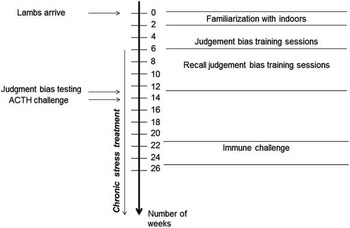
In total, 30 4-month-old female Romane-breed (Romanov×Berrichon du Cher; age=114±2 days; weight=33.5±4.4 kg) lambs were housed in six indoor pens, each housing five lambs, allocated to two adjacent rooms for 2 weeks before starting habituation procedures and experiments. The lambs were fed a daily ration of concentrate in a predictable manner at the same time each morning (0830 h) signaled by a light switched on 5 to 10 min before ration delivery, and given hay and straw in the afternoon (1600 h). The floor of the pens were bedded with straw and the room was artificially lit from 0730 to 1930 h. Lambs were exposed to the human handling required for feeding and pens cleaned once per week. Timing of the experimental procedures is described in Figure 1.
Schedule of the experimental procedures.

Chronic stress treatment
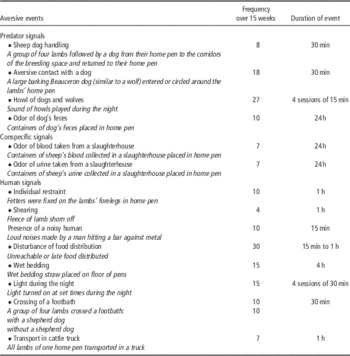
Lambs (n=15) in one room were exposed every day for 15 weeks to a chronic stress model developed by Destrez et al. (Reference Destrez, Deiss, Leterrier, Boivin and Boissy2013a), that is, exposure to aversive events regularly encountered in farming systems. Aversive events fell into three classes known to be biologically significant for sheep (Destrez et al., Reference Destrez, Deiss, Leterrier, Boivin and Boissy2013a), that is predator, conspecific and human cues (Table 1). All lambs as a group were exposed to all of these types of stressors. Each exposure to an aversive event was uncontrollable and unpredictable for the lambs, randomly occurring at different times of the day or night. Control lambs were housed in three pens in the other room (n=15) and thus were not affected by the stressful treatments. Furthermore, to facilitate the ability of all the lambs to discriminate human beings according to type of handling (Rushen et al., Reference Rushen, Taylor and de Passille1999), experimenters wore blue clothing during rearing work, gray clothes with horizontal stripes when leading animals to the tests and white clothing during aversive events (i.e. for stressed animals only).
Aversive events (description, frequency and duration) that stressed lambs (n=15) were exposed for 15 weeks of the chronic stress treatment (Destrez et al., Reference Destrez, Deiss, Leterrier, Boivin and Boissy2013a)

Judgment bias training and testing
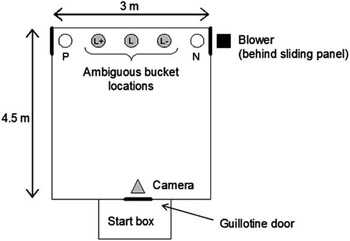
Before 4 weeks of beginning of the stressful treatment, animals were exposed to the judgment bias training and testing apparatus. Then 7 weeks after the beginning of the stress treatment, all the lambs were individually exposed to the judgment bias testing. The test arena was a 4.5×3-m compound with 1.5-m high solid wooden walls. The lambs entered and exited via a guillotine door from a start box. Five locations of bucket were used (Figure 2): a positive location (i.e. with a food reward), a negative location (i.e. with unreachable food, 3 m from the positive one) and three ambiguous locations such as partially positive (L+, 0.75 m from the positive one), central (L, 1.5 m from the positive one) and partially negative (L−, 2.25 m from the positive one). Wooden panels in the front corners of the test pen could also be raised vertically to expose the lamb to a negative stimulus (an automatic fan-forced blower, 40-cm high; Figure 2).
The judgment bias testing facility. For a lamb trained for the left corner to be positive (P) and the right corner to be negative (N), and the three ambiguous locations are partially positive (L+), central (L) and partially negative (L−) from left to right.

Habituation and training procedure
Before being exposed to the judgment bias test, all the lambs underwent a 4-week period of habituation and training performed a month before the beginning of the stress treatment. For 3 days, 30 lambs were habituated daily to the facility by entering in pairs and receiving a food reward (25 g of concentrate and barley). Then, over 3 weeks, the lambs were individually trained to complete an operant task that required them to spatially differentiate two different locations in the testing facility. This spatial differentiation task was adapted from methodology used by Doyle et al. (Reference Doyle, Fisher, Hinch, Boissy and Lee2009). The lambs were randomly assigned to either the left (n=15) or right (n=15) corner of the facility for positive training. Positive training sessions involved the feed bucket being placed in the allocated corner and allowing the lamb to approach and eat from the bucket (25 g of concentrate and barley). This was done over five consecutive sessions in a day for 25 s each. After 2 weeks, negative training (5 days) was initiated in sessions that involved randomly splitting the four consecutive entries into negative or positive events. The fifth entry was always a positive event. This sequence was chosen to prevent the last tested negative association from masking the preceding positive associations made by the lambs. The negative event involved the bucket being placed in the corner opposite the positive location. If the lamb approached within a 30-cm radius of the bucket, the side panel lifted to reveal the blower. The negative bucket contained unreachable food (25 g of concentrate and barley blocked by a shelf) to ensure that the choice made by the lambs resulted from learning the paradigm and not from olfactory cues. As soon as the lamb retreated from the 30-cm radius, the panel was lowered and the blower stopped. After the blower stopped, lambs were returned to the start box. On each entry, the lamb had a 25 s time window in which to approach the bucket before it was deemed a ‘no-go’ response. For the lambs to be classified as trained, they had to approach all the positive buckets (go response) and never approach negative buckets (‘no-go’ response) in two consecutive training sessions. In total, 10 sessions of positive training and five sessions of negative training were required for lambs to reach the criterion.
During the entire training procedure, lambs received only half of their concentrate before each judgment bias training session (based on food reward) to avoid lack of appetite. The other half of the concentrate was provided 30 min after test completion (between 1030 and 1600 h). Of the 30 animals that underwent training, 28 were classified as trained (14 allocated to the control group and 14 to the stressed group) and were exposed to the judgment bias test. Throughout the first 7 weeks of the treatment of repeated exposure to aversive events, all lambs were given a weekly recall training session (one session, consisting splitting the five consecutive entries into negative or positive events). During this period, all the lambs remained trained.
Judgment bias testing
As soon as the last recall training session finished, judgment bias testing began. Judgment assessment was done once and involved presenting the feed bucket in three ambiguous locations in addition to the two learnt locations, one at a time. The three ambiguous locations were as follows: a partially positive location (L+, 0.5 m from the positive corner of the facility), a center location (L, 1 m from both corners of the facility) and a partially negative location (L−, 0.5 m from the negative corner of the facility). The three ambiguous buckets were empty to avoid lambs from perceiving the ambiguous location as positive (i.e. food) or negative event (i.e. inaccessible food). First positive and second negative bucket positions were presented to remind the lambs of the locations they had learnt previously. Then the three ambiguous locations were presented in the order: L+/L−/L. If the lamb did not approach within a 30-cm radius of a bucket within 25 s, this was deemed a ‘no-go’ response and the lamb was released from the test facility. Latency of approach for each bucket location was recorded. Latency of approach for a lamb that did not approach a bucket within 25 s was recorded as 26 s.
ACTH challenge test
All lambs underwent an ACTH challenge test 8 weeks after the beginning of the treatment, on the basis of previously validated methodology (Veissier and Leneindre, Reference Veissier and Leneindre1988). Following the collection of a blood sample (BS1), dexamethasone was injected i.m. (20 µg/kg BW, Dexalone; COOPHAVET, Ancenis, France) in the afternoon before the ACTH challenge to obtain baseline cortisol concentrations. On the following morning, ACTH was injected i.v. (0.7 IU/kg BW, Synacthène ND; Novartis-Pharma, Rueil-Malmaison, France). Blood samples were taken 1 min before and at 30, 120 and 180 min after the ACTH injection (named BS2, BS3, BS4 and BS5, respectively) via jugular venous puncture. All blood samples were immediately centrifuged and the plasma was stored at −20°C until cortisol assay.
Vaccination and blood samples
All lambs underwent a vaccine challenge 15 weeks after the beginning of the chronic stress treatment, that is they were vaccinated at the age of 8 months against ovine chlamydial abortion with the attenuated C. abortus live vaccine strain 1B (Rodolakis and Souriau, Reference Rodolakis and Souriau1983) (Ovilis® Chlamydia vaccine; MSD Santé Animale, Beaucouzé, France) by subcutaneous route. Blood samples (5 ml, with and without anticoagulant ethylenediaminetetraacetic acid (EDTA)) were collected by jugular venous puncture the day before vaccination (D−1) and at D+1, D+3, D+7, D+14 and D+21 after vaccination to analyze antibody and APP responses and blood parameters using a hemogram electronic cell counter (scil Vet abc, Germany). At the same time, other blood samples (5 ml with anticoagulant EDTA) were collected, immediately centrifuged for 10 min at 3000×g, and plasma samples were stored at −20°C until cortisol assay. Vaginal swabs were performed at the same times as blood samples to detect the presence of Chlamydia and the vaccinal strain. Other vaginal swabs were performed on the day of lambing (6 months after the immune challenge) and 1 month after lambing to screen for vaccinal strain. After each blood sample (D−1, D+1, D+3, D+7, D+14 and D+21), rectal temperature was measured using a digital thermometer.
Antibody response and vaginal shedding screening
Antibodies raised against Chlamydia live vaccine strain 1B were analyzed in serum samples using an indirect ELISA kit based on a peptide specific to C. abortus (ELISA ID Screen® Chlamydophila abortus Indirect; ID-VET, France). ELISA tests were performed according to the manufacturer’s instructions, and results were expressed as percent positivity=(sample absorbance/positive control absorbance)×100. Vaginal swabs were subjected to DNA extraction using the QIAamp DNA MiniKit (QIAGEN, Courtaboeuf, France) according to the manufacturer-recommended ‘buccal swab spin’ protocol. DNA was eluted with 150 µl of elution buffer and stored at −20°C before analysis. DNA samples were first screened using a Chlamydiaceae-specific real-time PCR targeting the 23S ribosomal DNA gene (Ehricht et al., Reference Ehricht, Slickers, Goellner, Hotzel and Sachse2006). All samples with a quantification cycle over 38 were considered as negatives. Positive samples were then analyzed with C. abortus and Chlamydia pecorum species-specific PCR systems (Pantchev et al., Reference Pantchev, Sting, Bauerfeind, Tyczka and Sachse2009) for species determination.
Acute-phase protein and cortisol assays
For all days of blood sampling, Hp, SAA and AGP were assayed using a commercial ELISA kit or radial immunodiffusion tests (Tridelta Development, PLC, Dublin, Ireland) according to the manufacturer’s instructions. For all days of blood sampling, plasma cortisol concentrations were determined by a radioimmunoassay method (Boissy and Bouissou, Reference Boissy and Bouissou1994) using an antibody produced by Cognié and Poulin (INRA, Tours, France). Limit of detection was 0.02 ng/ml and within- and between-assay CV values were 6.5% and 13%, respectively, for low controls (4 ng/ml) and 11% and 13%, respectively, for high controls (32 ng/ml).
Statistical analysis
SAS software (version SAS 9.4; SASTM Institute, Cary, NC, USA) was used to analyze the data. The homogeneity of variance was verified. The normal distribution for the residuals of all values was checked on a Q-Q plot. Latencies to approach the different bucket locations in the judgment test were non-normally distributed (i.e. standardized residuals did not meet the assumption of normality on a Q-Q plot) and so could not be analyzed with traditional parametric statistics. A randomization test (a resampling statistical technique called ‘permutation test,’ i.e. a statistical significance test in which the distribution of the test statistic under the null hypothesis was obtained by calculating all possible values of the test statistic under rearrangements of the labels on the observed data points) was used with 10 000 replications (method described by Adams and Anthony, Reference Adams and Anthony1996) as in our previous study (Destrez et al., Reference Destrez, Deiss, Leterrier, Calandreau and Boissy2014). Cortisol concentrations, blood cell count, antibody response to Chlamydia vaccine, Hp, AGP, SAA and temperatures met the requirements for parametric tests to test factor interactions. These data were analyzed using a repeated measures SAS ProcMixed analysis (a mixed procedure in which the variables ‘day,’ ‘treatment’ and ‘day×treatment’ interaction were fixed effects and ‘animals’ was a random effect and lamb was specified as experimental unit). Bonferroni’s post hoc tests were used to find relationships between specific ‘day’ or ‘day×treatment’ subgroups for data our repeated measures model indicated a main effect of treatment or an interaction. Threshold of significance was set at P-value=0.05 for all analyses, and values bracketed between 0.05<P-value<0.1 were considered statistical trends.
Results
Judgment bias testing
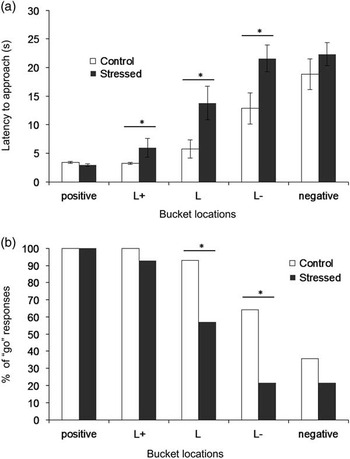
Latency to approach the learnt positive and negative locations of the bucket did not differ between stressed and control lambs (n=28 trained lambs, P positive=0.13 and P negative=0.28; Figure 3), whereas the latencies to approach ambiguous bucket locations (L+, L and L−) were significantly higher in stressed than control lambs (P L+=0.02, P L=0.02 and P L−=0.03; Figure 3a). The number of lambs displaying a ‘go’ response were lower for L bucket (χ 2=4.8, P=0.03) and for L− bucket (χ 2=5.3, P=0.02; Figure 3b) in stressed lambs than in controls. The number of ‘go’ responses did not significantly differ for positive, L+, and negative buckets, L− (χ 2<0.7, P >0.05; Figure 3b) between stressed and control lambs.
(a) Latencies to approach (s) positive, L+, L, L− and negative buckets for control and stressed lambs. (b) Percentage of ‘go’ responses to each of the bucket locations: positive, L+, L, L− and negative of control and stressed lambs (n=28, *P<0.05).

ACTH challenge
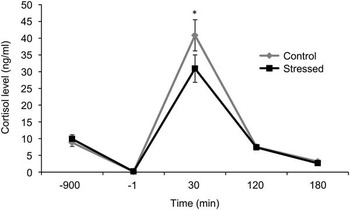
There was no significant effect of treatment on cortisol concentration (F 1,28=2.1; P=0.1). There was a significant effect of time of blood sampling (F 4,25=98.5; P<0.001). There was a significant interaction between the two factors treatment and time of blood sampling (F 9,20=2.5; P<0.05): the highest cortisol concentrations were observed 30 min after ACTH injection (BS3) and the increase was stronger in control than stressed lambs (BS3control=40.9±4.4 ng/ml; BS3stressed=30.9±4.4 ng/ml, P<0.05; Figure 4).
Cortisol concentration response (ng/ml) to the ACTH challenge for control and stressed lambs (blood samples were taken −900 and −1 min before challenge and 30, 120 and 180 min thereafter) (n=30 lambs, *P<0.05).

Vaccination with the Chlamydia live vaccine strain 1B
Effect of treatment
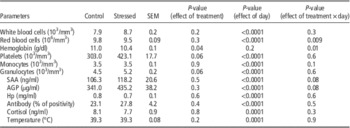
Platelets and granulocyte numbers tended to be higher in stressed sheep than controls throughout the vaccine challenge (Table 2). There was no significant effect of treatment for white blood cell number, monocyte number, Hp concentration, antibody response, cortisol concentration and temperature throughout the vaccine challenge (Table 2).
Effects of treatment (control v. stressed), day (the day before vaccination, the day after vaccination and at the days 3, 7, 14 and 21 after vaccination) and treatment×day interaction on blood parameters, antibody and acute-phase protein concentrations, cortisol concentration and temperature throughout the vaccine challenge in sheep

SAA=serum amyloid A; AGP=α-1-acid glycoprotein; Hp=haptoglobin.
Least squares means±SEM.
Effect of day
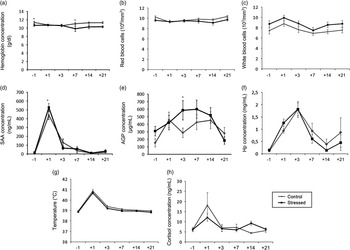
Significant effect of the day in relation to the vaccination with Chlamydia live vaccine strain 1B was observed for white blood cell, platelets, monocyte, granulocyte numbers and Hp concentration, antibody response, cortisol concentration and temperature (Table 2, Figure 5). D+1 was significantly higher than other day timepoints (Bonferroni’s test, P<0.05) for white blood cell number (Figure 5c), body temperature (Figure 5g) and cortisol concentration (Figure 5h). D+3 was significantly higher than other day timepoints (Bonferroni’s test, P<0.05) for Hp concentration (Figure 5f)
(a) Hemoglobin concentration (g/dl), (b) red blood cells number (106/mm3), (c) white blood cells number (103/mm3), (d) serum amyloid A (SAA) concentration (ng/ml), (e)α-1-acid glycoprotein (AGP) concentration (µg/ml), (f) haptoglobin (Hp) concentration (mg/ml), (g) temperature (°C) and (h) cortisol concentration (ng/ml) responses to vaccination with Chlamydia live vaccine strain 1B (in function of days: D−1, D+1, D+3, D+7, D+14 and D+21) for control and stressed lambs (n=30 lambs, *P<0.05).

Effect of treatment×day interaction
There was a significant treatment×day interaction on hemoglobin concentration (Table 2), which was significantly lower in stressed sheep than controls at D−1 and D+7 (Bonferroni’s test, P<0.05; Figure 5a). There was a significant treatment×day interaction on red blood cell number (Table 2) but no significant difference between treatments at the same-day timepoints (Bonferroni’s test, P>0.05; Figure 5b). The treatment×day interaction tended to be significant for the APP responses (Table 2). The SAA response was significantly higher in stressed sheep than controls at D+1 (Bonferroni’s test, P<0.05; Figure 5d) and AGP response was significantly higher in stressed sheep than controls at D+3 (Bonferroni’s test, P<0.05; Figure 5e).
Vaginal shedding
Vaginal shedding screening by PCR found only low shedding of Chlamydiaceae (C t in the range 35 to 38) and only at odd times for six animals (n=4 in the stressed group and n=2 in the control group). C. pecorum was the only detected species.
Discussion
The aim of this study was to describe the effect of a chronic mild stress, in sheep, known to induce a negative affective state on health through a response to vaccine challenge. The effect of chronic stress was investigated by giving an ACTH challenge testing and the negative affective state was investigated by judgment bias testing. In the chronically stressed animals, the adrenal response to ACTH was reduced (30 min after the injection of ACTH), latencies to approach the ambiguous buckets in the judgment bias test were higher indicating a pessimistic-like bias, and the inflammatory response to an immune challenge with a Chlamydia vaccine was increased.
Exposure to various unpredictable and uncontrollable aversive events appeared to induce lower adrenal gland sensitivity revealed by lower cortisol response to ACTH challenge (30 min after the injection of ACTH). The cortisol response after an ACTH injection depends on the characteristic of the stress. Acute stress in animals is widely associated with higher cortisol concentrations (for review Korte, Reference Korte2001), whereas chronic stress leads to less consistent variation (i.e. associated with higher or lower cortisol concentrations in different experiments) (Rushen, Reference Rushen1991). The physiological stress-related response appears to be dependent on time of day of the stressor, type of aversive event (i.e. physical or psychological challenge) and mainly on whether the animal is able to develop a coping strategy. For example, a social instability challenge induced higher adrenal gland sensitivity following an ACTH injection in calves (Veissier et al., Reference Veissier, Boissy, dePassille, Rushen, van Reenen, Roussel, Andnason and Pradel2001), whereas tethering induced apathy and lower adrenal gland sensitivity in bulls (Ladewig and Smidt, Reference Ladewig and Smidt1989). Chronic stress may also have no effect on an ACTH challenge as observed in a previous study in sheep (Destrez et al., Reference Destrez, Deiss, Leterrier, Boivin and Boissy2013a). Here, chronic stress seemed to be associated with lower cortisol concentrations in animals.
Regarding the latencies in judgment test, all lambs took longer to approach the L− bucket than the L bucket and longer to approach the L bucket than the L+ bucket. These results were observed despite the ambiguous buckets being empty, the L+ bucket presented first and the L bucket presented last. Stressed lambs took longer to approach all the ambiguous bucket locations. A judgment bias could explain responses to the ambiguous location. Stressed lambs seemed to display pessimistic-like judgment of the environment and so a negative affective state (Harding et al., Reference Harding, Paul and Mendl2004; Paul et al., Reference Paul, Harding and Mendl2005). Taken together, these results confirmed that the lambs subjected to repeated negative events presented an alteration both of the HPA axis and the environment judgment pointing to a negative affective state.
In this study, hemoglobin concentrations differed between treatments before the vaccine challenge: stressed lambs had lower hemoglobin concentrations at D−1. It was previously reported in humans that chronic stress induces a reduction in hemoglobin concentrations (Ribas et al., Reference Ribas, Martins, Viana, Fraga, Carneiro, Galvão, Bezerra, Castro, Sougey and Castro2011). Here, the vaccine challenge may have mitigated this difference, as a lower hemoglobin concentration was observed in stressed lambs 1 day before the vaccination and again at 7 days after vaccination in stressed lambs. Moreover, vaccination with the Chlamydia live vaccine strain 1B triggered an immediate change in all the other blood parameters associated with hyperthermia, cortisol secretion, acute-phase response and specific antibody response in lambs, thus demonstrating that the challenge was sufficient. SAA and AGP concentrations were significantly higher after vaccination in stressed lambs than controls. A similar SAA pattern was previously reported in a study of maternal undernutrition effects on vaccine response in lambs (Eckersall et al., Reference Eckersall, Lawson, Bence, Waterston, Lang, Donachie and Fontaine2008). The post-vaccination acute-phase response was thought to be stimulated by proinflammatory cytokines known to be involved in the link between the innate and acquired immunity. Some authors have proposed using the production of APP as a marker of animal welfare (Cray et al., Reference Cray, Zaias and Altman2009). Indeed, changes in APP have been observed in stressed animals such as newly weaned calves exposed to new housing situations (Kim et al., Reference Kim, Yang, Upadhaya, Lee, Yun and Ha2011). The higher acute-phase response observed in vaccinated stressed lambs had no significant effect on antibody response to the vaccine. Although we did not analyze the cellular immune response induced after the vaccination, our results did not show major effects of chronic stress on immune response to Chlamydia vaccination in the lambs. This contrasts with previous studies reporting a significant alteration of both antibody and cellular immune responses in humans and mice after viral or bacterial vaccination (Glaser et al., Reference Glaser, Sheridan, Malarkey, MacCallum and Kiecolt-Glaser2000; Nezam et al., Reference Nezam, Hosseini, Kheiri, Abdoli, Memarnejadian, Shenagari, Gholami, Sohani, Rahmatollahi and Jamali2015). The effect of stress on immune responses is indeed highly dependent on the antigenic stimulus (e.g. bacteria or viruses) and the kind of response examined (e.g. humoral or cellular) (Ader and Cohen, Reference Ader and Cohen1993). The effect of stress on immune responses could also be dependent on the type of chronic stress animals were experiencing. Here, physical and psychological stressors were used. Exposure to physical or psychological stressors may produce ‘behavioral depression’ and immunosuppression. For example, Maier et al. (Reference Maier, Silbert, Woodmansee and Desan1990) reported that exposure to inescapable tail-shock stress produces a reduction in spontaneous wheel-running behavior for several weeks in rodents. Oishi et al. (Reference Oishi, Nishio, Konishi, Shimokawa, Okuda, Kuriyama and Machida2003) underlined the importance of distinguishing between physical v. psychological stressors when examining the effects of stress on immune functions in animals. In rats, Oishi et al. (Reference Oishi, Nishio, Konishi, Shimokawa, Okuda, Kuriyama and Machida2003) showed differences in macrophage production, lymphocyte responses and natural killer cell activity between physical (electric foot shock) and psychological (sight, sounds and smells of other rats receiving foot shock) stress groups. In farm animals, von Borell (Reference von Borell1995) also underlined the influence of the type of stressors on health. Hence, differential responses to psychological and physical stressors may explain why our results differ from the previous studies on the effect of stress on immune response to vaccination.
Traces of DNA from Chlamydiaceae were detected in vaginal secretions in few ewes from both the stressed and control groups, but only C. pecorum, a Chlamydial species commonly detected in the gut of ewes, was found in detectable levels. As no Chlamydiaceae were detected after parturition (data not shown), the chronic stress induced before the vaccination could not have modified the immune system’s control of vaccine strain replication.
Conclusion
Chronic stress in sheep induces a negative judgment bias revealing a negative affective state, a stronger inflammatory response to a vaccine challenge, a reduction in hemoglobin concentration and an increase of granulocytes count, but does not affect the antibody response. Improvement of animal health may be achieved through consideration of stressors that may affect the emotional and immunological state of sheep.
Acknowledgments
The authors thank D. Chassaignes and B. Viallard from the experimental farm for their assistance on animal care and the experiment as a whole. MSD’s Animal Health division (France) provided the Ovilis® Chlamydia vaccine, and ID-VET (France) provided the ID Screen® Chlamydophila abortus Indirect ELISA kits. This study was performed with grant support from the French National Research Agency (grant no: ANR-09-BLAN-0339-01) and from the Auvergne region.