INTRODUCTION
Efforts to increase the number of women in politics have been driven by the belief that numerical representation of women will lead to the substantive representation of women, i.e. the inclusion of women voices, ideas, and interests in political debates and decisions (Celis Reference Celis2009). Indeed, the presence of women in parliament positively affects the adoption of maternity and childcare (Kittilson Reference Kittilson2008); women as a group are more likely to support policies as they relate to children/family, education, health care, societal welfare, and the environment (Thomas Reference Thomas1991 on US legislatures; Taylor-Robinson and Heath Reference Taylor-Robinson and Heath2003 on Honduras); women are twice as likely than men to support feminist and pro-equality measures (Chaney Reference Chaney2008 on Wales; Piscopo Reference Piscopo2011 on Argentina; Swers 2005 on US Congress); and women are more likely to co-sponsor or sponsor bills addressing women's issues (Reingold Reference Reingold, Wolbrecht, Beckwith and Baldez2008; Swers 2005; Taylor-Robinson and Heath Reference Taylor-Robinson and Heath2003). Thus, while many scholars have illustrated that the descriptive representation of women indeed translates into the substantive representation of women, less attention has been paid to the other side of the coin: whether and how political actors resist women's substantive representation.
There is little doubt that women in politics can experience pushback against their presence in politics: a nascent but burgeoning literature on violence against women in politics draws attention to physical, psychological, economic, and symbolic violence (see for example Bardall Reference Bardall2013; Krook and Sanin Reference Krook and Sanín2016; Krook Reference Krook2017; Piscopo Reference Piscopo2016). While either form of violence against women in politics can be utilized to silence or ridicule women in politics, this article focuses on symbolic violence which ‘seeks to delegitimize female politicians through gendered tropes denying them competence in the political sphere’ (Krook and Sanin Reference Krook and Sanín2016, 144). Examples of symbolic violence include presenting women as incompetent or ill-suited for political office, sexual remarks on female representatives’ appearance, turning off women's microphone in parliament when it is their turn to speak or not allowing women to take the floor. One commonly employed method to question, oppose, or ridicule a fellow member of parliament is the use of interruptions during parliamentary debates. For example, Georgalidou (Reference Georgalidou2017) found that women are subject to sexist aggression and derogative forms of addresses in the Greek parliament. Likewise, Stopfner (Reference Stopfner2018) shows that in the Canadian, German, and British House of Commons, women are frequently subject to interruptions targeting their appearance, competence, gender roles, or personal traits. Collier and Raney (Reference Collier and Raney2018) analyze the lower Houses in Australia, the United Kingdom, and Canada and find that women are subject to sexist heckles, taunts, and shouting while Erikson and Josefsson (Reference Erikson and Josefsson2018) find that women report being frequently interrupted in the Swedish parliament.
There is also plenty of anecdotal evidence of how male members of parliament use interruptions to discredit women's voices: in the United States, Senator Kamala Harris continued to be interrupted by fellow male Senate Intelligence Committee members when she questioned a witness (Rogers Reference Rogers2017) and Senator Elizabeth Warren was barred from finishing her speech on the US Senate floor (Chappell 2017); in France, representatives Cecile Duflot was mocked during her parliamentary speech for the dress she was wearing (Dresses Unwelcome: French MPs Catcall Female Colleague, 2015); in Canada, representative Chrystia Freeland was unable to properly question the minister because she was interrupted by collective jeering (Maloney Reference Maloney2014); and in Tokyo, assembly member Ayaka Shiomuro was interrupted and told to get married by a male colleague (Sanghani Reference Sanghani2014). Thus, if women are subject to interruptions that do not add substantively to the debate, this will ultimately hamper women's substantive representation (Sanbonmatsu Reference Sanbonmatsu2008). After all, one of the most important parts of being a representative is speaking in parliament to propose new policies, express support or opposition for specific policies, or draw attention to issues important to the representative or her constituency. For women's interests to be heard, at the most fundamental level they need to be able to speak up in parliament.
The use of interruptions to silence women and discredit their expertise has been increasingly highlighted in social and traditional media by referring to these types of interruptions as manterrupting - unnecessary interruption of a woman by a man (Bennett Reference Bennett2015, Bridges Reference Bridges2017). The term manterrupting is typically used to describe women's frustrations of being silenced, ignored, or sidelined in professional or personal conversations. The issue of interruptions in politics is important because interruptions are a show of (verbal) dominance and power which men can utilize to silence or discredit women's voices.
Interruptions can serve many functions (Coates Reference Coates2016; Lawson and Lutzky Reference Lawson and Lutzky2016; Jacobi and Schweers Reference Jacobi and Schweers2017; Palonen Reference Palonen2019): they can be supportive, i.e. adding positively to what is being said or non-verbal affirmation, such as clapping or exclamations of ‘correct’; interruptions can be disruptive, i.e. challenging or confusing the speaker; and interruptions can be displays of power and dominance by taking the floor away from the speaker. Manterruptions in their essence are disruptive and power-grabbing forms of interruptions that play out between male and female members of parliament. Thus, manterruptions can be considered a form of symbolic violence against women. Using the German Bundestag as a case study, I explore whether (a) women are subject to manterruptions in the Bundestag and (b) whether manterruptions are frequent enough to prevent women from realizing the substantive representation of women. If both these conditions hold, manterruptions should be considered a form of symbolic violence against women.
LITERATURE REVIEW
Political discourse is defined by the nature of participants, type of activity, and context in which it takes place (van Dijk Reference van Dijk1997). In parliamentary debates, the participants are elected representatives who engage in a formal discussion of turn-taking where one speaker is followed by another. However, this orderly turn-taking structure is often disrupted by spontaneous responses of fellow members of parliaments such as laughter, heckling, or interruptions (Illie Reference Ilie, Tracy and Sandel2015). Studies exploring legislative speechmaking along gendered lines are less common and typically explore the issue from two main angles: (1) when do women speak and (2) how often do women speak. Regarding the former, women more often than men engage in and initiate debates about women's issues (Pearson and Dancey Reference Pearson and Dancey2011 on the US Congress; Chaney Reference Chaney2006 and Reference Chaney2008 on Welsh Assembly, 2011 on the Scottish Assembly; Clayton et al. Reference Clayton, Josefsson and Wang2017 on Ugandan parliament; Piscopo Reference Piscopo2011 on the Argentinian parliament). Further, Bäck and Debus (Reference Bäck and Debus2016) find that women speak more often on soft policy issues than hard ones (see also Bäck et al. Reference Bäck, Debus and Müller2014 on the Swedish parliament and Fraune Reference Fraune2016 on energy policy-making in Germany and the United States). In terms of speaking frequency, results are mixed: some studies find that gender makes no differences in how often women speak on the floor (see Wang Reference Wang2014 on Ugandan parliament or Murray Reference Murray2010 on French parliament) while others find that women speak less frequently than men (Bäck and Debus Reference Bäck and Debus2016 on European parliaments or Bäck et al. Reference Bäck, Debus and Müller2014 on the Swedish parliament). In contrast, Funk and Taylor-Robinson (Reference Funk and Taylor-Robinson2014) find that women speak more often than men on committees in the Costa Rican parliament when women make up more than 40% of committee members.
While these studies illustrate that gender matters for the behavior of members of parliament, a major gap in these studies is that they only compare men's behavior on the floor to women's behavior rather than exploring floor interactions between men and women. Interruptions are a regular part of parliamentary debate which ‘serves as signals of the existence of a “real” - and fruitful - debate’ (Carbó, Reference Carbó1992, 37). Interruptions occur when they violate the turn-taking structure of parliamentary debate, i.e. when representatives start talking before the speaker has finished his or her speech (Eecke and Fernandez Reference Eecke and Fernández2016). The ability to hold the floor is a valuable political resource that increases the power of individual representatives; interruptions are attempts by others to absorb this political resource to increase their own power (Shaw Reference Shaw2000).
Despite the relative importance of parliamentary speech in representational acts, few studies have studied interruptions in terms of gender interaction effects (Illie 2010; Shenhav Reference Shenhav2008). One shortcoming of existing studies is that these studies focus on the interrupter only. For example, studies analyze how frequently men and women interrupt parliamentary speakers (see for example Edelsky and Adams Reference Edelsky and Adams1990; Shaw Reference Shaw2000, Reference Shaw and Baxter2006) or they compare interruption patterns by men and women; for example, studies have found that men are more likely to interrupt than women and that men interrupt women more often than other men (see Eecke and Fernandez Reference Eecke and Fernández2016 for an overview of the literature; the same findings have also been found for federal judges in the United States, see Patton Reference Dana Patton2017 or Jacobi and Schweers Reference Jacobi and Schweers2017).
To understand gendered patterns of speech interruption, we need to remember that women representatives do not operate in a vacuum; they exist in a political space that for centuries has been dominated by men and has been formed by rules rooted in masculine identities and behavior. In politics, women are not only outsiders to the political space but also potential disturbers of political power equilibria. Thus, a rise of women in politics might elicit negative reactions against women in politics (Bjarnegard Reference Bjarnegard2013; Sanbonmatsu Reference Sanbonmatsu2008) and women's presence in politics potentially can lead to resistance from male representatives for (1) violating gender roles and (2) for challenging gender hierarchies in an institution where men's qualifications and competence are hardly questioned and male dominance is seen as the norm (Bjarnegard Reference Bjarnegard2013; Murray Reference Murray2014). This assumption is backed up by social psychology and masculinity studies which have shown that men often react negatively or even aggressively to challenges of social gender hierarchies or to threats to their masculine identity, especially if women challenge dominant gender roles and stereotypes.
Social role theory argues that there is an assumed link between what individuals do and what their personal characteristics are (Eagly and Karau Reference Eagly and Karau2002; Rudman et al Reference Rudman2012). When it comes to gender attributes, women are considered to have communal skills, e.g. being warm, kind, or supportive, while men are associated with agentic skills, which typically means being assertive, independent, competitive etc. Thus, society and individuals share certain assumptions concerning what the appropriate social roles are for both women and men. Gender stereotypes build on these shared social gender roles and can be divided into descriptive gender stereotypes, i.e. how women are thought to be, and prescriptive gender stereotypes, i.e. how women should act (Burgess and Borgida Reference Burgess and Borgida1999). In a broad sense, communal skills are linked to lower social status and roles as homemakers and caretakers while agentic skills are linked to higher status social roles such as political leadership. Of course, women (and men for that matter) can exhibit female attributes and skills. In fact, studies show that leaders display a mix of both masculine and feminine attributes depending on the context (Grebelsky-Lichtman Reference Grebelsky-Lichtman2017; Baxter Reference Baxter and Madsen2017; Mullany and Young Reference Mullany, Young and Vine2018). However, this does not negate the fact that women are interlopers in the political space. Further, studies on community of practice show that masculine spaces, such as politics, tend to adopt masculine behavioral norms, making it more likely that women will display stereotypical masculine behavior in parliament (Shaw Reference Shaw2013; Cameron and Shaw Reference Cameron and Shaw2016). For example, Jones (Reference Jones2016) show that Hillary Clinton's language became more masculine the higher she climbed the political ladder.
Status incongruity hypothesis in social role theory holds that resistance against women occurs when women act contrary to gender stereotypes and social role expectations as this is perceived as an attempt to undermine the social gender hierarchy (Rudman et al Reference Rudman2012). Because both men and women are (consciously or not) aware of social roles and gender role expectations, this affects their behavior. For example, Brescroll (2011) in an analysis of US Senate transcripts found that powerful male Senators speak longer while powerful female Senators did not speak longer than less powerful ones. Drawing on social role theory, the author concludes that powerful women limit their speaking time as talkative women are perceived as incompetent and unfit for leadership. Similarly, Bäck and Debus Reference Bäck and Debus2016 suggest that social role theory potentially explains why women take the floor less frequently than men: when women take the floor, they visibly find themselves in a gender-incongruent role which makes it more likely that they are judged as being incompetent. Finally, past studies have shown that societies where traditional gender roles dominate have fewer women in politics (see Norris and Inglehart Reference Norris and Inglehart2001; Paxton and Kunovich Reference Paxton and Kunovich2003).
Masculinity studies argue that the sense of a masculine identity depends on the maintenance of traditional gendered social hierarchies and divisions of labor where men are socially superior to women and where men occupy the public sphere, i.e. politics and business, whereas women remain confined to the private sphere (Cheng Reference Cheng2007). The political space in particular, has been constructed by men for men and has been maintained by the marginalization of women from politics (Kimmel Reference Kimmel1993). When these social hierarchies and gendered divisions of labor are violated, it can open the door to resistance against women in politics ranging from defensive and discriminatory behavior, e.g. displays of prejudiced behavior, sexist jokes, the sexualization of women, benevolent sexism, and even sexual harassment (Dahl et al. Reference Dahl, Vescio and Weaver2015; O'Connor et al. Reference O'Connor, Ford and Banos2017; Netchaeva et al Reference Netchaeva, Kouchaki and Sheppard2015). Indeed, past studies have shown that male representatives react negatively to female representatives when the number of women in politics increases: for example, Kathlene (Reference Kathlene1994) finds that increases in the number of women in US state legislatures lead to men becoming ‘more verbally aggressive and controlling of the [committee] hearing’ (560); she argues that despite a growing presence in the legislatures, women grew more silenced and sidelined in the policy making process. Grey (Reference Grey2006) observed that in New Zealand parliamentary debates saw an increase in statements expressing hostility towards feminism as the number of women in the New Zealand parliament grew. Further, Grey finds that the open hostility towards women's issues has ‘made female parliamentarians (…) reluctant to speak for women in parliamentary debates’ (499). These findings correspond with studies in social role theory which have shown that agentic women are more likely to be subject to harassment in male dominated professions, such as politics, where they are more likely to be subject to interpersonal attacks than attacks based on their competence (Burgess and Borgida Reference Burgess and Borgida1999).
While sexual harassment in politics certainly exists, it is less acceptable when it is committed in plain sight of the constituency; and parliamentary debates are typically available as visual or audio recordings. The same is true for other obvious discriminatory attacks such as sexual assault or other forms of physical violence. Thus, resistance against women in politics needs to occur in more subtle and acceptable ways. Since interruptions are institutionalized and acceptable parts of parliamentary debates, men can utilize interruptions to reassert dominance against their female colleagues. Thus, the key question this article addresses is whether manterruptions can be considered a form of symbolic violence against women in politics. To be considered a form of symbolic violence, manterruptions need to impede women's ability to fulfill their representative functions. I propose the following hypotheses, based on the existing findings in the literature discussed above. First, according to the insight provided by parliamentary discourse studies into parliamentary speech interruptions, I expect that regardless of whether the interruption is a manterruptions or not, women will be more frequently interrupted than men. Second, based on expectations articulated by social role theory, I expect that male representatives are more likely to utilize manterruptions when they interrupt women. Third, based on the assumptions of social role theory that agentic women are more likely to be subject to harassment in male dominated professions, such as politics, I expect that women are more likely to be subject to interpersonal attacks than attacks based on their competence. Finally, based on existing findings in masculine hegemonic studies, I expect that manterruptions should be more frequent if women representatives support policies that would upend male dominance in other spheres, such as corporate board quotas do in the business world.
METHODOLOGY AND CONCEPTUALIZATION
To test these hypotheses, this article analyzes gendered speech interruption patterns in the 234th session of the German Bundestag on April 13, 2013 during the 17th legislative period in Germany (2009–2013). Specifically, the analysis will focus on the Gesetz zur Förderung gleichberechtigter Teilhabe von Frauen und Männern in Führungsgremien (law for the promotion of equal participation of women and men in leadership positions) introduced by the opposition parties (the Social Democratic Party and the Green Party) to establish a legal corporate board quota in Germany. Studying instances of male interruptions in female parliamentary speeches in this context has several advantages: first, this case represents a clear instance of the substantive representation of women as the law intended to address gender discrimination in the appointment procedures to corporate boards. This allows us to understand how men react when they are confronted with women's claim-making. To determine whether men interrupt women differently when the substantive representation of women is involved, I also analyze two additional debates: one concerning a gender-neutral topic (internet governance) and one regarding a masculine topic (finance). Second, because the majority of men in the government coalition opposed the proposed bill, it allows me to study whether men used interruptions as a means to discredit women's arguments or the merit of the bill proposal itself. Third, studying a controversial debate of great national interest is in line with many other studies of parliamentary discourse; while these debates might be atypical, they often expose the quintessential features of parliamentary discourse (Bayley Reference Bayley and Bayley2004).
I define interruptions as ‘intrusions into the current speaker's turn’ (Kollock, Blumenstein, and Schwartz Reference Kollock, Blumstein and Schwartz1985, 38). In this article, I focus on verbal interruptions both institutionalized and non-institutionalized (or illegal) interruptions (Illie 2010). Typically, parliamentary rules allow for institutionalized interruptions. In the German case, institutionalized interruptions take the form of an interposed question - Zwischenfrage - which allows a member of parliament to ask a question. The speaker can reject the request for an interposed question if so desired. Non-institutionalized interruptions in the German parliament typically occur when individual members of parliament heckle the speaker or disrupt the speech with acclamations of support or opposition from the bench. I define manterruptions as unnecessary interruptions by men of women. Unnecessary is defined to mean any interruption that does not substantially add to the debate, or what Bärs (Reference Bärs2010) calls apolitical interruptions, i.e. personal insults. This is in contrast to political interruptions which substantially add to the debate and refer to the content of the speech. I define personal insults to mean any interruptions that either (a) discredit a women's expertise on the subject matter or (b) questions a women's professionalism and qualifications as a representative. Adopting this definition of manterruptions, I follow insights from previous research which show that disruptive discourse practices often ‘exhibit gender-related asymmetries in parliamentary power balances’ (Ilie Reference Ilie2013, 502) and that unparliamentary language (i.e. political insults) are based in social and cultural norms (Ilie Reference Ilie, Tracy and Sandel2015). Because parliament and politics more generally are considered a masculine domain and as previous studies, as discussed above, show, political insults are grounded in traditional gender norms and expected social gender hierarchies.
Speech interruptions are identified and analyzed with the help of a qualitative content analysis of the verbatim parliamentary transcript of the 234th sitting of the Bundestag which featured three separate debates lasting 1.5 hours each. The main analysis is limited to one sitting of parliament to increase the likelihood that the same parliamentarians were present throughout the full sitting as well as to hold the background conditions, such as political issues and climate of the day, constant. Both institutionalized and illegal as well as verbal and non-verbal (laughter, applause, etc.) interruptions are marked in the verbatim transcripts of parliamentary debates as such and give the name and party affiliation of the interrupter and the content of the interruption.
The Bundestag is considered a competitive space where debates take on a combative tone and where parliamentary speakers are frequently interrupted and ridiculed by other members of parliament. On average interruptions occur every 1 to 1.5 minutes during a parliamentary speech (Bär Reference Bärs2010) and are used to confuse and derail the speaker. When debating polarizing issues, the level of respect towards the speaker, and thus the frequency and hurtfulness of interruptions can increase (Steiner et al. Reference Steiner, Bächtiger, Spörndli and Steenbergen2004). Over time, interruptions have become longer and often result in a mini dialogue between speaker and heckler whose purpose is to ridicule the speaker (Burkhardt Reference Burkhardt2016). Interruptions then, are not noteworthy per se. However, Burkhardt (Reference Burkhardt, Günthner and Kotthoff1992) found that women are not only more often subject to heckling than men but that they were more likely to be subject to sexist comments on their appearance or competence, i.e. manterruptions.
I coded individual interruptions noting the frequency, object (who is being interrupted), and subject of the interruption (who is doing the interruption). This allows me to understand whether women are more often interrupted by men than vice versa. Further, to assess whether the gendered interruption patterns displayed in the corporate board quota debate are typical or not, this article also analyzes gendered interruption patterns in two other parliamentary debates during the same parliamentary session: one on a gender-neutral subject (internet governance in public life) and the other one on an issue typically considered to be a masculine policy area (economic stability in the European Union - fiscal aid for Cyprus). Further, I also analyze the verbatim parliamentary transcript of an additional four parliamentary debates on the issue of corporate board quotas which occurred in the 17th legislative period which lasted from 2009 to 2013 to gain an in-depth understanding of how gendered interruption patterns played out in the overall corporate board quota debate.
ANALYSIS & RESULTS
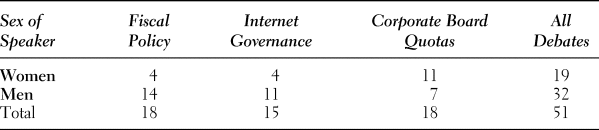
In total, 51 representatives spoke across all three debates; of those, 32 speakers were men and 19 were women. Table 1 shows the breakdown along each debate and shows that in both the gender-neutral topic (internet governance) and the masculine topic (fiscal policy) men made up the majority of speakers while women represented the majority of speakers on the issue of corporate board quotas.Footnote 1
Number of Speakers by Sex in all Debates

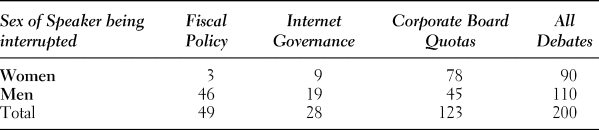
Across all three debates, I recorded a total of 200 interruptions by individuals. Of these, five were legal interruptions in the form of the Zwischenfrage while the rest were illegal interruptions called out by individual members of parliaments from their seats. To test the first hypothesis that women will be more frequently interrupted than men, I count the number of times female speakers are interrupted when they hold the floor. A simple count of interruptions shows that women were interrupted less frequently than men overall but more often in the corporate board quota debate. However, because women represent fewer speakers overall, we need to weigh the number of interruptions comparatively to the number of female speakers in the overall debate. If all 200 interruptions were equally distributed across speakers, men should experience 63% of all interruptions and women should experience 37% of all interruptions. In total numbers, this means 126 interruptions for male speakers and 74 interruptions for female speakers. Yet women experienced a total of 90 interruptions rather than the expected 74. Thus, despite being fewer speakers overall, women are 17.7% more likely to be interrupted. I can thus confirm the first hypothesis: women are more frequently interrupted then men.
Frequency of Interruptions by Sex of Speaker and Debate

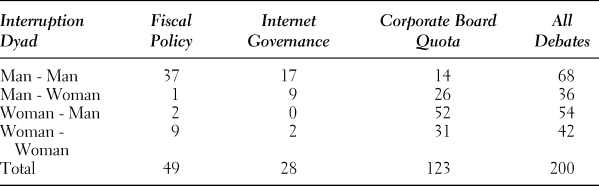
Further, we also need to consider how often female representatives interrupt speakers. If politics is still a male space as many claim, we should see men interrupting women more frequently than the other way around. Contrary to this expectation, I find that women interrupted men more often than vice versa and that men interrupt other men almost twice as often as they interrupt women.
Interruption Dyads by Sex in all Debates

Thus, interruptions of female speakers by male colleagues seems to be more an indicator of regular parliamentary debate behavior than a form of resistance against women.
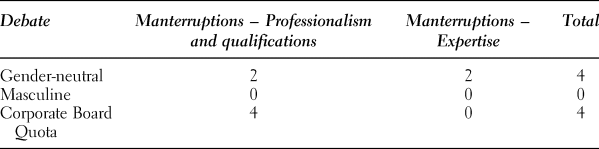
The next question is how often men interrupt women and how often these man-woman interruption dyads classify as manterruptions (hypothesis 2). To test this hypothesis, I both analyze the count and the content of each interruption. In total, men interrupted women once in the fiscal debate, nine times in the gender-neutral debate and 26 times in the corporate board quota debate. Of these interruptions, zero were manterruptions in the fiscal debate, 44% were manterruptions in the gender-neutral debate, and 15.3% in the corporate board quota debate (see Table 4).
Manterruptions across all Debates

The following exchange is an example for manterruptions questioning the expertise of female representatives in the gender-neutral debate:
Female Speaker: Those who question the right to anonymity, guaranteed in the German telemedia law, have, in my opinion, problematic beliefs of how much transparency the state can request from its citizens.
Male MP: The same is true for data storage!
Female Speaker: This is a different issue, we will talk about this later.
Male MP: It is the same issue!
In this example, the male representative questions the female speaker's expertise by interjecting that data storage is also part of the issue. When the female speaker rejects his claim, the male representative doubles down and insists that it is the same issue, essentially asserting that he knows more about it than the female speaker. The questioning of expertise is particularly important because speakers are typically picked for parliamentary debates based on their knowledge about the subject. Here, the female speaker – Brigitte Zypries - was the parliamentary secretary of the Economics and Energy Department. In contrast, the interrupter – Volker Beck – was the Green's party speaker on state and religious matters. Thus, while Beck was less qualified to speak on the issue, he nevertheless questioned the expertise and refused to back down when she rejected his attack on her expertise. While, by its very nature, manterruptions’ purpose is to discredit women's voices, in the cases under consideration, manterruptions are not systemic or frequent enough to represent a form of resistance against women in politics or to prevent the substantive representation of women.
Looking at the type of manterruptions, manterruptions targeted women's professionalism or qualifications three times more often than women's expertise on a policy subject. Thus, I can confirm the third hypothesis 3 that women are more likely to be subject to interpersonal attacks than attacks based on their competence. Below is an example for a manterruptions in the corporate board quota debate questioning the professionalism of the female speaker:
Male MP2: Let's talk more seriously about this topic, will you?
Female speaker: Ladies and Gentlemen, I will say it once more: we have a duty to act. You had the chance today
Male MP: What kind of standard is this!
Female speaker: to make a good decision
This type of interruption serves to question women's professionalism by questioning the seriousness and professionalism with which she approached the subject rather than the merits of the argument presented by the female representative. A much more callous example questioning women's qualification is the exchange below which also occurred during the corporate board quota debate:
Female Speaker: I personally, as a liberal through and through, do not believe in top down orders. Merit based ambitions will pay off
Male MP: How did you then get here?
Here, a male member of parliament interrupts the female speaker right when she claims that women do not need quotas because the merit system works. In essence, he claims that she is not qualified to be a representative and that she herself in unqualified to be a representative.
Finally, I am unable to confirm the final hypothesis that manterruptions should be more frequent if women representatives support policies that would upend male dominance in other spheres. To test this hypothesis, I analyzed all instances of interruptions across all corporate board quota parliamentary debates in the 17th legislative period which lasted from 2009 to 2013. In this particular case (and in contrast to the finding above), I find that men interrupt women more often than other men. Using the frequency of interruption as an indicator, this could mean that men react more strongly against attempts to represent women's interest which challenge traditional gender hierarchies in the public sphere. Yet when taking the ratio of female to male speakers into account, women are actually less likely to be interrupted (24% less likely) while men are more likely to be interrupted (43.4% more likely). In terms of manterruptions, I counted a total of 20 instances across all five debates. Yet, overall, manterruptions accounted for only 9.1% of all interruptions across all five parliamentary debates centered on corporate board quotas and thus, do not make up a significant part of the overall interruptions. Further, when controlling for partisanship, I find that in the German case, men never manterrupted female speakers from their own party.
DISCUSSION
The presented findings suggest that interruption might be driven not by the sex of the speaker but by the speaker's party affiliation or by few male representatives who are more likely to engage in manterrupting. First, if male representatives direct manterruptions both at female speakers from their own party as well as at female speakers from different parties, manterruptions can be considered a resistance against women in politics. I did not find this to be the case in Germany. This is not surprising as the German parliament is governed by strong party discipline where members of each party are not only expected to fall behind official party policy stances but also to vote in accordance with the official party line (Baumann, Debus, and Müller Reference Baumann, Debus and Müller2015). Second, manterruptions might not be a widespread phenomenon but limited to a few specific male representatives. Considering all instances of manterruptions across all five corporate board quota debates plus the gender-neutral parliamentary debate, only eleven men account for all the manterruptions (a total of 24 manterruptions). Further, most of the serial manterrupters were from the conservative parties: five men were from the conservative Christian Democratic Union or Christian Social Union and three were from the conservative Free Liberal Democrats. Together, they accounted for 79.1% of all manterruptions. This finding corresponds with previous findings in the masculinity literature that conservative men are more likely to be threatened by agentic women (Burgess and Borgida Reference Burgess and Borgida1999). The fact that a small group of male representatives account for the great majority of manterruptions brings up several interesting questions that beg further research. For example, as previous studies suggest, men who consider themselves very masculine and highly value traditional gender roles react more strongly to masculine threats (see O'Connor et al Reference O'Connor, Ford and Banos2017). Thus, these serial manterrupters might score higher in terms of masculine identities than other male representatives. Future research should use insights from the social psychology literature to measure masculine identities of male representatives and test whether men who score highly on masculinity traits are more prone to manterruptions. If this is the case, manterruptions can indeed be considered a form of symbolic violence against women in politics.
CONCLUSION
This study represents an initial exploration of men's reaction towards women's presence and claim-making in legislative debates and as such has added to the legislative behavioral literature on gender and floor participation by asking how men and women interact. Case-orientated research is not meant to be generalizable but instead tries to improve our understanding of under-studied issues. Specifically, I tried to determine whether manterruptions in parliamentary debates can be considered a form of symbolic violence against women. While I was able to confirm the first hypothesis – that female speakers are more likely to be interrupted than male speakers – and the third hypothesis – that men are more likely to questions a woman's professionalism and qualifications than their expertise when manterruptions do occur – the analysis presented above is not sufficient to sustain the claim that manterruptions can be considered a form of symbolic violence. In the German case, at least, it seems that women not only are not silenced by their male colleagues in parliamentary debates but also that female MPs have learned to utilize interruptions as a regular part of parliamentary debate behavior. This is in line with previous research that shows that women often adapt to the dominant institutional norms, including the use of interruptions (see Baxter Reference Baxter and Madsen2017; Jones Reference Jones2016; Cameron and Shaw Reference Cameron and Shaw2016).
However, this does not mean that manterruptions do not have the possibility to silence or discredit women's voices as other studies have found that women often stop participating in floor debates due to sexist attacks (see Collier and Raney Reference Collier and Raney2018). The findings presented in this article are limited by the fact that it is a single-case study of a specific parliamentary session. Further comparative research is necessary, particularly the collection of longitudinal data on speech interruptions across more parliamentary sessions and across several legislative periods, to determine when and where manterruptions represent a form of symbolic violence against women in politics. Several avenues of future research seem to be of particular value: first, parliamentary debates are potentially self-regulating as they occur in front of a public audience and recordings are accessible long after the debate has ended. Thus, a public venue of debate might control the behavior of representatives. The lack of manterruptions in the analyzed parliamentary debate consequently could either mean that there is limited resistance against women in politics and the substantive representation of women overall or that resistance against women's presence and claim-making can be contained by a strong norm of party loyalty and the publicity of the venue. If the former is the case, it might be misplaced to analyze parliamentary debates as a forum where resistance against women in politics is enacted, particularly in political systems where strong party discipline exists, such as in Germany. In that case, resistance against women's presence in politics might be articulated behind closed doors rather than openly in parliamentary debate. Thus, future research should explore whether and how resistance against women in politics occurs amongst members of the same party, for example behind closed doors in intra-party meetings or in political institutions closed to public scrutiny such as parliamentary party group or coalition meetings (see Wängnerud Reference Wängerud2015).
Second, it is entirely possible that manterruptions target certain kinds of women differently (see for example Celis, Erzeel, and Mügge Reference Celis, Erzeel and Mügge2015; Wängnerud Reference Wängerud2015). For example, young women might be subject to greater scrutiny or skepticism. The same could be true for women who are perceived to harbor progressive ambitions or to be feminist advocates (see Houvouras and Carter Reference Houvouras and Scott Carter2008; Mansbridge and Shames Reference Mansbridge and Shames2008). While this analysis is outside the scope of this particular article, further research should explore how background characteristics of female speakers impact the type and frequency of interruptions different types of women experience.
Finally, while manterrupting in its essence discredits a woman's presence in parliament by questioning her expertise, qualifications, and professionalism, manterruptions might not be confined to male-female dyads alone. Further research is needed to test whether male representatives interrupt their male colleagues in the same manner, e.g. by questioning their male colleagues’ credentials, professionalism, expertise, or frequency than they do with female representatives. If this is the case, manterruptions might represent a form of general heckling or jeering in parliamentary debates employed to discredit speakers with opposing views rather than a form of symbolic violence. If, however, manterruptions are indeed confined to female speakers, it is more likely that they comprise symbolic violence against women in politics.