Early-life adversity – stressful, maladaptive, or dangerous experiences during childhood or adolescence – is relatively common in the United States, with prevalence ranging from 15.2% to 37.3% (Finkelhor et al., Reference Finkelhor, Turner, Shattuck and Hamby2015). Early-life adversity contributes to compromised adaptation across domains (e.g., neurobiological processes; emotion regulation; physiological responsiveness) that are imperative for successful development (Cicchetti, Reference Cicchetti2013). As such, early-life adversity is a robust risk factor for psychopathology, health risk behaviors, health status, and diseases (Felitti et al., Reference Felitti, Anda, Nordenberg, Williamson, Spitz, Edwards and Marks1998; Kessler et al., Reference Kessler, McLaughlin, Green, Gruber, Sampson and Zaslavsky2010; McLaughlin, Reference McLaughlin2016). However, in line with the concept of multifinality (Cicchetti & Rogosch, Reference Cicchetti and Rogosch1996), not everyone who experiences early-life adversity develops negative outcomes including psychopathology (Kaufman et al., Reference Kaufman, Montalvo-Ortiz and Lee2019). Therefore, it is crucial to examine factors that offer resilience against adversity and compensate for developmental disruptions of adversity (McLaughlin, Reference McLaughlin2016).
Early-life adversity represents a harmful relational experience resulting in stressful challenges for youth (Cicchetti & Lynch, Reference Cicchetti, Lynch, Cicchetti and J. Cohen1995). However, youth have been found to fare better after adversity when they engage in and have positive relationships with others (Masten et al., Reference Masten, Best and Garmezy1990), suggesting that supportive interpersonal relationships over the lifespan may have the potential to buffer the effects of adversity and promote adaptive functioning in youth. The current study evaluated whether interpersonal support – defined as felt closeness, trust, availability, reciprocality, dependability, size, and contact frequency provided by friends, romantic partners, and family members – is associated with risk for depression and anxiety over time more for youth with a history of early adversity exposure (i.e., buffering effect) and/or regardless of early-life adversity exposure (i.e., general benefits).
Youth who experience early-life adversity are at heightened risk for developing psychopathology compared to individuals without such experience; the vulnerability to develop psychopathology persists across the life course (McLaughlin, Reference McLaughlin2016). Data from large epidemiological samples have demonstrated that various forms of early adversity (e.g., death of a parent, emotional abuse) predict depression diagnoses in adulthood (Björkenstam et al., Reference Björkenstam, Vinnerljung and Hjern2017; Felitti et al., Reference Felitti, Anda, Nordenberg, Williamson, Spitz, Edwards and Marks1998; Gibb et al., Reference Gibb, Chelminski and Zimmerman2007; Kessler & Magee, Reference Kessler and Magee1993) as well as a greater likelihood of recurrence and chronicity of depression (Gilman et al., Reference Gilman, Kawachi, Fitzmaurice and Buka2003). Evidence also demonstrates that abuse during childhood is associated with various anxiety disorders (ADs) measured in adulthood (Cougle et al., Reference Cougle, Timpano, Sachs-Ericsson, Keough and Riccardi2010; Gekker et al., Reference Gekker, Coutinho, Berger, da Luz, de Araújo, da Costa Pagotto and Mendlowicz2018; Gibb et al., Reference Gibb, Chelminski and Zimmerman2007; Kilpatrick et al., Reference Kilpatrick, Ruggiero, Acierno, Saunders, Resnick and Best2003; Moreno-Peral et al., Reference Moreno-Peral, Conejo-Cerón, Motrico, Rodríguez-Morejón, Fernández and García-Campayo2014; Spataro et al., Reference Spataro, Mullen, Burgees, Wells and Moss2004). We previously demonstrated that severity of childhood and adolescent adversity was associated with first onsets of major depressive disorder (DD) and AD over 5 years in late adolescence into early adulthood (Vrshek-Schallhorn et al., Reference Vrshek-Schallhorn, Wolitzky-Taylor, Doane, Epstein, Sumner, Mineka, Zinbarg, Craske, Isaia, Hammen and Adam2014). The current study extends this work by examining whether interpersonal support levels over time explain variation in diagnostic outcomes.
An extensive line of research links interpersonal support to positive mental health outcomes (e.g., Alegría et al., Reference Alegría, NeMoyer, Bagué, Wang and Alvarez2018; Gurung et al., Reference Gurung, Sarason and Sarason1997). Two models have been proposed linking interpersonal support to these outcomes: general benefits and buffering. The general benefits model refers to a global promotive effect of interpersonal support on well-being, irrespective of exposure to stressful events such as early adversity (Cohen & Wills, Reference Cohen and Wills1985). Specifically, interpersonal support is associated with positive affect, stability, and predictability as well as reduced negative affect (Cohen & Wills, Reference Cohen and Wills1985; Rueger et al., Reference Rueger, Malecki, Pyun, Aycock and Coyle2016). Interpersonal support has also been posited to confer benefit through pathways including enhanced self-esteem, mastery, purpose, and sense of belonging (Thoits, Reference Thoits2011). There is longitudinal evidence supporting the general benefits model of interpersonal support in reducing the incidence of depression and anxiety diagnoses and symptom severity (Demaray et al., Reference Demaray, Malecki, Davidson, Hodgson and Rebus2005; Kendler et al., Reference Kendler, Myers and Prescott2005; Morrison & Clavenna-Valleroy, Reference Morrison and Clavenna-Valleroy1998). A recent meta-analysis also found overall support for the general benefits model, compared to the buffering model, in relation to depression outcomes in youth (Rueger et al., Reference Rueger, Malecki, Pyun, Aycock and Coyle2016). In a previous study, we examined whether baseline interpersonal support explained variation in diagnostic outcomes in adolescents with and without consideration of neuroticism risk levels (Metts et al., Reference Metts, Zinbarg, Hammen, Mineka and Craske2020). We found that interpersonal support measured at baseline predicted reduced likelihood of first depression and anxiety onsets over 3 years, regardless of neuroticism risk, providing support for the general benefits model. Specifically, there was a negative association between interpersonal support and psychopathology such that as interpersonal support increased, the risk for depression and anxiety decreased. In the current study, we are interested in effects of interpersonal support levels measured longitudinally across adolescence and whether there is evidence for general benefits when examining early-life adversity in these associations.
According to the buffering model, interpersonal support confers benefit by offering protection from the negative effects of stressful events (Cohen & Wills, Reference Cohen and Wills1985), including exposure to early adverse experiences. A modified buffering model allows for general positive effects and buffering effects such that interpersonal support offers benefit to individuals under low and high stress conditions, but those with higher stress show greater benefit of interpersonal support (Stroebe & Stroebe, Reference Stroebe, Stroebe, Higgins and Kruglanski1997). Overall, buffering effects of interpersonal support have received less research support (Rueger et al., Reference Rueger, Malecki, Pyun, Aycock and Coyle2016). Most existing research on buffering effects of interpersonal support focus on concurrent life stressors (e.g., Gore & Aseltine, Reference Gore and Aseltine1995; Burton et al., Reference Burton, Stice and Seeley2004) regarding depression outcomes (see Rueger et al., Reference Rueger, Malecki, Pyun, Aycock and Coyle2016 for review). Existing longitudinal research on buffering effects of interpersonal support against early adverse experiences with regard to anxiety and depression has found that perceived family support, but not school and friendship support, buffered the longitudinal relationship between violence exposure and depressive symptoms, but not anxiety symptoms in an adolescent sample (Shahar & Henrich, Reference Shahar and Henrich2015). A separate longitudinal study also supported buffering effects of perceived family support in the relationship between witnessing intimate partner violence and depressive symptoms in school-aged children (Kennedy et al., Reference Kennedy, Bybee, Sullivan and Greeson2010). Other longitudinal studies, however, fail to find evidence for interactive effects of perceived friend or family support in predicting depressive symptoms (Van Harmelen et al., Reference van Harmelen, Gibson, St Clair, Owens, Brodbeck, Dunn and Goodyer2016) and trait anxiety (White et al., Reference White, Bruce, Farrell and Kliewer1998) in adversity-exposed youth.
The equivocal nature of the findings may be due to reliance upon self-report to capture perceived support (Demaray et al., Reference Demaray, Malecki, Davidson, Hodgson and Rebus2005; Dingfelder et al., Reference Dingfelder, Jaffee and Mandell2010, Kennedy et al., Reference Kennedy, Bybee, Sullivan and Greeson2010; Morrison & Clavenna-Valleroy, Reference Morrison and Clavenna-Valleroy1998; van Harmelen et al., Reference van Harmelen, Gibson, St Clair, Owens, Brodbeck, Dunn and Goodyer2016). Perceived support (i.e., perception that social resources are available) is distinct from the experience that one is loved and cared for by others or structural indicators of support (e.g., social integration; network size; Taylor, Reference Taylor2011). Interpersonal support effects may vary depending on the construct considered (Cohen et al., Reference Cohen, Gottlieb, Underwood, Cohen, Underwood and Gottlieb2000). It is also possible that the methodology of studies thus far has prevented an adequate test of buffering effects of interpersonal support, as such a test would require strong reliability of measures and large sample sizes to detect an interactive effect (Cohen & Wills, Reference Cohen and Wills1985; Rueger et al., Reference Rueger, Malecki, Pyun, Aycock and Coyle2016). Further, stronger evidence for buffering effects is found when measures assess specific interpersonal resources and perceived support as opposed to solely structural indicators (e.g., network size) and utilized support (Cohen & Wills, Reference Cohen and Wills1985; Schwarzer & Leppin, Reference Schwarzer and Leppin1991; Rueger et al., Reference Rueger, Malecki, Pyun, Aycock and Coyle2016). Less is known about buffering effects of interpersonal support that is assessed by reliable interview measurement tapping into multiple aspects of interpersonal functioning.
The present study
The present study aims to extend existing research on interpersonal support effects in the context of early-life adversity. First, we explore these relationships using reliable interview measures. Our measure of early-life adversity – the Childhood Trauma Interview (CTI) (Fink et al., Reference Fink, Bernstein, Handelsman, Foote and Lovejoy1995) – examines maltreatment more dimensionally, considering adversity severity, as well as subtypes of maltreatment, and maltreatment that occurs in different developmental periods. This allows for examination of maltreatment over and above maltreatment versus nonmaltreatment status (Manly, Reference Manly2005). Separately, our interpersonal support measure – the Life Stress Interview (LSI; Hammen et al., Reference Hammen, Adrian, Gordon, Burge, Jaenicke and Hiroto1987; Hammen, Reference Hammen1991) – assesses key structural and functional indicators of supportive interpersonal relationships (e.g., reciprocality, felt closeness, contact frequency) from a diverse range of support sources. Importantly, a semistructured interview addresses key limitations of self-report measures. Self-report measures of interpersonal resources and stressors run the risk of bias by a respondent’s symptomatology and lack the degree of objectivity that independent raters provide, especially in individuals at risk for depression and anxiety (Hammen, Reference Hammen2018). While the use of this measure typically focuses on the end of the spectrum indicating interpersonal stress, the other end of the spectrum indicates good relationships and functioning and effectively assesses interpersonal support as well (Metts et al., Reference Metts, Zinbarg, Hammen, Mineka and Craske2020).
Second, we account for interpersonal support levels over a 5-year follow-up period. Interpersonal support is typically considered at one time point in prospective designs (e.g., Bolger & Eckenrode, Reference Bolger and Eckenrode1991; Metts et al., Reference Metts, Zinbarg, Hammen, Mineka and Craske2020). This approach assumes that support levels remain stable over the prediction period. However, support may be characterized by notable fluctuations over time, especially when youths enter new environments, such as college (Cohen & Wills, Reference Cohen and Wills1985). Therefore, a more robust prospective analysis would account for changes in support over time.
Third, given that vulnerability and resilience change over the course of development (Cicchetti & Rogosch, Reference Cicchetti and Rogosch1996) and that childhood and adolescence are periods during which development may increase sensitivity to adversity (Manly et al., Reference Manly, Kim, Rogosch and Cicchetti2001), we examined adverse experiences occurring in childhood and adolescence separately. Most existing research focuses on adverse experiences throughout childhood without separate consideration of events during adolescence. Developmental tasks occurring concurrently with adversity exposure are interrupted by the experience of adversity (McLaughlin, Reference McLaughlin2016). Additionally, changes in social networks take place across developmental transitions to meet an individual’s developmental needs (Kahn & Antonucci, Reference Kahn, Antonucci, Baltes and Brim1980). Thus, it is possible that interpersonal support effects may differ depending on when youth experience adversity.
Fourth, research on social support effects in relation to anxiety outcomes as compared to depression outcomes is lacking. Given that adolescence marks a period of increased risk for psychopathology onset (Dalsgaard et al., Reference Dalsgaard, Thorsteinsson, Trabjerg, Schullehner, Plana-Ripoll and Brikell2020) and depression and anxiety are the most common mental disorders (Kessler et al., Reference Kessler, Petukhova, Sampson, Zaslavsky and Wittchen2012), attention to both classes of disorders is crucial in examining factors that could explain variations in these outcomes. Therefore, we aimed to examine these relationships predicting onsets of clinically significant DD and AD across adolescence into young adulthood.
We accomplish these aims by using data from the Youth Emotion Project (Zinbarg et al., Reference Zinbarg, Mineka, Craske, Griffith, Sutton, Rose, Nazarian, Mor and Waters2010), a longitudinal study that aimed to examine predictors of depression and anxiety from adolescence into young adulthood, to assess the relationships between adversity, interpersonal support, and depression and anxiety over a 5-year follow-up period. Risk measures can simultaneously function as promotive measures (Masten & Cicchetti, Reference Masten and Cicchetti2016), as is the case with information collected with the LSI. That is, one end of the spectrum can reflect risk effects associated with chronic interpersonal stress and the other end of the spectrum can reflect promotive effects associated with ongoing interpersonal support. Examining solely linear effects would not allow for teasing apart effects primarily representing interpersonal stress from effects primarily representing interpersonal support such that we might erroneously attribute effects of one to the other (i.e., variation in outcomes explained by full range of scores). Given that we were primarily interested in examining general benefits and buffering effects of interpersonal support, we examined whether interpersonal support more strongly predicted our diagnostic outcomes through examination of simple slopes of significant quadratic effects.
Given previous longitudinal evidence supporting general benefits of interpersonal support (e.g., Kendler et al., Reference Kendler, Myers and Prescott2005, Metts et al., Reference Metts, Zinbarg, Hammen, Mineka and Craske2020), we expected that interpersonal support would have an overarching beneficial effect and significantly predict decreased incidence of depression and anxiety as demonstrated by significant negative linear and quadratic effects of the LSI dimension. Second, given work suggesting that positive relationships are particularly beneficial for individuals who experience early harmful relational experiences (e.g., Cicchetti & Lynch, Reference Cicchetti, Lynch, Cicchetti and J. Cohen1995, Masten et al., Reference Masten, Best and Garmezy1990), we hypothesized that interpersonal support would buffer the effects of child and adolescent adversity against onsets of depression and anxiety within the overarching beneficial effect as demonstrated by significant interactions between early-life adversity and the linear and quadratic effects of the LSI dimension. Lastly, in absence of clear directional evidence, we explored the hypothesis that interpersonal support would be differentially associated with child adversity and adolescent adversity.
Method
Participants
Adolescents enrolled in three cohorts from two diverse public high schools in Chicago and Los Angeles participated in an 8- to 10-year longitudinal study aimed to examine psychopathology risk factors during the transition into early adulthood (Youth Emotion Project; Zinbarg et al., Reference Zinbarg, Mineka, Craske, Griffith, Sutton, Rose, Nazarian, Mor and Waters2010). Adolescents were categorized as low-, medium-, and high-risk based on the revised Eysenck Personality Questionnaire-Revised (EPQ-R neuroticism; Eysenck & Eysenck, Reference Eysenck and Eysenck1975). Those who endorsed seven or fewer items were classified as low-scorers. Students who endorsed more than seven but fewer than 12 items were classified as medium-scorers, and those who endorsed 12 or more items were classified as high-scorers. To increase the likelihood of observing onsets of depression and anxiety over the study course, high-scorers were oversampled (Clark et al., Reference Clark, Watson and Mineka1994; Hayward et al., Reference Hayward, Killen, Kraemer and Taylor2000). We also aimed to maintain approximately equal proportions of females to males within each risk category. Detailed sampling procedures can be found in Zinbarg et al. (Reference Zinbarg, Mineka, Craske, Griffith, Sutton, Rose, Nazarian, Mor and Waters2010). Of the 627 who completed baseline interviews, 456 who completed baseline diagnostic and LSIs and at least one follow-up interview, as well as the CTI were eligible for inclusion. CTI completers did not differ from CTI noncompleters in gender (both proportions female = 0.69; χ 2 = 0.001, p = .972), minority group status (proportion Caucasian completer = 0.42, noncompleter = 0.44; χ 2 = 0.245, p = .621; baseline socioeconomic status (SES; completer M = 48.69, SD = 12.57, noncompleter M = 46.43, SD = 13.80; F(1, 611) = 3.72, p = .054), screener EPQ-R neuroticism (completer M = 11.89, SD = 4.52, noncompleter M = 11.91, SD = 4.89; F(1, 625) = 0.006, p = .937), or age (completer M = 16.12, SD = 0.42, noncompleter M = 16.06, SD = 0.38; F(1, 624) = 2.308, p = .129).
The resulting sample had a mean age of 16.12 years (SD = 0.43) at baseline and was 68.9% female and 49.1% White, 14.3% Hispanic/Latino, 13.6% African American/Black, 4.2% Asian, 0.7% Pacific Islander, 12.9% Multiracial, and 5.3% “Other.” Participant’s SES was measured at baseline and coded based on participants’ report of parental education and occupation (Hollingshead, Reference Hollingshead1975). The sample’s scores (M = 48.69, SD = 12.57; range 12–66) indicate that the sample was on average upper-middle class. Participants completed a mean of 5.25 (SD = 0.99) out of six diagnostic and LSIs. Of our sample, LSI data were available for 100% of the sample at baseline, 87.9% of the sample at first follow-up, 81.1% of the sample at second follow-up, 83.9% of the sample at third follow-up, 85.5% of the sample at fourth follow-up, and 89.0% of the sample at fifth follow-up.
Measures and assessment procedures
Childhood Trauma Interview
Early-life adversity was assessed retrospectively using a semistructured interview that collects information on adversity that occurred during childhood and adolescence Fink et al., Fink et al., Reference Fink, Bernstein, Handelsman, Foote and Lovejoy1995). CTIs were administered after the assessment of diagnoses and support levels reported here. Specifically, interviews were conducted by phone beginning in the sixth year of the Youth Emotion Project, when participants were 22–24 years old. Participants reported on adverse experiences between ages 0 and 16 years old. Interviewers completed extensive administration and scoring training that included information on local legal and ethical requirements for reporting abuse of minors to child protection governmental agencies. They were also provided with guidance about asking sensitive interview questions. Participants were asked about six domains of adversity: separation/loss, neglect, emotional abuse, witnessing violence, physical abuse, sexual abuse. Interviewers rated the severity of each adversity endorsed based on over 260 manual examples, using a scale ranging from 1 (minimal/mild) to 6 (very extreme/sadistic). Adversities were counted separately if they differed in perpetrator, severity, frequency, or duration.
Severity scores of 1 and 2 were considered “minor,” scores of 3 and 4 were considered “moderate” and scores of 5 and 6 were considered “severe” adversities (per manual). If participants denied experiencing any event that merited a score, a score of 0 was entered for their summary data. Major events were classified as adversities scored moderate or severe (Vrshek-Schallhorn et al., Reference Vrshek-Schallhorn, Wolitzky-Taylor, Doane, Epstein, Sumner, Mineka, Zinbarg, Craske, Isaia, Hammen and Adam2014). The current analyses used cross-domain aggregate scores of major event severity sums, a summary index previously used in this sample (Vrshek-Schallhorn et al., Reference Vrshek-Schallhorn, Wolitzky-Taylor, Doane, Epstein, Sumner, Mineka, Zinbarg, Craske, Isaia, Hammen and Adam2014). Major events were examined given evidence that adverse events with substantial impact or threat conferring risk for psychopathology outcomes, such as depression (e.g., Brown & Harris, Reference Brown and Harris1978; Monroe, Reference Monroe2008). Adversities were considered separately for 0–9 years old (early/middle childhood) and 9–16 years old (pre-adolescence/adolescence). Age nine was chosen as the cutoff for determining when adversities occurred during development given evidence of prepubertal gonadal hormone changes by this time, which are thought to influence brain development as well as reactivity and sensitivity to adversity (Romeo, Reference Romeo2010). Additionally, age nine was halfway through the CTI assessment period, and roughly corresponds to the mean age of adversity onset in this sample (Vrshek-Schallhorn et al., Reference Vrshek-Schallhorn, Wolitzky-Taylor, Doane, Epstein, Sumner, Mineka, Zinbarg, Craske, Isaia, Hammen and Adam2014). When one adversity pattern spanned both periods, it was counted in indices for both periods.
A rater blind to the interviewer’s scores reviewed slightly more than 10% of audiotaped CTI interviews (n = 94 within-site and cross-site) to determine interrater reliabilities (intraclass correlations; ICCs). ICCs were for major adversity counts were sufficient: major childhood (within-site = 0.84, cross-site = 0.90), major adolescent (within-site = 0.92, cross-site = 0.94; Vrshek-Schallhorn et al., Reference Vrshek-Schallhorn, Wolitzky-Taylor, Doane, Epstein, Sumner, Mineka, Zinbarg, Craske, Isaia, Hammen and Adam2014).
Life Stress Interview
Interpersonal support was derived from the interpersonal domains of the Chronic Stress Interview of the LSI, a semistructured interview of ongoing, typical conditions in 10 life domains (Hammen et al., Reference Hammen, Adrian, Gordon, Burge, Jaenicke and Hiroto1987; Hammen, Reference Hammen1991). Of note, interpersonal support is conceptualized broadly as it encompasses social life, close friendships, romantic relationships, and familial relationships. Each domain was rated by trained interviewers to indicate the severity of chronic stress on a scale ranging from 1 (minimal stress) to 5 (most stress), using half-point increments. Scores of 1 and 5 were considered rare and only for extreme cases. Interviewer ratings were based on objective information about each domain as described below. The LSI was administered at baseline, collecting information that covered the past year of the participant’s life, as well as at five consecutive annual interviews, which covered the time between follow-up interviews.
Because low scores are defined as exceptionally high or good quality in a given interpersonal domain, we conceptualized this end of the spectrum to represent good ongoing interpersonal support. Each interpersonal domain (close friendships; social life; romantic relationships; family relationships) was scored on behaviorally specific anchors. Example anchors for the social life domain were: (1) many good friends, engages in frequent social activities, diverse activities, and friends; (2) some close friends, engages in average number of social activities, less diverse activities, and friends; (3) some contact with friends during week, some activities on weekends, some difficulty keeping friends, less diversity; (4) somewhat isolated from peers and spends considerable time alone, some acquaintances, lacks stable friendships; (5) severe social problems with no friends, totally isolated from peers, rejected by peers. Reverse scoring was used given our interest in whether support (positive end of the support/stress dimension) confers benefit to individuals. Higher scores therefore represented more interpersonal support (Metts et al., Reference Metts, Zinbarg, Hammen, Mineka and Craske2020). Interpersonal support scores used in present analyses were created by averaging scores across the interpersonal domains after ratings in each domain were given.
Reliability was completed for approximately 10% of baseline LSI interviews (n = 76 within-site and crosssite) by independent ratings of audio recorded interviews to determine ICCs. The ICC was .71 for chronic interpersonal stress of the LSI (Doane et al., Reference Doane, Mineka, Zinbarg, Craske, Griffith and Adam2013).
Structured Clinical Interview for the Diagnostic and Statistical Manual of Mental Disorders (DSM)-IV, nonpatient edition (SCID-I/NP)
DD and AD were evaluated by trained interviewers using the Structured Clinical Interview for the DSM-IV (SCID; First et al., Reference First, Spitzer, Gibbon and Williams2002). After screening questions, interviewers administered endorsed diagnostic sections and rated the clinical severity of each diagnosis using the 0–8 Clinical Severity Rating (CSR) Scale (Di Nardo & Barlow, Reference Di Nardo and Barlow1988). Clinically significant disorders (CSR ≥ 4) were used in the present analyses.
Participants completed interviews at baseline assessment and then were contacted by phone or e-mail 10 months after each SCID to schedule the follow-up SCID during the subsequent 5 years. The interval between successive SCIDs was 10–18 months. Participants who were not reached or unable to complete a particular follow-up assessment in that time frame were contacted for the subsequent follow-up assessment. Follow-up SCIDs covered the entire period since the last completed SCID.
All interviewers had at least a bachelor’s degree and underwent extensive training and supervision, and interviewers presented each SCID at consensus meetings led by a doctoral-level supervisor. Crosssite interrater reliability (Cohen’s kappa; Cohen, Reference Cohen1960) for the present study was found to be acceptable to good when aggregated across all disorders (κ = 0.82) and for individual diagnoses including major DD (κ = 0.83) and generalized AD (κ = 0.85; Uliaszek et al., Reference Uliaszek, Hauner, Zinbarg, Mineka, Craske, Griffith and Rose2009).
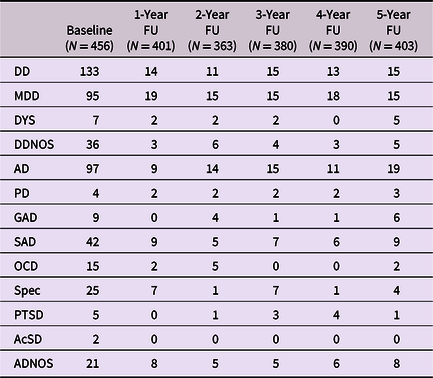
Tests were conducted at the level of diagnostic spectra (i.e., groups of disorders classified together; Zinbarg et al., Reference Zinbarg, Mineka, Bobova, Craske, Vrshek-Schallhorn, Griffith, Wolitzky-Taylor, Waters, Sumner and Anand2016). Table 1 shows the distribution of participants meeting criteria for DDs and ADs at baseline and new onsets over the follow-up period. Study procedures were approved by Institutional Review Boards at Northwestern University (protocol #00007246) and University of California, Los Angeles (protocol #10-001607).
Disorder count by time point

Note. Baseline diagnoses represent individuals who met for past or current diagnoses at the baseline interview. DD and AD counts are inclusive of all depressive and anxiety diagnoses specified here. Any case with a particular diagnosis at a given time point was censored from the subsequent time points of the survival analyses of that diagnosis to ensure that we were predicting onsets of each diagnosis. Some participants met for more than one depressive or anxiety disorder and therefore the DD and AD counts do not represent simple sums of their corresponding disorders. There are more cases of MDD than DD at certain follow-ups because individuals with a diagnosis of a DD other than MDD at an earlier assessment had their subsequent person-years excluded from the analyses of DD but not MDD. Thus, for example, a case with a diagnosis of DDNOS at baseline and an initial diagnosis of MDD at the 1-year follow-up would have been included as a new onset of MDD but not of DD at the 1-year follow-up. AcSD = acute stress disorder; AD = anxiety disorder; ADNOS = anxiety disorder NOS; DD = depressive disorder; DDNOS = depressive disorder not otherwise specified; DYS = dysthymia; GAD = generalized anxiety disorder; MDD = major depressive disorder; OCD = obsessive-compulsive disorder; PD = panic disorder; PTSD = posttraumatic stress disorder; SAD = social anxiety disorder; Spec = specific phobias.
Data analysis
Incomplete variables that contribute to interactive or curvilinear effects (in our case, interpersonal support) require a model-based missing data handling approach that tailors the distributions of missing values (imputations) to the complexities of the nonlinearity (Enders et al., Reference Enders, Du and Keller2020). As unbiased maximum likelihood estimators are not yet widely available for our models, we used Bayesian estimation and the Blimp 3 software for all analyses (Keller & Enders, Reference Keller and Enders2021). Like other contemporary missing data handling approaches, Bayesian estimation assumes a conditionally missing at random process where an individual’s unseen scores carry no information about missingness beyond that contained in their observed scores.
Blimp’s Markov chain Monte Carlo algorithm iterates between two major steps: estimate all model parameters, given the filled-in data from the prior iterations; then use the updated model parameters to estimate (impute) missing values. We used the potential scale reduction factor diagnostic (Gelman & Rubin, Reference Gelman and Rubin1992) to establish the algorithm’s convergence (i.e., initial burn-in period), and we based all analyses on 10,000 iterations following the initial burn-in period. This iterative process produces a distribution of estimates for each model parameter (i.e., a posterior distribution), the center and spread of which serve as point estimates and measures of uncertainty that are analogous to frequentist point estimates and standard errors. We used 95% credible intervals (CIs) to evaluate individual model parameters.
The discrete-time survival analyses followed a multilevel specification with repeated measurements nested within individuals (Singer & Willett, Reference Singer and Willett2003), and analyses used a person-year (stacked) database with diagnostic variables as dependent variables. Diagnostic variables were coded such that individuals were given a score of 0 until the time point at which the onset occurred and a score of 1 when the onset occurred. Data from individuals who developed a disorder at a given assessment were excluded from subsequent time points. Individuals with a lifetime history or current diagnosis of a DD or AD at baseline were included at the first time point given our interest in whether interpersonal support levels over time buffered the effects of previous adversity exposure, rather than solely predicting first onsets. Available follow-up interview data were used as outcomes.
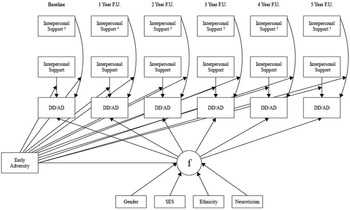
The tested model (Figure 1) included early-life adversity, gender, ethnicity, baseline SES (Hollingshead’s Index; Hollingshead, Reference Hollingshead1975), and baseline neuroticism (general neuroticism factor; Zinbarg et al., Reference Zinbarg, Mineka, Bobova, Craske, Vrshek-Schallhorn, Griffith, Wolitzky-Taylor, Waters, Sumner and Anand2016) as time-invariant covariates. Linear and quadratic effects of the LSI dimension (interpersonal support/stress) were entered as time-variant covariates. Interactive effects between early-life adversity and linear and quadratic effects of the LSI dimension were included to assess buffering effects of interpersonal support.
Tested model. Model tested to examine general benefits and buffering effects of interpersonal support in the context of early-life adversity. Early-life adversity was represented with both child major adversity severity sums and adolescent major adversity severity sums in focal models. “f” is a factor used to specify a proportional odds assumption for the hazards of the event.

An effect primarily representing interpersonal support (the effect of primary interest) should show a flat slope from the end of the spectrum representing high chronic interpersonal stress to moderate scores of the LSI variable and a linear slope from moderate scores of the LSI variable to the other end of the spectrum representing high ongoing interpersonal support. Conversely, an effect primarily reflecting interpersonal stress should show a linear slope from moderate scores of the LSI variable to the end of the spectrum representing high chronic interpersonal stress and a flat linear slope from moderate scores of the LSI variable to the other end of the spectrum representing high ongoing interpersonal support. An effect that is approximately linear without a significant quadratic effect indicates that the effect is neither primarily of an interpersonal support or interpersonal stress nature. Rather, such an effect indicates that variation over the full LSI score range (effects of interpersonal stress and interpersonal support) are associated with variation in the outcome variable (see Figure S1). We previously tested effects of interpersonal support using the LSI dimension in this manner (Metts et al., Reference Metts, Zinbarg, Hammen, Mineka and Craske2020). To follow-up significant interactions or quadratic effects, pick-a-point tests of conditional effects (i.e., simple slopes) were performed to examine the direction, magnitude, and significance of slopes at different levels of the focal variable of interest (Cohen et al., Reference Cohen, Cohen, West and Aiken2003). In addition, Johnson–Neyman analyses were performed to determine regions of significance for the simple slopes (Miller et al., Reference Miller, Stromeyer and Schwieterman2013).
Stationarity was imposed because of the assumption that the effects of interpersonal support on diagnostic outcomes are stable over time (Cole & Maxwell, Reference Cole and Maxwell2003). The four time-variant covariate paths were constrained to not change over waves: the linear effect of interpersonal support; the quadratic effect of interpersonal support; the interaction between early-life adversity and the linear effect of interpersonal support; the interaction between early-life adversity and the quadratic effect of interpersonal.
We used the Bayesian Wald test (Asparouhov & Muthén, Reference Asparouhov and Muthén2021) for model comparisons, which involved constraining parameters in the unrestricted model to their hypothesized values under the null hypothesis model. For the Wald test of linear versus quadratic effects, the quadratic effect of interpersonal support was constrained to 0. For the Wald test of time-specific effects, the interaction between time and interpersonal support was constrained to 0. To examine whether interpersonal support added contribution to diagnostic outcomes beyond early-life adversity, we constrained the linear, quadratic, and interactive effects of interpersonal support to 0. Continuous predictor variables were grand mean centered in all analyses.
Two sets of secondary analyses were also conducted. In the first set, we examined whether the linear and quadratic effects of the LSI dimension were significant above and beyond influence of past diagnoses. Thus, we entered baseline DD diagnosis in the DD model and did the same for AD. Given evidence of the specificity of benefits associated with certain kinds of interpersonal support (e.g., Shahar & Henrich, Reference Shahar and Henrich2015), we further probed the effects of interpersonal support in a second set of secondary analyses. Additionally, because more recent family maltreatment effects may have been captured in the familial domain, we were interested in whether the effects of the full interpersonal support variable remained after removing family ratings from the predictor variable. The interpersonal support variable was separated into two variables: social support and family support. Social support was calculated by averaging ratings across close friendships, social life, and romantic relationship domains. Family support was represented by average ratings in the family domain.
Results
Descriptive statistics
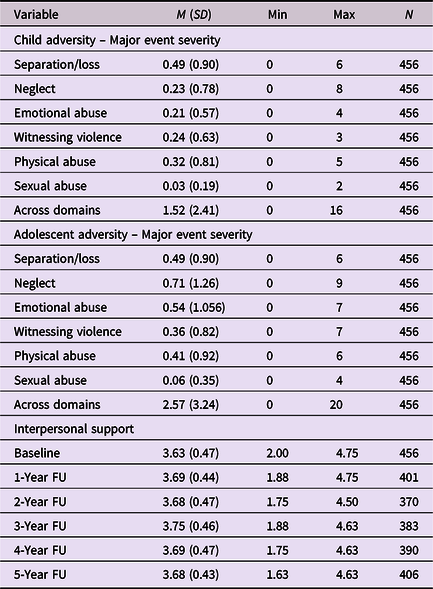
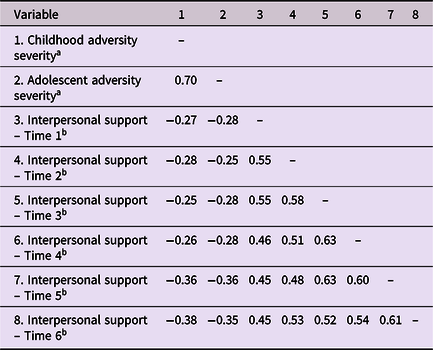
Table 2 reports means, standard deviations, and ranges of child and adolescent adversity by domain and interpersonal support over the study period. Table 3 displays correlations between adversity variables and each time point of interpersonal support.
Descriptive statistics of study variables

Bivariate correlations for early adversity variables and interpersonal support

Note. aChildhood Trauma Interview (Fink et al., Reference Fink, Bernstein, Handelsman, Foote and Lovejoy1995); bLife Stress Interview (Hammen, Reference Hammen1991; Hammen et al., Reference Hammen, Adrian, Gordon, Burge, Jaenicke and Hiroto1987), reverse-scored. All ps < .001 (pairwise deletion).
Model selection
Linear versus quadratic effects
Results from the tests assessing fit of competing models (linear vs. quadratic; time-specific effects) can be found in Table S1. Across models, quadratic slopes were different from 0 (i.e., the 95% CIs did not contain the null value) and Wald model comparison tests similarly supported the quadratic model. Therefore, linear and quadratic effects of interpersonal support were examined.
Time-specific effects of interpersonal support
Across models, Wald tests were significant when considering the set of interaction terms. However, each of the individual 95% CIs for the time-by-support interactions – except for one time point in each DD model – contained the null value 0. We felt that it was difficult to justify including the time-specific effects that were largely indistinguishable from one another, as such effects would not be practically significant. Therefore, these interactive paths were omitted from the models. Additional information about the tests can be found in Table S1.
Unique contribution of interpersonal support
Across models, removing this set of parameters indicated worsened model fit (p < .00). Therefore, interpersonal support added contribution to diagnostic outcomes beyond early-life adversity.
Survival analyses
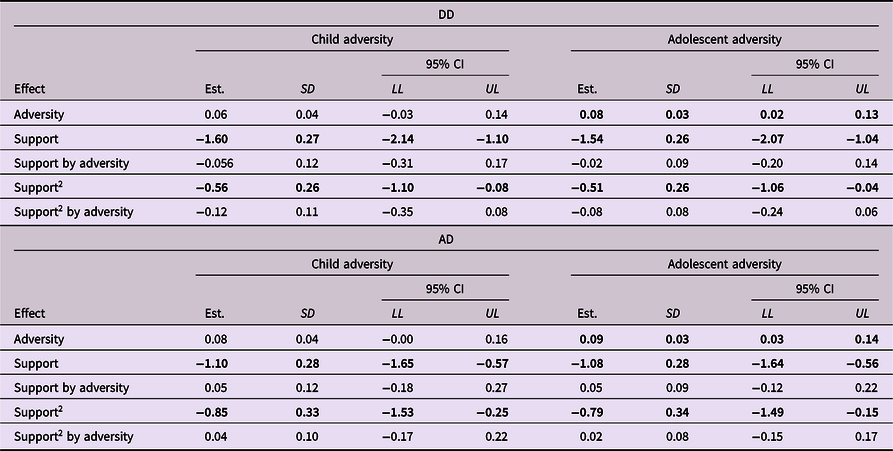
Table 4 summarizes survival analyses results. The estimates column contains Bayesian point estimates (posterior medians), and the SD columns reflect the standard deviations of the estimates (Bayesian measures of uncertainty that are analogous to standard errors in the frequentist framework). As seen in the table, interpersonal support did not significantly interact with child or adolescent adversity to predict DDs or ADs. Results therefore failed to support a buffering hypothesis of interpersonal support against either child or adolescent adversity.
Survival analysis results

Note. Rows containing significant estimates are bolded. Support2 refers to the quadratic effect of interpersonal support. Covariates were gender, ethnicity, SES, and neuroticism. Child Adversity refers to models in which child adversity is included as a predictor. Adolescent Adversity refers to models in which adolescent adversity is included as a predictor. LL = lower limit; UL = upper limit.
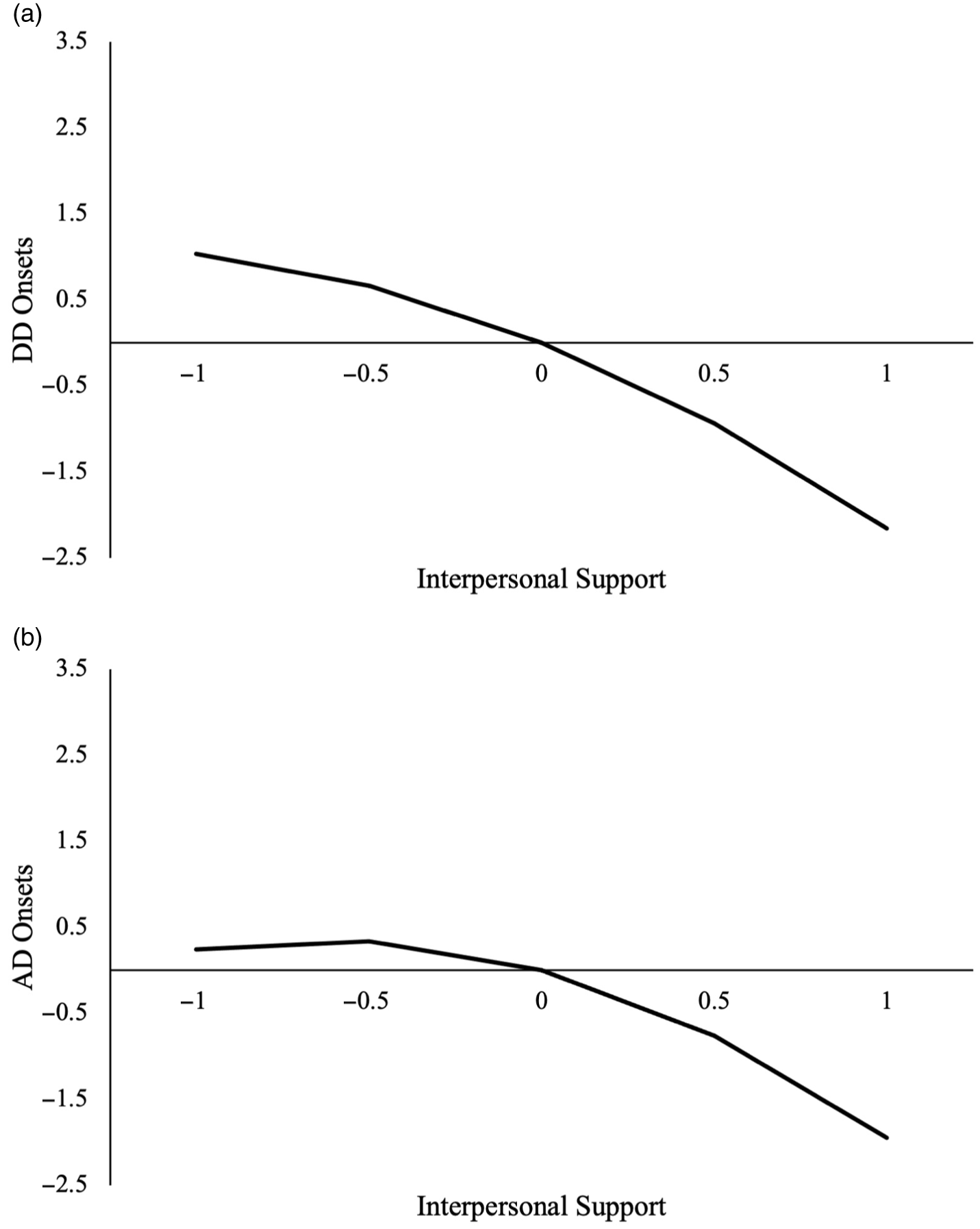
However, quadratic effects of interpersonal support predicted both DDs and ADs at mean levels of adversity, indicating an effect primarily reflecting interpersonal support and providing support for the general benefits model. For both analyses, the lower-order support slope (which is negative) reflects the effect of this variable at its mean, and the negative quadratic term indicates that the slope becomes more negative as support increases. The estimates in Table 4 are on the logit metric, and Figure 2 illustrates the significant linear and quadratic effects of interpersonal support. As seen in the table, DD and AD onset likelihood decreases nonlinearly as levels of interpersonal support increase.
Model predicted regression lines for the quadratic effect of interpersonal support predicting onsets of (a) depressive and (b) anxiety disorders. Y-axis is on a regression coefficient metric. Lines depict the quadratic effect of interpersonal support with child adversity in the model. The vertical height of this function is conditional on 0 values of all predictors. Patterns were similar when including adolescent adversity in the model.

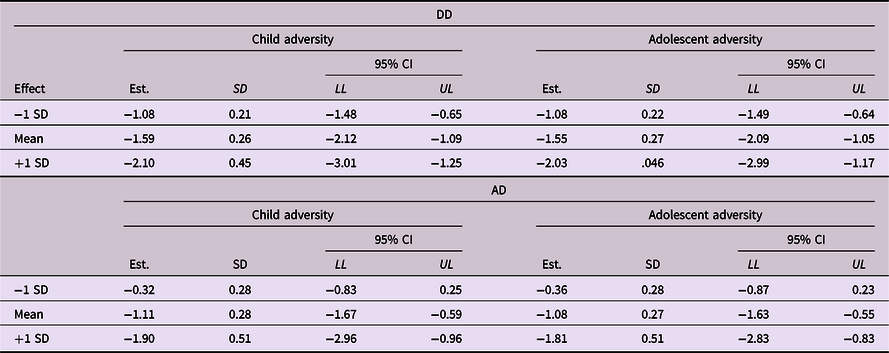
The conditional effects of interpersonal support at different levels of support (i.e., simple slopes) are presented in Table 5. Results indicated that the simple slope of interpersonal support on DD onsets at the mean of adolescent adversity remained significant, but increased, as interpersonal support increased. As explained previously, the interpersonal slope was negative at the support mean, and the effect become stronger (more negative) at higher levels of support and weaker (less negative) at lower levels of support. The 95% CIs did not include 0 at the mean of support or at one standard deviation above the mean, but they did in some cases at one standard deviation below the mean.
Conditional effects estimates and results

Note. Simple slopes represent the effect of interpersonal support on depression and anxiety levels at mean levels of adversity. Child Adversity refers to models in which child adversity is included as a predictor. Adolescent Adversity refers to models in which adolescent adversity is included as a predictor. LL = lower limit; UL = upper limit.
The results in Table 5 illustrate that the effect of support weakens as support decreases, but they do not convey the exactly point in the distribution where the slope is no longer salient. Johnson–Neyman analyses were also performed on the significant quadratic effects in the DD and AD models to identify the region in which the conditional effects are significant. Figure S2 displays Johnson–Neyman plots for the simple slopes of interpersonal support on depression and anxiety onsets at mean levels of adversity. DD model results indicate that the conditional effects are significant for interpersonal support scores ≥ −0.84 units from the mean (−1.44 SDs) in the child adversity models, and they are significant at interpersonal support scores ≥ −0.83 units from the mean (−1.85 SDs) in the adolescent adversity models. Turning to the AD model results, the Johnson–Neyman procedure indicated that the conditional effects were negative and significant for interpersonal support scores ≥ −0.36 units from the mean (−0.81 SDs) in child adversity models, and they were significant at interpersonal support scores ≥ −0.37 from the mean (−0.83 SDs) in adolescent adversity models. Together, results indicate that decreased risk for both DD and AD onsets are associated with increased interpersonal support, with DD outcomes being associated with a wider range of interpersonal support scores than AD outcomes.
There was also a conditional effect of adolescent adversity at the mean of support in predicting DD and AD onsets. These results indicate that higher adolescent adversity severity was associated with greater likelihood of depression and anxiety onsets over the study period. The conditional effect of child adversity at the mean of support did not significantly predict DD or AD onsets.
Secondary analyses
Lifetime diagnosis effects
Table S2 summarizes results from secondary analyses. Results indicated that the linear and quadratic effects remain significant predictors of both DD and AD onsets when baseline diagnoses are in the models.
Social versus family support
Results indicated that the quadratic effect of interpersonal support was evident in predicting AD and DD onsets in social support models in which child adversity was included as a predictor. Results further indicated only a linear effect of social support in predicting AD and DD onsets in social support models in which adolescent adversity was included as a predictor. Only the linear effect of family support was a significant predictor of AD and DD outcomes across all models in the secondary analysis.
Discussion
Results of our analyses over a 5-year follow-up period in adolescents indicated that interpersonal support levels over time predicted DD and AD onsets in a nonlinear fashion. Failing to support a buffering hypothesis, the effects of current interpersonal support levels did not significantly vary with early adversity occurring during either childhood or adolescence. Yet, interpersonal support over time independently predicted decreased depression and anxiety. This adds to findings from Metts et al. (Reference Metts, Zinbarg, Hammen, Mineka and Craske2020) by demonstrating that patterns of interpersonal support over 5 years predict depression and anxiety after adding adversity to models.
Our general benefits finding demonstrated that interpersonal support reduces the onset of depression and anxiety that did not significantly vary with adversity is consistent with prior research supporting the general benefits model (Demaray et al., Reference Demaray, Malecki, Davidson, Hodgson and Rebus2005; Kendler et al., Reference Kendler, Myers and Prescott2005; Rueger et al., Reference Rueger, Malecki, Pyun, Aycock and Coyle2016). Our use of a global measure of support may explain evidence for our general benefits finding, in that these measures tap into a variety of stable connections (Cohen & Wills, Reference Cohen and Wills1985). The lack of evidence for a buffering effect of interpersonal support against adversity exposure is consistent with some prior findings (White et al., Reference White, Bruce, Farrell and Kliewer1998; van Harmelen et al., Reference van Harmelen, Gibson, St Clair, Owens, Brodbeck, Dunn and Goodyer2016), but not others (Kennedy et al., Reference Kennedy, Bybee, Sullivan and Greeson2010; Shahar & Henrich, Reference Shahar and Henrich2015). Our measurement may explain divergence from some prior work (Kennedy et al., Reference Kennedy, Bybee, Sullivan and Greeson2010; Shahar & Henrich, Reference Shahar and Henrich2015). Specifically, the measure of interpersonal support used in this study was based upon interviewer ratings of objective indicators of support that participants felt from close others (e.g., felt closeness), structural support (e.g., network size), as well as enacted support (e.g., availability). Past work has often relied on self-reported, perceived interpersonal support, which is distinct from actual support (Cohen et al., Reference Cohen, Gottlieb, Underwood, Cohen, Underwood and Gottlieb2000). It has been posited that buffering effects may depend on the use of measures that tap into an individual’s perceived availability of support as opposed to utilized support (Schwarzer & Leppin, Reference Schwarzer and Leppin1991).
Separately, the “matching hypothesis” has been proposed suggesting that social support is beneficial in response to stress when the support provided meets the specific needs of the recipient (Thoits, Reference Thoits1995; Taylor, Reference Taylor2011). Therefore, global measures of support may not tap into the level of specificity needed to capture a buffering effect. Less than perfect statistical power might also account for our nonsignificant findings as well as those reported by others. Our results from analyses with and without interpersonal support in the statistical model indicate that the effect of objective indicators of global interpersonal support over time promoting mental well-being remains when risk posed by a wide range of early adverse experiences are included in the statistical model.
Follow-up analyses of the quadratic effects of interpersonal support demonstrated that the effect of interpersonal support more strongly predicted decreased depression and anxiety outcomes as interpersonal support levels increased. These findings demonstrate a more nuanced effect than our previous work that considered only baseline support levels (Metts et al., Reference Metts, Zinbarg, Hammen, Mineka and Craske2020) when analyzing interpersonal support longitudinally and including adversity severity in models. Results regarding interpersonal support effects were relatively similar whether considering adversity in childhood or adolescence. This pattern suggests that early adversity is subject to similar effects of interpersonal support, regardless of childhood versus adolescent timing.
The quadratic effect of interpersonal support was driven by close friendships, social life, and romantic relationship domains as opposed to the familial domain in models in which child adversity was included as a predictor of depression and anxiety outcomes. This suggests that variation along the full range of scores representing both support and stress in the familial domain are associated with depression and anxiety outcomes. Therefore, whereas benefits of effects primarily representing interpersonal support were demonstrated by both social and family models, the adverse effects of interpersonal stress in the familial domain seem to be equally potent predictors of outcomes compared to stress in social domains. Nonetheless, this result deserves replication given that the quadratic effect of social support was only evident in child adversity models. Our use of the LSI to capture functioning in the family domain encompasses significant and enduring problems, particularly regarding one’s relationships with parents. Whereas LSIs assessed interpersonal functioning over the 1-year period of the interview in adolescents, reported experiences may reflect earlier relationship strain with family members during childhood and adolescence. This aspect of reported information could potentially explain why the full range of scores in the familial domain results in variation in depression and anxiety outcomes compared to other interpersonal domains.
Our findings have important intervention implications, some of which have been previously suggested and to which our findings lend confidence and some of which are novel. First, given that early adversity is a robust risk factor for depression and anxiety, early intervention targeting youth contexts or youth response to their contexts are crucial (Hazel et al., Reference Hazel, Hammen, Brennan and Najman2008). Our findings suggest that addressing effects of more proximal major adversity in adolescence is a potent target to address in conjunction with current support and stressors as compared to more distant major adversity. Separately, our interpersonal support findings point to leveraging strength in existing support systems, even long after adversity occurs. Strengthening family environments and social connections in adolescents seems to reduce risk of both depression and anxiety onsets. Given the correlational nature of our data, one potential implication of this work would be to conduct a randomized controlled prevention trial to test the potential benefits of boosting interpersonal support. Examples include whether social interaction skills training (Segrin, Reference Segrin2000), engaging in pleasant activities with friends and family members to increase positive emotions (Craske et al., Reference Craske, Meuret, Ritz, Treanor and Dour2016), or strengthening current social functioning and close relationships (Markowitz & Weissman, Reference Markowitz and Weissman2004) can reduce depression and anxiety onsets. Additionally, one could test whether targeting interpersonal support has differential effects on depression compared to anxiety. Whereas the current study adds to the small but growing literature on the importance of interpersonal relationships regarding anxiety outcomes, more research on interpersonal support benefits for anxiety interventions is needed.
This study possesses several strengths, including its longitudinal nature relatively large, diverse sample, and consideration of both depression and anxiety outcomes. Further, we targeted adolescence, a developmental stage marked by heightened vulnerability for internalizing disorders (McLaughlin & King, Reference McLaughlin and King2015) and social environment sensitivity (NASEM, 2019). Therefore, this is a key time at which to identify environmental factors like interpersonal support that could offset risk effects. Our measures are also strengths. Our reliable interview measure of adversity elicited details of what actually happened to provide event narratives that are later rated by trained raters for characteristics (e.g., severity). Self-report questionnaires of adversity are subject to consequences of intracategory variability of actual events reported in broad checklist categories (Dohrenwend, Reference Dohrenwend2006). Further, interpersonal support data were gathered from a reliable semistructured interview of indicators of support that participants felt from close others (e.g., felt closeness), structural support (e.g., network size), as well as support that was enacted from close others (e.g., availability, contact frequency) conducted by independent raters with consensus ratings. Thus, we captured a different construct than participant self-report measures of perceived support, which is a different construct (Cohen et al., Reference Cohen, Gottlieb, Underwood, Cohen, Underwood and Gottlieb2000). Self-report measures of constructs such as interpersonal support also run the risk of being obscured by a respondent’s symptomatology and lack the degree of objectivity of independent raters (Hammen, Reference Hammen2018). Therefore, this study’s use of reliable measures increases confidence in existing findings supporting the general benefits model of interpersonal support.
Study limitations include the restriction of outcomes to diagnostic variables, which prevents claims about interpersonal support effects upon functional outcomes that may better capture the construct of resilience (Kalisch et al., Reference Kalisch, Müller and Tüscher2015). In terms of measurement, diagnoses and interpersonal support were reported prior to information collected on the CTI (Fink et al., Reference Fink, Bernstein, Handelsman, Foote and Lovejoy1995), which was administered retrospectively when participants were 22–24 years old. Our repeated measurements of support took into account current support levels and therefore may not capture the support or lack thereof that took place at the time of adversity exposure, therefore complicating the extent to which we could have seen true buffering effects. It is also possible that the presence of disorders and interpersonal support may have biased reporting later such that individuals may have catastrophized prior experiences to rationalize negative outcomes or interpersonal stressors (Brown & Harris, Reference Brown and Harris1978). Recent research also demonstrates poor to moderate agreement between retrospective and prospective measures of early-life adversity (Baldwin et al., Reference Baldwin, Reuben, Newbury and Danese2019; Newbury et al., Reference Newbury, Arseneault, Moffitt, Caspi, Danese, Baldwin and Fisher2018). However, this has been found to affect interview measures less than questionnaires due to clearer definitions of maltreatment, anchors, and greater participant engagement in interviews (Baldwin et al., Reference Baldwin, Reuben, Newbury and Danese2019). Nevertheless, our results may be more applicable to individuals identified by retrospective measurement of adverse early experiences.
Further, our results may underestimate the effects of adversity given that our sample was on average upper-middle class and potentially representative of lower adversity prevalence compared to a lower SES population on average. However, given that there is a dearth of research on effects of early-life adversity in middle and upper SES environments (Cicchetti, Reference Cicchetti2013), the present study address an important gap in existing research. Separately, we treated SES as a static risk factor. It is possible that one’s SES could have changed over the course of the study period and therefore baseline SES may not be indicative of one’s status across the prediction period. Methodologically, we included individuals with a history of disorders at baseline and therefore do not capture purely prospective risk associations. However, excluding individuals who met criteria for depression or anxiety at baseline would result in a uniquely resilient sample that would not properly address the research question. In addition, our participants were oversampled on neuroticism. Thus, the current results may be limited in the degree to which they can generalize to adolescents who are not elevated on neuroticism and at lower risk for depression and anxiety onsets. Lastly, early-life adversity in this sample represented a range of severities across domains, with severe adversities being relatively rare, particularly in childhood. As such, it is possible that interpersonal support effects specific to a type or severity level may be obscured.
Interpersonal support is associated with decreased risk for both depression and anxiety in adolescents when adjusting for exposure to early-life adversity that occurred during childhood or adolescence. Thus, fostering friendships and familial relationships and skills to maintain their health seem to be important targets. Future research should go beyond the specified adversities in the CTI (Fink et al., Reference Fink, Bernstein, Handelsman, Foote and Lovejoy1995) and examine early experiences of poverty and discrimination in these associations. Future work should also focus on mechanisms that account for the benefit of interpersonal support in relation to depression and anxiety (e.g., interpersonal emotion regulation; Marroquín, Reference Marroquín2011). Further elucidation of what explains variability in negative outcomes can inform how to promote resilience in individuals at risk for depression and anxiety.
Supplementary material
The supplementary material for this article can be found at https://doi.org/10.1017/S0954579422000116.
Acknowledgments
We thank Dr. Suzanne Vrshek-Schallhorn, who developed scoring methods for the Childhood Trauma Interview data, Dr. Andy Lin, who provided consultation on the statistical analysis, Mr. Cole Ziegler, who assisted with model figure design, and Ms. Ekin Kiyici, who assisted with the initial literature search.
Funding
This research was supported by a two-site grant from the National Institute of Mental Health (NIMH) to Susan Mineka and Richard Zinbarg [R01-MH065652] and to Michelle Craske [R01-MH065651].
Conflicts of interest
No authors have any conflicts of interest to declare.