Introduction
Research into mentally ill populations shows that patients frequently have a poor understanding of their condition and that, accordingly, a cornerstone of treatment is psychoeducation to address this issue in the interest of the therapeutic alliance (Pekkala and Merinder Reference Pekkala and Merinder2002; Bellack et al. Reference Bellack, Bennett and Gearon2007). Patients with a primary diagnosis of personality disorder may know less about their diagnosis than other diagnostic groups and this may reflect polarised views among mental health staff regarding both the validity and treatability of personality disorder (Stephens, Reference Stephens2000). An assessment of the understanding patients had of their personality disorder diagnosis by D'Silva & Duggan (Reference D'Silva and Duggan2002) found that only one (of 11) had a good understanding while four (36%) had no or a poor understanding. Further, only two (18%) knew their diagnostic categories while over half (64%) had no knowledge at all. The majority (eight patients, 73%) had not had their diagnosis explained to them, while two of the other three patients had forgotten the explanation. The authors conclude that diagnostic information is often not available and that it is often not relayed to patients who are in most need of it (D'Silva & Duggan, Reference D'Silva and Duggan2002). A more recent survey (Getachew et al. Reference Getachew, Dimic and Priebe2009) found that patients with mental illness have limited access to standard psychoeducation programmes.
The needs of patients with a primary diagnosis of personality disorder have been increasingly recognised since the publication of best practice guidance by the National Institute for Mental Health in England (2003). Providing patients with clear explanations regarding their condition and its treatment is particularly important for women with borderline personality disorder (Linehan, Reference Linehan1993) who are subject to intense social labelling processes as being mentally ill (due to frequent hospitalisation and visible scars) and who show higher levels of shame and self stigma (Rusch et al. Reference Rusch, Lieb, Bohus and Corrigan2006). Improved understanding of the diagnosis and its treatment (National Institute for Health and Clinical Excellence, 2009) is key to the recovery approach in mental health (Shepherd et al. Reference Shepherd, Boardman and Slade2008) and in particular, to the promotion of hope that goals can be met.
Psychoeducation, defined by the National Institute for Health and Clinical Excellence (2006), as ‘any structured group or individual programme that addresses an illness from a multi-dimensional viewpoint as well as providing service users and carers with information, support and management strategies’, is key to treatment engagement. Over one third (37%) of people in treatment for personality disorder do not complete therapy (McMurran et al. Reference McMurran, Huband and Overton2010) and non-completion is associated with poorer treatment outcomes when compared with treatment completion (Webb & McMurran, Reference Webb and McMurran2009). Adequately preparing people for treatment however, has the potential to improve engagement. Ogrodniczuk et al. (Reference Ogrodniczuk, Joyce and Piper2005) listed a variety of strategies to prepare patients while Banerjee et al. (Reference Banerjee, Duggan, Huband and Watson2006) developed psychoeducational interventions to develop skills and attitude to help patients make the best use of therapy. The development of psychoeducation programmes for male in patients with personality disorder has been well received (D'Silva & Duggan, Reference D'Silva and Duggan2002). Imparting knowledge about personality difficulties, instilling beliefs about capability for change and building rapport have been found to improve pre-treatment knowledge and working alliance in detained personality disordered offenders (Banerjee et al. Reference Banerjee, Duggan, Huband and Watson2006). Zanarini and Frankenburg's (Reference Zanarini and Frankenburg2008) randomised trial of psychoeducation for women with borderline personality disorder (BPD) concluded that it was a useful and cost efficient form of pre-treatment that helped to alleviate two of the core elements of BPD: impulsivity and unstable relationships. However, despite the potential value of these interventions there have been few evaluations particularly with women in secure settings (McMurran, Reference McMurran2012).
This pilot study aims to evaluate the benefit of a psychoeducation group programme for women with personality disorder admitted to a medium secure setting. The evaluation assesses pre- and post-intervention measures of knowledge, session attendance and psychological constructs (shame, self stigma) in addition to examining differences between treatment completers and non-completers.
Method
Patient group and setting
The Women's Service at St Andrew's (an independent charitable trust) has personality disorder, mental illness and learning disability care pathways. Women admitted to the Personality Disorder treatment pathway on two medium secure wards (with 13 and 15 beds respectively) over a two year period were invited to participate in group treatment.
Concurrent with attendance at population-specific manualised cognitive behavioural therapy groups (Long et al. Reference Long, Fulton and Hollin2008), patients attend a variety of treatment sessions led by psychology, occupational therapy and nursing staff. These are needs-led and include self care, daily living skills, education, physical health and exercise and recreational skills.
Group treatment
The Understanding Personality Disorder group employs a closed group format and consists of six, hour long sessions. It is preceded by an individual orientation session and followed by a post-group individual session. Time limited (30 minute) individual sessions occur on an ‘as needs’ basis to address any issues arising from group sessions and to clarify information issues.
The individual orientation session involves discussing the purpose and content of the group, practical considerations (dates, times, names) and the potential benefits of attendance. It enables the potential participant to raise questions and concerns about attendance. Pre-treatment assessments are usually completed at this meeting.
Sessions cover understanding and awareness of personality disorder; understanding and reducing associated stigma; and treatment approaches. Session material is adapted from psychoeducation programmes (Healy, Reference Healy2008) for secure settings with emphasis on overcoming stigma and recovery. The content is listed below:
-
• Session 1: Introduction to group programme
-
• Session 2: Understanding personality disorder: what does it look like? (What does personality disorder mean; what are the symptoms?)
-
• Session 3: Understanding personality disorder: how does it develop?
-
• Session 4: The challenges of personality disorder: stigma
-
• Session 5: A positive approach: recovery treatment
-
• Session 6: Treatment approaches (tackling therapies and medication).
Participants complete a number of in-session group exercises designed to enhance the learning of concepts and material presented. Responses are noted and given back to participants in the form of a hand out at the commencement of the next session.
Measures
Pre- and post-group intervention measures assessed knowledge of personality disorder, treatment engagement, stigma, hope and self efficacy. In addition, global measures of in-patient behaviour, risk and symptomatology were used.
Knowledge of Personality Disorder Questionnaire (KPDQ)
A 14 item true/false ad hoc questionnaire was developed to assess participants’ knowledge of the information disseminated in the group. The maximum knowledge score is 14.
Treatment engagement
Attendance at care programme timetabled sessions was recorded. Treatment engagement was defined as both attendance and active participation in programmed sessions. Active participation was defined using the following criteria: participated in at least one activity in the group; made at least one appropriate verbal contribution; and concentrated to the best of her ability. Rates of engagement in the three months prior to treatment were compared to the three months following treatment.
The Stigma Scale (SS)
Stigma reduction is a primary outcome measure for group psychoeducation interventions for mental health (Morriss et al. Reference Morriss, Lobban, Jones, Riste, Peters, Roberts, Davies and Mayes2011). The 28 item stigma scale (King et al. Reference King, Dinos, Shaw, Watson, Stevens, Passetti, Weich and Sertaty2007) has a three factor structure: discrimination, disclosure and positive aspects of mental illness. The ten item disclosure scale (e.g. ‘I do not feel bad about having had mental health problems’) was used. Items refer to managing information about the condition to avoid discrimination and scores correlate highly with the overall stigma score (Pearson r = 0.794, p < 0.001) and negatively with global self esteem (r = 0.545, p < 0.001). Items are scored on a 0–4 scale (maximum score is 40) with higher scores reflecting greater stigma. Cronbach's alpha for the disclosure subscale was 0.85 (King et al. Reference King, Dinos, Shaw, Watson, Stevens, Passetti, Weich and Sertaty2007).
Adult State Hope Scale (ASHS; Goals Scale for the Present)
This six item self-report questionnaire assesses goal directed thinking in any given moment or situation (Snyder et al. Reference Snyder, Sympson, Ybasco, Borders, Babyak and Higgins1996). The scale has three agency items (e.g. Q6: ‘At this time, I am meeting the goals that I have set for myself’) and three pathway items (e.g. Q5: ‘I can think of many ways to reach my current goals’). Items are scored using an eight point Likert scale with total hope scores ranging from 3–24 with high scores representing high hope. No descriptive statistics or norms are reported on the ASHS as scores fluctuate according to circumstances. The scale has good reliability (Cronbach's alpha range from 0.79 to 0.95 for overall Hope Scale).
Generalized Self Efficacy Scale (GSES)
The GSES is a ten item self-administered scale that assesses the strengths of an individual's belief in his or her own ability to respond to difficult situations and to deal with any associated obstacles or setbacks (Jerusalem & Schwarzer, Reference Jerusalem and Schwarzer1992). Test and re-test reliability for women was found to be 0.63 and in terms of predictive validity the measure correlated positively with measures of self-esteem (0.40) and optimism (0.56) (Schwarzer, Reference Schwarzer1993).
Short Term Assessment of Risk and Treatability (START)
START is a 20 item clinical guide designed to structure regular clinical assessment regarding the evaluation of mental disorders, monitoring of patients’ progress, planning of treatment and estimation of seven short term risks (maximum of three months) to the self and others (Webster et al. Reference Webster, Martin, Brink, Nicholls and Desmarais2009). Both strengths and vulnerabilities are assessed. For the purpose of this study, ratings of patients’ strengths, in terms of insight, coping, and emotional state were used. START has demonstrated good internal consistency (Nonstad et al. Reference Nonstad, Nesset, Kroppan, Pedersen, Nottestad, Almvik and Palmstierna2010) and convergent validity with the Historical Clinical Risk 20 (HCR-20; Webster et al. Reference Webster, Douglas, Eaves and Hart1997; Singh et al. Reference Singh, Grann and Fazel2011). The reliability of START coding is indicated by intra class correlation coefficients greater than 0.85 (Desmarais et al. Reference Desmarais, Nicholls, Read and Brink2010).
In-patient/Institutional Behaviour Scale (IIBS)
The In-patient/Institutional Behaviour Scale (M. Dolan & R. Fullam, unpub. scale, 2001) is rated by the patient's care coordinator. Statements are used to guide ratings of 0–3 for behaviour observed in the previous month: self destructive behaviour (three items); personal care (two items); social behaviours (three items); destructive behaviour (four items); institutional behaviour (eight items); relationships with external systems (two items); and interpersonal behaviour and relationships (eight items). The following items were used: self harm, suicide ideation, participation in ward/hospital programmes, compliance with drug treatment, responsibility for own behaviour, insight into disorder, insight into risk, relationship with primary nurse and relationship with staff.
Brief Psychiatric Rating Scale – Expanded Version (BPRS-E)
The BPRS-E is widely used in outcome research and has 24 symptom constructs, each rated on a seven point scale from ‘not present’ to ‘extremely severe’ (Lukoff et al. Reference Lukoff, Neuchterlin and Wenture1986).
Ethical Approval
The current study formed part of a wider evaluation of St Andrew's Healthcare Women's Service with approval from an NHS research ethics committee (LNRI 06/02501/91).
Statistical Analysis
Data was entered into PASW Statistics 18.0 (SPSS, 2009). The χ2 test was used for categorical data and t tests for normally distributed data. A Bonferroni correction was applied to reduce the possibility of Type 1 error.
Results
Patient group
A total of 36 women out of 42 consecutive referrals with a diagnosis of emotionally unstable personality disorder agreed to participate in group treatment; their mean age was 23.4 years (SD 9.2 years; range 18 to 45 years). All were detained under a section of the Mental Health Act 1983 and had a history of disturbed behaviour, particularly self-harm, and emotional dysregulation. The majority of participants had been admitted from other medium secure units (n = 21; 58.3%) or from prison (n = 15; 41.7%); index offences ranged from major violence (n = 7; 19.4%) to arson (n = 9; 25%) and assault, minor violence and ABH (n = 17; 47.2%). Three patients had no index offence.
Completers vs non-completers
Five group programmes were run. Patients who attended five (83%) or six (100%) group sessions were classified as treatment completers in accord with previous research in secure settings (Long et al. Reference Long, Dolley and Hollin2011); 22 women (61.1%) were completers while 14 (38.9%) were classified as non-completers.
Comparisons of the completers and non-completers revealed that the former were older (mean age 27.6 years, SD = 4.5 vs 23.2 years, SD = 1.8; t (34) = 3.98, p < 0.05) and were more likely to have previous experience of psychotherapy [n = 16, 73% vs n = 2, 14%, χ2 = 14.21, (1)]. Only one non-completer had previously engaged in group therapy. Completers had also been in treatment for longer periods of time compared to non-completers (mean = 5.84 months, SD = 1.7 months vs mean = 3.2, SD = 2.4 months, t = 2.87, p < 0.01).
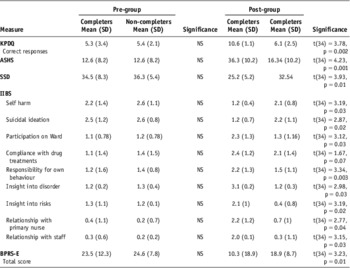
Prior to the commencement of group therapy there were no significant differences between completers and non-completers in terms of knowledge of personality disorder (KPDQ), Hope (ASHS), Stigma (SSD), Inpatients Institutional Behaviour Ratings (IIBS), Generalized Self Efficacy (GSES), symptomatology (BPRS-E) or START ratings of emotional state, insight and coping as strengths.
Table 1 shows significant post-group differences between completers and non-completers.
Pre- and post-group comparisons of completers and non-completers

KPDQ, Knowledge of Personality Disorder Questionnaire; ASHS, Adult State Hope Scale; SSD, Stigma Scale Disclosure; IIBS, In-patient/Institutional Behaviour Scale; BPRS-E, Brief Psychiatric Rating Scale – expanded version.
START items rated as strengths post-group differentiated between completers and non-completers in terms of: Emotional State (completers n = 11 (50%) vs non-completers n = 3 (21%), χ2 (1) = 12.9, p < 0.01); Insight (completers n = 14 (64%) vs non-completers n = 2 (14%), χ2 (1) = 13.63, p < 0.01); and Coping (completers n = 10 (45%) vs non-completers n = 4 (28%), χ2 (1) = 14.6, p < 0.01).
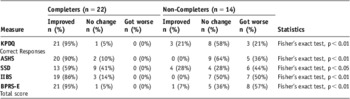
Table 2 shows those who either improved, did not change or got worse in the completer and non-completer groups. Significant post-treatment differences between the two groups were apparent on all measures. Between 86% and 95% of completers improved on four of the five psychometric measures and none got worse. In contrast the percentage of non-completers who either got worse or did not improve varied from 72% to 100% on the five psychometric measures. Improvements were evident for a minority of non-completers on knowledge of personality disorder (21%) and stigma disclosure (28%).
Post-group comparisons of completer and non-completers

KPDQ, Knowledge of Personality Disorder Questionnaire; ASHS, Adult State Hope Scale; SSD, Stigma Scale Disclosure; IIBS, In-patient/Institutional Behaviour Scale; BPRS-E, Brief Psychiatric Rating Scale – expanded version.
Table 3 shows differences in session attendance pre- and post-treatment. Treatment completers completed more sessions following group therapy and were also more likely to attend more than ten sessions per week.
Session attendance pre- and post-group attendance

14 (64%) out of 22 completers had attended and completed over three core cognitive behavioural therapy groups (Interpersonal Effectiveness, Dealing with Feelings and Social Problem Solving) compared to only 3 patients (21%) from the non-completer group (McNemar test χ2 (1) = 12.36, p < 0.01).
Discussion
Current results show that women completing the Understanding Personality Disorder group were more knowledgeable about their condition following the intervention than non-completers. This difference was reinforced by independent staff ratings of insight into disorder (START), and insight into risks (IIBS).
Implicit in the delivery of the group was the hope that psychoeducation about personality disorder would aid therapeutic alliance and treatment engagement. Tarrier (Reference Tarrier2006) described the therapeutic relationship as crucial to engagement with patients with long standing complex problems as seen in forensic environments. Although this was not formally assessed, staff IIBS ratings show significant post-group changes in terms of relationships with staff and with the primary nurse. Significant changes were evident in terms of mean number of sessions attended per week and the percentage of those attending ten or more sessions weekly.
Perhaps not surprisingly, improved engagement was reflected in reductions in ratings of overall symptomatology (BPRS-E); improvement in emotional state and coping (START); and staff rated improvements of self harm, suicidal ideation and responsibility for own behaviour (IIBS). The association between treatment engagement, symptom improvement and risk reduction has previously been noted in studies of women in secure settings (e.g. Long et al. Reference Long, Dolley and Hollin2011, Reference Long, Dolley and Hollin2013).
Women with borderline personality disorder have higher self stigma than other diagnostic groups that is linked to low self esteem and other indices of poor psychological well being (Rusch et al. Reference Rusch, Lieb, Bohus and Corrigan2006). Patients completing the group showed significantly higher hope (ASHS) and significantly lower stigma disclosure scores. The latter finding reinforces previous reports that suggest that stigma can influence how a psychiatric diagnosis is accepted, whether treatment will be adhered to, and how people with mental illness function in the world (Dinos et al. Reference Dinos, Stevens, Sertaty, Weich and King2004). Concern about disclosure is a major theme of past research (Dinos et al. Reference Dinos, Stevens, Sertaty, Weich and King2004) highlighting the fact that subjective feelings of stigma can occur in the absence of direct discrimination (Jacoby, Reference Jacoby1994). Just as attempts to avoid disclosure result in stress, isolation and a sense of shame (Dinos et al. Reference Dinos, Stevens, Sertaty, Weich and King2004), current results indicate a greater willingness to disclose to be associated with symptomatic improvement.
Our results also indicate an increase in the measure of hope for group treatment completers, which is central to the concept of recovery (Wright & Barber, Reference Wright and Barber2011). Two of the factors that contribute to hopefulness in patients include relationships with others, and experiencing success in daily life and managing mental health (Kylma et al. Reference Kylma, Juvakka, Nikkonen, Karhonen and Isohanni2006). These are reflected in the current study.
The current intervention adds to a growing body of literature that attests to the value of brief psychoeducation in terms of instilling belief about the ability to change by improving working alliance and promoting skills to make the best use of therapy (Banerjee et al. Reference Banerjee, Duggan, Huband and Watson2006; McMurran & Jinks, Reference McMurran and Jinks2012). Training a wide range of staff to deliver such education including the awareness of the neurobiology that underlies personality disorder (Porr, Reference Porr2010) may also help to modify the negative attitude held by some toward working with such patients (McGrath & Dowling, Reference McGrath and Dowling2012).
This study has limitations common to uncontrolled ‘real world’ service evaluations. Treatment completers were older with previous experience of psychotherapy and the observed changes cannot be unequivocally attributed to the described intervention given the concurrent influence of other therapeutic interventions such as medication. However, the specificity of the assessment measures and treatment goals and the delivery of a manualised treatment programme by trained staff and the failure by treatment non-completers to improve to the same extent as completers lends evaluative support to a programme with clear face validity.