Introduction
The pepper weevil, Anthonomus eugenii Cano (Coleoptera: Curculionidae) is a major pest of pepper crops, genus Capsicum Linnaeus (Solanaceae). First described by Donaciano Cano y Alcacio (Cano Reference Cano1894), the pepper weevil is native to Central America, Mexico, and the southwestern United States of America (Clausen Reference Clausen1978). It has also spread to the Caribbean and French Polynesia, with sporadic occurrences in Italy, The Netherlands, Hawaii, and southern Canada (Nederlandse Voedsel-en Warenautoriteit Reference Gibson2013; Speranza et al. Reference Speranza, Colonnelli, Garonna and Laudonia2014). To meet market demand in Canada, peppers are often imported to supplement local production, generally from southern regions where the pepper weevil is widespread. These imports can be the source of subsequent outbreaks of the pest when retail locations and/or packing facilities are in close proximity to field or greenhouse pepper production (Canadian Food Inspection Agency 2011; Baker et al. Reference Baker, Eyre, Matthews-Berry, Anderson and MacLeod2012; Nederlandse Voedsel-en Warenautoriteit Reference Gibson2013). Similarly, movement of alternate Solanaceous hosts and/or packing materials from the established range of the pepper weevil can serve as potential sources of invasion (Costello and Gillespie Reference Costello and Gillespie1993). In the United States of America, pepper weevil was recently identified as a significant pest as far north as New Jersey, likely the result of infested pepper shipments from the known range of the pest (Ingerson-Mahar et al. Reference Ingerson-Mahar, Eichinger and Holmstrom2015). Through a similar pathway, the pepper weevil was reported in 1992 in southern British Columbia, Canada, but was eradicated shortly thereafter (Costello and Gillespie Reference Costello and Gillespie1993). It was subsequently found in greenhouses in southern Ontario, Canada in 2009 and 2010; however, no regulatory action was taken (Canadian Food Inspection Agency 2011; Nederlandse Voedsel-en Warenautoriteit Reference Gibson2013). Although it is unclear whether pepper weevil is able to permanently establish and overwinter in Canada, repeated annual invasions may result in localised, transient populations that are able to cause significant damage to greenhouse and field peppers during a given growing season. Such an event occurred in 2016 in southern Ontario in field and greenhouse pepper crops (Fernández et al. Reference Fernández, Sinclair, Van Laerhoven and Labbé2017), and clearly demonstrates that this pest can have a serious impact in major pepper growing regions in Canada. Furthermore, rising global temperatures resulting from climate change may facilitate the establishment of species that were previously unable to survive the harsh winter climate (Hellmann et al. Reference Hellmann, Byers, Bierwagen and Dukes2008), and this once transient pest problem may progress into a more permanent and global concern.
Management of the pepper weevil is based on scouting, physical pest exclusion, cultural practices (i.e., removing and disposing of infested fruit), and chemical control of adults (Frantz and Mellinger Reference Frantz and Mellinger1998; Servín et al. Reference Servín, Aguilar, Martínez, Troyo and Ortega2002). Management tactics targeting the potentially more vulnerable immature life stages (e.g., egg, larvae, and pupae) are generally not feasible because these life stages all occur within the protected environment of the pepper fruit. Thus, the adult weevil is the only life stage that can be targeted for management using pesticides. Concerns over the development of insecticide resistance and the undesired effects these have on beneficial arthropod communities has led to consideration of biological control as a means of pest management.
Documentation of releases of parasitoids that attack the pepper weevil has come from Mexico, the southern United States of America, and Hawaii. From 1934 to 1937, introductions of Eupelmus cushmani (Crawford) (Gibson Reference Gibson2016) (Hymenoptera: Eupelmidae) and Jaliscoa hunteri (Crawford) (Gibson Reference Gibson2013) (Hymenoptera: Pteromalidae) were performed in Hawaii and resulted in successfully established populations of the parasitoids for biological control of pepper weevil (Clausen Reference Clausen1978). Recently, there has been renewed interest in biological control of the pepper weevil, namely to assess the efficacy of Triaspis eugenii Wharton and López-Martínez (Hymenoptera: Braconidae) (Toapanta Reference Toapanta2001; Rodríguez-Leyva Reference Rodríguez-Leyva2006) and J. hunteri in field bell pepper in Florida, United States of America (Schuster Reference Schuster2012). In fact, Shuster (Reference Schuster2012) demonstrated that J. hunteri significantly reduces the number of weevil-infested bell pepper fruit. Recent natural enemy surveys have documented a considerable diversity of parasitoids associated with the pepper weevil, and relatively little is known regarding their ecology and host range. Hymenopteran parasitoids from at least five families have been identified from the pepper weevil, including members of the Braconidae (Urosigalphus Ashmead, Bracon Fabricius, Aliolus Say, Triaspis Haliday), Eurytomidae (Eurytoma Illiger), Eulophidae (Ceratoneura Ashmead, Baryscapus Förster), Eupelmidae (Eupelmus Dalman), and Pteromalidae (Jaliscoa Bouček) (Cortez et al. Reference Cortez, Cabanillas and Armenta2005; Rodríguez-Leyva et al. Reference Rodríguez-Leyva, Stansly, Schuster and Bravo-Mosqueda2007). Among these, Rodríguez-Leyva et al. (Reference Rodríguez-Leyva, Stansly, Schuster and Bravo-Mosqueda2007) found that T. eugenii, Urosigalphus species, and J. hunteri, accounted for 96% of all specimens collected in Mexico. To determine if parasitoids are associated with transient, seasonally established populations of the pepper weevil in southern Ontario, Canada a survey was conducted to identify the pepper weevil natural enemy community in this region.
Materials and methods
Collection of insects
Surveys were conducted weekly at multiple locations in southwestern Ontario from April to November 2016. Sampling began in Essex County, where the pepper weevil was first detected in fields beginning in April. As the pepper weevil range expanded in late summer, sampling was extended to Norfolk and Elgin Counties. In total, 10 locations were surveyed, including six conventional and one organic pepper fields, as well as two conventional and one organic pepper greenhouses.
Fruits that showed pepper weevil damage, including calyx yellowing, oviposition marks or premature fruit drop (Campbell Reference Campbell1924; Addesso et al. Reference Addesso, McAuslane, Stansly and Schuster2007) were collected from each location. Peppers belonging to six varieties of Capsicum annuum Linnaeus (Solanaceae) including hot cherry, banana, mini sweet, bell, jalapeño, and chili were collected as available. Also collected directly from plants were peppers of the scotch bonnet variety of Capsicum chinense Jacquin (Solanaceae), although no signs of oviposition or weevil emergence were detected from this variety. A total of 2604 aborted peppers were collected, with a range of sample sizes from each location as available. Collected peppers were maintained in a fine mesh bag sealed and held in a single pepper layer so as to reduce the decomposition of peppers within. All peppers were maintained in a controlled environment chamber set at 24 °C, 16 hour photoperiod, 50% relative humidity. Once a week, emerged weevils and natural enemies were collected and counted from each pepper batch. Peppers were monitored for up to five weeks, until no further adult weevils or parasitoids emerged for at least one week. Peppers were then cut open and checked for any remaining weevils or parasitoids before being discarded. Per cent parasitism was calculated for each batch of peppers collected ((#emerged parasitoids/#weevils+#emerged parasitoids)×100). Emerged weevil and parasitoid specimens were preserved in 90% alcohol. Specimens were sent to the National Insect Identification Service, Agriculture and Agri-Food Canada, Ottawa, Ontario, where they were identified by taxonomic experts and deposited at the Canadian National Collection of Insects, Arachnids, and Nematodes.
Genetic characterisation of parasitoids
To contribute to the development of a DNA barcode database for parasitoids associated with the pepper weevil, the DNA barcode region of the mitochondrial cytochrome oxidase I (COI) gene was sequenced for representative specimens of each parasitoid species collected and for which vouchers were deposited at the Canadian National Collection of Insects, Arachnids, and Nematodes. To clarify the identity of specimens belonging to the Bracon genus, all 16 of the individuals collected were sequenced. Genomic DNA was non-destructively extracted from the whole body of adult parasitoids, using a Chelex DNA extraction protocol (Walsh et al. Reference Walsh, Metzger and Higuchi1991) that has been optimised for extraction of parasitoid DNA in 96-well plate format (T.D.G., unpublished).
A portion of the cytochrome c oxidase subunit 1 (COI) mitochondrial gene was amplified by polymerase chain reaction using universal primers LCO and HCO2198 (Folmer et al. Reference Folmer, Black, Hoeh, Lutz and Vrijenhoek1994). Purified polymerase chain reaction products were sequenced bi-directionally (with above primers) on an ABI 3730 DNA analyser at the Robarts Research Institute (London Regional Genomics Centre, London, Ontario, Canada). Forward and reverse sequences were edited and assembled in Sequencher version 5.4.1 (available from www.genecodes.com) and were deposited in BOLD (www.boldsystems.org) and GenBank (www.ncbi.nlm.nih.gov/genbank/) databases. Interspecific distances were calculated using the K2P method in BOLD (Kimura Reference Kimura1980).
Results
Parasitoid emergence
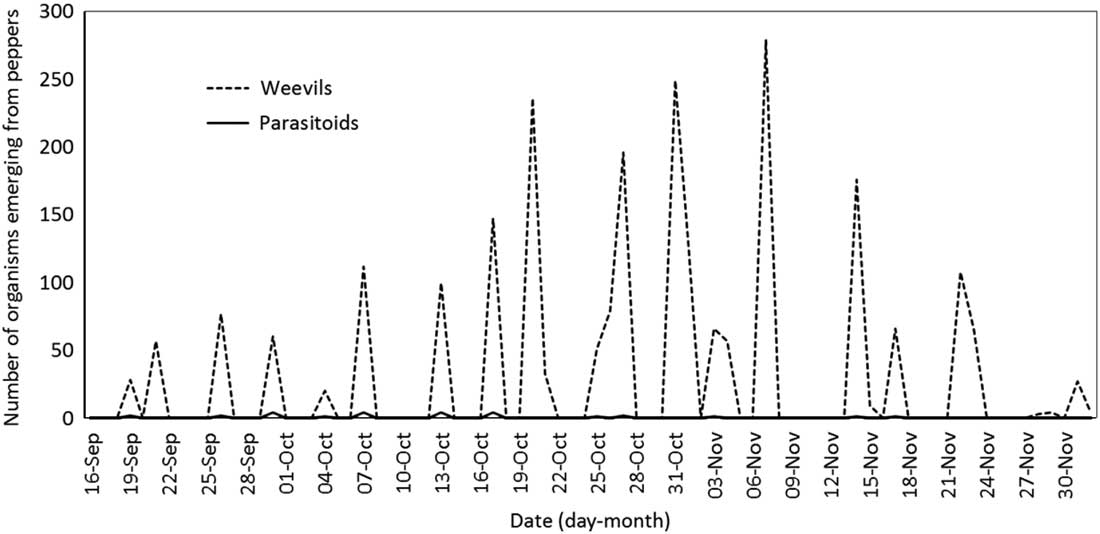
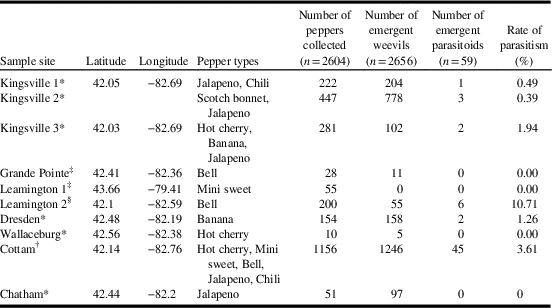
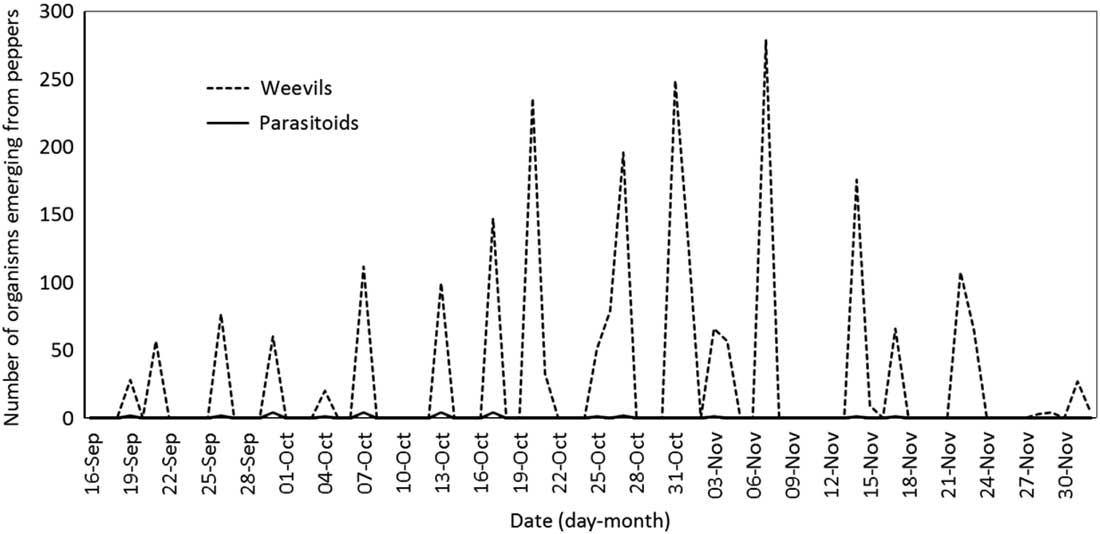
A total of 2656 weevils were collected from 2604 aborted peppers at the 10 sample locations, averaging 1.02 weevils per pepper (Table 1). Samples collected from 16 September to 1 December 2016 were evaluated for pepper weevil and parasitoid emergence from aborted peppers (Fig. 1). Only one greenhouse site yielded no weevils. However, this may be due to an unfavourable pepper type or perhaps a low sample size being collected from this site. While most pepper weevil parasitoids were collected from one sample site in Cottam, Ontario, some specimens were collected from sample sites at least 14.8 km (Nealiolus Mason species 1), and 77.1 km (Bracon species) away from this location.
Numbers of adult Anthonomus eugenii and hymenopteran parasitoids emerging from aborted peppers (n=2604) of six different varieties over time in 2016.
Results of a 2016 survey of Anthonomus eugenii infested peppers from 10 locations in southwestern Ontario.

Note: Parasitism=#parasitoids emerged/(#parasitoids+#pepper weevils)×100 for each sample site.
* Traditional field practice.
† Organic field practice.
‡ Traditional greenhouse practice.
§ Organic greenhouse practice.
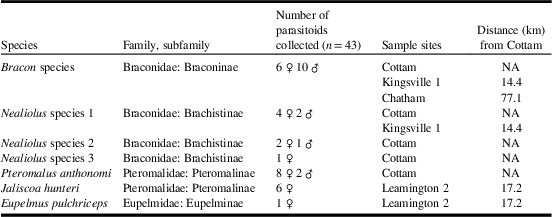
Based on morphology and genetic analysis, at least seven parasitoid species belonging to five genera were associated with pepper weevil (Table 2). Jaliscoa hunteri, a parasitoid previously reported from the pepper weevil in its native range, is reported from Canada for the first time, from a single sampling date at the organic greenhouse pepper site. Pteromalus anthonomi, a generalist known to be associated with a number of weevil species, has been previously reported from Anthonomus signatus Say (Coleoptera: Curculionidae) in Ontario (Yu Reference Yu2018). A single Eupelmus pulchriceps Cameron (Hymenoptera: Eupelmidae), a known parasitoid of the pepper weevil and hyperparasitoid of parasitic wasps was also collected. At least four parasitoid species were identified as Braconidae, and included representatives from two subfamilies: members of the genus Bracon (Braconinae) and the genus Nealiolus (Brachistinae). Within Nealiolus, three species were confirmed based on distinct morphological and molecular differences observed between specimens. Of the 16 Bracon specimens collected and sequenced in this study, all appear to belong to the same species as they were found to have 1.37% or less sequence variation. However, some morphological variation does exist among these individuals so further examination of additional specimens and a more detailed investigation of their natural history and life cycle may be required to clarify the implications for this variation. In addition to the parasitoids listed above, two female parasitoids of a species of Aphaereta Förster (Hymenoptera: Braconidae) and six individuals of a species of Asobara Förster (Hymenoptera: Braconidae) were also recorded emerging from peppers. The latter two species are likely associated with flies such as Scaptomyza adusta (Loew) (Diptera: Drosophilidae), which also emerged from some infested peppers. This is also supported by the many records of these species parasitising dipteran hosts and the absence of evidence for their parasitism of coleopteran species (Yu Reference Yu2018).
Parasitoids associated with Anthonomus eugenii from five southwestern Ontario sample locations.
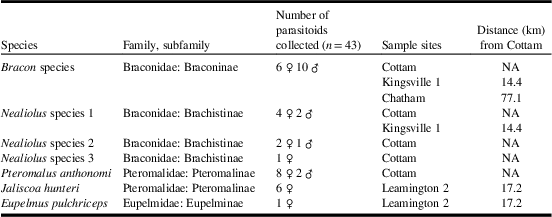
Note: The three Nealiolus species are distinguished as separate on the basis of distinct morphological and molecular characters.
Genetic characterisation
Representative DNA sequences were obtained from the seven different parasitoid wasp species identified in this study. These have been deposited into Genbank and BOLD databases and include sequences from: Bracon species (658 base pairs) (BOLD:ADL4705), J. hunteri (652 base pairs) (BOLD:ADS6957), Nealiolus species 1 (658 base pairs) (BOLD:ACE7371), Nealiolus species 2 (658 base pairs) (BOLD:ACE7370), Nealiolus species 3 (658 base pairs) (BOLD:ADR5301), P. anthonomi (652 base pairs) (BOLD:AAU9445), and E. pulchriceps (658 base pairs) (BOLD:ACQ1025). Specimen information, sequences, and trace files are also available on BOLD (title: Project PEW Parasitoids of Anthonomus eugenii). While these preliminary DNA barcode data did not permit identification beyond what the morphological identifications provided, they did in some instances support the identity of specimens. For instance, the Bracon species COI sequence obtained in this study shared 89.97% similarity to that of a Bracon species voucher (BOLD:AAQ2969). Among the three Nealiolus voucher specimen barcodes, species 1 and 2 were 97.84% similar to each other, whereas species 2 and 3 were only 87.86% similar. In addition, when compared with their top matching sequences within the BOLD database, Nealiolus species 1 shared 98.46% similarity with a Nealiolus labelled specimen (BOLD:ACE7370), Nealiolus species 2 shared 99.07% similarity with the same Nealiolus labelled specimen (BOLD:ACE7370), and Nealiolus 3 shared 87.86% similarity with Nealiolus labelled specimen (BOLD:ACE7370). The P. anthonomi COI sequence obtained here shared 99.52% similarity to the COI sequence of a voucher specimen identified only to the Pteromalidae family level (BOLD:AAU9445). Records indicate that this specimen was collected from Algonquin Provincial Park, Ontario, Canada. The J. hunteri COI barcode sequence shared only 92.23% similarity to a voucher sequence labelled only to the Pteromalidae family level (BOLD:ABW8261). The E. pulchriceps COI sequence shared 98.33% similarity to that of voucher specimen sequence labelled E. cushmani (BOLD:ACQ1025). Together, the preliminary DNA barcode data generated here contributes to populating a DNA barcode database for parasitoids associated with the invasive pepper weevil. Once complete, this database will serve to assist with future identification and species separation efforts.
Discussion
The outbreak of the pepper weevil in southern Ontario in 2016 provided a timely and unprecedented opportunity to conduct a preliminary survey for natural enemies that can exploit this exotic pest as a host resource. These results are considered significant given the importance of this pest to the cultivation of pepper crops in North America and elsewhere, and given the propensity for the pest to transiently establish in different locations worldwide. Despite the relatively short duration of the survey (one field season), a surprisingly diverse parasitoid community was found in association with the pepper weevil. This community is strikingly similar to those known to be associated with the pepper weevil or other weevil species in Ontario and elsewhere.
There is a strong possibility that the parasitoid community associated to A. eugenii in Canada is the result of their prior association with a native weevil such as with the strawberry clipper weevil, A. signatus, an important pest of strawberries in Ontario (Ontario Ministry of Agriculture, Food, and Rural Affairs 2017). Like the pepper weevil, it is exploited by a diverse community of hymenopteran parasitoids, including Bracon mellitor Say, Aliolus canadensis (Provancher) (formerly Eubazus canadensis) (Provancher Reference Provancher1883), and Nealiollus curculionis (Fitch) (Braconidae); Lariophagus fragariae (Rohwer) (formerly Catolaccus fragariae) (Gibson Reference Gibson2013), Pteromalus obscuripes (Ashmead), P. anthonomi, and J. hunteri (Pteromalidae); and Eupelmus vesicularis (Retzius) (Eupelmidae) (Yu Reference Yu2018). In the case of the unidentified Nealiolus species recovered from pepper weevil-infested peppers in this study, it is possible that further morphological and molecular analyses will demonstrate a close relation to N. curculionis, which may attack any Anthonomus species as available. It is also possible that the unidentified Bracon species discovered here could be B. mellitor Say (Hymenoptera: Braconidae), which is considered the most important parasitoid of the boll weevil, Anthonomus grandis Boheman (Coleoptera: Curculionidae) in the southeastern United States of America (Hunter and Hinds Reference Hunter and Hinds1905; Pierce Reference Pierce1908), and is recognised as a parasitoid of pepper weevil elsewhere (Cross and Chesnut Reference Cross and Chesnut1971). A survey of natural enemies of clipper weevils and other related weevils in Canada would help clarify these potential interactions.
The parasitoids associated with pepper weevil in this study also overlap considerably with species found associated with the pepper weevil in Mexico including Bracon species, Aliolus species, J. hunteri, and Eupelmus species (Rodríguez-Leyva et al. Reference Rodríguez-Leyva, Stansly, Schuster and Bravo-Mosqueda2007). Findings from such studies may thus provide guidance for determining the most effective species for a biological control programme in Ontario. For example, in Mexico, Bracon species was the least abundant parasitoid and therefore unlikely to be effective as a biological control agent. In contrast, J. hunteri extensively parasitised the pepper weevil in Mexico, and is the primary parasitoid of pepper weevil in fields in Florida (Wilson Reference Wilson1986). In this study, we provide the first record for the occurrence of this species in Canada. While it is possible that this species is adventive, having been imported along with weevil-infested peppers from Mexico or Florida (Aguilar and Servín Reference Aguilar and Servin2000; Rodríguez-Leyva et al. Reference Rodríguez-Leyva, Leyva, Gomez, Barcenas and Elzen2000), it may also have come into Canada from more proximal sources. For instance, J. hunteri has been previously recorded in Washtenaw County, Michigan, United States of America (Gibson Reference Gibson2013), which is ~120 km away from the site at which the species was recorded in Canada.
Missing from this initial survey of the parasitoid complex in Ontario is T. eugenii Wharton and Lopez-Martinez (Hymenoptera: Braconidae) another important parasitoid species attacking this pest in Mexico (Wharton and López-Martínez Reference Wharton and López-Martinez2000). As it is currently known to be associated with only two weevil species, A. eugenii and A. sisyphus Clark (Coleoptera: Curculionidae) (Yu Reference Yu2018), T. eugenii would be a good initial candidate for evaluation as biological control agent of pepper weevil. Similarly, P. anthonomi also seems to have a relatively narrow host range, associated with only four Anthonomus species as well as Lixus musculus Say (Coleoptera: Curculionidae) (Yu Reference Yu2018). The narrower host range of these two species make them safer options as candidate biological control agents relative to Nealiolus species and J. hunteri, which have broader host ranges. Furthermore, E. pulchriceps is known to act as a hyperparastoid with the potential to attack primary pepper weevil parasitoids (Gibson Reference Gibson2011). It may therefore actually reduce the efficacy of other parasitoid agents employed in biological control.
Conclusion
The findings of this study serve as a preliminary basis to elucidate the associations between locally occurring parasitoids that may successfully exploit A. eugenii as it potentially expands into a new geographic range, either as a transient or permanent population. This first step provides evidence that natural enemies are capable of exploiting the pepper weevil in southern Ontario. Subsequent steps should include additional surveys that cover a broader geographic range, and evaluation of the parasitoid community over successive field seasons to determine the prevalence of the different species and exploitation of alternative hosts. In addition, further genetic characterisation of these parasitoid communities will permit for more accurate assignments to taxonomic groups and help clarify host-parasitoid associations. While there are currently insufficient barcodes available in public databases to characterize the genetic variation within and among species, this and other initiatives will serve to eventually address this lack. Collectively, these steps are essential to determine which parasitoid species are capable of effectively suppressing populations of the pepper weevil or whether they are generalist parasitoids that are exploiting a transient resource at a low level. Should one or more of these species provide promise as a candidate biological control agent, further exploration of host-parasitoid associations and host specificity will be the next logical step in the potential development of an augmentative or inundative biological control programme targeting the pepper weevil in field and greenhouse pepper crops.
Acknowledgements
The authors thank Jade Paxton and Kyle Pimentel for assistance in collecting and monitoring of weevil and parasitoid specimens. They are also grateful to the numerous pepper growers who have allowed them to sample from their fields and greenhouses. This study was funded through Agriculture and Agri-Food Canada A-base project 1526.