In the late autumn of 1941, Colonel Georges Girvès, the mayor of Puisserguier – a small town south-west of Montpellier – received several posters from his departmental prefect. The posters featured a drawing of a grey-haired woman daintily removing a piece of shredded cloth from an overflowing rubbish bin. At the top was the slogan ‘No more tossing out! (Ne jetez plus rien!)’ and below, in pink lettering, was the one-word imperative: ‘Salvage! (Récupérez!)’Footnote 1 The official memo accompanying the poster ordered the organisation of local salvage drives for glass, paper, rags, bones and scrap iron.Footnote 2 Colonel Girvès met with the directors of the local schools, the president of the veterans group and the head of the charitable relief organisation Secours national. After careful consideration, they all agreed that the only material worth collecting was paper. Girvès explained his reasoning in a letter to his prefect in Montpellier:
Old rags are used until nothing is left. The scrap iron that was salvaged previously, after having spent some eighteen months near the railway station, has finally disappeared. Metal tubes and similar objects are salvaged by the shopkeepers . . . As for bones, it will be difficult to claim a significant portion for salvage from our town's starving dogs.Footnote 3
Girvès was particularly concerned that all collected materials be picked up immediately. He mentioned that fifteen days earlier a ‘salvage agent’ had visited his town to remove a bronze bust of the socialist leader Jean Jaurès. The man had told Girvès that he would return in the afternoon to take the statue, but he had never returned. Girvès also pointed out that acorns collected by local children a year earlier were ‘rotting in the school cellar’ and that 1600 kilograms of rusting copper, bronze and brass objects collected the previous month remained unclaimed. Yet Girvès had an even more pressing problem. Having received the posters from Montpellier, he had no way of putting them on display because his town had run out of glue.Footnote 4
Colonel Girvès's experience illustrates one of the more peculiar episodes of daily life in occupied France during the Second World War. Mayors throughout France carried out salvage drives of scrap metal, paper, glass, rags and other waste products starting as early as the spring of 1940 and continuing as late as the autumn of 1945.Footnote 5 Why did they do so? Governments in the United States, Germany, Great Britain and Japan conducted salvage drives as a way to acquire critical raw materials for armaments production and as a means to mobilise patriotic sentiment for the war effort, but in France – occupied by the Germans from June 1940 to August 1944 – industry was under the tutelage of the German military and the war had already been lost. People like Girvès undoubtedly explained salvage simply as a logical consequence of shortages; in the words of Henri Michel, ‘for the occupier, the good products, for the Parisians, the leftovers’.Footnote 6 This view has not been seriously challenged by historians.Footnote 7 But the reality was far more complex.
Girvès, a career soldier who had fought for France in both world wars, would have been horrified to learn that much of the scrap iron, non-ferrous metal, waste paper and rags collected by mayors like himself was shipped directly to Germany.Footnote 8 Girvès might also have been less co-operative had he known that the organisation that issued the salvage posters was a conjoint Franco-German initiative that actively restructured the French salvage industry along Nazi German lines. In practice, this meant the ‘elimination’ of Jews. But Vichy officials carefully hid these details from officials like Girvès tasked with carrying out the salvage drives.
From the perspective of a mayor struggling with local shortages of raw materials, Vichy's arguments that salvage was necessary to preserve French industry might be compelling. Indeed, those arguments were not entirely false. When faced with similar shortages during the ‘phony war’ preceding the German invasion, the French government had relied on salvage drives to keep factories running. During the occupation, though much of the salvaged material was shipped to Germany, still more of it stayed in France. Most convincingly, these salvage drives continued to supply French industry after the defeat of France and the establishment of the Fourth Republic.
Colonel Girvès's choice whether or not to comply with Vichy's salvage directives in the autumn of 1941 typifies the difficulties faced by all local French administrators during the occupation. In his survey of daily life in occupied France, Robert Gildea described how mayors ‘could choose to act as transmission belts relaying official instructions or as screens or buffers to protect local people from official pressures’.Footnote 9 But these choices were complicated. In micro-histories of cities and regions, historians of daily life like Gildea have explored the ‘notoriously murky’ ‘moral universe of occupied France’, a universe ‘between resistance and collaboration’, by looking at the choices of not only mayors but also Jews, foreigners, refugees, clergymen, shopkeepers, housewives or black marketeers.Footnote 10
Studying the salvage drives in Girvès's département of Hérault might elucidate the choices of these sorts of individuals, but such a study would be unable to answer larger questions. Why did the Vichy government collaborate with Nazi Germany in salvage efforts? Was this primarily a Vichy or German initiative? How were these salvage drives connected to those carried out before the German invasion? Who processed the material once it was collected? Where did that material go? Why did salvage efforts continue after the war? Why did they stop in 1947? What impact did the experience of wartime salvage have on French attitudes towards waste and on government policy in the post-war period? How do these salvage drives fit into the larger history of recycling in twentieth-century France and Europe?
To answer these questions, Colonel Girvès's salvage experience needs to be connected to a broader administrative apparatus. The first steps have been taken by Kirrily Freeman and Elizabeth Karlsgodt in their work on Vichy's destruction of bronze statues.Footnote 11 Drawing on extensive research in national, departmental and municipal archives, they explain why Puisserguier's bust of Jean Jaurès was removed on 22 January 1942.Footnote 12 It was neither a German initiative nor a Vichy project to purge France of monuments to revolutionary heroes. Instead, Vichy destroyed statues to meet German demands for copper and tin.Footnote 13 Yet the narrow focus on this one Vichy ‘recycling’ programme developed independently of German directives minimises the German influence on all Vichy salvage efforts and does not explain how and why Vichy focused so much attention on less valuable materials. Indeed, using terminology such as ‘recycling’, ‘recovery’ or ‘mobilisation’ interchangeably, both Freeman and Karlsgodt conflate a key difference made at the time between the ‘salvage’ (récupération) of scrap and waste products and the ‘mobilisation’ (mobilisation) of finished goods. As will be seen, these distinctions mattered for the German and French officials who carried out these salvage drives.
Recent research on Franco-German relations in occupied France has moved beyond the binary of collaboration or resistance by emphasising the give-and-take of this encounter.Footnote 14 Thoroughly grounded in both the French and German archives, studies such as those by Hervé Joly, Simon Kitson, Allan Mitchell, Thomas Laub and Julia Torrie examine the emulation, cultural transfer or even competition that informed Franco-German policy.Footnote 15 A similar approach is needed to fully understand France's wartime salvage drives.
Fortunately, the archival record, though scattered across France, is particularly rich. The central office that organised these drives was the Service for the Salvage and Use of Waste and Old Materials (Service de la Récupération et de l'Utilisation des Déchets et Vieilles Matières, hereafter referred to as the Salvage Service), which the Vichy government established in January 1941.Footnote 16 At its headquarters in Paris, the Salvage Service held meetings with German experts, gave press conferences, corresponded with regional delegations, collected statistics and sent directives to departmental prefects who then forwarded instructions to mayors and chambers of commerce throughout France.Footnote 17 Tracing the sequence of events through these widely dispersed documents, the local and national press, and recent literature on the history of recycling in this period, unravels the tangled bureaucratic complexity of French salvage from 1939 to 1946. In the late 1930s, French condescending views towards Nazi German salvage shifted towards grudging admiration with the onset of war and the crisis in raw materials that it provoked. In the spring of 1940 officials at the French Ministry of Armaments emulated Nazi Germany by carrying out salvage drives of scrap iron and paper. After the fall of France, this emulation became collaboration. Vichy's salvage efforts were organised at the highest levels of the German occupation administration and were based on the experience of Nazi German salvage experts working both in Germany and the occupied territories. German authorities imposed legislation eliminating Jews from the salvage industry, while French experts attempted to enact household waste management schemes developed before the German invasion. In the spring of 1942, increasing raw material shortages in Germany intensified German influence on Vichy's salvage efforts. These efforts continued to meet the industrial needs of a France depleted of raw materials from the liberation in the summer of 1944 to the moment when French salvage was turned back over to private industry in 1947.Footnote 18
Salvage . . . à la française!
Before the Second World War, the salvage industry in France was a highly decentralised, traditional activity that had changed little since the seventeenth or eighteenth centuries.Footnote 19 Throughout French villages, towns and cities, individuals on the margins of society collected scrap metal, rags, waste paper, rabbit skins, bones and glass from households or rubbish dumps. Known as chiffonniers (rag men), ferrailleurs (scrap metal dealers) or brocanteurs (bric-à-brac traders), these men and women, often working together as a family and equipped with nothing more than a simple handcart, gathered assorted material, separated it by category and sold it to specialised wholesalers in major urban and industrial centres. In large cities with municipal waste services, such as Paris and Lyon, a hierarchy developed among the chiffoniers between the placier, allowed by the concierge to pick through the waste bin before the arrival of the dust-cart, and the lowly coureur, who poached whatever valuable material remained. In 1884, Paris had 7,500 chiffonniers, 5,000 inside the city and 2,000 on its outskirts. By 1916, the balance had shifted, with the majority of the chiffonniers living in the banlieues.Footnote 20
In the early twentieth century, the top of the salvage hierarchy was held by ‘the king of the rag-pickers’, M. Verdier-Dufour, whose business grossed 4 or 5 million francs annually. A British account from 1907 described how he ran his factory on the outskirts of Paris:
Rags which come to him in one class are subjected to a more searching analysis by hundreds of women, who sit surrounded by a score or more bags. They snap up the pieces of silk, or linen, or woollen, rapidly feel the texture, glance at the colour, and cast each scrap into its proper bag. It is the duty of these women to be acquainted with all the complications of textile fabrics, and as each tint has a great variety of subdivisions it needs almost the subtle eye of a Turner to do the work with the necessary accuracy and speed.
His establishment, spread out over several acres and including three- and four-storey buildings, processed 150 tonnes of waste paper a week.Footnote 21
The salvage trade was dominated by migrant labourers from the Auvergne and, after 1870, Jews from Alsace.Footnote 22 By the inter-war period, more and more East European immigrants – especially Jews from Poland and Romania – joined the trade. In Paris, they settled in the banlieues of Montreuil, Bagnolet, Vincennes or Saint-Ouen.Footnote 23 One of these men was Joseph Joinovici, a Jewish immigrant from Bessarabia who arrived in Saint-Ouen in June 1924. He soon became one of the most powerful players in the scrap metal market, gaining contracts to provide metal for the construction of the Maginot Line fortifications.Footnote 24 Joinovici's success was not atypical. Before the war, in some sectors of collection like used clothing, Jews had gained monopolies.Footnote 25 They began specialising in these more lucrative areas like scrap iron, clean papers and used clothing, because, by the late 1930s, the abundance of high quality raw materials meant that factories no longer accepted inferior scrap from household waste. Indeed, before the war, the factories that processed Parisian rubbish – all under the direction of the company Traitement des Résidus Urbains or TIRU – refused to allow chiffonniers to sort through the waste stream because of hygiene considerations.Footnote 26 Nevertheless, the majority of the French population had relatively little understanding of the salvage industry beyond the local chiffonnier or ferrailleur, and the word salvage in French (récupération) remained a technical term limited to specialists in the industry.
Two prominent exceptions to this general lack of awareness were local collections carried out by religious organisations and a few limited salvage drives during the First World War. From at least the nineteenth century onward, religious charities collected used goods (including paper and metal) and resold them to wholesalers as a way to raise funds. A survey of the Catholic daily paper La Croix from 1880 to 1939 reveals numerous appeals to ‘give donations’ (faire des dons) of ‘useless paper’.Footnote 27 Between 1895 and 1898, a charity that taught blind people to make and sell paper bags from scrap collected over 1,000 tonnes of used paper.Footnote 28 Faced with a looming wartime paper shortage in the spring of 1916, the Ministry of Commerce organised a nationwide scrap paper collection that brought in 10,000 tonnes in just seven days. The lack of further mention in the press suggests that these initial results were enough to end the shortage.Footnote 29 During the summers of 1917 and 1918, French schoolchildren gathered horse chestnuts and sweet chestnuts for the production of alcohol and acetone.Footnote 30 All these appeals referred to ‘collections’ (collectes), ‘harvests’ (récoltes) or ‘gathering’ (ramassage) rather than the technical term ‘salvage’ (récupération).
In the late 1930s, the French press began featuring articles that characterised German raw material shortages as evidence of economic weakness. The articles focused on German legislation that controlled the sale and price of goods and the implementation of ‘salvage drives’.Footnote 31 In September 1939, with the outbreak of war, French and German émigré experts argued that Germany's inadequate supply of labour, food, oil and metals was no match for France and Britain's inexhaustible colonial resources. From September to December, the daily press and popular illustrated weeklies cited the German government's ‘draconian’ rationing of food and goods as proof of the Allied blockade's effectiveness.Footnote 32 Reviews and excerpts of the émigré technical literature stressed Germany's critical metal shortages, often by seeking to characterise German scrap metal salvage efforts as desperate measures: ‘The German authorities do not hesitate to mobilise fifty workers to remove the rails of unused tramway lines . . . The iron railings around public parks have been requisitioned, as well as the ornamental ironwork in front of private houses.’Footnote 33
That Nazi Germany had been reduced to the ‘mobilisation’ (or Mobilisierung in German) of objects such as iron railings and fences was indeed evidence of serious economic weakness. But ‘salvage’ (Altmaterialverwertung) and ‘mobilisation’ of all usable material in blockaded Germany had kept German factories running during the First World War. By the end of that war, women, children and wounded soldiers were collecting a bewildering array of materials including kitchen slops, wool, copper, nickel, acorns and chestnuts, thistles, nettles, pine sap, mushrooms, leaves, rubber, tin, corks, human hair, gramophone records, old dentures and coffee grounds.Footnote 34 As in France, the salvage industry depended on Jewish technical expertise, from the lowest rag-and-bone men to the large firms that triaged, processed and resold the material.Footnote 35 For Nazi Germany, this dependency was seen as a liability. As both Susanne Köstering and Friedrich Huchting have argued, when faced with shortages of raw materials in the 1930s, the Nazi hierarchy, who did not like the idea that measures for economic autarky ‘rested on the shoulders of racially-hygienic inferiors’, began the process of excluding Jews and other ‘non-desirable elements’.Footnote 36 As Jews were banned from the scrap trade, Nazi officials replaced them with Nazi-affiliated organisations and supported salvage efforts with the party's extensive propaganda apparatus. Beginning in 1934 and 1935, the Hitler Youth, the German Workers Front, the National Socialist People's Welfare (NS Volkswohlfahrt) and other Nazi organisations began sporadic salvage drives of household waste.Footnote 37 After the autumn of 1936, these efforts became more systematically structured under the Four-Year Plan organisation.Footnote 38 Hermann Goering's appointment in the summer of 1937 of SA-Brigade Leader Wilhelm Ziegler as Reich Commissioner for Scrap Salvage (Reichskommissar für die Altmaterialverwertung) further intensified scrap collection.Footnote 39 All cities with over 35,000 inhabitants were required to sort household waste at their rubbish dumps, remove all salvageable material, keep statistical records of the quantity of waste and report it monthly.Footnote 40 The following year, Ziegler ordered the removal of wrought iron railings on both public and private land, and the SA instituted concentrated collections such as the ‘Iron Week’ in Saarpfalz in October, when they tore out iron fences, garden railings and even iron crosses from tombstones.Footnote 41
Germany's removal of iron railings continued to be used by the French press as evidence of German weakness – even as Germany defeated and occupied Poland in September 1939. Soon, however, French government officials with experience in wartime economic organisation began cautiously proposing to carry out salvage drives similar to those of the Germans. On 14 November 1939, Le Petit Parisien published a front page editorial by a deputy from the Vosges who described himself as the ‘grand chiffonnier’ of the Ministry of Commerce during the First World War. The deputy argued that ‘rather than mock the Germans . . . [the French] would be wise to adopt some of their methods’.Footnote 42 He then described his belated and ultimately unsuccessful efforts in 1918 as a young officer in the French army to develop a ‘collection and salvage’ service at the Ministry of Commerce, ending his article with a call to institute a national salvage programme.Footnote 43
Within a month, this suggestion had become official French government policy. By late December 1939, the newly appointed French minister of armaments, Raoul Dautry, had concluded that the only way to address serious shortages of raw materials necessary for armaments production was to have ‘a more rational use of material resources, machines, and men’ by, in part, ‘salvaging waste material’.Footnote 44 Between 18 and 23 December 1939, an article appeared in most French newspapers entitled ‘In Order To Win the Economic War, Let's Salvage Our Waste’. The unsigned article – probably authored by Dautry – alluded to British efforts to salvage waste paper, encouraged the salvage of sulphuric acid, fats and rubber, and described how the Germans had ‘for a long time . . . used old tin cans (and) the zinc from used batteries’. Unlike German practice, however, French efforts to salvage would be voluntary: ‘The French government, the government of a free people, understands that this salvage must remain voluntary. Let's salvage . . . à la française, without constraints, without coercive measures.’Footnote 45
Despite the previous association of salvage with Nazi German economic weakness, people were quite receptive to the idea. The calls for salvage resulted in France's major newspapers receiving a flood of ‘letters to the editor’. Readers recommended the collection of cork, lead, copper, paper, cardboard, cotton, tin cans, oil drums, used tyres, used motor oil, junk cars, wool and jute rags, mercury from old barometers, vegetable peel for pigs, overripe fruit (to be made into alcohol), German cannons sent to municipalities after 1919, the hundreds of thousands of artillery shells and bullets from the First World War transformed into souvenir lighters, umbrella bins and lamp stands, and even the rails from discontinued tramway lines.Footnote 46 One reader, citing Germany's Hitler Youth as a model for the ‘collaboration of school children’, wrote that ‘without being as ridiculous as the Germans . . . who even salvage cherry pips to extract some acid, we might need to imitate them a little’.Footnote 47
The messy reality of paper and scrap metal salvage
This imitation would not be easy. The two nationally organised salvage drives immediately ran into organisational difficulties. On 2 January, a letter from the High Commissioner for National Economy to prefects announcing the salvage of waste paper immediately sparked public debate about what constituted waste, just as it had in Great Britain.Footnote 48 For the satirical daily Le Canard Enchaîné, it was easy. An article described examples of salvageable papers: the manifestos of de Brinon's Franco-German Committee, Stalin's writings to Laval on the necessity of French national defence, all editions of Mein Kampf and everything from the Communist Party.Footnote 49 A columnist in Lyon described an elderly woman's contribution of her ‘stock of papers’ in her attic: ‘Aunt Julie's expense accounts . . . Uncle Paul's poems . . . these writings were her only memories of them . . . but she was resolved, and her accepted sacrifice seemed to lightly intoxicate her.’Footnote 50 On 10 January, the Minister of National Education sent a follow-up letter to prefects, forwarded to sub-prefects and mayors, announcing that archives would not be included.Footnote 51 Still not satisfied, Le Journal des Débats wrote a strongly worded editorial on 14 January against the collection of old papers, partly because those attic collections also contained priceless historical documents.Footnote 52 The collection proceeded with little public fanfare because it mainly required that individuals separate paper from household rubbish to be picked up by the local chiffonnier. The invasion of France in May 1940 was accompanied by a hardening of legislation, challenging the notion of voluntary salvage à la française. A law on 15 May fixed prices for the sale of waste paper and included punitive measures against those who did not separate their paper.Footnote 53
While the collection of waste paper remained largely confined to the traditional salvage trade and therefore out of the public eye, the collection of scrap iron became a nationwide patriotic mobilisation effort supported by an extensive propaganda apparatus. Dautry, the dynamic minister of armaments, personally directed this salvage drive; its purpose was not only to gain critically needed scrap iron for war industries but also to boost morale. Rather than passing laws requiring participation, Dautry delegated the task to the presidents of the chambers of commerce and the station masters of the French national railway company SNCF, providing them with a set of general, voluntary instructions. The SNCF or city government would pay 15 francs per kilogram, then be reimbursed by the Group for the Import and Purchase of Scrap Iron (GIAF), a central distribution organisation created by Dautry.Footnote 54 On 5 January 1940, the minister of education sent a letter to France's academic inspectors, outlining the role of schools in Dautry's collection drive and including a sample lesson plan about the importance of scrap metal salvage.Footnote 55 Dautry's message found the most resonance in cities with large metallurgical industries, and chambers of commerce or individual mayors took the initiative. Lyon's chamber of commerce responded within two weeks. The prefect of the Nord department in Lille forwarded Dautry's directives to mayors on 29 December, and this communication was quickly followed by letters from SNCF station masters and local businesses offering mayors their services.Footnote 56 On 3 January the mayor of Grenoble asked the prefect of Isère to organise a scrap iron and paper drive to benefit local relief efforts.Footnote 57 Without any clear instructions from Dautry, municipalities informed each other about how they had organised their drives. Depending on the availability of local resources, they relied on various combinations of charitable organisations, industry and trade groups, military authorities, and private collections.Footnote 58
Lyon's even more ambitious salvage drive relied on a study of German methods completed in January 1940. In early December 1939, responding to local reports about continued shortages of scrap iron, Lyon's chamber of commerce had decided to study salvage as a way to supply local and regional enterprises with raw materials.Footnote 59 They proposed the following: that non-ferrous metals, scrap iron, textiles and paper be included; that the chamber of commerce organise the drive so that regular commerce would be interrupted as little as possible; and that the collection drive be a permanent activity. Believing that individuals were ‘more sensitive to regional propaganda’, the chamber of commerce set up propaganda ‘action committees’ in the major cities of the region.Footnote 60
The chamber based these guidelines on a twenty-two-page report by the chief engineer of Lyon's incineration plant, René Martin, who had independently developed a comprehensive proposal for salvaging raw materials from France's waste. Martin's report began with the salvage programmes of ‘foreign countries, Germany in particular’, arguing that France should immediately organise collection efforts.Footnote 61 Martin advised collecting paper, scrap iron, cast iron, tin cans, aluminium, copper, zinc, rags and clear glass, but only in cities of over 25,000 inhabitants, because ‘rural society did not produce very much rubbish’. He calculated that of the 2.1 million tonnes of trash produced per year in French cities, 190,000 tonnes of paper, 41,600 tonnes of metal, 49,000 tons of rags and 31,000 tonnes of glass could be salvaged. Individual households could separate domestic waste into two bins (one for waste and one for rubbish), and municipal trucks could bring the bins to a regional centre where the rubbish could be sorted on conveyor belts and resold to consumers.Footnote 62 According to one estimate in 1938, Martin's projections would have doubled the quantity of salvaged waste paper and increased the supply of used rags by 25%. Additionally, his proposal kept the waste stream directly in control of the professional scrap trade rather than in the hands of the consumers or private charitable organisations.
To enact this proposal for Lyon, the chamber of commerce formed a salvage committee with representatives from the chamber, the prefecture, the city, property owners and industry leaders. The technical advisory council included Martin and two owners of local scrap metal businesses.Footnote 63 At their first meeting on 18 January 1940, these industry experts established their conception of a professional collection.Footnote 64 They rejected offers from organisations such as the scouts, who wanted to use the collections programme to profit war charities, arguing: ‘there is no way these people could achieve any kind of success because of a lack of organisation in their transport and personnel’.Footnote 65 Instead, municipal trucks or military vehicles would pick up household donations on a pre-arranged schedule and bring the material to a sorting centre where it would be sorted by specialists and not, as some had hoped, by people on the unemployment rolls. An action committee was established to handle the propaganda, including personal visits to rural areas, newspaper articles, posters, radio announcements and even short newsreel clips in cinemas.Footnote 66
Not anticipated was how chiffonniers would respond. In Lyon, the night before their first collection drive on 17 February 1940, a garage owner put out a zinc bathtub filled with sheet metal, paper and a large cast-iron machine. Some chiffoniers passed by twice with their handcarts, asking if they could buy all of it. When the man refused, they insulted him, telling him he ‘was depriving them of their livelihood’. The next morning, the bathtub was empty, the official scrap collectors had not come by and the landlord was furious that the bathtub was blocking the alleyway.Footnote 67
Lyon was not the only city to encounter such problems. Similar incidents plagued collection drives throughout France. In Caen, on 19 February, the second day of the collection drive, two local homeless chiffoniers, a 39-year-old woman and her mother, ‘well known to the local police’, rummaged through the household scrap put out for the municipal pick-up, and found copper, zinc and aluminium that they took and sold for 80 francs to a dealer. Both were arrested. During the same drive, a painting contractor left out two old car radiators and a used paint mixer worth 2,000 francs, which was stolen before the salvage trucks arrived.Footnote 68
Nevertheless, in Lyon as elsewhere, once in place, the collections worked relatively well. Lyon's drive gathered a respectable 64 tonnes of metal and paper in its first week.Footnote 69 By mid May, Lyon's public services alone had contributed over 20 tonnes of paper. Altogether, the sorting centre had received 614 tonnes of mixed material but had processed and sent on only 78 tonnes of paper, 55 tonnes of cast iron and 25 tonnes of light scrap iron to local factories.Footnote 70 That only 25% of the collected material had been processed in four months of operation was typical for sorting centres around France.
Without national statistics for the collection of paper or textiles, it is difficult to assess the success of these campaigns. In the case of scrap metal, however, a government report estimated that of the 85,000 tonnes of metal collected by the end of May, only 45,000 tonnes had made it to sorting centres, leaving 40,000 tonnes on railway platforms, city hall courtyards and school playgrounds.Footnote 71 Colonel Girvès never declared how much scrap iron the school children of Puisserguier had collected, only that it still remained near the railway station until a ferrailleur picked it up in late October 1941, much to his relief.
Unknown to Girvès, soon after the fall of France in the summer of 1940, the GIAF – the organisation set up by Dautry in 1939 to carry out his scrap iron drive – signed a contract with Germany for the delivery of 100,000 tonnes of scrap metal and had nearly completed the shipments by the summer of 1941. At the end of July 1941, the GIAF signed another contract for the delivery of 180,000 tonnes as well as the 6,000 tonnes remaining from their previous contract. During the course of the occupation, the GIAF would sell 242,617 tonnes of iron scrap to German firms. At least 10,735 tonnes of the ‘Dautry scrap iron’ was removed ‘irregularly’ by German troops, and the GIAF most likely gathered and sold the remaining 30,000 tonnes to Germany. In this case, Puisserguier's scrap iron probably ended up in a German foundry.Footnote 72
Vichy salvage in occupied and non-occupied France
In the summer of 1940 Vichy attempted to continue the paper salvage drives begun during the ‘phony war’.Footnote 73 On 23 July, the prefect, mayor, representative of the departmental mayoral association, education inspector, departmental archivist and delegates from the press and waste paper industry met at Clermont-Ferrand to determine how to proceed with the departmental waste paper collection.Footnote 74 By early September, the newly formed Ministry of Industrial Production had published harshly worded instructions regarding the 15 May 1940 decree to salvage waste paper, declaring in no uncertain terms, that it was forbidden to burn or throw away waste paper, that all apartment buildings needed a separate waste paper bin and anybody found to be in non-compliance would be subject to fines.Footnote 75
Vichy's earliest effort to create new salvage drives preceded the first meeting between Vichy economic negotiators and the head of the economic section of the German military administration in Paris.Footnote 76 On 12 July 1940, the state secretary of provisioning (Secrétariat d'Etat au Ravitaillement) requested an investigation into the salvage of blood from slaughtered cows, sheep and pigs to make blood pudding. This demand was followed by collection requests for horse chestnuts on 4 and 13 September and kitchen slops on 1 October.Footnote 77 The chemical industries section of the ministry of industrial production asked prefects on 24 October to organise collections of used bones in order to transform them into soap. In mid October, Pétain sent instructions for the ‘conservation of resources’ to ministers and state secretaries in which he evoked a 1938 law on wartime economy, stressing that ‘the salvage of scrap materials must be assured with vigilance’ and ‘waste in all its forms must be suppressed’.Footnote 78 Though some programmes had pre-war precedents, this effort to reach a totality of reusable products (blood, bones, kitchen slops and textiles) emulated German practice. All these instructions predated the establishment of the Salvage Service.
In early September 1940, Vichy authorities approached the economic administrator for occupied France, Elmar Michel, with a proposal for organising the allocation of raw materials in both unoccupied and occupied France.Footnote 79 In part because the proposal matched his own plans for the economic exploitation of France, Michel approved it, and on 10 September Vichy passed legislation establishing the Central Office for the Allocation of Industrial Products (Office central de répartition des produits industriels or OCRPI).Footnote 80 The organisation consisted of twelve ‘sections’ determined by categories of raw materials, each chaired by a Government Commissioner and a ‘Chief Allocator’ (Répartiteur) with legal authority to determine the allocation of raw materials for all French industry.Footnote 81 The Germans controlled OCRPI by approving each Répartiteur, by requiring a special German delegate for each section and by appointing a German Commissioner (Generalbeauftragter) for Raw Material Rationing at the Central Office to ‘execute the special interests of the Reich’.Footnote 82
In December 1940, Michel's chief of staff sent a circular to German military district leaders and field commanders in occupied France explaining OCRPI and the new rationing laws, and indicating that a salvage organisation using German experience and technique would soon be put in place. A visit in mid January of a ‘delegation of German technical counsellors’ to Paris for a series of ‘Franco-German economic conversations’ included a presentation by Michel on the ‘current economic situation of France and Franco-German collaboration in the economic domain’.Footnote 83 Following the visit, Marshal Pétain issued his 23 January 1941 decree on the ‘salvage and use of waste products and scrap’. Much like Goering and Ziegler's legislation, it required all scrap dealers to register with OCRPI and forbade anyone ‘to burn, throw away, or destroy . . . useless waste and scrap . . . rags; scrap iron and scrap metal; old paper; feathers; rubber; bones; furs and hides; animal hair and manes; [and] glass’. The following day, Pétain's minister of industrial production created the Salvage Service under the direction of François Delannoy and Robert Anglès and tasked it with organising salvage drives, collecting statistical documentation and licensing scrap dealers.Footnote 84
The transition proceeded smoothly. Tellingly Delannoy's first action as head of the Salvage Service was to inform his German counterpart about Vichy's efforts to begin collecting used bones in the fall of 1940.Footnote 85 Delannoy's right-hand man, Anglès, was also particularly well suited for the job. He was a wholesaler in rags and waste paper and owned the Etablissements Verdier-Dufour – the company founded in the late nineteenth century by ‘the king of the rag-pickers’.Footnote 86
In late February 1941, Goering's agent, Hans Heck, Wilhelm Ziegler's successor as Reich Commissioner for Scrap Salvage, along with representatives of the Reich offices for raw materials, visited Paris for a series of meetings with the French heads of the OCRPI.Footnote 87 He was a former wholesaler in scrapped automobiles and a devout party loyalist. On 20 February, Heck led a meeting of the ‘mixed committee for salvage’, which included Delannoy and Anglès of Vichy's Salvage Service, Michel and Heck's salvage delegates for the German military administrations in Brussels, Lille and Paris. The last of these individuals, the wartime civilian administrator Paul Niessner, had the ultimate authority for all decisions made by the Salvage Service.Footnote 88
Speaking in German, Heck began with a survey of Germany's successful salvage programmes instigated by the Four-Year Plan and explained how several foreign countries ‘Italy, Switzerland . . . even America’ had begun to adopt similar measures. He claimed that the great success of these measures in Germany, especially for rags and scrap iron, had ‘not been imitated’ in France due to a lack of organisation or ‘maybe propaganda’. Heck provided several pointers for implementing successful propaganda, including how to organise teams of school children in scrap competitions, and offered to send samples of propaganda material used in Germany.Footnote 89 To avoid the mistakes of earlier German drives, Heck suggested that the salvage trade be re-organised ‘so that the implemented measures not be sabotaged’ – a veiled allusion to the Nazi accusation that Jewish scrap dealers were interfering with the collections. Heck claimed that Germany did not want to ‘remove raw materials from the country [France]’ or ‘to paralyse French industry’ but rather had the intention of ‘creating co-operation (Zusammenarbeit) that shall continue in times of peace’. Delannoy and Anglès thanked Heck for his insights, told him they would approach Vichy with his proposals and assured him that ‘despite their incomplete mastery of the German language’ they had ‘followed with great interest his clear and persuasive explanations’.Footnote 90
Two days later, in his closing speech to the assembled French and German representatives, Heck declared that the mission of France's newly created Salvage Service was to ‘educate the people to work in harmony with the Répartiteurs’ and to ‘take in hand the salvage trade’. Leaving no room for misunderstanding, Heck explained that ‘the Jews were represented in extraordinarily large numbers’ in the salvage trade and ‘this must change’.Footnote 91 It was Heck himself who, along with Ziegler, had carried out a complete restructuring of the scrap trade in Germany. Beginning in late 1937, they had divided Germany into salvage districts and an official, non-Jewish, scrap dealer was assigned to each area. At the same time, the scrap trade's representative organisation in the Ministry of Economic Affairs was relegated to a sub-group of a newly created Reich Group of Scrap and Waste Material (Alt- und Abfallstoffe) headed by Heck himself.Footnote 92 As a result of this restructuring, the Nazi organisation effectively bypassed the middle-men, favouring ‘the non-Jewish wholesalers and brokers’ and making it easier to liquidate Jewish operations.Footnote 93 Heck hoped to put in place a similar system in France.
The French delegation wasted little time in implementing these initial measures. Preceding the meeting, Delannoy had asked the Ministry of Interior to help create ‘departmental action and propaganda committees for waste and scrap salvage’, a ‘project . . . to which the occupation authorities attached an extreme importance’. His Salvage Service also drafted a circular, which he had translated into German, telling prefects how to set up these committees.Footnote 94 On 19 April, the head of OCRPI, Jean Bichelonne, sent a revised version of that circular to all prefects (in occupied and non-occupied France), requesting that they designate a member of their administration, preferably somebody ‘active and competent in the field’, to head a committee including one representative from the salvage trade, youth movements, education, a chamber of commerce and each sub-prefecture.Footnote 95
The ‘action committees’ were later expanded to include a representative of Secours national and the departmental director of the ‘Temporary Administration Agency’ (Service de contrôle des proviseurs administratifs or SCAP), the organisation created by Vichy in September 1940 to supervise ‘Aryanised’ Jewish businesses.Footnote 96 The presence of the SCAP director on these salvage committees was a result of the Salvage Service's creation of a ‘Jewish Affairs’ division on 1 July 1941.
Though the 1941 inspection report suggested that the Jewish Affairs division was set up – in line with Nazi policy – to eradicate ‘Jewish influence’ in the scrap trade, an internal memo in December 1942 argued that its goal was partly to retain Jewish expertise by attempting to ‘maintain the activity of all the elements of Jewish salvage specialists, who represented a strong majority in the scrap trade’.Footnote 97 Their first activity was to register Jewish scrap dealers. Niessner had requested a list of all waste paper wholesalers on 14 February, had received the list by 7 March, and the German military administration in Paris had published an ordinance regulating Jewish salvage businesses on 10 May.Footnote 98 The ‘Jewish Affairs’ division acted as a liaison between these Jewish businesses (or their non-Jewish trustees), the German administration and the General Commissariat for Jewish Affairs (Commissariat général aux questions juives or CGQJ), the central anti-Jewish office created by Vichy in March 1941 and tasked with confiscating and liquidating Jewish property.Footnote 99
Following a return visit by Heck in September 1941, Delannoy sent his delegate Michel Couturaud to check up on the departmental salvage committees, one of which was discovered to be led by a nineteen-year-old boy and a senile man, to ensure that the ‘Aryanisation’ of scrap firms charged with sorting and processing metal had proceeded correctly and to examine apparent disorganisation.Footnote 100 In most cases, Couturaud reported that though non-Jewish trustees were nominally in charge, they ‘masked Jewish interests’. Former Jewish owners remained salaried; consequently, ‘the salvage in the East was assured only by Jewish businesses, and that explained the current disorganisation’. Non-Jews who fronted collection operations were incompetent at worst and not really in charge at best.Footnote 101
Claims in the internal report that Salvage Service officials attempted to preserve Jewish salvage experts are confirmed in multiple sources. In early October 1941 the head of the Household Waste division of the Salvage Service, Riedinger, visited the general secretary of the Paris prefecture of police. The two discussed Niessner's proposal to systematise the scrap trade as well as the announcement that all Parisian scrap dealers had to register with the police chief of their neighbourhood.Footnote 102 During this meeting, Riedinger asked if it would be possible to allow Jewish scrap dealers to keep working if they wore a special armband. The head of police replied that ‘the Jewish second-hand dealers (brocanteurs) interned in the Pithiviers and Drancy camps would not be released and that they (the Salvage Service) would have to find replacements for them’.Footnote 103
On 27 November, Delannoy sent Niessner a list of twenty-six Jewish businesses that he wanted to maintain for an additional three months, because he thought they would significantly increase the quantities of salvaged material. He added that the ‘Jewish Affairs’ division was supervising them and that they had followed all the conditions of the 10 May ordinance.Footnote 104 After several meetings, Niessner decided to maintain twenty-five Jewish scrap businesses. Nevertheless, Delannoy continued his requests for exceptions. On 13 January 1942, he asked Niessner to allow just 111 Jewish scrap dealers permission to keep working.Footnote 105 By the end of January, the Jewish Affairs section was supervising only twenty companies and, a year later, the number had dropped to eleven.Footnote 106 The round-ups of the summer of 1942 coincided with the arrest of at least seven of the Jews still working for the Salvage Service.Footnote 107 A December 1942 report described how ‘the diverse measures and ordinances taken against the Jews brought about the disappearance of almost all the Jewish elements, even among those authorised businesses’.Footnote 108
Another sign of the Salvage Service's unwillingness to go along with all the policies desired by Heck and other German salvage officials was a handwritten note – in French – scrawled on the French translation of a letter from Niessner to Delannoy describing how one French prefect had divided the territory of his department into ‘salvage districts’ following Heck's restructuring of the German scrap trade. In pencil, an official at the Salvage Service – possibly Delannoy – scrawled that somebody needed to write a letter to the head of the Interior Affairs division ‘drawing attention to the inconveniences of this aryanisation’.Footnote 109
There is no doubt that Jewish expertise was crucial to the smooth functioning of French salvage efforts. Delannoy's report on the ‘Jewish Affairs’ division contained a list of ‘Jewish Enterprises Maintained on the Date of 1 January 1942’, with the name of the business, its location and the French trustee. Not surprisingly, the records of the ‘Jewish Affairs’ division of the Salvage Service have disappeared; nevertheless, it is possible to give a sense of the importance of Jewish expertise by comparing the French trustees of these twenty companies with the Salvage Service's list of licensed scrap dealers. Only non-Jewish companies could be officially licensed scrap dealers. The nine ‘Aryan’ companies that supervised the twenty Jewish companies comprised the entirety of the licensed dealers of rags (chiffons) in Paris and the Seine department. That there were no other non-Jewish companies listed suggests that the trade in Paris relied heavily on Jewish expertise and that many other licensed dealers on that list had served as French trustees of Jewish scrap businesses or benefited from their liquidation. Not surprisingly, one of these French trustee companies was Verdier-Dufour, the company owned by the director general of the Salvage Service, Robert Anglès.Footnote 110
The greatest irony, however, was that while Niessner was carrying out Heck's vision of a French salvage industry without Jews, German purchasing agents were relying on Jewish scrap wholesalers like Joseph Joinovici or Michel Szkolnikoff to acquire massive quantities of scrap on the black market. These men not only survived the occupation, but they each made over four billion francs in profits.Footnote 111 It would not be surprising if there were other cases of lesser known, less profitable Jewish black market scrap operations.
Salvage . . . à la française?
Just as in Germany in the late 1930s, the loss of Jewish expertise and labour would have to be made up – if not through black market purchases, then through increased participation of mayors, school children, youth groups and charitable organisations.
Beginning in June 1941, the departmental action committees of the Salvage Service, with the help of local school teachers, began sporadically organising collection drives of paper, glass, rags, bones and scrap iron throughout France, with the exception of annexed Alsace-Lorraine.Footnote 112 The committee in Montpellier organised a city-wide collection at the end of November with the support of local children, including – most surprisingly – eight boys from the Jewish scouts (Éclaireurs juifs). The committee then turned their efforts to the rest of the department.Footnote 113
In late December 1941, when Colonel Girvès received his salvage posters and request to organise more collection drives, he was most likely unaware of the connection between anti-Semitic measures and this recent request. What did he know about the drives? What reasons had he been given for carrying out a new salvage drive?
What we do know is that Colonel Girvès was understandably exasperated. The tone of his letter to his prefect makes clear that he thought the authorities were already scraping attics, basements and dustbins clean. If Girvès had been a careful reader of the national press, he might have picked up on the Franco-German origins of the Salvage Service. On 17 April 1941, Niessner gave a press conference stating that the new organisation was ‘inspired by the German experience’ and that salvage itself was ‘a social duty’ because it would ‘contribute greatly to absorb unemployment by providing factories with raw materials that are currently lacking’.Footnote 114 Delannoy, in an earlier interview, was more circumspect about the German origins, emphasising that it was ‘national salvage’ to meet widespread shortages of consumer goods.Footnote 115
On 26 January 1942, a representative of the departmental action committee in Montpellier visited Girvès and argued that the salvage drive was not only ‘vital’ for French industry but also important to charity. Half of the proceeds would go to Secours national. Better yet, the other half would go to Girvès himself, who, as mayor, could distribute the funds as he saw fit to local youth movements and schools. After two more prodding circulars on 3 February and 10 March 1942, Girvès managed ‘not without difficulty’ to collect two tonnes of scrap iron, 200 kg of glass and half a tonne of scrap paper or cardboard. He declared that he ‘was unable either to do it better or more quickly’ because the inhabitants of his town ‘had difficulty understanding the importance of this work’. After providing a numbered list of excuses for his (perceived) poor success, Girvès ended his letter: ‘I regret that I have done such a bad job with this assignment and I apologise’.Footnote 116 While Girvès's letter might seem to offer evidence of his sympathies for Vichy, it is more likely that it provided cover for Resistance activities. Girvès's son, Jean Girvès alias Latourette, was the head of a regional Resistance group that received air-dropped explosives and arms in late 1943 and participated in the liberation of Béziers in 1944. By doing his utmost to appear that he was carrying out Vichy's salvage directives, Girvès might have drawn attention away from mayors who appeared to put up more resistance.Footnote 117
Even though detailed statistics are available, the relative success of these salvage drives is difficult to judge. In the case of Girvès's collection in Puisserguier, the departmental action committee followed up the 1942 collection with a statistical survey of 308 municipalities in the department of Hérault, ranging from tiny Romiguière (population 32) to Montpellier (population 80,958), noting the total amount (in kilograms) of collected paper, rags, scrap iron, bottle caps, bones and glass, as well as the number of inhabitants. What these numbers do illustrate is the high proportion of those who did not participate; 65% of the department's mayors did not organise a drive or gave a ‘null’ response.Footnote 118
Back in Paris, Niessner was not pleased with these results. On 10 March 1942, he contacted M. Lafon, head of the Salvage Service's propaganda division, ordering him to launch a propaganda programme that Niessner himself had developed, initially consisting of a press campaign of short articles and slogans for ‘public edification’ of the salvage issue. Niessner called for a meeting on 19 March with journalists in order to ‘expose his personal views on the issue’.Footnote 119 Lafon acted quickly. On 13 March, a detailed article about the industrial salvage of household waste appeared in the daily Le Matin.Footnote 120 Within a month, Films de France had signed a contract to create the short film The Metamorphosis of Matter. The draft script, approved by Lafon, made an economic argument for the need to collect waste paper: ‘Don't accumulate without reason, for hundreds of years, papers that present no historical or social interest . . . all the waste paper thrown in the rubbish and salvaged will provide new material worth hundreds of millions of francs.’Footnote 121
Economic incentives played a key role in the further programmes developed by Niessner and the Salvage Service after November 1942, when Germany occupied the previously non-occupied zone. A nationwide waste paper drive from November to December 1942 offered school children one lottery ticket for every 2 kg packet of waste paper.Footnote 122 The prizes included a tantalising array of new ‘bicycles, clothing, shoes, chocolate, [and] toys’.Footnote 123 Footage of that collection drive made its way into a 17-second propaganda reel the following February.Footnote 124
Between September 1942 and February 1943, the Salvage Service carried out a series of ‘Textile Actions’ (modelled after Nazi Germany), first in Paris, Lyon and Bordeaux, then the departments of the southern zone, and finally throughout France.Footnote 125 Propaganda posters for these collections emphasised that rags could be exchanged for ration card ‘points’ to purchase new textiles. In addition to these targeted actions, mayors of major industrial centres began putting in place more sophisticated systems of household collection.Footnote 126
The active Franco-German co-operation envisaged by Hans Heck in February 1941 continued despite the increasing pressure of the Germans. Besides their nearly daily correspondence – translated into both French and German – the French and German officials even occasionally met over dinner.Footnote 127 A particularly good example of this close working relationship was the discussions related to the regulations for the kerbside salvage of kitchen slops. The Germans first requested that a system be put in place to salvage kitchen waste in March 1941 similar to those in operation in Germany. The Salvage Service ended up developing three different solutions. They first decided to have individuals separate their household waste into three separate containers: paper, rags and other recyclables, and useless waste. The minister of industrial production objected, the proposal was modified and Vichy rejected it again in May 1942.Footnote 128 On 1 June 1942, René Martin – the head engineer in Lyon who first proposed recycling household waste in Lyon in January 1940 – submitted a fourteen-page report to the Salvage Service with his own solution. He argued that incinerators no longer made economic sense because of the high cost and the elimination of material that could be used as fertiliser or fuel. Martin described the successful collections of vegetable waste collected in Geneva, Zurich and Berne, in Switzerland, and argued that the French should do the same.Footnote 129 By the summer of 1942, the amount of salvageable waste being separated out of household trash had increased drastically. Martin claimed that the proportion of paper in the rubbish left on the streets had dropped in the past two years from 12 to 1.2%, for scrap iron from 2.5 to 1%, for rags 3 to 0.1%, for bones 1.15 to 0.2% and for glass 3.5 to 0.2%.Footnote 130
Martin's proposal received further support after 16 November 1942, when a delegation of the Salvage Service, including Delannoy and Anglès, returned from a visit to the German cities of Hanover, Weimar, Munich and Stuttgart in order to study the diverse ways they processed household waste. Surprisingly, Delannoy concluded that the sorting system in Paris was ‘much more advanced . . . in the end much less non-salvageable waste remained’. If the Parisians separated kitchen slops from the waste stream, as they did in German cities, Delannoy believed that the Parisian system ‘would be infinitely better to all that we have seen [in Germany]’.Footnote 131
Yet the Salvage Service's repeated efforts to put in place trial-runs and to get funding for ‘thermo-sterilisation’ technology were rebuffed by Vichy officials because of the high cost. Delannoy finally concluded that household waste could only be sorted at waste treatment centres because of the difficulty of procuring multiple containers to separate waste in individual households, the lack of fuel and labour to remove separate containers, and a public who ‘only pays attention to salvage when there is a possibility of profit’.Footnote 132
Where did all this material go? The urban waste treatment company TIRU processed all the collected Parisan household waste in its four factories in Saint-Ouen, Issy-les-Moulineaux, Romainville and Ivry. Each factory separated and resold the scrap iron, bones, rags and paper, while only Saint-Ouen specialised in broken glass. For TIRU, all sales were handled by the Verdier-Dufour company owned by Anglès.Footnote 133 Similar sorting centres throughout France processed the waste and sold it directly to consumers.
Much of this raw material ended up in Germany. In March 1942, Delannoy wrote an angry letter to Niessner when he learnt that the Germans had refused a request to allow French prisoners of war with salvage expertise to return to France. His justification for why they needed the extra labour was revealing: ‘Finally, besides [the salvage industry's] importance in providing raw materials for French industry . . . I do not need to remind you that in terms of rags, scrap iron and [non-ferrous] metals and rabbit skins, deliveries to Germany number in the hundreds of thousands of tonnes.’Footnote 134 At the end of December 1942, Niessner informed the Salvage Service that so much waste paper was being shipped to Germany that waggons carrying paper had to be identified with a special number (1678).Footnote 135 After the war, though officials of the Salvage Service were not able to determine the precise numbers, they concluded that vast quantities of French rags, paper and scrap metal had ended up in German factories.
‘Light green’ salvage
After the liberation, the Salvage Service remained in place and continued its efforts with little change in personnel. The monthly activity reports continued from the summer of 1944 to 1945 with very little indication of the drastic political changes that had occurred throughout the country.Footnote 136 One of the first post-war measures was a general amnesty for all false declarations of reserves of industrial products, an indication of the scale of black market traffic and dissimulation during the occupation.Footnote 137 Other measures targeted the large amounts of waste produced by American military camps and the accumulation of abandoned scrap metal as the detritus of war. Another measure finally enacted a project first proposed by Vichy representatives in October 1940 – the exchange of bones for soap ration tickets.Footnote 138
In 1947, the Consultative Commission for Wartime Damage and Reparations – chaired by none other than Raoul Dautry – commissioned a report surveying German influence on the French salvage industry.Footnote 139 The report began with a general history of the salvage profession and then addressed each sector separately: scrap iron, rags, scrap non-ferrous metals, waste paper, other materials and used industrial material. For each sector, it described the situation before the war, the situation during the occupation and the situation after the war. The purpose of this commission was to determine the exact ‘cost’ of the occupation and thus the report primarily cited figures: imports and exports, the relative size of personnel, the number of wholesalers, the number of factories. With one exception – ‘a certain number of [waste paper] factories belonging to Jews had been closed or transferred’ – the report failed to mention the effect of anti-Semitic legislation. This is not surprising. Most of these reports had input from the actual Vichy officials who enacted legislation, which meant that the numbers were often good but the ideology was often terribly distorted. Vichy initiatives (like bronze statue ‘mobilisation’) became German impositions, while the participation of Vichy officials in aryanisation was completely ignored.
The conclusion, however, provides insight into the long-term legacy of the experience of wartime salvage on French attitudes towards government policy and recycling. It began by detailing the four key constraints on the salvage industry: requisition of transport, regulations, price controls and requisition of reserves.
The occupation severely affected most of the salvage trade and industry, first, by depriving it through massive debits [requisitions] of trucks, the principal tool of the trade; afterwards, by tightly encircling this community in a rigid regulatory network that shackled private initiative, the important source of productivity; then, by controlling prices – at rates too low in proportion to the real value of the products; finally, by carrying out extremely large debits [requisitions] of wholesalers’ reserves, for the benefit of German industry.Footnote 140
The first and fourth of these conditions disappeared with the defeat of the Germans, but – to a certain extent – the second and third conditions remained.
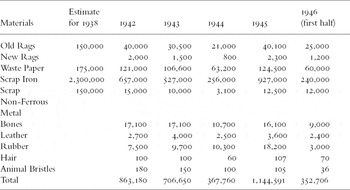
Despite the continuation of Salvage Service regulations, the report concluded that after the war, partly because of an increase in scrap dealers’ activity, France had significantly improved its export of domestic scrap, particularly in the area of scrap iron and scrap paper, producing enough salvaged material to fill, as the report triumphantly stated, ‘5,000 trains, each with 70 waggons!’Footnote 141 Statistics from a separate report detailing the amount of salvaged materials from 1942 to the first term of 1946 confirm these observations (Table 1).Footnote 142
Salvaged Materials (in tonnes) 1942 to first half of 1946

Source: ‘Matières récupérés (en tonnes) en 1942–1943–1944–1945 et 1er semestre 1946’ (n.d. but a handwritten annotation is dated 16 Aug. 1946), AN, 68AJ 479.
Nevertheless, it is not surprising that in 1947, the moment that the report was drafted, the French government decided to turn control over the waste stream directly back to the professional scrap trade. The project had failed. The desire of technocratic engineers such as René Martin or even Raoul Dautry to restructure the French salvage industry along German lines began before the war and had the opportunity to develop during the war. Yet the French pre-war vision of German efficiency confronted the reality of the inefficiencies of Nazi ideology. Nazi anti-Semitic policy hobbled the French salvage industry by eliminating Jewish expertise and by trying to shift the burden to the French consumer, a consumer who had associated the word ‘salvage’ with German peculiarity or even brutality since the late 1930s. The occupation did little to change these attitudes. If ‘nature mattered’ for the French from 1940 to 1944, ‘waste’ did not.Footnote 143 Further research might show that the wartime experience of ‘German’ salvage helped shape France's post-war ambivalence towards ecological ideas. Unlike her ‘dark green’ neighbours in central Europe and Scandinavia, France's ‘light-green society’ did not embrace household recycling of consumer goods – the kind of recycling Colonel Georges Girvès was asked to do in 1941 – until the late 1990s.Footnote 144 Indeed, it was only in 2006 that Puisserguier first instituted a household recycling programme.Footnote 145