Introduction
In intensive poultry production, the economic importance of autochthonous breeds is significantly reduced. However, those breeds are still very significant for intensive poultry production because of their gene pool, which could be used for the improvement of some traits in the selection of modern strains of poultry. They are very important for biodiversity conservation as well. The resistance to diseases of those breeds is high, as well as their adaptive and acclimatisation abilities, while their demands/requirements in terms of growing conditions and feeding are low (Jovanović et al., Reference JOVANOVIĆ, SAVIĆ and TRAILOVIĆ1997, Bogosavljević-Bošković et al., Reference BOGOSAVLJEVIĆ-BOŠKOVIĆ, MITROVIĆ, ĐOKOVIĆ, DOSKOVIĆ and ĐERMANOVIĆ2010, Reference BOGOSAVLJEVIĆ-BOŠKOVIĆ, PAVLOVSKI, PETROVIĆ, DOSKOVIĆ and RAKONJAC2011). As such, they have great potential for production of meat and eggs of specific quality, particularly in free range and organic production systems (Savić et al., Reference SAVIĆ, JOVANOVIĆ, TRALOVIĆ and VEGARA2004).
In Serbia, autochthonous poultry breeds are of national interest, as part of the strategy of preservation of total biodiversity in the Republic of Serbia and within the program of preservation of autochthonous genotypes, which is supported by the government of the Republic of Serbia in the form of substantial annual subsidies. Accordingly, the interest of breeders in the reactivation of old poultry breeds has increased for the purpose of preservation of traditional production in rural environment (Mašić et al., Reference MAŠIĆ, MARINKOVIĆ, RUSOV, Č., GANČIĆ, PAVLOVSKI, SUPIĆ, MITROVIĆ and MILOŠEVIĆ1995). Due to their ability for fast adjustment to local bio-geographic conditions, the rearing of autochthonous breeds could contribute to economic development of certain rural areas in which there are no optimal conditions for intensive poultry production (Rodić et al., Reference RODIĆ, PERIĆ, PAVLOVSKI and MILOŠEVIĆ2010).
Domestic autochthonous poultry breeds are much endangered, almost without exception. The number of birds of certain autochthonous breeds in Serbia is reduced to only several dozen of individual animals; especially the Dečan and Svrljig hens, the Jagodina and Dobrička turkeys, the Novi Pazar and Sombor geese are almost extinct (Mitrović et al., 2011). The program of poultry gene pool preservation in the Republic of Serbia has existed since 1992 (Mašić et al., Reference MAŠIĆ, MARINKOVIĆ, RUSOV, Č., GANČIĆ, PAVLOVSKI, SUPIĆ, MITROVIĆ and MILOŠEVIĆ1995), but because of the lack of financial means provided by the government, very little has been done so far. There was an attempt to proceed with a program of sustainable production, but this initiative was not realised in the expected volume, so today autochthonous breeds are reared mainly by amateur breeders within several associations for preservation and protection of small animals in Serbia.
Background of the development of autochthonous poultry breeds in the Republic of Serbia
Poultry rearing in the Republic of Serbia was at the low level of development until mid-20th century. Extensive and semi-intensive production within rural households was sufficient to meet the needs for poultry meat and eggs. The breed structure of reared poultry was based on autochthonous breeds, imported breeds and their crosses. There was only moderate selection activities focused on the improvement of poultry quality. Poultry were reared in small flocks and poultry coops of very low quality and were very poorly fed and tended. The basis for production of poultry meat and eggs were the domestic autochthonous poultry populations reared within almost every rural household. The task was to provide a sufficient number of eggs and enough poultry meat for the needs of the household itself, and only a small quantity of ‘leftovers’– surplus – were sold on the market, as reported by Brown (Reference BROWN1905), Grujić (Reference GRUJIĆ1928) and Bajkov (Reference BAJKOV1929). In light of that time, it is difficult to speak of the rearing of certain specific breeds. It was actually rearing of domestic poultry populations which were occasionally crossed with more productive breeds. Over a longer period of time, the domestic hen was crossed with the Partridge Italian hen, the New Hampshire, the Rhode Island, the Plymouth Rock, the Styria, the Transylvanian Naked Neck hen, and several new breeds of domestic hen were created. Some of them still exist today, such as the Banat Naked Neck, the Sombor Crested, the Svrljig and the Dečan hens (Bajkov, Reference BAJKOV1934; Mitrović and Đermanović, Reference MITROVIĆ and ĐERMANOVIĆ2009; Milošević and Perić, Reference MILOŠEVIĆ and PERIĆ2011).
Banat Naked Neck
The origin of this unusual type of hen has not been fully determined. There is a perception (Athes, Reference ATHES2008) that this type of hen originates from Asian game birds with certain dominant gene mutations which are passed on to progeny (Szalay, Reference SZALAY2008). In Bangladesh, there is an autochthonous population of the Naked Neck hen very similar to the Transylvanian hen in Romania, the Naked Neck from Hungary and the Banat Naked Neck from Serbia (Barua et al., Reference BARUA, HOWLIDER and YOSHIMURA1998) and on Madagascar, poultry game breeds are reared with naked necks (Russell, Reference RUSSELL2003). The Naked Neck hen was established as a breed on the territory of Transylvania (Romania). It is unknown, however, how it first arrived in Romania – probably by trade caravans (Roberts, Reference ROBERTS1997; Szalay, Reference SZALAY2008). It was presented for the first time as a breed at poultry exhibition in Vienna in 1875 (Pascal, Reference PASCAL1905). The breed was originally reared in Transylvania (Erdelj), but also throughout the Banat region as a domestic hen (Athes, Reference ATHES2008). In several European countries, the Naked Neck hen is an autochthonous hen breed (Hungary, Romania and Serbia). In Romania, it is mentioned early in the 19th century, as a plain hen with black feathers/plumage, and later, the white strain of this hen is also mentioned. The Naked Neck hen in Hungary dates back to the mid-19th century, and it was crossed with domestic hens so a few hen types of combined abilities were created (Szalay, Reference SZALAY2008; Bodzsar et al., Reference BODZSAR, EDING, REVAY, HIDAS and WEIGEND2009; Revay et al., Reference REVAY, BODZSAR, MOBEGI, HANOTTE and HIDAS2010). The Transylvanian hen was brought to Serbia in the mid-19th century to the territory of Kikinda in Banat (Vojvodina), which was reported and recorded by Grujić (Reference GRUJIĆ1928) and Bajkov (Reference BAJKOV1929); there, it was crossed with present domestic hens. Taking into consideration its resistance to diseases and good production characteristics, the breed spread quickly not only in Banat region, but also to other parts of Serbia and Bosnia.
By the beginning of the 20th century, the Banat Naked Neck hen was reared as a pure breed on several locations in Serbia, especially on the holding of the King Alexander I and Queen Maria, under the management of Lav Bajkov (Kuga, Reference KUGA2002). An elite flock of this breed was used for the improvement of domestic hen populations. Due to planned breeding over a longer period of time, the Naked Neck hen was created. In some external and production characteristics, the new breed was different from the original Transylvanian hen. It became known as a special breed of the Naked Neck hen called ‘the Banat Naked Neck’, although it was not registered as a separate breed for a long time. It was exhibited for the first time in 1957, at an exhibition organized in Zemun (Belgrade), and from that moment on it has been constantly present at all exhibitions (Kuga, Reference KUGA2010). In Serbia, it became a much appreciated hen breed, reared considerably on family farms called ‘salaš’, where it was named the ‘salaš’ hen. There were almost no farms in Vojvodina where one could not find, among other poultry, hens and roosters of this breed. Considering that Vojvodina family farms represented closed environments, there was very little or no mixing with poultry from other parts, which mainly contributed to establishment of this special hen breed.
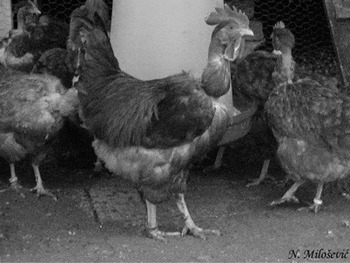
The Banat Naked Neck can easily be distinguished from other hen breeds (Figure 1). The main exterior attribute is its slightly shorter neck; the craw is always covered in plumage, and in the middle of the neck, on the front, there is a puff (a ruff or collar) of feathers, and it has a small tuft on the head (Mitrović, Reference MITROVIĆ1996; Milošević, Reference MILOŠEVIĆ2003). The head is medium size and pointy; there is some plumage at the back of the head, whereas the remaining part of the head and neck are naked. The neck is red and with no feathers down to the craw. It is medium long, muscular, slightly buckled where it connects to the head and carried upright; the skin on the neck is very thick. In regard to the general appearance, the Banat Naked Neck has a slightly smaller body frame compared to the Hungarian Naked Neck (Milošević et al., Reference MILOŠEVIĆ, PERIĆ and ŽIKIĆ2007; Kuga, Reference KUGA2010). The comb is simple, upright, and medium-sized, with four to six regular teeth. The hens also have a simple comb which is often slightly slanted to either left or right side. Their wattles, as well as earlobes are smaller compared to the Transylvanian hen, but always very prominent and red. The eyes are big and a vivid orange-red colour. The body is medium long, strong, oval, wide and muscular. The breasts are round and wide, and the back is medium long and wide, flat and carried horizontally. Its wings are strong, so this breed can fly more easily compared to the breeds of the same frame that are reared in Serbia. The tail is strong, full, wide, slightly smaller in females and in the form of semi-opened fan, while in males it is fuller and well rounded. The tail in males and females is placed at an angle of 45°. The legs are medium length, very strong with fine bones and end in four digits. The colour of shank varies, from yellow to greenish dark, with no feathers. The Banat Naked Neck exists in several colours. Its original colour is grayish, but it can often be black, white and a partridge-like colour (Supić et al., Reference SUPIĆ, MILOŠEVIĆ, KONJEVIĆ, PERIĆ, MITROVIĆ, DIMITRIJEVIĆ and SAVIĆ1997; Milošević et al., Reference MILOŠEVIĆ, PERIĆ and ŽIKIĆ2007). There are opinions that the original colour of plumage was red in roosters and partridge-like in hens (Pavlović, Reference PAVLOVIĆ1950; Kuga, Reference KUGA2008).
Banat Naked Neck flock.

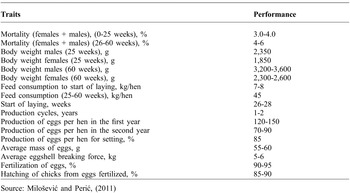
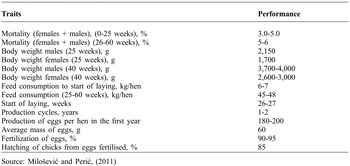
The Banat Naked Neck is very tolerant to poor rearing conditions. As a breed they are very lively, mobile and agile in searching for food and have modest nutritional requirements. In addition they are resistant to high and low air temperatures, tolerant of modest housing conditions and thrive in low-standard poultry coops with very little equipment. From Table 1 it is obvious that this is a medium maturing breed, which achieve good production results compared to other populations of autochthonous breeds in Serbia, with the exception of the Sombor Crested. Its laying ability is slightly lower in the winter time, and it starts to produce eggs in early spring. The hens have a very strong laying instinct and are committed to brooding their eggs, and they take good care of their chicks. This makes the breed very easy to rear.
Production traits of Banat Naked Neck breed.

Source: Milošević and Perić, (Reference MILOŠEVIĆ and PERIĆ2011)
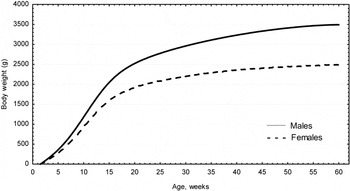
The reproductive characteristics of the breed are good. The hens start laying at the age of six to seven months, which primarily depends on the quality of nutrition in rearing. The roosters are aggressive and temperamental, with a strong instinct for mating. The quality of the eggs is very good with strong shells, which are cream in colour. The Banat Naked Neck is a breed suitable for rearing in the backyard on an unlimited area. The poultry look for their own food, and therefore they achieve excellent production results if they are additionally fed grain food (corn, wheat, barley or oats). It takes long to fatten this breed and pre-slaughter mass is reached only after three or four months of age, when the hens and roosters weigh 1.5-1.7 kg on average (Figure 2).
Body weight of Banal Naked Neck breed.

For the purpose of investigation into the fattening and slaughter characteristics of the Banat Naked Neck (NN), Pavlovski et al. (Reference PAVLOVSKI, ŠKRBIĆ, LUKIĆ, VITOROVIĆ and PETRIČEVIĆ2009) compared it with the French hybrid Farma Q (FQ). The characteristics of different varieties (white, black, gray) of the autochthonous Banat Naked Neck breed were studied in the extensive system with an unlimited free range. Fattening lasted for 98 days (Naked Neck). It was established that the average pre-slaughter body mass of chickens was 1.371 kg (FQ) and 1.295 kg (NN). The dressing percentage ‘traditionally dressed carcass’ was 79.4% (FQ) and 75.4% (NN), the dressing percentage ‘ready to cook’ 72.4% (FQ) and 68.1% (NN), and the dressing percentage ‘ready to grill’ 62.6% (FQ) and 58.7 (NN). The proportion of abdominal fat in carcasses was significantly lower in the Banat Naked Neck breed (2.00 -13.5g) compared to the hybrid Farma Q (7.0-52.0g). The carcass conformation shows slightly lower meat yield and poorer carcass appearance (Pavlovski et al., Reference PAVLOVSKI, LUKIĆ, CMILJANIĆ and ŠKRBIĆ2006). The proportion of breast meat is relatively low and the thighs and drumsticks are moderately developed but without subcutaneous fat tissue. Its muscle fibres are fine; the meat is very tender and succulent, pleasantly tasty and aromatic. The quality of meat from young fattened chickens is especially good and preferred by consumers (Pavlovski et al., Reference PAVLOVSKI, ŠKRBIĆ, LUKIĆ, VITOROVIĆ and PETRIČEVIĆ2009). The Banat Naked Neck is medium-size but has very firm bones. The breaking force for the femoral bone in males is 36.1 kg and for tibia 31.6 kg (Vitorović et al., Reference VITOROVIĆ, PAVLOVSKI, ŠKRBIĆ, LUKIĆ, PETRIČEVIĆ and ADAMOVIĆ2009).
The vulnerability of this breed in Serbia is rated medium-high risk. The Banat Naked Neck is reared mainly by enthusiasts, fans of pure breed poultry who do it as a hobby, and less because of economic benefit. It is estimated that between 5,000-6,000 hens of this breed are reared in Serbia. The protection program was initiated in 1992 (Mašić et al., Reference MAŠIĆ, MITROVIĆ and TOLIMIR1996; Mašić et al., Reference MAŠIĆ, SUPIĆ, MILOŠEVIĆ and BOGOSAVLJEVIĆ-BOŠKOVIĆ1997), but had limited success. The government still annually gives subsidies in the amount of 500 RSD (5 euro) per bird to the breeders of the Banat Naked Neck hens.
Sombor Crested
The Sombor Crested, a domestic autochthonous hen breed, was created at the beginning of the 20th century near Sombor (Vojvodina – the Republic of Serbia) on the basis of the domestic hen and the Styrian hen brought from the regions of Celje (Slovenia) and Zagorje (Croatia) (Kodinec, Reference KODINEC1947). Later, through combined crossing of the Houdan and the Sulmtaler breeds, a transitional flock was formed for creation of a heavy hen breed which produced high quality eggs (Kuga, Reference KUGA2002). The breed was created by Stevan Sel, Otto Weigand and Joseph Resch. The standard for this breed was established immediately after the end of the First World War (Petkov, Reference PETKOV2010). In the years between two wars, this breed became famous outside Vojvodina province as a productive and hardy breed of combined abilities. The complete documentation of the origin and history of this breed vanished during the Second World War and the number of birds dropped to the level of a severely endangered group. Due to the enthusiasm and persistence of Mr. Rudolf Cirkli and Mrs. Vera Petkov, the breed was preserved. It is reared again in numerous households, especially by breeders of pure breed and decorative poultry, so today it is present at many exhibitions all over Europe.
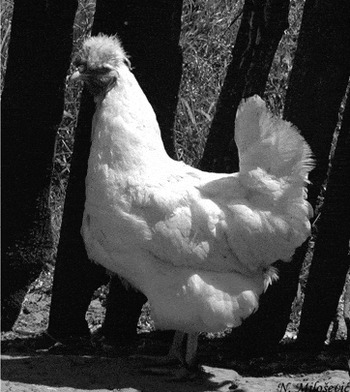
A precise representation of this breed was best done by Mrs. Vera Petkov (personal communication) herself, who completed the standard. According to the exterior appearance, the Sombor Crested is a hen with a very harmonious body shape, very lively and temperamental, and constantly looking for food (Figure 3). Its head is of medium size, and there is a well formed crest immediately behind the beak. The tuft feathers are directed vertically with a slight slope to the left or the right side (it does not cover the eyes) and to the back. In roosters, the crest plumage stands almost vertically, which is not the case with hens. Too big or too small a crest in both sexes is considered as deficiency. The beak is medium long, strong, slightly curved, and yellow-pink. The comb in this hen breed is simple with five regular bright red teeth. It is visible in the initial part, above the beak, whereas in the middle and rear part it is covered with the crest especially in hens, and it is more or less always bent to the left or to the right. The rooster crest is far bigger, the facial skin is soft and red and above the eyes there is a layer of fine, short and narrow down. The earlobes are medium long, more oval; in light strains they are vivid red, whereas in dark strains they are a red-gray colour. This breed has wattles of medium size, finely built, and the same colour as earlobes. The birds of this breed have a medium long and strong neck, slightly curved and well covered with lush feathers, especially in roosters. The body is oval with a back which is medium wide and long and is carried horizontally, with a slight droop to the rear. The breasts are slightly pronounced, deep and well developed. The wings are large and proportional to the body and firmly joined to the body. The roosters have a moderately developed tail with a few well developed sickle feathers, carried at the angle of 30-40°. The tail in hens is medium size and rather closed. The drumsticks are very well developed, not too long, but rounded and full. The legs are medium long, with thin bones, covered with yellow skin in light strains, and dark in dark strains. The legs end in four properly developed digits, and in roosters, in properly developed spurs. According to the standard, their legs must be featherless. The breed is covered in plumage that is very firm. The breed is present in several colours: white, black, blue, yellow-reddish, etc. Originally, the hens were partridge-like, and roosters predominantly red coloured.
Sombor Crested hen.

The Sombor Crested is a resilient hen with very good production performances (Table 2). In the conditions of semi-intensive rearing it starts to lay eggs in the early spring until the beginning of summer, when it starts to moult. It moults for a long period of time, but if fed properly, it will start to lay eggs again in early autumn and will continue until December. The production of eggs in good quality flocks was over 220 eggs per hen (Milošević et al., Reference MILOŠEVIĆ, PERIĆ and ŽIKIĆ2007). In regard to performances, it is similar to the Styrian and the Zagorje hens with which it was crossed from the very beginning of its origin (Lošničkar et al., 1991; Milošević et al., Reference MILOŠEVIĆ, SUPIĆ, KONJEVIĆ S., MITROVIĆ, DIMITRIJEVIĆ and SAVIĆ1997; Janječić et al., Reference JANJEČIĆ, MUŽIC and ĐIKIĆ2005).
Production traits of Sombor Crested hen breed.

Source: Milošević and Perić, (Reference MILOŠEVIĆ and PERIĆ2011)
The reproductive characteristics of this breed are moderate. For a very short period of time it lays small eggs, so most of its eggs can be used for hatching (up to 95%). The hens are very committed and persistent when sitting on eggs and take good care of their chicks. The chickens are very resilient, lively and they quickly attain feathers. In the spring they can easily be reared on free ranges. The chickens reach the pre-slaughter weight at the age of four to five months, with total feed intake of approximately 6 kg. Their meat is of excellent quality, without excess fat, very tender and succulent (Milošević et al., Reference MILOŠEVIĆ, PERIĆ and ŽIKIĆ2007; Milošević and Perić, Reference MILOŠEVIĆ and PERIĆ2011).
The Sombor Crested today is a highly endangered breed, with the total population fewer than 1,000 birds. In terms of pure bred birds, there are only a few hundred birds reared on farms in Vojvodina, and it is listed as an autochthonous breed protected by law. For this breed, the program of preservation has been made by the government in order that small breeders are stimulated through subsidies to rear this bird in pure breed (Mašić et al., Reference MAŠIĆ, MITROVIĆ and TOLIMIR1996). Consequently, a slight increase of the number of birds of this breed has been recorded in the last few years.
Conclusions
The productive performance which characterise the Banat Naked Neck and Sombor Crested breeds suggest that these are very important autochthonous hen populations, characterised by certain specific properties and geographical originality. Therefore, they need to be preserved and protected from extinction. The program of preservation of autochthonous poultry breeds in the Republic of Serbia was defined two decades ago, but so far only modest results have been achieved. It is necessary to define a long-term program so that the rearing of autochthonous breeds is not left to enthusiasts who usually do not have sufficient knowledge about poultry breeding. Only in this way the autochthonous breeds in Serbia could be protected from extinction.
Acknowledgment
The gratitude for the financial support in realization of the program of protection of these breeds goes to the Ministry of Agriculture, Trade, Forestry and Water Management of the Republic of Serbia, for showing great interest in preventing the extinction of autochthonous hen breeds. The efforts of breeders must also be recognised in the preservation of the valuable Banat Naked Neck and Sombor Crested hen breeds. Owing to their enthusiasm, they have managed to maintain a critical number of birds.
The paper is a part of the researches conducted under the project No TR-31033 financed by Ministry of Science and Education of the Republic of Serbia.