Introduction
Conduct disorders (CDs) and oppositional defiant disorders (ODDs) are leading causes of referral for youth mental health services. Whereas CD criteria are related to a consistent pattern of rule breaking and antisocial behaviour, ODD encompasses parenting and anger-related problems. After the introduction of ODD to the major classification systems, criticism has been raised regarding the distinction of ODD from normal behaviour in adolescence and from milder forms of CD. Thus, high symptom overlap has been found for both disorders (Frick et al. Reference Frick, Lahey, Loeber, Stouthamer-Loeber, Christ and Hanson1992). However, in the meantime ODD has been established as a separate disorder due to its differentiation from normal behaviour (Keenan & Wakschlag, Reference Keenan and Wakschlag2004), its persistence into adolescence (Maughan et al. Reference Maughan, Rowe, Messer, Goodman and Meltzer2004), its psychiatric co-morbidity (Simonoff et al. Reference Simonoff, Pickles, Meyer, Silberg, Maes, Loeber, Rutter, Hewitt and Eaves1997; Greene et al. Reference Greene, Biederman, Zerwas, Monuteaux, Goring and Faraone2002; Maughan et al. Reference Maughan, Rowe, Messer, Goodman and Meltzer2004) and its continuity with emotional disorders after controlling for CD (Nock et al. Reference Nock, Kazdin, Hiripi and Kessler2007). Furthermore, sex differences indicate a less consistent role of ODD in the development of CD and antisocial behaviour in girls (Rowe et al. Reference Rowe, Maughan, Pickles, Costello and Angold2002; Moffitt et al. Reference Moffitt, Arseneault, Jaffee, Kim-Cohen, Koenen, Odgers, Slutske and Viding2008). Finally, twin studies suggest a different contribution of gene and environmental factors for ODD rather than CD (Dick et al. Reference Dick, Viken, Kaprio, Pulkkinen and Rose2005; Hudziak et al. Reference Hudziak, Derks, Althoff, Copeland and Boomsma2005).
ODD is highly co-morbid with attention deficit hyperactivity disorder (ADHD; Angold et al. Reference Angold, Costello and Erkanli1999; Egger & Angold, Reference Egger and Angold2006) and several studies have pointed to ADHD as a precursor of persistent and serious CD (Loeber et al. Reference Loeber, Green, Keenan and Lahey1995; Mannuzza et al. Reference Mannuzza, Klein, Abikoff and Moulton2004). Furthermore, independently from ADHD, ODD has been found to be a significant mediator for the development of CD (Lahey et al. Reference Lahey, Loeber, Burke, Rathouz and McBurnett2002; Burke et al. Reference Burke, Loeber, Lahey and Rathouz2005; van Lier et al. Reference van Lier, van der Ende, Koot and Verhulst2007; Biederman et al. Reference Biederman, Petty, Dolan, Hughes, Mick, Monuteaux and Faraone2008 b) and is, therefore, presumed to have a pivotal role in the development of later serious antisocial behaviour. An early and reliable identification of ODD in ADHD referred youth may contribute a significant improvement for the assessment of subtypes and courses of antisocial behaviour (Moffitt, Reference Moffitt1993; Moffitt et al. Reference Moffitt, Arseneault, Jaffee, Kim-Cohen, Koenen, Odgers, Slutske and Viding2008).
Parent and teacher rating scales have been found to be useful and reliable instruments for assessing behavioural problems in children and adolescents. The Conners' Parent Rating Scale (CPRS; Conners et al. Reference Conners, Sitarenios, Parker and Epstein1998) and the Strength and Difficulties Questionnaire (SDQ; Goodman, Reference Goodman1997, Reference Goodman2001) are two of the most common rating scales and have been translated into diverse languages. Both of these instruments also include specific scales to screen for ODD (Conners, Reference Conners1997; Goodman et al. Reference Goodman, Ford, Simmons, Gatward and Meltzer2000 b; Goodman, Reference Goodman2001). The CPRS and related versions have been used in previous studies as screening instruments for various mental disorders and as outcome parameters in treatment studies dealing with externalizing behaviour problems, including ADHD (for an overview, see Gianarris et al. Reference Gianarris, Golden and Greene2001). So far, the CPRS revised oppositional scale (CPRS-R OPP) has not yet been tested in terms of its predictive validity for ODD (Collett et al. Reference Collett, Ohan and Myers2003).
In comparison with the Conners' Parent Rating Scale revised (CPRS-R), the SDQ is of more recent origin and is a shorter instrument for screening the most important mental disorders in childhood and adolescence. The SDQ addresses five narrowband syndromes: emotional symptoms; conduct problems; hyperactivity; peer problems; prosocial behaviour. A computer algorithm has been developed for the prediction of oppositional-conduct, hyperactive-inattention, anxious-depressed or any psychiatric disorder. The predictions from the algorithm of the multi-informant SDQ have been found to correlate with clinical diagnoses of CD/ODD in referred subjects from Europe, Bangladesh and Australia (Goodman et al. Reference Goodman, Renfrew and Mullick2000 c; Mathai et al. Reference Mathai, Anderson and Bourne2004). High sensitivity in the detection of clinical CD/ODD has been established (86–93%), whereas specificity was only modest, indicating that the SDQ was over-including subjects in these samples. On the other hand, in a community sample, a smaller number of subjects (68.2%) with Internet interview-based diagnosis of CD/ODD (Development and Well-Being Assessment; Goodman et al. Reference Goodman, Ford, Richards, Gatward and Meltzer2000 a) were rated as having a probable diagnosis of CD/ODD based on the SDQ (Goodman et al. Reference Goodman, Ford, Simmons, Gatward and Meltzer2000 b). Due to the high rate of false positives, the SDQ seems to be more suitable for screening rather than for confirmation of diagnoses in community samples.
A recent study based on the International Multicentre ADHD Genetics (IMAGE) sample has analysed CPRS-R and the parent version of the SDQ (PSDQ) in the identification of conduct problems (Christiansen et al. Reference Christiansen, Chen, Oades, Asherson, Taylor, Lasky-Su, Zhou, Banaschewski, Buschgens, Franke, Gabriels, Manor, Marco, Muller, Mulligan, Psychogiou, Rommelse, Uebel, Buitelaar, Ebstein, Eisenberg, Gill, Miranda, Mulas, Roeyers, Rothenberger, Sergeant, Sonuga-Barke, Steinhausen, Thompson and Faraone2008). This study found that the CPRS-R OPP and the PSDQ conduct problem scales (PSDQ CP) yielded the best discrimination of pure ADHD, ODD and CD. However, the prediction of ODD as a separate disorder apart from CD has not yet been analysed in this study. Therefore, the present study is a first step aimed at the assessment of the diagnostic accuracy of the CPRS-R and the PSDQ in the prediction of ODD in an ADHD-referred sample. These analyses will include the establishment of cut-off scores. The performance of these instruments in clinical practice is important given the high prevalence rates of ADHD and its co-occurrence with ODD in mental health services. Sound assessments of ODD will contribute favourably to clinical decision making.
Reflecting the heterogeneous nature of ODD (Lahey et al. Reference Lahey, Waldman and McBurnett1999; Burke et al. Reference Burke, Loeber, Lahey and Rathouz2005), Stringaris & Goodman (Reference Stringaris and Goodman2009 b) defined three a priori dimensions of oppositionality, which were labelled ODD-irritable, ODD-headstrong and ODD-hurtful based on the DSM-IV criteria for ODD. The authors found different associations with other disorders in a large community sample of youth aged 5–16 years using parent and teacher information from a structured Internet-based diagnostic interview (Development and Well-Being Assessment; Goodman et al. Reference Goodman, Ford, Richards, Gatward and Meltzer2000 a). The ODD-irritable dimension was related to emotional disorders, whereas the ODD-headstrong dimension was related to ADHD and all three dimensions were related to CD. In a 3-year follow-up study, the longitudinal prediction of these ODD dimensions was tested after controlling for initial psychopathology in a community sample (Stringaris & Goodman, Reference Stringaris and Goodman2009 a). ODD-irritable was found to be a predictor of generalized anxiety disorders and mood disorders, whereas ODD-headstrong was the sole predictor of ADHD. Not as expected, among all three dimensions, only the headstrong dimension was found to be associated with the outcome of CD. However, the hurtful dimension was predicting aggressive CD symptoms. In conclusion, these findings suggest that ODD is a complex problem that may require differential clinical interventions according to the predominant dimension.
Based on these findings, the second aim of the present study was to test the predictive power of the CPRS-R and the SDQ for the irritable, headstrong and hurtful dimensions of ODD. The performance of the instruments in these domains may be clinically important in children and adolescents with ADHD, independently from the presence of ODD. It has been shown that irritability is associated with early age of onset and persistence of major depression (Fava et al. Reference Fava, Hwang, Rush, Sampson, Walters and Kessler2009) and that irritability in combination with hyperarousal is a core symptom of paediatric bipolar disorders and severe mood dysregulation (SMD; Brotman et al. Reference Brotman, Schmajuk, Rich, Dickstein, Guyer, Costello, Egger, Angold, Pine and Leibenluft2006). Particularly in children and adolescents with ADHD, who often show an impaired affect regulation (Braaten & Rosen, Reference Braaten and Rosen2000), the assessment of irritability dimension may be of clinical importance for the prevention of future affective and stress-related disorders (Stringaris & Goodman, Reference Stringaris and Goodman2009 a). Furthermore, an early and reliable assessment of the hurtful dimension may be helpful for the identification of callous unemotional features in subjects with early onset and chronic persistent antisocial behaviour (Moffitt, Reference Moffitt1990, Reference Moffitt1993). Finally, the assessment of the headstrong dimension may be important for the evaluation of parent counselling needs, because these items predominantly refer to parenting problems.
Prior to testing the predictability of the ODD dimensions, the substructure of ODD was analysed in the present sample with children and adolescents referred for ADHD by confirmatory factor analysis. In contrast to the procedure used in the study by Stringaris & Goodman (Reference Stringaris and Goodman2009 a, Reference Stringaris and Goodmanb), the item ‘often deliberately annoys people’ was assigned to the ODD-hurtful dimension because, in a previous study, this item was most strongly correlated with spiteful behaviour (Speltz et al. Reference Speltz, McClellan, DeKlyen and Jones1999). Thus, there is some face validity that this item belongs to the hurtful rather than the headstrong dimension. In a final step of the analyses, the accuracy of the CPRS-R and the PSDQ in addressing these separate dimensions was tested both in subjects with and without ODD.
Method
Participants
The IMAGE study comprises 3229 offspring from 1187 fathers and 1341 mothers. Probands participating in the present study were European Caucasians aged 5–17 years who had been recruited in 12 child and adolescent psychiatry clinics representing eight countries: Belgium; Germany; Switzerland; Holland; Republic of Ireland; Israel; Spain; UK. Entry criteria for probands were a clinical diagnosis of ADHD based on DSM-IV criteria and access to one or both biological parents and one or more full siblings for DNA collection and clinical assessment. Exclusion criteria applying to both probands and siblings included autism, epilepsy, IQ<70, brain disorders and any genetic or medical disorder associated with externalizing behaviours that might mimic ADHD.
The original sample of 1401 probands has been restricted to 1225 subjects with ADHD combined type. Furthermore 91 (7%) were excluded due to missing information on DSM-IV ODD criteria and another 31 (3%) subjects due to more than 10% missing items in the CPRS-R or the PSDQ. Thus, the final sample consisted of 1093 probands with a mean age of 10.8 (s.d.=2.8) years. A total of 956 subjects were male (87.5%) and 726 (66.4%) subjects from the present sample fulfilled DSM-IV criteria of ODD based on the Parental Account of Childhood Symptoms (PACS) interview (see below).
Measures
Diagnoses of ADHD and co-morbid disorders were based on a standardized, semi-structured interview with the parents (PACS; Taylor et al. Reference Taylor, Schachar, Thorley and Wieselberg1986; Chen & Taylor, Reference Chen, Taylor and Oades2006). The PACS was developed for assessing ADHD and the most common child psychiatric disorder according to DSM-IV with good inter-rater reliability, predictive and discriminant validity and has been used in a number of epidemiological, genetic and interventional studies (Taylor et al. Reference Taylor, Sandberg, Thorley and Giles1991; Leung et al. Reference Leung, Luk, Ho, Taylor, Mak and Bacon-Shone1996; Chen & Taylor, Reference Chen, Taylor and Oades2006). The diagnoses of ADHD, ODD and CD were based on an algorithm that is appropriate for symptom count, age, time interval and impairment according to DSM-IV criteria. The diagnosis of ODD was considered irrespective of the presence of CD. The interview was administered by skilled interviewers after advanced training. Translation and back translation procedures were used for validation of the non-English versions of the PACS.
The long form of the CPRS-R, consisting of 80 items, was used in the present study. The CPRS-R is a reliable, accurate and relatively brief measure of parental perceptions of children's disruptive behaviour. Adequate psychometric properties have been confirmed (Conners, Reference Conners1997; Conners et al. Reference Conners, Sitarenios, Parker and Epstein1998). The seven syndrome scales (cognitive problems, oppositional, hyperactivity-impulsivity, anxious-shy, perfectionism, social problems and psychosomatics), the ADHD index and the two subscales of the Conners Global Index (CGI; restless-impulsive, emotional lability) were included in the present study.
The SDQ is a brief behavioural screening questionnaire valid for 4- to 16-year-olds. There are versions for adolescents (starting from 11 years onwards), parents and teachers. The SDQ consists of five syndrome scales (emotional symptoms, conduct problems, hyperactivity, peer problems and prosocial behaviour) and can be obtained free via the Internet (http://www.sdqinfo.com). Adequate psychometric properties of the scales have been documented (Goodman, Reference Goodman1997, Reference Goodman2001).
Analytic procedure
To study the diagnostic accuracy in the prediction of ODD, receiver-operating characteristic (ROC) analyses were performed separately for each CPRS-R syndrome scale including the two CGI subscales and the ADHD index scale. Furthermore, the PSDQ scales were included in the ROC analyses. To compare different scales within the same sample, a critical z ratio was calculated using a formula correcting for the non-independence of the scales (Hanley & McNeil, Reference Hanley and McNeil1983). Finally, the optimal cut-off score for the best scales was established: Efficiency (EFF) was calculated by the sum of true positives and true negatives. In order to correct EFF for independence of the base rate (P) in the sample and to take into account the rate of a positive test result (Q), a quality index of efficiency was calculated using the following formula (Kraemer, Reference Kraemer1992):

In addition, the proposed computer algorithm for the identification of possible and probable CD/ODD cases was compared with the results based on the cut-off score analyses.
Before testing the predictability of the three ODD dimensions, their validity was analysed by the use of confirmatory factor analysis including all symptoms accounting for ODD in the PACS. Each symptom was rated as present or absent according to the corresponding PACS algorithm. Due to the dichotomous nature of the items, weighted least square confirmatory factor analysis (CFA) of the tetrachoric correlation matrix of the DSM-IV criteria was used to test the three-factor model and a conventional one-factor model of ODD (Brown, Reference Brown2006). Three different recommended goodness of fit indicators (GFIs; Hair et al. Reference Hair, Black, Babin, Anderson and Tatham2006) have been assessed using amos 16 software (SPSS Inc., USA), i.e. the root mean square residual (RMR) as indicator of the unexplained co-variances of the model, the root mean square error of approximation (RMSEA), which includes a parsimony correction and the comparative fit index (CFI) for evaluating the hypothesized model compared with a null model. Acceptance of any model was based on the following cut-offs: RMR<0.05, RMSEA<0.08 and CFI>0.95 (Hu & Bentler, Reference Hu and Bentler1999; Marsh et al. Reference Marsh, Kit-Tai and Zhonglin2004). χ2 difference for nested models was used when comparing the three-factor model with the DSM-IV related one-factor model of ODD.
Subsequently, backward linear regression analyses were performed separately for the CPRS-R (with and without inclusion of the index scales) and the PSDQ in order to predict the ODD-irritable, ODD-headstrong and ODD-hurtful dimensions in the entire ADHD sample.
Results
An overview of the means and standard deviations of the CPRS-R scores and the PSDQ scores is available on request to the corresponding author. Internal consistency as measured by Cronbach's α was 0.88 for the CPRS-R oppositional scale and 0.66 for the PSDQ CP. The scores of the two scales were strongly correlated (r=0.67, p<0.001).
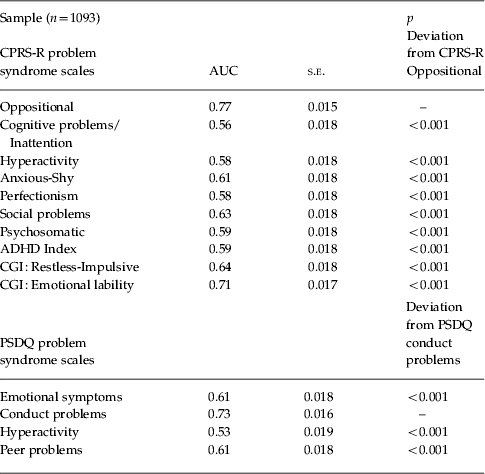
Table 1 shows the results of the ROC analyses for all CPRS-R syndrome scales and the PSDQ scales for predicting ODD. The CPRS-R oppositional scale showed the best prediction [area under curve (AUC)=0.77] compared with all remaining CPRS-R scales. The PSDQ CP showed the best prediction (AUC=0.73) in contrast to the remaining SDQ problem scales. The CPRS-R oppositional scale was superior when compared with the SDQ CP scale (z=2.248, p=0.014). There were no gender differences in the prediction of ODD by the CPRS-R OPP (boys AUC=0.76; girls AUC=0.79; z=−0.63, p=0.263) and for the PSDQ CP (boys AUC=0.73; girls AUC=0.75; z=−0.34, p=0.367).
Receiver-operating characteristic analysis findings with AUC of the CPRS-R and the PSDQ problem syndrome scales

AUC, Area under the curve; CPRS-R, Conners' Parent Rating Scale revised; PSDQ, parent version of the Strength and Difficulties Questionnaire; ADHD, attention deficit hyperactivity disorder; CGI, Conners Global Index; S.E., standard error.
All scales showed significant deviance of AUC from random prediction (AUC=0.5) except the PSDQ hyperactivity scale (p=0.07).
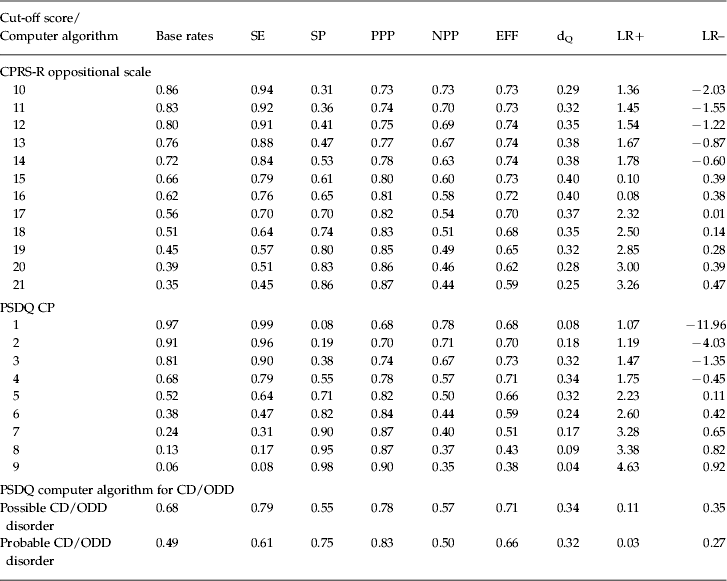
The results of the cut-off analyses are shown in Table 2. For the CPRS-R OPP, a cut-off score of 15–16 was established based on the quality index of efficiency (dQ=0.40). In total, 73% of the subjects were classified correctly by this score. Sensitivity, specificity and positive and negative predictive power ranged between 0.58 and 0.80. For the PSDQ CP, the optimal cut-off score was 5 (dQ=0.34). The corresponding sensitivity and specificity scores were in a similar range between 0.55 and 0.79. In addition, the point-biserial correlation coefficients were 0.44 (p<0.001) between ODD and CPRS-R OPP and 0.38 (p<0.001) between ODD and the PSDQ CP.
Cut-off score analyses of the CPRS-R oppositional scale and the parent version of the PSDQ CP by a dQ

CPRS-R, Conners' Parent Rating Scale revised; PSDQ CP, parent version of the Strength and Difficulties Questionnaire conduct problem scales; dQ, quality efficiency indicator; SP, specificity; SE, sensitivity; PPP, positive predictive power; NPP, negative predictive power; EFF, efficiency; LR+, likelihood ratio of a positive test; LR−, likelihood ratio of a negative test; CD, conduct disorder; ODD, oppositional defiant disorder.
As can be seen from Table 2, the proposed computer algorithm for the SDQ in predicting possible CD/ODD resulted in equivalent results as those observed for the quality index efficiency score of 0.40 (sensitivity=0.73, specificity=0.55). Finally, the corresponding computer algorithm for probable CD/ODD, which considers the social impact of the symptoms, showed quite comparable efficiency with a reduced sensitivity score (0.61) when compared with the specificity score (0.75).
In the second part of the analyses, the three-factor structure of the ODD was tested in the entire ADHD sample by confirmatory factor analysis with weighted least square statistics for the parameter estimation. The factor structure and parameter estimates are shown in Fig. 1. Whereas the comparative fit indicator value was close to an acceptable level (CFI=0.947), the other two GFIs suggested that the model had an excellent fit to the data (RMR=0.006 and RMSEA=0.041). The three dimensions as latent factors were correlated moderately to strongly. In particular, the irritable and the headstrong dimension showed a strong correlation of 0.89. However, compared with the three-factor solution, a single factor model of ODD showed a decreased fit (χ2 difference for nested models=60.24, degrees of freedom=3, p<0.001) and according to the CFI an unacceptable fit to the present data (RMR=0.010, RMSEA=0.064 and CFI=0.852).
Confirmatory factor analysis of the eight DSM-IV oppositional defiant disorder (ODD) criteria. Standardized regression weights and correlations between the three ODD factors: ODD-irritable; ODD-headstrong; ODD-hurtful.

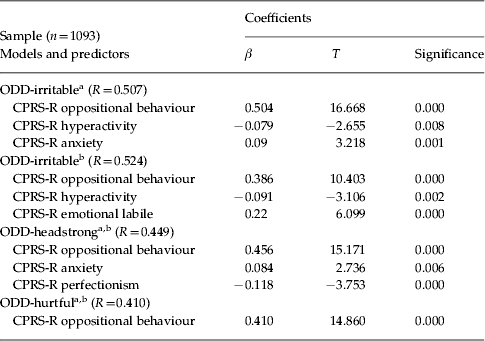
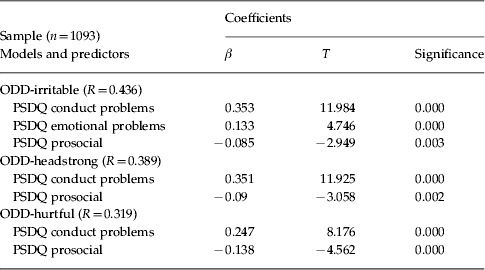
Finally, backward linear regression analyses (probability level of F for entry=0.001 and for removal=0.01) were performed including the entire ADHD sample: first, for the CPRS-R problem scales; second, for all the CPRS problem and index scales; third, for the PSDQ. The results for the prediction of ODD-irritable, ODD-headstrong and ODD-hurtful are shown in Table 3 for the CPRS-R and in Table 4 for the PSDQ. All tested regression models were highly significant. The ODD-irritable dimension was predicted most successfully by the CPRS-R (R=0.507 only for problem scales; R=0.524 for all scales) and the PSDQ (R=0.436) compared with the prediction of the ODD-headstrong (CPRS-R R=0.449, PSDQ R=0.389) and ODD-hurtful dimensions (CPRS-R R=0.410, PSDQ R=0.319).
Prediction of ODD dimensions by the CPRS-R problem and index scales based on backward linear regression analyses

ODD, Oppositional defiant disorder, CPRS-R, Conners' Parent Rating Scale revised; β=standardized regression coefficent.
a Including CPRS-R problem scales only.
b Including CPRS-R problem and index scales.
Prediction of ODD dimensions by the PSDQ scales based on backward linear regression analyses

ODD, Oppositional defiant disorder; PSDQ, parent version of the Strength and Difficulties Questionnaire; β=standardized regression coefficent.
ODD-irritable was positively and most strongly predicted by the CRPS-R OPP, positively by the CPRS-R anxiety scale (CPRS-R ANX) and negatively by the CPRS-R hyperactivity scale (CPRS-R HYP). However, when all CPRS problem and index scales were included in the analyses, the anxiety scale was replaced by the CPRS-R emotional-lability index (CPRS-R EL), whereas the CPRS-R OPP and CPRS-R HYP remained as significant predictors of the irritable dimension. In fact, the latter model led to a slightly increased predictive power compared with the first model (R=0.524 v. R=0.507), whereas the CPRS-R EL had stronger impact in the regression model than the CPRS-R ANX (β=0.22 v. 0.09). Furthermore, similar results were found for the PSDQ when an emotional problem scale was included. However, next to the PSDQ CP and PSDQ EP, the PSDQ prosocial scale was also identified as a significant negative predictor of the ODD-irritable dimension. Compared with the CPRS-R, the predictive power by the PSDQ model was reduced (R=0.436).
The ODD-headstrong dimension was strongly predicted by the CPRS-R OPP and less strongly by the CPRS-R ANX and by the CPRS-R perfectionism scale, whereas the ODD-hurtful dimension was only predicted by the CPRS-R OPP. These results were stable and independent of inclusion of the additional CPRS-R index scales. Both, the ODD-headstrong and ODD-hurtful dimensions were predicted by the PSDQ CP and PSDQ prosocial scale.
Discussion
The first part of the present study dealt with testing the diagnostic accuracy of two common parent rating scales for predicting ODD in a sample of ADHD referred youth. Second, after confirming the three-dimensional ODD structure in the present sample, the diagnostic accuracy of the CPRS-R and PSDQ in the prediction of these three dimensions of ODD was examined.
Diagnostic accuracy was tested by ROC, leading to the calculation of the AUC. This measure of excellence in the prediction of diagnoses should be interpreted as follows: poor (50–0.70); moderate to fair (0.70–0.80); good (0.80–0.90); excellent (0.90–1.00). Accordingly, the AUC for CPRS-R OPP (0.77) and PSDQ CP (0.73) indicate an acceptable convergence of these scales with the diagnosis of ODD. These results are quite comparable with the diagnostic accuracy of the Child Behaviour Checklist aggressive behaviour scale in a pure ADHD sample (Biederman et al. Reference Biederman, Ball, Monuteaux, Kaiser and Faraone2008 a) and in a mixed ADHD sample with unreferred controls (Hudziak et al. Reference Hudziak, Copeland, Stanger and Wadsworth2004).
In comparison with the present findings, higher AUC based on parental ratings have been reported in the prediction of various psychiatric disorders other than ODD, e.g. for obsessive compulsive disorders (Hudziak et al. Reference Hudziak, Althoff, Stanger, van Beijsterveldt, Nelson, Hanna, Boomsma and Todd2006) and for ADHD (Chen et al. Reference Chen, Faraone, Biederman and Tsuang1994). Furthermore, a better diagnostic accuracy has also been found in the study by Christiansen et al. (Reference Christiansen, Chen, Oades, Asherson, Taylor, Lasky-Su, Zhou, Banaschewski, Buschgens, Franke, Gabriels, Manor, Marco, Muller, Mulligan, Psychogiou, Rommelse, Uebel, Buitelaar, Ebstein, Eisenberg, Gill, Miranda, Mulas, Roeyers, Rothenberger, Sergeant, Sonuga-Barke, Steinhausen, Thompson and Faraone2008) in the prediction of CD in ADHD subjects by the PSDQ CP and the CPRS-R OPP in a smaller subsample of the IMAGE study. The differences in diagnostic accuracy may be partly due to sample and rater effects. The assessment of CD may be superior because CD symptoms differentiate more strongly than ODD symptoms from normal behaviour.
In the present study, a cut-off score of 15/16 on the CPRS-R oppositional problem scale and a cut-off score of 4 on the PSDQ CP in the detection of ODD were found by quality efficiency statistics. For the CPRS-R, raw scores of 15/16 correspond to T scores of 66–73 in boys and to 70–75 in girls. On the other hand a cut-off score of T=65 has been recommended for screening for ODD (Conners, Reference Conners1997). Whereas this lower cut-off score may be accurate in clinical settings, the same score will be over-inclusive in an ADHD sample and in particular for girls. However, the PSDQ computer algorithm for possible ODD/CD seems to work well in subjects with or without co-morbid ADHD.
Before addressing the prediction of the ODD dimensions, the three-factor structure of ODD was tested by using CFA. In contrast with previous studies, a slightly different item composition was used by attaching one item to the hurtful rather than the headstrong dimension. The GFI results of the CFA convincingly show that a three-factor structure of ODD is more appropriate than a single general factor of ODD. However, the latent factor structure was highly correlated (Fig. 1). (Spearman correlations: irritable – headstrong r=0.450; irritable – hurtful r=0.410; headstrong – hurtful r=0.346). Nevertheless, the present results show that ODD is a heterogeneous construct including three related but distinct dimensions. This finding may have nosological implications for the upcoming DSM-V criteria. Furthermore, the strong correlation of ODD-irritable and ODD-headstrong may have its origins in the present ADHD sample. Thus, emotional self-regulation deficits (Barkley, Reference Barkley1997) and delay aversion in ADHD (Castellanos et al. Reference Castellanos, Sonuga-Barke, Milham and Tannock2006; Sonuga-Barke et al. Reference Sonuga-Barke, Sergeant, Nigg and Willcutt2008) may strongly affect both ODD-irritable and ODD-headstrong.
Based on these analyses, potential predictors of these three dimensions were analysed. Overall, the prediction models based on the CPRS-R were slightly better than those based on the PSDQ but both instruments were adequate in the prediction of the ODD dimensions. However, approximately 75–80% of the variance remained unexplained in all prediction models. An improved diagnostic assessment of ODD dimensions seems feasible. All ODD dimensions were significantly predicted by the CPRS-R OPP and the PSDQ CP. Thus, both scales are non-specific for the assessment of ODD dimensions. In addition, the PSDQ prosocial scale was inversely correlated with oppositionality. Again, the PSDQ prosocial scale predicted all three dimensions and did not show a distinct profile for the three ODD dimensions. As expected, the PSDQ emotional problem scale was a significant predictor of ODD-irritable. In contrast with previous studies (Stringaris & Goodman, Reference Stringaris and Goodman2009 a, Reference Stringaris and Goodmanb) the CPRS-R ANX significantly predicted ODD-headstrong. However, this was not true for the CPRS-R EL, which obviously is more specific in the prediction of ODD-irritability.
Both, the CPRS-R and the PSDQ are suitable screening instruments for ODD-irritability. The present results suggest consideration of both the CPRS-R OPP and the CPRS-R EL scales for the assessment of ODD-irritability. However, the CPRS-EL consists of three items only and the item ‘temper outbursts’ is also part of the CPRS-R OPP. Diagnostic accuracy of the CPRS-R EL may be improved by considering additional items reflecting DSM-IV ODD-irritable criteria. However, there is sufficient evidence that emotional problem scales need to cover stress-related and emotional symptoms of ODD when evaluating ODD-irritability. As a consequence, more adequate ODD-irritable assessment may help to administer appropriate prevention programmes for stress-related disorders.
Recently, the role of irritability in ADHD with co-morbid ODD has been addressed in the context of SMD (Brotman et al. Reference Brotman, Schmajuk, Rich, Dickstein, Guyer, Costello, Egger, Angold, Pine and Leibenluft2006). Next to abnormal mood, the diagnostic criteria of SMD include symptoms that are similar to ADHD (e.g. distractibility, pressured speech) and a markedly increased reactivity to negative emotional stimuli (similar to ODD-irritable). Furthermore, Waschbusch et al. (Reference Waschbusch, Pelham, Jennings, Greiner, Tarter and Moss2002) found increased anger expression and increased heart rate after mild provocation in a sample that was co-morbid for ADHD/ODD but not in ADHD or ODD-only subjects. Thus, the present results indicate that the construct of SMD is related to the ODD-irritable dimension in ADHD subjects.
A previous study has found support for two separate but correlated constructs of ODD against adults and ODD against peers (Taylor et al. Reference Taylor, Burns, Rusby and Foster2006). Further studies may test ODD dimensions in combination with the target of oppositional behaviour. It may be assumed that the headstrong dimension is associated with coercive parent–child interactions (Granic & Patterson, Reference Granic and Patterson2006) and may, therefore, be restricted predominantly to adults, whereas irritable and hurtful behaviours are more strongly associated with temperamental factors and may be independent of the provoking person.
Some limitations of the present findings should be mentioned. First, the present results were based on a referred ADHD sample and may not generalize to other community and clinical samples with different base rates and characteristics of ODD. Second, the subjects were recruited from several mental health clinics and the sample may be biased by a referral bias. Third, the results were based on Caucasian subjects only and can hardly be generalized to females because the sample consisted mostly of male subjects. Finally, the present findings are based on parental ratings of ODD only. Multi-informant diagnostic criteria might shed further light on the prediction of these ODD dimensions.
However, the use of an ADHD-referred sample does not necessarily restrict conclusions dealing with ODD assessment. Due to the definition of ADHD as a precondition for inclusion into the present study, the validity of the CPRS-R and the PSDQ was confirmed in a sample at risk for serious antisocial behaviour (Loeber et al. Reference Loeber, Green, Keenan and Lahey1995; Mannuzza et al. Reference Mannuzza, Klein, Abikoff and Moulton2004; Moffitt et al. Reference Moffitt, Arseneault, Jaffee, Kim-Cohen, Koenen, Odgers, Slutske and Viding2008). Both the frequent co-morbidity of these two disorders and the increased risk for later CD and antisocial personality disorder development require a more specific treatment programme as compared with subjects referred for pure ADHD (Biederman et al. Reference Biederman, Petty, Dolan, Hughes, Mick, Monuteaux and Faraone2008 b).
In summary, both the PSDQ, including the recommended computer algorithm, and the CPRS-R with the suggested cut-off scores can be recommended for clinical assessment of ODD. In clinical practice, lower cut-off scores may be chosen to increase sensitivity and by taking into account the higher costs for missing true cases. However, additional assessments may be necessary regarding onset, duration and impact of the symptoms to improve diagnostic efficiency. For clinicians, the three dimensions of ODD can be helpful for a better understanding of the disorder. Accordingly, the CPRS-R EL scale may help to detect irritability symptoms in ADHD subjects. These procedures may be important for treatment planning because next to ADHD therapy additional training of emotional skills or stress prevention is useful. However, the diagnostic assessment of ODD dimensions with the present rating scales is still limited and further studies involving other diagnostic instruments are warranted.
Declaration of Interest
Tobias Banaschewski, Jan Buitelaar, Joseph Seargent, Edmund Sonuga-Barke, Aribert Rothenberger, Margaret Thompson and Hans-Christoph Steinhausen have been consultants, speakers or members of advisory boards of various companies including Bioproject, Bristol–Myers Squibb, Eli Lilly, Flynn Pharma, Janssen-Cilag, Medice, Novartis, Organon, Pfizer, Servier, Shire and/or UCB. Robert D. Oades, Herbert Roeyers, Joseph Seargent, Edmund Sonuga-Barke, Aribert Rothenberger, Hans-Christoph Steinhausen and Margaret Thompson have received research grants from Eli Lilly, Janssen-Cilag, National Institute for Mental Health (USA), and/or UCB.